

DashClicks Blog
The industry's top experts offer their best advice, research, how-tos, and insights—all in the name of helping you level-up your business and online marketing skills.
Join Us!
.svg)
.svg)
.svg)
.svg)
.svg)

How Agencies Can Deliver Conversion-Focused SEO Without Hiring
Organic search drives approximately 53% of all trackable website traffic, according to the BrightEdge Channel Share Report. That scale creates a significant opportunity for agencies. But the conversation around SEO performance has shifted. Clients no longer measure success by rankings or traffic reports alone. They want to see leads, booked appointments, sales, and revenue growth directly tied to the SEO work their agencies deliver.
According to the Conductor State of SEO Report, companies with mature SEO strategies generate stronger returns from organic channels. That finding reflects a broader expectation: SEO should function as a business growth driver, not simply a visibility tool.
For agencies, meeting these expectations is challenging. Delivering conversion-focused SEO often requires expertise in CRO, UX, content strategy, and analytics, making it expensive to build and manage large in-house teams.
Instead of focusing solely on rankings, conversion-focused SEO maximizes the value of existing organic traffic by turning visitors into customers. White label SEO services for agencies make this approach scalable, giving agencies access to specialist expertise without expanding internal resources.
This article explores why rankings alone are no longer enough, how conversion-focused SEO drives better business outcomes, and how a partner can help agencies deliver results at scale.
Why Rankings Alone No Longer Define SEO Success?
For years, rankings were the primary way agencies measured SEO success. Higher positions in search results typically led to more clicks, making rank tracking a reliable indicator of performance.
That relationship has changed.

Image Source: Semrush
1. Search Results Have Become More Competitive
Modern search results are no longer limited to the traditional list of blue links. AI Overviews, featured snippets, knowledge panels, local packs, and People Also Ask sections now occupy significant space on the results page.
These features often answer users' questions directly, reducing the need to click through to a website.
2. High Rankings No Longer Guarantee Traffic
The data reflects this shift.
According to a 2024 SparkToro and Datos study, approximately 58.5% of Google searches in the United States end without a click. Even a number-one ranking for a high-volume keyword may generate fewer visits than it once did.
As a result, rankings and impressions alone have become incomplete measures of SEO performance.
3. Traffic Without Conversions Has Limited Value
Even when rankings generate traffic, the next question matters more:
Are those visitors taking meaningful action?
A campaign that attracts fewer but highly qualified visitors often delivers better business results than one that drives large volumes of informational traffic with little buying intent.
4. SEO Success Is About Business Outcomes
Effective SEO follows a complete performance journey:
Rankings → Traffic → Qualified Leads → Revenue
Rankings remain important, but they are only the starting point. Agencies that measure success across this entire journey provide clients with reporting that connects SEO efforts to tangible business growth.
If rankings are no longer the finish line, agencies need a more conversion-focused approach to defining and measuring SEO success.
What Is Conversion-Focused SEO?
Conversion-focused SEO combines traditional search optimization with strategies that encourage qualified visitors to complete meaningful business actions. Those actions vary by client: a lead form submission, a phone call, a booked consultation, a product purchase, or a visit to a physical location.
This approach does not replace SEO. It strengthens SEO by connecting visibility with client business goals. Search intent becomes a central consideration at every stage, from keyword selection through to landing page design and call-to-action placement.
The components that distinguish conversion-focused SEO include:
- Targeting commercial and transactional keywords based on purchase readiness.
- Aligning landing page content with the specific intent behind each query.
- Structuring content to guide visitors toward a clear next step.
- Strengthening internal linking to move visitors between informational and conversion-oriented pages.
- Optimizing technical performance, including page speed and mobile usability.
- Building CTAs that match where the visitor is in the buying process.
- Designing logical conversion paths rather than isolated landing pages.
The contrast with traditional SEO is straightforward:
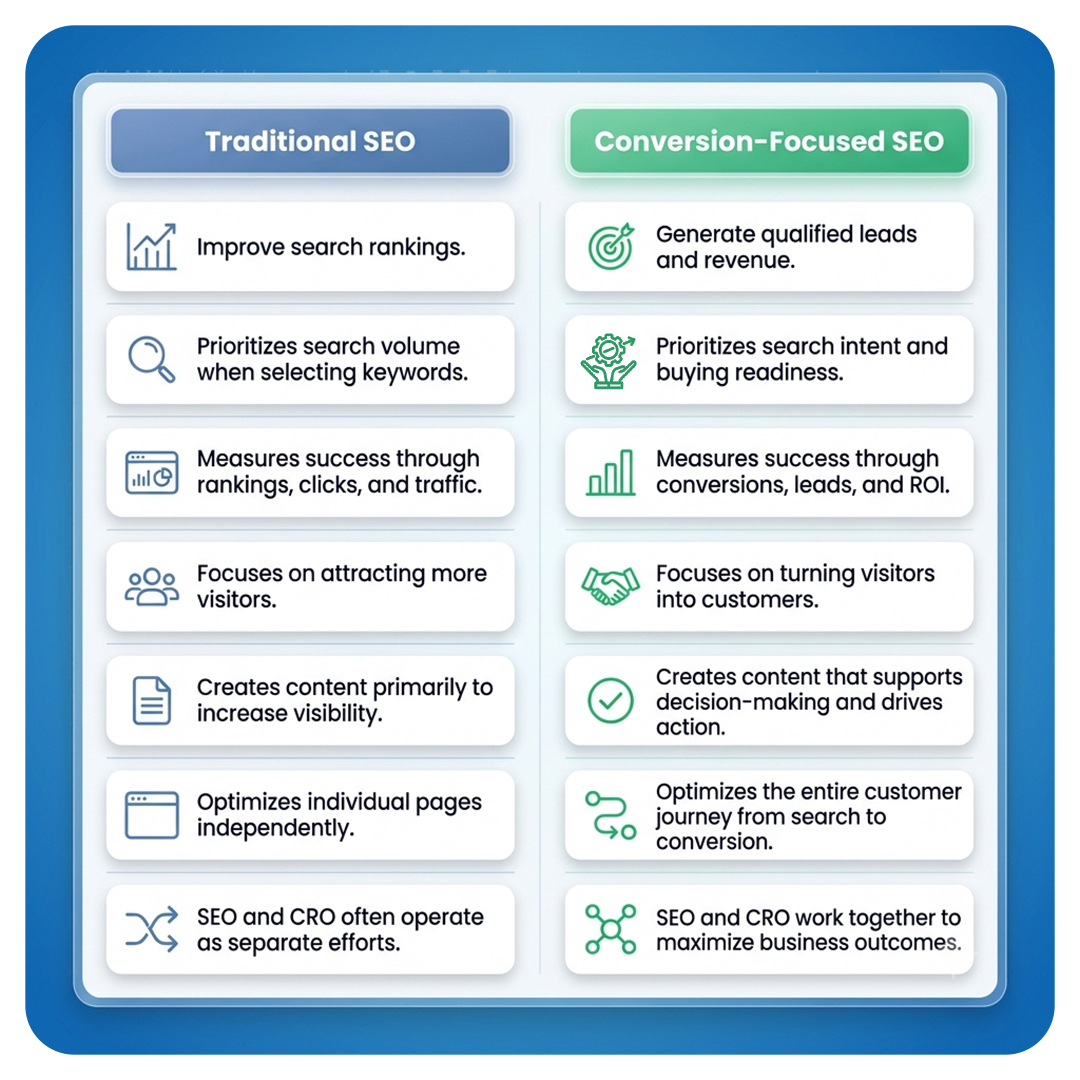
Both approaches still value rankings and traffic. The difference is that conversion-focused SEO evaluates whether those metrics contribute to meaningful outcomes. A page that ranks well and generates sessions but produces no leads is underperforming, even if the ranking report looks strong.
Consider a practical example. A service page may rank for a high-volume keyword and attract thousands of visitors. However, a lower-volume page targeting a highly specific service query may generate far more calls or consultation requests because it aligns precisely with what a buyer is actively looking for.
Understanding conversion-focused SEO is only part of the equation. Agencies must also deliver these improvements consistently across every client account.
Why Growing Agencies Struggle to Deliver Conversion-Focused SEO In-House?
Delivering conversion-focused SEO is operationally demanding. The overlap between SEO, content strategy, UX, analytics, technical execution, and conversion optimization means that no single generalist can cover every area at depth.
1. Limited Specialist Resources
Modern SEO campaigns touch multiple disciplines simultaneously, including:
- Content strategy and production
- User experience and page design
- Analytics configuration and interpretation
- Technical SEO auditing and implementation
- Local SEO and location-based targeting
- Conversion path development
- Landing page strategy and optimization
- Reporting and performance analysis
A single SEO professional working across a portfolio of clients cannot maintain specialist-level depth in every one of these areas.
2. Hiring Challenges
Building an internal team capable of delivering across all these functions is expensive and time-consuming. Agencies face recruiting costs for experienced specialists, extended training periods, ongoing payroll commitments, tool and software expenses, and management overhead. Even when the right people are hired, coordinating a multidisciplinary team takes significant leadership capacity.
3. Scaling Problems
As client volume grows, agencies often see quality and consistency decline. Common symptoms include:
- Inconsistent deliverable quality between accounts
- Delayed campaign milestones
- Overworked team members
- Slower iteration and testing cycles
- Reduced strategic depth on individual accounts
4. Context Switching
Agency teams regularly move between SEO audits, content briefs, technical fixes, client reporting, performance reviews, and client communication within a single workday. Frequent context switching makes focused, systematic conversion optimization difficult to sustain.
HubSpot's State of Marketing report consistently identifies generating traffic and leads as a top priority for marketing organizations. That finding underlines the pressure agencies face. Clients are not just looking for organic visibility. They expect SEO campaigns to contribute to lead generation and business growth, which raises the stakes for every account.
Rather than expanding internal departments every time client expectations increase, many agencies are redesigning how they deliver SEO.
The Five Strategic Shifts That Make SEO More Conversion-Focused
Conversion-focused SEO requires a change in how agencies prioritize opportunities, structure content, and evaluate performance.

Image Source: Objects
These five shifts form the practical foundation of that change.
1. Prioritize Buying Intent Over Search Volume
Keyword strategy should reflect where a prospect sits in the buying process, not just how many people search a given term. Agencies should evaluate keywords based on:
- Commercial relevance to the client's services or products
- Purchase readiness signals in the search query
- Alignment with specific service or product offerings
- Revenue potential relative to the cost of ranking
- Position in the sales funnel
Lower-volume keywords with strong buying intent often produce better business outcomes than broad, high-volume queries that attract general interest rather than commercial readiness.
2. Build Conversion Paths Instead of Publishing More Content
Every page on a client's site should have a logical next step. Publishing more content without connecting it to a conversion path can increase traffic without improving results. Agencies should evaluate whether each page includes:
- Internal links directing visitors to relevant service pages
- Consultation, booking, or contact CTAs
- Product or service comparisons that support purchase decisions
- Lead magnets where appropriate
- Contact forms positioned at natural decision points
- Location pages for service-area businesses
3. Optimize Customer Journeys, Not Individual Pages
The full journey matters, not just the landing page:
Search Query → Content Page → Service Page → Conversion
Message consistency across that journey is critical. A visitor who lands on an informational blog post and then navigates to a service page should find continuity in tone, relevance, and intent. Page experience, mobile usability, and clarity about the next step all influence whether that journey ends in a conversion.
4. Treat SEO as Continuous Optimization, Not Monthly Tasks
Agencies that treat SEO as a fixed monthly deliverable rather than an ongoing optimization cycle leave performance gains unrealized. Consistent improvement requires regularly:
- Refreshing content to reflect current search intent
- Reviewing conversion data to identify underperforming pages
- Improving internal linking as new pages are published
- Testing and refining calls to action
- Updating landing pages based on performance trends
- Monitoring technical health for issues that affect usability
5. Measure Business Impact Instead of Vanity Metrics
Reporting should center on metrics that reflect client business goals:
- Qualified leads generated through organic search
- Organic conversion rate
- Form submissions and phone calls
- Booked appointments and consultation requests
- Assisted conversions across the buyer journey
- Revenue contribution from organic traffic
These shifts deliver the strongest value when they are applied consistently rather than treated as isolated projects.
These initiatives produce the strongest results when they are executed consistently rather than as isolated improvements.
How White Label SEO Services Help Agencies Scale Conversion-Focused SEO?
Applying these five shifts across a growing client portfolio requires execution capacity, specialist expertise, and standardized processes. A reliable white label SEO partner provides all three behind the agency's brand, enabling consistent delivery without requiring agencies to scale internal headcount in proportion with client growth.
1. Strategic Keyword Research Built Around Business Goals
Keyword research through a white label partner focuses on commercial relevance, not just search volume. That includes:
- Commercial and transactional keyword identification
- Intent analysis to distinguish informational from buying-stage queries
- Competitor gap research to surface overlooked opportunities
- Service-focused targeting aligned with client offerings
- Local buying-intent terms for location-based businesses
- Prioritization based on business value rather than volume alone
Keyword strategy built around business goals gives clients a stronger foundation for attracting visitors who are ready to act.
2. Content Production That Supports Conversions
Content production through a structured white label model is mapped to the buyer journey rather than designed to increase page count. That means:
- Content aligned with specific stages of the purchase decision
- Clear calls to action built into each piece
- Internal linking that directs readers toward relevant service pages
- Decision-stage and comparison content that supports commercial intent
- Content briefs structured around intent rather than keyword density
Content should guide visitors toward action. A white label partner with defined content processes helps agencies deliver that consistently.
3. Technical SEO That Prioritizes Business Impact
Technical improvements affect both search visibility and user experience. A white label SEO partner handles the technical layer across all client accounts, covering:
- Page speed optimization
- Mobile usability
- Crawlability and indexation
- Broken link identification and resolution
- Site architecture improvements
- Conversion tracking configuration support
4. Consistent Monthly Optimization
Conversion-focused SEO requires ongoing attention, not just initial setup. Monthly optimization through a white label partner includes content updates, technical monitoring, on-page improvements, internal linking reviews, performance analysis, and opportunity identification. That consistency is difficult for agencies to sustain internally across a large client portfolio.
5. Scalable SEO Fulfillment Without Hiring
White label SEO packages give agencies the flexibility to match fulfillment levels to different client needs and budgets without adding permanent headcount. Benefits include:
- Predictable, standardized workflows across accounts
- Consistent quality regardless of client volume
- Faster execution due to established processes
- Greater capacity to onboard new clients
- Reduced hiring and training pressure
According to PMI's Pulse of the Profession, organizations with standardized processes are significantly more likely to achieve consistent project outcomes. Applied to SEO fulfillment, that principle means repeatable delivery models produce better results than ad hoc execution, particularly as agencies scale.
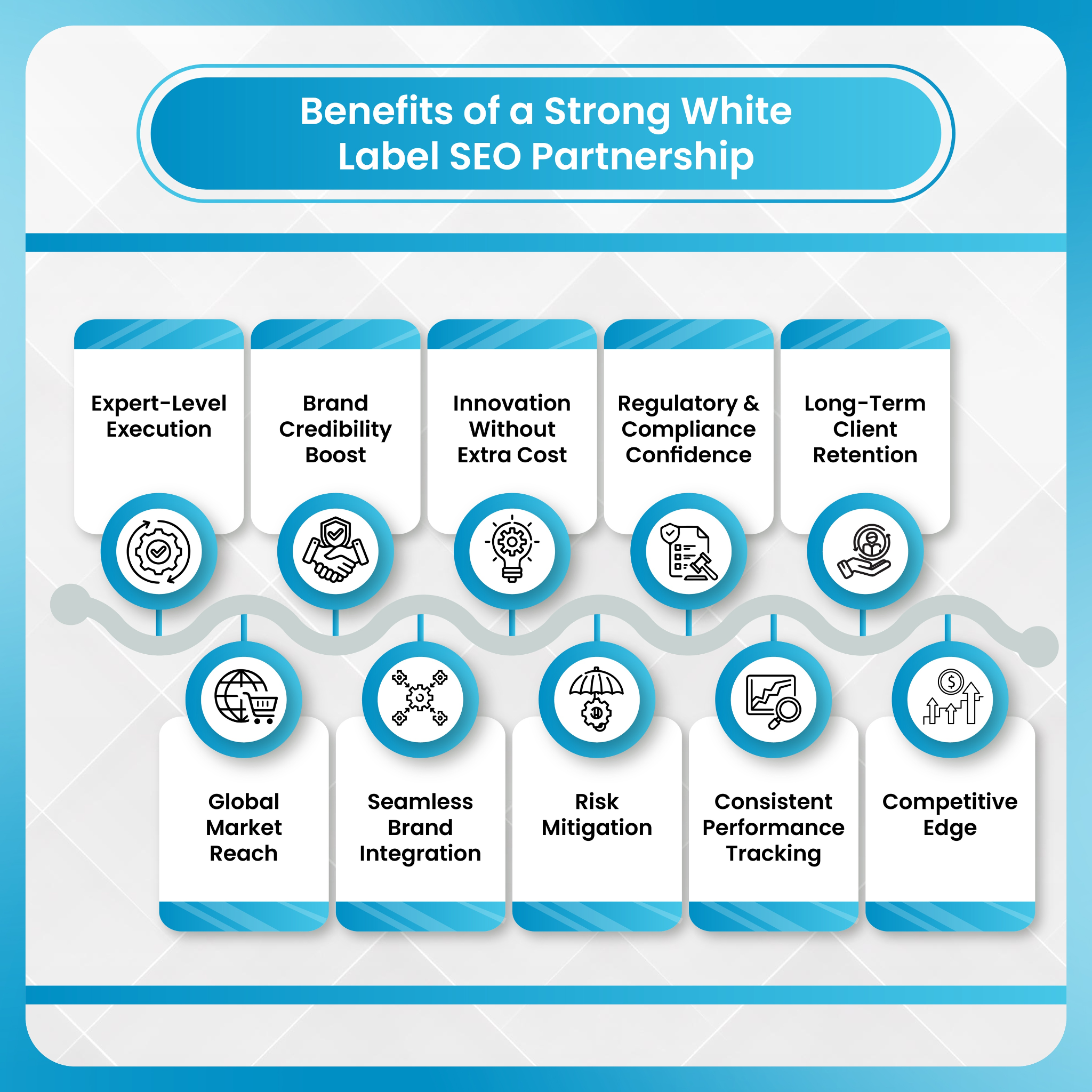
Consistent execution creates stronger campaigns, but agencies also need a way to demonstrate that value clearly to clients.
Measuring the Success of Conversion-Focused SEO
Clients care most about whether SEO supports measurable growth. That means reporting frameworks need to evolve beyond rankings and traffic.
Traditional SEO reports often focus on:
- Keyword rankings
- Impressions
- Total traffic
- Indexed pages
- Keyword count growth
Those metrics have value, but they do not tell the full story. Conversion-focused reporting also tracks:
- Qualified organic leads
- Organic conversion rate
- Form submissions and phone calls
- Booked appointments
- Revenue attribution from organic traffic
- Assisted conversions
- Cost per organic lead
- Conversion path performance
Rankings and traffic should still appear in reports. They provide important context about visibility and trend direction. But they need to be connected to business outcomes to communicate genuine campaign value.
Better reporting helps agencies explain the impact of their work, strengthen client confidence, support retention, identify conversion bottlenecks, and recommend strategic improvements that align SEO with broader marketing goals.
Consider this example: traffic may remain flat while conversion rate improves, because the agency has attracted more commercially aligned visitors and improved conversion paths. A ranking-only report would miss that progress entirely, leaving the client unable to see the real value being generated.
When agencies consistently improve and communicate these metrics, client relationships naturally become stronger.
How DashClicks Helps Agencies Deliver Conversion-Focused SEO at Scale?
DashClicks functions as an operational partner that helps agencies combine strategic SEO delivery with scalable fulfillment. The model is built to support agencies that want to deliver conversion-focused outcomes without building large internal teams.
- Strategic SEO Planning: Structured planning helps agencies align SEO priorities with client business goals from the start. Support includes keyword strategy development, campaign planning, opportunity identification, and the creation of business-focused roadmaps that connect SEO activity to client outcomes.
- High-Intent Keyword Research: Targeting commercial and transactional searches helps agencies attract visitors who are closer to making a decision. Keyword research focuses on buying intent and service alignment, giving agencies a stronger foundation for campaigns that produce leads rather than just traffic.
- Content and On-Page Optimization: Content optimization is built around search intent, internal linking, service page support, and conversion-oriented recommendations. The goal is to guide visitors toward action rather than simply increasing content volume.
- Technical SEO Fulfillment: Technical improvements support both search visibility and the user experience that influences conversion behavior. Technical SEO fulfillment across client accounts helps agencies deliver the foundation that stronger conversion paths require.
- Transparent Reporting: Clear white label reporting helps agencies communicate completed work, performance trends, identified opportunities, recommended next steps, and measurable business impact. Transparent reporting strengthens client relationships and supports long-term retention.
- Scalable Monthly Execution: DashClicks helps agencies serve more clients while maintaining consistent quality, reducing internal workload, and avoiding the pressure of immediate hiring. The result is better client outcomes, improved retention, and more time for agency leadership to focus on strategy and relationship management.
Ultimately, combining SEO and CRO successfully requires more than isolated tactics. It requires a repeatable delivery model that connects visibility with measurable business growth.
Agencies That Connect SEO to Revenue Are Built to Last
Modern SEO success is defined by whether organic visibility translates into qualified leads, conversions, and revenue. Agencies that connect these outcomes create more defensible client relationships and stronger long-term retention.
Conversion-focused SEO draws on search intent, content strategy, technical performance, user experience, and clear conversion paths working together. No single tactic produces that outcome. It comes from a coordinated, consistent approach applied across every client account.
Delivering that internally becomes progressively harder as client portfolios grow. Recruiting specialists, managing multidisciplinary teams, and maintaining consistent quality across accounts requires resources that most agencies cannot sustain indefinitely. White label SEO services for agencies solve that problem by providing execution capacity, standardized processes, and specialist expertise under the agency's brand.
A reliable partner allows agencies to maintain the quality of strategic thinking and client relationships in-house, while trusting an experienced fulfillment team to execute campaigns that connect visibility to measurable outcomes.
Agencies that build this model are better positioned to strengthen client retention, protect margins, and grow sustainably, without adding internal complexity every time client expectations rise.


Why Operational Consistency Leads to Better PPC Results
Many agencies believe better PPC results come from smarter bidding, stronger creatives, or larger budgets. These elements matter, but they are only part of the picture. Campaign tactics determine what you do. Operational execution determines whether those tactics are applied correctly, every time.
As agencies grow, inconsistent processes begin affecting campaign quality, reporting accuracy, response times, and client satisfaction. A well-structured bid strategy means little if it is implemented differently across accounts. A strong creative has limited impact if tracking is misconfigured and conversion data cannot be trusted.
High-performing agencies understand this. They treat PPC as an operational discipline, not just a marketing function. According to the Project Management Institute's Pulse of the Profession report, organizations with standardized project management practices complete more projects successfully and waste significantly less investment due to poor performance. The same principle applies to PPC management at scale.
This article covers why operational consistency directly impacts PPC performance, which operational areas matter most, common breakdowns agencies experience while scaling, how standardized workflows improve client outcomes, and how white label PPC supports consistent execution.
Before discussing consistency, it is important to understand why PPC performance often becomes less predictable as agencies grow.
Why PPC Performance Becomes Inconsistent as Agencies Scale?
Growing agencies frequently experience performance inconsistencies that are difficult to trace back to a single cause. The problem is rarely a flawed strategy. More often, it is the result of operational gaps that develop as workloads increase and team structures evolve.
Common inconsistencies include:
- Campaign launches completed without standardized checklists
- Optimization reviews delayed or skipped during busy periods
- Negative keywords list left unupdated across accounts
- Reporting formatted differently depending on the account manager
- Communication gaps between team members managing the same account
- QA steps missed under time pressure
- Different account managers following entirely different internal processes
Operational complexity grows alongside client volume. One PPC manager may optimize accounts daily, while another reviews accounts weekly. Neither approach is automatically wrong, but inconsistency creates uneven client results, making it difficult to identify whether performance differences are caused by strategy or execution.
Poor performance is not always caused by poor strategy. It is often caused by inconsistent execution.
These inconsistencies usually appear in several operational areas long before they become visible in campaign performance.
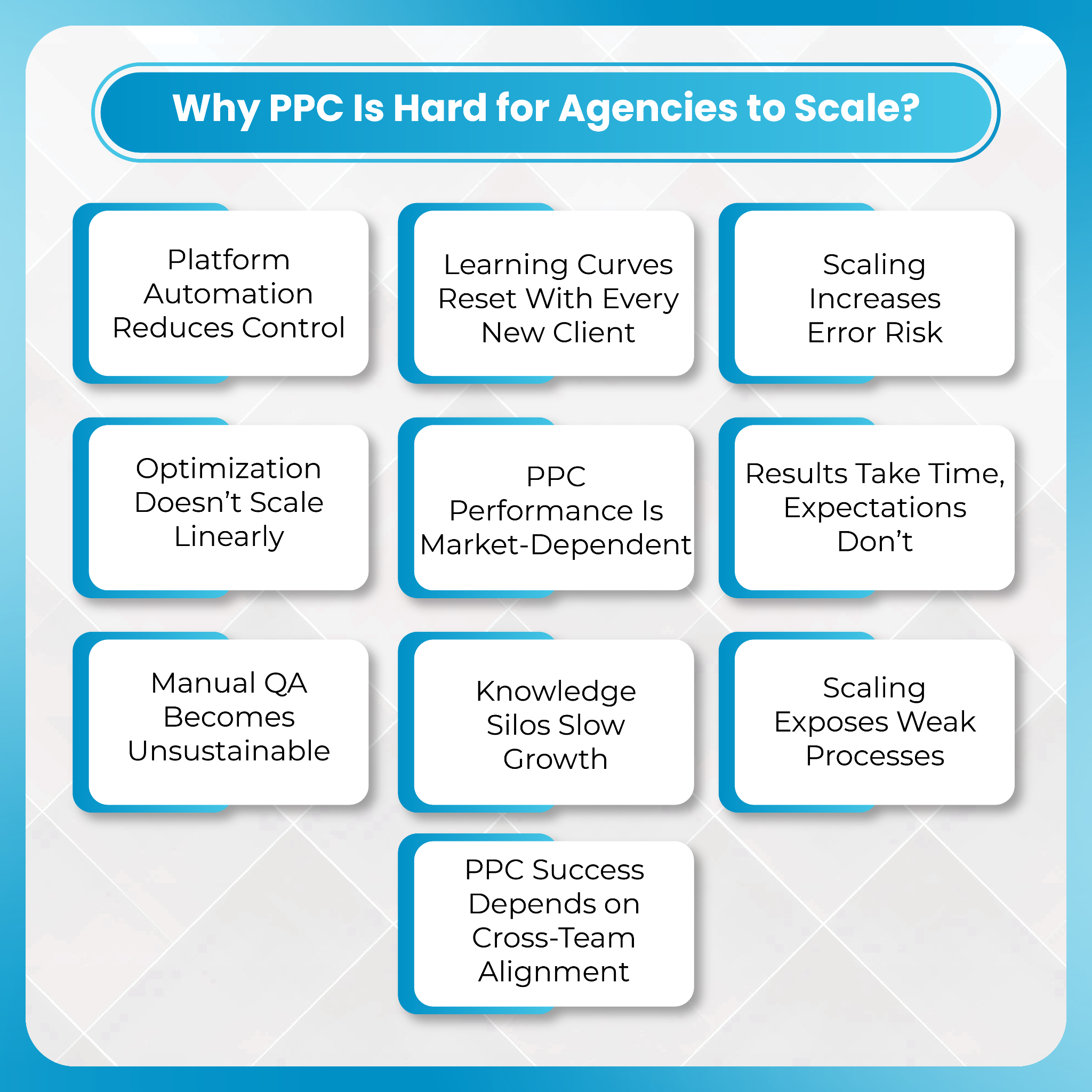
The Operational Areas That Have the Greatest Impact on PPC Results
PPC consistency depends on several agency operations layers working together. When even one layer breaks down, the effects ripple across campaign quality, data reliability, and client confidence.
1. Campaign Build Consistency
How a campaign is built determines how efficiently it can be managed over time. Standardized builds reduce future errors and make ongoing optimization significantly easier. Key elements include:
- Naming conventions applied consistently across all accounts
- Account structure organized to align with client goals and reporting needs
- Audience organization documented and replicated across similar campaigns
- Conversion tracking verified before campaigns go live
- Asset management maintained so creative is organized and accessible
When these elements are handled the same way every time, account managers spend less time deciphering past decisions and more time improving performance.
2. Optimization Cadence
Optimization should be process-driven, not reactive. Reactive optimization means accounts only receive attention when something goes wrong. Process-driven optimization means every account is reviewed on a defined schedule, regardless of how busy the team is.
A consistent optimization cadence includes:
- Routine bid adjustments based on performance data
- Regular search term reviews to capture new negatives and identify intent shifts
- Budget allocation reviewed against pacing and performance targets
- Negative keyword lists updated on a fixed schedule
- Audience refinement based on observed conversion patterns
Structured optimization schedules reduce the risk of missed opportunities that quietly erode campaign performance over time.
3. Quality Assurance
QA prevents avoidable mistakes before they affect performance or create client-facing problems. A repeatable QA process should cover:
- Launch checklists completed for every new campaign
- Tracking verification confirmed before and after campaign activation
- Landing page functionality tested across devices
- Policy compliance reviewed to reduce disapproval risk
- Budget validation checked against signed agreements
Without QA checkpoints, errors that could be caught in minutes end up costing hours of troubleshooting and potentially weeks of compromised data.
4. Reporting Processes
Clients value consistency. Receiving a different report format each month, with different metrics highlighted and different levels of explanation, creates uncertainty and erodes confidence. Monthly reports should:
- Explain what changed and why
- Highlight meaningful insights rather than just raw numbers
- Define specific next actions the team will take
- Connect campaign metrics directly to the client's business goals
Consistent reporting transforms data into a communication tool, helping clients understand the value of what is being delivered.
5. Internal Communication
When account knowledge lives only in someone's memory, it disappears the moment that person is unavailable. Structured internal communication protects continuity and reduces knowledge gaps. This includes:
- Standard operating procedures documented and accessible to the full team
- Campaign notes maintained within account management tools
- Shared workflows that keep multiple team members aligned on account status
- Documentation updated whenever strategy or structure changes
Strong internal communication ensures that any team member can step into an account and understand its history without starting from scratch.
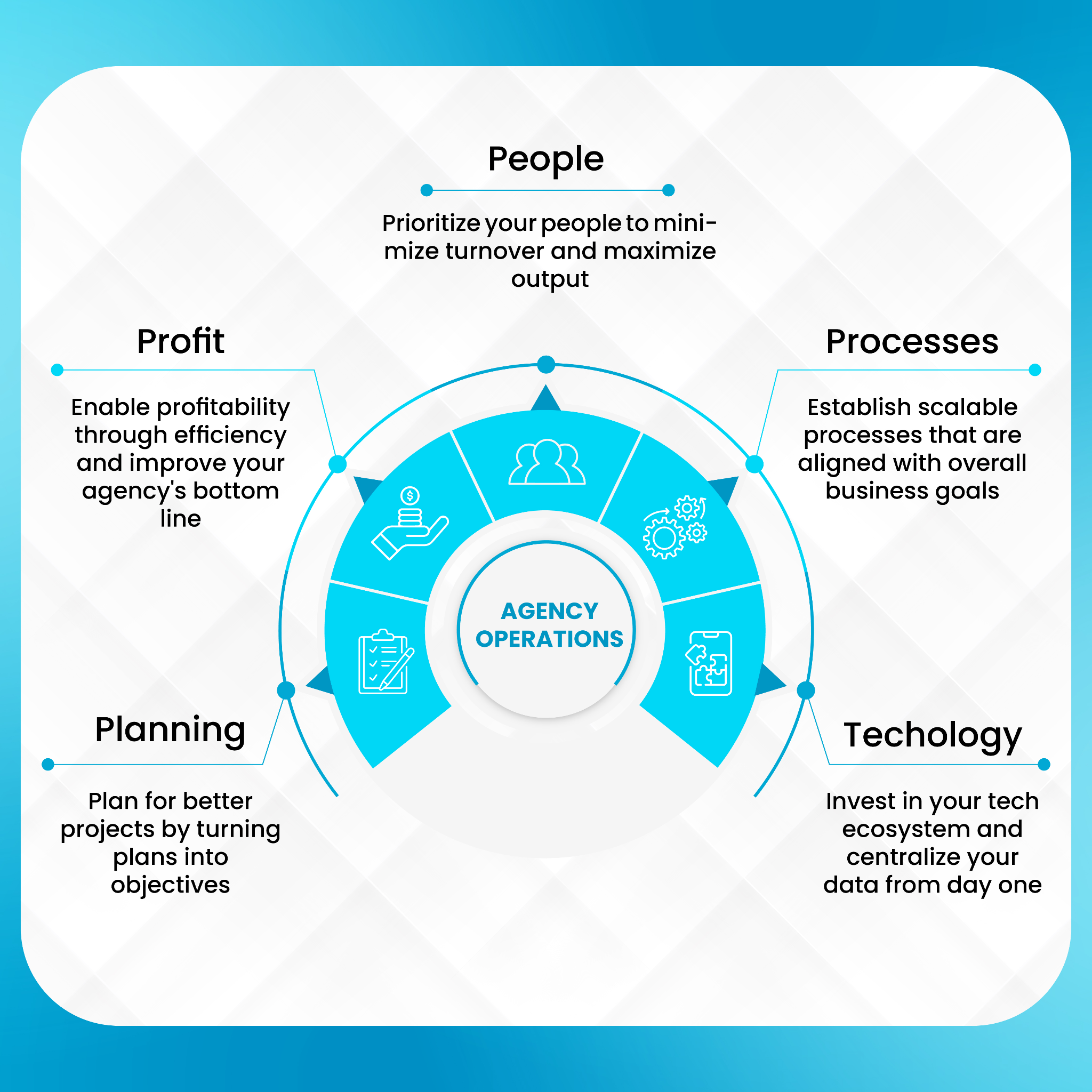
When these operational elements become standardized, the benefits extend well beyond smoother internal workflows.
How Operational Consistency Improves PPC Performance?
Standardized execution does not just make agencies easier to manage internally. It creates measurably better campaign outcomes for clients.
1. Better Optimization Decisions
Routine reviews prevent missed opportunities and reduce guesswork. When optimization follows a defined schedule, account managers can identify patterns, act on emerging trends, and make adjustments based on data rather than urgency. Reactive management leads to optimization decisions made under pressure, which are more likely to be inconsistent or incomplete.
2. Faster Problem Detection
Consistent monitoring helps identify issues before clients notice them. Problems that go undetected for days or weeks can significantly distort performance data and damage client trust. Regular account reviews make it easier to catch:
- CPA spikes that signal audience fatigue or competitive shifts
- Conversion tracking failures that corrupt reporting data
- Budget exhaustion happening earlier than expected
- Disapproved ads reducing impression share without triggering alerts
3. More Reliable Performance Data
Data quality depends directly on execution consistency. The relationship works in sequence:
- Consistent tracking
- Better reporting
- Better optimization
- Better decisions
Inconsistent tracking produces unreliable data. Unreliable data leads to poor optimization decisions. Poor optimization decisions produce weaker results. Fixing data quality at the source creates a compounding improvement across every downstream process.
4. Easier Testing
Structured testing frameworks improve the reliability of ad copy experiments, landing page tests, and audience experiments. When account structures and naming conventions are standardized, test results are easier to interpret and apply across multiple accounts. Unstructured testing often produces findings that cannot be replicated or scaled.
5. Higher Client Confidence
Clients notice operational consistency even when they cannot name it. Predictable reporting, proactive communication, and fewer surprises build the kind of trust that leads to longer client relationships and referrals. According to HubSpot's State of Marketing Report, marketers consistently rank data-driven decision-making and performance measurement among the most important factors for marketing success. Clients expect their agencies to meet that standard.
Despite understanding these benefits, many agencies struggle to maintain operational consistency as client demand increases.
Common Operational Challenges Growing Agencies Face
Operational strain usually grows quietly as more clients are added. Each new account adds a small amount of pressure, and the cumulative effect often goes unnoticed until performance starts to slip.
1. Increasing Client Volume
Adding clients without adding structure creates a predictable outcome:
- More accounts
- Less attention per account
- Higher risk of inconsistent execution
Volume growth without process investment is one of the most common causes of declining service quality at scaling agencies.
2. Team Expansion
Bringing on new specialists solves a capacity problem but can introduce a consistency problem. Different team members arrive with different workflows, different standards, and different interpretations of best practices. Without documented processes, each person manages accounts according to their own approach.
3. Manual Processes
Agencies that rely on manual methods for reporting, QA, and optimization tracking face increasing inefficiency as volume grows. Manual processes are slower, more error-prone, and difficult to audit when problems arise.
4. Staff Turnover
When employees leave, account knowledge often leaves with them. If processes are not documented, the next person to manage that account starts with incomplete context, increasing the risk of errors and inconsistent execution during the transition.
5. Limited Bandwidth
As agencies scale, strategic work gets replaced by operational tasks:
- Pulling and formatting reports
- Troubleshooting tracking issues
- Managing client emails
- Coordinating internally across accounts
According to Asana's Anatomy of Work Index, knowledge workers spend a substantial portion of their time on work, including coordination, status updates, and searching for information. This significantly reduces the time available for the strategic work that actually drives campaign performance.
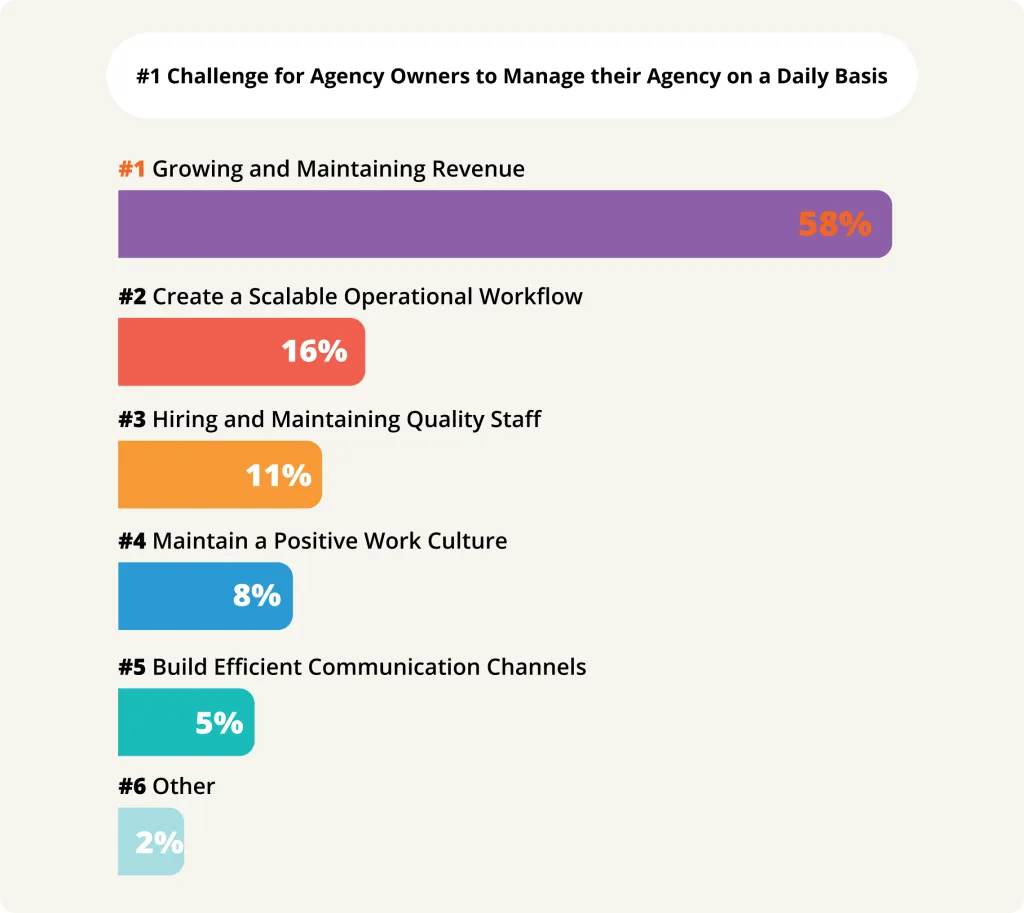
Image Source: Function Point
The solution is not simply hiring more people. It is creating systems that maintain consistency regardless of team size.
How White Label PPC Services Improve Operational Consistency?
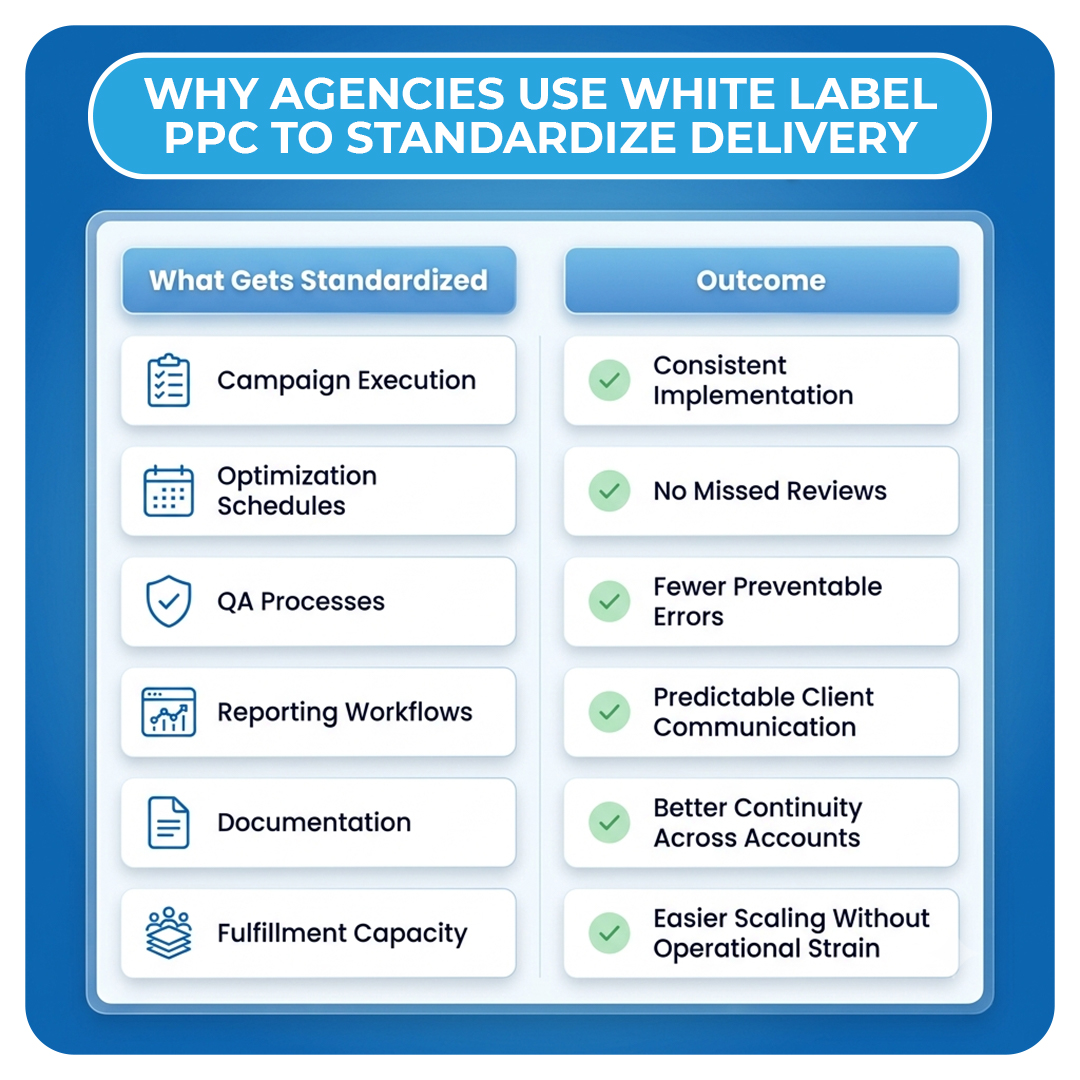
Building standardized PPC processes internally is possible, but maintaining them becomes harder as agencies scale. White label PPC services help agencies maintain consistent execution, improve efficiency, and support growth without expanding internal teams.
1. Standardized Campaign Management
White label PPC providers follow established workflows across every account they manage. This covers:
- Campaign setup completed according to documented standards
- Account structure organized consistently across client accounts
- Audience targeting applied based on campaign objectives
- Budget allocation aligned with client goals and performance data
- Ongoing campaign management handled through structured processes
Standardized execution reduces the inconsistencies that emerge when internal teams manage accounts differently.
2. Consistent Optimization Processes
A white label PPC agency operates on defined optimization schedules rather than reactive workflows. Routine processes include:
- Regular bid adjustments based on performance signals
- Search query reviews conducted on a fixed cadence
- Negative keyword management maintained across accounts
- Budget pacing monitored against targets
- Performance monitoring completed as part of an established routine
Consistency in optimization helps prevent the missed opportunities that silently reduce campaign performance over time.
3. Quality Assurance at Every Stage
Repeatable QA processes are one of the clearest advantages of working with a structured white label PPC provider. Documented checkpoints help agencies avoid:
- Tracking errors that distort reporting data
- Incorrect campaign settings that limit performance
- Budget allocation mistakes that waste client spend
- Ad policy issues that result in disapprovals
- Landing page mismatches that reduce conversion rates
4. Reliable Reporting and Client Communication
White label PPC support allows agencies to deliver reports on a consistent schedule, present performance data clearly, explain campaign changes in client-friendly language, and recommend next steps with confidence. Operational consistency at the fulfillment level strengthens the agency's relationship with each client.
5. Scalable Fulfillment Without Operational Bottlenecks
White label PPC services allow agencies to handle growing client workloads, maintain service quality across accounts, reduce operational strain on internal teams, and scale without immediately hiring additional PPC specialists. This gives agencies the flexibility to grow their client base without compromising the execution standards that client retention depends on.
While white label PPC services provide the operational framework for consistent execution, choosing the right fulfillment partner determines how effectively those processes translate into better client outcomes.
How DashClicks Helps Agencies Deliver Consistent PPC Performance?
DashClicks functions as a white label PPC agency designed to help agencies improve operational consistency and scale campaign fulfillment without building everything internally.
- White Label PPC Fulfillment: Campaign execution is managed under the agency's brand, maintaining consistent standards across every client account. Agencies retain the client relationship while the fulfillment team handles the operational work behind it.
- Experienced PPC Specialists: Agencies gain access to PPC specialists who follow established optimization workflows and consistent account management practices. This provides specialized expertise without absorbing the cost and time of internal hiring and training.
- Standardized Reporting: Clear, structured reports can be presented to clients with confidence. Consistent reporting formats make it easier to explain performance, highlight progress, and communicate next steps.
- Scalable Fulfillment: As agencies add clients, DashClicks supports the additional workload without requiring immediate internal expansion. Agencies can grow their revenue while maintaining the service quality their clients expect.
- Reliable Operational Processes: Proven workflows are applied across every account, helping agencies maintain quality and consistency as client volume increases. Documented processes reduce the risk of execution gaps that damage performance or erode client trust.
Ultimately, consistent PPC success is not created by isolated optimizations. It is built through reliable systems that make great execution repeatable.
Operational Excellence Is the Foundation of Scalable PPC Growth
Great PPC results require more than tactical expertise. Operational consistency ensures every campaign receives the same level of attention, optimization, reporting, and quality assurance, regardless of team size or client volume.
Standardized processes improve efficiency, strengthen client trust, and create more predictable performance outcomes. Agencies that invest in repeatable workflows are better equipped to scale without sacrificing the service quality that earns and retains clients.
White label PPC services support this by providing a scalable operational framework that maintains execution standards as demand grows. For agencies looking to grow without operational strain, the right fulfillment partner can be the difference between scaling successfully and losing quality in the process.
Operational excellence is a competitive advantage. With the right systems and the right fulfillment partner, agencies can consistently deliver stronger PPC outcomes while building a more scalable and resilient business.

Why Does Inconsistent Local SEO Execution Cause Client Churn?
Most agencies assume they lose local SEO clients because of ranking drops. A keyword slips, a competitor climbs, and the phone rings. That assumption feels logical, but it misses the more common pattern playing out in agencies every day.
Client confidence rarely disappears overnight. It fades gradually, shaped by dozens of small signals that pile up long before a cancellation email arrives. Local SEO is not a one-time optimization. It is a continuous execution discipline that demands recurring attention across multiple channels, platforms, and tasks. When that attention becomes inconsistent, clients notice, even if they cannot always articulate why.
The data reinforces just how much is at stake. According to Google and Think with Google, 88% of consumers who perform a local search on their smartphone visit or call a business within one week. Separately, BrightLocal's Local Consumer Review Survey found that 98% of consumers used the internet to find information about local businesses in 2022. These are not marginal behaviors. Local search directly influences real purchase decisions at scale.
Agencies that build repeatable, standardized delivery systems retain clients longer. The reason is straightforward: consistency builds trust, and trust is what keeps clients renewing month after month. If local SEO influences so many purchase decisions, it becomes easier to understand why clients closely monitor every aspect of campaign delivery.
Why Local SEO Clients Notice Inconsistency Faster Than Other SEO Clients?
Local SEO is highly visible. Unlike broader organic SEO campaigns where results play out quietly in the background, local SEO touches assets that clients interact with almost every day.
A business owner checks their Google Business Profile. They search their own name on Google Maps. They read their reviews. They answer customer calls that come directly from local search results. This proximity to the work means that execution gaps surface quickly, often before any ranking data tells the full story.
Local SEO directly affects:
- Phone calls generated through local listings
- Map Pack visibility and ranking
- Customer reviews and reputation signals
- Direction requests from Google Maps
- Website traffic from local queries
- In-store foot traffic and conversions

Image Source: SeoProfy
Maintaining strong local SEO performance requires ongoing work across multiple fronts, including:
- Google Business Profile updates and posts
- Citation management and NAP consistency
- Review generation and response
- Local landing page optimization
- Localized content creation
- Map optimization and schema accuracy
According to Google and Think with Google, 76% of people who search for something nearby on their smartphone visit a business within one day. That speed from search to action means local SEO performance directly impacts revenue, not just visibility. Because clients can see and interact with so many of these assets personally, even small execution gaps become noticeable much faster than they would in a traditional SEO campaign.
What Inconsistent Local SEO Execution Actually Looks Like?
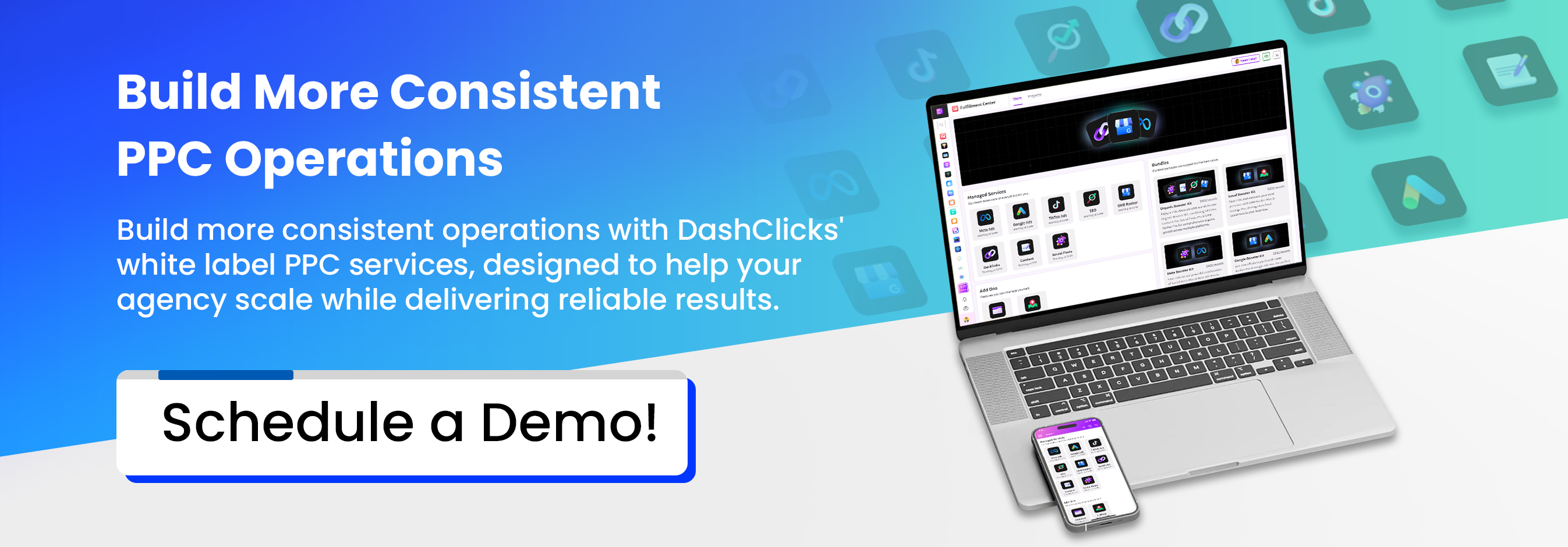
Inconsistency is easier to understand through concrete examples than through general definitions. Across client accounts, it tends to surface in six predictable areas, each one capable of quietly eroding the client relationship over time.
1. Google Business Profile
A Google Business Profile requires active, ongoing management. When that management slips, the gaps are visible to both clients and their customers. Common problems include:
- Outdated business hours that no longer reflect current operations
- Missing weekly or monthly posts that reduce engagement signals
- Neglected Q&A sections where unanswered questions create confusion
- Incomplete service listings that leave conversion opportunities on the table
2. Citation Management
Citations form the backbone of local authority, but they require regular attention to stay accurate. Agencies often let citation work slide after the initial audit, which creates compounding problems over time:
- Inconsistent NAP (name, address, phone number) across directories
- Duplicate listings that dilute ranking signals
- Outdated directory profiles that contradict the client's current information
3. Review Management
Reviews influence both local rankings and conversion rates. When review management becomes irregular, the damage extends beyond the algorithm:
- Negative reviews left unanswered signal indifference to potential customers
- Irregular review request campaigns reduce the overall review velocity
- Missed reputation opportunities weaken the client's competitive position in the Map Pack
4. Content
Content consistency signals ongoing relevance to search engines and reassures clients that active work is happening on their account:
- Skipped location pages leave geographic targeting gaps
- Inconsistent blog publishing disrupts the content signals search engines use to evaluate authority
- A lack of localized content fails to connect the brand with the specific communities it serves
5. Reporting
Reporting is how agencies demonstrate value. When it becomes delayed or incomplete, clients fill the silence with doubt:
- Late reports create anxiety about whether work is actually being completed
- Missing KPIs make it impossible for clients to evaluate progress
- Reports without context or explanation leave clients unable to connect deliverables to outcomes
6. Technical Local SEO
Technical issues quietly undermine results and are often the last thing agencies catch when capacity becomes stretched:
- Outdated schema markup reduces eligibility for rich results
- Broken location pages create poor user experiences and weaken local relevance signals
- Slow mobile performance damages both rankings and conversion rates
Clients rarely track every optimization. They notice when recurring work stops happening.
Inconsistency affects trust just as much as rankings. A client who sees recurring gaps in execution begins to question the entire engagement, regardless of where their keyword positions stand.
The Trust Gap: Why Inconsistency Leads to Client Churn
Clients evaluate their agency relationships through two lenses simultaneously: performance and perceived activity. Both matter, but they operate on very different timelines.
When a client reviews their account, they are subconsciously asking two questions:
- Are we getting results?
- Are they actively working on our account?
The second question gets answered much sooner. A client will wait months to fully evaluate ranking progress, but they will notice a missing report within days. This is where the trust gap opens, and once it opens, it tends to widen.
The pattern typically unfolds like this:
Missing Report → Missed Email → Late Optimization → Reduced Confidence → Client Questions Value → Higher Churn Risk
Each step feels small in isolation. Collectively, they erode the foundation that every client relationship depends on. The financial implications of losing that trust are significant. According to Small Business Trends, 65% of a company's business comes from existing customers. Bain & Company research shows that increasing customer retention by just 5% can increase profits by 25% to 95%.
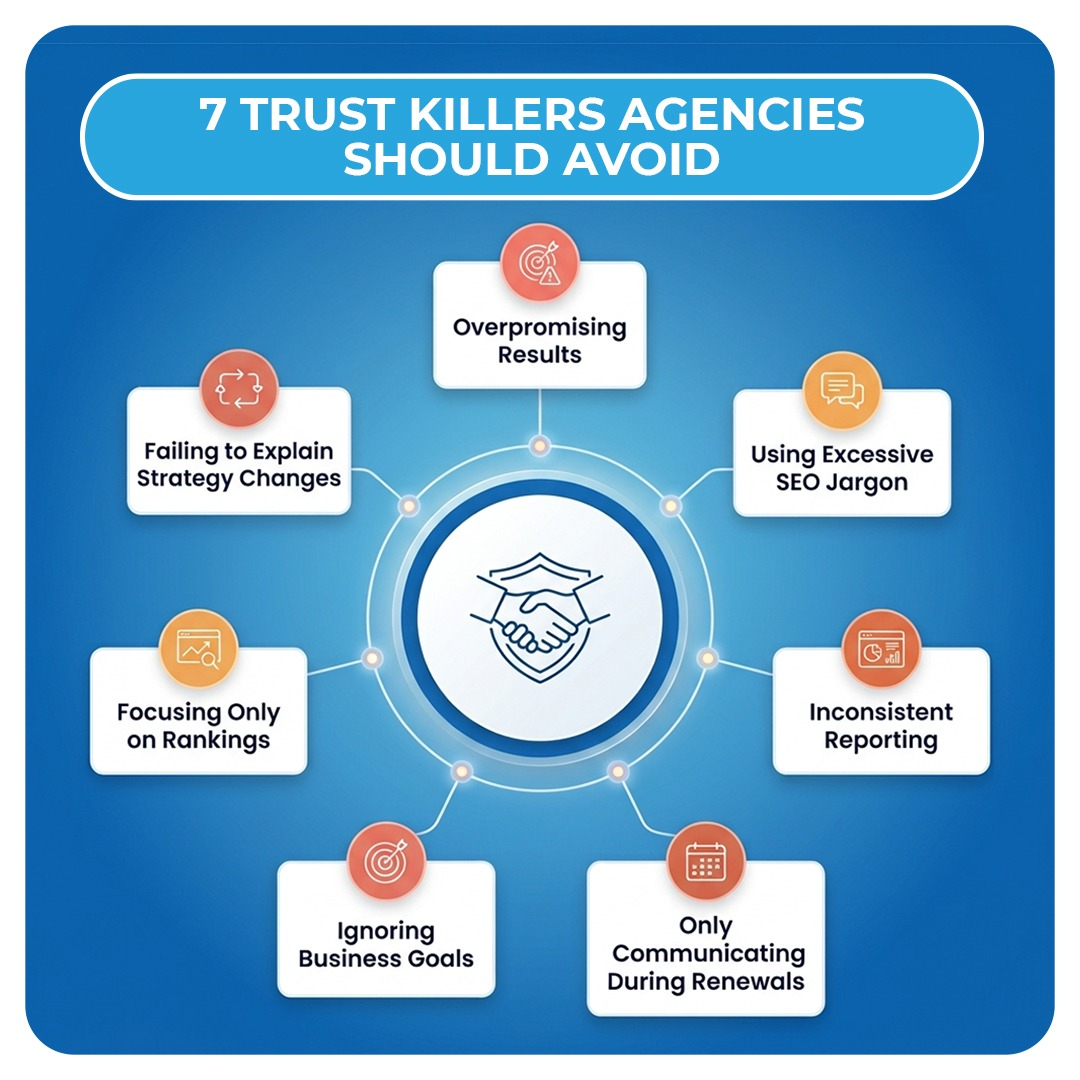
Trust does not collapse suddenly. It declines one missed touchpoint at a time. A client who has lost confidence rarely announces it early. They grow quieter, ask fewer questions, and begin exploring alternatives before ever raising a direct concern. By the time the conversation about cancellation happens, the decision is often already made. The root cause of this pattern is rarely strategic. It is almost always operational.
Why Agencies Struggle to Deliver Local SEO Consistently?
Scaling local SEO creates recurring operational demands that many agencies underestimate when they first start growing their client base. The challenge is not a lack of expertise. It is a lack of systems designed to handle volume.
Common bottlenecks that emerge as agencies scale include:
- Growing client load that outpaces team capacity
- Multiple recurring deliverables that require coordination across channels
- Manual processes that are time-consuming and error-prone
- Account manager overload that pulls focus away from proactive execution
- Hiring delays that leave gaps in fulfillment capacity
- Inconsistent quality control across client accounts
- Communication bottlenecks between departments or freelancers
- Reactive workflows that address problems after clients notice them
The scaling challenge compounds quickly:
10 Clients → 30 Clients → 50 Clients → More Recurring Tasks → Greater Risk of Inconsistency
Local SEO involves more recurring work than many agencies initially expect. Each client account requires regular attention across Google Business Profile management, citations, reviews, content, and reporting. As client count grows, the volume of recurring tasks grows proportionally, while the margin for error shrinks.
According to the 2024 Agency Benchmarks Report by Promethean Research, talent acquisition, operational efficiency, and delivery capacity remain among the top growth challenges reported by digital agencies. Successful agencies solve this challenge by building systems, not by simply working harder. Individual effort alone cannot sustain consistent execution across a growing client portfolio.
Building a Repeatable Local SEO Delivery System
Consistency does not come from motivation or good intentions. It comes from standardized systems that remove reliance on memory, individual effort, and informal processes. Agencies that retain clients at high rates have typically built delivery frameworks that operate the same way regardless of who is executing the work.
The core components of a repeatable local SEO delivery system include:
- Monthly SOPs: Documented procedures for every recurring task, from GBP updates to citation audits.
- Task automation: Tools that handle scheduling, reminders, and routine monitoring without manual input.
- Quality assurance checkpoints: Review steps built into the workflow before deliverables reach the client.
- Standardized reporting templates: Consistent report formats that communicate progress clearly every month.
- Review monitoring protocols: Scheduled alerts and response workflows that keep reputation management active.
- Google Business Profile maintenance schedule: A recurring calendar of updates, posts, and audits.
- Citation audit schedule: Regular checks that catch inconsistencies before they compound.
- Content calendar: A planned publishing schedule that eliminates gaps in localized content.
- Performance reviews: Scheduled internal reviews that catch delivery gaps before clients do.
The principle behind all of these components follows a simple sequence:
Consistency → Predictability → Trust → Client Retention
When execution is consistent, clients can predict what they will receive each month. Predictability creates confidence. Confidence builds trust. Trust is what drives long-term retention. Standardized execution also improves internal efficiency, reducing the time spent on reactive problem-solving and freeing up account managers to focus on client relationships and strategy. For agencies looking to accelerate these systems, white label SEO fulfillment offers one practical path forward.
How White Label Local SEO Helps Agencies Reduce Client Churn?
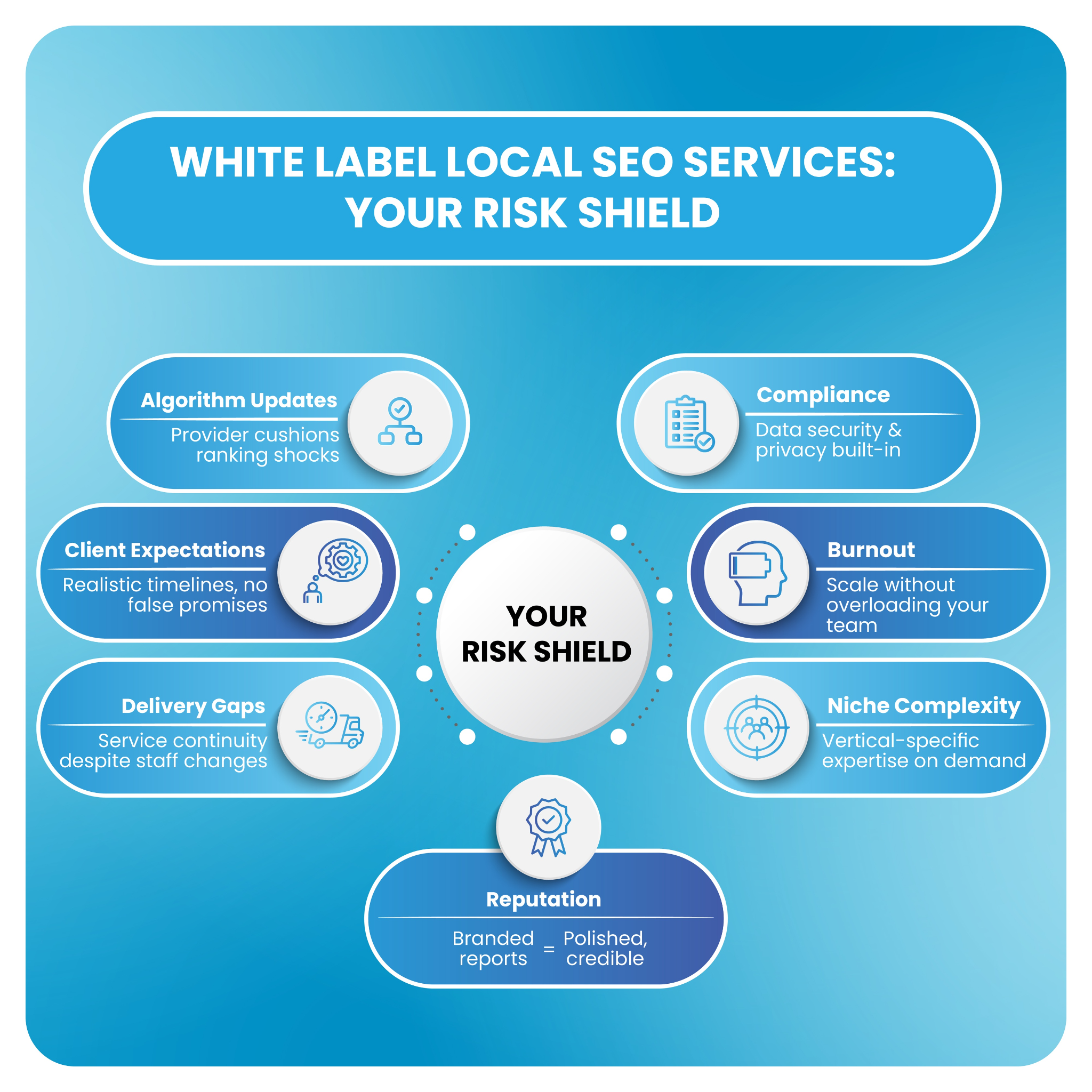
Partnering with a white label local SEO agency is not about outsourcing client management. It is about extending operational capacity through a fulfillment partner that can deliver consistent, recurring execution at scale, while the agency retains full ownership of the client relationship.
A white label local SEO service helps agencies deliver:
- Consistent monthly execution across every client account
- Scalable fulfillment that grows with the agency without proportional hiring
- Standardized quality that removes dependence on individual performance
- Reliable reporting delivered on schedule every month
- Predictable timelines that clients can count on
- More time for agency teams to focus on strategy
- More time for meaningful client communication
- Stronger relationship management across the entire book of business
Importantly, the agency retains full control over the areas that define the client relationship. Strategy, client communication, and account ownership remain entirely within the agency. The fulfillment partner operates behind the scenes, managing the recurring execution that would otherwise strain internal resources as the agency scales.
When recurring tasks are handled reliably, account managers can shift their energy toward proactive communication, deeper strategy, and the kind of relationship-building that makes clients want to stay. That shift, from reactive execution to strategic partnership, is one of the clearest competitive advantages a growing agency can build. For agencies ready to put that structure in place, DashClicks offers a purpose-built solution.
Further Reading: Why Partnering with a White Label SEO Agency is a Smart Move in 2026
How DashClicks Helps Agencies Deliver Consistent Local SEO at Scale?
DashClicks is built to serve as an operational partner for digital agencies that want to scale local SEO delivery without compromising on quality or consistency. The platform is designed specifically to support agency growth, not to replace the agency's role in the client relationship.
- White Label Local SEO Fulfillment: The platform provides ongoing local SEO fulfillment entirely behind the agency's brand. Clients see the agency's name. The agency maintains the relationship. The fulfillment team handles the recurring execution that keeps campaigns active and consistent month after month.
- Google Business Profile Optimization: The team manages the full lifecycle of Google Business Profile work, including initial profile optimization, ongoing updates, and continuous improvements to local visibility. Keeping GBP active and accurate is one of the highest-leverage recurring tasks in local SEO, and this maintenance is built into the standard fulfillment process.
- Citation Management: Citation consistency is foundational to local authority. The service includes citation cleanup to correct existing inaccuracies, ongoing consistency monitoring to catch new discrepancies, and directory management to ensure listings stay accurate across all relevant platforms.
- Content and Reporting Support: DashClicks supports agencies with localized content creation, white label reporting delivered on schedule, clear performance visibility, and consistent monthly execution across every deliverable. Clients receive reports that reflect the agency's brand while the underlying data is managed and formatted by the fulfillment team.
The outcomes agencies achieve span both retention and growth:
- Better client retention driven by reliable, consistent delivery
- Predictable fulfillment that removes uncertainty from the delivery cycle
- Greater operational capacity without proportional increases in headcount
- Reduced fulfillment bottlenecks as client volume scales
- More time for strategic client management at every account level
Client Retention Is Built on Operational Discipline
Client churn rarely begins with a ranking drop. It begins when clients stop seeing consistent execution and start questioning whether their agency is actively working on their account.
Reliable local SEO delivery is what strengthens client confidence over time. When clients receive consistent reports, see regular updates across their local assets, and experience a steady flow of work being done on their behalf, they have no reason to look elsewhere. Operational consistency is a competitive advantage, not just a service quality metric. It is what separates agencies that grow sustainably from those that struggle to hold onto the clients they work hard to acquire.
Whether systems are built internally or supported by a trusted white label local SEO firm, the outcome is the same: agencies that deliver consistently retain more clients, generate stronger referrals, and build the kind of reputation that drives long-term growth. The work of building those systems is worth every bit of the investment.

Reducing Client Concerns About Facebook Ads Performance With White Label Support
Managing client expectations has become one of the most demanding responsibilities in digital marketing today. Facebook Ads remain one of the world's largest digital advertising platforms, and businesses of every size continue investing in them at scale. Meta generated more than $160 billion in advertising revenue in 2024, demonstrating that businesses continue investing heavily in its advertising ecosystem despite increasing competition. Still, that widespread adoption has not made client management any easier.
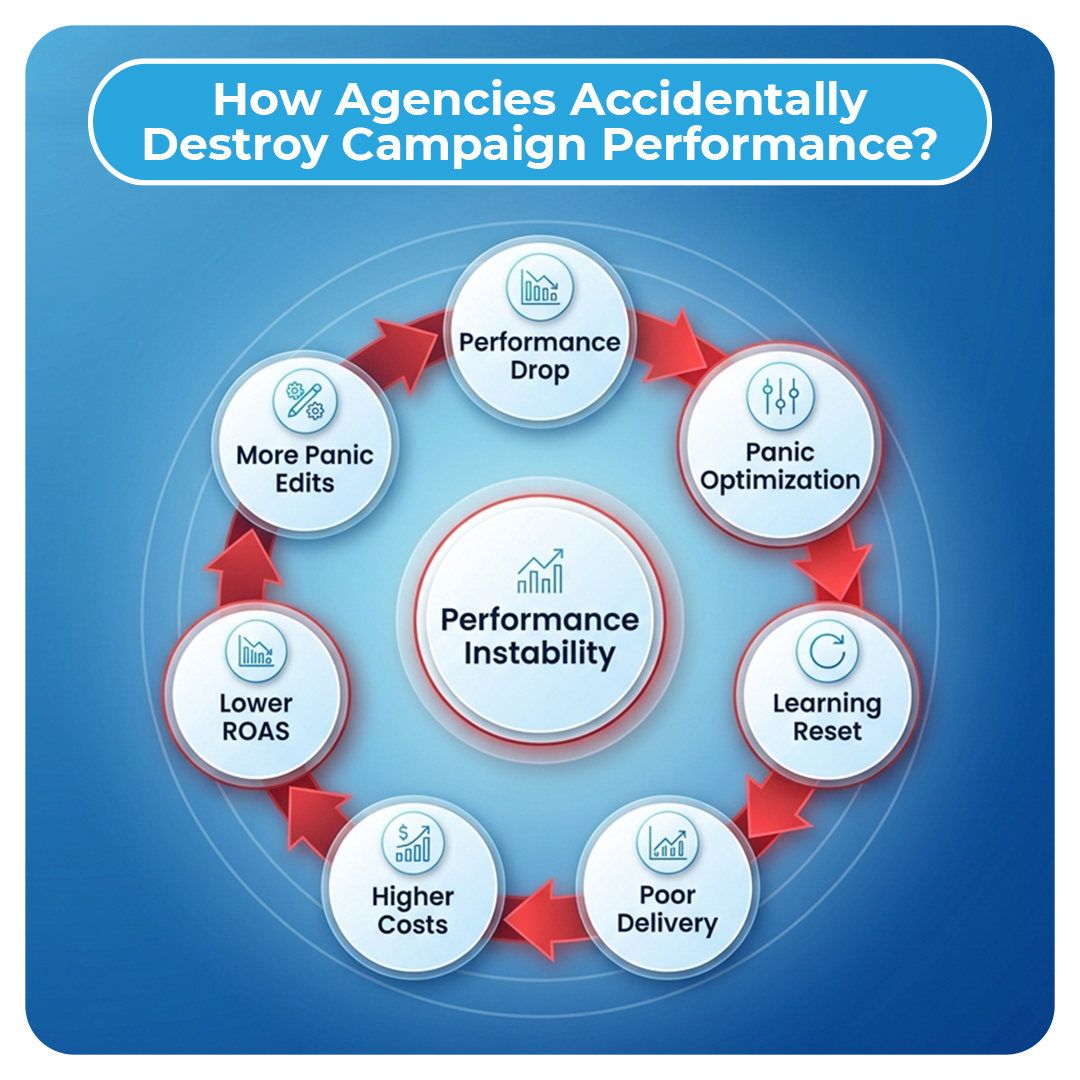
Performance naturally fluctuates because of competition, audience behavior, creative fatigue, seasonality, and continuous platform changes. Yet many clients become concerned after only a few weeks of shifting metrics, even when campaigns are progressing exactly as they should. Those concerns often arrive before an agency has had enough time to move through a proper optimization cycle.
Agencies are expected to handle all of this at once: optimize active campaigns, educate clients about how digital advertising actually works, explain results clearly, and maintain the kind of relationship that keeps a client renewing month after month. That is a significant workload, and it only grows as an agency takes on more clients.
White label Facebook advertising has emerged as a scalable operational solution for agencies navigating these pressures. By combining expert optimization with transparent reporting and proactive communication, white label support allows agencies to deliver stronger results without stretching their internal teams to the breaking point.
Understanding client concerns starts with recognizing that many of them stem from misconceptions rather than poor campaign performance.
Why Clients Lose Confidence in Facebook Ads So Quickly?
Client concerns are often driven by psychology rather than actual campaign failure. When clients invest money in advertising, they naturally want to see results quickly. That instinct is understandable, but it frequently leads to misaligned expectations from the very beginning of an engagement.
Clients commonly expect immediate ROI, predictable performance week over week, and linear growth that maps directly onto their ad spend. These expectations make sense from a business perspective, but they do not reflect how Facebook Ads actually work. The platform relies on machine learning, audience signals, and iterative testing to improve results over time.
Many of these frustrations are also fueled by comparisons. Clients who have run Google Search Ads often expect Facebook to behave the same way, with clear intent signals and predictable conversion paths. Facebook Ads operate on a fundamentally different model, one driven by interruption-based discovery rather than active search intent. That distinction is rarely explained upfront, and the gap between expectation and reality becomes a source of ongoing friction.
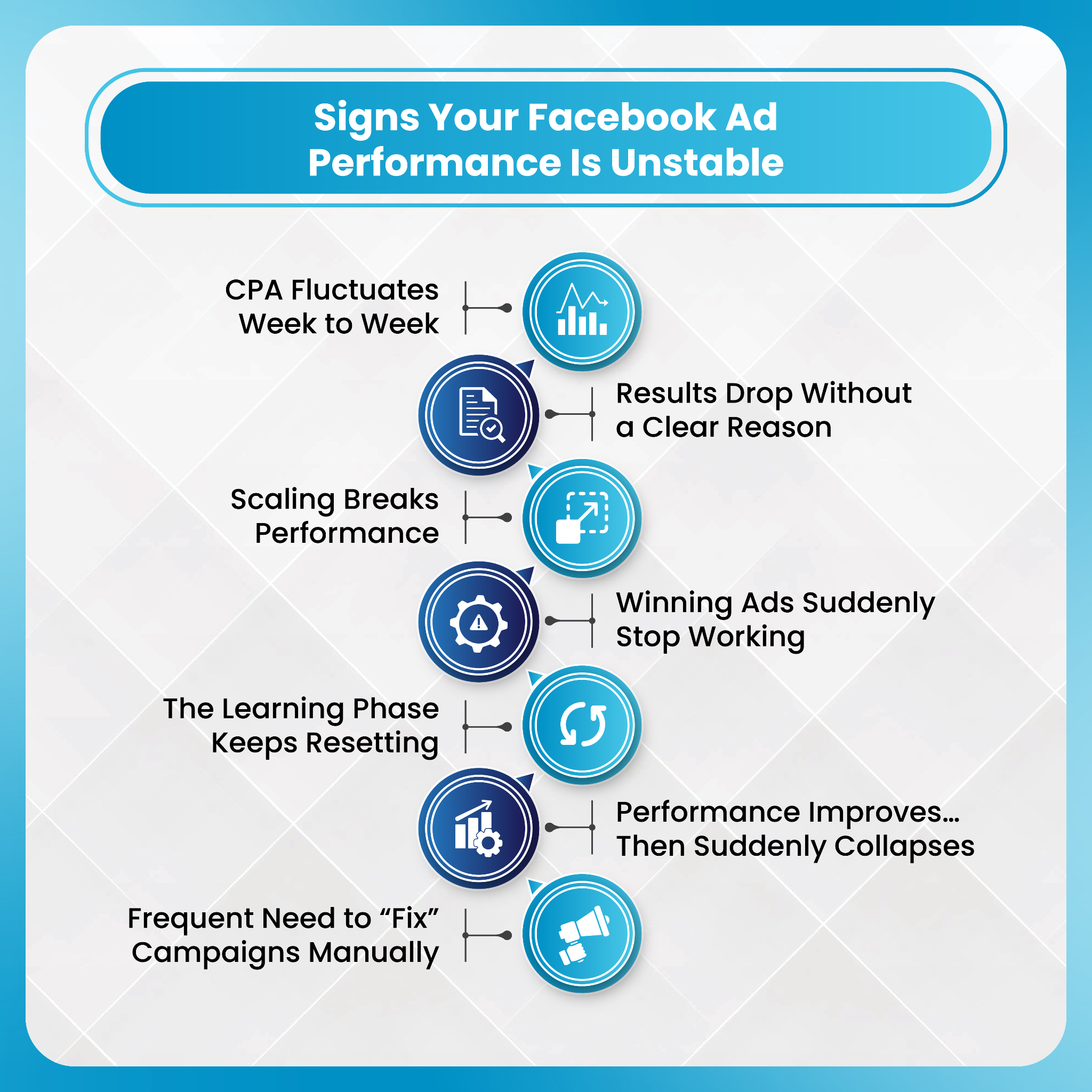
Clients also tend to focus on vanity metrics, misunderstand the Learning Phase, and react strongly to short-term fluctuations that any experienced media buyer would consider normal. Some of the most common concerns include:
- CPA increasing week over week
- ROAS dropping unexpectedly
- CPM spikes during high-demand periods
- Lower lead volume during optimization cycles
- A falling CTR as creative becomes more familiar to the audience
According to HubSpot's State of Marketing Report, Facebook continues to rank among the highest ROI paid social advertising platforms despite normal performance variability. That context is often missing from the conversations agencies are having with their clients.
Many important performance factors exist outside an agency's direct control, and understanding those factors is essential for setting realistic expectations.
The Factors That Influence Facebook Ads Performance
Campaign performance depends on a wide range of constantly changing variables. Even the most experienced media buyers cannot fully control every element that influences results. Helping clients understand this reality is one of the most important things an agency can do to protect its relationships during difficult periods.
1. Meta's Machine Learning Needs Time
Meta's ad delivery system learns through data. During the Learning Phase, the algorithm tests different audiences, placements, and delivery strategies to find the combination most likely to achieve a campaign's objective. This process requires a meaningful volume of conversions before the system can optimize reliably.
When agencies or clients make frequent edits to active campaigns, including budget changes, audience adjustments, or creative swaps, the Learning Phase resets. That means the algorithm starts over, which delays optimization and introduces the kind of inconsistency that makes clients nervous. Patience during this period is not a passive choice. It is part of a deliberate strategy.
2. Audience Saturation
Even a well-built audience has limits. As a campaign runs, frequency increases, meaning the same people see the same ads more often. Creative fatigue sets in, engagement drops, and performance weakens. Audience overlap between different ad sets can amplify this problem further.
Refreshing creative and expanding audiences are routine parts of any healthy campaign lifecycle. Clients who are not aware of this often interpret declining performance as a sign that something has gone wrong, when it is actually a signal that the campaign needs its next phase of optimization.
3. Competition Changes Every Day
Ad auction dynamics shift constantly. During peak seasons, such as the holiday shopping period or major industry events, more advertisers compete for the same audiences. That competition drives up CPMs and changes what a dollar of ad spend can achieve.
Competitor budgets increase and decrease without warning. A sudden surge in spending from a competitor can affect an agency's client without any change in the client's own campaign. Explaining these auction dynamics to clients early in a relationship prevents confusion when CPMs rise unexpectedly.
4. Landing Page Experience Matters
Facebook Ads can deliver qualified traffic, but the conversion still happens on the client's website. A slow load time, weak messaging, or a poor mobile experience will suppress results regardless of how well the ad campaign is optimized.
Google's research has consistently shown that improving mobile experience positively impacts conversion rates, and those same principles apply when Facebook users click through to a landing page. When performance underperforms expectations, agencies should evaluate the full customer journey, not only the ad account.
5. Attribution Isn't Perfect
Tracking has become significantly more complex over the past several years. Apple's App Tracking Transparency significantly reduced deterministic tracking, requiring advertisers to rely more heavily on modeled attribution and aggregated measurement. Attribution windows have shortened, cross-device behavior is harder to capture, and some conversions simply do not appear in reported data.
This means campaigns sometimes perform better than the numbers suggest. Explaining modeled attribution and its limitations helps clients understand that the data they see in a dashboard is an estimate, not a complete picture.
Structured optimization and consistent communication matter just as much as technical campaign management, which is why client confidence often depends on what happens outside the ad account.
Why Managing Client Expectations Is Just as Important as Managing Campaigns?
Agencies rarely lose clients simply because campaigns go through a rough patch. Performance fluctuations are a normal part of digital advertising, and most clients understand that at some level. What erodes trust is the feeling that nothing is being done about it, or that the agency is not being transparent about what is happening.
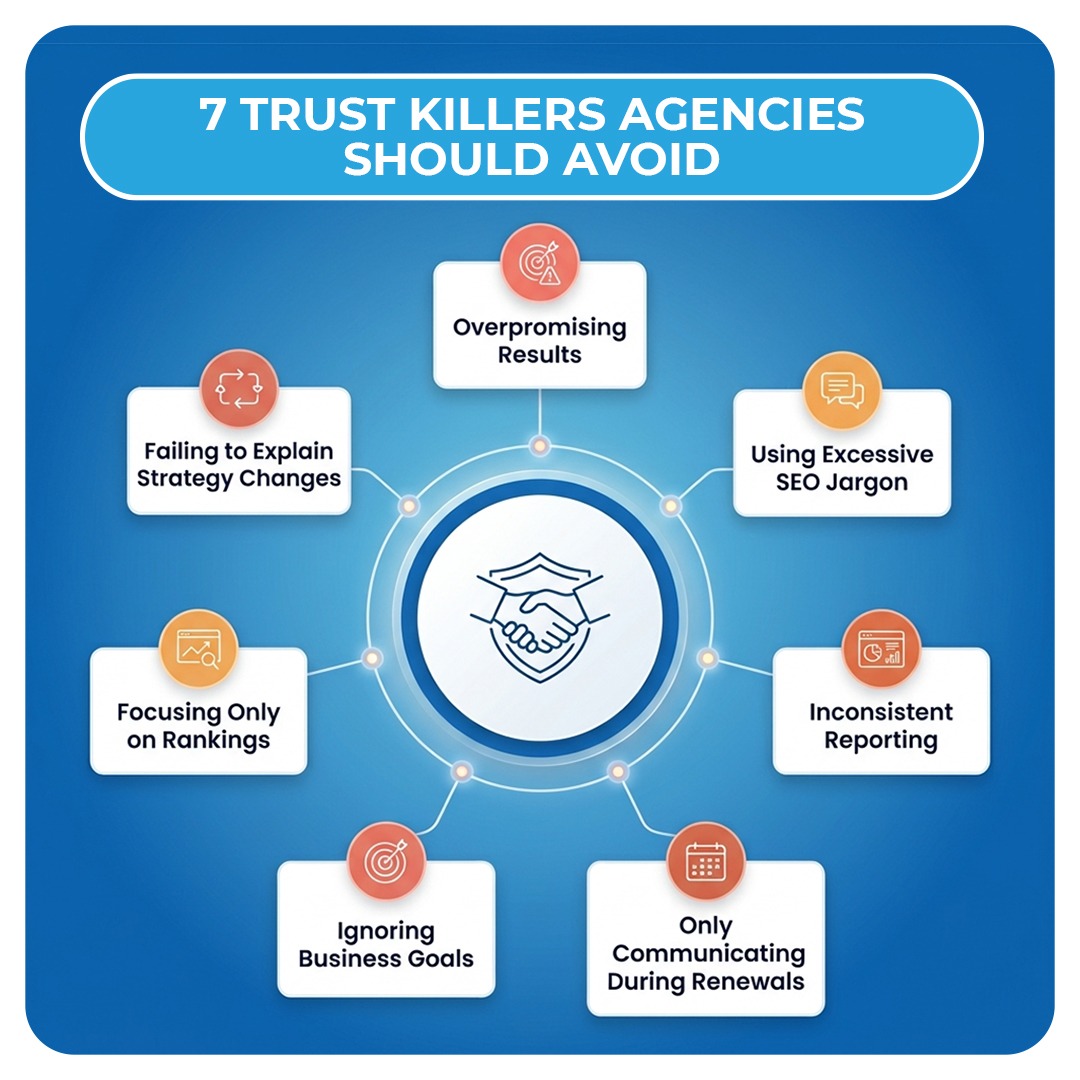
Clients leave when expectations were never properly aligned at the start, communication becomes inconsistent during difficult periods, reports provide numbers without meaningful context, and performance changes go unexplained for too long. Each of these failure points is preventable with the right systems in place.
Agencies that proactively educate clients build a foundation of trust that holds up when performance fluctuates. That education should cover:
- Testing periods and why they take time
- Optimization cycles and what agencies are actually doing during them
- When and why creative refreshes are necessary
- Realistic timelines for seeing meaningful results
- How to measure success using business-focused KPIs rather than platform metrics alone
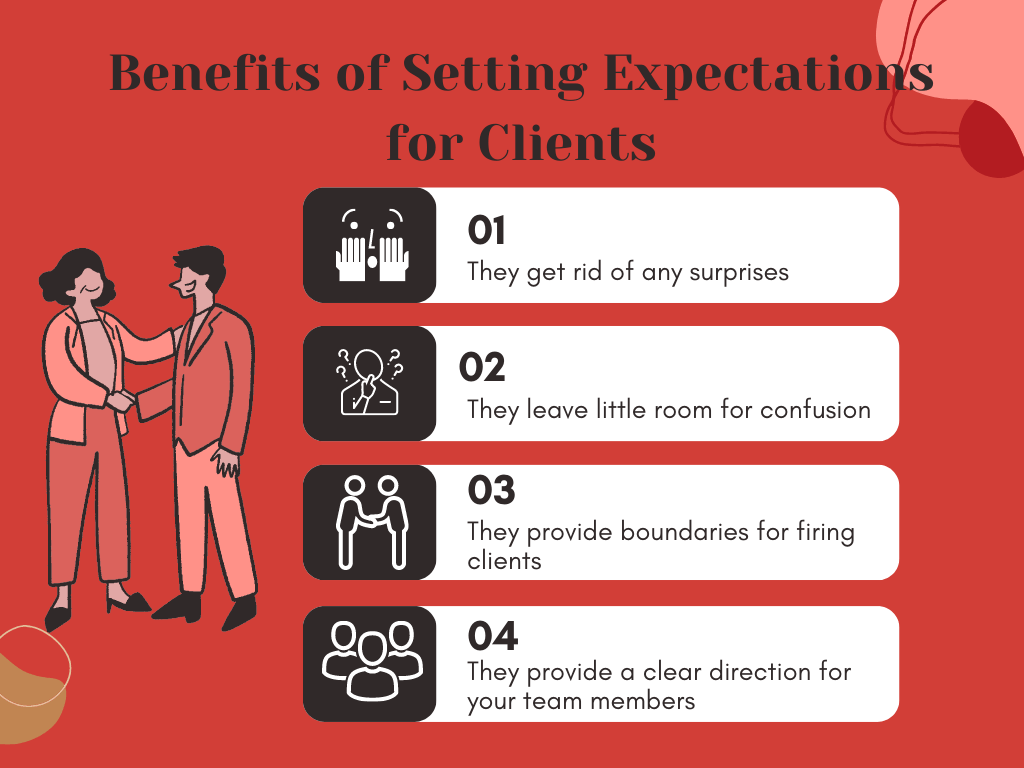
Image Source: The HOTH
A clear framework for expectations helps both sides of the relationship stay aligned. Agencies should set expectations around four key areas at the start of every engagement:
- Timeline: How long before the campaign exits the Learning Phase, and when should meaningful results be expected?
- KPIs: Which metrics reflect actual business impact, and which are supporting indicators?
- Optimization Process: What does the agency monitor, test, and adjust, and how often?
- Reporting Frequency: When will the client receive updates, and what will those updates include?
This framework does not eliminate every difficult conversation, but it dramatically reduces how often those conversations feel like surprises. Clients who understand the process are more patient and more likely to stay engaged during periods when results are building rather than peaking.
Maintaining this level of communication becomes increasingly difficult as agencies grow, which is where operational support becomes critical.
Further Reading: Facebook Ads: Managing Client Expectations with White Label Services
How White Label Facebook Ads Support Reduces Client Concerns?
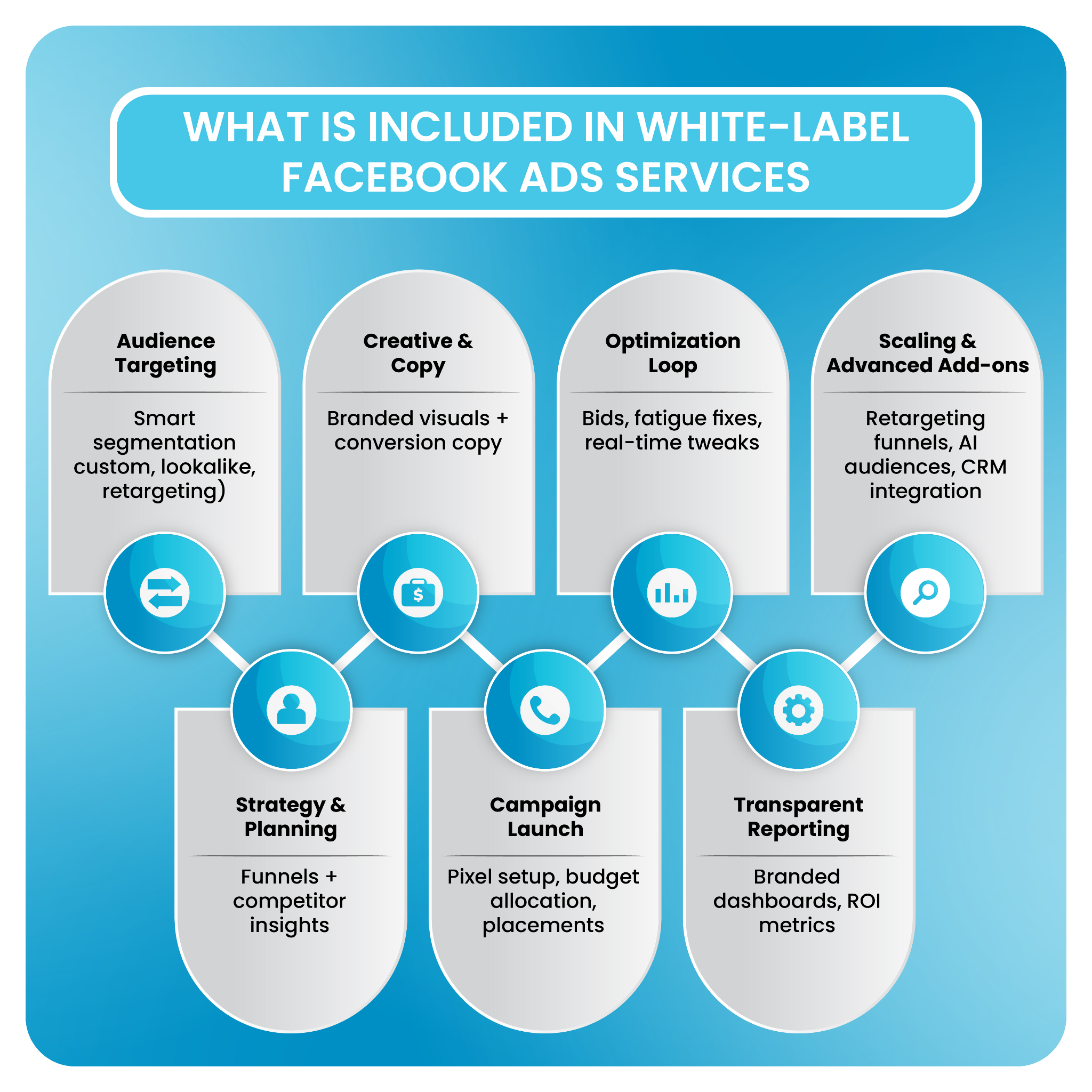
White label fulfillment is not simply a way to outsource Facebook Ads work to another team. It is an operational support system that allows agencies to deliver a higher standard of campaign management and client communication without scaling internal headcount at the same rate as client growth.
1. Faster Campaign Optimization
One of the most direct benefits of white label Facebook Ads support is continuous campaign monitoring. In-house teams managing multiple client accounts often struggle to catch performance shifts quickly enough to respond before clients notice them. A dedicated white label team can monitor campaigns more closely and act faster, reducing the amount of time a campaign spends underperforming before an optimization is made.
Faster optimization means fewer opportunities for client concern to develop in the first place.
2. Access to Specialized Facebook Ads Expertise
Media buyers work inside Facebook Ads Manager every day. They bring deep experience with advanced testing strategies, budget allocation across campaign structures, and audience segmentation techniques that generalist teams may not use consistently.
That expertise translates into stronger campaign performance and fewer costly mistakes. It also means agencies can take on more complex client accounts with confidence, knowing the fulfillment behind the work is handled by people with the right skills.
3. Consistent Reporting
Reporting is one of the most visible parts of an agency relationship. White label Facebook Ads support typically includes white label reporting software and client-ready performance reports that make it easier for agencies to hold regular reporting conversations without spending hours compiling data.
Consistent, well-structured reporting improves ROI conversations and gives clients the transparency they need to feel confident in what their ad spend is achieving.
4. More Time for Client Communication
When fulfillment is handled externally, agency teams spend less time inside Ads Manager and more time on the things that directly impact client retention. That includes:
- Strategy conversations that help clients think longer-term
- Regular check-ins that strengthen the relationship
- Identifying upsell opportunities within existing accounts
- Proactive communication during periods of performance fluctuation
These are the activities that build the kind of client trust that survives difficult months.
5. Scalable Fulfillment
Agency growth typically creates operational pressure. Adding clients without adding headcount leads to inconsistent execution, slower response times, and higher staff burnout. White label Facebook advertising allows agencies to scale the number of clients they serve without proportionally increasing their operating costs.
The result is a more sustainable business model where service quality does not decline as the client roster grows.
These operational improvements allow agencies to shift from a reactive posture to a proactive one, addressing client concerns before they become a reason to cancel.
Proactive Strategies Agencies Can Use to Build Client Confidence
Building client confidence is most effective when it happens before concerns arise. Agencies that wait for a client to raise a complaint are already operating in a defensive position. The agencies that retain clients longest are the ones that establish credibility and transparency from the very beginning.
1. Share Performance Trends Instead of Daily Results
Daily performance data is noisy. Showing a client a single day's ROAS or CPA without context invites unnecessary anxiety. Weekly and monthly reporting provides a much clearer picture of whether a campaign is improving over time.
Agencies that frame results in terms of trends rather than snapshots give clients a more accurate and less alarming view of their investment.
2. Celebrate Leading Indicators
Not every positive development shows up immediately in revenue. Improvements in CTR, reductions in CPC, stronger engagement rates, and higher conversion rates are all signs that a campaign is moving in the right direction.
Celebrating these indicators with clients and explaining what they predict about future performance helps maintain confidence during the optimization period when final results are still developing.
3. Explain Every Optimization
Clients do not need to understand every technical detail of campaign management. But they do benefit from knowing what changed, why the change was made, and what the agency expects to happen as a result.
A brief optimization update with each reporting cycle demonstrates that the agency is actively working, not simply waiting for results to improve on their own.
4. Report Business Impact
Platform metrics like clicks, impressions, and reach are useful internally but rarely meaningful to a business owner. Agencies that translate campaign performance into business outcomes, including leads generated, appointments booked, revenue influenced, and customer acquisition costs, make it far easier for clients to connect their ad spend to real growth.
That connection is what keeps clients committed to their campaigns over the long term.
5. Establish Quarterly Strategy Reviews
Regular quarterly reviews give agencies an opportunity to look beyond day-to-day performance and discuss the bigger picture. These sessions can cover market changes that have affected campaign conditions, opportunities to expand into new audiences, updates to creative strategy, and goals for the next quarter.
According to Harvard Business Review, retaining customers is generally far less expensive than acquiring new ones, making strong client relationships a major driver of long-term agency profitability. Quarterly strategy reviews are one of the most effective tools for building those relationships over time.
The combination of operational efficiency and proactive communication is where white label Facebook Ads support can make the greatest difference for growing agencies.
How DashClicks Strengthens Facebook Ads Delivery for Agencies?
DashClicks operates as an operational partner for agencies that want to improve their Facebook Ads fulfillment without building out a full in-house media buying team. The platform is designed specifically to support agency growth by delivering expert execution while keeping the client relationship firmly in the agency's hands.
- White Label Facebook Ads Management: The team provides white label Facebook ads management, including campaign creation, audience building, ongoing optimization, and strategic execution across Meta's advertising platforms. Every campaign is managed under the agency's brand, so clients experience a seamless service that reflects the agency they hired.
- Continuous Campaign Optimization: The fulfillment team monitors active campaigns on an ongoing basis, making budget adjustments, refining audience targeting, and testing creative to maintain performance. This continuous attention reduces the gaps between performance shifts and corrective action that can trigger client concern.
- Transparent Performance Reporting: DashClicks provides white label reporting software that agencies can share directly with clients. These reports are built to be client-ready, presenting campaign data in a clear format that supports productive conversations about results and progress.
- Scalable Fulfillment for Growing Agencies: As an agency's client roster grows, the fulfillment model scales alongside it. Agencies can take on more accounts, maintain consistent campaign quality across all of them, and free up their internal teams to focus on strategy, communication, and new business development. The agency keeps full ownership of every client relationship while the fulfillment team handles the technical fulfillment behind the scenes.
Build the Kind of Agency Clients Stay With
Facebook Ads naturally go through periods of fluctuation. That is not a sign of failure; it is a characteristic of any performance-driven, auction-based advertising platform. What determines whether clients stay or leave is rarely the performance itself. It is the confidence they have in the agency managing their investment.
Client confidence depends on education as much as optimization. Transparent communication strengthens trust in ways that no single strong month of results can fully replicate. Consistent optimization, honest reporting, and proactive outreach create the conditions where clients feel informed rather than anxious.
Agencies that choose to outsource Facebook Ads fulfillment to a reliable white label partner improve their operational capacity while creating more time for the strategic and relational work that drives retention. The best white label Facebook Ads partnerships do not just fill a capacity gap. They raise the standard of service an agency can consistently deliver.
The agencies that combine expert execution with proactive communication are better positioned to retain clients, strengthen their reputation, and scale sustainably over time. Building that combination requires intentional systems, not just talented people working harder.
Invest in the right operational foundation now, and client confidence becomes something your agency earns by design rather than defends under pressure.
.jpg)
15 Local SEO Mistakes That Cost Agencies Clients (And How to Avoid Them)
Agencies rarely lose local SEO clients because of a single bad month. More often, client churn is the result of a slow accumulation of missed optimizations, inconsistent execution, and a gradual decline in confidence. By the time a client decides to leave, the damage has usually been building for months.
Effective local SEO requires ongoing attention across multiple disciplines, including:
- Google Business Profile optimization
- Citation management
- Customer review strategy
- Localized content creation
- Technical SEO
- Local ranking monitoring
Each of these areas demands consistent upkeep. Overlooking small but important tasks can quietly reduce a client's visibility, cut organic traffic, and erode the trust that agencies work hard to build.
The numbers make this even clearer. According to Google, 46% of all searches have local intent, meaning nearly half of every query on the platform has a geographic component. And with 42% of users clicking on Google Map Pack results for local searches, Local Pack visibility directly determines how much traffic a client receives. Missing that placement is not a minor inconvenience. It is a measurable loss.
This guide covers the most common local SEO mistakes agencies make, why they happen, and how to prevent them before they start costing you and your clients.
Why Local SEO Is Different From Traditional SEO?
Traditional SEO focuses primarily on informational intent. A user searches for an answer, a guide, or a comparison. Local SEO targets transactional and navigational intent. A user wants a service nearby, right now. That difference in intent changes how Google evaluates and ranks results.
Google's local ranking algorithm considers three primary signals: proximity, relevance, and prominence. Proximity refers to how close the business is to the searcher. Relevance is how well the business listing matches the search query. Prominence reflects how well-known and credible the business is based on citations, reviews, links, and online activity. All three signals must be addressed together.
This is why Google Business Profile, review management, citation consistency, and local authority building are all essential components of effective local optimization. According to Think with Google, searches containing phrases such as "near me" have grown significantly over recent years. These searches signal immediate purchase or visit intent, which is precisely why local businesses expect faster and more visible results than traditional SEO clients.
Local businesses do not measure success in domain authority. They measure it in calls answered and customers through the door. Because local SEO relies on multiple interconnected ranking signals, agencies have more opportunities to make mistakes, and every mistake affects client trust.
15 Local SEO Mistakes That Cost Agencies Clients
Most local SEO failures do not stem from a lack of knowledge. They stem from operational inconsistencies that compound over time. The following mistakes are among the most damaging and the most preventable.
1. Treating Google Business Profile as a One-Time Setup
Many agencies complete the initial Google Business Profile setup and move on, assuming the job is done. It is not. Profiles with outdated information, missing service descriptions, incorrect categories, or a lack of recent photos signal neglect to both Google and potential customers.
According to Google, customers are 2.7x more likely to consider a business reputable when its Google Business Profile is complete, and they are 70% more likely to visit it. That is a significant impact for a task that is often skipped.
Avoiding this mistake requires:
- Monthly profile reviews and updates
- Regular publishing of Google Posts with offers, events, or announcements
- Ongoing photo uploads to keep the profile fresh and active
- Accurate service listings and category selections
2. Ignoring NAP Consistency Across Directories
NAP stands for Name, Address, and Phone number. When these details differ across online directories, search engines receive conflicting signals that can suppress local rankings. Duplicate listings compound the problem further.
The solution is straightforward but requires discipline:
- Conduct regular citation audits to identify inconsistencies.
- Centralize listing management to ensure updates apply across all platforms simultaneously.
- Remove or merge duplicate listings before they create trust issues with Google.
Further Reading: The Power of NAP in SEO: Ensuring Consistency for Success
3. Choosing the Wrong Google Business Profile Categories
Category selection is one of the most influential factors in local ranking. Choosing an imprecise primary category, or ignoring secondary categories entirely, means missing relevance signals that competitors are capturing.
Best practices include:
- Researching which categories local competitors use and rank for.
- Selecting the most specific primary category available for the client's core service.
- Adding secondary categories that reflect additional services without overreaching.
- Reviewing categories periodically as Google adds new options.
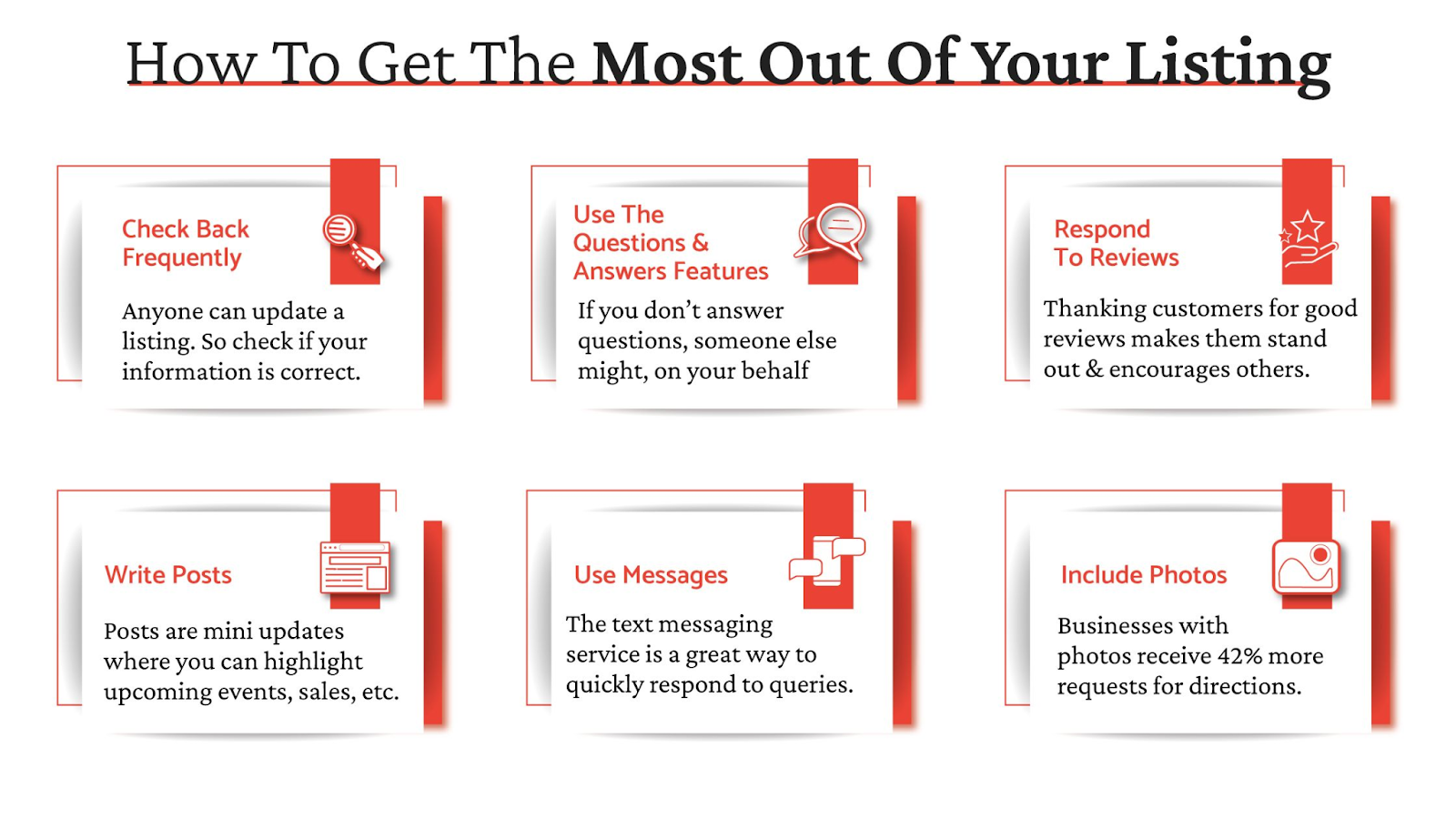
4. Neglecting Customer Reviews
Review volume and quality directly influence local rankings and consumer behavior. Agencies that set up a client's profile and then leave review management to chance are leaving a major variable uncontrolled.
According to BrightLocal's Local Consumer Review Survey, 97% of consumers read reviews for local businesses, and 54% visit a business's website after reading positive reviews. Ignoring this channel is not a neutral decision.
A strong review strategy includes:
- Automated review request systems triggered after purchases or service completions.
- Prompt, professional responses to both positive and negative reviews.
- Ongoing monitoring to catch and address new reviews quickly.
5. Publishing Generic Location Pages
Creating nearly identical pages for different service areas, with only the city name swapped out, does not fool search engines. Thin, duplicated location pages fail to build local relevance and often get filtered out of results entirely.
Location pages that perform well include:
- Unique descriptions of the services offered in each area.
- Area-specific details such as neighborhoods served, local landmarks, or community references.
- Helpful local resources that add genuine value for the reader.
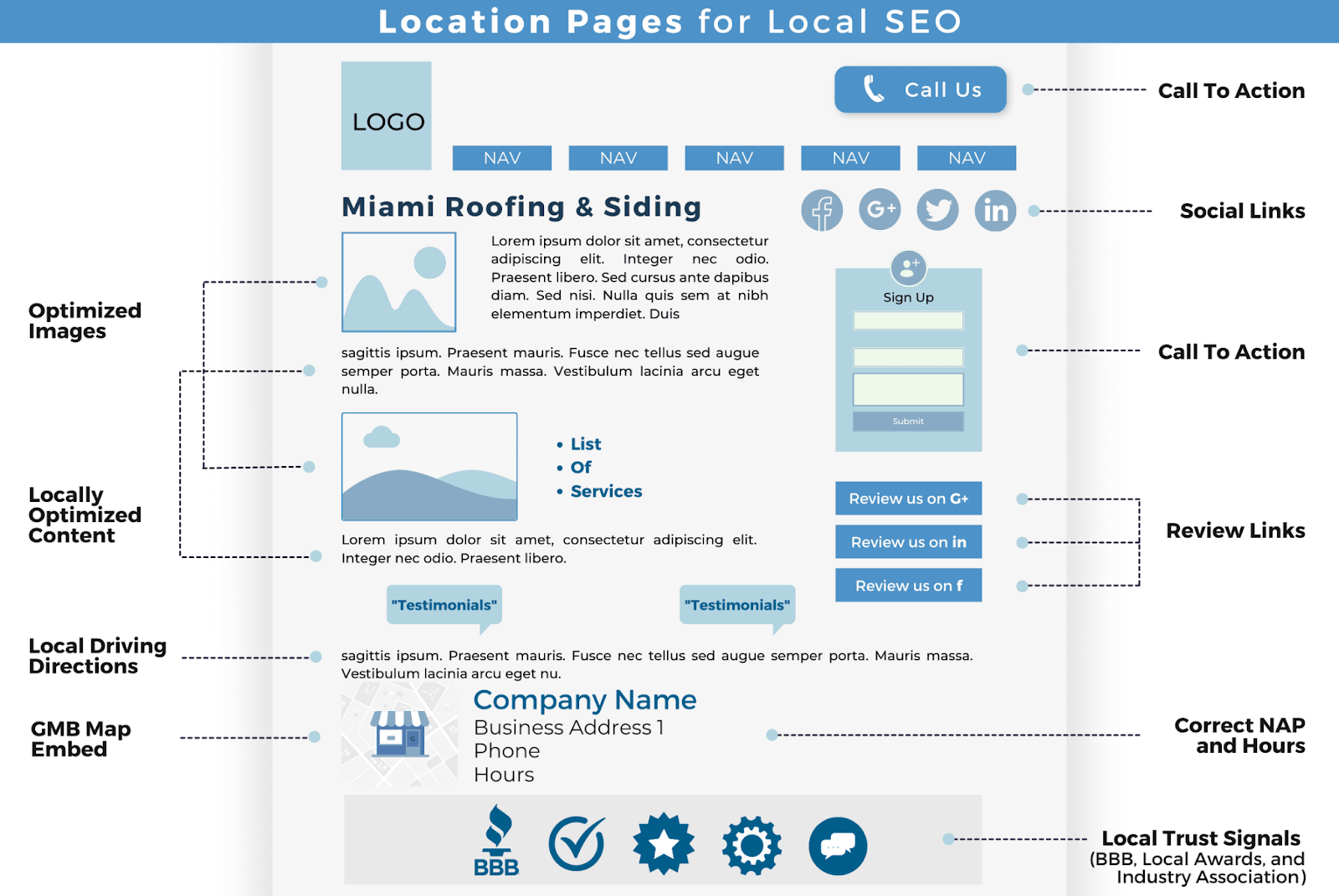
6. Forgetting About Mobile User Experience
Local searches happen predominantly on mobile devices. A website that loads slowly, displays poorly on a small screen, or buries the phone number in an inconvenient location will lose conversions regardless of how well it ranks.
Key mobile considerations include:
- Page load speed below three seconds
- Tap-friendly navigation and button sizing
- Prominent click-to-call functionality
- Clean layouts that prioritize the most critical conversion actions
Mobile experience is not just a technical issue. It directly determines whether a ranking translates into a phone call or a lost lead.
7. Targeting Broad Instead of Local Keywords
Generic keywords like "plumber" or "dentist" are competitive, expensive to rank for, and often misaligned with how local users actually search. Agencies that skip local keyword research miss the terms that drive qualified, location-specific traffic.
A more effective approach:
- Conduct location keyword research that surfaces neighborhood and city-level terms.
- Target service-plus-location combinations such as "emergency plumber in [city]".
- Align keyword strategy with the search intent of users who are ready to convert.
8. Not Monitoring Local Rankings
Standard rank tracking tools often report national averages that have little relevance to how a business appears in a specific city or neighborhood. Local Pack rankings, in particular, vary significantly based on the user's physical location.
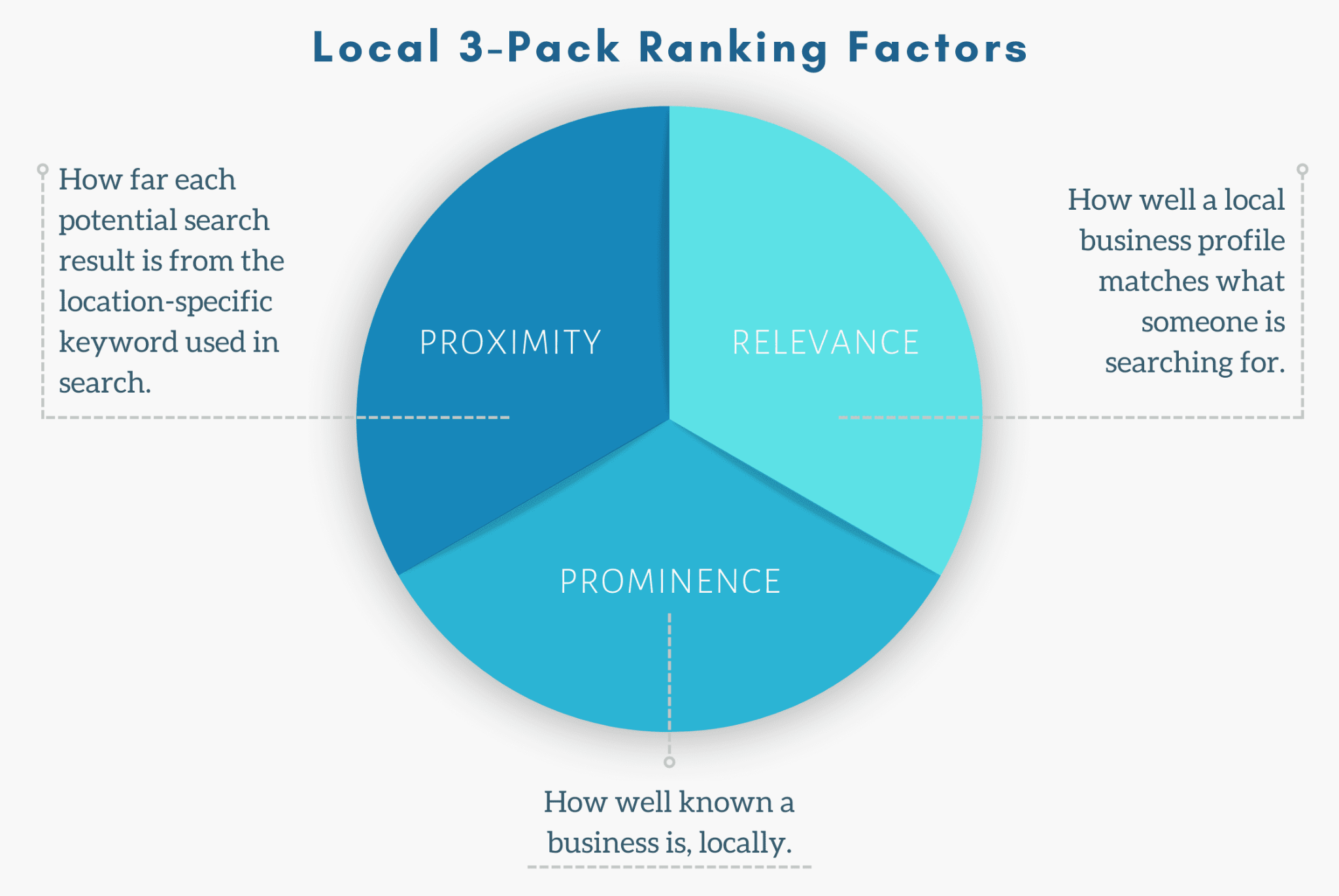
Agencies should implement:
- Geo-targeted rank tracking that monitors rankings from specific zip codes or neighborhoods.
- Separate tracking for Local Pack visibility versus organic rankings.
- Monthly ranking reports tied to actual geographic targets.
Without this level of tracking, agencies cannot accurately diagnose problems or demonstrate progress to clients.
9. Overlooking Local Schema Markup
Schema markup helps search engines understand the structured details of a business, but many agencies skip this step entirely. Missing structured data means missed opportunities for enhanced search appearances.
Relevant schema types for local SEO include:
- LocalBusiness Schema to communicate address, hours, and contact details.
- Organization Schema to reinforce brand identity and entity information.
- Review Schema to surface star ratings in search results.
Implementing schema correctly takes time, but the visibility benefits make it worth the investment.
Further Reading: How to Use Schema Markup for Boosting Local SEO
10. Inconsistent Google Business Profile Activity
An active Google Business Profile sends positive engagement signals. Profiles that go weeks or months without updates, new photos, or posted offers tend to lose ground to competitors who stay active.
Signs of a neglected profile include:
- No new photos added in recent months
- No Google Posts published
- No responses to Questions and Answers
- No seasonal offers or announcements
Consistent activity does not require hours of work each month. Routine updates signal to Google that the business is current, engaged, and relevant to local searchers.
11. Ignoring Competitor Activity
Local SEO does not exist in a vacuum. Competitors are continuously adjusting their strategies, adding reviews, publishing content, and updating their profiles. Agencies that do not monitor competitor activity cannot respond to shifts in the local landscape.
Competitor research should cover:
- Google Business Profile categories and attributes competitors use
- Review volume and response patterns
- Local content topics and publishing frequency
- Seasonal promotions and offers.
Identifying gaps and opportunities in competitor strategy allows agencies to create advantages for their clients rather than simply reacting to declining rankings.
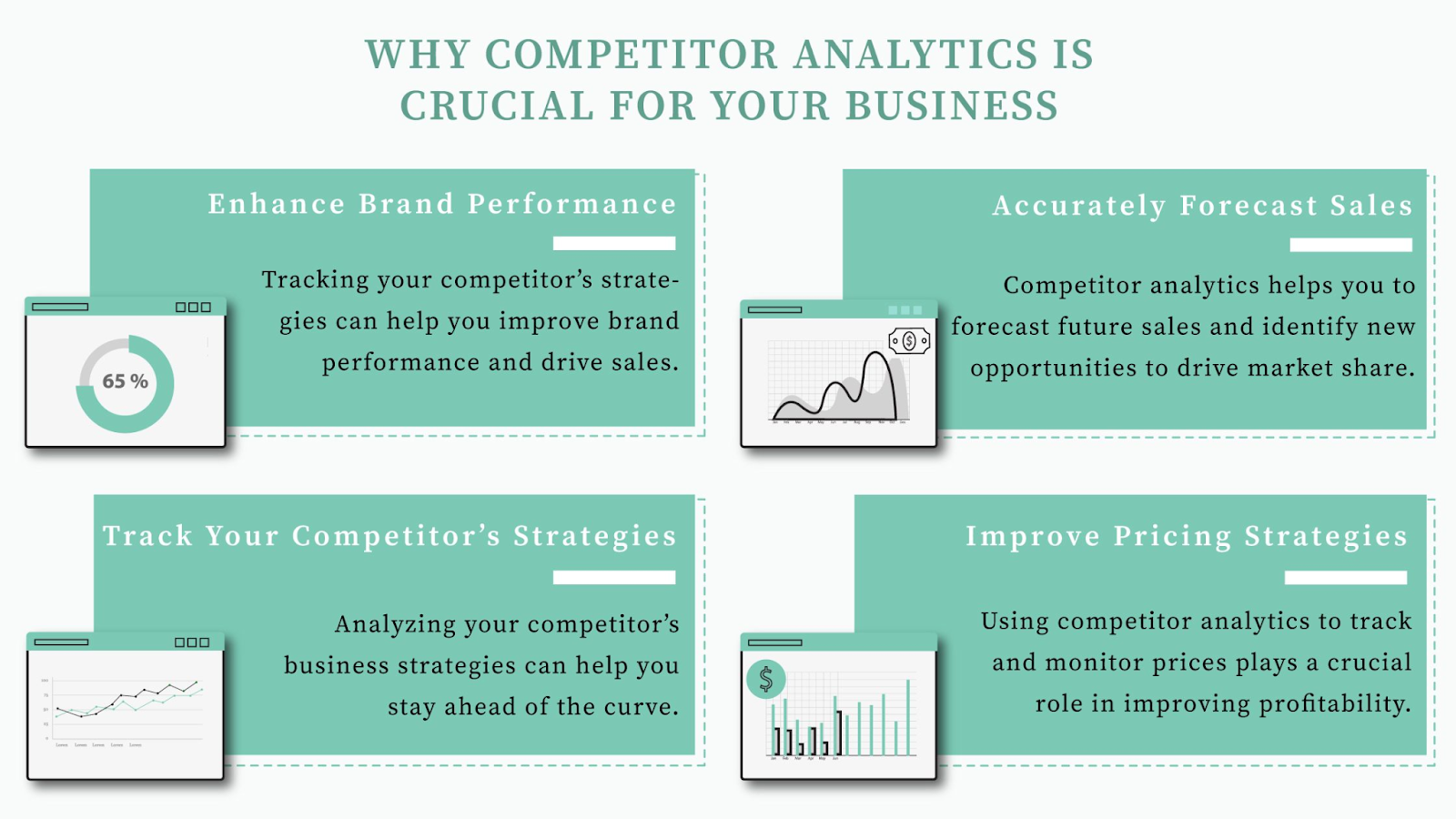
12. Letting Citations Become Outdated
Business information changes. Phone numbers update, locations move, and service areas shift. When citations across the web reflect old information, potential customers get frustrated, and search engines get confused.
According to a BrightLocal study, 62% of consumers would avoid a business after finding incorrect information online. Outdated citations do not just affect rankings. They cost clients real business.
Preventing this requires:
- Scheduled citation audits, particularly following any business changes.
- Ongoing citation monitoring across major and niche directories.
- Proactive cleanup of inaccurate or duplicate listings.
13. Failing to Align Website Content With Google Business Profile
When a client's website describes different services, uses different business names, or lists different contact details than their Google Business Profile, it creates conflicting signals. Search engines rely on consistency to validate local relevance.
Common misalignments include:
- Service descriptions that do not match what is listed on the profile.
- Missing local landing pages for services featured on the profile.
- Inconsistent business names or phone numbers across web properties.
Consistent messaging across all digital touchpoints reinforces the local SEO signals Google uses to assess trust and relevance.
14. Measuring Rankings Instead of Business Outcomes
Rankings are a useful indicator, but they are not a business goal. Agencies that report only on keyword positions without connecting those metrics to actual client outcomes miss the bigger picture and put client relationships at risk.
A more complete measurement framework tracks:
- Phone calls generated through the Google Business Profile and website
- Direction requests from the Local Pack listing
- Website visits attributed to local search
- Lead form completions and customer inquiries
Presenting these metrics demonstrates tangible value and builds the kind of trust that keeps clients renewing.
15. Treating Local SEO as a One-Time Project
Local SEO is not a campaign with a defined end date. Competitors grow more aggressive, algorithms shift, customer behavior evolves, and Google Business Profile signals change constantly. Agencies that treat local SEO as a setup task rather than an ongoing service will consistently fall short.
Continuous optimization means monitoring changes across:
- Competitor activity and ranking shifts
- Review volume and sentiment
- Algorithm updates that affect local results
- Citation accuracy
- Profile signals and engagement patterns
Many agencies begin struggling at this stage, not because they lack expertise, but because maintaining consistent optimization across dozens of client accounts becomes increasingly difficult.
How White Label Local SEO Services Help Agencies Avoid These Mistakes?
Knowing what the mistakes are is only part of the challenge. Executing consistently across a growing client roster is where most agencies run into operational limits.
White label local SEO services provide the structured, repeatable workflows that make consistency possible. Rather than relying on improvised processes that vary from client to client, white label fulfillment introduces a standardized approach that reduces errors and improves outcomes at scale.
A well-structured white label local SEO partnership typically includes:
- Ongoing Google Business Profile optimization and updates.
- Citation management and cleanup across major and niche directories.
- Review monitoring and response support.
- Local keyword research tailored to each client's service area and industry.
- On-page local SEO improvements, including schema markup and location page optimization.
- Local content recommendations aligned with search intent.
- Monthly performance reporting with clear, client-ready metrics.
- Regular audits to catch and correct emerging issues.
- Dedicated fulfillment specialists who manage execution with accountability.
- Quality assurance processes that catch errors before they reach the client.
A white label local SEO agency functions as an operational extension of your team. Your agency retains full ownership of the client relationship and all communications. The white label partner handles the fulfillment behind the scenes, ensuring that every client account receives consistent, high-quality work regardless of your team's internal capacity.
This model is particularly valuable for agencies looking to scale. Adding new clients should not require proportional increases in internal headcount. A reliable white label partner absorbs the operational load while your agency focuses on strategy, client communication, and business growth.
How DashClicks Helps Agencies Deliver Consistent Local SEO Results?
DashClicks is built to serve as a scalable operational partner for agencies that need reliable, white label local SEO fulfillment across multiple client accounts.
- Google Business Profile Management: The platform provides ongoing Google Business Profile optimization, including regular updates, photo management, Google Posts, and profile audits. Consistent profile maintenance ensures clients maintain visibility and engagement without requiring your team to manage every detail manually.
- Citation Cleanup and Monitoring: The fulfillment team handles citation audits, inconsistency corrections, duplicate listing removal, and ongoing monitoring. Keeping NAP data accurate across directories protects client rankings and prevents the consumer trust issues that incorrect information creates.
- Local SEO Audits and On-Page Optimization: The team conducts structured local SEO audits that identify technical issues, content gaps, and on-page optimization opportunities. From schema markup to location page improvements, the fulfillment process covers the details that directly affect local search performance.
- White Label Reporting and Dedicated Fulfillment Specialists: Every client account receives branded monthly reports that communicate performance clearly and professionally. DashClicks also assigns dedicated fulfillment specialists to each account, providing consistency, accountability, and a quality assurance process that scales alongside your agency. Whether you are managing 10 client accounts or 100, the workflow remains structured, reliable, and built for growth.
Build the Local SEO Systems That Keep Clients Around
Agencies rarely lose clients because of one isolated mistake. They lose clients because small gaps in execution accumulate until the results and the trust are no longer there.
Consistency is what separates agencies that retain clients from those that are constantly replacing them. Repeatable local SEO systems, built around proven processes and ongoing attention, are what make long-term results possible.
Agencies that partner with providers offering white label local SEO services are better positioned to deliver that consistency at scale. They can take on more clients without compromising quality, demonstrate measurable business outcomes rather than just rankings, and build the kind of client relationships that do not need to be constantly renegotiated.
The agencies that will win in local SEO are the ones that stop treating it as a reactive service and start treating it as an operational discipline. Prioritizing consistency now is what makes sustainable growth possible later.

Why Growing Agencies Struggle With PPC Delivery (And How White Label PPC Helps)
Growth is supposed to make running an agency easier. More clients should mean more revenue, more stability, and more room to invest in the team. But for many agencies, the opposite happens. As the client roster expands, operations become harder to manage, delivery timelines stretch, and the quality that earned those clients in the first place starts to slip.
PPC is one of the most common services where this tension surfaces. Agencies focus heavily on acquiring new PPC clients, which makes sense. The contracts are recurring, the results are measurable, and the margin potential is strong. But as client numbers increase, consistently delivering PPC services becomes far more difficult. The problems that emerge are rarely about strategy. They are almost always operational.
Scaling PPC is not simply a matter of running more campaigns. It requires maintaining quality, consistency, and responsiveness across every account simultaneously. When an agency manages five clients, that is manageable. At twenty clients, the cracks begin to show. At forty, the entire operation can feel like it is held together with spreadsheets and goodwill.
This is why outsource white label PPC has become a scalable solution for agencies facing these kinds of bottlenecks. Rather than trying to absorb more work with the same team, agencies are finding smarter ways to expand delivery capacity without sacrificing the client relationships they have worked hard to build.
Before looking at solutions, it is important to understand why PPC delivery becomes increasingly difficult as agencies grow.
Why PPC Is One of the Most Operationally Intensive Agency Services?
PPC is not a one-time setup. It is an ongoing management service that demands consistent attention, regular updates, and continuous refinement across every account under management.
To deliver PPC effectively, teams must stay on top of a broad range of recurring responsibilities:
- Daily budget monitoring to ensure spend stays on pace without overshooting or underdelivering.
- Search term reviews to identify irrelevant queries and protect budget from wasted clicks.
- Bid adjustments based on device, time of day, location, and audience performance.
- Negative keyword management to continuously improve targeting precision.
- Ad testing to rotate creatives, assess performance, and keep messaging fresh.
- Landing page reviews to ensure continuity between ad copy and destination experience.
- Client reporting to communicate performance clearly and reinforce value.
- Platform updates to adapt when Google, Meta, or Microsoft change their interfaces, policies, or algorithms.
According to the Google Ads Help Center, advertisers should review campaign performance regularly and continuously optimize budgets, keywords, bidding strategies, and creatives instead of treating campaigns as "set and forget." That philosophy is sound in theory. In practice, it means every PPC account requires active management week after week, regardless of how well the previous month performed.
Every additional PPC client does not simply add revenue to the agency. It multiplies the operational workload. The tasks listed above do not scale linearly. They stack, and without the right systems in place, they begin competing for the same limited hours in the workday.
These ongoing responsibilities become increasingly difficult to manage consistently as client numbers grow.
Why Does PPC Delivery Get Harder as Your Agency Grows?
Most agency owners expect some growing pains as they scale. What they often fail to anticipate is how quickly those pains can compound into something more serious.
There is a concept worth naming here: Delivery Debt. This is the invisible operational workload that accumulates every time a new PPC client is added to the agency's portfolio. Unlike financial debt, Delivery Debt does not show up on a balance sheet. It builds quietly in the background until it starts affecting the quality of work being delivered.
Every new client brings a fresh layer of responsibility:
- Campaign launches that require setup, tracking, and QA.
- Client onboarding that demands time, communication, and documentation.
- Ongoing reporting that must be accurate, timely, and clearly communicated.
- Strategy calls that require preparation and follow-through.
- Performance reviews that involve analysis, insights, and recommendations.
- Creative requests that add design and copywriting tasks to the queue.
- Budget adjustments that need to be made quickly when circumstances change.
- Emergency troubleshooting when something breaks or underperforms unexpectedly.
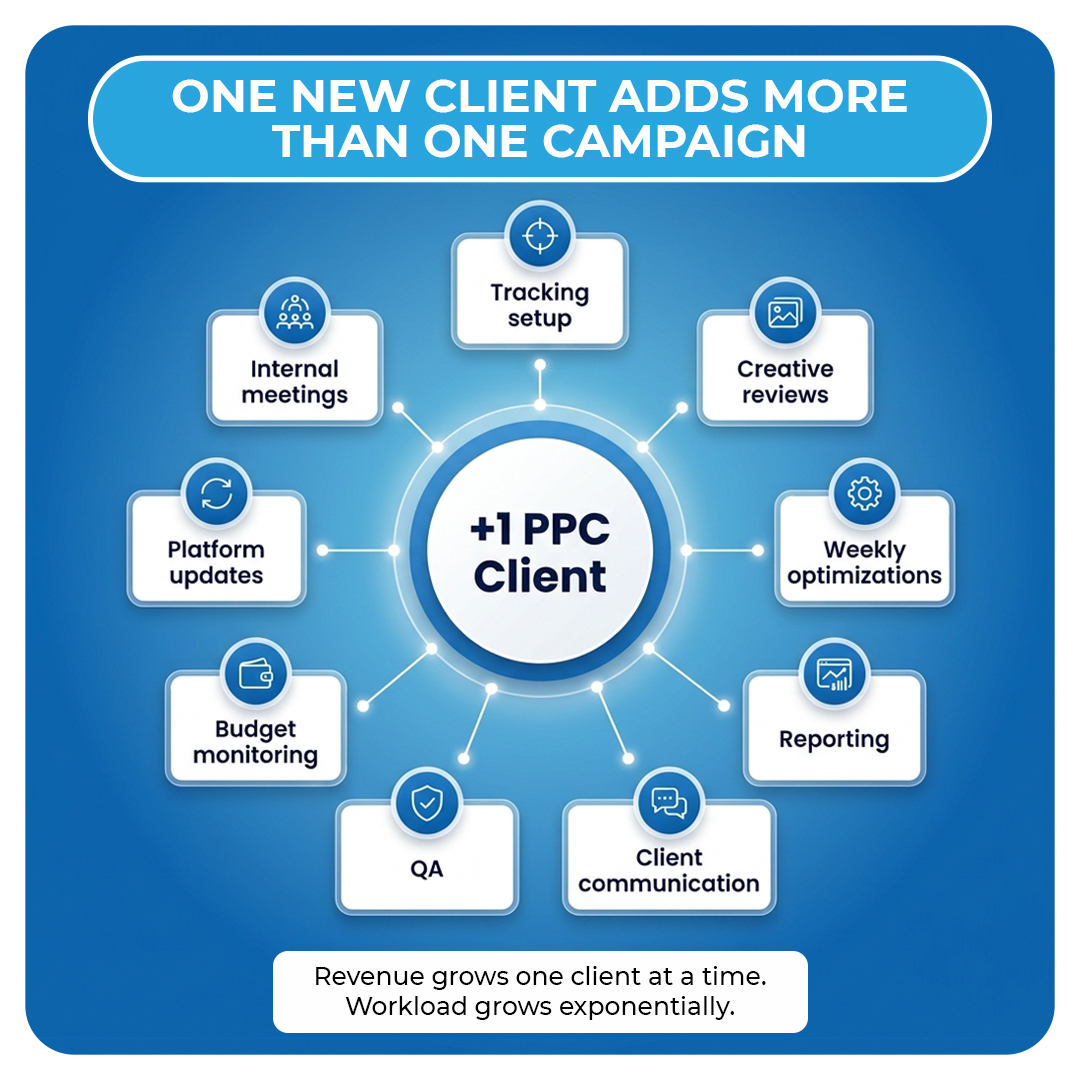
The danger of this framework is that it is gradual. No single new client breaks the system. But each one reduces the average time available for every other account. Agencies often fail to recognize the pattern until delivery quality begins declining and clients start asking questions.
The warning signs are worth knowing before they become a crisis.
Seven Signs Your Agency Is Experiencing PPC Delivery Strain
Delivery strain rarely announces itself all at once. It tends to surface through a series of small, easy-to-rationalize problems that eventually add up to something much harder to ignore.
- Campaign Launches Take Longer: When the team is overloaded, new campaign launches get pushed back. Account setup, ad copy review, and QA processes take longer than they should. Clients who were promised a fast launch start chasing timelines, and trust erodes before a single click has been recorded.
- Optimization Becomes Reactive Instead of Proactive: Proactive optimization, reviewing search terms, testing bids, and refreshing ads before performance drops require time and headspace that a stretched team simply does not have. When capacity is low, teams shift into reactive mode, responding to problems only after they have already impacted results.
- Reporting Is Consistently Delayed: Monthly reports require pulling data, analyzing performance, writing commentary, and formatting output for each client. When the workload grows faster than the team, reporting becomes the first thing to slip. Late or incomplete reports signal to clients that they are not a priority.
- Testing Frequency Declines: Ad testing is one of the most powerful levers in PPC performance, but it is also one of the first things to be deprioritized when capacity is tight. When teams stop testing regularly, campaigns stagnate and performance plateaus.
- Junior Staff Begins Managing Enterprise Accounts: As senior specialists get stretched across more accounts, higher-value clients often end up being handled by less experienced team members. The risk to campaign quality and client confidence is significant, particularly for clients with large budgets or complex account structures.
- Client Communication Slows Down: When delivery teams are overwhelmed, response times suffer. Emails go unanswered for longer than they should. Clients who are not hearing from their agency regularly start to question whether their account is being managed at all.
- Team Burnout Increases: Gallup reports that employee burnout is strongly associated with unmanageable workloads and a lack of support. For PPC teams managing a growing client load with limited resources, burnout is not a risk. It is a predictable outcome. When specialists burn out, performance declines, turnover increases, and the agency is left rebuilding capacity from scratch at the worst possible time.
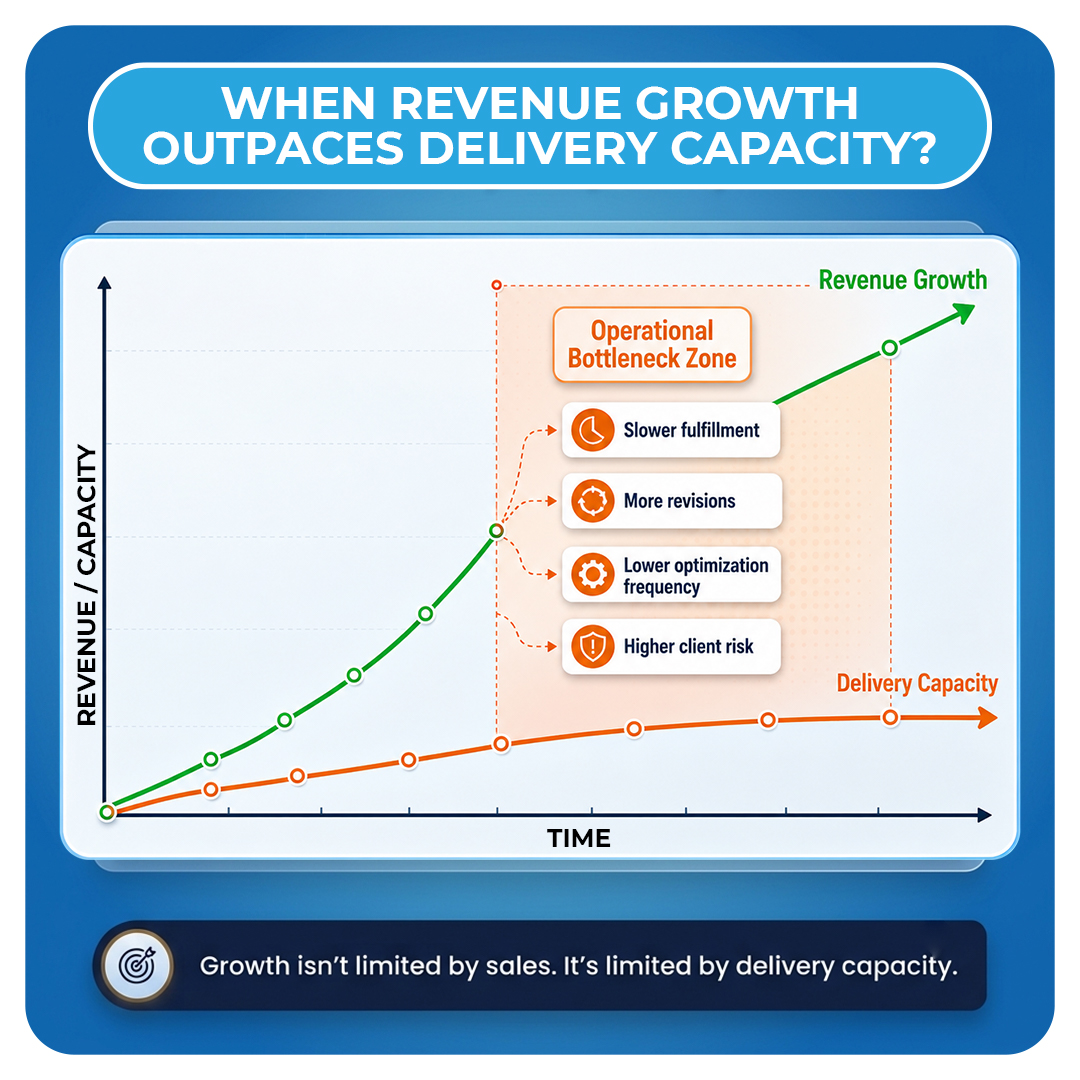
Taken together, these warning signs do not just affect the team. They eventually start showing up in campaign results.
How PPC Delivery Problems Affect Client Results?
Operational bottlenecks and campaign performance are directly connected. When delivery systems are strained, it is only a matter of time before the numbers tell the story.
Agencies experiencing delivery strain often see results shift in predictable ways:
- Rising cost-per-click (CPC) as bids go unreviewed and competitors gain ground.
- Higher cost-per-acquisition (CPA) as inefficient spend accumulates without correction.
- Missed optimization opportunities that would have improved targeting and reduced waste.
- Reduced impression share from campaigns that are not being actively managed.
- Slower response to market changes, including competitor activity, seasonality, and platform updates.
- Less effective testing, leaving campaigns running on outdated creative for longer than is appropriate.
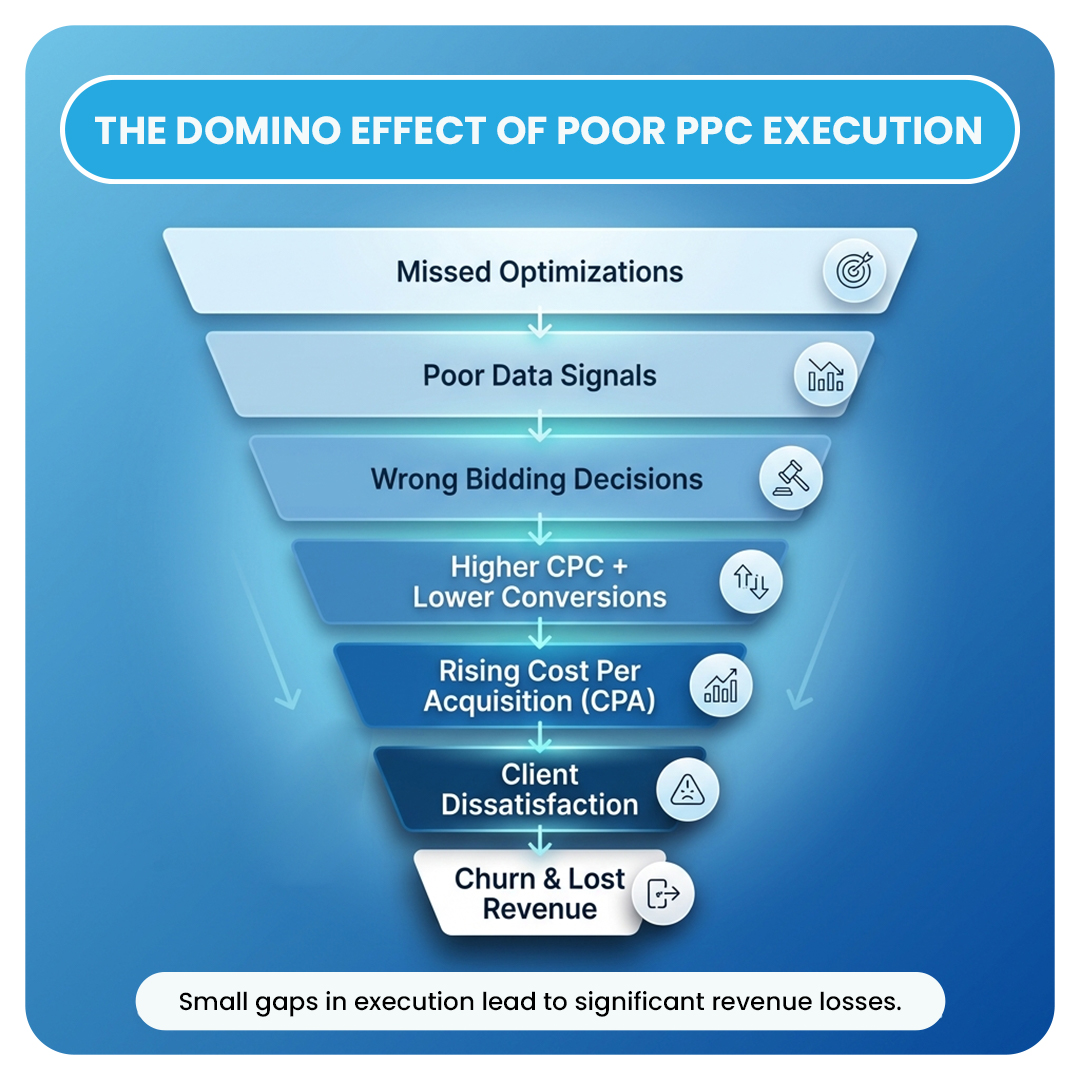
According to Google Ads Best Practices, regularly testing ads and optimizing campaigns improves performance over time. The inverse is equally true. Inconsistent optimization, which is a direct result of operational strain, reduces campaign effectiveness at a compounding rate. Gaps in management are not neutral. They are actively costly.
These performance gaps are what ultimately damage client relationships and drive churn. Hiring more staff seems like the logical response, but the reality is more complicated.
Why Hiring More PPC Specialists Isn't Always the Best Scaling Strategy?
The instinct to hire when workloads increase makes sense. More work requires more people. But hiring as the primary scaling strategy has significant limitations that agencies often underestimate until they are deep into the process.
Recruiting and onboarding skilled PPC professionals takes time and resources that most growing agencies cannot easily absorb. The costs and complications include:
- Recruitment time, which can stretch from weeks to months for experienced candidates.
- Training costs, particularly when the new hire needs to learn agency-specific tools, processes, and client contexts.
- SOP creation, because without documented processes, quality depends entirely on individual effort.
- Quality control, which requires management bandwidth that may already be in short supply.
- Employee turnover, which means the investment in recruitment and training, may need to be repeated more often than expected.
- Payroll overhead, which is a fixed cost that continues regardless of client volume fluctuations.
According to the U.S. Bureau of Labor Statistics, recruiting and onboarding skilled professionals requires significant investments of time and resources. For agencies where sales are moving faster than operational capacity, hiring rarely keeps pace. By the time a new specialist is fully onboarded and productive, the delivery gap has often widened further.
This mismatch between sales growth and operational readiness is exactly why many agencies are choosing more flexible operating models.
How Does White Label PPC Solve Agency Delivery Problems?
A white label PPC partner extends an agency's delivery capacity without replacing the client relationship. The agency remains the face of the service. A dedicated fulfillment team works behind the scenes to execute, optimize, and report on campaigns at scale.
This model addresses the core operational problems that internal teams struggle to manage alone. Fulfillment partners help agencies through:
- Dedicated PPC specialists who focus entirely on execution and optimization.
- Faster campaign launches supported by established processes and experienced teams.
- Consistent optimization schedules that keep every account actively managed.
- Structured QA processes that maintain quality standards across the entire portfolio.
- Continuous campaign monitoring to catch issues before they affect results.
- Reporting support that keeps client communication clear and timely.
- SOP-driven execution that reduces dependency on individual team members.
- Flexible scalability that allows agencies to onboard new clients without rebuilding their operations.
Importantly, the agency retains full ownership of what matters most:
- Client communication and relationship management
- Strategic direction and recommendations
- Brand identity and positioning
- Account oversight and approval
This structure removes the operational bottleneck without removing the agency from the picture. Clients receive consistent, professional PPC management. The agency maintains the relationship, earns the revenue, and avoids the overhead of building out an internal department to match every wave of growth.
The advantages of this model extend well beyond campaign management.
Agency Benefits Beyond Campaign Management
White label PPC fulfillment improves more than campaign execution. It changes the operational foundation of the agency in ways that support long-term growth and profitability.
Agencies that partner with a white label PPC agency typically experience broader improvements across their business:
- Better margins because fulfillment costs scale with client volume rather than running as fixed overhead.
- Predictable fulfillment because structured processes replace individual effort as the core delivery mechanism.
- Easier client onboarding because the fulfillment infrastructure is already in place and ready to deploy.
- Faster agency growth because sales no longer have to slow down to wait for operational capacity to catch up.
- Reduced burnout because internal teams are no longer being stretched beyond what is sustainable.
- Greater operational consistency because every client receives the same standard of service regardless of internal workload.
- Improved client retention because consistent performance and communication keep clients engaged and satisfied.
- Ability to offer PPC at scale without hiring, training, or managing a specialized internal department.
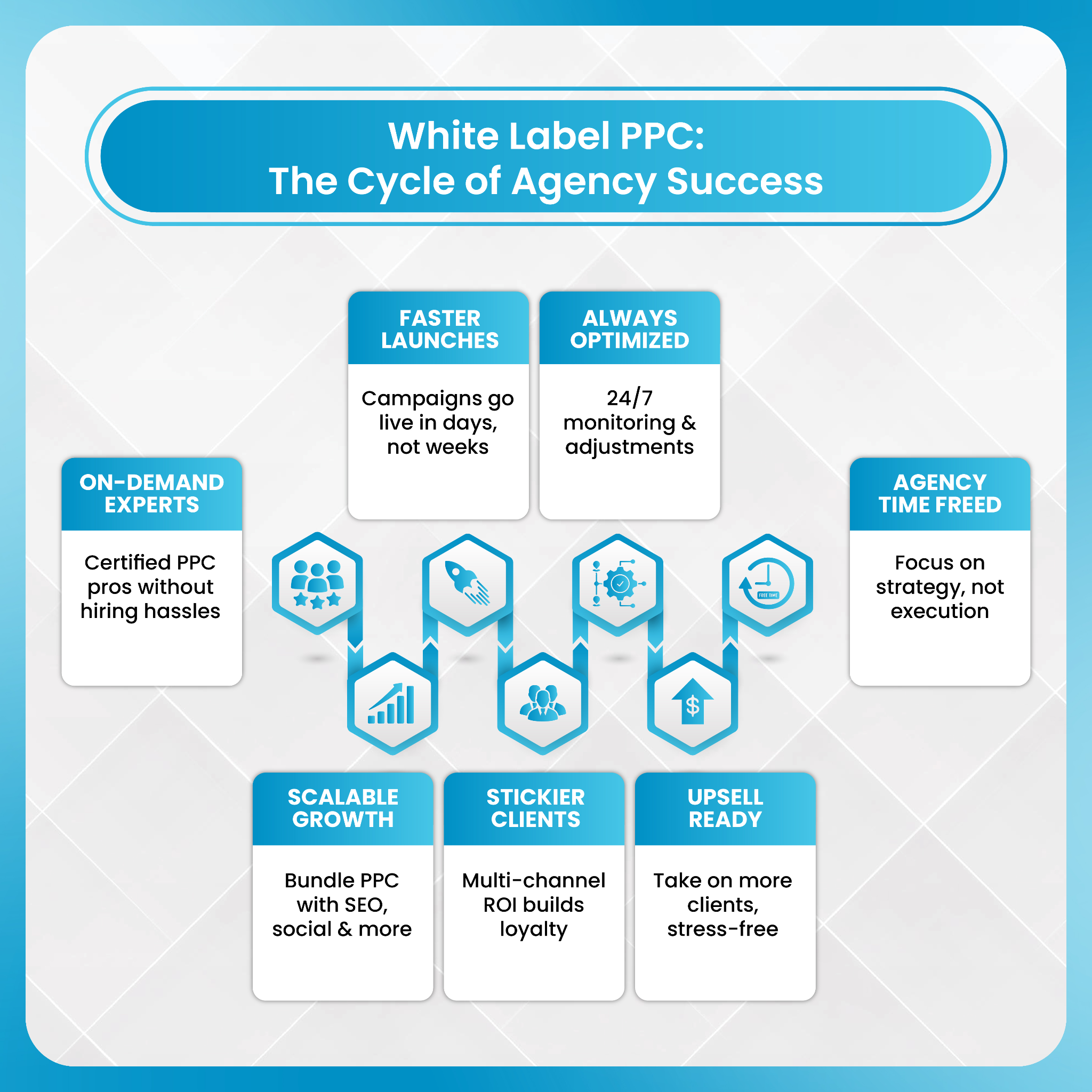
Customer retention is generally far more cost-effective than customer acquisition, making consistent service delivery a major contributor to long-term agency profitability. According to research published by Bain and Company, increasing customer retention rates by just 5% can increase profits by 25% to 95%. When white label fulfillment helps agencies deliver consistently, it protects and strengthens the client relationships that drive sustainable revenue.
Operational consistency is not just an internal benefit. It is something clients notice and respond to. When reporting arrives on time, campaigns perform reliably, and communication stays proactive, clients stay longer and refer more often.
For agencies ready to put this model into practice, the right white label PPC partner makes the difference.
How does DashClicks Support Growing Agencies?
DashClicks functions as an operational partner designed specifically for agencies looking to scale PPC services efficiently and sustainably. Rather than replacing agency expertise, it extends it.
- Strategic Campaign Management: Campaigns are developed and managed using structured, repeatable processes focused on measurable outcomes. Every campaign is built around clear performance goals, ensuring that execution aligns with the strategy the agency has established for each client.
- Dedicated PPC Specialists: Experienced PPC professionals handle campaign execution, freeing agency teams to remain focused on client relationships and strategic direction. Agencies benefit from specialized expertise without the overhead of hiring and retaining that talent internally.
- Continuous Optimization: Ongoing campaign monitoring, bid adjustments, ad testing, and optimization cycles are designed to keep performance moving in the right direction. Campaigns are never left to run without active management, which means performance issues are identified and addressed before they escalate.
- Transparent White Label Reporting: Reporting includes branded reports, performance dashboards, and actionable insights that make client communication straightforward. Agencies can present professional, clearly formatted results without building a reporting system from scratch.
- Scalable Fulfillment Infrastructure: DashClicks’ white label PPC services give agencies the infrastructure to increase fulfillment capacity, launch campaigns faster, support more PPC clients, and scale without expanding internal headcount. As an agency's client base grows, the fulfillment infrastructure scales alongside it, removing the operational ceiling that often limits how far an agency can grow.
Conclusion
Growing agencies rarely struggle because they lack marketing expertise. The real challenge is that operational complexity grows faster than fulfillment capacity. When that gap widens, even the most capable teams begin to underdeliver.
PPC, more than almost any other agency service, requires structured systems rather than simply more people. The daily workload is relentless, the stakes are high, and the margin for inconsistency is narrow. Without reliable delivery infrastructure, growth becomes a liability rather than an asset.
A white label PPC agency provides scalable operational support while allowing agencies to maintain full client ownership and campaign quality. The agency earns the relationship. The fulfillment partner enables the execution. Together, the model creates the kind of operational resilience that sustains long-term growth.
Sustainable agency growth depends just as much on efficient delivery systems as it does on successful client acquisition. Agencies that build those systems before hitting operational limits position themselves to grow with confidence rather than scrambling to keep up. The time to build that foundation is before the cracks appear.

No results found.
Please try different keywords.
Get Started with
DashClicks Today
Get found online, convert leads faster, generate more revenue, and improve your reputation with our all-in-one platform.
.svg)
Unlimited Sub-Accounts
Unlimited Users
All Apps
All Features
White-Labeled
Active Community
Mobile App
Live Support
100+ Tutorials
Unlimited Sub-Accounts
Unlimited Users
All Apps
All Features
White-Labeled
Active Community
Mobile App
Live Support
100+ Tutorials
Unlimited Sub-Accounts
Unlimited Users
All Apps
All Features
White-Labeled
Active Community
Mobile App
Live Support
100+ Tutorials


