

DashClicks Blog
The industry's top experts offer their best advice, research, how-tos, and insights—all in the name of helping you level-up your business and online marketing skills.
Join Us!
.svg)
.svg)
.svg)
.svg)
.svg)

White Label Google Ads for Agencies: Drive More Store Visits for Local Businesses
Most PPC reports look impressive on paper. Clicks increase, impressions grow, and CTR improves. But local business owners often ask a different question: "How many customers actually came into my store because of these ads?" Traditional PPC metrics rarely provide that answer.
According to Google's How Mobile Search Connects Consumers to Stores study, 76% of people who search on their smartphone for something nearby visit a related business within a day, and 28% of those searches result in a purchase. This highlights why local businesses care more about store visits, calls, and appointments than clicks alone.
Google Ads is uniquely positioned to connect online searches with offline actions through features like location targeting, call assets, Google Maps placements, and store visit measurement. However, achieving these outcomes requires campaigns that are built and optimized around customer intent, not just traffic.
In this blog, you'll learn why local businesses need Google Ads beyond website traffic, which campaign types are most effective for driving store visits, how to structure campaigns for offline conversions, which metrics agencies should report, the common mistakes that limit local PPC success, and how white label Google Ads management helps agencies scale high-performing local campaigns without expanding internal teams.
Local PPC success is no longer measured by traffic alone. Agencies that connect advertising performance with real business outcomes create stronger client relationships, improve retention, and deliver greater long-term value.
Why Local Businesses Need Google Ads Beyond Website Traffic?
Click-based reporting made sense when websites were the final destination. For local businesses, the website is often just a waypoint. The real goal is a phone call, a store visit, a booked appointment, or a completed purchase. When agencies report only on traditional PPC metrics, they miss most of what actually matters to the client.
Consider an HVAC company running Google Ads. A campaign generating 800 clicks at a $2.50 CPC looks efficient. But if those clicks produced only three service call bookings, the campaign is underperforming regardless of what the dashboard shows. The business cares about booked jobs. Clicks do not pay the bills.
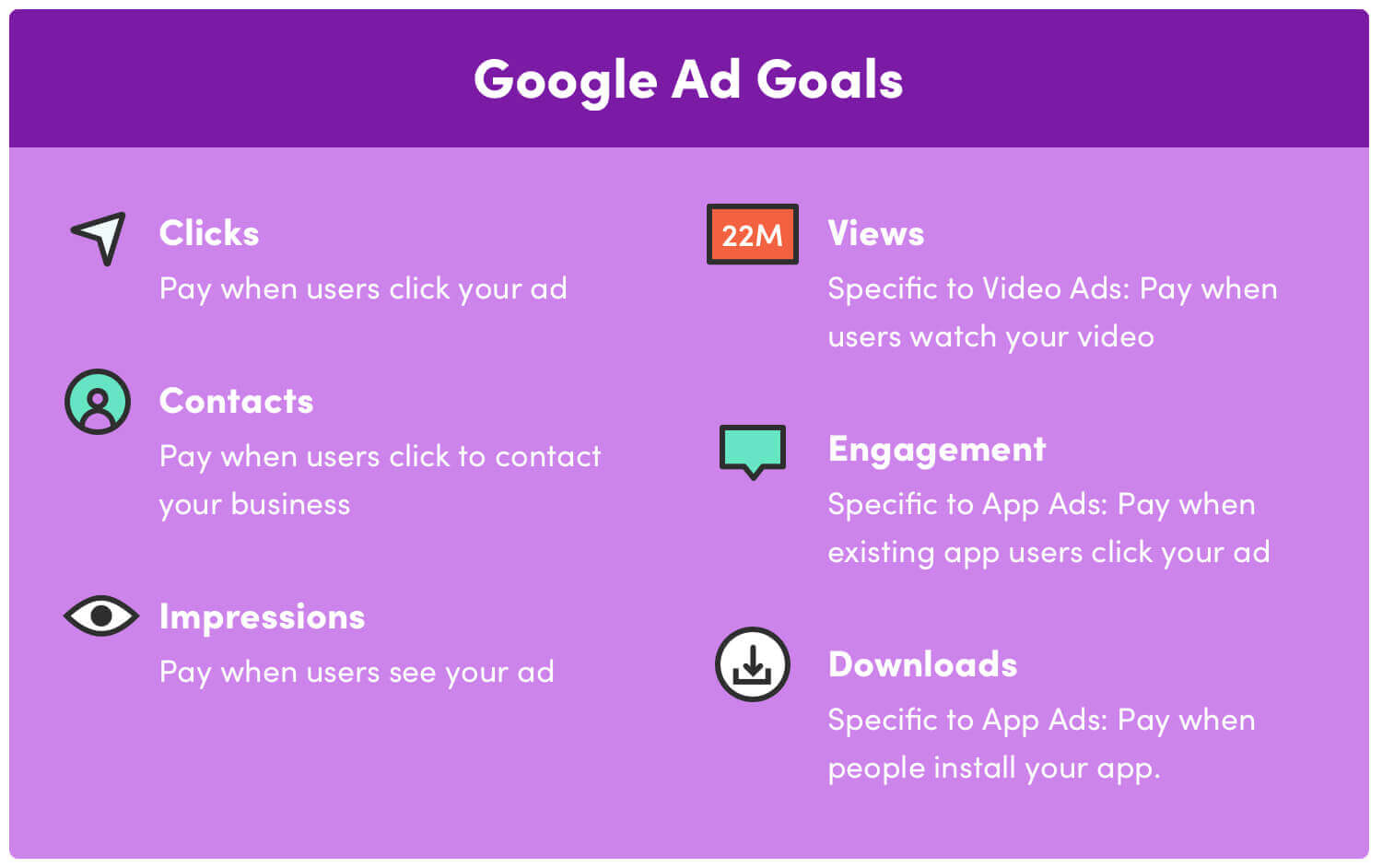
Image Source: Vital
The customer journey for a local business looks like this:
Search > Ad Click > Website or Call > Store Visit > Purchase
Every stage of that journey requires a specific optimization focus:
- Keyword Targeting: Capturing high-intent, local search queries.
- Ad Messaging: Communicating proximity, availability, and offers.
- Landing Pages: Delivering location-specific content and clear calls to action.
- Location Strategy: Ensuring ads appear where the audience is physically located.
- Conversion Tracking: Measuring actions that reflect real business outcomes.
Once agencies focus on the full customer journey instead of isolated click metrics, campaign selection becomes much more strategic. The right campaign type depends entirely on the offline action the business wants to drive.
The Google Ads Campaign Types Agencies Should Use to Drive Store Visits
Not every campaign type is equally effective at driving offline results. Agencies serving local businesses need to be selective and intentional about which formats they deploy, and why. Each Google Ads type plays a different role in connecting online searches with in-store activity.
1. Performance Max Campaigns
Performance Max (PMax) is Google's fully automated campaign type that runs across Search, Display, YouTube, Gmail, and Maps from a single campaign. For local businesses, PMax can be an effective tool for capturing audience intent across multiple touchpoints and driving store visit conversions.
PMax works best for:
- Multi-location retailers managing inventory across several stores.
- Restaurants running promotions or time-sensitive offers.
- Automotive businesses advertising services like oil changes or tire rotations.
- Healthcare practices promoting availability and appointment booking.
Running PMax campaigns effectively requires accurate conversion tracking, quality creative assets (images, headlines, descriptions, and video where possible), and strong business data fed through the Google Business Profile. Without these inputs, the algorithm has little signal to optimize against.
2. Local Search Campaign Strategies
High-intent local searches drive some of the strongest offline results in Google Ads. Queries like "coffee shop near me," "dentist open today," and "auto repair near me" signal immediate purchase intent. People searching these terms are usually ready to act, not just researching.
Optimizing for local search intent means prioritizing:
- Location Targeting: Radius-based targeting around the physical business location.
- Keyword Intent: Focusing on transactional, proximity-based queries.
- Call Assets: Making it easy to call directly from the search results page.
- Location Assets: Displaying the business address and linking to Google Maps.
These elements work together to lower the barrier between the search and the store visit. A shopper who sees your ad with an address, a phone number, and directions one tap away is far more likely to convert offline than one who has to navigate a generic website first.
3. Google Maps Visibility Through Location Assets
Google Business Profile integration is foundational to local PPC performance. When location assets are linked to a campaign, ads can appear directly within Google Maps, showing the business name, address, and distance from the searcher.
This placement captures navigational intent at the moment of decision. A user searching for a hardware store while they are already out running errands is not browsing. They are choosing. Appearing in that Maps result with directions one tap away is a direct driver of store visits.
Store visit measurement also depends on this setup. Google uses anonymized, aggregated signals from users who have location history enabled to estimate how many ad-attributed searches resulted in a physical store visit.
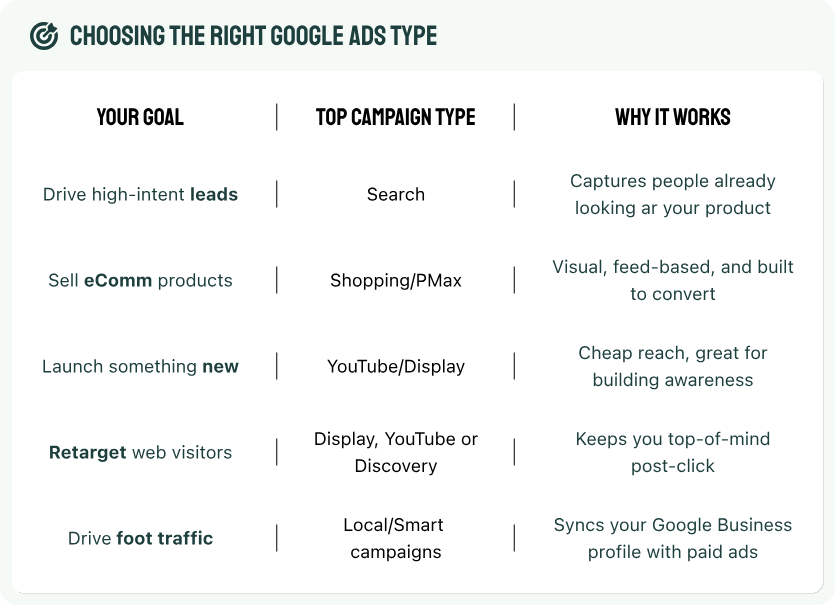
Image Source: Hitprobe
Selecting the right campaign type is only the beginning. How a campaign is structured ultimately determines how effectively it converts local intent into real store visits.
Further Reading: What Are the 22 Types of Google Ads (+ When & How to Use Them)
How Agencies Should Structure Google Ads Campaigns for Store Visit Optimization?
Campaign structure is where many local PPC campaigns fall apart. Grouping all keywords into a single campaign or using broad targeting without intent segmentation produces inconsistent results and makes optimization difficult. Structuring campaigns around customer intent solves both problems.
1. Build Campaigns Around Intent
A restaurant is a useful example. Rather than running one broad campaign covering every possible search term, a well-structured account separates intent into distinct campaigns:
- Campaign 1: Near me searches ("Italian restaurant near me," "dinner near me tonight")
- Campaign 2: Brand searches (the restaurant's own name and variations)
- Campaign 3: Competitor searches (capturing users searching for nearby alternatives)
- Campaign 4: High-value services ("private dining," "catering," "birthday dinner reservations")
Each campaign targets a different stage of decision-making and warrants different messaging, bidding strategies, and conversion goals. Mixing these intent layers into a single campaign makes it impossible to optimize each one effectively.
2. Prioritize High-Intent Keywords
Certain keyword modifiers consistently produce stronger offline results. These include:
- Near me searches that signal proximity as the primary deciding factor.
- Open now searches that indicate urgency and readiness to visit.
- Buy today or same-day keywords that suggest immediate purchase intent.
- City-specific searches that include the neighborhood, suburb, or city name.
These keywords typically convert at higher rates and generate more direct store visits than broader awareness-oriented queries. Prioritizing them in bidding and budget allocation concentrates spending where offline results are most likely.
3. Write Ads That Encourage Offline Action
Ad copy is one of the most underused levers in local PPC optimization. Many agencies write ads that describe the business but do not prompt the offline action the client needs.
Compare these two headline approaches for a furniture retailer:
Weaker approach:
- Affordable Furniture Store
Stronger approach:
- Visit Our Showroom Today
- Open Until 9 PM
- Same-Day Pickup Available
- Free In-Store Consultation
The second set of ads bridges online intent with offline action. They answer practical questions (hours, availability, what to expect) and give the searcher a concrete reason to visit rather than just browse. Every headline is an opportunity to reduce friction between the search and the store.
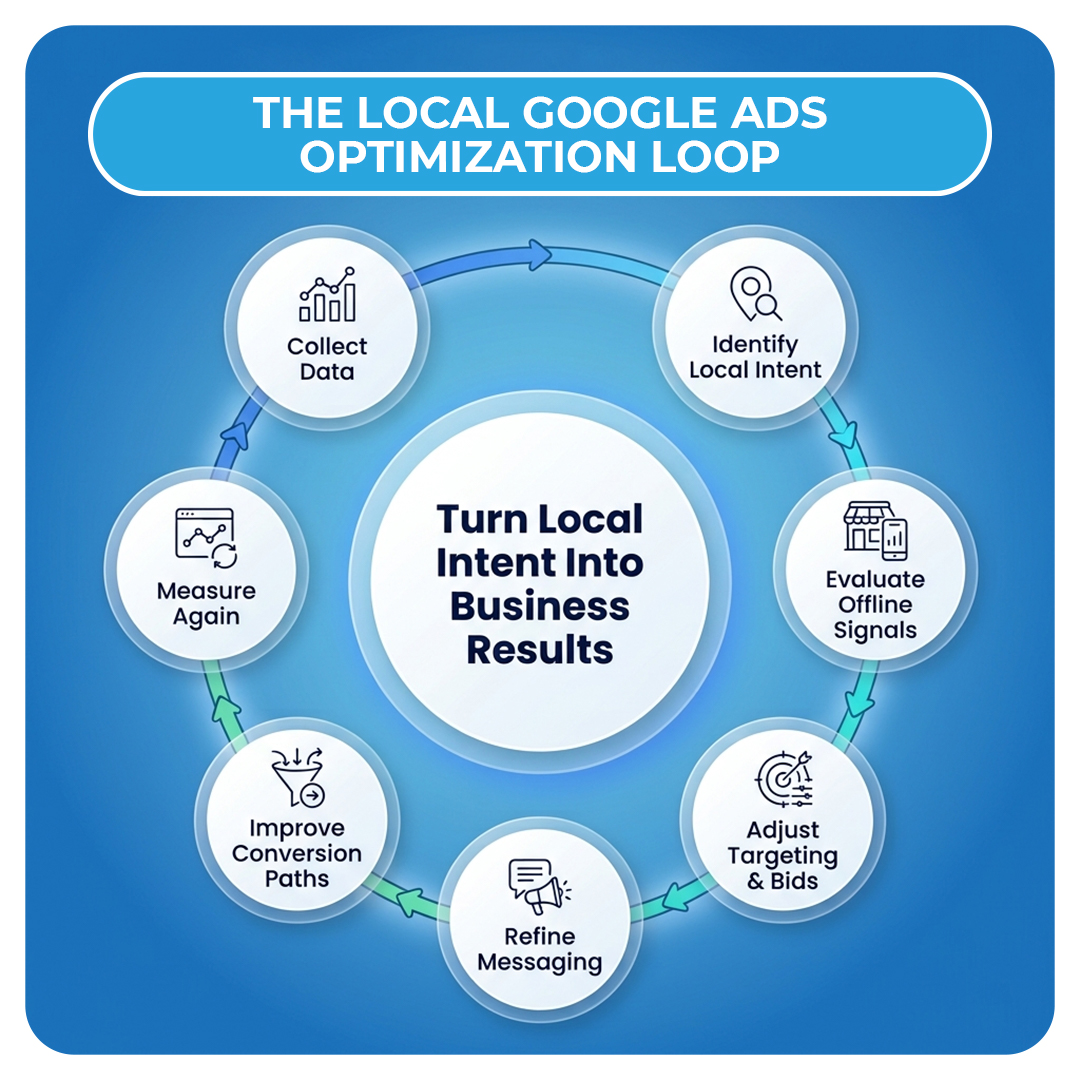
Strong campaign structures need equally strong reporting to demonstrate the business impact agencies are delivering.
Measuring Store Visit Performance: Metrics Agencies Should Report
Reporting on local PPC campaigns requires a different mindset than traditional digital reporting. The goal is to show clients how advertising contributed to real business outcomes, not just digital activity.
1. Store Visits
Google's Store Visit Conversions feature estimates how many users clicked on an ad and then visited the physical location. This metric relies on aggregated, anonymized location data from users who have opted into location history. Eligibility requires sufficient campaign volume and location data to produce statistically reliable estimates.
Agencies should use store visit data for trend analysis rather than treating each number as an exact count. Directional movement over time is the meaningful signal.
2. Calls Generated
Call assets within Google Ads allow users to call the business directly from the search results page. Google's call reporting tracks the number of calls generated, call duration, and whether calls resulted in connections. These metrics help agencies assess lead quality beyond raw call volume.
Longer call durations often indicate more qualified conversations. Tracking which keywords and ad groups generate the most calls helps with ongoing PPC optimization.
3. Directions Requests
When users click a location asset to get directions to a business, that action indicates strong purchase intent. Someone requesting directions is not casually browsing. They have decided to visit, or are very close to that decision. Tracking directions requests alongside store visits gives agencies a fuller picture of offline engagement.
4. Conversion Actions
Beyond calls and visits, local campaigns should track:
- Appointment bookings through integrated scheduling tools.
- Form submissions for quote requests or consultations.
- Purchases tracked through offline conversion imports or point-of-sale integrations.
5. Attribution Limitations
Store visit data is modeled and aggregated. It reflects estimated behavior across a population of users rather than individual-level tracking. Agencies should communicate this clearly to clients and frame PPC reporting around trends and directional performance improvements rather than precise figures.
Google states that advertisers using Store Visit Conversions gain a better understanding of how online advertising influences offline customer actions.
Even with accurate tracking in place, agencies can undermine campaign performance through a handful of common and avoidable mistakes.
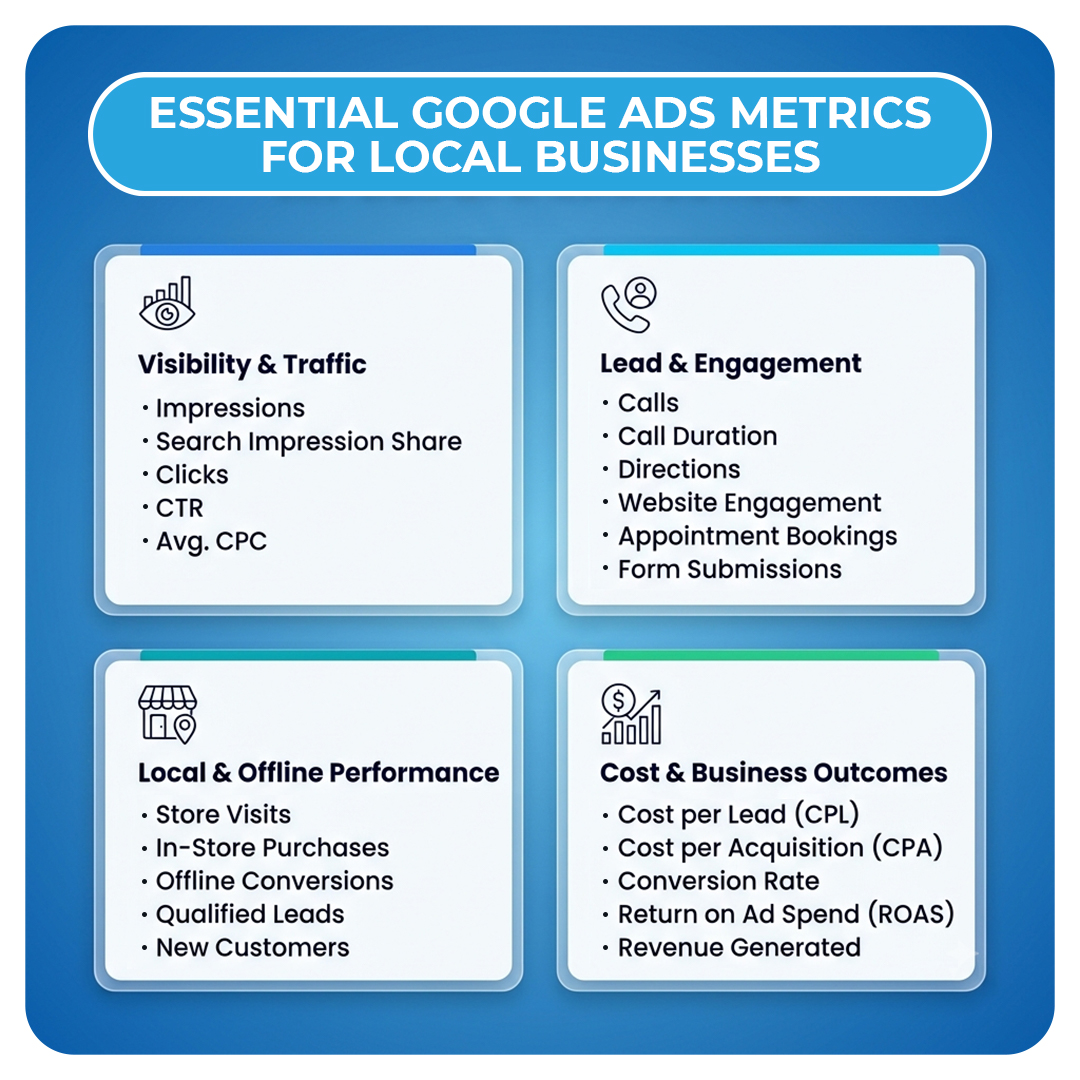
Common Google Ads Mistakes That Prevent More Store Visits
Local PPC campaigns fail in predictable ways. Understanding these mistakes helps agencies avoid them during setup and catch them during ongoing campaign optimization.
1. Optimizing for Cheap Clicks
Low cost-per-click is not a success metric for local businesses. A campaign generating 500 clicks at $1.00 each looks budget-efficient. But if those clicks came from low-intent queries with no connection to the local area or the service offered, that $500 produced nothing of value.
Optimizing purely for cheap clicks often means targeting broad, low-competition keywords that attract the wrong audience. A plumbing company in Chicago does not benefit from clicks generated by users in another city or by people researching plumbing DIY content. A budget spent on unqualified traffic is a budget not spent on customers who would actually call.
2. Ignoring Google Business Profile
Google Ads and Google Business Profile work together. A poorly maintained Business Profile undermines even well-structured campaigns. Issues that damage local ad performance include:
- Incorrect or outdated business hours
- Missing or low-quality photos
- Few or unresponded-to reviews
- Inaccurate address information
- Missing service descriptions or categories
Before running local PPC campaigns, agencies should audit and optimize the client's Google Business Profile. Location assets pull data directly from the Profile, so errors there surface in the ads themselves.
3. Sending Traffic to Generic Landing Pages
Sending local search traffic to a generic homepage is one of the most common campaign performance killers. A user searching for "emergency plumber Austin" clicks an ad and lands on a homepage with no mention of Austin, no phone number above the fold, and no way to book quickly. That user bounces.
Local PPC landing pages should include:
- Location-specific content that confirms relevance
- A prominent phone number and click-to-call functionality
- An appointment booking form or clear next step
- Business hours and address
The more directly the PPC landing page answers the searcher's intent, the more likely that click converts into a call or store visit.
4. Reporting Activity Instead of Business Results
Reporting clicks, impressions, and CTR to a local business owner is not enough. It may satisfy a monthly reporting requirement, but it does not demonstrate value. Clients who do not understand the business impact of their campaigns are more likely to reduce budgets or cancel.
Agencies should shift reporting to include:
- Calls generated and estimated lead quality
- Directions requests and store visit trends
- Appointment bookings and form submissions
- Revenue opportunities tied to tracked conversions
Framing results in business language rather than PPC jargon builds client trust and makes retention conversations easier.
Avoiding these mistakes becomes significantly easier when fulfillment is driven by standardized operational systems built for local PPC at scale.
How Does White Label Google Ads Help Agencies Scale Campaigns?
Growing a local PPC offering through in-house hiring is expensive and slow. Finding experienced PPC specialists, training them on local campaign best practices, and building consistent processes across a growing client base takes time that most agencies do not have. White label Google Ads management offers a faster path to scalable, high-quality fulfillment.
1. Access to PPC Specialists
When agencies partner with a white label provider, they gain access to experienced PPC professionals without adding headcount. This means agencies can sell local PPC services with confidence, knowing that campaign setup and optimization are handled by specialists. Client ownership stays with the agency. The partner works behind the scenes.
2. Consistent Campaign Setup
A structured white label fulfillment process covers every component of a well-built local campaign:
- Keyword research focused on high-intent, location-specific queries
- Campaign builds organized around customer intent
- Audience targeting using location radius and demographic filters
- Bid optimization aligned with offline conversion goals
- Negative keyword management to eliminate wasted spend
- Conversion tracking setup for calls, forms, and store visits
Consistency across these elements is what separates campaigns that produce results from those that simply run.
3. Better Reporting
A white label Google Ads provider typically deliver reporting that goes beyond raw performance data. Agencies receive performance explanations, optimization updates, and business-focused summaries they can share directly with clients. This kind of reporting makes client communication easier and helps retain accounts through clearer demonstration of value.
4. Scale Across More Clients
As an agency grows its local PPC client base, operational capacity becomes the limiting factor. White label fulfillment removes that constraint by providing:
- Standardized campaign workflows that reduce setup time
- Faster client onboarding without sacrificing quality
- Consistent performance quality across every account
- Greater capacity to take on new business without proportional cost increases
Structured fulfillment lets agencies focus on selling, strategizing, and building client relationships while campaign execution runs reliably in the background.
How DashClicks Helps Agencies Deliver White Label Google Ads Campaigns?
DashClicks provides white label Google Ads management built specifically for agencies that want to deliver measurable local results without managing campaign execution in-house.
1. Google Ads Campaign Fulfillment
The team handles the full campaign lifecycle for agency clients. This includes initial strategy development, campaign setup, ongoing optimization, and continuous monitoring. Every campaign is built around the client's actual business goals, whether that means driving phone calls, increasing store visits, or generating appointment bookings.
2. Conversion Tracking and Reporting
Tracking offline results requires careful setup. The platform configures conversion tracking for calls, location asset interactions, form submissions, and store visit reporting where eligible. Agencies receive clear visibility into the KPIs that matter most to their clients, along with client-ready reporting that communicates results in business terms rather than platform metrics.
3. Scalable Fulfillment
The team manages recurring campaign fulfillment so agencies can keep their focus on the areas that drive business growth:
Agencies continue to own:
- Client relationships and communication
- Sales and new business development
- Strategy and account direction
- Growth planning
DashClicks manages:
- Campaign builds and optimization
- Performance monitoring and adjustments
- Reporting and fulfillment documentation
With structured fulfillment supporting every campaign, agencies can consistently connect digital advertising with measurable offline business growth.
Turning Local Searches Into Real Business Outcomes
Local businesses need customers, not clicks. Measuring Google Ads performance against store visits, calls, appointment bookings, and in-store purchases is not optional for agencies that want to deliver genuine value. It is the standard.
Campaigns optimized around offline outcomes require deliberate strategy at every level: the right campaign types, intent-based campaign structures, ad copy that drives action, and reporting that speaks the client's language. These are not complex concepts, but they do require operational discipline and consistent execution.
White label Google Ads management helps agencies deliver that consistency at scale. Rather than stretching internal resources or compromising on campaign quality, agencies can fulfill local PPC campaigns through experienced specialists while maintaining full client ownership and growing their book of business.
Agencies that connect digital advertising with real-world business results will build stronger client relationships, higher retention rates, and a more sustainable competitive position. The opportunity is clear. The infrastructure to act on it is available.

How White Label SEO Helps Agencies Grow Existing Client Accounts
Most agencies focus on growth through new client acquisition, but one of the biggest revenue opportunities often lies within existing client relationships. Clients who already trust your agency are easier to retain, more likely to purchase additional services, and require far less effort to convert than new prospects. According to research, acquiring a new customer costs 5 to 25 times more than retaining an existing one, while existing customers spend 67% more on average.
This is where white label SEO services become a practical growth strategy. SEO remains one of the most sought-after digital marketing services, yet many agencies hesitate to offer it because they lack the internal expertise or capacity. White label SEO outsourcing enables agencies to provide high-quality SEO under their own brand without building an in-house team.
For agencies already managing websites, paid advertising, or content marketing, SEO is a natural extension of existing services. It helps increase monthly retainers, strengthens client relationships, and creates long-term value for both the agency and its clients.
In this blog, we'll explore why expanding existing client accounts is more profitable than constantly pursuing new business, when to introduce SEO opportunities, how a white label SEO agency supports scalable growth, and how agencies can build SEO into long-term client growth strategies.
Why Growing Existing Client Accounts Is More Profitable Than Constantly Chasing New Business?
Relying on new client acquisition to fuel agency growth is expensive, unpredictable, and unsustainable over time. Understanding the difference between acquisition-led growth and expansion-led growth helps agencies make smarter decisions about where to invest their energy.
1. Revenue Growth Through Acquisition
New client acquisition requires constant effort. The process typically involves:
- Ongoing Prospecting: Lead generation, outreach, and follow-up consume significant agency resources.
- Higher Acquisition Costs: Sales, marketing, and onboarding expenses reduce margin on new accounts.
- Longer Sales Cycles: Cold prospects take time to build trust before committing to a retainer.
The result is unpredictable revenue and a growth model that requires continuous investment just to stay in place.
2. Revenue Growth Through Account Expansion
Expanding existing accounts is a fundamentally different exercise. Key advantages include:
- Established Trust: Existing clients have already seen your agency deliver results.
- Easier Sales Conversations: Introducing a new service to a current client rarely requires a full sales process.
- Higher Recurring Revenue: Multi-service clients typically invest more per month than single-service clients.
- Better Retention: The more services a client relies on your agency for, the less likely they are to leave.
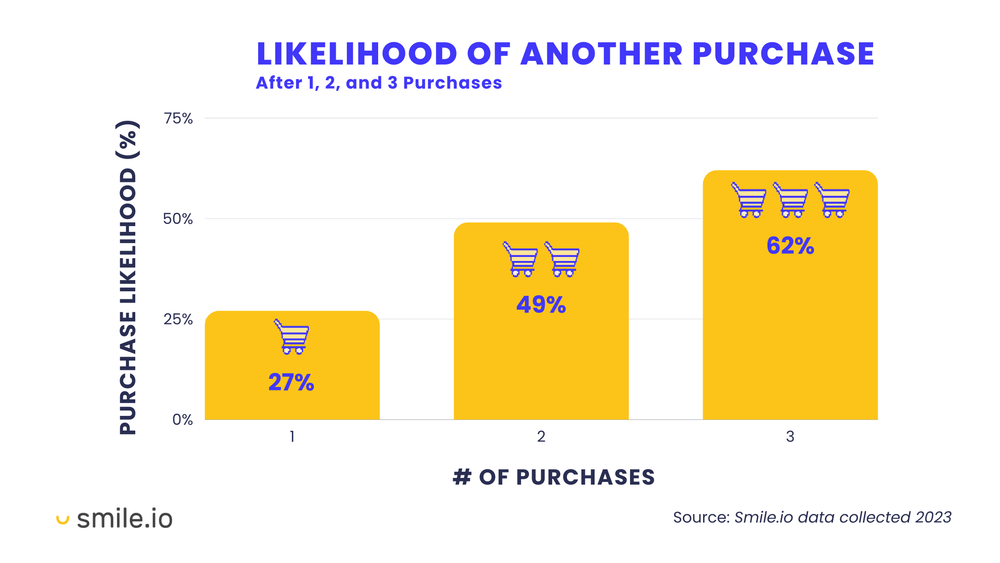
Image Source: Smile.io
These dynamics directly improve two of the most important agency metrics: Monthly Recurring Revenue (MRR) and Client Lifetime Value (LTV). When MRR grows through expansion rather than only acquisition, agencies build more predictable revenue streams that are easier to forecast and manage.
The most successful agencies don't choose between acquisition and expansion. They balance both growth strategies, using new client wins to build their base while consistently expanding relationships within their existing client roster.
Expanding client accounts successfully depends on introducing new services at the right time.
Further Reading: 11 Killer Strategies to Generate More Revenue from Existing Customers
Recognizing the Right Time to Introduce SEO to Existing Clients
SEO is not a service that should be pitched to every client at every stage of a relationship. It works best when it solves a problem the client is already experiencing or aligns with a goal they're already pursuing.
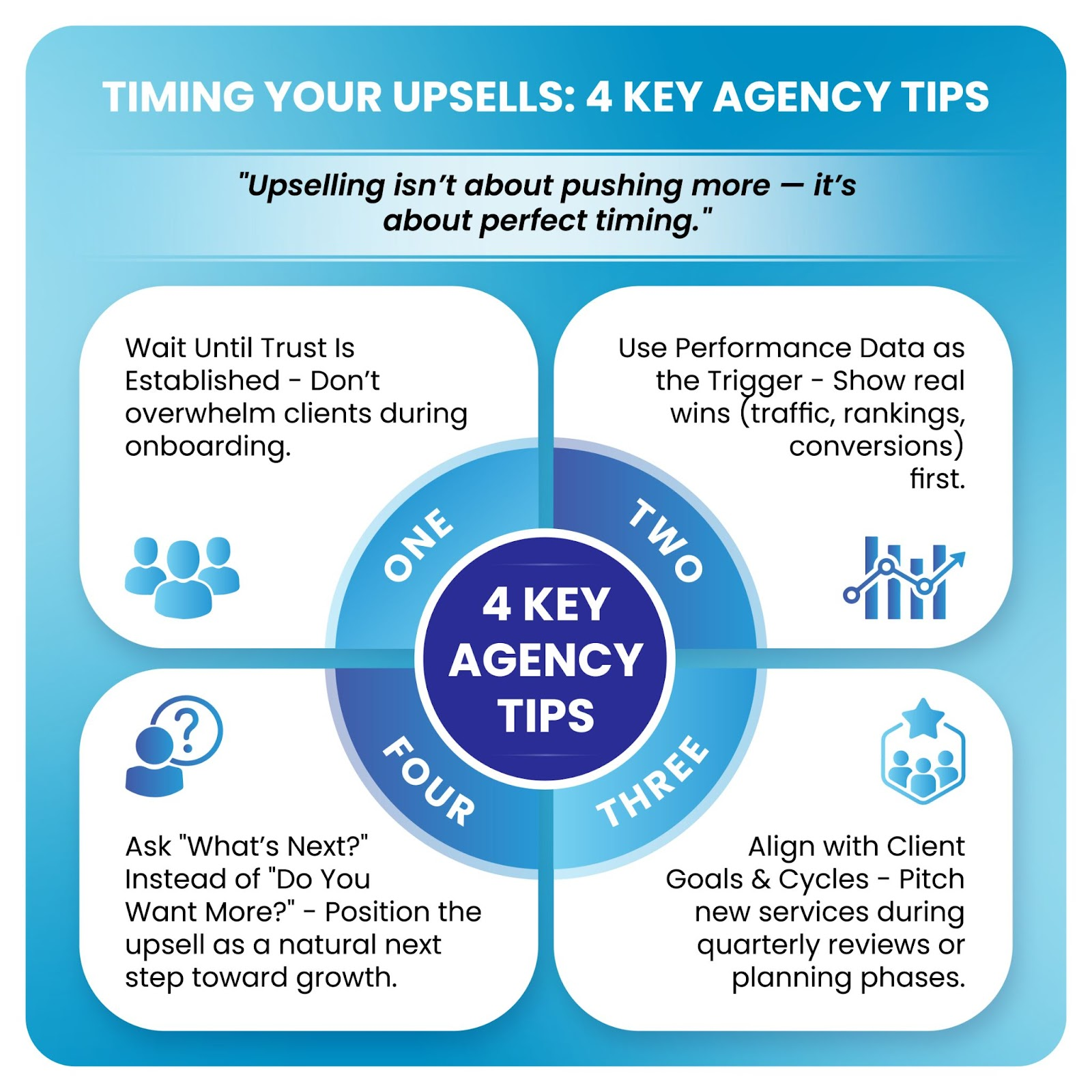
Timing often determines whether an SEO upsell feels helpful or sales-driven. The key is recognizing the buying signals that indicate genuine readiness.
Situations where SEO introduction tends to work well include:
- A client launches a new website: Post-launch is a natural moment to discuss technical SEO and on-page optimization.
- PPC campaigns perform well, but organic visibility is weak: Clients who see strong paid results often become curious about building organic traffic to reduce long-term ad spend.
- Local competitors dominate search results: When a client can see competitors outranking them in local search, the conversation about local SEO practically opens itself.
- A client asks about long-term lead generation: This question is often a direct signal that they're thinking beyond paid advertising.
- Website traffic plateaus: Stagnant traffic is a clear indicator that current efforts aren't driving growth, creating an opening to discuss keyword research and content optimization.
- Seasonal growth planning: Budget reviews and growth planning conversations are ideal moments to introduce search rankings as a strategic priority.
- Expansion into new markets: Clients entering new geographic areas or targeting new audiences often need SEO support to quickly establish visibility.
Account managers who listen carefully to client conversations will find these signals appear regularly. The goal isn't to force SEO into every account. It's to recognize when SEO genuinely addresses something the client already cares about.
Once agencies recognize the right opportunity, SEO naturally becomes part of a broader client relationship.
How White Label SEO Turns Single-Service Clients Into Multi-Service Partnerships?
One of the most effective ways to think about account expansion is as a natural service progression rather than a series of individual upsells. When agencies introduce services in a logical sequence, clients experience each addition as a continuation of ongoing work rather than a separate pitch.
A practical example of how this progression works:
Website Design → Technical SEO → Content Optimization → Local SEO → Ongoing SEO Management
Each phase in this workflow builds on the previous one and creates a foundation for the next. A client who invests in a new website is already a strong candidate for technical SEO. A client receiving ongoing SEO management is a natural fit for content optimization and local SEO support.
This approach delivers clear benefits:
- Higher Retainers: Multi-phase relationships generate more monthly recurring revenue than single-service accounts.
- Stronger Relationships: Agencies that support clients across multiple areas become harder to replace.
- Reduced Churn: Clients with deeper service dependencies are significantly less likely to switch providers.
- Greater Strategic Value: Agencies shift from vendor to growth partner, a position that commands more trust and more budget.
White label SEO outsourcing makes this progression practical because agencies don't need to build internal SEO capacity from scratch before introducing each phase. Fulfillment is handled externally, while the agency maintains the client relationship.
Many agencies already have ideal expansion opportunities sitting inside their existing client list.
The Best Cross-Selling Opportunities for White Label SEO
For agencies that already provide other digital marketing services, SEO fits naturally alongside nearly every existing offering. The table below outlines common cross-selling opportunities:
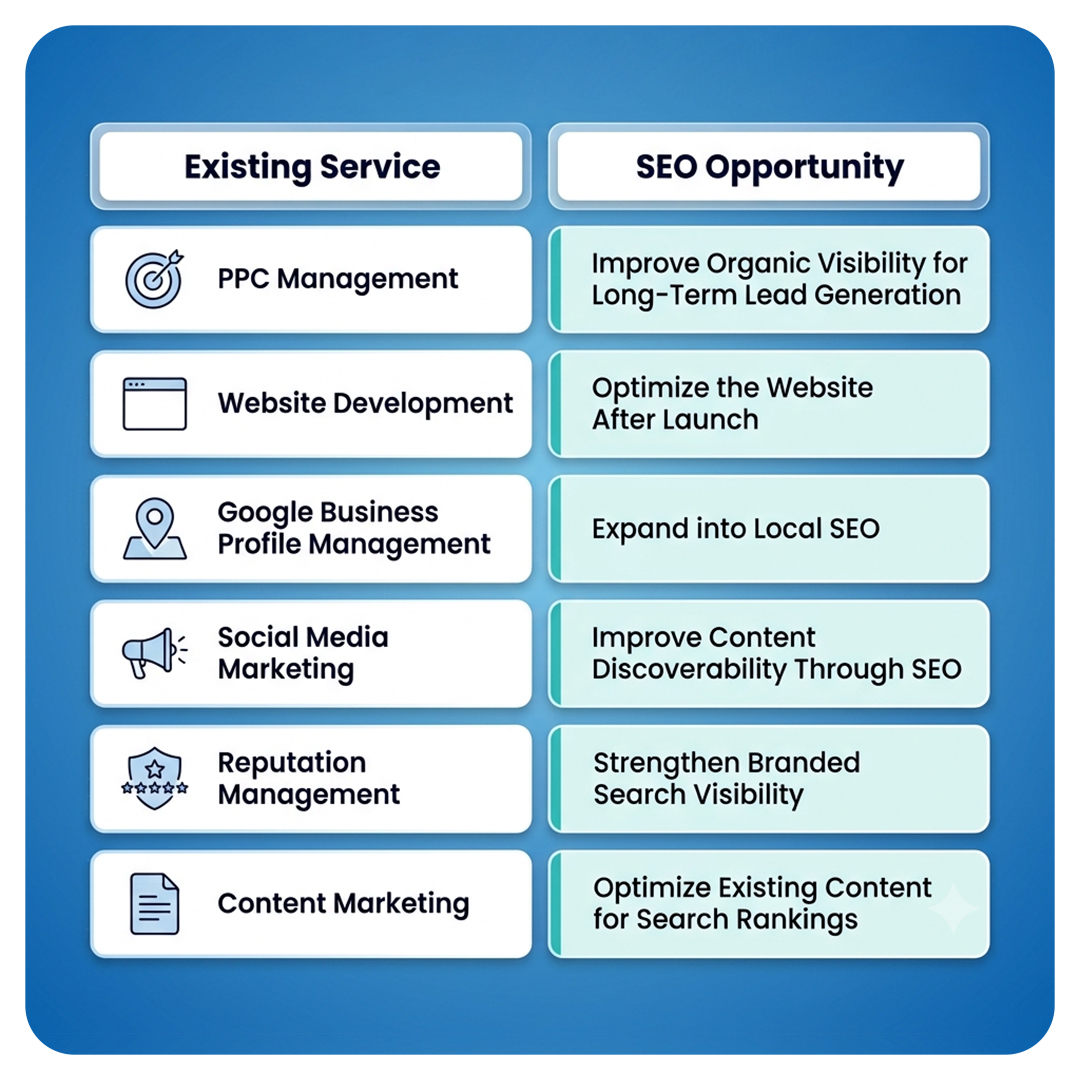
SEO complements existing marketing services rather than competing with them. A client running PPC campaigns benefits from stronger organic traffic because it reduces cost-per-acquisition over time. A client investing in content marketing gets more value from that content when it's optimized for search.
The most effective way to position SEO to existing clients is as an investment that strengthens what they're already doing, not as a replacement for any current strategy.
Despite these opportunities, many agencies struggle to introduce SEO because of operational limitations.
Common Operational Challenges That Prevent Agencies From Expanding Existing Accounts
Demand for SEO services is rarely the problem. Most agency clients would benefit from stronger organic visibility. The real barrier is usually internal.
Common operational challenges that prevent agencies from expanding into SEO include:
- Limited In-house SEO Expertise: Many agencies specialize in design, paid media, or social, and don't have the technical knowledge to deliver SEO confidently.
- Hiring Delays: Recruiting skilled SEO specialists takes time and often requires significant compensation packages that smaller agencies can't support.
- Capacity Constraints: Even agencies with some SEO knowledge may not have the bandwidth to take on additional accounts without compromising delivery quality.
- Inconsistent Fulfillment: Without standardized processes, SEO delivery becomes uneven across accounts, creating client satisfaction issues.
- Difficulty Pricing SEO Retainers: Without a clear understanding of what's included in each tier of service, pricing conversations become uncomfortable and margins suffer.
- Fear of Overpromising: Agencies that aren't confident in their SEO delivery often avoid offering it altogether, worried about committing to results they can't guarantee.
Many agencies fail to offer SEO because of operational challenges rather than lack of demand. Fixing that gap requires the right fulfillment structure.
These challenges become much easier to overcome when fulfillment is designed for scalability.
Why White Label SEO Makes Client Expansion Easier?
White label SEO services give agencies a way to offer search engine optimization without building an internal team from scratch. The result is faster service expansion, better delivery quality, and more room to grow. Here's how each component contributes to easier account expansion.
1. Faster Service Expansion
With white label SEO outsourcing, agencies can launch SEO services for new clients quickly. There's no waiting period for hiring, no ramp-up time for training, and no delay between the decision to offer SEO and the ability to actually deliver it. This speed matters because client opportunities don't wait for internal timelines to catch up.
2. Access to SEO Specialists
White label SEO agencies provide access to specialists across every area of search engine optimization, including:
- Technical SEO: Site audits, crawl optimization, site speed, and schema markup.
- Content optimization: Keyword research, on-page SEO, and content strategy.
- Local SEO: Google Business Profile optimization, citation building, and local search rankings.
- Link building: Outreach, placements, and authority building.
Agencies benefit from this expertise without carrying the cost of maintaining it internally.
3. Standardized Fulfillment
Reliable white label SEO providers operate with repeatable workflows and consistent deliverables. This means every client receives the same standard of work regardless of account size or complexity. Standardized fulfillment reduces errors, improves client satisfaction, and makes it easier to scale.
4. White Label Reporting
Branded reporting is one of the most practical benefits of white label SEO outsourcing. Agencies can present professional, client-ready SEO reports under their own branding, making every client presentation straightforward and polished.
5. Scalable Growth
White label SEO removes the ceiling that in-house capacity creates. Agencies can expand production, take on more accounts, and grow recurring revenue without needing to hire proportionally. Quality remains consistent because fulfillment processes are already built for scale.
According to HubSpot's 2026 State of Marketing Report, website, blog, and SEO continue to deliver among the highest marketing ROI of any digital marketing channel. Agencies that offer SEO as part of their service portfolio are well positioned to capture that value for their clients.
Scaling SEO becomes even more effective when agencies present it as part of a long-term growth roadmap.
Building SEO Into Long-Term Client Growth Plans Instead of Selling One-Off Projects
Project-based SEO engagements generate short-term revenue but don't build the long-term relationships that agencies need for sustainable growth. Positioning SEO as a phased, ongoing strategy changes how clients perceive the investment and makes retainer conversations much easier.
A practical phased framework looks like this:
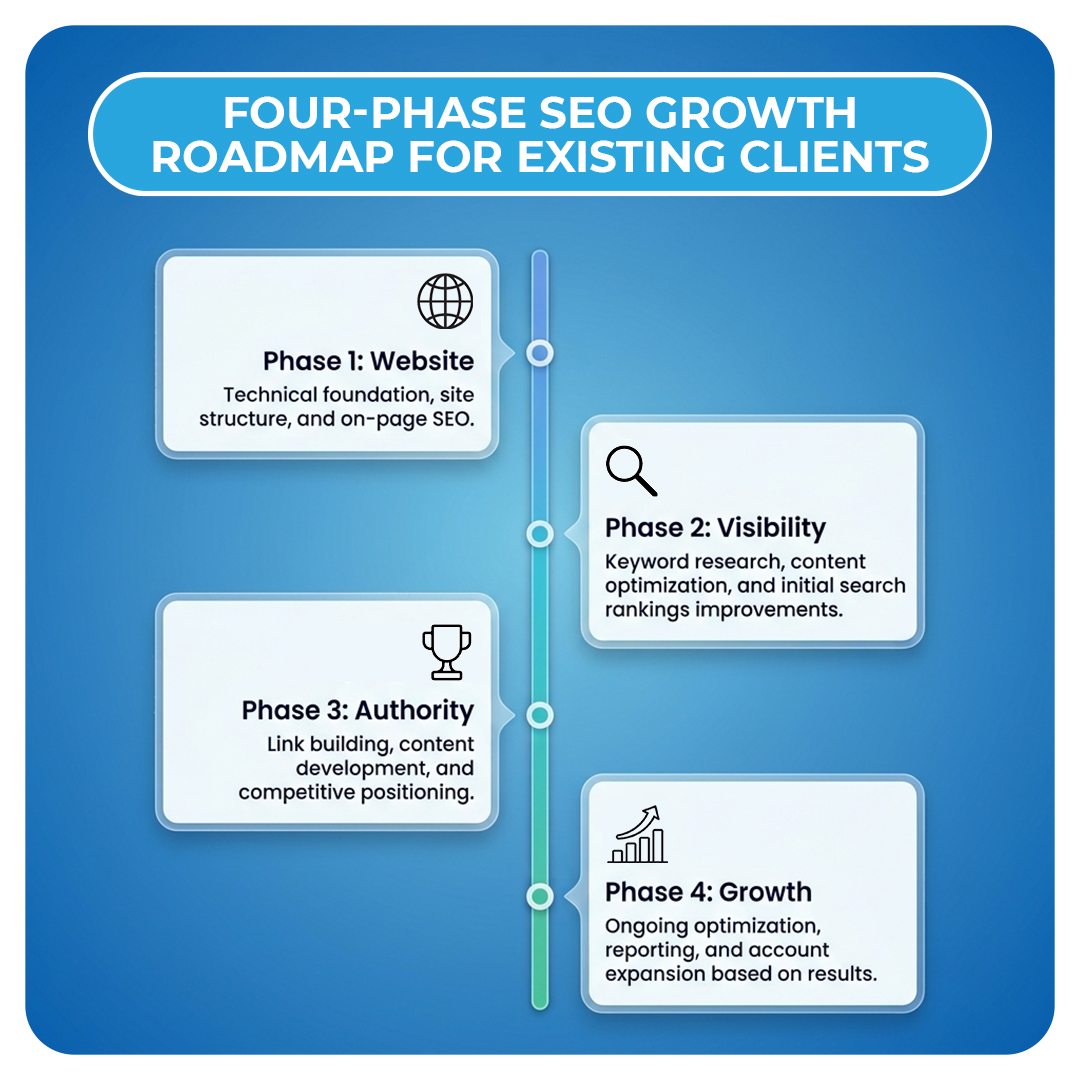
This framework works for two reasons. First, it shows clients a clear path forward rather than an open-ended commitment. Second, it builds confidence because each phase has a defined purpose and measurable outcomes.
Clients respond better to long-term planning than to isolated service pitches because a roadmap demonstrates strategic thinking. It positions the agency as a growth partner invested in outcomes, not just a vendor delivering tasks.
Not every client is ready immediately, but certain operational signals indicate when expansion is likely to succeed.
Operational Indicators That an Existing Client Is Ready for an SEO Expansion
Account managers who know what to look for can identify expansion opportunities well before clients raise them directly. The following checklist highlights the key indicators that an existing client is ready to invest in SEO:
- Website traffic has stabilized or plateaued
- Paid ads generate qualified leads, but costs are rising
- Client wants to reduce reliance on paid advertising
- Competitors consistently outrank them in search results
- Multiple service locations have been added
- Existing content generates little organic traffic
- Marketing goals have shifted toward long-term growth
These indicators matter because they signal genuine business need rather than manufactured urgency. When account managers can point to specific data from a client's own performance, the conversation about SEO becomes evidence-based and collaborative rather than a sales pitch. The checklist also helps account managers prioritize which existing clients to approach first, making outreach more efficient and more likely to convert.
Recognizing opportunities is only valuable if agencies can fulfill additional work consistently.
How Does DashClicks Help Agencies Expand Existing Client Accounts With White Label SEO?
DashClicks is built to help agencies deliver white label SEO services at scale, without adding internal headcount or compromising on quality. Its fulfillment infrastructure supports consistent delivery across growing agency client rosters.
- Scalable White Label SEO Fulfillment: Flexible production capacity allows agencies to take on additional SEO accounts without disrupting delivery timelines or quality standards. Whether you're adding one new account or ten, fulfillment can scale alongside your client base.
- Dedicated SEO Specialists: Agencies gain access to SEO specialists across technical SEO, on-page optimization, content development, local SEO, and link building. They don't need to source, vet, or manage these specialists directly. Fulfillment is handled externally while the agency maintains full ownership of the client relationship.
- White Label Reporting: Client reports are delivered under the agency's branding, making SEO performance easier to communicate and helping agencies maintain a professional, consistent client experience.
- Consistent Delivery Processes: Repeatable, standardized workflows help ensure predictable fulfillment across accounts. Agencies can set clear client expectations knowing that delivery remains consistent, timely, and aligned with agreed deliverables.
DashClicks provides the operational support agencies need to expand existing accounts confidently while maintaining control of client relationships.
When fulfillment is reliable, agencies can focus more on identifying expansion opportunities and strengthening client relationships rather than managing production capacity.
Sustainable Agency Growth Starts With the Clients You Already Have
The agencies that grow most sustainably aren't always the ones with the most aggressive acquisition strategies. They're the ones that recognize how much value already exists in their current client relationships and build systems to expand those relationships over time.
White label SEO services give agencies the operational foundation to introduce SEO without building an internal team, deliver consistently at scale, and increase recurring revenue through deeper client partnerships. The result is stronger retention, higher monthly retainers, and a more predictable growth trajectory.
SEO is not just another service to add to a price sheet. When positioned correctly and delivered reliably, it becomes a long-term growth initiative that benefits both the agency and the client. Agencies that treat it this way will find that their best growth opportunities aren't always waiting in a new prospect pipeline. Sometimes, they're already inside an existing account.

How White Label SEO Helps Agencies Balance Speed and Quality
Agencies don't have to choose between fast SEO delivery and high-quality execution. The real challenge is building operational systems that support both. White label SEO services give agencies the structured workflows, specialized teams, and scalable infrastructure needed to grow without sacrificing results.
According to BrightEdge, 53.3% of all trackable website traffic comes from organic search, making consistent SEO execution critical for businesses. For digital marketing agencies, that statistic represents both an enormous opportunity and a mounting operational pressure. Clients expect SEO to be set up quickly. They also expect continuous optimization, measurable progress, and regular reporting, all delivered without disruption.
The problem is that speed and quality are often treated as opposing forces. When agencies rush to onboard new clients or meet tight turnaround expectations, technical mistakes creep in, content becomes thin, and optimization becomes inconsistent. The result is poor rankings, frustrated clients, and churn that offsets any growth the agency achieved.
But agencies don't need to choose between speed and quality. The real solution isn't working faster or hiring more people. It's building the operational systems that allow both to happen at the same time. A white label SEO agency, used strategically, isn't just a way to outsource work. It's an operational solution that allows agencies to scale without the bottlenecks that slow most of them down.
If SEO has become one of the most valuable services agencies provide, why do so many agencies struggle to deliver it efficiently as they grow?
Why Agency Growth Often Creates a Speed vs. Quality Problem?
Growth feels like the goal until it starts creating operational strain. Every new SEO client adds a recurring workload, not a one-time project. That distinction matters more than most agency owners realize when they're in growth mode.
SEO requires continuous execution. Rankings shift, algorithms update, content needs refreshing, and technical issues appear without warning. One new client might mean several recurring tasks per month across technical SEO audits, keyword research, content optimization, link building, quality assurance reviews, reporting, and client communication. Multiply that across 20, 40, or 80 clients, and the volume becomes difficult to manage without a structured system.
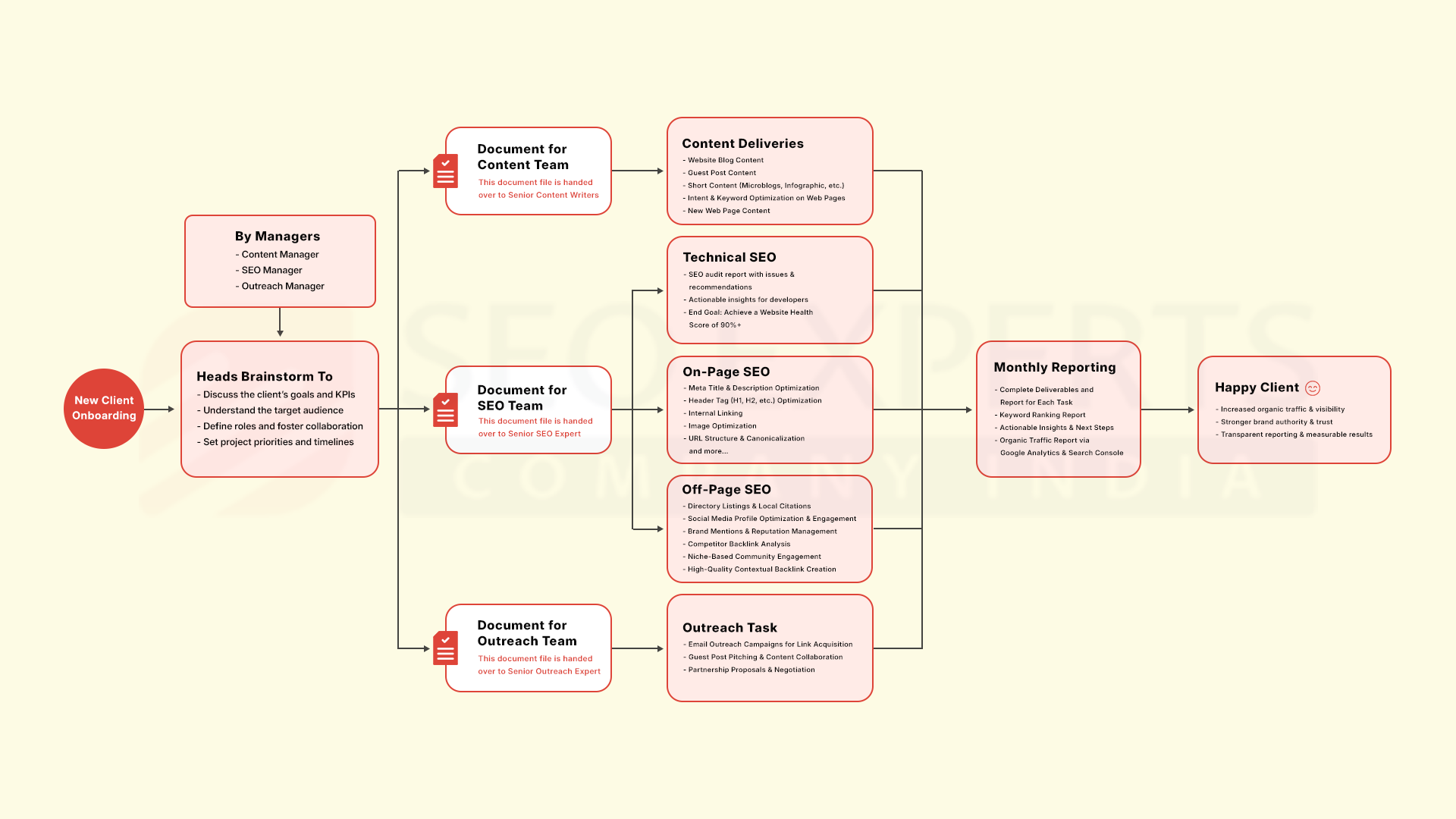
Image Source: SEO Experts
Small delays compound quickly. If keyword research runs a day late, content briefs are delayed. If content is delayed, publishing falls behind. If publishing slips, the reporting cycle becomes inconsistent. None of these delays look serious in isolation, but across a full client base, they erode confidence and slow down results.
Hiring seems like the obvious answer, but recruitment takes time, onboarding takes longer, and new team members need months before they operate at full capacity. Operational complexity increases faster than headcount, and agencies that rely on adding people to solve delivery problems often find themselves hiring reactively rather than scaling strategically.
The issue is rarely SEO knowledge. It is the growing number of recurring tasks that must be completed consistently, across every client, every month, without gaps.
What "Quality SEO" Actually Looks Like Behind the Scenes?
Quality SEO isn't just about rankings. It's about structured execution and aligned SEO strategy across every layer of a campaign.
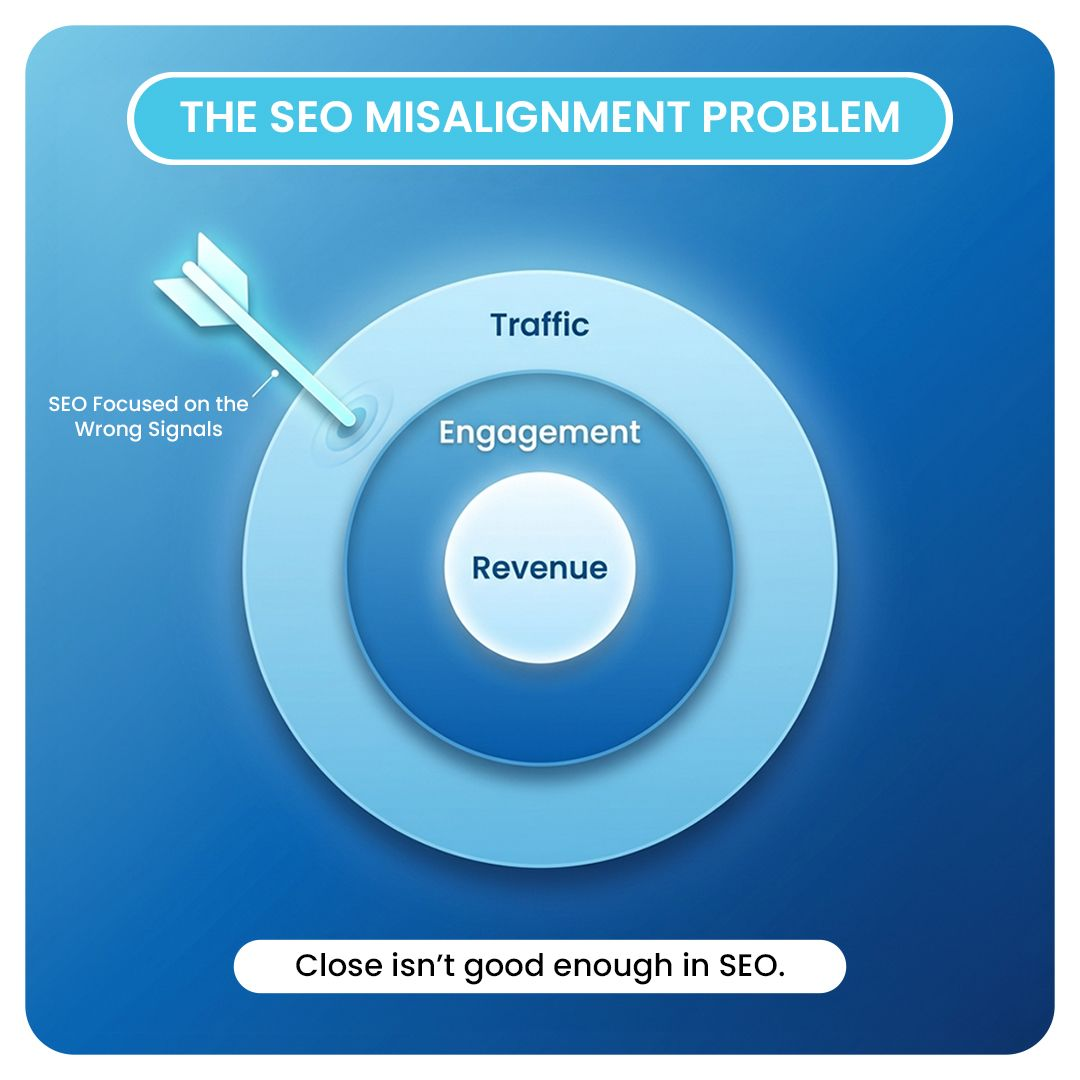
Agencies that understand this are better positioned to build repeatable delivery systems rather than relying on individual effort.
- Strategic Planning: Every quality SEO engagement starts with a clear understanding of the client's business goals, target audience, and competitive landscape. This means mapping search intent carefully, identifying which keywords signal purchase readiness versus research behavior, and analyzing competitor visibility to find gaps worth targeting. Without this foundation, even technically flawless SEO can miss the mark.
- Technical Excellence: Search engines need to crawl, index, and understand a website before any optimization can take effect. Technical SEO covers crawlability, site architecture, indexation, and Core Web Vitals, the performance metrics Google uses as part of its page experience systems (Google Search Central). Addressing technical issues early removes barriers that can suppress rankings regardless of content quality or link authority.
- Content Optimization: Content is the primary way a website communicates relevance to search engines and value to users. Quality content optimization goes beyond keyword placement. It involves aligning content with search intent, building topical authority across related subjects, strengthening internal linking structures, and updating existing content to reflect current information and rankings data.
- Authority Building: Search engines use external signals to evaluate how trustworthy and authoritative a website is within its industry. Building that authority requires acquiring quality backlinks through digital PR, strategic outreach, and local citations for businesses targeting specific geographic markets. Low-quality link building can cause more harm than good, which is why this pillar demands consistent standards.
- Continuous Improvement: SEO is not a launch-and-leave discipline. Rankings fluctuate. Competitors make moves. User behavior shifts. Monitoring organic traffic, tracking keyword movement, analyzing conversions, and making ongoing optimizations are what separate campaigns that plateau from those that continue growing.
Delivering this level of execution consistently across dozens of SEO clients is primarily an operational challenge.
Where Agencies Lose Speed Without Realizing It?
Most agencies don't lose time because their SEO knowledge is lacking. They lose time because their internal workflows aren't built to handle recurring, high-volume fulfillment efficiently.
- Context Switching: Every time a team member shifts between client accounts, they lose momentum. Moving from a technical SEO audit for one client to a content brief for another and then to a reporting call for a third fragments focus and increases error rates. Context switching is a quiet productivity drain that becomes more damaging as the client roster grows.
- Manual Processes: Spreadsheets, manual audits, repetitive reporting, and disconnected tools slow everything down. When teams build and format reports from scratch each month, export data from multiple platforms, or perform audits without structured templates, they spend hours on logistics that could be handled through standardized systems.
- Lack of Standardized Workflows: Without documented processes, every team member approaches tasks differently. One person's SEO audit might cover 15 checks while another's covers 40. One content brief might include search intent mapping while another skips it entirely. Inconsistent workflows produce inconsistent quality, which means QA reviews take longer and errors slip through more often.
- Quality Control Delays: Review and approval steps are necessary, but they become bottlenecks when there's no clear structure. Without defined review checkpoints, deliverables sit in queues, feedback loops are slow, and final approvals delay the entire production schedule.
- Communication Bottlenecks: Internal delays caused by unclear ownership, missing context, or slow responses between team members can hold up entire campaigns. When a team member needs clarification before moving forward and can't get it quickly, tasks stall.
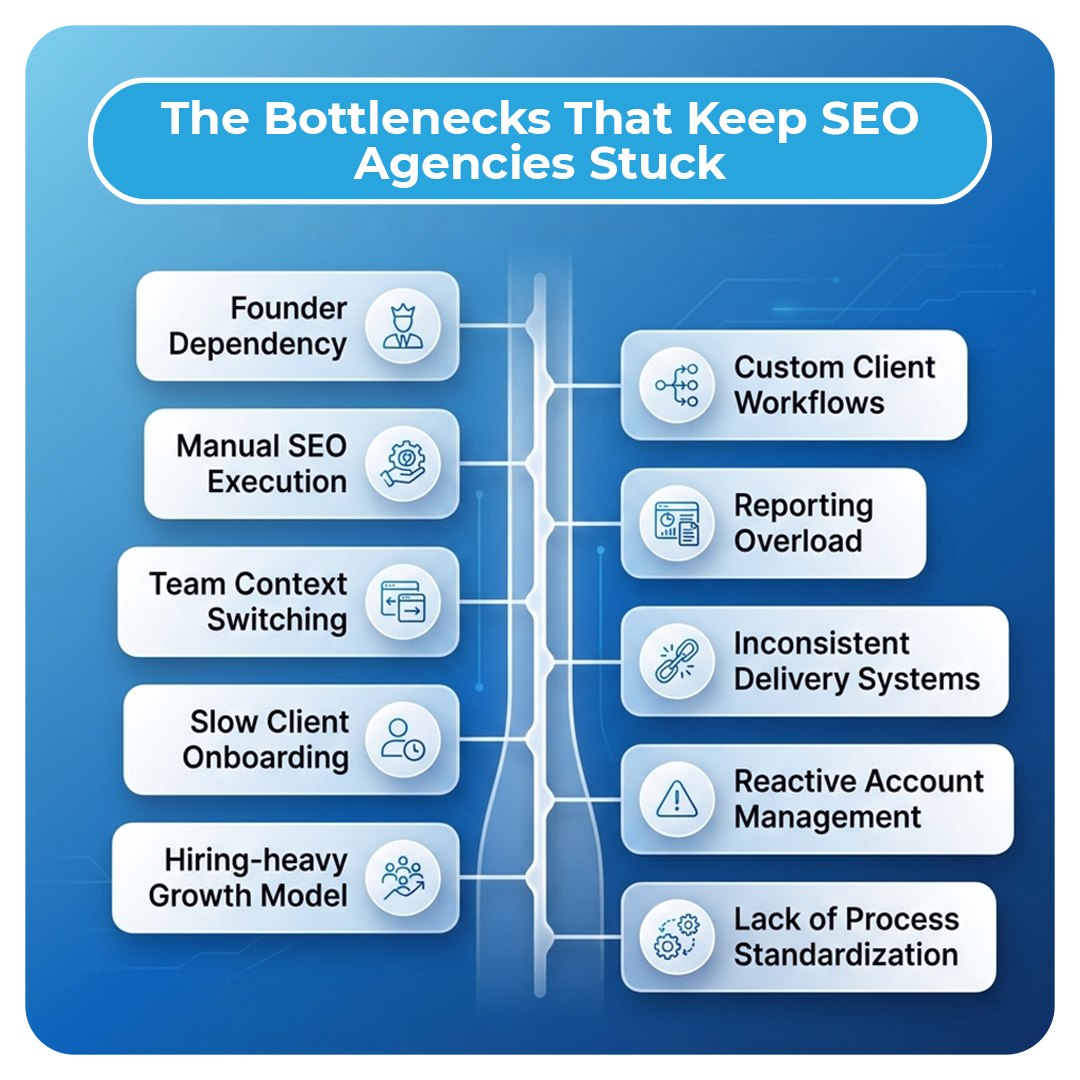
Improving delivery speed requires improving operational workflows, not just working harder or adding hours.
How White Label SEO Creates Operational Efficiency Without Sacrificing Quality?
A white label SEO partner doesn't just add capacity. When structured correctly, it introduces operational efficiency that most agencies can't replicate internally without significant investment and time.
1. Specialized Teams Instead of Generalists
Internal agency teams are often built around versatility. One person handles technical SEO, content, reporting, and client calls. That versatility is valuable for small account loads, but it becomes a liability at scale. White label SEO services typically use specialized teams, where technical SEO specialists focus exclusively on crawlability, site architecture, and Core Web Vitals.
Content teams focus on search intent, topical authority, and content optimization. Link acquisition teams manage outreach and digital PR. Local SEO specialists handle citations and local search visibility. Reporting teams build and maintain white label dashboards. Specialization reduces errors, increases speed, and raises the quality ceiling for each function.
2. Standardized SOPs
Reliable white label SEO partners operate on documented standard operating procedures. Repeatable workflows mean every SEO audit follows the same structure, every content brief addresses the same strategic elements, and every report delivers consistent data. Fewer decisions need to be made from scratch each time, which reduces errors and maintains quality across all accounts.
3. Parallel Execution
Sequential fulfillment is one of the biggest speed constraints agencies face. A linear workflow where a technical audit must be completed before keyword research begins, keyword research before content briefs, and content before technical fixes creates unnecessary delays. White label SEO services built on specialized teams can execute multiple activities simultaneously. While one specialist runs a technical SEO audit, another conducts keyword research, and a third begins content optimization planning. Parallel execution compresses timelines without cutting corners.
4. Built-In Quality Assurance
Structured review systems catch errors before deliverables reach the agency or client. Rather than relying on individual team members to self-review, white label partners build QA into the workflow at defined checkpoints, ensuring consistency without adding pressure to the agency's internal team.
5. Predictable Turnaround Times
Consistency in delivery timelines allows agencies to set accurate client expectations, structure retainer agreements confidently, and plan capacity without guessing. According to PMI's Pulse of the Profession, organizations using standardized project management practices achieve better performance outcomes. Predictability is a byproduct of standardized systems, and it makes agencies easier to work with from a client's perspective.
Operational efficiency becomes even more valuable as agencies continue growing.
Further Reading: How White Label SEO Simplifies SEO Operations for Agencies
Scaling SEO Without Expanding Internal Headcount
Hiring is expensive and slow. A single experienced SEO specialist can take weeks or months to recruit, followed by an onboarding process that may last another two to three months before the new hire operates at full productivity. Add training time, documentation requirements, and the ongoing cost of salary, benefits, and management overhead, and internal hiring becomes a significant barrier to rapid, sustainable growth.
Employee turnover compounds the problem. When a specialist leaves, the agency loses institutional knowledge along with capacity. Rebuilding takes time, and the clients those specialists were serving feel the disruption.
White label SEO services offer an alternative model. When an agency wins new business, it can expand fulfillment capacity almost immediately without recruiting, interviewing, or onboarding anyone. The white label SEO partner absorbs that additional volume through its existing infrastructure. Resources scale up as the agency grows and adjust if business needs change, without the fixed cost structure of a full-time team.
This model also removes the capacity planning problem. Agencies no longer need to predict exactly how many specialists they'll need six months from now. The partner handles fluctuations, allowing agency leadership to focus on strategy, client relationships, and business development rather than workforce planning.
Scaling successfully also requires maintaining the client experience, not just the production volume.
Why Does Consistency Improve Client Confidence?
Clients don't only evaluate agencies on rankings. They evaluate agencies on how it feels to work with them. Responsiveness, timely deliverables, clear reporting, actionable strategic recommendations, and reliable communication all shape how a client perceives the value they're receiving, especially in the early months before significant ranking movement occurs.
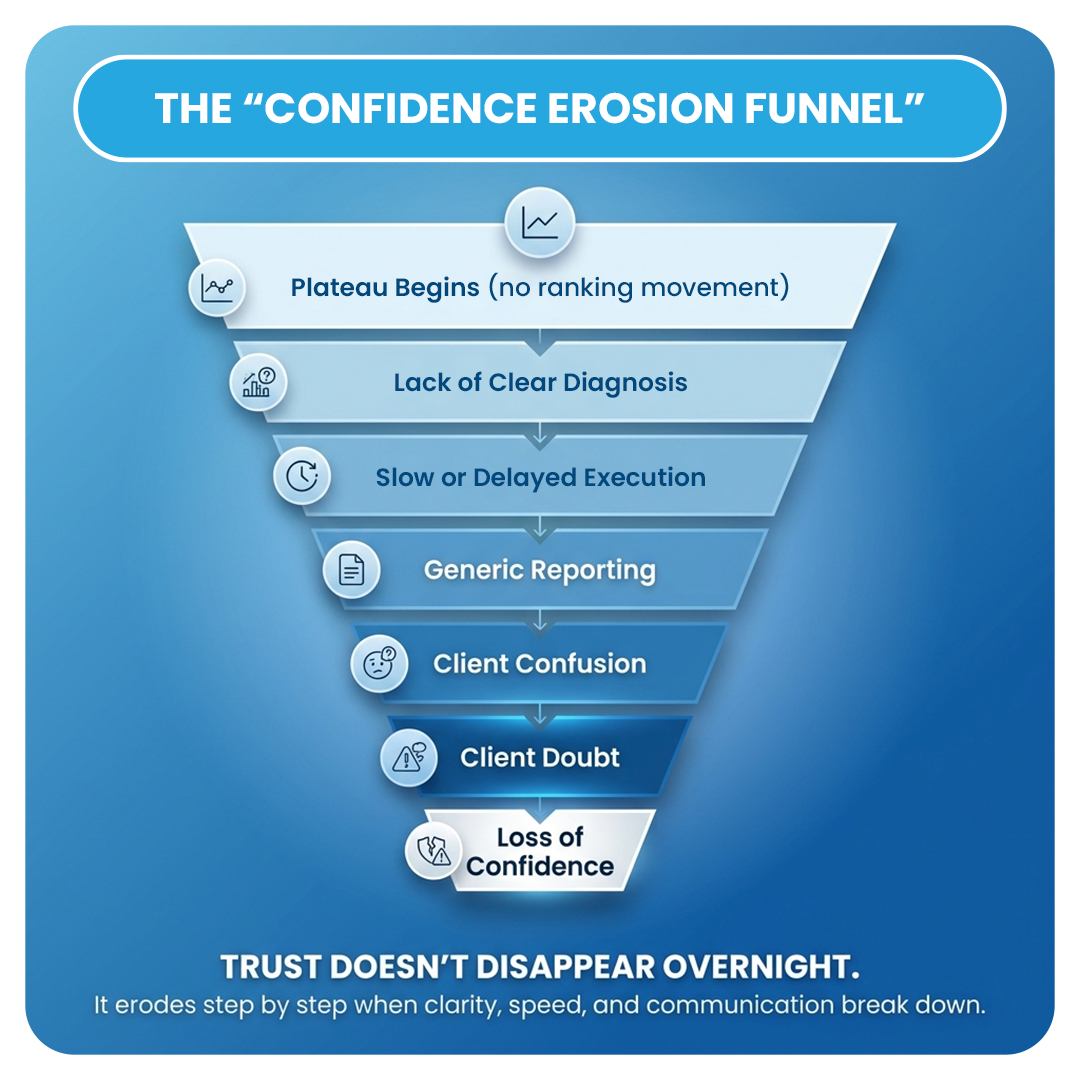
Consistency builds trust faster than results alone. A client who receives a thorough monthly report on time, gets questions answered promptly, and sees a clear plan being executed is far more likely to stay than a client who gets inconsistent updates and unclear progress signals, even if both clients have similar ranking trajectories.
According to Bain and Company, increasing customer retention by just 5% can increase profits by 25% to 95%. For agencies, that means the operational systems that support consistent delivery aren't just fulfillment decisions. They are revenue decisions.
Agencies that deliver SEO consistently, communicate clearly, and report transparently build the kind of client relationships that generate long-term retainer revenue and referrals. Those that struggle with inconsistency lose clients before the SEO work has time to produce meaningful results.
Operational consistency becomes easier when agencies rely on repeatable fulfillment systems.
How DashClicks Helps Agencies Balance Speed and Quality?
DashClicks provides white label SEO services designed specifically to help agencies scale fulfillment without sacrificing quality. Every component of the offering is built around structured execution and consistent delivery.
- White Label SEO Fulfillment: The white label SEO team handles the full scope of SEO delivery, including technical SEO, content optimization, backlink building, and local SEO. Agencies gain access to comprehensive fulfillment without managing individual specialists or building out separate service lines internally.
- Experienced SEO Specialists: Work is executed by dedicated SEO professionals with experience across technical, content, and authority-building disciplines. Specialization ensures that each component of the SEO strategy is handled by someone focused on that specific area, which produces more consistent and reliable results.
- Structured Workflows: Standardized processes govern how every task is scoped, executed, and reviewed. This reduces variability, improves turnaround reliability, and makes it possible for agencies to plan delivery timelines with confidence.
- White Label Reporting: Agencies receive professional, white label reports that can be delivered directly to clients under the agency's brand. Reports communicate progress clearly, demonstrate ongoing value, and support transparent communication throughout the engagement.
- Scalable Fulfillment Infrastructure: As an agency's client base grows, the fulfillment infrastructure scales with it. It is built to absorb increased volume without compromising standards, giving agencies the operational flexibility to pursue growth without worrying about whether they can deliver on it.
DashClicks positions itself as an operational extension of the agency, handling fulfillment so that internal teams can focus on strategy, relationships, and growth.
The Right Operational Partner Changes What's Possible
Speed without quality produces poor SEO outcomes. Thin content, ignored technical issues, and inconsistent optimization don't generate rankings or organic traffic, regardless of how fast they're delivered. Quality without operational efficiency limits how far an agency can grow before fulfillment becomes unsustainable.
Sustainable agency growth requires systems that support both. White label SEO services, built on specialized teams, standardized workflows, and parallel execution, give agencies the operational infrastructure to scale without choosing one over the other.
Agencies that invest in consistent execution strengthen client trust, reduce churn, and create the foundation for long-term growth. The constraint isn't SEO knowledge. It's operational capacity. And with the right white label SEO partner, that constraint disappears.

Reactive vs. Structured Google Ads Optimization: Why White Label PPC Wins
Google Ads has evolved significantly. What once relied on manual adjustments now uses AI-powered bidding, automated campaign types, and machine learning to optimize campaigns across millions of auctions in real time. While automation has made campaign management more efficient, it has not eliminated the need for strategic oversight.
Successful campaigns still depend on accurate conversion tracking, well-structured accounts, quality creative assets, and consistent optimization. According to Google's Economic Impact methodology, businesses earn an average of $8 in revenue for every $1 spent on Google Ads, but those results rely on ongoing optimization rather than campaign setup alone.
As agencies grow, maintaining that level of optimization becomes increasingly difficult. More client accounts often mean less time for proactive account reviews. PPC specialists shift from scheduled optimization to reactive problem-solving, addressing issues only after performance declines or clients raise concerns. Over time, these reactive workflows lead to inconsistent results, operational inefficiencies, and lower client retention.
The challenge isn't a lack of PPC expertise. It's the absence of structured operational systems that ensure every account receives consistent attention. A white label PPC agency helps agencies implement repeatable optimization processes across their entire client portfolio without expanding internal teams. While winning Google Ads clients is important, consistently optimizing campaigns at scale is what separates successful agencies from the rest.
Why Google Ads Optimization Has Become More Complex?
Google Ads has evolved far beyond keyword bidding and text ad creation. Today, the platform combines AI, automation, audience intelligence, and privacy-focused measurement, making optimization far more complex than it was just a few years ago.
Several key changes have transformed how agencies manage campaigns:
- AI-Powered Bidding and Smart Bidding: Manual CPC strategies have largely been replaced by automated bidding. Google states that Smart Bidding performs best when supported by accurate conversion tracking and reliable data, making proper account setup more important than ever.
- Performance Max Campaigns: Performance Max distributes budgets across Search, Display, YouTube, Gmail, Discover, and other Google properties. Success depends on strong creative assets, audience signals, campaign goals, and continuous optimization rather than simple keyword management.
- Broad Match Evolution: Broad Match keywords now reach a wider range of relevant searches. While this increases reach, it also makes regular search term reviews and negative keyword management essential for maintaining traffic quality.
- Greater Reliance on First-Party Data: Customer Match lists, audience signals, and other first-party data sources now play a much larger role in campaign performance. Agencies must develop stronger audience strategies to maximize results.
- More Complex Conversion Tracking: Before Google's AI can optimize effectively, agencies need clean conversion data, appropriate attribution models, and properly configured tracking. Privacy changes, including cookie deprecation and Consent Mode, have made accurate measurement more challenging.
- Rising Competition and Advertising Costs: Increasing advertiser competition has driven higher CPCs across many industries. Budget allocation, Quality Score improvements, and efficiency optimization have become increasingly important for maintaining profitability.
Automation has certainly reduced repetitive manual work, but it has not replaced strategic oversight. As Google Ads continues to evolve, how agencies optimize campaigns has become just as important as the optimization strategies they choose.
What Is Reactive Google Ads Optimization?
Reactive optimization occurs when agencies make changes only after problems have already appeared. There is no structured schedule, no recurring review process, and no systematic approach to monitoring account health. Work happens in response to issues rather than in anticipation of them.
Common triggers for reactive optimization include CPA increases, ROAS declines, budget overspends, Impression Share drops, disapproved ads, declining conversion volume, and client emails asking why performance has changed. Each of these events pulls specialists away from planned work and into unplanned firefighting.
Reactive management looks like this in practice:
- No optimization schedule exists
- Account reviews happen manually and inconsistently
- Changes are rushed in response to client escalations
- Client priorities override planned work
- Firefighting consumes most available optimization time
Reactive Optimization Timeline: Problem → Investigation → Fix → Temporary Improvement → Next Problem
This cycle treats symptoms rather than addressing root causes. A spike in CPA might be fixed by pausing a bidding strategy, but if search terms are not reviewed weekly, irrelevant traffic continues entering the account and raising costs again within weeks. Reactive management rarely breaks this cycle because the conditions that created the problem are still present.
While reactive management can solve immediate problems, it rarely creates long-term account stability.
What Structured Google Ads Optimization Actually Looks Like?
Structured optimization is a documented operational system where campaign activities follow recurring schedules regardless of whether problems have appeared. Rather than waiting for performance to decline, structured teams complete planned optimization tasks at defined intervals, reducing variability across accounts and client portfolios.
The structure is organized by frequency.
- Daily: Daily monitoring focuses on budget pacing, spend anomalies, and conversion tracking alerts. Budget pacing ensures accounts do not overspend or underspend at a rate that will miss monthly targets. Conversion tracking alerts catch data loss early before it affects Smart Bidding performance. Campaign health checks confirm ads are running, targeting is active, and no policy issues have appeared overnight.
- Weekly: Weekly optimization covers the activities that have the highest impact on campaign efficiency. Search term reviews identify irrelevant queries entering the account. Negative keyword lists are expanded to prevent wasted spend. Bid adjustments are reviewed against performance trends. Audience performance is analyzed, and creative asset performance is monitored for signals of fatigue or improvement opportunities.
- Biweekly: Every two weeks, structured teams review ad testing roadmaps, landing page performance, and geographic and device data. Ad tests are assessed for statistical significance and winning variations are identified. Landing page recommendations are documented and communicated to clients. Geographic and device analysis reveals segments that may justify bid adjustments or budget reallocation.
- Monthly: Monthly reviews include formal account audits, client reporting, strategy recommendations, and competitor analysis. This is where patterns become visible across the full month of data. Reporting is prepared and distributed on schedule rather than assembled reactively before client calls.
- Quarterly: Quarterly reviews address attribution validation, campaign restructuring, budget planning, and growth opportunity identification. These deeper reviews ensure that the account strategy remains aligned with client business goals as market conditions and platform capabilities evolve.
Structured Optimization Calendar
Daily: Budget, tracking, campaign health
Weekly: Search terms, negatives, bids, audiences, assets
Biweekly: Ad tests, landing pages, geo/device analysis
Monthly: Audits, reporting, strategy, competitor review
Quarterly: Attribution, restructuring, budget planning, growth
Consistency creates predictable performance, but it also transforms agency operations.
Reactive vs. Structured Optimization Across the Entire PPC Workflow
Reactive and structured approaches differ across every stage of PPC management, not just in how campaigns are monitored. The table below illustrates how operational discipline affects the full workflow.
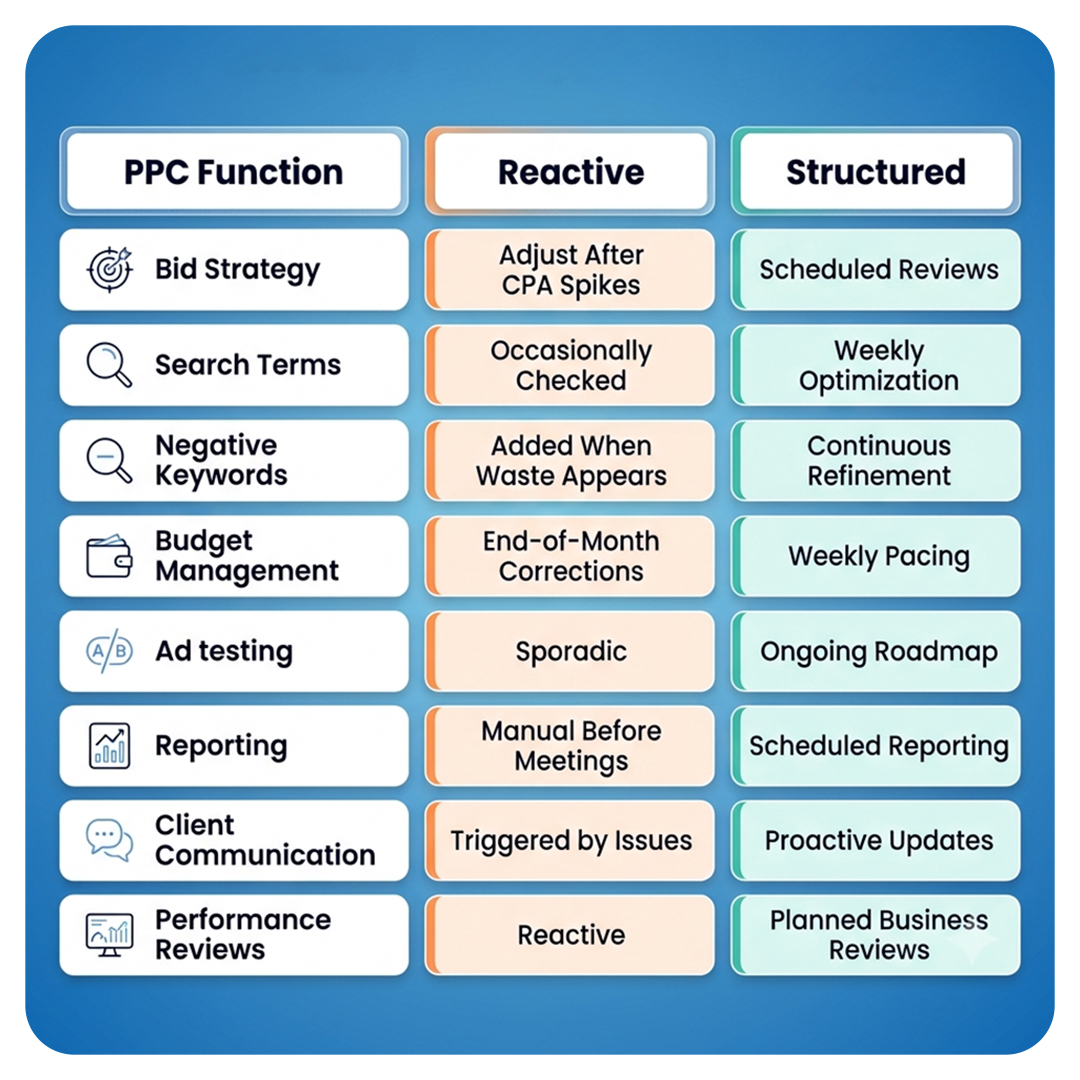
Operational discipline changes more than campaign performance. It shapes how agencies communicate with clients, how they allocate specialist time, and how much firefighting consumes the team's capacity. Agencies operating structured workflows spend less time reacting to client escalations because performance issues are caught and addressed before clients notice them.
These differences influence far more than campaign metrics. They shape agency profitability, client retention, and operational efficiency.
The Costs of Reactive Google Ads Management
Reactive management carries costs that rarely appear in campaign dashboards but show up consistently in agency financials and client retention data. Wasted ad spend accumulates between reactive reviews. Missed optimization windows allow poor-performing search terms, underperforming assets, and inefficient bidding strategies to run longer than necessary.
WordStream benchmark data shows that CPCs and CPAs fluctuate significantly across industries, making regular optimization essential to maintaining cost efficiency. Agencies managing accounts reactively are slower to respond to these fluctuations, which means clients absorb costs that structured optimization would have reduced.
Beyond ad spend, reactive management creates additional operational costs:
- Increased client escalations require account manager time that is not billable
- Team burnout develops when specialists constantly shift between urgent tasks
- Inconsistent campaign quality makes performance harder to predict or improve
- Reduced client retention shrinks revenue without reducing agency overhead
- Shrinking margins follow when clients downgrade budgets or cancel after performance drops
These costs compound over time. A reactive workflow that manages ten accounts might be manageable. The same workflow applied to forty accounts creates operational strain that degrades quality across the entire portfolio.
Most agencies never intend to become reactive. Operational pressure gradually pushes them in that direction.
Why Agencies Fall Into Reactive Optimization?
The path toward reactive management follows a predictable pattern. As agencies grow, account volume increases faster than specialist capacity. Each new client adds monitoring responsibilities, reporting requirements, and communication touchpoints. The time available for structured, proactive optimization shrinks.
More Accounts → More Interruptions → Less Optimization Time → More Reactive Work → Performance Variability
Several factors accelerate this shift:
- Too many accounts per specialist without adequate support systems
- Hiring delays that leave teams understaffed during growth periods
- Competing client priorities that push planned work aside
- Manual reporting processes that consume hours before every client meeting
- Inconsistent or absent standard operating procedures
- Lack of systematic quality assurance across campaigns
- Frequent Google Ads platform updates that require immediate attention
- Unplanned interruptions from client requests and internal meetings
Skilled PPC specialists still become reactive when systems are inconsistent. The problem is not expertise. It is the absence of operational infrastructure that protects planned optimization time from being consumed by urgent work.
Solving these issues requires more than additional hiring. Agencies need structured systems.
Why White Label PPC Creates Structured Optimization at Scale?
White label PPC fulfillment is not simply outsourced campaign management. For agencies, it functions as an operational framework that brings structured optimization, documented workflows, and dedicated specialist capacity to every account in the portfolio.
- Dedicated Optimization Teams: White label PPC services assign dedicated specialists who focus exclusively on campaign optimization rather than splitting attention between client communication, reporting, and strategy. These specialists follow recurring optimization schedules across every account, ensuring that daily, weekly, biweekly, and monthly activities are completed consistently rather than when time permits.
- SOP-Driven Workflows: Documented standard operating procedures define exactly how each optimization task should be completed and at what frequency. SOP-driven workflows remove the variability that occurs when different specialists approach the same task differently. Every search term review, negative keyword update, and bid adjustment follows the same process, which produces more consistent results across the portfolio.
- Scheduled QA: Quality assurance is built into the fulfillment workflow rather than applied informally. Launch validation confirms campaign structure, targeting, and tracking are correct before spend begins. Ongoing QA reviews verify conversion tracking accuracy, policy compliance, and campaign health on a scheduled basis rather than after problems appear.
- Standardized Reporting: White label reporting gives agencies structured, scheduled reports that are ready on time without requiring account managers to build them manually before every client meeting. Reports are formatted to reflect the agency's brand and include performance insights and strategy recommendations rather than data summaries alone.
- Capacity Flexibility: White label PPC services allow agencies to scale fulfillment capacity in line with client volume without adding internal headcount. When an agency onboards five new clients in a quarter, fulfillment capacity expands to match without the delays associated with hiring, onboarding, and training new specialists.
Agencies retain full ownership of strategy, client communication, and relationships throughout this process. White label fulfillment teams handle recurring optimization execution while the agency focuses on the activities that directly drive growth and retention.
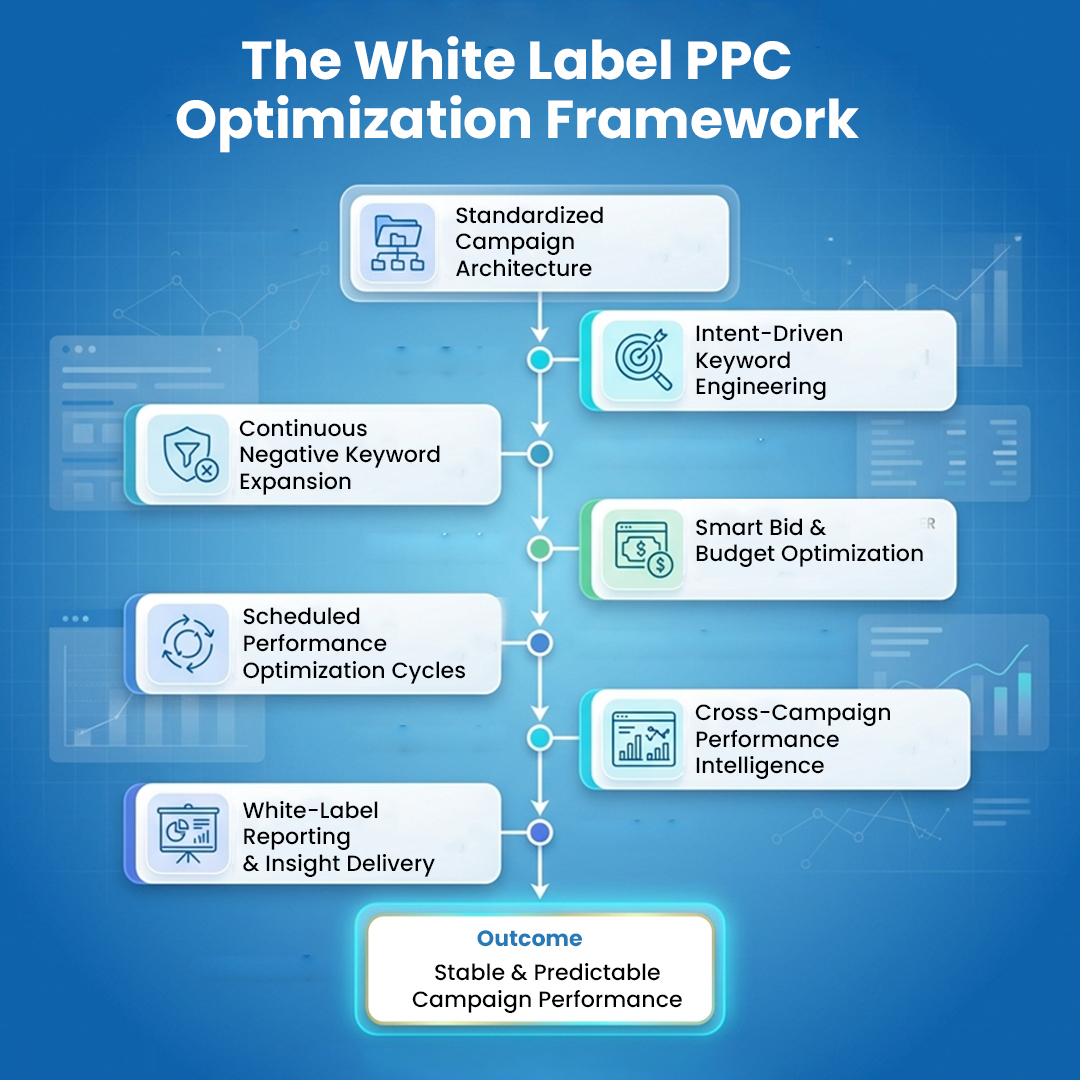
Structured optimization creates the biggest impact when applied consistently across every recurring PPC activity.
Google Ads Activities That Benefit Most From Structured Optimization
Every recurring optimization task in a Google Ads account produces better results when completed on a consistent schedule. The table below identifies the activities that benefit most from operational consistency.
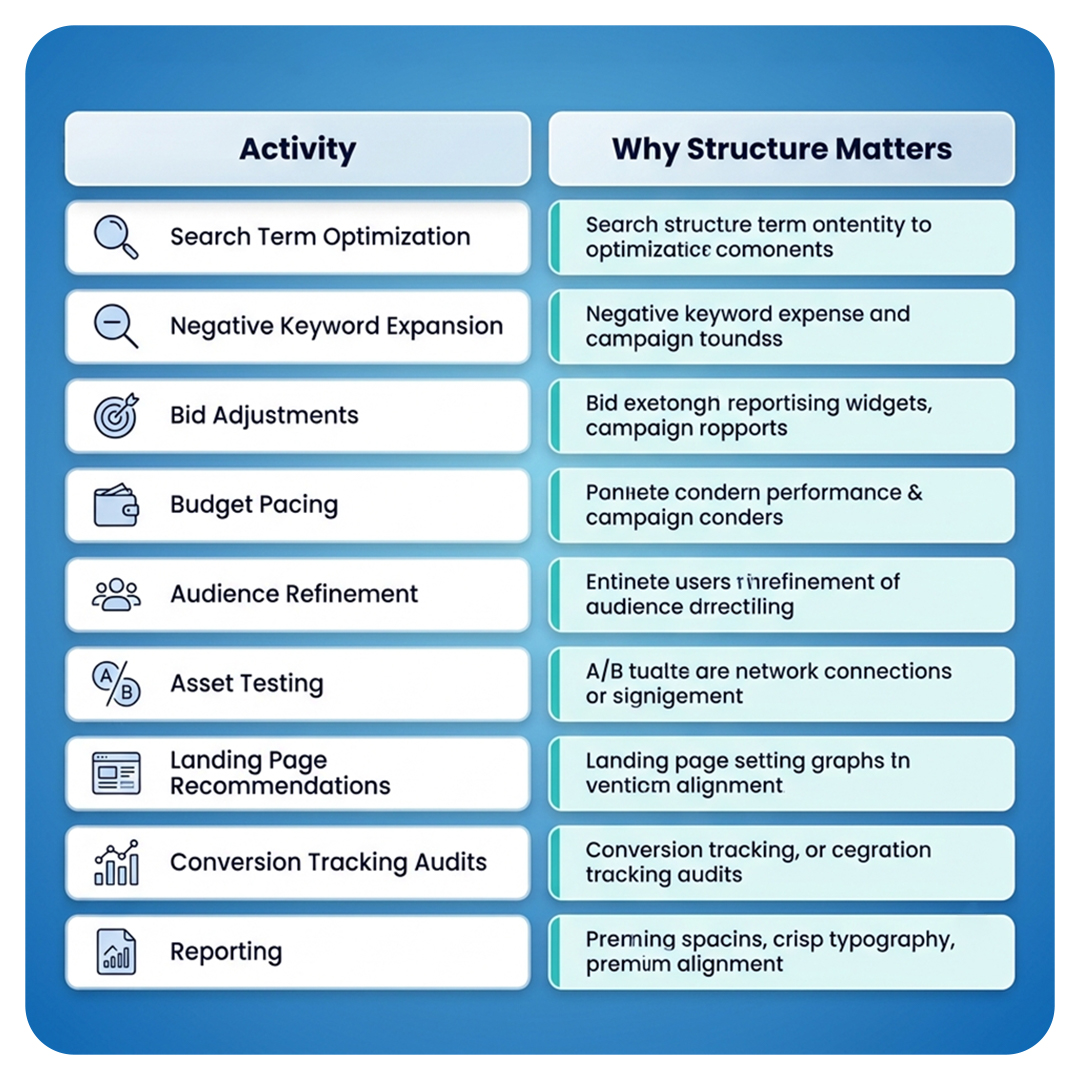
Each of these tasks has a compounding effect. Search term optimization completed every week removes irrelevant queries before they consume budget. Consistent asset testing identifies winning creative faster, which improves CTR and reduces CPC over time. Regular conversion tracking audits ensure that Smart Bidding systems receive accurate data, which directly affects how well automated bidding performs.
Agencies that complete these activities consistently gain a measurable competitive advantage.
Signs Your Agency Needs a More Structured PPC Model
Reactive management rarely announces itself clearly. It develops gradually as operational pressure increases. These warning signs indicate that an agency has moved away from structured optimization.
- Optimizations happen only in the days before client meetings
- PPC managers are responsible for more accounts than they can monitor proactively
- Campaign performance fluctuates unexpectedly without clear explanations
- Reporting preparation consumes several hours each month per client
- Campaign launches are delayed because specialists are occupied with existing accounts
- Clients ask more questions about results and performance trends
- Ad testing has become inconsistent or paused entirely
- Urgent, unplanned work dominates most daily schedules
These signs reflect operational strain rather than a lack of PPC expertise. An experienced specialist managing forty accounts without adequate systems will still produce inconsistent results. The volume of work simply exceeds what reactive, unstructured management can sustain at a high level.
Recognizing these warning signs early makes it easier to adopt scalable fulfillment before quality declines.
How DashClicks Helps Agencies Build Structured Google Ads Operations?
DashClicks provides white label Google Ads fulfillment designed to give agencies the operational structure needed to manage campaigns consistently across their full client portfolio.
- White Label Google Ads Fulfillment: The white label PPC team handles the complete campaign lifecycle, from account setup and ongoing optimization to reporting and performance monitoring. Agencies maintain ownership of the client relationship while experienced PPC specialists execute structured campaign management behind the scenes.
- Dedicated PPC Specialists: Each account is managed by dedicated PPC specialists who follow structured optimization schedules. This removes the inconsistency that occurs when accounts are passed between generalists or managed by overextended internal teams.
- Standardized Optimization Processes: Documented optimization workflows ensure consistent standards across every account. Recurring processes cover search term optimization, negative keyword management, bid adjustments, budget pacing, and ongoing ad testing.
- White Label Reporting: Agencies receive scheduled reports branded with their own identity, ready to share with clients without manual preparation. Reports include performance data, strategic context, and forward-looking recommendations that support proactive client communication.
- Ongoing Campaign Monitoring: Continuous monitoring helps identify budget anomalies, tracking discrepancies, and performance shifts before they become client concerns, allowing issues to be addressed as part of the standard fulfillment process.
Agencies retain complete strategic control and client ownership, while DashClicks provides the operational infrastructure that makes structured Google Ads optimization possible at scale.
Structured PPC Operations Are a Long-Term Competitive Advantage
Reactive optimization solves today's problems. Structured optimization prevents tomorrow's. This distinction becomes more important as agency portfolios grow and as Google Ads continues developing more complex automation systems that demand consistent data inputs and ongoing strategic oversight.
Operational systems improve campaign quality by ensuring that recurring tasks are completed on schedule rather than when time permits. Standardized workflows strengthen reporting by eliminating the manual effort that delays client communication. Better consistency across accounts improves client retention because performance is more predictable and problems surface earlier.
White label PPC services give agencies a practical path toward structured operations without increasing internal headcount. Fulfillment capacity scales with client volume, optimization processes follow documented standards, and reporting is delivered on schedule without pulling account managers away from client-facing work.
Agencies that invest in operational structure now will be better positioned as Google Ads continues evolving. Automation will expand. Complexity will increase. The agencies that thrive will be those running repeatable, scalable systems rather than reacting to problems after performance has already declined.


How White Label SEO Helps Agencies Prevent Small SEO Issues From Becoming Major Problems
SEO rarely fails because of one catastrophic mistake. Rankings decline, traffic drops, and client confidence erodes gradually as small, overlooked issues accumulate over time. A missing meta description, a broken internal link, or an outdated page that no longer matches search intent may seem minor individually, but together they can significantly reduce a website's search visibility.
For agencies managing multiple client accounts, routine SEO maintenance often becomes harder as workloads grow. Content updates get delayed, technical fixes are deprioritized, and small issues remain unnoticed. Yet organic search continues to drive approximately 53.3% of all trackable website traffic, according to BrightEdge, making consistent SEO maintenance essential for long-term performance.
The challenge is rarely a lack of SEO expertise. It is maintaining the operational capacity to monitor, identify, and resolve issues consistently across every client account. A reliable white label SEO service provider helps agencies scale proactive SEO maintenance without immediately expanding their internal team. By leveraging white label support, agencies can increase fulfillment capacity while staying focused on strategy and client relationships.
This blog explores the small SEO issues agencies often overlook, how they grow into larger performance problems, why preventive maintenance becomes difficult at scale, and how white label fulfillment helps keep client campaigns healthy over the long term.
Why Small SEO Problems Often Go Unnoticed?
Many SEO issues develop quietly and do not cause an immediate ranking decline. There is no alert, no sudden traffic drop, and no client complaint. The problem simply exists, grows, and compounds over time before anyone realizes it has been affecting performance.
Agencies commonly overlook minor issues for several interconnected reasons:
- SEO improvements and declines happen gradually, making short-term changes easy to dismiss.
- Many problems do not trigger an immediate performance warning that would prompt investigation.
- Teams prioritize urgent client requests over recurring maintenance tasks.
- Multiple specialists handle different areas of SEO, and no single person sees the full picture.
- Ownership of recurring checks is often unclear, particularly across larger teams.
- Manual processes make routine monitoring inconsistent and easy to skip during busy periods.
- Reporting tends to focus on rankings while technical issues develop in the background.
Consider what this looks like in practice. An account manager is managing six client campaigns simultaneously. A content specialist is working on three blog posts with a Friday deadline. A technical specialist is resolving a crawl issue flagged by a client. In this environment, routine checks for missing meta descriptions, broken internal links, incorrect canonical tags, slow-loading images, outdated content, unoptimized headings, schema errors, duplicate metadata, or orphan pages get deprioritized.
Each of these issues may appear minor in isolation. A single orphan page is not going to collapse a domain's rankings. Duplicate metadata on two product pages is unlikely to cause an immediate traffic drop. But when no one owns the responsibility for identifying and resolving these issues, they accumulate. That is when minor problems begin to affect performance.
Individually, these issues may seem harmless. Collectively, they can significantly reduce a website's search performance over time.
How Small SEO Issues Turn Into Major Client Problems?
Minor SEO problems usually follow a predictable progression. What begins as a small oversight eventually compounds into a visible performance decline. Understanding this progression helps agencies recognize why early detection matters so much.
1. Technical Debt Builds Over Time
Unresolved technical issues accumulate in layers. Crawl errors increase as internal links break or redirect incorrectly. Redirect chains become longer as site structures change without proper cleanup. Indexation problems spread when robots.txt errors or misconfigured canonical tags prevent important pages from being discovered. Duplicate URLs multiply across pagination, URL parameters, and session-based variations. Site architecture becomes harder to manage as new content is added without updating internal linking. The overall technical health of the website gradually declines.
Technical debt makes future optimization slower and more expensive. What might have taken one hour to fix in the early stages can require significantly more time and effort once the issues have compounded.
2. Rankings Slowly Decline
Keyword positions begin slipping before most teams notice. Search impressions fall. Click-through rate declines as pages lose positioning. Commercial pages lose visibility to competitors who are actively maintaining their SEO. Competing domains that were previously behind the client begin gaining ground.
Ranking declines may appear gradual at first, which makes them easy to dismiss as seasonal variation or algorithm noise. By the time the trend becomes undeniable, the recovery timeline has already extended significantly.
3. Organic Traffic Drops
Reduced rankings and lower visibility translate directly into fewer visitors. Organic sessions decline. Service pages receive less traffic. Branded and non-branded discovery both suffer. For clients with local service areas, local search visibility may drop as well, reducing calls and direction requests from nearby prospects.
4. Leads and Revenue Are Affected
Once traffic declines, business outcomes follow. Form submissions decrease. Phone calls are slow. Bookings, ecommerce sales, assisted conversions, and revenue contribution all reflect the upstream SEO problems that were never resolved. Once business outcomes decline, the agency becomes accountable in the client's eyes, regardless of what caused the original issue.
Google's Search Essentials documentation consistently emphasizes the importance of maintaining crawlability, technical accessibility, and high-quality content for sustainable search visibility. While this does not guarantee specific rankings, it reinforces the value of ongoing maintenance as a foundation for consistent performance.
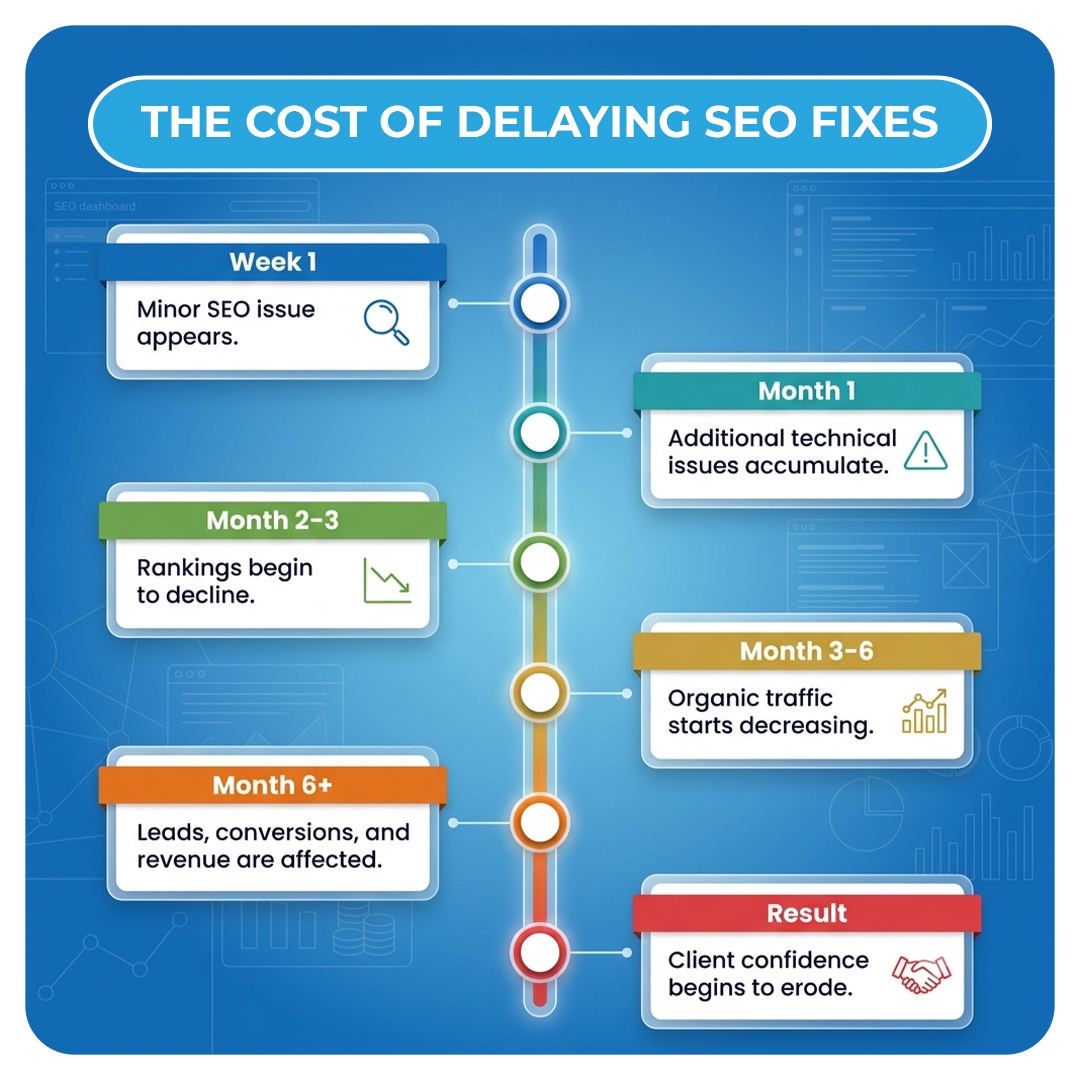
Fortunately, most of these problems are preventable when agencies adopt a proactive SEO management approach.
Common SEO Issues Agencies Should Catch Early
Prevention starts with knowing which recurring issues deserve regular attention. The following categories represent the areas where minor problems most frequently develop unnoticed.
1. Technical SEO
Technical SEO issues are among the most damaging because they affect how search engines crawl and index an entire website. Agencies should monitor regularly for:
- Broken links and 404 errors
- Redirect loops and unnecessary redirect chains
- Crawl errors appearing in Google Search Console
- XML sitemap issues, including outdated or excluded URLs
- Robots.txt mistakes that block important pages
- Duplicate pages created by URL parameters or CMS settings
- Incorrect canonical tags that misdirect search engine authority
- Indexation problems that prevent pages from appearing in search results
2. On-Page SEO
On-page SEO issues affect how well individual pages communicate their relevance to search engines. Key areas to review include:
- Missing or poorly written title tags
- Duplicate metadata across multiple pages
- Poor heading structure that lacks logical hierarchy
- Thin pages with insufficient content depth
- Keyword cannibalization where multiple pages compete for the same terms
- Weak internal linking that fails to distribute page authority
- Unoptimized images without descriptive alt text or appropriate file sizes
3. Content
Content degrades over time if left unmanaged. Common content issues include:
- Outdated statistics and references that reduce credibility
- Declining topical relevance as industry language evolves
- Missing internal links to newer related content
- Orphan pages that receive no internal links and minimal traffic
- Old offers or discontinued services still appearing on live pages
- Content that no longer matches current search intent for its target keywords
4. Local SEO
For clients who depend on local search visibility, consistency across platforms is critical. Agencies should routinely review:
- Google Business Profile inconsistencies across categories, descriptions, and attributes
- Citation inaccuracies across business directories
- NAP (name, address, phone number) inconsistencies across the web
- Incorrect business hours, particularly after seasonal changes
- Outdated service information on the business profile
- Unanswered reviews where engagement is appropriate
5. Performance
Technical performance directly affects user experience and search engine quality signals. Core areas to monitor include:
- Slow Core Web Vitals scores, particularly Largest Contentful Paint and Interaction to Next Paint
- Oversized images that slow page load times
- JavaScript rendering issues that delay content visibility
- Poor mobile usability across key landing pages
- Cumulative Layout Shift problems that disrupt the user experience
- Slow-loading landing pages that increase bounce rates
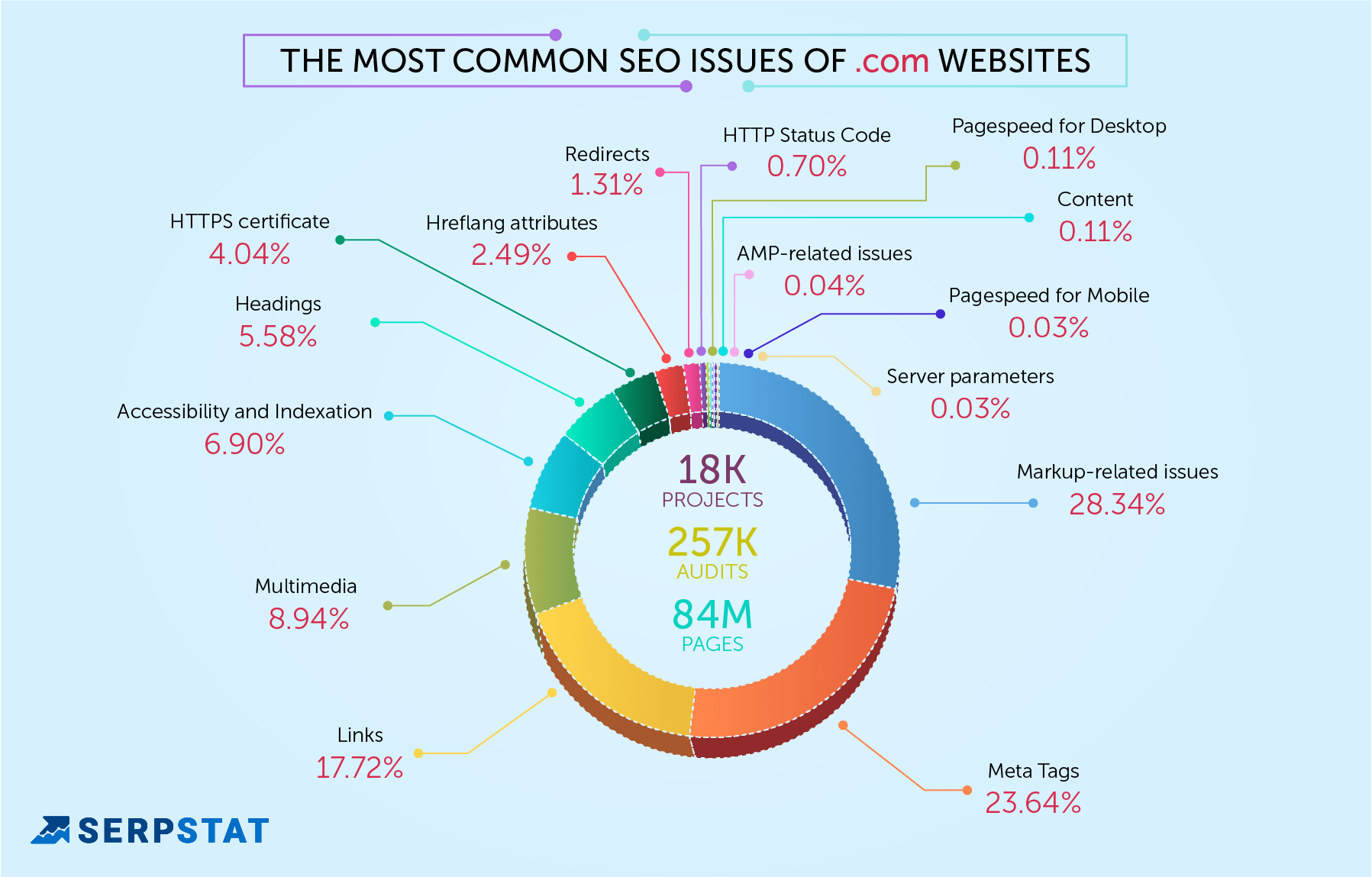
Image Source: Serpstat
Google's Core Web Vitals remain part of its page experience signals, reinforcing the value of maintaining fast and user-friendly websites. Core Web Vitals should be viewed as part of overall website quality rather than a standalone ranking guarantee.
Catching these issues early requires more than occasional SEO audits. It requires consistent operational discipline.
Why Agencies Struggle to Stay Ahead of SEO Issues?
Most agencies understand preventive SEO in theory but struggle to execute it consistently at scale. The gap between knowing what should be done and actually doing it across every client account is largely an operational problem, not a knowledge problem.
Operational realities that create this gap include:
- Growing client portfolios that increase the volume of recurring tasks
- Limited specialist bandwidth across technical, content, and on-page teams
- Competing priorities that push maintenance behind urgent deliverables
- Manual QA processes that are time-consuming and prone to inconsistency
- Reactive workflows where the loudest problem always gets addressed first
- Employee turnover that disrupts institutional knowledge and ongoing processes
- Inconsistent SOPs that produce variable quality across team members
- Delayed reporting that surfaces issues only after they have affected performance
- Unclear ownership of recurring tasks, particularly for cross-functional checks
- Excessive context switching that reduces focus and throughput across accounts
The result is a compounding cycle:
More Clients → More Recurring Tasks → Less Time for Maintenance → More Unnoticed Issues → More Emergency Fixes
Reactive workflows reduce profitability because urgent work consumes more time and attention than planned maintenance. Emergency fixes require triage, rapid diagnosis, client communication, and expedited execution. Preventive maintenance, by contrast, is predictable, efficient, and far less disruptive to operations.
Agencies do not necessarily lack SEO knowledge. They often lack the operational capacity to apply that knowledge consistently across every account.
This is where operational consistency becomes a competitive advantage rather than simply an internal process improvement.
How White Label SEO Creates a Preventive SEO System?
A white label SEO firm is not simply a source of one-off deliverables. It is an operational partner that helps agencies build preventive maintenance into a repeatable, scalable process. The goal is to shift from reacting to visible problems to maintaining a structured system that identifies and resolves issues earlier.
1. Continuous Website Monitoring
Preventive SEO starts with knowing what is happening across every client website on a regular basis. Recurring monitoring should include regular site health checks, crawl monitoring to detect new errors, indexation reviews to confirm key pages remain accessible, ranking trend analysis to identify early movement, performance checks against Core Web Vitals benchmarks, and alert-based issue detection that flags problems before they affect traffic.
2. Routine Technical Maintenance
Recurring technical maintenance reduces the accumulation of technical debt over time. This includes monitoring and resolving broken links, managing redirect structures, maintaining crawlability, reviewing indexation, keeping XML sitemaps accurate and current, reviewing robots.txt for unintended blocks, validating schema markup, and confirming that canonical tags are correctly implemented. Regular maintenance prevents small technical issues from layering into larger structural problems.
3. Ongoing On-Page Optimization
On-page SEO requires continuous attention as content ages and search intent evolves. Ongoing optimization activities include metadata improvements across title tags and descriptions, internal linking updates as new content is published, heading structure optimization, content refreshes for pages with declining performance, image optimization for both accessibility and load speed, alignment with current search intent, and cannibalization reviews to ensure multiple pages are not competing for the same queries.
4. Regular Performance Reviews
Monthly snapshots provide limited context. Performance reviews should track ranking movements across target keywords over time, organic traffic trends at both domain and page levels, conversion performance for key landing pages, technical health scores from regular site audits, page-level engagement data, and lead quality where measurable within the client's attribution setup. Trends matter more than isolated monthly snapshots.
5. Consistent Reporting
Standardized reporting helps agencies surface issues early, explain the work that has been completed, show progress clearly across tracked metrics, recommend next actions before problems escalate, and address risks proactively before clients raise concerns. When reporting is consistent, agencies demonstrate control over the campaign rather than reacting to the client's observations.
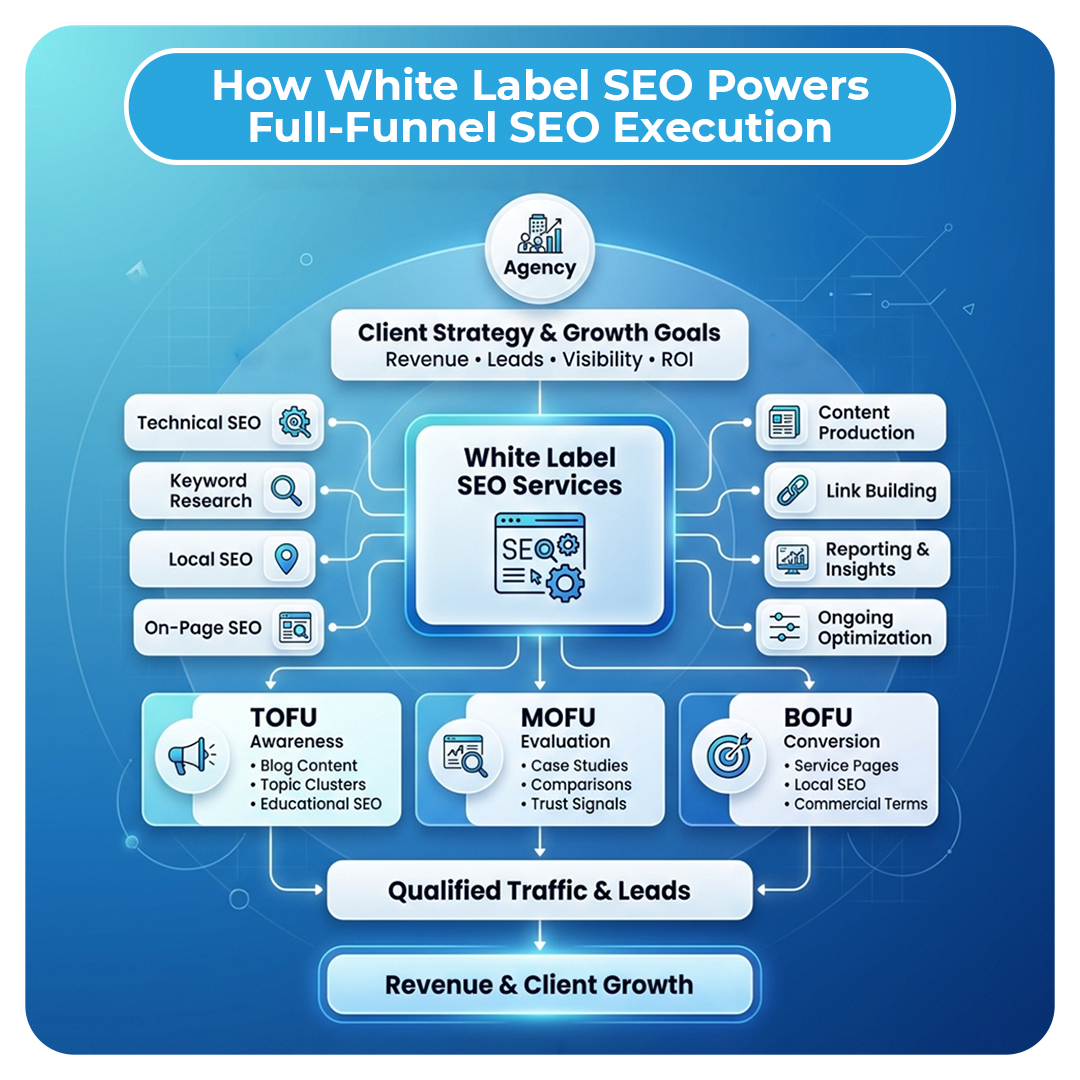
Preventive SEO works when monitoring, maintenance, optimization, and reporting operate as one connected system.
Prevention is only effective when every recurring SEO activity follows a structured process.
Operational Habits That Keep Small SEO Issues From Escalating
Preventive SEO depends on operational habits as much as technical expertise. Even the best fulfillment partner cannot compensate for internal processes that are inconsistent, undocumented, or poorly maintained.
The following habits improve consistency across a growing client portfolio:
- Monthly technical SEO audit to identify new issues before they compound
- Standardized SEO QA checklists applied consistently across all accounts
- Content update schedules that ensure pages are reviewed and refreshed regularly
- Internal documentation that captures campaign history, decisions, and ongoing tasks
- Defined ownership for every recurring SEO task so nothing falls through the cracks
- Automated monitoring tools that reduce reliance on manual spot checks
- Routine client reporting on a consistent schedule that reflects completed work and upcoming priorities
- Regular strategy reviews to ensure campaign direction remains aligned with client goals
- Centralized campaign notes accessible to all team members working on an account
- Escalation processes for urgent issues so they receive appropriate attention without disrupting planned work
Together, these habits form what can be described as the SEO Prevention Flywheel:
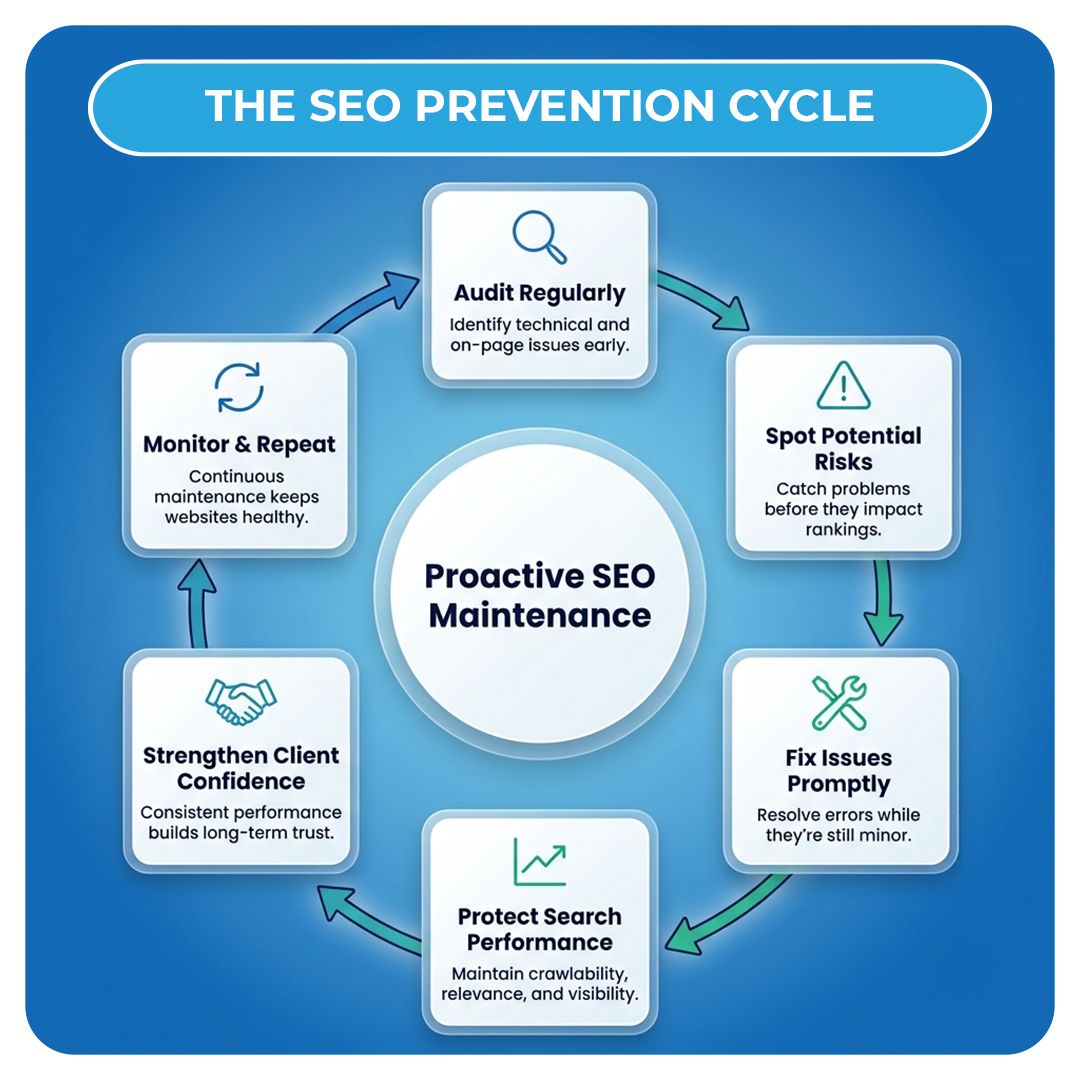
Every stage of the flywheel supports the next. Consistent monitoring leads to earlier detection. Earlier detection leads to faster resolution. Faster resolution maintains rankings and strengthens client trust. Stronger trust reduces the pressure that comes with reactive, emergency-driven work. Over time, the flywheel reduces both operational stress and client risk. The system becomes self-reinforcing.
The goal is not to eliminate every SEO issue permanently. The goal is to detect and resolve problems before they affect business outcomes.
Many agencies have these processes documented, but maintaining them consistently becomes more difficult as the client roster grows.
When Should Agencies Consider White Label SEO Support?
Agencies should not wait until fulfillment breaks down before expanding capacity. By the time delivery quality is visibly suffering, client relationships are already at risk, and team members are already stretched.
Common operational signals that indicate the need for additional support include:
- SEO specialists are consistently overloaded and unable to complete planned tasks on schedule.
- Technical issues remain unresolved for weeks due to bandwidth constraints.
- Website audits have become infrequent because there is no time to conduct them properly.
- Clients are identifying ranking declines before the agency does.
- Reporting consumes excessive specialist time that should be spent on execution.
- Quality varies significantly between team members or between accounts.
- New client onboarding delays work on existing accounts.
- Content refreshes are repeatedly postponed in favor of urgent tasks.
- Account managers spend more time firefighting than planning ahead.
These are capacity warnings, not isolated team failures. Recognizing them early allows agencies to expand fulfillment proactively rather than reactively.
Engaging a white label partner does not mean surrendering control. Agencies continue owning strategy, client communication, expectation-setting, and relationship management. The fulfillment partner supports recurring execution and specialist tasks behind the agency's brand.
The right white label partner does not simply complete SEO tasks. It helps agencies build a proactive maintenance system that prevents issues from recurring.
How DashClicks Helps Agencies Stay Ahead of SEO Issues?
DashClicks functions as a white label SEO service provider that helps agencies move from reactive SEO management to proactive, structured maintenance. The focus is on building consistent delivery systems that protect client performance over time.
- White Label SEO Fulfillment: Recurring SEO execution is delivered behind the agency's brand. Work is completed under the agency's identity, allowing agencies to maintain client relationships while expanding their operational capacity through an experienced team.
- Ongoing Technical SEO Monitoring: Technical site health monitoring includes regular audits, technical issue identification, crawlability checks, indexation reviews, and routine maintenance. This helps agencies surface and resolve technical problems before they affect rankings or client outcomes.
- On-Page and Content Optimization: On-page support includes metadata improvements, internal linking updates, content refreshes, search intent alignment, and broader on-page optimization. These activities keep client pages relevant and properly structured as search behavior evolves.
- Local SEO Management: For clients who depend on local visibility, support includes Google Business Profile consistency, citation accuracy, local optimization, and location-based visibility.
- White Label Reporting: Standardized white label reporting helps agencies communicate completed work clearly, identify issues early, show progress across tracked metrics, and recommend next actions. Consistent reporting reduces the risk that clients discover problems before the agency does.
- Scalable Fulfillment for Growing Agencies: DashClicks provides experienced SEO specialists who follow standardized workflows across client accounts. This helps agencies increase fulfillment capacity, maintain consistent quality, reduce delivery bottlenecks, onboard new clients more smoothly, and preserve internal time for strategy and client management.
DashClicks helps agencies shift from reacting to visible SEO problems to maintaining a structured system that identifies and resolves issues earlier.
Ultimately, proactive SEO is not about fixing more problems. It is about building systems that prevent minor issues from becoming major client concerns.
Small Problems, Left Unmanaged, Become Large Ones
Small SEO issues rarely stay small. Broken links, outdated content, crawl errors, weak metadata, and slow pages can each seem insignificant in isolation. Left unresolved across multiple client accounts over time, they accumulate into performance declines that are harder to reverse and more costly to address.
Preventive SEO creates better client outcomes, fewer operational emergencies, and stronger long-term retention. It requires consistent monitoring, routine maintenance, structured QA, clear internal documentation, and regular reporting. Each of these activities is straightforward individually. Maintaining all of them consistently across a growing client portfolio is where most agencies face real operational pressure.
Building these systems internally is achievable. Sustaining them at scale without additional capacity is not always practical. A dependable provider gives agencies the operational bandwidth and standardized execution they need to maintain consistent delivery without requiring immediate internal expansion. White labeling SEO allows agencies to retain ownership of strategy and client relationships while improving the consistency and depth of their fulfillment.
Investing in preventive systems now reduces the volume of reactive work later. Proactive operations protect client rankings, strengthen trust, and support more sustainable agency growth over time.

How to Set Realistic Facebook Ads Expectations for Clients
Facebook Ads can go live within hours, which creates a common misconception: if the campaign is running, results should follow immediately. In reality, agencies that do not address this expectation early often spend more time managing client anxiety than campaign performance.
Paid advertising produces data faster than SEO, but faster data does not mean mature results. Profitable campaigns still require testing, learning, audience refinement, and creative iteration. A campaign launched on Monday will not perform the same way after several weeks of optimization.
Clients often confuse campaign launch with campaign maturity. When early fluctuations appear, they may interpret normal optimization cycles as poor management. That can damage trust even when the agency is executing effectively.
Agencies that educate clients before campaigns launch usually face fewer difficult conversations, fewer reactive check-ins, and stronger retention. Client education is not separate from delivering Facebook Ads services. It is part of the service itself.
The challenge is scaling that education across a growing client base. White label Facebook Ads management helps agencies maintain consistent optimization and reporting while preserving time for strategic communication.
This blog explains how to define campaign goals, clarify Meta’s Learning Phase, set realistic timelines, report meaningful KPIs, normalize performance fluctuations, and use white label support to deliver consistently as your agency grows.
Before discussing expectations, clients first need to understand what Facebook Ads are actually designed to accomplish.
Start With the Business Goal, Not the Ad Platform
Every Facebook campaign should begin with a clearly defined business objective. Too often, agencies and clients focus on ad formats, targeting options, and creativity before agreeing on what success actually looks like.
Common campaign goals include:
- Lead generation
- Ecommerce sales
- Brand awareness
- Local store visits
- Appointment bookings
- App installs
- Website traffic
- Engagement
Success metrics differ depending on the campaign objective. A brand awareness campaign is not designed to generate immediate purchases, and evaluating it against ROAS will always produce a misleading result.
Clients expecting immediate ROAS from an awareness campaign are measuring success using the wrong criteria. For example, a local service business running a brand awareness campaign to a cold audience may see strong reach and frequency numbers without a corresponding spike in direct inquiries. That does not mean the campaign is underperforming. It means the campaign is doing exactly what it was built to do, and the agency's job is to explain that clearly.
Campaign performance should always be evaluated against the original business objective.
Once campaign goals are clear, clients also need to understand why Facebook's system requires time before delivering consistent results.
Explain the Facebook Ads Learning Phase in Simple Terms
The Learning Phase is one of the most misunderstood parts of Facebook Ads management. Clients see spending leaving their account while results look inconsistent, and without context, that early period can feel like money wasted.
The Learning Phase is the period during which Meta's delivery system tests different audiences, placements, and creative combinations to determine the most efficient way to achieve the campaign objective. Early cost-per-action (CPA) and ROAS fluctuations during this phase are normal. The platform is collecting conversion data, not yet operating at full efficiency.
Frequent edits during the Learning Phase, such as changing budgets, audiences, or creative, can restart or disrupt optimization. Clients who push for constant adjustments in the first two weeks often extend the very period they are trying to get through.
Launching Facebook Ads is like hiring a new salesperson. They do not become the top performer on Day 1. They improve as they learn which prospects respond and which conversations lead to sales.
According to data, approximately 50 optimization events per ad set within seven days is a commonly referenced benchmark that can help an ad set exit the Learning Phase more efficiently. Lower-volume accounts, or those with restrictive budgets and narrow audiences, may take longer to reach that threshold or may remain in "Learning Limited" status for an extended period.
Learning Limited status can result from:
- Insufficient conversion volume
- Budget restrictions
- Audience size limitations
- Limited creative variety
- Conversion event selection that is too far down the funnel
Agencies should explain the Learning Phase before campaigns launch, not after clients become concerned.
Image Source: Roomvu
Understanding the Learning Phase naturally leads to another important discussion: how long clients should realistically wait before evaluating success.
Create a Realistic Timeline for Results
Telling a client "it depends" without context does not build confidence. Clients need a flexible but understandable framework that explains what should happen and when.
Week 1: Data Collection and Initial Learning
The first week is primarily about setup validation and early data collection. This includes confirming that tracking is working correctly, checking that ads are being delivered as expected, reviewing early creative performance signals, and monitoring the Learning Phase. Agencies should resist drawing performance conclusions from Day 1 data.
Weeks 2 to 4: Active Optimization
Once initial data is available, the focus shifts to refinement. This period typically involves budget adjustments, early creative testing conclusions, audience exclusions, placement analysis, and monitoring initial conversion trends. Results during this window may still fluctuate, but patterns begin to emerge.
Months 2 to 3: Performance Stabilization
By the second and third months, campaigns with sufficient conversion volume start showing more reliable CPA trends. Winning audiences become clearer, ROAS visibility improves, and budget allocation becomes more informed by actual performance data. Agencies can make more confident optimization decisions during this window.
Month 4 and Beyond: Scaling and Expansion
Campaigns that have stabilized are positioned for growth. This phase involves scaling budgets on proven audiences, testing new audience segments, expanding creative libraries, improving funnel touchpoints, and running more advanced campaign tests.
Profitability is created through optimization, not simply through campaign launch. Nielsen's marketing effectiveness research consistently demonstrates that campaigns benefit from sufficient time, consistent exposure, and ongoing optimization rather than early or frequent changes to campaign strategy.
The timeline should be presented as a framework, not a guaranteed schedule. Account maturity, budget size, sales cycle length, offer strength, and conversion volume all affect how quickly a campaign progresses through each stage.
Once clients understand realistic timelines, they also need to know that not every metric deserves equal attention.
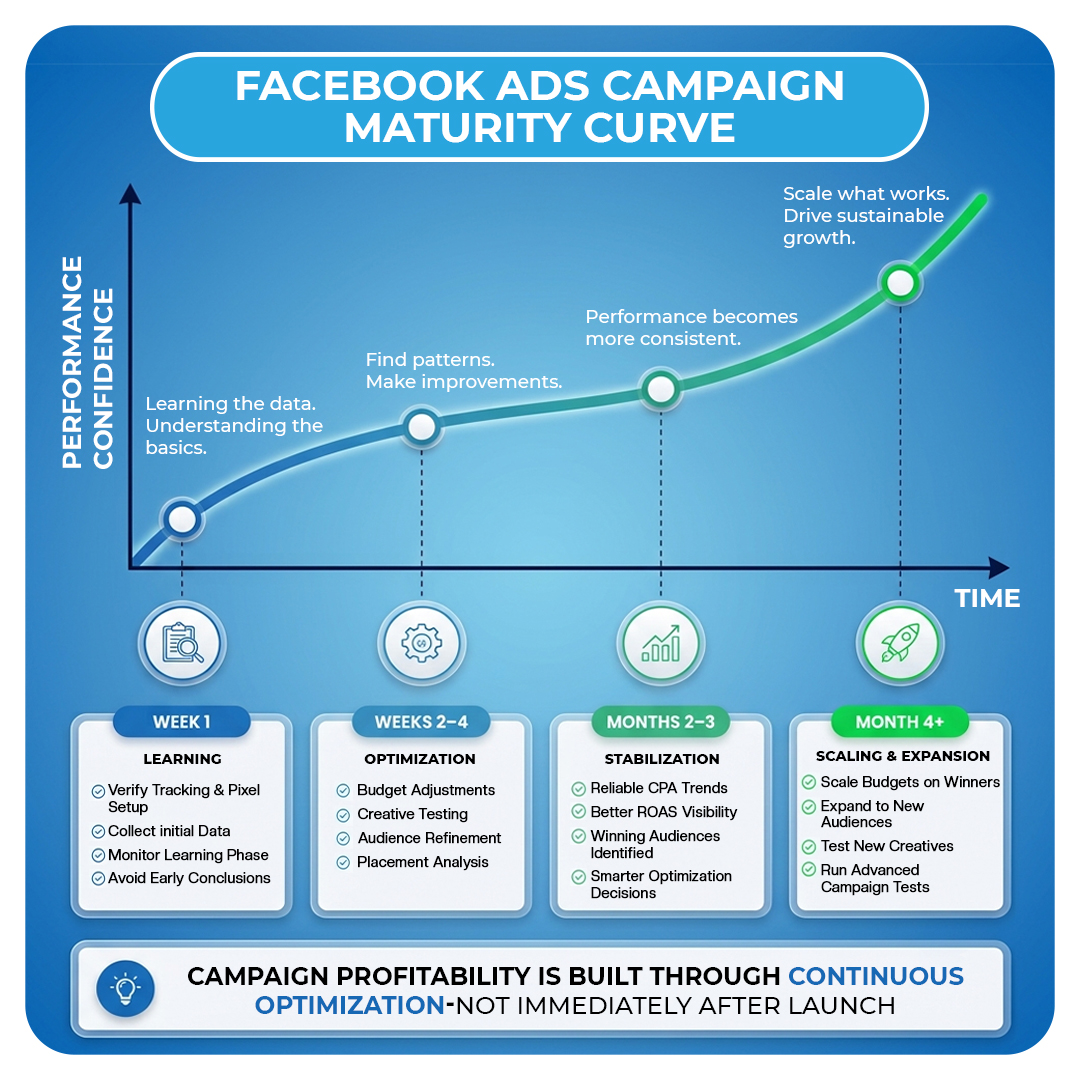
Teach Clients Which Metrics Actually Matter
Ads Manager surfaces more data than most clients need or can interpret. Effective reporting simplifies performance and connects platform activity to business outcomes, rather than presenting clients with a full export and expecting them to draw their own conclusions.
Metrics Clients Often Obsess Over
Clients frequently fixate on:
- Click-through rate (CTR)
- Cost per click (CPC)
- Cost per thousand impressions (CPM)
- Reach
- Impressions
These metrics are useful for diagnosing how ads are being delivered and whether creative is resonating at the surface level. However, they do not prove business success on their own. A high CTR on an ad that generates no qualified leads is not a sign of a successful campaign.
Metrics That Reflect Business Outcomes
These should receive the most attention during client conversations:
- Cost per lead
- Cost per purchase
- Return on ad spend (ROAS)
- Conversion rate
- Revenue
- Qualified leads
- Pipeline value
- Booked appointments
- Customer acquisition cost
These metrics connect campaign activity directly to commercial results. They are the numbers clients should use to evaluate whether Facebook Ads are delivering business value.
Supporting Metrics
Some metrics fall between delivery and business outcomes. These supporting metrics help explain performance changes without standing on their own as success indicators:
- Frequency
- Landing page views
- Video completion rate
- Lead-to-sale rate
- Conversion lag
- Engagement
Strong Facebook Ads services connect platform metrics to meaningful business outcomes, rather than leaving clients to interpret delivery data without context.
Even when agencies report the right KPIs, performance will not always move in a straight line. Clients also need to understand why results fluctuate.
Normalize Performance Fluctuations Before They Become Problems
Facebook Ads operate in a live auction environment. Performance changes constantly, and a single difficult week is rarely an accurate indicator of long-term campaign health.
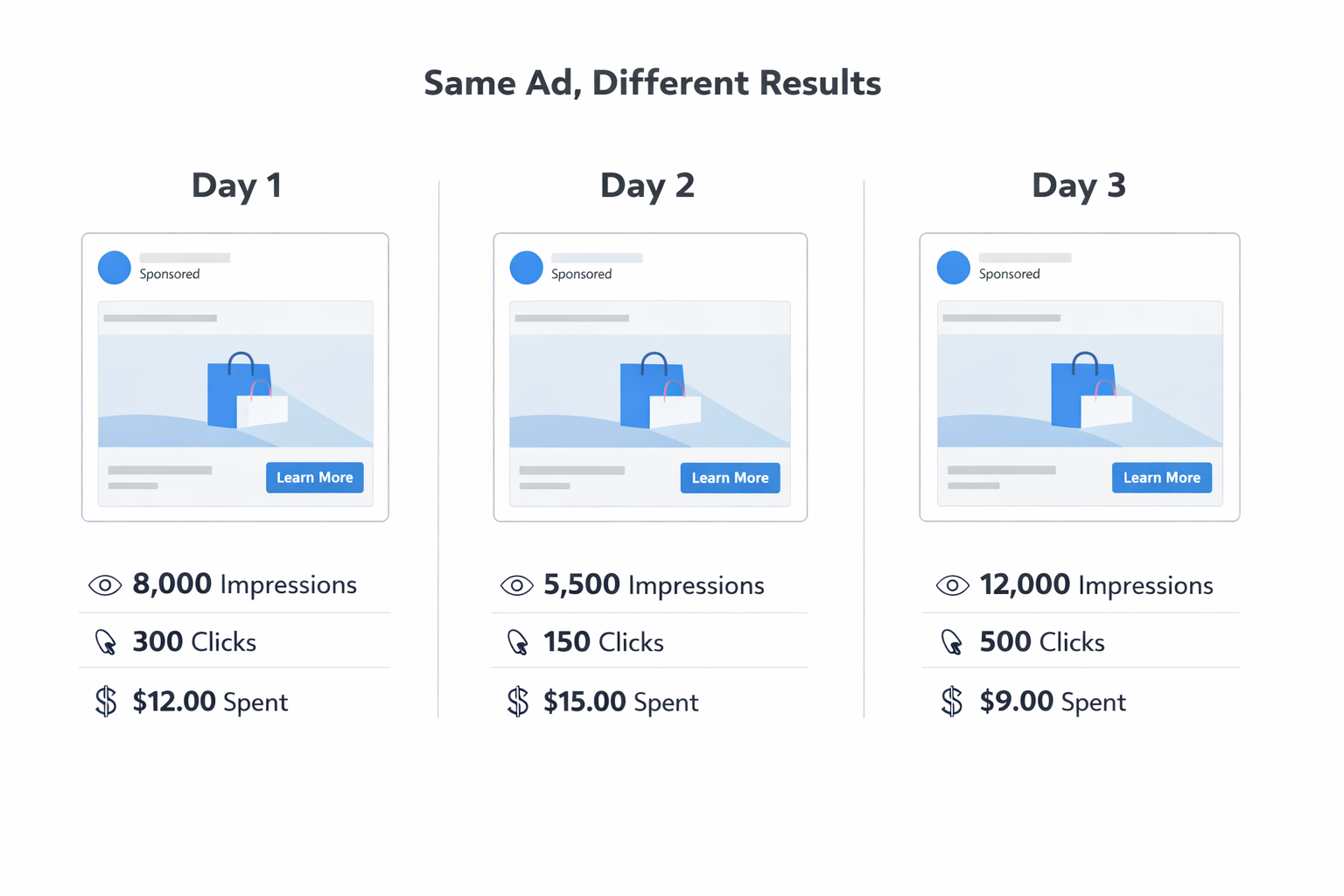
Image Source: LeadEnforce
Common causes of fluctuations include:
- Seasonality and holidays
- Increased competitor spending
- Auction competition
- Ad fatigue and creative saturation
- Audience saturation
- Changes in consumer behavior
- Platform algorithm updates
- Offer changes or landing page issues
- Economic shifts
A single difficult week does not necessarily signal poor campaign management. Context matters significantly when interpreting short-term performance dips.
According to Meta's Business documentation, the advertising auction uses dynamic pricing. CPMs and delivery change depending on competition levels, audience demand, expected action rates, and ad quality scores. Advertisers do not purchase impressions at a permanently fixed rate, which means cost efficiency will shift based on factors outside any agency's direct control.
For example, a campaign may experience significantly higher CPMs during a major holiday period because more advertisers are competing for the same audience at the same time. An experienced agency may still improve conversion efficiency during that period through stronger creative testing or tighter audience segmentation, even when raw costs are elevated.
Performance changes should be evaluated through trends, context, and business outcomes rather than isolated daily numbers.
Setting expectations is not only about educating clients. It also requires consistent communication throughout the engagement.
Build a Reporting Process That Reduces Client Anxiety
Sending a dashboard without interpretation often creates more questions than confidence. Numbers without context leave clients to form their own conclusions, and those conclusions are frequently more negative than the actual performance warrants.
A structured reporting framework across three communication levels creates consistency and reduces reactive client conversations.
Weekly Updates
Weekly updates should be brief and action-focused. They should cover:
- Major wins from the previous week
- Active optimizations currently in progress
- Issues being monitored
- Upcoming tests or experiments
- Any significant budget changes
Keeping weekly updates concise signals that the agency is in control and actively managing the account, without overwhelming clients with unnecessary detail.
Monthly Performance Reviews
Monthly reviews provide a fuller picture and are the appropriate place for deeper performance discussion. These reviews should address:
- Business outcomes against agreed KPIs
- Performance trends across the month
- Budget pacing and recommendations
- Strategic insights from the data
- Creative results and audience learnings
- Priorities for the coming month
Quarterly Strategy Reviews
Quarterly reviews zoom out further and focus on strategic alignment. These sessions should cover:
- Goal alignment and any shifts in business priorities
- Scaling opportunities identified over the quarter
- New audience or creative strategies worth testing
- Market changes affecting performance
- Funnel recommendations based on campaign learnings
- Budget planning for the next quarter
Every report or update, regardless of the level, should answer three questions clearly: what changed, why it changed, and what happens next.
Research from professional services and client experience literature consistently supports the connection between proactive communication and higher client satisfaction. Clients who receive regular, clear updates are less likely to second-guess campaign decisions or escalate concerns into formal disputes.
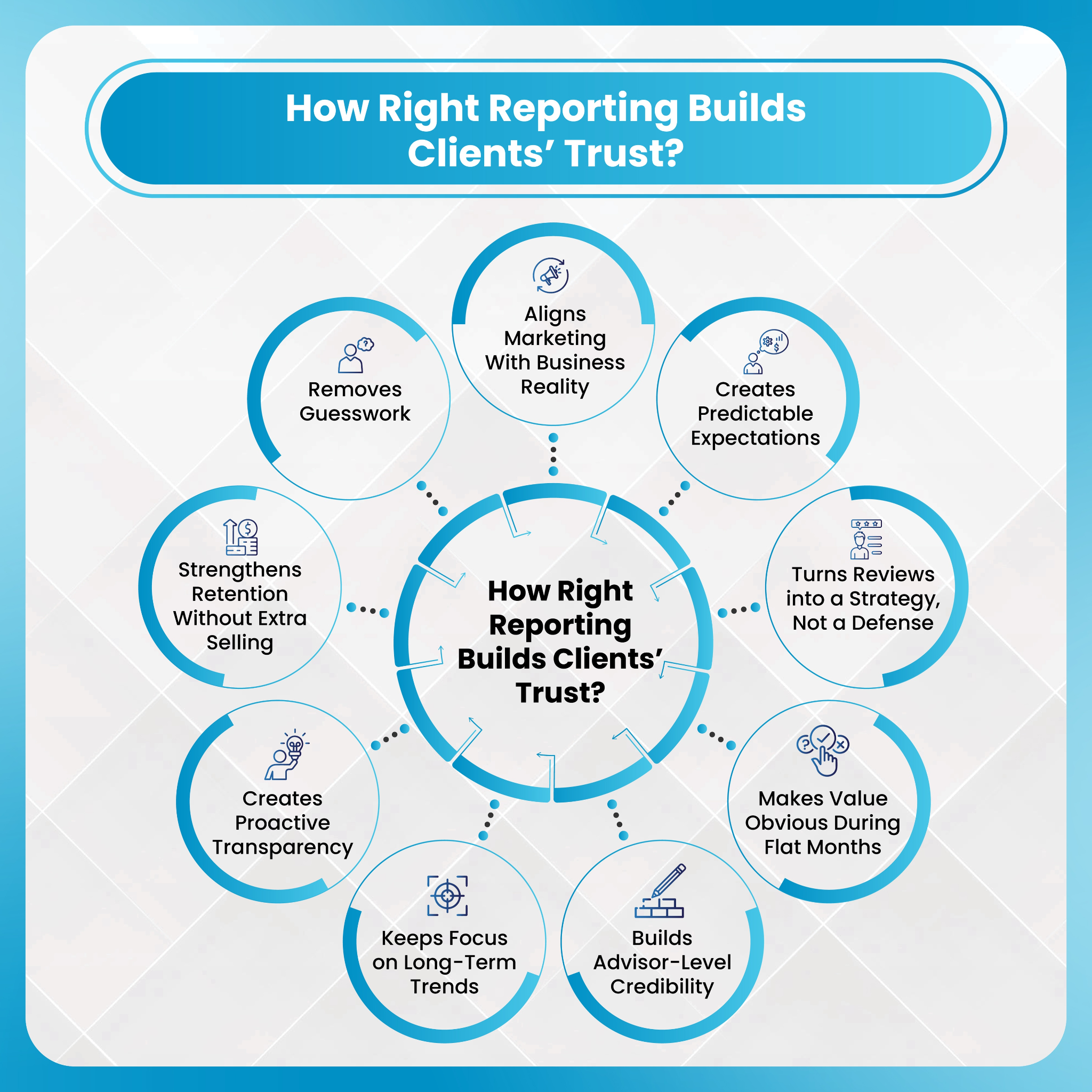
Clients need interpretation, context, and next steps, not just numbers.
Maintaining this level of communication becomes more difficult as agencies add more clients and campaigns.
Further Reading: Facebook Ads Reporting: How to Analyze Performance and Present It to Clients
Why Scaling Agencies Struggle With Client Education?
Communication quality often declines as agencies grow, not because agencies stop caring about their clients, but because operational capacity does not scale at the same rate as the client base.
As agencies add clients, internal teams manage:
- More ad accounts running simultaneously
- More campaign launches requiring setup and QA
- More reports due at different times
- More optimization tasks across accounts
- More client meetings and check-ins
- More tracking issues to diagnose
- More creative requests in the pipeline
- More client questions requiring responses
That growing workload reduces the time available for the activities that build client confidence, including strategic conversations, proactive client education, performance interpretation, personalized recommendations, and relationship building.
The common outcome is that campaigns may still be managed effectively at the technical level, but clients begin to feel underserved because updates feel reactive, incomplete, or generic. Client churn often begins with communication gaps long before it becomes a performance dispute. By the time performance is raised as the reason for leaving, the communication breakdown has usually been in place for weeks or months.
This is where operational support can become a competitive advantage.
How White Label Facebook Ads Help Agencies Deliver on Their Promises?
Setting realistic expectations is only half the equation. Agencies must consistently deliver on the commitments they make throughout the engagement to build long-term trust.
A white label Facebook ads reseller functions as an operational extension of the agency. The agency retains full control of strategy, branding, and client relationships, while the white label partner handles campaign execution, optimization, and reporting infrastructure.
- Consistent Campaign Optimization: White label support enables ongoing monitoring, audience refinement, budget adjustments, creative performance analysis, conversion tracking reviews, and regular performance improvement cycles. This consistent activity demonstrates to clients that their campaigns are being actively managed rather than simply monitored.
- Reliable Reporting: White label Facebook Ads management typically includes client-friendly performance updates, consistent reporting schedules, white label dashboards, transparent data presentation, and clear explanations of performance changes. Reliable reporting makes ROI conversations easier because clients receive information they can understand and act on.
- Strategic Recommendations: Beyond reporting, white label partners can provide budget recommendations, audience opportunity analysis, creative testing priorities, scaling recommendations, funnel observations, and performance insights. These recommendations position the agency as a strategic partner rather than a reporting vendor.
- Predictable Service Delivery: Predictability matters more as agencies scale. White label support provides consistent execution across accounts, reliable campaign launch timelines, regular optimization schedules, defined quality assurance processes, and consistent reporting deadlines. Clients notice when execution feels consistent, and they notice equally when it does not.
- More Time for Client Relationships: When white label Facebook Ads management handles campaign execution, internal agency teams recover time to invest in client meetings, retention strategies, upselling conversations, goal alignment sessions, and business development. Client relationships require time and attention that execution-heavy workflows often consume.

Consistently delivering on client promises requires reliable processes and experienced support. This is where DashClicks helps agencies scale without compromising service quality or communication.
How DashClicks Helps Agencies Build Client Confidence?
DashClicks serves as an operational partner for agencies offering Facebook Ads services, providing the infrastructure, expertise, and fulfillment support that agencies need to deliver consistent results as their client base grows.
- White Label Facebook Ads Management: DashClicks supports agencies with campaign setup, audience research, campaign structure development, budget allocation, and ongoing account management. Agencies can offer Facebook Ads services confidently, knowing that experienced specialists are handling execution under their brand.
- Tracking and Conversion Setup: Accurate tracking is foundational to meaningful reporting. Support includes pixel implementation, conversion tracking configuration, event validation, and performance visibility setup to ensure that campaign data reflects actual business activity.
- Ongoing Optimization and Creative Testing: Campaign performance requires continuous attention. Ongoing management includes budget optimization, audience refinement, creative testing, performance monitoring, and campaign adjustments. This consistent activity supports the kind of results that agencies promise clients at the start of an engagement.
- Transparent Reporting: White label reporting, client-ready reports, KPI tracking, and performance insights help agencies maintain clear communication with their clients. Reports are structured to answer the questions clients ask most frequently, reducing the volume of reactive follow-up communications.
- Dedicated Experts and Scalable Fulfillment: DashClicks helps agencies handle more clients, maintain consistent service quality, reduce internal workload, protect campaign performance standards, improve retention, and focus internal teams on growth and client relationships. As client volume increases, fulfillment capacity scales without requiring agencies to hire and train additional in-house staff.
The core framework that guides this approach is straightforward:
Clear Expectations + Consistent Optimization + Transparent Reporting = Stronger Client Trust
Ultimately, client confidence does not depend on perfect performance. It depends on whether the agency communicates clearly, optimizes consistently, and explains what progress actually looks like.
Realistic Expectations Are a Retention Strategy
Clients do not expect perfection. They expect clarity. Agencies that communicate clearly from the beginning of an engagement are far better positioned to retain clients through the inevitable ups and downs of campaign performance.
Campaign launch and campaign maturity are not the same event. The gap between those two milestones is where client education matters most. Agencies that help clients understand goals, the Learning Phase, realistic timelines, meaningful KPIs, and normal performance fluctuations give clients the context they need to evaluate progress accurately.
Strong reporting goes beyond sharing numbers. Every update should explain what changed, why it changed, and what the agency is doing next. That structure turns performance reviews into trust-building conversations rather than defensive justifications.
White label Facebook Ads management helps agencies maintain consistent execution while creating more time for the strategic communication that retains clients. A reliable partner supports fulfillment without replacing the agency's client relationship. The agency remains the expert. The white label partner ensures that the execution behind the expertise is always consistent.
Agencies that combine expert execution with transparent communication are better positioned to strengthen trust, improve retention, and scale sustainably without sacrificing the service quality that clients expect.

No results found.
Please try different keywords.
Get Started with
DashClicks Today
Get found online, convert leads faster, generate more revenue, and improve your reputation with our all-in-one platform.
.svg)
Unlimited Sub-Accounts
Unlimited Users
All Apps
All Features
White-Labeled
Active Community
Mobile App
Live Support
100+ Tutorials
Unlimited Sub-Accounts
Unlimited Users
All Apps
All Features
White-Labeled
Active Community
Mobile App
Live Support
100+ Tutorials
Unlimited Sub-Accounts
Unlimited Users
All Apps
All Features
White-Labeled
Active Community
Mobile App
Live Support
100+ Tutorials


