

.svg)

.svg)
.svg)
.svg)
.svg)
.svg)
Facebook Ads can go live within hours, which creates a common misconception: if the campaign is running, results should follow immediately. In reality, agencies that do not address this expectation early often spend more time managing client anxiety than campaign performance.
Paid advertising produces data faster than SEO, but faster data does not mean mature results. Profitable campaigns still require testing, learning, audience refinement, and creative iteration. A campaign launched on Monday will not perform the same way after several weeks of optimization.
Clients often confuse campaign launch with campaign maturity. When early fluctuations appear, they may interpret normal optimization cycles as poor management. That can damage trust even when the agency is executing effectively.
Agencies that educate clients before campaigns launch usually face fewer difficult conversations, fewer reactive check-ins, and stronger retention. Client education is not separate from delivering Facebook Ads services. It is part of the service itself.
The challenge is scaling that education across a growing client base. White label Facebook Ads management helps agencies maintain consistent optimization and reporting while preserving time for strategic communication.
This blog explains how to define campaign goals, clarify Meta’s Learning Phase, set realistic timelines, report meaningful KPIs, normalize performance fluctuations, and use white label support to deliver consistently as your agency grows.
Before discussing expectations, clients first need to understand what Facebook Ads are actually designed to accomplish.
Start With the Business Goal, Not the Ad Platform
Every Facebook campaign should begin with a clearly defined business objective. Too often, agencies and clients focus on ad formats, targeting options, and creativity before agreeing on what success actually looks like.
Common campaign goals include:
- Lead generation
- Ecommerce sales
- Brand awareness
- Local store visits
- Appointment bookings
- App installs
- Website traffic
- Engagement
Success metrics differ depending on the campaign objective. A brand awareness campaign is not designed to generate immediate purchases, and evaluating it against ROAS will always produce a misleading result.
Clients expecting immediate ROAS from an awareness campaign are measuring success using the wrong criteria. For example, a local service business running a brand awareness campaign to a cold audience may see strong reach and frequency numbers without a corresponding spike in direct inquiries. That does not mean the campaign is underperforming. It means the campaign is doing exactly what it was built to do, and the agency's job is to explain that clearly.
Campaign performance should always be evaluated against the original business objective.
Once campaign goals are clear, clients also need to understand why Facebook's system requires time before delivering consistent results.
Explain the Facebook Ads Learning Phase in Simple Terms
The Learning Phase is one of the most misunderstood parts of Facebook Ads management. Clients see spending leaving their account while results look inconsistent, and without context, that early period can feel like money wasted.
The Learning Phase is the period during which Meta's delivery system tests different audiences, placements, and creative combinations to determine the most efficient way to achieve the campaign objective. Early cost-per-action (CPA) and ROAS fluctuations during this phase are normal. The platform is collecting conversion data, not yet operating at full efficiency.
Frequent edits during the Learning Phase, such as changing budgets, audiences, or creative, can restart or disrupt optimization. Clients who push for constant adjustments in the first two weeks often extend the very period they are trying to get through.
Launching Facebook Ads is like hiring a new salesperson. They do not become the top performer on Day 1. They improve as they learn which prospects respond and which conversations lead to sales.
According to data, approximately 50 optimization events per ad set within seven days is a commonly referenced benchmark that can help an ad set exit the Learning Phase more efficiently. Lower-volume accounts, or those with restrictive budgets and narrow audiences, may take longer to reach that threshold or may remain in "Learning Limited" status for an extended period.
Learning Limited status can result from:
- Insufficient conversion volume
- Budget restrictions
- Audience size limitations
- Limited creative variety
- Conversion event selection that is too far down the funnel
Agencies should explain the Learning Phase before campaigns launch, not after clients become concerned.
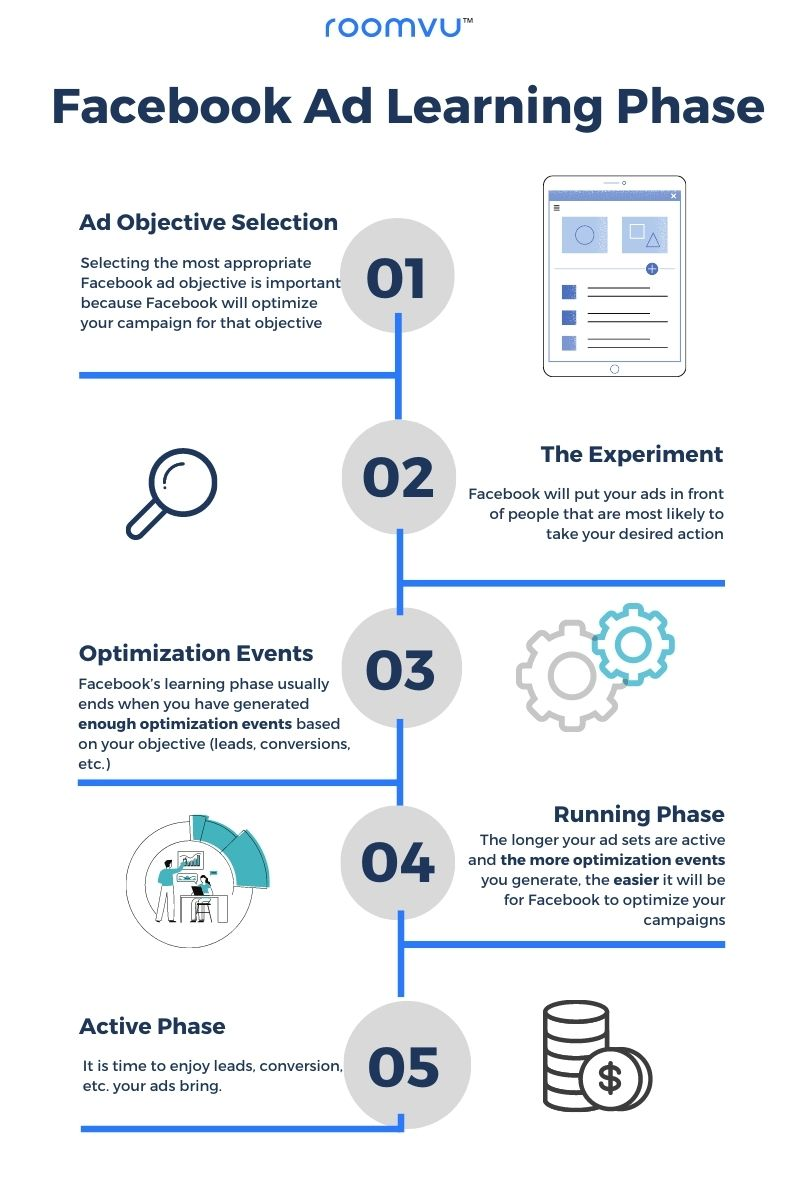
Image Source: Roomvu
Understanding the Learning Phase naturally leads to another important discussion: how long clients should realistically wait before evaluating success.
Create a Realistic Timeline for Results
Telling a client "it depends" without context does not build confidence. Clients need a flexible but understandable framework that explains what should happen and when.
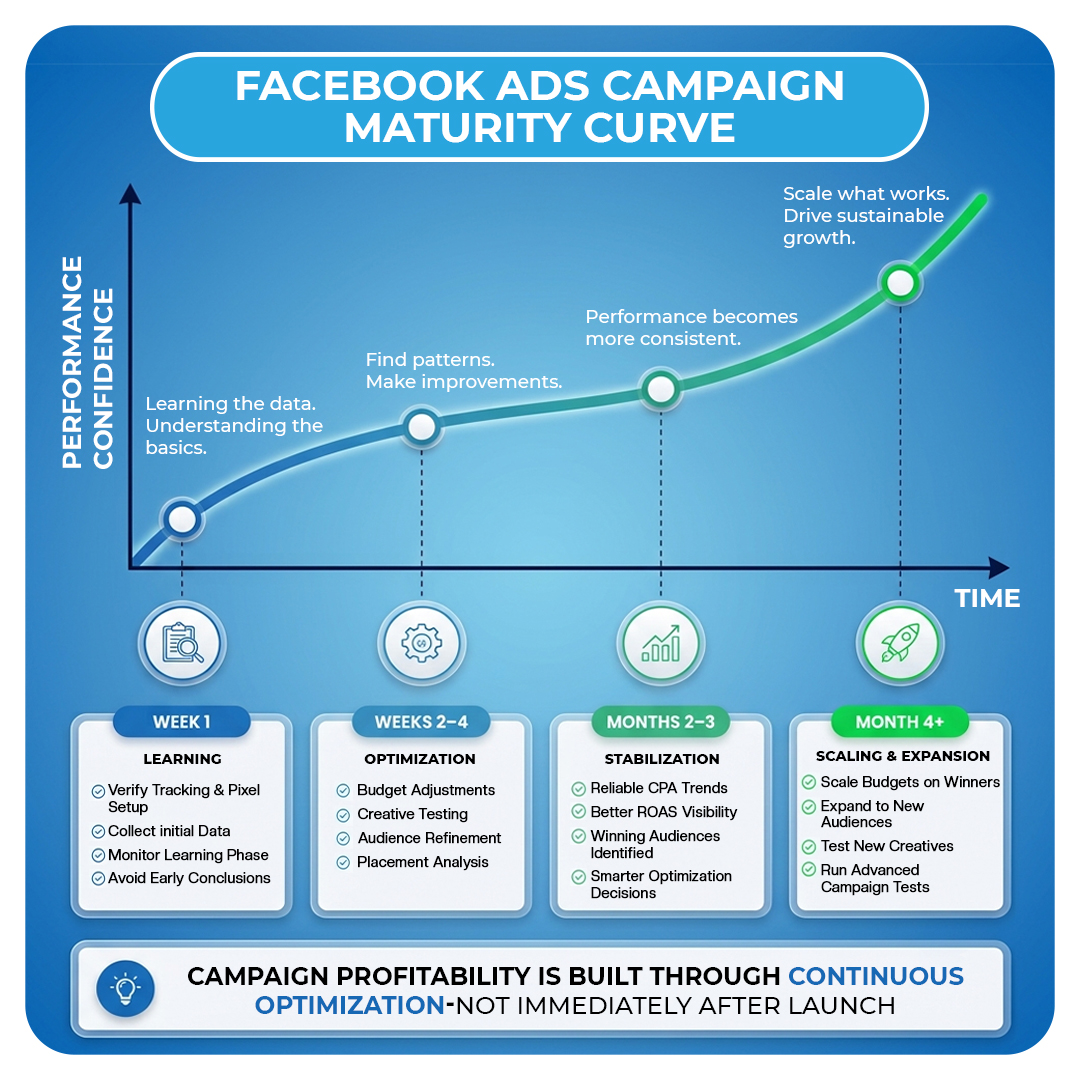
Week 1: Data Collection and Initial Learning
The first week is primarily about setup validation and early data collection. This includes confirming that tracking is working correctly, checking that ads are being delivered as expected, reviewing early creative performance signals, and monitoring the Learning Phase. Agencies should resist drawing performance conclusions from Day 1 data.
Weeks 2 to 4: Active Optimization
Once initial data is available, the focus shifts to refinement. This period typically involves budget adjustments, early creative testing conclusions, audience exclusions, placement analysis, and monitoring initial conversion trends. Results during this window may still fluctuate, but patterns begin to emerge.
Months 2 to 3: Performance Stabilization
By the second and third months, campaigns with sufficient conversion volume start showing more reliable CPA trends. Winning audiences become clearer, ROAS visibility improves, and budget allocation becomes more informed by actual performance data. Agencies can make more confident optimization decisions during this window.
Month 4 and Beyond: Scaling and Expansion
Campaigns that have stabilized are positioned for growth. This phase involves scaling budgets on proven audiences, testing new audience segments, expanding creative libraries, improving funnel touchpoints, and running more advanced campaign tests.
Profitability is created through optimization, not simply through campaign launch. Nielsen's marketing effectiveness research consistently demonstrates that campaigns benefit from sufficient time, consistent exposure, and ongoing optimization rather than early or frequent changes to campaign strategy.
The timeline should be presented as a framework, not a guaranteed schedule. Account maturity, budget size, sales cycle length, offer strength, and conversion volume all affect how quickly a campaign progresses through each stage.
Once clients understand realistic timelines, they also need to know that not every metric deserves equal attention.
Teach Clients Which Metrics Actually Matter
Ads Manager surfaces more data than most clients need or can interpret. Effective reporting simplifies performance and connects platform activity to business outcomes, rather than presenting clients with a full export and expecting them to draw their own conclusions.
Metrics Clients Often Obsess Over
Clients frequently fixate on:
- Click-through rate (CTR)
- Cost per click (CPC)
- Cost per thousand impressions (CPM)
- Reach
- Impressions
These metrics are useful for diagnosing how ads are being delivered and whether creative is resonating at the surface level. However, they do not prove business success on their own. A high CTR on an ad that generates no qualified leads is not a sign of a successful campaign.
Metrics That Reflect Business Outcomes
These should receive the most attention during client conversations:
- Cost per lead
- Cost per purchase
- Return on ad spend (ROAS)
- Conversion rate
- Revenue
- Qualified leads
- Pipeline value
- Booked appointments
- Customer acquisition cost
These metrics connect campaign activity directly to commercial results. They are the numbers clients should use to evaluate whether Facebook Ads are delivering business value.
Supporting Metrics
Some metrics fall between delivery and business outcomes. These supporting metrics help explain performance changes without standing on their own as success indicators:
- Frequency
- Landing page views
- Video completion rate
- Lead-to-sale rate
- Conversion lag
- Engagement
Strong Facebook Ads services connect platform metrics to meaningful business outcomes, rather than leaving clients to interpret delivery data without context.
Even when agencies report the right KPIs, performance will not always move in a straight line. Clients also need to understand why results fluctuate.
Normalize Performance Fluctuations Before They Become Problems
Facebook Ads operate in a live auction environment. Performance changes constantly, and a single difficult week is rarely an accurate indicator of long-term campaign health.
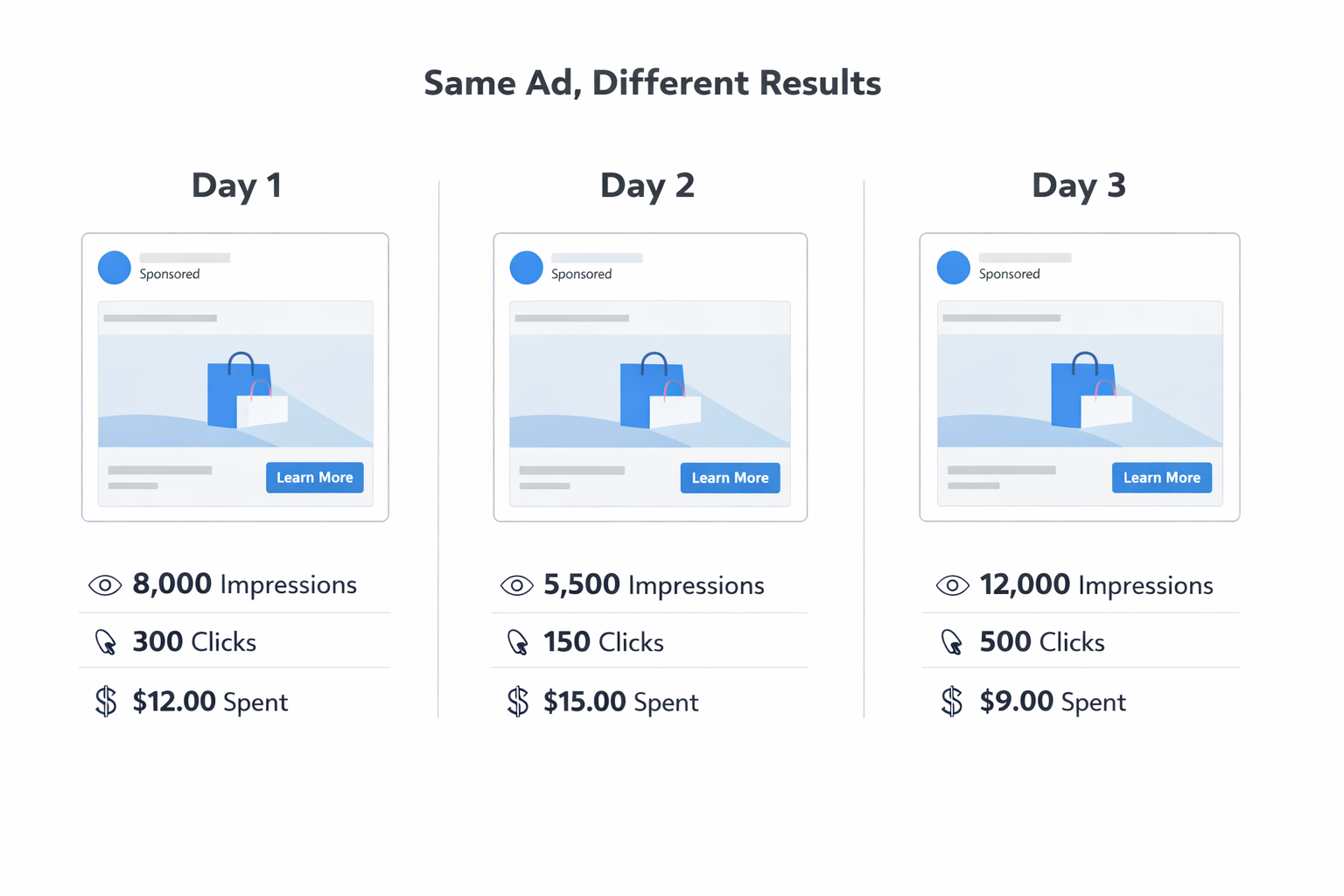
Image Source: LeadEnforce
Common causes of fluctuations include:
- Seasonality and holidays
- Increased competitor spending
- Auction competition
- Ad fatigue and creative saturation
- Audience saturation
- Changes in consumer behavior
- Platform algorithm updates
- Offer changes or landing page issues
- Economic shifts
A single difficult week does not necessarily signal poor campaign management. Context matters significantly when interpreting short-term performance dips.
According to Meta's Business documentation, the advertising auction uses dynamic pricing. CPMs and delivery change depending on competition levels, audience demand, expected action rates, and ad quality scores. Advertisers do not purchase impressions at a permanently fixed rate, which means cost efficiency will shift based on factors outside any agency's direct control.
For example, a campaign may experience significantly higher CPMs during a major holiday period because more advertisers are competing for the same audience at the same time. An experienced agency may still improve conversion efficiency during that period through stronger creative testing or tighter audience segmentation, even when raw costs are elevated.
Performance changes should be evaluated through trends, context, and business outcomes rather than isolated daily numbers.
Setting expectations is not only about educating clients. It also requires consistent communication throughout the engagement.
Build a Reporting Process That Reduces Client Anxiety
Sending a dashboard without interpretation often creates more questions than confidence. Numbers without context leave clients to form their own conclusions, and those conclusions are frequently more negative than the actual performance warrants.
A structured reporting framework across three communication levels creates consistency and reduces reactive client conversations.
Weekly Updates
Weekly updates should be brief and action-focused. They should cover:
- Major wins from the previous week
- Active optimizations currently in progress
- Issues being monitored
- Upcoming tests or experiments
- Any significant budget changes
Keeping weekly updates concise signals that the agency is in control and actively managing the account, without overwhelming clients with unnecessary detail.
Monthly Performance Reviews
Monthly reviews provide a fuller picture and are the appropriate place for deeper performance discussion. These reviews should address:
- Business outcomes against agreed KPIs
- Performance trends across the month
- Budget pacing and recommendations
- Strategic insights from the data
- Creative results and audience learnings
- Priorities for the coming month
Quarterly Strategy Reviews
Quarterly reviews zoom out further and focus on strategic alignment. These sessions should cover:
- Goal alignment and any shifts in business priorities
- Scaling opportunities identified over the quarter
- New audience or creative strategies worth testing
- Market changes affecting performance
- Funnel recommendations based on campaign learnings
- Budget planning for the next quarter
Every report or update, regardless of the level, should answer three questions clearly: what changed, why it changed, and what happens next.
Research from professional services and client experience literature consistently supports the connection between proactive communication and higher client satisfaction. Clients who receive regular, clear updates are less likely to second-guess campaign decisions or escalate concerns into formal disputes.
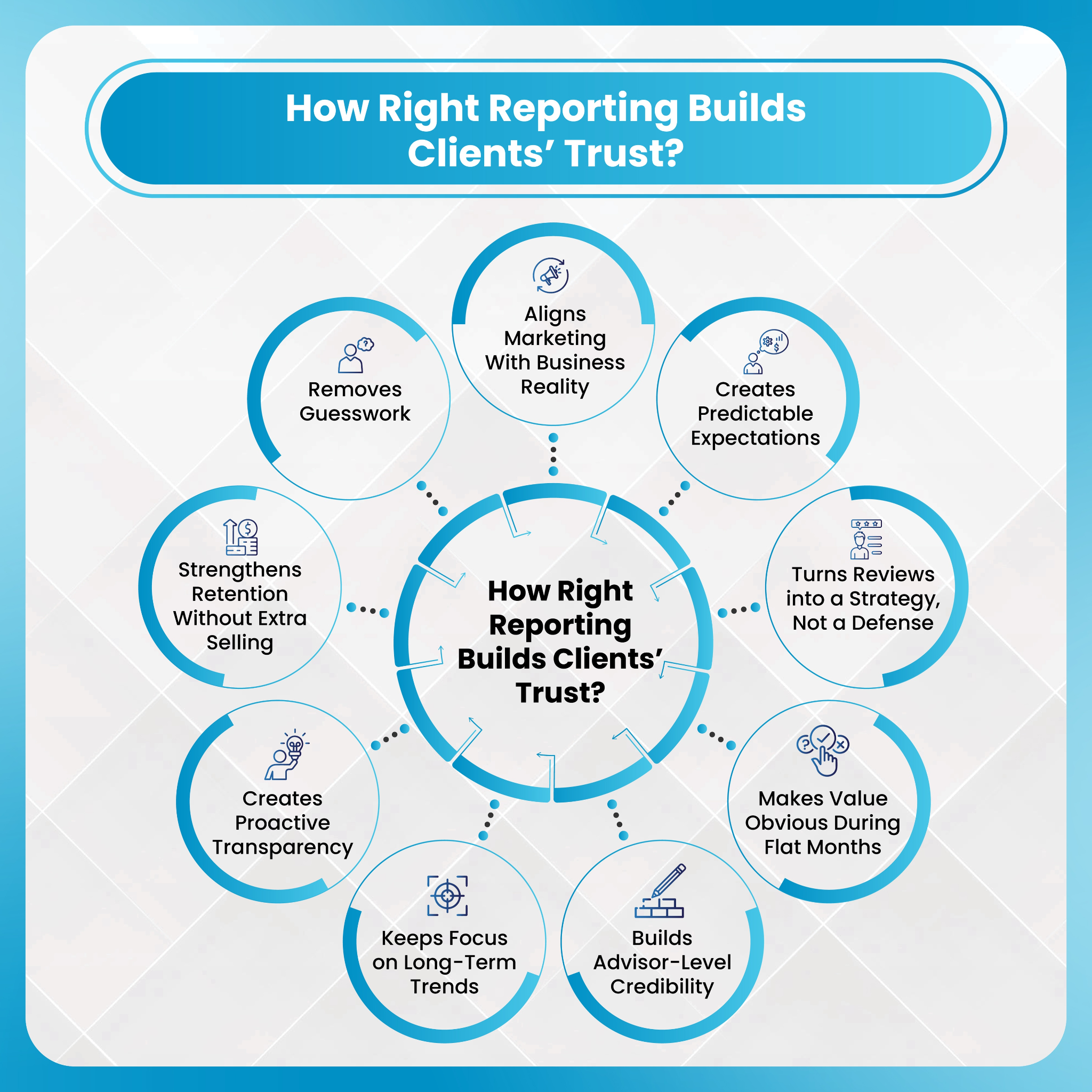
Clients need interpretation, context, and next steps, not just numbers.
Maintaining this level of communication becomes more difficult as agencies add more clients and campaigns.
Further Reading: Facebook Ads Reporting: How to Analyze Performance and Present It to Clients
Why Scaling Agencies Struggle With Client Education?
Communication quality often declines as agencies grow, not because agencies stop caring about their clients, but because operational capacity does not scale at the same rate as the client base.
As agencies add clients, internal teams manage:
- More ad accounts running simultaneously
- More campaign launches requiring setup and QA
- More reports due at different times
- More optimization tasks across accounts
- More client meetings and check-ins
- More tracking issues to diagnose
- More creative requests in the pipeline
- More client questions requiring responses
That growing workload reduces the time available for the activities that build client confidence, including strategic conversations, proactive client education, performance interpretation, personalized recommendations, and relationship building.
The common outcome is that campaigns may still be managed effectively at the technical level, but clients begin to feel underserved because updates feel reactive, incomplete, or generic. Client churn often begins with communication gaps long before it becomes a performance dispute. By the time performance is raised as the reason for leaving, the communication breakdown has usually been in place for weeks or months.
This is where operational support can become a competitive advantage.
How White Label Facebook Ads Help Agencies Deliver on Their Promises?
Setting realistic expectations is only half the equation. Agencies must consistently deliver on the commitments they make throughout the engagement to build long-term trust.
A white label Facebook ads reseller functions as an operational extension of the agency. The agency retains full control of strategy, branding, and client relationships, while the white label partner handles campaign execution, optimization, and reporting infrastructure.
- Consistent Campaign Optimization: White label support enables ongoing monitoring, audience refinement, budget adjustments, creative performance analysis, conversion tracking reviews, and regular performance improvement cycles. This consistent activity demonstrates to clients that their campaigns are being actively managed rather than simply monitored.
- Reliable Reporting: White label Facebook Ads management typically includes client-friendly performance updates, consistent reporting schedules, white label dashboards, transparent data presentation, and clear explanations of performance changes. Reliable reporting makes ROI conversations easier because clients receive information they can understand and act on.
- Strategic Recommendations: Beyond reporting, white label partners can provide budget recommendations, audience opportunity analysis, creative testing priorities, scaling recommendations, funnel observations, and performance insights. These recommendations position the agency as a strategic partner rather than a reporting vendor.
- Predictable Service Delivery: Predictability matters more as agencies scale. White label support provides consistent execution across accounts, reliable campaign launch timelines, regular optimization schedules, defined quality assurance processes, and consistent reporting deadlines. Clients notice when execution feels consistent, and they notice equally when it does not.
- More Time for Client Relationships: When white label Facebook Ads management handles campaign execution, internal agency teams recover time to invest in client meetings, retention strategies, upselling conversations, goal alignment sessions, and business development. Client relationships require time and attention that execution-heavy workflows often consume.

Consistently delivering on client promises requires reliable processes and experienced support. This is where DashClicks helps agencies scale without compromising service quality or communication.
How DashClicks Helps Agencies Build Client Confidence?
DashClicks serves as an operational partner for agencies offering Facebook Ads services, providing the infrastructure, expertise, and fulfillment support that agencies need to deliver consistent results as their client base grows.
- White Label Facebook Ads Management: DashClicks supports agencies with campaign setup, audience research, campaign structure development, budget allocation, and ongoing account management. Agencies can offer Facebook Ads services confidently, knowing that experienced specialists are handling execution under their brand.
- Tracking and Conversion Setup: Accurate tracking is foundational to meaningful reporting. Support includes pixel implementation, conversion tracking configuration, event validation, and performance visibility setup to ensure that campaign data reflects actual business activity.
- Ongoing Optimization and Creative Testing: Campaign performance requires continuous attention. Ongoing management includes budget optimization, audience refinement, creative testing, performance monitoring, and campaign adjustments. This consistent activity supports the kind of results that agencies promise clients at the start of an engagement.
- Transparent Reporting: White label reporting, client-ready reports, KPI tracking, and performance insights help agencies maintain clear communication with their clients. Reports are structured to answer the questions clients ask most frequently, reducing the volume of reactive follow-up communications.
- Dedicated Experts and Scalable Fulfillment: DashClicks helps agencies handle more clients, maintain consistent service quality, reduce internal workload, protect campaign performance standards, improve retention, and focus internal teams on growth and client relationships. As client volume increases, fulfillment capacity scales without requiring agencies to hire and train additional in-house staff.
The core framework that guides this approach is straightforward:
Clear Expectations + Consistent Optimization + Transparent Reporting = Stronger Client Trust
Ultimately, client confidence does not depend on perfect performance. It depends on whether the agency communicates clearly, optimizes consistently, and explains what progress actually looks like.
Realistic Expectations Are a Retention Strategy
Clients do not expect perfection. They expect clarity. Agencies that communicate clearly from the beginning of an engagement are far better positioned to retain clients through the inevitable ups and downs of campaign performance.
Campaign launch and campaign maturity are not the same event. The gap between those two milestones is where client education matters most. Agencies that help clients understand goals, the Learning Phase, realistic timelines, meaningful KPIs, and normal performance fluctuations give clients the context they need to evaluate progress accurately.
Strong reporting goes beyond sharing numbers. Every update should explain what changed, why it changed, and what the agency is doing next. That structure turns performance reviews into trust-building conversations rather than defensive justifications.
White label Facebook Ads management helps agencies maintain consistent execution while creating more time for the strategic communication that retains clients. A reliable partner supports fulfillment without replacing the agency's client relationship. The agency remains the expert. The white label partner ensures that the execution behind the expertise is always consistent.
Agencies that combine expert execution with transparent communication are better positioned to strengthen trust, improve retention, and scale sustainably without sacrificing the service quality that clients expect.


.svg)


.svg)
.svg)
.svg)
.svg)
.svg)