

DashClicks Blog
The industry's top experts offer their best advice, research, how-tos, and insights—all in the name of helping you level-up your business and online marketing skills.
Join Us!
.svg)
.svg)
.svg)
.svg)
.svg)

Questions Agencies Must Ask Before Choosing a Long-Term White Label Facebook Ads Partner
Choosing a white label Facebook ad agency is not just a vendor decision. It is a delivery infrastructure decision.
The partner you select will be responsible for campaign performance across multiple client accounts, in your agency's name. That means optimization quality, tracking accuracy, creative testing, and communication standards all become your agency's responsibility, even when a third party handles execution.
Many agencies evaluate white label Facebook ads reseller options based on price, turnaround time, or the number of services offered. Those factors matter, but they do not tell you whether a provider can consistently deliver results as your client base grows.
The right questions reveal how a provider actually operates. They expose whether the team follows structured processes or reacts to problems after the fact. They also clarify whether you are hiring a fulfillment vendor or a strategic partner. The difference between those two shapes your agency's reputation, client retention, and internal workload over time.
This article walks through 12 operational questions every agency should ask before committing to a long-term white label Facebook ads partner. Each question targets a specific area:
- Campaign optimization and troubleshooting
- Creative strategy and testing
- Tracking and conversion data
- Communication and account management
- Quality control across accounts
- Scalability and onboarding
- Reporting and strategic support
- Platform adaptability and ownership
Poor partner selection does not just produce bad campaign results. It creates more internal work for your team, reduces your ability to scale, and puts agency-client relationship at risk. The questions below help you avoid that outcome.
The Problem: Why the Wrong White Label Partner Creates More Work for Agencies
1. Inconsistent Optimization
Optimization is not the same as campaign monitoring. A provider who monitors campaigns without a defined optimization framework tends to react to problems rather than prevent them.
Reactive optimization means your agency often discovers issues only after clients raise concerns. Missed budget pacing, ad fatigue, and audience overlap are all preventable problems that require a proactive process to catch early.
2. Poor Campaign Structure
Fragmented target audience and poorly organized ad sets make campaigns harder to manage and harder to scale. Budget dilution across too many small audiences reduces learning efficiency and makes it difficult for Meta's algorithm to optimize.
Meta's own guidance supports simplified account structures. In one internal test, consolidating campaign architecture produced a 41% increase in conversions. Providers who build bloated structures may be working against that principle.
3. Weak Data and Tracking
Facebook Ads optimization depends on signal quality. Without proper Pixel configuration, Conversions API implementation, and CRM integration, the algorithm is working with incomplete data.
Poor event quality scores reduce delivery efficiency and lead to optimization decisions built on inaccurate attribution. This is especially damaging when scaling ad spend across multiple clients.
4. Communication Gaps
Agencies need regular visibility into what is happening inside their client accounts. A provider who does not proactively communicate changes, test results, or performance issues puts your account managers in a difficult position.
Delayed communication creates delayed issue discovery. By the time your team identifies a problem, the client may already be asking questions your team cannot answer.
5. Scaling Becomes a Fulfillment Problem
A provider may handle five or ten accounts efficiently but struggle when volume increases significantly. Inconsistent turnaround times, declining output quality, and limited specialist capacity all surface under growth pressure.
If a provider cannot scale alongside your agency, your growth creates operational problems rather than momentum. The questions below help you assess that risk before it becomes a reality.
Question #1: How Do You Actually Optimize Campaigns?
This question reveals whether a provider has a structured approach or an informal one.
Questions Agencies Should Ask
- What triggers an optimization review: scheduled cadence, performance thresholds, or both?
- How do you document optimization decisions across accounts?
- What does a typical week of campaign management look like for an account at our average spend level?
- How do you prioritize which accounts to optimize first when managing multiple clients?
What Strong Answers Reveal
Strong providers describe a defined optimization cadence tied to both time intervals and performance signals. They can explain what triggers a bid adjustment, audience refresh, or creative rotation, and why.
Documentation matters here. Providers who log optimization changes enable accountability, support continuity when team members change, and make it easier to communicate reasoning back to your account managers.
Vague answers like "we check campaigns regularly" suggest informal processes. Formal processes reduce variance in quality across accounts.
Question #2: What Happens When a Campaign Underperforms?
Every Facebook Ads campaign eventually underperforms. The question is whether your partner has a structured process for diagnosing and resolving those situations.
Questions to Ask
- Walk me through your troubleshooting process when a campaign misses its KPIs for two consecutive weeks.
- How do you determine whether underperformance is caused by creative fatigue, audience saturation, tracking issues, or structural problems?
- When do you escalate an issue, and who makes that call?
Red Flags
- No structured troubleshooting workflow
- Inability to explain how root causes are identified
- No clear escalation path for persistent problems
Strong Diagnostic Process
A capable provider isolates variables before making changes. They review creative performance, audience overlap, landing page data, and event quality before drawing conclusions.
Escalation should be built into the process, not improvised. Knowing who reviews difficult accounts and when problems are resolved faster and communicated to your team before a client notices.
Question #3: How Do You Approach Creative Testing?
Creative is one of the highest-leverage variables in Facebook Ads performance. Providers who test systematically outperform those who rotate creatives based on intuition.
Ask how frequently new creative concepts are tested, how hypotheses are formed before testing, and how ad fatigue is monitored at the account level.
Strong providers test one primary variable at a time and define success metrics before launching. They track fatigue signals proactively and build iteration schedules rather than waiting for performance to drop before refreshing.
Meta's own creative diversification guidance supports running multiple creative formats across placements to maximize reach efficiency. Ask whether your potential partner builds this principle into their testing workflow.
Question #4: Who Owns Tracking and Conversion Data?
Tracking ownership is one of the most technically consequential questions on this list.
Ask specifically about:
- Pixel implementation and event verification
- Conversions API setup and CRM signal integration
- Event quality monitoring and how discrepancies are caught
- What tracking validation looks like before a campaign launches
Providers who validate conversion events, monitor data quality scores, and integrate offline signals tend to produce more reliable optimization outcomes. Providers who treat tracking as a setup task rather than an ongoing responsibility leave gaps that compound over time.
Reliable data is not a nice-to-have. It is the foundation that Meta's algorithm uses to allocate budget, find audiences, and optimize toward the right outcomes.
Question #5: How Will Your Team Work With Our Account Managers?
Your account managers serve the client relationship. The white label team supports them from behind the scenes. If that working relationship is unclear or poorly structured, your internal team absorbs the management burden.
Questions to Ask
- What is your average response time for account manager inquiries?
- How do you communicate proactive recommendations, not just updates?
- What does your team prepare when an account manager needs to present results to a client?
- How do you handle urgent issues outside of normal business hours?
A good white label Facebook Ads agency reduces the number of questions your account managers need to ask by providing clear, consistent communication. Providers who require frequent follow-up to get basic answers create more internal overhead than they relieve.
Question #6: How Do You Maintain Quality Across Multiple Accounts?
Quality consistency across many accounts requires documented processes. Ask how the provider maintains execution standards when managing campaigns across a range of industries, budgets, and objectives.
Look for:
- Standard operating procedures for campaign setup and ongoing management
- Quality assurance reviews before launches and after significant changes
- Processes for onboarding new accounts without sacrificing quality on existing ones
- A review layer that catches errors before they reach your clients
Providers who rely on individual team members rather than documented systems introduce variability that grows more problematic as your account volume increases.
Question #7: What Happens When We Add 10, 20, or 50 New Accounts?
According to Databox research, agencies commonly manage between 10 and 30 clients simultaneously. Onboarding and scaling become operational challenges without structured fulfillment processes, and many agencies cite this as a significant growth constraint.
Ask your potential partner directly:
- How many accounts does your team currently manage?
- What does your onboarding workflow look like for a surge of five or ten new accounts?
- How do you allocate specialists when volume increases quickly?
- What is your standard turnaround time for campaign setup, and does it change under growth pressure?
Providers who can describe their capacity structure and onboarding workflow clearly are more likely to scale alongside your agency without a quality decline. Vague answers about scalability are a signal to dig deeper.
Question #8: What Does Your Reporting Actually Give Us?
Reporting is often positioned as a deliverable when it should function as a communication tool. The format matters less than the substance.
Databox research shows that 45% of agencies report on a monthly basis, while 18% report weekly or biweekly. Your reporting cadence should match client expectations, but the quality of insights should remain consistent regardless of frequency.
Ask specifically:
- Are reports white-labeled and customizable to our branding?
- Do reports include optimization context or just performance metrics?
- Can we see what actions were taken and why, not just what the numbers show?
- Are strategic recommendations included alongside performance data?
A white label reporting software that explains decisions gives your account managers something to work with. Reporting that only displays metrics puts the interpretation burden on your team.
Question #9: Who Is Actually Managing Our Clients' Campaigns?
This question is about accountability and expertise, not just headcount.
Ask whether dedicated specialists are assigned to your accounts or whether work is distributed across a generalist pool. Ask about the experience level of the people running day-to-day management versus those providing strategic oversight.
The distinction matters because:
- Dedicated specialists build account-specific knowledge over time
- Generalist pools create continuity risks when staff changes occur
- Senior strategy oversight catches issues that junior execution misses
You should know exactly who is responsible for your accounts and what level of expertise they bring to campaign decisions.
Question #10: How Do You Adapt to Meta Ads Changes?
Meta's platform evolves continuously. Providers who adapt quickly outperform those who rely on outdated structures and manual processes.
Ask how the provider incorporates Meta's AI-driven tools, including Advantage+ Shopping Campaigns and automated audience targeting. Ask how they balance automation with human oversight to avoid loss of control over account strategy.
Meta's AI recommendation models have contributed roughly 5% more Instagram conversions and 3% more Facebook conversions based on internal data. These figures underscore why providers need to stay current with Meta's evolving guidance, not just its current features.
Also ask about their process for testing new platform features and how they decide when automation is appropriate versus when manual control is better suited to a client's goals.
Question #11: What Strategic Support Do You Provide Beyond Campaign Execution?
Execution gets campaigns live. Strategy determines whether those campaigns grow client businesses over time.
Ask whether your potential partner offers:
- Growth recommendations based on account performance trends
- Budget allocation advice across campaign types and objectives
- Funnel-level insights that connect ad performance to business outcomes
- Periodic account reviews that go beyond monthly reporting
The difference between an execution partner and a strategic partner is whether they help your agency understand what to do next, not just what happened last month. Agencies that want to position themselves as consultative partners to their clients need the same quality of thinking from their white label providers.
Question #12: What Happens If We Need to End the Partnership?
Every business relationship should have a clear exit process. Avoiding this question does not protect the partnership. It creates risk if the relationship eventually changes.
Ask specifically:
- Who owns the ad accounts, Pixel data, and creative assets?
- How is campaign documentation handed over at the end of the engagement?
- What is the transition timeline, and what support is provided during handoff?
- Are there contractual restrictions that affect your agency's ability to transition?
Vendor lock-in through data ownership or restrictive contract terms is a legitimate operational risk. Providers who have clear, client-first exit processes are more confident in the value they deliver.
How to Evaluate the Answers: Strong Signals vs. Red Flags
Use this table to evaluate what a provider's responses actually indicate:
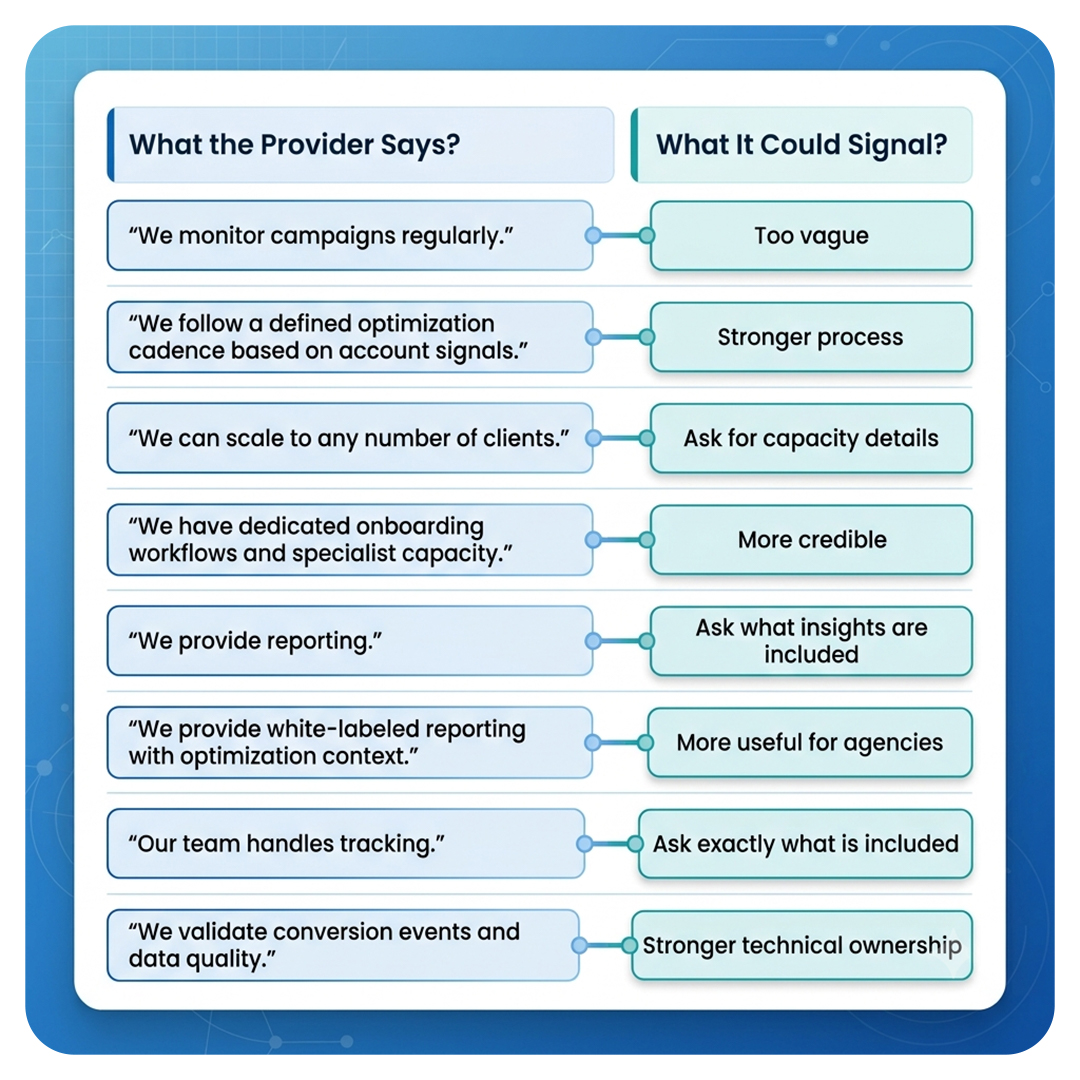
No single answer confirms a partner is the right fit. Pattern recognition across multiple questions gives you a more accurate picture of how the provider actually operates.
The Final Test: Can This Partner Make Your Agency Easier to Run?
Before committing to any white label Facebook ads reseller, consider whether the provider helps your agency:
- Reduce internal management workload across client accounts
- Maintain consistent campaign optimization without constant oversight
- Troubleshoot performance issues quickly and with clear communication
- Run structured creative testing that improves results over time
- Keep tracking and conversion data reliable across all accounts
- Communicate proactively rather than reactively
- Onboard and scale new accounts without quality decline
- Support account managers with reporting and client-ready insights
- Adapt to Meta platform changes without manual intervention
- Contribute strategic thinking beyond campaign execution
Facebook ads services at scale require more than task completion. The right partner strengthens your agency's delivery systems, improves your ability to retain clients, and gives your team the infrastructure to grow without increasing internal complexity.
Choosing a white label Facebook ad agency based on operational capability, not just price or availability, is one of the most consequential decisions a growing agency will make.

How White Label SEO Helps Agencies Build Sustainable Organic Growth
Sustainable organic growth depends on consistent execution, not just a strong SEO strategy. While many agencies achieve quick wins at the start of a campaign, maintaining long-term performance becomes much more challenging as those initial opportunities disappear.
Early improvements often come from fixing technical issues, optimizing metadata, improving internal linking, and updating existing pages. Once those tasks are complete, continued growth relies on ongoing optimization, content improvements, technical maintenance, and responding to changes in search behavior and competition. According to BrightEdge, organic search accounts for approximately 53.3% of all trackable website traffic, making it a critical acquisition channel for businesses. However, sustaining that visibility requires continuous effort.
At the same time, client websites continue to evolve. New content is published, products and services change, competitors expand, and search algorithms are updated. When identified SEO tasks are repeatedly delayed, agencies begin to accumulate SEO execution debt: a growing backlog of technical fixes, content updates, internal linking opportunities, and optimization work that eventually limits growth and puts existing rankings at risk.
The challenge is often not strategy but execution capacity. Agencies may know what needs to be done but lack the bandwidth to implement it consistently across every client account.
This is where a white label SEO agency can help. By providing dedicated fulfillment capacity, agencies can maintain a consistent optimization cadence, protect existing performance, and continue driving sustainable organic growth without expanding their internal team.
What Sustainable Organic Growth Actually Means for an Agency?
Agencies often define SEO success as more traffic or more rankings. Both matter, but neither tells the full story. Sustainable organic growth rests on three interconnected pillars.
- Continuous Improvement: After the initial optimization layer is complete, campaigns must keep finding and acting on new opportunities. This means identifying pages approaching page one, closing content gaps, targeting emerging queries, and building topical depth. The work does not stop because the obvious problems are solved.
- Performance Protection: Rankings are not permanent. A page that ranks well today can slip within weeks if competitors improve their content, if a core update shifts how Google evaluates relevance, or if the page itself stops meeting current search intent. Every existing ranking requires active protection.
- Consistent Execution: Identifying opportunities is not enough. Sustainable SEO comes from acting on those opportunities before they become missed opportunities. Strategy without execution is just documentation.
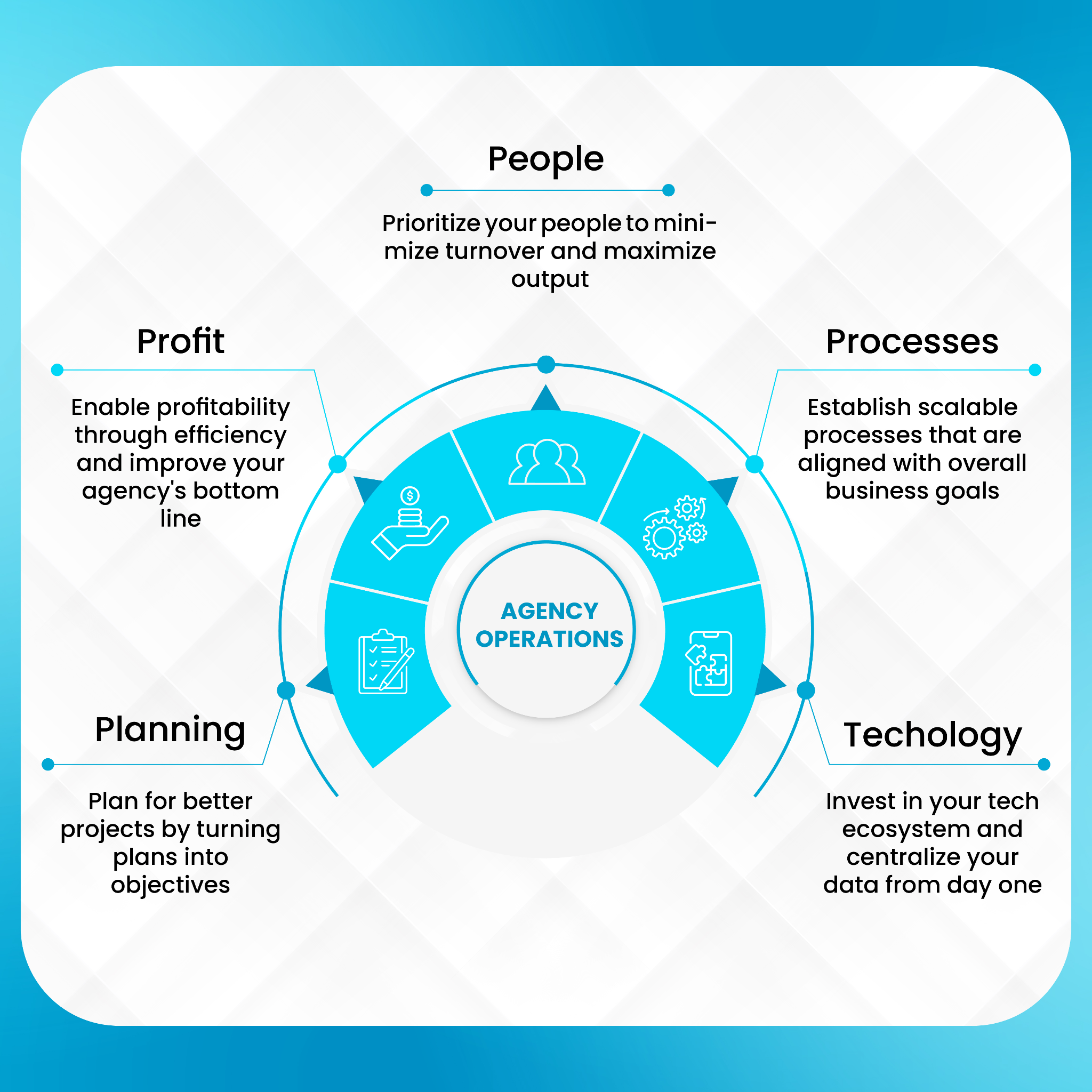
Put simply: Sustainable SEO = Grow What is Working + Protect Existing Performance + Respond to Ongoing Change
Google's own documentation reinforces this point, noting that search results continually evolve because user expectations, content quality, and the web itself are always changing. SEO cannot be treated as a fixed deliverable with an end date.
Why Organic Growth Often Stalls After the Initial SEO Wins?
The SEO plateau is real, and it is predictable.
Every campaign starts with an initial optimization layer, the foundational fixes that produce early momentum:
- Missing title tags
- Duplicate metadata
- Broken links
- Crawl and indexation issues
- Weak page optimization
These problems are usually widespread on new clients, which is why early results can feel dramatic.
The issue is that these wins have a ceiling. Once solved, they are solved. Growth then depends on harder, less obvious work:
- Pages ranking in positions 5 to 15 that need targeted content improvements to break into the top tier.
- Declining pages that are losing visibility to stronger competitors.
- Keyword cannibalization limiting how effectively internal pages compete.
- Content gaps where competitors cover topics the client's site does not address.
- Search intent mismatches between what users expect and what a page delivers.
- Internal authority distribution that is not aligned with high-priority pages.
At the same time, the website itself keeps evolving. New service pages get added. Products launch without proper optimization. Competitors enter the market or improve existing content. Older content decays as information becomes outdated. Google updates its understanding of what good content looks like.
Google's guidance specifically recommends that site owners regularly review and update existing content to keep it useful, accurate, and relevant. In practice, very few agency teams have the bandwidth to act on that recommendation consistently across all client accounts.
The Cost of SEO Execution Debt
Execution debt forms whenever SEO work gets identified but not completed. It is not a single missed task. It is a pattern of deferred action that compounds over time. Here is a simplified example of how it plays out:
Month 1: A content refresh gets delayed due to capacity constraints.
Month 2: A competitor publishes stronger content targeting the same queries.
Month 3: Rankings begin to slip as Google favors the competitor's updated page.
Month 4: Traffic drops become visible in client reports.
Month 5: Recovery requires more effort than prevention would have taken.
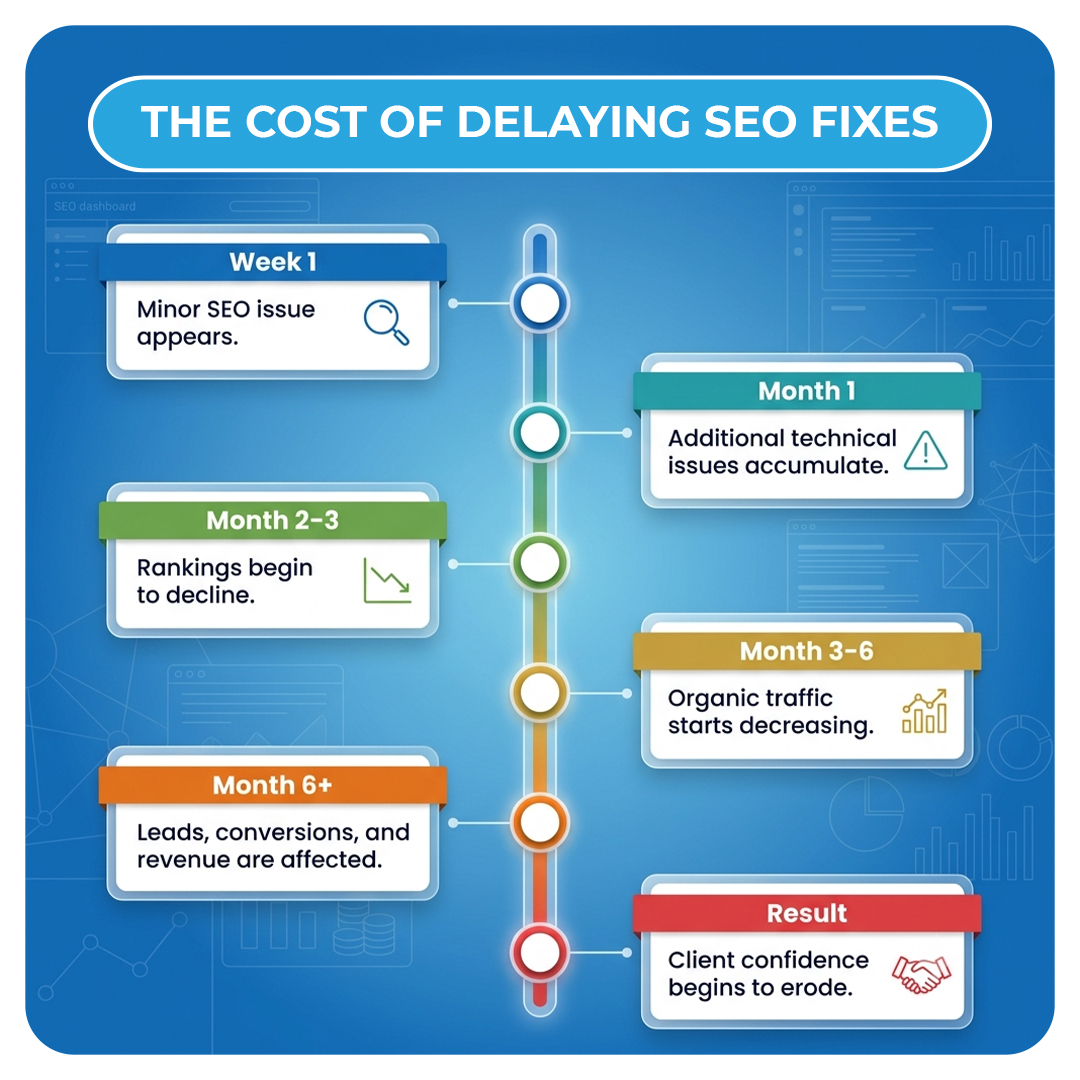
What starts as a delayed task becomes a performance decline that requires reactive work to address. The longer debt accumulates, the more expensive it becomes to resolve.
Common sources of execution debt include:
- Technical fixes sitting in the backlog for weeks.
- Declining pages ignored in favor of new campaign work.
- Internal linking opportunities identified but never implemented.
- New keyword opportunities not pursued because the team is stretched.
- Competitor changes not responded to.
- Reporting delivered without implementation to support it.
Here is the important part: execution debt is not primarily a knowledge problem. Most agency SEO teams understand what needs to be done. The bottleneck is fulfillment capacity. Larger agencies managing multiple accounts often feel this most acutely because the volume of identified work far exceeds what their teams can act on in any given month.
Sustainable SEO Requires a Balance Between Growth and Maintenance
The agencies that avoid execution debt tend to operate with something worth calling the Grow and Protect Model. It recognizes that sustainable organic growth requires two parallel streams of work running simultaneously.
Growth Activities
Growth-focused SEO work expands search visibility through new keyword targeting, landing page development, content expansion for topical authority, link acquisition, and conversion optimization. These activities are visible to clients and often get prioritized because results are easy to attribute.
Protection Activities
Protection-focused work maintains and defends existing performance. This includes technical maintenance, content refreshes, internal link auditing, redirect monitoring, indexation checks, and fixes for declining or cannibalized pages.
The challenge is that protection work rarely feels urgent until rankings start to slip. Agencies naturally emphasize growth because it is easier to present in client reports. However, sustainable growth comes from expanding search visibility while simultaneously protecting the assets already generating traffic.
Google's guidance is consistent here: content should remain useful, accurate, and current. A page that ranked well two years ago on the basis of strong optimization will not hold that position indefinitely without maintenance.
Where Agencies Commonly Lose SEO Momentum?
Understanding where momentum breaks down is the first step toward preventing it. Six patterns show up consistently across agencies of all sizes.
- Growing Optimization Backlog: Audits routinely surface more work than teams can realistically complete. When the backlog grows faster than the team can clear it, lower-priority tasks get pushed out repeatedly until they become urgent problems.
- Mature Accounts Receive Less Attention: New clients generate energy and scrutiny. Mature accounts that are performing adequately often receive less resources over time, even though those accounts still require ongoing optimization to maintain their performance.
- Publishing Replaces Optimization: It can feel more productive to publish new content than to refresh existing pages. However, optimizing a page that already has some authority and index history frequently delivers better ROI than starting from scratch. When agencies focus exclusively on new content, existing assets quietly decay.
- Technical Work Keeps Getting Postponed: Technical SEO issues tend to accumulate quietly. Site migrations introduce redirect chains. New page templates create structured data gaps. Site speed degrades as the codebase grows. None of these issues cause immediate ranking drops, so they keep getting pushed down the priority list.
- Ranking Declines Become Reactive: Proactive SEO monitoring catches problems early. Reactive agencies discover ranking drops in monthly reports and then scramble to respond. The difference between catching a decline at week two versus week eight can mean the difference between a minor correction and a significant traffic loss.
- Client Changes Create Additional SEO Work: New locations. New services. New products. Website redesigns. Each of these client-side changes generates SEO work that was not part of the original scope. Without capacity to absorb it, these changes introduce execution debt immediately.
Often the issue is not strategy. It is the execution bandwidth.
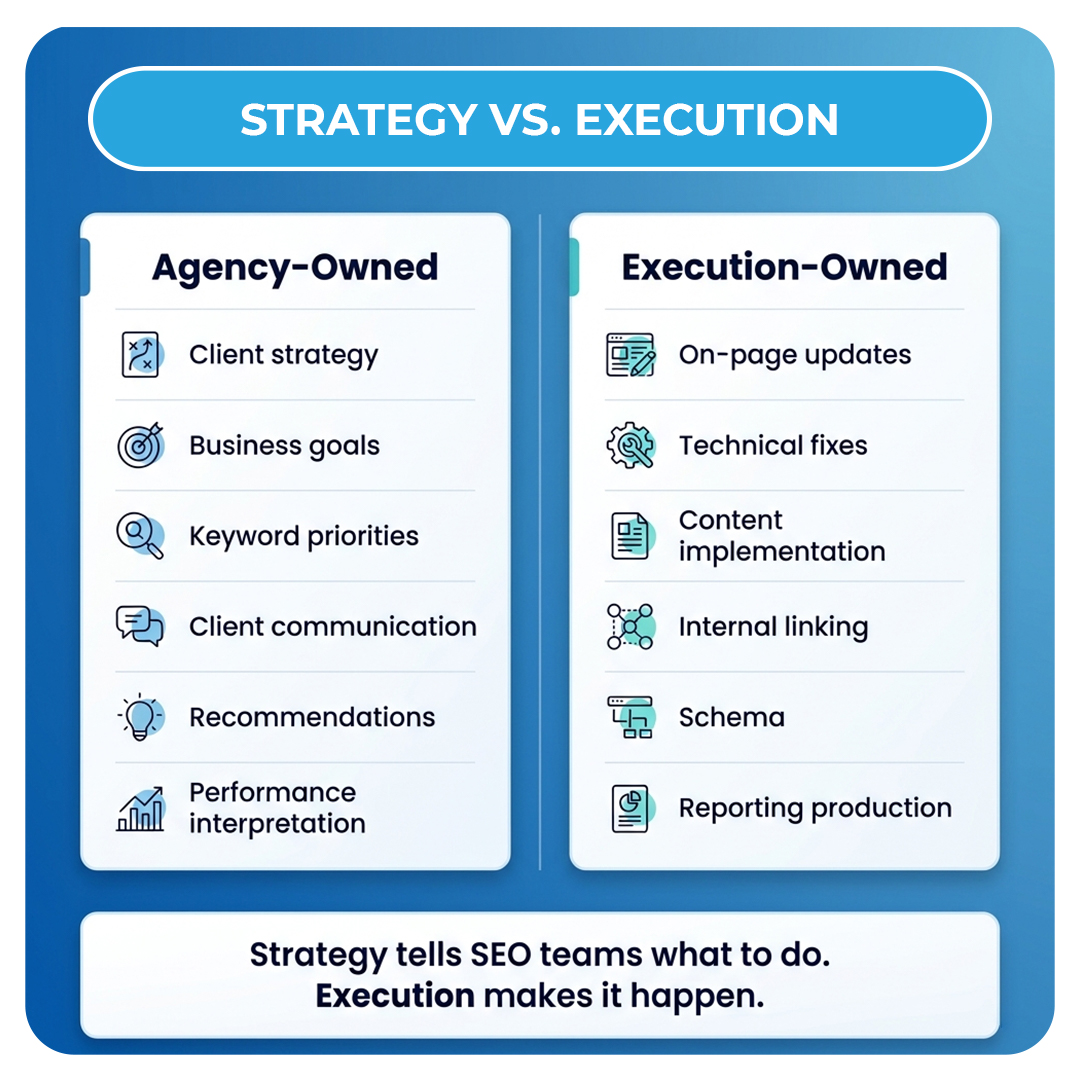
How White Label SEO Helps Keep the Optimization Cycle Moving
Partnering with a white label SEO firm is not simply about delegating tasks. The real value is execution continuity: keeping the optimization cycle moving month after month regardless of how many accounts an agency is managing.
- Converting Opportunities Into Recurring Execution: Effective SEO operates as a cycle: identify, prioritize, execute, measure, and reassess. The breakdown usually happens at the execution stage. White label SEO fulfillment keeps that cycle moving by converting identified opportunities into completed work rather than backlog items.
- Clearing Accumulated SEO Backlog: A capable white label SEO partner can address accumulated technical SEO issues, on-page optimization gaps, internal linking needs, schema implementation, local SEO work, content optimization, and off-page signals. The goal is not just clearing the list. It is increasing throughput so that backlog does not reform faster than it gets resolved.
- Supporting Mature Accounts: Mature accounts need a different kind of attention than new ones. That means optimizing existing pages rather than building from scratch, addressing content decay, identifying competitive gaps in topical coverage, and improving internal authority distribution. White label SEO services built around ongoing optimization, rather than launch-phase deliverables, are better suited to this type of work.
- Maintaining Optimization Cadence: Consistent optimization requires a reliable rhythm: monitor, identify, execute, measure, and repeat. White label fulfillment provides the infrastructure to sustain that rhythm. Rather than relying on a single in-house hire to manage every account's ongoing needs, agencies can distribute execution work across a specialized team that operates within standardized workflows.
- Freeing Agencies for Higher-Value Work: When fulfillment is handled reliably, agency teams can focus on what they do best: strategy, client relationships, prioritization, performance interpretation, and business goal alignment. The client relationship becomes stronger because the agency is no longer buried in execution details. Reporting becomes more meaningful because there is consistent execution behind it.
A Sustainable SEO Operating Cycle for Agencies
The agencies that build lasting organic growth treat SEO as an operating system, not a project. Here is a practical framework for how that system works:
- Audit: Assess current performance, technical health, content quality, and competitive positioning.
- Prioritize: Rank opportunities by impact and effort.
- Execute: Complete the prioritized work within the month.
- Measure: Track outcomes from completed work.
- Detect Decay: Identify pages losing visibility or traffic.
- Refresh: Update and strengthen declining content and technical elements.
- Expand: Build on what is working through content depth, new keywords, and link acquisition.
- Repeat: Return to audit with the results of the previous cycle informing the next.
Visualized as a cycle: Audit > Prioritize > Execute > Measure > Detect > Refresh > Expand > Audit
This is not a one-time project. It is a recurring process that compounds over time when executed consistently and deteriorates when deferred.
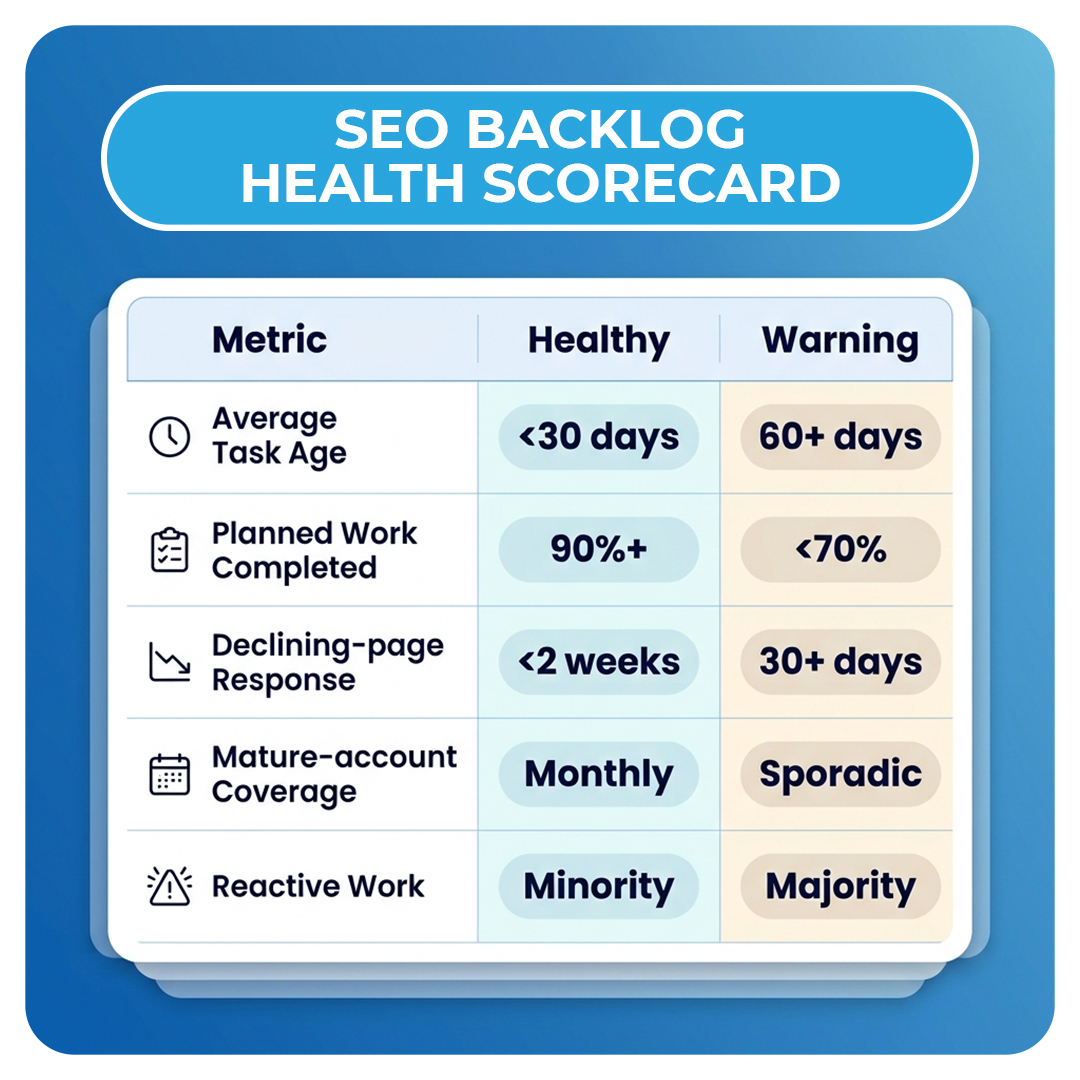
How Agencies Can Tell Whether Their SEO Fulfillment Is Sustainable?
Before assuming a strategy problem, agencies should evaluate whether their fulfillment operations can actually support the work their strategy requires. A few operational indicators worth tracking:
- SEO backlog age: How long do identified tasks sit before completion?
- Task completion rate: What percentage of monthly planned work actually gets done?
- Optimization cadence: Are all active accounts receiving consistent ongoing work each month?
- Content decay response time: How quickly are declining pages identified and addressed?
- Proactive vs. reactive split: Is most of the team's time spent acting on plans or responding to problems?
- Account coverage: Are mature accounts receiving the same attention as newer ones?
If opportunities are consistently being identified but not executed, fulfillment capacity is likely limiting growth more than strategy.
How Does DashClicks Support Continuous SEO Fulfillment?
DashClicks is built around the operating model described throughout this article. The white label SEO services are designed for execution continuity, not one-time deliverables.
Recurring SEO fulfillment means client accounts receive consistent monthly optimization work rather than bursts of activity followed by gaps. Standardized workflows ensure that technical SEO, on-page optimization, content improvement, and link building all progress within a predictable structure rather than depending on who is available that week.
The client dashboard gives agencies visibility into what is being done and what results it is producing. Rank tracking provides the early detection capability that makes proactive optimization possible rather than reactive. White label reporting means agencies can present this work under their own brand without rebuilding the infrastructure from scratch.
The result is that agencies can scale their SEO services without scaling internal headcount at the same rate. The fulfillment infrastructure exists. Agencies bring the client relationships, the strategy, and the judgment about what matters most for each account.
The Agencies That Win at SEO Are the Ones That Never Stop Executing
SEO is never finished. Early wins eventually disappear. Existing rankings need protection. Deferred work creates execution debt that compounds silently until it becomes a visible performance problem.
The agencies building sustainable organic growth are not necessarily the ones with the most advanced strategies or the largest teams. They are the ones with the execution capacity to act on opportunities consistently, month after month, across every account they manage.
Partnering with a white label SEO firm provides that capacity without requiring agencies to build every operational function internally. It turns SEO from a deliverable into a system.
The agencies that build sustainable organic growth are not necessarily the ones that identify the most SEO opportunities. They are the ones that consistently act on those opportunities before they become missed opportunities.

How White Label Google Ads Help Agencies Improve Search Campaign Performance
White label Google Ads management helps agencies improve search campaign performance by providing dedicated specialist capacity, structured optimization workflows, and consistent quality assurance. As agencies scale, these operational advantages make it easier to maintain campaign performance without overloading internal teams.
Managing a growing portfolio of Google Ads accounts becomes increasingly difficult as the number of clients rises. Account managers often balance reporting, client communication, and urgent requests, leaving less time for proactive optimization. As a result, issues such as search-term waste, tracking errors, budget inefficiencies, and missed optimization opportunities can go unnoticed.
The cost of inconsistent management is high. According to WordStream's 2025 benchmark analysis, the average Google Ads search campaign records a $5.26 average CPC, 7.52% conversion rate, and $70.11 average cost per lead, while CPC increased year over year in 87% of industries. With advertising costs continuing to rise, agencies cannot afford inefficient campaign management.
Google Ads management offers a scalable solution by providing dedicated specialists, standardized optimization processes, and ongoing quality assurance without increasing internal headcount. However, outsourcing alone does not improve campaign performance. Better results come from consistent execution, regular monitoring, accurate tracking, and disciplined optimization applied across every account.
This blog explores how a structured Google Ads outsourcing agency helps agencies maintain optimization quality, reduce wasted spend, and improve search campaign performance as their client portfolio grows.
Why Search Campaign Performance Slips as Agencies Scale?
Growth creates operational pressure. For many agencies, that pressure hits hardest in Google Ads management.
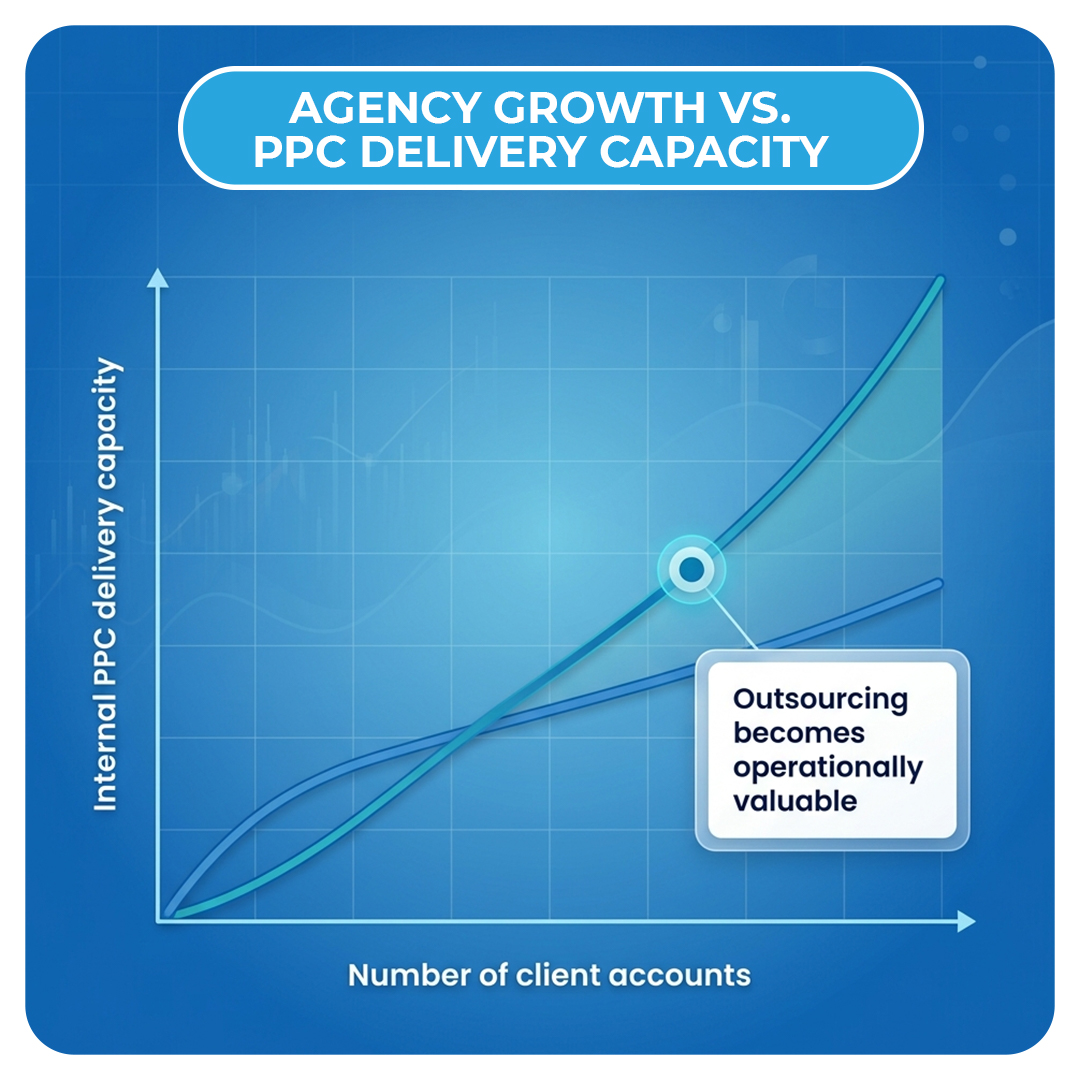
1. Optimization Becomes Reactive Instead of Proactive
When an agency is managing 10 to 20 client accounts, staying on top of each campaign is manageable. At 40 or 60 accounts, something has to give.
Client communication and reporting tend to take priority. Reactive tasks, responding to performance questions, preparing monthly reports, and handling onboarding, consume the hours that should go toward proactive optimization. Bid adjustments get delayed. Negative keyword lists go unreviewed. Ad copy tests sit unanalyzed.
Each individual delay seems minor. Over weeks and months, the accumulated neglect shows up in performance data: rising CPCs, declining conversion rates, wasted spend on poor-quality traffic. By the time the problem is obvious, it has already cost the client real money.
2. Specialist Attention Gets Spread Across Too Many Accounts
Google Ads performance is not generic. A lead generation campaign for a home services company requires a completely different approach than an e-commerce campaign or a B2B SaaS account. Keywords match types, bidding strategies, landing-page alignment, and audience layering all vary by industry and business model.
When account managers are responsible for too many clients across too many verticals, optimization depth suffers. They can manage. They can monitor. What they cannot do is investigate thoroughly, test systematically, and improve consistently. The result is performance that plateaus or slowly deteriorates rather than improving over time.
3. Campaign Signals Get Missed Between Reporting Cycles
A monthly reporting cadence is standard in most agencies. The problem is that campaign conditions do not stay static for 30 days.
Search-term behavior shifts. Competitor bidding changes. Conversion rates fluctuate. Budget caps throttle campaigns during peak demand windows. Tracking tags break. Lead quality changes without any obvious explanation in the data.
Each of these issues has a cost. Some are recoverable quickly if caught early. Others compound silently for weeks before someone notices.
The core issue is not that agencies lack Google Ads knowledge. The issue is inconsistent application of that knowledge across growing account portfolios.
How White Label Google Ads Creates More Consistent Optimization Capacity
When agencies outsource Google Ads, they can change how optimization work gets done and how consistently it happens.
1. Dedicated Specialists Reduce Generalist Bottlenecks
There is a structural difference between an account manager who handles Google Ads alongside client communication, reporting, and strategy work, and a dedicated PPC specialist whose entire role is campaign execution.
Account managers are responsible for the relationship. PPC specialists are responsible for performance. When both functions are separated, each one gets the attention it requires.
White label Google Ads specialists focus on campaign structure, bid management, search-term analysis, ad copy performance, and conversion tracking. Their work goes deeper because their scope is narrower. That depth translates directly into better campaign outcomes.
2. Standardized Optimization Cycles Keep Accounts From Being Neglected
One of the most practical benefits of white label fulfillment is the enforcement of a structured optimization cadence. Campaigns are not reviewed when time allows. They are reviewed according to a defined schedule.
A well-structured cadence typically includes:
Weekly:
- Search-term review to identify irrelevant queries and new keyword opportunities
- Spend pacing review to catch budget misallocation early
Regular (biweekly or as needed by account size):
- Keyword performance analysis
- Negative keyword updates
- Ad performance review and copy testing
Monthly:
- Conversion trend analysis
- Budget reallocation across campaigns
- Campaign restructuring where performance data supports it
- Strategic recommendations to share with the client
The specific frequency varies based on monthly spend, conversion volume, and account complexity. A high-spend e-commerce account needs more frequent attention than a small local services campaign. A professional white label fulfillment team applies the right cadence to each account rather than treating all clients the same.
3. Built-In QA Reduces Execution Errors
Execution errors are more common than most agencies acknowledge. Budgets get set incorrectly after a restructure. Bidding strategies get switched without checking conversion history thresholds. Conversion tracking breaks after a website update and goes undetected for weeks.
Quality assurance processes catch these issues before they become expensive. A structured QA workflow covers budget settings, bid strategies, targeting parameters, conversion tracking status, keyword updates, ad assets, and tracking implementation after any campaign change.
QA is not glamorous work. It is, however, what separates agencies that deliver consistent performance from those that manage by exception.
4. Parallel Fulfillment Increases Agency Capacity
A single senior specialist can realistically manage a finite number of accounts at the optimization depth that produces results. When an agency scales beyond that threshold without adding capacity, quality degrades.
White label fulfillment solves this by providing multiple specialists working simultaneously across an agency's account portfolio. New clients can be onboarded without creating a backlog. Existing accounts do not lose attention when workload spikes. Optimization runs in parallel rather than sequentially.
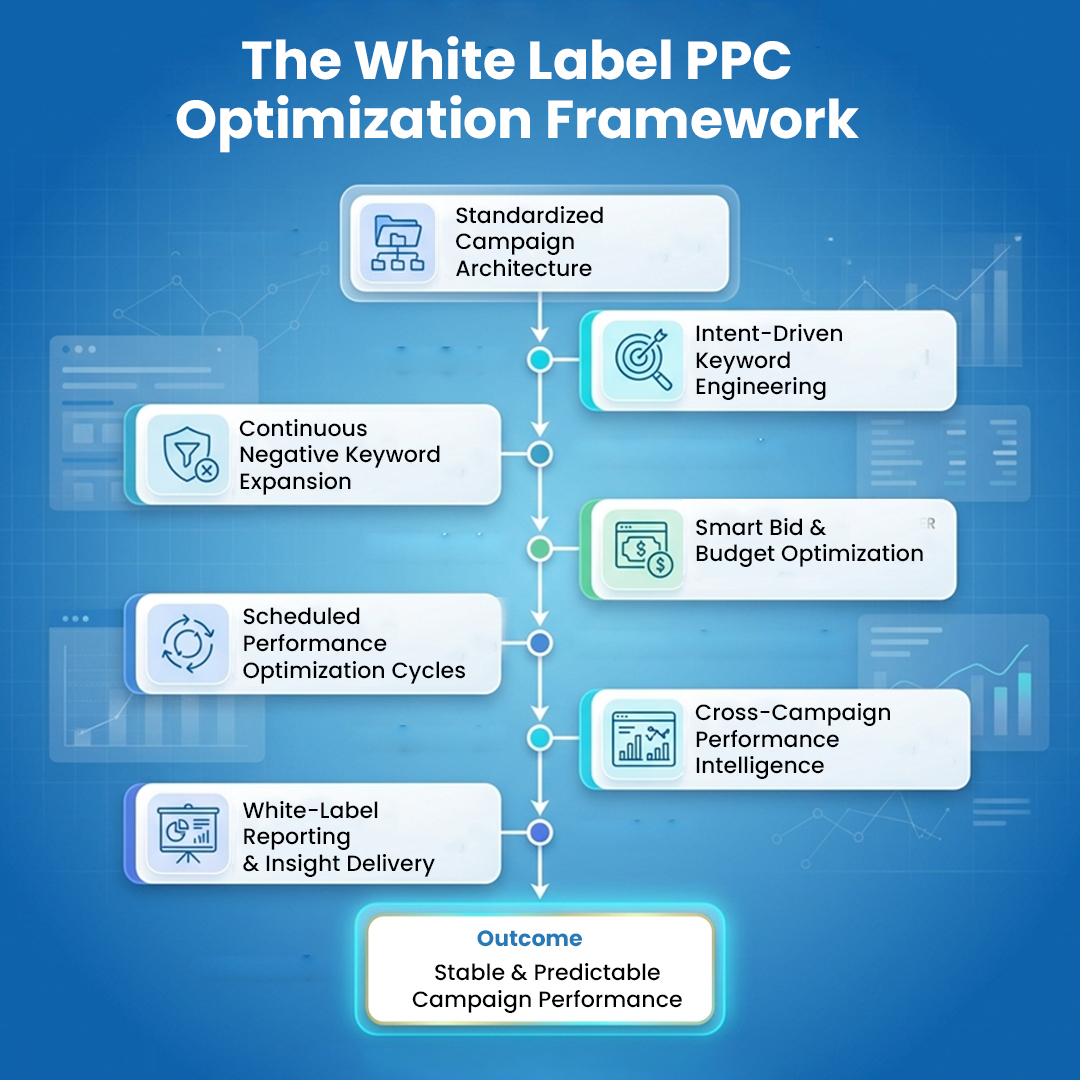
White label fulfillment creates the operational capacity for consistent optimization at any account volume.
How Consistent Search-Term Management Reduces Wasted Spend?
Search-term analysis is one of the highest-impact optimization tasks in any Google Ads account. It is also one of the most commonly neglected as agencies grow.
1. Identify Queries That Consume Spend Without Producing Value
Google's broad match and Smart Bidding systems cast wide nets. That is by design. The tradeoff is that campaigns frequently attract irrelevant searches, low-intent informational queries, and traffic from audiences unlikely to convert.
When these queries are not identified and excluded through negative keywords, the budget gets consumed without producing leads or revenue. CPAs rise. ROAS falls. The campaign appears to be underperforming when the underlying issue is poor targeting hygiene.
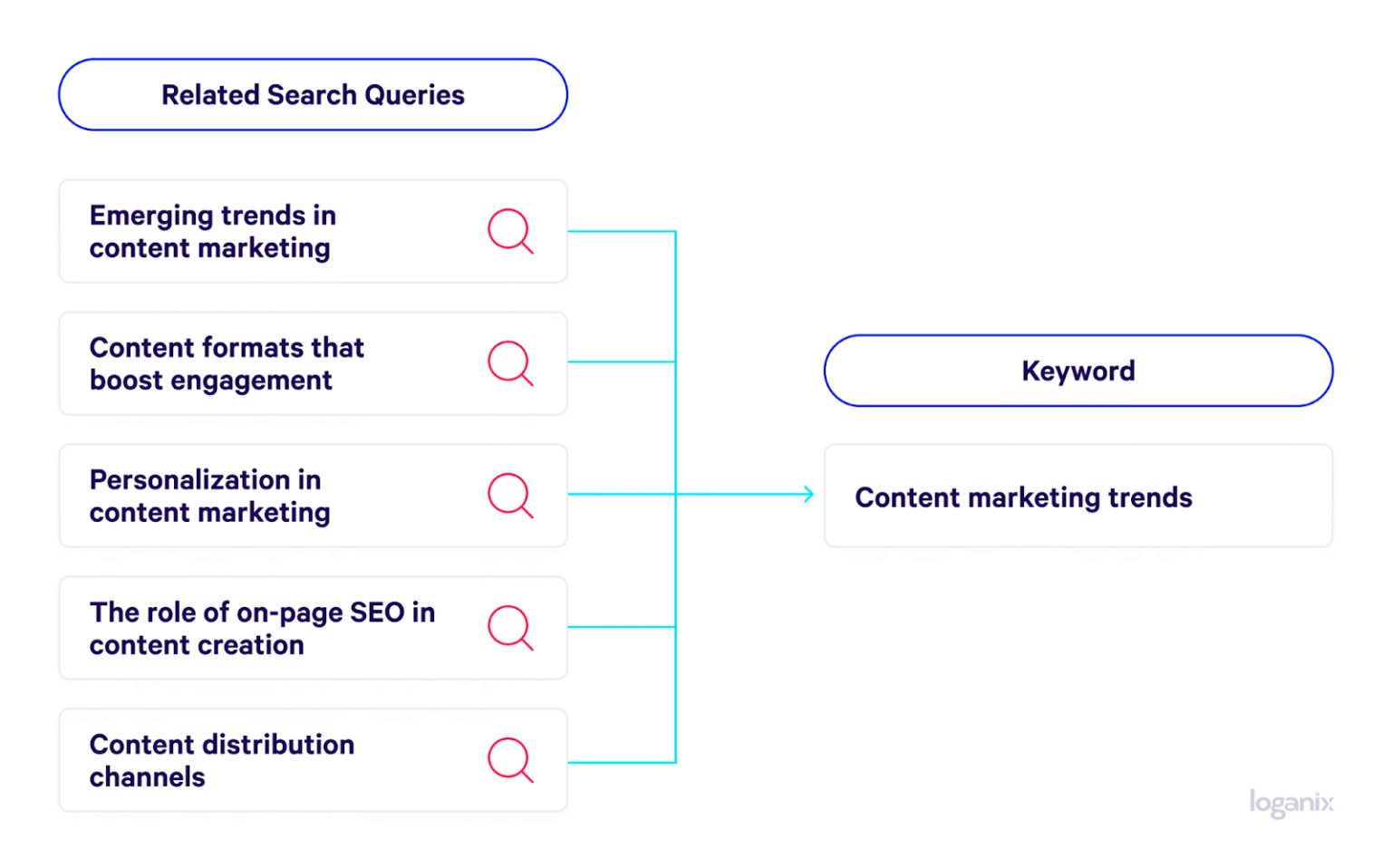
Image Source: Loganix
Regular search-term reviews identify these patterns and eliminate wasted spend through systematic negative keyword management.
2. Search-Term Data Reveals New Keyword Opportunities
Search-term reports do more than surface irrelevant queries. They also reveal what real users are actually searching for, which is often different from what keyword research predicted.
Specific high-intent modifiers, industry terminology used by qualified buyers, location-specific phrases, and competitor comparison queries often appear in search-term data before they appear in keyword research tools. These insights inform keyword expansion, ad copy refinement, and landing-page development.
The search-term report is one of the most underused sources of strategic intelligence in Google Ads.
3. Search-Term Analysis Must Become a Recurring Process
Search behavior changes continuously. New competitors enter the market. Seasonal patterns shift. User intent evolves as a product category matures. A search-term cleanup performed once during onboarding provides a one-time benefit and then becomes outdated.
Consistent weekly reviews build an ongoing optimization loop. Each review improves targeting precision. Over months, the cumulative impact on spend efficiency and lead quality is significant.
4. Becomes Difficult to Maintain Across Dozens of Client Accounts
Manual search-term analysis takes time. For a single account, the weekly task is manageable. Across 30 or 50 accounts, maintaining that discipline requires dedicated capacity.
White label Google Ads specialists maintain structured search-term reviews as a non-negotiable part of their workflow, rather than a task that gets skipped when workloads increase.
How Better Conversion Data Helps Google Ads Automation Work Toward the Right Goal?
Smart Bidding is powerful. It is also only as effective as the conversion data it receives.
1. Smart Bidding Depends on Meaningful Conversion Signals
Google's machine learning adjusts bids based on historical conversion patterns, user signals, and real-time context. When conversion tracking is accurate and the signals fed into the system reflect genuine business value, Smart Bidding performs well.
When tracking is broken, conversion actions are poorly defined, or the system is optimizing toward low-value events, Smart Bidding will do exactly what it was configured to do, just not in the direction the agency intended. Human oversight is still essential to verify that automation is working toward the right objective.
2. More Conversions Is Not Always Better
Maximizing conversion volume is not always the right goal. A campaign optimized for form submissions will generate more form fills. Whether those submissions produce qualified leads, sales conversations, or closed revenue is a separate question.
Agencies serving lead generation clients need to distinguish between:
- Form submissions
- Phone calls
- Qualified leads
- Sales-accepted leads
- Revenue-generating conversions
Optimizing toward top-of-funnel events can inflate volume while reducing actual business value. Aligning conversion goals with client business objectives produces better outcomes even when raw conversion numbers are lower.
3. Choose the Right Primary Conversion Actions
Google allows campaigns to optimize toward primary conversion actions while tracking secondary ones for reference. Choosing the right primary signal matters.
Agencies should audit conversion action settings regularly, ensure that Smart Bidding is not optimizing toward micro-conversions like page visits or scroll depth, and align primary conversion actions with the outcomes clients care about most.
4. Connecting Lead Data to Business Value Improves Bidding
For clients where lead quality varies significantly, value-based bidding strategies produce better results than volume-based strategies. Assigning conversion values to different lead types, importing offline conversion data, and providing Google's algorithm with revenue-level signals allows Smart Bidding to prioritize the traffic most likely to generate real business value.
Better conversion data improves how Google's automation performs at every stage of the funnel.
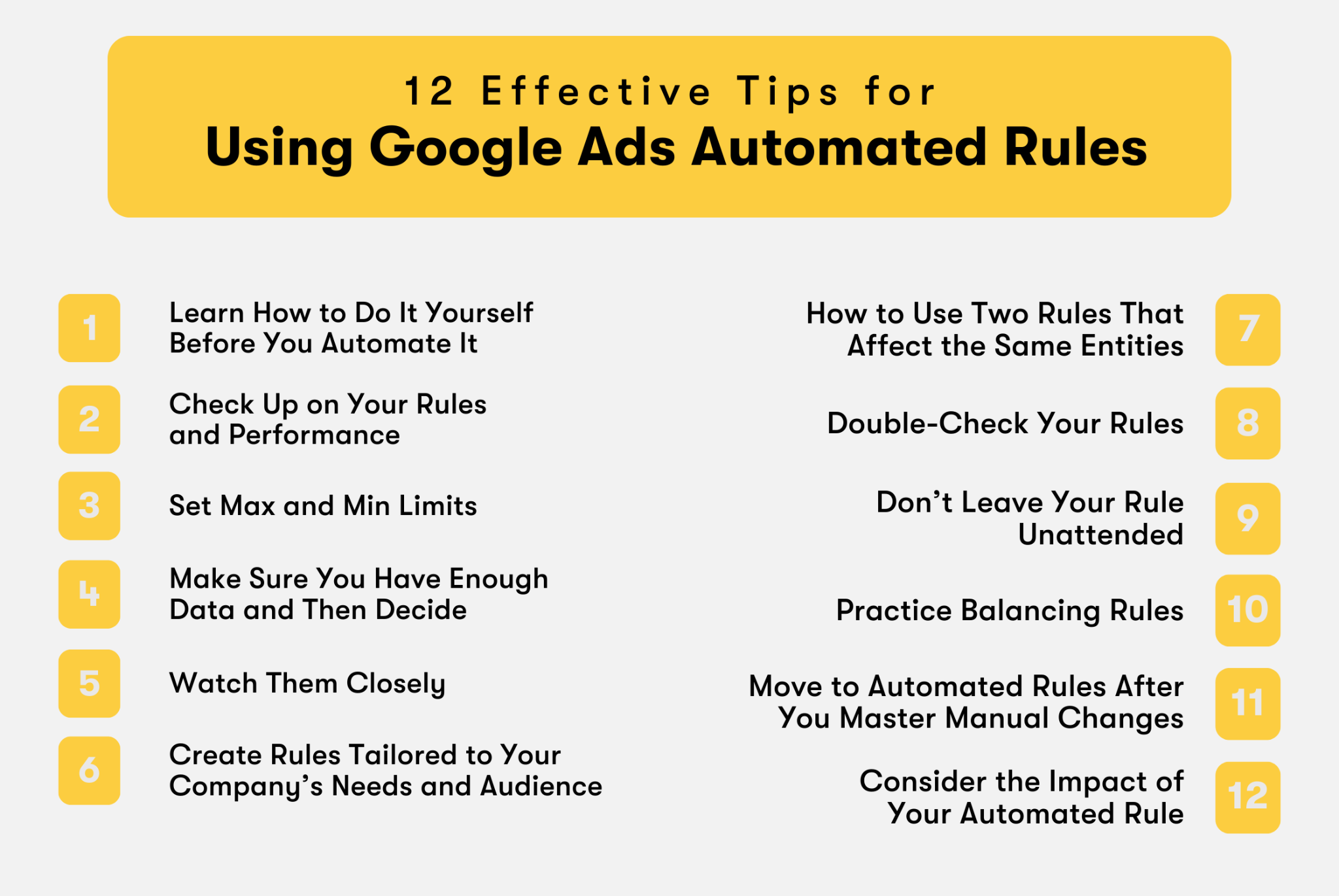
How Agencies Can Catch Performance Problems Before They Become Expensive?
Performance problems rarely appear suddenly. They develop gradually, through small shifts that compound over time.
1. Monitor CPC, CPA, and Conversion Efficiency Together
Rising CPC is not inherently a problem if conversion rates are improving and CPL remains within target. Declining conversion rate is not always a campaign issue if lead quality is improving and fewer, higher-value leads are being generated.
These metrics need to be evaluated in combination, not in isolation. Monitoring CPC, CPA, conversion rate, lead quality feedback, and conversion value together gives a more accurate picture of account health than any single metric.
2. Detect Declining Conversion Rates Early
A declining conversion rate can have several root causes. The diagnostic process matters as much as identifying that a decline has occurred.
Common causes include:
- Search-query mix shifting toward lower-intent traffic
- Ad creative fatigue reducing click quality
- Landing-page issues affecting post-click experience
- Conversion tracking changes or breaks
- Increased competitive activity driving up CPC without proportional volume gains
- Audience targeting drift in Smart Bidding
Identifying the root cause quickly allows the team to respond with the right fix rather than making indiscriminate changes.
3. Identify Budget Constraints and Misallocation
Budget-limited campaigns miss impression share during peak demand windows. High-spend campaigns in competitive markets may be over-indexed relative to conversion potential. Efficient campaigns may be underfunded while poor performers continue to consume budget.
Regular budget allocation reviews ensure that spend is directed toward the campaigns with the strongest performance signals. This is especially important when overall client budgets are fixed.
4. Tracking Anomalies Require Immediate Investigation
Missing conversions, sudden spikes in recorded events, and attribution changes are not data quirks. They are signals that something in the measurement infrastructure has changed.
A broken conversion tag means Smart Bidding is making decisions without accurate data. A sudden spike in conversions may indicate a tracking duplication error inflating reported performance. These issues require fast investigation and resolution.
5. Escalation Process Prevents Expensive Deterioration
Agencies should define clear thresholds that trigger immediate investigation: CPA increases above a defined percentage, conversion rate drops sustained over multiple days, significant spend anomalies, tracking data gaps, or meaningful shifts in traffic quality.
Consistent monitoring combined with a defined escalation process prevents performance deterioration from becoming client-threatening.
How Agencies Should Measure Whether White Label Fulfillment Is Improving Performance?
Adding white label Google Ads management is an operational investment. Agencies should track whether that investment is delivering measurable improvement.
1. Campaign Performance Metrics to Track
The most direct measure of fulfillment quality is campaign performance across the account portfolio. Key metrics include:
- CTR (click-through rate)
- CPC trends
- Conversion rate
- CPA and CPL
- ROAS for e-commerce accounts
- Impression share
No single metric tells the full story. Reviewing these metrics together, across multiple accounts over time, surfaces patterns that reflect the quality of optimization work being delivered.
2. Fulfillment Quality Metrics to Track
Beyond campaign numbers, agencies should track operational quality indicators:
- Optimization frequency relative to scheduled cadence
- Time between issue detection and resolution
- Tracking error resolution time
- QA completion rates
- Reporting turnaround time
- Consistency of scheduled review completion
These metrics reveal whether the fulfillment process is being executed with discipline or whether the same inconsistencies are recurring under a different provider.
3. Agency-Level Metrics to Track
White label fulfillment should improve agency operations, not just individual campaigns. Track:
- Average accounts managed per specialist
- Total fulfillment hours relative to output
- Gross margin per client
- Client retention rates over 6 and 12 months
- Onboarding capacity per month
- Time saved for internal strategy and client communication
A fulfillment partnership that improves campaign performance while freeing up internal team capacity is delivering compound value to the agency.
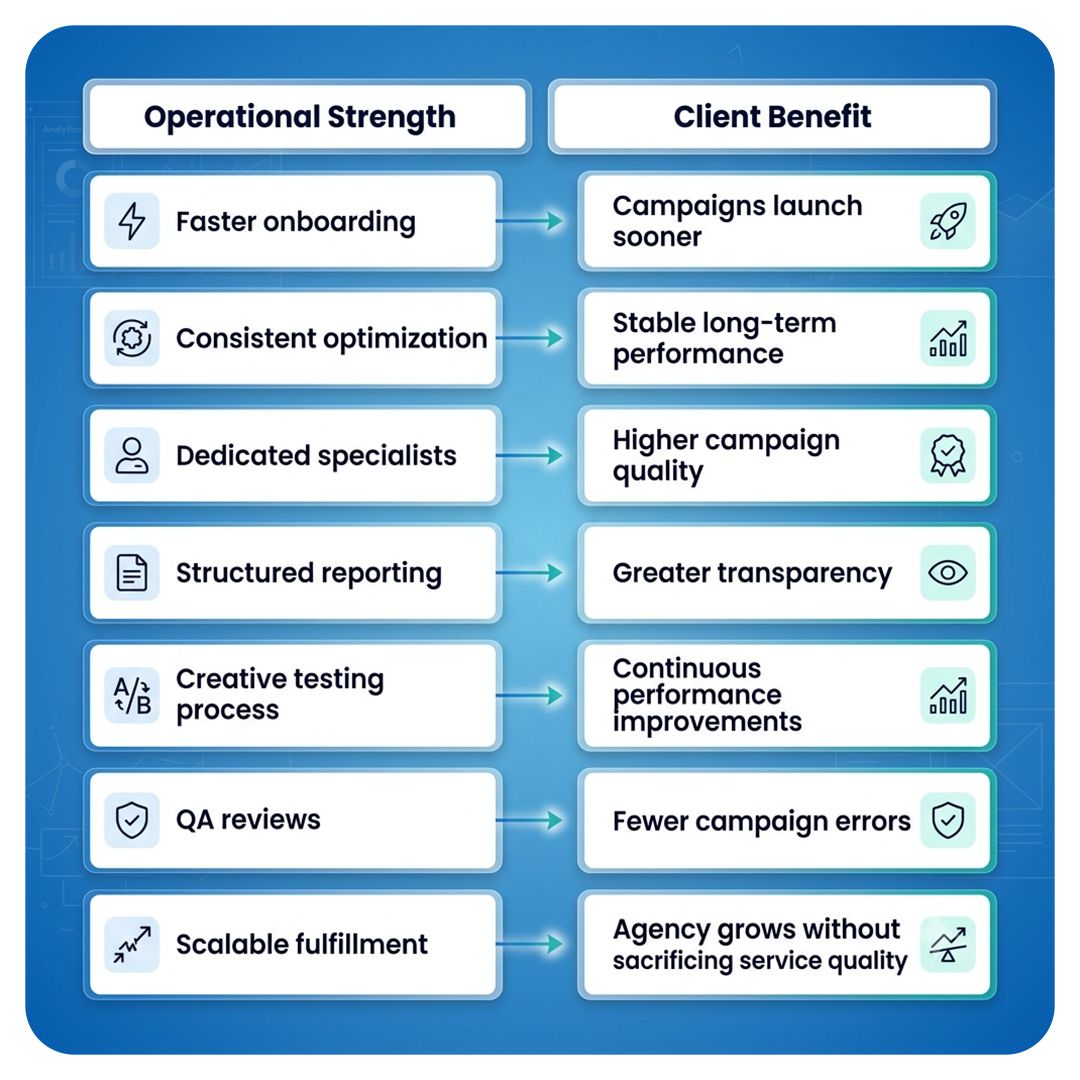
How DashClicks Helps Agencies Improve Search Campaign Performance?
DashClicks provides white label Google Ads management designed specifically for agencies that need reliable, scalable PPC fulfillment.
- Dedicated Google Ads Fulfillment: The fulfillment team assigns dedicated Google Ads specialists to manage campaigns on behalf of agency clients. Specialists focus entirely on campaign execution, bringing the depth of attention that generalist account management cannot consistently provide.
- Structured Optimization and QA: The platform uses standardized optimization workflows and quality assurance processes across all managed accounts. Campaigns are reviewed on consistent schedules, not when time allows. QA checks run after every significant change to catch execution errors before they affect performance.
- White Label Reporting: The platform provides white label reporting software that agencies can deliver directly to clients. Reporting is clear, performance-focused, and built to support agency-client communication rather than complicate it.
- Scalable Fulfillment: Agencies can onboard new Google Ads clients without adding internal headcount. DashClicks scales fulfillment capacity to match agency growth, allowing teams to focus on client strategy and business development.
Better Search Performance Requires Consistent Execution
Search campaign performance does not improve by accident. It improves through continuous optimization, disciplined monitoring, accurate conversion tracking, and systematic search-term management, applied consistently across every account in a portfolio.
As agencies grow, maintaining that consistency becomes operationally difficult. Specialist attention gets diluted. Optimization shifts from proactive to reactive. Small performance issues accumulate into larger ones.
White label Google Ads management addresses this directly by providing the specialist capacity and structured workflows that consistent execution requires. Agencies that implement reliable fulfillment processes deliver stronger campaign performance, retain clients longer, and scale without sacrificing optimization quality.

When Should Agencies Outsource SEO? A Decision-Making Guide
Agencies should outsource SEO when internal capacity, expertise, or profitability cannot support sustainable delivery, not simply because outsourcing is convenient. The right decision depends on your operational maturity, growth stage, and which parts of SEO actually differentiate your business. This guide walks through a practical framework to help you decide.
Outsourcing SEO gets positioned as the obvious move for growing agencies. You take on more clients, the workload climbs, and someone suggests bringing in a white label SEO agency to handle fulfillment. Problem solved, right?
Not always.
Outsourcing SEO is a significant operational decision, and agencies that treat it as a default shortcut often end up scaling problems rather than solving them. Poor delivery quality, strained client relationships, and eroded margins are common outcomes when outsourcing happens for the wrong reasons, or at the wrong time.
The agencies that get it right approach outsourcing as a strategic tool. They evaluate it through clear operational factors: capacity, profitability, internal expertise, operational risk, client SEO expectations, and long-term growth goals. They ask hard questions before they sign contracts.
This guide is designed to help you do exactly that. Whether you're a founder juggling fulfillment, an operations manager evaluating delivery models, or a marketing director building a scalable SEO offering, the goal here is to give you a decision-making framework grounded in business logic, not assumptions.
Let's start by reframing the question entirely.
Stop Asking "Should We Outsource?" Start Asking "What Problem Are We Solving?"
Most outsourcing decisions fail because agencies start with the solution. Someone mentions white label SEO outsourcing, it sounds appealing, and the conversation moves to vendor selection before anyone has clearly defined the underlying problem.
Here's why that matters: different operational problems require different solutions.
Outsourcing to reduce workload looks very different from outsourcing to improve quality. Outsourcing because hiring is slow looks different from outsourcing to expand into new service lines. Outsourcing to protect margins requires an entirely different cost analysis than outsourcing because your founders are spending too much time managing SEO fulfillment.
If you misidentify the problem, the solution won't hold. A firm can absorb execution volume, but it cannot fix broken internal workflows. It can add specialized capabilities, but it won't repair a client communication problem.
Use this decision matrix to pressure-test your thinking before moving forward.
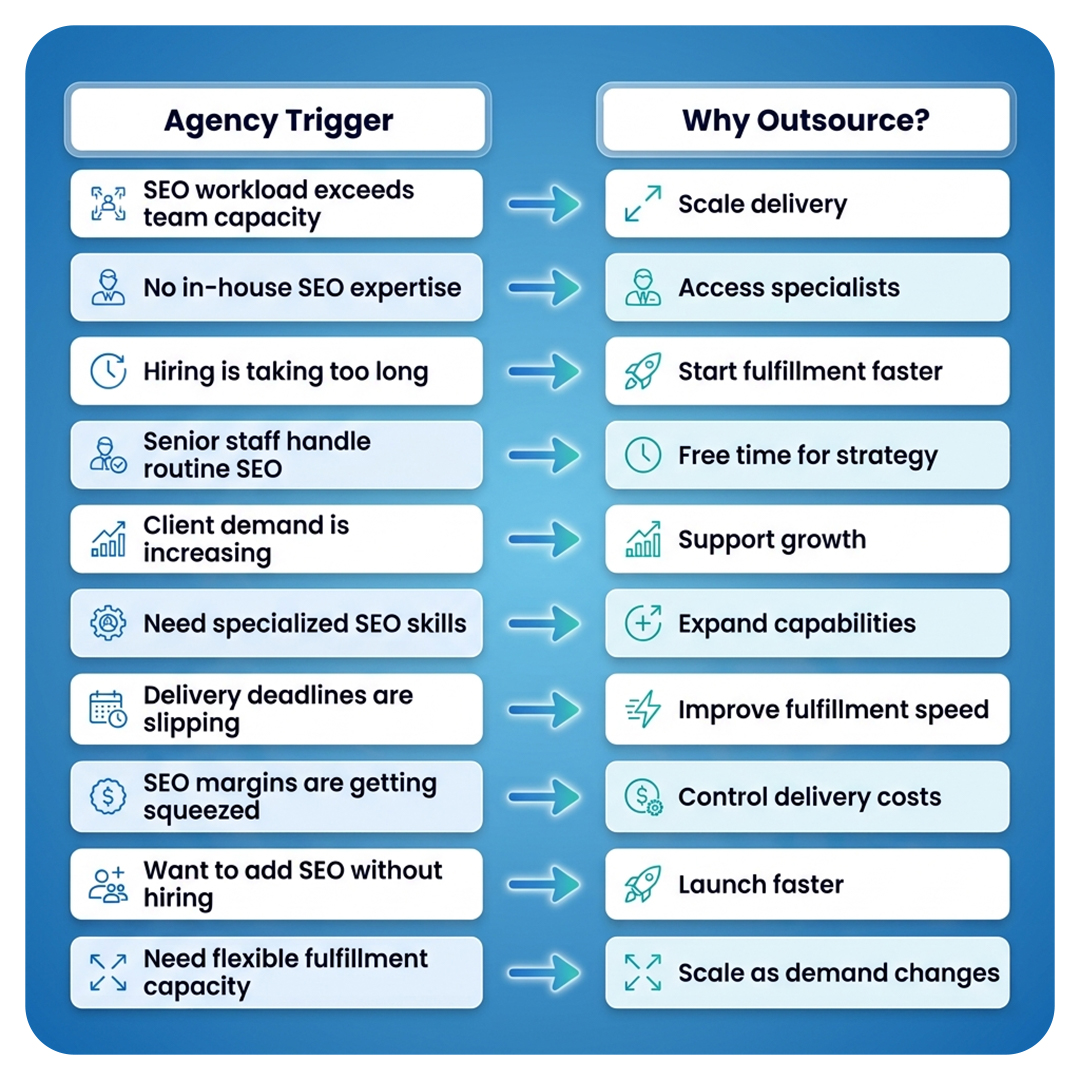
The pattern here is important. Outsourcing works best when the problem is structural (capability gaps, sustained demand, specialized needs) rather than operational (undefined processes, weak project management, inconsistent delivery standards).
McKinsey & Company research supports this. Organizations with standardized, scalable operating models are better positioned to sustain growth than those relying on ad hoc processes. Outsourcing onto an unstable foundation tends to amplify instability, not eliminate it.
Once you understand what problem you're actually solving, you can evaluate outsourcing objectively.
The Seven Questions Every Agency Owner Should Answer Before Outsourcing SEO
1. Is Your Constraint Capacity or Capability?
This distinction matters more than most agency owners realize, and confusing the two leads to the wrong decision every time.
Capacity is a volume problem. You have enough expertise in-house, but there aren't enough hours to handle current demand. Capability is a skills problem. Your team doesn't have the depth to deliver certain types of SEO work at the quality your clients expect.
These problems look similar on the surface. Deadlines get missed, clients get frustrated, and founders start feeling like fulfillment is consuming everything. But they require different solutions.
A capacity constraint can be addressed through outsourcing, better resource allocation, or hiring. A capability gap almost always requires external expertise, whether through outsourcing or targeted recruitment. Identifying which constraint you're facing determines what type of solution will actually work.
2. Does Hiring Actually Cost Less?
The instinct to hire before outsourcing is understandable. It feels like more control. But the true cost of an in-house hire often surprises agency owners who haven't modeled it out carefully.
Direct salary is only the starting point. Add payroll taxes, benefits, software licenses, recruiting fees, onboarding costs, management overhead, quality assurance time, and the cost of turnover. According to the Society for Human Resource Management (SHRM), the average cost per hire in the United States exceeds $4,700, and that figure doesn't include lost productivity during ramp-up periods, which can run three to six months for specialized SEO roles.
When agencies calculate their true delivery cost per client, outsourcing to a white label SEO firm often becomes significantly more cost-competitive than it initially appears. The comparison isn't salary versus agency retainer. It's total loaded cost versus total outsourced cost, including the management time you get back.
3. Which Parts of SEO Actually Differentiate Your Agency?
Not everything your agency does is a competitive advantage. Some of it is simply execution, necessary, time-consuming, and replicable, but not the reason clients choose you over someone else.
Competitive advantage typically lives in:
- SEO strategy and consulting
- Client communication and relationship management
- Planning and goal alignment
- Business consulting and growth recommendations
Execution work, while essential, is generally less differentiated:
- Technical SEO audits
- Keyword mapping and research
- On-page optimization
- Content optimization
- Link building
- Monthly reporting
The problem is that many agencies protect their execution capacity fiercely while letting strategic work slide. Founders and senior team members spend hours on deliverable production instead of high-value client strategy, which ultimately hurts retention.
Outsourcing execution frees your best people to do the work that actually wins and keeps clients.
4. Can You Document What You're Outsourcing?
If you can't clearly define a deliverable, you can't effectively outsource it. Before engaging a white label SEO agency, you need documented service packages, clear scope definitions, and measurable quality standards.
This is a readiness question, not a capability question. Agencies that skip this step end up with frustrating vendor relationships, inconsistent output, and client escalations that trace back to undefined expectations on both sides.
5. Do You Have a Point of Contact for Oversight?
Outsourcing is not the same as delegation without accountability. Someone internally needs to own vendor performance, review deliverables, and manage the relationship.
That person doesn't need to be a technical SEO expert. But they need to understand your clients' goals well enough to evaluate whether work is on track. Without this, quality tends to drift over time.
6. Are Your Client Relationships Strong Enough to Absorb a Transition?
Switching from internal to outsourced fulfillment can create temporary disruption. If your client relationships are already strained, the timing matters.
Strong agency-client relationship creates enough trust to navigate a delivery transition. Weak ones amplify every hiccup. Evaluate your current client health before you make changes to your delivery model.
7. What Does Success Look Like in Six Months?
Define it before you outsource, not after. Measurable outcomes might include faster onboarding, more consistent reporting, fewer founder hours spent on fulfillment, or improved client retention rates.
Without defined success metrics, it's difficult to evaluate whether outsourcing is working or simply adding cost.
Build a Keep vs. Delegate SEO Decision Framework
Once you've worked through the seven questions above, a keep-versus-delegate framework helps you allocate work intelligently across internal and external resources.
This hybrid fulfillment model is increasingly common among high-performing agencies. According to Harvard Business Review, companies that selectively outsource operational tasks while retaining core strategic functions tend to outperform those that either fully insource or fully outsource. The keyword is "selectively," which is why the decision framework matters so much.
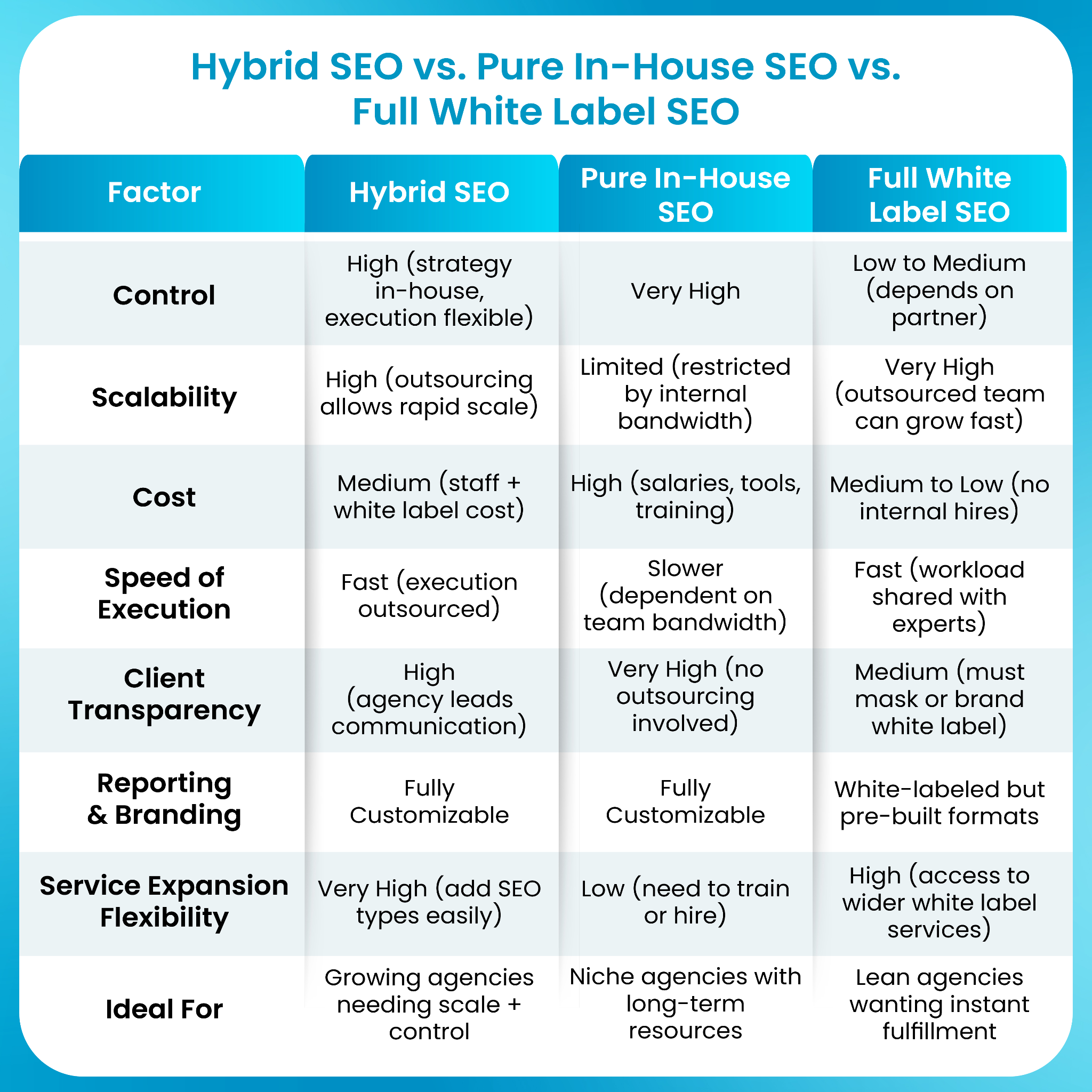
The goal is not to outsource as much as possible. It's to outsource the right work so your internal team can focus on what actually drives client value and business growth.
What Is the Cost of Waiting Too Long?
A lot of outsourcing discussions focus on whether to outsource at all. Fewer focus on what happens when agencies wait too long to make the move.
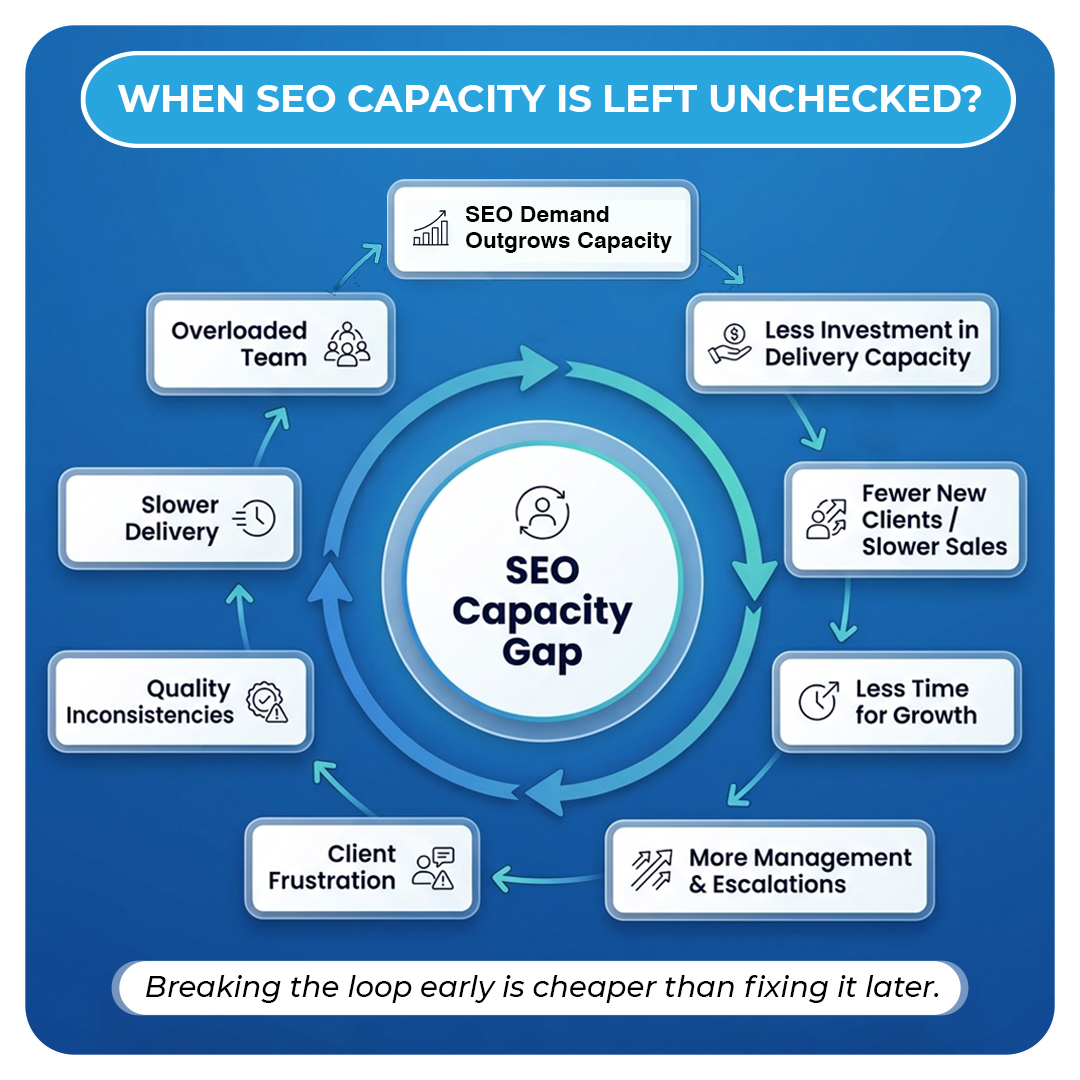
The costs of delayed outsourcing are real and compound quickly. When your SEO specialists are overloaded, quality begins to slip before anyone officially acknowledges a problem. Onboarding slows down. New clients take longer to launch. Existing clients notice inconsistencies in their reporting.
Meanwhile, founders who should be focused on growth become bottlenecks, approving deliverables, fielding escalations, and managing workloads that have outgrown the team. Client churn accelerates, often tied to delivery issues that could have been addressed earlier. Sales slows down because the agency loses confidence in its ability to take on new SEO business.
According to Bain and Company, acquiring a new customer costs five to seven times more than retaining an existing one. When operational overload drives client churn, the financial impact extends far beyond the cost of the clients lost. It erodes the margin available to invest in growth.
Opportunity cost is real even when it's invisible in your P&L. Every month your team operates above sustainable capacity is a month your agency isn't building toward the next stage of growth.
Four Agency Scenarios and the Right SEO Delivery Model for Each
Practical frameworks only go so far without real-world context. Here are four agency scenarios and the delivery model that makes the most sense for each.
Agency A: 10 SEO clients, experienced specialist, stable workload.
This agency has capacity and capability. Outsourcing now would add cost and complexity without clear benefit. The right move is to keep fulfillment internal and focus on building repeatable processes while demand is manageable. Outsourcing becomes relevant when workload grows beyond what the current specialist can absorb.
Agency B: 25 clients, overloaded SEO manager, growing rapidly.
This is a classic hybrid candidate. The internal specialist retains ownership of strategy, client communication, and quality oversight, while execution work (technical audits, link building, reporting) shifts to a white label SEO firm. This protects the client relationship while creating the capacity needed to keep scaling.
Agency C: No SEO specialists, wants to sell SEO services.
White label SEO outsourcing is the right starting point here. Building an internal SEO department from scratch requires significant investment and time. A white label SEO agency provides the expertise and infrastructure to launch SEO services quickly, while the agency focuses on sales and client management.
Agency D: Enterprise agency with an internal SEO department, occasional overflow.
Selective outsourcing fills overflow capacity without requiring permanent headcount changes. This model works well for agencies with variable client demand or project-based SEO work that doesn't justify full-time additions.
According to the U.S. Small Business Administration, small business owners who regularly evaluate their operational models, rather than defaulting to past habits, are better positioned to adapt and scale. The right delivery model for your agency today may not be the right model twelve months from now.
Red Flags That Suggest Your Agency Isn't Ready to Outsource Yet
Outsourcing amplifies what already exists in your operations. If the foundation is strong, outsourcing adds capacity and capability. If it's weak, outsourcing scales the weakness.
Before engaging a white label SEO agency, check your agency against this list:
- No documented client onboarding process
- Unclear or inconsistent SEO deliverables
- Weak internal communication between sales and fulfillment
- Inconsistent reporting formats across clients
- SEO processes that change month to month
- Undefined service packages with vague scope
- No internal point of contact to manage vendor performance
- Client expectations set without alignment to delivery capacity
If more than two or three of these apply to your agency, the highest-leverage work right now is operational improvement, not outsourcing. Define your services, document your processes, and establish your quality standards first. Once those systems exist, bringing in outside support becomes significantly easier and more effective.
What Success Should Look Like Six Months After Outsourcing?
When outsourcing is working, the results show up in operations before they show up in rankings.
Healthy outsourcing outcomes include:
- Your senior team spends more time on strategy and client consulting
- Onboarding timelines shrink because fulfillment moves faster
- Clients receive consistent, well-formatted reports on time
- Fewer bottlenecks in delivery
- Your agency can confidently sell SEO to new clients without capacity concerns
- Client retention improves because delivery quality is stable
- Profitability increases as delivery costs come down or revenue scales up
According to the Project Management Institute, organizations with mature project management practices waste 28 times less money than those with low project maturity. Outsourcing to a structured white label SEO firm brings process maturity to agencies that haven't built it internally yet.
The six-month benchmark is useful because it gives enough time to see operational trends without waiting so long that problems become entrenched. If your team is still managing constant fires six months after outsourcing, the issue is likely in how the outsourcing relationship was structured, not in the concept itself.
How DashClicks Helps Agencies Outsource SEO With Confidence
For agencies that have worked through the framework above and determined that outsourcing is the right move, DashClicks is built specifically to support agency growth through white label SEO fulfillment.
- Supporting Different Agency Growth Stages: DashClicks is designed to serve agencies at different points in their development, from agencies launching SEO services for the first time to established operations managing large client rosters. The platform scales with demand rather than requiring agencies to restructure their operations around a vendor's limitations.
- Reducing Operational Risk: One of the most common concerns agencies have about outsourcing is losing visibility into delivery quality. The platform addresses this through structured fulfillment workflows and transparent reporting, so agencies retain oversight without having to manage every execution detail.
- Helping Agencies Focus on Their Competitive Advantage: By handling execution, DashClicks frees agency teams to concentrate on the work that actually differentiates them: strategy, client relationships, business consulting, and growth planning. This shift is where the long-term value of outsourcing shows up most clearly.
- Flexible Fulfillment That Grows With the Agency: The platform supports both full white label SEO outsourcing and hybrid models, where agencies manage some SEO work internally and outsource specific components. This flexibility means agencies aren't locked into a single delivery model as their needs evolve.
- White Label Reporting: The platform provides white label reporting that agencies can present directly to clients under their own brand. This maintains the client relationship on the agency's terms while outsourcing the production work behind the scenes.
The agency retains strategy, client relationships, and business ownership. DashClicks handles scalable fulfillment. That's the operational partnership model that makes outsourcing work long-term.
Make the Decision That Fits Your Agency, Not Someone Else's
Outsourcing SEO is not automatically the right answer. Neither is hiring. The right decision depends on a clear-eyed look at your capacity, capability, profitability, operational maturity, and long-term growth goals.
Many agencies benefit most from a hybrid fulfillment model, retaining strategic and relationship-driven work internally while outsourcing execution to a white label SEO firm or white label SEO agency with proven delivery infrastructure. This model protects what makes the agency valuable to clients while creating the operational space to grow.
Successful outsourcing strengthens client outcomes. It improves delivery consistency, reduces bottlenecks, and frees your best people to focus on the work that wins and keeps business. But it only works when the decision is grounded in operational logic, not convenience.
The agencies that thrive in the next five years will not be the ones that outsource the most or hire the most. They'll be the ones that make deliberate, well-reasoned decisions about how to build and scale delivery. That discipline, applied consistently, is what separates growing agencies from great ones.

How White Label Facebook Ads Help Agencies Stand Out in a Competitive Market
Facebook Ads has become one of the most widely offered services in digital marketing, making it increasingly difficult for agencies to stand out. According to Meta's Q1 2025 Earnings Report, Meta's Family of Apps reaches more than 3.4 billion people daily, while Statista reports that Facebook has over 3 billion monthly active users. With nearly every agency advertising similar Facebook Ads services, prospects are often faced with identical promises of more leads, higher ROAS, and lower CPA.
Competing on price is rarely a sustainable strategy. Lower fees attract lower-value clients, reduce profitability, and fail to communicate why one agency is a better choice than another. Today's most successful agencies differentiate themselves through consistent execution, proactive communication, reliable reporting, and an exceptional client experience rather than simply offering Facebook Ads.
This is where white label Facebook advertising provides a competitive advantage. By leveraging structured fulfillment and standardized processes, agencies can deliver high-quality campaigns, consistent optimization, and dependable client communication without expanding their internal teams.
In this blog, you'll learn why Facebook Ads services have become increasingly commoditized, what truly differentiates high-performing agencies, how operational excellence creates a lasting competitive advantage, and how white label Facebook advertising helps agencies scale while competing on value instead of price.
Why Has Standing Out Become More Difficult for Facebook Ads Agencies?
The demand for Facebook Ads services has never been higher. But high demand has also attracted more competition, and the gap between agencies on a technical level has narrowed significantly.
Most agencies operating today offer some version of Facebook Ads management. When prospects begin comparing options, they tend to hear the same set of promises regardless of which agency they speak to:
- More leads at a lower cost per acquisition. Every agency leads with this promise, making it difficult for any single agency to own it.
- Better ROAS through improved targeting and creativity. This is a standard selling point now, not a differentiator.
- Lower CPC and CPM through campaign optimization. Again, widely claimed and difficult to verify upfront.
- Higher-quality ad creatives that convert. Most agencies say this, but few show a structured process for achieving it.
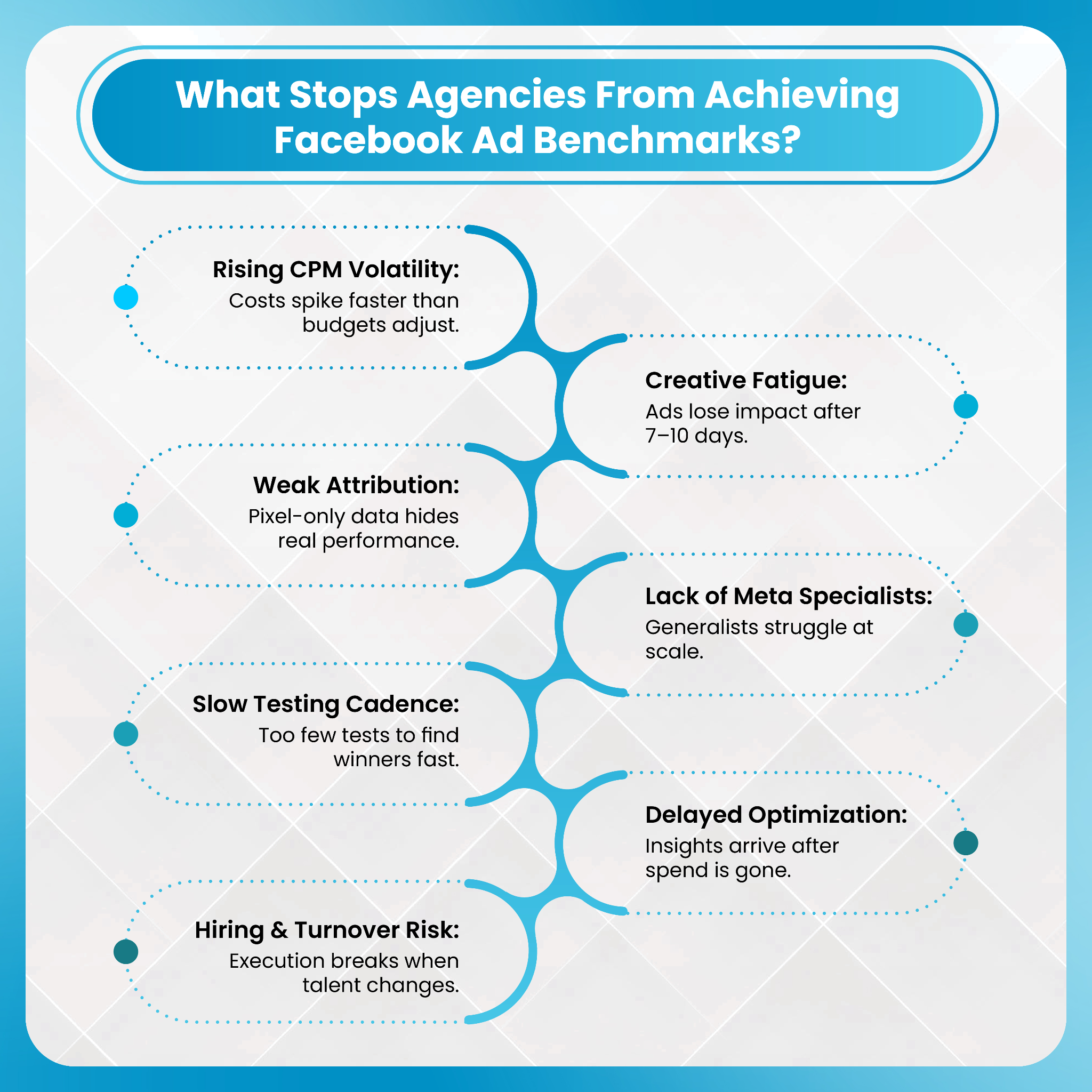
This similarity in messaging creates real buyer indecision. When everything sounds the same, prospects default to price as the deciding factor. That is a race no agency wants to run.
The barrier to entry has also dropped. AI-powered tools inside Meta Ads Manager now assist with audience suggestions, budget optimization, and creative generation. These tools have made it easier for newer or smaller agencies to produce functional campaigns without deep platform expertise.
What clients are increasingly evaluating is not just whether an agency can run ads, but whether the agency has the operational maturity to manage campaigns reliably over time. Platform knowledge is table stakes. How your agency delivers, communicates, and scales is where the real evaluation happens.
When every agency promises similar campaign results, clients begin evaluating something much harder to copy: confidence.
Clients No Longer Buy Facebook Ads, They Buy Confidence
Most clients hiring a Facebook Ads agency do not have a deep background in paid social advertising. They cannot open Meta Ads Manager to accurately assess whether their campaigns are well structured, whether audience targeting is dialed in, or whether budget optimization is handled correctly.
They can evaluate how your agency makes them feel.
According to Salesforce's State of the Connected Customer, 88% of customers say the experience a company provides is as important as its products or services. This applies directly to agency-client relationships. Clients are not just buying campaign management. They are buying the experience of being managed well.
Here is what clients actually use to judge agency quality:
- Responsiveness. How quickly does the agency reply to questions or concerns? Slow responses signal disorganization, regardless of campaign performance.
- Communication. Does the agency explain what is happening, why it matters, and what comes next? Or does it send raw data and leave clients to interpret it?
- Transparency. Are clients kept informed about performance changes, budget pacing, and creative decisions? Or do they feel like things are happening without their knowledge?
- Consistency. Does the agency deliver on time, every time? Or do deadlines slip and reports arrive late?
- Professionalism. Does the agency feel structured and reliable, or does it feel reactive and disorganized?
Agencies that build predictable execution into their operations create a better client experience by default. Clients renew because they trust the process, not because they fully understand every media buying decision. Reliability becomes part of the value proposition, and that is something price alone cannot compete with.
Confidence is built through daily execution, which means operational systems matter just as much as campaign strategy.
The Five Areas Where High-Performing Agencies Differentiate Their Facebook Ads Service
Agencies that consistently outperform their competition tend to share similar operational habits. These habits show up across five specific areas of Facebook Ads service delivery.
1. Faster Campaign Launches
Every day a campaign sits unlaunched is a day a client is questioning their decision to hire your agency. High-performing agencies minimize that window through structured onboarding processes that include:
- Standardized client onboarding checklist that gathers the right information upfront.
- Pixel validation to confirm that conversion tracking is firing correctly before launch.
- Event testing to verify that key actions such as purchases, form fills, and page views are tracked accurately.
- Creative approvals that move through a defined process rather than waiting in someone's inbox.
- Audience preparation so targeting parameters are ready before the account goes live.
Faster launches do not just improve efficiency internally. They immediately strengthen client confidence. A client who sees their campaigns live within a week of signing feels like they made the right choice.
2. Better Creative Testing Systems
Creative is consistently one of the most important variables in Facebook and Instagram ad performance. Meta recommends refreshing ad creatives regularly to reduce ad fatigue and maintain engagement rates. High-performing agencies build repeatable testing frameworks to manage this systematically.
A structured creative testing process includes:
- Testing hooks to determine which opening lines stop the scroll.
- Testing offers to identify which value propositions resonate most with the target audience.
- Testing headlines, formats, and calls to action across ad sets.
- Scheduled creative refresh cycles to prevent audience fatigue before it damages performance.
Without a defined process, creative testing becomes inconsistent. Some clients get it; others do not. A structured system ensures every account benefits from ongoing improvement.
3. Stronger Performance Communication
There is a meaningful difference between reporting and communication. Reporting means sharing data. Communication means turning that data into insights a client can understand and act on.
High-performing agencies build communication habits that include:
- Monthly performance summaries written in plain language, not pulled metrics.
- Recommendations that explain what should change and why.
- Forecasting that sets realistic expectations for upcoming periods.
- Next-step planning so clients understand what the agency is working on, not just what happened last month.
When clients understand campaign performance, they feel more confident in the agency managing it. That confidence directly supports retention.
4. Consistent Optimization Discipline
Campaign optimization is not a one-time task. It is a recurring discipline that drives sustained performance improvements over time. Agencies with strong optimization habits follow structured weekly processes that include:
- Budget pacing reviews to ensure spend is distributed correctly across campaigns.
- Frequency monitoring to identify audiences that are seeing ads too often.
- Audience expansion planning to introduce new targeting when performance plateaus.
- Placement analysis to assess where conversions are coming from and where the budget should shift.
- Attribution review and conversion validation to ensure tracked results are accurate.
Recurring optimization consistently outperforms occasional adjustments because problems get caught earlier and improvements compound over time.
5. Reliable Client Experience
Operational reliability is a form of agency branding. Every time a deadline is met, a report arrives on schedule, or a question is answered quickly, the agency reinforces a reputation for being dependable. Specific habits that build this reputation include:
- Meeting campaign launch and reporting deadlines without exception.
- Delivering consistent reporting on a predictable schedule.
- Responding to client questions faster than clients expect.
- Maintaining organized account documentation and workflows.
- Providing proactive recommendations rather than waiting for clients to ask.
Reliability creates familiarity, and familiarity creates trust. Clients who trust their agency rarely look for alternatives.
Maintaining this level of consistency becomes more difficult as client portfolios expand.
Why Most Agencies Struggle to Differentiate as They Grow?
Operational discipline is manageable when an agency has a small client base. As portfolios grow, the same habits that made differentiation possible become harder to sustain.
Common bottlenecks that emerge with growth include:
- Increased Client Volume: More accounts mean more variables to manage, more reporting to produce, and more communication to maintain simultaneously.
- Limited Specialist Capacity: As account managers take on more clients, the depth of attention each account receives starts to decline.
- Context Switching: Managing multiple accounts across different industries and campaign objectives fragments focus and increases the likelihood of errors.
- Inconsistent Quality Assurance: Without structured QA processes, campaign reviews become reactive rather than systematic.
- Reporting Delays: Reports get pushed back when teams are stretched, which is exactly the moment clients start questioning the relationship.
- Creative Bottlenecks: Creative requests pile up, refresh schedules get delayed, and performance suffers while clients wait.
- Campaign Review Delays: Optimization tasks get deprioritized during busy periods, leading to performance gaps that are difficult to explain.
The growth trap looks like this:
More Clients → More Operational Complexity → Less Strategic Time → Inconsistent Delivery → Weaker Client Experience → Reduced Differentiation
Agencies that built their reputation on reliable execution find that the same growth they worked toward is now threatening the quality that got them there.
Operational consistency influences client perception just as much as campaign performance.
Why Better Facebook Ads Results Alone Aren't Enough?
Imagine two agencies with identical ROAS across their client portfolios. One retains 80% of its clients year over year. The other churns through clients every six months. The difference rarely comes down to campaign performance. It comes down to operational brand perception.
Clients do not experience an agency through spreadsheets and ad accounts. They experience it through every interaction, including:
- How smooth the onboarding process felt.
- How clearly the agency communicated during the first 30 days.
- How professional the first report looked.
- How quickly questions were answered.
- How well the agency explained performance changes.
- How organized the workflow appeared from the client's perspective.
- How proactively the agency educated them on what was happening and why.
Agencies with strong operational brand perception build confidence at every touchpoint. Even during periods when campaign performance is being optimized, clients stay because they trust the process and the people managing it.
Agencies with similar ROAS but weaker operational habits tend to experience higher churn because the client experience does not reinforce trust. Performance alone is not enough to hold relationships together when communication, reporting, and reliability are inconsistent.
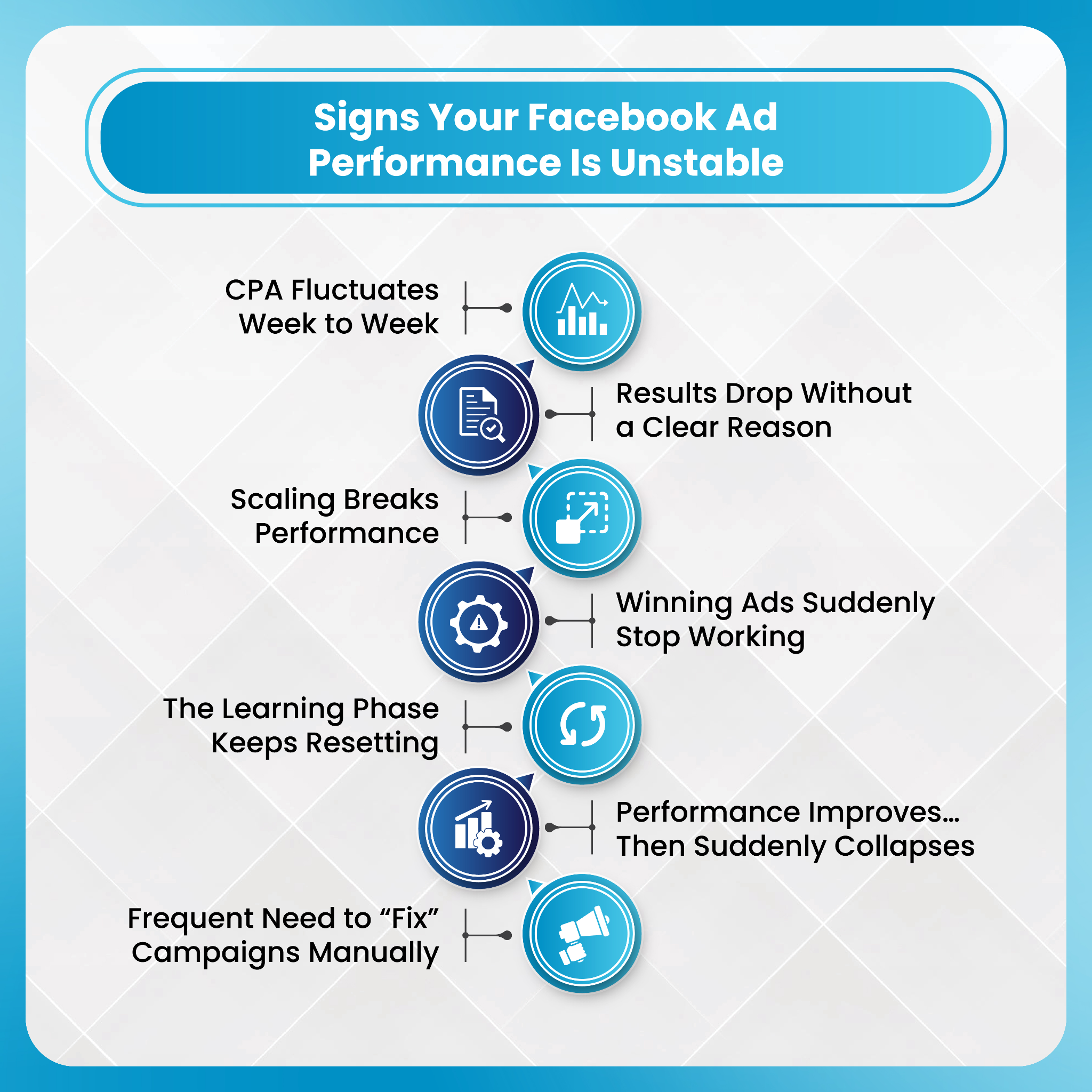
Operational excellence becomes much easier to maintain when fulfillment follows structured systems.
How White Label Facebook Ads Strengthen Every Competitive Advantage?
White label Facebook advertising is more than a way to increase capacity. With structured workflows and experienced specialists, it strengthens the operational areas clients value most.
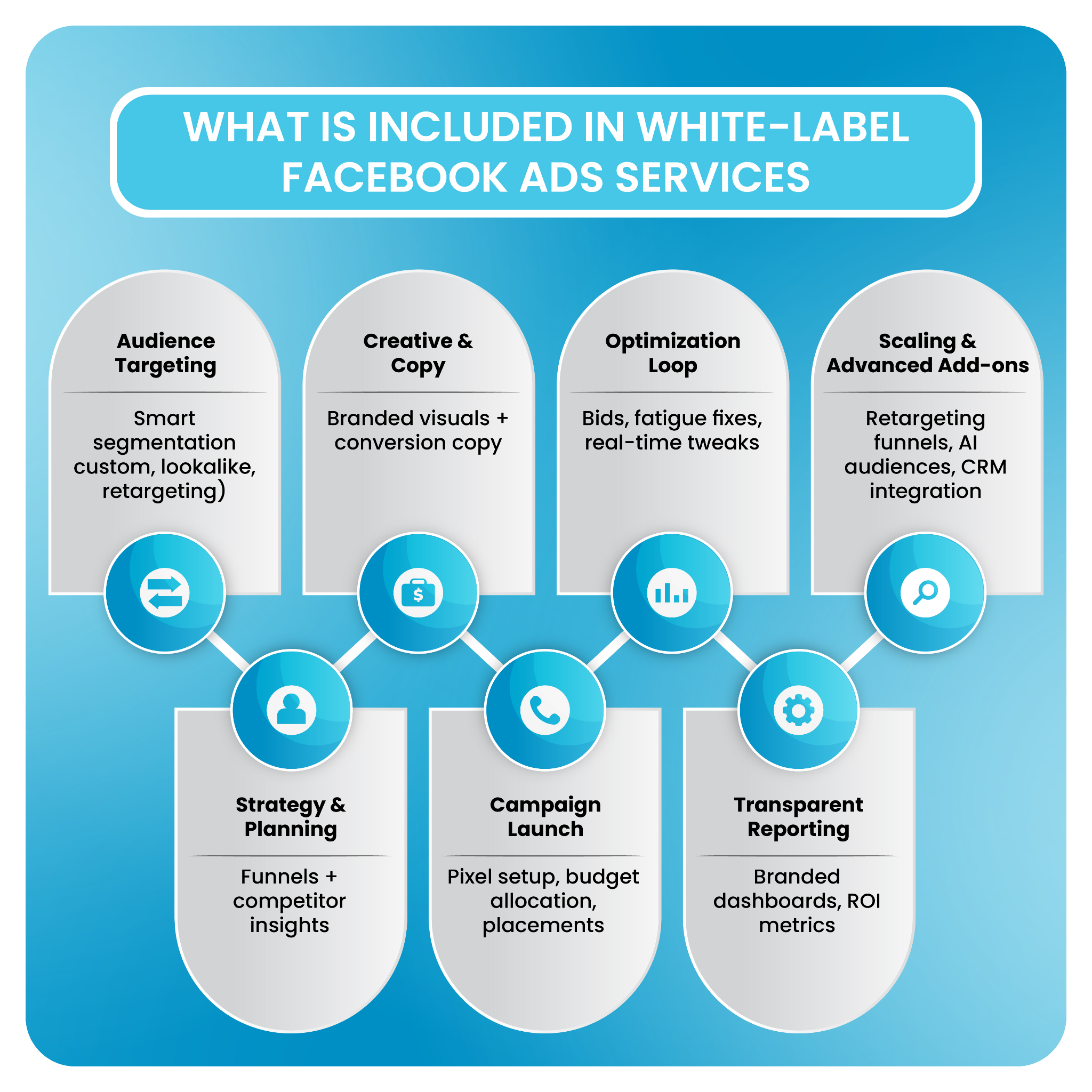
- Specialized Facebook Ads Experts: A white label Facebook advertising agency gives agencies access to dedicated media buyers who focus exclusively on Meta Ads. Their expertise spans audience targeting, creative testing, bidding strategies, budget optimization, and performance analysis, leading to more consistent campaign execution.
- Standardized Campaign Operations: White label partners follow documented SOPs for campaign setup, launch checklists, optimization schedules, quality assurance, and reporting. These standardized workflows reduce errors, improve consistency, and ensure every client receives the same high-quality experience.
- Consistent Creative Execution: Creative testing often becomes inconsistent as agencies grow. White label reporting helps streamline creative requests, organize asset management, schedule testing, and plan refresh cycles, helping campaigns stay optimized without last-minute adjustments.
- White Label Reporting: Professional, branded reporting reinforces agency credibility. White label reporting provides customized dashboards, performance summaries, and actionable insights under the agency's brand, giving clients clear visibility into campaign progress.
- Flexible Fulfillment Capacity: White label fulfillment allows agencies to onboard more clients and handle seasonal demand without hiring additional staff. As workloads increase, fulfillment scales alongside the agency while maintaining consistent service quality.
Together, these operational improvements strengthen both client retention and new business acquisition.
Competitive Advantages Agencies Can Market When Using White Label Facebook Ads
Structured fulfillment creates tangible advantages agencies can showcase during sales conversations.
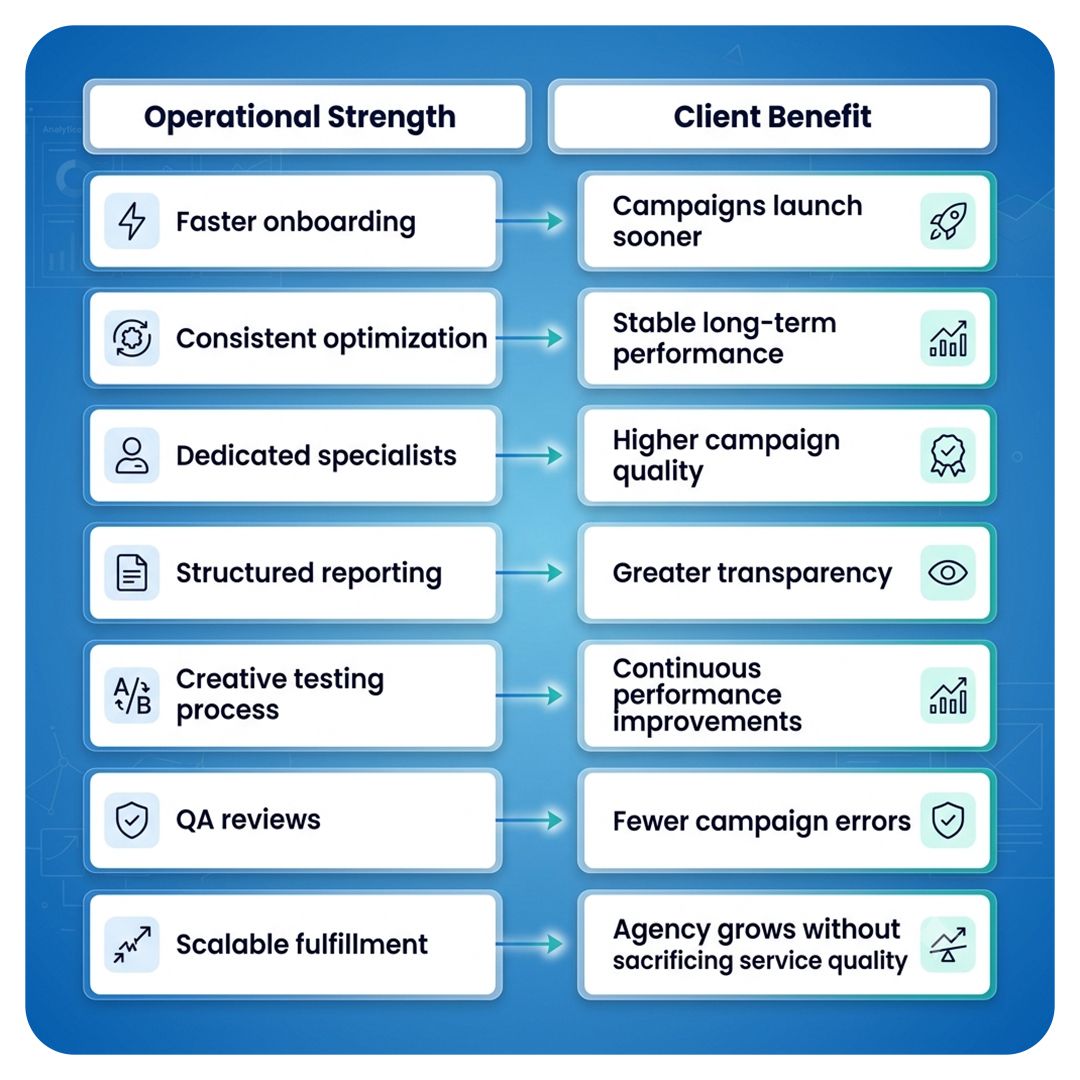
Rather than relying on generic promises, agencies can demonstrate operational maturity through faster launches, structured optimization, and professional reporting. These are differentiators that are difficult for competitors to replicate.
Agencies competing mainly on price often lack these operational advantages.
Signs Your Agency Is Competing More on Price Than Value
If several of these apply, your agency may be relying on pricing instead of operational strength.
- Prospects ask about pricing before strategy.
- Sales conversations frequently involve discounts.
- Facebook Ads packages look similar to competitors'.
- Reports rely mostly on exported Meta Ads metrics.
- Campaign launches regularly miss deadlines.
- Creative testing is inconsistent.
- Client referrals have slowed.
- Account managers spend more time explaining delays than discussing growth.
These signs often point to operational gaps rather than sales problems. Improving internal processes helps shift conversations from price to value by creating a better overall client experience.
How DashClicks Helps Agencies Build a Stronger Competitive Position?
DashClicks provides scalable white label Facebook Ads fulfillment that helps agencies deliver consistent results without expanding internal teams.
- White Label Facebook Ads Fulfillment: The fulfillment team manages campaign setup, ongoing optimization, and day-to-day management under your agency's brand. Every task is handled by experienced specialists, giving your clients the quality of a dedicated media buying team without the overhead of building one.
- Dedicated Media Buyers: Each account is managed by a specialist focused on Meta Ads performance. These media buyers bring platform expertise across campaign objectives, audience targeting, bid strategies, and creative performance, ensuring optimization decisions are grounded in real paid social advertising experience.
- Standardized Campaign Workflows: Fulfillment follows documented SOPs that govern every stage of campaign management, from pre-launch setup through recurring optimization and quality assurance. Structured workflows reduce errors, improve delivery speed, and ensure consistent outcomes across your entire client portfolio.
- Creative Collaboration: The fulfillment team supports asset management and creative testing to help agencies maintain fresh, high-performing ad creatives. Structured testing schedules and organized asset libraries make it easier to keep campaigns running at their best without falling behind on refresh cycles.
- White Label Reporting: Clients receive branded reports and performance summaries through white label reporting software that reflect your agency, not your fulfillment partner. Reports are built to communicate campaign results clearly, with actionable insights that help clients understand what is happening and what comes next.
- Scalable Fulfillment Infrastructure: Whether onboarding new clients or managing seasonal demand, fulfillment scales with your agency while maintaining delivery quality.
Your agency continues to own client relationships, strategy, and growth, while DashClicks manages execution behind the scenes.
The Agencies That Win Long-Term Compete on Execution, Not Price
Every agency can promise better Facebook Ads results, but few consistently deliver a superior client experience. Sustainable differentiation comes from reliable execution, structured communication, and operational consistency.
White label Facebook advertising helps agencies scale these strengths without building large in-house teams. By improving fulfillment, reporting, and campaign management, agencies can compete on value instead of price, strengthen client relationships, and build a more scalable business.

Why More Content Alone Won't Fix Your Clients' SEO
Publishing more blogs feels like progress. Clients can see the new posts. The content calendar stays full. Reports show consistent output month after month. For many agencies, that rhythm creates the impression that SEO is working.
The problem is that content volume and SEO performance are not the same thing. According to BrightEdge Organic Search Research, 53.3% of all trackable website traffic comes from organic search. Capturing that traffic requires far more than a steady stream of new articles. It requires optimized pages, a technically sound website, clean site architecture, and ongoing maintenance that keeps everything performing over time.
Many agencies fall into the trap of equating publishing activity with SEO progress. Content is easy to produce, easy to measure, and easy for clients to understand. Technical SEO is harder to explain and largely invisible. That imbalance often shifts agency resources toward content production while the deeper work gets deprioritized.
Content creates opportunities. SEO systems turn those opportunities into rankings. Without the systems, most of the content an agency publishes will underperform.
This article explains why more content is not a complete SEO strategy, what ongoing optimization work actually drives rankings, and how white label SEO outsourcing helps agencies deliver complete campaigns at scale without overextending internal teams.
Why Agencies Often Mistake Content Production for SEO Progress?
Content production is the most visible part of an SEO engagement. Clients can read new blog posts, share them on social media, and clearly see that work is happening. As a result, publishing content often becomes the easiest way for agencies to demonstrate progress.
Several factors contribute to this misconception:
- New Content is Highly Visible: Clients can immediately see published blogs, landing pages, and other website updates, making content feel like tangible progress.
- Publishing is Easy to Measure: Agencies can report the number of articles or pages created each month, giving clients a simple metric to track.
- Content Creates the Perception of SEO Success: As page count increases, clients often assume rankings and organic traffic will naturally follow.
- Reporting Reinforces the Belief: Monthly reports frequently highlight content production rather than improvements in technical SEO or search visibility.
However, technical SEO tells a different story.
Most optimization happens behind the scenes, making it less noticeable even though it has a significant impact on rankings. This work includes:
- Resolving Crawl Errors: Helps search engines discover and index important pages correctly.
- Fixing Canonical Conflicts: Prevents duplicate content from competing against itself in search results.
- Improving Internal Linking: Strengthens page authority and helps search engines understand the site's structure.
- Maintaining Site Health: Ongoing audits identify technical issues before they affect performance.
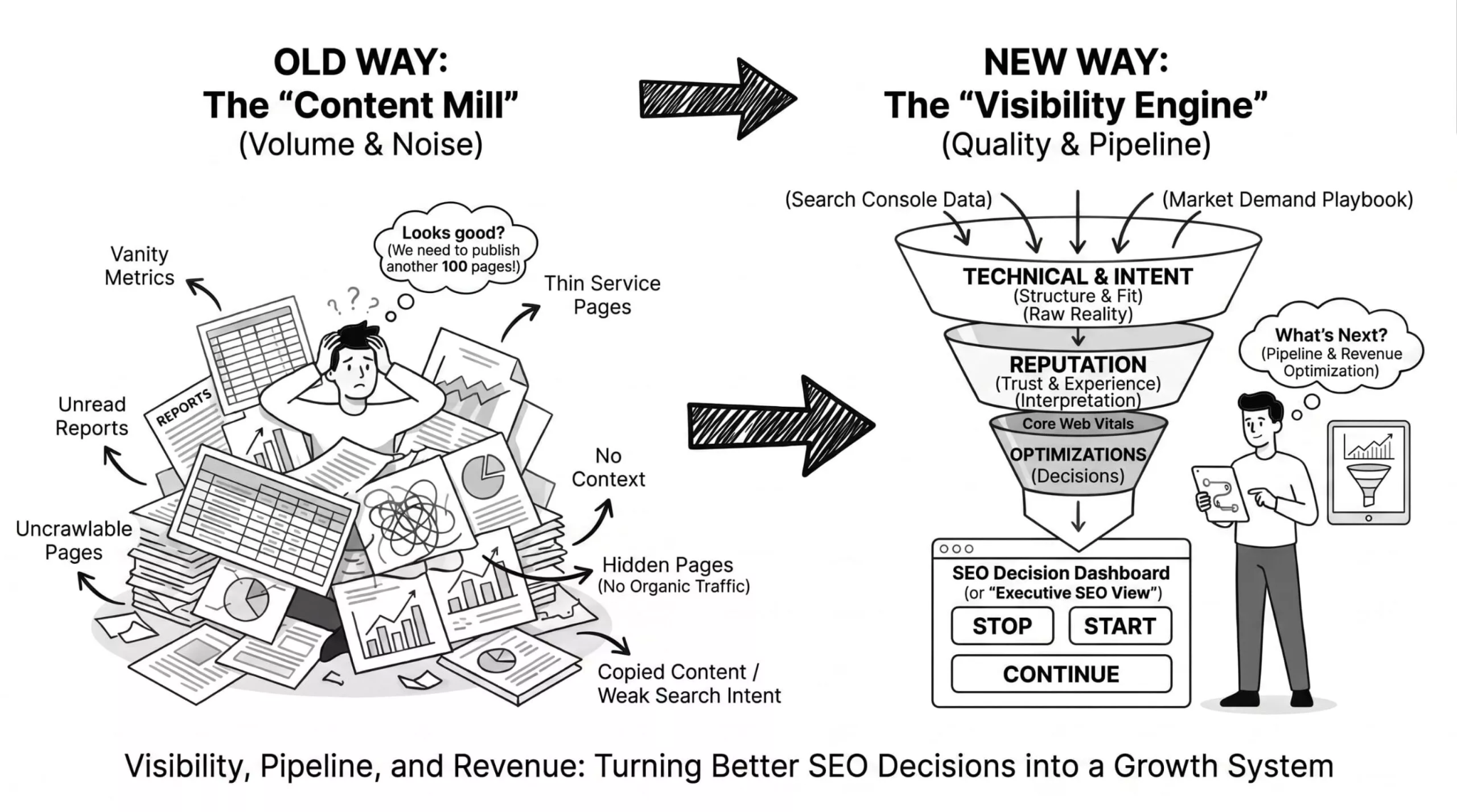
Image Source: dau
Limited internal bandwidth often makes the problem worse.
When agencies become busier, content production usually scales more easily than technical optimization because:
- Content Follows Predictable Workflows: Writing and publishing blogs is easier to standardize across multiple clients.
- Technical SEO Requires Specialized Expertise: Site audits, crawl analysis, and structural improvements demand more time and experience.
- Growing Client Rosters Reduce Optimization Time: Teams often prioritize visible deliverables over recurring maintenance work.
The result is that agencies begin measuring the wrong indicators. Content volume is not a reliable measure of SEO performance. A website with 300 indexed pages and unresolved technical issues is unlikely to outperform a competitor with 100 well-optimized pages built on a technically sound foundation.
Creating more content expands your opportunities to rank, but it cannot fix the underlying SEO issues that prevent existing pages from performing well.
More Content Doesn't Fix the SEO Problems Holding Rankings Back?
New content competes for rankings within whatever technical and structural environment already exists on a website. If that environment has unresolved problems, publishing more pages will not overcome them. Understanding which barriers are actually suppressing performance is the first step toward fixing them.
1. Technical SEO Barriers
Technical problems prevent search engines from properly crawling and indexing a website, regardless of how much content gets published. Common issues include:
- Crawl errors that block search engines from accessing important pages.
- Indexation issues that prevent content from appearing in search results.
- Broken internal links that interrupt crawl paths and dilute authority.
- Poor site architecture that buries important pages too deep for efficient crawling.
- Canonical issues that create duplicate content signals.
- XML sitemap problems that send incomplete or inaccurate signals to search engines.
2. On-Page SEO Problems
Even when a page is technically accessible, weak on-page SEO limits its ability to rank. Agencies frequently encounter:
- Weak metadata that reduces click-through rates and fails to signal relevance.
- Keyword cannibalization where multiple pages compete for the same terms.
- Thin commercial pages that do not satisfy search intent.
- Poor heading hierarchy that obscures content structure for both users and crawlers.
3. Performance Issues
Site performance affects both user experience and search rankings. Core Web Vitals are now a confirmed Google ranking factor, making performance optimization a direct SEO concern. Key issues include slow Core Web Vitals scores, mobile usability failures, and oversized image files that inflate load times.
4. Local SEO Issues
For clients with physical locations or service areas, local SEO problems limit visibility in map results and local search. These issues often involve Google Business Profile inconsistencies, citation inaccuracies across directories, and weak local relevance signals across the website.
Publishing ten new articles will not solve the technical barriers preventing existing pages from performing. In many cases, improving what already exists delivers stronger results than constantly adding new pages.
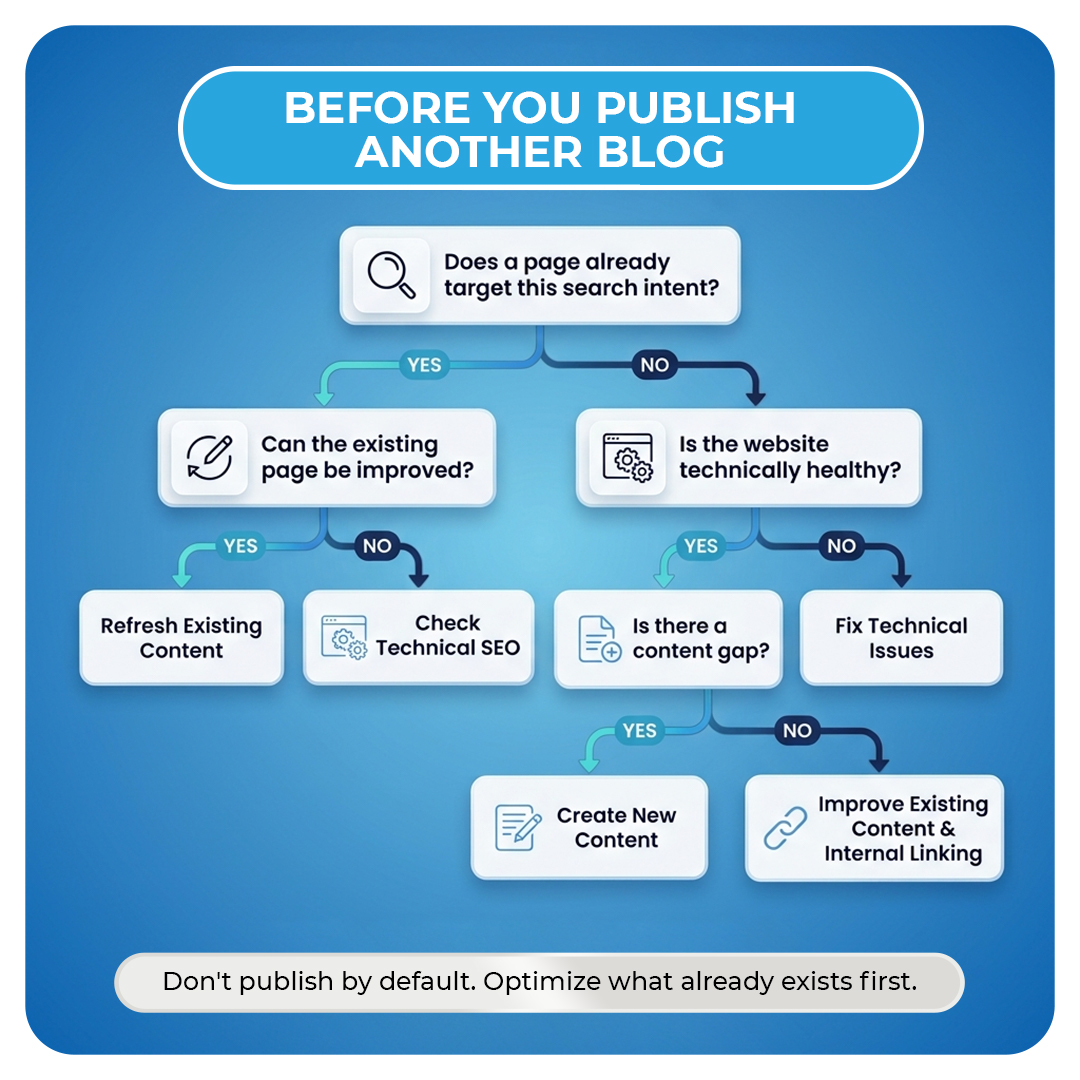
Why Does Existing Content Often Deliver More ROI Than Publishing New Content?
Most established websites already have pages that rank somewhere on page two or three of search results. Those pages have existing authority, backlinks, and indexation history. With targeted optimization, many of them can move to page one without the effort required to build a brand-new page from scratch.
Content refreshes are often the highest-ROI activity in an SEO campaign, yet they remain consistently underused. Common refresh activities include:
- Updating outdated statistics to restore accuracy and credibility.
- Improving search intent alignment so the page better matches what users are actually looking for.
- Expanding topical depth to cover subtopics competitors are ranking for.
- Refreshing internal links to pass authority to related pages and improve site structure.
- Consolidating overlapping pages to resolve keyword cannibalization.
- Improving metadata to increase click-through rates.
- Adding schema markup to enhance search result appearance.
- Updating call-to-action to reflect current offers or funnels.
Refreshed content often outperforms newly published content because it builds on an existing foundation rather than starting from zero. Google Search Central recommends keeping content accurate, useful, and regularly maintained rather than simply increasing content volume. Frequent updates signal that a page remains relevant, which supports continued indexing and rankings.
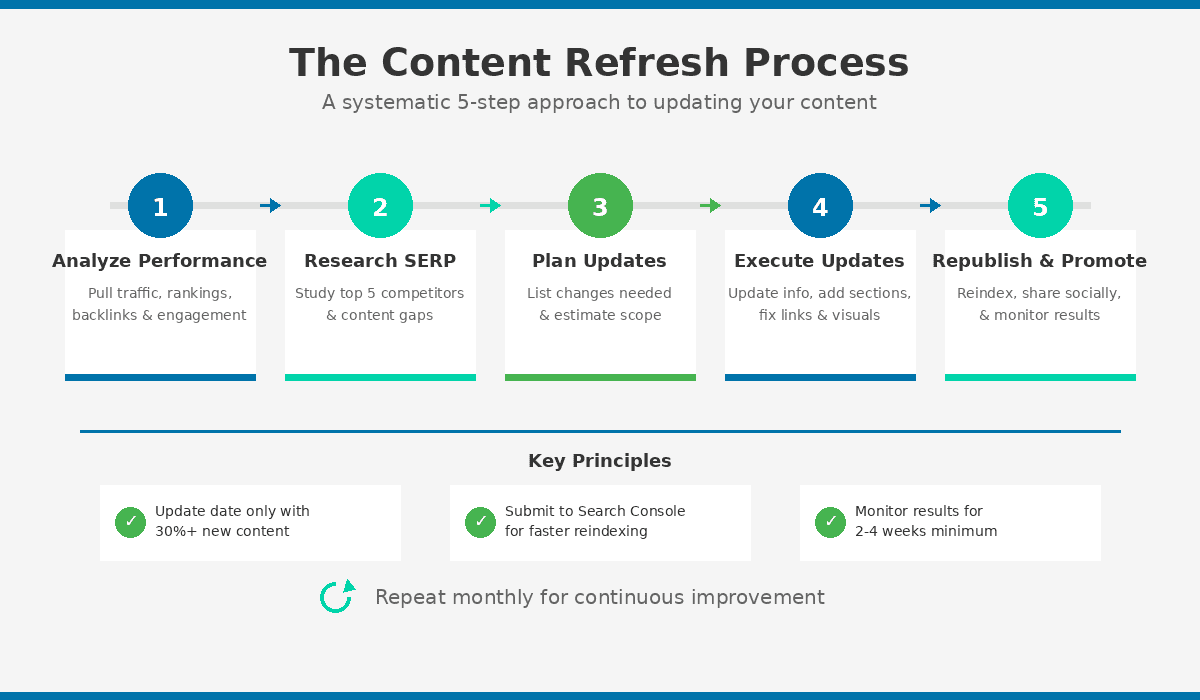
Image Source: Christopher Jan
While clients often notice new blog posts, much of the work that drives rankings happens behind the scenes.
The SEO Work Clients Never See (But Rankings Depend On)
Between every published blog post, there is a continuous set of operational tasks that keep a website performing. This work is rarely visible to clients, but it is what separates websites that sustain rankings from those that plateau.
The SEO Work Happening Between Blog Posts
Recurring optimization activities include:
- Technical Monitoring: Reviewing crawl data for new errors and accessibility issues.
- Crawl Reviews: Ensuring search engines can reach and process all important pages.
- Indexation Management: Confirming that published content is indexed and de-indexed content is properly excluded.
- Internal Link Audits: Identifying broken links, orphaned pages, and opportunities to strengthen authority flow.
- Redirect Maintenance: Managing redirect chains and resolving errors from site changes.
- Metadata Optimization: Updating titles and descriptions based on CTR data and ranking movement.
- Image Optimization: Compressing files and adding descriptive alt text.
- Schema Validation: Confirming that structured data is correctly implemented and error-free.
- Content Pruning: Removing or consolidating thin, outdated, or underperforming pages.
- Site Health Monitoring: Tracking overall technical performance across the site.
None of these activities produce a deliverable a client can read or share. But together, they maintain the foundation that allows published content to rank and hold its position over time.
This ongoing maintenance is what transforms SEO from a publishing activity into a long-term growth system.
SEO Isn't a Publishing Strategy - It's a Maintenance System
The most effective way to understand SEO is as infrastructure rather than output. A website's rankings depend on a combination of content quality, technical integrity, authority, and ongoing upkeep. Treating SEO as a content publishing schedule misses three of those four components entirely.
Sustainable SEO growth depends on recurring activities across multiple disciplines:
- Monitoring to catch technical issues before they affect rankings.
- Auditing to identify gaps in optimization across the site.
- Optimization to improve page-level performance continuously.
- Reporting to track what is working and identify new opportunities.
- Continuous improvement to respond to algorithm changes, competitor movements, and evolving search intent.
Agencies that focus only on publishing tend to become reactive. Rankings decline, a content push follows, and the cycle repeats without addressing the root cause. Proactive agencies treat SEO as a maintenance system, scheduling recurring optimization work alongside content production.
Maintaining this level of optimization becomes increasingly difficult as agencies grow.
The Operational Challenge: Why Agencies End Up Prioritizing Content Over SEO Maintenance
The shift toward content-heavy SEO is not usually a strategic choice. It is an operational outcome. As agencies scale, the pressure to deliver visible work to more clients increases, and content is the path of least resistance.
Several factors reinforce this pattern:
- Content Calendars Scale Easily: Adding a new blog post to a workflow is straightforward. Adding a monthly technical audit for each client is not.
- Technical SEO Requires Specialists: Not every team member can resolve crawl errors, manage schema markup, or diagnose Core Web Vitals issues.
- Growing Client Portfolios Reduce Optimization Time: More accounts mean less time per account for deep technical work.
- Reactive Work Replaces Proactive Maintenance: When something breaks, or rankings drop, the team responds. Scheduled optimization gets pushed.
- Multiple Specialists Create Fragmented Ownership: When content, technical SEO, and local SEO are handled by different people without clear coordination, recurring tasks fall through the cracks.
The result follows a predictable pattern:
More Clients → More Content Requests → Less Time for SEO Maintenance → Technical Debt Grows → Rankings Plateau
Operational bottlenecks create stagnant SEO performance not because agencies lack SEO knowledge, but because they lack the capacity to execute recurring optimization consistently across a growing client base.
A balanced SEO process allocates effort across multiple recurring optimization activities, not just content creation.
A Balanced SEO System Agencies Should Follow
Agencies that consistently deliver long-term SEO results treat content as one input in a broader system. Each month, work should cover multiple optimization activities that together support ranking performance and site health.
No single activity in this table can substitute for the others. New content without technical audits builds on an unstable foundation. Technical audits without content refreshes leave underperforming assets untouched. Reporting without optimization produces data that never gets applied.
Long-term SEO depends on cycling through these activities consistently rather than defaulting to whichever deliverable is easiest to produce or explain to a client.
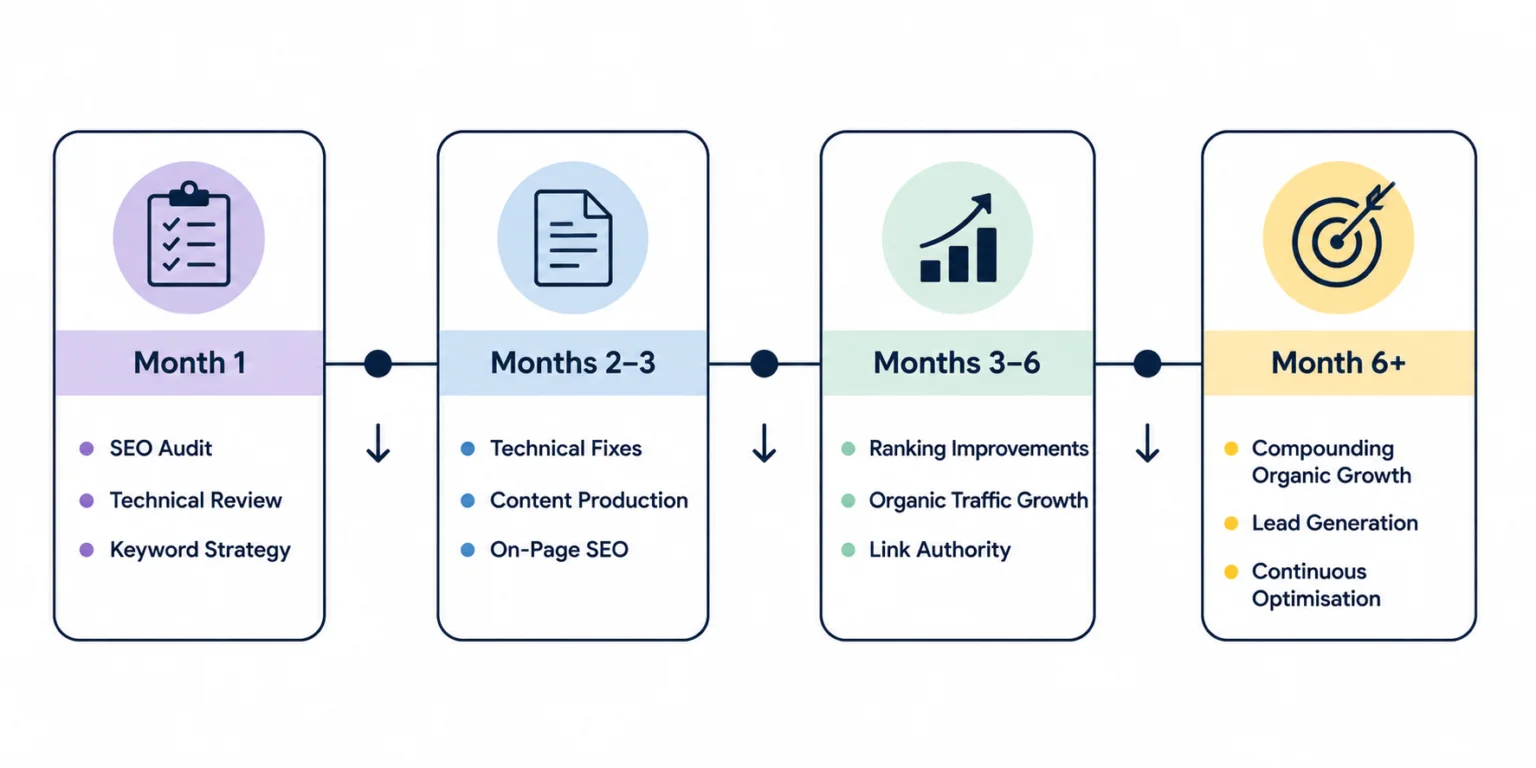
Image Source: Justwords
Delivering this complete SEO process consistently often requires additional operational capacity.
How White Label SEO Helps Agencies Go Beyond Content Production?
SEO outsourcing gives agencies the ability to deliver a complete SEO service without building every capability in-house. Rather than replacing agency strategy, a white label SEO firm expands fulfillment capacity so that recurring optimization work happens consistently alongside content production.
- Technical SEO Support: A white label agency handles the technical layer of optimization that many internal teams cannot sustain at scale. This includes conducting technical audits, monitoring crawl data, maintaining site health, and managing indexation reviews across client websites. These tasks require consistent time investment and technical expertise that is difficult to maintain across a growing portfolio without dedicated resources.
- Content Optimization: White label SEO outsourcing supports on-page optimization beyond initial content creation. Existing pages get reviewed for metadata improvements, internal linking gaps, search intent alignment, and opportunities to expand topical coverage. This work improves the performance of assets already indexed rather than relying on new content to carry all SEO growth.
- Local SEO: For clients with local visibility goals, a white label SEO firm manages Google Business Profile optimization and citation management across directories. Consistent and accurate local signals support rankings in map results and local search, areas that often get overlooked when agencies focus primarily on content production.
- Reporting: White label reporting keeps clients informed without adding reporting burden to internal teams. Reports cover completed optimization work, ranking movements, organic traffic trends, and upcoming priorities. This gives clients visibility into behind-the-scenes SEO activity, not just the content published during the month.
The right fulfillment partner helps agencies deliver every part of SEO consistently, not just content production.
How DashClicks Helps Agencies Deliver Complete SEO Campaigns?
DashClicks is a white label SEO agency built to support digital marketing agencies with recurring fulfillment across every component of SEO. The goal is to handle the ongoing execution so agency teams can focus on client relationships and business growth.
- White Label SEO Fulfillment: The team manages recurring SEO optimization as a consistent, behind-the-scenes process. Fulfillment happens every month across technical, on-page, local, and reporting activities, giving agencies a complete SEO service without building a large internal specialist team.
- Technical SEO Maintenance: The fulfillment team conducts ongoing site audits to maintain crawlability, resolve indexation issues, and monitor site health across client accounts. Technical problems get identified and addressed before they escalate into ranking losses.
- On-Page Optimization: Metadata gets reviewed and improved based on CTR and ranking data. Internal linking is audited to strengthen authority flow across the site. Content optimization focuses on search intent alignment and expanding topical depth on existing pages.
- Local SEO Support: The team manages Google Business Profile optimization and citation management for clients with local SEO goals. Accurate and consistent local signals support visibility in map results and local search results.
- White Label Reporting: With white label reporting, agencies receive branded reports covering completed work, ranking performance, organic traffic trends, and identified opportunities. Reporting communicates the full scope of SEO activity to clients, including the work that happens between blog posts.
- Scalable Fulfillment: Agencies maintain direct client relationships while the fulfillment team supports the recurring execution behind the scenes. As an agency grows its client portfolio, DashClicks scales alongside it without requiring additional internal hiring or restructuring.
With recurring SEO work consistently managed, agencies can move beyond content production and deliver sustainable organic growth.
Publishing More Is the Start, Not the Strategy
Content creates opportunities for rankings. Optimization is what unlocks them. Technical SEO protects existing rankings from being lost to crawl errors, site structure problems, and performance issues. Ongoing maintenance sustains growth over time as search algorithms evolve and competitors continue to optimize.
Agencies that combine consistent publishing with recurring optimization deliver meaningfully stronger long-term SEO performance than those relying on content volume alone. The challenge is operational: doing all of this well requires more capacity than most growing agencies can sustain internally.
White label SEO outsourcing gives agencies a practical path to delivering complete SEO campaigns without increasing operational complexity. Successful agencies treat SEO as an ongoing system rather than a publishing schedule, and they build the fulfillment structure to support it.

No results found.
Please try different keywords.
Get Started with
DashClicks Today
Get found online, convert leads faster, generate more revenue, and improve your reputation with our all-in-one platform.
.svg)
Unlimited Sub-Accounts
Unlimited Users
All Apps
All Features
White-Labeled
Active Community
Mobile App
Live Support
100+ Tutorials
Unlimited Sub-Accounts
Unlimited Users
All Apps
All Features
White-Labeled
Active Community
Mobile App
Live Support
100+ Tutorials
Unlimited Sub-Accounts
Unlimited Users
All Apps
All Features
White-Labeled
Active Community
Mobile App
Live Support
100+ Tutorials


