

.svg)

.svg)
.svg)
.svg)
.svg)
.svg)
Most agencies can technically deliver search engine optimization services to a handful of clients, but very few can deliver those same services consistently at scale. As an agency grows and acquires more clients, the operational complexity expands much faster than the overall efficiency of the team. Growth creates immediate fragmentation. You suddenly have more clients, more workflows, and a massive increase in coordination complexity across different departments. The real bottleneck holding back growth is not a lack of SEO skill alone. The core bottleneck is operational coordination.
SEO success inside agencies increasingly depends on systems instead of individual specialists. HubSpot reports that over 60% of marketers cite generating traffic and leads as their top challenge. Operational inefficiency is often the underlying issue here, not the strategy itself. When teams cannot execute efficiently, the strategy fails to materialize into actual traffic or leads.
As agencies grow, this inefficiency does not appear immediately. It accumulates silently as operational debt inside every SEO process.
The Hidden Operational Debt Inside Growing SEO Agencies
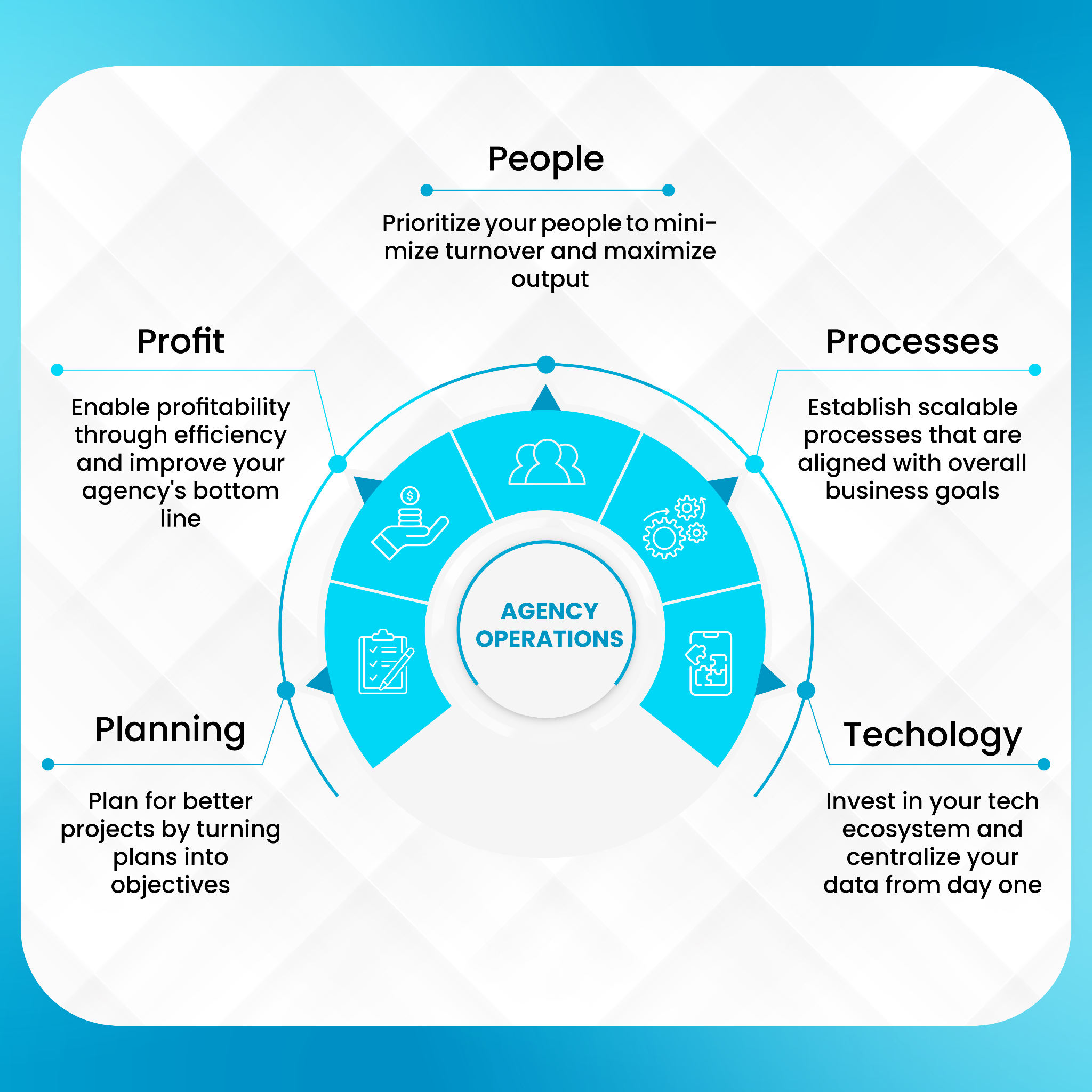
Operational debt refers to the hidden costs of taking shortcuts in processes, workflows, and systems to accommodate rapid growth. When an agency brings on new accounts without a rigid system, teams invent localized solutions to get the work done. Over time, these localized solutions create a massive web of disconnected processes. This debt forces teams to work harder rather than smarter.
1. Disconnected SEO Workflows
Disconnected SEO workflows occur when different account managers build custom processes for every single client. Instead of relying on unified standard operating procedures, team members use different execution styles. One specialist might track keyword progress in a private spreadsheet, while another uses specialized project management software. This creates severe inconsistencies across the agency.
When scaling an agency, you cannot afford to have unique workflows for every account. Scaling increases inconsistency because every new client adds another unique process to the pile.
If a team member goes on vacation or leaves the company, nobody else knows how to manage their specific accounts. The cause of this problem is a lack of centralized fulfillment guidelines from leadership. The effect is that quality control becomes impossible. Managers spend hours trying to understand what work has been completed rather than reviewing the quality of the work itself. When delivery looks different for every client, client expectations become misaligned, and churn rates inevitably rise.
2. Manual Reporting Cycles
Manual reporting cycles are one of the most significant sources of operational drag inside growing agencies. Agencies often rely on spreadsheet-heavy workflows where account managers pull data manually from Google Analytics, search console tools, and keyword trackers. This time-consuming reporting process can take hours for a single client each month.
When team members are manually compiling data, the presentation of key performance indicators becomes highly inconsistent. One manager might highlight traffic growth, while another focuses strictly on backlink acquisition. Reporting becomes an operational drag rather than a strategic asset. The fundamental reason this happens is that agencies treat reporting as a customized deliverable rather than a standardized infrastructure layer.
As the client roster grows, the end of the month becomes a chaotic scramble to assemble data. The time spent building reports directly cannibalizes the time teams should spend executing actual SEO tasks. By failing to systemize data presentation, agencies allow manual reporting to throttle their capacity for taking on new business.
3. Approval Bottlenecks
Approval bottlenecks emerge when an agency scales its client base but fails to distribute decision-making power. In many growing agencies, content approvals are constantly delayed because they require sign-off from senior personnel. You often see a senior SEO dependency or a founder bottleneck, where the agency owner insists on reviewing every single piece of content or technical audit before it goes to the client.
Scaling creates dependency layers. When a founder or a senior manager must approve every deliverable, that individual becomes the absolute limit to the agency's growth. The cause of this SEO bottleneck is a lack of trust in standardized quality assurance processes. Without a rigid framework for what constitutes "good" work, senior staff feel obligated to manually check everything. The effect is that execution velocity plummets. Content sits in a pending folder for weeks, link-building outreach stalls, and clients become frustrated with slow turnaround times. You cannot build a scalable operation if every task must pass through one or two highly constrained individuals.
4. Task Fragmentation
Task fragmentation happens when the core components of an SEO campaign are scattered across too many uncoordinated channels. A single campaign might have SEO tasks split across multiple software tools, independent freelancers, and internal teams. The content writers operate in one system, the technical team operates in another, and the link builders work out of private email inboxes.
This lack of centralized execution means that nobody has a complete view of the campaign's true status. Fragmentation slows execution velocity because team members must constantly chase each other down for updates. "Did the writer finish the blog?" or "Has the technical audit been implemented?" have become daily questions that waste valuable time. The root cause is that agencies treat SEO as a series of isolated tasks rather than a unified production line. The effect is a highly disjointed workflow where deadlines are missed simply because the handoff between the content team and the publishing team was poorly managed. Centralization is mandatory for speed.
5. Inconsistent SOPs
Inconsistent standard operating procedures guarantee that an agency will struggle to deliver uniform results. When an agency lacks centralized documentation, every new hire introduces workflow variance based on their previous experiences or personal preferences. Scaling amplifies inconsistency because you are multiplying this variance by every new employee you bring into the system.
If one account manager believes in aggressive on-page optimization while another prioritizes off-page link velocity, the agency lacks a unified product. The cause of this issue is a failure to document the agency's specific methodology. The result is unpredictable client outcomes.
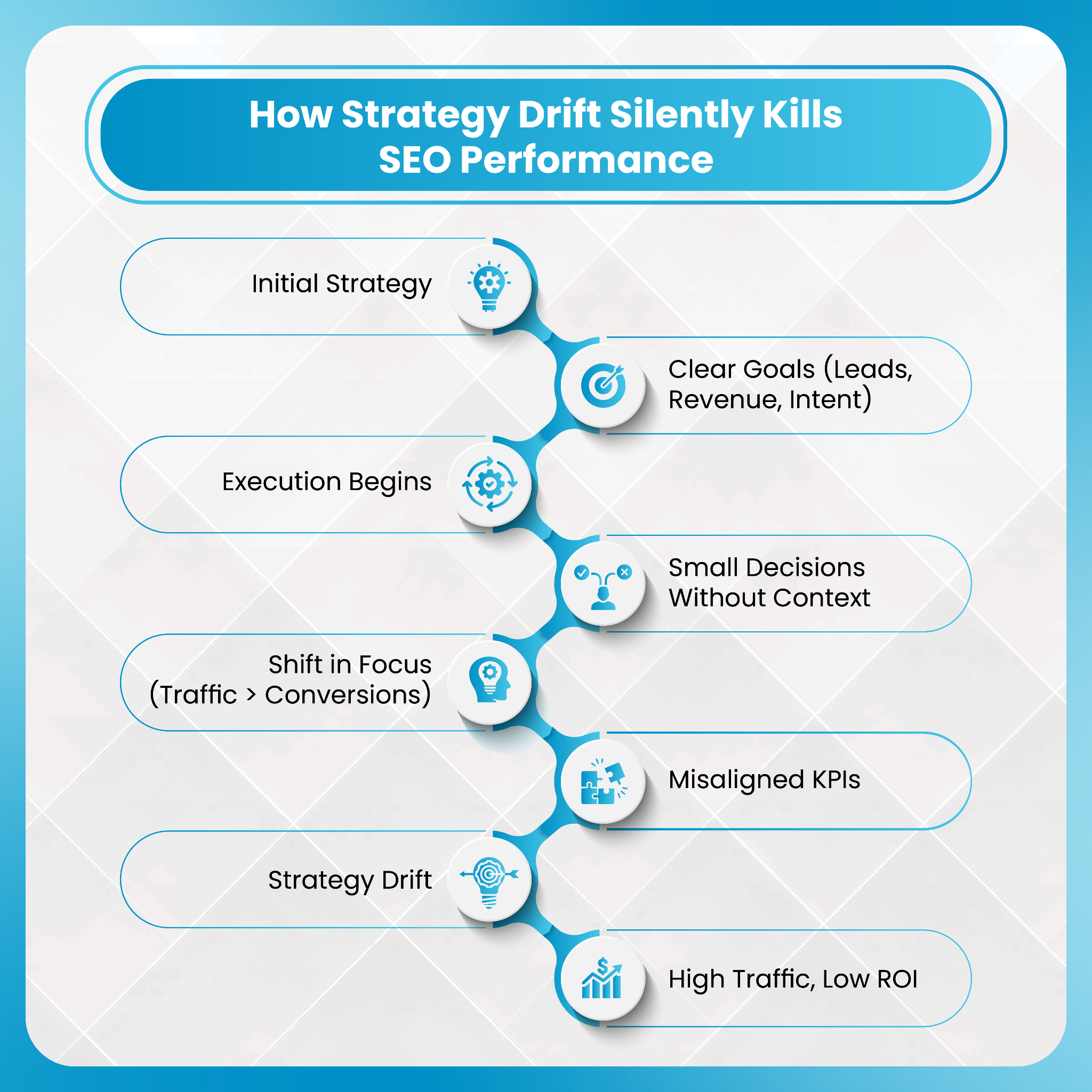
Operational complexity compounds faster than client acquisition. When your processes are inconsistent, training new employees takes months instead of days. As operational debt grows, most agencies assume the answer is hiring more SEO talent. In reality, that creates a deeper structural problem.
Why Most SEO Agencies Scale Inefficiently?
Hiring more SEO specialists increases coordination complexity. Adding more people to a broken system does not fix the system; it only makes the chaos more expensive. Agencies scale inefficiently because they try to solve operational problems with human capital.
1. Context Switching Overload
Context switching overload happens when an SEO manager is forced to juggle multiple accounts across entirely different industries in a single day. A manager might jump from a local plumbing campaign to an enterprise software account, and then to an e-commerce store. This drastic shifting of focus results in a severely reduced execution depth.
Context switching can significantly reduce productivity in knowledge-based work environments. When the brain is forced to constantly shift parameters, cognitive fatigue sets in rapidly. The cause of this overload is poor account distribution and a lack of structured, batched workflows. The effect is that managers do surface-level work on every account rather than deep, impactful optimization. They check off basic tasks just to survive the day but miss the nuanced strategic opportunities that actually drive organic growth. This inefficiency scales linearly with every new client added to their roster.
2. Internal Communication Overload
Internal communication overload paralyzes agencies that have not established clear operational frameworks. When workflows are fragmented, teams develop a heavy dependency on Slack channels, direct messages, and email threads just to figure out what needs to be done. This leads to more meetings, more status checks, and significantly slower execution.
Communication scales faster than output. If you have five people working on an account without a centralized system, the number of communication lines required to keep everyone aligned grows exponentially. The cause is a lack of a single source of truth for project status. If team members have to ask a project manager for an update, the system is failing. The effect is that highly paid SEO professionals spend half their day discussing the work rather than actually doing the work. You cannot scale profitability if your team is trapped in endless alignment meetings.
3. Dependency on Senior Talent
Dependency on senior talent is a major roadblock for agencies attempting to scale up their operations. In an inefficient agency, senior SEOs become bottlenecks for everyday tasks. Junior staff depend on detailed reviews and constant guidance because there are no step-by-step systems in place to guide their execution autonomously.
A lack of systems creates dependency. When the "how to" knowledge lives exclusively inside the head of a senior strategist, the agency cannot leverage its junior talent effectively. The cause is a failure to externalize senior knowledge into standardized operating procedures. The effect is that senior talent becomes overworked and burned out, while junior talent remains underutilized and frustrated. Scaling requires that junior staff can execute up to 80% of the work without direct supervision, which is only possible when execution steps are rigidly defined and systemized.
4. QA Bottlenecks
Quality assurance bottlenecks are the inevitable result of inconsistent execution. When an agency does not have standardized input criteria, the output will always require heavy scrutiny. This leads to more review cycles and an exponentially increased approval load for management.
Scaling multiplies QA friction. If an agency goes from delivering ten articles a month to one hundred articles a month, the time required for quality assurance does not just increase by a factor of ten; it often breaks the system entirely. The cause of this friction is that writers or technicians do not have clear boundaries or checklists to follow before submitting their work. The effect is that managers spend their days sending work back for endless revisions. This cycle degrades profit margins and frustrates clients who are waiting on deliverables that are trapped in internal review purgatory.
5. Inconsistent Execution Quality
Inconsistent execution quality destroys agency reputations. When there is a lack of standardized delivery, you see wildly different SEO styles applied to different accounts. One client might receive phenomenal link-building outreach, while another receives mediocre automated placements simply because different teams are managing them.
Most agencies do not fail because SEO is difficult. They fail because delivery complexity becomes operationally unmanageable. The cause of this inconsistency is treating SEO as an art form rather than a manufacturing process. The effect is that the agency cannot promise a specific baseline of quality to its clients. Client retention drops because the results are unpredictable.
To break this inefficiency loop, agencies must separate strategic SEO thinking from execution. That separation begins with a structured SEO operations layer.
How White Label SEO Simplifies Fulfillment?
White label SEO creates a centralized operations layer. By partnering with a white label SEO agency, a growing firm can fully outsource the mechanical execution of campaigns while retaining full control over the strategic client relationship.
The 4-Layer SEO Operations Model
To understand how white label SEO management simplifies agency growth, you must break agency workflows down into four distinct layers.
1. Strategy Layer (Agency-Owned)
The strategy layer must always remain in-house. This is where the agency defines the core client goals and builds the overarching SEO roadmap. You identify the target audiences, finalize the keyword strategy, and handle the long-term growth planning. Keeping this layer internal ensures that the agency maintains its unique value proposition and preserves the direct relationship with the client. It is the brain of the operation, dictating the direction that the fulfillment layers will eventually take.
2. Fulfillment Layer (White Label SEO Core Value)
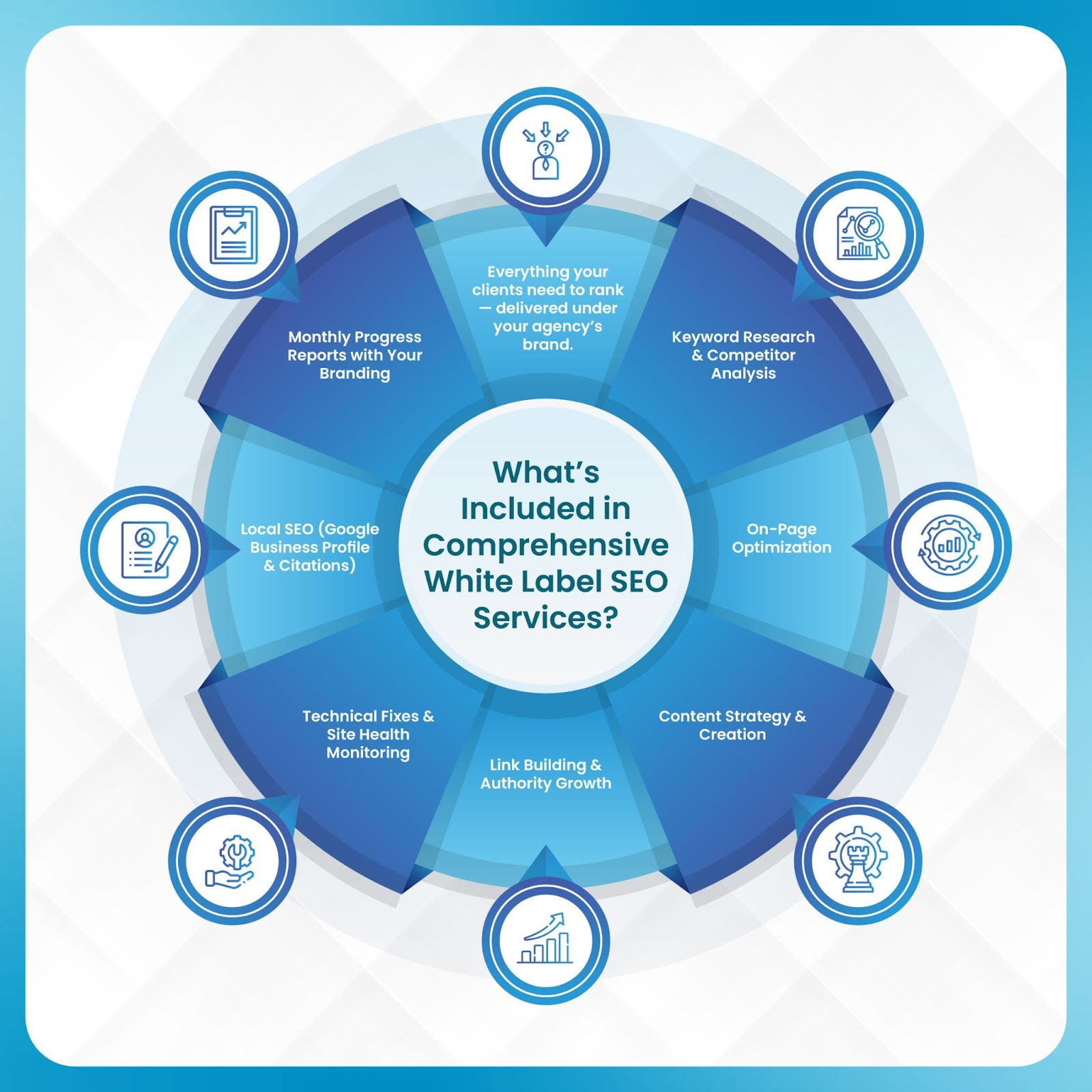
The fulfillment layer is the engine room of the campaign. This is where content creation, link building, technical SEO implementation, and on-page optimization take place. By offloading this layer to the best white label SEO services, agencies eliminate the need to manage writers, editors, and outreach specialists. The white label partner executes the roadmap defined by the strategy layer, turning concepts into tangible deliverables at scale without adding headcount to the agency.
3. Reporting Layer
The reporting layer involves gathering data and presenting it effectively. This includes tracking ranking updates, analyzing traffic insights, measuring ROI tracking, and handling dashboard automation. Many premium white label partners integrate directly with agency dashboards, meaning the reporting layer is updated automatically as fulfillment tasks are completed. This eliminates the end-of-month scramble and ensures clients always have access to accurate, professional performance metrics.
4. Communication Layer
The communication layer is how the agency interacts with the client. This involves providing client updates, summarizing performance metrics, and having strategic alignment discussions. Because the fulfillment and reporting layers are handled by the white label partner, agency account managers have significantly more time to focus purely on proactive communication. They shift from apologizing for delayed deliverables to discussing future growth opportunities.
White label SEO simplifies operations by centralizing the fulfillment layer and removing execution fragmentation.
This model solves major delivery bottlenecks because the white label partner brings their own optimized workforce. It eliminates workflow fragmentation because the partner uses standardized delivery systems. It solves resource instability by providing elastic capacity, and it ensures consistent turnaround times regardless of how many clients the agency signs. Agencies scale faster when fulfillment becomes a system instead of a collection of disconnected tasks.
With the SEO operations layer defining structure across strategy, fulfillment, reporting, and communication, the next challenge becomes execution at scale.
Eliminating Decision Fatigue in SEO Operations
Agencies waste scalability on repeated micro-decisions. Every time an employee asks what anchor text to use, which tool to run an audit through, or how to format a specific type of blog post, they are burning operational energy. Decision fatigue sets in rapidly when teams are forced to reinvent the wheel for every single client task.
White label SEO introduces rigorous standard operating procedures and standardized execution frameworks out of the box. Because a white label provider is built purely for scale, they have already mapped out every possible micro-decision in the fulfillment process. They do not rely on guesswork; they rely on strict procedural guidelines.
When an agency adopts this infrastructure, teams stop asking: “How do we do this?”
And start focusing on: “What needs to be delivered?”
By removing the burden of figuring out the "how," agency employees can redirect their cognitive energy toward strategy and client retention. They review deliverables against a known standard rather than managing the chaotic process of creation. Scaling fails when agencies scale decisions instead of systems. You cannot build a massive agency if every deliverable requires a committee meeting to determine the optimal approach. White label partnerships eliminate decision fatigue by turning SEO fulfillment into a predictable, measurable utility.
Standardizing Execution for Predictable SEO Delivery
Standardizing execution is the only way to achieve predictable delivery across dozens or hundreds of accounts. White label SEO providers utilize unified workflows for content production, technical SEO implementations, and complex link-building campaigns. They operate like factories, where raw inputs (keywords and strategy) are reliably transformed into high-quality outputs (published content and acquired links).
This rigid standardization removes delivery variation entirely. It does not matter if you send the white label team two tasks or two hundred tasks; the workflow remains identical, and the quality remains strictly controlled.
The impact of this standardization is massive. It guarantees predictable SEO outcomes because the work is executed perfectly according to best practices every time. Predictable outcomes lead to stronger client retention because clients are not experiencing wild swings in performance based on internal agency chaos. Furthermore, it guarantees a consistent turnaround time. Account managers can confidently tell clients exactly when a campaign will launch without worrying about internal bottlenecks or sick days derailing the timeline.
Simplifying Reporting into a Scalable System
Simplifying the reporting process transforms how an agency operates at the end of every month. Traditional agencies drown in manual data collection, pulling stats from multiple platforms into messy spreadsheets. White label SEO providers solve this by replacing manual reports with automated dashboards.
By implementing unified KPI frameworks, agencies ensure that every client is judged by the same foundational metrics. You no longer have custom reports for every account; you have a standardized view of traffic, rankings, and conversions. This creates a drastically reduced reporting workload for the internal team.
Reporting becomes infrastructure instead of a repetitive manual task. When reporting is automated and standardized, account managers simply log in, review the data, and prepare their strategic talking points for the client call. They are not building the report; they are analyzing it. This operational shift allows agencies to handle significantly more clients per account manager without sacrificing the quality of communication.
White Label SEO as Operational Infrastructure
It is crucial to understand that utilizing a white label SEO agency is not temporary outsourcing. It is not equivalent to hiring a few freelance support members to help out during a busy month. Outsourcing is often a band-aid applied to a broken system. White label SEO is a permanent structural upgrade.
White label SEO acts as a scalable fulfillment infrastructure. You are essentially plugging your agency into a massive, highly optimized machine that is specifically engineered to handle volume. You are integrating their standard operating procedures, their specialized software, and their labor force into your business model seamlessly.
Agencies scale by reducing operational friction, not by endlessly increasing headcount. When you hire internally to solve fulfillment problems, you increase HR burdens, management overhead, and payroll risk. When you adopt white-label infrastructure, you acquire infinite execution capacity that scales up or down based exactly on your current client load.
With execution, reporting, and decision-making systemized, agencies finally operate like scalable SEO systems instead of service-heavy production teams.
How DashClicks’ White Label SEO Services Support Operational Scalability?
When building a scalable SEO operation, utilizing an established platform like DashClicks provides a massive structural advantage. DashClicks offers comprehensive white label SEO management that integrates directly into an agency's existing workflow.
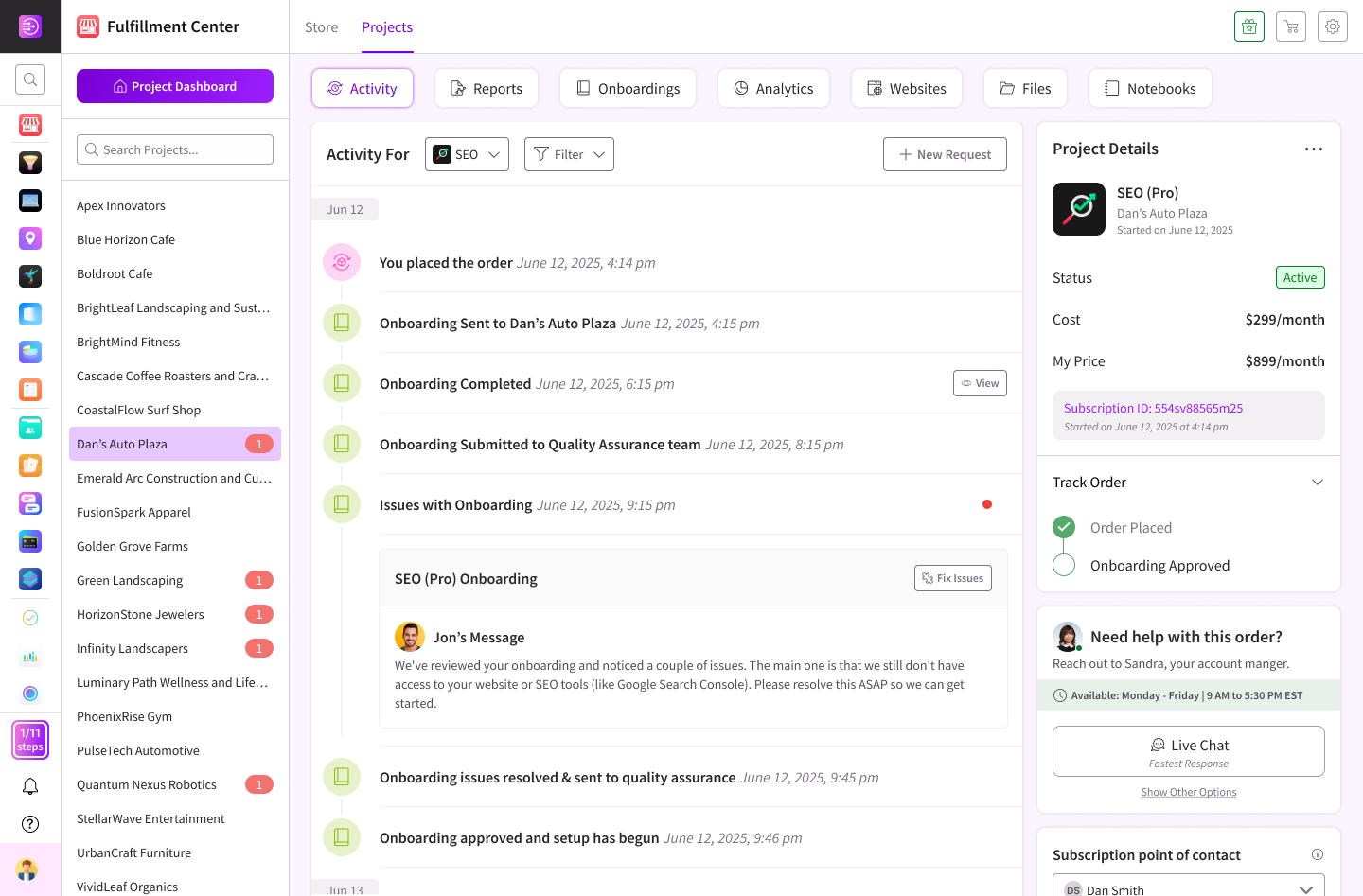
They provide robust content fulfillment, deep technical SEO support, and highly structured link-building systems. Rather than managing disparate teams, an agency can route all fulfillment through this single hub. Furthermore, the platform offers automated reporting dashboards that eliminate the manual data gathering process entirely, ensuring clients have real-time access to their campaign metrics.
By enforcing workflow standardization across all campaigns, the platform functions as a scalable execution infrastructure. DashClicks functions as a centralized SEO operations layer that helps agencies scale delivery consistency without increasing operational fragmentation. You get the exact standardized processes needed to eliminate decision fatigue and QA bottlenecks, allowing your internal team to focus on strategy and account growth.
Conclusion
Scaling an SEO agency is fundamentally an operational problem, not a talent problem. Hiring more specialists to navigate a broken, fragmented system will only amplify your internal chaos. True growth requires systems that can handle volume without sacrificing quality.
Implementing white label SEO enables structured fulfillment, predictable delivery, and scalable execution. By removing the burden of daily task management and manual reporting, your team can focus exclusively on strategy and client relationships. Operational simplicity drives profitability more than team expansion. When your internal costs remain stable, but your capacity to deliver expands, your margins naturally improve.
The agencies that win in SEO are not those doing more work. They are the ones engineering less operational friction through scalable systems.


.svg)


.svg)
.svg)
.svg)
.svg)
.svg)