

.svg)

.svg)
.svg)
.svg)
.svg)
.svg)
SEO rarely fails because of one catastrophic mistake. Rankings decline, traffic drops, and client confidence erodes gradually as small, overlooked issues accumulate over time. A missing meta description, a broken internal link, or an outdated page that no longer matches search intent may seem minor individually, but together they can significantly reduce a website's search visibility.
For agencies managing multiple client accounts, routine SEO maintenance often becomes harder as workloads grow. Content updates get delayed, technical fixes are deprioritized, and small issues remain unnoticed. Yet organic search continues to drive approximately 53.3% of all trackable website traffic, according to BrightEdge, making consistent SEO maintenance essential for long-term performance.
The challenge is rarely a lack of SEO expertise. It is maintaining the operational capacity to monitor, identify, and resolve issues consistently across every client account. A reliable white label SEO service provider helps agencies scale proactive SEO maintenance without immediately expanding their internal team. By leveraging white label support, agencies can increase fulfillment capacity while staying focused on strategy and client relationships.
This blog explores the small SEO issues agencies often overlook, how they grow into larger performance problems, why preventive maintenance becomes difficult at scale, and how white label fulfillment helps keep client campaigns healthy over the long term.
Why Small SEO Problems Often Go Unnoticed?
Many SEO issues develop quietly and do not cause an immediate ranking decline. There is no alert, no sudden traffic drop, and no client complaint. The problem simply exists, grows, and compounds over time before anyone realizes it has been affecting performance.
Agencies commonly overlook minor issues for several interconnected reasons:
- SEO improvements and declines happen gradually, making short-term changes easy to dismiss.
- Many problems do not trigger an immediate performance warning that would prompt investigation.
- Teams prioritize urgent client requests over recurring maintenance tasks.
- Multiple specialists handle different areas of SEO, and no single person sees the full picture.
- Ownership of recurring checks is often unclear, particularly across larger teams.
- Manual processes make routine monitoring inconsistent and easy to skip during busy periods.
- Reporting tends to focus on rankings while technical issues develop in the background.
Consider what this looks like in practice. An account manager is managing six client campaigns simultaneously. A content specialist is working on three blog posts with a Friday deadline. A technical specialist is resolving a crawl issue flagged by a client. In this environment, routine checks for missing meta descriptions, broken internal links, incorrect canonical tags, slow-loading images, outdated content, unoptimized headings, schema errors, duplicate metadata, or orphan pages get deprioritized.
Each of these issues may appear minor in isolation. A single orphan page is not going to collapse a domain's rankings. Duplicate metadata on two product pages is unlikely to cause an immediate traffic drop. But when no one owns the responsibility for identifying and resolving these issues, they accumulate. That is when minor problems begin to affect performance.
Individually, these issues may seem harmless. Collectively, they can significantly reduce a website's search performance over time.
How Small SEO Issues Turn Into Major Client Problems?
Minor SEO problems usually follow a predictable progression. What begins as a small oversight eventually compounds into a visible performance decline. Understanding this progression helps agencies recognize why early detection matters so much.
1. Technical Debt Builds Over Time
Unresolved technical issues accumulate in layers. Crawl errors increase as internal links break or redirect incorrectly. Redirect chains become longer as site structures change without proper cleanup. Indexation problems spread when robots.txt errors or misconfigured canonical tags prevent important pages from being discovered. Duplicate URLs multiply across pagination, URL parameters, and session-based variations. Site architecture becomes harder to manage as new content is added without updating internal linking. The overall technical health of the website gradually declines.
Technical debt makes future optimization slower and more expensive. What might have taken one hour to fix in the early stages can require significantly more time and effort once the issues have compounded.
2. Rankings Slowly Decline
Keyword positions begin slipping before most teams notice. Search impressions fall. Click-through rate declines as pages lose positioning. Commercial pages lose visibility to competitors who are actively maintaining their SEO. Competing domains that were previously behind the client begin gaining ground.
Ranking declines may appear gradual at first, which makes them easy to dismiss as seasonal variation or algorithm noise. By the time the trend becomes undeniable, the recovery timeline has already extended significantly.
3. Organic Traffic Drops
Reduced rankings and lower visibility translate directly into fewer visitors. Organic sessions decline. Service pages receive less traffic. Branded and non-branded discovery both suffer. For clients with local service areas, local search visibility may drop as well, reducing calls and direction requests from nearby prospects.
4. Leads and Revenue Are Affected
Once traffic declines, business outcomes follow. Form submissions decrease. Phone calls are slow. Bookings, ecommerce sales, assisted conversions, and revenue contribution all reflect the upstream SEO problems that were never resolved. Once business outcomes decline, the agency becomes accountable in the client's eyes, regardless of what caused the original issue.
Google's Search Essentials documentation consistently emphasizes the importance of maintaining crawlability, technical accessibility, and high-quality content for sustainable search visibility. While this does not guarantee specific rankings, it reinforces the value of ongoing maintenance as a foundation for consistent performance.
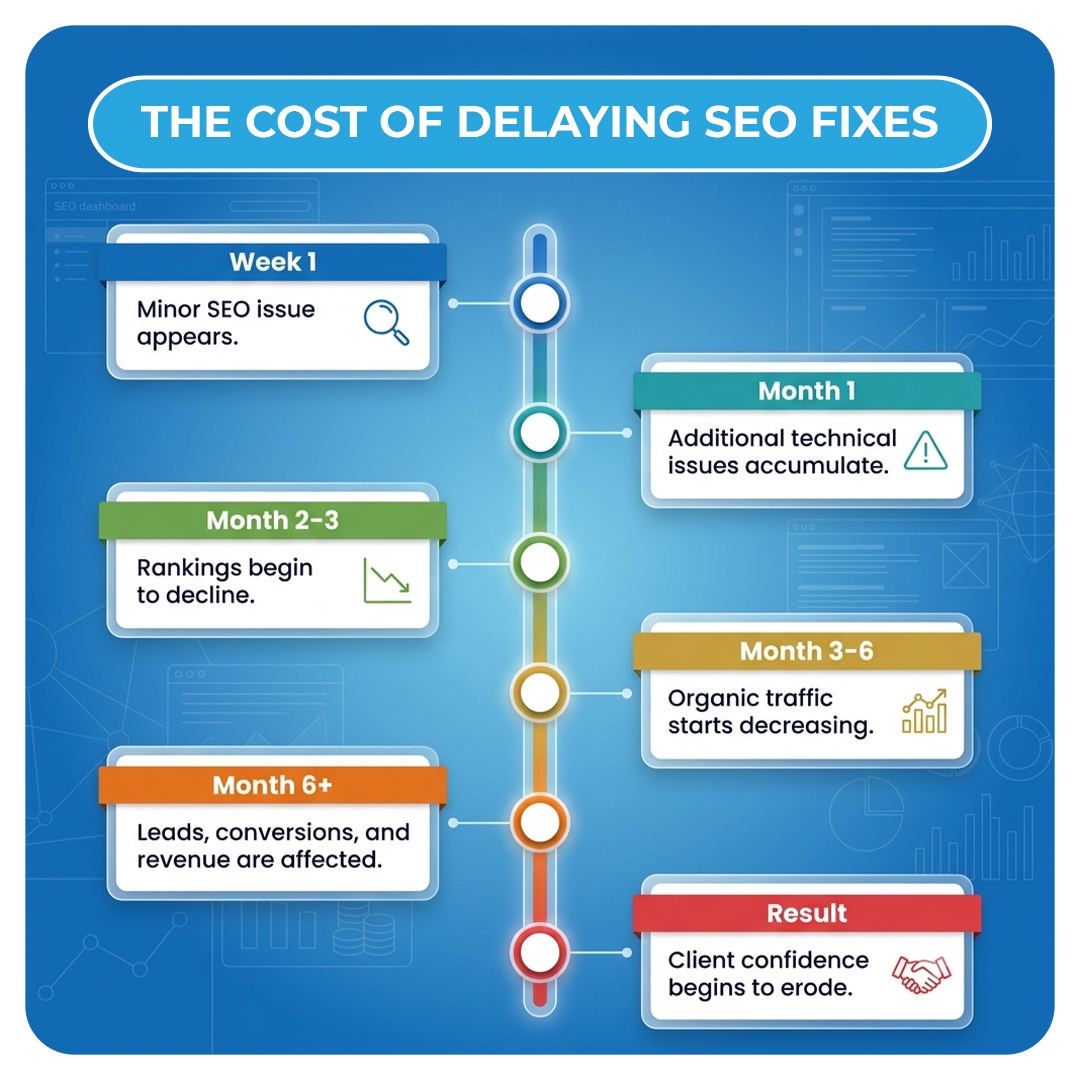
Fortunately, most of these problems are preventable when agencies adopt a proactive SEO management approach.
Common SEO Issues Agencies Should Catch Early
Prevention starts with knowing which recurring issues deserve regular attention. The following categories represent the areas where minor problems most frequently develop unnoticed.
1. Technical SEO
Technical SEO issues are among the most damaging because they affect how search engines crawl and index an entire website. Agencies should monitor regularly for:
- Broken links and 404 errors
- Redirect loops and unnecessary redirect chains
- Crawl errors appearing in Google Search Console
- XML sitemap issues, including outdated or excluded URLs
- Robots.txt mistakes that block important pages
- Duplicate pages created by URL parameters or CMS settings
- Incorrect canonical tags that misdirect search engine authority
- Indexation problems that prevent pages from appearing in search results
2. On-Page SEO
On-page SEO issues affect how well individual pages communicate their relevance to search engines. Key areas to review include:
- Missing or poorly written title tags
- Duplicate metadata across multiple pages
- Poor heading structure that lacks logical hierarchy
- Thin pages with insufficient content depth
- Keyword cannibalization where multiple pages compete for the same terms
- Weak internal linking that fails to distribute page authority
- Unoptimized images without descriptive alt text or appropriate file sizes
3. Content
Content degrades over time if left unmanaged. Common content issues include:
- Outdated statistics and references that reduce credibility
- Declining topical relevance as industry language evolves
- Missing internal links to newer related content
- Orphan pages that receive no internal links and minimal traffic
- Old offers or discontinued services still appearing on live pages
- Content that no longer matches current search intent for its target keywords
4. Local SEO
For clients who depend on local search visibility, consistency across platforms is critical. Agencies should routinely review:
- Google Business Profile inconsistencies across categories, descriptions, and attributes
- Citation inaccuracies across business directories
- NAP (name, address, phone number) inconsistencies across the web
- Incorrect business hours, particularly after seasonal changes
- Outdated service information on the business profile
- Unanswered reviews where engagement is appropriate
5. Performance
Technical performance directly affects user experience and search engine quality signals. Core areas to monitor include:
- Slow Core Web Vitals scores, particularly Largest Contentful Paint and Interaction to Next Paint
- Oversized images that slow page load times
- JavaScript rendering issues that delay content visibility
- Poor mobile usability across key landing pages
- Cumulative Layout Shift problems that disrupt the user experience
- Slow-loading landing pages that increase bounce rates
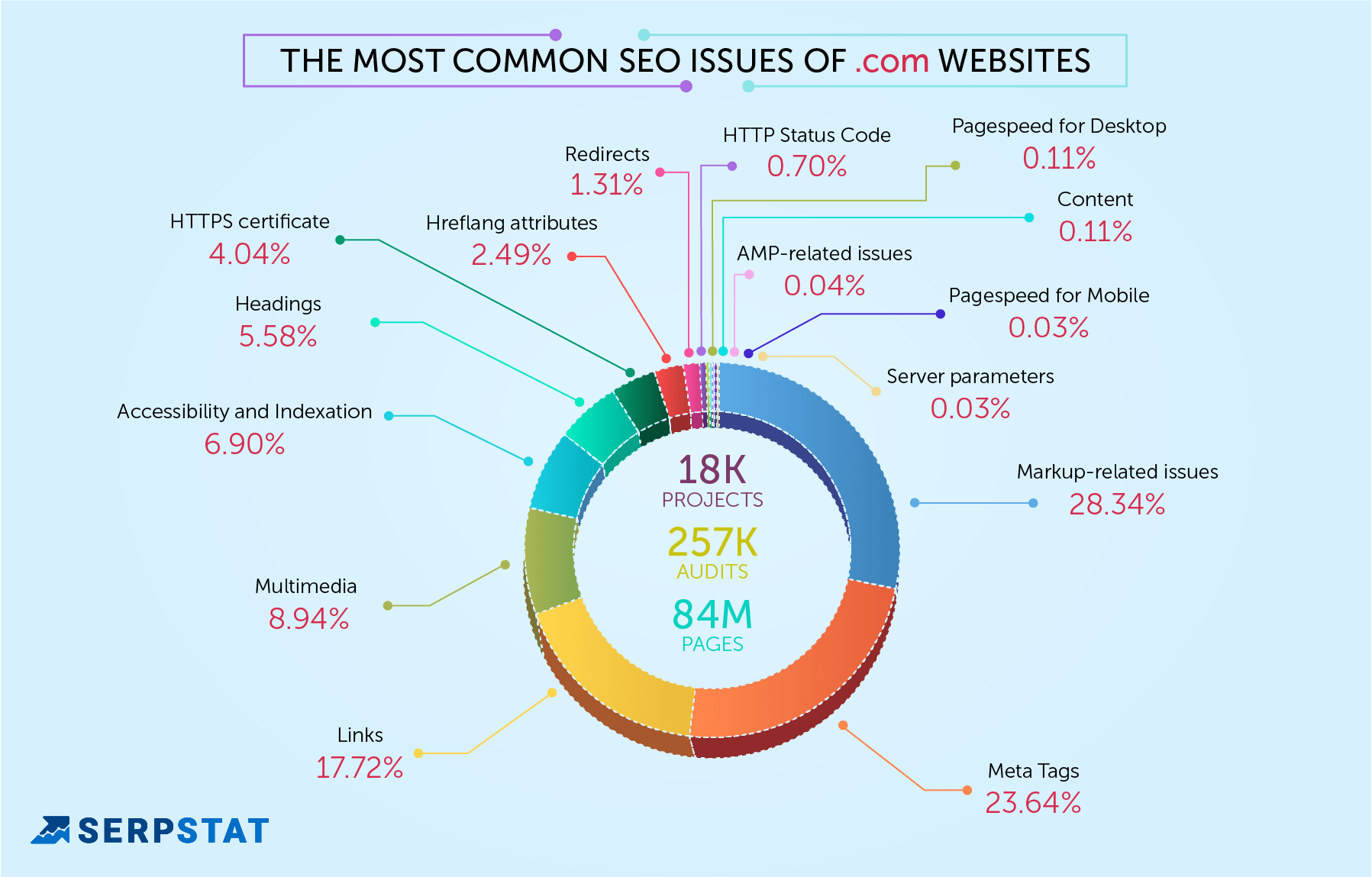
Image Source: Serpstat
Google's Core Web Vitals remain part of its page experience signals, reinforcing the value of maintaining fast and user-friendly websites. Core Web Vitals should be viewed as part of overall website quality rather than a standalone ranking guarantee.
Catching these issues early requires more than occasional SEO audits. It requires consistent operational discipline.
Why Agencies Struggle to Stay Ahead of SEO Issues?
Most agencies understand preventive SEO in theory but struggle to execute it consistently at scale. The gap between knowing what should be done and actually doing it across every client account is largely an operational problem, not a knowledge problem.
Operational realities that create this gap include:
- Growing client portfolios that increase the volume of recurring tasks
- Limited specialist bandwidth across technical, content, and on-page teams
- Competing priorities that push maintenance behind urgent deliverables
- Manual QA processes that are time-consuming and prone to inconsistency
- Reactive workflows where the loudest problem always gets addressed first
- Employee turnover that disrupts institutional knowledge and ongoing processes
- Inconsistent SOPs that produce variable quality across team members
- Delayed reporting that surfaces issues only after they have affected performance
- Unclear ownership of recurring tasks, particularly for cross-functional checks
- Excessive context switching that reduces focus and throughput across accounts
The result is a compounding cycle:
More Clients → More Recurring Tasks → Less Time for Maintenance → More Unnoticed Issues → More Emergency Fixes
Reactive workflows reduce profitability because urgent work consumes more time and attention than planned maintenance. Emergency fixes require triage, rapid diagnosis, client communication, and expedited execution. Preventive maintenance, by contrast, is predictable, efficient, and far less disruptive to operations.
Agencies do not necessarily lack SEO knowledge. They often lack the operational capacity to apply that knowledge consistently across every account.
This is where operational consistency becomes a competitive advantage rather than simply an internal process improvement.
How White Label SEO Creates a Preventive SEO System?
A white label SEO firm is not simply a source of one-off deliverables. It is an operational partner that helps agencies build preventive maintenance into a repeatable, scalable process. The goal is to shift from reacting to visible problems to maintaining a structured system that identifies and resolves issues earlier.
1. Continuous Website Monitoring
Preventive SEO starts with knowing what is happening across every client website on a regular basis. Recurring monitoring should include regular site health checks, crawl monitoring to detect new errors, indexation reviews to confirm key pages remain accessible, ranking trend analysis to identify early movement, performance checks against Core Web Vitals benchmarks, and alert-based issue detection that flags problems before they affect traffic.
2. Routine Technical Maintenance
Recurring technical maintenance reduces the accumulation of technical debt over time. This includes monitoring and resolving broken links, managing redirect structures, maintaining crawlability, reviewing indexation, keeping XML sitemaps accurate and current, reviewing robots.txt for unintended blocks, validating schema markup, and confirming that canonical tags are correctly implemented. Regular maintenance prevents small technical issues from layering into larger structural problems.
3. Ongoing On-Page Optimization
On-page SEO requires continuous attention as content ages and search intent evolves. Ongoing optimization activities include metadata improvements across title tags and descriptions, internal linking updates as new content is published, heading structure optimization, content refreshes for pages with declining performance, image optimization for both accessibility and load speed, alignment with current search intent, and cannibalization reviews to ensure multiple pages are not competing for the same queries.
4. Regular Performance Reviews
Monthly snapshots provide limited context. Performance reviews should track ranking movements across target keywords over time, organic traffic trends at both domain and page levels, conversion performance for key landing pages, technical health scores from regular site audits, page-level engagement data, and lead quality where measurable within the client's attribution setup. Trends matter more than isolated monthly snapshots.
5. Consistent Reporting
Standardized reporting helps agencies surface issues early, explain the work that has been completed, show progress clearly across tracked metrics, recommend next actions before problems escalate, and address risks proactively before clients raise concerns. When reporting is consistent, agencies demonstrate control over the campaign rather than reacting to the client's observations.
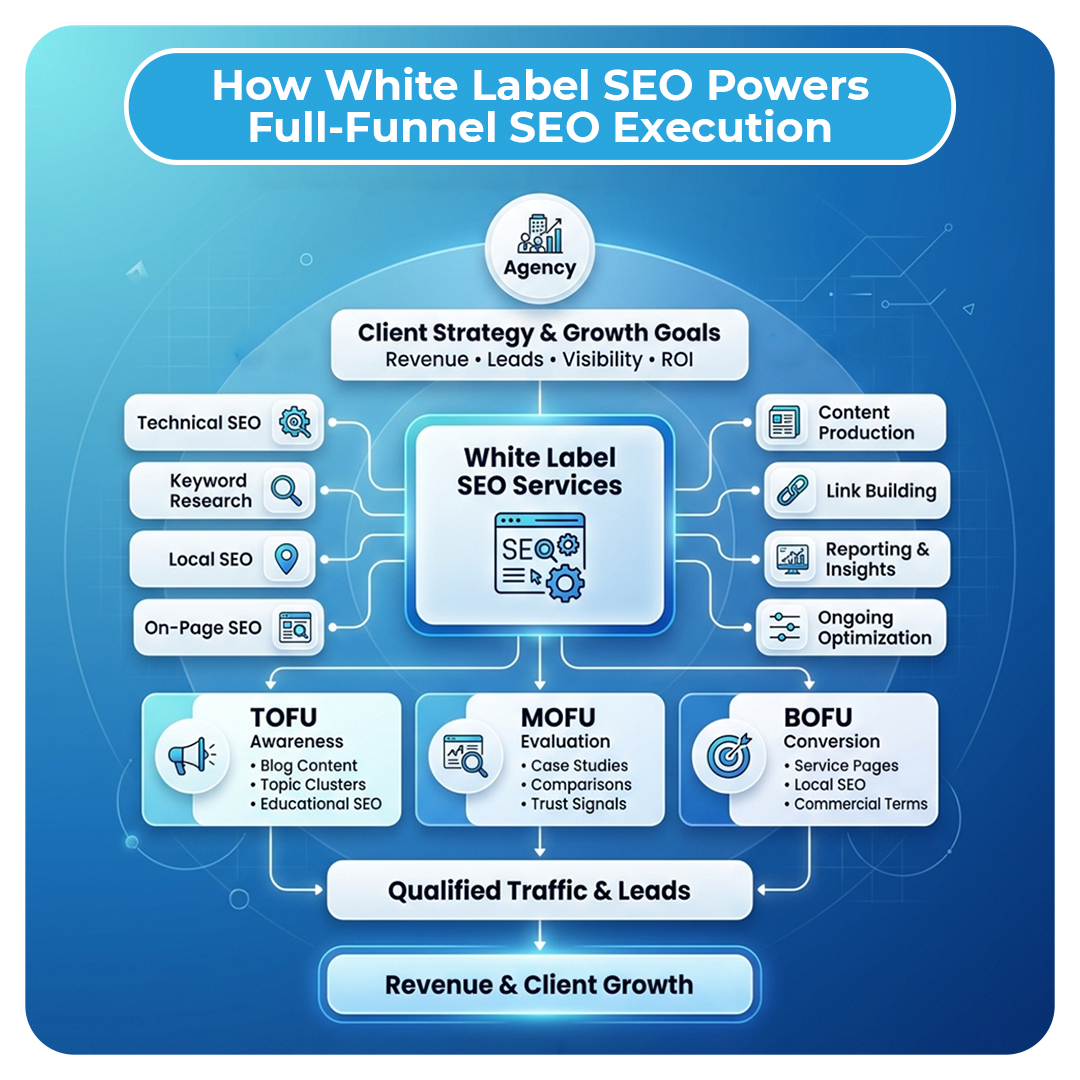
Preventive SEO works when monitoring, maintenance, optimization, and reporting operate as one connected system.
Prevention is only effective when every recurring SEO activity follows a structured process.
Operational Habits That Keep Small SEO Issues From Escalating
Preventive SEO depends on operational habits as much as technical expertise. Even the best fulfillment partner cannot compensate for internal processes that are inconsistent, undocumented, or poorly maintained.
The following habits improve consistency across a growing client portfolio:
- Monthly technical SEO audit to identify new issues before they compound
- Standardized SEO QA checklists applied consistently across all accounts
- Content update schedules that ensure pages are reviewed and refreshed regularly
- Internal documentation that captures campaign history, decisions, and ongoing tasks
- Defined ownership for every recurring SEO task so nothing falls through the cracks
- Automated monitoring tools that reduce reliance on manual spot checks
- Routine client reporting on a consistent schedule that reflects completed work and upcoming priorities
- Regular strategy reviews to ensure campaign direction remains aligned with client goals
- Centralized campaign notes accessible to all team members working on an account
- Escalation processes for urgent issues so they receive appropriate attention without disrupting planned work
Together, these habits form what can be described as the SEO Prevention Flywheel:
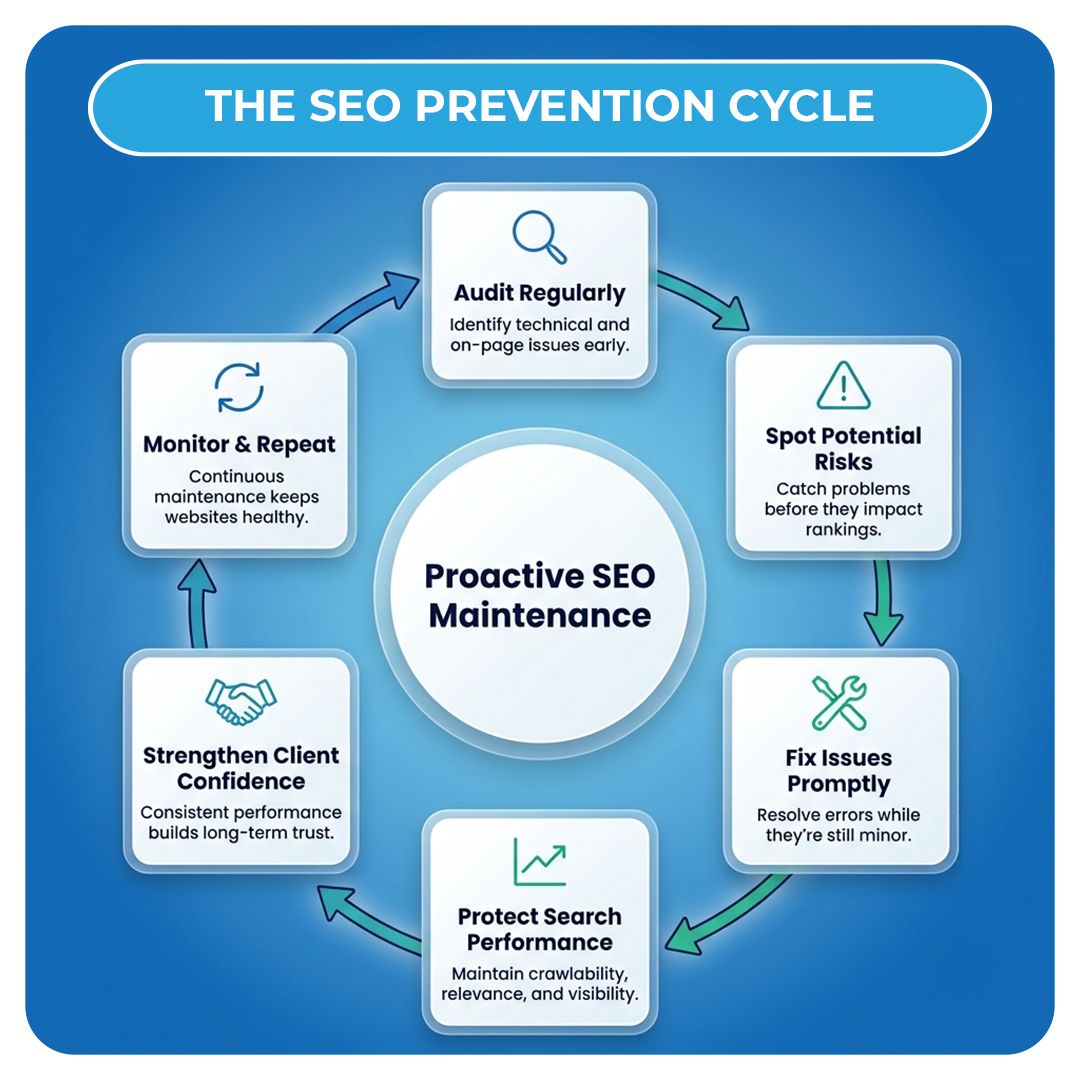
Every stage of the flywheel supports the next. Consistent monitoring leads to earlier detection. Earlier detection leads to faster resolution. Faster resolution maintains rankings and strengthens client trust. Stronger trust reduces the pressure that comes with reactive, emergency-driven work. Over time, the flywheel reduces both operational stress and client risk. The system becomes self-reinforcing.
The goal is not to eliminate every SEO issue permanently. The goal is to detect and resolve problems before they affect business outcomes.
Many agencies have these processes documented, but maintaining them consistently becomes more difficult as the client roster grows.
When Should Agencies Consider White Label SEO Support?
Agencies should not wait until fulfillment breaks down before expanding capacity. By the time delivery quality is visibly suffering, client relationships are already at risk, and team members are already stretched.
Common operational signals that indicate the need for additional support include:
- SEO specialists are consistently overloaded and unable to complete planned tasks on schedule.
- Technical issues remain unresolved for weeks due to bandwidth constraints.
- Website audits have become infrequent because there is no time to conduct them properly.
- Clients are identifying ranking declines before the agency does.
- Reporting consumes excessive specialist time that should be spent on execution.
- Quality varies significantly between team members or between accounts.
- New client onboarding delays work on existing accounts.
- Content refreshes are repeatedly postponed in favor of urgent tasks.
- Account managers spend more time firefighting than planning ahead.
These are capacity warnings, not isolated team failures. Recognizing them early allows agencies to expand fulfillment proactively rather than reactively.
Engaging a white label partner does not mean surrendering control. Agencies continue owning strategy, client communication, expectation-setting, and relationship management. The fulfillment partner supports recurring execution and specialist tasks behind the agency's brand.
The right white label partner does not simply complete SEO tasks. It helps agencies build a proactive maintenance system that prevents issues from recurring.
How DashClicks Helps Agencies Stay Ahead of SEO Issues?
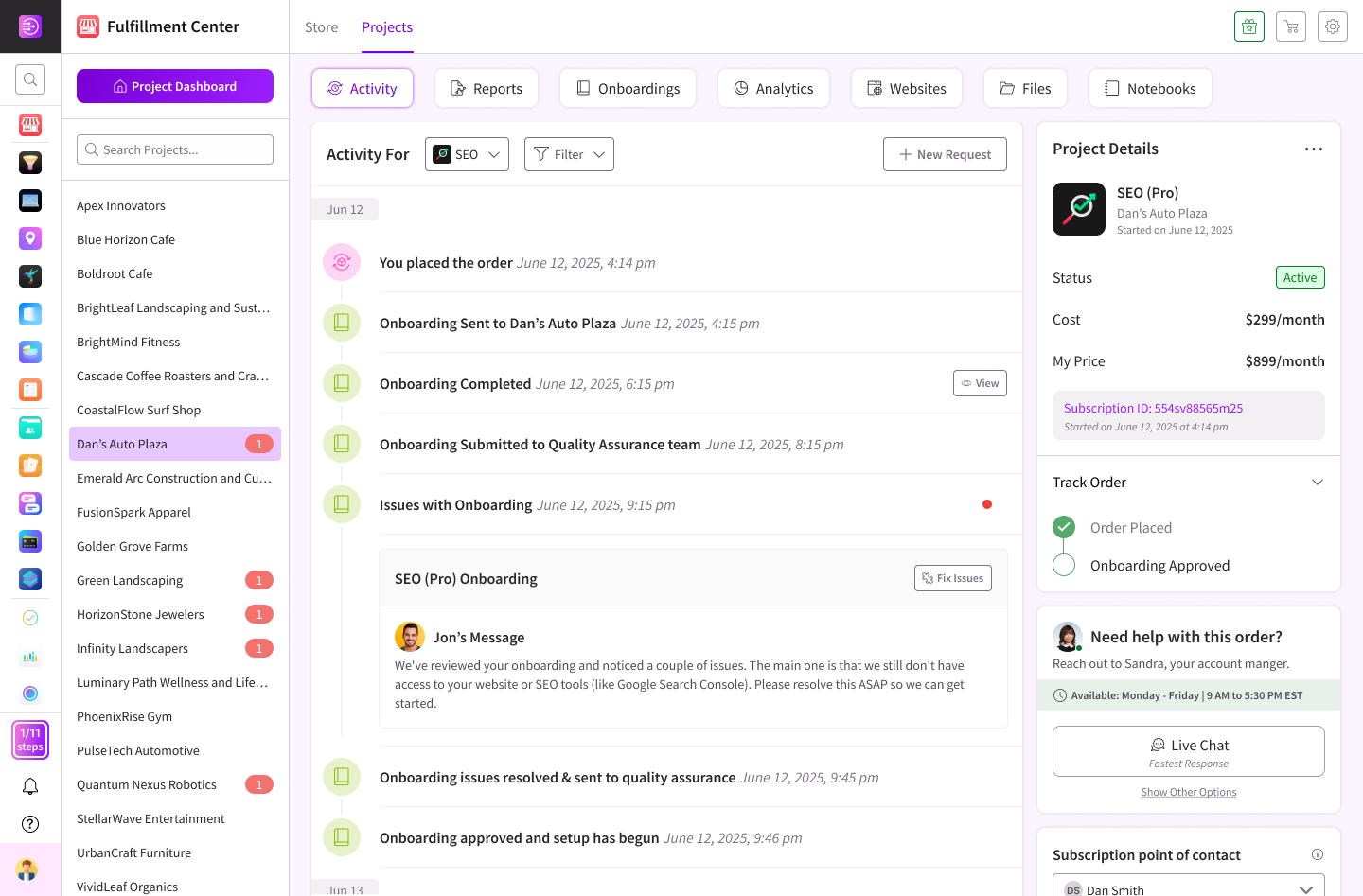
DashClicks functions as a white label SEO service provider that helps agencies move from reactive SEO management to proactive, structured maintenance. The focus is on building consistent delivery systems that protect client performance over time.
- White Label SEO Fulfillment: Recurring SEO execution is delivered behind the agency's brand. Work is completed under the agency's identity, allowing agencies to maintain client relationships while expanding their operational capacity through an experienced team.
- Ongoing Technical SEO Monitoring: Technical site health monitoring includes regular audits, technical issue identification, crawlability checks, indexation reviews, and routine maintenance. This helps agencies surface and resolve technical problems before they affect rankings or client outcomes.
- On-Page and Content Optimization: On-page support includes metadata improvements, internal linking updates, content refreshes, search intent alignment, and broader on-page optimization. These activities keep client pages relevant and properly structured as search behavior evolves.
- Local SEO Management: For clients who depend on local visibility, support includes Google Business Profile consistency, citation accuracy, local optimization, and location-based visibility.
- White Label Reporting: Standardized white label reporting helps agencies communicate completed work clearly, identify issues early, show progress across tracked metrics, and recommend next actions. Consistent reporting reduces the risk that clients discover problems before the agency does.
- Scalable Fulfillment for Growing Agencies: DashClicks provides experienced SEO specialists who follow standardized workflows across client accounts. This helps agencies increase fulfillment capacity, maintain consistent quality, reduce delivery bottlenecks, onboard new clients more smoothly, and preserve internal time for strategy and client management.
DashClicks helps agencies shift from reacting to visible SEO problems to maintaining a structured system that identifies and resolves issues earlier.
Ultimately, proactive SEO is not about fixing more problems. It is about building systems that prevent minor issues from becoming major client concerns.
Small Problems, Left Unmanaged, Become Large Ones
Small SEO issues rarely stay small. Broken links, outdated content, crawl errors, weak metadata, and slow pages can each seem insignificant in isolation. Left unresolved across multiple client accounts over time, they accumulate into performance declines that are harder to reverse and more costly to address.
Preventive SEO creates better client outcomes, fewer operational emergencies, and stronger long-term retention. It requires consistent monitoring, routine maintenance, structured QA, clear internal documentation, and regular reporting. Each of these activities is straightforward individually. Maintaining all of them consistently across a growing client portfolio is where most agencies face real operational pressure.
Building these systems internally is achievable. Sustaining them at scale without additional capacity is not always practical. A dependable provider gives agencies the operational bandwidth and standardized execution they need to maintain consistent delivery without requiring immediate internal expansion. White labeling SEO allows agencies to retain ownership of strategy and client relationships while improving the consistency and depth of their fulfillment.
Investing in preventive systems now reduces the volume of reactive work later. Proactive operations protect client rankings, strengthen trust, and support more sustainable agency growth over time.


.svg)


.svg)
.svg)
.svg)
.svg)
.svg)