

.svg)

.svg)
.svg)
.svg)
.svg)
.svg)
Most agencies focus on growth through new client acquisition, but one of the biggest revenue opportunities often lies within existing client relationships. Clients who already trust your agency are easier to retain, more likely to purchase additional services, and require far less effort to convert than new prospects. According to research, acquiring a new customer costs 5 to 25 times more than retaining an existing one, while existing customers spend 67% more on average.
This is where white label SEO services become a practical growth strategy. SEO remains one of the most sought-after digital marketing services, yet many agencies hesitate to offer it because they lack the internal expertise or capacity. White label SEO outsourcing enables agencies to provide high-quality SEO under their own brand without building an in-house team.
For agencies already managing websites, paid advertising, or content marketing, SEO is a natural extension of existing services. It helps increase monthly retainers, strengthens client relationships, and creates long-term value for both the agency and its clients.
In this blog, we'll explore why expanding existing client accounts is more profitable than constantly pursuing new business, when to introduce SEO opportunities, how a white label SEO agency supports scalable growth, and how agencies can build SEO into long-term client growth strategies.
Why Growing Existing Client Accounts Is More Profitable Than Constantly Chasing New Business?
Relying on new client acquisition to fuel agency growth is expensive, unpredictable, and unsustainable over time. Understanding the difference between acquisition-led growth and expansion-led growth helps agencies make smarter decisions about where to invest their energy.
1. Revenue Growth Through Acquisition
New client acquisition requires constant effort. The process typically involves:
- Ongoing Prospecting: Lead generation, outreach, and follow-up consume significant agency resources.
- Higher Acquisition Costs: Sales, marketing, and onboarding expenses reduce margin on new accounts.
- Longer Sales Cycles: Cold prospects take time to build trust before committing to a retainer.
The result is unpredictable revenue and a growth model that requires continuous investment just to stay in place.
2. Revenue Growth Through Account Expansion
Expanding existing accounts is a fundamentally different exercise. Key advantages include:
- Established Trust: Existing clients have already seen your agency deliver results.
- Easier Sales Conversations: Introducing a new service to a current client rarely requires a full sales process.
- Higher Recurring Revenue: Multi-service clients typically invest more per month than single-service clients.
- Better Retention: The more services a client relies on your agency for, the less likely they are to leave.
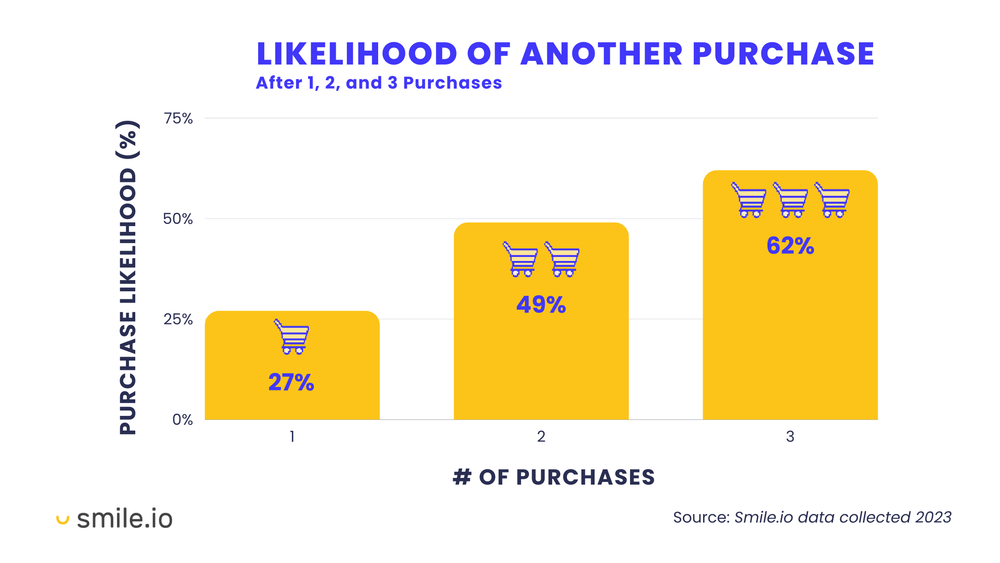
Image Source: Smile.io
These dynamics directly improve two of the most important agency metrics: Monthly Recurring Revenue (MRR) and Client Lifetime Value (LTV). When MRR grows through expansion rather than only acquisition, agencies build more predictable revenue streams that are easier to forecast and manage.
The most successful agencies don't choose between acquisition and expansion. They balance both growth strategies, using new client wins to build their base while consistently expanding relationships within their existing client roster.
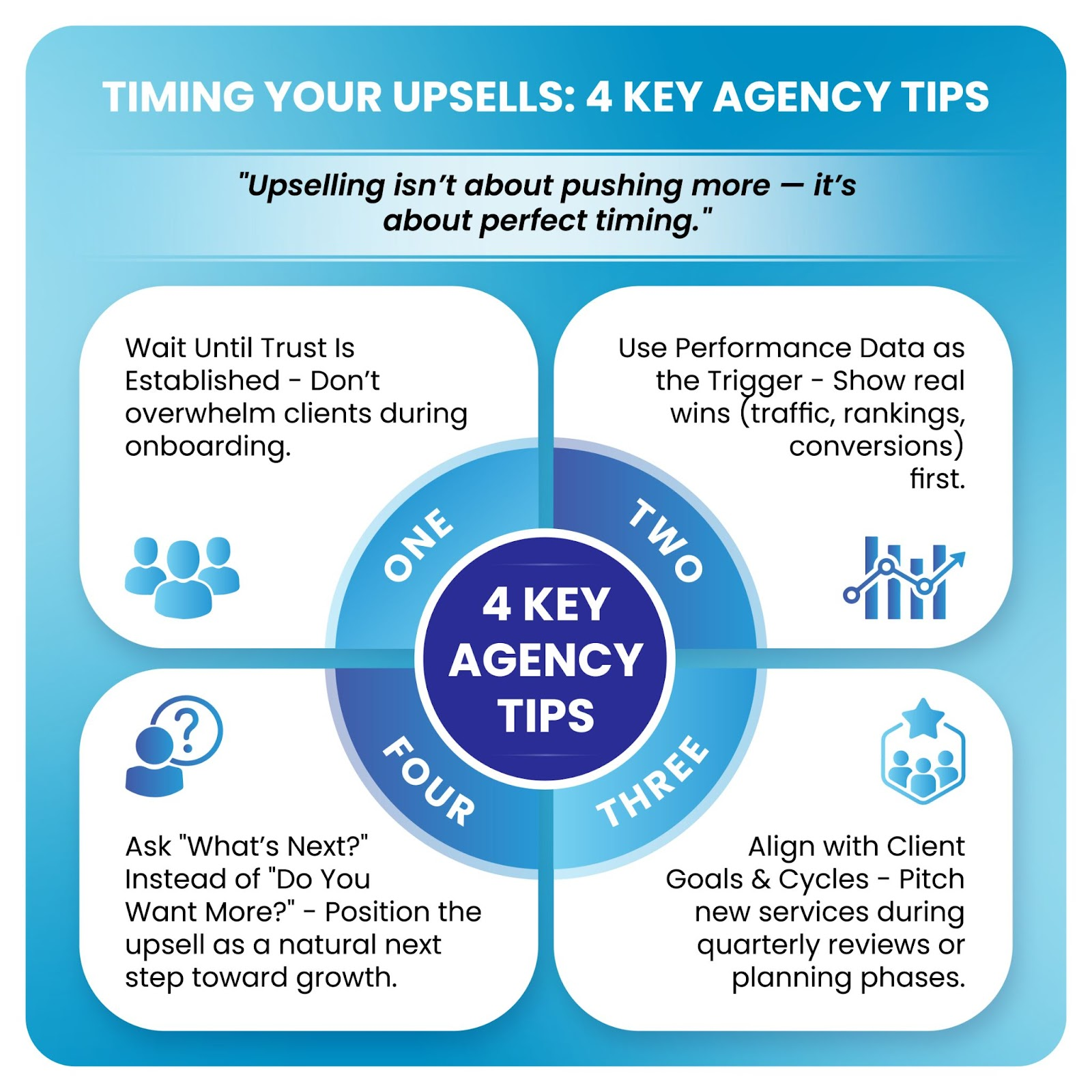
Expanding client accounts successfully depends on introducing new services at the right time.
Further Reading: 11 Killer Strategies to Generate More Revenue from Existing Customers
Recognizing the Right Time to Introduce SEO to Existing Clients
SEO is not a service that should be pitched to every client at every stage of a relationship. It works best when it solves a problem the client is already experiencing or aligns with a goal they're already pursuing.
Timing often determines whether an SEO upsell feels helpful or sales-driven. The key is recognizing the buying signals that indicate genuine readiness.
Situations where SEO introduction tends to work well include:
- A client launches a new website: Post-launch is a natural moment to discuss technical SEO and on-page optimization.
- PPC campaigns perform well, but organic visibility is weak: Clients who see strong paid results often become curious about building organic traffic to reduce long-term ad spend.
- Local competitors dominate search results: When a client can see competitors outranking them in local search, the conversation about local SEO practically opens itself.
- A client asks about long-term lead generation: This question is often a direct signal that they're thinking beyond paid advertising.
- Website traffic plateaus: Stagnant traffic is a clear indicator that current efforts aren't driving growth, creating an opening to discuss keyword research and content optimization.
- Seasonal growth planning: Budget reviews and growth planning conversations are ideal moments to introduce search rankings as a strategic priority.
- Expansion into new markets: Clients entering new geographic areas or targeting new audiences often need SEO support to quickly establish visibility.
Account managers who listen carefully to client conversations will find these signals appear regularly. The goal isn't to force SEO into every account. It's to recognize when SEO genuinely addresses something the client already cares about.
Once agencies recognize the right opportunity, SEO naturally becomes part of a broader client relationship.
How White Label SEO Turns Single-Service Clients Into Multi-Service Partnerships?
One of the most effective ways to think about account expansion is as a natural service progression rather than a series of individual upsells. When agencies introduce services in a logical sequence, clients experience each addition as a continuation of ongoing work rather than a separate pitch.
A practical example of how this progression works:
Website Design → Technical SEO → Content Optimization → Local SEO → Ongoing SEO Management
Each phase in this workflow builds on the previous one and creates a foundation for the next. A client who invests in a new website is already a strong candidate for technical SEO. A client receiving ongoing SEO management is a natural fit for content optimization and local SEO support.
This approach delivers clear benefits:
- Higher Retainers: Multi-phase relationships generate more monthly recurring revenue than single-service accounts.
- Stronger Relationships: Agencies that support clients across multiple areas become harder to replace.
- Reduced Churn: Clients with deeper service dependencies are significantly less likely to switch providers.
- Greater Strategic Value: Agencies shift from vendor to growth partner, a position that commands more trust and more budget.
White label SEO outsourcing makes this progression practical because agencies don't need to build internal SEO capacity from scratch before introducing each phase. Fulfillment is handled externally, while the agency maintains the client relationship.
Many agencies already have ideal expansion opportunities sitting inside their existing client list.
The Best Cross-Selling Opportunities for White Label SEO
For agencies that already provide other digital marketing services, SEO fits naturally alongside nearly every existing offering. The table below outlines common cross-selling opportunities:
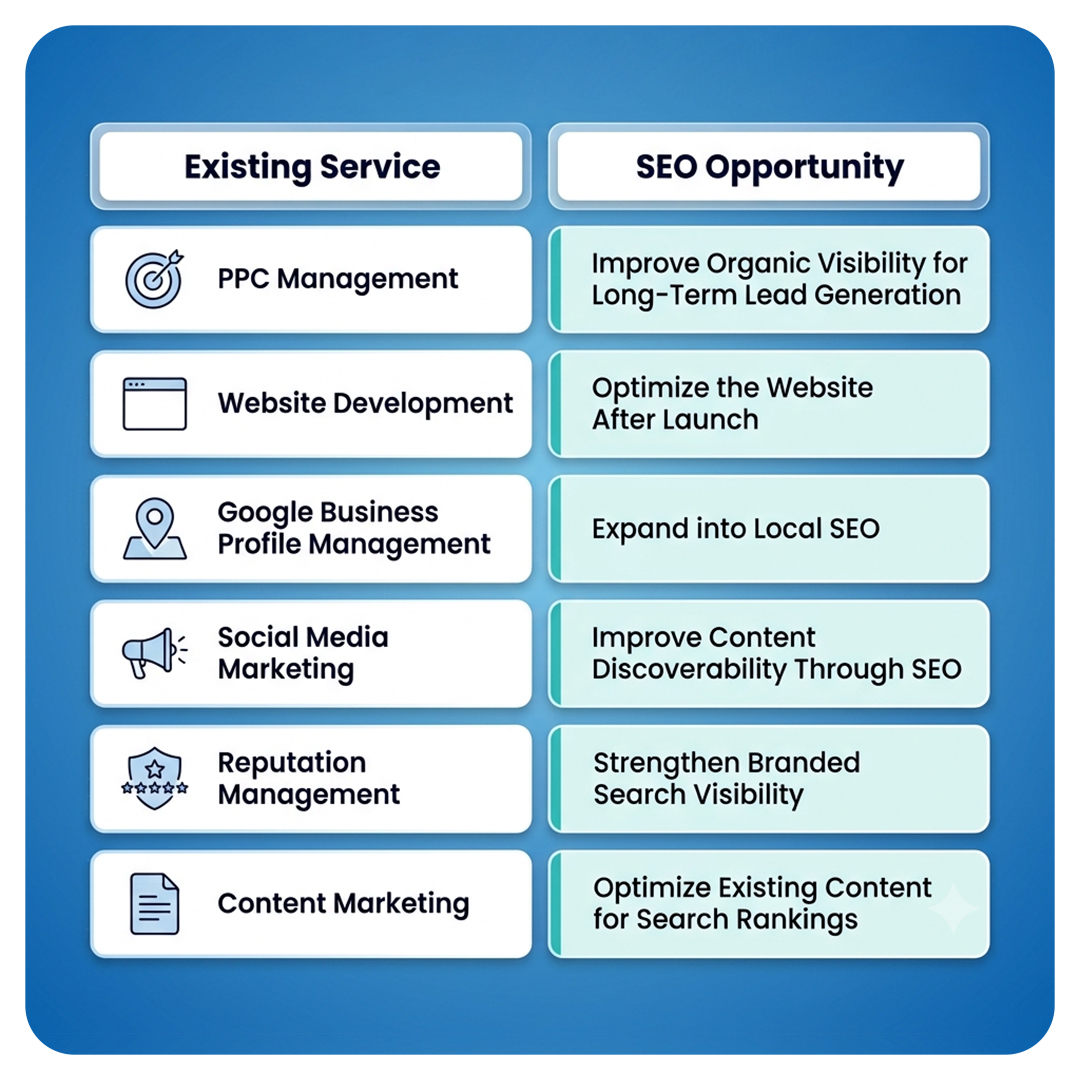
SEO complements existing marketing services rather than competing with them. A client running PPC campaigns benefits from stronger organic traffic because it reduces cost-per-acquisition over time. A client investing in content marketing gets more value from that content when it's optimized for search.
The most effective way to position SEO to existing clients is as an investment that strengthens what they're already doing, not as a replacement for any current strategy.
Despite these opportunities, many agencies struggle to introduce SEO because of operational limitations.
Common Operational Challenges That Prevent Agencies From Expanding Existing Accounts
Demand for SEO services is rarely the problem. Most agency clients would benefit from stronger organic visibility. The real barrier is usually internal.
Common operational challenges that prevent agencies from expanding into SEO include:
- Limited In-house SEO Expertise: Many agencies specialize in design, paid media, or social, and don't have the technical knowledge to deliver SEO confidently.
- Hiring Delays: Recruiting skilled SEO specialists takes time and often requires significant compensation packages that smaller agencies can't support.
- Capacity Constraints: Even agencies with some SEO knowledge may not have the bandwidth to take on additional accounts without compromising delivery quality.
- Inconsistent Fulfillment: Without standardized processes, SEO delivery becomes uneven across accounts, creating client satisfaction issues.
- Difficulty Pricing SEO Retainers: Without a clear understanding of what's included in each tier of service, pricing conversations become uncomfortable and margins suffer.
- Fear of Overpromising: Agencies that aren't confident in their SEO delivery often avoid offering it altogether, worried about committing to results they can't guarantee.
Many agencies fail to offer SEO because of operational challenges rather than lack of demand. Fixing that gap requires the right fulfillment structure.
These challenges become much easier to overcome when fulfillment is designed for scalability.
Why White Label SEO Makes Client Expansion Easier?
White label SEO services give agencies a way to offer search engine optimization without building an internal team from scratch. The result is faster service expansion, better delivery quality, and more room to grow. Here's how each component contributes to easier account expansion.
1. Faster Service Expansion
With white label SEO outsourcing, agencies can launch SEO services for new clients quickly. There's no waiting period for hiring, no ramp-up time for training, and no delay between the decision to offer SEO and the ability to actually deliver it. This speed matters because client opportunities don't wait for internal timelines to catch up.
2. Access to SEO Specialists
White label SEO agencies provide access to specialists across every area of search engine optimization, including:
- Technical SEO: Site audits, crawl optimization, site speed, and schema markup.
- Content optimization: Keyword research, on-page SEO, and content strategy.
- Local SEO: Google Business Profile optimization, citation building, and local search rankings.
- Link building: Outreach, placements, and authority building.
Agencies benefit from this expertise without carrying the cost of maintaining it internally.
3. Standardized Fulfillment
Reliable white label SEO providers operate with repeatable workflows and consistent deliverables. This means every client receives the same standard of work regardless of account size or complexity. Standardized fulfillment reduces errors, improves client satisfaction, and makes it easier to scale.
4. White Label Reporting
Branded reporting is one of the most practical benefits of white label SEO outsourcing. Agencies can present professional, client-ready SEO reports under their own branding, making every client presentation straightforward and polished.
5. Scalable Growth
White label SEO removes the ceiling that in-house capacity creates. Agencies can expand production, take on more accounts, and grow recurring revenue without needing to hire proportionally. Quality remains consistent because fulfillment processes are already built for scale.
According to HubSpot's 2026 State of Marketing Report, website, blog, and SEO continue to deliver among the highest marketing ROI of any digital marketing channel. Agencies that offer SEO as part of their service portfolio are well positioned to capture that value for their clients.
Scaling SEO becomes even more effective when agencies present it as part of a long-term growth roadmap.
Building SEO Into Long-Term Client Growth Plans Instead of Selling One-Off Projects
Project-based SEO engagements generate short-term revenue but don't build the long-term relationships that agencies need for sustainable growth. Positioning SEO as a phased, ongoing strategy changes how clients perceive the investment and makes retainer conversations much easier.
A practical phased framework looks like this:
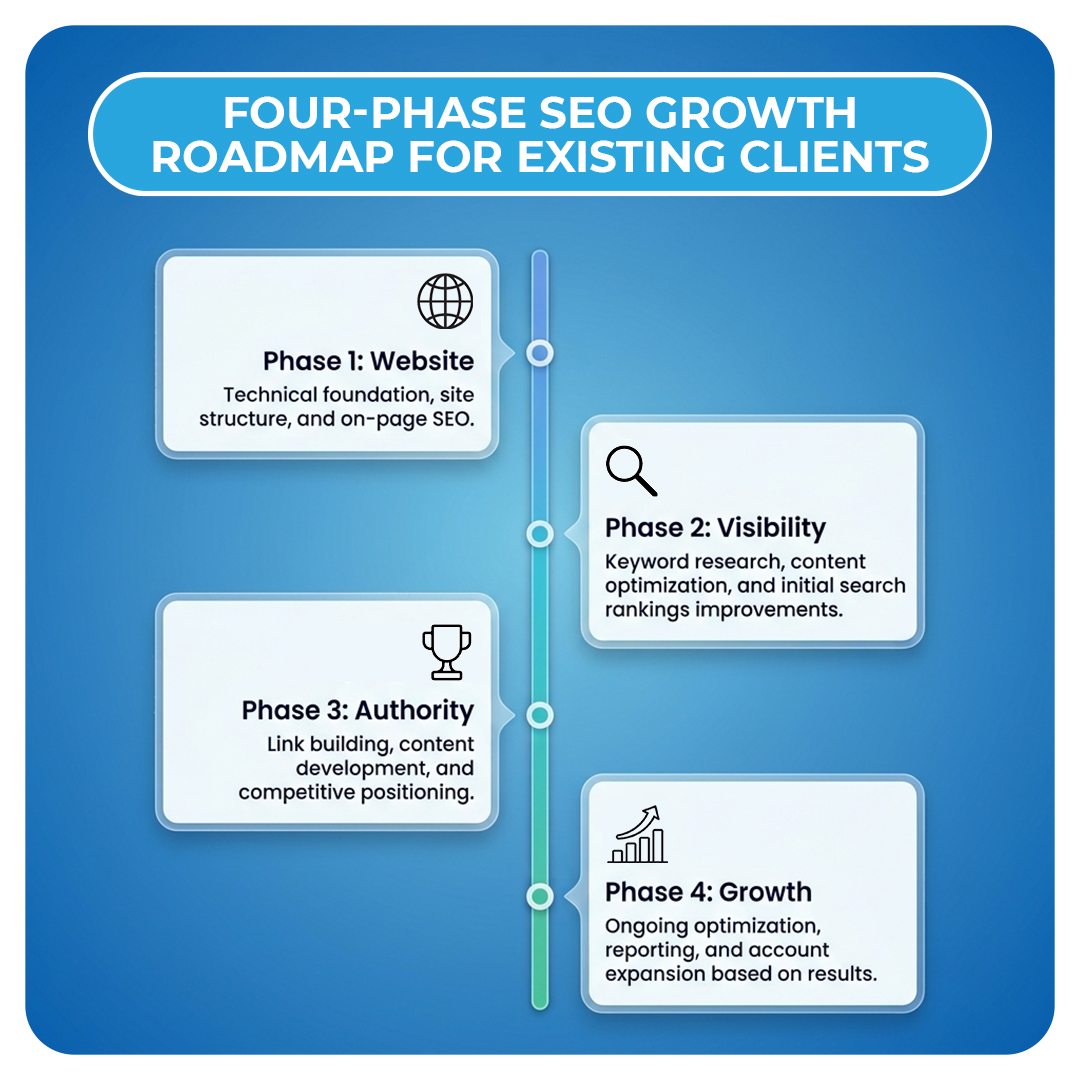
This framework works for two reasons. First, it shows clients a clear path forward rather than an open-ended commitment. Second, it builds confidence because each phase has a defined purpose and measurable outcomes.
Clients respond better to long-term planning than to isolated service pitches because a roadmap demonstrates strategic thinking. It positions the agency as a growth partner invested in outcomes, not just a vendor delivering tasks.
Not every client is ready immediately, but certain operational signals indicate when expansion is likely to succeed.
Operational Indicators That an Existing Client Is Ready for an SEO Expansion
Account managers who know what to look for can identify expansion opportunities well before clients raise them directly. The following checklist highlights the key indicators that an existing client is ready to invest in SEO:
- Website traffic has stabilized or plateaued
- Paid ads generate qualified leads, but costs are rising
- Client wants to reduce reliance on paid advertising
- Competitors consistently outrank them in search results
- Multiple service locations have been added
- Existing content generates little organic traffic
- Marketing goals have shifted toward long-term growth
These indicators matter because they signal genuine business need rather than manufactured urgency. When account managers can point to specific data from a client's own performance, the conversation about SEO becomes evidence-based and collaborative rather than a sales pitch. The checklist also helps account managers prioritize which existing clients to approach first, making outreach more efficient and more likely to convert.
Recognizing opportunities is only valuable if agencies can fulfill additional work consistently.
How Does DashClicks Help Agencies Expand Existing Client Accounts With White Label SEO?
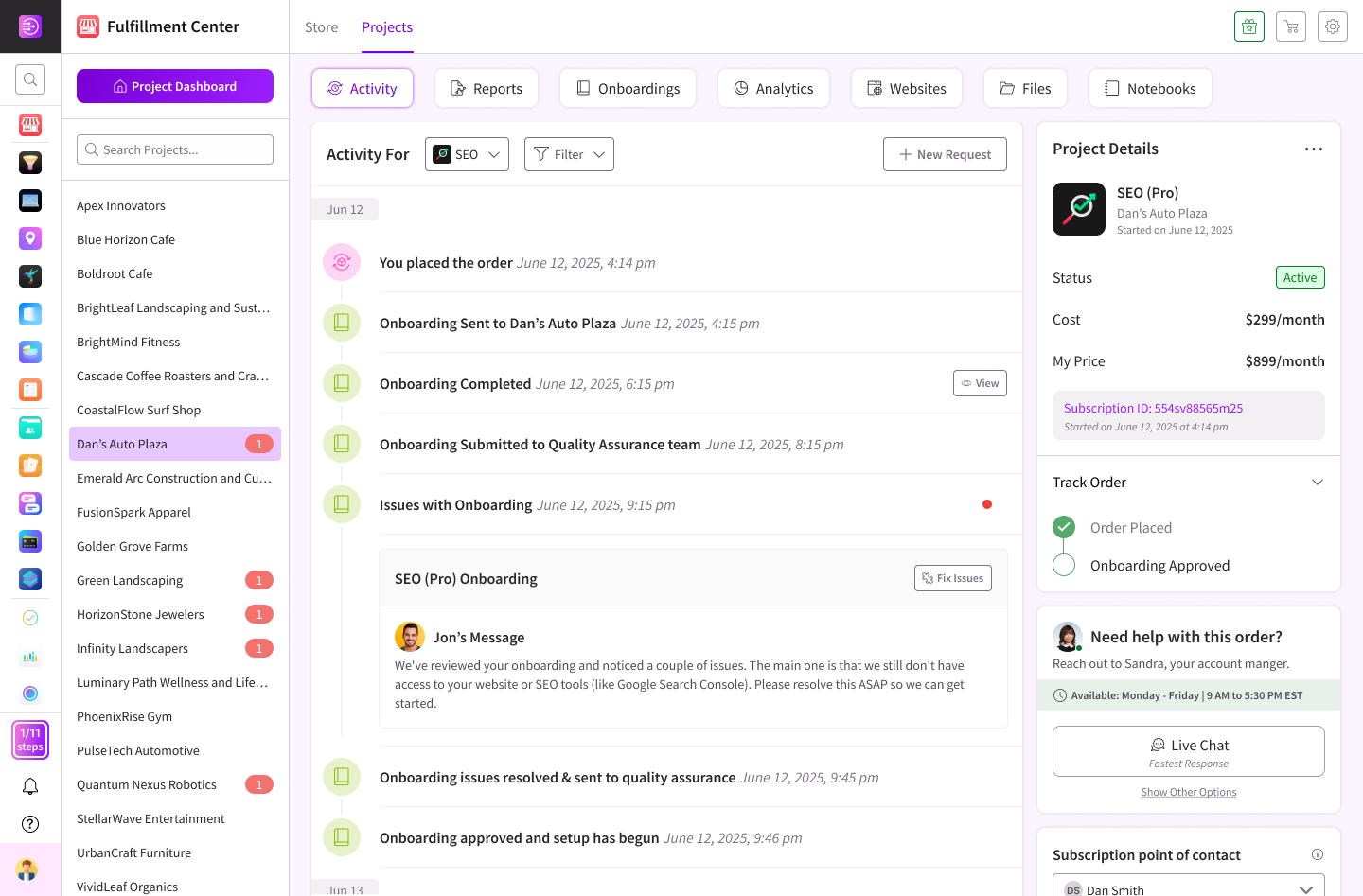
DashClicks is built to help agencies deliver white label SEO services at scale, without adding internal headcount or compromising on quality. Its fulfillment infrastructure supports consistent delivery across growing agency client rosters.
- Scalable White Label SEO Fulfillment: Flexible production capacity allows agencies to take on additional SEO accounts without disrupting delivery timelines or quality standards. Whether you're adding one new account or ten, fulfillment can scale alongside your client base.
- Dedicated SEO Specialists: Agencies gain access to SEO specialists across technical SEO, on-page optimization, content development, local SEO, and link building. They don't need to source, vet, or manage these specialists directly. Fulfillment is handled externally while the agency maintains full ownership of the client relationship.
- White Label Reporting: Client reports are delivered under the agency's branding, making SEO performance easier to communicate and helping agencies maintain a professional, consistent client experience.
- Consistent Delivery Processes: Repeatable, standardized workflows help ensure predictable fulfillment across accounts. Agencies can set clear client expectations knowing that delivery remains consistent, timely, and aligned with agreed deliverables.
DashClicks provides the operational support agencies need to expand existing accounts confidently while maintaining control of client relationships.
When fulfillment is reliable, agencies can focus more on identifying expansion opportunities and strengthening client relationships rather than managing production capacity.
Sustainable Agency Growth Starts With the Clients You Already Have
The agencies that grow most sustainably aren't always the ones with the most aggressive acquisition strategies. They're the ones that recognize how much value already exists in their current client relationships and build systems to expand those relationships over time.
White label SEO services give agencies the operational foundation to introduce SEO without building an internal team, deliver consistently at scale, and increase recurring revenue through deeper client partnerships. The result is stronger retention, higher monthly retainers, and a more predictable growth trajectory.
SEO is not just another service to add to a price sheet. When positioned correctly and delivered reliably, it becomes a long-term growth initiative that benefits both the agency and the client. Agencies that treat it this way will find that their best growth opportunities aren't always waiting in a new prospect pipeline. Sometimes, they're already inside an existing account.


.svg)


.svg)
.svg)
.svg)
.svg)
.svg)