

.svg)

.svg)
.svg)
.svg)
.svg)
.svg)
Google Ads has evolved significantly. What once relied on manual adjustments now uses AI-powered bidding, automated campaign types, and machine learning to optimize campaigns across millions of auctions in real time. While automation has made campaign management more efficient, it has not eliminated the need for strategic oversight.
Successful campaigns still depend on accurate conversion tracking, well-structured accounts, quality creative assets, and consistent optimization. According to Google's Economic Impact methodology, businesses earn an average of $8 in revenue for every $1 spent on Google Ads, but those results rely on ongoing optimization rather than campaign setup alone.
As agencies grow, maintaining that level of optimization becomes increasingly difficult. More client accounts often mean less time for proactive account reviews. PPC specialists shift from scheduled optimization to reactive problem-solving, addressing issues only after performance declines or clients raise concerns. Over time, these reactive workflows lead to inconsistent results, operational inefficiencies, and lower client retention.
The challenge isn't a lack of PPC expertise. It's the absence of structured operational systems that ensure every account receives consistent attention. A white label PPC agency helps agencies implement repeatable optimization processes across their entire client portfolio without expanding internal teams. While winning Google Ads clients is important, consistently optimizing campaigns at scale is what separates successful agencies from the rest.
Why Google Ads Optimization Has Become More Complex?
Google Ads has evolved far beyond keyword bidding and text ad creation. Today, the platform combines AI, automation, audience intelligence, and privacy-focused measurement, making optimization far more complex than it was just a few years ago.
Several key changes have transformed how agencies manage campaigns:
- AI-Powered Bidding and Smart Bidding: Manual CPC strategies have largely been replaced by automated bidding. Google states that Smart Bidding performs best when supported by accurate conversion tracking and reliable data, making proper account setup more important than ever.
- Performance Max Campaigns: Performance Max distributes budgets across Search, Display, YouTube, Gmail, Discover, and other Google properties. Success depends on strong creative assets, audience signals, campaign goals, and continuous optimization rather than simple keyword management.
- Broad Match Evolution: Broad Match keywords now reach a wider range of relevant searches. While this increases reach, it also makes regular search term reviews and negative keyword management essential for maintaining traffic quality.
- Greater Reliance on First-Party Data: Customer Match lists, audience signals, and other first-party data sources now play a much larger role in campaign performance. Agencies must develop stronger audience strategies to maximize results.
- More Complex Conversion Tracking: Before Google's AI can optimize effectively, agencies need clean conversion data, appropriate attribution models, and properly configured tracking. Privacy changes, including cookie deprecation and Consent Mode, have made accurate measurement more challenging.
- Rising Competition and Advertising Costs: Increasing advertiser competition has driven higher CPCs across many industries. Budget allocation, Quality Score improvements, and efficiency optimization have become increasingly important for maintaining profitability.
Automation has certainly reduced repetitive manual work, but it has not replaced strategic oversight. As Google Ads continues to evolve, how agencies optimize campaigns has become just as important as the optimization strategies they choose.
What Is Reactive Google Ads Optimization?
Reactive optimization occurs when agencies make changes only after problems have already appeared. There is no structured schedule, no recurring review process, and no systematic approach to monitoring account health. Work happens in response to issues rather than in anticipation of them.
Common triggers for reactive optimization include CPA increases, ROAS declines, budget overspends, Impression Share drops, disapproved ads, declining conversion volume, and client emails asking why performance has changed. Each of these events pulls specialists away from planned work and into unplanned firefighting.
Reactive management looks like this in practice:
- No optimization schedule exists
- Account reviews happen manually and inconsistently
- Changes are rushed in response to client escalations
- Client priorities override planned work
- Firefighting consumes most available optimization time
Reactive Optimization Timeline: Problem → Investigation → Fix → Temporary Improvement → Next Problem
This cycle treats symptoms rather than addressing root causes. A spike in CPA might be fixed by pausing a bidding strategy, but if search terms are not reviewed weekly, irrelevant traffic continues entering the account and raising costs again within weeks. Reactive management rarely breaks this cycle because the conditions that created the problem are still present.
While reactive management can solve immediate problems, it rarely creates long-term account stability.
What Structured Google Ads Optimization Actually Looks Like?
Structured optimization is a documented operational system where campaign activities follow recurring schedules regardless of whether problems have appeared. Rather than waiting for performance to decline, structured teams complete planned optimization tasks at defined intervals, reducing variability across accounts and client portfolios.
The structure is organized by frequency.
- Daily: Daily monitoring focuses on budget pacing, spend anomalies, and conversion tracking alerts. Budget pacing ensures accounts do not overspend or underspend at a rate that will miss monthly targets. Conversion tracking alerts catch data loss early before it affects Smart Bidding performance. Campaign health checks confirm ads are running, targeting is active, and no policy issues have appeared overnight.
- Weekly: Weekly optimization covers the activities that have the highest impact on campaign efficiency. Search term reviews identify irrelevant queries entering the account. Negative keyword lists are expanded to prevent wasted spend. Bid adjustments are reviewed against performance trends. Audience performance is analyzed, and creative asset performance is monitored for signals of fatigue or improvement opportunities.
- Biweekly: Every two weeks, structured teams review ad testing roadmaps, landing page performance, and geographic and device data. Ad tests are assessed for statistical significance and winning variations are identified. Landing page recommendations are documented and communicated to clients. Geographic and device analysis reveals segments that may justify bid adjustments or budget reallocation.
- Monthly: Monthly reviews include formal account audits, client reporting, strategy recommendations, and competitor analysis. This is where patterns become visible across the full month of data. Reporting is prepared and distributed on schedule rather than assembled reactively before client calls.
- Quarterly: Quarterly reviews address attribution validation, campaign restructuring, budget planning, and growth opportunity identification. These deeper reviews ensure that the account strategy remains aligned with client business goals as market conditions and platform capabilities evolve.
Structured Optimization Calendar
Daily: Budget, tracking, campaign health
Weekly: Search terms, negatives, bids, audiences, assets
Biweekly: Ad tests, landing pages, geo/device analysis
Monthly: Audits, reporting, strategy, competitor review
Quarterly: Attribution, restructuring, budget planning, growth
Consistency creates predictable performance, but it also transforms agency operations.
Reactive vs. Structured Optimization Across the Entire PPC Workflow
Reactive and structured approaches differ across every stage of PPC management, not just in how campaigns are monitored. The table below illustrates how operational discipline affects the full workflow.
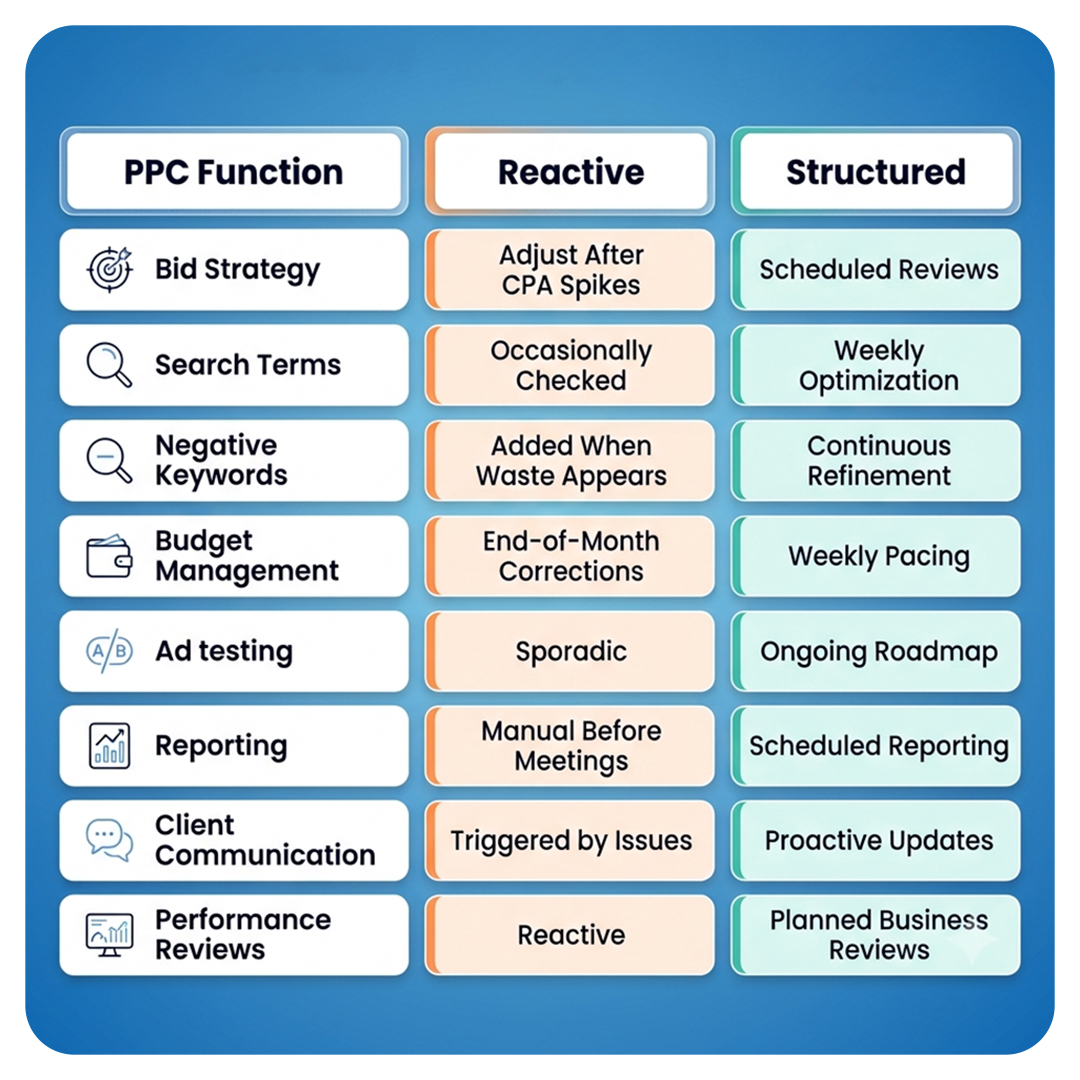
Operational discipline changes more than campaign performance. It shapes how agencies communicate with clients, how they allocate specialist time, and how much firefighting consumes the team's capacity. Agencies operating structured workflows spend less time reacting to client escalations because performance issues are caught and addressed before clients notice them.
These differences influence far more than campaign metrics. They shape agency profitability, client retention, and operational efficiency.
The Costs of Reactive Google Ads Management
Reactive management carries costs that rarely appear in campaign dashboards but show up consistently in agency financials and client retention data. Wasted ad spend accumulates between reactive reviews. Missed optimization windows allow poor-performing search terms, underperforming assets, and inefficient bidding strategies to run longer than necessary.
WordStream benchmark data shows that CPCs and CPAs fluctuate significantly across industries, making regular optimization essential to maintaining cost efficiency. Agencies managing accounts reactively are slower to respond to these fluctuations, which means clients absorb costs that structured optimization would have reduced.
Beyond ad spend, reactive management creates additional operational costs:
- Increased client escalations require account manager time that is not billable
- Team burnout develops when specialists constantly shift between urgent tasks
- Inconsistent campaign quality makes performance harder to predict or improve
- Reduced client retention shrinks revenue without reducing agency overhead
- Shrinking margins follow when clients downgrade budgets or cancel after performance drops
These costs compound over time. A reactive workflow that manages ten accounts might be manageable. The same workflow applied to forty accounts creates operational strain that degrades quality across the entire portfolio.
Most agencies never intend to become reactive. Operational pressure gradually pushes them in that direction.
Why Agencies Fall Into Reactive Optimization?
The path toward reactive management follows a predictable pattern. As agencies grow, account volume increases faster than specialist capacity. Each new client adds monitoring responsibilities, reporting requirements, and communication touchpoints. The time available for structured, proactive optimization shrinks.
More Accounts → More Interruptions → Less Optimization Time → More Reactive Work → Performance Variability
Several factors accelerate this shift:
- Too many accounts per specialist without adequate support systems
- Hiring delays that leave teams understaffed during growth periods
- Competing client priorities that push planned work aside
- Manual reporting processes that consume hours before every client meeting
- Inconsistent or absent standard operating procedures
- Lack of systematic quality assurance across campaigns
- Frequent Google Ads platform updates that require immediate attention
- Unplanned interruptions from client requests and internal meetings
Skilled PPC specialists still become reactive when systems are inconsistent. The problem is not expertise. It is the absence of operational infrastructure that protects planned optimization time from being consumed by urgent work.
Solving these issues requires more than additional hiring. Agencies need structured systems.
Why White Label PPC Creates Structured Optimization at Scale?
White label PPC fulfillment is not simply outsourced campaign management. For agencies, it functions as an operational framework that brings structured optimization, documented workflows, and dedicated specialist capacity to every account in the portfolio.
- Dedicated Optimization Teams: White label PPC services assign dedicated specialists who focus exclusively on campaign optimization rather than splitting attention between client communication, reporting, and strategy. These specialists follow recurring optimization schedules across every account, ensuring that daily, weekly, biweekly, and monthly activities are completed consistently rather than when time permits.
- SOP-Driven Workflows: Documented standard operating procedures define exactly how each optimization task should be completed and at what frequency. SOP-driven workflows remove the variability that occurs when different specialists approach the same task differently. Every search term review, negative keyword update, and bid adjustment follows the same process, which produces more consistent results across the portfolio.
- Scheduled QA: Quality assurance is built into the fulfillment workflow rather than applied informally. Launch validation confirms campaign structure, targeting, and tracking are correct before spend begins. Ongoing QA reviews verify conversion tracking accuracy, policy compliance, and campaign health on a scheduled basis rather than after problems appear.
- Standardized Reporting: White label reporting gives agencies structured, scheduled reports that are ready on time without requiring account managers to build them manually before every client meeting. Reports are formatted to reflect the agency's brand and include performance insights and strategy recommendations rather than data summaries alone.
- Capacity Flexibility: White label PPC services allow agencies to scale fulfillment capacity in line with client volume without adding internal headcount. When an agency onboards five new clients in a quarter, fulfillment capacity expands to match without the delays associated with hiring, onboarding, and training new specialists.
Agencies retain full ownership of strategy, client communication, and relationships throughout this process. White label fulfillment teams handle recurring optimization execution while the agency focuses on the activities that directly drive growth and retention.
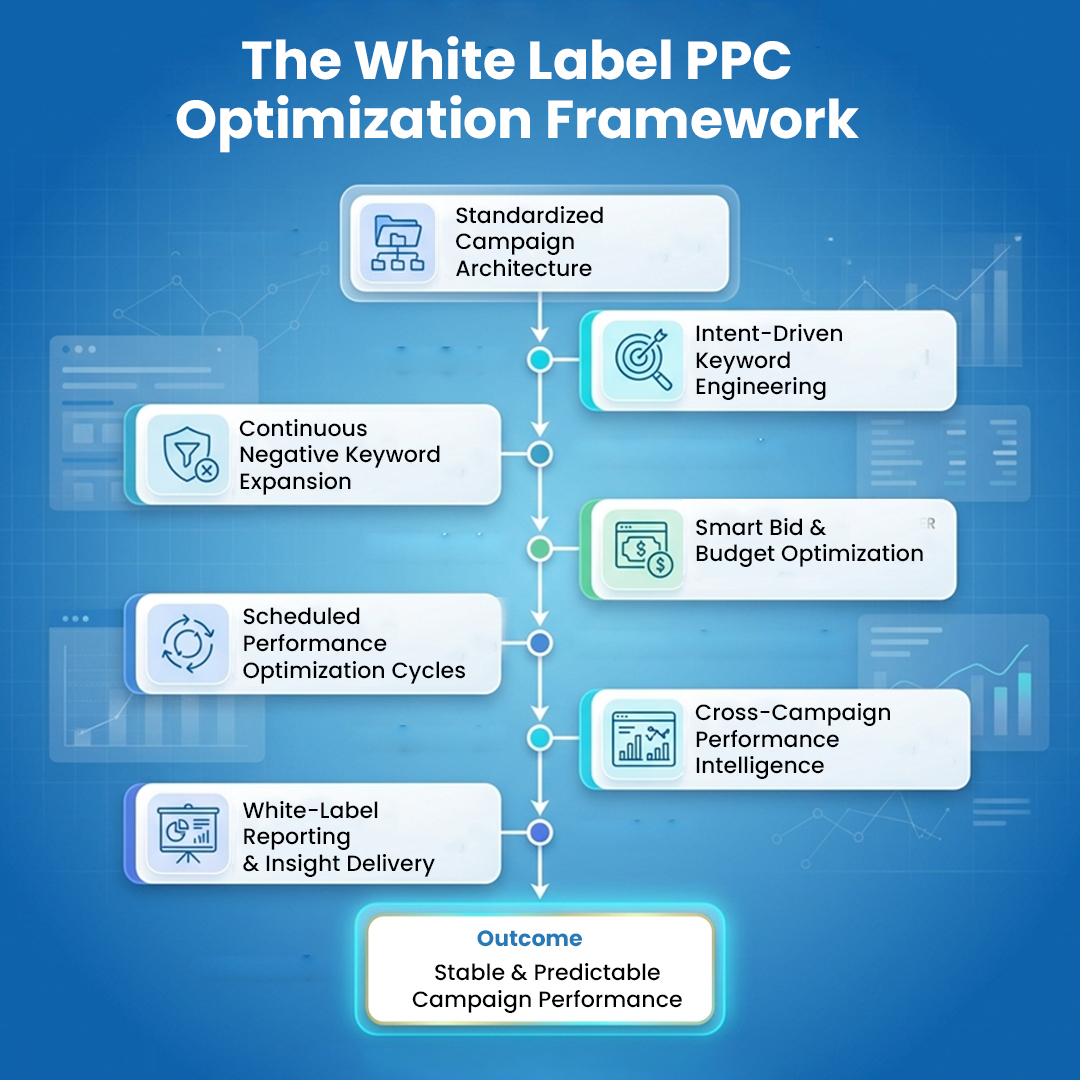
Structured optimization creates the biggest impact when applied consistently across every recurring PPC activity.
Google Ads Activities That Benefit Most From Structured Optimization
Every recurring optimization task in a Google Ads account produces better results when completed on a consistent schedule. The table below identifies the activities that benefit most from operational consistency.
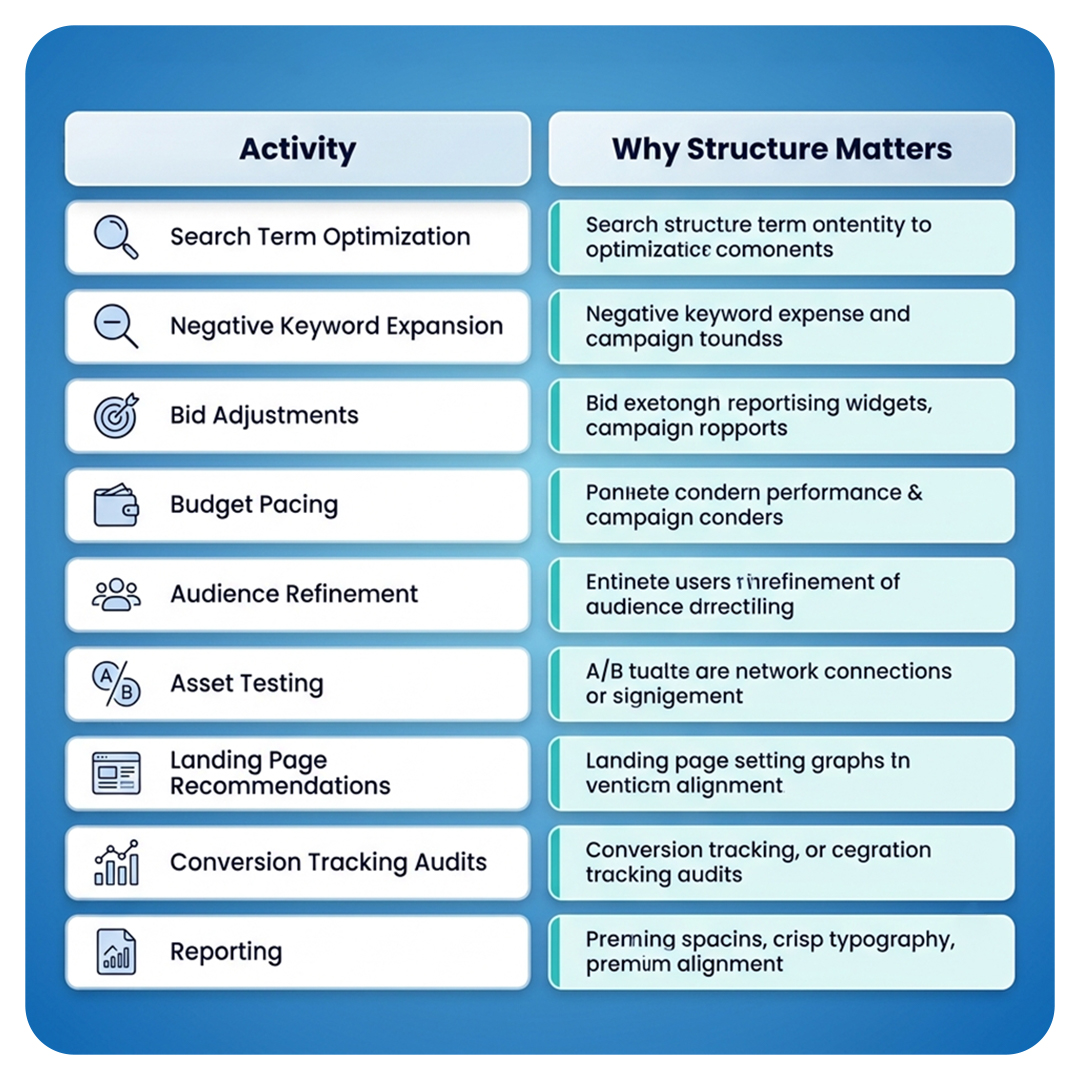
Each of these tasks has a compounding effect. Search term optimization completed every week removes irrelevant queries before they consume budget. Consistent asset testing identifies winning creative faster, which improves CTR and reduces CPC over time. Regular conversion tracking audits ensure that Smart Bidding systems receive accurate data, which directly affects how well automated bidding performs.
Agencies that complete these activities consistently gain a measurable competitive advantage.
Signs Your Agency Needs a More Structured PPC Model
Reactive management rarely announces itself clearly. It develops gradually as operational pressure increases. These warning signs indicate that an agency has moved away from structured optimization.
- Optimizations happen only in the days before client meetings
- PPC managers are responsible for more accounts than they can monitor proactively
- Campaign performance fluctuates unexpectedly without clear explanations
- Reporting preparation consumes several hours each month per client
- Campaign launches are delayed because specialists are occupied with existing accounts
- Clients ask more questions about results and performance trends
- Ad testing has become inconsistent or paused entirely
- Urgent, unplanned work dominates most daily schedules
These signs reflect operational strain rather than a lack of PPC expertise. An experienced specialist managing forty accounts without adequate systems will still produce inconsistent results. The volume of work simply exceeds what reactive, unstructured management can sustain at a high level.
Recognizing these warning signs early makes it easier to adopt scalable fulfillment before quality declines.
How DashClicks Helps Agencies Build Structured Google Ads Operations?
DashClicks provides white label Google Ads fulfillment designed to give agencies the operational structure needed to manage campaigns consistently across their full client portfolio.
- White Label Google Ads Fulfillment: The white label PPC team handles the complete campaign lifecycle, from account setup and ongoing optimization to reporting and performance monitoring. Agencies maintain ownership of the client relationship while experienced PPC specialists execute structured campaign management behind the scenes.
- Dedicated PPC Specialists: Each account is managed by dedicated PPC specialists who follow structured optimization schedules. This removes the inconsistency that occurs when accounts are passed between generalists or managed by overextended internal teams.
- Standardized Optimization Processes: Documented optimization workflows ensure consistent standards across every account. Recurring processes cover search term optimization, negative keyword management, bid adjustments, budget pacing, and ongoing ad testing.
- White Label Reporting: Agencies receive scheduled reports branded with their own identity, ready to share with clients without manual preparation. Reports include performance data, strategic context, and forward-looking recommendations that support proactive client communication.
- Ongoing Campaign Monitoring: Continuous monitoring helps identify budget anomalies, tracking discrepancies, and performance shifts before they become client concerns, allowing issues to be addressed as part of the standard fulfillment process.
Agencies retain complete strategic control and client ownership, while DashClicks provides the operational infrastructure that makes structured Google Ads optimization possible at scale.
Structured PPC Operations Are a Long-Term Competitive Advantage
Reactive optimization solves today's problems. Structured optimization prevents tomorrow's. This distinction becomes more important as agency portfolios grow and as Google Ads continues developing more complex automation systems that demand consistent data inputs and ongoing strategic oversight.
Operational systems improve campaign quality by ensuring that recurring tasks are completed on schedule rather than when time permits. Standardized workflows strengthen reporting by eliminating the manual effort that delays client communication. Better consistency across accounts improves client retention because performance is more predictable and problems surface earlier.
White label PPC services give agencies a practical path toward structured operations without increasing internal headcount. Fulfillment capacity scales with client volume, optimization processes follow documented standards, and reporting is delivered on schedule without pulling account managers away from client-facing work.
Agencies that invest in operational structure now will be better positioned as Google Ads continues evolving. Automation will expand. Complexity will increase. The agencies that thrive will be those running repeatable, scalable systems rather than reacting to problems after performance has already declined.



.svg)


.svg)
.svg)
.svg)
.svg)
.svg)