

.svg)

.svg)
.svg)
.svg)
.svg)
.svg)
Organic search drives approximately 53% of all trackable website traffic, according to the BrightEdge Channel Share Report. That scale creates a significant opportunity for agencies. But the conversation around SEO performance has shifted. Clients no longer measure success by rankings or traffic reports alone. They want to see leads, booked appointments, sales, and revenue growth directly tied to the SEO work their agencies deliver.
According to the Conductor State of SEO Report, companies with mature SEO strategies generate stronger returns from organic channels. That finding reflects a broader expectation: SEO should function as a business growth driver, not simply a visibility tool.
For agencies, meeting these expectations is challenging. Delivering conversion-focused SEO often requires expertise in CRO, UX, content strategy, and analytics, making it expensive to build and manage large in-house teams.
Instead of focusing solely on rankings, conversion-focused SEO maximizes the value of existing organic traffic by turning visitors into customers. White label SEO services for agencies make this approach scalable, giving agencies access to specialist expertise without expanding internal resources.
This article explores why rankings alone are no longer enough, how conversion-focused SEO drives better business outcomes, and how a partner can help agencies deliver results at scale.
Why Rankings Alone No Longer Define SEO Success?
For years, rankings were the primary way agencies measured SEO success. Higher positions in search results typically led to more clicks, making rank tracking a reliable indicator of performance.
That relationship has changed.

Image Source: Semrush
1. Search Results Have Become More Competitive
Modern search results are no longer limited to the traditional list of blue links. AI Overviews, featured snippets, knowledge panels, local packs, and People Also Ask sections now occupy significant space on the results page.
These features often answer users' questions directly, reducing the need to click through to a website.
2. High Rankings No Longer Guarantee Traffic
The data reflects this shift.
According to a 2024 SparkToro and Datos study, approximately 58.5% of Google searches in the United States end without a click. Even a number-one ranking for a high-volume keyword may generate fewer visits than it once did.
As a result, rankings and impressions alone have become incomplete measures of SEO performance.
3. Traffic Without Conversions Has Limited Value
Even when rankings generate traffic, the next question matters more:
Are those visitors taking meaningful action?
A campaign that attracts fewer but highly qualified visitors often delivers better business results than one that drives large volumes of informational traffic with little buying intent.
4. SEO Success Is About Business Outcomes
Effective SEO follows a complete performance journey:
Rankings → Traffic → Qualified Leads → Revenue
Rankings remain important, but they are only the starting point. Agencies that measure success across this entire journey provide clients with reporting that connects SEO efforts to tangible business growth.
If rankings are no longer the finish line, agencies need a more conversion-focused approach to defining and measuring SEO success.
What Is Conversion-Focused SEO?
Conversion-focused SEO combines traditional search optimization with strategies that encourage qualified visitors to complete meaningful business actions. Those actions vary by client: a lead form submission, a phone call, a booked consultation, a product purchase, or a visit to a physical location.
This approach does not replace SEO. It strengthens SEO by connecting visibility with client business goals. Search intent becomes a central consideration at every stage, from keyword selection through to landing page design and call-to-action placement.
The components that distinguish conversion-focused SEO include:
- Targeting commercial and transactional keywords based on purchase readiness.
- Aligning landing page content with the specific intent behind each query.
- Structuring content to guide visitors toward a clear next step.
- Strengthening internal linking to move visitors between informational and conversion-oriented pages.
- Optimizing technical performance, including page speed and mobile usability.
- Building CTAs that match where the visitor is in the buying process.
- Designing logical conversion paths rather than isolated landing pages.
The contrast with traditional SEO is straightforward:
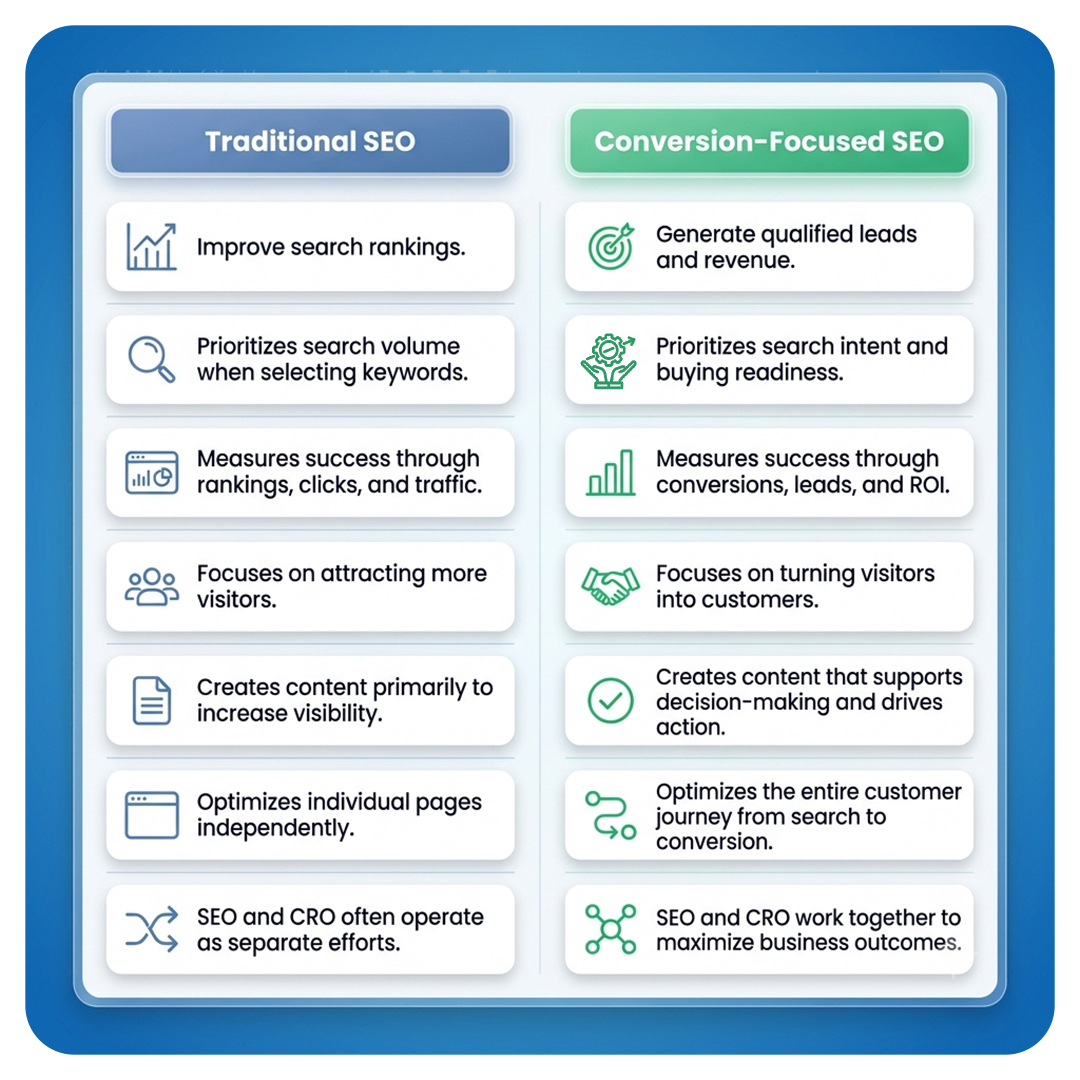
Both approaches still value rankings and traffic. The difference is that conversion-focused SEO evaluates whether those metrics contribute to meaningful outcomes. A page that ranks well and generates sessions but produces no leads is underperforming, even if the ranking report looks strong.
Consider a practical example. A service page may rank for a high-volume keyword and attract thousands of visitors. However, a lower-volume page targeting a highly specific service query may generate far more calls or consultation requests because it aligns precisely with what a buyer is actively looking for.
Understanding conversion-focused SEO is only part of the equation. Agencies must also deliver these improvements consistently across every client account.
Why Growing Agencies Struggle to Deliver Conversion-Focused SEO In-House?
Delivering conversion-focused SEO is operationally demanding. The overlap between SEO, content strategy, UX, analytics, technical execution, and conversion optimization means that no single generalist can cover every area at depth.
1. Limited Specialist Resources
Modern SEO campaigns touch multiple disciplines simultaneously, including:
- Content strategy and production
- User experience and page design
- Analytics configuration and interpretation
- Technical SEO auditing and implementation
- Local SEO and location-based targeting
- Conversion path development
- Landing page strategy and optimization
- Reporting and performance analysis
A single SEO professional working across a portfolio of clients cannot maintain specialist-level depth in every one of these areas.
2. Hiring Challenges
Building an internal team capable of delivering across all these functions is expensive and time-consuming. Agencies face recruiting costs for experienced specialists, extended training periods, ongoing payroll commitments, tool and software expenses, and management overhead. Even when the right people are hired, coordinating a multidisciplinary team takes significant leadership capacity.
3. Scaling Problems
As client volume grows, agencies often see quality and consistency decline. Common symptoms include:
- Inconsistent deliverable quality between accounts
- Delayed campaign milestones
- Overworked team members
- Slower iteration and testing cycles
- Reduced strategic depth on individual accounts
4. Context Switching
Agency teams regularly move between SEO audits, content briefs, technical fixes, client reporting, performance reviews, and client communication within a single workday. Frequent context switching makes focused, systematic conversion optimization difficult to sustain.
HubSpot's State of Marketing report consistently identifies generating traffic and leads as a top priority for marketing organizations. That finding underlines the pressure agencies face. Clients are not just looking for organic visibility. They expect SEO campaigns to contribute to lead generation and business growth, which raises the stakes for every account.
Rather than expanding internal departments every time client expectations increase, many agencies are redesigning how they deliver SEO.
The Five Strategic Shifts That Make SEO More Conversion-Focused
Conversion-focused SEO requires a change in how agencies prioritize opportunities, structure content, and evaluate performance.

Image Source: Objects
These five shifts form the practical foundation of that change.
1. Prioritize Buying Intent Over Search Volume
Keyword strategy should reflect where a prospect sits in the buying process, not just how many people search a given term. Agencies should evaluate keywords based on:
- Commercial relevance to the client's services or products
- Purchase readiness signals in the search query
- Alignment with specific service or product offerings
- Revenue potential relative to the cost of ranking
- Position in the sales funnel
Lower-volume keywords with strong buying intent often produce better business outcomes than broad, high-volume queries that attract general interest rather than commercial readiness.
2. Build Conversion Paths Instead of Publishing More Content
Every page on a client's site should have a logical next step. Publishing more content without connecting it to a conversion path can increase traffic without improving results. Agencies should evaluate whether each page includes:
- Internal links directing visitors to relevant service pages
- Consultation, booking, or contact CTAs
- Product or service comparisons that support purchase decisions
- Lead magnets where appropriate
- Contact forms positioned at natural decision points
- Location pages for service-area businesses
3. Optimize Customer Journeys, Not Individual Pages
The full journey matters, not just the landing page:
Search Query → Content Page → Service Page → Conversion
Message consistency across that journey is critical. A visitor who lands on an informational blog post and then navigates to a service page should find continuity in tone, relevance, and intent. Page experience, mobile usability, and clarity about the next step all influence whether that journey ends in a conversion.
4. Treat SEO as Continuous Optimization, Not Monthly Tasks
Agencies that treat SEO as a fixed monthly deliverable rather than an ongoing optimization cycle leave performance gains unrealized. Consistent improvement requires regularly:
- Refreshing content to reflect current search intent
- Reviewing conversion data to identify underperforming pages
- Improving internal linking as new pages are published
- Testing and refining calls to action
- Updating landing pages based on performance trends
- Monitoring technical health for issues that affect usability
5. Measure Business Impact Instead of Vanity Metrics
Reporting should center on metrics that reflect client business goals:
- Qualified leads generated through organic search
- Organic conversion rate
- Form submissions and phone calls
- Booked appointments and consultation requests
- Assisted conversions across the buyer journey
- Revenue contribution from organic traffic
These shifts deliver the strongest value when they are applied consistently rather than treated as isolated projects.
These initiatives produce the strongest results when they are executed consistently rather than as isolated improvements.
How White Label SEO Services Help Agencies Scale Conversion-Focused SEO?
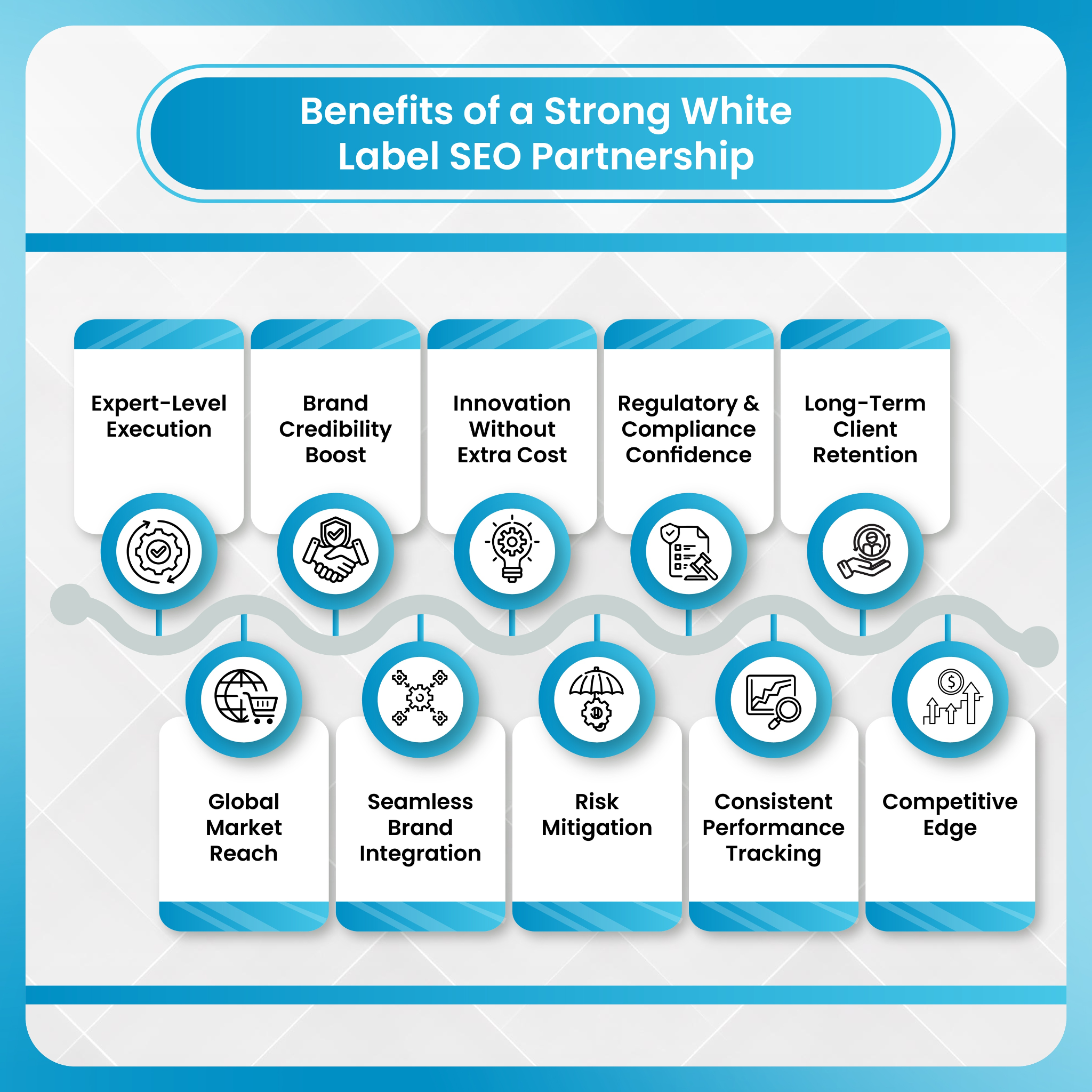
Applying these five shifts across a growing client portfolio requires execution capacity, specialist expertise, and standardized processes. A reliable white label SEO partner provides all three behind the agency's brand, enabling consistent delivery without requiring agencies to scale internal headcount in proportion with client growth.
1. Strategic Keyword Research Built Around Business Goals
Keyword research through a white label partner focuses on commercial relevance, not just search volume. That includes:
- Commercial and transactional keyword identification
- Intent analysis to distinguish informational from buying-stage queries
- Competitor gap research to surface overlooked opportunities
- Service-focused targeting aligned with client offerings
- Local buying-intent terms for location-based businesses
- Prioritization based on business value rather than volume alone
Keyword strategy built around business goals gives clients a stronger foundation for attracting visitors who are ready to act.
2. Content Production That Supports Conversions
Content production through a structured white label model is mapped to the buyer journey rather than designed to increase page count. That means:
- Content aligned with specific stages of the purchase decision
- Clear calls to action built into each piece
- Internal linking that directs readers toward relevant service pages
- Decision-stage and comparison content that supports commercial intent
- Content briefs structured around intent rather than keyword density
Content should guide visitors toward action. A white label partner with defined content processes helps agencies deliver that consistently.
3. Technical SEO That Prioritizes Business Impact
Technical improvements affect both search visibility and user experience. A white label SEO partner handles the technical layer across all client accounts, covering:
- Page speed optimization
- Mobile usability
- Crawlability and indexation
- Broken link identification and resolution
- Site architecture improvements
- Conversion tracking configuration support
4. Consistent Monthly Optimization
Conversion-focused SEO requires ongoing attention, not just initial setup. Monthly optimization through a white label partner includes content updates, technical monitoring, on-page improvements, internal linking reviews, performance analysis, and opportunity identification. That consistency is difficult for agencies to sustain internally across a large client portfolio.
5. Scalable SEO Fulfillment Without Hiring
White label SEO packages give agencies the flexibility to match fulfillment levels to different client needs and budgets without adding permanent headcount. Benefits include:
- Predictable, standardized workflows across accounts
- Consistent quality regardless of client volume
- Faster execution due to established processes
- Greater capacity to onboard new clients
- Reduced hiring and training pressure
According to PMI's Pulse of the Profession, organizations with standardized processes are significantly more likely to achieve consistent project outcomes. Applied to SEO fulfillment, that principle means repeatable delivery models produce better results than ad hoc execution, particularly as agencies scale.
Consistent execution creates stronger campaigns, but agencies also need a way to demonstrate that value clearly to clients.
Measuring the Success of Conversion-Focused SEO
Clients care most about whether SEO supports measurable growth. That means reporting frameworks need to evolve beyond rankings and traffic.
Traditional SEO reports often focus on:
- Keyword rankings
- Impressions
- Total traffic
- Indexed pages
- Keyword count growth
Those metrics have value, but they do not tell the full story. Conversion-focused reporting also tracks:
- Qualified organic leads
- Organic conversion rate
- Form submissions and phone calls
- Booked appointments
- Revenue attribution from organic traffic
- Assisted conversions
- Cost per organic lead
- Conversion path performance
Rankings and traffic should still appear in reports. They provide important context about visibility and trend direction. But they need to be connected to business outcomes to communicate genuine campaign value.
Better reporting helps agencies explain the impact of their work, strengthen client confidence, support retention, identify conversion bottlenecks, and recommend strategic improvements that align SEO with broader marketing goals.
Consider this example: traffic may remain flat while conversion rate improves, because the agency has attracted more commercially aligned visitors and improved conversion paths. A ranking-only report would miss that progress entirely, leaving the client unable to see the real value being generated.
When agencies consistently improve and communicate these metrics, client relationships naturally become stronger.
How DashClicks Helps Agencies Deliver Conversion-Focused SEO at Scale?
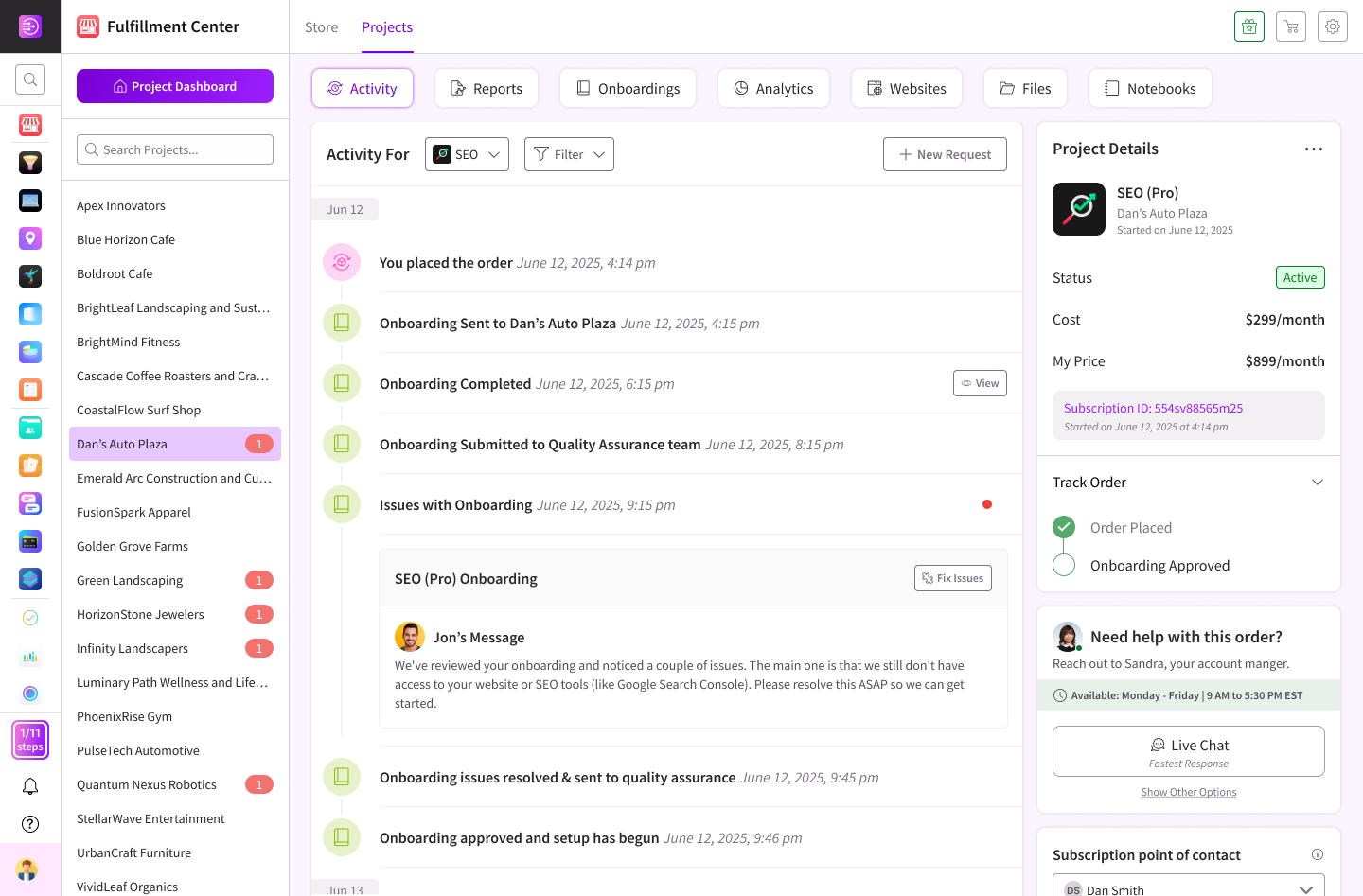
DashClicks functions as an operational partner that helps agencies combine strategic SEO delivery with scalable fulfillment. The model is built to support agencies that want to deliver conversion-focused outcomes without building large internal teams.
- Strategic SEO Planning: Structured planning helps agencies align SEO priorities with client business goals from the start. Support includes keyword strategy development, campaign planning, opportunity identification, and the creation of business-focused roadmaps that connect SEO activity to client outcomes.
- High-Intent Keyword Research: Targeting commercial and transactional searches helps agencies attract visitors who are closer to making a decision. Keyword research focuses on buying intent and service alignment, giving agencies a stronger foundation for campaigns that produce leads rather than just traffic.
- Content and On-Page Optimization: Content optimization is built around search intent, internal linking, service page support, and conversion-oriented recommendations. The goal is to guide visitors toward action rather than simply increasing content volume.
- Technical SEO Fulfillment: Technical improvements support both search visibility and the user experience that influences conversion behavior. Technical SEO fulfillment across client accounts helps agencies deliver the foundation that stronger conversion paths require.
- Transparent Reporting: Clear white label reporting helps agencies communicate completed work, performance trends, identified opportunities, recommended next steps, and measurable business impact. Transparent reporting strengthens client relationships and supports long-term retention.
- Scalable Monthly Execution: DashClicks helps agencies serve more clients while maintaining consistent quality, reducing internal workload, and avoiding the pressure of immediate hiring. The result is better client outcomes, improved retention, and more time for agency leadership to focus on strategy and relationship management.
Ultimately, combining SEO and CRO successfully requires more than isolated tactics. It requires a repeatable delivery model that connects visibility with measurable business growth.
Agencies That Connect SEO to Revenue Are Built to Last
Modern SEO success is defined by whether organic visibility translates into qualified leads, conversions, and revenue. Agencies that connect these outcomes create more defensible client relationships and stronger long-term retention.
Conversion-focused SEO draws on search intent, content strategy, technical performance, user experience, and clear conversion paths working together. No single tactic produces that outcome. It comes from a coordinated, consistent approach applied across every client account.
Delivering that internally becomes progressively harder as client portfolios grow. Recruiting specialists, managing multidisciplinary teams, and maintaining consistent quality across accounts requires resources that most agencies cannot sustain indefinitely. White label SEO services for agencies solve that problem by providing execution capacity, standardized processes, and specialist expertise under the agency's brand.
A reliable partner allows agencies to maintain the quality of strategic thinking and client relationships in-house, while trusting an experienced fulfillment team to execute campaigns that connect visibility to measurable outcomes.
Agencies that build this model are better positioned to strengthen client retention, protect margins, and grow sustainably, without adding internal complexity every time client expectations rise.



.svg)


.svg)
.svg)
.svg)
.svg)
.svg)