

DashClicks Blog
The industry's top experts offer their best advice, research, how-tos, and insights—all in the name of helping you level-up your business and online marketing skills.
Join Us!
.svg)
.svg)
.svg)
.svg)
.svg)

Should Your Agency Outsource SEO? A Decision-Making Guide
Winning more SEO clients is exciting until your team reaches capacity. Suddenly, every new project means hiring, training, investing in expensive SEO tools, or risking burnout. And the demand keeps coming. Organic search drives 53% of all trackable website traffic, and 68% of online experiences begin with a search engine, according to BrightEdge research. For agencies, those numbers translate directly into client pressure.
As SEO becomes one of the most consistently requested digital marketing services, agencies face a fulfillment challenge that hiring alone cannot always solve. Building an internal team is one path forward, but it is no longer the only viable option. Freelancers, white label SEO agencies, and hybrid models have matured significantly, giving agency owners more flexibility than ever before.
The real question is not simply "Should we outsource SEO?" It is "Which delivery model best supports our agency's growth at this stage?" That distinction matters. Outsourcing is not the right answer for every agency, and neither is hiring. The best decision depends on your business goals, current resources, operational capacity, and where your agency is in its growth journey.
If SEO has become an essential service offering for your agency, the path forward requires honest self-assessment and a clear understanding of your available options. This guide covers all of it.
Why More Agencies Are Rethinking SEO Delivery?
SEO is no longer a single-skill discipline. Traditional delivery models built around one or two generalists are struggling to keep pace with how the channel has evolved.
Several compounding factors are pushing agencies to reconsider how they structure SEO fulfillment:
- Increasing complexity: Modern SEO spans technical audits, content strategy, link acquisition, Core Web Vitals, schema markup, and more.
- Frequent algorithm updates: According to Search Engine Journal, 82% of SEO agencies report algorithm updates as the primary cause of ranking fluctuations, requiring constant adaptation.
- Growing specialization: Clients increasingly expect expertise in local SEO, e-commerce SEO, and enterprise-level strategy, not generalist support.
- Rising client expectations: Measurable ROI and transparent reporting are now baseline expectations, not premium features.
- Hiring challenges: 44% of agency owners report that finding and hiring experienced SEO professionals is a major challenge, according to agency industry surveys.
- Increasing software costs: Comprehensive SEO tooling across auditing, rank tracking, and reporting represents a significant fixed overhead.
These challenges compound quickly. A single algorithm update can destabilize rankings across an entire client portfolio. A key hire leaving can stall delivery for months.
The real challenge is not whether SEO is valuable. It is whether your agency has the operational capacity to deliver it consistently. Before evaluating delivery models, the most productive starting point is an honest look inward.
Start With These Questions Before You Decide
Agencies that rush into outsourcing decisions without first understanding their own operational constraints often end up switching models repeatedly and wasting resources. A structured self-assessment changes that.
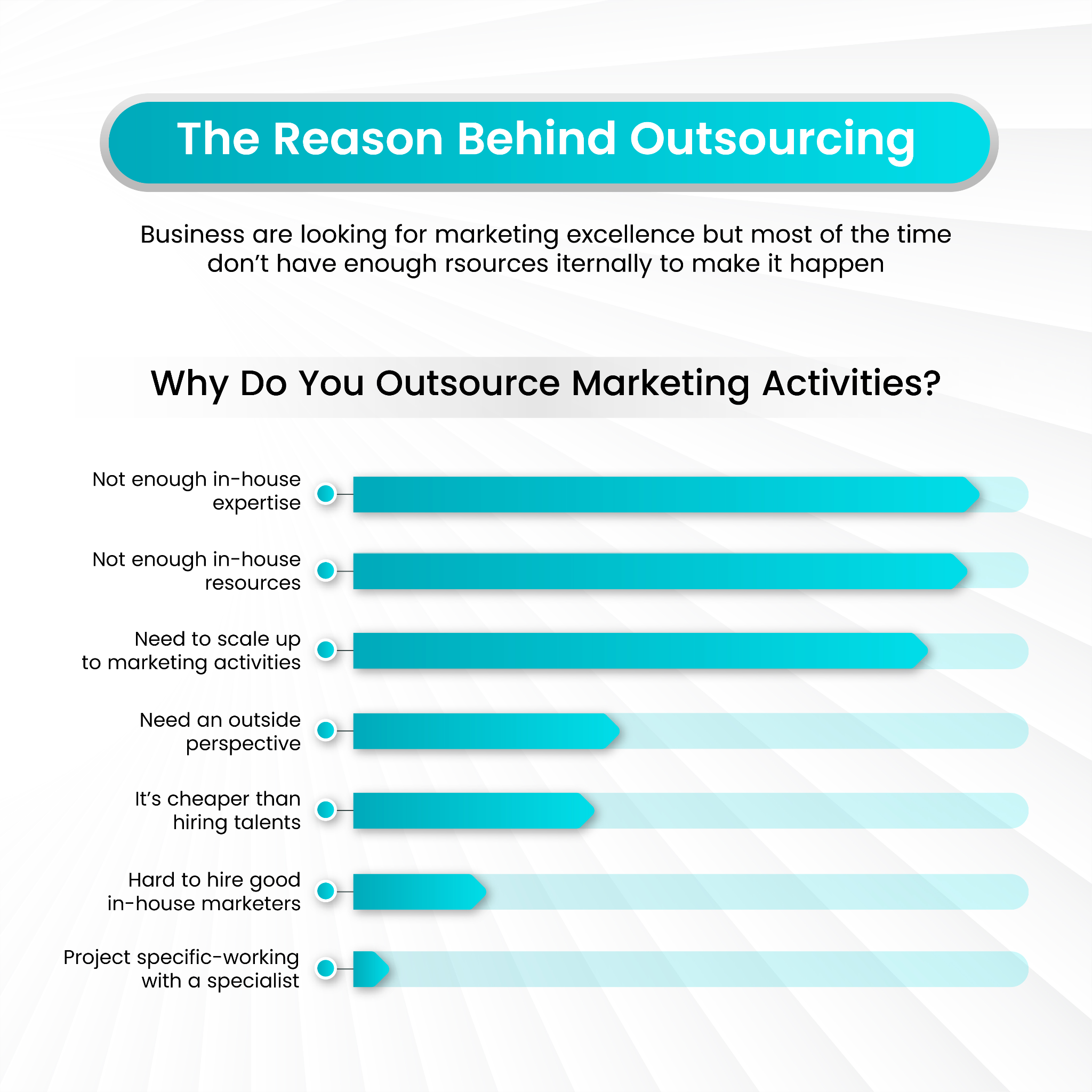
Before evaluating any outsourcing option, work through these questions honestly:
- How many SEO clients do you currently manage?
- Is your SEO demand predictable month over month, or does it spike seasonally?
- Is your team consistently meeting deadlines, or are projects slipping?
- Do you have senior SEO expertise in-house, or are generalists filling the gap?
- Can your current revenue support additional full-time hires?
- How quickly do you need to scale to meet client demand?
- Which specific SEO activities consume the most team time each week?
Your answers will surface your agency's primary operational constraint. Most agencies identify one of five:
- Capacity: The team cannot take on more work without dropping quality.
- Expertise: The work requires specialization that does not exist internally.
- Budget: Hiring is not financially viable at the current growth stage.
- Scalability: Demand fluctuates too much to justify full-time headcount.
- Time-to-market: Clients need results faster than a hiring process allows.
Be honest. Knowing your constraint is not a weakness. It is the foundation of a smarter decision.
Once you understand where your agency stands operationally, you are ready to evaluate the available delivery models objectively.
Comparing Your Three SEO Delivery Models
Every SEO delivery model has real strengths and meaningful limitations. The right choice depends on your agency's current situation, not on which model sounds most appealing in theory.
Pros:
- Maximum control over quality standards and processes
- Deep integration with agency culture and client relationships
- Builds long-term internal capability
Cons:
- High recruiting, onboarding, and training costs
- Slow to scale during rapid growth periods
- Fixed overhead persists even when client volume drops
Best suited for: Established agencies with SEO as their primary service, a stable client base, and the revenue to sustain headcount through demand fluctuations.
Freelancers
Pros:
- Low upfront commitment
- Flexible for project-based or overflow work
- Access to niche expertise for specific deliverables
Cons:
- Inconsistent availability and reliability
- Low-cost predictability across months
- Requires significant management time to maintain quality
Best suited for: Agencies with occasional, project-specific SEO needs that do not justify a long-term engagement or internal hire.
White Label SEO
Pros:
- No hiring overhead or onboarding delays
- Access to a full team of specialists under your agency brand
- Highly scalable up or down based on client demand
- Predictable monthly costs
Cons:
- Less direct control over day-to-day execution
- Requires strong communication and handoff processes
- Quality varies significantly across white label SEO firms
Best suited for: Agencies experiencing demand growth that outpaces internal capacity, those launching SEO services for the first time, or those looking to reduce operational complexity.
The best delivery model is determined by where your agency is today, not where you hope to be in three years.
When Keeping SEO In-House Makes the Most Sense
Outsourcing is a powerful operational lever, but it is not universally the right choice. Some agencies are genuinely better served by continuing to invest internally.
Maintaining an in-house SEO department makes the most sense when:
- SEO is the agency's flagship or primary revenue-generating service
- The agency manages a large, stable base of recurring SEO clients
- Revenue is consistent enough to absorb fixed team costs across slower periods
- Established senior SEO leadership already exists internally
- A long-term hiring and training budget is in place
- Complete operational control and custom process development are strategic priorities
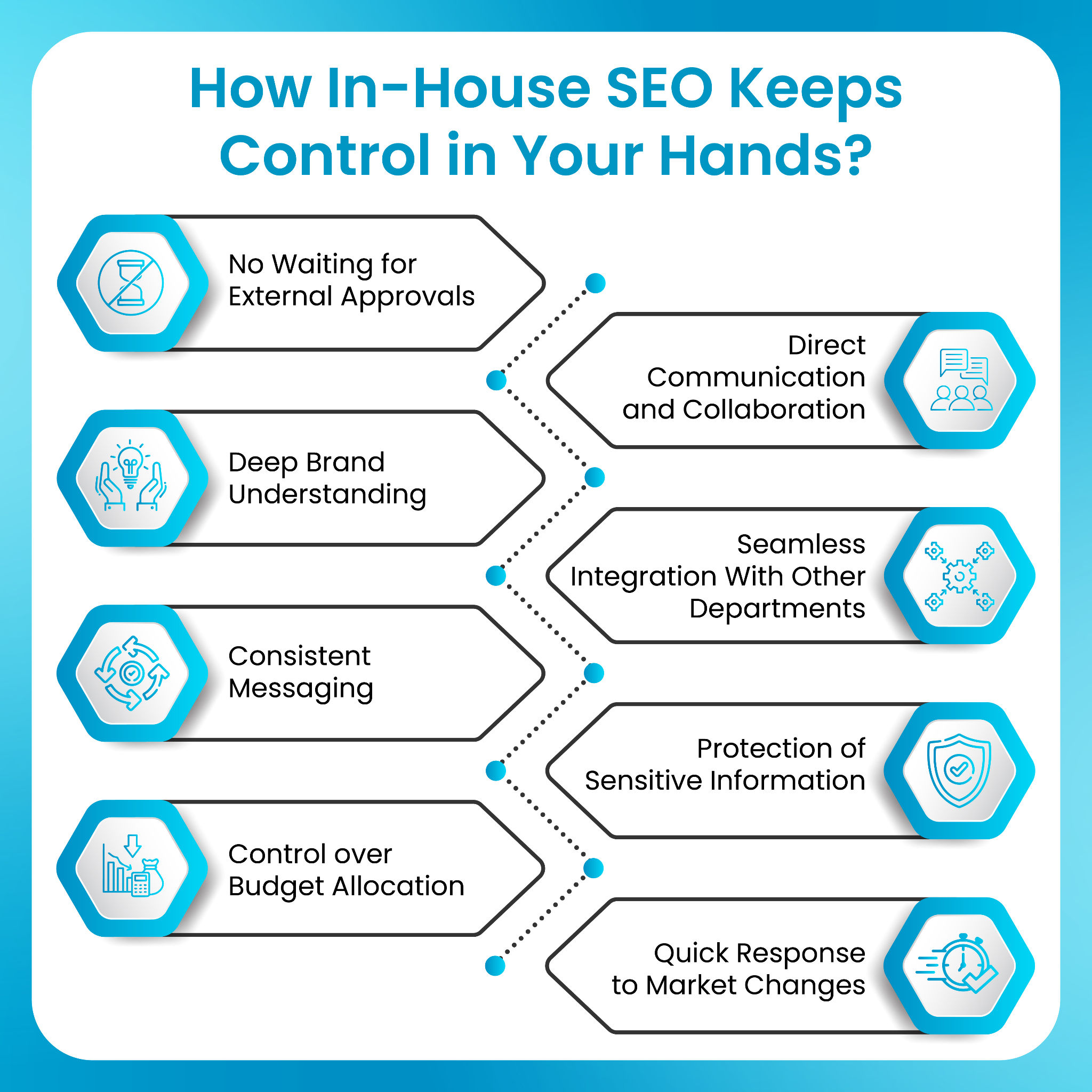
For these agencies, internal investment builds compounding capability over time. Each hire adds institutional knowledge. Each process refined internally becomes a competitive differentiator.
Outsourcing is not about replacing what works. It is about solving what is not working. Agencies that have already built strong internal SEO infrastructure often benefit more from optimizing that investment than from introducing an external partner.
Not every agency, however, has the resources or stage of growth to justify a full internal department. For many, outsourcing becomes not just practical but strategically sound.
Signs Your Agency May Be Ready to Outsource SEO
Knowing when to outsource is as important as knowing how. The following scenarios are consistent indicators that a white label SEO agency or outsourced fulfillment model deserves serious consideration.
- Your Team Is Consistently at Capacity: If your SEO team is running at full capacity every month and quality is starting to slip, adding more clients without adding resources is a losing equation. Outsourcing fulfillment creates immediate headroom without a slow hiring process.
- You're Declining SEO Opportunities: Turning away qualified leads because of bandwidth constraints is a direct revenue loss. If your agency is regularly declining SEO work that fits your client profile, that is a clear signal that your delivery model needs to expand.
- Hiring Is Slowing Business Growth: Recruiting experienced SEO professionals is genuinely difficult. If open roles are sitting unfilled for months and slowing your ability to onboard new clients, a white label SEO partner can bridge that gap while recruitment continues.
- Clients Need Specialized SEO Expertise: Technical SEO, enterprise-scale link building, and multilingual SEO require deep specialization. If your generalist team is being asked to deliver specialized work outside their core competency, quality will suffer. Outsourcing to specialists solves that problem directly.
- Demand Fluctuates Throughout the Year: Seasonal demand spikes are one of the strongest arguments for outsourcing. Hiring full-time staff to cover peak periods creates overhead that becomes a burden during slower months. A white label SEO firm scales with your workload.
- You Want to Launch SEO Without Building a Department: Many agencies want to add SEO to their service offering but are not ready to build an internal team from scratch. Partnering with the best white label SEO services provider allows agencies to launch the service immediately while generating revenue to eventually build internally if they choose.
According to available industry data, more than 54% of enterprise organizations outsource at least part of their SEO efforts. Across agency communities, discussions consistently highlight scalability, access to specialists, and avoiding hiring overhead as the primary reasons agencies adopt white label SEO while keeping strategy and client communication in-house.
Recognizing that outsourcing is the right move is only the first step. Choosing the wrong partner can create more problems than it solves.
Common Mistakes Agencies Make When Outsourcing SEO
The decision to outsource SEO does not guarantee better outcomes. How agencies manage the transition and the ongoing relationship determines whether outsourcing delivers on its promise.
These are the most common mistakes agencies make:
- Choosing providers based only on price: The cheapest option almost never delivers the quality, consistency, or communication that client relationships require.
- Expecting instant rankings: SEO timelines are measured in months, not weeks. Agencies that promise unrealistic results to clients set up the entire engagement for failure.
- Poor communication processes: Without structured handoffs and regular check-ins, execution gaps grow, and client satisfaction erodes.
- Lack of reporting standards: Inconsistent or unclear reporting creates friction with clients and obscures whether the work is actually performing.
- No quality assurance: Trusting deliverables without review introduces errors that damage your agency's credibility.
- Outsourcing strategy instead of execution: Your agency should own the strategic direction. Outsourcing strategy creates a disconnection from client goals.
- Overpromising client timelines: Agencies sometimes commit to deadlines based on vendor assurances rather than realistic delivery windows.
A clear division of responsibility helps prevent most of these issues.
Your agency should own:
- Client communication and relationship management
- Strategy and goal-setting
- Managing client expectations
Your outsourcing partner should handle:
- SEO execution and campaign management
- Technical SEO work
- Specialized deliverables
- Reporting support and data
Keeping that boundary clear protects your client relationships and ensures your partner delivers within a defined scope.
What to Look for in an SEO Outsourcing Partner?
Selecting the right white label SEO firm is a business-critical decision. The partner you choose will directly impact your clients' results and your agency's reputation.

Evaluate any prospective partner against these criteria:
- Proven SEO processes: Standardized, documented workflows that produce consistent outcomes across different clients and industries
- Transparent reporting: White label reporting tools and dashboards your agency can present directly to clients
- White label capabilities: Full behind-the-brand operation so your client relationship is never exposed or compromised
- Technical SEO expertise: Demonstrated capability in site audits, Core Web Vitals, crawlability, and structured data
- Content production: In-house writers or a managed content process aligned with SEO strategy
- Link-building standards: Ethical, scalable link acquisition with clear quality controls
- Scalability: Demonstrated ability to handle volume increases without quality degradation
- Dedicated support: A consistent point of contact rather than a rotating support queue
- Communication cadence: Regular updates, structured check-ins, and clear escalation paths
- Quality assurance: Formal review processes before deliverables reach your agency
Can They...
- Scale with my agency as client volume grows?
- Meet deadlines consistently, not just on the first project?
- Adapt to different industries and client types?
- Work entirely behind my agency's brand?
- Provide measurable, clear reporting that my clients can understand.
Asking these questions directly during the evaluation process separates credible partners from vendors offering surface-level promises.
Decision Framework for Agency Owners
Use this framework to identify the delivery model that fits your agency's current reality.
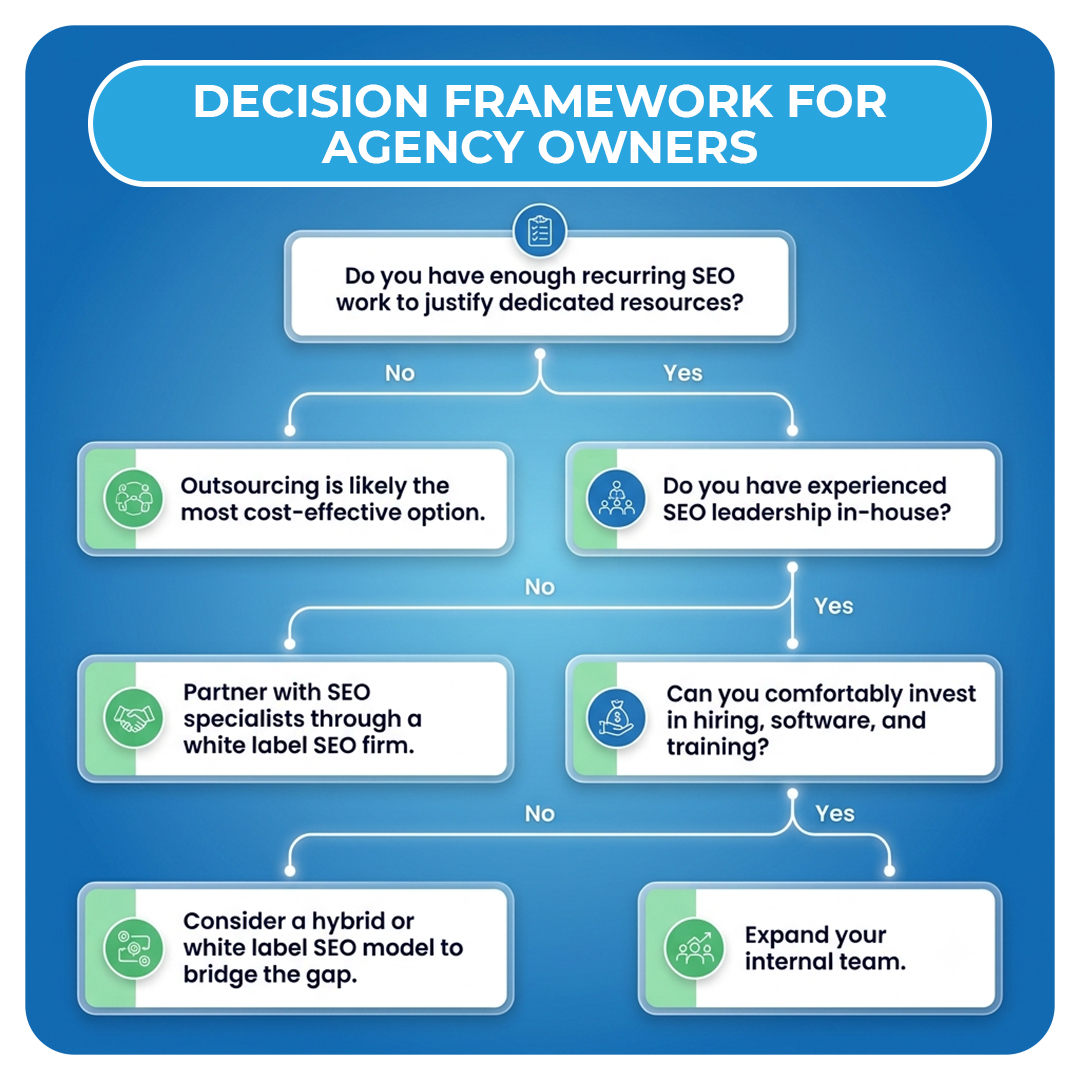
This framework does not prescribe a permanent answer. Agencies move through these stages as they grow. An agency that outsources today may have the revenue and infrastructure to hire internally in 18 months. The framework identifies what makes sense now, with the resources available now.
Many agencies land in a middle position that is neither fully internal nor fully outsourced, and that is often the most practical outcome.
Why a Hybrid SEO Model Often Delivers the Best of Both Worlds
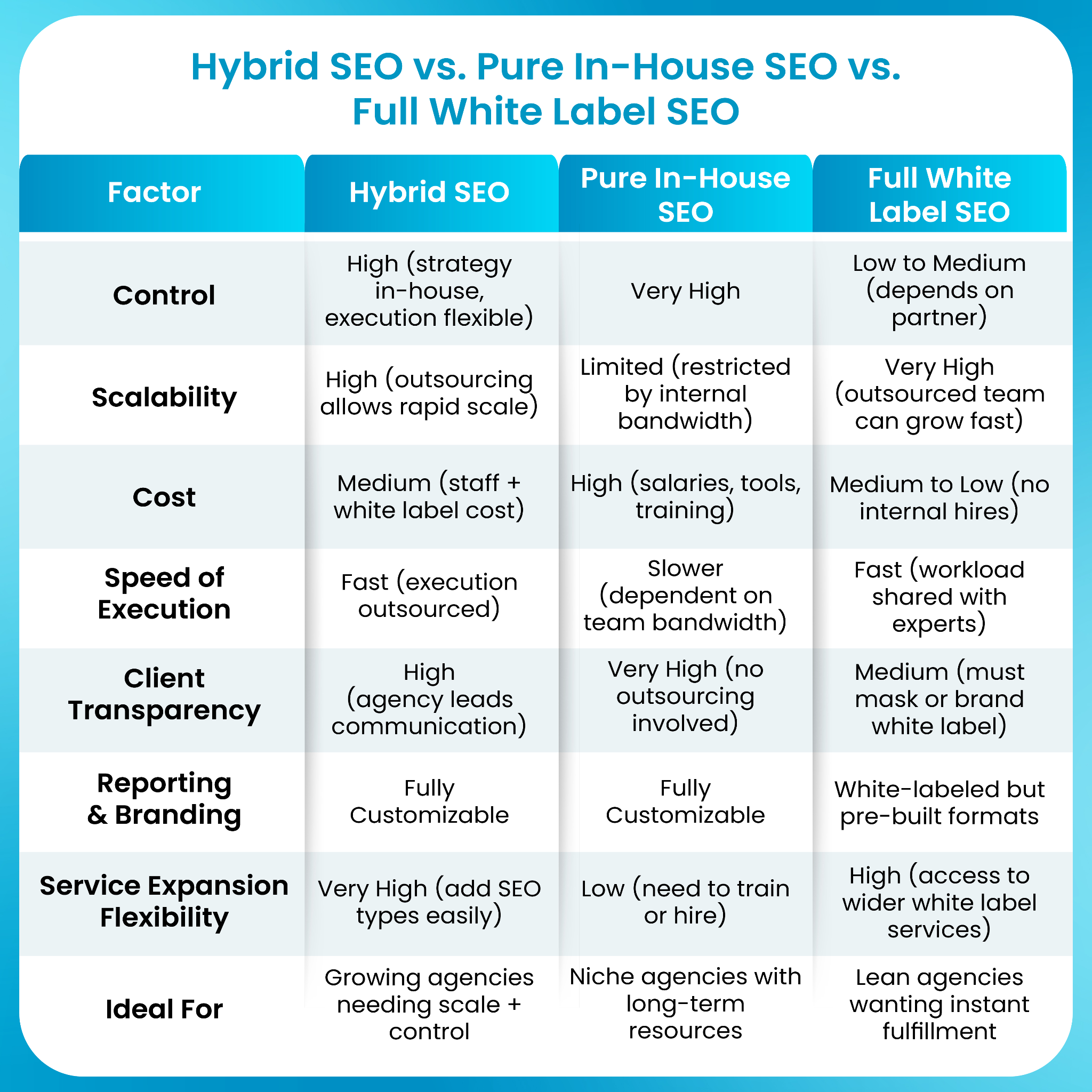
Outsourcing does not have to be all or nothing. A growing number of agencies build sustainable SEO practices by combining internal strategy with outsourced execution, keeping what benefits from internal ownership and delegating what scales more efficiently externally.
Keep In-House
- Overall SEO strategy and goal-setting
- Client communication and relationship management
- Sales and new business development
- Reporting reviews and performance conversations
Outsource
- Technical SEO audits and implementation
- Content production and optimization
- Link building and digital PR
- Comprehensive SEO audits
- Local SEO campaign management
- Overflow work during high-demand periods
This operating model gives agencies the flexibility to grow client volume without proportional increases in overhead. Internal teams stay focused on high-value, relationship-driven work. Outsourced partners handle execution at scale.
The result is an agency that can consistently deliver across a broader client base while maintaining the strategic oversight that protects long-term client satisfaction.
How DashClicks Helps Agencies Scale SEO With Confidence?
DashClicks operates as an operational partner for agencies that need reliable SEO fulfillment without the complexity of building and managing it internally.
White Label SEO Fulfillment
The white label SEO fulfillment solution covers every core component agencies need to deliver results:
- Technical SEO audits and on-site optimization
- Content creation aligned with keyword strategy
- Link building through quality acquisition processes
- In-depth keyword research and competitive analysis
- Local SEO campaign management
- Comprehensive SEO audits with actionable recommendations
Every deliverable is completed under your agency's brand, keeping your client relationship exactly where it belongs.
Proven Processes and Consistent Execution
SEO services are delivered through standardized workflows built to produce reliable outcomes across different industries and client types. Structured processes reduce variability, improve delivery timelines, and ensure that what gets handed to your clients meets a consistent quality standard regardless of workload volume.
Transparent Reporting
Reporting is one of the most common friction points in outsourced SEO relationships. The solution addresses this directly with:
- White label reporting your agency can present under its own brand
- White label dashboard built for clarity, not complexity
- Measurable performance data tied to the metrics that matter to your clients
- Reporting structures that support clear, confident client communication
Scalable Operational Support
The platform is designed to grow with your agency, not create a ceiling on how far it can grow. Working with DashClicks, agencies can:
- Increase fulfillment capacity without adding internal headcount
- Launch SEO services faster than a traditional hiring timeline allows
- Reduce hiring pressure during periods of rapid client growth
- Scale up or down in response to real demand without fixed overhead consequences
The combination of expert fulfillment, structured processes, transparent reporting, and scalable support allows agencies to grow confidently while maintaining high-quality SEO delivery for every client on their roster.
Build the SEO Delivery Model That Fits Your Agency
Outsourcing SEO is not about replacing an internal team. It is about making intentional operational decisions that allow your agency to grow without sacrificing quality or burning out the people responsible for delivering results.
Every agency is different. Some will thrive by investing in strong internal SEO teams. Others will build efficient practices through white label SEO partnerships. Many will find the right balance through a hybrid model that combines internal strategy with outsourced execution.
The delivery model that serves your agency best is the one that lets you:
- Deliver consistent quality at the volume your clients expect
- Scale profitably without unsustainable overhead
- Protect the client relationships your agency has built
- Adapt quickly when demand increases or shifts
Agencies that take the time to assess their operational constraints honestly, evaluate their options clearly, and choose a delivery model intentionally are the ones that build SEO practices capable of sustaining long-term growth. The agencies still guessing will be catching up to them.

How to Eliminate Facebook Ads Execution Bottlenecks and Scale Your Agency Faster
Facebook Ads remain one of the most powerful paid advertising channels available to businesses today. With the ability to reach approximately 2.28 billion users worldwide, Facebook gives advertisers unmatched access to a massive, highly targetable audience. That reach has driven significant growth in advertiser demand, with more businesses investing in Facebook advertising than ever before.
For digital marketing agencies, this surge in demand is both an opportunity and a challenge. Selling Facebook Ads services is rarely the hard part. The real difficulty begins the moment a client signs. Agencies frequently discover they can win new business faster than their teams can deliver it, creating a growing gap between what has been sold and what can actually be executed.
This gap is the result of execution bottlenecks, and they are one of the most common barriers to sustainable agency growth. Bottlenecks slow campaign delivery, strain internal teams, and limit how many clients an agency can realistically serve at once. Understanding where they come from and how to eliminate them is critical for any agency that wants to scale beyond its current capacity. Winning new clients is only half the challenge. The real operational difficulties begin after onboarding.
What Are Facebook Ads Execution Bottlenecks?
Before solving the problem, it helps to understand exactly what execution bottlenecks are and where they appear in the agency workflow.
An execution bottleneck is any process, constraint, or resource limitation that slows down or delays campaign delivery after a client has signed. These are distinct from sales bottlenecks, which affect lead generation and closing rates, and they require a completely different set of solutions.
Common execution bottlenecks include:
- Campaign setup delays caused by limited internal bandwidth
- Creative production backlogs when ad content cannot be produced fast enough
- Audience research delays that push back launch timelines
- Pixel installation issues that stall accurate tracking
- QA and approval processes that create unnecessary friction
- Reporting delays that consume hours of team time each month
- Optimization backlogs that prevent proactive campaign management
- Limited account manager capacity that reduces client communication quality
Agencies rarely stop growing because they cannot sell their services. They stop growing because the fulfillment side of the business cannot keep pace with the volume of work being sold. These slowdowns eventually ripple across the entire client lifecycle, affecting launch timelines, optimization quality, reporting accuracy, and overall client satisfaction.
7 Signs Your Agency Has a Facebook Ads Execution Bottleneck
Execution bottlenecks rarely appear overnight. They develop gradually, often disguised as minor delays or temporary team pressures, before becoming significant operational problems. Recognizing the warning signs early allows agencies to address them before they begin affecting the agency-client relationship and revenue.
- Campaign Launches Keep Getting Delayed: When campaigns consistently miss their planned launch dates, client confidence erodes quickly. Delayed launches mean delayed results, and delayed results give clients every reason to question whether they made the right decision. Beyond the relationship damage, launch delays also push back billing cycles, which has a direct impact on agency cash flow.
- Your Media Buyers Are Overloaded: Overloaded media buyers face an impossible tradeoff. When account managers are responsible for too many campaigns, the time available for optimization shrinks. Accounts receive less attention, testing slows down, and performance suffers. Overloaded teams also make more errors, which creates additional rework and compounds existing delays.
- Client Onboarding Takes Too Long: A slow onboarding process sets a poor first impression and delays the start of billable campaign activity. When agencies lack standardized onboarding systems, every new client requires custom handling, which multiplies the time investment for each new account. Clients notice when onboarding feels disorganized, and that perception is difficult to recover from.
- Reporting Consumes Hours Every Month: Manual reporting is one of the most time-intensive operational tasks in an agency. According to Databox research, agency teams spend an average of 4.8 hours per client each month on reporting alone, excluding the time required for performance analysis. At five clients, that is 24 hours of monthly work. At twenty clients, it becomes a full-time job. Agencies that rely on manual reporting will eventually reach a point where the time required simply does not scale.
- Creative Requests Pile Up: When creative production cannot keep up with campaign demand, approvals stall and launch timelines extend. Creative backlogs are particularly common in agencies that have grown their client base without building a structured production workflow. The result is a constant queue of pending requests that blocks progress across multiple accounts simultaneously.
- Team Members Are Constantly Firefighting: An agency operating in reactive mode is not optimizing. When team members spend their days responding to problems rather than proactively improving campaign performance, results plateau and client retention suffers. Firefighting is a symptom of an operation that lacks the structure and capacity to stay ahead of its workload.
- You're Turning Away Potential Clients: The clearest sign of a capacity problem is turning away new business. When agencies cannot take on additional clients because fulfillment is already stretched, every rejected lead represents lost revenue. This is the point where execution bottlenecks stop being an internal inconvenience and start actively limiting agency growth.
Each of these issues may seem manageable in isolation. Together, they create a compounding effect that significantly reduces profitability, team performance, and the agency's ability to grow.

Why Execution Bottlenecks Hurt Agency Growth?
Execution bottlenecks do more than slow campaign launches. They affect the entire agency in ways that compound over time, making it increasingly difficult to grow without first addressing the underlying operational constraints.
- Lost Revenue: Agencies with constrained fulfillment capacity cannot accept new clients at the rate the market demands. Every client turned away or delayed represents direct revenue loss. Capacity ceilings become revenue ceilings.
- Lower Client Retention: When campaigns launch late and results take longer to materialize, clients question the value of the service. Retention rates drop when clients feel their investment is not being managed with urgency and consistency.
- Lower Margins: Excessive manual labor, rework, and inefficient workflows drive up the cost of delivering each campaign. As operational costs rise without a corresponding increase in client volume, profit margins shrink.
- Founder Burnout: When fulfillment breaks down, agency owners often step back into execution to keep things running. This pulls founders away from business development, strategy, and leadership, creating a ceiling on growth that is tied directly to the owner's personal bandwidth.
- Poor Team Morale: Constant operational pressure, unclear priorities, and reactive workflows take a measurable toll on team morale. High-pressure environments with no clear path to relief lead to turnover, which only adds to the operational burden.
These individual impacts combine to create what is commonly referred to as the Sales-to-Service Gap: the difference between how many clients an agency sells and how many it can actually serve well. Selling 20 new clients in a month has little value if only 12 campaigns successfully launch on schedule. Agencies often recognize this gap and attempt to close it in the most obvious way possible, by hiring more staff.
Why Hiring More Staff Isn't Always the Answer?
Adding headcount feels like a logical response to a capacity problem. In practice, hiring rarely solves a bottleneck as cleanly or as quickly as agency owners expect.
1. Hiring More Media Buyers
Recruiting qualified media buyers takes time, often weeks or months. Once hired, new team members require training, access setup, and time to reach full productivity. Throughout that ramp-up period, payroll costs accumulate while additional output remains limited. By the time a new hire is fully operational, the backlog may have already grown larger.
2. Using Freelancers
Freelancers offer a faster path to additional capacity, but they introduce their own challenges:
- Availability is unpredictable and often tied to other client commitments
- Communication across time zones and platforms adds friction to workflows
- Quality consistency varies, requiring additional QA oversight that consumes internal management time
3. Growing Internal Teams
Building a larger internal team creates management overhead that scales with headcount. More staff requires more:
- Standard operating procedures to maintain consistency
- QA processes to catch errors before they reach clients
- Scheduling coordination to manage coverage during vacations and sick leave
- Leadership time that could otherwise go toward growth

Increasing headcount addresses symptoms rather than the underlying system. Without scalable delivery processes in place, a larger team often means a larger version of the same operational problems. A more sustainable path requires rethinking how fulfillment is structured, not just how many people are performing it.
How White Label Facebook Ads Eliminate Execution Bottlenecks?
White label Facebook Ads fulfillment gives agencies the ability to increase operational capacity without adding internal complexity.
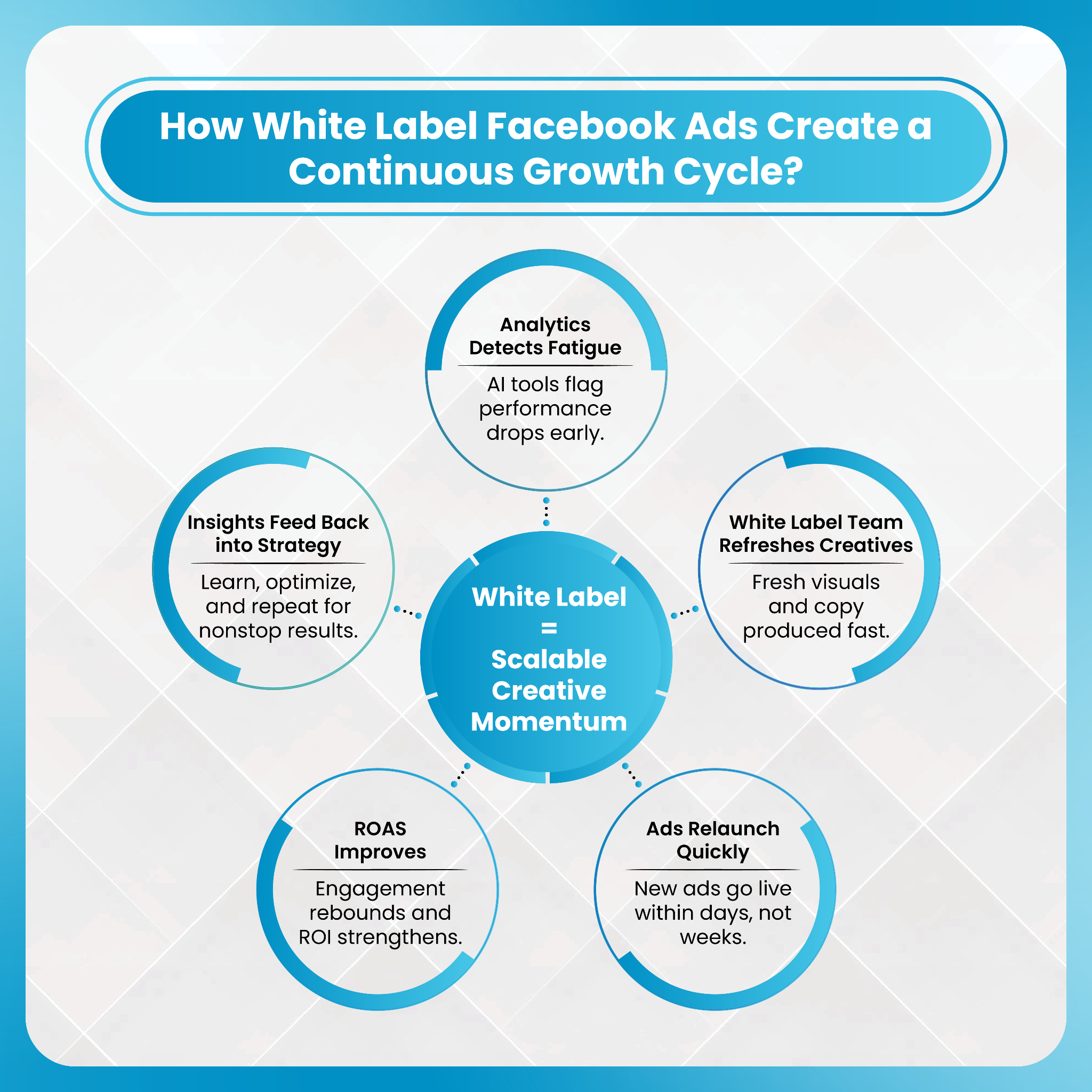
Rather than hiring and managing additional staff, agencies partner with a specialized fulfillment provider that handles campaign execution under the agency's brand.
- Faster Campaign Launches: White label partners maintain dedicated teams ready to begin work immediately. There is no waiting for internal bandwidth to open up, no competing priorities across accounts, and no ramp-up time for new hires.
- Specialized Experts: Experienced Facebook Ads professionals who work exclusively on paid social campaigns bring a depth of expertise that generalist hires cannot replicate quickly. Specialized knowledge improves campaign quality and reduces the likelihood of costly errors.
- Flexible Capacity: White label fulfillment scales up or down based on client volume. Agencies can take on new business during growth periods without committing to permanent headcount increases during slower months.
- Better Workflow: Dedicated fulfillment teams operate with established processes designed specifically for campaign execution. Structured workflows reduce friction, minimize errors, and create predictable timelines across every account.
- Consistent Optimization: Reliable fulfillment partners conduct regular testing and systematic campaign improvements rather than making reactive adjustments when performance drops.
- Reliable Reporting: Automated reporting systems replace manual data collection, saving hours of team time each month while delivering consistent, accurate performance data to clients.
- Predictable Turnaround Times: Defined service-level agreements and structured delivery schedules create a consistent client experience that builds trust and reduces the reactive communication that consumes account manager time.
Throughout this entire process, the agency remains the client-facing relationship owner. The fulfillment partner operates behind the scenes, handling execution while the agency focuses on strategy, client relationships, and new business development. White label fulfillment does not replace the agency. It gives the agency the operational foundation it needs to grow.
Facebook Ads Tasks That Can Be Outsourced
The range of tasks available for white label Facebook ads fulfillment is broader than many agency owners initially realize. The table below outlines the core campaign functions that can be outsourced and the primary operational benefit each one delivers.

Outsourcing these repetitive, time-intensive operational tasks frees internal teams to focus on what drives agency growth: client strategy, relationship management, and business development. Rather than spending the day inside ad accounts, account managers can invest their time in proactive communication, upselling, and building the long-term client relationships that drive retention.
Building the right fulfillment infrastructure is one piece of the equation. Pairing it with clear internal processes ensures the results are sustainable.
Best Practices to Prevent Facebook Ads Bottlenecks
Operational systems create the foundation for scalable growth. Agencies that proactively build structured workflows are far better positioned to absorb new business without disrupting existing client delivery.
Key practices that reduce execution bottlenecks include:
- Standardizing onboarding so every new client follows the same intake process
- Creating repeatable workflows for campaign setup, QA, and reporting that remove guesswork at every stage
- Using project management tools to track task ownership, deadlines, and progress across all active accounts
- Defining approval processes clearly so creative reviews and client sign-offs do not become open-ended delays
- Monitoring operational KPIs consistently, including time-to-launch, client onboarding time, campaign QA time, and reporting turnaround
- Automating repetitive tasks such as data collection, performance alerts, and scheduled reports
- Partnering with reliable fulfillment providers who operate with defined service-level standards
- Conducting weekly capacity reviews to identify pressure points before they become bottlenecks
Tracking the right metrics is particularly important. KPIs like time-to-launch and onboarding time make operational problems visible before they grow into client-facing issues.
The importance of ongoing optimization cannot be understated. According to the 2025 benchmark report, while traffic campaign click-through rates improved year over year, lead campaign cost per lead increased by approximately 21%. That figure reinforces a critical point: Facebook Ads performance does not sustain itself. Campaigns require active, consistent management to remain efficient. For agencies, this means fulfillment processes must support regular optimization rather than simply maintaining the status quo.
Operational systems reduce bottlenecks significantly. As agencies continue to grow, however, internal processes alone may not be sufficient to sustain the pace of delivery that growth demands.
When Is the Right Time to Use White Label Facebook Ads Support?
There is no single trigger point that signals when an agency should engage white label Facebook Ads support. The decision depends on a combination of operational signals that, when present together, indicate that internal capacity has reached its ceiling.
Agencies should seriously consider white label support when they are:
- Consistently operating at or near full capacity with no bandwidth for new accounts
- Experiencing recurring campaign launch delays that affect client satisfaction
- Still managing campaigns at the founder level rather than delegating fully to a team
- Seeing client acquisition outpace their ability to fulfill campaigns to a high standard
- Finding that hiring costs reduce the margins that make new accounts profitable
- Noticing increasing signs of staff burnout or disengagement
- Regularly turning away new business because there is no capacity to onboard additional clients
White label support works best when it is treated as a proactive growth strategy rather than a reactive fix. Agencies that build fulfillment partnerships before hitting their operational ceiling are able to scale smoothly, without the disruption that comes from trying to solve a capacity crisis in real time.
For agencies ready to build that infrastructure, DashClicks offers a purpose-built solution designed specifically around the challenges discussed throughout this post.
How DashClicks Helps Agencies Remove Facebook Ads Execution Bottlenecks?
DashClicks is built to give digital marketing agencies the operational capacity they need to scale Facebook Ads fulfillment without increasing internal complexity. Rather than requiring agencies to hire, train, and manage additional staff, DashClicks handles campaign execution while agencies maintain full ownership of the client relationship.
1. White Label Facebook Ads Fulfillment
DashClicks manages the complete fulfillment workflow, including campaign setup, audience targeting, ongoing optimization, and day-to-day campaign management. Agencies using white label Facebook ads management can deliver campaigns at scale without the internal bandwidth constraints that typically limit growth. The service operates entirely under the agency's brand, keeping the client relationship intact.
2. Dedicated Facebook Ads Specialists
DashClicks assigns experienced Facebook Ads professionals who specialize in paid social campaign execution. Dedicated specialists bring focused expertise to each account, which improves campaign quality, reduces setup errors, and shortens delivery turnaround times compared to generalist internal hires.
3. Transparent Reporting
Reporting is delivered through white label performance dashboards that are designed for client-facing use. Agencies receive clear, accurate performance visibility without spending hours on manual data compilation. Reports are formatted to communicate results in a way that clients can understand, reducing back-and-forth and strengthening the value perception of the service.
4. Scalable Operational Support
DashClicks is structured to grow alongside the agencies it supports. As client volume increases, fulfillment capacity scales accordingly, without the hiring costs, training timelines, or management overhead that internal growth requires. Agencies working with DashClicks can:
- Increase fulfillment capacity on demand as new clients are onboarded
- Reduce operational bottlenecks without restructuring internal teams
- Maintain consistent service quality across all active accounts
- Scale the delivery side of the business without scaling headcount
The combined result is an agency that spends less time managing operations and more time focused on growth, strategy, and client relationships.
Build an Agency That Scales With Demand
Facebook Ads demand is growing, and agencies that cannot execute at scale will consistently lose ground to competitors that can. Execution bottlenecks are not simply operational inconveniences. They reduce profitability, slow client acquisition, increase team burnout, and create a ceiling on how large an agency can realistically grow.
Hiring more staff can provide temporary relief, but it rarely addresses the underlying systems that create bottlenecks in the first place. Scalable growth requires scalable delivery infrastructure, and that is precisely what white label Facebook Ads fulfillment provides.
Agencies that build repeatable, outsourced fulfillment systems gain back the time, capacity, and energy required to focus on what actually grows the business: selling, strategizing, and building strong client relationships. The operational work still gets done, just through a structure designed to handle volume without breaking down.
Agencies that remove execution bottlenecks today are not simply solving a current problem. They are building the operational foundation that positions them for sustainable, long-term growth as demand for Facebook advertising continues to increase.


How to Educate Clients About SEO and Earn Their Trust
Many businesses invest in SEO without fully understanding how it works or why it takes time to deliver meaningful results. They sign on expecting fast wins, then grow anxious when the rankings don't shift overnight. This gap between expectation and reality is one of the biggest sources of friction in the agency-client relationship.
When clients don't understand SEO timelines, they tend to ask the same questions over and over. Why aren't we ranking yet? What exactly are we paying for? When will we see a return? These questions are completely fair, but they often stem from a lack of context rather than poor performance.
Educating clients doesn't mean turning them into SEO experts. It means helping them understand a few key things:
- Why specific SEO activities matter
- What realistic timelines actually look like
- How success should be measured beyond keyword rankings
When you communicate transparently and report consistently, something powerful happens. Clients begin to trust the process. They stop panicking over small fluctuations and start seeing the bigger picture. That trust strengthens relationships and directly improves retention.
This is also where white label SEO services can make a real difference. By providing organized execution and client-friendly reporting, they make the education process far easier for agencies to manage. Instead of scrambling to explain confusing data, you get clean, structured insights that practically tell the story for you.
Let's start by looking at why SEO education matters so much in the first place.
Why Does SEO Client Education Matter?
SEO remains one of the most misunderstood marketing channels for business owners. It's invisible, technical, and slow by nature, which makes it hard to grasp for anyone outside the industry. That confusion is exactly why education is so valuable.
There's a clear relationship between education, trust, and retention. Clients who understand what they're paying for are far more likely to stay patient, stay engaged, and stay subscribed. Those who don't understand tend to churn the moment results dip.
Informed clients also make better strategic decisions. When they understand the value of content, technical health, and authority building, they're more willing to approve the work that drives long-term results. Agencies that educate clients proactively run into fewer misunderstandings and spend less time defending their work.

Image Source: Backlinko
Consider what search behavior tells us:
- 68% of online experiences begin with a search engine. For clients, this means search visibility isn't optional. It's where most customer journeys start, so showing up matters more than almost anything else.
- SEO drives over 1,000% more traffic than organic social media. This statistic helps agencies frame SEO as a high-impact channel rather than a slow afterthought, especially compared to platforms clients often prioritize.
When you explain these numbers in plain terms, clients begin to see SEO as an investment in where their customers already are. That reframing shifts the conversation away from impatience and toward strategy.
The takeaway is simple. Educated clients are far more likely to stay committed, even when rankings or traffic naturally fluctuate. They understand that dips are part of the process, not a sign of failure.
With that foundation in place, let's look at the specific concepts every client should understand.
The SEO Concepts Every Client Should Understand
Clients don't need to understand technical SEO to be good partners. They do, however, need to grasp a handful of core concepts that shape realistic expectations. These ideas help them interpret progress accurately and stay calm when results take time.
1. SEO Is a Long-Term Investment
SEO is not a switch you flip. It requires continuous optimization over weeks and months to build momentum.
- Search engines need time to crawl, evaluate, and trust the changes you make.
- Rankings improve gradually as your content, authority, and technical health strengthen.
- Sustainable results are built layer by layer, not all at once.
Here's a statistic that puts this into perspective: only 5.7% of newly published pages rank in Google's Top 10 within one year (Ahrefs). That means even strong content often needs time to climb. When clients understand this, they stop expecting page-one results in the first month and start appreciating steady progress.
2. Rankings Alone Don't Define Success
Keyword positions are easy to obsess over, but they don't tell the full story. A number-one ranking for the wrong keyword can deliver almost no value.
Instead, guide client conversations toward metrics that actually affect their business:
- Qualified traffic that matches their ideal customer
- Leads generated from organic search
- Conversions that turn visitors into customers
- Revenue tied directly to SEO efforts
When clients focus on outcomes rather than individual rankings, they make smarter decisions and feel more confident in the work.
3. SEO Requires Continuous Improvement
SEO is never truly finished. The landscape shifts constantly, which means optimization has to keep pace.
- Algorithm updates change how search engines evaluate pages.
- Competitor activity can push your client's rankings up or down.
- Content freshness signals relevance to search engines.
- Technical optimization keeps the site healthy and crawlable.
Framing SEO as an ongoing process, rather than a one-time project, helps clients understand why monthly work is essential.
4. Some Factors Are Beyond Anyone's Control
It's important to set honest boundaries around what any agency can promise. Several factors sit outside everyone's control.
- Google algorithm updates can reshape rankings overnight.
- Seasonality affects search demand throughout the year.
- Competitor investments can sift through the competitive landscape quickly.
The goal here is transparency, not guarantees. Clients respect honesty far more than empty promises, and it protects your credibility when things fluctuate.

Image Source: Backlinko
Once clients understand these concepts, the next challenge is communicating them clearly without overwhelming anyone.
How to Educate Clients Without Overwhelming Them?
Successful client education is about simplifying information, not burying clients in SEO jargon. The goal is clarity. When you make complex ideas easy to understand, clients feel informed rather than intimidated.
1. Speak Their Language
Technical terms mean nothing to most business owners. Instead of using insider language, translate it into outcomes.
For example, rather than mentioning:
- Crawl budget
- Canonicals
- Schema markup
Explain what those efforts achieve in business terms, like helping the right pages get found or preventing search engines from wasting time on the wrong content.
2. Connect SEO to Business Goals
Clients care about their business, not your tactics. So tie every SEO activity back to something they value.
- More qualified leads are coming through organic search
- Better visibility in front of the right audience
- Increased revenue opportunities over time
- Local market growth in the areas that matter most
When clients see SEO as a path to their goals, they stay invested in the work.
3. Make Reports Tell a Story
A dashboard full of numbers can confuse more than it clarifies. Reports should guide clients through a clear narrative.
- What changed during the reporting period
- Why it changed and what drove the movement
- What happens next in the strategy
A story-driven report turns raw data into insight, which builds confidence with every update.
4. Set Expectations Early
The best time to manage client SEO expectations is at the very beginning. Honest timeline conversations prevent disappointment later.
- Set clear expectations about how long results take
- Outline monthly milestones, so progress feels tangible
- Explain what clients should expect during the first 90 to 180 days

This early framing matters because SEO pays off over time. HubSpot consistently ranks SEO among the highest ROI marketing channels over the long term, so setting a long-game mindset early helps clients appreciate the eventual payoff.
Educating clients becomes far easier when agencies have consistent fulfillment systems supporting every campaign. Let's look at how that works.
How White Label SEO Services Help Agencies Build Client Trust?
Agencies can educate clients more effectively when campaigns are delivered consistently, and progress is easy to communicate. When execution is reliable and reporting is clear, conversations with clients become smoother and far more productive.
1. Professional Reporting Builds Confidence
Strong reporting reassures clients that work is happening and progress is real. A white label SEO agency typically provides:
- Easy-to-understand dashboards that simplify complex data
- Branded reports that reinforce your agency's professionalism
- Regular performance updates that keep clients informed
These reports give clients a clear window into the work, which builds confidence over time.
2. Reliable Execution Reinforces Trust
Consistency is the foundation of trust. When work is delivered each month dependably, clients learn they can count on you.
Reliable execution usually includes:
- Content optimization
- Technical SEO
- Link building
- Local SEO
Delivering these consistently shows clients that the strategy is moving forward as promised.
3. Agencies Gain More Time to Communicate
Handling fulfillment in-house eats up enormous amounts of time. White label SEO frees agencies to focus on the relationship instead of the execution.
That extra time can go toward:
- Strategy meetings
- Client education
- Relationship building
- Performance discussions
More communication time means stronger, more trusting partnerships.
4. Expert Support Improves Client Conversations
A good white label provider does more than execute. They give agencies the insights needed to have better conversations.
- Strategy recommendations grounded in real expertise
- Reporting insights that explain what the data means
- Performance explanations that make client updates easier
Trust grows through consistent communication supported by consistent execution. When both work together, clients feel secure in their decision to stay.

This is exactly where the right operational partner can make all the difference.
How DashClicks Helps Agencies Educate Clients and Build Long-Term Trust?
DashClicks serves as the operational backbone that helps agencies educate clients more effectively while delivering consistent SEO services. It combines execution, reporting, and structure so agencies can focus on what matters most: the client relationship.
1. Strategic SEO Planning
Strong client education starts with a clear plan. DashClicks supports agencies through:
- Strategic keyword research that targets the right opportunities
- SEO roadmaps that outline the path forward
- Prioritized recommendations so the most impactful work comes first
- Goal-focused planning aligned with each client's objectives
This structure makes it easy to explain to clients exactly what's being done and why.
2. Consistent White Label SEO Fulfillment
Reliable delivery is the heart of client trust. DashClicks provides consistent white label SEO fulfillment, including:
- Content optimization
- Technical SEO
- Link building
- Local SEO
- Reliable monthly execution
Consistent fulfillment reinforces client confidence because agencies consistently deliver what they communicate. When you say the work will happen, it happens.
3. Transparent Reporting
Clear reporting removes confusion and builds credibility. DashClicks offers:
- White label reports branded as your own
- Performance dashboards that simplify the data
- Progress tracking that shows momentum over time
- Reporting that connects SEO activities to business outcomes
This kind of transparency reduces confusion and helps agencies educate clients far more effectively.
4. More Time for Client Education
By outsourcing fulfillment to DashClicks, agencies reclaim the time they would have spent on execution. That time can be reinvested into:
- Client strategy sessions
- Performance reviews
- Goal alignment
- Relationship building
- Proactive communication
The overall outcome is powerful. DashClicks helps agencies build stronger trust by combining expert execution, transparent reporting, scalable fulfillment, and structured SEO processes. This allows agencies to improve client retention while scaling without increasing internal workload.
All of this leads to one simple truth about the value of client education.
Turn SEO Education Into Long-Term Client Relationships
Client education isn't just a nice-to-have. It's a strategy that pays off in retention, referrals, and growth. Educated clients behave differently from confused ones, and the difference shows up directly in your bottom line.
Clients who understand SEO tend to:
- Hold realistic expectations about timelines and results
- Better understand the value of ongoing optimization
- Stay with agencies longer because they trust the process
- Refer additional businesses based on their positive experience
- Expand service agreements over time as trust deepens
Agencies that work with a reliable white label SEO agency can consistently educate clients while maintaining operational efficiency. You get the best of both worlds: better communication and smoother delivery.
Seen this way, client education becomes a long-term competitive advantage. It strengthens retention, builds reputation, and fuels sustainable growth in a market where many agencies struggle to keep clients beyond a few months.

15 Questions to Ask Before Choosing a White Label PPC Partner
Most agencies evaluate a white label PPC partner based on pricing, turnaround times, and platform expertise. Those factors matter, but they rarely determine whether the partnership succeeds over the long term.
A white label PPC agency is more than a fulfillment provider. It becomes an extension of your agency, influencing campaign performance, client retention, profitability, operational efficiency, and your overall reputation. When your partner delivers consistent results, your clients stay satisfied. When they fall short, your agency bears the consequences.
The challenge is that many agencies lack a structured process for evaluating a white label PPC reseller. Decisions are often based on referrals, sales calls, or first impressions rather than a thorough assessment of long-term capabilities.
This makes careful evaluation essential. According to research, B2B buyers are nearly 70% through their purchasing process before engaging with a vendor, and 80% already have a preferred vendor before the first conversation. Agencies should apply the same level of diligence when choosing a partner.
This guide provides a practical framework to help you evaluate potential partners, ask the right questions, and identify providers that can support your agency's long-term growth.
Before evaluating specific providers, agencies first need to understand why choosing the wrong partner can become far more expensive than simply paying a higher monthly fee.
Why Choosing the Wrong White Label PPC Partner Can Cost More Than You Think?
A poor white label PPC partner affects far more than campaign performance. The impact often spreads across client relationships, team productivity, profitability, and your agency's reputation.
Common consequences include:
- Missed client KPIs that put accounts at risk.
- Poor communication creates uncertainty.
- Inconsistent campaign management and unpredictable results.
- Damaged agency-client relationship when performance questions go unanswered.
- Increased client churn and lower profitability.
- Time spent fixing issues instead of growing your agency.
- Harm to your agency's reputation and future sales opportunities.
These problems compound over time. A missed KPI leads to difficult client conversations, increased account management time, and lower account profitability.
A white label PPC partner is not simply a fulfillment provider. They directly influence client satisfaction, retention, and long-term agency growth. Evaluating providers on price alone overlooks the factors that truly determine success.
Once you understand what's at stake, the next step is to ask better questions during the evaluation process.
Category 1: Questions About PPC Expertise and Strategy
Technical expertise and strategic thinking are the foundation of successful PPC campaigns. This category helps determine whether a provider can consistently deliver results.
Question #1: What PPC Platforms Do You Actively Manage?
Not every provider specializes across every advertising platform. Ask which platforms they manage daily rather than relying on a list of logos on their website.
Look for expertise in:
- Google Ads
- Microsoft Ads
- YouTube Ads
- Performance Max
- Display campaigns
- Local Services Ads
Each platform requires different strategies, bidding models, and optimization techniques. A capable partner matches platforms to business goals rather than applying the same approach everywhere.
Question #2: Do You Have Experience in My Clients’ Industries?
Industry experience shortens onboarding and improves campaign performance.
Ask whether they've managed campaigns in industries such as:
- Home services
- Legal
- Healthcare
- SaaS
- Ecommerce
Industry knowledge often leads to stronger keyword selection, better ad copy, and more realistic performance expectations.
Question #3: How Do You Develop Campaign Strategy?
A strong white label PPC agency should build every campaign around research instead of templates.
Look for a planning process that includes:
- Market research
- Competitor analysis
- Audience segmentation
- Conversion-focused planning
Avoid providers that launch campaigns without a defined strategic framework.
Question #4: How Do You Handle Campaign Plateaus?
Even successful campaigns eventually plateau. The best providers use structured processes to restore growth.
Look for:
- Structured testing frameworks
- Audience expansion strategies
- Landing page recommendations
- Data audits
A provider focused on campaign revitalization will continue creating growth after the initial wins.
Technical expertise is only part of the equation. Agencies also need complete transparency into how campaigns are managed and communicated.
Further Reading: Why Most PPC Campaigns Stall and How White Label PPC Teams Fix Them
Category 2: Questions About Transparency and Communication
Strong communication is essential to a successful white label partnership. When your white label PPC partner communicates clearly, you can confidently update clients, explain performance, and build trust. Poor communication, on the other hand, leaves your agency answering questions without complete visibility.
This category helps you evaluate how a provider communicates, responds to issues, and keeps your agency informed.
Question #5: Who Will Be Managing My Accounts?
Knowing who manages your clients' campaigns provides insight into the consistency and quality of service you can expect.
Ask whether you'll work with:
- A dedicated PPC strategist or a pooled team.
- Experienced specialists or junior account managers.
- A clearly defined escalation process for urgent issues.
A dedicated point of contact often improves continuity, accountability, and long-term campaign performance.
Question #6: How Often Will We Communicate?
Communication expectations should be established before the partnership begins. Inconsistent updates often lead to unnecessary frustration and misunderstandings.
Ask about:
- Regular strategy or performance meetings.
- Slack or other real-time communication channels.
- Scheduled email updates.
- Emergency response procedures for account issues.
Providers with structured communication processes are easier to trust with client-facing work.
Question #7: Can I See Exactly What Changes Are Being Made?
Transparency is critical because your agency remains accountable for every client campaign.
Look for visibility into:
- Budget adjustments.
- Bid changes.
- Creative testing and new ad variations.
- Campaign restructures and optimization updates.
Clear account visibility makes it easier to explain performance, justify decisions, and strengthen client confidence.
Question #8: What Happens When a Campaign Underperforms?
Every PPC campaign experiences periods of lower performance. The key difference is how a provider responds.
Look for a process that includes:
- Proactive communication.
- Root-cause analysis.
- Action plans with clear next steps.
- Regular performance reviews.
A provider that addresses problems before you have to ask demonstrates accountability and helps you navigate difficult client conversations with confidence.
Strong communication builds trust, but meaningful reporting is what demonstrates measurable business impact.
Category 3: Questions About Reporting and Performance Measurement
Reporting should demonstrate business outcomes, not just campaign activity. Metrics like clicks and impressions provide useful context, but they don't show whether campaigns are generating meaningful results. This category helps you evaluate whether a provider measures success using the KPIs your clients actually care about.
Question #9: Which KPIs Do You Prioritize?
The KPIs a provider emphasizes reveal how they define success. The strongest white label PPC partners focus on metrics tied directly to business growth.
Look for KPIs such as:
- Cost per acquisition (CPA)
- Return on ad spend (ROAS)
- Lead quality
- Revenue contribution
Be cautious if reporting focuses primarily on:
- Clicks
- Impressions
- CTR without conversion or revenue context
Providers that prioritize revenue-focused metrics are more likely to align with your clients' business goals.
Question #10: How Do You Measure Lead Quality?
Lead volume alone doesn't indicate campaign success. A strong provider should explain how they evaluate whether leads actually become customers.
Look for processes that include:
- CRM integration
- Offline conversion tracking
- Sales-qualified lead measurement
- Revenue attribution
Connecting campaign data to business outcomes makes it easier to demonstrate ROI and justify ongoing investment.
Question #11: What Reporting Will My Agency Receive?
Your reporting should strengthen your brand while making client communication easier.
Look for:
- Fully white label reports
- Real-time performance dashboards
- Executive summaries
- Actionable recommendations and next steps
Professional reporting backed by meaningful insights helps reinforce your agency's value. Even the best reporting loses impact if your provider cannot scale alongside your agency.
Category 4: Questions About Scalability
Scalability should be evaluated before you need it. A provider that supports five accounts may struggle with fifty. This category helps determine whether a white label PPC agency can grow alongside your business.
Question #12: Can You Support Agency Growth?
Ask how the provider maintains quality as agencies expand.
Discuss how they handle situations when you:
- Double your client roster
- Win larger PPC accounts
- Expand into additional advertising platforms
Experienced providers should be able to explain their scaling process with confidence.
Question #13: How Quickly Can You Onboard New PPC Accounts?
Slow onboarding delays campaign launches and creates unnecessary client frustration.
Ask about:
- Average onboarding timelines
- Account setup process
- Required information before launch
Efficient onboarding reflects strong internal systems and helps your agency maintain momentum.
Question #14: What Is Your Process for Handling Multiple Account Launches Simultaneously?
As agencies grow, launching several accounts at once becomes common.
Look for:
- Documented SOPs
- Dedicated onboarding teams
- Quality assurance processes
- Consistent project management
Well-defined operational systems ensure quality remains consistent, even during periods of rapid growth.
Scalability is important, but agencies should also understand what truly differentiates one white label PPC reseller from another.
Category 5: Questions About the White Label Partnership
The final question helps you cut through generic sales language. Many providers sound similar on the surface, so this is your chance to find out what really sets one apart.
Question #15: What Makes You Different From Other White Label PPC Providers?
Be wary of vague promises like "we care more" or "we get results." Strong providers back up their claims with specifics.
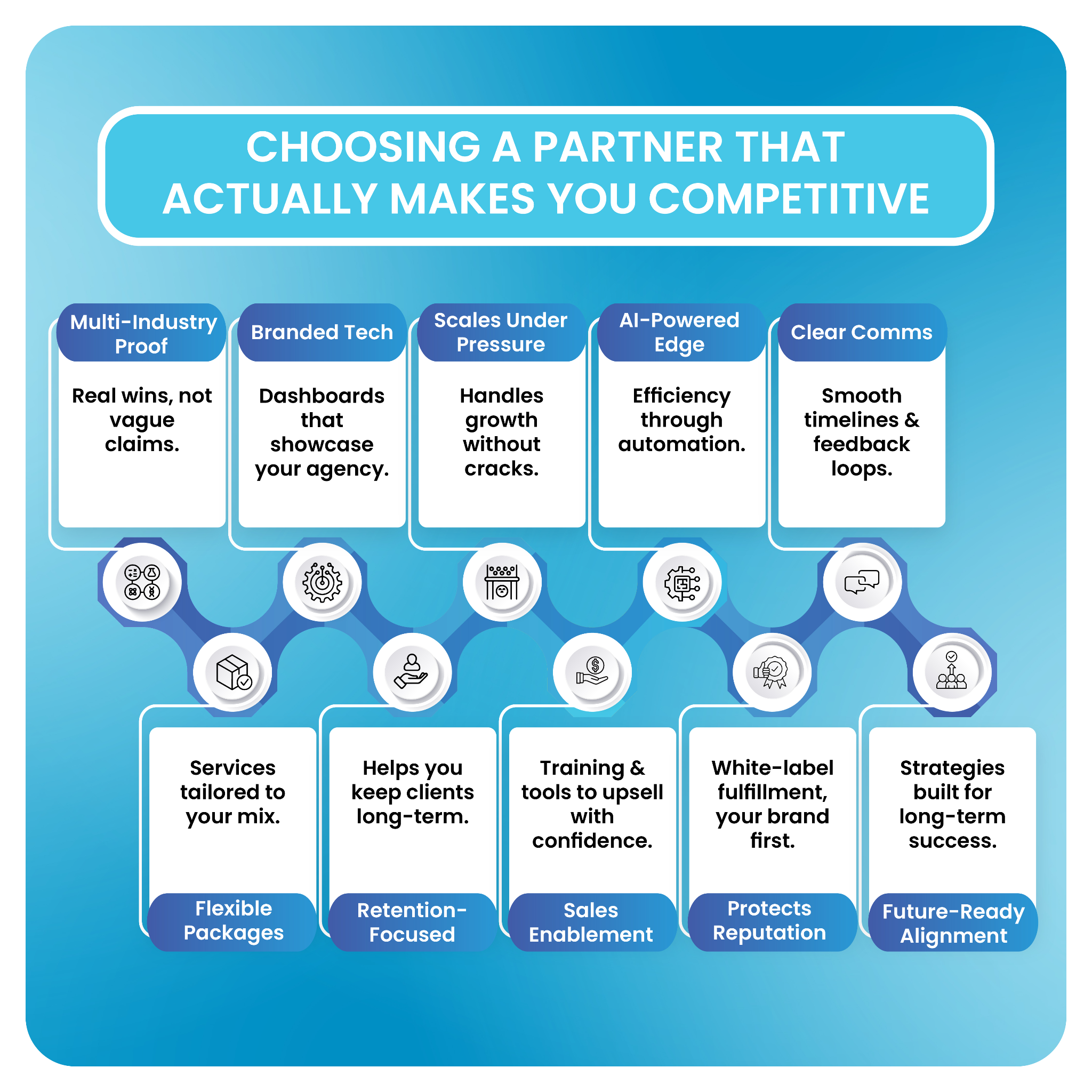
A compelling answer should demonstrate clear strengths across several areas:
- Expertise shown through certifications, case studies, and platform depth.
- Processes that are documented and repeatable.
- Communication habits that keep you informed and confident.
- Technology that improves efficiency and reporting.
- Results proven with real client outcomes.
When a provider can speak concretely about all five, you know their differentiation is real rather than marketing copy.
Knowing the right questions is valuable, but recognizing warning signs is equally important before signing a partnership agreement.
Red Flags to Watch For During the Evaluation Process
Identifying warning signs early helps you avoid partnerships that turn costly later. The evaluation stage is when problems are easiest to spot and least expensive to walk away from. Pay close attention to how a provider responds when you press for details.
- Vague Answers About Strategy: A provider who cannot clearly explain how they build campaigns is a serious concern. Vagueness often hides a lack of real strategy or experience. If you leave the conversation unsure how they would approach your clients, treat that as a warning.
- No Transparency Into Account Activity: If a provider hesitates to show you what happens inside campaigns, ask why. Reluctance to share account activity usually points to either weak processes or work they would rather you not see. You cannot stand behind work you cannot inspect.
- No Clear Reporting Process: A partner without a defined reporting process will leave you scrambling at the end of each month. Reporting should be standardized and reliable, not something improvised when a client asks. Inconsistent reporting makes it nearly impossible to prove value.
- Unrealistic Performance Guarantees: Promises of guaranteed rankings, instant results, or specific ROAS figures should raise immediate doubts. No one can guarantee PPC outcomes because results depend on many factors outside any provider's control. Honest partners set realistic expectations instead.
- Limited Scalability: A provider that cannot describe how they handle growth may stall your agency later. Limited scalability becomes a hard ceiling on your own expansion. If they cannot grow with you, the partnership has a built-in expiration date.
These issues often create long-term operational challenges that are difficult and expensive to fix once a partnership is underway. Spotting them early saves you from inheriting someone else's weaknesses.
The best partnerships combine expertise, transparency, and operational scalability.
How DashClicks Help Agencies Scale PPC With Confidence?
DashClicks’ white label PPC services are designed to function as an extension of your agency's PPC team, not just another vendor on your list. The goal is to give you the expertise and infrastructure of an in-house team without the cost and complexity of building one. That distinction shapes how the entire service is structured.
When you work with DashClicks, your accounts are supported by people and processes built for agency growth. The focus stays on delivering results your clients can see and reports that strengthen your brand.
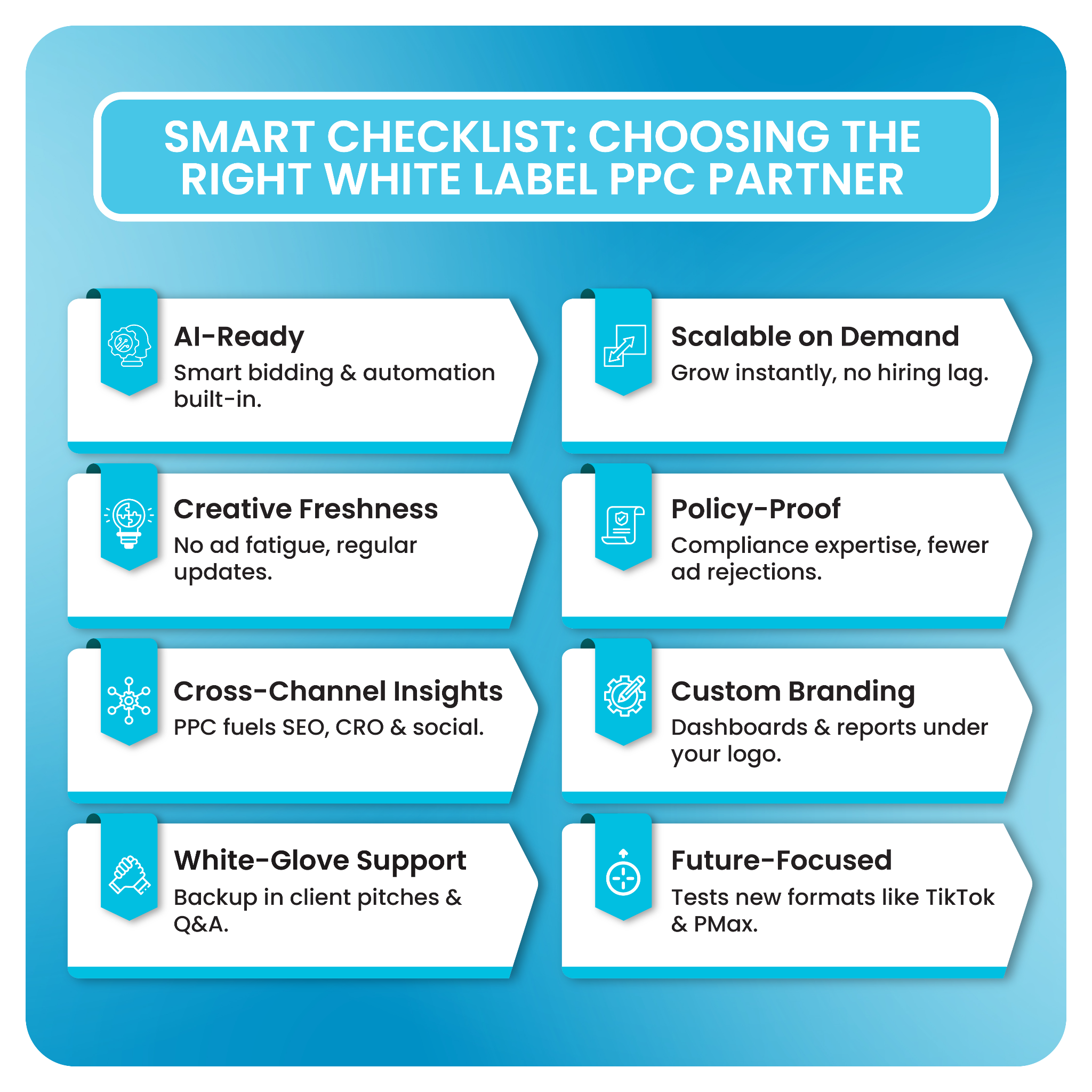
Key capabilities that support agency success include:
- Dedicated PPC specialists who learn your accounts and act as part of your team.
- Google Ads expertise grounded in hands-on, daily campaign management.
- White label reporting branded entirely as your agency.
- Transparent communication that keeps you informed at every stage.
- Strategic campaign management focused on business outcomes, not vanity metrics.
- Scalable fulfillment that grows as your client roster grows.
These capabilities work together to solve the exact problems covered throughout this guide. With dedicated specialists and transparent reporting, you can answer client questions with confidence. With scalable fulfillment and structured onboarding, you can take on new accounts without overloading your internal team.
The practical result is an agency that can improve client satisfaction, increase fulfillment capacity, and grow without constantly hiring. By treating fulfillment as a strategic partnership rather than a transaction, DashClicks helps you protect your reputation while expanding your services.
Ultimately, choosing the right white label PPC partner begins with asking thoughtful questions before any agreement is signed.
Ask Better Questions, Build Better Partnerships
The right white label PPC partner is rarely the cheapest option, and it is not always the largest. Price and size are easy to compare, but they say little about how a provider will perform once real client budgets are on the line.
Long-term success depends on a deeper set of factors. Expertise, communication, transparency, reporting, and scalability all determine whether a partnership lasts or unravels. Each of the 15 questions in this guide is designed to test one of these areas before you commit.
Take the time to evaluate providers carefully rather than rushing the decision. A thorough process now prevents painful transitions, lost clients, and damaged trust later.
The best white label PPC partners share a clear set of traits. They:
- Understand your agency's clients and their industries.
- Communicate proactively instead of waiting for problems to surface.
- Deliver measurable results tied to revenue and growth.
- Scale alongside your agency as your needs expand.
Asking better questions today leads to stronger partnerships and more sustainable agency growth tomorrow. The effort you put into evaluation now pays off in client retention, profitability, and peace of mind for years to come.

How White Label SEO Services Help Agencies Align Clients Around the Right SEO Priorities
SEO has become increasingly complex for both agencies and the clients they serve. A single strategy discussion can involve rankings, organic traffic, content creation, backlinks, AI search, and technical SEO. For most clients, understanding which activities deserve the most attention can be challenging. Every recommendation sounds important, making it difficult to separate priorities from distractions.
The challenge is amplified by the amount of conflicting advice available today. Competitors suggest one approach, social media influencers promote another, and AI tools often generate recommendations that contradict what clients read elsewhere. As a result, many businesses become uncertain about where to invest their SEO budget and effort.
This confusion matters because SEO remains one of the most important digital marketing channels. According to BrightEdge, organic search drives 53% of all website traffic. When such a significant share of business visibility depends on SEO, clients naturally want confidence that resources are being allocated to the right initiatives.
This is where white label SEO services create value. By providing structure, consistent processes, and strategic direction, the best white label SEO services help agencies simplify decision-making and align clients around the activities that support meaningful business growth.
As SEO becomes more complex, many clients struggle to determine which initiatives deserve the most attention. Before agencies can align clients around the right priorities, they must first understand why SEO confusion is so common.
Why Clients Often Struggle to Understand SEO Priorities?
Most clients are not difficult on purpose. They struggle because SEO presents several genuine obstacles that make prioritization hard.
1. Too Many Moving Parts
Modern SEO covers content creation, technical SEO, link building, local SEO, user experience, internal linking, and more. Each of these areas has its own best practices and its own specialists. From the outside, every initiative looks equally important. A client who hears that internal linking, page speed, and content quality all matter has no easy way to rank them. So they often assume everything must happen at once, which stretches budgets and dilutes focus.
2. Conflicting SEO Advice
Clients rarely get their information from a single trusted source. Competitors share recommendations during sales conversations. Social media influencers promote shortcuts that promise fast wins. AI tools generate suggestions that sometimes contradict each other. Industry blogs disagree on best practices, and each one sounds authoritative. When every source claims to have the answer, clients end up more confused than informed.
3. Search Behavior has Changed
Rankings and traffic used to be the clearest signs of SEO success. That is no longer the case. Search results now include SERP features, AI-generated answers, local packs, and zero-click experiences that keep users on Google instead of sending them to a website. In fact, approximately 58.5% of Google searches now end without a click, according to data from SparkToro and Datos. A client who only watches rankings may miss the bigger picture entirely.
4. Difficulty Connecting SEO to Revenue
Clients understand leads, sales, and revenue because those numbers shape their business. What they often cannot see is how keyword research, content creation, technical fixes, and on-page optimization feed into those outcomes. The link between a meta tag fix and a new customer is not obvious. Without that connection, SEO can feel like an expense with unclear returns.
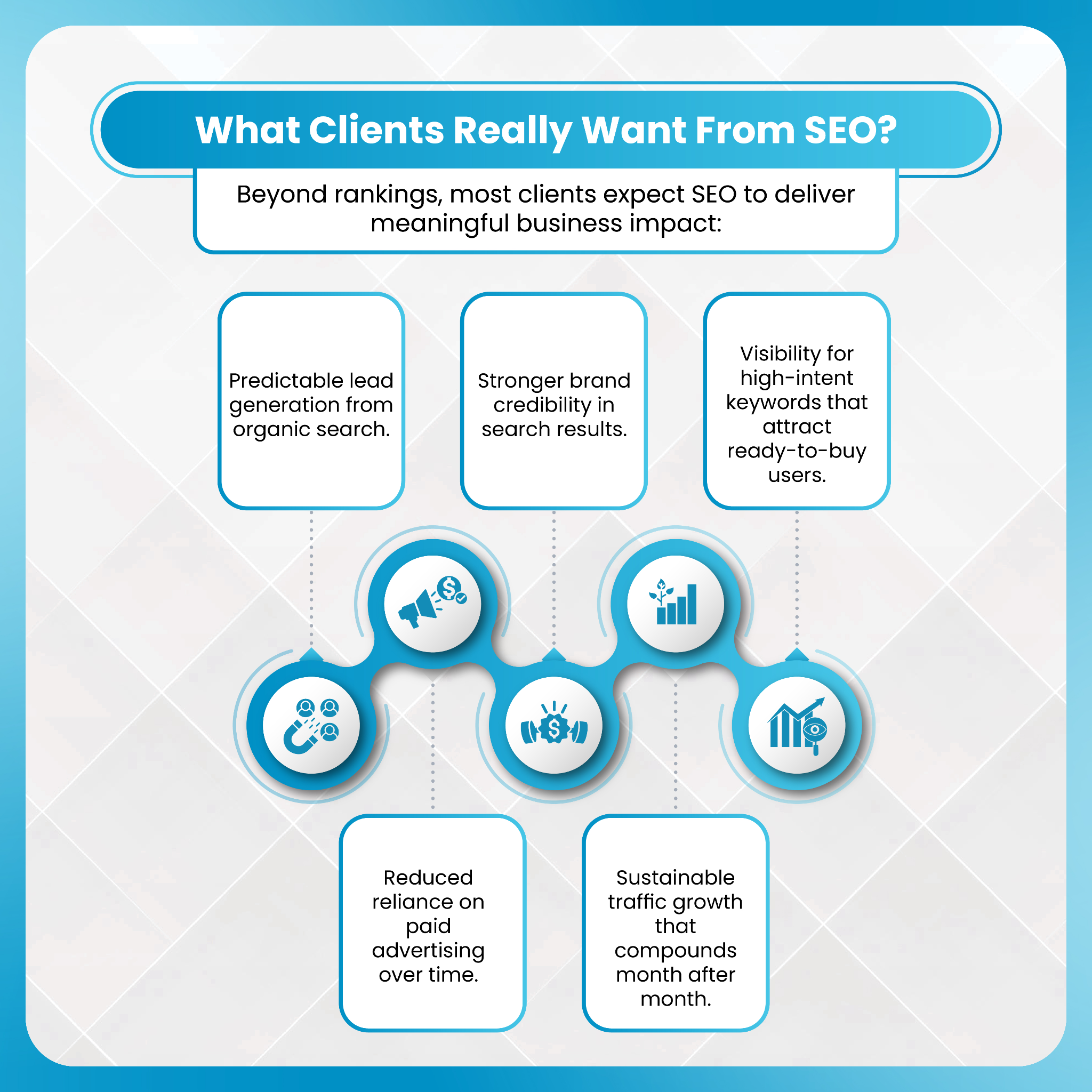
When clients cannot clearly distinguish between high-impact and low-impact activities, prioritization becomes difficult. This often leads to common mistakes that prevent SEO strategies from delivering their full value.
The Most Common SEO Prioritization Mistakes
When clients lack a clear framework, they tend to fall into the same traps. Recognizing these mistakes helps agencies steer conversations in a more productive direction.
1. Chasing Rankings Instead of Revenue
A client might celebrate a number one ranking for a keyword that brings in almost no business. High rankings feel like a win, but they do not always produce meaningful outcomes. The keywords that matter most carry commercial or transactional intent, meaning the searcher is close to making a decision. An agency that ranks a client first for an informational term with no buying intent may have technically succeeded while delivering little real value. Helping clients understand the difference between vanity rankings and revenue-driving rankings is one of the most useful things an agency can do.
2. Prioritizing Traffic Over Conversions
More visitors sound good, but traffic alone does not pay the bills. Imagine a local plumbing company that doubles its blog traffic with viral DIY articles, yet sees no increase in service calls. The target audience reading those posts was never going to hire a plumber. Conversion-focused SEO, which targets the right people rather than the most people, almost always produces stronger long-term results.
3. Focusing on Tactics Instead of Strategy
Clients frequently arrive with specific requests. They want more blog posts, a batch of backlinks, or a technical SEO fix they read about. These requests are not wrong, but when they happen in isolation, they create fragmented SEO efforts. A pile of disconnected tactics rarely adds up to a coherent strategy. Picture an agency that publishes content because the client asked, builds links because a competitor has them, and fixes technical issues at random. The work happens, but nothing pulls in the same direction.
4. Treating Every SEO Issue as Urgent
SEO audits often surface dozens of issues, and a worried client may want them all fixed immediately. In reality, not every recommendation deserves the same priority. A broken canonical tag on a key landing page is critical. A handful of missing alt tags on archived blog images can wait. Agencies that distinguish between critical problems and minor improvements protect both their clients' budgets and their own resources.
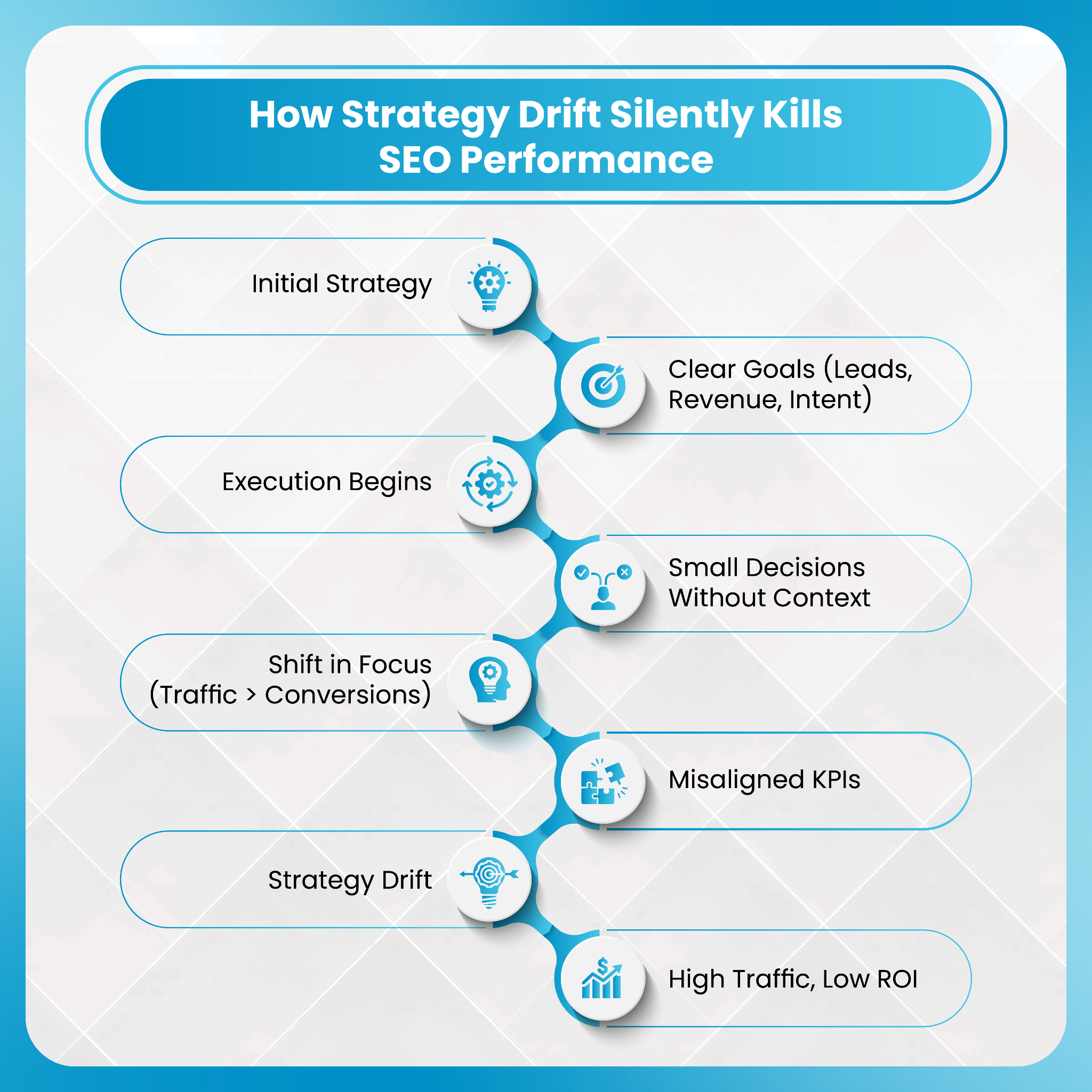
The solution is not more SEO activity. The solution is a structured framework that helps agencies determine what matters most and communicate those priorities effectively.
How White Label SEO Services Create a Structured SEO Roadmap?
A reliable white label SEO firm gives agencies the framework they need to turn scattered effort into a clear plan. Instead of reacting to every request, the agency works from a roadmap built around business impact.
1. Strategic Keyword Research
The foundation of any roadmap is choosing the right targets. A strong white label SEO program focuses on high-intent opportunities rather than the keywords with the largest search volume. Targeting is aligned with the client's business objectives, so the terms chosen reflect how customers actually search when they are ready to buy. By prioritizing revenue-generating search intent, agencies make sure early wins translate into real business results, not just ranking reports.
2. SEO Audits and Prioritization
A good SEO audit does more than list problems. It separates critical issues from lower-priority improvements and explains the reasoning behind that order. The output is an actionable roadmap sequenced by business impact. For example, an agency might tackle indexation problems and broken conversion pages first, then schedule smaller on-page refinements for later phases. The client sees a logical path instead of an intimidating wall of red flags.
3. Content Planning
Content works best when it follows the buyer journey. White label SEO services build content plans that move prospects from awareness to consideration to decision, aligning each piece with a conversion opportunity. This approach also supports topical authority, which strengthens long-term visibility as search engines recognize the site as a trusted resource on its core subjects. A roofing company, for instance, might receive educational guides for early-stage searchers and service-focused pages for buyers ready to request a quote.
4. Technical SEO Guidance
Technical work should support visibility, user experience, and performance, not bury the client under a list of obscure fixes. A focused white label SEO firm highlights the technical improvements that genuinely affect results and skips the noise. That restraint keeps clients from feeling overwhelmed and keeps the team's attention on what matters.
The biggest advantage here is repeatability. The best white label SEO services help agencies create a consistent prioritization framework instead of reacting to every request, trend, or algorithm update. When a client asks about a shiny new tactic, the agency can place that request inside the existing roadmap and explain where it fits. That structure turns reactive conversations into strategic ones and helps clients make better decisions about their own marketing.
Creating a roadmap is only the first step. Agencies must also execute consistently if they want clients to remain confident in the strategy.
Further Reading: Building a Client-Facing SEO Roadmap Using White Label SEO Services
Why Consistent SEO Fulfillment Reduces Client Confusion?
A roadmap loses its power if the work behind it changes direction every month. Consistency is what turns a plan into trust.
- Inconsistency Creates Uncertainty: When priorities shift constantly, clients start to wonder whether anyone is steering the ship. A campaign that chases content one month, link building the next, and technical fixes after that sends a confusing signal. Frequent changes weaken confidence in the strategy and make clients more likely to question every invoice.
- Repeatable Processes Create Confidence: Standardized workflows produce consistent execution, and consistent execution produces a clear strategic direction clients can follow. When a client knows that each month brings a predictable rhythm of research, content, and optimization, the uncertainty fades. They stop worrying about whether work is happening and start trusting the process.
- Connecting Activities to Outcomes: Consistency also makes it easier to show the chain of value. Keyword research leads to content creation, which supports rankings, which generates leads, which produces revenue. When the same process runs month after month, clients can see how individual SEO activities feed into larger business objectives. That visibility is far harder to provide when the approach keeps changing.
This is why consistency often matters more than volume. An agency that delivers a steady, well-organized stream of work builds more trust than one that produces a burst of activity and then goes quiet. Clients value reliability because it gives them something they can plan around.
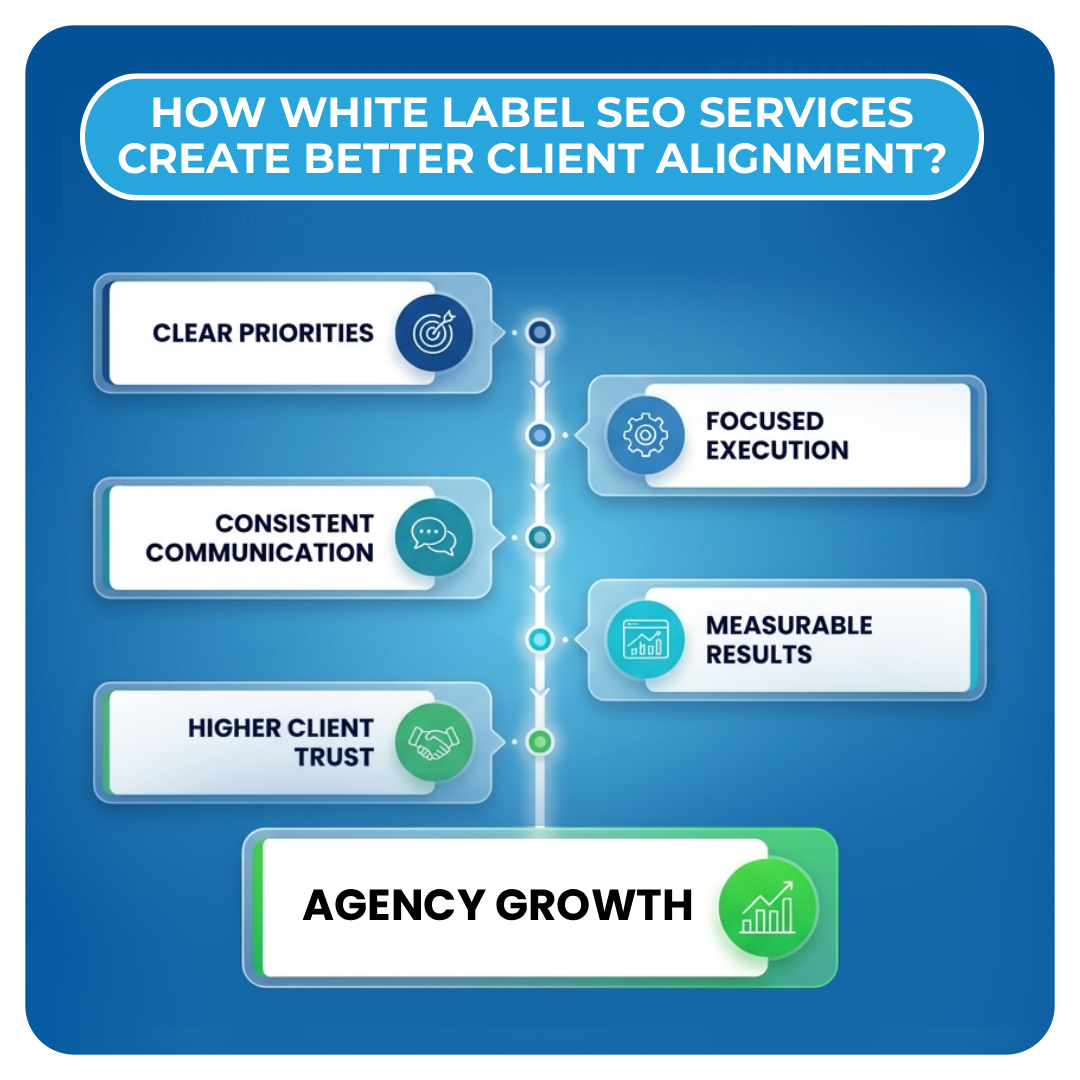
Even strong execution can lose value if agencies fail to explain why certain activities were prioritized. This is where client reporting becomes a critical communication tool.
Using Reporting to Reinforce SEO Priorities
Reporting is the moment when strategy becomes visible to the client. Done well, it reinforces priorities and builds trust. Done poorly, it becomes a confusing list of tasks. Strong reports answer four simple questions.
What was completed?
Start by clearly communicating the deliverables finished during the period. Clients want to know the work is getting done, and a clear summary gives them that reassurance without forcing them to dig through dashboards.
Why was it prioritized?
This is the question most reports skip, and it is the most important one. Explaining why a particular task was chosen connects the work to larger goals. A note that says a set of service pages was optimized because they target high-intent buyers tells a far better story than a bare checklist.
What results were generated?
Tie the completed work to performance outcomes. Movement in rankings for priority keywords, growth in qualified traffic, or an increase in form submissions all show progress. The goal is to link activity to impact so the client sees the return.
What happens next?
Close by giving the client visibility into upcoming priorities and the strategic direction ahead. This keeps them informed and reminds them that the work is part of a longer plan.
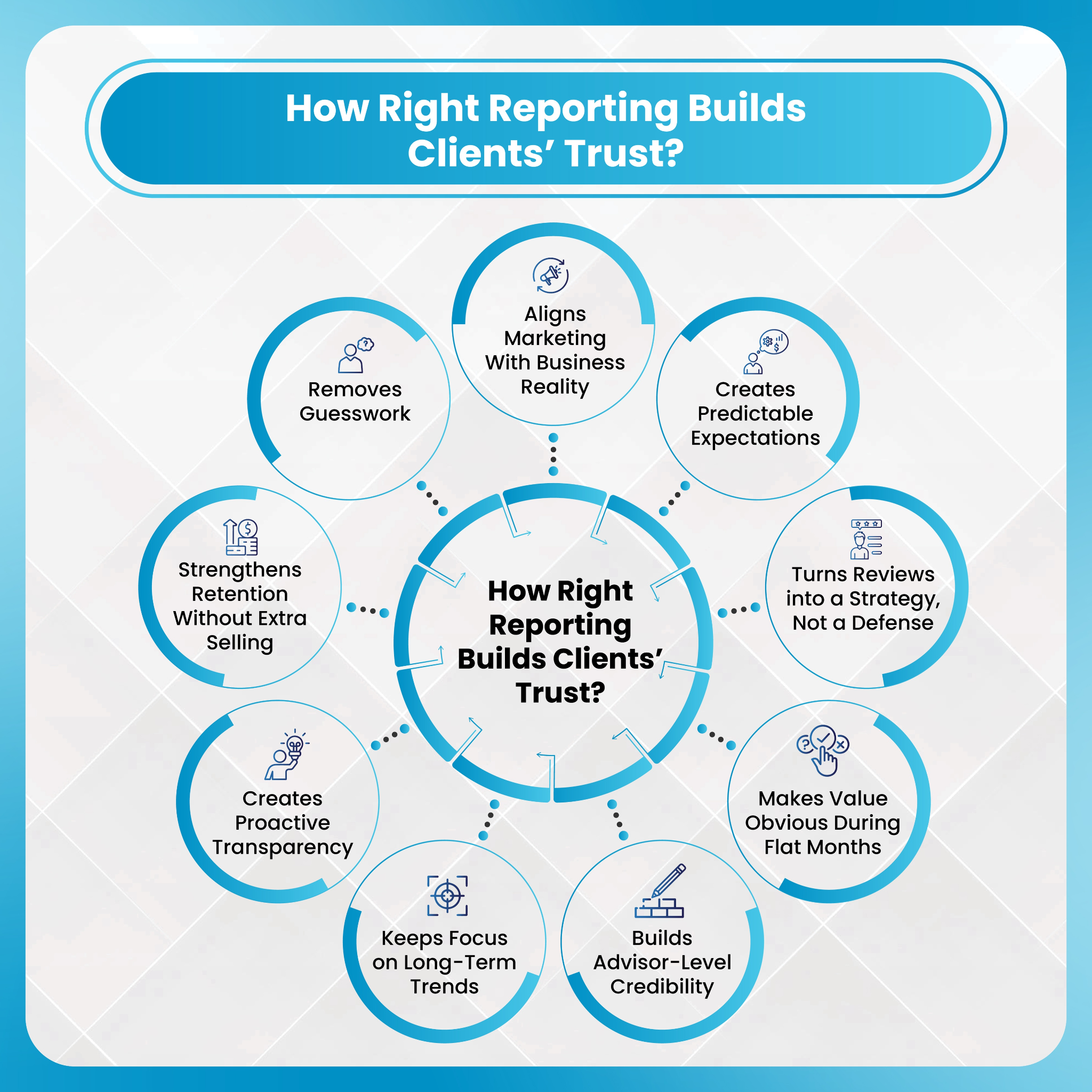
The central idea is simple. Reporting should connect SEO activities to business outcomes rather than simply listing completed tasks. When reports do this consistently, they reduce confusion, strengthen trust, and reinforce the strategic alignment the agency worked to build. A client who reads a report and immediately understands what was done, why it mattered, and what comes next is a client who stays.
As agencies grow, maintaining this level of communication and execution becomes increasingly difficult without scalable systems and support.
Further Reading: The Role of White Label SEO in Streamlining Client Reporting
How DashClicks' White Label SEO Services Help Agencies Create Clarity Around SEO Strategy?
Scaling clear communication across a growing client base is one of the hardest challenges an agency faces. DashClicks' white label SEO services are built to help agencies deliver structure and consistency without stretching internal teams to the breaking point.
- Strategic Research and Planning: DashClicks supports agencies with prioritized keyword opportunities and business-focused SEO roadmaps. Instead of guessing which terms to chase, agencies can present clients with a plan rooted in intent and business goals. This gives every engagement a strong strategic starting point.
- Content and Technical SEO Support: Consistent content execution and technical optimization are easier to maintain with dedicated fulfillment behind them. Agencies can keep content flowing along the buyer journey and address the technical work that supports performance, all without hiring and training a large in-house team.
- Consistent Fulfillment Processes: Standardized workflows mean reliable execution across accounts. Whether an agency manages five clients or fifty, the same dependable process applies. That reliability is exactly what reduces client confusion and builds the trust discussed earlier.
- Reporting Visibility: DashClicks gives agencies clear visibility into completed work and campaign progress. With organized reporting at hand, agencies can answer the four key questions clients care about and present results in a way that reinforces priorities rather than muddying them.
- Scalable Campaign Management: As client portfolios grow, quality often suffers. A strong white label SEO program lets agencies expand without sacrificing the consistency that earned client trust in the first place. Growth becomes an opportunity instead of a strain.
The real value here is not a feature list. It is the ability to communicate priorities clearly, execute efficiently, and maintain consistency across many accounts at once. By handling the heavy lifting of fulfillment and reporting, DashClicks frees agency leaders to focus on strategy and client relationships, which are the areas that drive retention and growth.
Ultimately, successful SEO campaigns are not built on doing everything at once. They are built on doing the right things in the right order.
Conclusion
SEO confusion is rarely a sign that a client is careless. It is the natural result of a discipline with countless competing priorities, conflicting advice, and outcomes that are not always easy to trace back to revenue. Clients struggle because the field genuinely is complex, and that struggle puts pressure on the agency relationship.
Agencies that respond with clear prioritization frameworks change that dynamic. When clients understand what matters most and why, they stop second-guessing the strategy and start trusting the partnership. That trust is the foundation of long-term retention.
White label SEO services give agencies the structure, consistency, and alignment needed to deliver that experience at scale. They turn scattered tactics into organized roadmaps, replace unpredictable effort with repeatable processes, and use reporting to keep priorities front and center. Most importantly, they keep the focus on business outcomes rather than SEO activities alone.
The agencies that win are the ones that simplify decision-making for their clients. By moving beyond task execution and creating genuine strategic clarity, they position themselves to retain clients longer and scale with confidence. The best white label SEO services make that possible, helping agencies grow without losing the focus that made them valuable in the first place.


How White Label Facebook Ads Help Build Client Trust and Retention
Facebook Ads performance is rarely a straight line. Results can fluctuate due to auction competition, shifting audience behavior, seasonality, creative fatigue, and frequent platform updates. A campaign that delivered strong ROAS last month may dip the next, even when the overall strategy remains unchanged. For agencies, this volatility is simply part of managing paid social campaigns.
Most agencies focus heavily on improving campaign performance, but managing how clients perceive that performance is equally important. A temporary decline in leads can feel alarming to a client who does not understand the factors influencing Facebook Ads results. The same fluctuation often feels far less concerning when expectations have been set properly and communication remains consistent.
This distinction has significant business implications. Acquiring a new customer can cost 5 to 25 times as much as retaining an existing one, making client retention one of the most valuable growth levers for agencies. Maintaining client confidence is often far more cost-effective than constantly replacing lost accounts.
This is where white label Facebook Ads support becomes valuable. By providing consistent campaign management, clearer reporting, and specialized expertise, white label support helps agencies maintain trust, transparency, and consistent performance, even when results fluctuate.
While performance optimization is essential, client confidence often determines whether an agency relationship survives temporary setbacks. To manage expectations effectively, agencies first need to understand what typically causes client concern.
Why Clients Become Concerned About Facebook Ads Performance?
Client anxiety usually follows a few predictable patterns. Recognizing them early helps you respond before frustration sets in.
Common sources of concern include:
- Fluctuating ROAS and lead volume. When return on ad spend drops or leads slow down, clients often assume something is broken, even when the change is temporary.
- Rising CPMs and advertising costs. As cost per thousand impressions climbs, clients see their budgets stretch thinner and start questioning the value they are getting.
- Attribution discrepancies. Numbers in Facebook Ads Manager rarely match a client's CRM or Google Analytics exactly, and those gaps create doubt.
- Delayed conversion cycles. In industries with longer sales cycle, leads may take weeks to convert, leaving clients impatient in the meantime.
- Unrealistic expectations around speed and results. Many clients expect immediate returns and have not been told that early campaigns require a testing period.
Here is the important part: most of these concerns are completely normal. Facebook Ads performance is rarely linear. Campaigns move through testing, learning, and optimization phases, and each of these naturally creates fluctuations in cost and output. The algorithm needs data before it can perform efficiently, and that data takes time to gather.
Platform changes add another layer. When Facebook adjusts its ad delivery system, privacy rules, or reporting tools, results can shift temporarily through no fault of the agency. A client who does not know this is happening behind the scenes may interpret a brief dip as poor management.
For example, an e-commerce client running ads during a slow seasonal period might see their cost per purchase rise. That is a predictable market shift, not a campaign failure. But without a clear explanation, the client may push for sudden changes that disrupt the account.
While occasional performance fluctuations are normal, client perception often matters as much as actual campaign results. If concerns aren't addressed proactively, uncertainty can quickly evolve into frustration, creating pressure on both campaign performance and the agency-client relationship.
How Does Client Doubt Affect Agency Growth?
When a client loses confidence, the effects ripple through your entire operation in ways that are easy to underestimate.
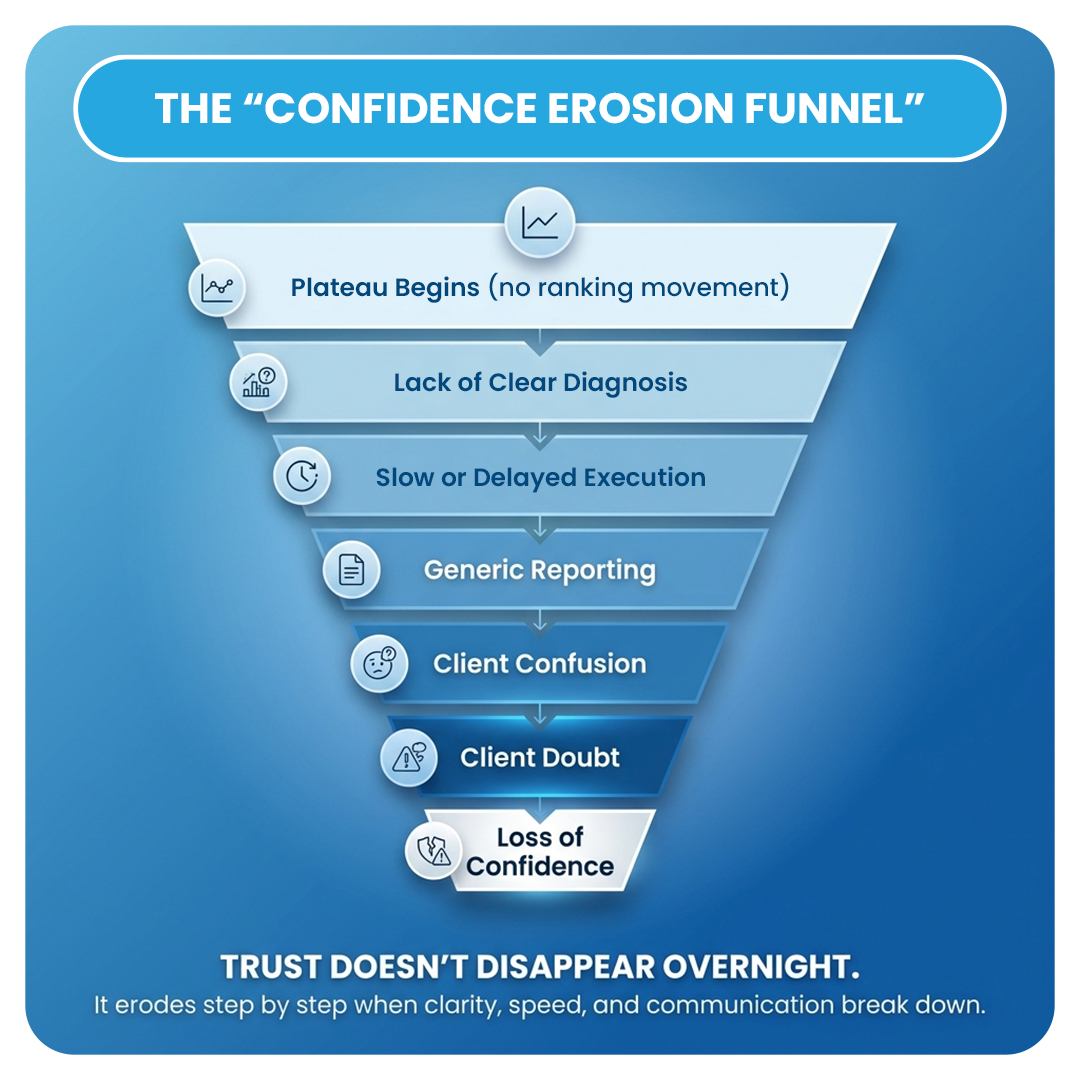
Here is how client concerns typically affect agencies:
- Increased account scrutiny. Doubtful clients start examining every metric, asking for explanations on small movements that would normally go unnoticed.
- More reactive communication. Instead of strategic check-ins, your team spends time answering urgent emails and fielding worried phone calls.
- Additional reporting demands. Clients begin asking for extra reports, custom dashboards, and frequent updates that pull time away from actual optimization.
- Reduced trust in agency recommendations. When confidence erodes, clients second-guess your strategy and resist the very changes that could improve performance.
- Higher churn risk. Left unchecked, all of this builds toward cancellation.
The cost of this churn is high. Research shows that a 5% increase in customer retention can improve profits by 25% to 95%. In other words, holding onto clients does not just protect revenue; it actively multiplies profitability. Every client you keep contributes far more over time than the monthly retainer suggests.
Client trust is what makes that retention possible. When clients trust your agency, they give you room to test, learn, and optimize without panicking over every fluctuation. They understand that short-term dips are part of a longer strategy, and they wait for the results that proper optimization delivers.
Strong relationships also tend to compound. A client who trusts your judgment is more likely to expand their budget, add services, and refer other businesses to you. Retained clients often become long-term revenue drivers, and some of your most profitable accounts will be the ones you have held for years.
Consider an agency that loses a client three months into a campaign because performance had not yet stabilized. Not only does the agency lose that recurring revenue, but it also forfeits the future upsells and referrals that relationship might have produced. The real cost of doubt is rarely just the lost retainer.
Understanding the cost of client uncertainty is only half the equation. To reduce concerns effectively, agencies must first understand what clients actually expect from their marketing partners.
What Clients Really Want From Their Agency?
Clients are not asking for perfect results every month. What they want is more reasonable and more achievable than constant flawless performance.
- Transparency sits at the top of the list. Clients want honest discussions about performance trends, including the disappointing ones. They want clear explanations of both wins and losses, and they want realistic expectations set from the very start of the engagement. A client who hears the truth early is far more forgiving than one who feels blindsided.
- Consistent communication comes next. Regular updates, proactive reporting, and ongoing strategic recommendations show clients that their account is receiving attention. Silence breeds suspicion. When clients do not hear from you, they assume the worst, even if the campaign is performing well behind the scenes.
- Evidence of progress reassures clients that work is happening. This includes visible optimization efforts, clear testing roadmaps, and well-defined next steps. Clients want to know what you tried, what you learned, and what you plan to do next. Movement, even during a slow period, signals competence.
- Finally, clients care about business impact. At the end of the day, they want revenue and pipeline growth, improvements in lead quality, and more efficient customer acquisition. Vanity metrics rarely satisfy a business owner who is watching their bank account. Connecting your work to real outcomes keeps the relationship grounded in what actually matters to them.
Providing this level of communication and strategic guidance becomes increasingly difficult as agencies grow. The challenge isn't understanding what clients want. It's delivering that experience consistently across every account.
Further Reading: Facebook Ads: Managing Client Expectations with White Label Services
How White Label Facebook Ads Support Helps Agencies Build Client Confidence
As your client roster expands, the gap between what clients want and what your team can deliver tends to widen. White label Facebook Ads support closes that gap by adding fulfillment capacity and expertise without forcing you to hire. Here is how it strengthens client confidence on multiple fronts.
- Consistent campaign management is the foundation. A dedicated white label team can provide daily monitoring, continuous optimization, and faster issue resolution across every account. When a campaign starts underperforming, problems get caught and corrected quickly rather than sitting unnoticed until the client points them out. This consistency is hard to maintain in-house when a small team is juggling dozens of accounts at once.
- Better reporting and insights make client conversations easier. A strong white label Facebook Ads agency delivers more accurate performance visibility, which in turn helps you explain results in plain language. Instead of scrambling to interpret a confusing dip, you walk into agency client meetings with a clear narrative backed by data. That clarity builds credibility and calms nerves.
- More time for the agency-client relationship may be the most underrated benefit. When you choose to outsource Facebook marketing execution, your team spends far less time buried in Ads Manager and far more time on strategy and communication. The relationship-building work that actually drives retention finally gets the attention it deserves. For many agencies, this shift alone transforms how clients perceive their service.
- Access to specialized expertise rounds out the picture. White label Facebook Ads management connects you with experienced professionals who run campaigns every day across many industries. They bring proven optimization processes and stronger campaign execution than a generalist team can usually match. Your clients benefit from that depth of skill without ever knowing the work was fulfilled by a partner.
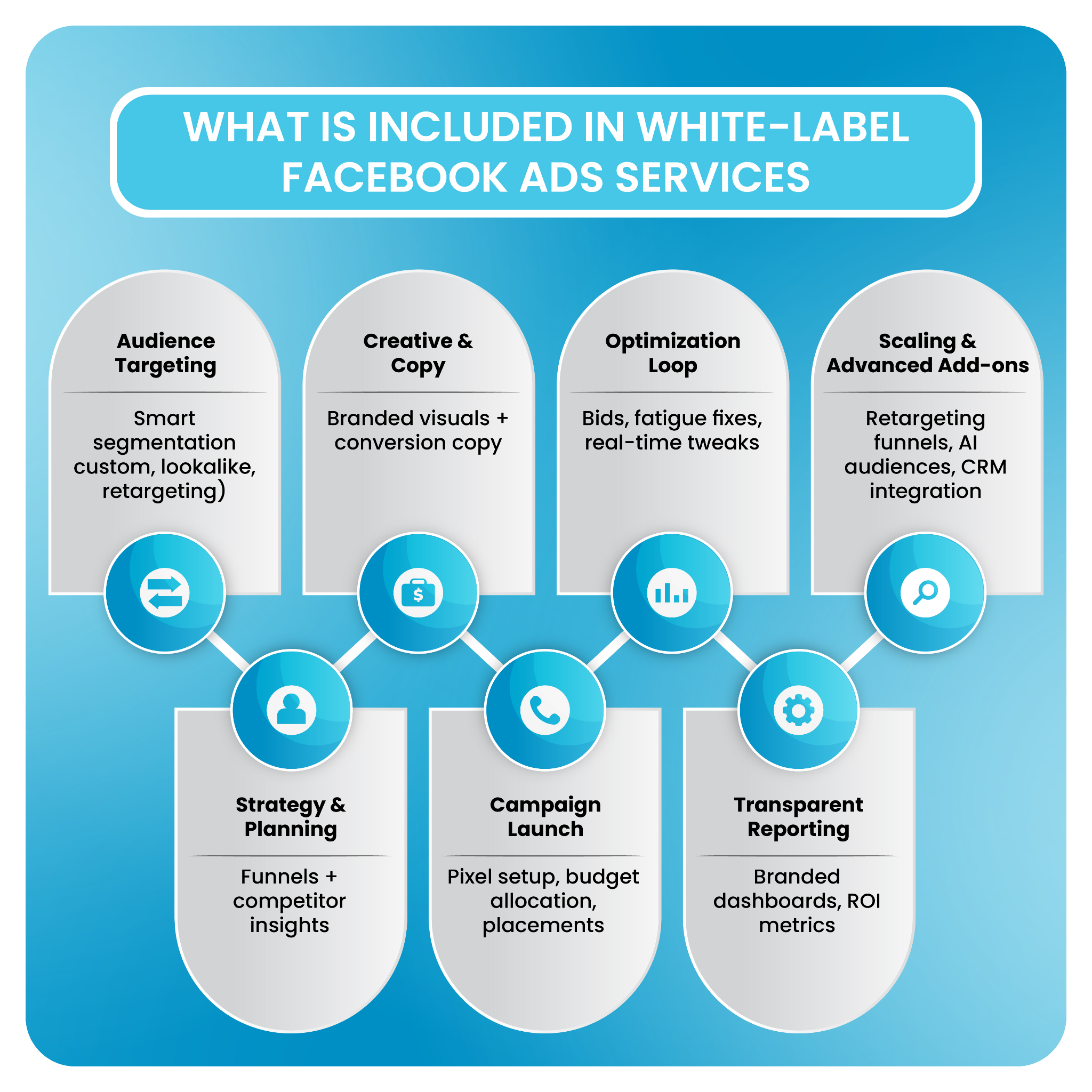
Consider a small agency with five Facebook Ads clients and a two-person team. As they sign three new accounts, optimization quality starts to slip, and client emails go unanswered for days. By partnering with a white label Facebook ads provider, the agency keeps every account properly managed while the founders focus on onboarding and client check-ins. The clients experience steady performance and responsive communication, and the agency grows without burning out its staff. That is the practical value of white label support: it protects both performance quality and communication standards at the same time.
The benefits of white label support become especially noticeable when agencies begin approaching operational capacity. As client demands increase, maintaining optimization quality and communication standards becomes significantly more challenging.
Signs Your Agency Could Benefit From White Label Support
Most agencies do not decide to outsource on a quiet day. The need usually announces itself through a series of warning signs that build over time.
- Operational warning signs show up first inside your team. A growing client roster starts to outpace your capacity. Reporting demands pile up faster than you can fulfill them. Campaign optimizations get delayed because no one has the bandwidth to log in. Team members are stretched thin, and account management becomes inconsistent, with some clients getting attention while others quietly slip through the cracks.
- Client experience warning signs follow close behind. You notice more performance-related questions landing in your inbox. Response times stretch from hours to days. Strategic conversations dry up because everyone is too busy putting out fires. And eventually, the most telling signal of all appears: client churn starts to creep upward.
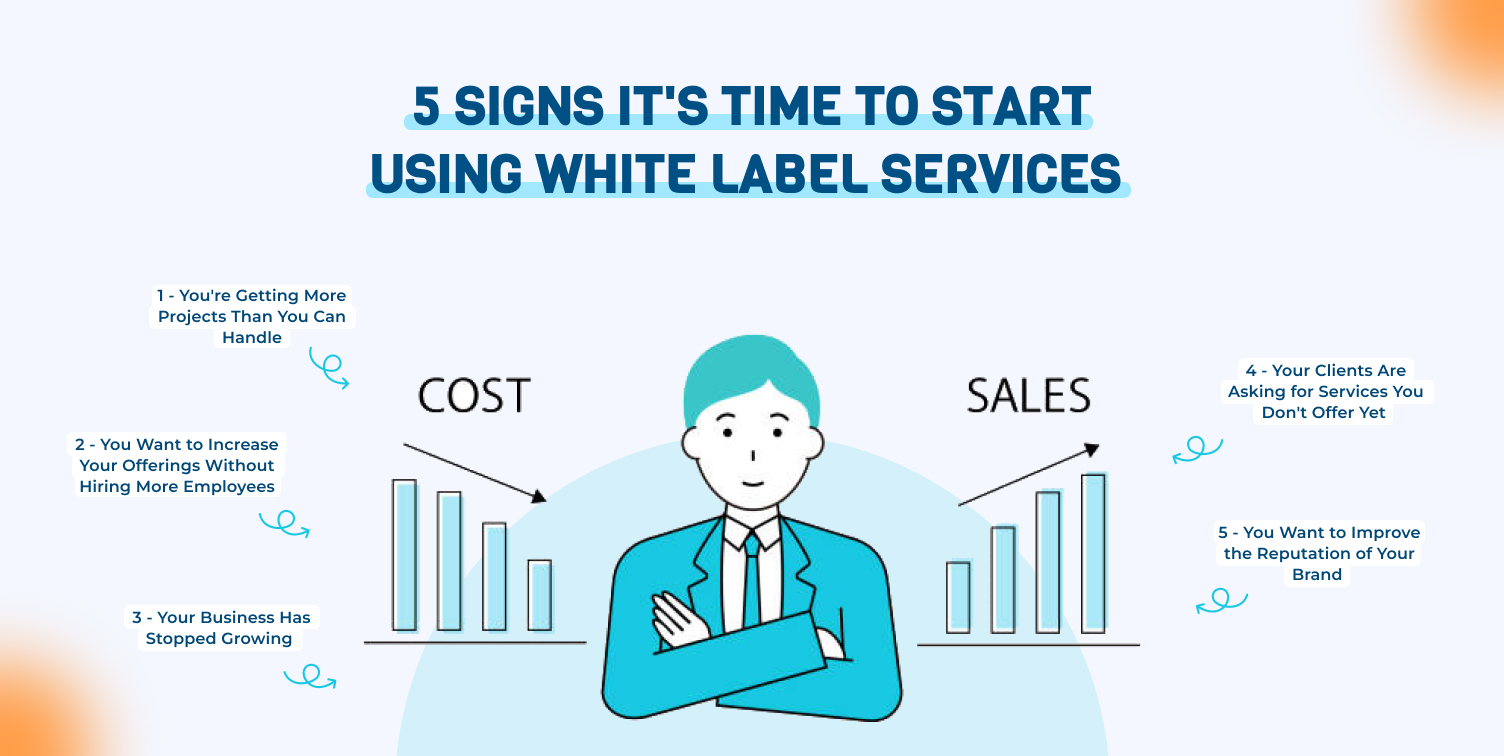
Image Source: Dynamic Dreamz
Picture a consultant who manages Facebook Ads for eight clients alone. For a while, the workload is manageable, but after landing two larger accounts, the consultant finds that reports go out late, optimizations happen weekly instead of daily, and two clients mention they feel out of the loop. These are not signs of incompetence. They are signs of a fulfillment model that has hit its ceiling. The work has simply outgrown the available hours in the day.
When you start seeing these patterns, it is a signal that your current setup cannot scale further without something breaking, either the quality of your work or the well-being of your team.
Recognizing these challenges is the first step. The next is finding a solution that helps your agency scale fulfillment while maintaining the level of service clients expect.
How DashClicks Helps Agencies Deliver a Better Client Experience
DashClicks is built to help agencies solve the exact tension described above: growing demand on one side and limited internal capacity on the other. Rather than adding to your team's workload, it expands what your agency can deliver behind the scenes.
- White label Facebook Ads management handles the day-to-day execution that consumes so much agency time. This includes campaign setup and management, audience optimization, and ongoing performance monitoring. Your clients receive professionally managed campaigns under your brand, while your team stays focused on the work only you can do.
- Reporting support gives you the visibility that keeps client conversations productive. With clear reporting, meaningful performance insights, and data-backed recommendations, you walk into every client meeting prepared to explain what is happening and why. That preparation translates directly into client confidence, especially during the inevitable rough patches.
- Scalability without additional hiring is where the operational impact really shows. DashClicks increases your fulfillment capacity, supports consistent service delivery across every account, and reduces the operational strain that comes with rapid growth. You can take on new clients without the cost, risk, and delay of recruiting and training new staff.
The downstream effect is agency growth. Improved client confidence leads to better retention opportunities, and the time you reclaim can be redirected toward strategy and business development. Instead of being trapped inside campaign execution, you get to focus on the activities that actually grow your agency. For agencies looking to outsource Facebook marketing without sacrificing quality, this combination of fulfillment and reporting support creates a dependable foundation for scaling.
Ultimately, maintaining client confidence is not about eliminating every fluctuation in performance. It is about building systems that allow agencies to communicate clearly, optimize consistently, and deliver a dependable client experience.
Trust Is the Foundation of Long-Term Client Retention
Facebook Ads performance concerns are not a problem you can fully eliminate. They are inevitable. Auction dynamics shift, costs rise and fall, and platform updates arrive whether you are ready for them or not. The question is never whether fluctuations will happen, but how your agency responds when they do.
That response is what separates agencies that retain clients from those that constantly chase new ones. Consistent optimization shows clients that their account is in capable hands. Transparency keeps them grounded in reality instead of fear. Clear, proactive communication turns a worrying dip into a manageable conversation rather than a relationship-ending event. Together, these habits build the trust that carries a client relationship through difficult stretches.
White label support makes it realistic to deliver these experiences at scale. By outsourcing fulfillment to specialists, agencies can maintain optimization quality, sharpen their reporting, and free up the time needed to nurture client relationships, all without expanding their internal teams. The result is a service experience that stays steady even as the client roster grows.
The financial logic is hard to ignore. Because acquiring a new client can cost 5 to 25 times more than retaining an existing one, investing in client confidence isn't just good service. It's a smart growth strategy. Every relationship you protect saves you the steep expense of replacement and opens the door to upsells, referrals, and long-term revenue.
Agencies that build trust are simply better positioned for the future. They retain more clients, improve profitability, and scale sustainably, while their competitors stay stuck on the acquisition treadmill.

No results found.
Please try different keywords.
Get Started with
DashClicks Today
Get found online, convert leads faster, generate more revenue, and improve your reputation with our all-in-one platform.
.svg)
Unlimited Sub-Accounts
Unlimited Users
All Apps
All Features
White-Labeled
Active Community
Mobile App
Live Support
100+ Tutorials
Unlimited Sub-Accounts
Unlimited Users
All Apps
All Features
White-Labeled
Active Community
Mobile App
Live Support
100+ Tutorials
Unlimited Sub-Accounts
Unlimited Users
All Apps
All Features
White-Labeled
Active Community
Mobile App
Live Support
100+ Tutorials


