

.svg)

.svg)
.svg)
.svg)
.svg)
.svg)
In the early days of paid advertising, success was often measured by one thing: return on ad spend (ROAS). If the numbers looked good, the campaign was considered a win. But that mindset has shifted.
Today, clients expect more than just strong results. They want consistency. A campaign that performs well one week and drops the next creates uncertainty. It makes forecasting difficult and weakens trust. Agencies are now judged not just on how high they can push performance, but on how reliably they can maintain it.
This is where many agencies struggle. Even when strategies seem correct, performance can fluctuate. Cost per lead spikes. Conversion rates dip. Results become unpredictable.
The truth is, this instability rarely comes from Facebook Ads itself. It usually comes from how campaigns are structured and managed behind the scenes. What looks like a performance issue is often a systems issue.
That is where white label Facebook advertising enters the picture. Instead of relying on inconsistent execution, it introduces structured systems designed to create stable, repeatable outcomes.
Why Facebook Ad Performance Becomes Unstable in Agency Environments?
Campaign instability is more common than many agencies are willing to admit. On the surface, everything may look fine. Budgets are consistent, targeting appears solid, and creatives seem aligned with the brand. Yet performance still fluctuates.
Industry data suggests that nearly 60% of advertisers experience inconsistent results across campaigns, even when they follow similar strategies. This inconsistency creates a ripple effect. It leads to wasted ad spend, unpredictable results, and difficulty in scaling campaigns with confidence.
The key issue is that instability is rarely caused by one single mistake. Instead, it is usually the result of multiple small gaps in execution that compound over time. When these gaps exist across structure, tracking, targeting, and scaling, even well-planned campaigns can become unreliable.
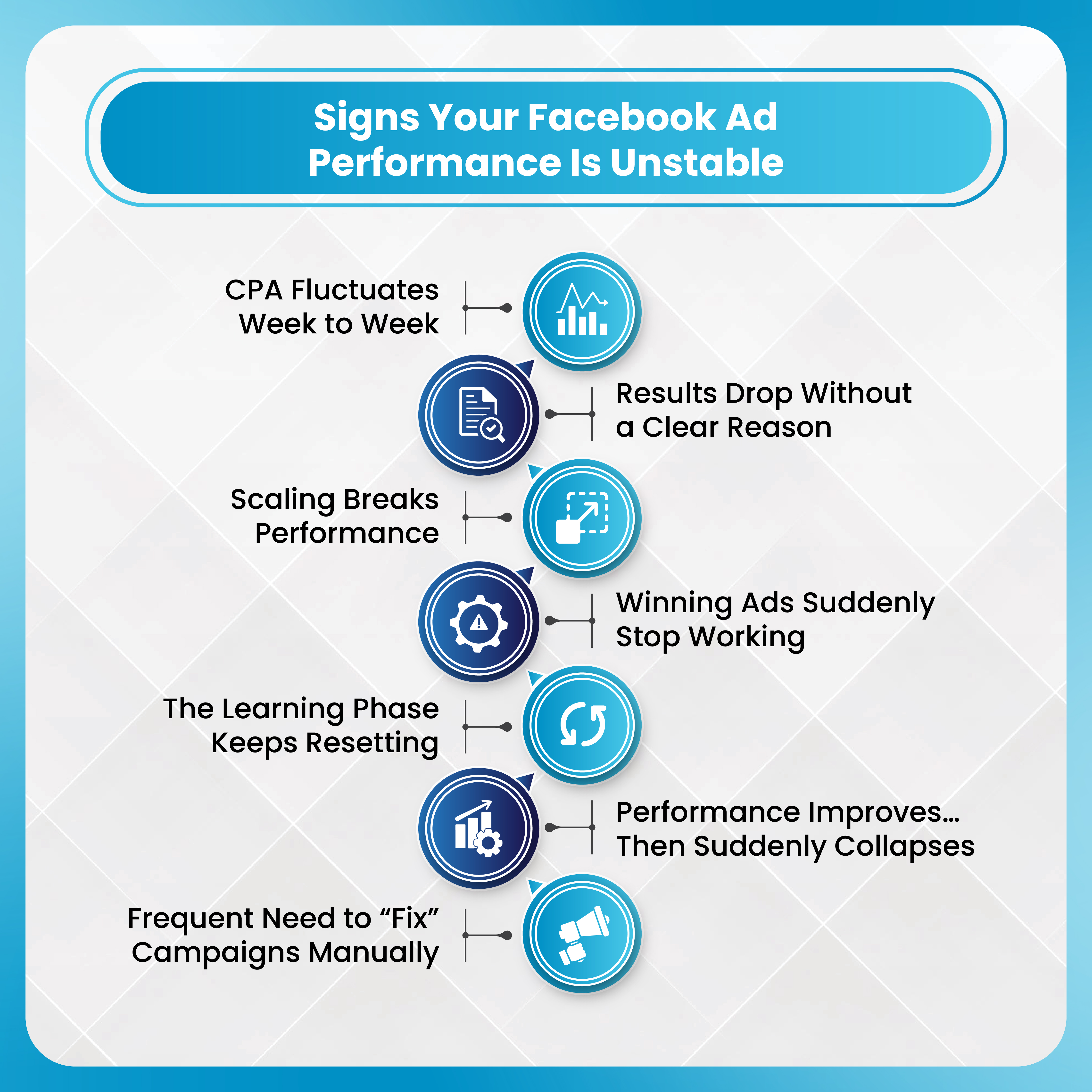
Let’s take a closer look at the main reasons behind this instability.
1. Weak or Inconsistent Campaign Foundations
Every successful campaign starts with a strong foundation. This includes how the account is structured, how campaigns are organized, and how data flows through the system.
In many agency environments, this foundation is often rushed. Campaigns are launched quickly to meet deadlines, and structure becomes an afterthought. Over time, this creates a cluttered account that is difficult to manage and even harder to optimize.
Some of the most common issues include:
- Too many campaigns targeting similar objectives
- Ad sets that lack clear intent or direction
- Naming conventions that vary from one campaign to another
- Pixel setups that are incomplete or incorrectly configured
When these problems exist, the algorithm struggles to understand what success looks like. Facebook’s optimization system depends on clear signals. If the structure is disorganized, those signals become diluted.
As a result, performance becomes inconsistent. One campaign may perform well simply by chance, while another underperforms despite having similar inputs. Without a clean foundation, stability is almost impossible to achieve.
2. Tracking Gaps That Break Optimization Loops
Tracking is the backbone of any type of digital advertising campaign. It tells the platform what actions matter and helps guide optimization decisions.
When tracking is accurate, the algorithm can learn quickly. It identifies patterns, refines targeting, and improves performance over time. But when tracking is flawed, the entire system breaks down.
Common tracking issues include:
- Conversion events are not firing properly
- Missing or incomplete tracking setup
- Attribution mismatches between platforms
- Data loss caused by privacy changes and browser restrictions
Recent studies indicate that up to 30% of ad accounts suffer from tracking inaccuracies. That means a significant portion of campaigns may be optimizing based on flawed data.
This creates a dangerous situation. The platform may prioritize the wrong audiences or optimize for low-quality actions. Over time, performance becomes unstable because decisions are based on incomplete information.
In simple terms, if the data cannot be trusted, the results cannot be trusted either.
3. Audience Fragmentation and Overlap
Audience targeting is one of the most powerful features of Facebook Ads. However, it can also become a major source of instability when not handled correctly.
Many agencies unintentionally create fragmented audience structures. This often happens when campaigns are built independently without a unified strategy.
Typical mistakes include:
- Targeting similar audiences across multiple campaigns
- Failing to exclude users who have already converted
- Combining cold and warm audiences within the same ad sets
- Overusing lookalike audiences without clear segmentation
These issues lead to audience overlap. When this happens, multiple campaigns end up competing for the same users.
Instead of working together, campaigns drive up costs by bidding against each other. This internal competition reduces efficiency and creates fluctuations in performance.
Clear segmentation solves this problem. When audiences are properly defined and separated, each campaign has a specific role. This allows the algorithm to optimize more effectively and maintain consistent results.
4. Creative Fatigue and Reactive Ad Management
Creative is often the most visible part of a campaign, and it has a direct impact on performance. According to Meta, creative quality can account for up to 56% of a campaign’s overall success.
Despite this, many agencies approach creative management without a clear system. Ads are launched based on intuition rather than data. New creatives are introduced without a testing plan. Existing ads are left running for too long.
This reactive approach leads to several issues:
- Audiences become fatigued after seeing the same ads repeatedly
- Click-through rates begin to decline
- Engagement drops, reducing overall performance
- Conversion rates fall as interest decreases
One of the biggest challenges is timing. Refresh creatives too early, and you lose valuable data. Refresh them too late, and performance has already dropped.
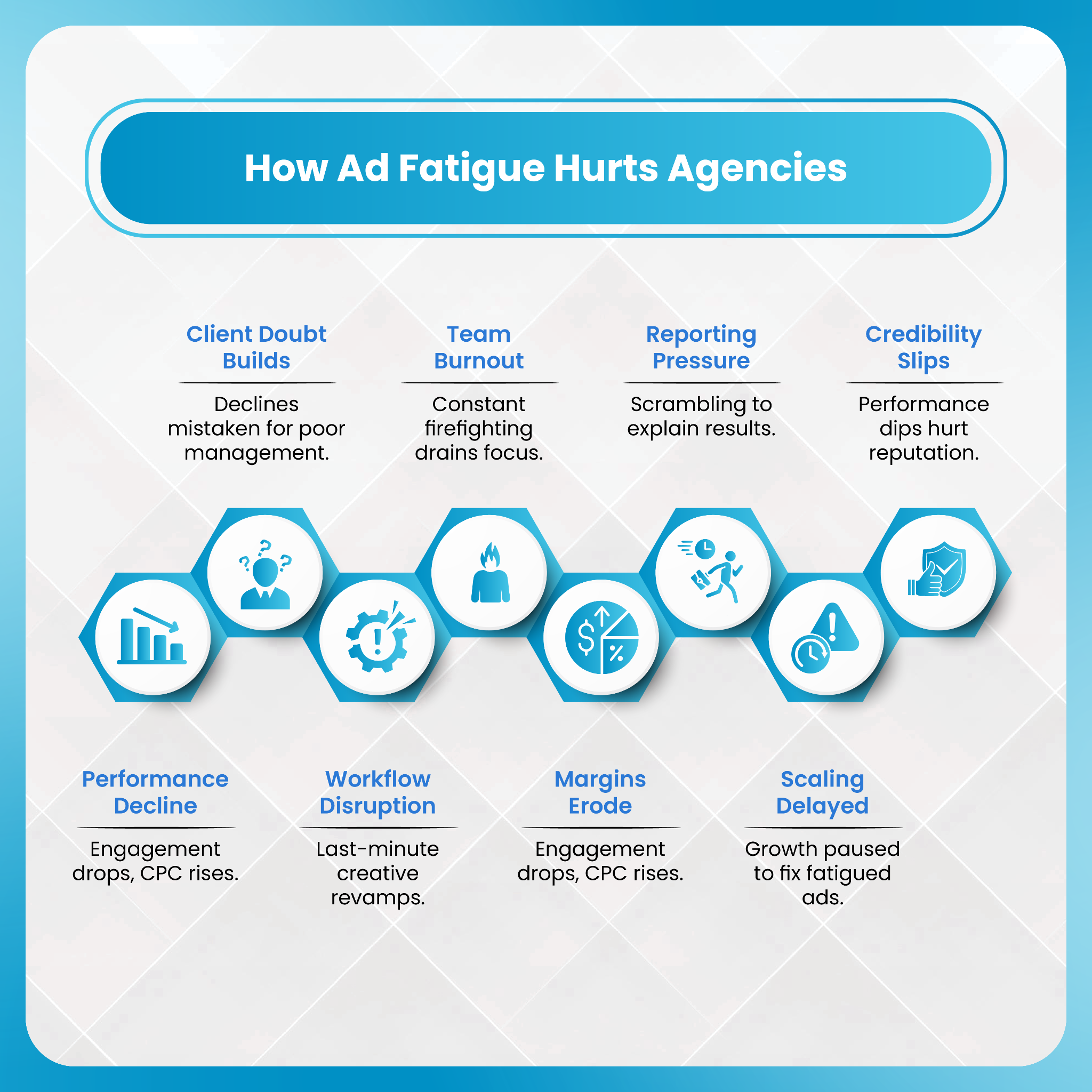
Without a structured testing framework, agencies are constantly reacting instead of planning. This creates a cycle of instability where performance rises and falls unpredictably.
A consistent creative strategy, supported by regular testing and rotation, is essential for maintaining steady results.
Further Reading: Managing Creative Fatigue at Scale: How Agencies Use White Label Facebook Ads
5. Scaling Volatility
Scaling is often seen as the goal of any successful campaign. Once performance is strong, the next step is to increase the budget and reach more users. However, scaling is also one of the most common points where campaigns break.
A frequent mistake is increasing budgets too quickly. While it may seem like a logical way to grow, it can disrupt the algorithm’s learning process.
When budgets are scaled aggressively, several things can happen:
- Cost per acquisition increases
- Conversion rates decrease
- The campaign re-enters the learning phase
- Performance becomes unpredictable
Research from WordStream shows that rapid budget increases can reduce efficiency by up to 20% in the short term. This drop may recover over time, but it creates instability in the process.
Another issue is the lack of scaling strategy. Many campaigns grow without clear rules or thresholds. Decisions are made based on short-term results rather than long-term patterns.
Effective scaling requires a controlled approach. Budgets should increase gradually, and performance should be monitored closely. Without this level of precision, growth often leads to volatility instead of stability.
6. The Underlying Problem: Lack of Systems
When you step back and look at these challenges, a clear pattern emerges. The issue is not a lack of effort or expertise. Most agencies are working hard to deliver results. The real problem is the absence of a consistent system.
Without standardized processes, every campaign is handled differently. Each media buyer may have their own approach. Each account may follow a different structure. Over time, this creates inconsistency at every level.
This is why performance feels unpredictable. It is not because Facebook Ads are unreliable. It is because the systems behind them are inconsistent.
Stability comes from structure. When campaigns are built on clear frameworks, supported by accurate data, and managed with consistent processes, performance becomes much more predictable.
Understanding these root causes is the first step. Once agencies identify where instability comes from, they can begin to fix it with a more structured and disciplined approach.
How White Label Facebook Ads Create Performance Stability?
White label Facebook Ads are not just about outsourcing execution. They act as a structured system that removes inconsistency from campaign management.
Instead of relying on individual approaches, they apply proven frameworks across all accounts.
1. Strong Campaign Foundations Before Scaling
Stability begins with structure.
White label providers focus on building campaigns with:
- Clear objectives for each campaign
- Standardized naming conventions
- Proper pixel and conversion API setup
- Event tracking aligned with business goals
This creates a clean environment where the algorithm can perform efficiently.
For example, a lead generation campaign that separates top-of-funnel, middle-of-funnel, and bottom-of-funnel audiences often sees more stable cost per lead compared to mixed structures.
2. Precision Audience Segmentation Frameworks
Segmentation is one of the most effective ways to stabilize performance.
A structured approach includes:
- Clear separation of cold, warm, and hot audiences
- Exclusion rules to prevent overlap
- Retargeting based on engagement level
- Lookalike audiences built from high-intent users
When audiences are clearly defined, Facebook does not have to guess user intent. This leads to more predictable outcomes.
3. Structured Creative Systems Instead of Random Testing
Creative testing should follow a system, not guesswork.
White label Facebook advertising typically uses:
- Controlled testing frameworks
- Defined testing cycles (weekly or bi-weekly)
- Creative rotation schedules
- Data-driven winner selection
A common structure is the 70/20/10 model:
- 70% budget on proven creatives
- 20% on variations
- 10% on new concepts
This approach ensures continuous improvement without disrupting performance.
4. Continuous Expert Oversight
Monitoring is key to stability.
Dedicated specialists track performance metrics such as:
- Click-through rate
- Cost per click
- Conversion rate
- Frequency
They identify issues early and make adjustments before performance drops significantly.
Instead of reacting after problems occur, they prevent them.
5. Controlled Scaling Systems
Scaling is handled with precision.
Best white label Facebook ads providers follow rules such as:
- Increasing budgets gradually
- Scaling only after performance thresholds are met
- Maintaining learning phase stability
- Expanding audiences and creatives step by step
This controlled approach reduces volatility and keeps results consistent.
Why White Label Execution Creates Stability?
At a broader level, white label execution removes variability.
It provides:
- Dedicated specialists instead of generalists
- Standardized systems across all accounts
- Consistent processes regardless of workload
- Reduced dependency on individual media buyers
This creates a reliable delivery model. Agencies can produce repeatable results instead of relying on trial and error.

How DashClicks Helps Stabilize Campaign Performance?
DashClicks approaches white label Facebook advertising with a strong focus on systems and consistency. Their framework is designed to eliminate common issues that cause performance instability.
They begin by building campaigns on clean, standardized structures. Each account follows a proven setup that includes proper tracking, organized naming, and clearly defined funnels. This ensures that campaigns start with a solid foundation rather than needing constant fixes later.
Their team also prioritizes accurate data. With proper pixel and conversion API integration, campaigns receive reliable signals. This allows Facebook’s algorithm to optimize effectively, which leads to more stable results over time.
Ongoing management is another key area. Dedicated experts monitor performance regularly and make adjustments based on data, not assumptions. Instead of reacting to sudden drops, they focus on maintaining steady performance through continuous optimization.
DashClicks also emphasizes controlled scaling. Campaigns are expanded gradually, ensuring that growth does not disrupt existing performance. This helps agencies deliver consistent outcomes to their clients without sudden fluctuations.
Transparency is built into the process. Agencies receive clear reporting, making it easier to track results and communicate with clients. This level of visibility adds another layer of stability, as decisions are based on accurate insights rather than guesswork.
For agencies offering facebook ads services, this structured approach makes it easier to deliver reliable results at scale.
Statistics That Highlight the Need for Stability
To understand why stability matters, it helps to look at the numbers:
- Businesses earn an average of $2 in revenue for every $1 spent on Facebook Ads
- Around 72% of marketers consider Facebook Ads effective for achieving business goals
- However, nearly 60% report inconsistent performance across campaigns
- Tracking inaccuracies affect up to 30% of ad accounts
- Creative quality contributes to more than half of campaign success
These figures show a clear pattern. While Facebook Ads can deliver strong returns, inconsistency remains a major challenge. Stability is what turns potential into reliable growth.
The Bigger Picture – Systems Over Effort
Many agencies work hard to improve performance. They test new strategies, adjust targeting, and refine creatives. But effort alone does not guarantee stability.
Without systems, even the best strategies can produce inconsistent results. One campaign may perform well, while another struggles under the same conditions. White label Facebook advertising changes this dynamic. It replaces guesswork with structure.
Instead of relying on individual decisions, it uses:
- Clean campaign foundations
- Clear audience segmentation
- Structured creative testing
- Continuous monitoring
- Controlled scaling
This combination creates a stable environment where campaigns can perform consistently.
Conclusion
Campaign performance is no longer just about achieving high results. It is about maintaining those results over time.
Instability often comes from hidden structural issues rather than visible strategy problems. Weak foundations, poor tracking, audience overlap, and inconsistent execution all contribute to unpredictable outcomes.
White label Facebook Ads address these challenges by introducing systems that prioritize consistency. They create a framework where campaigns are built, managed, and scaled in a controlled way.
For agencies, this means fewer surprises and more reliable delivery. For clients, it means steady performance and greater confidence in their marketing investment. If you are looking to bring more stability to your campaigns and deliver consistent results at scale, it may be time to explore a systems-driven approach.


.svg)


.svg)
.svg)
.svg)
.svg)
.svg)