

.svg)

.svg)
.svg)
.svg)
.svg)
.svg)
For many agencies, performance is often reduced to a single number. Return on ad spend looks strong, cost per acquisition seems reasonable, and click-through rates are trending in the right direction. On paper, everything appears to be working. Yet, clients still leave. The reality is simple. Performance alone does not build trust. Understanding performance does.
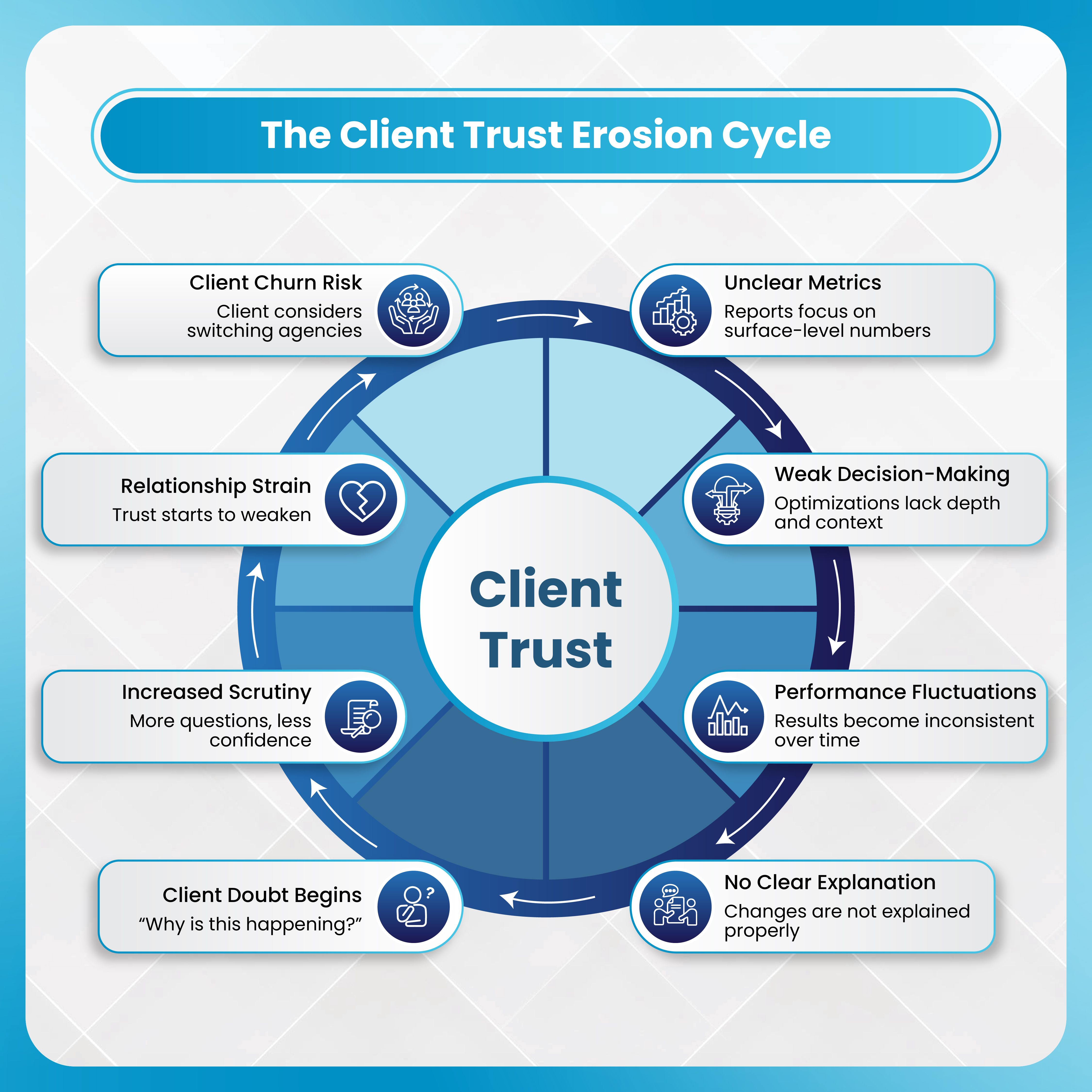
Clients rarely walk away only because results dip for a short period. They lose confidence when they cannot clearly see what is happening behind the scenes. When numbers change without explanation, it creates uncertainty. Over time, that uncertainty turns into doubt.
This is where most agencies miss the bigger picture. Trust is not built in reports or dashboards. It is built in the execution layer. The daily work that happens inside campaigns, often invisible to clients, is what truly defines the agency-client relationship.
Every keyword adjustment, every budget shift, every optimization decision plays a role. When these actions are consistent, explainable, and tied to outcomes, clients feel confident. When they are unclear or inconsistent, trust erodes.
This blog breaks down how better PPC execution directly influences long-term trust. Not through surface-level metrics, but through the systems and processes that sit beneath them. If trust is built through execution, then many agencies are not losing clients because of strategy. They are losing them because execution is either weak, inconsistent, or poorly communicated.
Where PPC Execution Breaks Trust?
1. Surface-Level Optimization = Fragile Trust
A common pattern across many agencies is reliance on high-level metrics. Click-through rate, cost per click, and return on ad spend often become the primary focus. These numbers are easy to track and simple to present, which is why they are often used as proof of performance.
While these metrics are useful, they only show what is happening on the surface. They do not explain the quality of traffic, the intent behind clicks, or how those clicks translate into actual business results. This creates a gap between what agencies report and what clients experience.
Many agencies also lean heavily on automated platform recommendations. Tools from ad platforms are designed to improve performance at scale, but they are not tailored to each business. They lack context around customer behavior, sales cycles, and profit margins.
When agencies follow these recommendations without deeper analysis, campaigns can drift away from the client’s actual goals.
The real issue begins when performance fluctuates. If results drop and the agency cannot clearly explain why, confidence quickly starts to erode. Clients begin asking questions like:
- What changed in the campaign?
- Was this expected?
- Could it have been prevented?
If those questions are met with vague answers, the assumption becomes straightforward. Something is not being managed properly.

This creates fragile trust. It is highly dependent on performance staying stable. The moment results dip, the relationship becomes vulnerable. Strong agencies build trust that can withstand performance fluctuations, but surface-level optimization does not allow for that.
2. Poor Search Term Control Leads to Silent Budget Waste
Search term management is one of the most important yet overlooked parts of PPC execution. It directly affects the quality of traffic entering the funnel, but it often receives minimal attention.
Industry audits consistently show that around 15 to 30 percent of ad spend is wasted on irrelevant or low-intent queries. This is not always obvious at first glance because campaigns can still generate conversions despite this inefficiency. The problem lies in how that spend accumulates over time.
This waste typically happens when agencies fail to:
- Review search term reports on a consistent schedule
- Identify patterns in irrelevant or low-value queries
- Build and update negative keyword lists regularly
- Separate high-intent traffic from exploratory searches
Without these steps, campaigns begin to capture broader and less relevant traffic. This increases costs without improving meaningful results.
From a client’s perspective, they do not see individual search queries. They see total spend and overall performance. If costs increase or efficiency declines, it raises concerns, even if the campaign appears to be functioning.
Over time, this creates a disconnect. Clients may feel that their budget is being used without sufficient control. Even if conversions are coming in, the lack of visible precision weakens confidence.
Silent waste is particularly damaging because it is not immediately obvious. It builds gradually, and by the time it becomes noticeable, it has already impacted performance and trust.
3. Budget Allocation Without Clear Logic
Budget allocation is one of the most visible aspects of campaign management. It directly affects performance, yet it is often handled without a clear, structured approach. From the outside, many budget decisions appear inconsistent.
Agencies frequently adjust spending based on short-term performance trends. If a campaign performs well, it gets more budget. If it slows down, the budget is reduced. While this may seem logical, it often lacks deeper analysis.
This approach can create several issues:
- Campaigns that perform well temporarily receive increased spend, only to become inefficient at scale
- New or experimental campaigns are underfunded and never fully tested
- Budget shifts happen without considering long-term impact
Clients notice these patterns quickly. They may see a campaign performing well one week, only to lose budget the next without explanation. Or they may notice increased spending in areas that do not align with their priorities.
This leads to questions such as:
- Why was the budget moved away from a strong campaign?
- What was the expected outcome of this change?
- How will success be measured after the shift?
When agencies cannot clearly answer these questions, decisions begin to feel arbitrary. Without a defined framework, budget allocation appears reactive rather than strategic. This lack of structure makes it difficult for clients to trust that their investment is being managed carefully.
Consistency and logic in budget decisions are essential for building confidence. Without them, even good results can feel unreliable.
4. Broken or Shallow Conversion Tracking
Accurate tracking is the backbone of effective PPC execution. Every optimization decision depends on the data being reliable. However, this is an area where many accounts fall short.
Studies from platforms like WordStream and various agency audits suggest that around 20 to 30 percent of PPC accounts have tracking issues. These issues are often hidden and can go unnoticed for long periods.
Common problems include:
- Double counting conversions, which inflates performance
- Missing offline conversions such as phone calls or closed deals
- Incorrect attribution windows that misrepresent when conversions occur
- Tracking only leads instead of actual revenue
When tracking is flawed, the entire decision-making process becomes compromised.
For example, a campaign might appear to generate a high number of conversions, leading the agency to increase its budget. However, if those conversions are duplicated or low quality, the increased spend does not translate into real business growth.
Over time, clients begin to notice discrepancies between reported results and actual outcomes. They may see strong numbers in reports, but no corresponding increase in revenue or leads.
This misalignment creates doubt. Clients start to question the accuracy of the data and the effectiveness of the strategy. Trust depends on alignment between what is reported and what is experienced. When tracking fails to reflect reality, that alignment breaks.
5. Reactive Communication Kills Confidence
Even strong execution can lose its impact if communication is handled poorly. Many agencies take a reactive approach. They wait for clients to ask questions before providing explanations. While this may seem efficient, it creates a sense of uncertainty.
Clients are left wondering:
- Is performance being monitored closely?
- Are issues being addressed proactively?
- Will they be informed if something changes?
This uncertainty often leads to increased involvement from the client side.
Instead of feeling confident, clients begin to:
- Check reports more frequently
- Ask for additional updates
- Question decisions more often
This dynamic shifts the relationship from trust to oversight.
Reactive communication also makes performance fluctuations feel more dramatic. If a client notices a dip before the agency addresses it, it creates concern. Even if the issue is temporary, the delay in communication amplifies its impact.
In contrast, proactive communication sets client expectations in advance. It prepares clients for potential changes and explains the reasoning behind them. Without this level of transparency, clients may feel that they are always one step behind. That feeling reduces confidence, even if the campaigns are performing well overall.
Clients want to feel that their campaigns are actively managed, with clear direction and consistent attention. When communication falls short, it becomes difficult to maintain that perception. If trust breaks in these execution gaps, the solution is not more reports or presentations. It is building a system where execution is clear, consistent, and easy to understand at every stage.
Execution Systems That Build Trust at Scale
1. Search Term Mining as a Trust-Building Mechanism
Search term management is one of the clearest ways to demonstrate active campaign control. Most agencies treat it as an occasional cleanup. High-trust agencies treat it as a continuous process.
A strong execution system includes:
- Weekly or bi-weekly search term reviews
- Categorizing queries into high intent, exploratory, and irrelevant
- Maintaining a live negative keyword list
Sharing these actions with clients makes a difference. For example:
- Highlighting blocked queries
- Showing cost savings from exclusions
- Explaining how traffic quality improved
Clients begin to see that their budget is being actively protected. In many optimized accounts, removing irrelevant queries can improve conversion rates by 15 to 25 percent. This is not just a performance gain. It is a trust signal.
When clients see that waste is being reduced consistently, they feel more confident in how their budget is managed.
2. Budget Allocation with Explainable Logic
Budget allocation should never feel random. A structured approach helps agencies make decisions that are both effective and easy to explain.
A common framework includes dividing campaigns into:
- Core revenue drivers
- Growth experiments
- Defensive campaigns such as brand and remarketing
Budget decisions should be based on:
- Marginal cost per acquisition or return on ad spend
- Stability of conversion volume
- Funnel stage
An advanced layer involves thinking about incrementality. This means understanding not just what performs, but what drives new value.
For example: Instead of simply increasing spend on a campaign with strong results, an agency might shift budget to a campaign where the marginal cost per acquisition is lower at scale.
Explaining decisions in this way changes the conversation. Clients no longer see budget shifts as guesses. They see them as calculated moves.
3. Conversion Tracking Accuracy = Trust Foundation
No optimization matters if the data behind it is incorrect. Accurate tracking requires ongoing validation, not a one-time setup.
A strong execution checklist includes:
- Verifying pixel accuracy
- Ensuring conversions are not double counted
- Aligning attribution windows across platforms
- Integrating offline data such as CRM or sales calls
- Tracking revenue, not just leads
Businesses that use advanced attribution models, such as data-driven attribution, can gain up to 15 to 30 percent more accurate performance insights. When tracking reflects real business outcomes, decisions become more reliable. Clients trust agencies that measure what actually matters.
4. Proactive Performance Narratives (Not Just Reports)
Data alone does not build client trust. Context does. Instead of sending reports filled with numbers, agencies should focus on explaining what those numbers mean.
Every update should answer three questions:
- What changed?
- Why did it change?
- What is being done about it?
For example: Instead of saying, “Cost per acquisition increased by 12 percent,” a better approach is:
“Cost per acquisition increased due to expanded targeting capturing broader queries. We have already added negative keywords and expect performance to stabilize within the next 7 to 10 days.”
This level of clarity helps clients stay informed and confident, even when performance fluctuates.
5. Speed of Optimization = Perceived Competence
Speed matters more than many agencies realize. Clients often equate responsiveness with expertise. When issues are identified and fixed quickly, it signals strong execution.
Best practices include:
- Addressing search term issues within 48 to 72 hours
- Adjusting budget inefficiencies within a week
- Running and evaluating tests every 2 to 3 weeks
Accounts that are optimized frequently tend to see up to 20 percent better efficiency over time compared to those managed less actively. Fast execution shows that campaigns are not left unattended. It reinforces the idea that the agency is in control.
6. Tie Every Optimization Back to Business Outcomes
One of the biggest gaps in PPC reporting is the disconnect between platform metrics and business impact. Clients care about revenue, profitability, and growth. Metrics like CTR or impressions are only meaningful when they connect to those outcomes.
A stronger approach is to map every improvement to a business result.
For example:
- Higher click-through rate leads to lower cost per click
- Lower cost per click allows more traffic within the same budget
- More traffic results in increased leads or sales
Instead of reporting isolated metrics, agencies should show the full chain of impact.
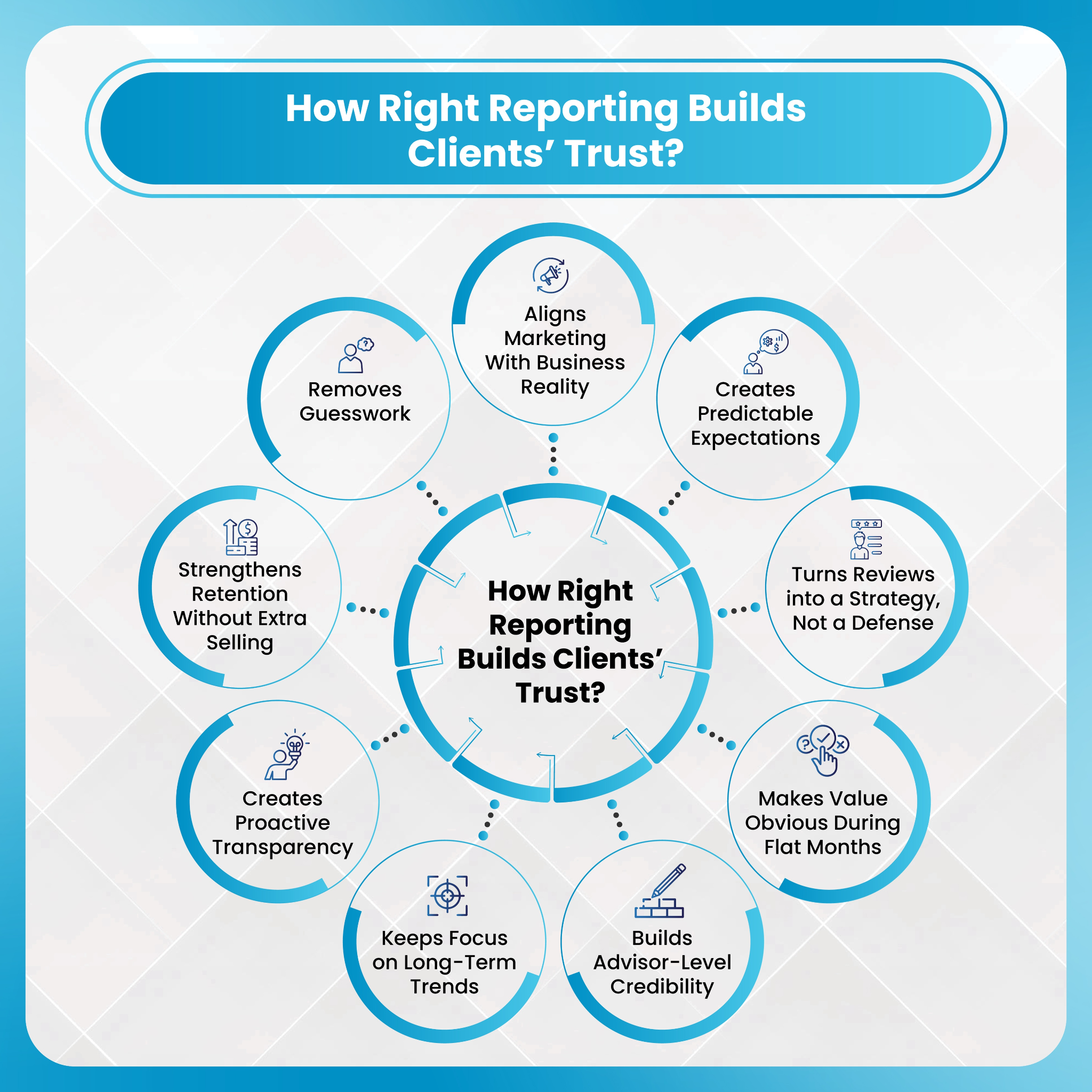
This helps clients understand how each optimization contributes to their overall goals.
Scaling Trust with Systems: Where White Label PPC Fits In
As agencies grow, maintaining consistent execution becomes more challenging. More clients mean more campaigns, more data, and more complexity.
Without strong systems, execution quality can start to vary. This leads to inconsistencies in optimization, tracking, and reporting. White label PPC services can help standardize these processes.
A platform like DashClicks supports agencies by providing structured execution across key areas:
- Search term management and negative keyword strategies
- Budget allocation frameworks
- Accurate conversion tracking setups
- Continuous optimization cycles
This consistency leads to:
- Faster execution
- Reduced errors
- More predictable performance
Instead of stretching internal teams too thin, agencies can maintain a high standard of execution across all accounts.
DashClicks plays a role in helping agencies scale without compromising on quality. By supporting the operational side of PPC, it allows agencies to focus on strategy, communication, and client relationships while ensuring that execution remains reliable and transparent.
Conclusion: Trust Is an Execution Discipline
Trust is not built during quarterly reviews or performance presentations. It is built in the small, consistent actions that happen every day inside a campaign.
It grows through:
- Every irrelevant search term that is filtered out
- Every budget decision that is clearly explained
- Every metric that is accurately tracked and validated
Agencies that succeed long term understand this. They do not rely solely on results to prove their value. They make their execution visible, structured, and aligned with real business outcomes.
In a landscape where automation is becoming more common, the real differentiator is not who uses the best tools. It is who can create transparency around how those tools are used.
Clients want clarity. They want to understand not just what is happening, but why it is happening. Agencies that can deliver that clarity will build stronger relationships, retain clients longer, and grow more sustainably.


.svg)


.svg)
.svg)
.svg)
.svg)
.svg)