

.svg)

.svg)
.svg)
.svg)
.svg)
.svg)
Growth is supposed to make running an agency easier. More clients should mean more revenue, more stability, and more room to invest in the team. But for many agencies, the opposite happens. As the client roster expands, operations become harder to manage, delivery timelines stretch, and the quality that earned those clients in the first place starts to slip.
PPC is one of the most common services where this tension surfaces. Agencies focus heavily on acquiring new PPC clients, which makes sense. The contracts are recurring, the results are measurable, and the margin potential is strong. But as client numbers increase, consistently delivering PPC services becomes far more difficult. The problems that emerge are rarely about strategy. They are almost always operational.
Scaling PPC is not simply a matter of running more campaigns. It requires maintaining quality, consistency, and responsiveness across every account simultaneously. When an agency manages five clients, that is manageable. At twenty clients, the cracks begin to show. At forty, the entire operation can feel like it is held together with spreadsheets and goodwill.
This is why outsource white label PPC has become a scalable solution for agencies facing these kinds of bottlenecks. Rather than trying to absorb more work with the same team, agencies are finding smarter ways to expand delivery capacity without sacrificing the client relationships they have worked hard to build.
Before looking at solutions, it is important to understand why PPC delivery becomes increasingly difficult as agencies grow.
Why PPC Is One of the Most Operationally Intensive Agency Services?
PPC is not a one-time setup. It is an ongoing management service that demands consistent attention, regular updates, and continuous refinement across every account under management.
To deliver PPC effectively, teams must stay on top of a broad range of recurring responsibilities:
- Daily budget monitoring to ensure spend stays on pace without overshooting or underdelivering.
- Search term reviews to identify irrelevant queries and protect budget from wasted clicks.
- Bid adjustments based on device, time of day, location, and audience performance.
- Negative keyword management to continuously improve targeting precision.
- Ad testing to rotate creatives, assess performance, and keep messaging fresh.
- Landing page reviews to ensure continuity between ad copy and destination experience.
- Client reporting to communicate performance clearly and reinforce value.
- Platform updates to adapt when Google, Meta, or Microsoft change their interfaces, policies, or algorithms.
According to the Google Ads Help Center, advertisers should review campaign performance regularly and continuously optimize budgets, keywords, bidding strategies, and creatives instead of treating campaigns as "set and forget." That philosophy is sound in theory. In practice, it means every PPC account requires active management week after week, regardless of how well the previous month performed.
Every additional PPC client does not simply add revenue to the agency. It multiplies the operational workload. The tasks listed above do not scale linearly. They stack, and without the right systems in place, they begin competing for the same limited hours in the workday.
These ongoing responsibilities become increasingly difficult to manage consistently as client numbers grow.
Why Does PPC Delivery Get Harder as Your Agency Grows?
Most agency owners expect some growing pains as they scale. What they often fail to anticipate is how quickly those pains can compound into something more serious.
There is a concept worth naming here: Delivery Debt. This is the invisible operational workload that accumulates every time a new PPC client is added to the agency's portfolio. Unlike financial debt, Delivery Debt does not show up on a balance sheet. It builds quietly in the background until it starts affecting the quality of work being delivered.
Every new client brings a fresh layer of responsibility:
- Campaign launches that require setup, tracking, and QA.
- Client onboarding that demands time, communication, and documentation.
- Ongoing reporting that must be accurate, timely, and clearly communicated.
- Strategy calls that require preparation and follow-through.
- Performance reviews that involve analysis, insights, and recommendations.
- Creative requests that add design and copywriting tasks to the queue.
- Budget adjustments that need to be made quickly when circumstances change.
- Emergency troubleshooting when something breaks or underperforms unexpectedly.
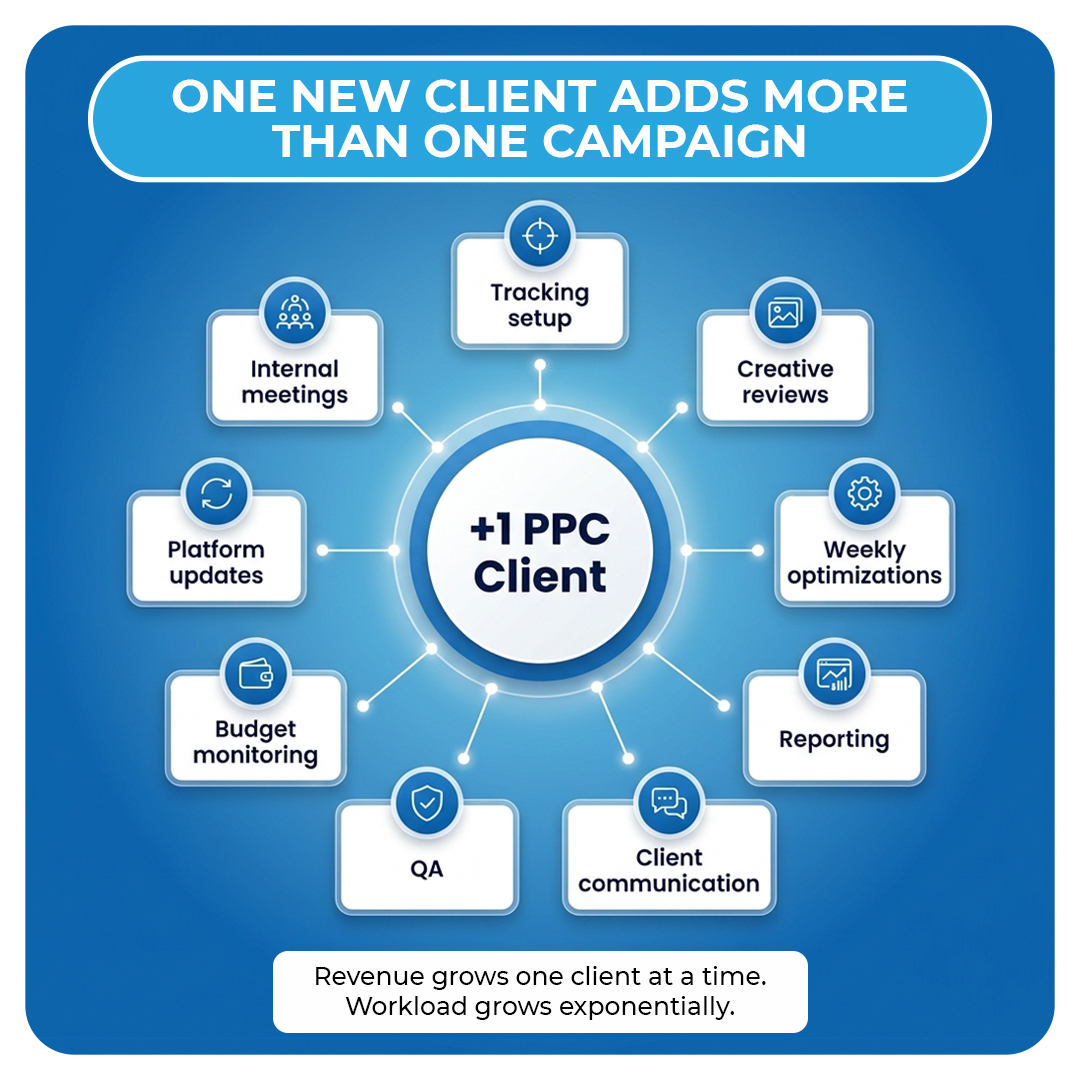
The danger of this framework is that it is gradual. No single new client breaks the system. But each one reduces the average time available for every other account. Agencies often fail to recognize the pattern until delivery quality begins declining and clients start asking questions.
The warning signs are worth knowing before they become a crisis.
Seven Signs Your Agency Is Experiencing PPC Delivery Strain
Delivery strain rarely announces itself all at once. It tends to surface through a series of small, easy-to-rationalize problems that eventually add up to something much harder to ignore.
- Campaign Launches Take Longer: When the team is overloaded, new campaign launches get pushed back. Account setup, ad copy review, and QA processes take longer than they should. Clients who were promised a fast launch start chasing timelines, and trust erodes before a single click has been recorded.
- Optimization Becomes Reactive Instead of Proactive: Proactive optimization, reviewing search terms, testing bids, and refreshing ads before performance drops require time and headspace that a stretched team simply does not have. When capacity is low, teams shift into reactive mode, responding to problems only after they have already impacted results.
- Reporting Is Consistently Delayed: Monthly reports require pulling data, analyzing performance, writing commentary, and formatting output for each client. When the workload grows faster than the team, reporting becomes the first thing to slip. Late or incomplete reports signal to clients that they are not a priority.
- Testing Frequency Declines: Ad testing is one of the most powerful levers in PPC performance, but it is also one of the first things to be deprioritized when capacity is tight. When teams stop testing regularly, campaigns stagnate and performance plateaus.
- Junior Staff Begins Managing Enterprise Accounts: As senior specialists get stretched across more accounts, higher-value clients often end up being handled by less experienced team members. The risk to campaign quality and client confidence is significant, particularly for clients with large budgets or complex account structures.
- Client Communication Slows Down: When delivery teams are overwhelmed, response times suffer. Emails go unanswered for longer than they should. Clients who are not hearing from their agency regularly start to question whether their account is being managed at all.
- Team Burnout Increases: Gallup reports that employee burnout is strongly associated with unmanageable workloads and a lack of support. For PPC teams managing a growing client load with limited resources, burnout is not a risk. It is a predictable outcome. When specialists burn out, performance declines, turnover increases, and the agency is left rebuilding capacity from scratch at the worst possible time.
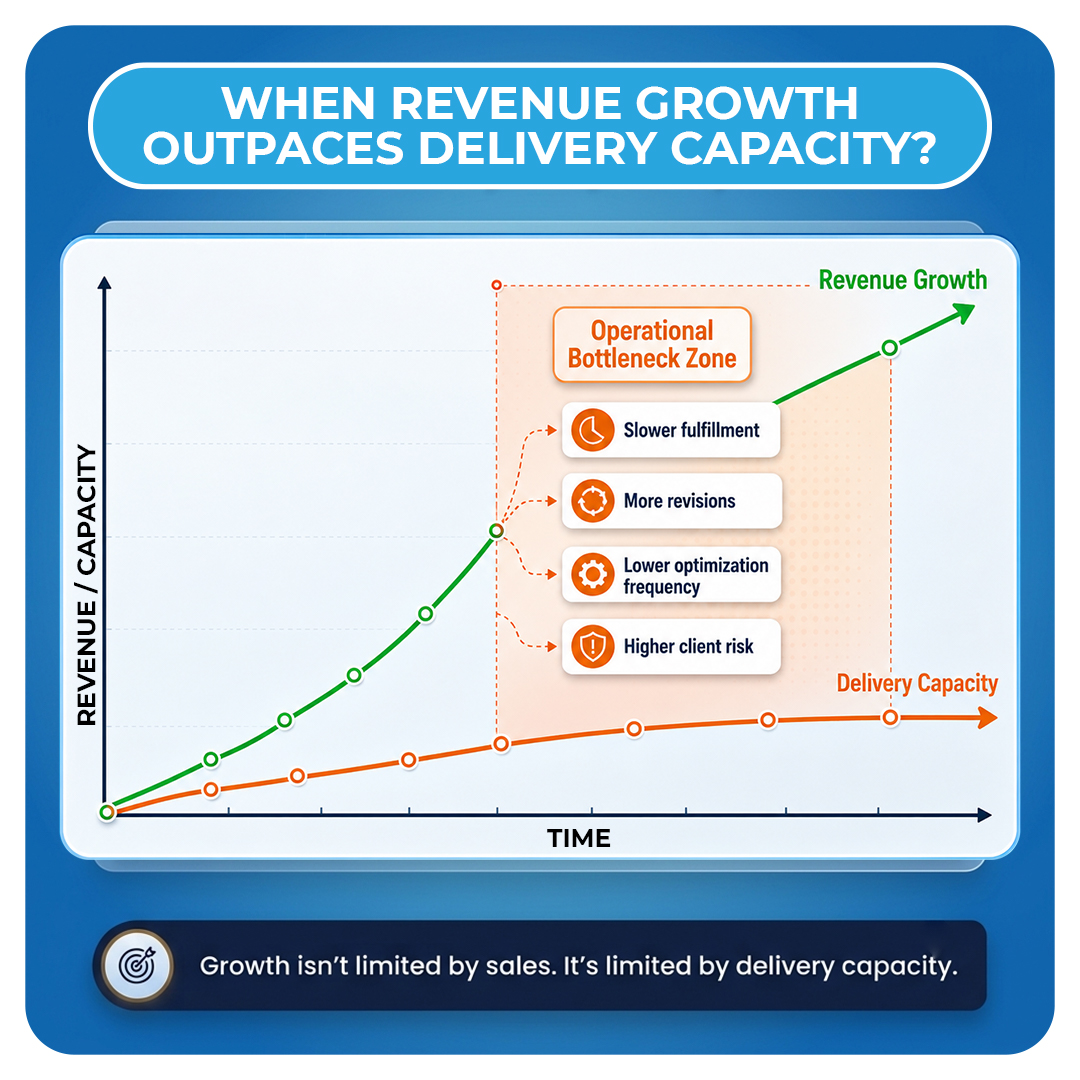
Taken together, these warning signs do not just affect the team. They eventually start showing up in campaign results.
How PPC Delivery Problems Affect Client Results?
Operational bottlenecks and campaign performance are directly connected. When delivery systems are strained, it is only a matter of time before the numbers tell the story.
Agencies experiencing delivery strain often see results shift in predictable ways:
- Rising cost-per-click (CPC) as bids go unreviewed and competitors gain ground.
- Higher cost-per-acquisition (CPA) as inefficient spend accumulates without correction.
- Missed optimization opportunities that would have improved targeting and reduced waste.
- Reduced impression share from campaigns that are not being actively managed.
- Slower response to market changes, including competitor activity, seasonality, and platform updates.
- Less effective testing, leaving campaigns running on outdated creative for longer than is appropriate.
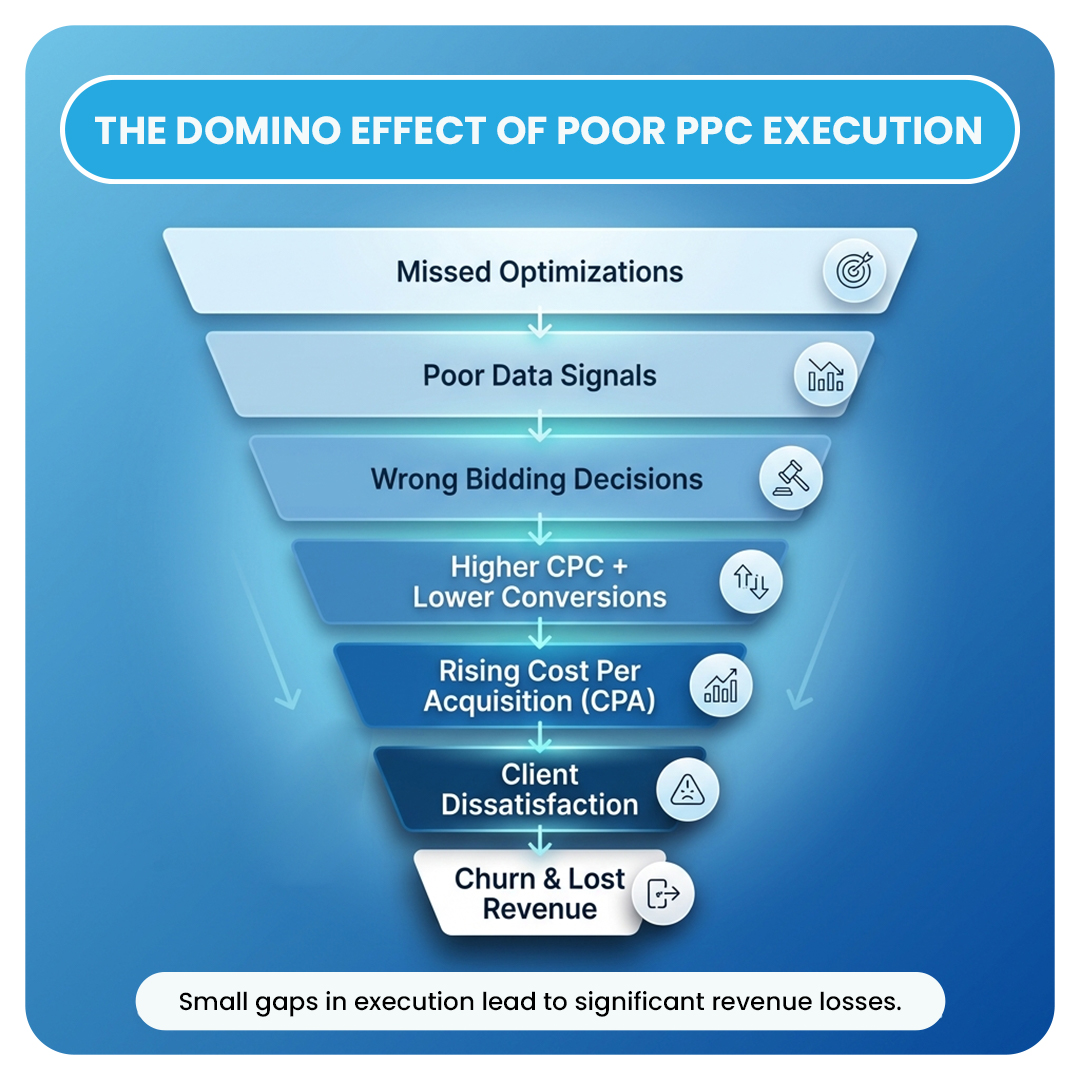
According to Google Ads Best Practices, regularly testing ads and optimizing campaigns improves performance over time. The inverse is equally true. Inconsistent optimization, which is a direct result of operational strain, reduces campaign effectiveness at a compounding rate. Gaps in management are not neutral. They are actively costly.
These performance gaps are what ultimately damage client relationships and drive churn. Hiring more staff seems like the logical response, but the reality is more complicated.
Why Hiring More PPC Specialists Isn't Always the Best Scaling Strategy?
The instinct to hire when workloads increase makes sense. More work requires more people. But hiring as the primary scaling strategy has significant limitations that agencies often underestimate until they are deep into the process.
Recruiting and onboarding skilled PPC professionals takes time and resources that most growing agencies cannot easily absorb. The costs and complications include:
- Recruitment time, which can stretch from weeks to months for experienced candidates.
- Training costs, particularly when the new hire needs to learn agency-specific tools, processes, and client contexts.
- SOP creation, because without documented processes, quality depends entirely on individual effort.
- Quality control, which requires management bandwidth that may already be in short supply.
- Employee turnover, which means the investment in recruitment and training, may need to be repeated more often than expected.
- Payroll overhead, which is a fixed cost that continues regardless of client volume fluctuations.
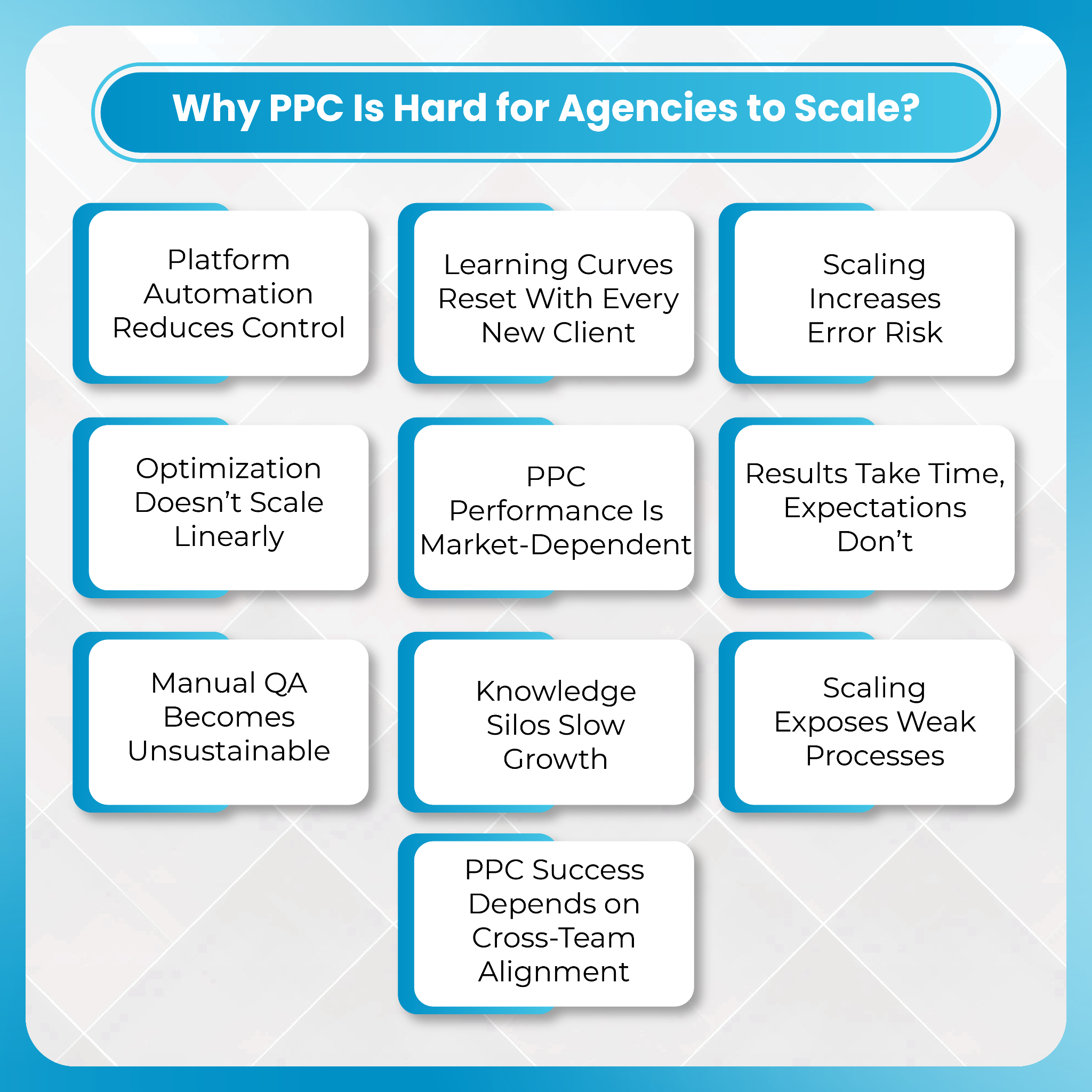
According to the U.S. Bureau of Labor Statistics, recruiting and onboarding skilled professionals requires significant investments of time and resources. For agencies where sales are moving faster than operational capacity, hiring rarely keeps pace. By the time a new specialist is fully onboarded and productive, the delivery gap has often widened further.
This mismatch between sales growth and operational readiness is exactly why many agencies are choosing more flexible operating models.
How Does White Label PPC Solve Agency Delivery Problems?
A white label PPC partner extends an agency's delivery capacity without replacing the client relationship. The agency remains the face of the service. A dedicated fulfillment team works behind the scenes to execute, optimize, and report on campaigns at scale.
This model addresses the core operational problems that internal teams struggle to manage alone. Fulfillment partners help agencies through:
- Dedicated PPC specialists who focus entirely on execution and optimization.
- Faster campaign launches supported by established processes and experienced teams.
- Consistent optimization schedules that keep every account actively managed.
- Structured QA processes that maintain quality standards across the entire portfolio.
- Continuous campaign monitoring to catch issues before they affect results.
- Reporting support that keeps client communication clear and timely.
- SOP-driven execution that reduces dependency on individual team members.
- Flexible scalability that allows agencies to onboard new clients without rebuilding their operations.
Importantly, the agency retains full ownership of what matters most:
- Client communication and relationship management
- Strategic direction and recommendations
- Brand identity and positioning
- Account oversight and approval
This structure removes the operational bottleneck without removing the agency from the picture. Clients receive consistent, professional PPC management. The agency maintains the relationship, earns the revenue, and avoids the overhead of building out an internal department to match every wave of growth.
The advantages of this model extend well beyond campaign management.
Agency Benefits Beyond Campaign Management
White label PPC fulfillment improves more than campaign execution. It changes the operational foundation of the agency in ways that support long-term growth and profitability.
Agencies that partner with a white label PPC agency typically experience broader improvements across their business:
- Better margins because fulfillment costs scale with client volume rather than running as fixed overhead.
- Predictable fulfillment because structured processes replace individual effort as the core delivery mechanism.
- Easier client onboarding because the fulfillment infrastructure is already in place and ready to deploy.
- Faster agency growth because sales no longer have to slow down to wait for operational capacity to catch up.
- Reduced burnout because internal teams are no longer being stretched beyond what is sustainable.
- Greater operational consistency because every client receives the same standard of service regardless of internal workload.
- Improved client retention because consistent performance and communication keep clients engaged and satisfied.
- Ability to offer PPC at scale without hiring, training, or managing a specialized internal department.
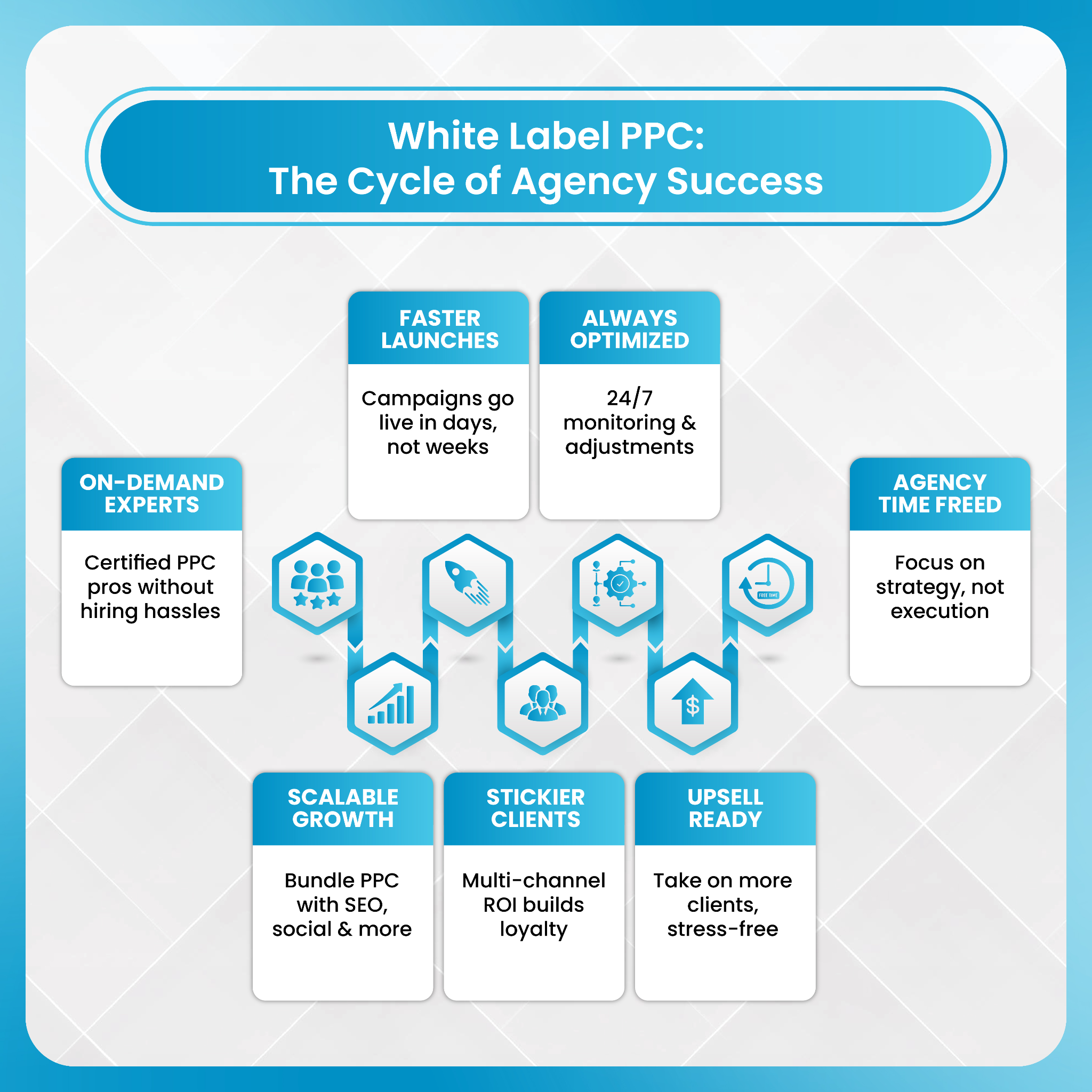
Customer retention is generally far more cost-effective than customer acquisition, making consistent service delivery a major contributor to long-term agency profitability. According to research published by Bain and Company, increasing customer retention rates by just 5% can increase profits by 25% to 95%. When white label fulfillment helps agencies deliver consistently, it protects and strengthens the client relationships that drive sustainable revenue.
Operational consistency is not just an internal benefit. It is something clients notice and respond to. When reporting arrives on time, campaigns perform reliably, and communication stays proactive, clients stay longer and refer more often.
For agencies ready to put this model into practice, the right white label PPC partner makes the difference.
How does DashClicks Support Growing Agencies?
DashClicks functions as an operational partner designed specifically for agencies looking to scale PPC services efficiently and sustainably. Rather than replacing agency expertise, it extends it.
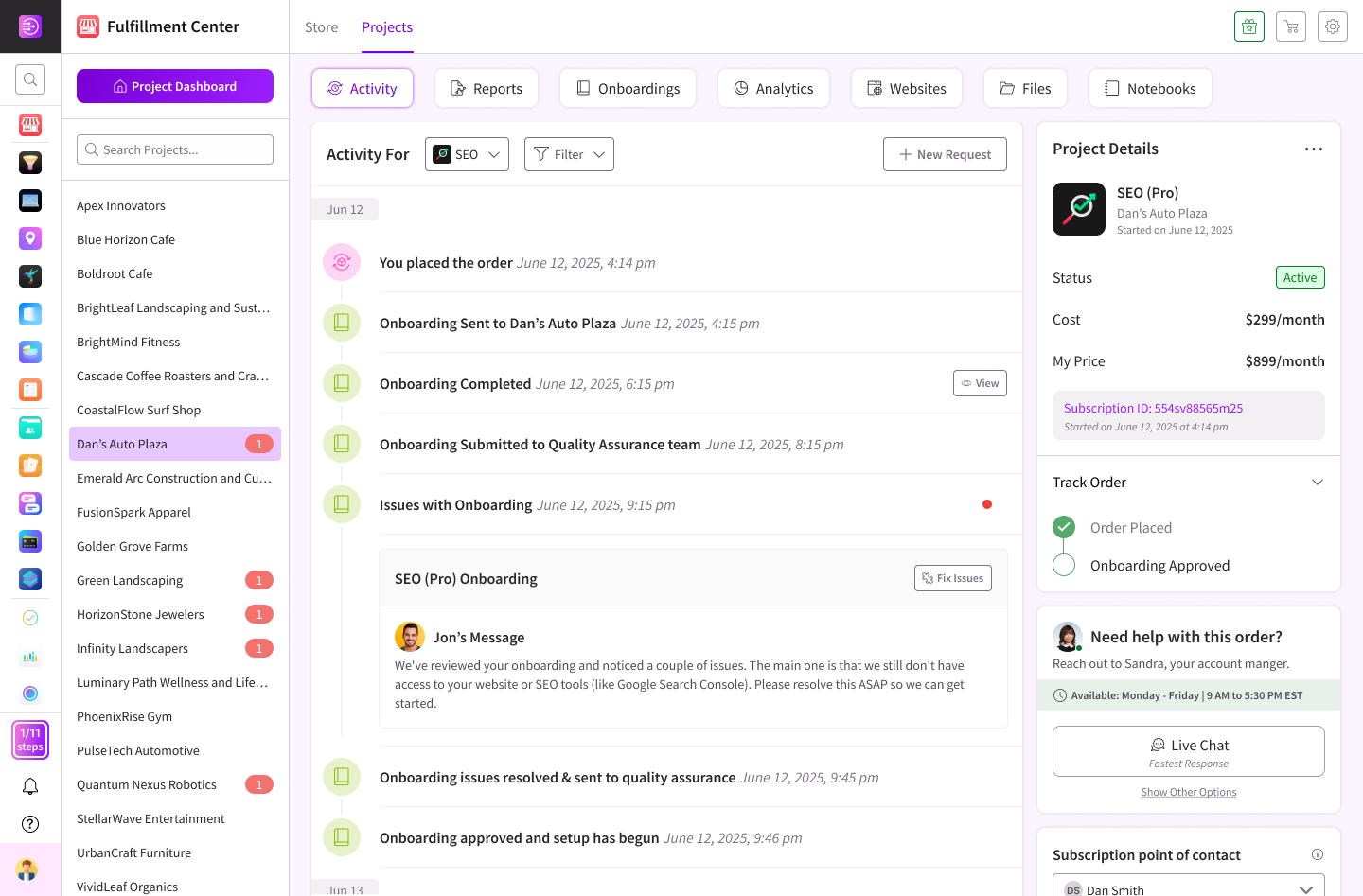
- Strategic Campaign Management: Campaigns are developed and managed using structured, repeatable processes focused on measurable outcomes. Every campaign is built around clear performance goals, ensuring that execution aligns with the strategy the agency has established for each client.
- Dedicated PPC Specialists: Experienced PPC professionals handle campaign execution, freeing agency teams to remain focused on client relationships and strategic direction. Agencies benefit from specialized expertise without the overhead of hiring and retaining that talent internally.
- Continuous Optimization: Ongoing campaign monitoring, bid adjustments, ad testing, and optimization cycles are designed to keep performance moving in the right direction. Campaigns are never left to run without active management, which means performance issues are identified and addressed before they escalate.
- Transparent White Label Reporting: Reporting includes branded reports, performance dashboards, and actionable insights that make client communication straightforward. Agencies can present professional, clearly formatted results without building a reporting system from scratch.
- Scalable Fulfillment Infrastructure: DashClicks’ white label PPC services give agencies the infrastructure to increase fulfillment capacity, launch campaigns faster, support more PPC clients, and scale without expanding internal headcount. As an agency's client base grows, the fulfillment infrastructure scales alongside it, removing the operational ceiling that often limits how far an agency can grow.
Conclusion
Growing agencies rarely struggle because they lack marketing expertise. The real challenge is that operational complexity grows faster than fulfillment capacity. When that gap widens, even the most capable teams begin to underdeliver.
PPC, more than almost any other agency service, requires structured systems rather than simply more people. The daily workload is relentless, the stakes are high, and the margin for inconsistency is narrow. Without reliable delivery infrastructure, growth becomes a liability rather than an asset.
A white label PPC agency provides scalable operational support while allowing agencies to maintain full client ownership and campaign quality. The agency earns the relationship. The fulfillment partner enables the execution. Together, the model creates the kind of operational resilience that sustains long-term growth.
Sustainable agency growth depends just as much on efficient delivery systems as it does on successful client acquisition. Agencies that build those systems before hitting operational limits position themselves to grow with confidence rather than scrambling to keep up. The time to build that foundation is before the cracks appear.


.svg)


.svg)
.svg)
.svg)
.svg)
.svg)