

DashClicks Blog
The industry's top experts offer their best advice, research, how-tos, and insights—all in the name of helping you level-up your business and online marketing skills.
Join Us!
.svg)
.svg)
.svg)
.svg)
.svg)

How White Label SEO Services Target High-Intent Keywords for Agency Clients
Agencies celebrate ranking wins. Clients celebrate new customers. That disconnect is one of the biggest reasons SEO relationships fail, and it highlights a common problem with traditional keyword strategies.
Ranking for a high-volume keyword may look impressive, but if it attracts researchers instead of buyers, traffic increases without generating revenue. Clients see higher traffic numbers, yet their sales pipeline remains unchanged, leading them to question the value of SEO.
Search behavior has evolved. Users are more specific, more purposeful, and often search with clear buying intent. Someone searching for "emergency commercial HVAC repair Chicago" is far more likely to convert than someone searching for "HVAC systems," regardless of search volume.
As a result, keyword intent has become a more valuable SEO metric than keyword volume. According to BrightEdge, organic search drives 53% of all website traffic, making it the largest digital channel for most businesses. The real challenge is not generating more traffic but attracting visitors who are ready to take action.
White label SEO services help agencies scale intent-focused keyword strategies across multiple clients without rebuilding research processes for every campaign. The agencies seeing the best results are not targeting the most keywords. They are targeting the right ones.
Understanding why high-intent keywords matter starts with recognizing why traditional keyword strategies often fail to drive meaningful business outcomes.
Why Ranking for High-Volume Keywords Is Not Enough Anymore?
Visibility and profitability are not the same thing. Agencies often treat them as equivalent, which creates campaigns that look successful on paper while underdelivering on business outcomes.
Informational traffic is a significant part of this problem. A blog post ranking for a broad educational query can pull thousands of sessions per month from users who have no intention of buying anything. That traffic inflates reporting dashboards while contributing nothing to the client's pipeline. The gap between impressions and revenue becomes harder to ignore over time.
The search landscape has shifted in ways that make vanity rankings even less valuable. According to research from SparkToro and Datos, approximately 58.5% of Google searches in the United States now end without a click, largely due to AI Overviews, featured snippets, and knowledge panels answering queries directly on the results page. A high ranking on an informational keyword may generate fewer visits than it did two years ago.
At the same time, reports say that 60% of marketers say inbound channels like SEO generate their highest-quality leads. The opportunity in organic search is real. The issue is that many agencies are investing their effort in the wrong part of the keyword spectrum.
A practical example illustrates the problem clearly:
- Monthly traffic: up 40%
- Leads generated: flat
- Revenue from organic: unchanged
Many agencies lose clients because they report traffic growth instead of revenue growth. When clients connect the dots between SEO spend and business outcomes, traffic metrics alone rarely justify the investment.
If search volume is no longer the best indicator of opportunity, agencies need a better way to identify keywords that actually drive business outcomes.
What Makes a Keyword High Intent?
Not all keywords carry the same commercial weight. Understanding the difference requires looking at the four categories of keyword search intent and evaluating where each keyword sits within the buyer journey.
- Informational Intent: These searches seek knowledge. Queries like "what is managed IT" or "how does CRM software work" attract users at the earliest stage of awareness. They can support brand visibility and top-of-funnel content strategies, but they rarely convert directly.
- Navigational Intent: Users searching for a specific brand or website already know where they want to go. These searches signal existing familiarity but rarely represent new acquisition opportunities for competing businesses.
- Commercial Investigation Intent: This is where serious buying decisions begin. Queries like "best CRM software" or "HubSpot alternatives" come from users actively comparing options before committing. These keywords attract prospects who are informed, motivated, and close to a decision.
- Transactional Intent: These searches signal readiness to act. "Buy CRM software for small business" or "schedule IT support consultation" indicates that the user has completed their research and is ready to engage with a vendor.
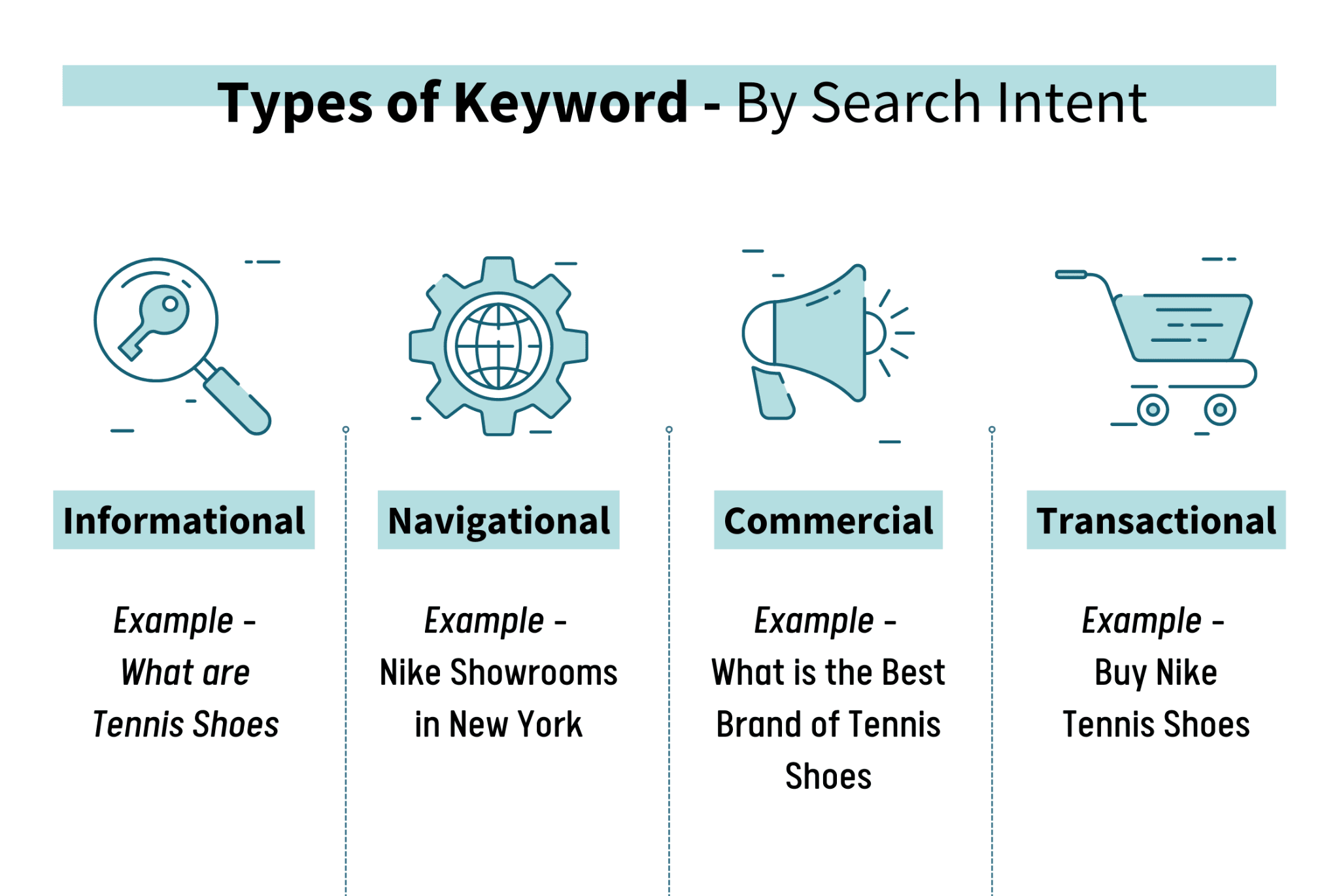
To evaluate keywords beyond simple category labels, agencies can apply an intent-based keyword scoring model. This framework scores each keyword opportunity across five dimensions:
- Purchase readiness
- Expected conversion rate
- Sales cycle stage
- Revenue potential
- Competition level
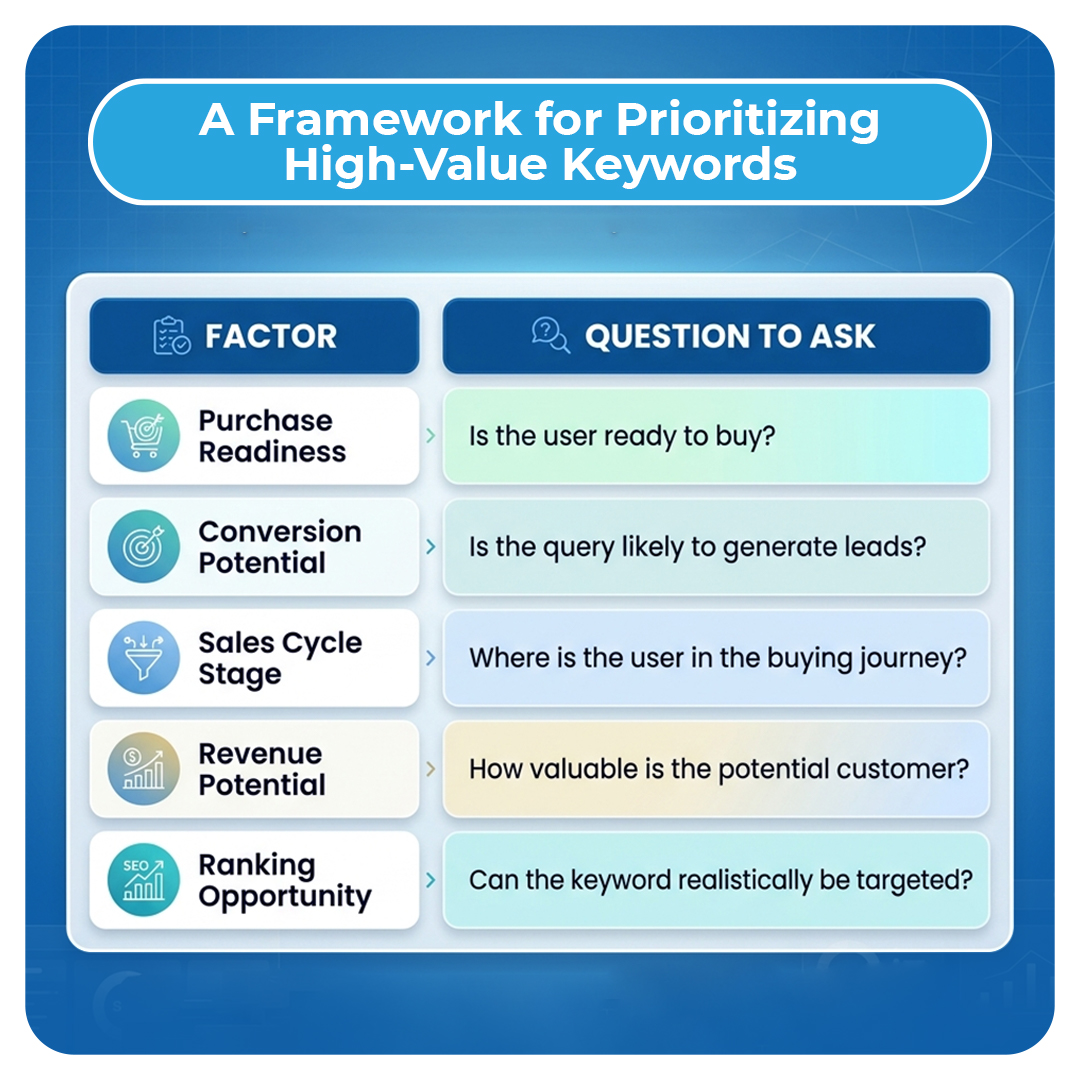
Consider the keyword progression: "CRM software" versus "best CRM software" versus "HubSpot alternatives" versus "buy CRM software for small business." Volume decreases at each step, but conversion probability increases sharply. The lower-volume keyword often outperforms the broader one by a significant margin when measured against actual revenue generated.
Intent should be scored, not guessed. Agencies that treat all keywords as equivalent will consistently underinvest in the opportunities that produce the strongest results.
Knowing what high-intent keywords look like is only the beginning. The real challenge is finding these opportunities consistently across multiple client campaigns.
How White Label SEO Services Uncover High-Intent Opportunities Faster?
Most agencies do not have the research infrastructure to identify high-intent keyword opportunities at scale. Building that capability internally requires enterprise-grade tools, dedicated analysts, and significant time investment that many teams cannot justify across a full client roster.
White label SEO provider closes that gap by bringing the research resources of a specialized team to every client engagement. The methods they use go well beyond basic keyword volume analysis.
Key research capabilities include:
- Enterprise keyword databases that surface long-tail and intent-rich queries that standard tools miss
- Competitor gap analysis to identify keywords where client competitors are capturing commercial traffic
- Search intent clustering to group related queries by buyer stage rather than topic alone
- SERP feature analysis to evaluate which keywords trigger shopping results, local packs, or featured snippets
- AI-assisted keyword discovery to surface emerging queries before they appear in standard research tools
- Topic clustering to map keyword opportunities around complete subject areas rather than isolated terms
Consider a roofing contractor client. A surface-level strategy targets "roof repair." An intent-focused research process uncovers a more valuable opportunity set:
- emergency roof repair near me
- same-day roof repair
- roof leak repair cost
- roof repair financing
Each of these keywords signals a buyer in a different stage of urgency, but all of them indicate far stronger purchase intent than the broad head term. White label providers identify keyword ecosystems rather than isolated keywords.
Finding high-intent opportunities creates the foundation for growth, but agencies generate the most value when those keywords are organized around the customer journey.
Building Intent-Based Content Funnels Instead of Individual Pages
Treating each keyword as an isolated page is one of the most common structural mistakes in SEO strategy. High-intent keyword targeting works best when keywords are organized into layered content funnels that guide users from awareness to action.
A single keyword cannot carry the full weight of a client's acquisition strategy. Users at different stages of the buying process need different content, and each piece of content should connect logically to the next.
Top of Funnel
Top-of-funnel content addresses awareness and education. Examples include:
- Industry guides and explainer articles
- Problem-awareness content
- Broad category overviews
Middle of Funnel
Middle-of-funnel content supports commercial investigation. Examples include:
- Comparison pages and alternative guides
- Pricing breakdowns and vendor evaluations
- Feature-focused resources
Bottom of Funnel
Bottom-of-funnel content exists to convert. Examples include:
- Service pages and location pages
- Consultation or demo request pages
- Product and pricing pages
Internal linking connects these layers, creating clear paths that move users from research to decision. A practical funnel for a managed IT services client might look like this, with dedicated content around SEO for IT MSPs helping attract high-intent prospects.
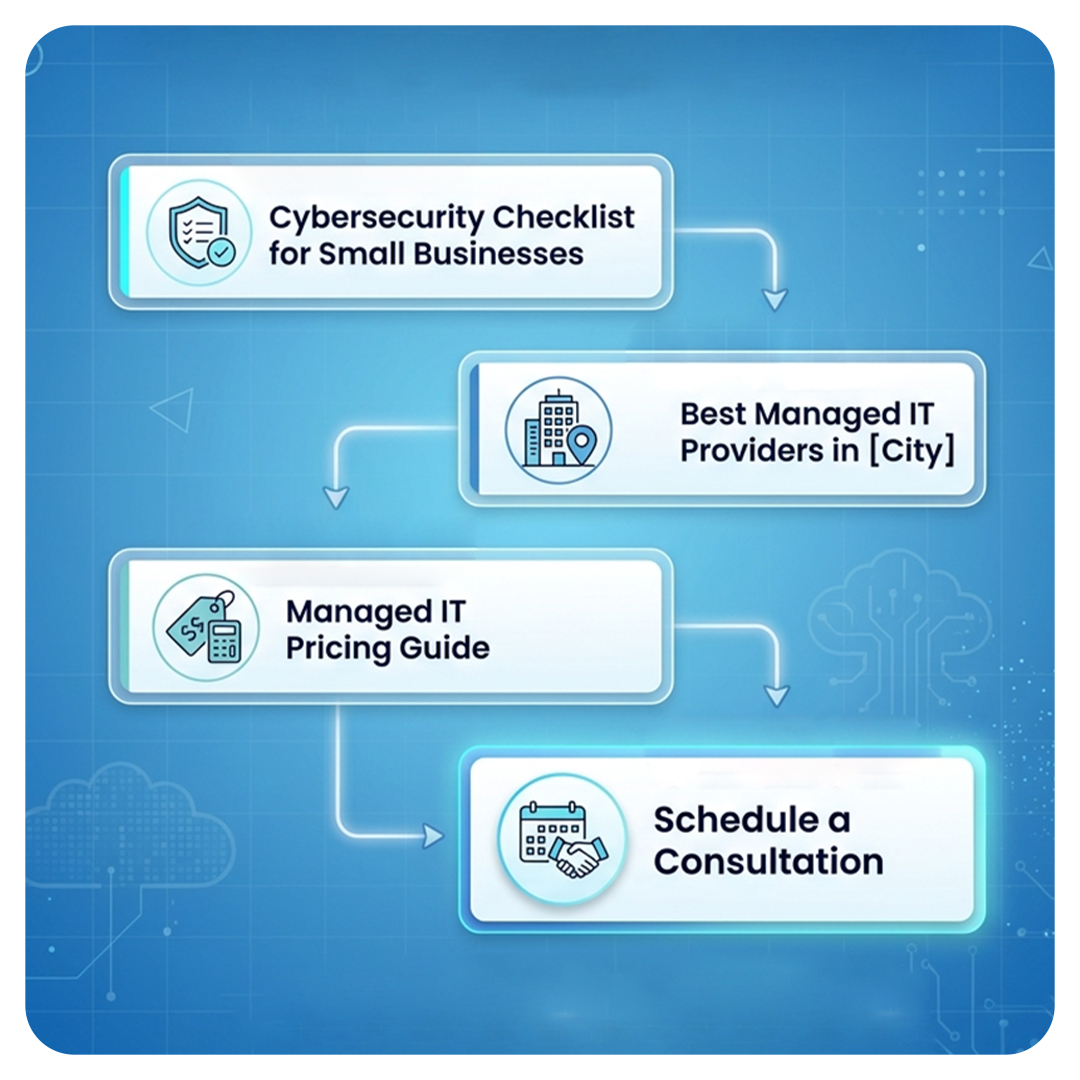
This approach generates what might be called Intent Stacking. Each layer builds on the one before it, creating compound SEO value as users move deeper into the funnel. The result is an architecture where every page serves a defined role in the client's acquisition process rather than simply occupying a spot in organic rankings.
Content strategy is only one side of the equation. Agencies also need a way to prioritize opportunities that produce measurable business impact.
How High-Intent Keyword Strategies Improve Client Retention?
The way an agency reports results shapes how clients perceive the value of SEO. Agencies that tie keyword strategy to business outcomes create a fundamentally different relationship with their clients than those reporting on rankings and impressions alone.
Reporting on high-intent SEO means presenting metrics that align directly with what clients care about:
- Leads generated from organic search
- Conversion rate growth on key landing pages
- Pipeline contribution from specific keyword clusters
- Revenue influence attributed to SEO
- Cost per acquisition improvements over time
This shift moves the agency from vendor to strategic advisor. The client stops thinking about SEO as a marketing expense and starts treating it as a revenue-generating investment.
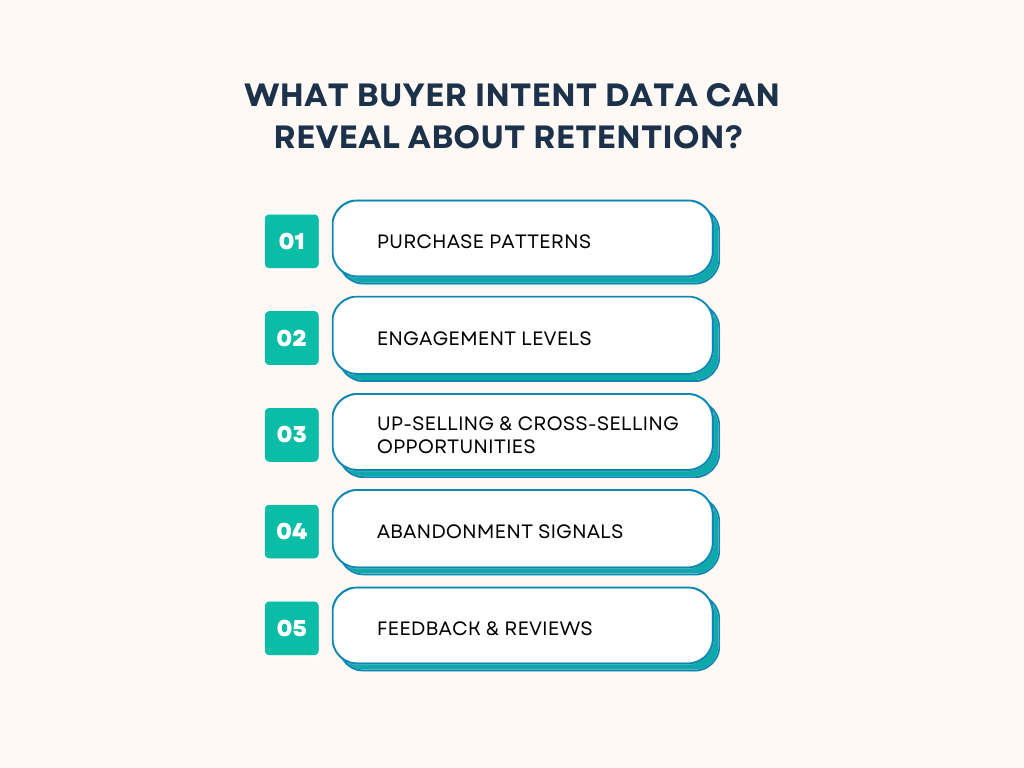
Image Source: Shortlister
A practical example: a legal services firm retains an agency not because its blog traffic increased, but because intake form submissions from organic search grew by 34% over six months. That is a result that leadership can connect directly to business growth.
Clients renew because SEO supports business growth, not because rankings improve. Agencies that anchor their strategy to intent-driven keywords have the data to make that case clearly every month.
Delivering these outcomes consistently requires systems and resources that many agencies struggle to build internally.
Why White Label SEO Gives Agencies a Competitive Advantage?
Scaling an intent-focused SEO practice requires more than talent. It requires research infrastructure, content specialists, technical capabilities, and repeatable fulfillment processes that hold up across dozens of client accounts simultaneously.
White label SEO services give agencies access to that full operational stack without the overhead of building it from scratch. The advantages compound quickly as an agency grows:
- Scalable research capacity without adding headcount for each new client
- Faster execution because fulfillment processes are already built and tested
- Access to dedicated specialists across content, technical SEO, and strategy
- Consistent quality is maintained through standardized workflows
- Enterprise-grade tools that most agency budgets cannot support independently
- Bandwidth to take on more clients without sacrificing delivery quality
The strategic value goes beyond execution. White label providers become a competitive intelligence engine for the agencies they support. Their exposure across multiple industries and markets produces pattern recognition that individual agencies cannot develop on their own.
Positioning a white label partner as a growth infrastructure investment rather than an outsourcing arrangement changes how agencies think about scaling. The right partner makes it possible to compete for larger accounts, deliver more sophisticated strategies, and retain clients longer.
As search becomes increasingly intent-driven and AI continues reshaping user behavior, agencies that prioritize business outcomes over rankings will be positioned for long-term success.
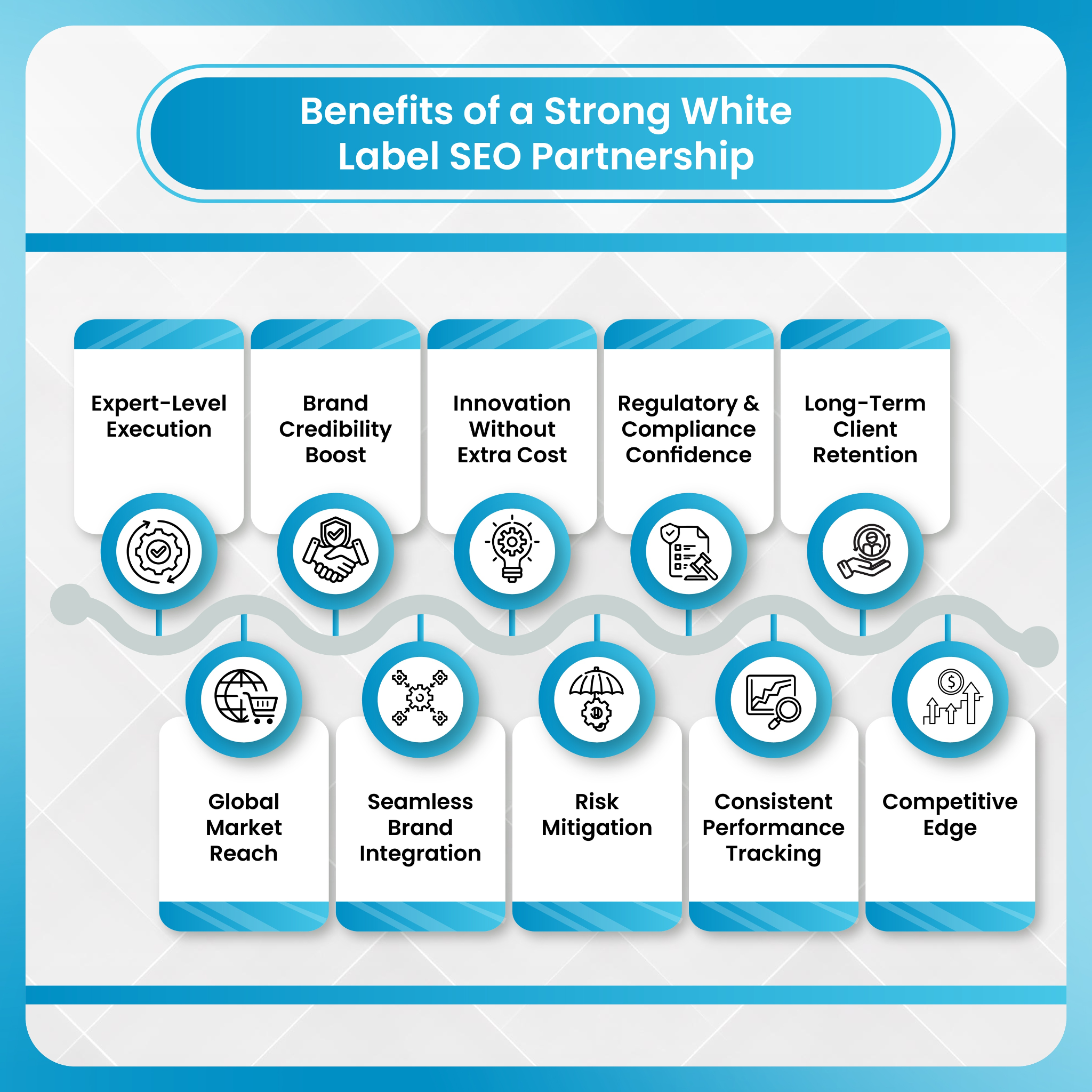
Further Reading: How to Stay Competitive With White Label Agency Services?
How DashClicks' White Label SEO Services Help Agencies Target High-Intent Keywords at Scale?
DashClicks offers white label SEO management built specifically to help agencies move beyond surface-level keyword targeting and build campaigns that drive measurable business results for clients.
The foundation of the approach is strategic keyword research paired with search intent analysis. Rather than delivering a keyword list ranked by volume, the team identifies commercial opportunities by evaluating where users are in the buying process and which queries are most likely to generate leads and conversions for a specific business type.
From that research foundation, DashClicks supports agencies with:
- Intent-focused content planning that maps keyword opportunities to each stage of the buyer journey
- White label SEO content creation optimized for both search visibility and conversion performance
- On-page optimization aligned to the intent signals embedded in target queries
- Internal linking strategies that build topical authority and guide users through content funnels
- Technical SEO support to ensure client websites meet the structural requirements for competitive rankings
- Reporting visibility that connects keyword performance to lead generation and client outcomes
For agencies managing multiple client accounts, the consistency of fulfillment by DashClicks is a significant operational advantage. Strategies are executed through repeatable systems, which means quality holds steady as volume increases.
The outcome for agencies is a scalable, intent-driven SEO practice that helps clients capture high-value traffic without requiring the agency to rebuild its research and execution infrastructure for every engagement.
Ultimately, the agencies that generate the strongest client results are not those chasing the most traffic. They are the ones consistently capturing the most valuable traffic.
The Agencies That Win Are the Ones Targeting the Right Keywords
Keyword strategy has always shaped SEO outcomes. What has changed is the standard for what a strong strategy actually looks like.
Raw search volume was once a reliable proxy for opportunity. That is no longer true. The combination of zero-click search behavior, AI-generated results, and increasingly specific user queries has made intent the primary variable that separates high-performing campaigns from those that generate traffic without impact.
High-intent SEO strategies produce outcomes that matter to clients: stronger leads, higher conversion rates, and revenue that can be traced back to specific keyword investments. Those outcomes build the kind of trust that extends contracts and generates referrals.
White label SEO services help agencies execute these strategies at scale. The research depth, content infrastructure, and fulfillment consistency that specialized providers bring make it possible to deliver intent-first campaigns across an entire client roster without the overhead of building that capability internally.
The agencies that outperform competitors will not necessarily rank for the most keywords. They will rank for the keywords that bring clients their next customers.
.jpg)
Why Facebook Ads Fail During Scaling (And How White Label Services Help)
Scaling Facebook Ads is one of the toughest challenges agencies face. A campaign that performs beautifully at $50 or $100 per day can suddenly stall the moment you push more budget into it. The frustrating part? More spending rarely produces proportionally more conversions.
Most scaling problems do not appear out of nowhere. They come from audience limitations, creative fatigue, measurement gaps, and operational bottlenecks that stay hidden at lower budgets. When agencies manage several client accounts at once, that complexity multiplies fast.
Here is the insight many agencies miss: scaling is an operational discipline, not simply a media buying tactic. The agencies that scale well treat it as a system, not a button they press inside Ads Manager.
Context matters too. WordStream reports that average Google Ads search conversion rates reached roughly 7.52% across industries in 2025. Paid conversion rates are healthy when campaigns are built well, which tells you that scaling failures usually come from execution, not demand.
This guide breaks down why scaling changes campaign behavior, the real reasons performance drops, and how white label Facebook advertising services help agencies grow without losing efficiency. Before understanding how to scale successfully, agencies must first understand why scaling changes campaign behavior in the first place.
Why Scaling Changes The Entire Campaign Dynamics?
Scaling does not just mean spending more money. It changes how Meta delivers your ads, who sees them, and what you pay to reach them. Understanding this shift is the foundation for everything that follows.
When you increase budgets, Meta is forced to reach beyond your highest-intent audience segments. To spend the extra money, the platform widens delivery, which creates several predictable effects:
- Auction participation expands as your ads compete for more impressions.
- CPMs often rise because you are bidding into more crowded inventory.
- CPA frequently increases as you reach less qualified users.
- Delivery becomes harder to predict and stabilize.
Picture a campaign producing profitable leads at $100 per day. At $1,000 per day, that same campaign often struggles because the high-intent audience pools have been exhausted. You are now paying to reach people who are less likely to convert.
The learning phase plays a major role here. Meta generally recommends around 50 optimization events within a seven-day window to reach learning stability. Without enough conversions, campaigns stay unstable, and delivery suffers.
This is why every major budget change can reset learning and disrupt performance. The algorithm needs consistent signals, and aggressive scaling breaks that consistency.

Understanding why scaling changes delivery explains why many agencies blame the algorithm when the real issue lies within campaign structure and execution.
The Real Reasons Facebook Ads Fail During Scaling
Once you accept that scaling changes campaign behavior, the next step is identifying exactly where performance breaks down. Most failures trace back to five specific issues, and they often occur simultaneously.
1. Audience Saturation
As budgets climb, your ads show up to the same people more often. That rising frequency leads to fatigue and weaker results.
Meta also expands delivery into lower-quality audience segments to spend the budget. The outcome is diminishing returns, where more spending buys less qualified traffic. In short, bigger budgets often mean a less interested audience.
2. Creative Fatigue Accelerates
Creative wears out faster at scale because more people see your ads in a shorter window. The warning signs are easy to spot:
- Declining click-through rate (CTR)
- Increasing CPM
- Falling engagement and comments
The fix is structural, not reactive. Agencies should maintain a continuous creative testing pipeline so fresh assets are always ready before fatigue sets in.
3. Learning Phase Resets
Every aggressive edit can throw a campaign back into the learning phase. Frequent changes, large budget jumps, and constant tweaking all create delivery instability.
Industry best practice recommends increasing budgets by roughly 10 to 20% at a time, then allowing 48 to 72 hours for stabilization. Patience protects the data that the algorithm depends on.
4. Weak Conversion Data
Scaling amplifies whatever data foundation you already have. If that foundation is weak, scaling makes the cracks worse. Common problems include:
- Pixel issues and firing errors
- Missing offline conversions
- Disconnected CRM systems
- General tracking inaccuracies
The principle is simple: garbage data produces garbage optimization. Meta can only optimize toward the signals it receives, so flawed tracking guarantees flawed delivery.
5. Scaling Operations Instead Of Strategy
This is the issue most agencies overlook. They scale budgets without scaling the systems that support those budgets.
Specifically, agencies often increase spending without expanding:
- Creative production
- Attribution and measurement
- Reporting depth
- Testing systems
Many scaling failures are operational failures rather than platform failures. The algorithm is doing its job, but the surrounding systems cannot keep up.
Once agencies recognize that scaling failures stem from multiple operational factors, the next challenge becomes managing those factors across dozens of client accounts.
The Hidden Agency Challenge: Scaling Multiple Facebook Accounts Simultaneously
For a single campaign, the problems above are manageable. For an agency running many accounts, they compound into something far harder to control.
Every client brings a different set of variables, and each one demands attention:
- Different KPIs and success metrics
- Different attribution models
- Different creative cycles and refresh rates
- Different sales cycles
- Different budgets and risk tolerances
When you stack these differences across an entire client roster, optimization complexity grows exponentially. Managing five accounts is demanding but doable. Managing fifty accounts with the same processes is nearly impossible without a system built for it.
Think about what changes between those two scenarios. Five accounts might mean a handful of creative tests and weekly reviews. Fifty accounts mean hundreds of active variables, dozens of reporting deadlines, and constant context switching that drains your team.
This leads to an important realization: agencies often hit an operational ceiling before they hit a client acquisition ceiling. They could sell more, but they cannot deliver more without quality slipping.
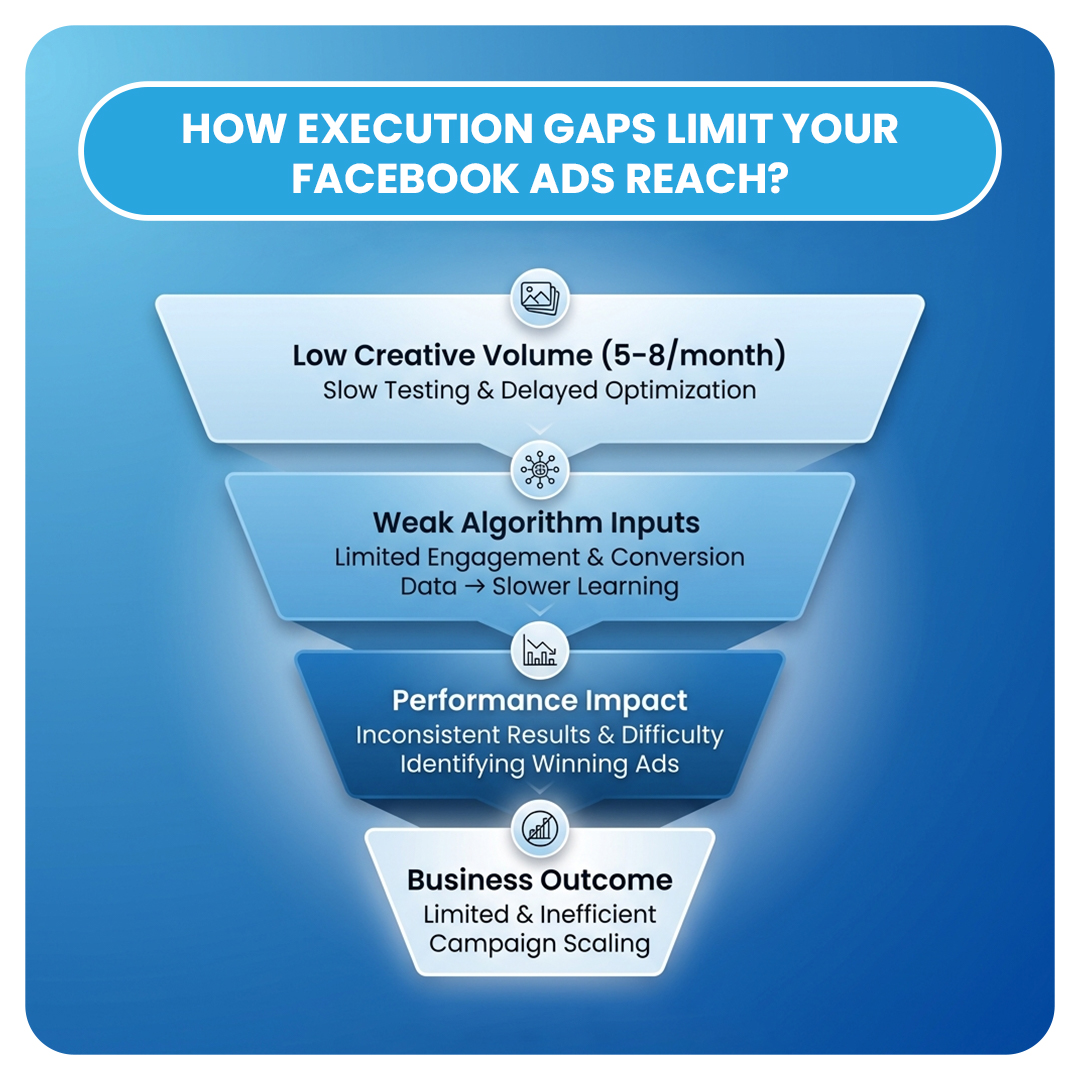
This operational complexity explains why many high-growth agencies eventually move toward strategy-led delivery models.
Further Reading: Managing 50+ Accounts Using White Label Facebook Ads Services
Why White Label Services Help Agencies Scale Better?
White label Facebook advertising is best understood as operational infrastructure, not simple outsourcing. It gives agencies the fulfillment capacity to scale campaigns without scaling internal headcount at the same rate.
Here is how the right white label partner strengthens each part of the scaling process.
1. Continuous Optimization Capacity
Scaling demands constant attention, and most lean teams cannot provide it across every account. A dedicated fulfillment team can deliver:
- Daily campaign monitoring
- Active bid management
- Ongoing audience testing
- Regular performance reviews
That consistency keeps campaigns stable as budgets grow.
2. Faster Creative Testing
Creative velocity is one of the strongest scaling levers, and it requires volume. White label support increases creative throughput, enabling faster experimentation and earlier fatigue prevention. More tested assets mean fewer performance dips.
3. Better Tracking Infrastructure
Clean data is the backbone of profitable scaling. Strong white label Facebook advertising services help agencies build and maintain accurate measurement through:
- Meta Pixel audits
- Conversions API setup
- CRM integrations
- Offline conversion imports
Better data improves algorithm performance, which directly improves results.
4. Agency Scalability
Beyond campaign work, white label fulfillment changes the economics of growth. The benefits include:
- More fulfillment capacity without proportional hiring
- More consistent delivery across accounts
- Lower hiring and training costs
- Improved profit margins
This reframes the core constraint. The biggest bottleneck in Facebook scaling is often agency bandwidth, not Meta's algorithm. Solve the bandwidth problem, and scaling becomes far more achievable.
Even with expert fulfillment support, agencies still need a repeatable framework for scaling campaigns consistently.
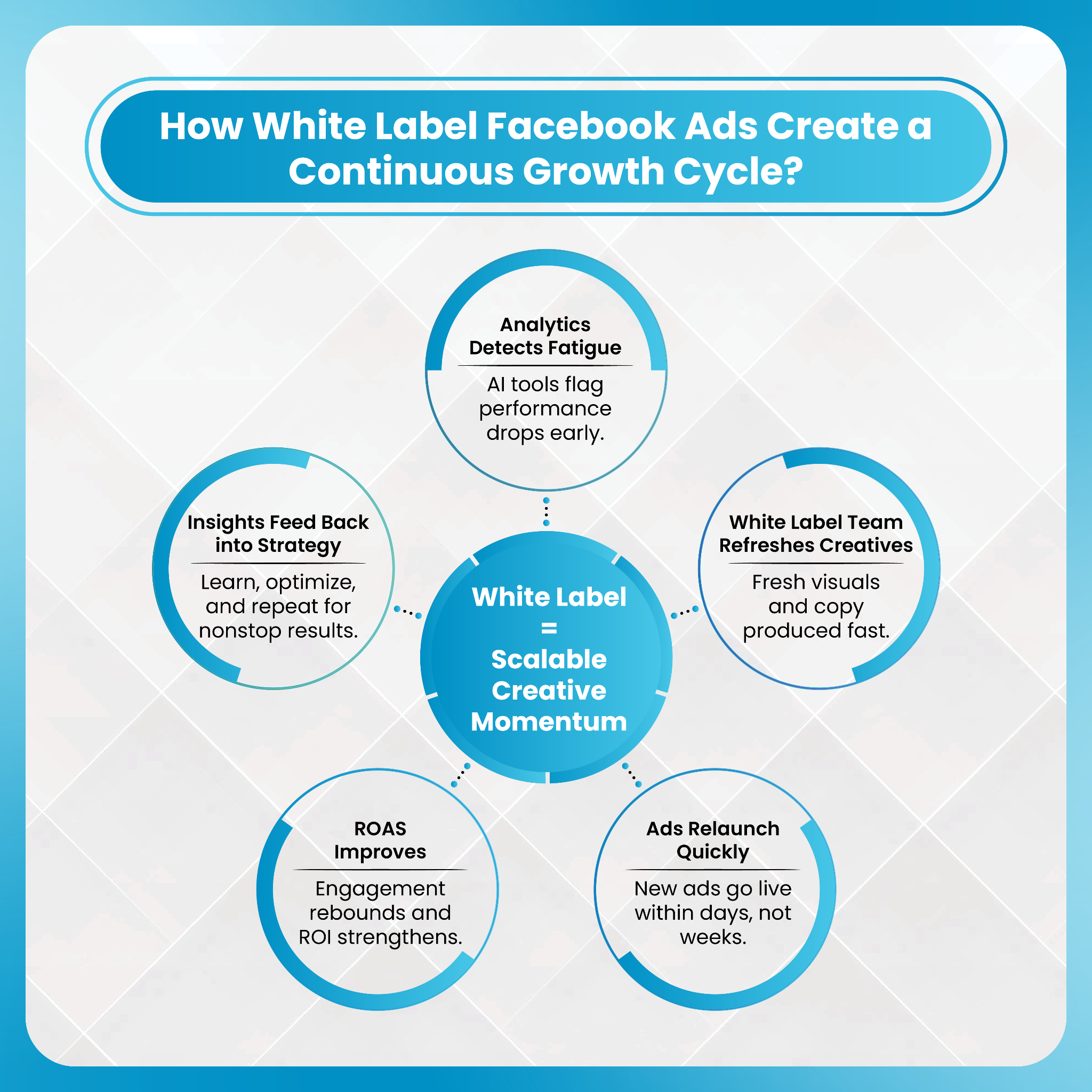
A Practical Scaling Framework Agencies Can Standardize Across Every Client
The best agencies do not improvise scaling decisions. They follow a repeatable framework that works across every client, regardless of industry or budget. Here is a five-step process you can standardize.
Step 1: Validate Tracking Before Increasing Spend
Never scale a campaign sitting on broken data. Before any budget increase, confirm your measurement foundation with a clear checklist:
- Pixel health and firing accuracy
- Event tracking for key actions
- CRM connections
- Attribution setup
- Offline conversion tracking
If any item fails, fix it first. Scaling on bad data only multiplies the damage.
Step 2: Expand Creative Before Expanding Budget
Fresh creative gives Meta more ways to find converting audiences. Before pushing spend, build out new variations:
- New hooks and opening lines
- New formats such as video, static, and carousel
- New messaging angles for different pain points
Scaling creative often drives better results than scaling spend, because it directly fights the fatigue that kills performance.
Step 3: Scale Audiences Before Budgets
A bigger budget needs a bigger qualified target audience to spend on. Expand your reach intelligently before raising spend:
- Broad targeting to give the algorithm room
- Lookalike audiences from strong data
- Remarketing expansion across more touchpoints
- Advantage+ signals to support automated delivery
Wider, well-built audiences absorb larger budgets without immediate saturation.
Step 4: Increase Budgets Gradually
With tracking, creativity, and audiences in place, you can finally increase spend. Do it in controlled increments and watch your core metrics closely:
- CPA
- ROAS
- Frequency
- CTR
- CPM
If frequency spikes or CPA climbs, slow down and let delivery stabilize before the next increase.
Step 5: Measure Business Outcomes
Platform metrics only tell part of the story. The real measure of success lives in your client's business results:
- Pipeline value
- Revenue generated
- Qualified leads
- Customer lifetime value
- Overall profitability
Keep this in focus at all times. The goal is not scaling ad spend. The goal is to scale profitable client acquisition.
As Meta continues investing in AI-driven automation, agencies that master operational scaling will be positioned ahead of competitors.
Emerging Trends Agencies Should Prepare For
The scaling playbook keeps evolving as Meta leans harder into automation. Agencies that anticipate these shifts will protect their margins and their relevance.
1. Creative Is Becoming The Biggest Scaling Lever
AI now handles much of the delivery optimization that media buyers once managed manually. What it cannot do is invent a winning creative strategy. Humans still craft the hooks, narratives, and angles that make audiences stop scrolling, which makes creativity the most valuable scaling input.
2. First-Party Data Is Becoming More Valuable
As tracking restrictions tighten, owned data becomes a competitive edge. Agencies should help clients strengthen:
- CRM integrations
- Customer lists for matching
- Conversions API implementation
- Enhanced measurement setups
This data feeds better signals to Meta and sharpens optimization.
3. Automation Increases The Value Of Agency Strategy
As execution gets automated, strategy becomes the differentiator. The high-value work shifts toward attribution, creative direction, measurement, and business strategy.
The takeaway is clear: automation is commoditizing execution while increasing the value of strategic agency expertise.
This evolution makes scalable operational partnerships increasingly important for agencies pursuing long-term growth.
How DashClicks' White Label Facebook Advertising Services Help Agencies Scale Profitably?
DashClicks gives agencies the operational backbone to scale Facebook campaigns without overloading their internal teams. The platform functions as a white label Facebook ads partner, handling the heavy fulfillment work while your team stays focused on strategy and client relationships.
Agencies working with DashClicks gain access to:
- Expert campaign management across multiple accounts
- Audience targeting support built on proven methods
- Creative execution assistance to keep testing pipelines full
- Ongoing campaign optimization and monitoring
- Clear tracking and reporting visibility for clients
- Scalable fulfillment systems that grow with your roster
- Operational flexibility to handle changing client demands
The value here is structural. Instead of hiring and training new specialists every time you add clients, you plug into a fulfillment system that already works. That keeps delivery consistent and margins healthy as you grow.
Think of DashClicks as an extension of your delivery team rather than a vendor on the sidelines. Your agency keeps the client relationship and the strategy, while the fulfillment engine runs reliably behind the scenes.
Ultimately, sustainable scaling requires more than campaign adjustments. It requires systems that support growth without sacrificing performance.
Building Systems That Scale, Not Just Budgets
Facebook Ads rarely fail because agencies increase budgets. They fail because agencies increase spending without scaling the systems that make spending profitable.
The pattern repeats across thousands of accounts. Budgets go up, but creative production, attribution, data quality, testing systems, and operational capacity stay the same. Performance drops, and the algorithm takes the blame for what is really a system's problem.
The agencies that win take a different path. They build repeatable scaling frameworks instead of relying on last-minute, campaign-level tactics. They validate data before spending, expand creative and audiences before budgets, and measure success by business outcomes rather than vanity metrics.
Strong Facebook ads services are built on operational discipline, supported by the right fulfillment infrastructure. That is what separates agencies that plateau from agencies that compound.
The agencies that scale most successfully are not those spending the most. They are the ones building the strongest operational systems behind every campaign.

How White Label SEO Services Help Agencies Build Long-Term Website Authority
Website authority has quietly become one of the strongest competitive advantages in search. Rankings come and go, algorithm updates shake up the landscape, but sites with genuine authority tend to weather the storms and keep climbing. For agencies, that makes authority-building the difference between clients who churn after three months and clients who stay for years.
Here is the catch. Authority is no longer built through backlinks alone. Google now rewards a blend of expertise, trust, technical excellence, content depth, and user satisfaction. A single great link will not carry a thin website very far. In fact, BrightEdge research found that organic search drives 53% of all website traffic, which means the stakes for getting authority right have never been higher.
For a solo brand, building authority is a focused project. For an agency, it is a logistical puzzle. You are not building authority for one site. You are building it across dozens of client accounts, each with different industries, timelines, and expectations. Doing that consistently requires systems, processes, and disciplined long-term execution rather than scattered bursts of activity.
This is where white label SEO services come in.
A white label SEO program gives agencies a scalable framework to build authority efficiently across every account, without hiring an army of specialists. Before understanding how white label SEO contributes to authority, agencies must first understand what website authority actually means in today's search landscape.
Website Authority Is More Than Just Domain Authority
Many agencies use "authority" and "Domain Authority" interchangeably, but they are not the same thing. Understanding the difference shapes how you build and measure success.
Website authority is the real-world trust and credibility a site has earned in the eyes of users and search engines. Domain Authority (a Moz metric) and Domain Rating (an Ahrefs metric) are third-party scores that estimate authority based mostly on backlinks. They are useful directional signals, but Google does not use them as ranking factors.
Google's own guidance points in a broader direction. Its helpful content system that rewards people-first content, clear expertise, and trust signals across many ranking factors rather than any single score.
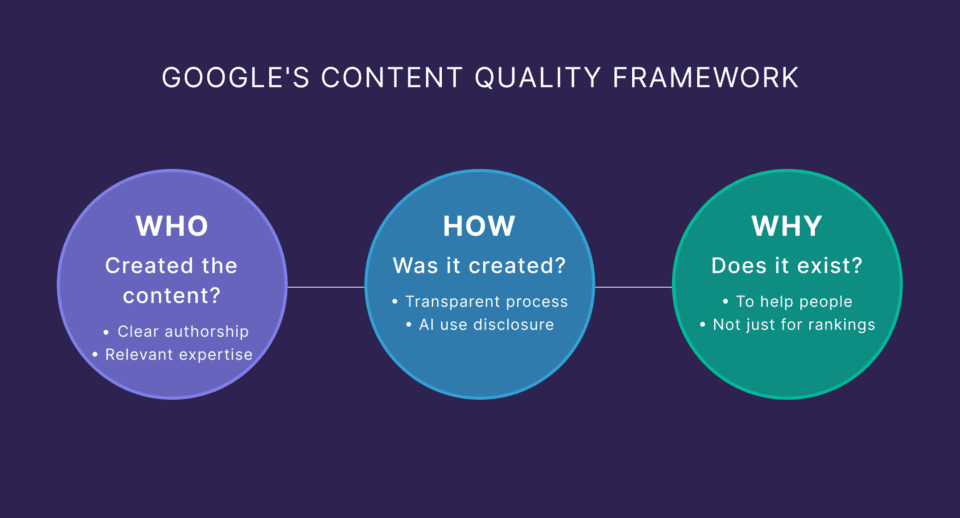
Image Source: Backlinko
A high Domain Rating means little if the content fails to satisfy the searcher. Long-term authority is built from several components working together:
- Topical expertise that shows deep knowledge of a subject
- Content depth that answers questions thoroughly
- Internal linking that connects related pages
- Technical SEO that keeps the site fast and crawlable
- Quality backlinks from relevant, credible sources
- User experience that keeps visitors engaged
- Trust signals like clear authorship and accurate information
There is a useful way to think about how these pieces add up. Call it Compound SEO Authority. Every optimized page does not just rank on its own. It strengthens the overall site ecosystem by reinforcing topics, passing link equity, and signaling expertise.
Picture two sites. Site A has 500 disconnected blog posts covering random topics with no internal structure. Site B has 75 strategically connected resources organized around clear themes and linked together. Site B often wins, even with fewer pages, because its authority compounds. Each page lifts the others instead of standing alone.
Understanding authority is only the first step. The next challenge is why agencies struggle to build it consistently across multiple client campaigns.
Why Most Agencies Struggle To Build Long-Term Authority?
Most agencies know what good SEO looks like. The trouble is delivering it month after month across a full client roster. Operational reality gets in the way.
Common challenges include:
- Managing many clients with limited bandwidth
- Inconsistent content quality from rotating writers
- Disconnected SEO teams that do not share a strategy
- Reactive execution driven by whoever is loudest this week
- Constant pressure to produce monthly deliverables
These pressures push agencies toward the wrong targets. Teams start optimizing for publishing quotas, backlink counts, and report volume because those numbers are easy to show clients. What actually builds long-term results gets sidelined: authority accumulation, topic ownership, and durable visibility.
Here is the part that hurts. Authority compounds slowly but deteriorates quickly when execution becomes inconsistent. Momentum is fragile.
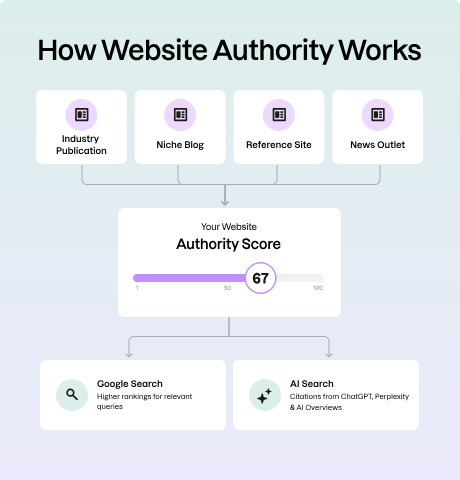
Image Source: Semrush
Consider a familiar scenario. An agency publishes strong content for a client for over six months. Rankings climb, traffic grows, everyone is happy. Then the client's budget shifts, optimization pauses, and the team moves attention elsewhere. Meanwhile, competitors keep expanding their content and links. Within a couple of quarters, those hard-won rankings slip away. The work was good, but it stopped.
These operational bottlenecks explain why many agencies plateau and why scalable authority-building requires standardized execution.
The Five Pillars Of Long-Term Website Authority
Authority feels abstract until you break it into parts you can actually work on. The most durable authority rests on five pillars. Master these, and you have a repeatable blueprint for any client account.
1. Topical Authority
Topical authority is earned by covering a subject completely rather than dabbling in it. Search engines want to see that a site is a genuine resource on its core themes.
You build it through:
- Topic clusters that group related content
- Semantic coverage of subtopics and related questions
- Clear entity relationships that connect concepts
- Comprehensive content that leaves few gaps
2. Technical Authority
Technical authority is the foundation on which everything else sits. If search engines cannot crawl, index, and render a site easily, great content will not reach its potential.
Key areas include:
- Crawlability and clean site structure
- Core Web Vitals and page speed
- Reliable indexing of important pages
- Schema markup that clarifies content meaning
- Logical site architecture
3. Link Authority
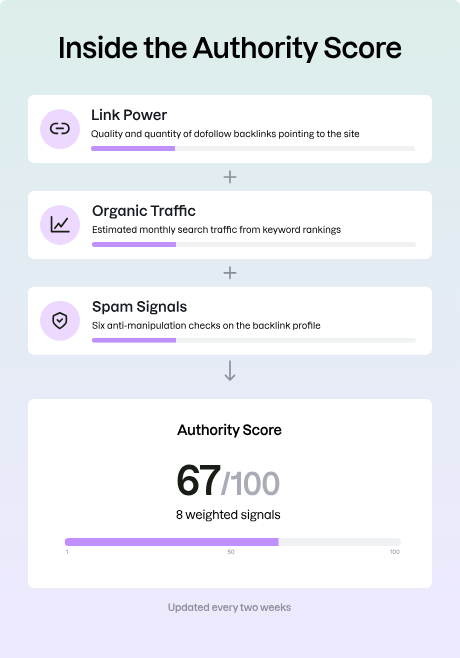
Backlinks still matter, but quality has overtaken quantity. A few editorial links from respected, relevant sites outweigh hundreds of low-value ones.
Focus on:
- Editorial backlinks earned through strong content
- Digital PR that generates coverage
- Relevance over raw volume
- Contextual authority from topically aligned sources
4. Internal Authority Flow
Internal linking is one of the most underused authority levers. It controls how trust and ranking power move through a site.
Strengthen it with:
- Deliberate internal linking between related pages
- Hub-and-spoke architecture around core topics
- Smart PageRank distribution to priority pages
5. Content Freshness
Content is not a publish-and-forget asset. Search engines favor information that stays accurate and current.
Maintain freshness by:
- Updating statistics and dated references
- Refreshing older content with new insights
- Expanding articles to cover emerging subtopics
- Pruning outdated or thin pages that drag down quality
These pillars do not operate in isolation. They feed each other in a cycle worth naming: The Authority Flywheel Model. Better content earns higher engagement. Higher engagement attracts stronger links. Stronger links build greater trust. Greater trust improves rankings. Better rankings bring more visibility. More visibility produces additional authority, which fuels even better content. Once the flywheel spins, each turn requires less effort to keep it moving.
While agencies understand these pillars conceptually, executing all five consistently across dozens of clients is where most delivery models begin to break down.
How White Label SEO Services Turn Authority Building Into A Scalable Process?
The gap between knowing the pillars and delivering them is filled by process. This is exactly what a strong white label SEO program provides. The providers standardize the moving parts, so quality does not depend on which team member happens to be available.
A reliable white label SEO agency builds repeatable systems for:
- Keyword strategy and research
- Topical mapping and content planning
- Technical optimization
- Content production
- Link acquisition
- Reporting
- Quality assurance
The value is consistency. A steady, structured effort beats occasional bursts of activity every time, because authority rewards the long haul.
This reframes what outsourcing actually does. White label SEO does not simply outsource tasks. It creates an authority-building production system that runs the same way for every client.
Compare two workflows. The weak model looks like this:
Strategy → Publish → Stop
The strong model looks like this:
Strategy → Production → Optimization → Promotion → Refresh → Expansion
The second workflow never truly ends. It loops, which is precisely how authority compounds.
Think about an agency managing fifteen clients with two in-house staff. Without a system, content quality swings wildly and some accounts get ignored for weeks. By partnering with white label SEO providers, that same agency delivers consistent topic clusters, technical fixes, and link campaigns across all fifteen accounts on a predictable schedule. The clients experience steady progress, and the agency stops scrambling.
Standardized execution creates consistency, but authority also depends on how every SEO component works together rather than independently.
Why Integrated SEO Execution Builds Stronger Authority Than Isolated Tactics?
SEO tactics deliver far more when they reinforce one another. Technical SEO, content, internal linking, backlinks, user experience, and conversion optimization are not separate projects. They are parts of one engine.
When you run them in silos, authority signals weaken. A blog team writes content without knowing the technical team's site structure. A link builder earns backlinks to pages that internal linking never supports. Each effort is fine on its own, but never reaches full strength.
Think of it as The SEO Authority Ecosystem. Improvements in one area amplify results in others. Faster page speed helps content rank. Better content earns more links. More internal links spread that link equity to commercial pages. The whole becomes greater than the sum of its parts.
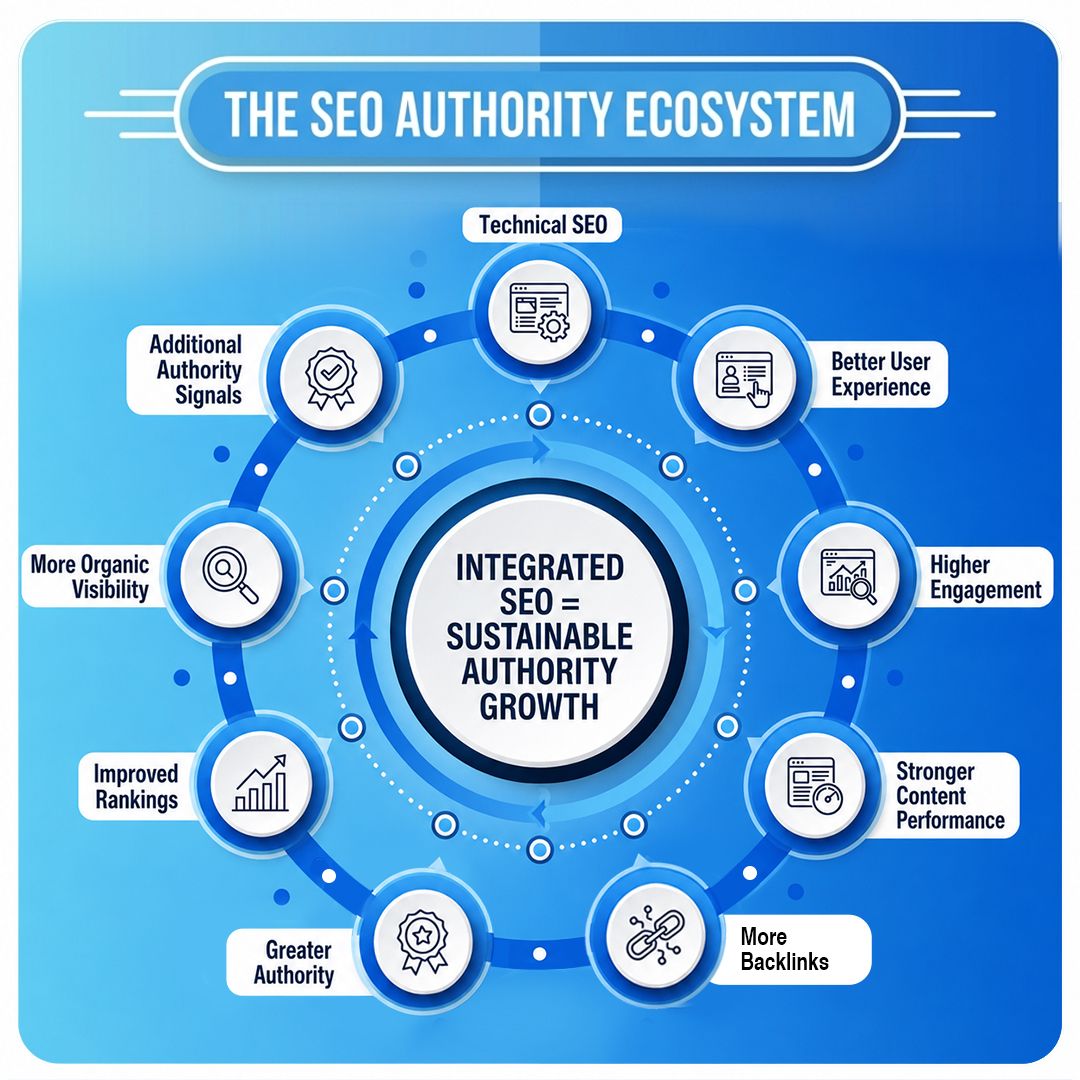
Here is a common failure. An agency produces a high-quality guide that earns several strong backlinks. Impressive on paper. But because internal linking is weak, none of that authority flows to the service pages that actually generate revenue. The links sit on a blog post and stop there. Integrated execution would have channeled that authority toward pages that matter to the business.
The agencies that consistently build authority do not simply execute SEO. They measure success differently.
KPIs Agencies Should Track Instead Of Chasing Vanity Metrics
How you measure SEO shapes how you deliver it. Many traditional metrics look impressive in a report but say little about real progress. They can even mislead clients into thinking nothing is wrong when growth has stalled.
Be cautious about overworking:
- Domain Authority scores
- Backlink totals
- Indexed page counts
- Raw keyword counts
These numbers can rise while business results stay flat. Instead, track metrics tied to outcomes:
- Non-branded organic traffic growth
- Topic cluster visibility
- Assisted conversions
- Organic lead quality
- Revenue influenced by SEO
- Returning organic visitors
- Engagement metrics like time on page and scroll depth
- Commercial keyword visibility
The principle is simple. Authority should be measured by business impact, not isolated SEO metrics. A client does not care about a Domain Authority bump if their pipeline has not grown.
The financial logic backs this up. SEO consistently produces strong returns when measured against revenue rather than rankings. According to FirstPageSage, SEO delivers an average ROI of 748% across industries, which only becomes visible when agencies track outcomes instead of surface stats.
Agencies that adopt authority-focused KPIs are also better positioned to scale sustainably without sacrificing delivery quality.
How DashClicks Helps Agencies Build Website Authority At Scale?
Putting all of this into practice is the real test, and it is where the right fulfillment partner earns its place. DashClicks gives agencies the structure to build authority across many accounts without expanding their internal team.
The DashClicks approach covers the full authority-building stack:
- Strategic keyword research that maps topics worth owning
- Content creation built around topical depth and clusters
- Technical SEO implementation that keeps sites crawlable and fast
- On-page optimization aligned with search intent
- Internal linking that distributes authority to priority pages
- Authority-focused execution rather than disconnected tasks
- DashClicks’ analytics software that presents progress under the agency's brand
- Consistent fulfillment systems that keep every account moving
What sets this apart is the systems mindset. Rather than handing back a checklist of completed tasks, white label SEO services help agencies run a repeatable authority-building process. Each client account follows the same disciplined workflow, so quality does not depend on bandwidth or luck.
For an agency, that means delivering enterprise-level SEO consistency across a full roster while keeping headcount lean. The flywheel keeps spinning on every account, not just the ones that happened to get attention this month.
Ultimately, sustainable authority is not built through isolated campaigns. It is the result of disciplined systems executed consistently over time.
Building Authority Is A System, Not A Sprint
Website authority is earned, not bought. It grows from consistency, genuine expertise, trust signals, and SEO execution, where every component supports the others. The agencies that treat authority as a slow-compounding asset are the ones whose clients stay and grow.
Agencies focused only on rankings tend to struggle when results plateau. Rankings are an outcome, not a strategy. Chase them in isolation, and you end up reacting to every algorithm shift instead of building something durable.
White label SEO services change that equation. By standardizing keyword strategy, content production, technical work, link acquisition, and reporting, a strong program lets agencies build repeatable systems that strengthen authority across every client account. The work becomes predictable, scalable, and far easier to sustain.
Long-term SEO success comes from authority accumulation, not isolated deliverables. One great month of content will not protect a client from competitors who never stop. A steady system will.
The agencies that win in the long term will not be the ones producing the most SEO activity. They will be the ones building the strongest systems for sustainable authority growth.

Fixing Inconsistent Conversion Rates Across PPC Campaigns with White Label PPC Services
Inconsistent conversion rates are one of the most disruptive challenges agencies face. Not because they indicate failure, but because they make performance difficult to predict and scale.
One PPC account delivers steady results month after month, while another fluctuates despite a similar budget, strategy, and audience. These swings make client retention harder, complicate budget planning, and weaken confidence in campaign performance.
That volatility creates a cascade of problems. Client retention becomes harder when performance cannot be explained or anticipated. Budget planning loses precision when conversion rates move unpredictably. ROAS reporting becomes a negotiation rather than a demonstration of value. And as agencies try to scale, unstable accounts consume disproportionate time and resources while contributing the least to profitability.
According to WordStream's Google Ads Benchmarks, the average search conversion rate reached approximately 7.52% across industries in 2025. At the same time, approximately 87% of industries experienced higher CPCs that same year. Rising CPCs mean agencies can no longer simply buy more traffic to offset weak performance. Conversion efficiency and consistency have become critical levers for sustainable growth.
Agencies need predictable performance, not occasional wins. White label PPC services offer a pathway to structured optimization frameworks and operational consistency that most agencies cannot build efficiently on their own. Before solving inconsistent conversion rates, however, agencies need to understand that volatility rarely stems from a single issue. It is usually the result of multiple campaign variables interacting simultaneously.
Why Conversion Rate Inconsistency Is A Bigger Problem Than A Low Conversion Rate?
A low conversion rate is a clear problem with a clear direction. Inconsistency is more insidious because it obscures the path forward entirely.
When conversion rates fluctuate unpredictably, client forecasting becomes unreliable. Budget planning loses its foundation. ROAS reporting turns into an exercise of qualifying results rather than presenting them with confidence. Growth projections become difficult to defend in business reviews, and client confidence erodes regardless of what average performance actually looks like.
Conversion Stability As An Agency KPI
Forward-thinking agencies are beginning to track Conversion Stability as a formal performance metric alongside CPA, ROAS, and revenue. Conversion Stability measures not just what a conversion rate is, but how consistently it holds across time.
Consider two campaigns with identical average conversion rates of 5%:
- Campaign A: Average conversion rate of 5%, with a range swinging between 2% and 8%
- Campaign B: Average conversion rate of 5%, with a range holding between 4.8% and 5.2%
Campaign A and Campaign B look identical in a summary report. They perform very differently in practice. Campaign B is easier to scale because budget increases produce predictable output. It is easier to forecast because historical data remains reliable. It is easier to optimize conversion rate because changes produce measurable, attributable effects.
Clients trust campaigns they can predict. A campaign with average results and high stability will outperform a campaign with peak results and high volatility when client satisfaction and retention are the true measures of success.
Once agencies recognize volatility itself as a performance issue worth tracking and reporting, the next challenge is identifying where that instability originates.
The Causes Behind Inconsistent PPC Conversion Rates
Most conversion volatility does not come from one major failure. It comes from several smaller issues building pressure simultaneously until performance destabilizes. Diagnosing the actual source requires looking across multiple campaign dimensions at once.
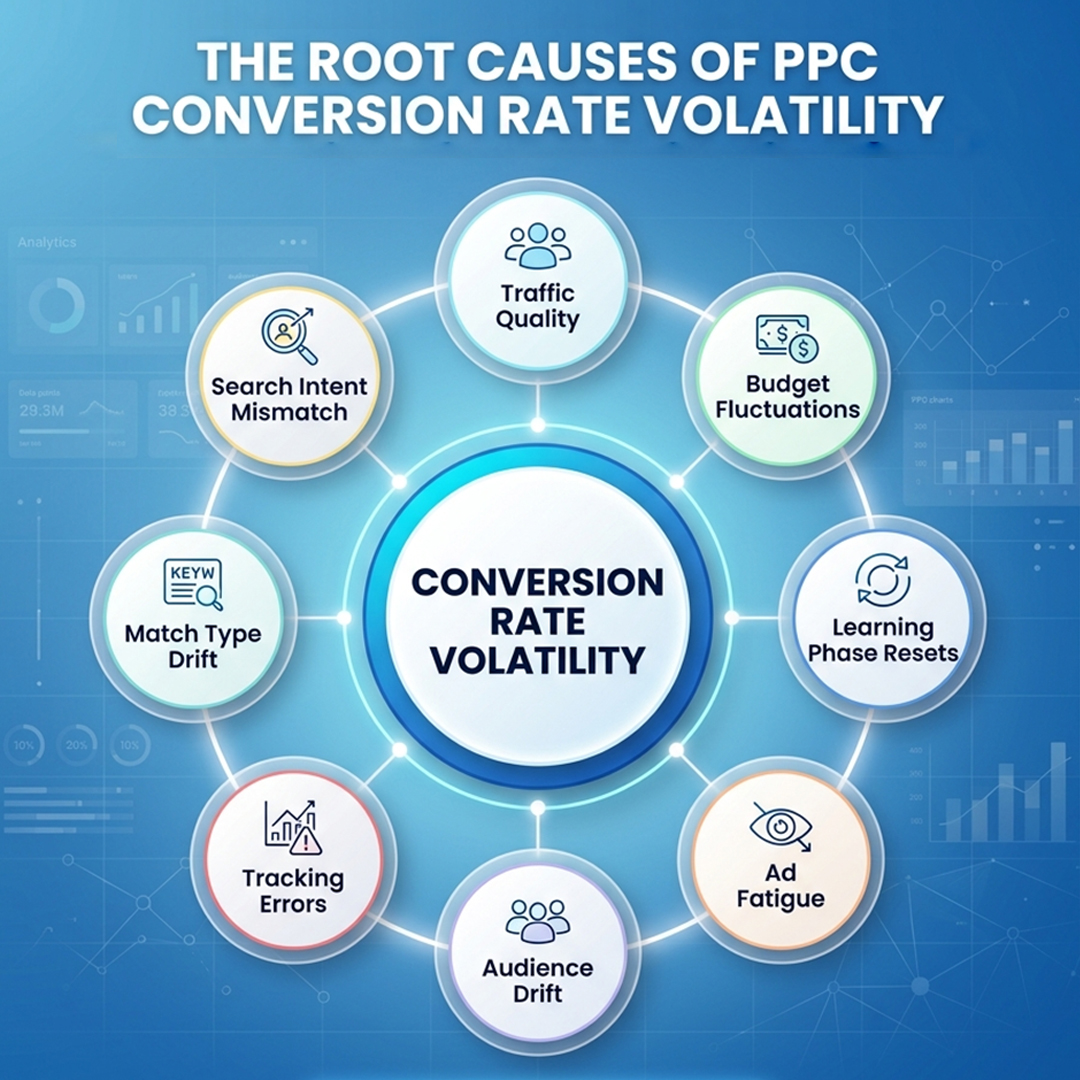
1. Traffic Quality Shifts
Keyword match type expansion is one of the most common sources of silent traffic degradation. When match types broaden, click volume often increases while search ntent weakens. A campaign may gain 30% more clicks after a targeting change, but if those clicks come from users earlier in the buying cycle, conversion rates drop despite higher activity.
Audience quality changes in Performance Max and broad match campaigns can create similar patterns without any explicit targeting change.
2. Budget And Delivery Changes
Budget fluctuations change which searches a campaign can compete for and when. When impression share drops significantly due to budget caps, campaigns may only surface for lower-competition, lower-intent queries during constrained periods. The result is a conversion rate that tracks budget cycles rather than actual demand.
3. Platform Learning Challenges
Google's smart bidding systems require stability to function effectively. Frequent campaign edits, bid strategy changes, and structural modifications push accounts back into learning phases. Each reset erodes the predictive accuracy that smart bidding relies on, producing conversion rate swings that appear random but are actually algorithm-driven.
4. Creative And Tracking Issues
Ad fatigue suppresses conversion rates gradually and often goes unnoticed until performance has already declined significantly. Tracking discrepancies, including delayed conversion windows and inconsistent tagging, can make campaigns appear volatile when the underlying performance is actually stable.
Many agencies optimize for CTR when the real issue lies in conversion quality. Common causes of conversion rate volatility include:
- Match type drift pulling in weaker search intent
- Budget fluctuations limiting access to high-value queries
- Learning phase disruptions from frequent campaign edits
- Audience quality deterioration in automated targeting
- Ad fatigue reduces qualified engagement over time
- Tracking gaps are creating inconsistent conversion attribution
Diagnosing volatility is only half the challenge. Maintaining consistency across dozens of client accounts is where most agencies struggle operationally.
How White Label PPC Services Create More Consistent Campaign Performance?
Consistency rarely comes from a single optimization. It comes from systems applied repeatedly across accounts over time.
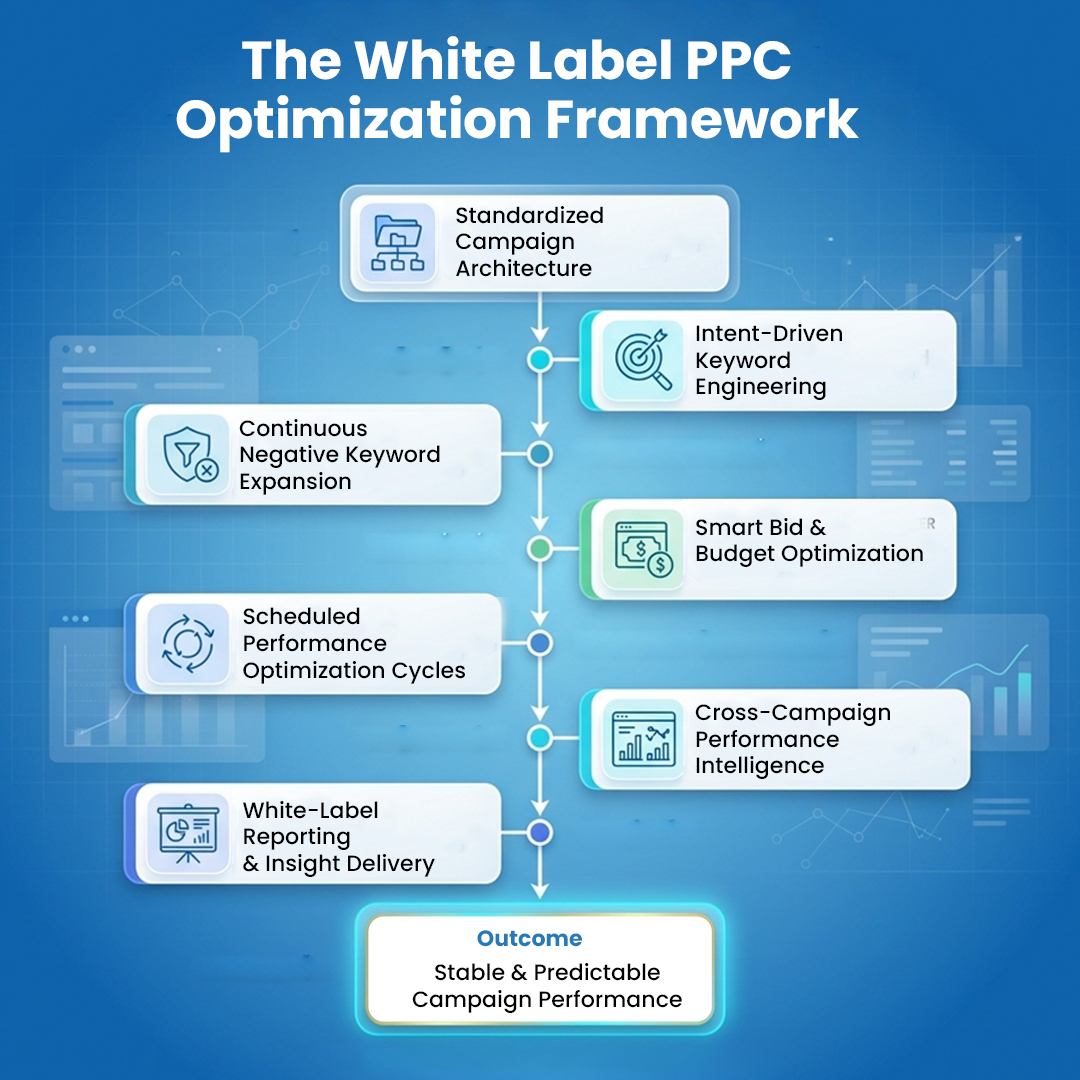
White label PPC services build that consistency through standardized frameworks that govern how campaigns are built, monitored, and adjusted. When the same structured process applies across every account, performance patterns become recognizable and correctable before they compound into client-level problems.
- Standardized Campaign Structures: Consistent account architecture ensures that similar campaigns behave similarly. When structural decisions are standardized, account managers spend less time diagnosing configuration issues and more time identifying genuine performance signals.
- Consistent Keyword Management And Negative Keyword Governance: Ongoing negative keyword governance is one of the highest-leverage activities in PPC management, and one of the most commonly deprioritized in agencies managing high account volumes. White label PPC teams apply systematic search term audits on a scheduled basis, continuously filtering out low-intent traffic before it erodes conversion rates.
- Scheduled Bid Reviews And Performance Monitoring Frameworks: Rather than reacting to performance drops after they occur, structured bid review schedules allow proactive adjustments based on trend data. Performance monitoring frameworks establish thresholds that trigger review before volatility becomes visible to clients.
Consider three healthcare campaigns that experience declining branded conversion rates after a platform update. A white label PPC agency identifies the pattern early across the portfolio and applies corrective actions across multiple accounts before performance deteriorates further. A single account manager would likely catch it in one account. A cross-account system catches it in all three simultaneously.
Cross-account visibility reveals patterns that single-account managers never see. Consistency improves when optimization processes become repeatable rather than reactive. The next step is measuring that stability accurately.
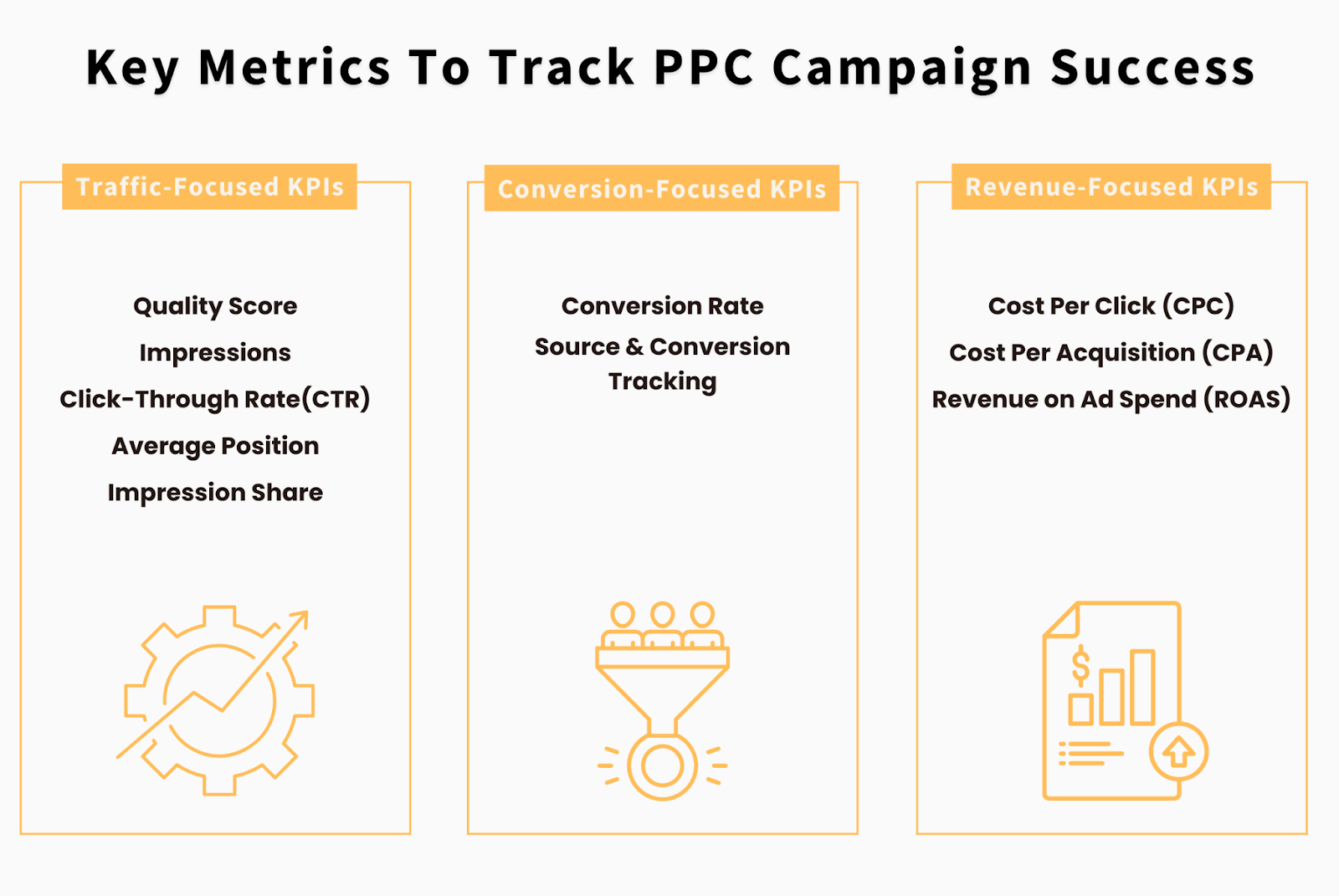
Metrics Agencies Should Track Beyond Conversion Rate
Conversion rate alone is too narrow a lens for evaluating campaign health. It captures one dimension of performance while leaving the structural signals of instability invisible.
1. The Campaign Stability Scorecard
A more complete picture of account health emerges when agencies track five dimensions together:
- Traffic Consistency: Are click volumes and impression share holding steady across reporting periods?
- Cost Consistency: Are CPC and overall spend tracking within expected ranges?
- Lead Quality Consistency: Are the leads being generated meeting qualification thresholds?
- Conversion Consistency: Is the conversion rate holding within a defined stable range?
- Revenue Consistency: Is downstream revenue output predictable relative to ad spend?
Together, these dimensions form a Campaign Stability Scorecard that gives agencies a structured view of account health rather than a snapshot of one variable.
2. CPA Stability And Impression Share Trends
CPA can remain acceptable while drifting in ways that signal future problems. Impression share trends reveal whether campaigns are maintaining competitive positioning or losing ground gradually. Both metrics matter most when evaluated directionally, not just as point-in-time figures.
2. Search Term Quality, Assisted Conversions, And Conversion Lag
Search term quality scores help agencies monitor whether traffic is remaining aligned with buyer intent. Assisted conversions and conversion lag data reveal how attribution windows affect reported performance, which prevents agencies from drawing inaccurate conclusions from standard conversion reports.
3. Cost Per Qualified Lead And Budget Pacing Consistency
Cost per qualified lead separates conversion volume from conversion value. Budget pacing consistency flags campaigns where delivery patterns may be distorting performance data in ways that make accounts appear more volatile than they actually are.
A campaign can maintain a strong conversion rate while becoming increasingly unstable underneath the surface. Measuring stability matters only when agencies have systems capable of improving it consistently.
Operational Advantages Of White Label PPC Services For Multi-Client Agencies
Operational consistency drives performance consistency. The agencies that deliver the most stable PPC results are usually not the ones with the most talented individual account managers. They are the ones with the most reliable processes.
1. SOP-Driven Optimization And Dedicated PPC Specialists
Standard operating procedures remove individual variability from campaign management. When optimization decisions follow defined frameworks, account performance becomes less dependent on which team member is working on a given account at a given time. Dedicated PPC specialists within white label teams apply those SOPs with depth and focus that generalist account managers rarely achieve at scale.
2. Faster Issue Detection And Reduced Dependence On Individual Account Managers
White label PPC partners maintain monitoring frameworks across large account portfolios. Issues that would go undetected in a single-account workflow surface quickly when performance patterns are tracked systematically. This reduces the operational risk of key-person dependency, where one account manager's departure or bandwidth constraint creates client-level exposure.
3. Scalable Campaign Management And Consistent Reporting Standards
An agency managing 50 PPC accounts can roll out optimization changes across all accounts within days through a white label partner, rather than weeks of prioritization and internal scheduling. Consistent reporting standards mean clients receive comparable transparency regardless of account size or complexity.
Many performance issues are operational problems disguised as campaign problems. Fixing the system often resolves the issue faster than fixing the campaign. Even with strong systems in place, however, agencies can still generate volatility through avoidable optimization behaviors.
Common Agency Mistakes That Lead To Conversion Volatility
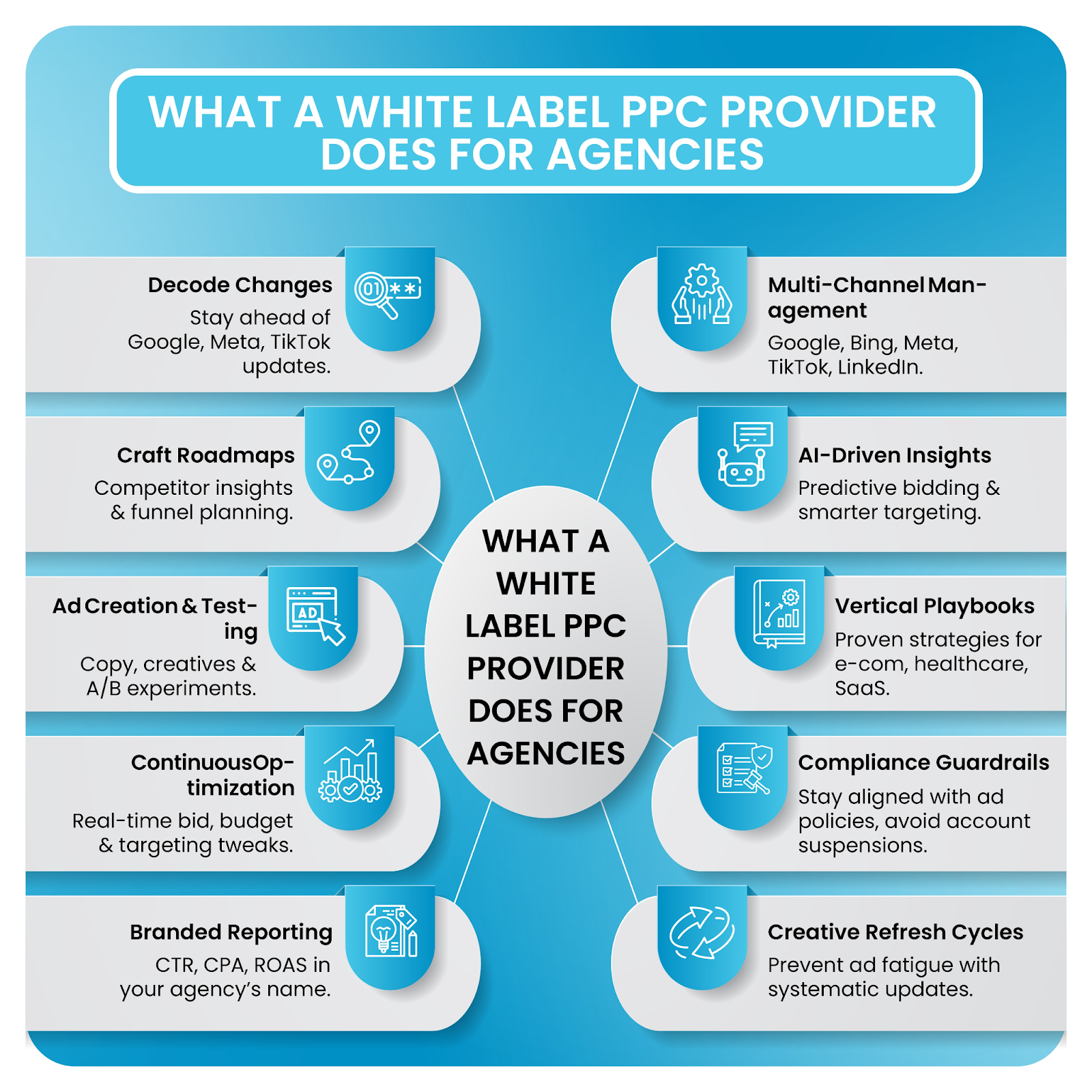
Some volatility is self-inflicted. The most disciplined optimization processes can be undermined by a handful of repeated mistakes that most agencies recognize only after the damage is done.
The most common include making multiple campaign changes simultaneously, scaling budgets too quickly without a structured ramp, ignoring search term reports between audit cycles, chasing short-term trend spikes with structural changes, overreacting to daily fluctuations before statistical significance is established, switching bidding strategies without allowing adequate learning periods, and failing to validate conversion tracking before drawing performance conclusions.
Change Log Discipline
High-performing agencies document every major campaign adjustment systematically. This practice, called Change Log Discipline, creates a direct link between actions taken and performance outcomes observed.
When a conversion decline occurs after three simultaneous changes, identifying the root cause becomes nearly impossible without documentation. Change logs narrow the diagnostic window from weeks to days and allow agencies to build institutional knowledge about what works in specific account contexts.
The fastest way to create volatility is to lose visibility into what changed. Disciplined optimization becomes significantly easier when agencies have scalable fulfillment support that can maintain consistent processes without internal bandwidth constraints.
How DashClicks' White Label PPC Services Help Agencies Improve Conversion Consistency?
DashClicks is a white label PPC services provider built to support scalable agency fulfillment and campaign management. For agencies managing growing client portfolios, the platform provides the operational infrastructure needed to deliver consistent PPC performance without expanding internal teams.
- Structured PPC Fulfillment: DashClicks handles campaign setup, ongoing optimization, and budget management through structured fulfillment workflows. Campaigns are built and maintained according to standardized frameworks, reducing the configuration variability that frequently contributes to conversion rate inconsistency.
- Consistent Optimization Processes: Standardized workflows govern how campaigns are reviewed, adjusted, and monitored across accounts. Performance reviews follow scheduled cadences, and ongoing monitoring is applied systematically rather than reactively.
- Better Reporting Visibility: Centralized reporting and client-facing dashboards give agencies a consistent view of performance across their portfolio. Campaign transparency improves client communication and reduces the time account managers spend assembling reports manually.
- Scalable Agency Growth And More Bandwidth For Client Success: By offloading PPC fulfillment to DashClicks, agencies increase their service capacity without adding headcount. Reduced operational strain creates space for stronger client communication, more strategic account conversations, and greater focus on growth initiatives that drive retention.
As client portfolios grow, operational consistency becomes increasingly important for maintaining campaign stability. Ultimately, stable conversion performance is not created by a single tactic. It is created by disciplined systems, repeatable execution, and continuous optimization applied consistently across every account.
Stable Conversion Performance Is A System, Not A Single Optimization
Inconsistent conversion rates create a kind of uncertainty that compounds over time. Client confidence erodes. Forecasting loses reliability. Growth projections become harder to defend. And the agency's ability to scale becomes constrained by accounts that demand constant reactive attention.
Conversion Stability should sit alongside CPA and ROAS as a formal agency KPI. Most conversion volatility originates from multiple interacting variables, including traffic quality shifts, platform learning disruptions, operational inconsistencies, and avoidable optimization mistakes. Addressing one in isolation rarely produces lasting results.
White label PPC services provide the standardized optimization, scalable execution, cross-account visibility, and operational consistency that agencies need to deliver predictable performance at volume. The agencies that retain clients longest are not always the ones generating the highest conversion rates. They are the ones delivering the most predictable, explainable, and consistently improving PPC performance over time.

Using White Label SEO to Improve Client Satisfaction Scores
Client satisfaction has become one of the most important growth levers for agencies. According to HubSpot, acquiring a new customer can cost five times more than retaining an existing one, which means agencies that retain clients longer grow faster and more profitably than those focused entirely on acquisition. Yet many agency leaders continue to treat satisfaction as a byproduct of performance, assuming that rankings and traffic gains will keep clients happy on their own.
That assumption creates a serious blind spot.
Clients become dissatisfied for reasons that often have nothing to do with SEO performance. Delayed reporting, inconsistent communication, unclear progress updates, and unmet expectations all erode trust long before rankings become an issue. By the time a client raises a concern, the satisfaction score has often been declining for months.
White label SEO management gives agencies a structural way to address these challenges. By outsourcing fulfillment to a specialized provider, agencies can create more consistent delivery, improve progress visibility, and free up internal capacity for the relationship-building work that actually drives retention.
To understand how white label SEO improves satisfaction, agencies first need to understand why SEO clients become unhappy in the first place.
Why Agencies Struggle To Improve SEO Client Satisfaction Scores?
Most client satisfaction issues stem from gaps between expectations and delivery rather than the SEO strategy itself. Agencies often invest heavily in technical execution while underinvesting in communication, consistency, and progress transparency. The result is a client who feels uncertain about the campaign, regardless of how well the work is actually progressing.
1. Clients Cannot Easily See SEO Progress
SEO involves a significant amount of work that clients never directly observe. Technical audits, internal linking improvements, schema implementation, crawl optimization, and content refreshes all contribute to long-term performance. However, none of these activities produces immediately visible outcomes.
Clients evaluate what they can see. When deliverables are not clearly communicated, clients often assume:
- Nothing meaningful is happening
- The agency is moving slowly
- The campaign lacks direction or momentum
This creates a satisfaction problem that has nothing to do with strategy quality. SEO success and client satisfaction are not always correlated. An agency can execute a strong campaign and still lose a client because progress was never made visible.
Agencies that fail to address this visibility gap will continue to lose clients even when their SEO work is genuinely effective.
2. Expectations Grow Faster Than SEO Results
One of the most common and least discussed challenges in agency client management is what can be called the Expectation Escalation Problem. Client goals rarely stay fixed throughout a campaign.
A typical progression looks like this:
- Month 1: "We need more traffic."
- Month 4: "We need more leads."
- Month 8: "We need more revenue."
Campaign performance may improve consistently throughout this period, but satisfaction declines because the benchmark keeps shifting. Agencies that only address expectations during onboarding are particularly vulnerable to this pattern.
Managing client SEO expectations is not a one-time conversation. It requires ongoing communication, consistent framing, and proactive goal alignment throughout the engagement. Agencies must manage expectations continuously, not only during onboarding.
Without that ongoing management, even strong SEO performance can feel like underdelivery to a client whose expectations have quietly escalated.
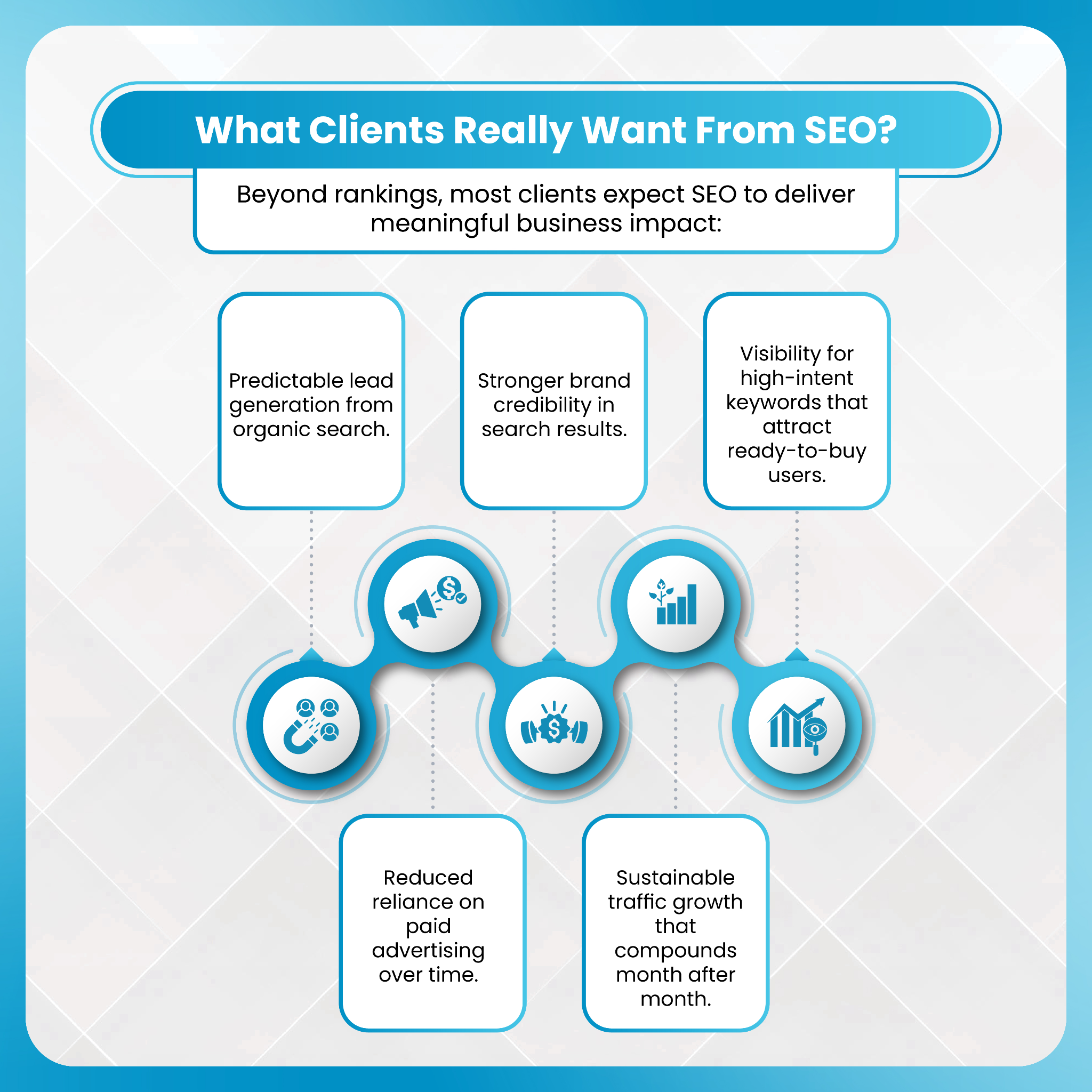
3. Agency Growth Often Creates Delivery Inconsistencies
Scaling creates a satisfaction problem that agencies rarely anticipate. This is the Scaling Satisfaction Gap, and it affects agencies across every size and specialization.
As agencies take on more clients without proportionally expanding fulfillment resources, several patterns emerge:
- Turnaround times increase
- Reporting becomes delayed or inconsistent
- SEO execution quality varies across accounts
- Client communication becomes reactive rather than proactive
Consider the difference between an agency managing 10 clients versus 50 clients using the same internal fulfillment resources. The first 10 clients likely receive thorough, timely, and consistent service. As the client roster grows, that consistency becomes harder to maintain without structural changes.
Clients notice inconsistency before they notice SEO problems. When delivery becomes unpredictable, trust erodes, and satisfaction scores follow.
How White Label SEO Helps Agencies Improve Client Satisfaction Scores?
White label SEO helps agencies improve satisfaction by solving operational bottlenecks that commonly damage client experiences. Rather than simply adding capacity, a well-integrated white label model changes how agencies deliver, communicate, and manage their client relationships at scale.
1. Creates Consistency Clients Can Feel
Clients may not fully understand keyword research, technical audits, or link acquisition strategy. They do understand whether an agency delivers on time, communicates clearly, and behaves predictably. Consistency is a satisfaction driver that agencies frequently undervalue.
When fulfillment is supported by a structured white label SEO provider, agencies can establish repeatable delivery processes across all accounts. Examples include:
- Content published on a predictable schedule
- Technical improvements completed within defined timeframes
- Reporting delivered consistently each month
- Communication touchpoints that happen proactively rather than reactively
Clients often judge agencies based on reliability rather than technical complexity. Repeatable fulfillment processes create the kind of predictable delivery experience that builds long-term client confidence.
Agencies that establish this consistency early in an engagement create a foundation that protects the relationship even during slower performance periods.
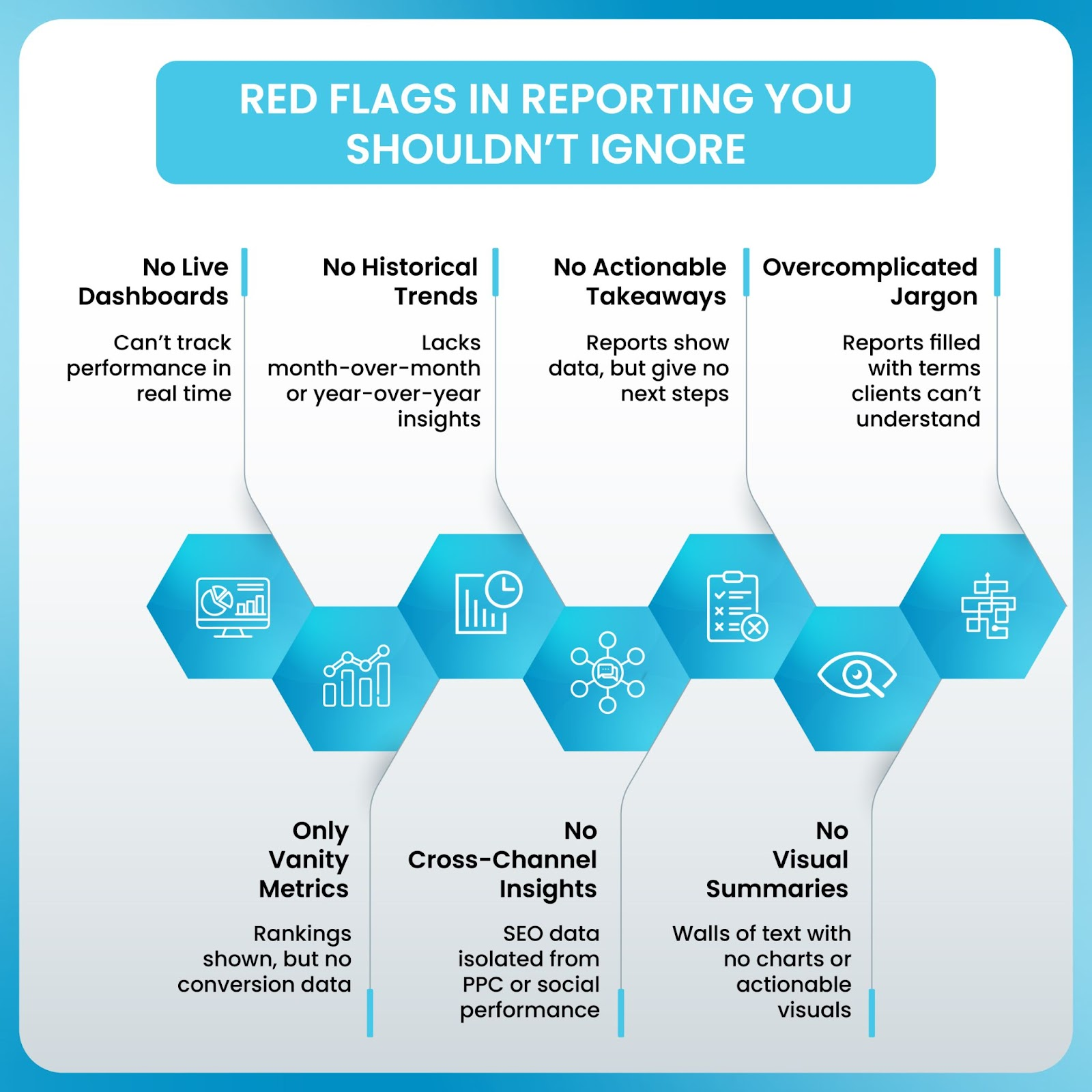
2. Makes SEO Progress More Visible
Many clients leave agencies not because SEO is failing, but because they cannot see that it is working. This is the Perceived Progress vs Actual Progress gap, and it is one of the most correctable causes of client churn.
This visibility gap matters because organic search remains one of the largest drivers of website engagement. BrightEdge reports that organic search drives more than 53% of trackable website traffic across industries, which means clients need clear reporting to connect ongoing SEO work with business outcomes.
White label SEO support gives agencies the capacity to document and communicate progress more effectively. Examples of visible momentum include:
- Content published and live on the client's website
- Completed on-page optimizations
- Technical fixes with before-and-after context
- Keyword growth tracked over time
- Ongoing activity summaries shared in regular reports
Visible momentum often improves satisfaction before major SEO wins occur. Clients who can see consistent activity and incremental progress are significantly less likely to question campaign value.
Progress communication is not just a reporting function. It is a retention strategy that best white label SEO services enable by handling the execution work that creates those visible milestones.
3. Gives Agencies More Time For Strategic Client Relationships
Most agencies spend a disproportionate amount of time managing deliverables, chasing deadlines, and coordinating specialist work. This leaves little room for the higher-value activities that actually strengthen agency-client relationship.
The time allocation problem is significant. When agency teams are consumed by fulfillment logistics, they spend less time:
- Advising clients on strategic priorities
- Explaining opportunities clearly
- Facilitating quarterly planning sessions
- Identifying growth initiatives before clients ask
White label SEO management creates capacity for these activities. With fulfillment handled externally, agency teams can reinvest time into strategy calls, client education, and forward-looking planning that clients genuinely value.
Clients often stay because of strategic guidance rather than deliverables alone. The agencies that become trusted advisors are typically those that have structured their operations to make that advisory role possible.
4. Helps Agencies Shift From Reactive To Proactive Service
The difference between reactive and proactive service is often the difference between a client who churns and a client who expands their engagement. Reactive agencies answer questions when clients ask them. Proactive agencies surface opportunities before clients think to raise them.
Examples of proactive service include:
- Flagging new content opportunities based on keyword trends
- Identifying technical issues before they affect performance
- Recommending funnel improvements tied to campaign data
- Proposing growth initiatives aligned with client business goals
This shift requires capacity, and capacity requires efficient fulfillment. A white label SEO agency model creates the operational foundation that makes proactive service scalable.
Proactivity is one of the strongest drivers of perceived agency value. When clients feel that their agency is thinking ahead on their behalf, satisfaction scores reflect that confidence.
Improves The Four Signals Clients Use To Evaluate Agencies
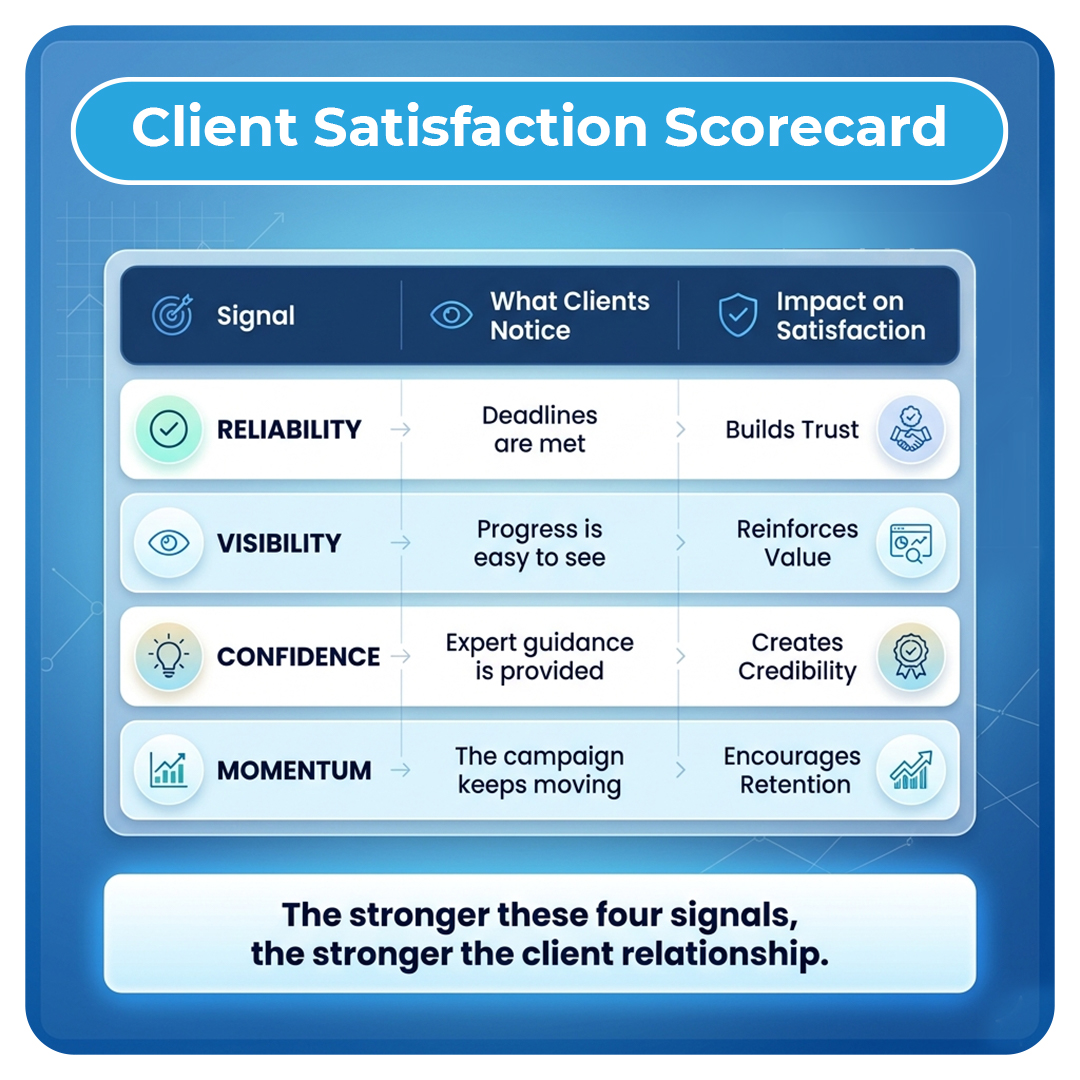
Client satisfaction is rarely measured through a formal scoring process. More often, clients evaluate their agency using four instinctive signals that collectively shape their overall perception of value. Agencies that understand these signals can address satisfaction more directly.
This is the Client Satisfaction Signals Framework.
1. Reliability
The Client Question: Do they consistently deliver?
Reliability is foundational. Clients need to trust that deliverables will arrive on time, reports will be accurate, and commitments will be honored. White label SEO management supports reliability by standardizing fulfillment processes across all accounts, reducing the variability that damages trust.
2. Visibility
The Client Question: Can I see progress?
Visibility answers the client's core concern about whether the investment is working. Agencies that use white label support can maintain consistent reporting cadences and document activity in ways that make progress tangible, even during periods where major ranking shifts have not yet occurred.
3. Confidence
The Client Question: Do they know what they are doing?
Confidence is built through clear explanations, proactive communication, and strategic recommendations. When agency teams are freed from fulfillment management, they can invest that time in educating clients and demonstrating expertise in ways that reinforce confidence and build strong long-term agency-client relationships.
4. Momentum
The Client Question: Does the campaign feel like it is moving forward?
Momentum is about perception as much as performance. Consistent content production, completed technical work, and regular activity updates all signal that the campaign is progressing. White label SEO fulfillment creates the steady output that generates this sense of forward movement.
Agencies that actively monitor and strengthen these four signals create a client experience that is harder to walk away from, regardless of where rankings currently stand.
Further Reading: The Impact of White Label Fulfillment on Client Satisfaction in Marketing Agencies
How DashClicks' White Label SEO Services Support Better Client Satisfaction?
DashClicks is a white label SEO agency platform built specifically to support agency growth and client delivery. Its services are designed to help agencies create more consistent fulfillment, improve reporting visibility, and scale without sacrificing the client experience.
1. Consistent SEO Fulfillment
DashClicks provides ongoing SEO execution through a standardized fulfillment model. Agencies receive structured delivery across technical SEO, content, and optimization tasks, reducing the inconsistency that often emerges as client rosters grow.
This standardization helps agencies maintain quality across all accounts, not just their highest-priority clients.
2. Better Visibility And Reporting
DashClicks offers reporting tools and campaign dashboards that give agencies a clearer view of progress across all active accounts. These tools make it easier to communicate campaign activity to clients in a structured and consistent format.
Better reporting infrastructure translates directly into better client communication, which is one of the strongest drivers of satisfaction.
3. More Time For Strategic Client Management
By handling SEO fulfillment, DashClicks creates capacity for agency teams to focus on strategic client work. That additional time can be directed toward advisory conversations, quarterly planning, and proactive opportunity identification that strengthens long-term relationships.
The operational relief that white label fulfillment provides is often what enables agencies to shift from transactional service to genuine strategic partnership.
4. Scalable Agency Growth
DashClicks supports agencies that are actively growing their client base. Its fulfillment infrastructure is designed to accommodate increased volume without requiring proportional increases in internal hiring or coordination overhead.
This scalability allows agencies to take on more clients while maintaining the consistency and communication standards that keep existing clients satisfied.
Agencies that build their growth model around scalable fulfillment infrastructure are better positioned to retain clients, expand engagements, and grow sustainably over time.
Client Satisfaction Is An Operational Problem, Not Just A Performance Problem
Many agencies approach client satisfaction as a rankings challenge. If performance improves, satisfaction will follow. That logic is understandable, but the evidence points in a different direction.
Dissatisfaction most commonly develops because of invisible SEO work, rising expectations that outpace results, inconsistent delivery as agencies scale, poor communication, and reactive account management. These are operational and relational problems, and SEO rankings alone cannot solve them.
White label SEO management addresses the root causes of dissatisfaction by creating more consistent fulfillment, improving progress visibility, and freeing agency teams to invest time in the strategic relationships that clients genuinely value. The agencies that retain clients longest are not always the ones generating the highest rankings. They are the ones delivering the most reliable, transparent, and confidence-building client experience.
That kind of experience does not happen by accident. It happens when agencies build the operational infrastructure to make it repeatable.

The Agency Guide to Fixing Underperforming Facebook Ad Funnels
Most agencies respond to underperforming Facebook campaigns by adjusting bids, refreshing creatives, or shifting budgets. These changes may help, but they rarely fix the deeper issue. In many cases, the real problem is the funnel.
A campaign can generate strong CTR, steady engagement, and a consistent flow of leads while still failing to drive revenue. Prospects click, visit the landing page, fill out a form, and then drop off before becoming customers. When that happens, the issue is not always the ad. It is what happens after the ad.
Facebook advertising has also become more complex. WordStream reports that the average CTR for Facebook lead campaigns is around 2.59% across industries, while cost per lead has increased by roughly 21% year over year in many verticals. With Meta investing more in AI-driven delivery, manual targeting changes now have less impact than they once did.
Performance today depends less on granular audience tweaks and more on signal quality, conversion quality, and the full customer journey.
Before agencies can improve client results, they need to identify exactly where Facebook funnels are breaking down.
Where Facebook Ad Funnels Actually Break?
Most funnel failures are not random. They typically occur at predictable stages, each with distinct warning signs. Agencies that evaluate these stages systematically can identify issues faster and avoid spending budget on the wrong fixes.
1. Audience Attraction
Every funnel starts with audience quality. Poor targeting, broad audience mismatches, or creativity that fails to resonate with the intended audience can drive low-quality traffic from the beginning. High impressions with low engagement often indicate the ad is reaching people who were unlikely to convert.
Creative relevance is a key factor. An ad that performs well with one audience segment may generate little traction with another, even when the messaging appears similar.
Watch for: Low relevance scores, high frequency with declining CTR, audience overlap across ad sets
Diagnostic Question: Are we attracting the right people, or just a lot of people?
2. Engagement
CTR shows whether an ad captured attention. It does not indicate whether the offer was compelling enough to drive action. Unclear value propositions, weak messaging, or offer-audience mismatches often create an engagement gap where clicks occur without meaningful intent.
This is especially common when bottom-of-funnel offers are shown to cold audiences. The click may be genuine, but the intent to convert is not.
Watch for: High CTR with low landing page conversion rates, high link clicks with low form completions
Diagnostic Question: Did the ad generate qualified intent or just curiosity?
3. Conversion
Landing pages, lead forms, and checkout experiences are where many funnel leaks occur. Slow load times, weak call-to-action, or messaging that does not match the ad can reduce conversions, regardless of campaign performance.
Example: A B2B SaaS campaign generates a strong 4.1% CTR, but the landing page converts at only 0.6%. The issue is not the ad platform. The landing page promotes a different offer and includes distracting navigation links that pull visitors away before they convert.
Watch for: High click volume, low form submissions, high bounce rates
Diagnostic Question: Is the landing page earning the conversion the ad created?
4. Revenue Generation
The funnel does not end at the lead form. CRM workflows, lead routing, nurturing sequences, and sales follow-up ultimately determine whether leads become revenue.
Agencies often focus on cost per lead, while clients focus on revenue outcomes. Delayed follow-up, weak nurturing, or poor CRM handoffs can make an otherwise successful campaign appear ineffective.
Watch for: High lead volume, low close rates, long sales cycle, poor nurture engagement
Diagnostic question: What happens after a lead enters the client's system?
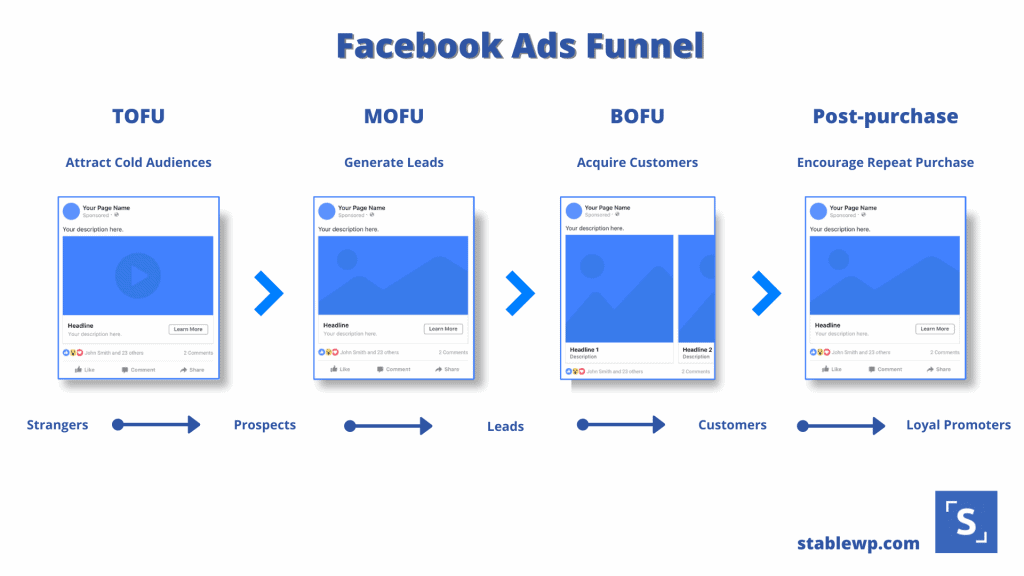
Image Source: StableWP
Key Insight: Most agencies ask whether their ads performed. The more important question is whether the entire system, from first impression to closed revenue, performed.
Building a diagnostic process across all four stages helps agencies identify and fix funnel issues before they compound.
7 Common Facebook Ad Funnel Mistakes Agencies Encounter
Funnel failures are rarely unique. The same mistakes appear across accounts, industries, and ad budgets. Spotting them early helps agencies troubleshoot faster and optimize with more accuracy.
Mistake #1: Optimizing for Clicks Instead of Business Outcomes
Click-through rate is useful, but it does not show revenue impact. A high CTR may indicate creative resonance, but it can also attract curiosity-based traffic with low buying intent.
When agencies optimize only for clicks, they may increase traffic while weakening lead quality. Better optimization should focus on cost per qualified lead, pipeline contribution, and revenue generated.
Mistake #2: Sending All Traffic to the Same Landing Page
Cold and warm audiences should not be sent to the same page. Cold audiences need context, while warm audiences need a clear path to act.
For example, sending both prospecting and retargeting traffic to a generic contact page can hurt both segments. Cold prospects may bounce, while warm prospects may struggle to find the next step. Separate conversion paths help improve funnel performance.
Mistake #3: Weak Offer-To-Audience Alignment
Every funnel stage needs a different offer. Pushing direct conversion offers to cold audiences can waste budget and reduce trust.
A stronger funnel structure looks like this:
- Cold audience: Educational content such as guides, videos, or reports
- Warm audience: Consideration offers such as case studies, comparisons, or webinars
- Hot audience: Direct conversion offers such as demos, consultations, or trials
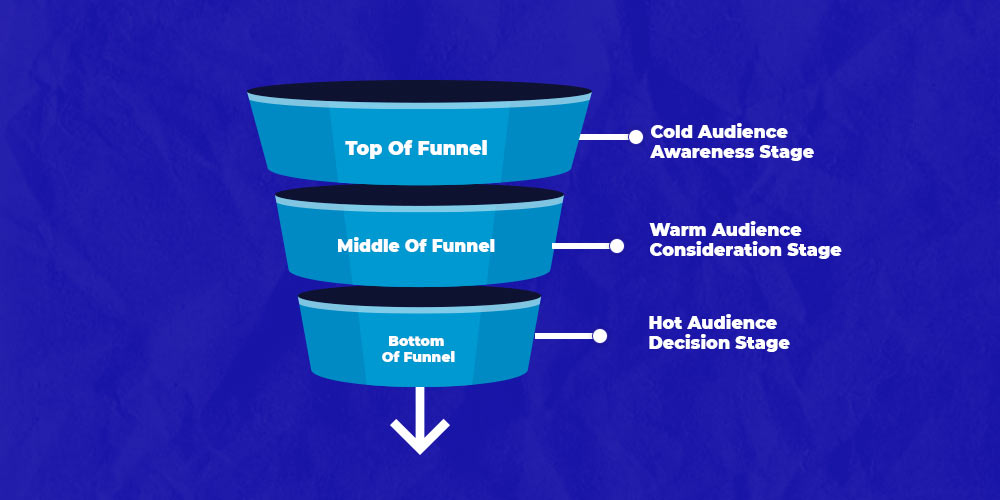
Image Source: Cedcommerce
When the offer does not match the audience stage, prospects disengage before they are ready to act.
Mistake #4: Ignoring First-Party Data Signals
Meta’s delivery system depends on signal quality. Poor Facebook pixel setup, missing conversion events, or absent offline conversion data can limit campaign optimization.
Agencies that rely on standard tracking without checking data quality may optimize against incomplete information. Clean, consistent signals tied to real business outcomes help improve delivery accuracy and reduce wasted spend.
Mistake #5: Poor Creative Rotation
Creative fatigue is predictable. When audiences see the same ads repeatedly, CPMs rise and engagement drops.
Common issues include:
- Running the same creatives for too long
- Testing too few variations
- Treating creative as a one-time task
Creative needs regular testing and refreshing. A wider mix of assets gives the algorithm more inputs to identify stronger audience and message combinations.
Mistake #6: No Lead Nurturing Process
A low CPL does not guarantee revenue. Many campaigns generate leads that fail to convert because there is no follow-up system after the form submission.
Without automated email sequences, timely sales outreach, lead qualification, and CRM workflows, even well-priced leads can become wasted acquisition costs. The funnel may work at the ad level but fail after conversion.
Mistake #7: Measuring the Wrong Funnel Metrics
CTR, CPC, CPM, and impressions show ad delivery. They do not show whether the campaign is driving business results.
Agencies should move beyond delivery metrics and track:
- Cost per qualified lead
- Pipeline value generated
- Revenue contribution per campaign
- Lead-to-close conversion rate
Reporting on delivery metrics can create a false sense of performance. Reporting on revenue metrics shows whether the investment is actually working.
Knowing what mistakes to avoid is useful. Understanding why these issues are difficult to fix at scale explains why they keep happening across agency accounts.
Why Agencies Struggle to Fix Facebook Funnels Consistently?
Identifying funnel issues is one challenge. Fixing them consistently across multiple client accounts without overwhelming internal teams is another.
1. Funnel Optimization Has Become More Technical
Modern funnel optimization requires more than media buying expertise. Agencies increasingly need skills in conversion rate optimization, attribution, CRM integrations, analytics, and automation.
A media buyer alone is rarely enough to diagnose and fix funnel issues at the level clients expect.
Key disciplines involved in funnel optimization:
- Paid media strategy and campaign management
- Conversion tracking and attribution setup
- Landing page and offer optimization
- Email and CRM nurturing workflows
- Reporting and analytics infrastructure
2. Agencies Spend Too Much Time Managing Campaigns
Routine campaign management often consumes time that could be spent on strategic optimization. Reporting, client approvals, account maintenance, and troubleshooting frequently push funnel analysis down the priority list.
This is usually a capacity issue rather than a motivation issue. Even agencies that increase headcount often find operational demands growing alongside their teams.
3. Meta's Automation Has Changed the Rules
With Advantage+ campaigns and increased automation, Meta relies more heavily on signal quality, conversion data, and first-party data infrastructure.
As a result, outcomes are influenced less by manual bid adjustments and audience tweaks than they were in the past. Agencies that have not adapted their optimization approach may still be focusing on levers with diminishing impact.
4. Funnel Problems Often Exist Outside the Ad Account
Some of the biggest performance barriers have nothing to do with campaign settings. Slow landing pages, weak lead capture experiences, delayed sales follow-up, and ineffective nurture sequences can reduce results without appearing in Ads Manager.
Common off-platform funnel issues:
- Landing pages that take more than three seconds to load
- Lead forms with unnecessary friction
- Sales teams responding to leads days after submission
- Generic or poorly segmented email nurture campaigns
Addressing these issues requires agencies to look beyond the ad account, something many teams lack the time or resources to do consistently.
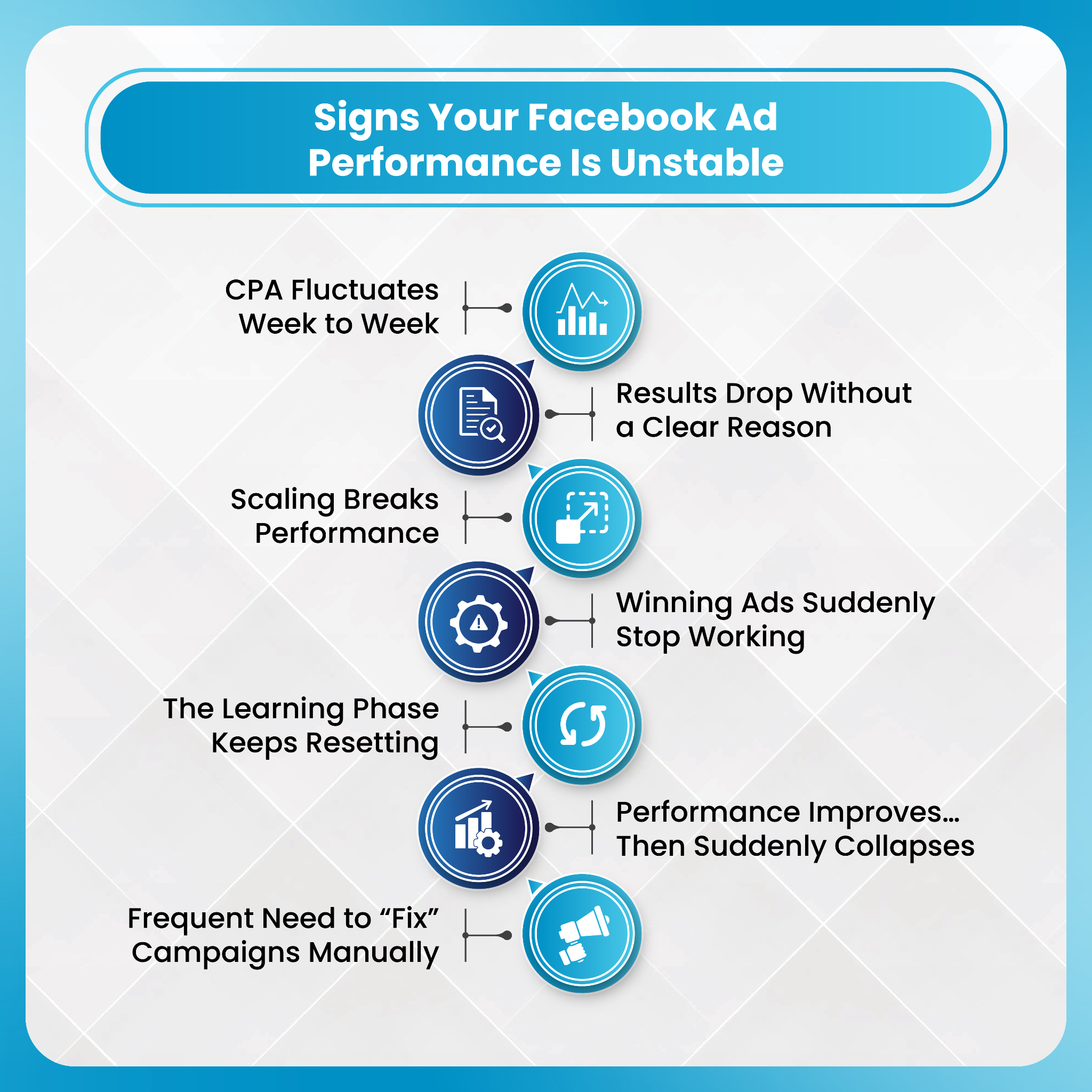
Fixing funnel performance at scale often requires additional support structures and specialized expertise. For many agencies, that is where white label Facebook advertising support becomes a practical way to expand capacity without increasing internal workload.
How White Label Facebook Ads Services Help Agencies Fix Funnel Problems Faster?
White label Facebook advertising partnerships give agencies access to specialized funnel expertise without rebuilding internal teams from scratch.
1. Access to Specialized Funnel Expertise
Strong white label Facebook ads providers bring campaign specialists, funnel strategists, CRO consultants, and tracking experts into one coordinated team.
This helps agencies diagnose multi-layer funnel issues faster and more accurately without months of internal hiring.
2. Faster Funnel Audits
White label partners often work with structured audit processes across multiple accounts, which helps reduce diagnosis time.
For example, a client may report low lead quality. Instead of spending weeks investigating, a repeatable audit may reveal that the lead form asks too many qualification questions before collecting contact details. This creates friction and reduces completions. Once identified, the fix can be made much faster.
3. Better Creative Testing Frameworks
Effective creative testing requires fresh inputs, structured variation, and regular performance monitoring. Many agencies struggle to maintain this across several clients.
White label providers can support creative testing by:
- Rotating fresh creative on a consistent schedule
- Testing meaningful variables instead of small cosmetic changes
- Tracking performance trends and spotting fatigue early
4. Stronger Attribution and Reporting
Attribution remains one of the biggest gaps in Facebook advertising services. Without clean tracking, agencies cannot clearly connect ad spend to revenue outcomes.
Dedicated tracking support helps agencies:
- Validate pixel setup and conversion events
- Build reports around revenue-level metrics
- Give clients clearer visibility into campaign value
5. Scalable Optimization Across Multiple Accounts
A key benefit of white label Facebook ads support is the ability to maintain optimization quality as the client base grows without adding internal headcount at the same pace.
This can lead to:
- Better client retention through consistent performance improvements
- Stronger agency margins through efficient fulfillment
- Less team burnout from account overload
Building internal capacity takes time. White label Facebook advertising support gives agencies a faster way to scale execution quality while keeping internal teams focused on strategy and client relationships.
The Funnel-First Framework Agencies Should Adopt
A structured optimization framework gives agencies a repeatable way to improve Facebook funnel performance across client accounts. Instead of reacting to performance drops, a funnel-first approach helps identify and fix issues before they grow.
Step 1: Diagnose
Start with a full funnel audit before changing the campaign. Map every stage from ad impression to revenue and identify where performance drops. Use pixel data, DashClicks’ CRM Software, and landing page analytics to quantify each leak.
- Identify the stage with the largest drop-off
- Separate media performance from funnel performance
- Document findings before prioritizing fixes
Step 2: Validate
Do not rely on one data point. Before making major changes, validate the issue using multiple sources. A low landing page conversion rate, for example, may point to traffic quality rather than page design.
- Cross-reference ad data with landing page analytics
- Confirm lead quality with the client’s sales team
- Use session recordings to review on-page behavior
Step 3: Optimize
Fix the highest-impact bottleneck first. Trying to solve every issue at once makes it harder to know what actually improved performance.
- Make one significant change at a time
- Set a clear measurement window
- Document the change, hypothesis, and outcome
Step 4: Scale
Increase ad spend only after funnel efficiency is confirmed. Scaling a leaking funnel increases waste, while scaling a proven funnel compounds gains.
- Set minimum efficiency thresholds before increasing budgets
- Use cost per qualified lead as a primary scaling signal
- Share scaling criteria with clients clearly
Step 5: Repeat
Funnel optimization is ongoing. Target audience behavior changes, creative fatigue builds, and competition shifts over time.
- Build a regular audit cadence into each client account
- Review funnel performance monthly, not only when problems appear
- Use each cycle to build knowledge about what works
Top-performing agencies scale proven funnels before scaling ad budgets. The sequence matters as much as the tactics.
A structured framework creates consistency. Pairing it with the right support infrastructure gives agencies the capacity to apply it across accounts at scale.
How DashClicks' White Label Facebook Ads Services Help Agencies Improve Funnel Performance?
DashClicks provides white label Facebook advertising services that help agencies improve funnel performance, expand capacity, and deliver consistent results across client accounts. The support complements agency strategy while handling execution.
1. Strategic Funnel Analysis
The process starts with funnel reviews across audience quality, conversion paths, and offer alignment. This helps agencies identify where performance is breaking down.
- Audience assessment to spot targeting issues
- Conversion path review to find friction points
- Offer review to improve message-to-audience fit
2. Campaign Management
Campaign management includes ad creation, testing, optimization, and budget allocation under the agency’s brand. This gives agencies consistent execution without building a full in-house paid media team.
3. Tracking and Performance Monitoring
Conversion tracking, reporting, and performance visibility are included in the service delivery. Agencies get clearer attribution data and client-ready reports without spending extra internal time on manual reporting.
4. Scalable Fulfillment
White label Facebook ads support helps agencies increase delivery capacity while protecting internal bandwidth.
Key benefits include:
- More team bandwidth without additional hiring
- Stronger client retention through consistent delivery
- Scalable service delivery as client demand grows
- Less media buyer burnout from account overload
For agencies looking to improve Facebook funnel performance without stretching internal resources, DashClicks provides a structured execution partner.
Conclusion
The biggest threat to Facebook advertising performance is often the funnel behind the ads. Campaign metrics may look strong, but hidden conversion barriers can still weaken client results. Agencies that focus only on ad-level changes often keep running into the same performance ceiling.
Funnel issues affect every stage, from lead quality to revenue outcomes. Structured funnel optimization helps agencies improve conversion paths, strengthen attribution, and turn campaign activity into measurable business results.
Long-term success will not come from constant bid adjustments or CPM monitoring alone. It will come from building stronger funnel systems, improving the customer journey, and delivering results clients can see beyond the dashboard.

No results found.
Please try different keywords.
Get Started with
DashClicks Today
Get found online, convert leads faster, generate more revenue, and improve your reputation with our all-in-one platform.
.svg)
Unlimited Sub-Accounts
Unlimited Users
All Apps
All Features
White-Labeled
Active Community
Mobile App
Live Support
100+ Tutorials
Unlimited Sub-Accounts
Unlimited Users
All Apps
All Features
White-Labeled
Active Community
Mobile App
Live Support
100+ Tutorials
Unlimited Sub-Accounts
Unlimited Users
All Apps
All Features
White-Labeled
Active Community
Mobile App
Live Support
100+ Tutorials


