

.svg)

.svg)
.svg)
.svg)
.svg)
.svg)
Website authority has quietly become one of the strongest competitive advantages in search. Rankings come and go, algorithm updates shake up the landscape, but sites with genuine authority tend to weather the storms and keep climbing. For agencies, that makes authority-building the difference between clients who churn after three months and clients who stay for years.
Here is the catch. Authority is no longer built through backlinks alone. Google now rewards a blend of expertise, trust, technical excellence, content depth, and user satisfaction. A single great link will not carry a thin website very far. In fact, BrightEdge research found that organic search drives 53% of all website traffic, which means the stakes for getting authority right have never been higher.
For a solo brand, building authority is a focused project. For an agency, it is a logistical puzzle. You are not building authority for one site. You are building it across dozens of client accounts, each with different industries, timelines, and expectations. Doing that consistently requires systems, processes, and disciplined long-term execution rather than scattered bursts of activity.
This is where white label SEO services come in.
A white label SEO program gives agencies a scalable framework to build authority efficiently across every account, without hiring an army of specialists. Before understanding how white label SEO contributes to authority, agencies must first understand what website authority actually means in today's search landscape.
Website Authority Is More Than Just Domain Authority
Many agencies use "authority" and "Domain Authority" interchangeably, but they are not the same thing. Understanding the difference shapes how you build and measure success.
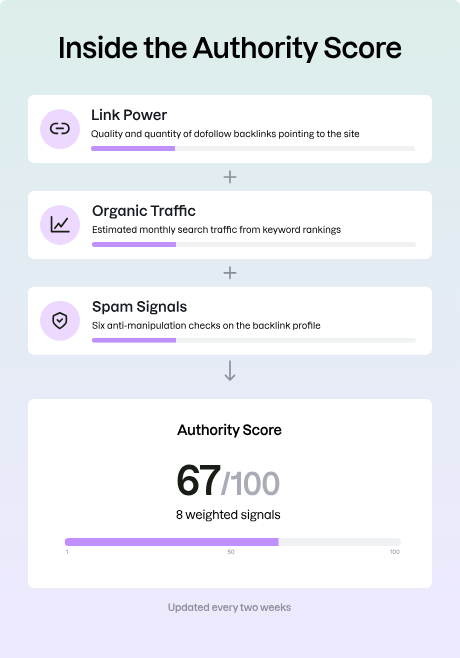
Website authority is the real-world trust and credibility a site has earned in the eyes of users and search engines. Domain Authority (a Moz metric) and Domain Rating (an Ahrefs metric) are third-party scores that estimate authority based mostly on backlinks. They are useful directional signals, but Google does not use them as ranking factors.
Google's own guidance points in a broader direction. Its helpful content system that rewards people-first content, clear expertise, and trust signals across many ranking factors rather than any single score.
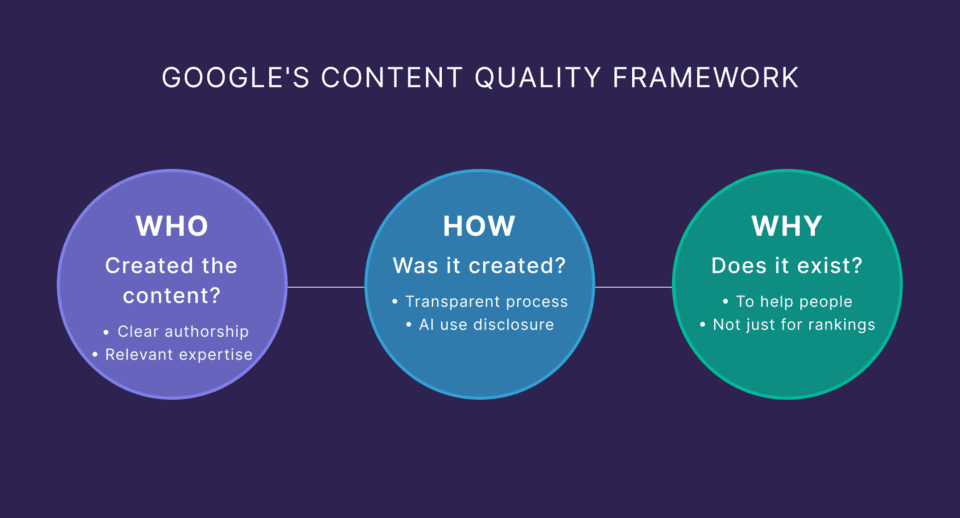
Image Source: Backlinko
A high Domain Rating means little if the content fails to satisfy the searcher. Long-term authority is built from several components working together:
- Topical expertise that shows deep knowledge of a subject
- Content depth that answers questions thoroughly
- Internal linking that connects related pages
- Technical SEO that keeps the site fast and crawlable
- Quality backlinks from relevant, credible sources
- User experience that keeps visitors engaged
- Trust signals like clear authorship and accurate information
There is a useful way to think about how these pieces add up. Call it Compound SEO Authority. Every optimized page does not just rank on its own. It strengthens the overall site ecosystem by reinforcing topics, passing link equity, and signaling expertise.
Picture two sites. Site A has 500 disconnected blog posts covering random topics with no internal structure. Site B has 75 strategically connected resources organized around clear themes and linked together. Site B often wins, even with fewer pages, because its authority compounds. Each page lifts the others instead of standing alone.
Understanding authority is only the first step. The next challenge is why agencies struggle to build it consistently across multiple client campaigns.
Why Most Agencies Struggle To Build Long-Term Authority?
Most agencies know what good SEO looks like. The trouble is delivering it month after month across a full client roster. Operational reality gets in the way.
Common challenges include:
- Managing many clients with limited bandwidth
- Inconsistent content quality from rotating writers
- Disconnected SEO teams that do not share a strategy
- Reactive execution driven by whoever is loudest this week
- Constant pressure to produce monthly deliverables
These pressures push agencies toward the wrong targets. Teams start optimizing for publishing quotas, backlink counts, and report volume because those numbers are easy to show clients. What actually builds long-term results gets sidelined: authority accumulation, topic ownership, and durable visibility.
Here is the part that hurts. Authority compounds slowly but deteriorates quickly when execution becomes inconsistent. Momentum is fragile.
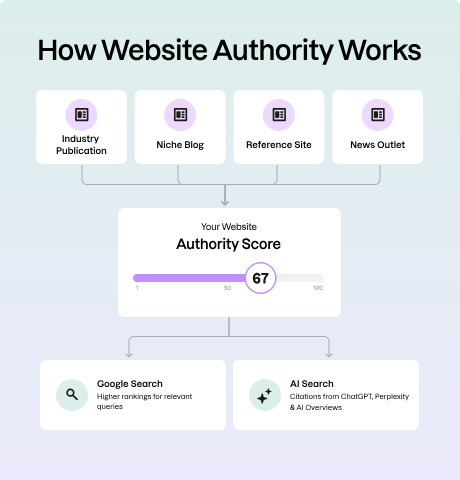
Image Source: Semrush
Consider a familiar scenario. An agency publishes strong content for a client for over six months. Rankings climb, traffic grows, everyone is happy. Then the client's budget shifts, optimization pauses, and the team moves attention elsewhere. Meanwhile, competitors keep expanding their content and links. Within a couple of quarters, those hard-won rankings slip away. The work was good, but it stopped.
These operational bottlenecks explain why many agencies plateau and why scalable authority-building requires standardized execution.
The Five Pillars Of Long-Term Website Authority
Authority feels abstract until you break it into parts you can actually work on. The most durable authority rests on five pillars. Master these, and you have a repeatable blueprint for any client account.
1. Topical Authority
Topical authority is earned by covering a subject completely rather than dabbling in it. Search engines want to see that a site is a genuine resource on its core themes.
You build it through:
- Topic clusters that group related content
- Semantic coverage of subtopics and related questions
- Clear entity relationships that connect concepts
- Comprehensive content that leaves few gaps
2. Technical Authority
Technical authority is the foundation on which everything else sits. If search engines cannot crawl, index, and render a site easily, great content will not reach its potential.
Key areas include:
- Crawlability and clean site structure
- Core Web Vitals and page speed
- Reliable indexing of important pages
- Schema markup that clarifies content meaning
- Logical site architecture
3. Link Authority
Backlinks still matter, but quality has overtaken quantity. A few editorial links from respected, relevant sites outweigh hundreds of low-value ones.
Focus on:
- Editorial backlinks earned through strong content
- Digital PR that generates coverage
- Relevance over raw volume
- Contextual authority from topically aligned sources
4. Internal Authority Flow
Internal linking is one of the most underused authority levers. It controls how trust and ranking power move through a site.
Strengthen it with:
- Deliberate internal linking between related pages
- Hub-and-spoke architecture around core topics
- Smart PageRank distribution to priority pages
5. Content Freshness
Content is not a publish-and-forget asset. Search engines favor information that stays accurate and current.
Maintain freshness by:
- Updating statistics and dated references
- Refreshing older content with new insights
- Expanding articles to cover emerging subtopics
- Pruning outdated or thin pages that drag down quality
These pillars do not operate in isolation. They feed each other in a cycle worth naming: The Authority Flywheel Model. Better content earns higher engagement. Higher engagement attracts stronger links. Stronger links build greater trust. Greater trust improves rankings. Better rankings bring more visibility. More visibility produces additional authority, which fuels even better content. Once the flywheel spins, each turn requires less effort to keep it moving.
While agencies understand these pillars conceptually, executing all five consistently across dozens of clients is where most delivery models begin to break down.
How White Label SEO Services Turn Authority Building Into A Scalable Process?
The gap between knowing the pillars and delivering them is filled by process. This is exactly what a strong white label SEO program provides. The providers standardize the moving parts, so quality does not depend on which team member happens to be available.
A reliable white label SEO agency builds repeatable systems for:
- Keyword strategy and research
- Topical mapping and content planning
- Technical optimization
- Content production
- Link acquisition
- Reporting
- Quality assurance
The value is consistency. A steady, structured effort beats occasional bursts of activity every time, because authority rewards the long haul.
This reframes what outsourcing actually does. White label SEO does not simply outsource tasks. It creates an authority-building production system that runs the same way for every client.
Compare two workflows. The weak model looks like this:
Strategy → Publish → Stop
The strong model looks like this:
Strategy → Production → Optimization → Promotion → Refresh → Expansion
The second workflow never truly ends. It loops, which is precisely how authority compounds.
Think about an agency managing fifteen clients with two in-house staff. Without a system, content quality swings wildly and some accounts get ignored for weeks. By partnering with white label SEO providers, that same agency delivers consistent topic clusters, technical fixes, and link campaigns across all fifteen accounts on a predictable schedule. The clients experience steady progress, and the agency stops scrambling.
Standardized execution creates consistency, but authority also depends on how every SEO component works together rather than independently.
Why Integrated SEO Execution Builds Stronger Authority Than Isolated Tactics?
SEO tactics deliver far more when they reinforce one another. Technical SEO, content, internal linking, backlinks, user experience, and conversion optimization are not separate projects. They are parts of one engine.
When you run them in silos, authority signals weaken. A blog team writes content without knowing the technical team's site structure. A link builder earns backlinks to pages that internal linking never supports. Each effort is fine on its own, but never reaches full strength.
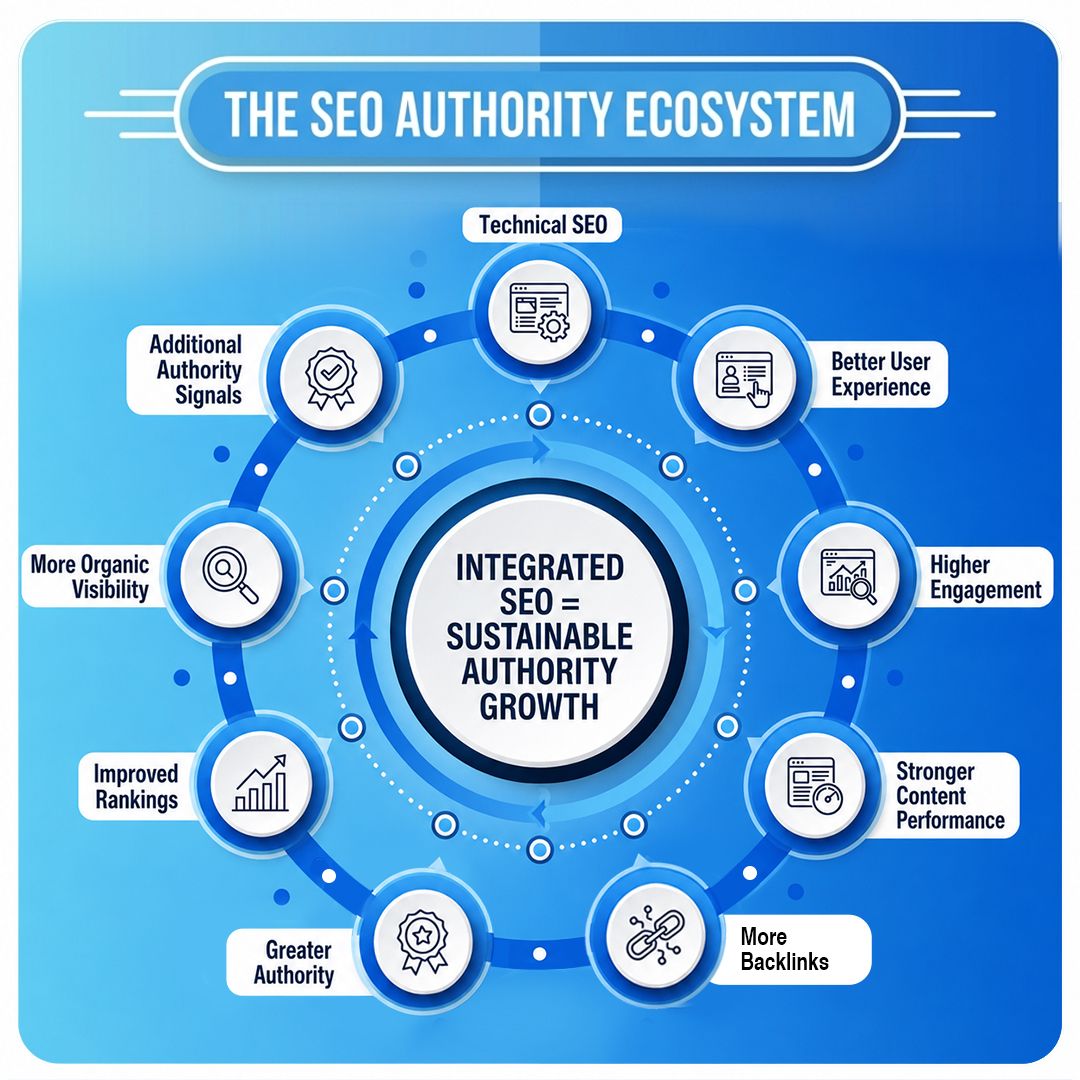
Think of it as The SEO Authority Ecosystem. Improvements in one area amplify results in others. Faster page speed helps content rank. Better content earns more links. More internal links spread that link equity to commercial pages. The whole becomes greater than the sum of its parts.
Here is a common failure. An agency produces a high-quality guide that earns several strong backlinks. Impressive on paper. But because internal linking is weak, none of that authority flows to the service pages that actually generate revenue. The links sit on a blog post and stop there. Integrated execution would have channeled that authority toward pages that matter to the business.
The agencies that consistently build authority do not simply execute SEO. They measure success differently.
KPIs Agencies Should Track Instead Of Chasing Vanity Metrics
How you measure SEO shapes how you deliver it. Many traditional metrics look impressive in a report but say little about real progress. They can even mislead clients into thinking nothing is wrong when growth has stalled.
Be cautious about overworking:
- Domain Authority scores
- Backlink totals
- Indexed page counts
- Raw keyword counts
These numbers can rise while business results stay flat. Instead, track metrics tied to outcomes:
- Non-branded organic traffic growth
- Topic cluster visibility
- Assisted conversions
- Organic lead quality
- Revenue influenced by SEO
- Returning organic visitors
- Engagement metrics like time on page and scroll depth
- Commercial keyword visibility
The principle is simple. Authority should be measured by business impact, not isolated SEO metrics. A client does not care about a Domain Authority bump if their pipeline has not grown.
The financial logic backs this up. SEO consistently produces strong returns when measured against revenue rather than rankings. According to FirstPageSage, SEO delivers an average ROI of 748% across industries, which only becomes visible when agencies track outcomes instead of surface stats.
Agencies that adopt authority-focused KPIs are also better positioned to scale sustainably without sacrificing delivery quality.
How DashClicks Helps Agencies Build Website Authority At Scale?
Putting all of this into practice is the real test, and it is where the right fulfillment partner earns its place. DashClicks gives agencies the structure to build authority across many accounts without expanding their internal team.
The DashClicks approach covers the full authority-building stack:
- Strategic keyword research that maps topics worth owning
- Content creation built around topical depth and clusters
- Technical SEO implementation that keeps sites crawlable and fast
- On-page optimization aligned with search intent
- Internal linking that distributes authority to priority pages
- Authority-focused execution rather than disconnected tasks
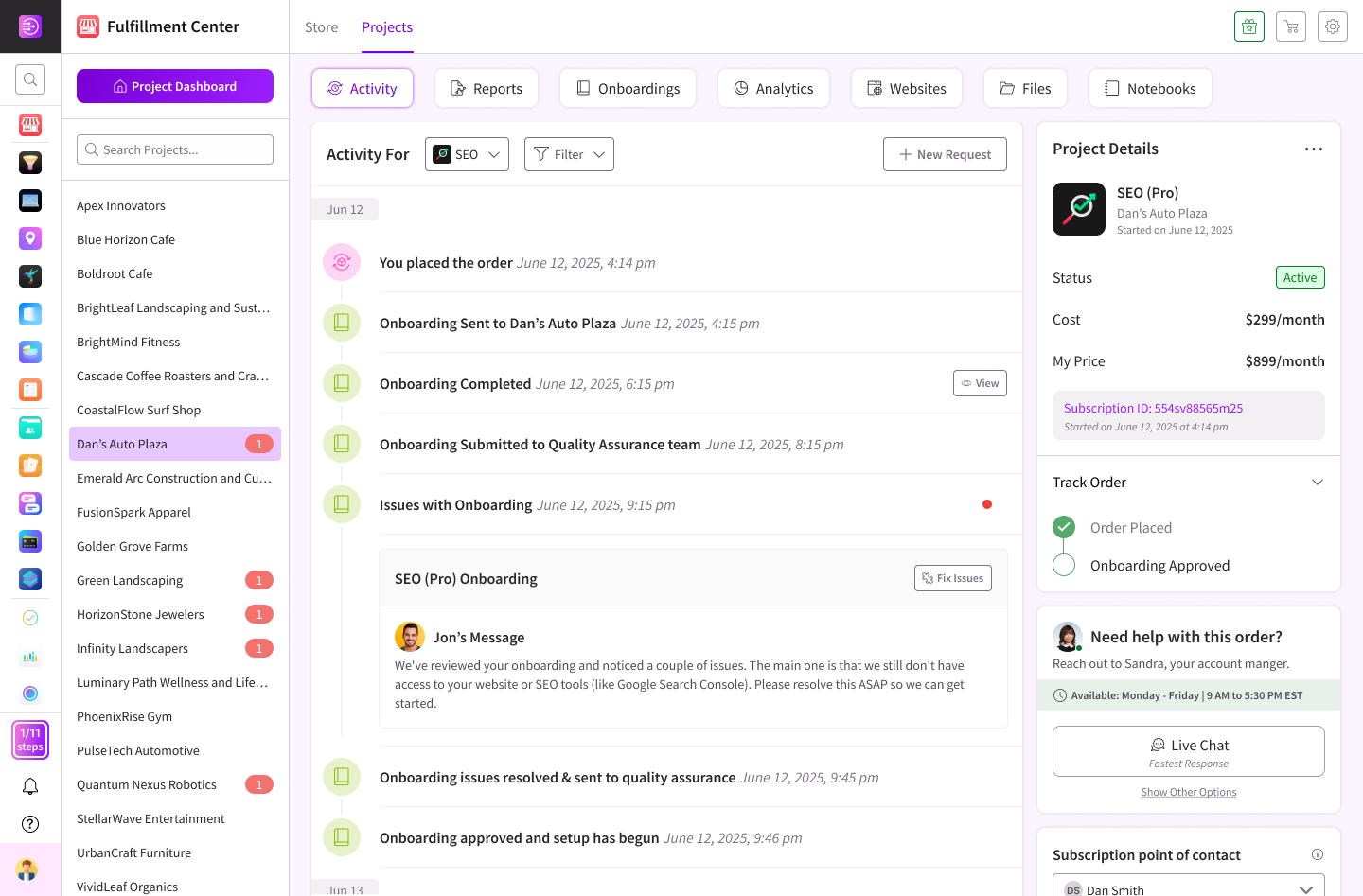
- DashClicks’ analytics software that presents progress under the agency's brand
- Consistent fulfillment systems that keep every account moving
What sets this apart is the systems mindset. Rather than handing back a checklist of completed tasks, white label SEO services help agencies run a repeatable authority-building process. Each client account follows the same disciplined workflow, so quality does not depend on bandwidth or luck.
For an agency, that means delivering enterprise-level SEO consistency across a full roster while keeping headcount lean. The flywheel keeps spinning on every account, not just the ones that happened to get attention this month.
Ultimately, sustainable authority is not built through isolated campaigns. It is the result of disciplined systems executed consistently over time.
Building Authority Is A System, Not A Sprint
Website authority is earned, not bought. It grows from consistency, genuine expertise, trust signals, and SEO execution, where every component supports the others. The agencies that treat authority as a slow-compounding asset are the ones whose clients stay and grow.
Agencies focused only on rankings tend to struggle when results plateau. Rankings are an outcome, not a strategy. Chase them in isolation, and you end up reacting to every algorithm shift instead of building something durable.
White label SEO services change that equation. By standardizing keyword strategy, content production, technical work, link acquisition, and reporting, a strong program lets agencies build repeatable systems that strengthen authority across every client account. The work becomes predictable, scalable, and far easier to sustain.
Long-term SEO success comes from authority accumulation, not isolated deliverables. One great month of content will not protect a client from competitors who never stop. A steady system will.
The agencies that win in the long term will not be the ones producing the most SEO activity. They will be the ones building the strongest systems for sustainable authority growth.


.svg)


.svg)
.svg)
.svg)
.svg)
.svg)