

.svg)

.svg)
.svg)
.svg)
.svg)
.svg)
Most agencies respond to underperforming Facebook campaigns by adjusting bids, refreshing creatives, or shifting budgets. These changes may help, but they rarely fix the deeper issue. In many cases, the real problem is the funnel.
A campaign can generate strong CTR, steady engagement, and a consistent flow of leads while still failing to drive revenue. Prospects click, visit the landing page, fill out a form, and then drop off before becoming customers. When that happens, the issue is not always the ad. It is what happens after the ad.
Facebook advertising has also become more complex. WordStream reports that the average CTR for Facebook lead campaigns is around 2.59% across industries, while cost per lead has increased by roughly 21% year over year in many verticals. With Meta investing more in AI-driven delivery, manual targeting changes now have less impact than they once did.
Performance today depends less on granular audience tweaks and more on signal quality, conversion quality, and the full customer journey.
Before agencies can improve client results, they need to identify exactly where Facebook funnels are breaking down.
Where Facebook Ad Funnels Actually Break?
Most funnel failures are not random. They typically occur at predictable stages, each with distinct warning signs. Agencies that evaluate these stages systematically can identify issues faster and avoid spending budget on the wrong fixes.
1. Audience Attraction
Every funnel starts with audience quality. Poor targeting, broad audience mismatches, or creativity that fails to resonate with the intended audience can drive low-quality traffic from the beginning. High impressions with low engagement often indicate the ad is reaching people who were unlikely to convert.
Creative relevance is a key factor. An ad that performs well with one audience segment may generate little traction with another, even when the messaging appears similar.
Watch for: Low relevance scores, high frequency with declining CTR, audience overlap across ad sets
Diagnostic Question: Are we attracting the right people, or just a lot of people?
2. Engagement
CTR shows whether an ad captured attention. It does not indicate whether the offer was compelling enough to drive action. Unclear value propositions, weak messaging, or offer-audience mismatches often create an engagement gap where clicks occur without meaningful intent.
This is especially common when bottom-of-funnel offers are shown to cold audiences. The click may be genuine, but the intent to convert is not.
Watch for: High CTR with low landing page conversion rates, high link clicks with low form completions
Diagnostic Question: Did the ad generate qualified intent or just curiosity?
3. Conversion
Landing pages, lead forms, and checkout experiences are where many funnel leaks occur. Slow load times, weak call-to-action, or messaging that does not match the ad can reduce conversions, regardless of campaign performance.
Example: A B2B SaaS campaign generates a strong 4.1% CTR, but the landing page converts at only 0.6%. The issue is not the ad platform. The landing page promotes a different offer and includes distracting navigation links that pull visitors away before they convert.
Watch for: High click volume, low form submissions, high bounce rates
Diagnostic Question: Is the landing page earning the conversion the ad created?
4. Revenue Generation
The funnel does not end at the lead form. CRM workflows, lead routing, nurturing sequences, and sales follow-up ultimately determine whether leads become revenue.
Agencies often focus on cost per lead, while clients focus on revenue outcomes. Delayed follow-up, weak nurturing, or poor CRM handoffs can make an otherwise successful campaign appear ineffective.
Watch for: High lead volume, low close rates, long sales cycle, poor nurture engagement
Diagnostic question: What happens after a lead enters the client's system?
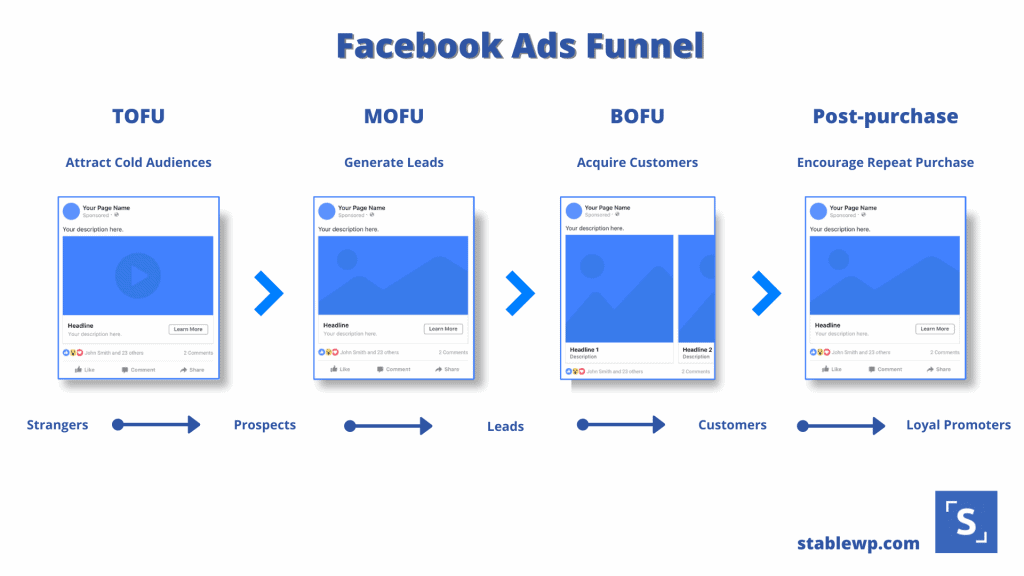
Image Source: StableWP
Key Insight: Most agencies ask whether their ads performed. The more important question is whether the entire system, from first impression to closed revenue, performed.
Building a diagnostic process across all four stages helps agencies identify and fix funnel issues before they compound.
7 Common Facebook Ad Funnel Mistakes Agencies Encounter
Funnel failures are rarely unique. The same mistakes appear across accounts, industries, and ad budgets. Spotting them early helps agencies troubleshoot faster and optimize with more accuracy.
Mistake #1: Optimizing for Clicks Instead of Business Outcomes
Click-through rate is useful, but it does not show revenue impact. A high CTR may indicate creative resonance, but it can also attract curiosity-based traffic with low buying intent.
When agencies optimize only for clicks, they may increase traffic while weakening lead quality. Better optimization should focus on cost per qualified lead, pipeline contribution, and revenue generated.
Mistake #2: Sending All Traffic to the Same Landing Page
Cold and warm audiences should not be sent to the same page. Cold audiences need context, while warm audiences need a clear path to act.
For example, sending both prospecting and retargeting traffic to a generic contact page can hurt both segments. Cold prospects may bounce, while warm prospects may struggle to find the next step. Separate conversion paths help improve funnel performance.
Mistake #3: Weak Offer-To-Audience Alignment
Every funnel stage needs a different offer. Pushing direct conversion offers to cold audiences can waste budget and reduce trust.
A stronger funnel structure looks like this:
- Cold audience: Educational content such as guides, videos, or reports
- Warm audience: Consideration offers such as case studies, comparisons, or webinars
- Hot audience: Direct conversion offers such as demos, consultations, or trials
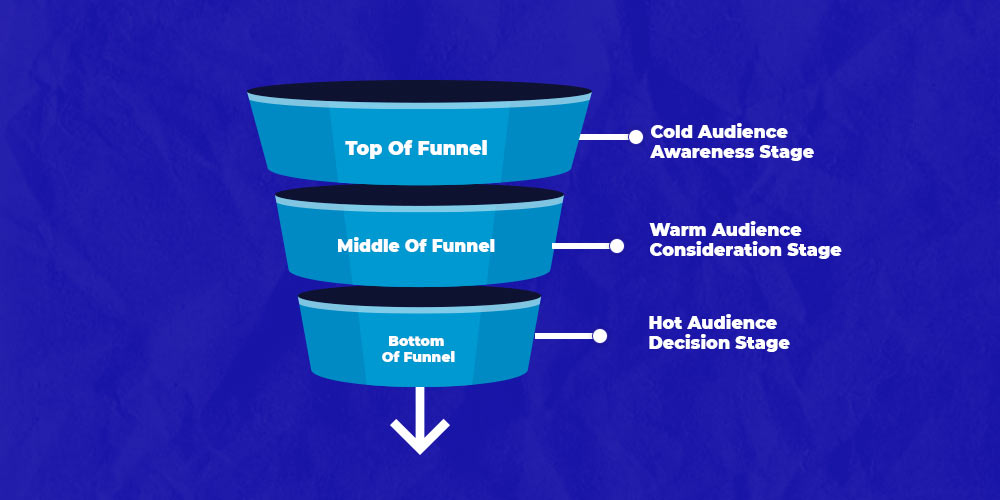
Image Source: Cedcommerce
When the offer does not match the audience stage, prospects disengage before they are ready to act.
Mistake #4: Ignoring First-Party Data Signals
Meta’s delivery system depends on signal quality. Poor Facebook pixel setup, missing conversion events, or absent offline conversion data can limit campaign optimization.
Agencies that rely on standard tracking without checking data quality may optimize against incomplete information. Clean, consistent signals tied to real business outcomes help improve delivery accuracy and reduce wasted spend.
Mistake #5: Poor Creative Rotation
Creative fatigue is predictable. When audiences see the same ads repeatedly, CPMs rise and engagement drops.
Common issues include:
- Running the same creatives for too long
- Testing too few variations
- Treating creative as a one-time task
Creative needs regular testing and refreshing. A wider mix of assets gives the algorithm more inputs to identify stronger audience and message combinations.
Mistake #6: No Lead Nurturing Process
A low CPL does not guarantee revenue. Many campaigns generate leads that fail to convert because there is no follow-up system after the form submission.
Without automated email sequences, timely sales outreach, lead qualification, and CRM workflows, even well-priced leads can become wasted acquisition costs. The funnel may work at the ad level but fail after conversion.
Mistake #7: Measuring the Wrong Funnel Metrics
CTR, CPC, CPM, and impressions show ad delivery. They do not show whether the campaign is driving business results.
Agencies should move beyond delivery metrics and track:
- Cost per qualified lead
- Pipeline value generated
- Revenue contribution per campaign
- Lead-to-close conversion rate
Reporting on delivery metrics can create a false sense of performance. Reporting on revenue metrics shows whether the investment is actually working.
Knowing what mistakes to avoid is useful. Understanding why these issues are difficult to fix at scale explains why they keep happening across agency accounts.
Why Agencies Struggle to Fix Facebook Funnels Consistently?
Identifying funnel issues is one challenge. Fixing them consistently across multiple client accounts without overwhelming internal teams is another.
1. Funnel Optimization Has Become More Technical
Modern funnel optimization requires more than media buying expertise. Agencies increasingly need skills in conversion rate optimization, attribution, CRM integrations, analytics, and automation.
A media buyer alone is rarely enough to diagnose and fix funnel issues at the level clients expect.
Key disciplines involved in funnel optimization:
- Paid media strategy and campaign management
- Conversion tracking and attribution setup
- Landing page and offer optimization
- Email and CRM nurturing workflows
- Reporting and analytics infrastructure
2. Agencies Spend Too Much Time Managing Campaigns
Routine campaign management often consumes time that could be spent on strategic optimization. Reporting, client approvals, account maintenance, and troubleshooting frequently push funnel analysis down the priority list.
This is usually a capacity issue rather than a motivation issue. Even agencies that increase headcount often find operational demands growing alongside their teams.
3. Meta's Automation Has Changed the Rules
With Advantage+ campaigns and increased automation, Meta relies more heavily on signal quality, conversion data, and first-party data infrastructure.
As a result, outcomes are influenced less by manual bid adjustments and audience tweaks than they were in the past. Agencies that have not adapted their optimization approach may still be focusing on levers with diminishing impact.
4. Funnel Problems Often Exist Outside the Ad Account
Some of the biggest performance barriers have nothing to do with campaign settings. Slow landing pages, weak lead capture experiences, delayed sales follow-up, and ineffective nurture sequences can reduce results without appearing in Ads Manager.
Common off-platform funnel issues:
- Landing pages that take more than three seconds to load
- Lead forms with unnecessary friction
- Sales teams responding to leads days after submission
- Generic or poorly segmented email nurture campaigns
Addressing these issues requires agencies to look beyond the ad account, something many teams lack the time or resources to do consistently.
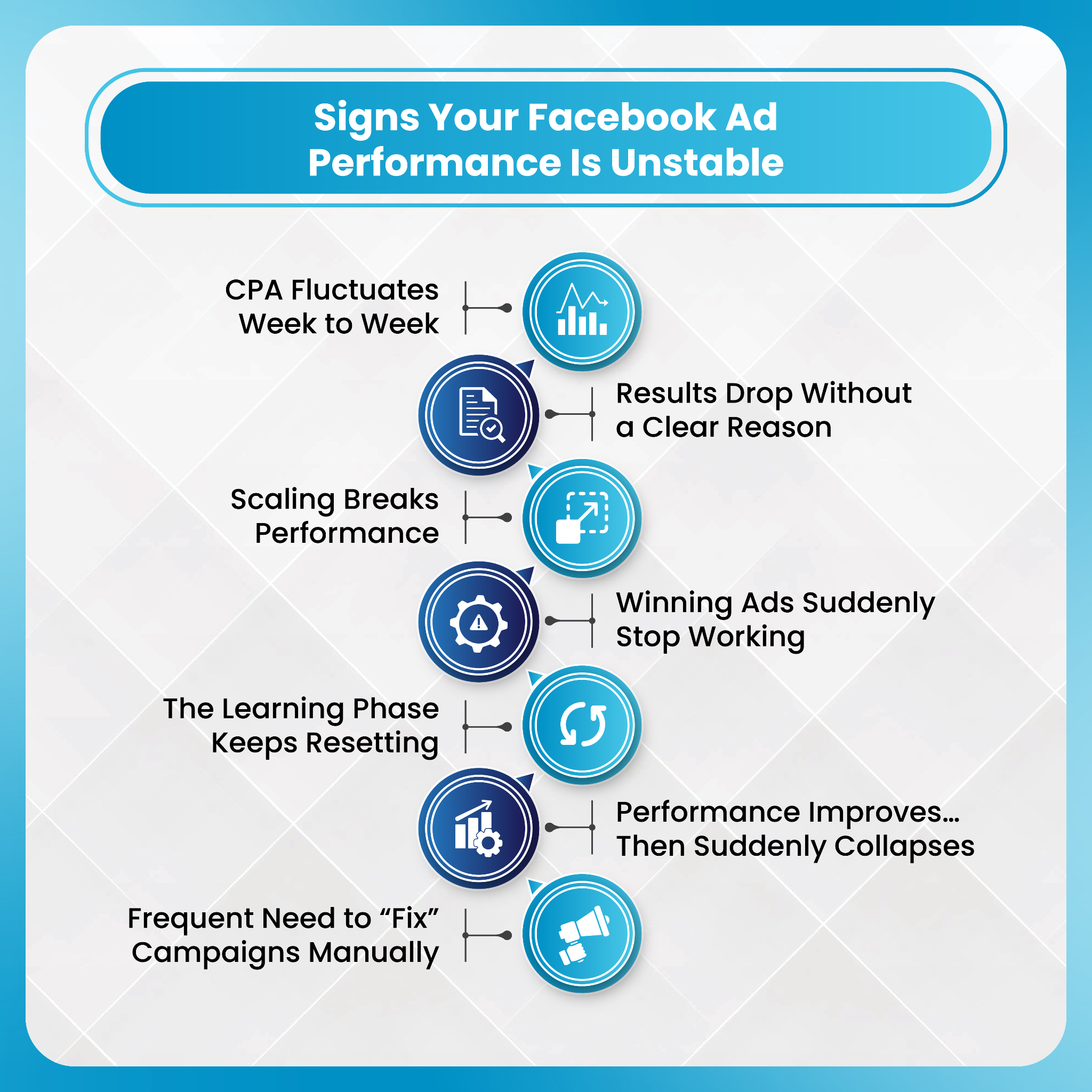
Fixing funnel performance at scale often requires additional support structures and specialized expertise. For many agencies, that is where white label Facebook advertising support becomes a practical way to expand capacity without increasing internal workload.
How White Label Facebook Ads Services Help Agencies Fix Funnel Problems Faster?
White label Facebook advertising partnerships give agencies access to specialized funnel expertise without rebuilding internal teams from scratch.
1. Access to Specialized Funnel Expertise
Strong white label Facebook ads providers bring campaign specialists, funnel strategists, CRO consultants, and tracking experts into one coordinated team.
This helps agencies diagnose multi-layer funnel issues faster and more accurately without months of internal hiring.
2. Faster Funnel Audits
White label partners often work with structured audit processes across multiple accounts, which helps reduce diagnosis time.
For example, a client may report low lead quality. Instead of spending weeks investigating, a repeatable audit may reveal that the lead form asks too many qualification questions before collecting contact details. This creates friction and reduces completions. Once identified, the fix can be made much faster.
3. Better Creative Testing Frameworks
Effective creative testing requires fresh inputs, structured variation, and regular performance monitoring. Many agencies struggle to maintain this across several clients.
White label providers can support creative testing by:
- Rotating fresh creative on a consistent schedule
- Testing meaningful variables instead of small cosmetic changes
- Tracking performance trends and spotting fatigue early
4. Stronger Attribution and Reporting
Attribution remains one of the biggest gaps in Facebook advertising services. Without clean tracking, agencies cannot clearly connect ad spend to revenue outcomes.
Dedicated tracking support helps agencies:
- Validate pixel setup and conversion events
- Build reports around revenue-level metrics
- Give clients clearer visibility into campaign value
5. Scalable Optimization Across Multiple Accounts
A key benefit of white label Facebook ads support is the ability to maintain optimization quality as the client base grows without adding internal headcount at the same pace.
This can lead to:
- Better client retention through consistent performance improvements
- Stronger agency margins through efficient fulfillment
- Less team burnout from account overload
Building internal capacity takes time. White label Facebook advertising support gives agencies a faster way to scale execution quality while keeping internal teams focused on strategy and client relationships.
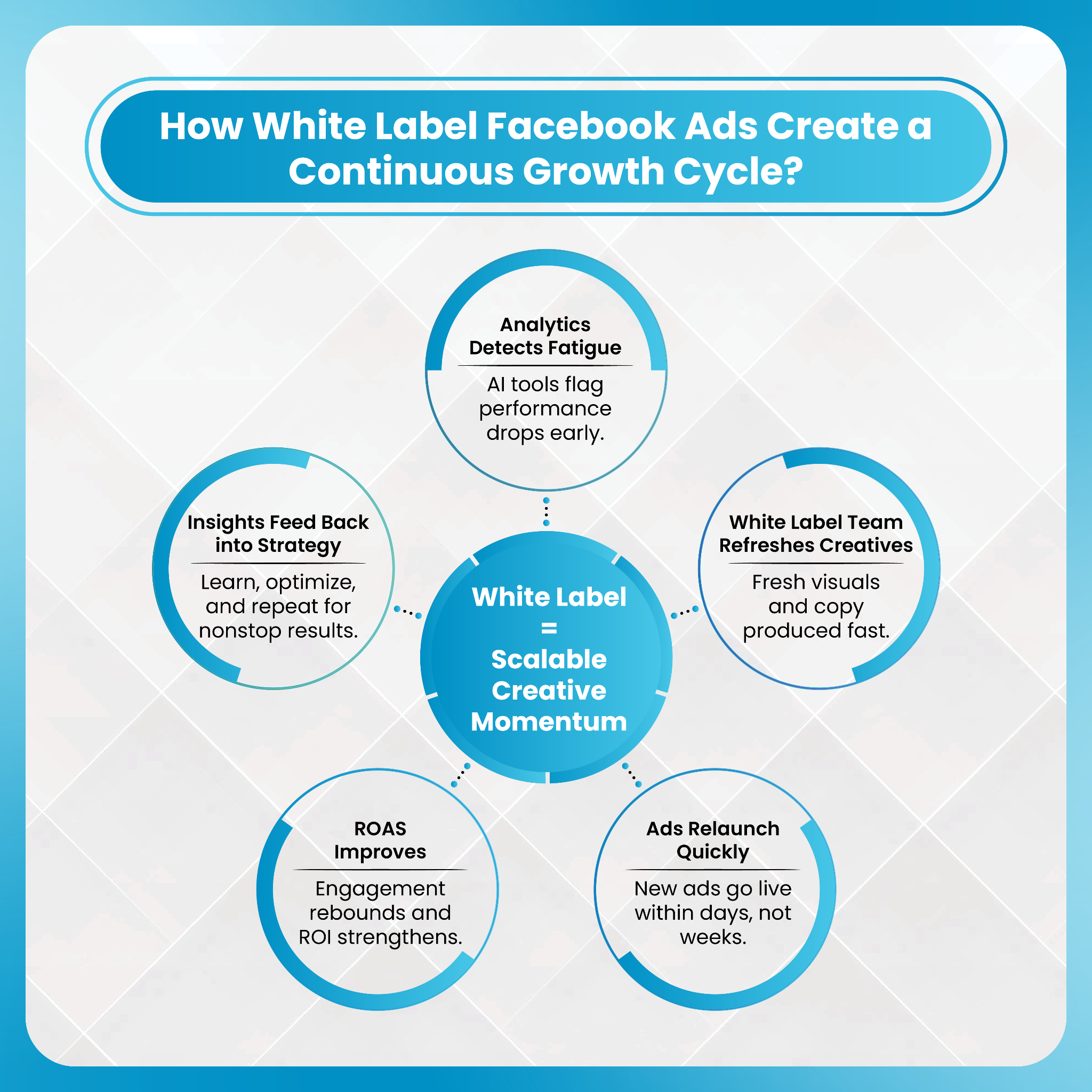
The Funnel-First Framework Agencies Should Adopt
A structured optimization framework gives agencies a repeatable way to improve Facebook funnel performance across client accounts. Instead of reacting to performance drops, a funnel-first approach helps identify and fix issues before they grow.
Step 1: Diagnose
Start with a full funnel audit before changing the campaign. Map every stage from ad impression to revenue and identify where performance drops. Use pixel data, DashClicks’ CRM Software, and landing page analytics to quantify each leak.
- Identify the stage with the largest drop-off
- Separate media performance from funnel performance
- Document findings before prioritizing fixes
Step 2: Validate
Do not rely on one data point. Before making major changes, validate the issue using multiple sources. A low landing page conversion rate, for example, may point to traffic quality rather than page design.
- Cross-reference ad data with landing page analytics
- Confirm lead quality with the client’s sales team
- Use session recordings to review on-page behavior
Step 3: Optimize
Fix the highest-impact bottleneck first. Trying to solve every issue at once makes it harder to know what actually improved performance.
- Make one significant change at a time
- Set a clear measurement window
- Document the change, hypothesis, and outcome
Step 4: Scale
Increase ad spend only after funnel efficiency is confirmed. Scaling a leaking funnel increases waste, while scaling a proven funnel compounds gains.
- Set minimum efficiency thresholds before increasing budgets
- Use cost per qualified lead as a primary scaling signal
- Share scaling criteria with clients clearly
Step 5: Repeat
Funnel optimization is ongoing. Target audience behavior changes, creative fatigue builds, and competition shifts over time.
- Build a regular audit cadence into each client account
- Review funnel performance monthly, not only when problems appear
- Use each cycle to build knowledge about what works
Top-performing agencies scale proven funnels before scaling ad budgets. The sequence matters as much as the tactics.
A structured framework creates consistency. Pairing it with the right support infrastructure gives agencies the capacity to apply it across accounts at scale.
How DashClicks' White Label Facebook Ads Services Help Agencies Improve Funnel Performance?
DashClicks provides white label Facebook advertising services that help agencies improve funnel performance, expand capacity, and deliver consistent results across client accounts. The support complements agency strategy while handling execution.
1. Strategic Funnel Analysis
The process starts with funnel reviews across audience quality, conversion paths, and offer alignment. This helps agencies identify where performance is breaking down.
- Audience assessment to spot targeting issues
- Conversion path review to find friction points
- Offer review to improve message-to-audience fit
2. Campaign Management
Campaign management includes ad creation, testing, optimization, and budget allocation under the agency’s brand. This gives agencies consistent execution without building a full in-house paid media team.
3. Tracking and Performance Monitoring
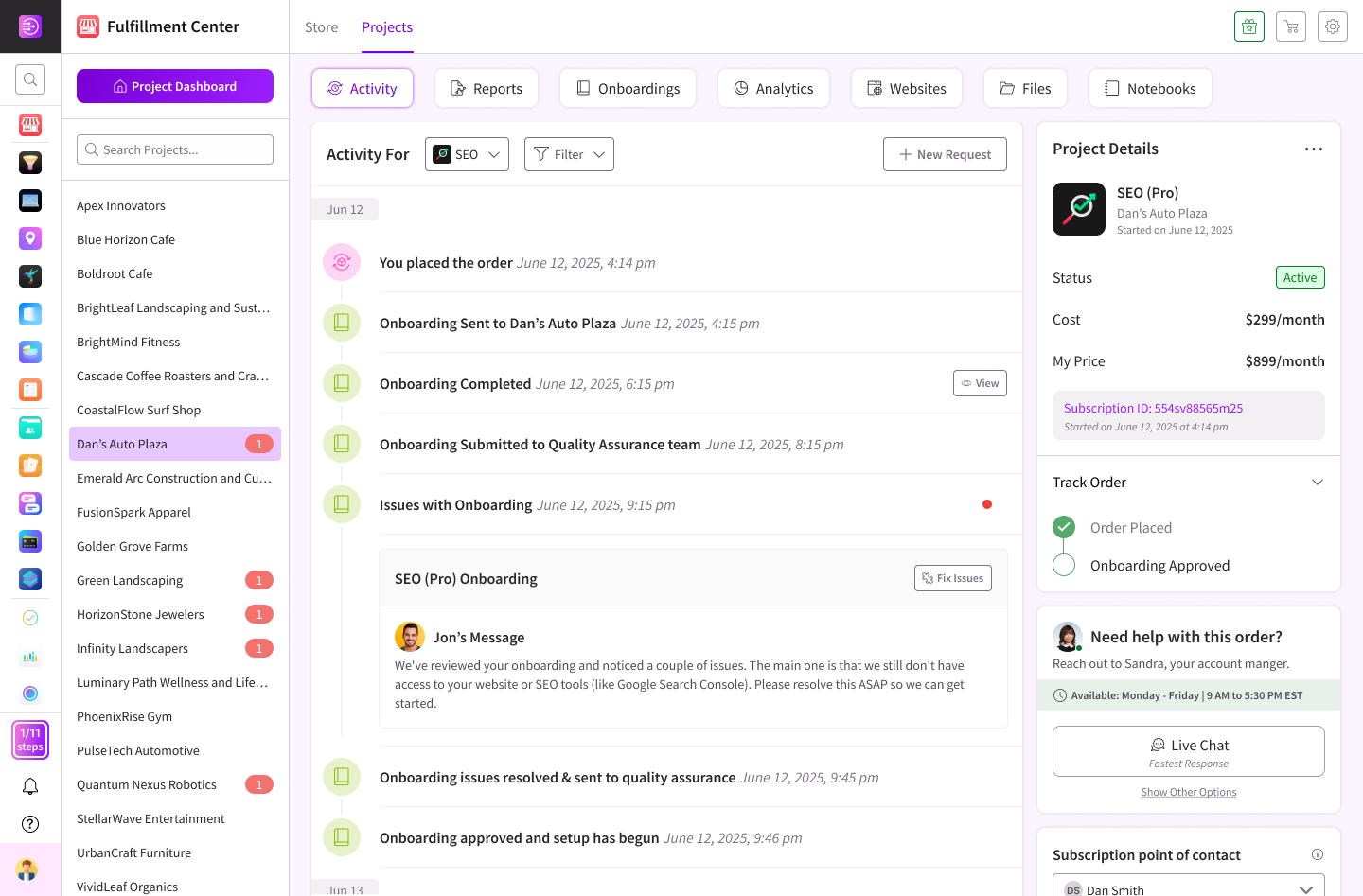
Conversion tracking, reporting, and performance visibility are included in the service delivery. Agencies get clearer attribution data and client-ready reports without spending extra internal time on manual reporting.
4. Scalable Fulfillment
White label Facebook ads support helps agencies increase delivery capacity while protecting internal bandwidth.
Key benefits include:
- More team bandwidth without additional hiring
- Stronger client retention through consistent delivery
- Scalable service delivery as client demand grows
- Less media buyer burnout from account overload
For agencies looking to improve Facebook funnel performance without stretching internal resources, DashClicks provides a structured execution partner.
Conclusion
The biggest threat to Facebook advertising performance is often the funnel behind the ads. Campaign metrics may look strong, but hidden conversion barriers can still weaken client results. Agencies that focus only on ad-level changes often keep running into the same performance ceiling.
Funnel issues affect every stage, from lead quality to revenue outcomes. Structured funnel optimization helps agencies improve conversion paths, strengthen attribution, and turn campaign activity into measurable business results.
Long-term success will not come from constant bid adjustments or CPM monitoring alone. It will come from building stronger funnel systems, improving the customer journey, and delivering results clients can see beyond the dashboard.


.svg)


.svg)
.svg)
.svg)
.svg)
.svg)