

.svg)
.jpg)
.svg)
.svg)
.svg)
.svg)
.svg)
Scaling Facebook Ads is one of the toughest challenges agencies face. A campaign that performs beautifully at $50 or $100 per day can suddenly stall the moment you push more budget into it. The frustrating part? More spending rarely produces proportionally more conversions.
Most scaling problems do not appear out of nowhere. They come from audience limitations, creative fatigue, measurement gaps, and operational bottlenecks that stay hidden at lower budgets. When agencies manage several client accounts at once, that complexity multiplies fast.
Here is the insight many agencies miss: scaling is an operational discipline, not simply a media buying tactic. The agencies that scale well treat it as a system, not a button they press inside Ads Manager.
Context matters too. WordStream reports that average Google Ads search conversion rates reached roughly 7.52% across industries in 2025. Paid conversion rates are healthy when campaigns are built well, which tells you that scaling failures usually come from execution, not demand.
This guide breaks down why scaling changes campaign behavior, the real reasons performance drops, and how white label Facebook advertising services help agencies grow without losing efficiency. Before understanding how to scale successfully, agencies must first understand why scaling changes campaign behavior in the first place.
Why Scaling Changes The Entire Campaign Dynamics?
Scaling does not just mean spending more money. It changes how Meta delivers your ads, who sees them, and what you pay to reach them. Understanding this shift is the foundation for everything that follows.
When you increase budgets, Meta is forced to reach beyond your highest-intent audience segments. To spend the extra money, the platform widens delivery, which creates several predictable effects:
- Auction participation expands as your ads compete for more impressions.
- CPMs often rise because you are bidding into more crowded inventory.
- CPA frequently increases as you reach less qualified users.
- Delivery becomes harder to predict and stabilize.
Picture a campaign producing profitable leads at $100 per day. At $1,000 per day, that same campaign often struggles because the high-intent audience pools have been exhausted. You are now paying to reach people who are less likely to convert.
The learning phase plays a major role here. Meta generally recommends around 50 optimization events within a seven-day window to reach learning stability. Without enough conversions, campaigns stay unstable, and delivery suffers.
This is why every major budget change can reset learning and disrupt performance. The algorithm needs consistent signals, and aggressive scaling breaks that consistency.

Understanding why scaling changes delivery explains why many agencies blame the algorithm when the real issue lies within campaign structure and execution.
The Real Reasons Facebook Ads Fail During Scaling
Once you accept that scaling changes campaign behavior, the next step is identifying exactly where performance breaks down. Most failures trace back to five specific issues, and they often occur simultaneously.
1. Audience Saturation
As budgets climb, your ads show up to the same people more often. That rising frequency leads to fatigue and weaker results.
Meta also expands delivery into lower-quality audience segments to spend the budget. The outcome is diminishing returns, where more spending buys less qualified traffic. In short, bigger budgets often mean a less interested audience.
2. Creative Fatigue Accelerates
Creative wears out faster at scale because more people see your ads in a shorter window. The warning signs are easy to spot:
- Declining click-through rate (CTR)
- Increasing CPM
- Falling engagement and comments
The fix is structural, not reactive. Agencies should maintain a continuous creative testing pipeline so fresh assets are always ready before fatigue sets in.
3. Learning Phase Resets
Every aggressive edit can throw a campaign back into the learning phase. Frequent changes, large budget jumps, and constant tweaking all create delivery instability.
Industry best practice recommends increasing budgets by roughly 10 to 20% at a time, then allowing 48 to 72 hours for stabilization. Patience protects the data that the algorithm depends on.
4. Weak Conversion Data
Scaling amplifies whatever data foundation you already have. If that foundation is weak, scaling makes the cracks worse. Common problems include:
- Pixel issues and firing errors
- Missing offline conversions
- Disconnected CRM systems
- General tracking inaccuracies
The principle is simple: garbage data produces garbage optimization. Meta can only optimize toward the signals it receives, so flawed tracking guarantees flawed delivery.
5. Scaling Operations Instead Of Strategy
This is the issue most agencies overlook. They scale budgets without scaling the systems that support those budgets.
Specifically, agencies often increase spending without expanding:
- Creative production
- Attribution and measurement
- Reporting depth
- Testing systems
Many scaling failures are operational failures rather than platform failures. The algorithm is doing its job, but the surrounding systems cannot keep up.
Once agencies recognize that scaling failures stem from multiple operational factors, the next challenge becomes managing those factors across dozens of client accounts.
The Hidden Agency Challenge: Scaling Multiple Facebook Accounts Simultaneously
For a single campaign, the problems above are manageable. For an agency running many accounts, they compound into something far harder to control.
Every client brings a different set of variables, and each one demands attention:
- Different KPIs and success metrics
- Different attribution models
- Different creative cycles and refresh rates
- Different sales cycles
- Different budgets and risk tolerances
When you stack these differences across an entire client roster, optimization complexity grows exponentially. Managing five accounts is demanding but doable. Managing fifty accounts with the same processes is nearly impossible without a system built for it.
Think about what changes between those two scenarios. Five accounts might mean a handful of creative tests and weekly reviews. Fifty accounts mean hundreds of active variables, dozens of reporting deadlines, and constant context switching that drains your team.
This leads to an important realization: agencies often hit an operational ceiling before they hit a client acquisition ceiling. They could sell more, but they cannot deliver more without quality slipping.
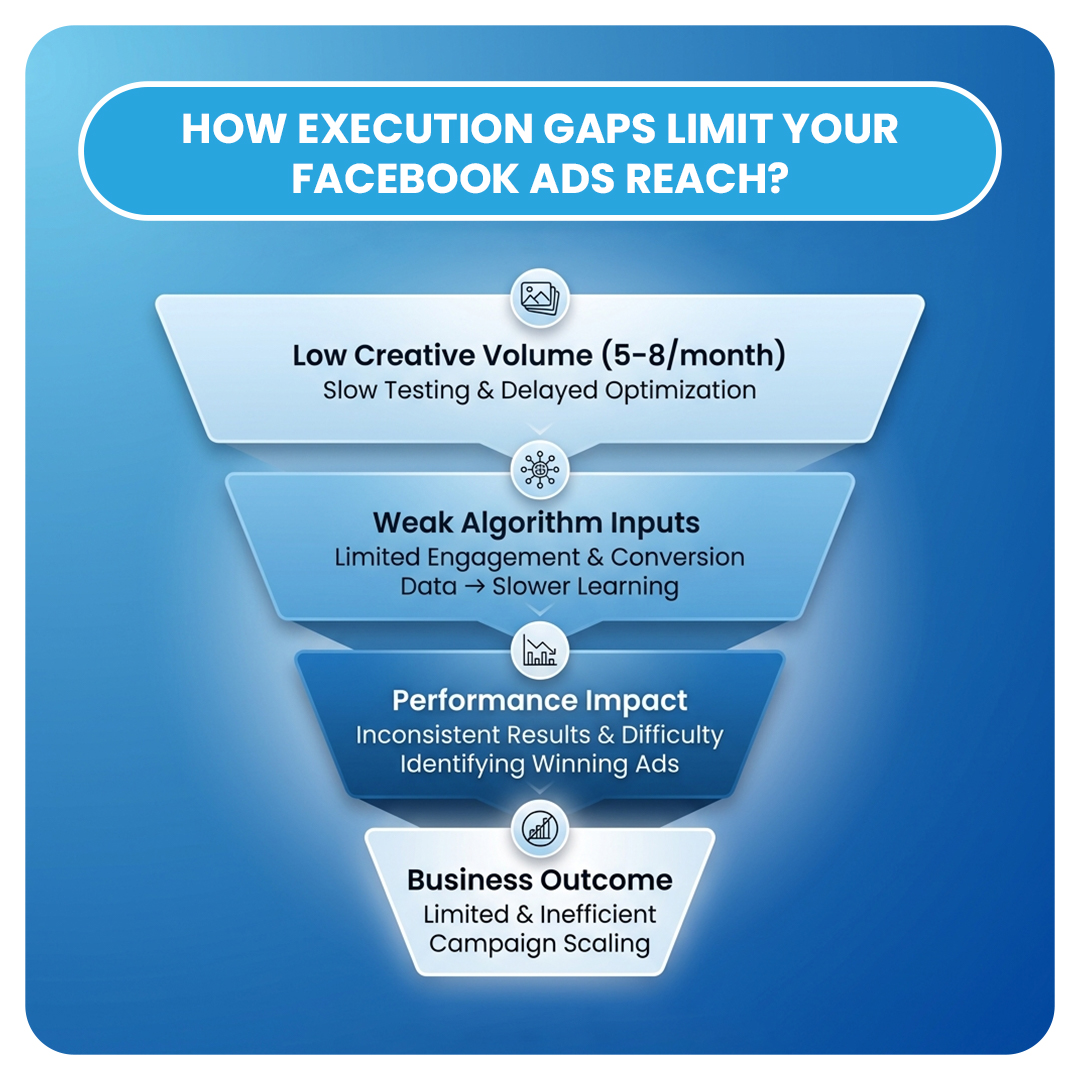
This operational complexity explains why many high-growth agencies eventually move toward strategy-led delivery models.
Further Reading: Managing 50+ Accounts Using White Label Facebook Ads Services
Why White Label Services Help Agencies Scale Better?
White label Facebook advertising is best understood as operational infrastructure, not simple outsourcing. It gives agencies the fulfillment capacity to scale campaigns without scaling internal headcount at the same rate.
Here is how the right white label partner strengthens each part of the scaling process.
1. Continuous Optimization Capacity
Scaling demands constant attention, and most lean teams cannot provide it across every account. A dedicated fulfillment team can deliver:
- Daily campaign monitoring
- Active bid management
- Ongoing audience testing
- Regular performance reviews
That consistency keeps campaigns stable as budgets grow.
2. Faster Creative Testing
Creative velocity is one of the strongest scaling levers, and it requires volume. White label support increases creative throughput, enabling faster experimentation and earlier fatigue prevention. More tested assets mean fewer performance dips.
3. Better Tracking Infrastructure
Clean data is the backbone of profitable scaling. Strong white label Facebook advertising services help agencies build and maintain accurate measurement through:
- Meta Pixel audits
- Conversions API setup
- CRM integrations
- Offline conversion imports
Better data improves algorithm performance, which directly improves results.
4. Agency Scalability
Beyond campaign work, white label fulfillment changes the economics of growth. The benefits include:
- More fulfillment capacity without proportional hiring
- More consistent delivery across accounts
- Lower hiring and training costs
- Improved profit margins
This reframes the core constraint. The biggest bottleneck in Facebook scaling is often agency bandwidth, not Meta's algorithm. Solve the bandwidth problem, and scaling becomes far more achievable.
Even with expert fulfillment support, agencies still need a repeatable framework for scaling campaigns consistently.
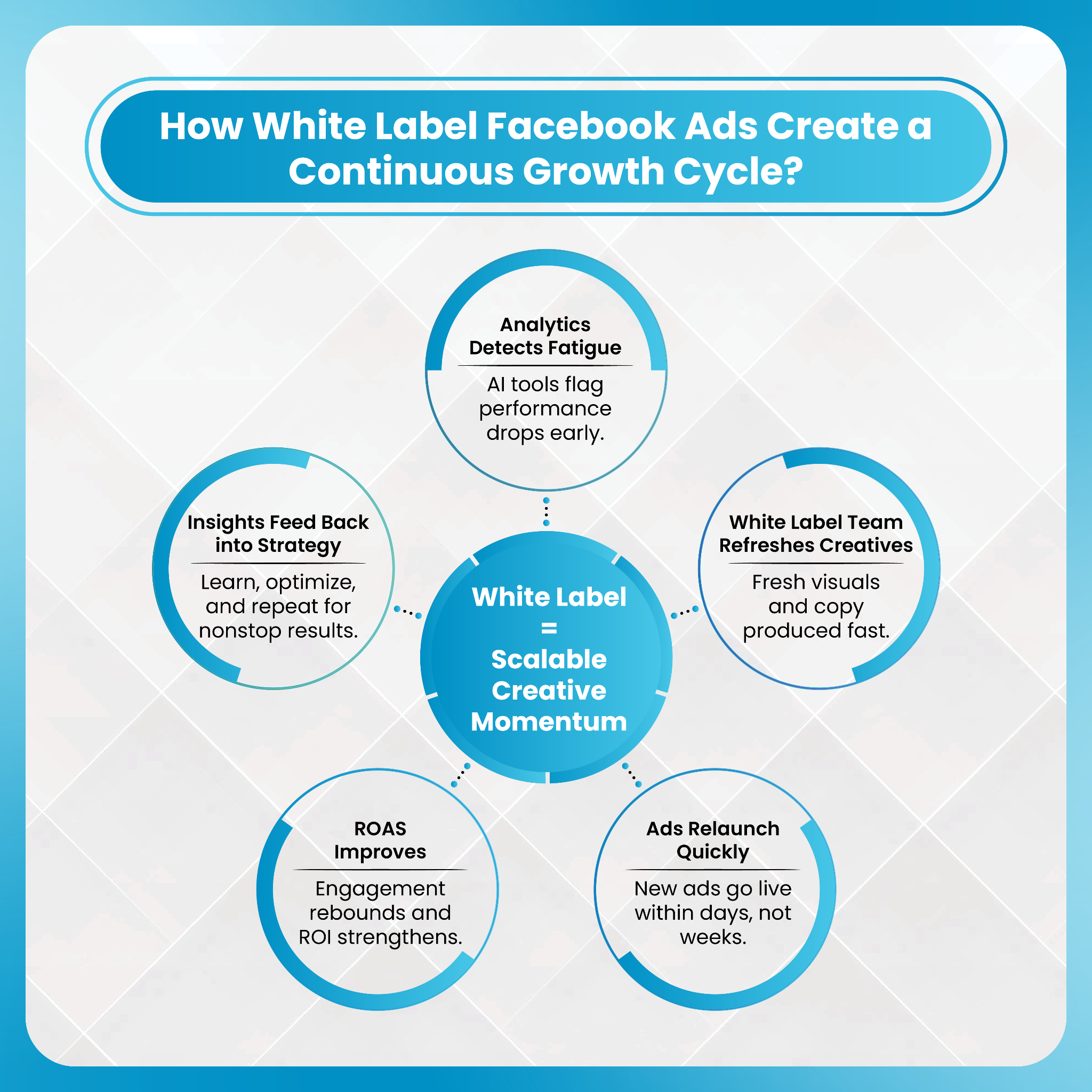
A Practical Scaling Framework Agencies Can Standardize Across Every Client
The best agencies do not improvise scaling decisions. They follow a repeatable framework that works across every client, regardless of industry or budget. Here is a five-step process you can standardize.
Step 1: Validate Tracking Before Increasing Spend
Never scale a campaign sitting on broken data. Before any budget increase, confirm your measurement foundation with a clear checklist:
- Pixel health and firing accuracy
- Event tracking for key actions
- CRM connections
- Attribution setup
- Offline conversion tracking
If any item fails, fix it first. Scaling on bad data only multiplies the damage.
Step 2: Expand Creative Before Expanding Budget
Fresh creative gives Meta more ways to find converting audiences. Before pushing spend, build out new variations:
- New hooks and opening lines
- New formats such as video, static, and carousel
- New messaging angles for different pain points
Scaling creative often drives better results than scaling spend, because it directly fights the fatigue that kills performance.
Step 3: Scale Audiences Before Budgets
A bigger budget needs a bigger qualified target audience to spend on. Expand your reach intelligently before raising spend:
- Broad targeting to give the algorithm room
- Lookalike audiences from strong data
- Remarketing expansion across more touchpoints
- Advantage+ signals to support automated delivery
Wider, well-built audiences absorb larger budgets without immediate saturation.
Step 4: Increase Budgets Gradually
With tracking, creativity, and audiences in place, you can finally increase spend. Do it in controlled increments and watch your core metrics closely:
- CPA
- ROAS
- Frequency
- CTR
- CPM
If frequency spikes or CPA climbs, slow down and let delivery stabilize before the next increase.
Step 5: Measure Business Outcomes
Platform metrics only tell part of the story. The real measure of success lives in your client's business results:
- Pipeline value
- Revenue generated
- Qualified leads
- Customer lifetime value
- Overall profitability
Keep this in focus at all times. The goal is not scaling ad spend. The goal is to scale profitable client acquisition.
As Meta continues investing in AI-driven automation, agencies that master operational scaling will be positioned ahead of competitors.
Emerging Trends Agencies Should Prepare For
The scaling playbook keeps evolving as Meta leans harder into automation. Agencies that anticipate these shifts will protect their margins and their relevance.
1. Creative Is Becoming The Biggest Scaling Lever
AI now handles much of the delivery optimization that media buyers once managed manually. What it cannot do is invent a winning creative strategy. Humans still craft the hooks, narratives, and angles that make audiences stop scrolling, which makes creativity the most valuable scaling input.
2. First-Party Data Is Becoming More Valuable
As tracking restrictions tighten, owned data becomes a competitive edge. Agencies should help clients strengthen:
- CRM integrations
- Customer lists for matching
- Conversions API implementation
- Enhanced measurement setups
This data feeds better signals to Meta and sharpens optimization.
3. Automation Increases The Value Of Agency Strategy
As execution gets automated, strategy becomes the differentiator. The high-value work shifts toward attribution, creative direction, measurement, and business strategy.
The takeaway is clear: automation is commoditizing execution while increasing the value of strategic agency expertise.
This evolution makes scalable operational partnerships increasingly important for agencies pursuing long-term growth.
How DashClicks' White Label Facebook Advertising Services Help Agencies Scale Profitably?
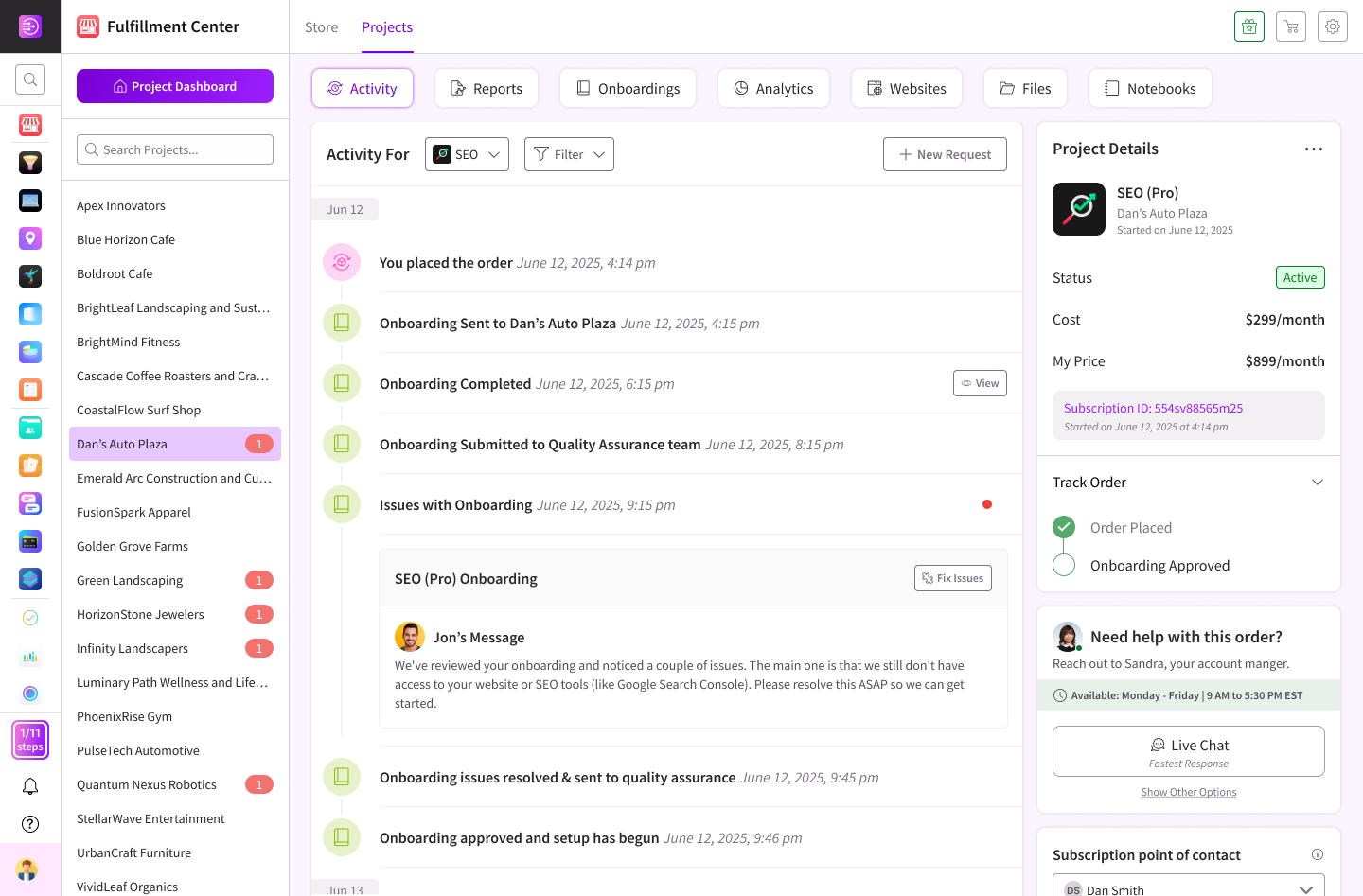
DashClicks gives agencies the operational backbone to scale Facebook campaigns without overloading their internal teams. The platform functions as a white label Facebook ads partner, handling the heavy fulfillment work while your team stays focused on strategy and client relationships.
Agencies working with DashClicks gain access to:
- Expert campaign management across multiple accounts
- Audience targeting support built on proven methods
- Creative execution assistance to keep testing pipelines full
- Ongoing campaign optimization and monitoring
- Clear tracking and reporting visibility for clients
- Scalable fulfillment systems that grow with your roster
- Operational flexibility to handle changing client demands
The value here is structural. Instead of hiring and training new specialists every time you add clients, you plug into a fulfillment system that already works. That keeps delivery consistent and margins healthy as you grow.
Think of DashClicks as an extension of your delivery team rather than a vendor on the sidelines. Your agency keeps the client relationship and the strategy, while the fulfillment engine runs reliably behind the scenes.
Ultimately, sustainable scaling requires more than campaign adjustments. It requires systems that support growth without sacrificing performance.
Building Systems That Scale, Not Just Budgets
Facebook Ads rarely fail because agencies increase budgets. They fail because agencies increase spending without scaling the systems that make spending profitable.
The pattern repeats across thousands of accounts. Budgets go up, but creative production, attribution, data quality, testing systems, and operational capacity stay the same. Performance drops, and the algorithm takes the blame for what is really a system's problem.
The agencies that win take a different path. They build repeatable scaling frameworks instead of relying on last-minute, campaign-level tactics. They validate data before spending, expand creative and audiences before budgets, and measure success by business outcomes rather than vanity metrics.
Strong Facebook ads services are built on operational discipline, supported by the right fulfillment infrastructure. That is what separates agencies that plateau from agencies that compound.
The agencies that scale most successfully are not those spending the most. They are the ones building the strongest operational systems behind every campaign.


.svg)


.svg)
.svg)
.svg)
.svg)
.svg)