

DashClicks Blog
The industry's top experts offer their best advice, research, how-tos, and insights—all in the name of helping you level-up your business and online marketing skills.
Join Us!
.svg)
.svg)
.svg)
.svg)
.svg)

How to Measure Retention With the Right Nonprofit CRM Metrics
You worked hard to get those donors. Campaigns, emails, events, maybe even personal calls. And then, nothing. They gave once and disappeared.
If that sounds familiar, you're not alone. And the numbers back it up. According to Q4 2024 data from the Fundraising Effectiveness Project, the average donor retention rate in the nonprofit sector dropped to 42.9%, a 2.6% year-over-year decline. Only 19.4% of new donors gave again the following year. That's 4 out of 5 first-time donors who never come back.
That's a real problem. But it's also a fixable one, if you know what to measure.
Most nonprofits focus heavily on how much they raised and how many new donors they brought in. Those numbers matter, but they don't tell you whether the people who already gave are sticking around.
Measuring donor retention is only half the equation. The bigger challenge is acting on what those metrics reveal. For example, if your nonprofit CRM shows that first-time donors rarely make a second gift, the next step isn't simply updating a report, it's creating personalized follow-ups, welcome email sequences, and engagement campaigns that encourage long-term support. That's where CRM data and marketing automation work together to strengthen donor relationships.
That's where retention metrics come in. Let's break down the ones that actually matter, what they tell you, and how to use them.
The Core Metrics You Should Actually Be Tracking
1. Donor Retention Rate
This is the starting point for everything else. It tells you what percentage of last year's donors gave again this year.
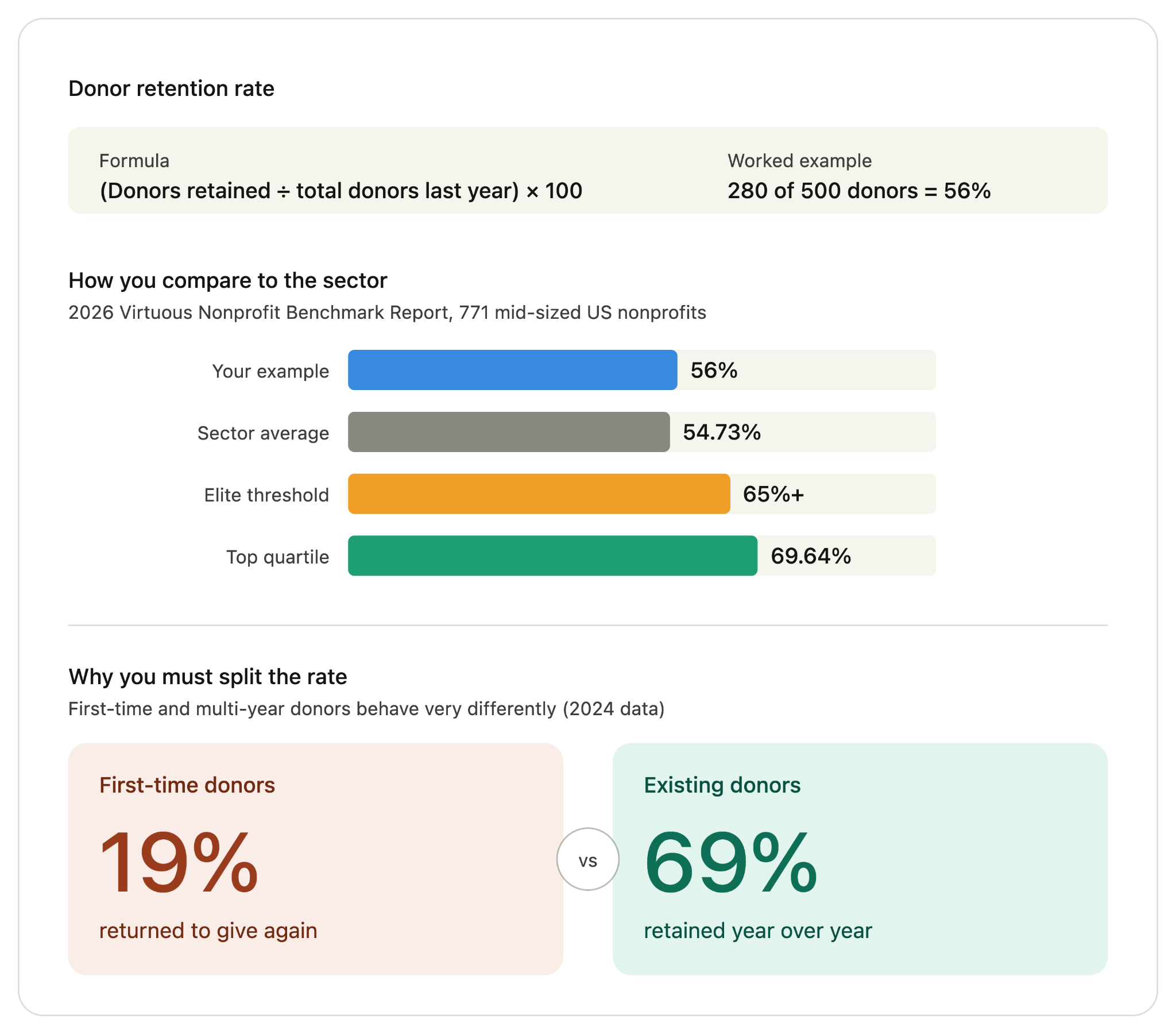
The formula: (Donors retained this year ÷ Total donors last year) × 100
So if you had 500 donors last year and 280 gave again, your retention rate is 56%.
Now, how does that compare to the sector? According to the 2026 Virtuous Nonprofit Benchmark Report, built on giving data from 771 mid-sized US nonprofits, the sector average donor retention rate sits at 54.73%, with top-quartile organizations reaching 69.64%. Hitting above 65% puts you in elite company.
In 2024, only 19% of first-time donors returned to give again, while existing donors had a much higher retention rate of 69%. Lumping them together in your reporting will mask what's actually happening.
How to improve it: If retention begins to decline, review your donor communication strategy. Sending automated thank-you emails, impact updates, and personalized follow-ups after a donation can help maintain engagement between fundraising campaigns.
2. Donor Attrition Rate
Attrition is the flip side of retention. If your retention rate is 56%, your attrition rate is 44%. Simple enough.
But the reason to track it separately is that it pushes you to ask a different question: who is leaving? Are lapsed donors concentrated around a particular campaign or appeal? A specific gift range? A time of year when donors were first acquired?
Donor attrition refers to supporters who stop giving to a nonprofit, either after making a single gift or by discontinuing a pattern of giving. Patterns in attrition usually point to fixable problems such as weak onboarding, irrelevant messaging, or donors who weren't the right fit to begin with.
How to improve it: Look for common characteristics among donors who stopped giving. Creating targeted re-engagement campaigns for inactive supporters often produces better results than sending the same fundraising appeal to every contact.
3. Donor Lifetime Value (LTV)
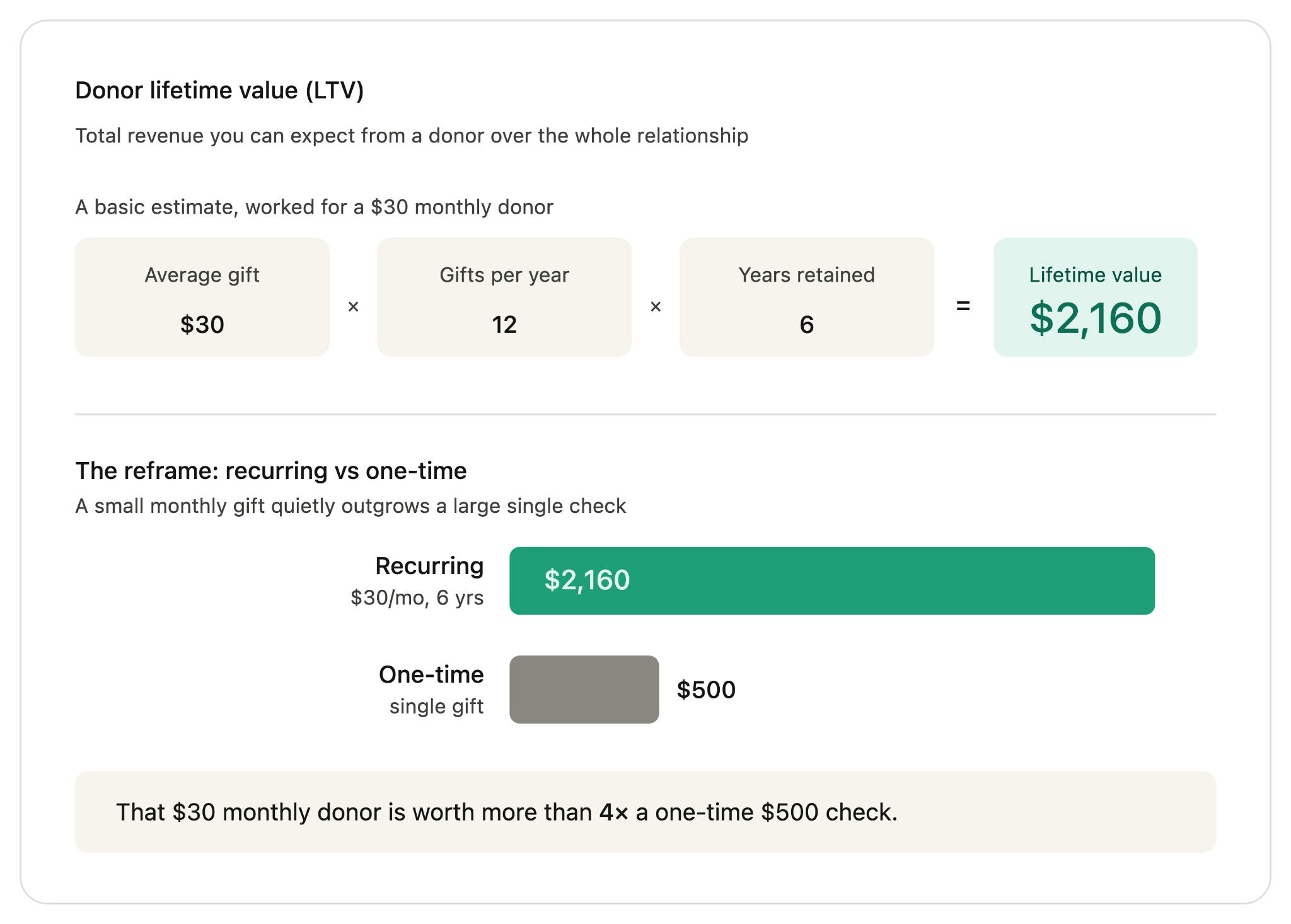
Lifetime value is the total revenue you can reasonably expect from a donor over the entire course of their relationship with your organization. A basic way to estimate it:
Average gift × Average gifts per year × Average years retained
This metric reframes how you see your donor base. A donor giving $30 a month for six years is worth far more than a one-time $500 check. Once you start thinking in LTV terms, decisions about stewardship investment start making a lot more sense.
How to improve it: High-value donors typically respond well to personalized communication. Sharing exclusive impact updates, invitations to events, or milestone acknowledgements can strengthen long-term relationships and encourage continued support.
4. Recency, Frequency, and Monetary Value (RFM)
RFM is a framework borrowed from direct marketing that works well for nonprofits. It scores donors based on three dimensions:
- Recency — When did they last give?
- Frequency — How often do they give?
- Monetary — What's their average or cumulative gift size?
Together, these help you identify your highest-value donors, catch people who are starting to drift, and prioritize who deserves more attention. A donor who gave $100 two years ago and hasn't responded since looks very different from someone who gives $50 three times a year. RFM helps you stop treating them the same way.
How to improve it: Segmenting donors based on recency, frequency, and donation value allows nonprofits to deliver more relevant communications. Rather than sending one generic campaign, organizations can tailor messages to first-time donors, recurring supporters, and major contributors.
5. Upgrade Rate
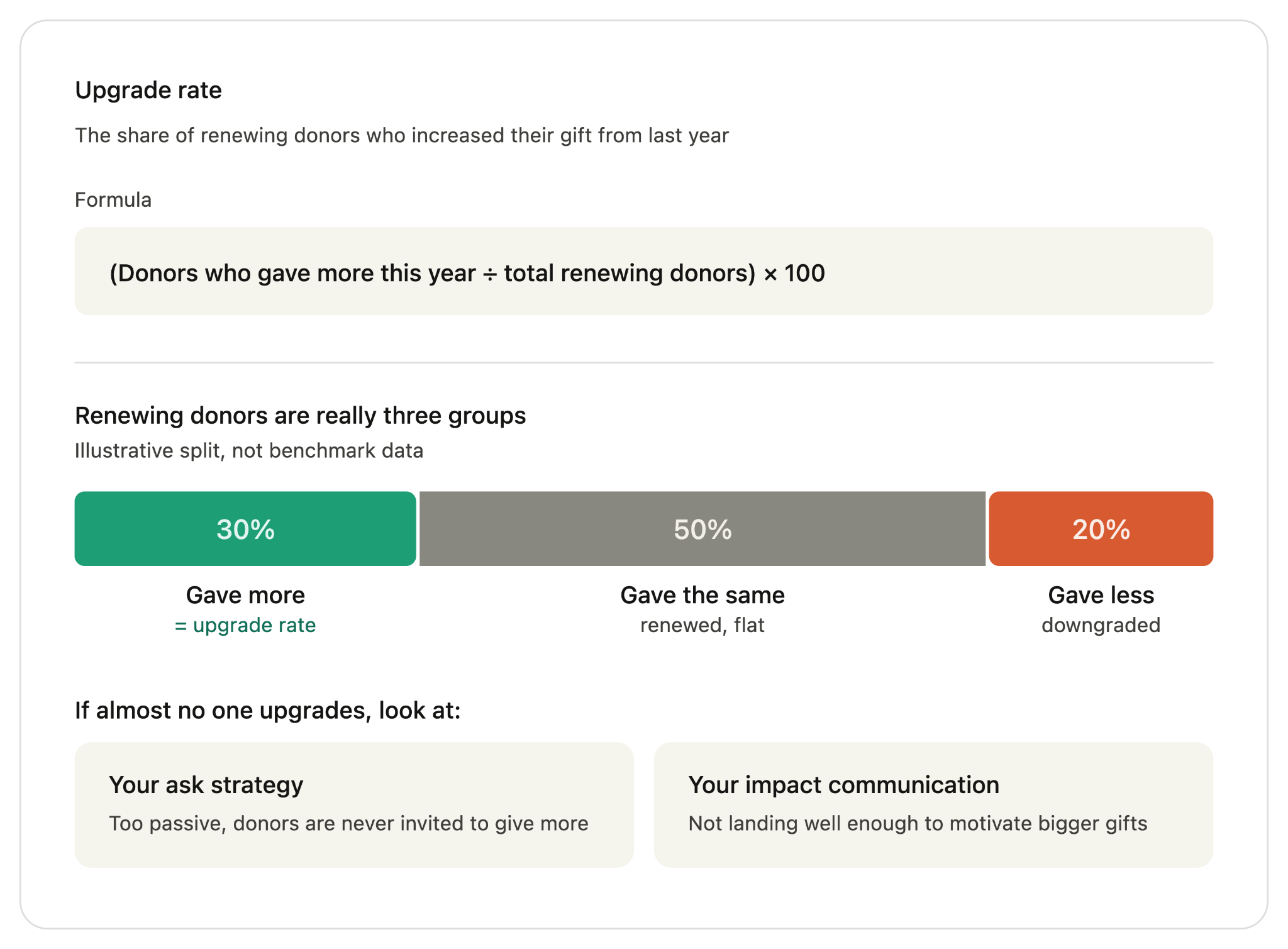
Often overlooked. Your upgrade rate tracks what percentage of renewing donors increased their gift from one year to the next.
(Donors who gave more this year ÷ Total renewing donors) × 100
A healthy upgrade rate means donors are deepening their relationship with your cause, not just renewing it. If almost no one is upgrading, it could mean your ask strategy is too passive, or your impact communication isn't landing well enough to motivate donors to give more.
How to improve it: Donors are more likely to increase their contributions when they clearly understand the impact of their previous gifts. Combining impact storytelling with personalized upgrade campaigns can encourage larger recurring donations.
6. Lapsed Donor Recovery Rate
Lapsed donors, meaning those who gave at least once but haven't given in 12 or more months, are a segment worth tracking separately because they have real potential. They already know your mission. They gave before. Something just interrupted the relationship.
Your recovery rate tells you what percentage of lapsed donors you're successfully re-engaging. Even modest improvements here compound meaningfully, because reactivating a lapsed donor is much cheaper than going out and finding a new one.
How to improve it: Don't wait until year-end to reconnect with inactive donors. Automated check-ins, newsletters, volunteer opportunities, and campaign updates help rebuild engagement before asking for another donation.
Putting It Together: Using a Nonprofit CRM the Right Way
Tracking these metrics manually in spreadsheets is possible when you're small, but it breaks down quickly as your donor base grows. That's where a good Nonprofit CRM becomes genuinely useful, not just as a contact database, but as the engine that surfaces these numbers in real time and makes segmentation practical at scale.
A well-configured CRM lets you:
- Monitor retention and attrition trends without running custom reports every time
- Segment donors by RFM score and automate outreach accordingly
- Flag donors who haven't given in a set number of months for personal follow-up
- Track which communication touchpoints, such as emails opened, events attended, and appeals responded to, correlate with higher retention
Research from NonProfit PRO shows that 42% of nonprofit leaders identify acquiring donors as their biggest challenge, while only 8% cite donor retention as a top concern. That gap is exactly why having a system that keeps retention visible is so important. When it's not in front of you, it's easy to deprioritize until the numbers have already slipped.
Turning CRM Insights Into Action
Collecting donor data doesn't improve retention on its own. What makes the difference is how quickly nonprofits act on those insights.
Consider how common nonprofit CRM metrics can guide donor engagement:
- Declining donor retention rate: Launch an automated appreciation campaign that shares recent success stories and reminds donors of the impact they've helped create.
- Growing lapsed donor segment: Create a re-engagement campaign with personalized emails, newsletters, or invitations to volunteer or attend upcoming fundraising events.
- High-value donors identified through RFM analysis: Provide tailored updates, exclusive event invitations, or behind-the-scenes stories that strengthen relationships with your most engaged supporters.
- First-time donors: Build an onboarding sequence that welcomes new supporters, introduces your mission, and explains how future contributions make a difference.
Turning CRM insights into consistent communication helps nonprofits strengthen relationships throughout the year instead of reaching out only during fundraising campaigns.
How DashClicks Helps Nonprofits Turn CRM Insights Into Action?
A nonprofit CRM gives organizations visibility into donor behavior, fundraising history, and engagement trends. However, improving donor retention requires more than collecting data. Nonprofits need to communicate consistently, personalize outreach, and follow up with supporters at the right time. That's where marketing automation and communication tools become valuable.
1. Automate Donor Follow-Ups
Timely communication can make a significant difference in donor retention. With DashClicks' Automation tools, nonprofits can create workflows that automatically send thank-you emails, welcome first-time donors, share impact updates, or reconnect with supporters who haven't engaged in recent months. Automating these touchpoints helps organizations maintain consistent communication without increasing manual work.
2. Keep Conversations Organized
Donors often reach out through multiple channels with questions about campaigns, events, or volunteer opportunities. DashClicks' Conversations software centralizes communications from supported channels into a single inbox, making it easier for nonprofit teams to respond promptly and maintain stronger relationships with supporters.
3. Capture and Nurture New Supporters
Whether someone signs up for a fundraising event, volunteers, or subscribes to a newsletter, DashClicks' Forms software helps capture contact information and automatically route new supporters into follow-up workflows. This reduces manual data entry while ensuring every new contact receives timely communication.
4. Measure Campaign Performance
Understanding which outreach efforts encourage repeat donations is just as important as tracking donor retention. DashClicks' Analytics software helps nonprofits monitor marketing performance, identify successful campaigns, and make more informed decisions about future fundraising efforts.
5. Build a More Connected Donor Journey
When nonprofit CRM insights are combined with marketing automation, communication tools, and performance reporting, organizations can create a more personalized donor experience. Instead of only reaching out during fundraising campaigns, nonprofits can maintain meaningful engagement throughout the year with DashClicks, strengthening relationships and encouraging long-term support.
What Good Retention Looks Like in Practice?
Organizations with strong customer retention numbers tend to share a few consistent behaviors, none of which require a massive budget.
They communicate impact, not just need. Donors don't lapse because they stop caring about the cause. They lapse because they stop feeling connected to it. Sending a story about what their gift made possible, rather than just a receipt followed by a renewal ask, changes that.
They treat the first 90 days seriously. The first interaction is not consistently leading to a second, and the biggest drop-off happens after the first gift. Organizations that address this have a deliberate onboarding sequence, such as a thank-you call, a welcome email series, or a survey, that signals "we noticed you, and we're glad you're here."
They segment their outreach. A first-time donor and a 10-year recurring giver should not be getting the same message. The ask, the tone, the story, all of it should feel like it was written for that person specifically.
They watch the leading indicators. Retention rate is a lagging metric. By the time it drops in your annual report, you've already lost people. Email open rates, event attendance, and response to mid-year appeals are the early signals. If they're falling, retention is about to follow.
One More Thing: The Donor Pipeline Problem
It's not just current retention that deserves attention. The donor base has shrunk for the fourth consecutive year, though the rate of decline has been slowing since 2022. Not a recovery yet, but possibly an inflection point.
Meanwhile, repeat donors now account for more than 60% of total fundraising dollars, which highlights nonprofits' increasing dependence on a shrinking core of loyal supporters.
That combination, fewer new donors coming in and more revenue depending on a smaller retained base, is a structural vulnerability. It makes retention not just a relationship goal, but a financial stability issue.
Common Mistakes That Hurt Donor Retention
Even nonprofits that carefully track donor metrics can struggle with retention if they overlook day-to-day engagement. Some of the most common mistakes include:
- Tracking donor metrics without taking action on the insights.
- Sending the same fundraising appeal to every supporter regardless of giving history.
- Only communicating during fundraising campaigns instead of maintaining year-round engagement.
- Failing to recognize or thank recurring donors consistently.
- Waiting too long to reconnect with inactive supporters.
Combining CRM data with personalized communication and marketing automation can help nonprofits avoid these challenges while building stronger donor relationships over time.
Where To Start If You're Starting From Zero
You don't need a perfect system on day one. Start here:
- Calculate your overall donor retention rate for the past two years.
- Separate first-time donors from returning donors and look at each group individually.
- Pull a list of anyone who gave in the last 13 to 24 months but not in the past 12. How large is that lapsed segment?
Those three steps alone will tell you more about your donor base than most organizations know. From there, you build, with better segmentation, more targeted outreach, and eventually the kind of retention numbers that make your fundraising genuinely sustainable rather than a yearly scramble.
The data is already there. The opportunity lies in using it effectively.
Tracking donor retention metrics helps nonprofits understand what's happening, but improving those numbers requires consistent communication, personalized engagement, and timely follow-up. By combining the insights from a nonprofit CRM with marketing automation, reporting, and communication tools, organizations can strengthen donor relationships, improve retention, and create more sustainable fundraising strategies.

How White Label Facebook Ads Help Agencies Avoid Costly Campaign Mistakes
White label Facebook advertising gives agencies the structure to prevent costly campaign mistakes. It replaces reactive adjustments with stronger attribution, consistent optimization, and scalable fulfillment.
Most agency Facebook ad failures are not caused by poor offers, weak creatives, or Meta’s algorithm. They usually come from operational breakdowns behind campaign execution.
Agencies lose profitability when lead tracking breaks, account structures become hard to manage, creatives fatigue faster than teams can replace them, and media buyers optimize using incomplete attribution. Scaling without statistical confidence only increases wasted spend.
The landscape is also more competitive. Meta reported over 3.4 billion people use at least one Meta app daily, making attention harder to win. WordStream benchmarks show rising CPC pressure across industries, which means every mistake drains budgets faster. HubSpot’s State of Marketing also identifies proving ROI and resource limitations as major challenges for modern teams.
White label Facebook ads services help agencies reduce these risks through operational consistency, scalable optimization, structured testing velocity, cross-account intelligence, and fulfillment stability.
To understand why agencies increasingly rely on white label partners, it is important to see how Facebook ad mistakes have changed. Today’s biggest failures are not only creative or targeting issues. They are operational failures caused by unstable execution systems.
Why Facebook Ad Mistakes Cost More Today Than They Did 3 Years Ago?
Facebook advertising has become less forgiving. Earlier, agencies could fix mistakes with manual targeting tweaks or budget changes. Today, performance depends on stable data, clean structures, fast creative testing, and disciplined optimization.
Small execution gaps now become expensive quickly. A delayed creative refresh, broken tracking event, or frequent learning-phase edit can weaken CPC, CPL, ROAS, and client retention.
Meta’s Algorithm Now Rewards Data Stability More Than Manual Control
The older approach to Facebook advertising gave media buyers a false sense of control. Agencies relied heavily on manual targeting and granular audience segmentation. They built complex campaign structures with detailed exclusions. This approach required frequent optimization edits to keep performance stable.
The modern approach is entirely different. The algorithm favors broad targeting and relies on stable conversion signals. Success now requires creative diversity, event consistency, and allowing machine learning optimization to do its job.
Outdated habits actively harm campaign performance. Constant tinkering creates unstable learning phases and fragmented data.
This leads to inflated CPMs and highly inconsistent ROAS for your clients.
White label Facebook advertising reduces this risk through:
- cleaner campaign structure
- fewer unnecessary edits
- better tracking discipline
- more stable optimization routines
Agencies Now Lose Money Faster From Small Performance Drops
A 15–20% performance drop hurts more today because the baseline costs are simply higher. CPMs are elevated across the board, and creative fatigue happens significantly faster.
Attribution windows are shorter, limiting the data available for optimization. At the same time, clients expect faster clarity on their returns. Small inefficiencies compound rapidly to destroy campaign profitability. Delayed creative refreshes leave audiences seeing the same ads too often.
Poor lead quality filtering wastes the client's sales team's time. Slow optimization response and broken attribution leave media buyers guessing.
The business impact is severe for growing agencies. It creates:
- retention problems
- margin pressure
- fulfillment overload
- client churn
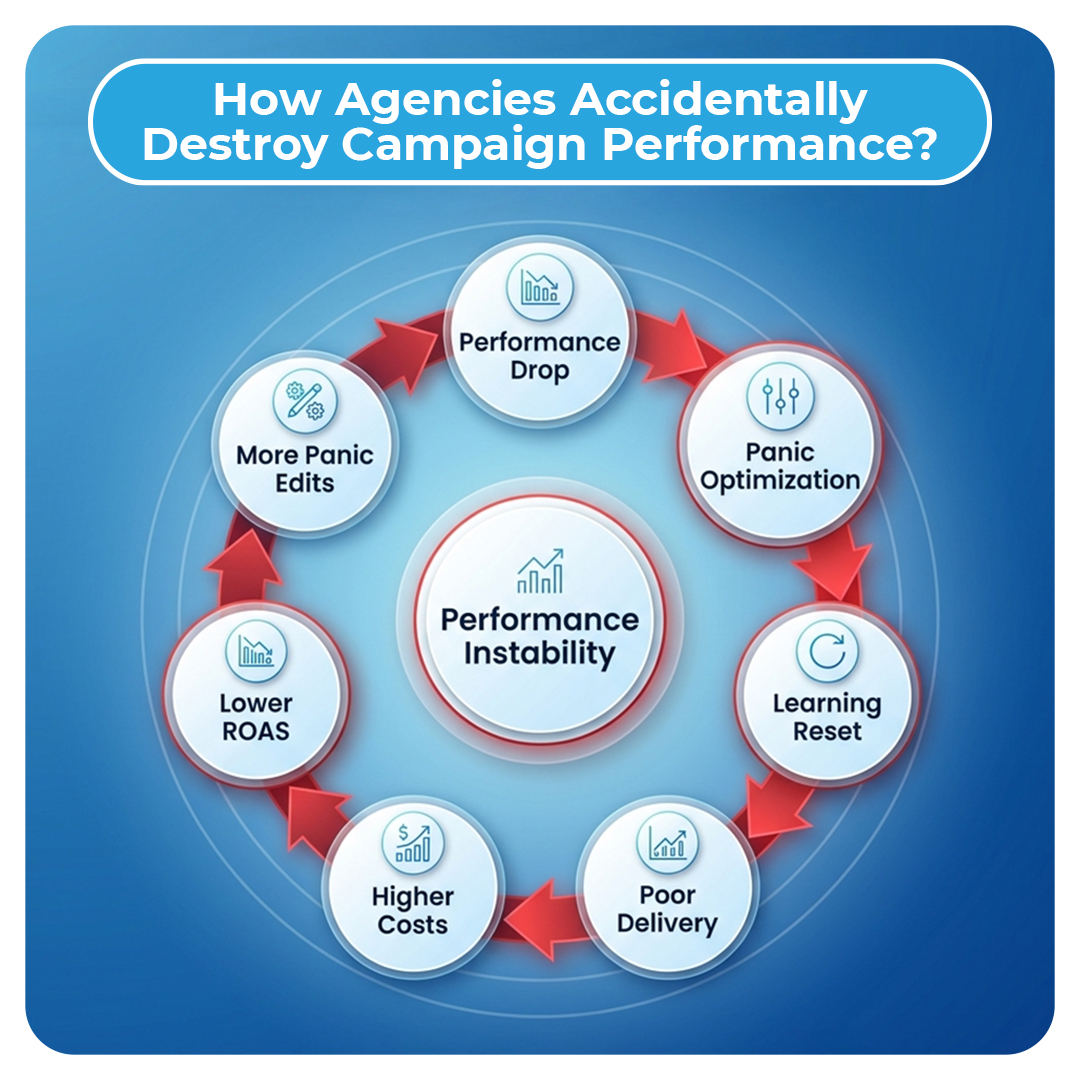
White label Facebook ads services reduce these issues through proactive monitoring and structured execution.
Rising acquisition costs and shrinking optimization windows mean agencies can no longer recover from mistakes through manual adjustments alone. Most performance losses now come from repeatable operational errors that quietly compound across campaigns. Understanding those mistakes reveals why stronger execution systems matter more than isolated campaign tactics.
The Most Expensive Facebook Ad Mistakes Agencies Make
Costly Facebook ad failures usually come from inconsistent execution, not a lack of technical knowledge. As account complexity grows, small operational gaps can turn into budget waste, unstable performance, weak reporting, and client dissatisfaction.
These mistakes become harder to control when agencies manage more campaigns at once. The following issues are expensive because they reduce campaign efficiency while increasing fulfillment pressure.
Mistake #1: Scaling Campaigns Before Signal Validation
Agencies frequently make this mistake because clients want fast results. Early ROAS appears promising, and the pressure to increase spending is high.
Media buyers optimize emotionally rather than logically. Teams scale budgets aggressively before the underlying data actually stabilizes.
Signal validation is critical before increasing spend. It requires:
- stable CPA range
- consistent conversion quality
- sufficient conversion volume
- multi-day performance consistency
Consider this common example. An agency's spend ranges from $150/day to $1,000/day after one strong day of sales.
The result is immediate audience saturation and an inflated CPM. Declining lead quality follows, resulting in unstable ROAS that ruins the client relationship.
The best white label facebook ads providers reduce this risk through:
- structured scaling frameworks
- pacing models
- data-threshold SOPs
- benchmark intelligence
Scaling discipline alone does not protect campaigns if agencies cannot trust the data driving decisions. Once attribution becomes incomplete, optimization begins moving in the wrong direction despite apparently strong performance.
Mistake #2: Optimizing Campaigns Using Incomplete Attribution Data
Many agencies optimize campaigns using only front-end data. They rely exclusively on Meta Ads Manager metrics to make critical budget decisions.
They optimize based on front-end lead volume and shallow ROAS reporting. This creates a dangerous disconnect between ad metrics and actual business revenue.
Modern Facebook optimization needs deeper visibility. It requires:
- CRM feedback loops
- lead quality scoring
- offline conversion syncing
- Conversion API support
- sales-stage visibility
There is a massive difference between running low CPL campaigns and high-revenue acquisition campaigns. Cheap leads often convert poorly.
For example, a campaign generating $12 leads appears highly successful in Ads Manager. However, CRM data shows poor qualification, low appointment attendance, and weak close rates.
White label providers reduce this risk through:
- deeper attribution workflows
- CRM integration support
- conversion quality analysis
- multi-stage optimization
Better attribution models often expose another hidden problem. Campaigns that appear structurally healthy may still decline because creatives stop producing strong engagement signals over time.
Mistake #3: Treating Creative as a Design Asset Instead of a Performance Variable
Many agencies treat creatives as static branding assets. They launch a beautiful video and leave it running for months.
High-performing advertisers treat creative differently. They view creatives as testing variables, behavioral data inputs, and audience psychology experiments.
When creativity runs too long without variation, performance inevitably decays. Advertisers face:
- hook decay
- thumb-stop decline
- message saturation
- frequency-based fatigue
- creative entropy
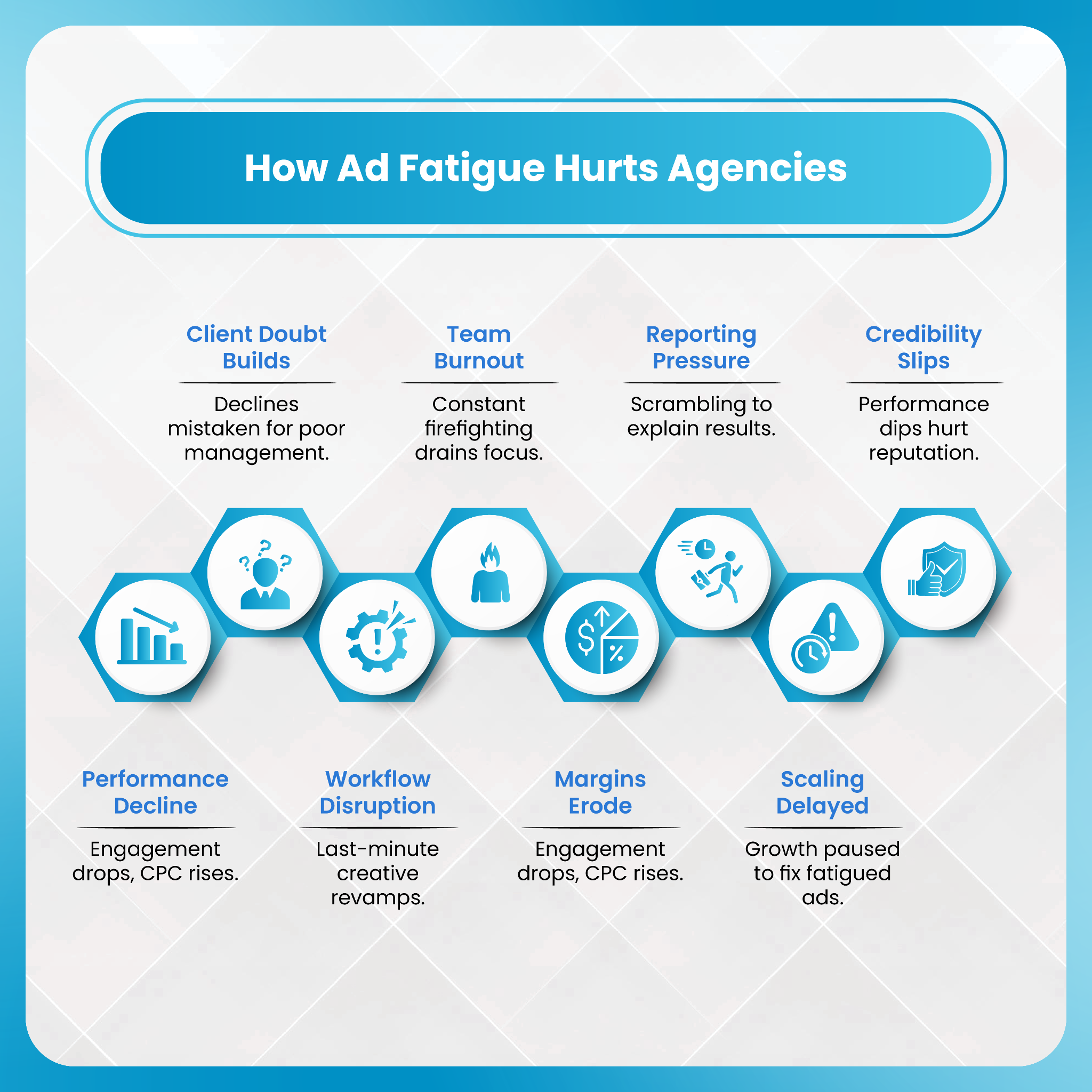
Strong testing frameworks are essential to maintain performance. Teams must deploy:
- hook testing
- angle testing
- persona-based creatives
- UGC variations
- offer-positioning tests
- first-three-second optimization
For example, an agency runs the same winning creative for 8 weeks. CTR declines, CPM increases, lead quality drops, and ROAS weakens. The campaign dies from exhaustion.
White label teams reduce this through:
- structured creative refresh cycles
- testing libraries
- performance tracking
- rapid iteration systems
Creative testing improves campaign longevity, but performance still becomes unstable when optimization decisions lack discipline. This is where many agencies unintentionally damage delivery through reactive management habits.
Mistake #4: Reactive Optimization Instead of Systemized Optimization
Many agencies optimize reactively by making emotional daily edits based on short-term data.
They reset learning phases by making changes too frequently. They change budgets aggressively and overreact to daily fluctuations.
The impact of this behavior is highly destructive to campaigns. It causes:
- learning phase disruption
- volatility amplification
- optimization lag
Stronger advertisers optimize based on larger data sets. They look at trend consistency and cohort behavior rather than yesterday's cost per lead.
They evaluate conversion quality and delayed attribution patterns before touching the budget.
For example, a campaign underperforms for 24 hours. The agency pauses ads, duplicates ad sets, and changes targeting. Three days later, performance worsens due to algorithm instability.
White label teams reduce this through:
- optimization SOPs
- decision thresholds
- pacing rules
- escalation systems
As campaign volume increases, avoiding these mistakes becomes less about media buying expertise and more about operational capacity. Internal teams eventually face a point where maintaining consistency across accounts becomes increasingly difficult.
Why Internal Agency Teams Struggle to Maintain Facebook Ads Consistency at Scale?
Consistency becomes harder when agencies add clients faster than they add systems. A single media buyer may manage details manually at first, but that model breaks as account volume grows.
The issue is not always talent. It has a limited capacity to monitor, test, report, and optimize every account with the same attention.
Most Agencies Scale Sales Faster Than Fulfillment Infrastructure
Agencies often sell Facebook ads aggressively to hit revenue targets. They onboard new clients quickly without expanding their operational backend.
This quickly overloads internal delivery teams. Media buyers end up managing too many accounts simultaneously.
The result is a breakdown in service quality. Agencies experience:
- slower optimization cycles
- inconsistent reporting
- creative bottlenecks
- delayed launches
- account neglect
Facebook ad performance often starts declining operationally before it appears in metrics. When the media buyer stops paying attention, the campaign begins to fail.
Operational overload affects more than delivery quality. It also reduces an agency’s ability to respond quickly enough to changing campaign conditions, creating a slower optimization cycle across the portfolio.
Optimization Velocity Is Now a Competitive Advantage
Optimization velocity is how quickly an agency can respond to data. It measures how fast a team can identify performance shifts and launch new tests.
It also measures their ability to analyze trends, refresh creatives, and stabilize volatile campaigns.
Agencies with slow optimization velocity fall behind. They discover fatigue too late and scale poor campaigns accidentally. They miss profitable audience windows entirely.
White label teams help agencies improve this speed through:
- dedicated specialists
- faster testing cycles
- account monitoring systems
- operational redundancy
Faster reaction speed alone is not enough. Agencies also need systems that convert operational discipline into repeatable campaign outcomes. This is where white label Facebook ads services become a strategic advantage rather than additional execution support.

How White Label Facebook Ads Services Help Agencies Prevent Expensive Mistakes?
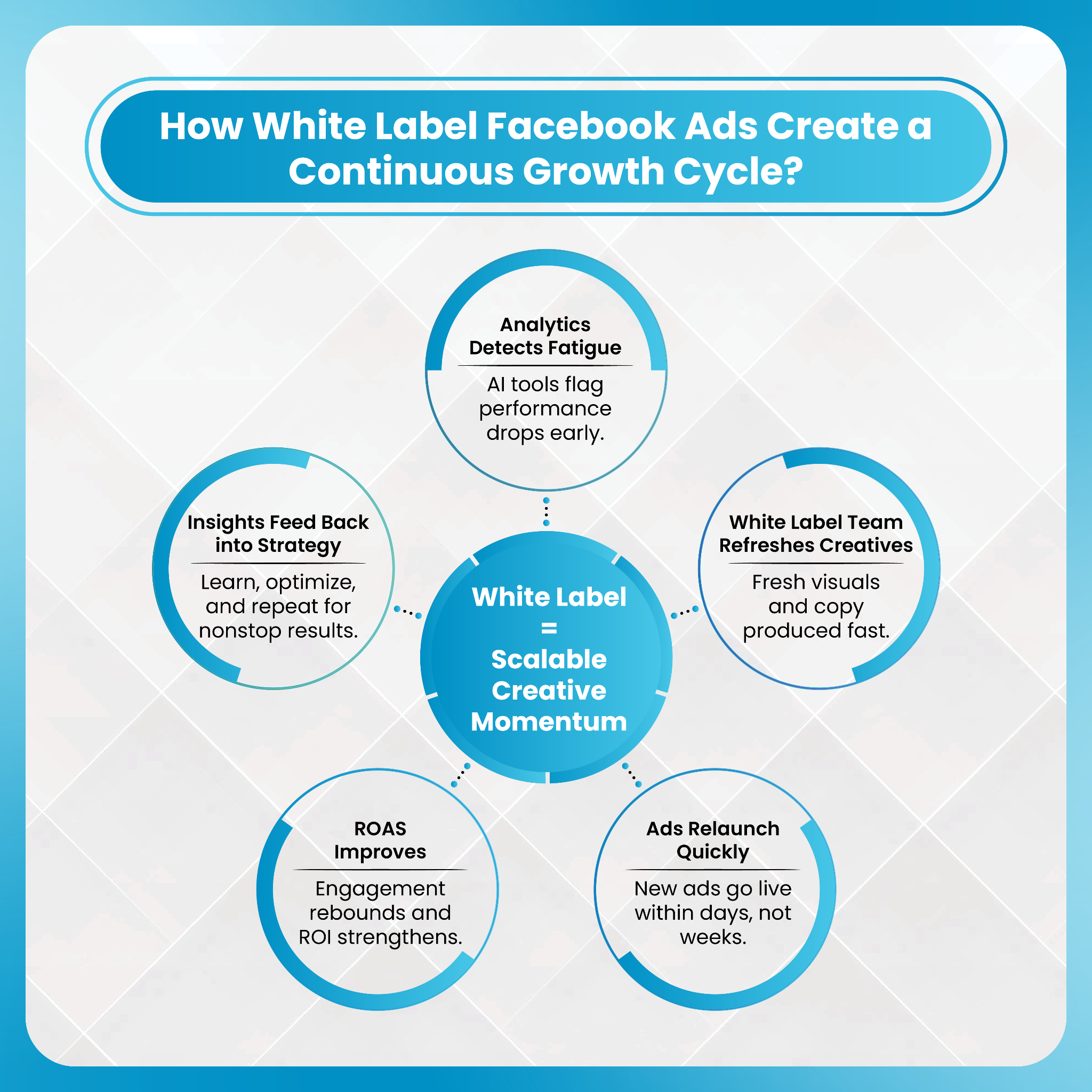
White label support helps agencies replace reactive fixes with structured execution. Instead of correcting mistakes after performance drops, agencies get repeatable workflows that reduce errors before they affect campaigns.
This matters because costly Facebook ad mistakes usually come from weak QA, incomplete attribution, slow testing, and unclear optimization rules.
1. White Label Teams Introduce Operational Discipline
Providers reduce variability through standardized QA and launch checklists. Nothing goes live without passing strict operational guidelines.
They implement attribution verification, structured testing frameworks, and clear optimization protocols.
This process consistency improves multiple areas of the business. It directly impacts:
- reporting reliability
- account stability
- client trust
- retention
When the execution is disciplined, campaign results become far more predictable.
2. Cross-Account Intelligence Creates Smarter Optimization Decisions
Established white label providers observe performance patterns across many different campaigns.
They monitor data across industries, geographies, target audience types, creatives, and funnel models.
This broad visibility helps them detect problems early. They spot:
- CPM spikes
- creative fatigue trends
- conversion drops
- seasonal behavior
- algorithm shifts
This intelligence is gathered across a wider account base than most individual agencies can access. It allows white label teams to make proactive adjustments.
3. White Label Facebook Ads Improve Agency Profit Margins
Building an internal team is expensive. Agencies must pay salaries and benefits and manage 50+ accounts.
They also carry the burden of training, turnover risk, and QA supervision. If a client leaves, the agency is still stuck paying the media buyer's salary.
White label fulfillment helps agencies manage costs effectively. It allows them to:
- stabilize delivery
- increase client capacity
- improve margin predictability
- reduce fulfillment chaos
Using scalable white label fulfillment ties costs directly to client revenue. Agencies only pay for fulfillment when they have paying clients, protecting their profit margins.
Process stability creates stronger campaign foundations, but execution frameworks alone are not the entire advantage. Agencies also benefit from broader performance visibility that internal teams rarely achieve independently.
How DashClicks’ White Label Facebook Ads Help Agencies Reduce Campaign Risk?
Reducing campaign risk starts before ads go live. Agencies need a structured setup, consistent optimization, reliable reporting, and backend fulfillment that can scale without overloading internal teams.
DashClicks’ white label Facebook ads support helps agencies manage campaign delivery under their own brand with a more organized backend system. This improves launch quality, visibility, and operational control as client volume grows.
- Stronger Campaign Foundations: DashClicks supports agencies with structured campaign setup and white label fulfillment. They provide the backend team needed to launch campaigns with proper targeting and technical setup. By utilizing established launch protocols, DashClicks helps agencies avoid the technical errors that often derail new client campaigns.
- Structured Optimization Systems: DashClicks can support ongoing campaign management and optimization. Their fulfillment teams monitor ad accounts to identify shifting trends. They apply necessary adjustments to help keep campaigns running smoothly, utilizing data-driven processes instead of reactive guessing.
- Reporting and Visibility: DashClicks provides a unified white label client dashboard for easier management. Agencies can pull data from multiple tools into one central location. This provides fully white labeled reporting. Clients can log into a branded portal to see their metrics, which builds trust and improves communication transparency.
- Controlled Scaling: Structured fulfillment can help agencies scale client delivery more predictably. DashClicks handles the execution, allowing the agency to bring on more clients safely. This backend support means agencies can increase their sales volume without breaking their internal fulfillment systems.
- Operational Support for Agencies: DashClicks supports agencies by helping them expand service delivery without building every function internally. Agencies can resell services under their brand, utilizing a comprehensive suite of tools that includes funnel builders and CRM systems. This saves valuable time and effort, allowing agency owners to focus strictly on sales and strategy.
Structured fulfillment systems reduce operational risk, but their biggest value appears over time. Agencies gain more predictable delivery, stronger campaign control, and greater confidence when scaling client acquisition without increasing execution complexity.
Conclusion
Facebook ad success today depends on highly structured execution. It requires operational consistency, optimization velocity, and high-quality attribution. Agencies also need dedicated testing infrastructure and scalable fulfillment systems to survive the rising costs of digital advertising.
Costly failures happen because agencies scale before validating data. They optimize from incomplete attribution, refresh creatives too slowly, and operate without structured systems.
White label Facebook ads services help agencies reduce these risks through process discipline and scalable expertise. They provide faster testing cycles and essential operational support.
The agencies that dominate Facebook advertising over the next few years will not necessarily be the ones with the largest teams. They will be the ones with the most stable systems behind campaign execution.

Using White Label SEO to Optimize Content for Every Stage of the Funnel
Organic traffic is becoming harder to sustain due to AI Overviews, zero-click searches, and content saturation. Clients no longer want more blog posts simply to increase publishing volume. They increasingly expect SEO content tied directly to revenue outcomes, lead progression, and conversion visibility. However, many agencies still build SEO strategies primarily around rankings and traffic growth instead of funnel progression. As a result, most agency SEO strategies over-invest in top-of-funnel traffic while under-investing in middle- and bottom-funnel conversion content.
The problem is not that agencies lack content. The problem is that much of their SEO content remains disconnected from the buyer journey. According to Gartner, 67% of the B2B buyer's journey now occurs digitally, with search driving much of that research behavior.
At the same time, buyers are consuming significantly more content before making decisions. Research from FocusVision found that B2B buyers consume an average of 13 pieces of content before making a purchase decision.
More importantly, not all SEO content contributes equally to conversions. Research from Grow and Convert shows that content focused on evaluation intent, such as comparisons, alternatives, and implementation pages, often converts 1.5x–3x higher than purely informational content.
This shift is forcing agencies to rethink how they approach SEO execution. White label SEO is no longer just outsourced content production. It is increasingly becoming a funnel infrastructure for scalable organic growth. By leveraging structured white label SEO services, agencies can systematically support awareness, consideration, and decision stages without overwhelming internal teams. Agencies that continue treating SEO purely as a traffic-generation channel will increasingly struggle to prove ROI as search behavior becomes more fragmented and conversion journeys become longer.
Why Most SEO Content Strategies Break Down Mid-Funnel?
Most marketing agencies operate with strategies heavily focused on the top of the funnel. They prioritize producing informational blogs, targeting high-volume keywords, and developing broad educational content. While this approach is effective for generating initial traffic, it leaves significant gaps deeper in the buyer journey. These strategies frequently lack comparison pages, use-case pages, implementation content, objection-handling content, and sales-enablement SEO assets.
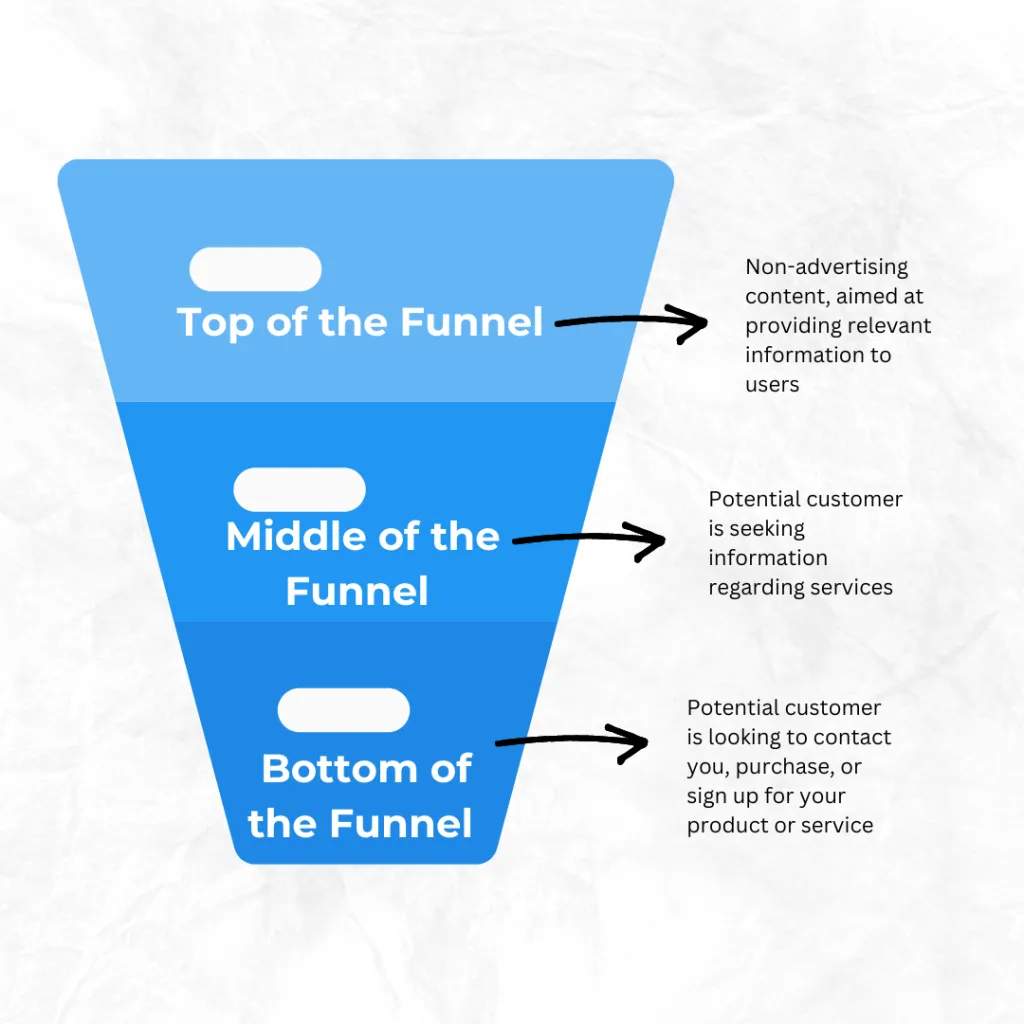
Image Source: RiZen Metrics
This situation creates what is known as a content funnel imbalance. Traffic successfully enters the top of the funnel, but insufficient content exists to move those users toward a conversion. There are several reasons why this imbalance occurs. Top-of-funnel traffic is generally easier to scale, and agencies often prioritize raw rankings over buyer progression. Internal SEO teams are frequently measured on traffic metrics instead of pipeline contribution. Additionally, creating bottom-of-funnel content requires deeper product knowledge, sales alignment, and a strong understanding of the ideal customer profile.
High traffic combined with weak funnel progression creates a multitude of problems for agencies. It results in lower lead quality, poor attribution visibility, and weaker retention conversations with clients.
Consider a SaaS client that successfully ranks for a broad term like "what is CRM software." If that client lacks CRM implementation guides, software comparison pages, pricing-focused SEO pages, and migration-related content, the traffic will grow, but the pipeline will stagnate. The visitors will simply find their educational answers and leave to evaluate competitors who provide deeper consideration content. Modern SEO success depends less on publishing volume and more on funnel-stage alignment.
SEO Content Must Match Search Intent Across the Entire Funnel
To effectively convert visitors into buyers, agencies must align their content strategy with specific search intents at every stage.
TOFU (Awareness)
The primary goal of top-of-funnel content is to capture problem-aware search behavior. Examples include educational blogs, industry explainers, trend articles, and statistics pages. Users at this stage are researching symptoms of a problem they face. TOFU content introduces brand awareness and builds initial trust, but it rarely converts directly into a sale. It serves as the entry point into the broader content ecosystem.
MOFU (Consideration)
Middle-of-funnel content aims to help users evaluate different approaches and solutions. Examples of this content include comparison pages, framework content, case studies, process explainers, and integration guides. At this stage, the searcher understands their problem and is actively exploring potential fixes. MOFU content builds evaluation confidence by demonstrating exactly how a specific solution addresses the user's operational challenges.
BOFU (Decision)
Bottom-of-funnel content is designed to reduce friction immediately before a conversion takes place. Examples include pricing pages, service pages, implementation content, migration pages, and ROI-focused landing pages. BOFU pages align directly with strong purchase intent. The user is ready to make a decision and simply needs final reassurance regarding costs, logistics, or operational deployment.
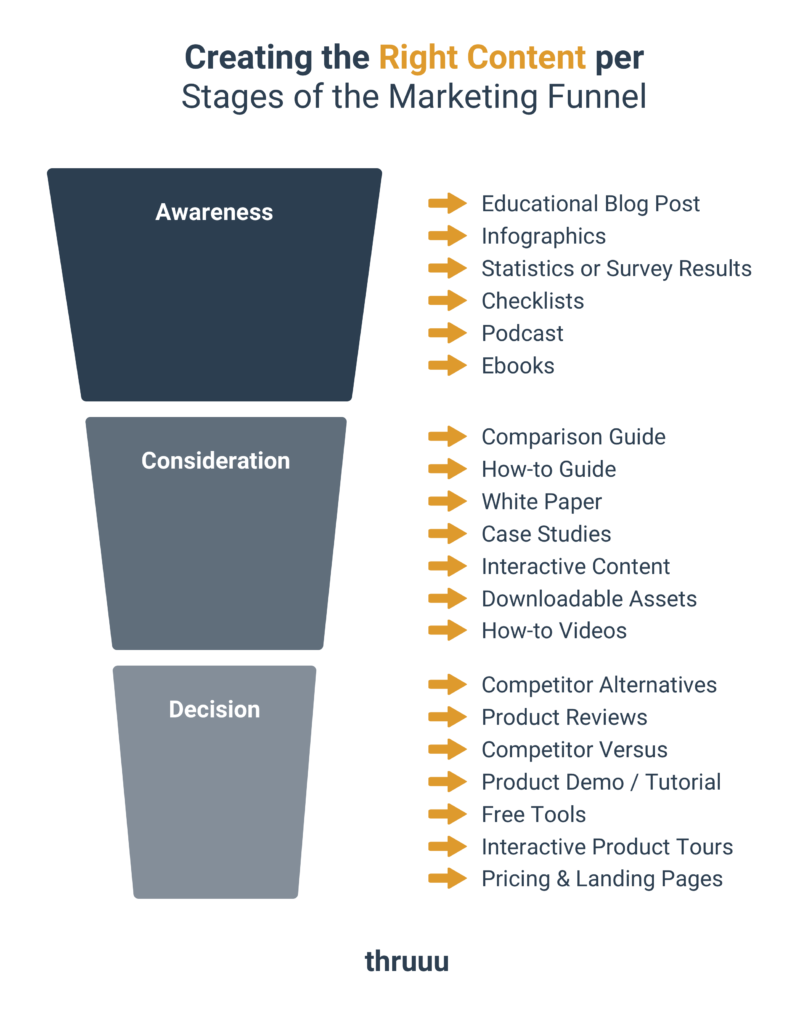
Image Source: thruuu
To connect these stages, agencies must implement intent sequencing. Intent sequencing occurs when SEO content intentionally moves users from one search intent stage to the next. Educational content must internally link to use-case content, comparison pages, and conversion-focused pages. Most agencies optimize pages individually. High-performing agencies optimize the transition between pages.
Implementation, pricing, and integration pages often convert significantly higher than informational pages because they align with late-stage buying intent. Building these interconnected pathways is critical, but executing full-funnel SEO becomes operationally difficult at scale.
Why Agencies Struggle to Execute Full-Funnel SEO Internally?
Building an interconnected content ecosystem requires resources that most agencies simply do not have in abundance. Operational bottlenecks consistently hinder execution. These bottlenecks include managing content production volume, coordinating SEO strategy planning, overseeing search intent mapping, finding writer specialization, maintaining editorial consistency, and ensuring technical SEO alignment.
Full-funnel SEO requires a highly specialized team. It demands strategists, technical SEOs, content writers, editors, conversion-focused copywriters, UX alignment professionals, and experts in internal linking strategy. Most agencies lack the bandwidth to scale all of these roles simultaneously. Hiring and training a full internal team to handle this level of complexity quickly erodes agency profit margins.
This reality introduces the concept of SEO execution debt. Agencies know exactly what content should exist across the funnel, but they cannot operationally produce and optimize it consistently. They become trapped between scaling client acquisition versus scaling fulfillment quality. When an agency brings on five new clients, the internal team must suddenly map and write highly technical, intent-driven content for five different industries. Execution debt accumulates as the agency defaults back to producing basic informational blogs just to meet monthly deliverables.
As AI-generated content increases saturation across the internet, generic top-of-funnel content becomes much less differentiated. This shifts the competitive landscape. It increases the importance of strategic funnel content, authority-building assets, conversion-focused SEO, and experience-driven content. Broader industry concerns around AI Overviews reducing clicks mean that higher-intent content is becoming exponentially more valuable. Agencies are realizing they must adapt. This is why agencies increasingly use white label SEO to operationalize funnel-stage content.
How White Label SEO Helps Agencies Build Full-Funnel Content Systems?
To overcome execution debt, agencies are shifting their perspective on fulfillment. They position white label SEO as a scalable funnel execution infrastructure. It is not viewed as outsourced blogging or cheap content production. It is a strategic mechanism to ensure every stage of the client's buyer journey is supported by high-quality content.
A. Scalable Content Production
White label SEO services help agencies produce content consistently without overwhelming internal teams. Agencies can maintain a reliable publishing cadence and scale white label SEO content across multiple funnel stages simultaneously. This infrastructure allows the agency to support multiple clients without worrying about writer capacity or missed editorial deadlines.
B. Specialized Funnel Content Expertise
Experienced white label SEO teams understand the nuances of search intent mapping. They know how to analyze SERP behavior, build complex internal linking structures, execute conversion-focused SEO, optimize for specific entities, and navigate AI-search visibility trends. This expertise enables search journey engineering. Modern SEO is no longer about isolated rankings. It is about engineering content pathways that guide users toward conversion.
C. Operational Flexibility
By leveraging an external fulfillment infrastructure, agencies gain massive operational flexibility. Agencies can expand their SEO offerings, support more diverse vertical markets, launch new campaigns faster, and reduce fulfillment bottlenecks. They achieve all of this without significantly increasing fixed overhead costs or spending months recruiting specialized talent.
D. Better Strategic Allocation
When production is handled by a trusted partner, internal teams spend less time chasing production deadlines, editing content, and managing fulfillment operations. Consequently, they spend more time on high-value activities like client strategy, retention conversations, upselling opportunities, and conversion rate optimization initiatives. This operational shift directly influences client impact and retention outcomes.
Full-Funnel SEO Creates Better Retention, Attribution, and Revenue Visibility
Client SEO expectations regarding SEO performance have evolved dramatically. Clients increasingly expect SEO to contribute to measurable pipeline growth, lead quality improvements, higher conversion rates, and clear revenue visibility. They are no longer satisfied with reports that simply show increased traffic or higher keyword rankings.
Full-funnel SEO improves attribution visibility, lead nurturing, conversion support, and sales alignment because content exists for every buying stage. This ecosystem creates revenue-supported SEO. This means the SEO content actively supports customer acquisition, continuous nurturing, competitive evaluation, direct conversion, and even sales enablement processes.
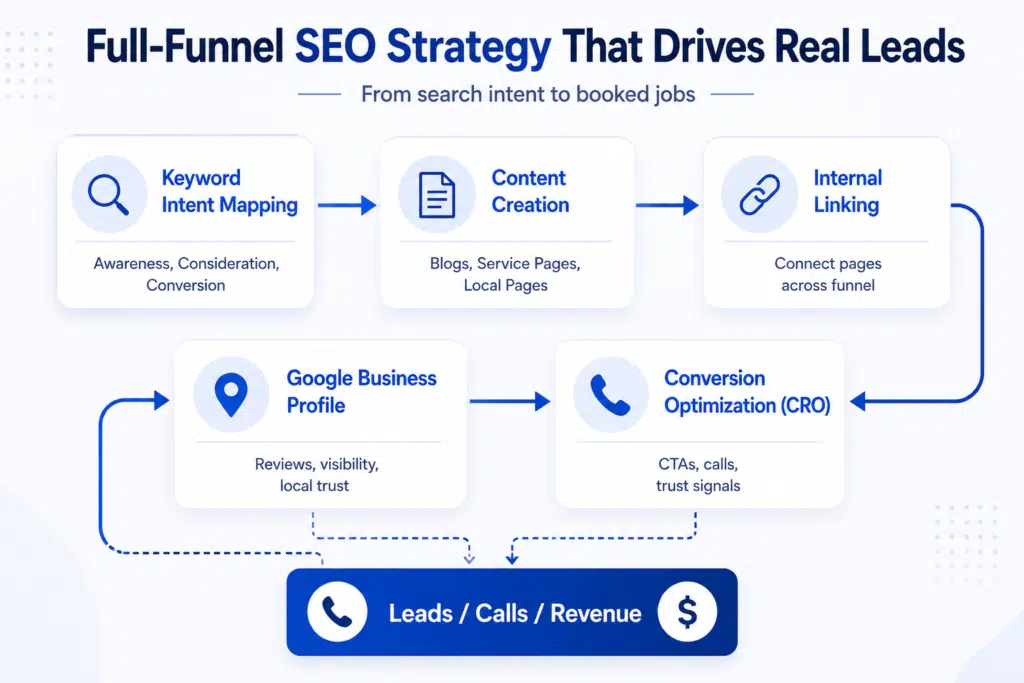
Image Source: Restoration Inbound
Consider a cybersecurity client that initially gains traffic through broad educational blogs about data privacy. If the strategy stops there, attribution remains muddy. However, after expanding the strategy into compliance guides, software comparison pages, implementation checklists, and migration content, the client experiences a major shift. The client begins generating higher-intent leads, longer session journeys, and improved demo conversions. The sales team uses the comparison pages to handle objections on calls. As a result, SEO becomes much easier to tie directly to revenue outcomes.
Evaluation-stage content and conversion-oriented pages consistently outperform informational content in lead conversion efficiency. When agencies provide this level of depth, clients see the financial impact of their marketing investment. This builds undeniable trust. It paves the way for long-term positioning around interconnected funnel ecosystems.
SEO Success Now Depends on Search Journeys
The future of SEO is shifting away from isolated keyword targeting, sheer content volume, and traffic-only reporting. The industry is moving rapidly toward search intent ecosystems, strict buyer journey alignment, and conversion-focused content architecture.
To adapt, agencies must implement SEO journey mapping. Agencies must think critically about what users search first, what they search next, and what exact piece of content will move them toward a final purchase decision. AI search experiences, zero-click behavior, mass content saturation, and rapidly evolving SERPs are drastically reducing the value of generic informational content alone.
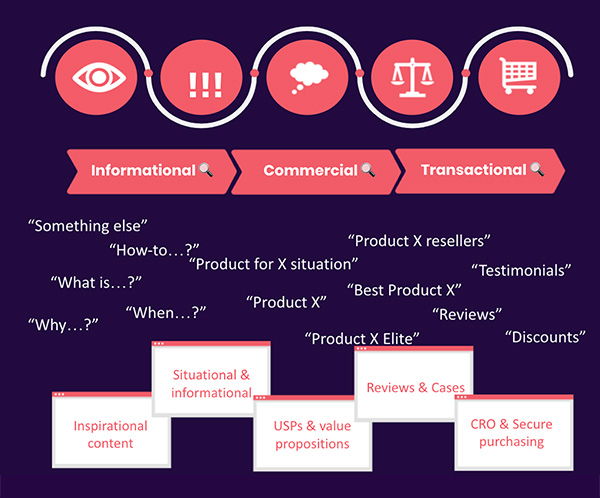
Image Source: Unikorn
If a user can get a basic definition from an AI overview, they will not click on a blog post. They will, however, click on a detailed comparison guide or a complex implementation checklist.
Agencies treating SEO as a mandate to simply "publish more blogs" will struggle to maintain ROI differentiation in this new landscape. Their clients will eventually churn due to a lack of tangible lead generation. Conversely, agencies building interconnected funnel content, deep authority assets, and logical conversion pathways will create significantly stronger long-term client value. The competitive advantage is no longer content quantity. It is strategic funnel orchestration.
How DashClicks’ White Label SEO Services Support Full-Funnel SEO Execution?
Executing a highly interconnected, full-funnel content strategy requires robust operational support. DashClicks provides marketing agencies with white label SEO services, fulfillment support, and powerful software to scale faster while eliminating backend operational work. Using a structured platform allows agencies to manage complex campaigns without losing visibility over the execution process.
The platform serves as a complete execution coordination system for agencies. Teams can seamlessly order, track, and manage SEO workflows under their own brand. The fulfillment infrastructure is designed to handle everything from initial setup to ongoing optimization. This backend coordination ensures that campaigns do not stall due to internal operational bottlenecks.
A major advantage of using structured fulfillment systems is the improvement in reporting continuity. DashClicks offers real-time analytics software that allows agencies to monitor all marketing campaigns in one place. Agencies can pull data into a unified client dashboard using pre-built widgets. This level of workflow standardization ensures that clients receive transparent, professional updates on their SEO progress.
Rather than functioning as a basic outsourcing solution, the system acts as a scalable operational SEO infrastructure. By utilizing this backend fulfillment support, agencies improve content production consistency and search intent alignment while freeing internal teams to focus more on strategy, retention, CRO, upselling, and client growth.
Conclusion
Modern SEO requires deep content alignment across the full buyer journey. The days of relying solely on top-of-funnel educational articles are over. Traffic alone is becoming less valuable without logical, intent-driven conversion pathways guiding the user forward. To remain competitive and prove ROI, agencies must adapt their methodologies to meet buyers exactly where they are in their decision-making process.
Agencies need scalable systems capable of producing, optimizing, and connecting funnel-stage content consistently. Relying on strained internal resources often leads to execution debt and missed opportunities in the middle and bottom of the funnel. White label SEO helps agencies scale content operations, improve search intent alignment, support lead progression, and strengthen attribution visibility. Most importantly, it allows agencies to tie SEO efforts more directly to actual revenue outcomes for their clients.
The agencies that win in modern SEO will not necessarily be the ones publishing the most content. They will be the ones building the most strategically connected search journeys across every stage of the funnel.

How Agencies Use White Label PPC to Improve Quality Score Strategically
Quality Score is frequently misunderstood as a simple vanity metric monitored exclusively by junior media buyers. For growing marketing agencies, this narrow view creates significant operational bottlenecks. Agencies managing multiple PPC accounts cannot treat Quality Score as just a Google metric. It acts as a fundamental indicator of portfolio health and operational efficiency.
When Quality Scores drop across a large volume of client accounts, the business impact is severe. Agencies face higher CPC pressure, lower ad visibility, and reduced margin efficiency. More client budget is wasted simply to maintain existing ad rankings. This friction increases the difficulty of scaling PPC profitably. A single weak campaign can be corrected manually by an in-house strategist.
However, a portfolio of 30 to 100 accounts requires robust systems. Poor Quality Score across many accounts increases fulfillment pressure, weakens reporting confidence, and creates massive margin inefficiency. Agencies managing many PPC accounts often lose margin when optimization work becomes reactive instead of systemized.
Agencies that scale PPC profitably build systems around Quality Score optimization, not isolated campaign tweaks. This operational shift requires a reliable execution infrastructure.
A white label PPC agency provides the operational layer, enabling consistent Quality Score improvements across large account portfolios. By leveraging dedicated execution teams, growing firms transform chaotic account management into a structured, repeatable process.
As account volume grows, improving Quality Score stops being a tactical optimization and becomes a system-wide operational challenge.
Why Quality Score Becomes an Agency-Level Profitability Metric?
To fully understand the agency-level impact of ad quality, we must look at how search engines evaluate campaigns. Google evaluates ad quality relative to competitors in the auction to ensure users see highly relevant search results. Quality Score is not merely a vanity metric used to decorate monthly client reports. It is a strict algorithmic evaluation of relevance.
Google confirms Quality Score is evaluated using expected CTR, ad relevance, and landing page experience.
Industry PPC benchmarks consistently consider a Quality Score of 7+ as healthy and cost-efficient.
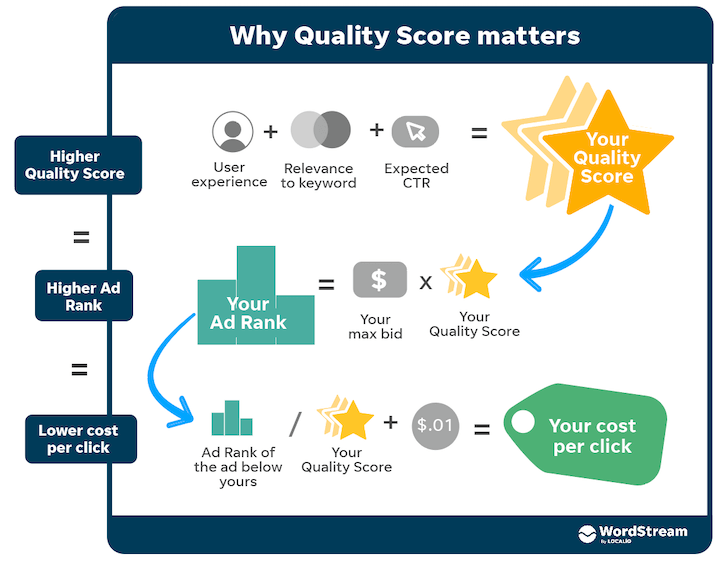
Image Source: WordStream
A weak Quality Score increases paid media inefficiency because the agency must work significantly harder to maintain visibility. Account managers must constantly increase bids to secure top ad placements. This dynamic forces the agency to spend valuable time controlling CPCs and explaining performance fluctuations to frustrated clients. When campaigns underperform due to low relevance, the agency absorbs the operational friction.
Lower Quality Scores increase fulfillment costs because strategists must dedicate hours to troubleshooting poorly structured campaigns. Scaling becomes more expensive, and margin compression accelerates at scale. Strategy teams spend more time diagnosing problems that should have been handled through operational systems from the beginning.
Agencies managing 30 to 100 accounts struggle to maintain Quality Score consistency manually because manual oversight breaks down under high volume. An in-house media buyer simply cannot audit ad relevance across thousands of active ad groups every week. They need a systematic approach to execution.
The real agency challenge is not improving one account’s Quality Score. It is creating repeatable systems that improve Quality Score across dozens of accounts simultaneously.
To improve Quality Score consistently at scale, agencies must first solve the biggest operational weakness in PPC management: ad relevance inconsistency.
How White Label PPC Improves Ad Relevance at Scale?
Ad relevance naturally deteriorates as agencies scale their operations. When in-house teams handle too many client accounts, they begin taking shortcuts to manage their workload. This leads to generic ad copy, broad ad groups, and rushed campaign launches. Account managers often rely on reused templates that fail to address the specific search intent of the user. Furthermore, overloaded teams have limited time for testing ad variations, leaving stale creatives running for months.
White label PPC teams improve ad relevance structurally by deploying strict account architecture standards. Instead of dumping dozens of loosely related terms into one ad group, these teams utilize granular keyword clustering. They build single-theme ad groups to ensure the ad copy matches the exact search query perfectly. This process includes intent-based ad copy mapping and consistent responsive search ad (RSA) optimization. White label PPC partners execute continuous copy testing across account segments to identify top-performing messaging without burdening the agency owner.
These operational advantages create massive leverage. Agencies benefit from dedicated execution specialists who run faster ad testing cycles and maintain a consistent optimization cadence. This removes the dependency on one overloaded in-house media buyer who might be juggling too many deliverables. Agencies maintain strategic oversight while fulfillment teams handle the tedious work of ad refinement.
Consider a local HVAC agency account as an example. An overworked in-house team might build a generic ad group titled "AC Services" with broad ad copy. A white label restructuring process breaks this down into hyper-specific groups:
- Emergency AC Repair
- Residential AC Installation
- Commercial HVAC Maintenance
The result is improved keyword-to-ad alignment, higher CTR potential, and a better Quality Score trajectory across the board. The biggest Quality Score gains often come from operational precision, not creative brilliance.
However, strong ad relevance alone cannot sustain Quality Score improvements if the post-click experience breaks user intent.
The Landing Page Consistency Problem Most Agencies Ignore
Many marketing firms successfully build highly relevant ad campaigns but fail to address the user experience after the click. Landing page experience becomes a massive scaling bottleneck for growing agencies.
Campaigns launch faster than pages improve, creating immediate friction. This leads to messaging mismatches between the active ads and the final destination pages. Common issues include poor mobile responsiveness, slow load speeds, and the frequent use of generic service pages to capture specific ad intent.
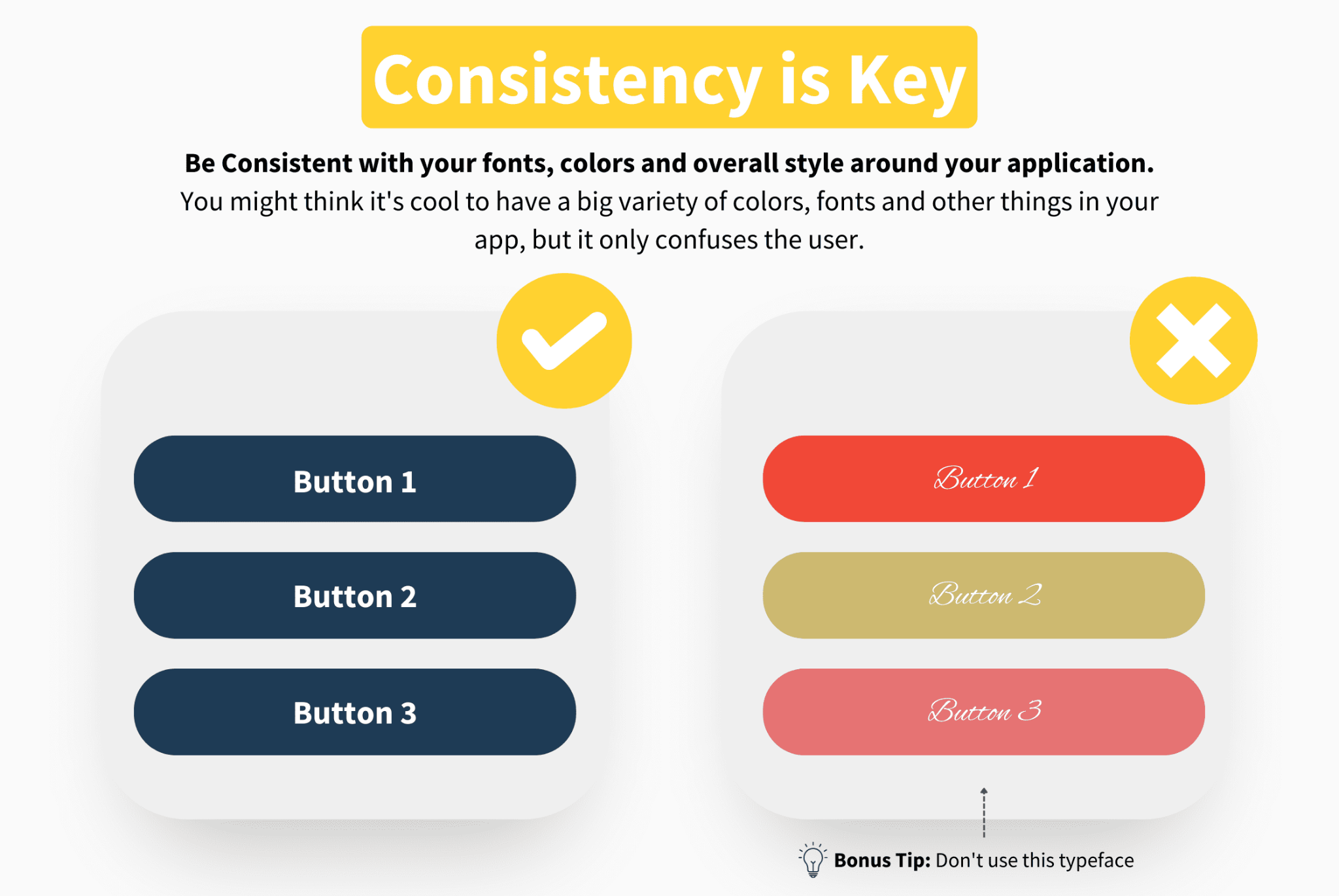
White label PPC support improves landing page alignment operationally by integrating strict quality control measures into the campaign launch workflow. These teams use message-matching systems to ensure the headline on the ad mirrors the headline on the page. They provide keyword-specific landing recommendations based on user intent and conduct conversion rate optimization (CRO) driven audits. By utilizing continuous landing page testing workflows, they ensure mobile functionality and speed checks are completed before scaling ad spend.
Google identifies landing page experience as one of the three Quality Score components.
Recent PPC research highlights relevance alignment as one of the strongest landing page optimization levers for Quality Score improvement.
There is a direct relationship between landing page relevance, conversion quality, and Quality Score efficiency. When users click an ad and immediately find the specific solution they were searching for, they stay on the page longer and convert at higher rates. Search engines monitor these engagement signals carefully. If a user bounces quickly because the page is irrelevant or slow, the Quality Score drops rapidly.
Many agencies optimize ads aggressively while sending traffic to generic service pages. That disconnect silently destroys Quality Score efficiency.
Once ad relevance and landing page alignment improve, agencies gain a new challenge: maintaining keyword control across growing account structures.
Why Keyword Management Determines Long-Term Quality Score Stability?
As client portfolios expand, keyword chaos develops inside scaling agencies rapidly. Without strict governance, accounts become bloated and inefficient. This chaos manifests through duplicate targeting, where multiple ad groups compete against each other in the same auction. Account managers create overlapping search intent, allowing irrelevant clicks to drain budgets. Poor negative keyword management further dilutes campaign performance. Agencies often develop an excessively broad match dependency because building granular exact match structures takes too much time. This results in an unclear match-type strategy that confuses the algorithm and degrades ad relevance.
White label PPC services introduce structured keyword governance to eliminate this entropy. Dedicated specialists perform rigorous search term mining to uncover high-intent queries. They use strict negative keyword isolation to prevent budget waste and apply precise match-type segmentation. This process includes intent grouping and regular keyword pruning systems to pause underperforming terms. Through routine keyword-to-ad group alignment reviews, white label teams ensure every active keyword still serves a clear purpose.
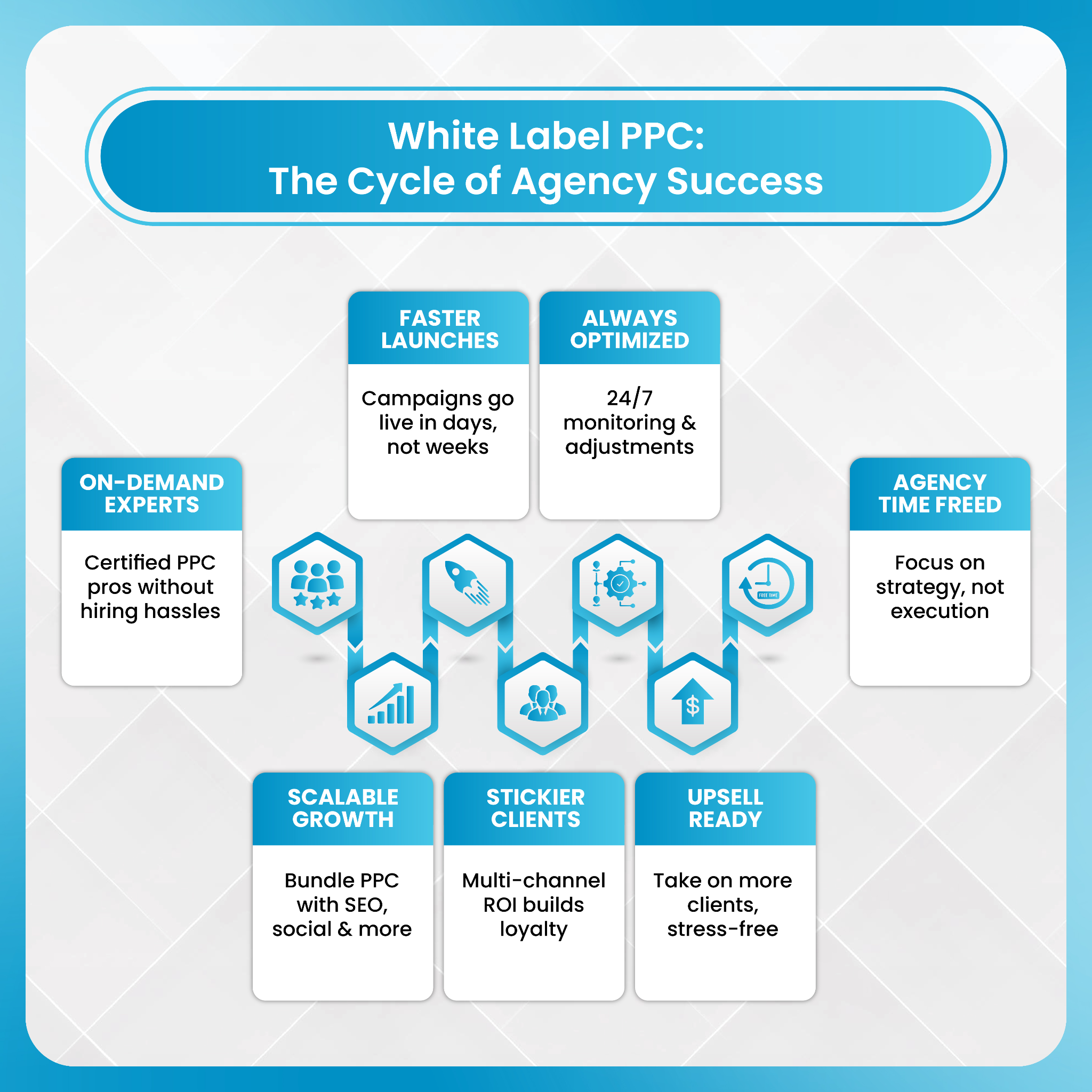
Cleaner keyword architecture improves campaign performance drastically. It generates CTR consistency, ensures search intent alignment, and boosts ad relevance scores. Consequently, the agency experiences better budget efficiency and provides reporting clarity to the end client.
A standard keyword management framework includes:
- Weekly search term review
- Bi-weekly negative keyword expansion
- Monthly keyword consolidation audits
- Quarterly intent restructuring
Agencies lose Quality Score gradually through unmanaged keyword entropy, not sudden campaign failures.
But keyword optimization alone is insufficient if campaign optimization becomes inconsistent across accounts.
How Structured White Label Optimization Creates Quality Score Momentum?
Inconsistent optimization cycles damage Quality Score growth because ad platforms reward active, engaged account management. When agencies scale too quickly, their internal teams fall behind on routine tasks. This results in delayed testing, stale ad creatives, and neglected search term reviews. Infrequent bid adjustments cause campaigns to lose competitive positioning, while slow landing page feedback loops prevent necessary conversion rate improvements.
White label teams create operational consistency by treating campaign management as a rigid, systemized process rather than a sporadic creative exercise. They implement daily optimization schedules to monitor spend pacing and auction dynamics. They utilize strict testing SOPs and advanced performance monitoring systems. This ensures a structured PPC reporting cadence that keeps the agency fully informed. Furthermore, they follow repeatable escalation workflows for underperforming ad groups, ensuring no failing campaign goes unnoticed for long.
These consistent workflows trigger powerful compounding effects across the portfolio. Better CTR means stronger engagement signals sent to the algorithm. Better relevance means stronger auction competitiveness, lowering the minimum bid required to rank. Better landing pages mean stronger conversion behavior, directly improving the client's return on investment. Cleaner keyword structures mean less wasted spend, allowing budgets to focus entirely on high-converting search terms.
This introduces a massive scalability advantage. Agencies improve account quality without overloading internal strategists, allowing the core team to focus on client communication and strategy.
Quality Score improvement is rarely the result of one optimization. It is usually the outcome of operational consistency over time.
As these systems mature, agencies begin to unlock the real business advantage behind Quality Score optimization: profitability expansion.
The Financial Impact of Strategic Quality Score Improvement
The ultimate goal of improving ad quality is not simply to achieve a perfect metric score on a dashboard. The goal is to generate a tangible downstream business impact. Accounts with highly optimized relevance experience lower CPCs, allowing them to acquire more clicks for the same budget. This leads to better ad positions and improved impression share against top competitors. Ultimately, these factors drive lower acquisition costs, which generate increased client retention and more stable campaign reporting month over month.
The agency profitability implications are substantial. With more efficient spend management, agencies can demonstrate better ROAS stability to their clients. This operational excellence leads to improved fulfillment margins. When campaigns run smoothly, account managers spend less time putting out fires and more time upselling services. This drastically reduces churn risk and builds stronger client trust.
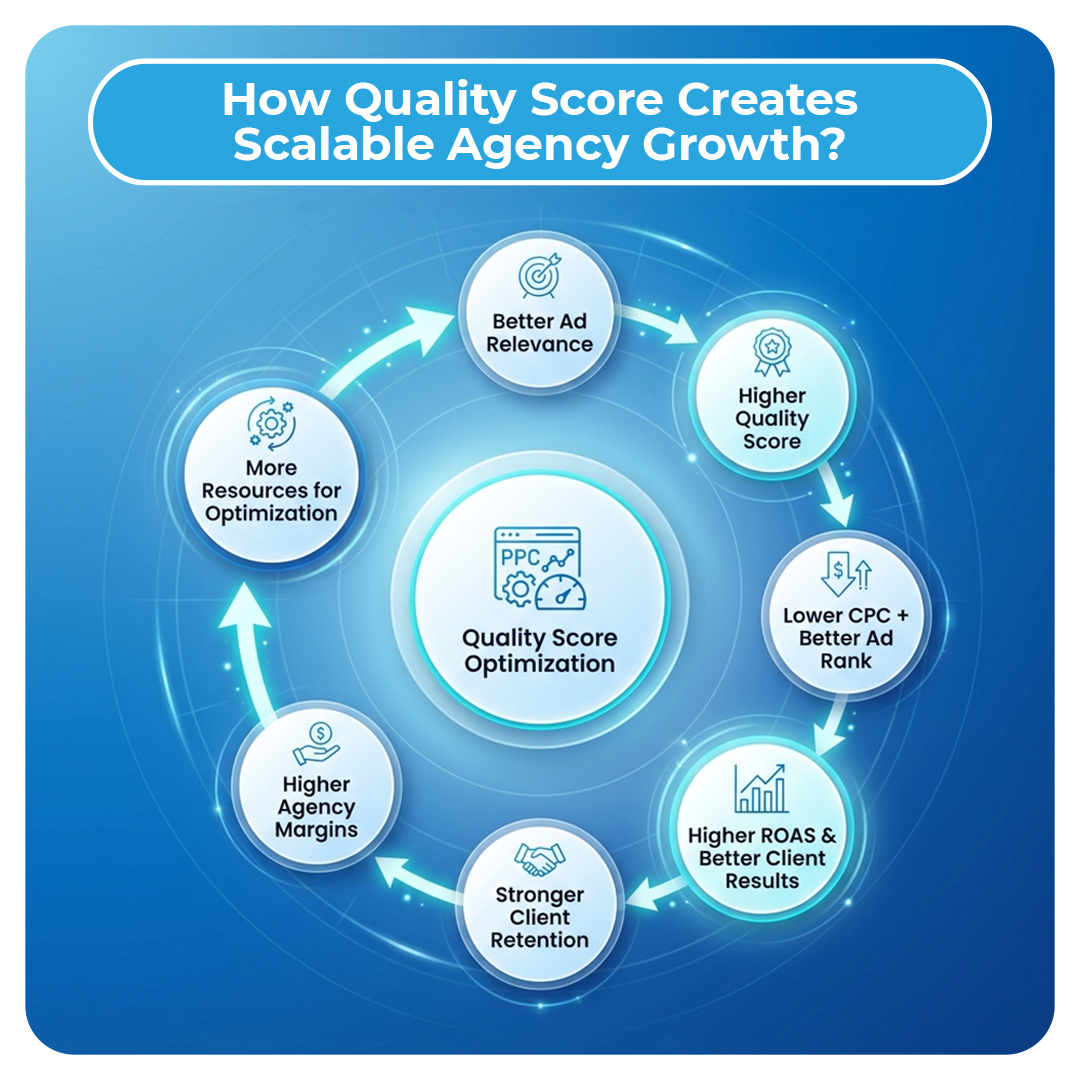
Google states that higher Quality Scores indicate more relevant and useful ads and landing pages compared to competitors. PPC industry studies consistently associate stronger Quality Scores with lower CPC pressure and improved ad positioning.
Agencies scale accounts more profitably when Quality Score improves systematically. A highly relevant account requires less manual intervention to generate leads, meaning the agency effectively increases its profit margin on the management fee.
Most agencies view Quality Score as a campaign metric. High-performing agencies treat it as a margin optimization system. This is why more agencies are shifting from fragmented PPC fulfillment toward operationally standardized white label models.
How DashClicks Supports Scalable Quality Score Optimization?
Scaling an agency requires backend infrastructure that can handle the rigorous demands of multi-account management. DashClicks provides this operational PPC infrastructure by functioning as a backend fulfillment system for agencies looking to systemize their growth. Through structured campaign execution, the platform ensures that ad relevance optimization remains a consistent priority across all client portfolios.
Agencies that partner with structured fulfillment platforms benefit from dedicated optimization workflows that tackle keyword management scalability. This systematic approach ensures that routine tasks like search term audits and bid adjustments occur on a reliable schedule. DashClicks helps agencies maintain strict operational standardization, directly influencing the metrics that matter most.
Agencies using structured fulfillment systems can improve Quality Score consistency, reporting continuity, and operational coordination. By relying on white label PPC services for fulfillment coordination, agencies eliminate the chaotic workflow typically associated with managing dozens of fragmented accounts. The platform's reporting systems offer clear visibility into backend operations, giving agency owners the confidence they need to scale aggressively.
This infrastructure enables internal teams to step away from repetitive daily execution. Instead, agency staff can focus more on strategy, client growth, retention, upselling, and profitability optimization. By removing the fulfillment bottleneck, agencies can build robust account portfolios without sacrificing the precision required to maintain excellent ad relevance and performance.
Conclusion
Sustainable Quality Score improvement requires operational consistency. Relying on sporadic campaign updates or isolated manual tweaks will never produce long-term stability for an agency managing multiple accounts. To maintain a competitive edge, agencies must build their fulfillment processes around rigid, systemized execution.
The core pillars of this systemic approach include relentless ad relevance, strict landing page alignment, structured keyword management, and continuous optimization systems. Agencies cannot afford to treat these elements as optional upgrades. They are fundamental components of a profitable media buying operation. White label PPC creates strategic leverage for agencies scaling multiple accounts by transforming these complex execution requirements into a seamless, managed process.
The agencies that scale PPC profitably are not necessarily the most creative. They are the most operationally disciplined.

How Agencies Use White Label SEO to Improve Branded Search Results
Search engine optimization is undergoing a massive transformation, and branded search results matter more than ever before. For years, agencies built their entire service models around capturing non-branded, high-volume keywords for their clients. That approach is no longer sufficient in the AI Overview era. As search engines evolve to deliver direct answers, generic organic click opportunities are rapidly shrinking.
To understand this shift, agencies only need to look at changing click behaviors. Google’s top organic CTR dropped from 28% to 19% after AI Overviews expanded in 2025. This decline is even more pronounced for top-of-funnel queries. AI Overviews caused organic CTR declines of up to 61% for informational searches between 2024 and 2025.
The sheer volume of these generative responses makes them impossible to ignore. AI Overviews now appear in nearly 31% of search results, reshaping click behavior and brand visibility.
Because generic organic click opportunities continue to decline, branded search visibility becomes significantly more valuable. When potential customers proactively search for a specific company by name, the results they see directly affect brand trust, lead quality, conversion rates, and client retention. Reputation management is now intertwined with search visibility. Agencies that fail to control how their clients appear for branded queries risk losing highly qualified leads to competitors or third-party reviewers.
As organic click opportunities shrink, agencies are increasingly prioritizing branded visibility strategies, and white label SEO has become one of the most scalable ways to execute them efficiently.
What Branded Search Results Actually Include Today?
Historically, a branded search engine results page was relatively straightforward. Agencies focused on ensuring the client's homepage ranked in the first position. Secondary priorities included securing a fully populated Google Business Profile, generating clean sitelinks, and maintaining active social media profiles. If a few positive review platforms appeared on the first page, the branded search strategy was considered successful.
The modern branded search environment is vastly more complex and unpredictable. Today, branded search results function as dynamic reputation ecosystems rather than simple ranking environments.
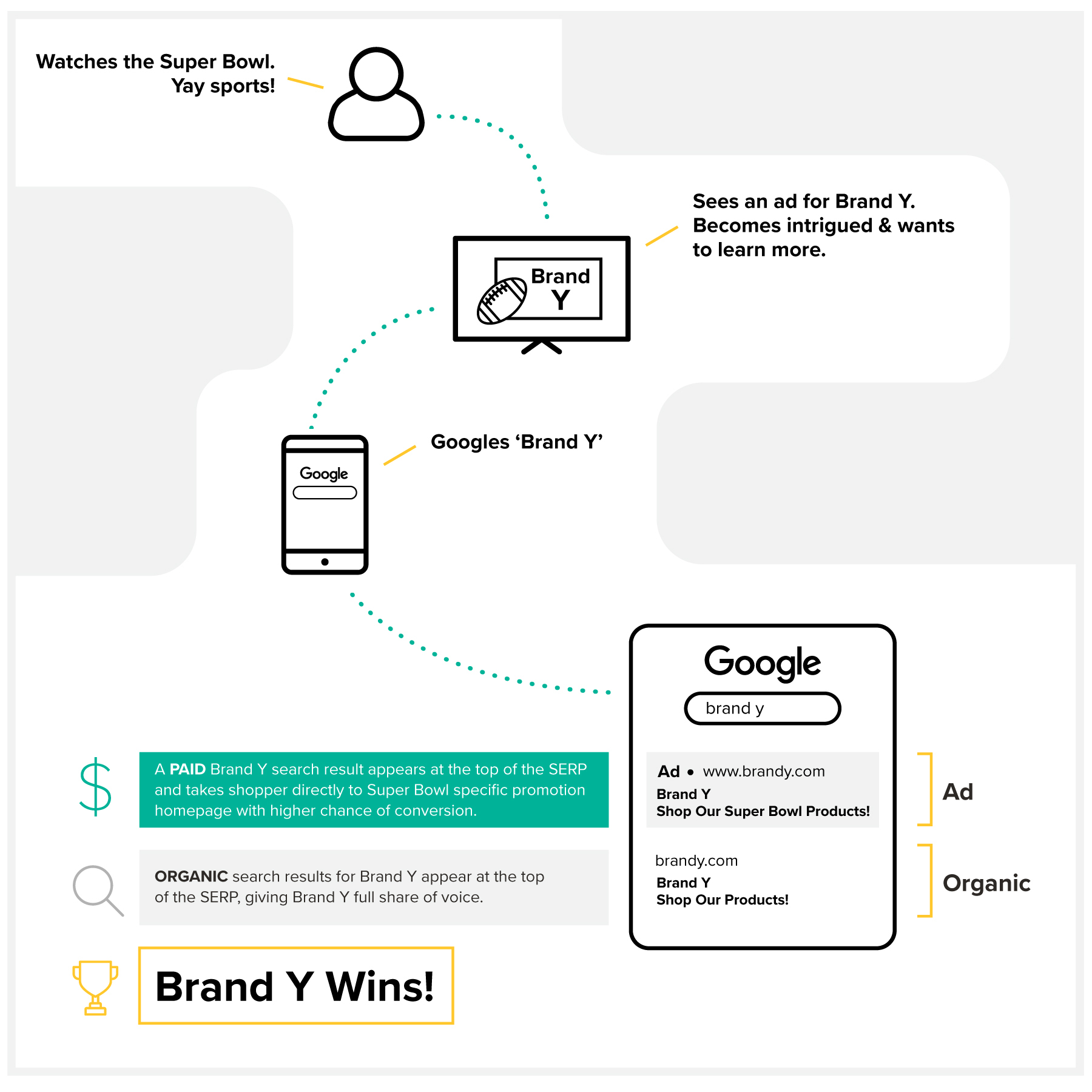
Image Source: Monks
Alongside the traditional elements, new features actively intercept the user's attention. AI Overviews synthesize brand summaries from various corners of the web. Knowledge panels pull deep entity data to establish credibility. Reddit threads and YouTube videos surface user-generated commentary directly on page one. Third-party listicles frequently rank alongside official domains, and "People Also Ask" boxes highlight common customer objections or questions before a user even reaches the target website.
This complexity introduces a critical concept known as the search perception gap. The search perception gap occurs when users decide whether to trust a brand based entirely on the search results, completely bypassing the actual website. If the search ecosystem looks fragmented, outdated, or negative, the user abandons their journey. Conversely, a robust and authoritative search presence bridges that gap immediately. The appearance of the search engine results page itself influences the likelihood of a conversion. A clean, authoritative page signals market leadership and reliability.
Once agencies understand how complex branded SERPs have become, the next challenge becomes execution at scale, especially across dozens of client accounts.
Why Agencies Are Turning to White Label SEO for Branded Visibility?
Managing a complex branded search ecosystem requires an extensive variety of specialized skills. Agencies consistently struggle to scale these operations internally because the required disciplines are so diverse. Delivering a comprehensive branded visibility campaign means executing reputation-focused SEO, entity optimization, continuous branded content production, advanced technical SEO, and targeted link acquisition simultaneously.
Attempting to build an internal team capable of handling all these moving parts is incredibly difficult. Internal hiring quickly becomes expensive, slow, and operationally burdensome. Sourcing a technical SEO specialist, a local search expert, and a high-level content strategist requires significant payroll investment and months of onboarding.
These scaling difficulties lead to severe agency pain points. Many firms suffer from limited specialized SEO talent, which inevitably causes delayed client deliverables. When account managers are stretched too thin, inconsistent SEO execution damages campaign performance and erodes client trust. Fulfillment overload eventually results in team burnout, leaving agencies completely unprepared to adapt their strategies whenever major Google updates roll out.
To solve these systemic bottlenecks, growth-focused firms are utilizing the best white label SEO services available in the market. By partnering with external fulfillment experts, agencies treat these solutions as operational leverage for branded search dominance. Instead of struggling to hire and train individual specialists, the agency plugs into a fully formed fulfillment machine. Operational scalability becomes absolutely essential as branded search management grows more complex. A reliable white label SEO agency provides the necessary bandwidth to deploy sophisticated branded campaigns across an entire client roster without increasing internal headcount.
But white label SEO only works if agencies know exactly which branded search components require optimization.
Core White Label SEO Strategies Agencies Use to Improve Branded Search Results
1. Branded Keyword Optimization
The foundation of a strong branded search presence begins with rigorous keyword optimization tailored specifically to the company's name and its variations. Protecting brand-name queries requires meticulous attention to on-page elements. Agencies deploy specialists to optimize homepage metadata, ensuring that title tags and meta descriptions clearly articulate the brand's core value proposition. This process also involves building dedicated branded landing pages, structuring branded FAQs to capture "People Also Ask" placements, and implementing branded schema markup to help search engines understand the organization accurately.
Beyond the exact brand name, agencies must capture high-intent modifier searches. Strategies are implemented to rank for "brand + service", "brand + review", and "brand + pricing" queries. For example, by restructuring homepage titles and optimizing internal linking structures for sitelinks, an agency can dramatically improve a client's branded click-through rate.
These optimizations are crucial because branded CTR directly affects trust and lead quality. When a user searches for a brand and sees a perfectly organized set of sitelinks guiding them to exact solutions, their confidence in the company rises before they even click.
2. Suppressing Negative or Irrelevant SERP Results
A clean, branded search page is just as important as a high-ranking homepage. Unfortunately, brands frequently suffer from outdated pages, aggressive competitor comparisons, negative reviews, or irrelevant directory pages ranking prominently for their name. Agencies utilize white label SEO content campaigns to systematically outrank and suppress these undesirable assets.
The strategy involves publishing highly optimized, positive content across authoritative domains. Specialists create consistent streams of blogs, strategic press releases, guest posts, and Web 2.0 properties that are specifically designed to rank for branded terms.
This approach introduces the strategic goal of SERP ownership instead of ranking ownership. By controlling multiple positions on the first page, brands leave less room for negative or irrelevant content to surface. Controlling more branded search assets increases trust stability. When a prospective customer investigates a company, a search page filled with positive, brand-controlled assets neutralizes objections and reinforces a pristine corporate image.
3. Google Business Profile and Local Brand Signals
For service-based and brick-and-mortar clients, local visibility is the most critical component of a branded search. When users look for a brand with local intent, the Google Business Profile dominates the screen real estate. Branded local searches often convert at higher rates because the user is typically seeking immediate contact information, directions, or operating hours.
To maximize this conversion potential, agencies rely on white label local SEO deliverables. Fulfillment teams perform comprehensive citation cleanup to ensure name, address, and phone number consistency across the web. They implement review generation strategies to build local authority. Furthermore, they conduct rigorous location page optimization and apply local business schema to the client's website.
These local signals communicate directly to both the user and the search algorithm. Strong map visibility reinforces branded trust. A fully optimized Google Business Profile with stellar reviews and accurate data provides immediate reassurance, making the prospect highly likely to transition from a searcher to a paying customer.
4. Entity SEO and Knowledge Graph Optimization
Modern search engines operate as semantic databases that understand real-world entities. Building entity trust signals is a highly technical process that defines how a brand is recognized by the Google Knowledge Graph. Agencies leverage fulfillment partners to establish these signals through interconnected digital assets.
This involves unifying social profiles, deploying advanced structured data, securing Wikidata references, and establishing robust Author entities for company leadership. Every piece of information must corroborate the brand's identity, industry category, and location.
These technical connections are mandatory because AI-driven search systems increasingly rely on entity confidence. If a search engine cannot confidently verify a brand's entity status, it will not trigger Knowledge Panels or feature the brand in generative AI Overviews.
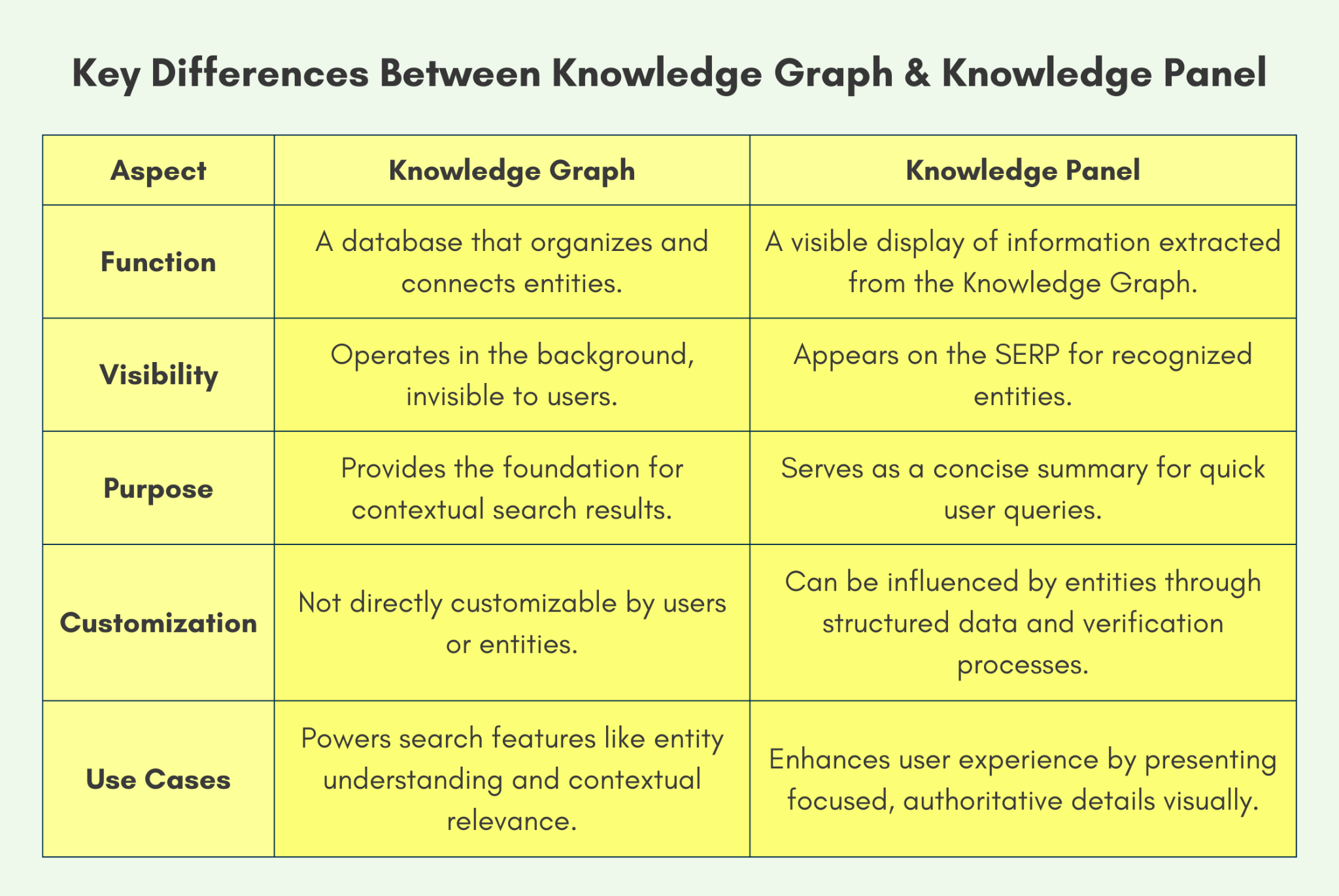
Strengthening the brand entity ensures that algorithms treat the company as a verified, authoritative source within its specific niche.
Improving branded visibility is no longer just about rankings. Agencies must also influence how brands are perceived across the full search ecosystem.
How White Label SEO Helps Agencies Manage Online Reputation Through Search?
The line between search engine optimization and public relations has effectively vanished. For modern businesses, reputation management increasingly functions as a search visibility strategy. What people read about a brand on the first page of Google is the ultimate defining factor of that company's public image.
To control this narrative, agencies use white label SEO services to proactively shape the search ecosystem. Fulfillment partners are tasked with creating positive branded assets that highlight corporate achievements and positive customer experiences. They actively optimize third-party review platforms so that highly rated profiles rank well for branded queries. Furthermore, these teams publish authoritative content on external publications and systematically improve off-page trust signals through digital PR.
This comprehensive execution involves managing reputation-driven content calendars, facilitating branded PR amplification, and conducting third-party trust optimization. This proactive approach highlights the difference between search reputation management and traditional ORM. Traditional online reputation management is often reactive, scrambling to hide negative press after it occurs. Search reputation management is proactive, building an impenetrable wall of positive assets before a crisis ever happens.
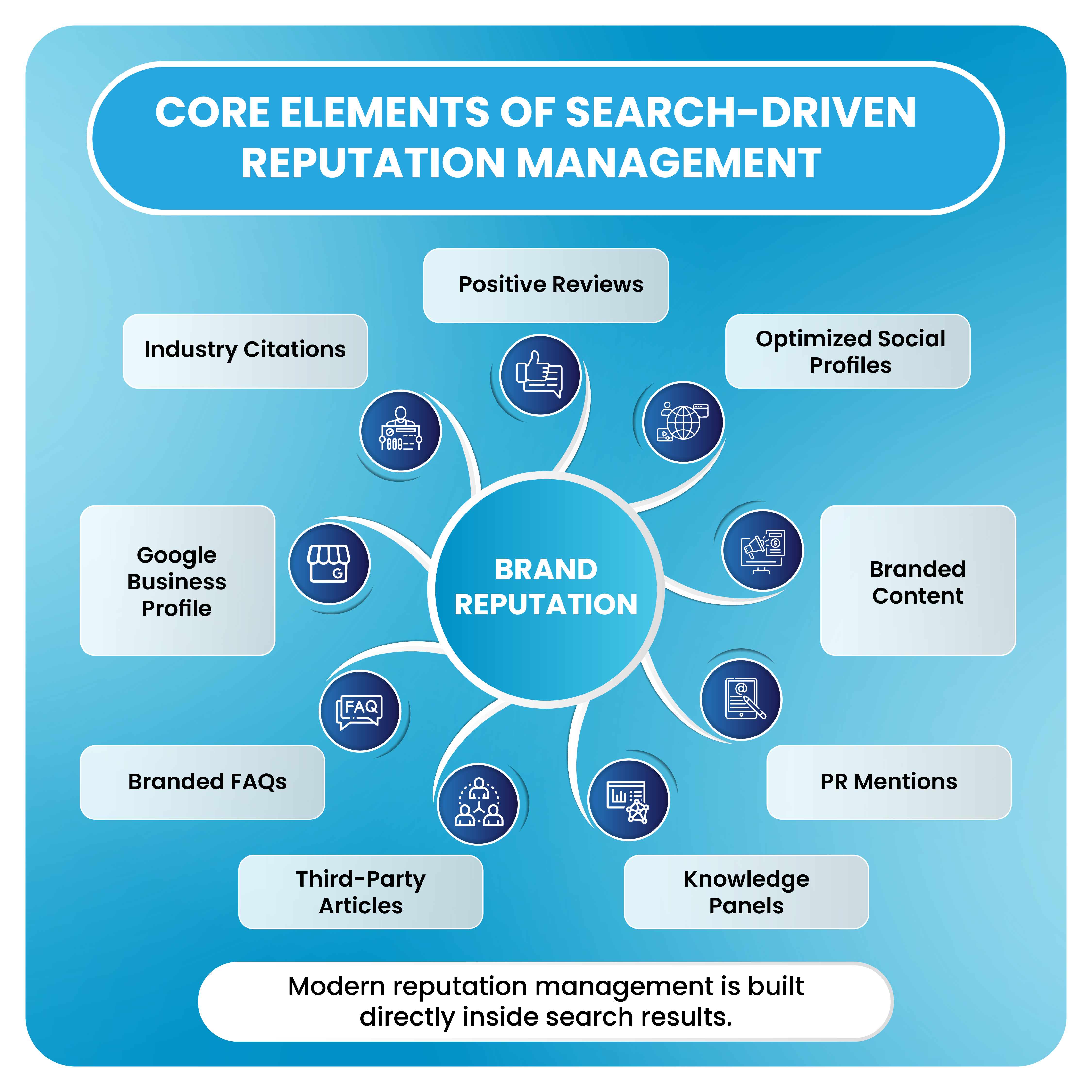
Consider a practical example scenario. A prospect hears about a software company and searches the brand name to conduct due diligence. Instead of seeing a generic homepage and empty directories, they see a highly optimized ecosystem. They see strong reviews on software rating sites, recent thought-leadership content authored by the CEO, comprehensive branded FAQs, trusted media mentions in industry publications, and perfectly optimized social profiles.
This level of saturation fundamentally alters the prospect's mindset. SERP perception shapes trust before engagement begins. By the time the prospect clicks the link to request a consultation, they are already pre-sold on the company's credibility.
The next challenge agencies face is proving measurable ROI from branded SEO efforts.
KPIs Agencies Use to Measure Branded Search Growth
Proving the value of branded search visibility requires tracking a specific set of performance metrics. Standard keyword ranking reports do not adequately capture the nuance of a reputation-driven strategy. Agencies must track branded organic traffic to ensure volume is growing as brand awareness campaigns succeed. They must monitor branded CTR to verify that optimized titles and sitelinks are effectively capturing user attention.
Agencies also measure the share of branded SERP ownership to determine exactly how many page-one results they actively control. Tracking Knowledge panel visibility and Local pack visibility confirms that the entity and local signals are recognized by the algorithm. Additionally, agencies evaluate review sentiment improvement, total impression share, AI Overview citations, and ultimately, conversion rates from branded searches.
By analyzing these metrics together, a clear pattern emerges. Branded traffic often converts at higher rates because trust already exists before the click. The user has specifically requested the brand by name, meaning they are much further along the buyer's journey than someone searching for a generic solution.
Agencies utilize a specific mini framework to explain this value to clients: Visibility → Trust → Click → Conversion.
- First, the brand dominates the search page visually.
- Second, the quality and consistency of those results establish undeniable trust.
- Third, the user confidently clicks the most relevant branded asset.
- Finally, the user converts rapidly because all their objections were handled by the SERP itself.
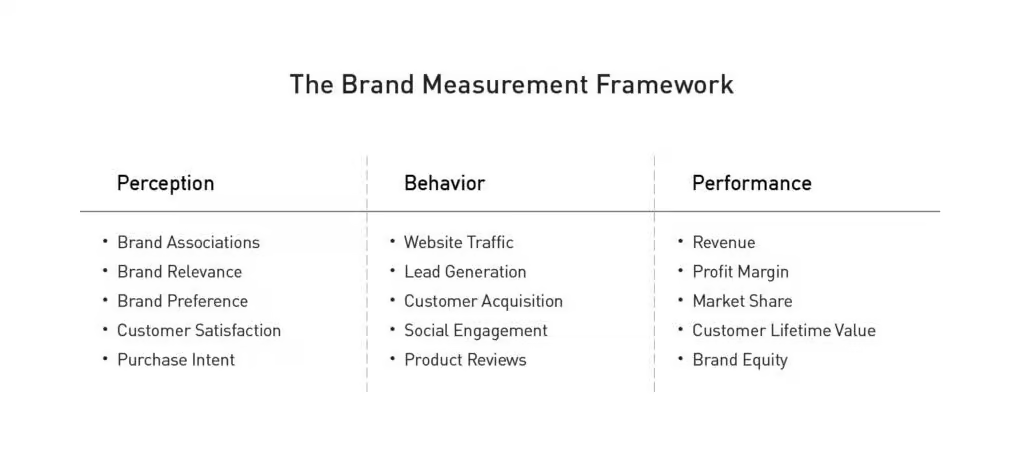
Image Source: Ignyte
Branded visibility compounds conversion efficiency. Every optimization made to the branded search ecosystem directly lowers the cost of customer acquisition.
While branded SEO can produce strong results, agencies still face operational barriers when trying to scale these campaigns internally.
Why White Label SEO Creates Operational Scale for Agencies?
The true value of a fulfillment partnership extends far beyond keyword rankings. White label SEO enables agencies to systematically bypass the standard bottlenecks of business growth. Partnering with a dedicated fulfillment provider allows for much faster campaign deployment, significantly lower hiring costs, and instant access to top-tier specialists. Agencies can seamlessly expand their core services without increasing internal payroll or taking on the financial risk of full-time salaries.
A reliable fulfillment provider takes over the heavy lifting associated with complex campaigns. They are responsible for handling technical SEO audits, executing large-scale content production, managing tedious local SEO tasks, building high-authority link profiles, and generating comprehensive white-labeled reporting.
By offloading these labor-intensive processes, the agency experiences profound business benefits. Agency owners enjoy increased profit margins because fulfillment costs are fixed and predictable. Providing superior branded search results leads to better client retention and significantly reduced churn. Furthermore, having faster fulfillment timelines and predictable delivery systems removes the daily chaos of agency operations that plagues most growing firms.
These business dynamics position white label SEO as infrastructure for scalable, reputation-driven SEO. Instead of viewing outsourcing as a temporary fix, smart agencies view it as the permanent foundation of their service delivery. Operational scalability becomes a competitive advantage. The agency that can deploy comprehensive branded search campaigns quickly, flawlessly, and profitably will continually outpace competitors who are bogged down by internal hiring struggles.
However, not all white label partnerships help agencies build strong branded search ecosystems effectively.
How DashClicks’ White Label SEO Services Support Branded Search Visibility?
To effectively manage the complexities of modern branded search, agencies require a robust operational SEO infrastructure. DashClicks provides white label SEO management that functions as a scalable fulfillment support system for marketing agencies. By utilizing a structured platform, agencies can seamlessly deliver complex search visibility campaigns without dealing with chaotic internal workflows.
The system operates as a comprehensive backend delivery infrastructure for agencies, offering specialized teams to handle the heavy lifting. The platform provides content fulfillment systems, technical SEO execution, and link-building systems designed to improve client authority. Because branded search relies heavily on local presence and trust signals, DashClicks also delivers local SEO support and reputation-supportive SEO infrastructure.
Agencies using structured fulfillment systems can significantly improve branded search visibility. The centralized reporting dashboards and workflow standardization ensure that reporting consistency and operational coordination remain flawless as the agency scales. This level of organized, scalable campaign delivery means that reputation-focused SEO execution is handled by dedicated specialists in the background.
By utilizing a streamlined fulfillment system, agency owners eliminate the daily stress of task management. This enables internal teams to focus more on overarching strategy, client communication, and long-term retention. Instead of worrying about backend deliverables, the agency can dedicate its resources to business development and high-level brand positioning. The platform provides the scalable operational workflows required to build authoritative branded search ecosystems efficiently.
Conclusion
The mechanics of search engine optimization have fundamentally changed. Ranking for generic industry terms is only one piece of the puzzle. Today, branded search is becoming a core business asset that directly dictates how potential buyers evaluate a company. Because AI-driven SERPs are actively compressing generic organic visibility, protecting and optimizing the brand's direct search presence is an absolute necessity.
Agencies controlling branded SERPs create stronger trust, higher conversions, and significantly improved client retention. When a brand completely dominates its own search results with positive reviews, authoritative content, and strong entity signals, customer acquisition becomes vastly more efficient. However, executing this strategy across an entire client base requires immense operational bandwidth. Effective white label SEO management enables agencies to scale these reputation-driven branded visibility services profitably and consistently.
The agencies that succeed in modern SEO will not simply rank clients. They will control how clients appear, are perceived, and are trusted across the entire branded search ecosystem.

How Agencies Use White Label Facebook Ads to Support Rapid Client Acquisition
The modern agency problem is no longer about finding clients. Agencies can often sell services much faster than they can fulfill them. Despite rising competition, Facebook Ads remain one of the fastest client acquisition channels available today. We are seeing a massive shift in the industry. Agency owners are moving away from building large internal teams and focusing instead on building scalable delivery systems. This is why many leaders are introducing white label Facebook advertising as a core growth infrastructure instead of treating it as mere outsourcing support. The reach of the platform continues to expand. Meta ads can now reach approximately 2.28 billion users globally.
The sheer scale of the network means the demand for Facebook ad services continues growing steadily. Furthermore, average Facebook Ads CTR for traffic campaigns increased to 1.71% in 2025, up from 1.57% in 2024.
This continuous engagement growth proves that effective campaigns still capture consumer attention. Additionally, 82% of Facebook advertisers are now using Meta’s Advantage+ AI automation tools.
Because of these platform automation changes, navigating the ecosystem requires highly refined execution systems. Agencies are not struggling to find demand. They are struggling to operationalize fulfillment at the speed modern clients expect.
The Hidden Agency Growth Ceiling: Fulfillment Capacity
Why Agencies Lose Momentum After Initial Growth?
Many agencies see rapid client growth early on, but that momentum often stalls when fulfillment cannot keep up. Onboarding delays are usually the first issue. New clients expect quick action after signing, and a slow setup can weaken trust from the start.
Hiring adds more pressure. Finding skilled media buyers takes time, pulls attention away from business development, and creates campaign launch delays. If the agency depends on a few key specialists, one overloaded or unavailable media buyer can disrupt the entire pipeline.
This often leads to founder burnout. Instead of focusing on growth, agency owners get pulled into daily campaign work to protect the agency-client relationship. The real issue is that human resources do not scale as easily as client demand. Once capacity is maxed out, growth slows.
The “Sales-to-Service Gap” Killing Client Acquisition
The sales-to-service gap happens when agencies close new clients faster than campaigns can launch. A strong sales team may bring in ten clients in a month, but if the fulfillment team can only launch three campaigns, a backlog builds fast.
Modern clients expect launch timelines in days, not weeks. When delays happen, churn risk starts before campaigns even go live. A client waiting weeks for a Facebook ad campaign may begin questioning the agency’s competence.
Speed-to-launch directly affects retention and referrals. A fast launch builds confidence. A slow launch creates doubt. For agencies trying to scale, closing this gap is essential.
Why In-House Facebook Ad Teams Become Expensive Too Quickly?
Building an in-house media buying team may seem logical, but costs rise fast. Experienced media buyers, ad tools, analytics software, and creative platforms can quickly reduce agency margins.
Management overhead also grows. Founders need to review campaigns, manage performance meetings, and handle training. Since Meta changes frequently, teams must keep relearning platform updates.
Agencies may hire junior buyers to control costs, but that can lead to inconsistent performance and costly mistakes with client ad spend. The result is higher risk, lower margins, and less cash available for growth.
The real scalability problem is not lead generation. It is operational latency.
This is where white label Facebook advertising changes agency economics entirely.
How White Label Facebook Ads Compress Client Onboarding Time?
Instant Access to Experienced Media Buyers
One immediate benefit of white label Facebook advertising is direct access to experienced media buyers. Agencies avoid long recruitment cycles, interviews, training, and hiring delays. The talent is already sourced, vetted, and ready to manage campaigns.
This gives agencies launch-ready specialists from day one. They know how to structure ad accounts, request access permissions, process creative assets, and move campaigns into setup without unnecessary back-and-forth. As a result, agencies expand fulfillment capacity quickly while staying focused on client relationships.
Standardized SOPs Reduce Delivery Friction
Fulfillment delays often happen when agencies lack clear operating procedures. White label teams reduce this friction through proven onboarding systems built from repeated campaign execution.
Their workflows usually include early ad account audits, policy checks, pixel setup, tracking validation, and audience research frameworks. These steps prevent reporting errors and speed up campaign activation. When every setup task follows a defined process, clients move from contract signing to active campaign delivery much faster.
Faster Launches Create Psychological Client Confidence
New clients want reassurance after signing. A fast launch helps validate their decision and builds early confidence in the agency. When ads go live quickly and initial traffic or leads begin appearing, client anxiety drops.
Traditional in-house onboarding can take 2 to 4 weeks because of internal bottlenecks. White label launch timelines can often reduce this to 3 to 5 business days. This faster activation makes clients feel prioritized instead of stuck in a queue.
Speed alone is not enough. Agencies also need campaigns that can perform in increasingly competitive ad auctions.
Why White Label Teams Often Launch Higher-Converting Campaigns Faster?
Specialized Teams See More Data Across Industries
The best white label Facebook ads teams have broader visibility across industries than most in-house media buyers. While an internal buyer may manage a handful of accounts, a white label team often works across hundreds of campaigns.
This gives them a stronger cross-industry learning advantage. They can spot winning patterns faster, adapt proven strategies from one niche to another, and identify early signals of a high-performing ad set. Shared campaign intelligence improves testing, optimization, and campaign quality across every account.
White Label Providers Already Understand Meta’s AI-Driven Ecosystem
Meta advertising now relies heavily on AI and machine learning. Advantage+ campaigns have changed how media buyers structure, test, and optimize campaigns.
White label providers usually adapt faster because they monitor larger campaign ecosystems. They understand creative diversification, broad targeting, first-party data, and conversion signal quality. Since AI now handles more targeting, creative variety becomes a major performance driver.
They can also test new Meta features earlier and observe how algorithm updates affect different accounts. This helps agencies avoid guesswork and launch with stronger campaign structures.
Faster Creative Iteration = Faster Performance Gains
Stagnant ads are the enemy of profitable campaigns. Agencies often fail because creative refresh cycles happen too slowly. When an internal team is bogged down by administrative tasks, they rarely have the time to produce and test new ad variations efficiently. Modern Meta campaigns require constant testing velocity. If you are not testing new angles, copy, and visuals weekly, ad fatigue will destroy your return on ad spend.
White label teams are structured specifically to handle high-volume testing. Meta’s AI ad improvements increased Facebook ad clicks by 3.5% and Instagram conversions by over 1%.
This improvement highlights that when you provide the platform with fresh, high-quality creatives rapidly, the algorithm rewards you with better engagement. White label partners have the streamlined workflows necessary to swap out underperforming assets without missing a beat. They analyze the data, kill the losing ads, and scale the winners seamlessly.
The best-performing agencies no longer treat Facebook Ads as media buying. They treat it as a creative testing engine.
When agencies consistently launch campaigns quickly and efficiently, client acquisition becomes significantly easier.
Using White Label Facebook Ads as a Client Acquisition Weapon
Agencies Can Sell Facebook Ads Without Operational Fear
Sales teams perform better when they trust the service they are selling. With a reliable backend partner, agencies can sell Facebook ad services without worrying about fulfillment capacity.
This gives sales teams stronger proposal confidence. They can pitch larger accounts, promise structured campaign delivery, and support bigger retainers without wondering if the internal team can handle the workload. For founders, it also removes the pressure of hiring quickly whenever a large deal closes.
Operational confidence improves sales effectiveness. When the agency knows delivery will happen on time, closing new clients becomes easier.
Faster Fulfillment Improves Sales Velocity
Faster fulfillment shortens the gap between deal closing and campaign launch. This helps agencies recognize revenue faster, improve cash flow, and create a smoother client experience.
Quick execution can also generate faster wins, stronger referrals, and better case studies. During sales calls, agencies can confidently mention faster launch timelines, which helps reduce prospect hesitation.
This creates a stronger growth loop. Fast launches lead to early results, early results support case studies, and case studies help bring in new clients.
White Label Support Enables “Capability Expansion”
White label support allows agencies to expand services without building new departments. For example, an SEO agency can start offering Facebook Ads without hiring media buyers or learning Meta campaign management from scratch.
This helps smaller agencies sell broader, higher-value marketing packages and compete with larger firms. Clients often prefer working with fewer vendors, so adding reliable Facebook Ads support can also improve retention.
White label Facebook ads fulfillment allows small agencies to appear operationally mature long before they build that maturity in-house.
But acquisition means little if agencies cannot retain clients profitably.
How Outsourced Facebook Fulfillment Improves Client Retention?
1. Consistency Beats Occasional Wins
In agency-client relationships, consistency matters more than one-time spikes. A viral campaign may create short-term excitement, but unpredictable results over the next few months can still lead to churn.
Clients need predictable reporting, steady optimization, and reliable performance patterns to forecast their own revenue.
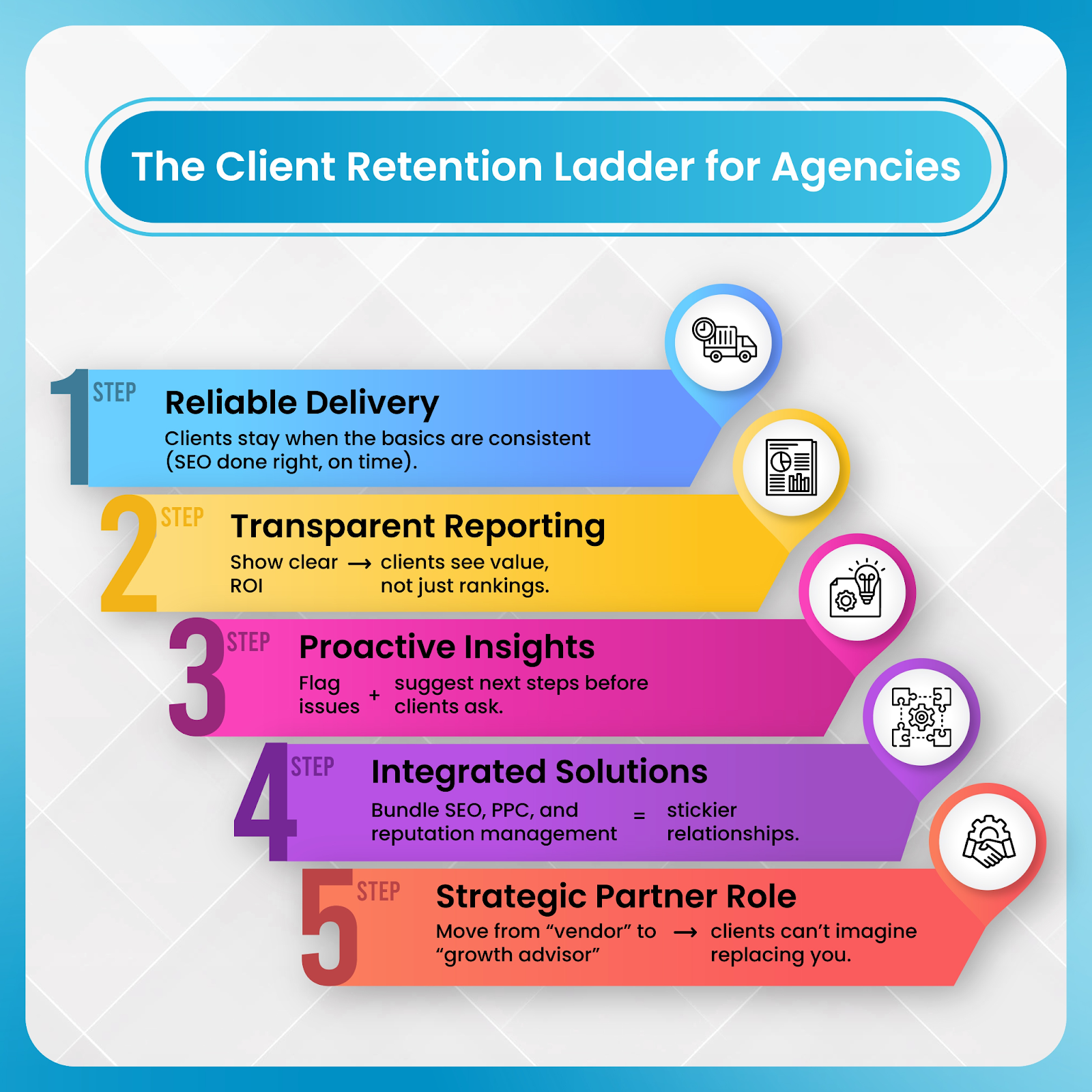
White label teams support this through daily account checks, structured bid adjustments, creative updates, and clear optimization schedules.
This steady approach builds trust. When clients know what baseline results to expect each month, they are less likely to look for another marketing partner.
2. Better Reporting Improves Client Trust
Better reporting gives clients visibility into how their ad budget is being used. Instead of spending hours on manual reports, agencies can rely on DashClicks’ white label client dashboard that shows campaign performance clearly.
This improves optimization transparency. Clients can see when budgets shift, weak ads are paused, and stronger campaigns receive more spend. It moves the conversation beyond vanity metrics and toward cost per acquisition, customer lifetime value, and revenue impact.
When clients understand the numbers and see ongoing effort, they feel more confident in the agency.
3. Reduced Founder Overload Improves Client Experience
A founder buried in fulfillment cannot deliver a premium client experience. Outsourced Facebook fulfillment removes daily media buying tasks from the founder’s plate.
This gives founders more time for client relationships, strategy calls, upsell conversations, and long-term planning. Instead of fixing ad disapprovals or tracking errors, they can focus on acting as a strategic marketing partner.
Better strategic attention improves retention and profitability. Keeping clients longer creates far more stability than constantly replacing churned accounts.
Client retention creates stability, but scalability requires agencies to expand into more competitive niches confidently.
Scaling Into Competitive Niches Without Building an Internal Media Department
Why Niche Expansion Usually Breaks Small Agencies?
As agencies grow, they often need to move beyond their original niche. This is where many small agencies struggle. Strategies that work for a local gym may not work for healthcare, legal, ecommerce, home services, or SaaS clients.
Each niche has its own rules. Healthcare involves compliance issues and restricted targeting. Legal ads have high CPCs and strict copy requirements. eCommerce requires catalog management and retargeting. SaaS and home services need specific lead generation workflows.
Without prior experience, agencies can burn client budgets quickly. Competitive niches add operational complexity, and without a proven playbook, the agency risks losing both results and reputation.
White Label Teams Reduce Niche Learning Curves
White label teams help agencies enter new niches with less risk. They already have experience across multiple industries and can apply proven campaign frameworks instead of starting from scratch.
These frameworks cover ad structures, audience testing, lead form strategy, landing page usage, negative keyword planning, and local angle testing. This reduces expensive trial-and-error cycles and helps campaigns move faster.
The client gets experienced execution, while the agency gets credit for delivering it. This allows smaller agencies to expand into profitable niches more confidently.
Agencies Gain Enterprise-Level Delivery Without Enterprise Payroll
Outsourced fulfillment helps agencies scale revenue without increasing payroll at the same pace. Agencies can offer advanced Facebook Ads delivery without hiring a large internal media team.
This protects margins, reduces management pressure, and makes scaling easier. Agencies know their fulfillment cost for each package, which helps maintain profitability as client volume grows.
Meta continues to dominate ecommerce ad spend, with brands allocating over 68% of paid social budgets to Meta platforms. Capturing that demand requires strong infrastructure. White label fulfillment gives agencies that infrastructure without enterprise-level overhead.
However, agencies that rely entirely on outsourcing without strategic control can still struggle to scale sustainably.
The Future of Agency Scaling: Lean Teams, Faster Execution, Better Margins
Why Traditional Agency Models Are Becoming Less Efficient?
Traditional agency models are becoming harder to sustain in a fast-moving, automated digital environment. Earlier, large teams were seen as a sign of growth. Today, heavy payroll structures can reduce flexibility and pressure margins.
Large internal teams also slow down adaptation. When platforms change, retraining staff takes time. Fixed costs remain high even during slower months, while clients expect faster results and stronger ROI.
This creates margin compression. Agencies may lower prices to win clients, but their internal costs stay the same. As a result, large teams can make agencies less agile.
The Rise of “Operationally Lean” Agencies
Operationally lean agencies are growing with smaller internal teams and stronger backend systems. Instead of hiring many media buyers, they keep strategic account managers, sales professionals, and client-facing leaders in-house.
White label infrastructure allows these agencies to handle more clients without increasing headcount. Campaigns can launch faster because the backend workflows are already tested and structured.
This model improves margins, reduces daily management stress, and gives founders more flexibility. The market now rewards agencies that deliver faster and more reliably, not just agencies with bigger teams.
Why White Label Facebook Ads Will Become a Competitive Requirement?
As automation and AI reshape advertising, execution speed will become a major differentiator. White label Facebook ads give agencies faster market entry, faster fulfillment, and better scalability economics.
Agencies can add Facebook Ads to their service stack quickly and sell it without building an internal department first. Since fulfillment costs are tied to active revenue, the model also protects margins better than fixed payroll.
Agencies that optimize for speed-to-execution will outperform agencies focused only on headcount growth.
The fastest-growing agencies today are not always the largest. They are the ones building the most efficient operational systems.
How DashClicks’ White Label Facebook Ads Services Support Scalable Agency Growth
To achieve this level of operational efficiency, agencies need a partner that provides more than just basic task completion. DashClicks offers comprehensive white label Facebook ads fulfillment designed specifically to support scaling agencies. By integrating the platform into your daily operations, you tap into highly refined campaign setup and optimization workflows. The system acts as your scalable backend delivery infrastructure, allowing you to bypass the friction of managing ad accounts directly.
The software provides intuitive reporting dashboards that keep both the agency and the client fully informed on campaign performance. This transparency is crucial for maintaining trust and proving value over time. DashClicks focuses heavily on workflow standardization, ensuring that every account receives the exact same high level of care and precision during the launch phase. Additionally, dedicated fulfillment support gives agencies the confidence to scale without fearing a drop in service quality.
Agencies using structured fulfillment systems can stabilize their onboarding speed, maintain reporting continuity, and ensure campaign execution quality. This scalable operational execution infrastructure stabilizes operational coordination and launch consistency across dozens of accounts. By utilizing a fulfillment support layer, internal teams can step away from technical campaign troubleshooting. This allows your in-house staff to focus more on overarching strategy, client acquisition, retention, upselling, and long-term business development.
Conclusion
The shift toward streamlined operations is reshaping how marketing firms operate. By utilizing white label Facebook ads services, agencies completely eliminate the roadblocks that traditionally choke growth. They achieve dramatically faster onboarding and execute much faster launches. This operational speed naturally translates into better client acquisition rates, as sales teams can confidently pitch rapid deployment to eager prospects.
Furthermore, the consistency and quality of the campaigns result in improved retention, keeping clients happily engaged for the long term. This creates an environment designed for easier scalability. Agency owners must reframe white label fulfillment from being viewed simply as outsourcing to recognizing it as a vital operational growth infrastructure. It is the engine that drives modern agency success.
The agencies growing fastest today are not necessarily the biggest. They are the most operationally efficient.
Operational speed, scalability, and fulfillment consistency now define modern agency competitiveness. Embracing these systems is the key to thriving in an on-demand market.

No results found.
Please try different keywords.
Get Started with
DashClicks Today
Get found online, convert leads faster, generate more revenue, and improve your reputation with our all-in-one platform.
.svg)
Unlimited Sub-Accounts
Unlimited Users
All Apps
All Features
White-Labeled
Active Community
Mobile App
Live Support
100+ Tutorials
Unlimited Sub-Accounts
Unlimited Users
All Apps
All Features
White-Labeled
Active Community
Mobile App
Live Support
100+ Tutorials
Unlimited Sub-Accounts
Unlimited Users
All Apps
All Features
White-Labeled
Active Community
Mobile App
Live Support
100+ Tutorials


