

.svg)

.svg)
.svg)
.svg)
.svg)
.svg)
White label Facebook advertising gives agencies the structure to prevent costly campaign mistakes. It replaces reactive adjustments with stronger attribution, consistent optimization, and scalable fulfillment.
Most agency Facebook ad failures are not caused by poor offers, weak creatives, or Meta’s algorithm. They usually come from operational breakdowns behind campaign execution.
Agencies lose profitability when lead tracking breaks, account structures become hard to manage, creatives fatigue faster than teams can replace them, and media buyers optimize using incomplete attribution. Scaling without statistical confidence only increases wasted spend.
The landscape is also more competitive. Meta reported over 3.4 billion people use at least one Meta app daily, making attention harder to win. WordStream benchmarks show rising CPC pressure across industries, which means every mistake drains budgets faster. HubSpot’s State of Marketing also identifies proving ROI and resource limitations as major challenges for modern teams.
White label Facebook ads services help agencies reduce these risks through operational consistency, scalable optimization, structured testing velocity, cross-account intelligence, and fulfillment stability.
To understand why agencies increasingly rely on white label partners, it is important to see how Facebook ad mistakes have changed. Today’s biggest failures are not only creative or targeting issues. They are operational failures caused by unstable execution systems.
Why Facebook Ad Mistakes Cost More Today Than They Did 3 Years Ago?
Facebook advertising has become less forgiving. Earlier, agencies could fix mistakes with manual targeting tweaks or budget changes. Today, performance depends on stable data, clean structures, fast creative testing, and disciplined optimization.
Small execution gaps now become expensive quickly. A delayed creative refresh, broken tracking event, or frequent learning-phase edit can weaken CPC, CPL, ROAS, and client retention.
Meta’s Algorithm Now Rewards Data Stability More Than Manual Control
The older approach to Facebook advertising gave media buyers a false sense of control. Agencies relied heavily on manual targeting and granular audience segmentation. They built complex campaign structures with detailed exclusions. This approach required frequent optimization edits to keep performance stable.
The modern approach is entirely different. The algorithm favors broad targeting and relies on stable conversion signals. Success now requires creative diversity, event consistency, and allowing machine learning optimization to do its job.
Outdated habits actively harm campaign performance. Constant tinkering creates unstable learning phases and fragmented data.
This leads to inflated CPMs and highly inconsistent ROAS for your clients.
White label Facebook advertising reduces this risk through:
- cleaner campaign structure
- fewer unnecessary edits
- better tracking discipline
- more stable optimization routines
Agencies Now Lose Money Faster From Small Performance Drops
A 15–20% performance drop hurts more today because the baseline costs are simply higher. CPMs are elevated across the board, and creative fatigue happens significantly faster.
Attribution windows are shorter, limiting the data available for optimization. At the same time, clients expect faster clarity on their returns. Small inefficiencies compound rapidly to destroy campaign profitability. Delayed creative refreshes leave audiences seeing the same ads too often.
Poor lead quality filtering wastes the client's sales team's time. Slow optimization response and broken attribution leave media buyers guessing.
The business impact is severe for growing agencies. It creates:
- retention problems
- margin pressure
- fulfillment overload
- client churn
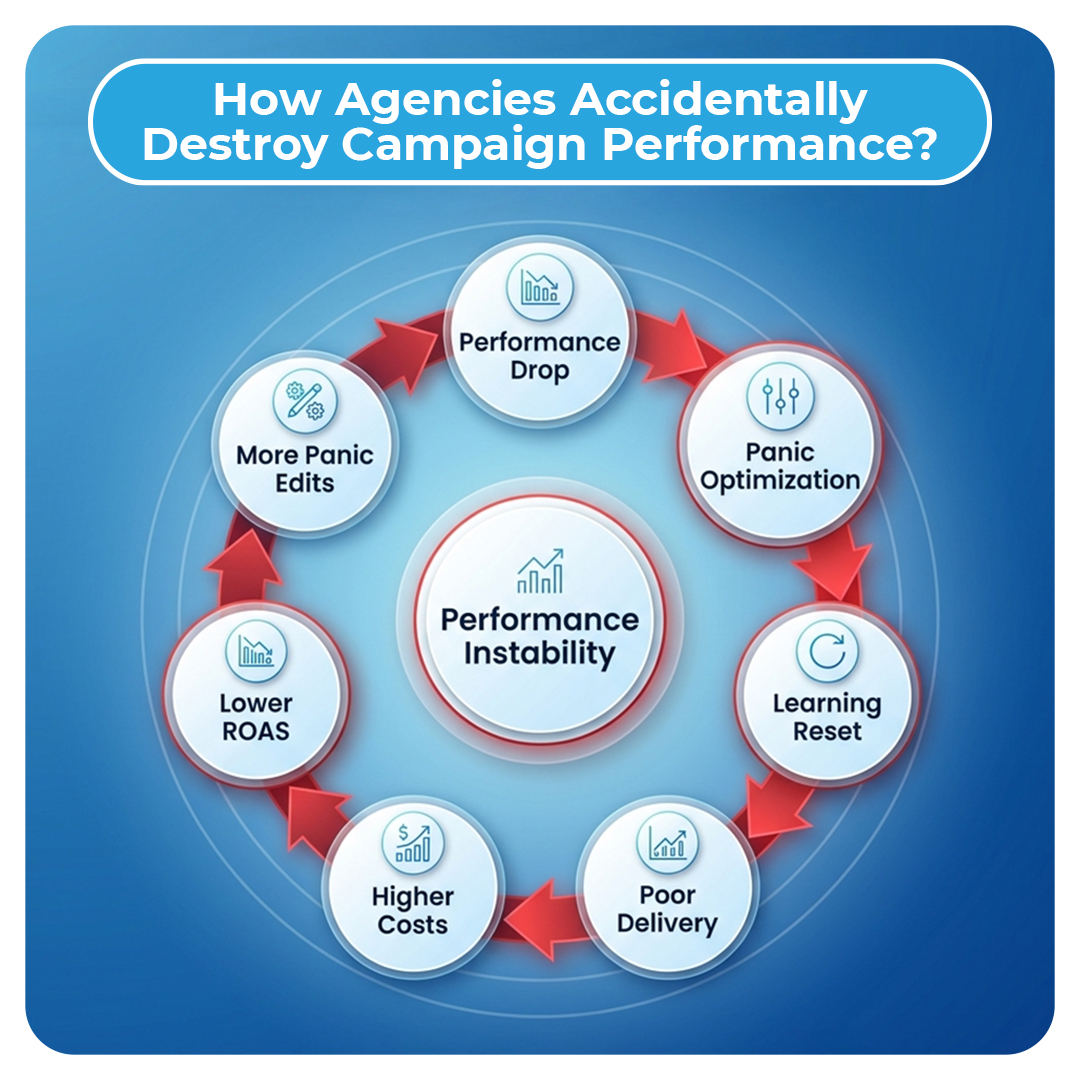
White label Facebook ads services reduce these issues through proactive monitoring and structured execution.
Rising acquisition costs and shrinking optimization windows mean agencies can no longer recover from mistakes through manual adjustments alone. Most performance losses now come from repeatable operational errors that quietly compound across campaigns. Understanding those mistakes reveals why stronger execution systems matter more than isolated campaign tactics.
The Most Expensive Facebook Ad Mistakes Agencies Make
Costly Facebook ad failures usually come from inconsistent execution, not a lack of technical knowledge. As account complexity grows, small operational gaps can turn into budget waste, unstable performance, weak reporting, and client dissatisfaction.
These mistakes become harder to control when agencies manage more campaigns at once. The following issues are expensive because they reduce campaign efficiency while increasing fulfillment pressure.
Mistake #1: Scaling Campaigns Before Signal Validation
Agencies frequently make this mistake because clients want fast results. Early ROAS appears promising, and the pressure to increase spending is high.
Media buyers optimize emotionally rather than logically. Teams scale budgets aggressively before the underlying data actually stabilizes.
Signal validation is critical before increasing spend. It requires:
- stable CPA range
- consistent conversion quality
- sufficient conversion volume
- multi-day performance consistency
Consider this common example. An agency's spend ranges from $150/day to $1,000/day after one strong day of sales.
The result is immediate audience saturation and an inflated CPM. Declining lead quality follows, resulting in unstable ROAS that ruins the client relationship.
The best white label facebook ads providers reduce this risk through:
- structured scaling frameworks
- pacing models
- data-threshold SOPs
- benchmark intelligence
Scaling discipline alone does not protect campaigns if agencies cannot trust the data driving decisions. Once attribution becomes incomplete, optimization begins moving in the wrong direction despite apparently strong performance.
Mistake #2: Optimizing Campaigns Using Incomplete Attribution Data
Many agencies optimize campaigns using only front-end data. They rely exclusively on Meta Ads Manager metrics to make critical budget decisions.
They optimize based on front-end lead volume and shallow ROAS reporting. This creates a dangerous disconnect between ad metrics and actual business revenue.
Modern Facebook optimization needs deeper visibility. It requires:
- CRM feedback loops
- lead quality scoring
- offline conversion syncing
- Conversion API support
- sales-stage visibility
There is a massive difference between running low CPL campaigns and high-revenue acquisition campaigns. Cheap leads often convert poorly.
For example, a campaign generating $12 leads appears highly successful in Ads Manager. However, CRM data shows poor qualification, low appointment attendance, and weak close rates.
White label providers reduce this risk through:
- deeper attribution workflows
- CRM integration support
- conversion quality analysis
- multi-stage optimization
Better attribution models often expose another hidden problem. Campaigns that appear structurally healthy may still decline because creatives stop producing strong engagement signals over time.
Mistake #3: Treating Creative as a Design Asset Instead of a Performance Variable
Many agencies treat creatives as static branding assets. They launch a beautiful video and leave it running for months.
High-performing advertisers treat creative differently. They view creatives as testing variables, behavioral data inputs, and audience psychology experiments.
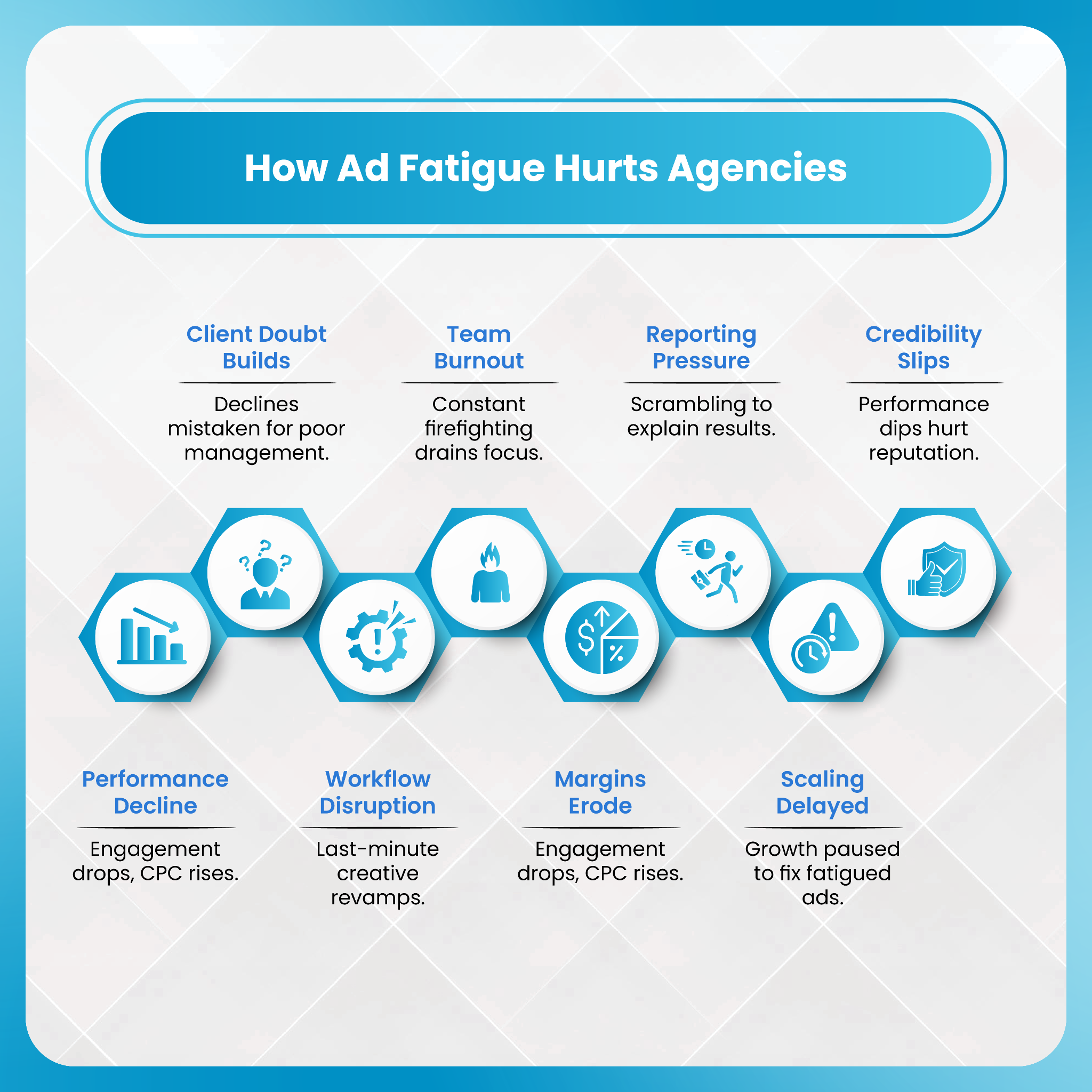
When creativity runs too long without variation, performance inevitably decays. Advertisers face:
- hook decay
- thumb-stop decline
- message saturation
- frequency-based fatigue
- creative entropy
Strong testing frameworks are essential to maintain performance. Teams must deploy:
- hook testing
- angle testing
- persona-based creatives
- UGC variations
- offer-positioning tests
- first-three-second optimization
For example, an agency runs the same winning creative for 8 weeks. CTR declines, CPM increases, lead quality drops, and ROAS weakens. The campaign dies from exhaustion.
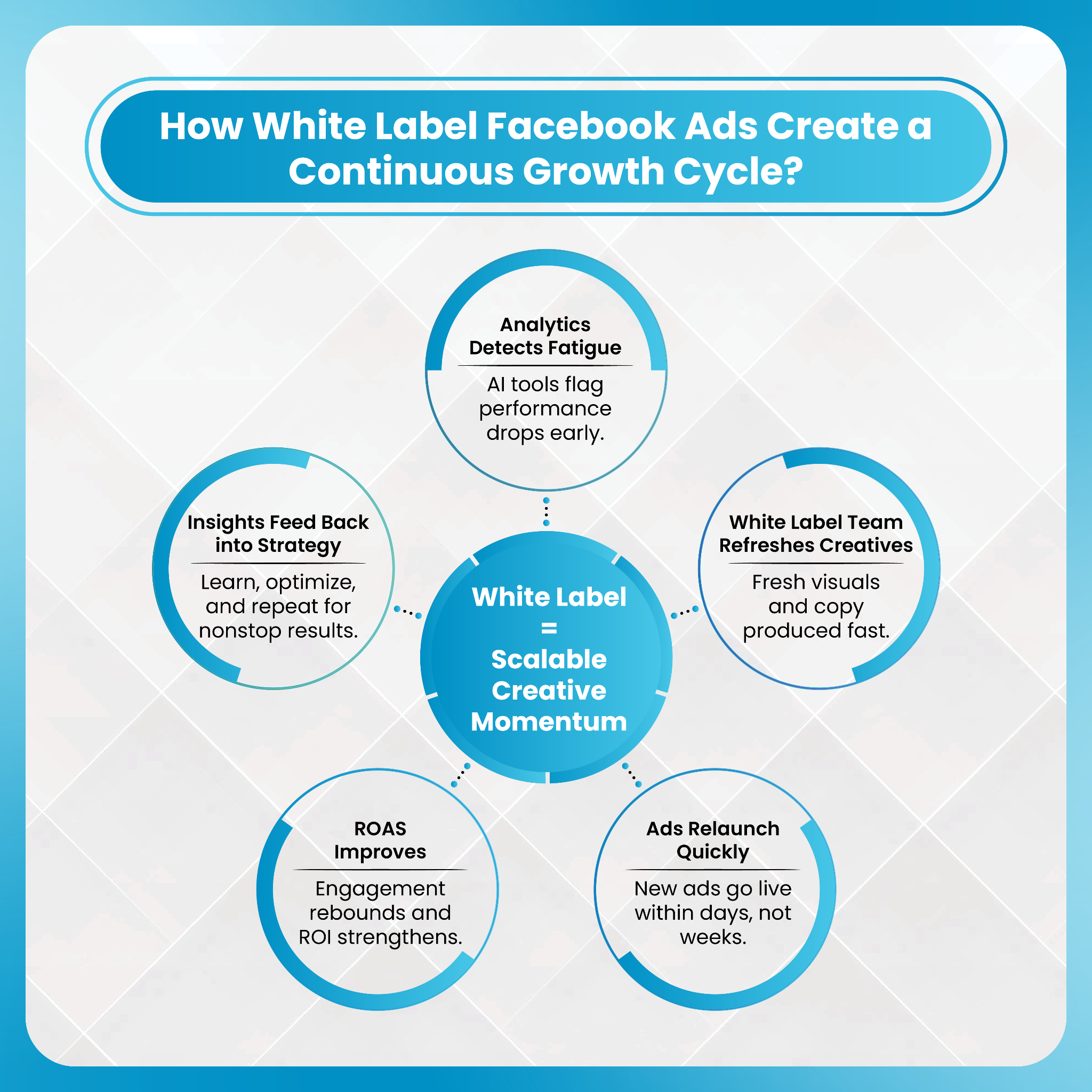
White label teams reduce this through:
- structured creative refresh cycles
- testing libraries
- performance tracking
- rapid iteration systems
Creative testing improves campaign longevity, but performance still becomes unstable when optimization decisions lack discipline. This is where many agencies unintentionally damage delivery through reactive management habits.
Mistake #4: Reactive Optimization Instead of Systemized Optimization
Many agencies optimize reactively by making emotional daily edits based on short-term data.
They reset learning phases by making changes too frequently. They change budgets aggressively and overreact to daily fluctuations.
The impact of this behavior is highly destructive to campaigns. It causes:
- learning phase disruption
- volatility amplification
- optimization lag
Stronger advertisers optimize based on larger data sets. They look at trend consistency and cohort behavior rather than yesterday's cost per lead.
They evaluate conversion quality and delayed attribution patterns before touching the budget.
For example, a campaign underperforms for 24 hours. The agency pauses ads, duplicates ad sets, and changes targeting. Three days later, performance worsens due to algorithm instability.
White label teams reduce this through:
- optimization SOPs
- decision thresholds
- pacing rules
- escalation systems
As campaign volume increases, avoiding these mistakes becomes less about media buying expertise and more about operational capacity. Internal teams eventually face a point where maintaining consistency across accounts becomes increasingly difficult.
Why Internal Agency Teams Struggle to Maintain Facebook Ads Consistency at Scale?
Consistency becomes harder when agencies add clients faster than they add systems. A single media buyer may manage details manually at first, but that model breaks as account volume grows.
The issue is not always talent. It has a limited capacity to monitor, test, report, and optimize every account with the same attention.
Most Agencies Scale Sales Faster Than Fulfillment Infrastructure
Agencies often sell Facebook ads aggressively to hit revenue targets. They onboard new clients quickly without expanding their operational backend.
This quickly overloads internal delivery teams. Media buyers end up managing too many accounts simultaneously.
The result is a breakdown in service quality. Agencies experience:
- slower optimization cycles
- inconsistent reporting
- creative bottlenecks
- delayed launches
- account neglect
Facebook ad performance often starts declining operationally before it appears in metrics. When the media buyer stops paying attention, the campaign begins to fail.
Operational overload affects more than delivery quality. It also reduces an agency’s ability to respond quickly enough to changing campaign conditions, creating a slower optimization cycle across the portfolio.
Optimization Velocity Is Now a Competitive Advantage
Optimization velocity is how quickly an agency can respond to data. It measures how fast a team can identify performance shifts and launch new tests.
It also measures their ability to analyze trends, refresh creatives, and stabilize volatile campaigns.
Agencies with slow optimization velocity fall behind. They discover fatigue too late and scale poor campaigns accidentally. They miss profitable audience windows entirely.
White label teams help agencies improve this speed through:
- dedicated specialists
- faster testing cycles
- account monitoring systems
- operational redundancy
Faster reaction speed alone is not enough. Agencies also need systems that convert operational discipline into repeatable campaign outcomes. This is where white label Facebook ads services become a strategic advantage rather than additional execution support.

How White Label Facebook Ads Services Help Agencies Prevent Expensive Mistakes?
White label support helps agencies replace reactive fixes with structured execution. Instead of correcting mistakes after performance drops, agencies get repeatable workflows that reduce errors before they affect campaigns.
This matters because costly Facebook ad mistakes usually come from weak QA, incomplete attribution, slow testing, and unclear optimization rules.
1. White Label Teams Introduce Operational Discipline
Providers reduce variability through standardized QA and launch checklists. Nothing goes live without passing strict operational guidelines.
They implement attribution verification, structured testing frameworks, and clear optimization protocols.
This process consistency improves multiple areas of the business. It directly impacts:
- reporting reliability
- account stability
- client trust
- retention
When the execution is disciplined, campaign results become far more predictable.
2. Cross-Account Intelligence Creates Smarter Optimization Decisions
Established white label providers observe performance patterns across many different campaigns.
They monitor data across industries, geographies, target audience types, creatives, and funnel models.
This broad visibility helps them detect problems early. They spot:
- CPM spikes
- creative fatigue trends
- conversion drops
- seasonal behavior
- algorithm shifts
This intelligence is gathered across a wider account base than most individual agencies can access. It allows white label teams to make proactive adjustments.
3. White Label Facebook Ads Improve Agency Profit Margins
Building an internal team is expensive. Agencies must pay salaries and benefits and manage 50+ accounts.
They also carry the burden of training, turnover risk, and QA supervision. If a client leaves, the agency is still stuck paying the media buyer's salary.
White label fulfillment helps agencies manage costs effectively. It allows them to:
- stabilize delivery
- increase client capacity
- improve margin predictability
- reduce fulfillment chaos
Using scalable white label fulfillment ties costs directly to client revenue. Agencies only pay for fulfillment when they have paying clients, protecting their profit margins.
Process stability creates stronger campaign foundations, but execution frameworks alone are not the entire advantage. Agencies also benefit from broader performance visibility that internal teams rarely achieve independently.
How DashClicks’ White Label Facebook Ads Help Agencies Reduce Campaign Risk?
Reducing campaign risk starts before ads go live. Agencies need a structured setup, consistent optimization, reliable reporting, and backend fulfillment that can scale without overloading internal teams.
DashClicks’ white label Facebook ads support helps agencies manage campaign delivery under their own brand with a more organized backend system. This improves launch quality, visibility, and operational control as client volume grows.
- Stronger Campaign Foundations: DashClicks supports agencies with structured campaign setup and white label fulfillment. They provide the backend team needed to launch campaigns with proper targeting and technical setup. By utilizing established launch protocols, DashClicks helps agencies avoid the technical errors that often derail new client campaigns.
- Structured Optimization Systems: DashClicks can support ongoing campaign management and optimization. Their fulfillment teams monitor ad accounts to identify shifting trends. They apply necessary adjustments to help keep campaigns running smoothly, utilizing data-driven processes instead of reactive guessing.
- Reporting and Visibility: DashClicks provides a unified white label client dashboard for easier management. Agencies can pull data from multiple tools into one central location. This provides fully white labeled reporting. Clients can log into a branded portal to see their metrics, which builds trust and improves communication transparency.
- Controlled Scaling: Structured fulfillment can help agencies scale client delivery more predictably. DashClicks handles the execution, allowing the agency to bring on more clients safely. This backend support means agencies can increase their sales volume without breaking their internal fulfillment systems.
- Operational Support for Agencies: DashClicks supports agencies by helping them expand service delivery without building every function internally. Agencies can resell services under their brand, utilizing a comprehensive suite of tools that includes funnel builders and CRM systems. This saves valuable time and effort, allowing agency owners to focus strictly on sales and strategy.
Structured fulfillment systems reduce operational risk, but their biggest value appears over time. Agencies gain more predictable delivery, stronger campaign control, and greater confidence when scaling client acquisition without increasing execution complexity.
Conclusion
Facebook ad success today depends on highly structured execution. It requires operational consistency, optimization velocity, and high-quality attribution. Agencies also need dedicated testing infrastructure and scalable fulfillment systems to survive the rising costs of digital advertising.
Costly failures happen because agencies scale before validating data. They optimize from incomplete attribution, refresh creatives too slowly, and operate without structured systems.
White label Facebook ads services help agencies reduce these risks through process discipline and scalable expertise. They provide faster testing cycles and essential operational support.
The agencies that dominate Facebook advertising over the next few years will not necessarily be the ones with the largest teams. They will be the ones with the most stable systems behind campaign execution.


.svg)


.svg)
.svg)
.svg)
.svg)
.svg)