

.svg)

.svg)
.svg)
.svg)
.svg)
.svg)
You worked hard to get those donors. Campaigns, emails, events, maybe even personal calls. And then, nothing. They gave once and disappeared.
If that sounds familiar, you're not alone. And the numbers back it up. According to Q4 2024 data from the Fundraising Effectiveness Project, the average donor retention rate in the nonprofit sector dropped to 42.9%, a 2.6% year-over-year decline. Only 19.4% of new donors gave again the following year. That's 4 out of 5 first-time donors who never come back.
That's a real problem. But it's also a fixable one, if you know what to measure.
Most nonprofits focus heavily on how much they raised and how many new donors they brought in. Those numbers matter, but they don't tell you whether the people who already gave are sticking around.
Measuring donor retention is only half the equation. The bigger challenge is acting on what those metrics reveal. For example, if your nonprofit CRM shows that first-time donors rarely make a second gift, the next step isn't simply updating a report, it's creating personalized follow-ups, welcome email sequences, and engagement campaigns that encourage long-term support. That's where CRM data and marketing automation work together to strengthen donor relationships.
That's where retention metrics come in. Let's break down the ones that actually matter, what they tell you, and how to use them.
The Core Metrics You Should Actually Be Tracking
1. Donor Retention Rate
This is the starting point for everything else. It tells you what percentage of last year's donors gave again this year.
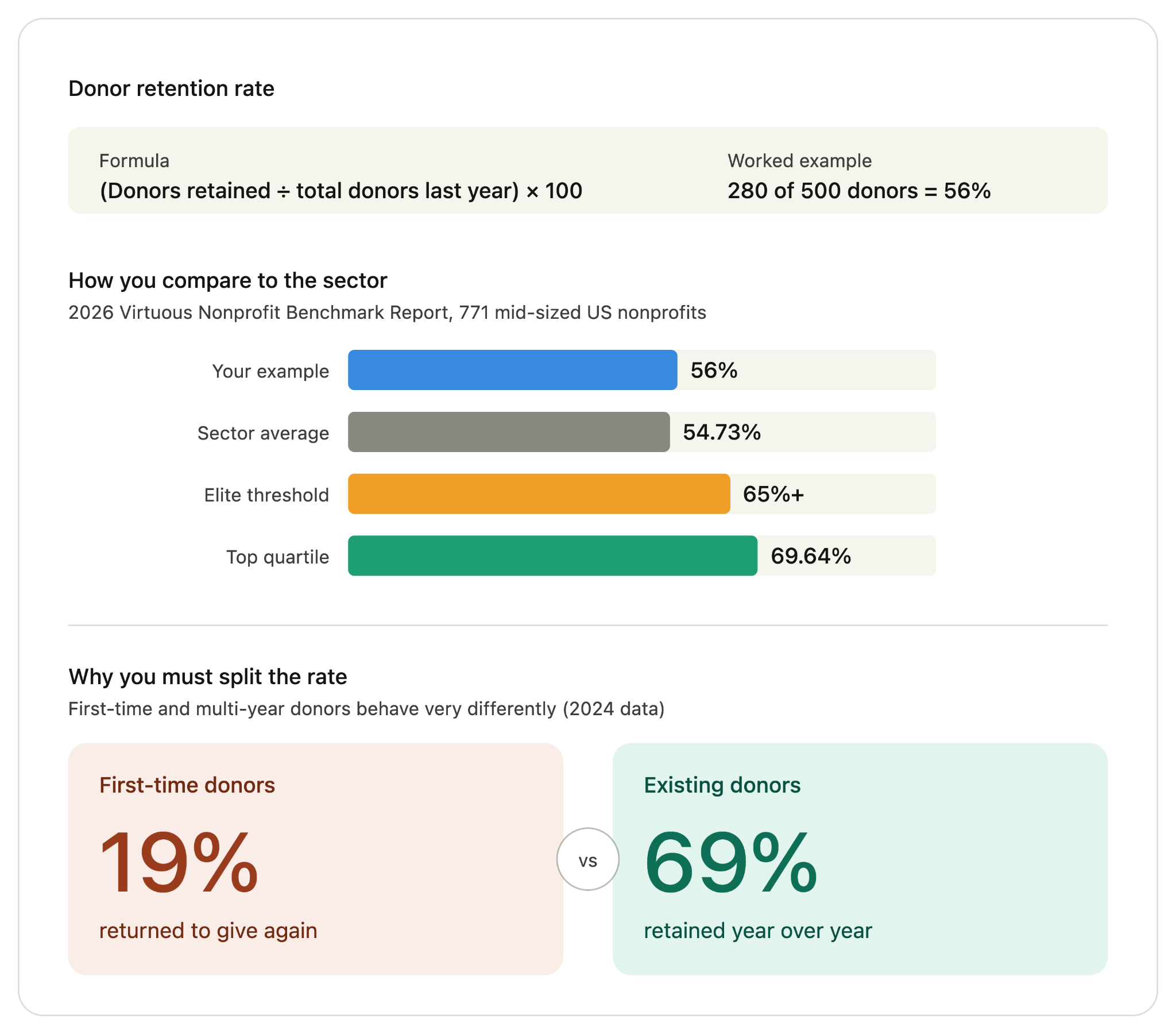
The formula: (Donors retained this year ÷ Total donors last year) × 100
So if you had 500 donors last year and 280 gave again, your retention rate is 56%.
Now, how does that compare to the sector? According to the 2026 Virtuous Nonprofit Benchmark Report, built on giving data from 771 mid-sized US nonprofits, the sector average donor retention rate sits at 54.73%, with top-quartile organizations reaching 69.64%. Hitting above 65% puts you in elite company.
In 2024, only 19% of first-time donors returned to give again, while existing donors had a much higher retention rate of 69%. Lumping them together in your reporting will mask what's actually happening.
How to improve it: If retention begins to decline, review your donor communication strategy. Sending automated thank-you emails, impact updates, and personalized follow-ups after a donation can help maintain engagement between fundraising campaigns.
2. Donor Attrition Rate
Attrition is the flip side of retention. If your retention rate is 56%, your attrition rate is 44%. Simple enough.
But the reason to track it separately is that it pushes you to ask a different question: who is leaving? Are lapsed donors concentrated around a particular campaign or appeal? A specific gift range? A time of year when donors were first acquired?
Donor attrition refers to supporters who stop giving to a nonprofit, either after making a single gift or by discontinuing a pattern of giving. Patterns in attrition usually point to fixable problems such as weak onboarding, irrelevant messaging, or donors who weren't the right fit to begin with.
How to improve it: Look for common characteristics among donors who stopped giving. Creating targeted re-engagement campaigns for inactive supporters often produces better results than sending the same fundraising appeal to every contact.
3. Donor Lifetime Value (LTV)
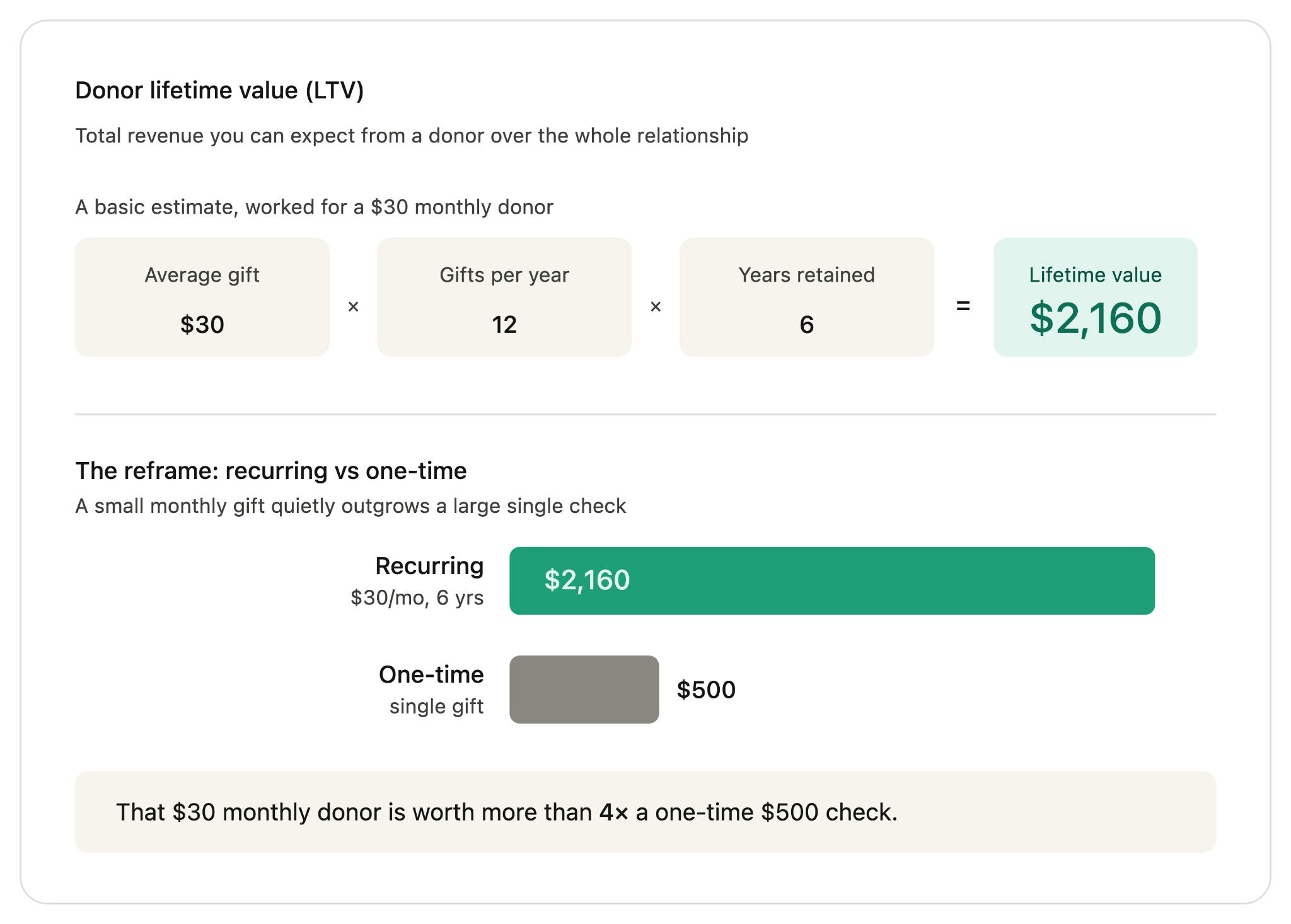
Lifetime value is the total revenue you can reasonably expect from a donor over the entire course of their relationship with your organization. A basic way to estimate it:
Average gift × Average gifts per year × Average years retained
This metric reframes how you see your donor base. A donor giving $30 a month for six years is worth far more than a one-time $500 check. Once you start thinking in LTV terms, decisions about stewardship investment start making a lot more sense.
How to improve it: High-value donors typically respond well to personalized communication. Sharing exclusive impact updates, invitations to events, or milestone acknowledgements can strengthen long-term relationships and encourage continued support.
4. Recency, Frequency, and Monetary Value (RFM)
RFM is a framework borrowed from direct marketing that works well for nonprofits. It scores donors based on three dimensions:
- Recency — When did they last give?
- Frequency — How often do they give?
- Monetary — What's their average or cumulative gift size?
Together, these help you identify your highest-value donors, catch people who are starting to drift, and prioritize who deserves more attention. A donor who gave $100 two years ago and hasn't responded since looks very different from someone who gives $50 three times a year. RFM helps you stop treating them the same way.
How to improve it: Segmenting donors based on recency, frequency, and donation value allows nonprofits to deliver more relevant communications. Rather than sending one generic campaign, organizations can tailor messages to first-time donors, recurring supporters, and major contributors.
5. Upgrade Rate
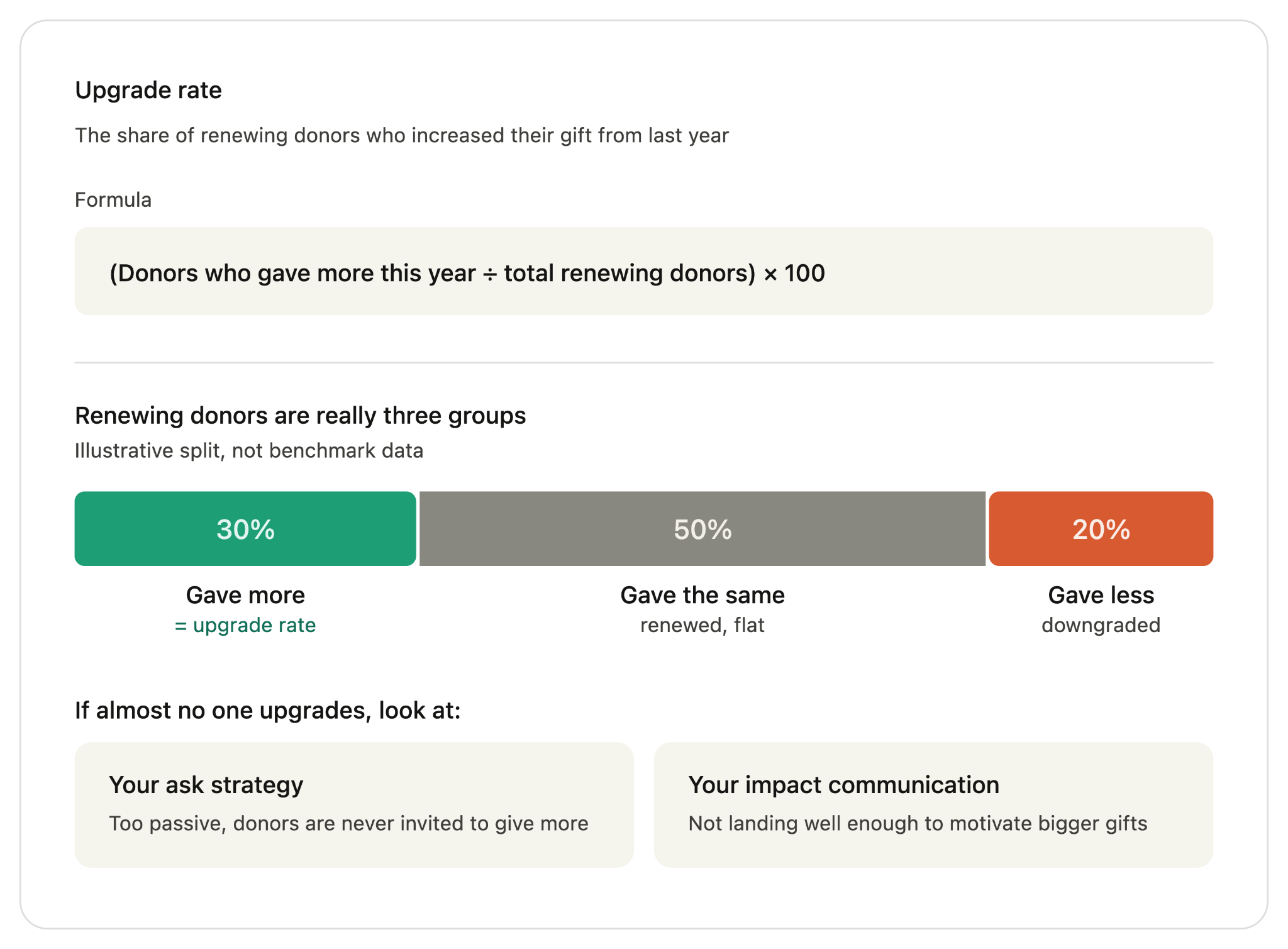
Often overlooked. Your upgrade rate tracks what percentage of renewing donors increased their gift from one year to the next.
(Donors who gave more this year ÷ Total renewing donors) × 100
A healthy upgrade rate means donors are deepening their relationship with your cause, not just renewing it. If almost no one is upgrading, it could mean your ask strategy is too passive, or your impact communication isn't landing well enough to motivate donors to give more.
How to improve it: Donors are more likely to increase their contributions when they clearly understand the impact of their previous gifts. Combining impact storytelling with personalized upgrade campaigns can encourage larger recurring donations.
6. Lapsed Donor Recovery Rate
Lapsed donors, meaning those who gave at least once but haven't given in 12 or more months, are a segment worth tracking separately because they have real potential. They already know your mission. They gave before. Something just interrupted the relationship.
Your recovery rate tells you what percentage of lapsed donors you're successfully re-engaging. Even modest improvements here compound meaningfully, because reactivating a lapsed donor is much cheaper than going out and finding a new one.
How to improve it: Don't wait until year-end to reconnect with inactive donors. Automated check-ins, newsletters, volunteer opportunities, and campaign updates help rebuild engagement before asking for another donation.
Putting It Together: Using a Nonprofit CRM the Right Way
Tracking these metrics manually in spreadsheets is possible when you're small, but it breaks down quickly as your donor base grows. That's where a good Nonprofit CRM becomes genuinely useful, not just as a contact database, but as the engine that surfaces these numbers in real time and makes segmentation practical at scale.
A well-configured CRM lets you:
- Monitor retention and attrition trends without running custom reports every time
- Segment donors by RFM score and automate outreach accordingly
- Flag donors who haven't given in a set number of months for personal follow-up
- Track which communication touchpoints, such as emails opened, events attended, and appeals responded to, correlate with higher retention
Research from NonProfit PRO shows that 42% of nonprofit leaders identify acquiring donors as their biggest challenge, while only 8% cite donor retention as a top concern. That gap is exactly why having a system that keeps retention visible is so important. When it's not in front of you, it's easy to deprioritize until the numbers have already slipped.
Turning CRM Insights Into Action
Collecting donor data doesn't improve retention on its own. What makes the difference is how quickly nonprofits act on those insights.
Consider how common nonprofit CRM metrics can guide donor engagement:
- Declining donor retention rate: Launch an automated appreciation campaign that shares recent success stories and reminds donors of the impact they've helped create.
- Growing lapsed donor segment: Create a re-engagement campaign with personalized emails, newsletters, or invitations to volunteer or attend upcoming fundraising events.
- High-value donors identified through RFM analysis: Provide tailored updates, exclusive event invitations, or behind-the-scenes stories that strengthen relationships with your most engaged supporters.
- First-time donors: Build an onboarding sequence that welcomes new supporters, introduces your mission, and explains how future contributions make a difference.
Turning CRM insights into consistent communication helps nonprofits strengthen relationships throughout the year instead of reaching out only during fundraising campaigns.
How DashClicks Helps Nonprofits Turn CRM Insights Into Action?
A nonprofit CRM gives organizations visibility into donor behavior, fundraising history, and engagement trends. However, improving donor retention requires more than collecting data. Nonprofits need to communicate consistently, personalize outreach, and follow up with supporters at the right time. That's where marketing automation and communication tools become valuable.
1. Automate Donor Follow-Ups
Timely communication can make a significant difference in donor retention. With DashClicks' Automation tools, nonprofits can create workflows that automatically send thank-you emails, welcome first-time donors, share impact updates, or reconnect with supporters who haven't engaged in recent months. Automating these touchpoints helps organizations maintain consistent communication without increasing manual work.
2. Keep Conversations Organized
Donors often reach out through multiple channels with questions about campaigns, events, or volunteer opportunities. DashClicks' Conversations software centralizes communications from supported channels into a single inbox, making it easier for nonprofit teams to respond promptly and maintain stronger relationships with supporters.
3. Capture and Nurture New Supporters
Whether someone signs up for a fundraising event, volunteers, or subscribes to a newsletter, DashClicks' Forms software helps capture contact information and automatically route new supporters into follow-up workflows. This reduces manual data entry while ensuring every new contact receives timely communication.
4. Measure Campaign Performance
Understanding which outreach efforts encourage repeat donations is just as important as tracking donor retention. DashClicks' Analytics software helps nonprofits monitor marketing performance, identify successful campaigns, and make more informed decisions about future fundraising efforts.
5. Build a More Connected Donor Journey
When nonprofit CRM insights are combined with marketing automation, communication tools, and performance reporting, organizations can create a more personalized donor experience. Instead of only reaching out during fundraising campaigns, nonprofits can maintain meaningful engagement throughout the year with DashClicks, strengthening relationships and encouraging long-term support.
What Good Retention Looks Like in Practice?
Organizations with strong customer retention numbers tend to share a few consistent behaviors, none of which require a massive budget.
They communicate impact, not just need. Donors don't lapse because they stop caring about the cause. They lapse because they stop feeling connected to it. Sending a story about what their gift made possible, rather than just a receipt followed by a renewal ask, changes that.
They treat the first 90 days seriously. The first interaction is not consistently leading to a second, and the biggest drop-off happens after the first gift. Organizations that address this have a deliberate onboarding sequence, such as a thank-you call, a welcome email series, or a survey, that signals "we noticed you, and we're glad you're here."
They segment their outreach. A first-time donor and a 10-year recurring giver should not be getting the same message. The ask, the tone, the story, all of it should feel like it was written for that person specifically.
They watch the leading indicators. Retention rate is a lagging metric. By the time it drops in your annual report, you've already lost people. Email open rates, event attendance, and response to mid-year appeals are the early signals. If they're falling, retention is about to follow.
One More Thing: The Donor Pipeline Problem
It's not just current retention that deserves attention. The donor base has shrunk for the fourth consecutive year, though the rate of decline has been slowing since 2022. Not a recovery yet, but possibly an inflection point.
Meanwhile, repeat donors now account for more than 60% of total fundraising dollars, which highlights nonprofits' increasing dependence on a shrinking core of loyal supporters.
That combination, fewer new donors coming in and more revenue depending on a smaller retained base, is a structural vulnerability. It makes retention not just a relationship goal, but a financial stability issue.
Common Mistakes That Hurt Donor Retention
Even nonprofits that carefully track donor metrics can struggle with retention if they overlook day-to-day engagement. Some of the most common mistakes include:
- Tracking donor metrics without taking action on the insights.
- Sending the same fundraising appeal to every supporter regardless of giving history.
- Only communicating during fundraising campaigns instead of maintaining year-round engagement.
- Failing to recognize or thank recurring donors consistently.
- Waiting too long to reconnect with inactive supporters.
Combining CRM data with personalized communication and marketing automation can help nonprofits avoid these challenges while building stronger donor relationships over time.
Where To Start If You're Starting From Zero
You don't need a perfect system on day one. Start here:
- Calculate your overall donor retention rate for the past two years.
- Separate first-time donors from returning donors and look at each group individually.
- Pull a list of anyone who gave in the last 13 to 24 months but not in the past 12. How large is that lapsed segment?
Those three steps alone will tell you more about your donor base than most organizations know. From there, you build, with better segmentation, more targeted outreach, and eventually the kind of retention numbers that make your fundraising genuinely sustainable rather than a yearly scramble.
The data is already there. The opportunity lies in using it effectively.
Tracking donor retention metrics helps nonprofits understand what's happening, but improving those numbers requires consistent communication, personalized engagement, and timely follow-up. By combining the insights from a nonprofit CRM with marketing automation, reporting, and communication tools, organizations can strengthen donor relationships, improve retention, and create more sustainable fundraising strategies.


.svg)


.svg)
.svg)
.svg)
.svg)
.svg)