

.svg)

.svg)
.svg)
.svg)
.svg)
.svg)
Quality Score is frequently misunderstood as a simple vanity metric monitored exclusively by junior media buyers. For growing marketing agencies, this narrow view creates significant operational bottlenecks. Agencies managing multiple PPC accounts cannot treat Quality Score as just a Google metric. It acts as a fundamental indicator of portfolio health and operational efficiency.
When Quality Scores drop across a large volume of client accounts, the business impact is severe. Agencies face higher CPC pressure, lower ad visibility, and reduced margin efficiency. More client budget is wasted simply to maintain existing ad rankings. This friction increases the difficulty of scaling PPC profitably. A single weak campaign can be corrected manually by an in-house strategist.
However, a portfolio of 30 to 100 accounts requires robust systems. Poor Quality Score across many accounts increases fulfillment pressure, weakens reporting confidence, and creates massive margin inefficiency. Agencies managing many PPC accounts often lose margin when optimization work becomes reactive instead of systemized.
Agencies that scale PPC profitably build systems around Quality Score optimization, not isolated campaign tweaks. This operational shift requires a reliable execution infrastructure.
A white label PPC agency provides the operational layer, enabling consistent Quality Score improvements across large account portfolios. By leveraging dedicated execution teams, growing firms transform chaotic account management into a structured, repeatable process.
As account volume grows, improving Quality Score stops being a tactical optimization and becomes a system-wide operational challenge.
Why Quality Score Becomes an Agency-Level Profitability Metric?
To fully understand the agency-level impact of ad quality, we must look at how search engines evaluate campaigns. Google evaluates ad quality relative to competitors in the auction to ensure users see highly relevant search results. Quality Score is not merely a vanity metric used to decorate monthly client reports. It is a strict algorithmic evaluation of relevance.
Google confirms Quality Score is evaluated using expected CTR, ad relevance, and landing page experience.
Industry PPC benchmarks consistently consider a Quality Score of 7+ as healthy and cost-efficient.
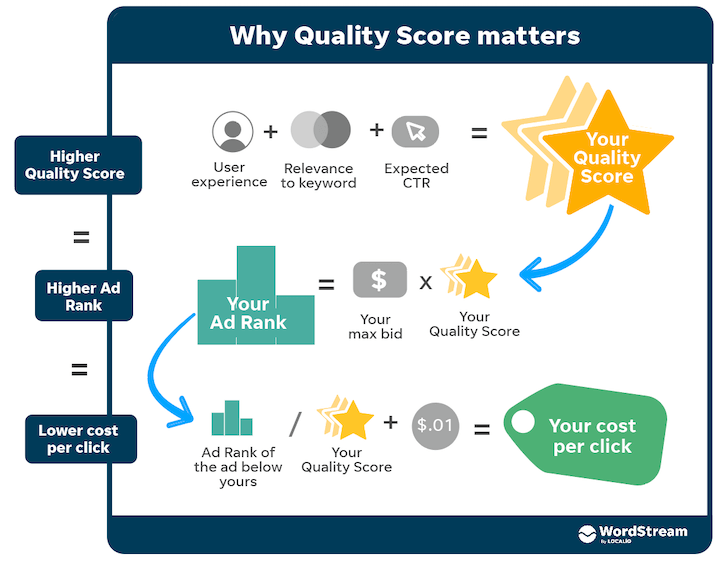
Image Source: WordStream
A weak Quality Score increases paid media inefficiency because the agency must work significantly harder to maintain visibility. Account managers must constantly increase bids to secure top ad placements. This dynamic forces the agency to spend valuable time controlling CPCs and explaining performance fluctuations to frustrated clients. When campaigns underperform due to low relevance, the agency absorbs the operational friction.
Lower Quality Scores increase fulfillment costs because strategists must dedicate hours to troubleshooting poorly structured campaigns. Scaling becomes more expensive, and margin compression accelerates at scale. Strategy teams spend more time diagnosing problems that should have been handled through operational systems from the beginning.
Agencies managing 30 to 100 accounts struggle to maintain Quality Score consistency manually because manual oversight breaks down under high volume. An in-house media buyer simply cannot audit ad relevance across thousands of active ad groups every week. They need a systematic approach to execution.
The real agency challenge is not improving one account’s Quality Score. It is creating repeatable systems that improve Quality Score across dozens of accounts simultaneously.
To improve Quality Score consistently at scale, agencies must first solve the biggest operational weakness in PPC management: ad relevance inconsistency.
How White Label PPC Improves Ad Relevance at Scale?
Ad relevance naturally deteriorates as agencies scale their operations. When in-house teams handle too many client accounts, they begin taking shortcuts to manage their workload. This leads to generic ad copy, broad ad groups, and rushed campaign launches. Account managers often rely on reused templates that fail to address the specific search intent of the user. Furthermore, overloaded teams have limited time for testing ad variations, leaving stale creatives running for months.
White label PPC teams improve ad relevance structurally by deploying strict account architecture standards. Instead of dumping dozens of loosely related terms into one ad group, these teams utilize granular keyword clustering. They build single-theme ad groups to ensure the ad copy matches the exact search query perfectly. This process includes intent-based ad copy mapping and consistent responsive search ad (RSA) optimization. White label PPC partners execute continuous copy testing across account segments to identify top-performing messaging without burdening the agency owner.
These operational advantages create massive leverage. Agencies benefit from dedicated execution specialists who run faster ad testing cycles and maintain a consistent optimization cadence. This removes the dependency on one overloaded in-house media buyer who might be juggling too many deliverables. Agencies maintain strategic oversight while fulfillment teams handle the tedious work of ad refinement.
Consider a local HVAC agency account as an example. An overworked in-house team might build a generic ad group titled "AC Services" with broad ad copy. A white label restructuring process breaks this down into hyper-specific groups:
- Emergency AC Repair
- Residential AC Installation
- Commercial HVAC Maintenance
The result is improved keyword-to-ad alignment, higher CTR potential, and a better Quality Score trajectory across the board. The biggest Quality Score gains often come from operational precision, not creative brilliance.
However, strong ad relevance alone cannot sustain Quality Score improvements if the post-click experience breaks user intent.
The Landing Page Consistency Problem Most Agencies Ignore
Many marketing firms successfully build highly relevant ad campaigns but fail to address the user experience after the click. Landing page experience becomes a massive scaling bottleneck for growing agencies.
Campaigns launch faster than pages improve, creating immediate friction. This leads to messaging mismatches between the active ads and the final destination pages. Common issues include poor mobile responsiveness, slow load speeds, and the frequent use of generic service pages to capture specific ad intent.
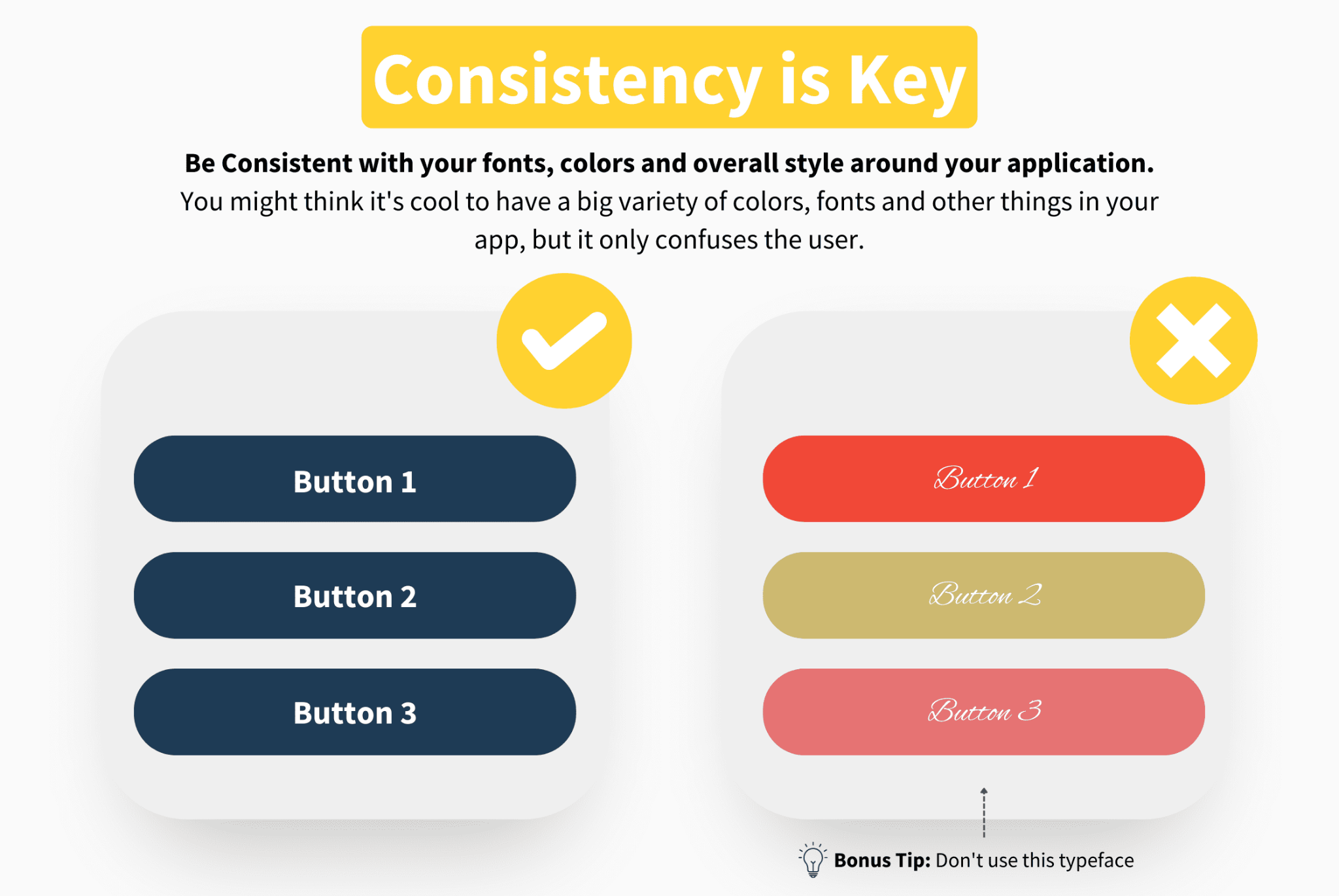
White label PPC support improves landing page alignment operationally by integrating strict quality control measures into the campaign launch workflow. These teams use message-matching systems to ensure the headline on the ad mirrors the headline on the page. They provide keyword-specific landing recommendations based on user intent and conduct conversion rate optimization (CRO) driven audits. By utilizing continuous landing page testing workflows, they ensure mobile functionality and speed checks are completed before scaling ad spend.
Google identifies landing page experience as one of the three Quality Score components.
Recent PPC research highlights relevance alignment as one of the strongest landing page optimization levers for Quality Score improvement.
There is a direct relationship between landing page relevance, conversion quality, and Quality Score efficiency. When users click an ad and immediately find the specific solution they were searching for, they stay on the page longer and convert at higher rates. Search engines monitor these engagement signals carefully. If a user bounces quickly because the page is irrelevant or slow, the Quality Score drops rapidly.
Many agencies optimize ads aggressively while sending traffic to generic service pages. That disconnect silently destroys Quality Score efficiency.
Once ad relevance and landing page alignment improve, agencies gain a new challenge: maintaining keyword control across growing account structures.
Why Keyword Management Determines Long-Term Quality Score Stability?
As client portfolios expand, keyword chaos develops inside scaling agencies rapidly. Without strict governance, accounts become bloated and inefficient. This chaos manifests through duplicate targeting, where multiple ad groups compete against each other in the same auction. Account managers create overlapping search intent, allowing irrelevant clicks to drain budgets. Poor negative keyword management further dilutes campaign performance. Agencies often develop an excessively broad match dependency because building granular exact match structures takes too much time. This results in an unclear match-type strategy that confuses the algorithm and degrades ad relevance.
White label PPC services introduce structured keyword governance to eliminate this entropy. Dedicated specialists perform rigorous search term mining to uncover high-intent queries. They use strict negative keyword isolation to prevent budget waste and apply precise match-type segmentation. This process includes intent grouping and regular keyword pruning systems to pause underperforming terms. Through routine keyword-to-ad group alignment reviews, white label teams ensure every active keyword still serves a clear purpose.
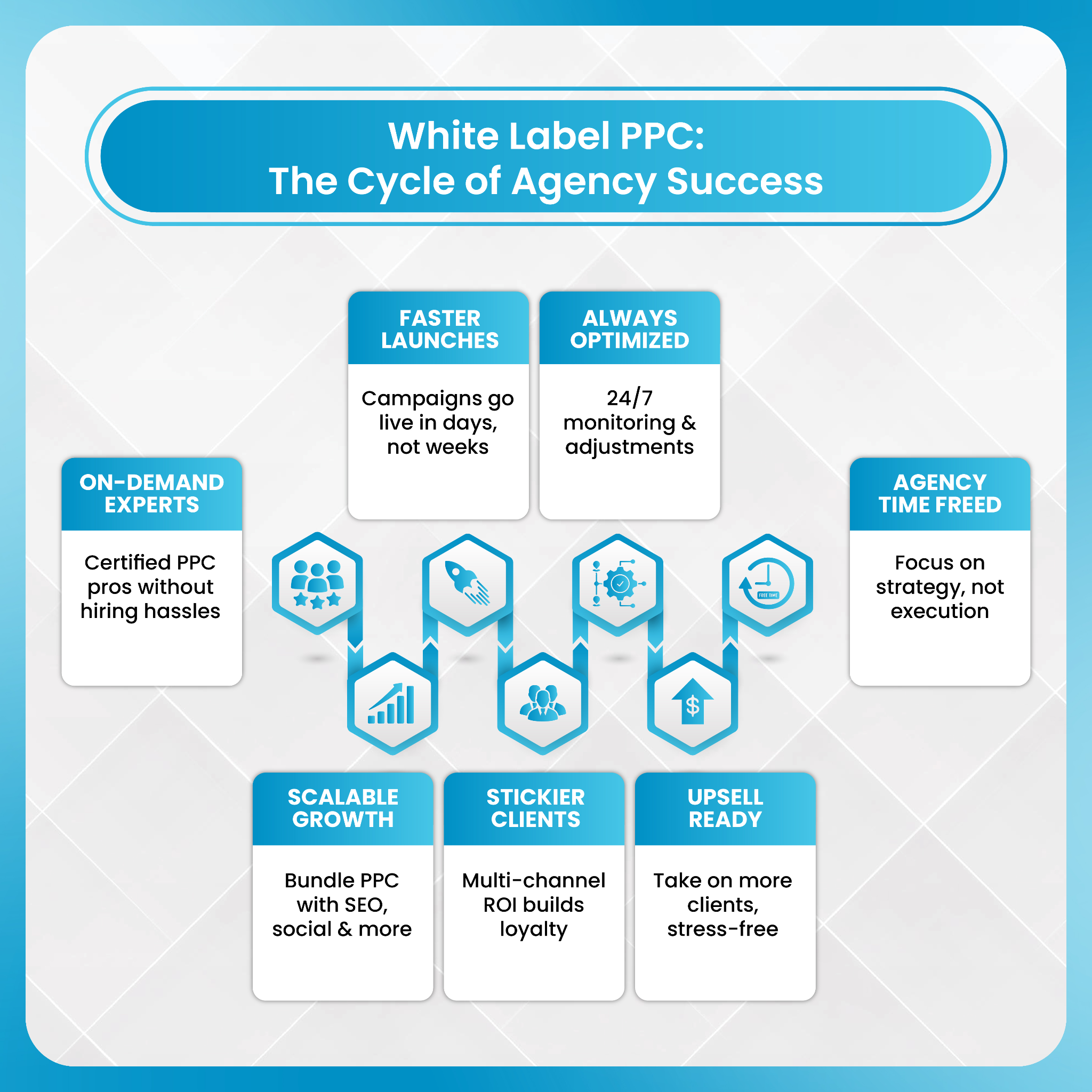
Cleaner keyword architecture improves campaign performance drastically. It generates CTR consistency, ensures search intent alignment, and boosts ad relevance scores. Consequently, the agency experiences better budget efficiency and provides reporting clarity to the end client.
A standard keyword management framework includes:
- Weekly search term review
- Bi-weekly negative keyword expansion
- Monthly keyword consolidation audits
- Quarterly intent restructuring
Agencies lose Quality Score gradually through unmanaged keyword entropy, not sudden campaign failures.
But keyword optimization alone is insufficient if campaign optimization becomes inconsistent across accounts.
How Structured White Label Optimization Creates Quality Score Momentum?
Inconsistent optimization cycles damage Quality Score growth because ad platforms reward active, engaged account management. When agencies scale too quickly, their internal teams fall behind on routine tasks. This results in delayed testing, stale ad creatives, and neglected search term reviews. Infrequent bid adjustments cause campaigns to lose competitive positioning, while slow landing page feedback loops prevent necessary conversion rate improvements.
White label teams create operational consistency by treating campaign management as a rigid, systemized process rather than a sporadic creative exercise. They implement daily optimization schedules to monitor spend pacing and auction dynamics. They utilize strict testing SOPs and advanced performance monitoring systems. This ensures a structured PPC reporting cadence that keeps the agency fully informed. Furthermore, they follow repeatable escalation workflows for underperforming ad groups, ensuring no failing campaign goes unnoticed for long.
These consistent workflows trigger powerful compounding effects across the portfolio. Better CTR means stronger engagement signals sent to the algorithm. Better relevance means stronger auction competitiveness, lowering the minimum bid required to rank. Better landing pages mean stronger conversion behavior, directly improving the client's return on investment. Cleaner keyword structures mean less wasted spend, allowing budgets to focus entirely on high-converting search terms.
This introduces a massive scalability advantage. Agencies improve account quality without overloading internal strategists, allowing the core team to focus on client communication and strategy.
Quality Score improvement is rarely the result of one optimization. It is usually the outcome of operational consistency over time.
As these systems mature, agencies begin to unlock the real business advantage behind Quality Score optimization: profitability expansion.
The Financial Impact of Strategic Quality Score Improvement
The ultimate goal of improving ad quality is not simply to achieve a perfect metric score on a dashboard. The goal is to generate a tangible downstream business impact. Accounts with highly optimized relevance experience lower CPCs, allowing them to acquire more clicks for the same budget. This leads to better ad positions and improved impression share against top competitors. Ultimately, these factors drive lower acquisition costs, which generate increased client retention and more stable campaign reporting month over month.
The agency profitability implications are substantial. With more efficient spend management, agencies can demonstrate better ROAS stability to their clients. This operational excellence leads to improved fulfillment margins. When campaigns run smoothly, account managers spend less time putting out fires and more time upselling services. This drastically reduces churn risk and builds stronger client trust.
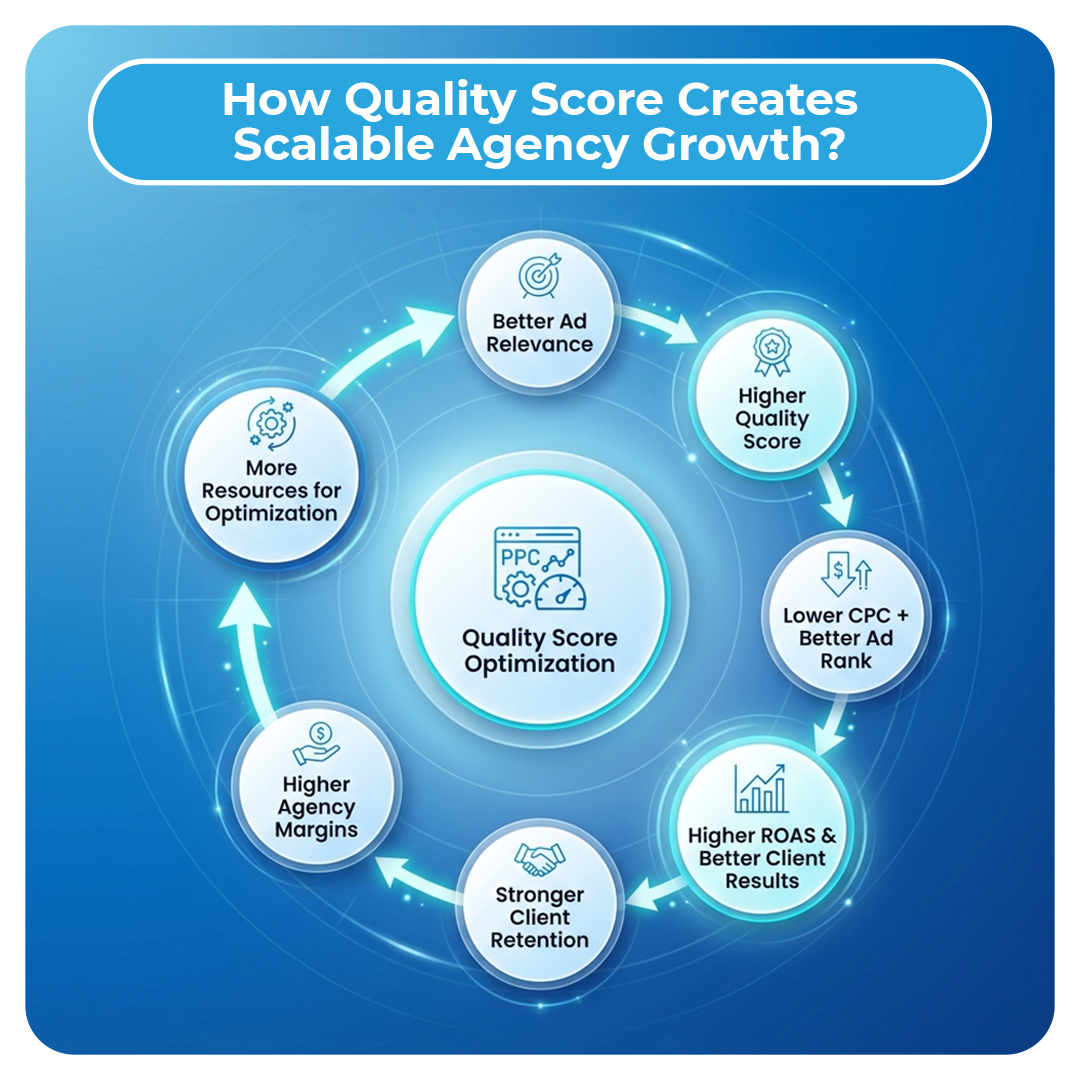
Google states that higher Quality Scores indicate more relevant and useful ads and landing pages compared to competitors. PPC industry studies consistently associate stronger Quality Scores with lower CPC pressure and improved ad positioning.
Agencies scale accounts more profitably when Quality Score improves systematically. A highly relevant account requires less manual intervention to generate leads, meaning the agency effectively increases its profit margin on the management fee.
Most agencies view Quality Score as a campaign metric. High-performing agencies treat it as a margin optimization system. This is why more agencies are shifting from fragmented PPC fulfillment toward operationally standardized white label models.
How DashClicks Supports Scalable Quality Score Optimization?
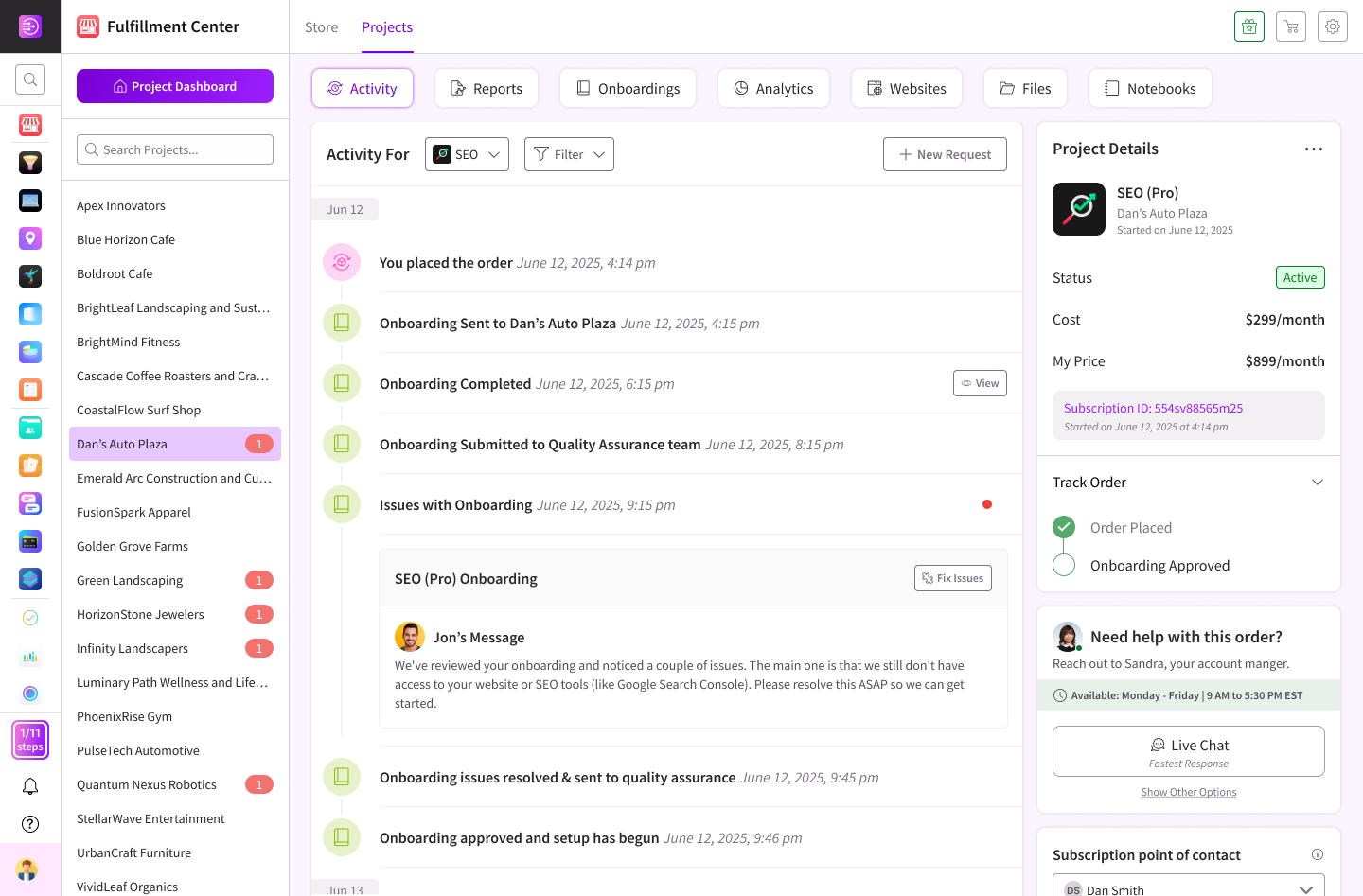
Scaling an agency requires backend infrastructure that can handle the rigorous demands of multi-account management. DashClicks provides this operational PPC infrastructure by functioning as a backend fulfillment system for agencies looking to systemize their growth. Through structured campaign execution, the platform ensures that ad relevance optimization remains a consistent priority across all client portfolios.
Agencies that partner with structured fulfillment platforms benefit from dedicated optimization workflows that tackle keyword management scalability. This systematic approach ensures that routine tasks like search term audits and bid adjustments occur on a reliable schedule. DashClicks helps agencies maintain strict operational standardization, directly influencing the metrics that matter most.
Agencies using structured fulfillment systems can improve Quality Score consistency, reporting continuity, and operational coordination. By relying on white label PPC services for fulfillment coordination, agencies eliminate the chaotic workflow typically associated with managing dozens of fragmented accounts. The platform's reporting systems offer clear visibility into backend operations, giving agency owners the confidence they need to scale aggressively.
This infrastructure enables internal teams to step away from repetitive daily execution. Instead, agency staff can focus more on strategy, client growth, retention, upselling, and profitability optimization. By removing the fulfillment bottleneck, agencies can build robust account portfolios without sacrificing the precision required to maintain excellent ad relevance and performance.
Conclusion
Sustainable Quality Score improvement requires operational consistency. Relying on sporadic campaign updates or isolated manual tweaks will never produce long-term stability for an agency managing multiple accounts. To maintain a competitive edge, agencies must build their fulfillment processes around rigid, systemized execution.
The core pillars of this systemic approach include relentless ad relevance, strict landing page alignment, structured keyword management, and continuous optimization systems. Agencies cannot afford to treat these elements as optional upgrades. They are fundamental components of a profitable media buying operation. White label PPC creates strategic leverage for agencies scaling multiple accounts by transforming these complex execution requirements into a seamless, managed process.
The agencies that scale PPC profitably are not necessarily the most creative. They are the most operationally disciplined.


.svg)


.svg)
.svg)
.svg)
.svg)
.svg)