

DashClicks Blog
The industry's top experts offer their best advice, research, how-tos, and insights—all in the name of helping you level-up your business and online marketing skills.
Join Us!
.svg)
.svg)
.svg)
.svg)
.svg)

What Should Be in Your Marketing Report? 6 Things to Include (and Where to Find Them)
A quality marketing report can make or break a relationship with a client.
Due to the varying timetables of how long it can take to get results, you need meaningful metrics to make an impact. Clients need to be able to understand those metrics in a way that makes sense and promotes further action.
Let's define what a marketing report is, how often you should present one, and the six most important things you need to include.
What is a Digital Marketing Report?
A digital marketing report is a collection of data that illustrates how your marketing efforts are helping a business achieve its goals.
You can generate and present marketing reports weekly, monthly, quarterly, or any other period that fits the agenda. Many marketers will present different marketing reports for different timetables that focus on short-term or long-term goals respectively.
What’s included in a marketing report can fluctuate depending on you and your client’s unique goals. Therefore, any report might include:
- Website analytics
- Social media analytics
- PPC campaign metrics
- Email marketing data
- Any other data that demonstrates where you are concerning the objective
However, if you utilize any marketing reporting tools, you’re likely to find yourself overwhelmed with data. Even though certain channels might provide a wealth of metrics, it does not mean you need to include everything.

Doing so will often confuse your client and obfuscate the hard work that your team accomplishes within a given period.
Though sorting through the data can be challenging, it's much easier if you understand your objectives. For the most part, however, there are the six most essential things that virtually every marketing report should include.
Let's get into it.
1. Your Objectives (with Supporting Research)
Before you begin taking any course of action, you always start by defining your goals and objectives.
Likewise, your client needs a reminder of what the goals are for the period. This will ensure that any following data will make sense and be understood in the context of those objectives.
You must always clearly define your objectives and avoid making any vague, unclear promises. Examples of poorly-defined goals might be:
- Get more followers
- Make more sales
While we can understand the overall idea of those points, it’s fairly difficult to define something so broad. Instead, we can give our clients a better sense of progress by precisely describing what we are attempting to achieve:
- Increase monthly website traffic to X amount by X month
- Improve organic rankings by X amount
- Reach X number of conversions on a specific social media platform
The platforms we use will provide in-depth metrics that communicate these finer points. In most cases, those numbers show the true journey of progress while ultimately serving grander goals like gaining more followers or generating more revenue.
Furthermore, you should attempt to support your objectives by providing research that supports those actions. As an example, marketers understand that LinkedIn is a powerful platform for B2B businesses. If you're trying to help your B2B client build traction on LinkedIn, you can include data that supports why this objective benefits them.
A quick and excellent way of generating excellent research data is through the use of DashClicks' very own InstaReports software.

Marketing reporting tools like these can instantly retrieve live data about a business in seconds. This self-contained report focuses on website data, social media, online reviews, SEO, and paid ads performance. You can use that data to highlight pain points and back your active objectives in those respective areas.
Once your client understands what you're working toward, they're ready to listen to review the next items.
2. Monthly Website Metrics
A business's SEO data is essential for every marketing report. Improving website rankings improves organic performance, meaning lower monthly spending.
In other words, your marketing team should always be working to improve the client's SEO and website performance.
There are numerous free tools for tracking metrics for any domain. The most popular is Google Analytics, which encompasses everything you could ever need to know about a web page or the entire site.
However, GA provides an immense amount of data, not all of which is necessary to illustrate your points to your client. Here are a few key metrics you’ll want to highlight:
- Daily, weekly, monthly website traffic
- Number of unique visits
- Traffic by source (how are visitors finding the site?)
- Page clicks
- Average session duration
- SEO page rankings

You'll want to spend more or less time on specific points depending on the goals for that reporting period.
If the goal is to simply boost brand awareness and traffic, highlighting unique visits as well as their origin is helpful. Highlighting areas of strong performance is what a client wants to see and will make a positive impression.
However, a great marketer won't shy away from the negatives. If you notice a trend in poor numbers for specific pages, make it known. This is an opportunity for growth and improvement, which serves to help the client's overall goals.
Including both positives and negatives also helps the client stay involved and proactive regarding their success. It also inspires their confidence in you when you are actively looking to improve instead of resting on your laurels.
Finally, we would be remiss not to highlight that tools like Google Analytics allow you to create custom conversions for the website. These will allow you to better track progress toward specific goals you have regarding the user experience. Not only does it drive your efforts, but it better communicates what you're accomplishing in the marketing report.
3. Performance Metrics by Campaign
Your digital marketing efforts will extend across many channels in addition to the website.
Examples of these channels might include:
- Email marketing campaigns
- Social media
- PPC campaigns
- Blogs
The marketing tools you’re using for any of these channels will also provide their built-in analytics tracking. Similar to Google Analytics, you’ll want to pull relevant data from the platforms you’re using to run campaigns.
A. Email Marketing Metrics to Include
Email marketing reporting is fairly straightforward and should highlight your reach and conversion rates. Data points to include are:
- Number of emails sent
- Number of emails successfully delivered
- CTR (clickthrough rate)
- Subscriber data
- CVR (conversion rate)
It helps the client to know not only that emails are going out to real contacts, but that those emails are being read by the recipient.
When users open those emails, subscribe to the listing, or convert, it’s transparent that your marketing efforts work. Likewise, a low CTR or a spike in unsubscribers could indicate that the campaign needs some attention.
B. Social Media Metrics to Include
If one of your core goals is to boost brand awareness on social, you’ll want to include some data in your report. This is also applicable if you’re running paid social ads or relying on your following to boost numbers in other areas.
Some key metrics you might include are:
- Follower counts
- Engagement rates
- Shares
- Ad or promoted post CTR
- Audience demographics
More followers, impressions, and engagement means that your social media content is making an impact. Likewise, shared content means an extended reach at zero additional cost to you or the client.
Additional insights about your audience on social media might motivate new campaign ideas depending on your findings.
C. Paid Ad Metrics
This is a necessity if you’re currently running any type of paid ad campaign on search or social media. Paying for clicks doesn’t come cheap, so you need to show your client that their money is being spent wisely.
Essential metrics to include are:
- Cost-per-click
- Conversions & conversion rate
- Cost-per-conversion
- CPM (cost per 1,000 impressions)
- CTR
- Total spend
- ROI / ROAS (return on investment, return on ad spend)

You'll want to highlight similar data for each platform that features a paid ad campaign for your client. Comparing and contrasting performance on different platforms can sometimes highlight where the client's money is best spent.
Something else to consider is highlighting ad creatives that are performing well. It's not uncommon to have creative differences between parties over what they want versus what gets results. Showing off the specific ads with the data leaves both parties with a better understanding of where to go moving forward.
Also, underperforming on other platforms is not always cause to pull all ads. Instead, you can use negatively trending data to promote new ad campaign ideas for the next period with your client's final approval.
You can quickly and seamlessly track all of this data for each platform within the DashClicks Analytics app. Users can integrate platforms like Facebook Ads, Google Ads, CallRail, and others at no cost. You can even track keyword rankings and other vital SEO data at the same time for all of your reporting needs.

4. Leads and Customers
Marketing data from the previous areas is important. It shows that your content is reaching new audiences and connections are happening.
However, many of these metrics can amount to little more than vanity if you're not capturing quality leads. Those leads then need to convert into customers.
In other words, your client is going to want to see the bottom line from all of the previously reported data. You can do this by highlighting:
- Qualified leads by channel (where are we capturing leads?)
- Marketing qualified leads (leads that show engagement and interest)
- Sales qualified leads (leads show motivation to spend)
- Cost-per-action (money spent for each action taken by a customer throughout the marketing process)
- Cost-per-acquisition
- Customer lifetime value (money spent by customer versus the cost to acquire)
Your marketing channels will provide you with the necessary, but these data points will likely require a bit of basic math on your part.
For example, calculating a particular cost-per-action would mean comparing your total expenses versus the number of conversions. A low CPA will indicate that you are reaching engaged customers at a lower cost. A high CPA could indicate that you need to better qualify customers or simplify the process of getting a customer from awareness to checkout.
We recommend placing this data toward the end of your report for two reasons. First, the prior data provides the necessary context for your lead and customer data. Second, your lead data acts as an effective summary of all of your efforts within each marketing channel.
5. A Full Marketing Report Analysis (In Layman's Terms)
All of your reported metrics now need an easy-to-understand breakdown. Your expertise is a big part of what they're paying you for, so now's the time to educate.
Though your client may be able to extrapolate their ideas from the numbers, they still want you to pull it all together and complete the story.
For this reason, your summary and analysis should:
- Explain positive results and highlight continued strategies
- Get ahead of negative snapshots and address the circumstances
- Propose new strategies or ideas to sustain or improve results
- Highlight exceptional achievements
Adding the final color to your marketing picture will better help nonmarketers understand the ebb and flow of the industry. Without your informed explanations, you leave clients to draw their conclusions, which can end up problematic even when there’s no cause for concern.
Likewise, a willingness to confidently address shortcomings outright can replace frustrations with new confidence. As with any customer service, letting the client know you're aware and engaged can alleviate short-term concerns.
Just be sure that your team communicates a plan to address existing issues so that you don't find yourself reporting poor results each period.
6. Future Plans and Strategies
Now that you've had your opportunity to tell the story, the client will be wondering one thing: what's next?
A solid marketing report should conclude with a clear outline of planned strategies and actions between now and the next reporting period.
Those strategies will now be informed by all of the data presented previously in the report. However, as a precaution, make sure to call back to key reporting points to keep your analytics fresh in the client's mind.
With this, the client has an idea of what to look forward to within the coming days and weeks. They're informed and empowered to connect with you if they have questions or concerns about any of your marketing efforts.
Your plans should also reiterate existing goals or propose new ones based on what fits the bill. That way, you can point back to data from the previous month and easily demonstrate progress from period to period.
How to Determine If It Belongs in a Marketing Report?
Before we conclude, we'll leave you with a few pointers that can help sort through marketing data. By asking yourself these key questions, you'll be able to eliminate irrelevant data that fails to serve your report.
A. Does the Data Explain Our Progress Towards Marketing Goals?
As discussed above, platforms like Google Analytics or Facebook Ads provide a wealth of information.
This data provides value, but only if it tells you something about your immediate goals.
For example, if you're attempting to increase website traffic by X percent for the month, stats like individual page rankings are not necessarily relevant to the topic.
Throwing in these additional facts will likely distract from the important conversation. However, a metric like bounce rate may be relevant if the website experiences a period of unusually high bounces. You may sometimes need to use your discretion and ask if this data is of immediate importance to the task at hand.
B. Is the Data Easy to Understand?
In this article, we've used a strong amount of marketing vernacular that you're like familiar with. However, the same is often not true for those that operate outside of the industry.
You want to ensure that your report contains basic vocabulary that's easy for all parties to understand. When taking the data from your analytics platform, restructure it in a way that speaks to the common person.
C. Does the Client Need to Know This?
This final point can be tricky if done improperly.
Even expert marketers will experience a rise and fall within certain metrics. Because we have expertise and insights into trends, we know when a red arrow is a cause for concern.
The same is not always true for the client and seeing negative trends will generally be a cause for alarm. Seeing numbers pointing down can end up dominating the report, even when much of your news is largely positive.
For this reason, think carefully about whether or not certain numbers need to be acknowledged or highlighted in the report.
Note that this is not an opportunity to evade talking about genuinely poor performance. Use your judgment to tell the difference and use your expertise to keep your client's concerns at ease.
Use This As a Template for Your Marketing Reports
Marketers will virtually always want these six categories somewhere within their weekly or monthly digital marketing reports.
However, remember that these ideas serve as a general template. The exact metrics you want to include will depend upon:
- The types of marketing channels being used
- What types of campaigns you’re running
- The client’s immediate marketing goals
Nevertheless, these categories will consistently point you toward the correct numbers that directly address progress. It’s then up to you to provide context for your analytics so that your client can understand where you stand even without insider marketing knowledge.
Your marketing efforts run on the client's budget, so you owe it to them to ensure they're educated. However, you have the power to tell a clear and cohesive story that they won't be able to discover themselves. Use that opportunity to show your strengths, plan new strategies, and omit obfuscatory data.
Remember, you can improve your reporting process right here at DashClicks by taking advantage of our free marketing and reporting software. Signing up for an account is completely free and you can integrate your third-party accounts at any time.
Demonstrate growth, highlight revenue increases, and get to the bottom line. This keeps clients happy and keeps them returning to your team for marketing services every month.

5 Tips for Selecting Marketing Technology
Marketing technologies are a necessity for achieving success and growth in the digital age.
However, simply subscribing to a new platform or purchasing new software will not make you an overnight success. Opting into the wrong digital marketing technology can increase costs, hinder productivity, and hurt your bottom line.
B2B marketing technology should primarily aid in making your team more efficient at what they do best. Here are five tips for selecting marketing technology that your brand can use today and for the years to come.
Tip 1 - Choose B2B Marketing Technology That Can Improve Your ROI
First, and perhaps, most importantly, B2B marketers need software that can provide actionable insights.
Brands and marketers alike are well aware of typical strategies for netting new leads.
Design an elegant website.
Run an ad campaign on social media.
Create the perfect landing page.
The problem is that even the best marketing team will face limitations without access to the right metrics. B2B marketers need to know where traffic comes from, who's converting, and what specifically appeals to unique customers.
Even if new software comes with a learning curve, combining it with the best B2B marketing courses can help teams quickly adapt and maximize the value of their marketing tech stack.

The best B2B marketing technologies should feature built-in analytics tracking for your website, profile, and/or marketing campaigns.
Specifically, sites like LinkedIn allow you to build profiles for free. You can then bridge into creating groups or running targeted ad campaigns that fit accordingly with your budget. You'll have access to a continuous stream of insights around the clock, which ultimately help to improve your bottom line.
Businesses can also find success on other social media platforms, email marketing campaigns, or video marketing. There are numerous affordable options for each that will inform you of daily clicks, traffic sources, engagement, shares, and much more.
Tip 2 - Choose What's Easy and Intuitive to Use
The overall goal when purchasing and using digital marketing technology is to improve efficiency. That hot new tool might work well for some companies, but the benefits are lost if it takes the average team member twice as long to complete a task as it would otherwise.
Ascend2, a research-based marketing company surveyed marketers and found that more than half value ease of use above all other factors. This is unsurprising for several reasons.
First, we want our tools to help us become even more productive than we already are. We're looking to eliminate the tedious aspects of B2B digital marketing so that we can place greater emphasis on those tasks more deserving of our attention.
Second, our team members need to be able to utilize those same tools just as effectively. Ideally, we want to be able to share ideas, creatives, and insights without necessarily possessing the same level of expertise with particular software.
Finally, we want to plan and think about how easy it will be for new team members to adapt to our current marketing technology stack. The more intuitive the toolset is, the less time and resources you need to invest in training, which can impact your bottom line.
Tip 3 - Ease of Integration
This tip effectively goes hand-in-hand with tip 2 but is worth taking note of on its own.
The latest, sexy marketing technologies might boast better ROIs, better insights, and more ease of use, but how does it integrate with your current marketing tech stack?
Any time you look to adopt new technologies, you need to run a cost-benefit analysis of what it will take to integrate your existing data with a new platform.

Does the new software offer open third-party integrations? Is it easy to customize your account and establish those integrations on your own? Will you need to back up data and manually reincorporate it within the new marketing tools?
Some of the newest, most innovative digital marketing solutions are prioritizing ease of integration more than ever. For example, the DashClicks platform offers seamless transitions in the following ways:
- Incorporate all data from any pre-existing CRM
- Incorporate any sales data from any pre-existing sales CRM
- Third-party integrations with popular analytics software
- Third-party integrations with popular campaign software
- Ability to incorporate new apps with an open API call
When choosing new B2B marketing technology, you'll want to look for these types of benefits. This will allow you to take advantage of new apps and features, while still making use of your hard work to date without any additional interruptions to your workflow.
Tip 4 - Invest in Tech That Can Scale
As your B2B marketing company progresses, you'll inevitably look to invest in new marketing technologies.
Because growth is your ultimate goal, you'll want to create a foundation for success by investing in tools that remain relevant as you scale.
This could mean taking advantage of tools and platforms that offer ever-increasing resources and account limits with corresponding price changes. As your team and your customer base grow, you'll be able to make a simple upgrade to your team's account without any interruption to the service.
Continued growth also means experimenting with new marketing channels and resources. You may specialize your efforts in PPC campaigns now but may wish to offer services like web design, report building, or improved CRMs as demands grow.
Platforms like DashClicks, Salesforce, and HubSpot offer these types of expansive platforms so that you can leverage the tools you need when the time comes. Because your company data is already located within that data system, expanding and upgrading becomes simple and intuitive for any user.
Failure to future proof your marketing technology can cause your team to find itself in the same position it's in now. You'll be researching better tech, juggling countless account passwords, and looking for safe ways to transfer existing account data.

Help yourself today by choosing tech that will satisfy your needs both now and in the future. This will keep your team mobile, agile, and allow them to continuously improve their skills within a specific platform over a long period.
Tip 5 - Run a Cost-Benefit Analysis
Finally, choosing the right B2B marketing technology for your team can be as simple as running cost analysis.
There are hundreds of free and paid marketing tools available that can aid your team in every area of digital marketing. While many offer tremendous benefits, that doesn't mean investing in a new tool is the right call at this point.
When looking to cut down on costs and improve profit margins, one of the most commonly recommended suggestions is to eliminate unneeded subscriptions or services. For that reason, you will benefit yourself from closely examining how a particular tool will benefit your team daily before sinking valuable dollars into something unnecessary.

Even if that new technology would be beneficial, you do not always need to leap today. Make a business goal of incorporating new technology into your marketing strategy by a specific date after you successfully reach certain milestones.
When your business continuously hits its marks and finds itself ready to scale healthily, you can look to invest in new marketing tech provided that it satisfies the other tips mentioned previously in this article.
Implement New B2B Marketing Technology the Right Way
Investing in the right digital marketing technology is simple when you follow these basic guidelines.
Marketing rapidly evolves every day with software creators providing new, specialized solutions to different companies. While those benefits and features may seem appealing, not every piece of new tech or software may be right for your team.
Your priority should always be on that which makes your team more efficient and allows them to attain superior results. If the new tech is not directly aiding with everyday tasks or dilemmas, it's not necessary for your marketing stack.
Follow up by researching the tech to ensure it's user-friendly, allows for simple integration with existing tools, and is capable of scaling with you as you grow. Finally, verify that you can safely enjoy all of these benefits without unnecessarily exhausting your budget.

Instagram Automation: 7 Useful Tips to Boost Engagement and Grow Your Account
The most prominent social media challenges include declining engagement rates and organic reach vs. increasing ad cost. With plummeting organic reach on leading social platforms, brands struggle to achieve their goals within their budgets.
According to a Trust Insights study, the average engagement rate for unpaid branded content on Instagram stands at just 0.3% now, meaning, for every 1000 followers, only 3.1 of them will engage with your content.
Forget about the engagement rate of the content on Instagram; the influencer industry on Instagram is also taking a nosedive. In a study conducted by trust insights in 2019, influencers' median engagement rate for more than half a million unpaid posts saw a 41% drop in just one year.
In this scenario, growing social presence and getting authentic followers can become a severe concern for businesses and marketers.
Instagram automation tools can efficiently speed up the process of adding followers and growing your social presence. However, here is a word of caution before you begin using the automation tools. Use only the legit tools to grow your account, and don't spam your followers.
This article discusses the best practices of Instagram automation, so you can drive engagement and accomplish your social media goals.
What is Instagram Automation?
Instagram automation enables you to manage your account, interact with users, and complete tasks using third-party software without the need for any human interference.
Instagram automation tools are of the following two types broadly:
- Service that takes over your direct interaction with users, such as likes and comments.
- Service that automates Instagram backend features such as reporting, publishing, and analytics.
Let’s talk about Instagram bots. You can easily sense bot activity in your account if you notice disappearing followers, mysterious story views, or spam comments. So, putting your Instagram interactions on autopilot can be risky and lead to spammy activities.
Instagram declared its “war on bots” years ago. The platform even went to the extent of shutting down many such bots or Instagram automation tools that violated its protocols and best practices. In 2017, they shut down a popular automation tool Instagress
On August 13, 2020, Instagram introduced new authenticity measures on the platform. Instagram announced that they only wanted to see authentic content on the platform from real people and not bots trying to mislead you. They began asking people to confirm their identities, especially when they observed a potential inauthentic behavior.
Even though bots don't enjoy a good reputation, it doesn't mean that all tools are spammy.
The second type of automation tool includes the tools that work at the backend and undertake post scheduling and publishing tasks. And here is some good news about these toolsāyou can freely use them without worrying about spam or a penalty from the platform.
With the help of these tools, you can automate your posts according to the slots when your audience is most active on the platform. During these slots, the users have the time to uncover hashtags, helping you expand your reach.

How to Automate Your Instagram Marketing for Better Engagement?
Here are the seven tips to automate your Instagram marketing to grow your account faster:-
1. Leverage the Benefits of Story Mention Automations
If you're on Instagram, you'll get lots of story mentions. If you reply to them in masses, you can generate lots of engagement. Automatic and personalized responses help you build instant connections and get more story mentions. As a result, your account grows faster, and you can easily nurture relationships.
Through automated story mentions, you can enter people in a contest. It also allows you to create promotional offers and attract even more mentions. Through these story-mentions, you can virtually respond to everyone who mentions you in their story.
These crafted messages can be stored in the automation tool and sent as soon as someone mentions you. People appreciate this kind gesture and personal touch, which helps you build customer loyalty and establish yourself as an Instagram star personality.
You can use MobileMonkey and set up story mentions in it. All you need to do is first go to your Instagram account and link it to a Facebook Business Page and then to MobileMonkey and follow the instructions.

2. Streamline Posts Scheduling
Now, you can easily schedule posts in advance on Instagram using its post scheduler feature known as Instagram Creator Studio. The tool helps you control your online presence, manage messages, and monitor growth. The batch scheduling feature will save you time.
Creator studio has many features, and one of its prominent features is its professional dashboard which allows you to monitor your success on the platform. It will also help you find educational content shared by Instagram. The growth insights will also help you understand which content is performing and attracting people to your account.
The platform's best feature is its advanced post scheduler, which allows you to follow your content calendar by scheduling posts for Instagram Feed and Instagram TV. It offers a calendar view and is quite addictive.

3. Grow Your Account through DM Response Automation
As your Instagram account grows, the number of direct messages also increases. It feels nice that many people want to speak to you. You can use this favorable opportunity to create a loyal fan base. Still, it's also annoying because you don't have the time to answer every message individually.
It's a common tendency to ignore these messages, but this is not a standard practice if you are a serious entrepreneur or individual. According to a study by Media Brief, 75% of the customers want to talk to the brands through private messages.

Automated direct messaging feature allows you to do many things, including:
- Schedule automated welcome messages to users who DM you
- Send bot-generated automatic replies to Instagram DMs. These are based on keyword triggers.
- Send FAQ answers in DMs using bots.
Even though these generic messages may look like spam in some cases, these can be an excellent way to add calls to action to numerous Instagram comments.
The best way to take advantage of using automated DMs is to ask the users to leave a comment with a specific keyword if they want to download a free eBook, report, or white paper.
This strategy will naturally lead to better engagement, lead generation, and increase the audience on autopilot.
Here’s how you do it:
- Link your Instagram account to a Facebook Business Page, then connect it with MobileMonkey.
- Sign in to your MobileMonkey account. Go to “Chatbot” and then click “Chat starters” on the top bar.
- Go to “Instagram Welcomer” and follow the instructions.
- Write the message you want users to receive when they DM you on Instagram. You are free to choose elements and widgets like attachments, forms, and images, etc.
See the preview and send it.
4. Create Drip Campaigns Messages in Instagram
Email drip campaigns are pretty effective, and you can leverage them on Instagram, too.
Instagram’s drip campaign feature helps you take advantage of the standard automated DM response to increase engagement on the platform.
So, with a drip campaign, you don’t just send a DM; you can share links to your landing pages, blogs, and other content assets, increasing brand awareness and engagement. This activity should go on for several days to achieve tangible results.
You can split the activity in the following manner:
- After you receive their first message, share some educational links about your brand.
- Your next marketing message a few days after your first interaction may contain some social proof. You can share a case study or user review for the purpose.
- Once you’re able to grab their attention, ask them to subscribe to your newsletter or offer them a tool or a free trial.
You can also power your Instagram drip campaigns by launching a lead nurturing campaign or sending an upsell campaign.
You can also try sending onboarding and educational messages to engage users. Another way to utilize drip emails is to ask questions for retargeting.
How to setup Instagram drip campaign:
- Choose “Campaigns” from the top bar and click “Drip Campaigns.”
- Create a new “Drip Campaign.”
- Choose the social platform.
- Choose the audience.
- Choose a schedule for your campaign messages and time interval to send those messages.
- Create messages along with follow-up messages for a 24 hours cycle. If a user responds, another 24-hour cycle starts.
5. Automate Comment Replies
You can leverage comments to go viral on Instagram. Moreover, you can encourage and increase comments on your posts by responding to the existing user comments. More comments lead to more views. Automation allows you to do it in a personalized manner.
You can set it up in the following manner:-
- First, link your Instagram account to a Facebook Business Page, then connect it with MobileMonkey.
- Sign in to your Mobile Money account>>Go to “Chatbot“>> “Chat starters.”
- Go to “Instagram comment guard“>> Create a new one.
- Choose from the two options the Comment Guard will work with, i.e., “All Posts” and “Specific Instagram Post.”
Now, you can decide how to respond.
These options include “respond to all comments” and “respond only to comments that contain the following keywords.”

5. You can put a cap on the frequency cap if a user posts multiple comments.

Craft a message for the users who comment on your Instagram post. You are free to choose elements and widgets like attachments, forms, and images, etc.
6. See the preview and send it.
6. Utilize Instagram Guides for Lead Nurturing
Instagram Guides were introduced for health and wellness businesses during the COVID-19 pandemic and are a new Instagram feature. Later, it was rolled out to all users.
Through these guides, you can share helpful, scrollable curated content and tips in an easy-to-digest format. It makes otherwise lengthy and complex content easy to share and consume.
Three types of guides are prevalent on Instagramāposts, places, and products. You can share guides in stories as well to amplify their reach. You can't precisely term it as automation, but Instagram guides help marketers amplify their reach in a big way.
First, guides are a boon for businesses on a shoestring budget as it's a free tool. Instagram does the heavy lifting of designing your brand pages and guiding you through content promotion.
Secondly, the curation style of guides makes them engaging and easy to share. Instagram guides are highly informative; therefore, you can use them to educate new customers about your brand and how your products add value to their life.
You can use this feature hassle-free because you can set it and forget it. It will help you create enormous content to engage users without putting in the extra effort.

Instagram Guides also make content delivery flexible by giving you a choice of the types of formats. For example, you can convert your text-based articles into slideshows and add images and videos tutorials. You can also create video tutorials that can walk users through the process.
7. Integrate With Short Video Apps Such as Tiktok
Cross promoting on social media amplifies your reach and gives you access to various low-hanging fruits in marketing, such as brand awareness, lead generation, and lead nurturing.
You can easily share your Instagram content on TikTok through the following steps:
Select “Edit profile” in TikTok>> “Instagram“>>Enter your user name>> Click connect

You're ready to share your content now. For example, you can repost your Instagram Reels on TikTok. Don't forget to remove watermarks, though. Follow the platform guidelines. Make sure the content you share is ideal for both audiences.
What Features of Instagram Can I Automate?
As discussed above, you can automate many elements using Instagram automation tools. So, you can:
- Like and comment on posts
- Respond to story mentions
- Schedule posts
- Send automatic responses to DMs
Conclusion
Instagram automation makes your life easier by preventing you from doing repetitive menial tasks and helps you achieve your marketing goals. You can instead use that free time for other crucial business functions like outreach and developing content.
Instagram automation allows you to manage the backend and front-end social media tasks without manual or virtual assistance. If it becomes a routine, it will boost your productivity and help you build strong community links and loyalty.

Top 11 AI Tools for Media Creation
The rise of artificial intelligence and AI tools now allow virtually every person to create media and content without training or skills. With these smart, automated technologies, you can put together content that contends with the most talented artists and content creators on the internet.
Virtually every industry is continuously looking for new ways to integrate and utilize artificial intelligence to work more efficiently and provide more engaging experiences. First-pass copy editing can now be done automatically. The right software can auto-correct images and videos for sharper, clearer images.
As a marketer or business owner, this enables you to take complete control over your branding, content creation, and ad creation. Below, we're going to list out 11 cutting-edge AI tools for media creation that can elevate your game and optimize your team's production.
AI Tools for Writing
1. Quillbot
Do you find yourself coming up with great thoughts for your written material, but can't come up with the best way to say it? Quillbot is an AI-driven writing tool that reads your on-page text and automatically paraphrases it for more concise reading. This is invaluable for those who wish to feature on pieces, but do not write on a regular basis. It can also help any writer by analyzing the body of text and changing lines to avoid repetition.
The key component of Quillbot is its AI-powered thesaurus. The tool features a Synonymsā gauge that you can adjust to varying degrees. By leaving this gauge off, the tool will look for ways to rearrange the words as-is to read in a way that's closer to natural speaking. As you move the gauge forward, the AI will look for opportunities to replace words for found synonyms. Turning this feature all the way up will prompt it to replace a variety of words and phrases throughout the text.

In addition to the synonym tool, Quillbot also provides you with a built-in grammar checker. This is one of the longest-standing forms of AI as it automatically detects errors in grammar and punctuation so that you can patch your writing up on the fly.
Finally, Quillbot offers different writing modes that will affect what types of writing suggestions the AI will offer. For example, you can set the tool to Formal mode for assistance in ensuring your content appears sophisticated and professional. It currently offers the following modes:
- Standard
- Fluency
- Creative
- Formal
- Shorten
- Expand
Only the Standard and Fluency modes are available to free users. Free members can paraphrase up to 700 characters at a time and can utilize extensions for both Google Chrome and Google Docs. There is a premium membership that will cost you $14.95 monthly or $79.95 annually ($6.67/month value). This gives you full access to the platform including its new Citation Generator tool that's still in beta.
2. Zoviz
Zoviz is the best AI-powered logo maker available today, offering fully unique, professionally designed logos in any language, including Arabic, Urdu, Chinese, Japanese, and more. Unlike template-based logo generators, Zoviz uses its own designer-created icon library, ensuring every logo is original, consistent, and brand-ready. You can customize colors, fonts, layouts, and symbols endlessly and download a complete brand kit, including vector files and full commercial usage rights.
But Zoviz goes far beyond logo creation. It has evolved into a complete AI marketing ecosystem that gives businesses everything they need to create brand-consistent content at scale—videos, images, and marketing copy—all in one place.
Its AI Video Generator transforms simple text prompts into polished marketing videos for TikTok, Instagram Reels, YouTube Shorts, and ad campaigns. The tool also supports logo animations and trending social formats, allowing users to produce short-form content without filming or editing expertise.
Zoviz’s AI Image Generator produces professional, on-brand visuals for product photography, website banners, ad creatives, and social posts. With reference-image support and more than five aspect ratios, it ensures consistent quality across every marketing channel.
For marketers who need fast, high-quality content, the AI Copywriting Tool generates email campaigns, SEO-optimized blog posts, ad copy, and social captions in seconds. It follows proven marketing frameworks like AIDA and automatically integrates keywords for better search performance.
Key features include:
- Industry-leading AI Logo Maker (unique icons, full brand kits, multilingual support)
- Text-to-Video Generation for social media and ads
- Brand-consistent AI Image Generation
- Reference Image Matching + 5+ Aspect Ratios
- AI Copywriter with AIDA + SEO integration
- Email, ad, and social content templates
Zoviz is built for businesses that want enterprise-grade performance with unmatched speed. From branding to marketing execution, it centralizes everything into a single, powerful platform, eliminating the need for multiple tools and subscriptions.
3. Articoolo
Articoolo is one of many new AI-driven writing assistants that can generate fresh, original content for you to use in seconds. While it won't deliver you a full, completed article, its ability to extract valuable material and sentiments instantly can drastically reduce the amount of time it takes for a writer to create engaging content.
It works by asking you to enter your topic. Similar to search engine logic, the AI will understand your query and begin to pull facts, quotes, and sentiments that are relevant to the topic you entered. The information it pulls is also complete with high-volume, relevant keywords that will help to make your content more SEO-friendly. It then continues to search for more content related to its findings before producing usable text. Finally, it will automatically check the content rendered for accuracy and readability.
This tool effectively eliminates the issues of both writer's block and the time it takes to research topics. The content it provides you is checked for plagiarism violations and only leaves you with material that you can safely use. This will save you hours of labor and numerous dollars you'd otherwise spend to see the job done properly. The latest addition to the software even helps you find images to supplement your text.

Articoolo is currently only available to paid members. You can currently pay-per-use or subscribe monthly for the following benefits:
Monthly
- $29 per month – 30 articles
- $49 per month – 100 articles
- $99 per month – 250 articles
Pay-Per-Use
- $19 – 10 Articles
- $75 – 50 Articles
- $99 – 100 Articles
4. Grammarly
Grammarly is a staple tool for many content writers and for great reason. It offers a healthy portion of its features to users for free to assist in creating better content across the internet.
Grammarly is a writing assistant that automatically checks your written content for errors in real-time. It regularly scans for punctuation issues and grammar errors. However, it also checks for more in-depth issues such as wordiness, clarity, repetition, and tone. It automatically compares your content to other high-quality content on the internet and issues a real-time score for the text on the page. A score of 100 indicates that your content is free of errors and of high quality.
While reading your content, the AI will inform you of how it interprets your tone. It can actually determine if you're writing a professional article based on the material provided and let you know if your tone sounds shaky or unconfident. Other tones it can identify are playful, humorous, or casual. If you want to shift your tone to be more consistent in one direction, Grammarly will automatically provide suggestions that change the way your content reads.
One of the most useful aspects of Grammarly is that you can integrate it into a wide variety of software that you already use. The AI tool can be integrated into Google Chrome, Google Docs, Slack, Facebook Messenger, Gmail, and various social media platforms. By turning your free plugin on, Grammarly will stay on top of any text you enter at any time.

While the basic suggestions are available to anyone who downloads, advanced suggestions and analytics are only available to paid members. You can get Grammarly Premium for one user at $12 per month. Grammarly Business will cost you $12.50 per month per member and will allow you to share writing suggestions across a team of up to 149 people.
5. GPTZero
GPTZero is an AI detector that helps marketers and content teams ensure their writing maintains a natural, human voice instead of sounding machine-generated. As AI tools become a regular part of content workflows, maintaining authenticity and originality is increasingly important for building audience trust and engagement.
The platform analyzes text using metrics like perplexity and burstiness to detect patterns commonly associated with automated writing. It highlights sentences that may need revision and can identify output generated by tools such as ChatGPT, Claude, Gemini, and other widely used AI systems. For teams handling larger content volumes, GPTZero supports batch scanning through its web dashboard and offers a Chrome extension that integrates directly with Google Docs.
In addition to AI detection, GPTZero also scans for plagiarism across billions of web pages and flags grammar issues during the same review. This allows teams to run multiple quality checks in one place, making the content review process faster and more efficient. The platform also provides section-level scores so editors can easily identify passages that may need human refinement.
The free plan includes up to 10,000 words per month with basic detection features. Paid plans start at $14.99 per month and unlock higher limits, deeper analytics, and collaboration tools. Enterprise options are also available for agencies and organizations managing large-scale content production.
AI Tools for Podcasting
6. Auphonic
Auphonic makes the process of recording, producing, and transcribing any audio recording swift and simple. The platform starts out free and allows you to record and process up to two hours of audio. It offers additional paid plans that range from $11 to $99 per month based on the hours of recording you need to save and edit.
Recording audio is a tricky process, especially for those who are unaware of what can impact the quality of the file. Auphonic largely eliminates these issues by using AI-driven technology that can intelligently identify the timestamps where peaking occurs and automatically level the audio balance between speakers and any additional sound effects. It can also identify any unwanted noise such as hissing or humming and filter it out entirely.

While an automated tool won't be a cure-all when it comes to a low-quality recording, it does an excellent job of alleviating issues that require time, expertise, and precision to remedy. It can accept a wide variety of audio files including MP3, MP4, FLAC, and more.
Even more impressively, the software features an automated speech recognition tool that can successfully identify up to eighty unique spoken languages and transcribe the entire podcast in a matter of minutes. This saves you the hassle of paying an individual to listen to your entire recording and transcribe it manually. You can produce a beautiful transcript that provides more accessible content engagement for all of your users regardless of how they prefer to experience it.
AI Tools for Image and Video
7. Synthesia
Synthesia is one of the most popular AI video creation and editing tools that exist. There was a time where recording and creating video content seemed to be a daunting and wildly expensive task. Today, many of us carry mobile devices that feature high-quality recording equipment capable of forming the foundation for quality video content.
Synthesia even further simplifies the process by allowing you to create full-length videos from a script alone. The AI will read through your script and present it in a video format using a synthetic or real voice of your choosing. You can select from a variety of avatars based on real human beings to represent your team. You can also create and upload custom avatars based on your appearance.
The avatar then reads and presents your scripts in a lifelike appearance that's indistinguishable from a real actor. The audio portion supports up to 57 worldwide languages in both female and male voice settings. With the Enterprise plan, you can even record your voice for use in any of your videos. Choose a custom background, select an audio recording as background music, add some complementary images, and your brand-new video is ready to go in no time at all.

Synthesia offers only two plans. A personal plan is $30 per month and gives you up to 10 video credits per month along with customization features, pre-built templates, and the ability to import PowerPoints. There is a Corporate-level plan that uses custom pricing and offers all of the personal features plus priority support, additional customizations, and premium services.
8. Raw Shorts
Raw Shorts is another AI-driven platform that allows you to create animated videos from your text. Its smart processing tools will read through your entire script, identify key focal points and topics, and draw up a storyboard based on its findings. It then will begin a search for free, stock media assets and place them throughout the storyboard in the relevant places. Finally, it uses a pre-recorded voice setting to narrate your presentation.
With the bulk of the work completed, you can then work with the first draft of your video to customize elements with the intuitive drag-and-drop editor. No video or audio editing knowledge is necessary. With your plan, you'll have access to an enormous free content library that allows you to add a variety of colorful images or videos to your animated presentation.
If using the AI video maker isn't what you need, you can also begin with a variety of pre-built video templates to get you started. Simply plug your script into the template, look for some relevant assets in the library, and you'll have a video to tell your story in a fraction of the time it would take to create and produce a video from scratch.

Raw Shorts offers a free trial that gives you 5 non-premium exports limited to 480p resolution. To gain 1080p HD for your videos, you'll need to upgrade to the Essential plan at $39 per month. This will grant you 25 exports, third-party transfer rights, and 10 licensed clips per month. Finally, the Business plan at $59 per month gives you 50 videos and 20 licensed clips per month.
9. Adobe Premiere Pro
It should be no surprise that an Adobe product makes a list of high-quality video and photo editing software. Adobe Premiere Pro is one of the most widely used and accepted AI tools for creating and exporting high-quality videos and stories. Premiere is such a high-quality product due to its versatility for both beginners and veteran video editors alike.
Premiere is unlike the script-reading software mentioned above and instead focuses on providing powerful tools for raw video editing. It utilizes AI technology to automatically assist with common edits such as color correction, reframing, and object removal. It can also automatically scan the scene and detect opportunities to add cuts when appropriate. The premiere will handle the tasks for you with your approval.
The tool simplifies all aspects of video editing including audio effects, photo transformation, scene morphing, and adding powerful scene effects with the touch of a button. There is a reason that Adobe Premiere Pro is considered the industry standard for creating short films, YouTube videos, social media stories, and much more. While some features may require a bit of experience to get the hang of, Adobe offers comprehensive and easy-to-follow tutorials so that you can get the most out of the media creation tool.

You can benefit from a free trial, but all implementations of Adobe Premiere Pro require a paid membership. Its pricing is highly customized and offers plans for individuals, businesses, and educators. A basic Premiere Pro plan for an individual will run you $20.99 per month. However, you can get the entire Creative Cloud including Photoshop, Illustrator, InDesign, Premiere Pro, and Acrobat for $52.99 per month.
10. Designs.AI
Designs.AI is a multi-use platform that enables the creation of logos, mockups, videos, social media graphics, and voiceovers. It boasts the ability to create high-quality banners or logos for your company or brand in just two minutes with no expertise.
It utilizes an intuitive, drag-and-drop editor where you can drag shapes, colors, fonts, and assets to create image and video files. You can also utilize the AI tool by providing it with information relevant to your brand. It then takes just a few seconds to create a completely unique logo that fits the tone of your company. If you're unsatisfied with the first draft, you can continue using the editor to play around with colors and icons until you get things to where you like them. You can use this process to create an entire folder of assets to use as you'd like around the web.

It also features tools similar to the ones mentioned above such as an automated video maker from text scripts and an automated speechmaker. You can translate your script to over 20 languages, adjust the pitch to match your tone, and add the voice to any of your PowerPoint or video presentations.
Designs.AI gives access to basic tools with a free trial, but you'll need to pay $29 per month for permanent access to the basic tools a marketer needs. There is also a professional plan at $69 per month that gives an entire team full access to highly-advanced editing tools that you can use to create high-quality content for your entire brand at the highest level.
11. KinetiX
KinetiX is an impressive tool that promises to convert your content into 3D animated videos. Though the platform is still technically in beta, you're free to try it for yourself at any time. You can review their guides to learn how to film your content in a way that produces optimal results.
The AI creates and edits your material using tools like Blender and aya to create high-quality, lifelike animations. You upload your file to the platform, optimize your output by instructing the AI on what you want for your animation, and allow the tool to perform the work. The process can take up to 30 minutes, but the result will leave you with a fully-animated 3D character that can help tell your story and share your content in a new, dynamic fashion.

The Starter package allows you to try things out by offering one minute of 3D extraction for personal use only. If you want to use it for commercial use, as most of you reading likely will be, you'll need to upgrade to the Creative Plan at 15ā‚¬ (roughly $17.50) per month.
These AI Tools for Media Creation Will Change the Way You Do Business
It was a slow beginning for artificial intelligence, but AI tools now pervade nearly every aspect of everything we want to accomplish. Its impact on the creative world is profound as it now enables those who are less educated or less artistically inclined to create beautiful, dynamic forms of media with minimal input or time investment.
Personal users and businesses alike can now leverage the power of technology to make use of our ideas as input and output high-quality images, videos, or audio files in seconds. While the output might not be our final product in some cases, having a well-painted canvas to work from can save us countless hours of labor and save us even more in monthly spending.
Video, audio, and image editing experts can also benefit from the AI tools by allowing them to handle routine, laborious tasks while giving you more opportunities to flex your creative muscles. This leaves you with better quality media to sell your brand while spending only a fraction of your usual time to do so.

A Guide to Using Power BI for Marketers
Every successful marketing campaign is driven by real-time data and analysis. However, it quickly can become a nightmare to track your data across a variety of accounts, platforms, and tools employed by your business or marketing agency.
Microsoft's Power BI application promises to alleviate this exact issue and simplify the process of marketing data collection and reporting. By downloading their free application, you can start integrating all of your information sources in one place for either you, a small team, or your entire organization.
What is Power BI?
Power BI is a collection and visualization software that allows you to integrate and gather data from a variety of local and online sources to create robust and dynamic reports. The software provides users with the ability to import analytics from roughly 150 unique data sources to create clear visualizations and powerful insights to guide your business activity.
While many of these sources are integral to a successful marketing campaign, it can be difficult for the untrained individual to necessarily make sense of the figures available. When you use Power BI, you can create a central goal for your report, draw in data from the relevant sources, and outline them in a way that allows for a clear understanding for both your team and your clients.
Power BI exists across three different services including the desktop application (free for all Windows users), the cloud service (for paid members only), and the mobile application for reviewing reports on the go. The desktop application is all you truly need for creating new reports, but the cloud service allows you to quickly share your projects with everyone else in your network.

For paid plans, the cloud service will run you $9.99/month and grant you 10GB of storage and up to eight data source refreshes per day. Their Premium plan costs $20.00/month per user, grants 100TB of shared storage, 48 refreshes per day, and offers additional modeling and visualization tools including advanced AI and dataflows. Finally, Microsoft offers an enterprise-level plan at $4,995/month for the entire organization. You get access tool on the platform, maximum benefits, and the ability to share seamlessly across your entire team. You can learn more about pricing and benefits here.
Finally, as an enterprise Power BI consulting company, Power BI can draw in data for your reports from a variety of sources including:
- Microsoft Excel
- PDF, CSV, Text
- IBM Product Suite
- Azure
- Amazon Redshift
- Salesforce Products
- Google Analytics
- Adobe Analytics
- Twilio
- Quickbooks
- Zendesk
- Zoho
- And much more (nearly 150 sources in total)
How Can I Use Power BI?
Getting started with Power BI is effortless. Simply head over to this link and click the “Download Free” button. On newer Windows machines, this will provide a notice asking you if you would like to open the Microsoft Store on your desktop. Do so, then click to download the application.
If you wish to start out with a paid membership or upgrade your existing plan, you’ll need to navigate to the pricing link given above in the previous section. Click “Buy Now” and follow the steps on the screen to purchase your monthly subscription. You will require a Power BI account, which can quickly be created so long as you have an existing email associated with a Microsoft account. A Microsoft account is free and can be used to log in to a variety of applications and services both locally and online.
After you download the desktop application, you’re ready to get moving. Additional features may or may not be available depending upon your active monthly plan. There is currently no free trial available to test out the additional features only offered with paid subscriptions.
How to Create Marketing Reports with Power BI?
Microsoft's Power BI is relatively straightforward, so let's dive in and know the critical steps to creating marketing reports using Power BI.
Let's begin with how to import data in Power BI:
1. How to Import Data in Power BI
With Power BI installed and open on your computer, you should have your first untitled blank report open by default. The screen should appear something like this:
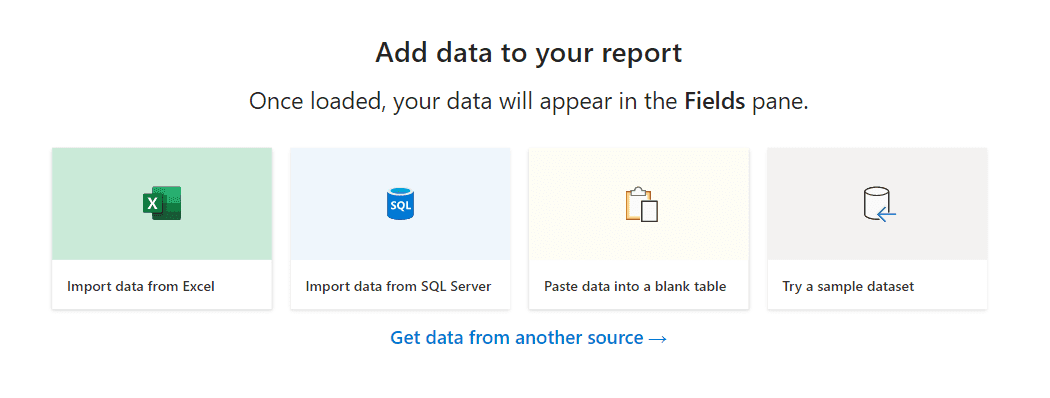
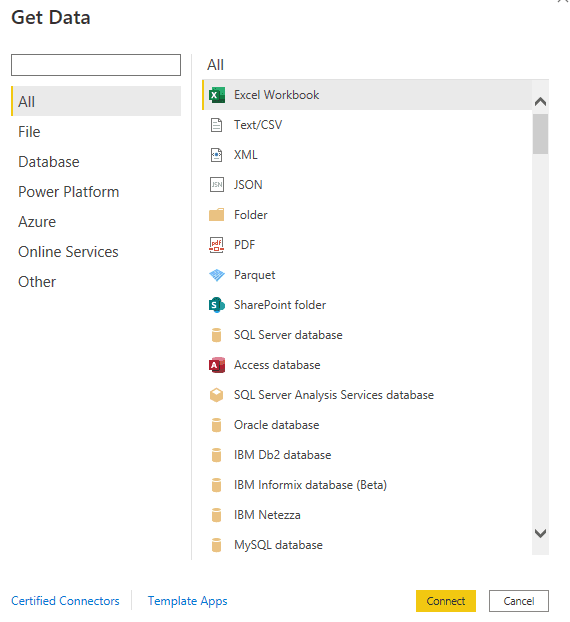
To get started, you will need to import data from at least one source. You can select from one of the pictured sources or click on “Get data from another source.” For future reference, you can also import additional data by clicking on “Get data” in the top menu pictured below:
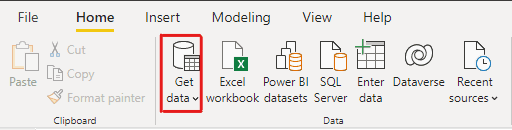
After clicking this button, you’ll receive a list of common data sources, but can access more by clicking “more.” This will provide you with the full list of possible services you can connect with Power BI for your reports. You only need to connect one source but have the ability to connect as many as you would like.
2. Create and Manage Relationships Between Data
After you integrate the data for your report into Power BI, you need to establish relationships between data points. These relationships form the basis of how you want to model your data for presentation. You can do this in one of two ways. The first is to select the “Modeling” tab from the top menu. From there, you can select “Manage Relationships” to start pairing related metrics. You can also quickly create new columns and tables to perform automated calculations based on the data you select.

The second is to select the Model button from the left-side menu. This looks like three modules with lines running through to indicate their connection.
In this menu, you can verify that the characteristic attributed to the metric is correct and easily connect or disconnect two or more properties. To create a relationship, drag and any fields you want to connect between two adjacent tables. To delete relationships, right-click and select “Delete.”
Power BI offers many tools and options for modeling your data, which you can learn more about by taking Microsoft's free, quick training course here. The entire module takes roughly an hour and provides examples and practice problems to verify your knowledge of the platform. Ensuring that you understand how to model your data appropriately is the foundation for creating dynamic and impressive reports for your team and clients. There are few more Power BI courses available online to exile your career in Power BI as a marketer.
3. Choose a Visualization for Your Data
A visualization option is an image or graph that takes your data, the relationships, and presents it in an easily digestible manner for your audience. Examples of visualization options include tables, pie charts, bar graphs, line charts, or waterfall charts. You can find the list of visualizations within one of the collapsible menus on the right side of the screen.

You can get access to additional visualizations with paid plans. Users can also import custom visualization files from trusted developers. If you want to learn more about how you can start creating your own visuals for Power BI, check out this tutorial from Microsoft here.
4. Further Testing and Customization
After importing your data, establishing relationships, implementing visualizations, and adding notes, you can make additional customizations to finalize your report. Head over to the “View” tab to select from a variety of colorful themes that can enhance and personalize your presentation. You can even test how your reports view on mobile devices to ensure that your team or clients receive the best experience no matter where they interact with your report.
This menu also allows you to create custom filters and bookmarks that users can interact with as they move through your report. This can highly key data points that you want to stand out and help users more readily find the metrics that are most pertinent to their needs.
The “Insert” tab also features customization options that may prove useful in certain scenarios. From here, you can add text boxes, create custom buttons to trigger events or change pages, or add images to augment your visualizations. There is also a “Smart Narrative” option that utilizes AI technology to automatically write summaries for you based on the data in a selected visual.
5. Exporting Your Data
When your report is ready to share, you can just as easily export your data as you imported it. Simply move over to “File” and select “Export” from the list of options. You can save your custom report as either a Power BI file to be used exclusively in this application or as a general PDF that can be viewed with a variety of software.
If you’re on a cloud-based plan and wish to share your work with your team, you can select “Publish” to push your report to Power BI services. Any users that operate in the same workspace will be able to discover and view any new reports that come from your desktop.
Use Cases for Power BI in Marketing
Now that we've covered the basics of how to create a customized report in Power BI, let's consider how this tool can augment and improve our marketing services.
As we know, the work of a marketer in 2021 is powered by and driven by automation and analytics. If you research any guides or tutorials on how to improve your SEO, PPC campaigns, enhance your website, and so on, you'll be pointed to a wide variety of analytics tools and software that automatically track user activity and gather data in real-time. As you may have noticed, nearly all of these resources are featured as possible connectors within Power BI. As a result, you'll have an easy time creating reports for the following:
Track Your ROI for Keywords and Organic Search
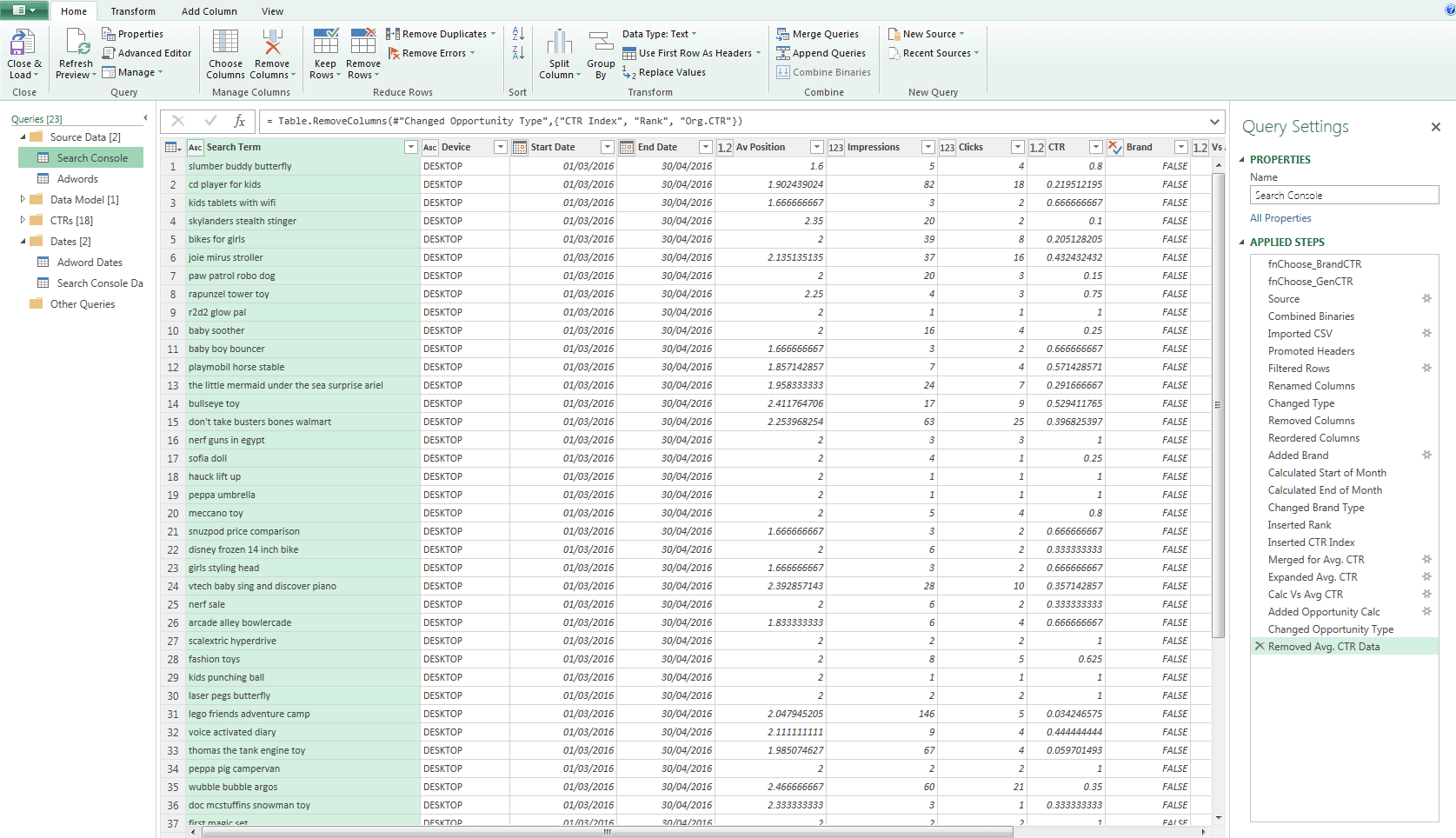
Google Analytics houses much of the data that is relevant to your SEO and organic search campaigns. You can track important data such as your ranked keywords, daily web traffic, search volume, page clicks, and much more. By integrating your Google Analytics data into Power BI, you can quickly compile select data points into tables and graphs to create beautiful, dynamic reports.
Not only will this simplify the process of choosing which data to analyze for your team, but your personalized reports will make your agency look like you're on top of the game when presenting to your clients. You no longer need to worry about scrambling to gather or access the relevant data, as you can save models as Power BI report templates and reuse them for monthly reporting.
Compare Results for Paid Advertising Campaigns
Likewise, you can integrate a variety of online services into Power BI that you may be using to create PPC campaigns and launch new landing pages. Your Power BI reports can focus on a variety of focal points. This could include the numbers behind your A/B testing to help you push for a specific creative or page variation or your average ROI between an existing campaign and past campaigns.
Because there is no limit to the number of connectors you can have in place for a given report, you could even create a report that compares the ROI for organic marketing efforts versus paid ones. These types of reports can provide valuable insights such as which strategies deserve more focus and get results. However, it can also highlight problem areas that require more attention. Without the ability to gather these metrics in one easy-to-read visualization, even the best marketing team can fall guilty of letting these issues spiral before they become unmanageable.
Be Better Prepared for Client Presentations
No matter how well your team prepares for a weekly or monthly presentation with your clients, their minds inevitably operate on a different wavelength than your team. As a result, you find yourself dealing with awkward moments when a question arises that you don't have the answer to. You know you have the analytics available, but it takes time to sort and process the data to come up with an expert response.
By integrating all of your data into Power BI and modeling the relationships upfront, you can more readily sort through your client's analytics in a dynamic manner. You won't need to have your team dedicate as much time understanding the data as your new reporting software has already completed that work for you. As a result, you can provide more valuable insights than normal in real-time. This helps your team appear one step ahead and allows you to tackle problems with your clients in real-time and formulate a game plan for the days and weeks ahead.
Sell Clients on Additional Services
Marketing analytics does not only benefit active services but can be used as case studies to reinforce your sales efforts. When you're able to connect analytics regarding a client's organic or paid marketing efforts, you can compare it to other reports you have for clients that are receiving improved results with the additional services you're attempting to sell.
Power BI makes it easy for you to delete relationships and remove metrics that might reveal private or sensitive data that would harm the privacy of your customers. Utilize the tools available to compare the relevant metrics, and allow the numbers to make the argument of how certain tools, strategies, or services might get the desired results at an additional expense. This is a powerful way of converting both existing customers and prospective clients.
Power BI for Marketers - Improve Your Reporting Efforts!
All of your agency's marketing efforts are driven by analytics and reporting tools. It's not enough to simply gather a list of figures, but you need to ensure that your reports outline the data in a manner that guides your team's strategy. Power BI offers a complete package solution by allowing you to integrate nearly 150 unique data sources that your marketing team is already using to get the job done.
Even with the free plan, your connected data sources will refresh up to a minimum of eight times per day, granting you more than enough leeway to ensure that your reporting is always correct and up-to-date. If you're a much larger business that demands even more data and reporting options for a wide array of clients, you can share Power BI between several users on your team for a slightly upgraded fee per person.
With zero cost to entry and how simple it is to connect your data, there's no reason not to experiment with Power BI and determine if it's a good fit. However, because this is a Microsoft product, it will only really be of benefit to teams using PCs. Don't worry if you're a Mac family, as there are a variety of alternatives available online if Power BI doesn't suit all of your marketing needs.

7 Emerging Technologies in SEO and Their Applications
As Google's search algorithm evolves, so too must our marketing strategies. SEO experts and business owners alike must stay on top of the latest SEO techniques for better site optimization, improved search rankings, and better conversion rates.
If you're concerned about how these changes will impact your website, worry no further. Below, we're going to provide you with a look at seven emerging technologies in SEO that are changing the way users access information. Some technologies are still being refined, while others are already here in a usable state.
1. Googlebot A/B Testing
If you have any experience in managing a website, creating ads, or creating landing pages, you're already familiar with A/B testing. This is the process of creating two different variations of the same creative. You then divide your web traffic to determine which version performs best with your audience. In this scenario, your campaign is already live and you are spending the budget to gather analytics.
With SEO A/B testing, you are performing the same process but unveiling it to Googlebot first rather than your audience. In addition to this, you are typically only providing one version of the page to compare it to the base version.
A/B testing with Googlebot can be used to analyze a variety of SEO factors including headlines, content variations, meta descriptions, schema markup and rich results, mobile page variations, and much more. You also do not need to worry about hurting your current page rankings so long as you follow Google's recommended guidelines for testing, which you can find here.

While user A/B testing is valuable and can certainly drive conversions, SEO A/B testing can allow for greater confidence in your results. This is because we are dealing with Google's search algorithm directly and making changes upon actual changes to search traffic, click-through rate, and search engine rankings.
If you're curious where you can begin experimenting with SEO A/B testing, you can take advantage of these features in Google Tag Manager along with Optimize.
2. Google's Multitask Unified Model
In the ongoing effort to be the world's best search engine, Google continues to improve how its algorithm reads and understands search results. Back in 2019, an addition to the algorithm known as BERT (Bidirectional Encoder Representations from Transformers) brought with it natural language processing technology. Since then, Google further improved its ability to understand complex queries with the Multitask Unified Model (MUM).
As smart as artificial intelligence can be, it commonly struggles with understanding user intent. This becomes an issue with how nuanced human language is and how we go about using it when browsing the web. AI is often left to read our search queries as entirely literal, while we as humans can decipher hidden meanings or intent behind a simple phrase. As a result, the user typically makes several searches before finding what they really need.
MUM is changing the game by allowing the algorithm to determine the actual meaning behind a web search. Essentially, the experts at Google trained the algorithm to better understand how users around the globe utilize language for search.
As a quick example, let's say a local store proprietor wants to start selling alcohol. He searches for something to the effect of need alcohol permit store.ā Based on the search intent and background information, we understand that the store owner wants a link telling him how to get his permit. However, the algorithm would previously interpret this in a number of ways, such as Do I need an alcohol permit? It may also not understand that specifically, a business person is completing this search, not your average citizen.
With the latest advances in machine learning, Google search can now immediately complete a series of complex tasks and derive the actual search intent based upon user behaviors worldwide. It now understands the search intent as we do and provides the most relevant information at the top of results.
MUM takes this even further by providing this level of accuracy across 75 different languages. Google's smart algorithm is able to remove language barriers as a factor and deliver the best information to anyone in the world regardless of the language used. It can deliver information in one language and deliver it in the user's preferred language.
As an SEO, this does not necessarily present new challenges for your existing SEO strategy. However, Google's continuous advances in searching for the most accurate information reinforces our need to optimize our content for this purpose. By delivering the most informative, easy-to-use content possible, we can potentially boost our traffic with users around the world.
3. Allow AI to Write Your First Draft
New AI-driven technology may someday write our SEO content for us entirely. OpenAI, an artificial intelligence research company, unveiled its GPT-3 language generator just over a year ago. This allows users to create some of the most human-like text ever created by machines. We provide the API with the subject we need to focus on, and it quickly creates the content of varying lengths depending on the information it finds around the internet.
However, if you glance at the article above, you will quickly see that this technology is currently posing problems, as well. Due to its complete reliance on existing human behavior only, it's very easy for the AI to deliver content that comes with biases that we do not intend to include in our content. Many tests were quick to deliver hateful, racist messages within the text.
For this reason, GPT-3 is not yet at a place where we can place total reliance on language-learning technology. At best, we can attempt to utilize this AI to create first drafts of content. We then review the copy to see the quality of information gathered, while making the necessary changes and revisions to produce a final copy.

With that said, it's just a matter of time before text-based content creation is no longer a task performed by humans. As experts in the field continue to train artificial intelligence to better understand the intention, desire, and emotion, robots will be able to apply those factors when creating long-form informational articles.
4. TF-IDF for Keyword Relevance
TF-IDF (Term Frequency Times Inverse Document Frequency) is an equation used to measure the actual importance and relevance of a keyword. This is as opposed to keyword density within a document. This is important for search engine optimization specialists as you can use TF-IDF when researching keywords that are the best fit for your page and website.
You will need to implement your usual SEO strategy and create the content you want to analyze with TF-IDF. Then, your TF-IDF tool will rapidly compare your document to high-quality information that exists online. This will highlight high-quality terms and phrases present in other content that can support and improve your own.
To further explain, every piece of content will generally contain common words or phrases. Because these words appear with a high frequency, TF-IDF determines that they are less relevant as they are not unique to the subject. However, less frequent terms that only appear in related topics are more valuable and have higher relevancy. This creates a list of the terms you should focus on and eliminates those you can ignore.
No longer do you need to leave the task of researching every piece of high-ranking content to determine gaps in your own. You can utilize tools online like TF-IDF Tool or Ryte.

5. Automated Content Research and Optimization
Businesses and marketers are already taking advantage of automated content research and optimization tools for efficient content creation. You no longer need to enlist dedicated content writers that need to spend hours researching, writing, and refining text to perfection. You simply enter your target keyword or subject, allow the tool to grab the most relevant data, and then get to compiling it into your new article.
These state-of-the-art tools rapidly check the internet for relevant articles at the top of search results as well as the People Also Ask section. It's also become sophisticated enough to discover popular questions and answers from major sites such as Reddit, Answers.com, Quora, or Wikipedia.
There is a wide variety of tools and platforms for you to choose from for your content research. This includes sites like Ubersuggest, BuzzSumo, and Content Harmony.

Source: Ubersuggest
6. Search Driven by Image and Video
While informative content is king in marketing, high-quality images and video become increasingly more valuable for SEO over time. Not only does it enhance the quality of your content and make it more engaging for your users, but it may also one day take precedence over text entirely in some cases.
Earlier in this article, we discussed a new level of sophistication that's reached Google's search algorithm through MUM. Not only does this technology help the algorithm under search intent, but it is also gaining the ability to recognize dynamic media and generate relevant results based upon what's shown in a picture or a video. Users can already utilize media as a search query and receive a list of results that Google determines is relevant.
While image and video optimization are already essential for SEO, they will continue to gain added importance for every website. Media optimization already improves site speeds, mobile friendliness, and user retention, but it may become a determining factor in whether or not your content successfully outranks your competitor's.
Google provides explicit guidelines as to what you should do for best practices when it comes to images, video, and rich media files. Free options for editing and optimizing images and videos include Canva and Invideo. If your SEO strategy does not already include plans for an emphasis on media, understand that it will continue to be a significant factor in search rankings.
7. Users will Learn More from AI Conversations (LaMDA)
The researchers at Google are not stopping at improving the quality of its search results. One of its latest technological advances is known as LaMDA, also known as Language Model for Dialogue Applications,ā may change the way we access information forever.
LaMDA follows in the footsteps of other language models mentioned in this article like BERT and GPT-3. The difference for this piece of technology is that its training is geared toward learning the principles of human conversation and interaction. While many of us may already use some form of voice-activated software such as Amazon's Alexa or Apple's Siri, those robots primarily seek out relevant search results to provide answers. Other responses are primarily scripted and will trigger when given the right inputs.

This new technology seeks to provide relevant information in a more conversational approach as opposed to simply pulling up the top-ranked results. The current task ahead is to maintain its compelling level of relatability, while still staying true to informational accuracy. It also faces the same challenges mentioned with other language models for its ability to be misused for harmful or hateful purposes.
Nevertheless, it is inevitable that we all will be able to access any information we desire by simply asking a robot a question. How this will directly affect our SEO strategies remains to be seen, but key practices will still remain. This means that our focus should still be to follow Google's guidelines when it comes to creating valuable, factual content.
Any information published on your website should follow Google's EAT (Expertise, Authority, Trustworthiness) principle. By providing reliable information that Google can use in its automated processes, we will continue to receive the SEO benefits we need and see our websites rank as more valuable in the eyes of the Google algorithm. However, we will need to keep a close eye on how conversational AI changes the way we format and present our data to search engines.
Conclusion - Emerging SEO Technologies Will Forever Change How We Access Information
While some of these technologies may yet be years away, many are already here and being used by business owners and marketers alike. You may no longer need to spend hours researching keywords and information for your articles but can utilize sophisticated tools that automatically bring you the data you need for valuable content.
Search engines are also continuously improving their machine learning algorithms and changing the way search engines read and deliver results. In time, we may be able to access all of the information we need to make a consumer decision by conversing with artificial intelligence just as we would with a sales representative.
Finally, media will continue to be a significant factor when determining what constitutes a valuable search result. Your SEO strategy should place even greater emphasis on video and image optimization that supports any text on a given webpage. The on-page content itself should factor in Google's EAT principle to demonstrate expertise, authority, and trustworthiness regarding any subject matter.
While there are still unknowns in regard to how changing technologies may impact SEO and search rankings, we still know to focus on these fundamental principles to continuously improve our site quality ranking. SEO and digital marketing will always be an ever-evolving landscape and it's up to us to stay on top of the latest trends to reap the greatest results possible.

No results found.
Please try different keywords.
Get Started with
DashClicks Today
Get found online, convert leads faster, generate more revenue, and improve your reputation with our all-in-one platform.
.svg)
Unlimited Sub-Accounts
Unlimited Users
All Apps
All Features
White-Labeled
Active Community
Mobile App
Live Support
100+ Tutorials
Unlimited Sub-Accounts
Unlimited Users
All Apps
All Features
White-Labeled
Active Community
Mobile App
Live Support
100+ Tutorials
Unlimited Sub-Accounts
Unlimited Users
All Apps
All Features
White-Labeled
Active Community
Mobile App
Live Support
100+ Tutorials


