

DashClicks Blog
The industry's top experts offer their best advice, research, how-tos, and insights—all in the name of helping you level-up your business and online marketing skills.
Join Us!
.svg)
.svg)
.svg)
.svg)
.svg)

What Should Be Included in White Label Google Ads Fulfillment
Digital marketing agencies can sell Google Ads management without building an in-house PPC department. Many use a white label partner to fulfill campaigns behind the scenes, allowing the agency to focus on strategy, client relationships, and growth. The key is defining exactly what fulfillment includes.
“Google Ads fulfillment” can mean different things. Some providers treat it as basic campaign setup, while a complete fulfillment model supports the campaign throughout its lifecycle.
Effective fulfillment should cover setup, measurement, launch, optimization, quality assurance, and reporting. Campaign creation is only the starting point. Ongoing search-term management, bid adjustments, budget monitoring, ad testing, and consistent reporting are equally important.
Current benchmark data highlights why this broader approach matters. According to WordStream’s 2026 Google Ads benchmark data, based on more than 13,000 U.S. campaigns, the average search-ad CPC is $5.42, while the average conversion rate is 8.18%. These figures vary by industry and competition and should not be treated as universal targets. They do, however, reinforce the importance of managing campaigns for efficiency and conversions rather than clicks alone.
This blog explains what a complete white label Google Ads fulfillment scope should include, from initial setup and measurement through ongoing optimization, quality assurance, and reporting, so agencies know what to expect and what to clarify before outsourcing.
What Should Google Ads Campaign Fulfillment Include?
Fulfillment is more than campaign creation. A complete scope should support the work required before, during, and after launch, covering everything from the initial build to the ongoing management that keeps a campaign aligned with its goals.
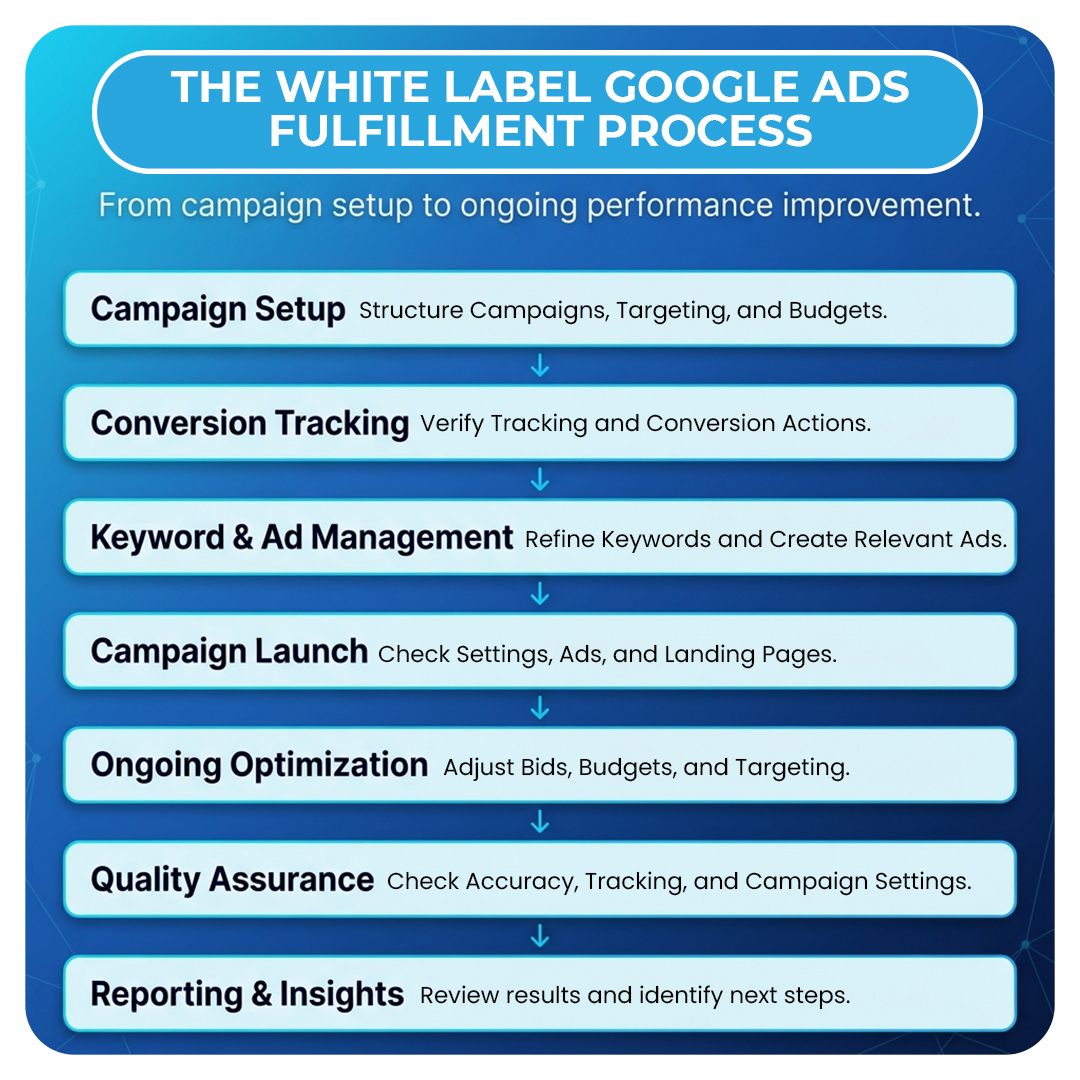
1. Campaign and Account Setup
A proper campaign setup should include several foundational elements that determine how well the account performs from day one. These include:
- Campaign Objectives and Structure: The campaign type and structure should match the client's goals, whether that's lead generation, e-commerce sales, or brand awareness.
- Targeting and Locations: Audience targeting and geographic settings need to reflect where the client's customers actually are, not a default setting.
- Ad Schedules and Budgets: Schedules and budget allocations should align with when the business can realistically handle leads or sales.
- Ad Groups and Keywords: Ad groups should be organized around tight keyword themes rather than broad, unfocused lists.
- Campaign Settings and Naming Conventions: Consistent naming and settings make accounts easier to audit and manage over time.
- Account Organization and Initial QA: Before launch, someone should review the full build to catch errors in targeting, tracking, or structure.
Setup should reflect the agency's strategy and the client's specific objectives rather than follow a one-size-fits-all template. A fulfillment partner should understand the approved campaign direction and implement it accurately, not substitute their own generic approach.
2. Conversion Tracking and Measurement
Measurement should be established before optimization begins. Without reliable tracking, every later decision about bidding, budget, and keywords is based on incomplete information.
This stage should cover primary versus secondary conversion actions, such as forms, calls, purchases, and other relevant actions specific to the client's business. It also includes verifying that tracking fires correctly, confirming the integration between Google Analytics and Google Ads, and setting conversion values where applicable.
Google states that the Conversions column contains primary conversion actions and that this data can be used for bidding optimization. Google also explains that conversion values can help advertisers measure business value and support value-based bidding. This guidance underscores why tracking accuracy matters so much.
Tracking is not a setup checkbox. Inaccurate or incomplete conversion data can affect the signals used to evaluate campaign performance and make optimization decisions, which means errors here ripple through every later stage of fulfillment.
3. Keyword and Search-Term Management
Keyword work does not end once a campaign launches. It continues throughout the life of the account as search behavior shifts and new data becomes available.
Ongoing keyword and search-term responsibilities typically include:
- Keyword Research and Intent Alignment: Identifying terms that match what the client's customers are actually searching for, not just high-volume terms.
- Match-type Strategy and Grouping: Choosing match types and organizing keywords into tight themes that keep ads relevant to searches.
- Search-term Reviews: Regularly reviewing the actual queries triggering ads to spot irrelevant traffic and new opportunities.
- Negative keyword management: Adding exclusions to prevent budget from being spent on searches that will not convert.
- Refining targeting based on data: Adjusting keyword lists as campaign data reveals which terms perform well and which do not.
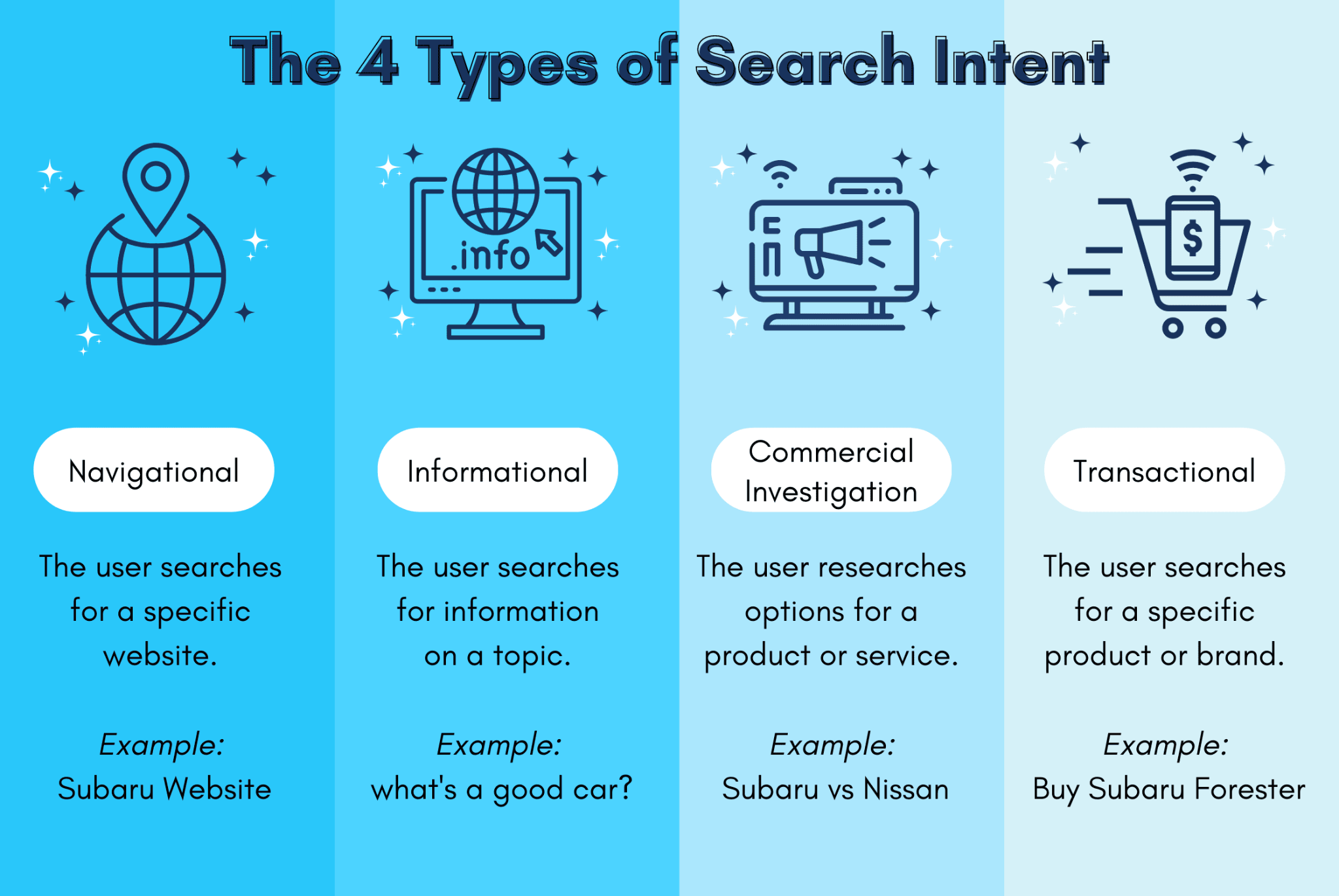
Ongoing search-term management is part of fulfillment, not simply an initial research task completed once at launch.
4. Ad Creation and Testing
Ad execution should center on Responsive Search Ads, including headlines, descriptions, and calls to action that align with the client's approved messaging. Keyword-to-ad relevance matters here too, since ads that closely match search intent tend to perform better within the account.
Fulfillment should help execute, test, and maintain ad variations based on the campaign's goals and available performance signals. This means reviewing ad-level performance regularly and adjusting assets when certain variations underperform, rather than leaving the same ads untouched indefinitely. This is not about teaching an agency how to write ad copy from scratch. It's about consistently executing against an already-approved strategy.
5. Landing Page and Conversion-Path Alignment
The path from a search query to a conversion involves several connected stages: search query, ad, landing page, and conversion. Google Ads fulfillment should consider whether these stages are actually aligned with one another.
This includes reviewing search-intent alignment, checking that the ad's message matches the landing page content, confirming the call to action is consistent, and verifying that tracking is firing correctly on the page. It also means identifying obvious conversion barriers, such as confusing forms or slow load times, that could be hurting results.
Fulfillment may include review and recommendations for landing pages, while actual development or implementation depends on the agreed scope between the agency and the white label partner. A fulfillment partner does not automatically develop or redesign landing pages unless that work is specifically part of the engagement.
6. Bidding and Budget Management
Bidding strategy should be selected based on the campaign's actual goals and what the measurement setup can support. This includes monitoring budget pacing, tracking spend against approved limits, and flagging when a campaign is over or under budget for its intended role.
Google describes Smart Bidding as using AI to optimize bids for conversions or conversion value at auction time. This kind of automation can be useful, but it still requires oversight. Someone needs to monitor how a bid strategy performs and avoid making unnecessary changes during learning periods, when algorithms need time to gather data before adjustments make sense.
Fulfillment includes monitoring and informed adjustments rather than making constant changes simply to demonstrate activity. A bidding strategy that is left alone during a learning period is often performing exactly as it should.
Setup lays the groundwork, but the work that follows is where most of the account's performance gets shaped over time.
Further Reading: How Agencies Can Adapt to Smart Bidding Trends Using White Label PPC Services
What Ongoing Google Ads Optimization Should Include?
Launching a campaign is only the beginning of campaign management. This is one of the most important distinctions agencies should understand when evaluating a fulfillment partner, since optimization quality often determines whether a campaign stays relevant or quietly stagnates.
Optimization should be based on performance signals, campaign data, and client objectives rather than arbitrary changes made for the sake of activity. A responsible fulfillment partner reviews data on a regular cycle and makes decisions tied to what that data actually shows.
Ongoing optimization typically covers:
- Search-term and Negative-keyword Reviews: Reviewing the queries generating traffic to identify irrelevant searches, useful new themes, and opportunities for negative keywords.
- Budget Monitoring: Tracking spend against the approved budget and identifying campaigns that may require allocation changes based on their role and performance.
- Bid Monitoring: Checking whether the current bidding strategy is producing the expected results given the campaign's goals.
- Ad Testing and Keyword Refinement: Testing new ad variations and adjusting keyword targeting as search behavior and performance data evolve.
- Campaign and Ad-group Performance Analysis: Reviewing how individual campaigns and ad groups are performing relative to the account's overall goals.
- Audience, Device, Location, and Schedule Analysis: Looking at performance across these dimensions where relevant to the campaign, since results often vary significantly by segment.
- Impression-share Monitoring: Checking whether budget or bid limits are preventing ads from showing as often as they could for relevant searches.
- Conversion Review: Evaluating whether reported conversions continue to reflect the business outcomes the campaign is intended to generate.
- Lead-quality Review: Considering whether the leads or conversions being tracked are actually valuable to the client's business, not just numerous.
- Landing-page Observations: Noting any patterns suggesting the landing page may be limiting conversion performance.
- Identifying Next Priorities: Determining what needs attention in the upcoming optimization cycle based on everything reviewed.
Good optimization should answer three questions:
- What does the data show?
- What changed?
- What needs attention next?
This is not about constantly changing campaigns for the sake of showing activity. Sometimes the right optimization decision is to leave a well-performing element alone and focus attention elsewhere.
QA and Reporting: The Final Layer of Fulfillment
Quality assurance and reporting complete the fulfillment cycle. These steps are often overlooked when agencies evaluate a white label partner, but they are what separate a reliable fulfillment process from one that creates more work for the agency down the line.
Quality Assurance
A concise pre-delivery QA checklist should confirm the following before work reaches the agency or client:
- Tracking verified and firing correctly
- Budgets checked against approved amounts
- Targeting checked against the approved strategy
- Ads reviewed for accuracy and compliance
- URLs reviewed to confirm they lead to the correct pages
- Negative keywords checked and up to date
- Conversion actions reviewed for accuracy
- Campaign settings checked against the original build
- Approved strategy confirmed before changes go live
QA helps catch execution issues before work reaches the agency or client, reducing the chance of errors slipping through. QA does not guarantee error-free campaigns, but it significantly reduces the likelihood of avoidable mistakes making it into a live account.
Reporting
Reporting should cover the core metrics that tell the story of how a campaign is performing: spend, clicks, conversions, CTR, CPC, conversion rate, CPA or CPL, and where applicable, conversion value and ROAS. Google's reporting documentation highlights metrics such as conversions, conversion value, cost per conversion, and conversion rate as important conversion-related reporting measures.
Reporting should also cover key changes made during the cycle, work completed, and the priorities identified for what comes next. Reporting should help the agency understand what happened, what changed, and what should happen next. A useful fulfillment report provides context around campaign activity and priorities rather than functioning as a simple list of platform metrics with no explanation attached.
Further Reading: Google Ads Reporting: Showcase Your Agency's ROI With Excellence
What Agencies Should Clarify Before Outsourcing Google Ads
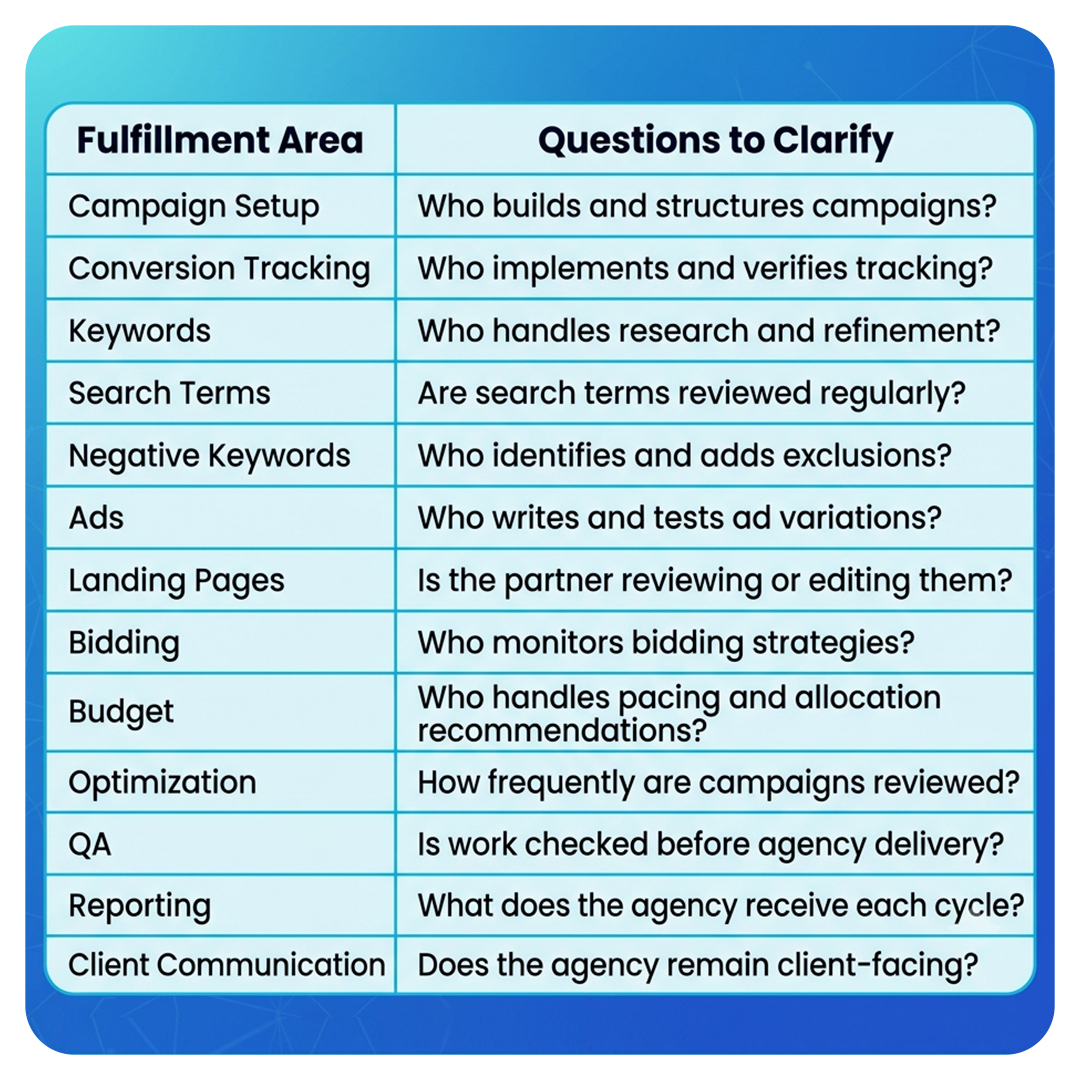
Before agreeing to outsource Google Ads, agencies should clarify exactly what "fulfillment" includes with any potential partner. The table below outlines the key areas worth discussing upfront.
Agency vs. White Label Partner: Who Handles What?
Agency Owns
- Client goals
- Strategic direction
- Prioritization
- Approvals
- Client communication
- Final recommendations
White Label Partner Supports
- Campaign implementation
- Keyword management
- Ad execution
- Technical setup
- Ongoing optimization
- QA
- Reporting support
Agency strategy + fulfillment capacity = scalable Google Ads delivery
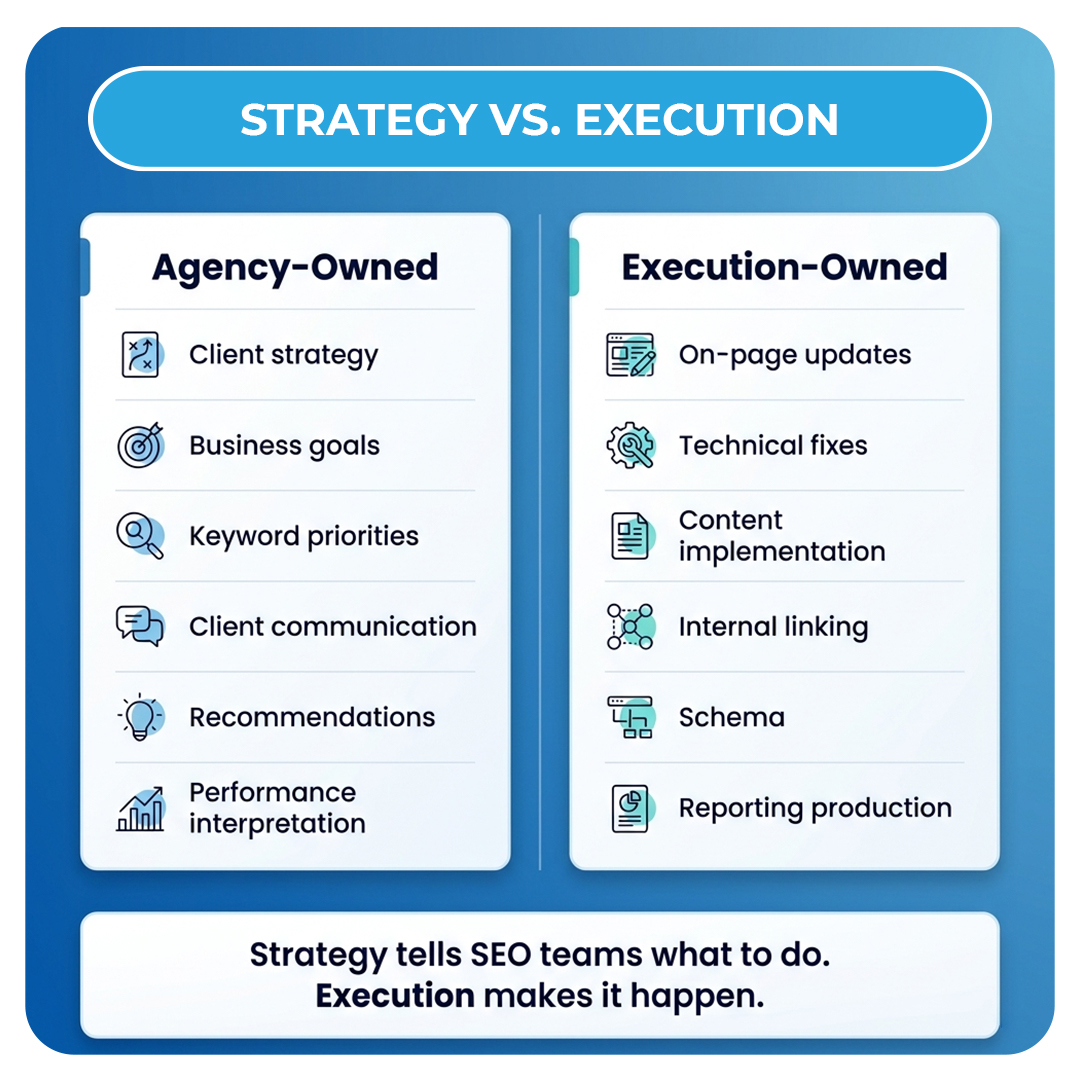
The purpose of white label fulfillment is to provide execution capacity while allowing the agency to remain responsible for strategy and the client relationship. A fulfillment partner supports the work that happens behind the scenes, but the agency stays in control of direction and client-facing decisions.
DashClicks: White Label Google Ads Fulfillment for Agencies
DashClicks supports agencies with the execution side of Google Ads, functioning as an extension of the agency's team rather than as the client-facing agency. Agencies retain ownership of strategy and the client relationship throughout the engagement.
White label Google Ads fulfillment support can include campaign setup, ongoing optimization, specialist execution, quality assurance, and reporting, all connected to the same fulfillment framework: setup, tracking, management, optimization, QA, and reporting. The goal is to give agencies the execution capacity they need to deliver Google Ads services consistently without having to build every function internally.
DashClicks does not replace the agency or take ownership of the client's strategy. Strategic direction and client communication remain the agency's responsibility, with fulfillment support working alongside that structure rather than in place of it.
A complete fulfillment workflow looks like this:
Agency Strategy → Campaign Setup → Tracking & QA → Launch → Monitor & Optimize → Report → Agency Review → Next Optimization Cycle
This workflow shows how fulfillment operates as a continuous cycle rather than a one-time launch task. Each cycle feeds into the next, with reporting and agency review informing what gets prioritized going forward.
Choosing the Right Fulfillment Partner
Effective white label Google Ads fulfillment should cover the full campaign lifecycle, not just the initial setup. Agencies evaluating a Google Ads outsourcing agency should look closely at the scope of fulfillment being offered, since the difference between a narrow setup-only service and a complete fulfillment model can significantly affect how well campaigns are managed over time.
Consistency matters across campaign setup, optimization, QA, and reporting. A partner that handles one stage well but neglects another, such as skipping regular search-term reviews or providing reports without context, creates gaps the agency will eventually need to fill itself.
The agency remains responsible for strategic direction and client relationships regardless of how much fulfillment work is outsourced. White label fulfillment provides execution capacity that can support consistent delivery, but it does not shift ownership of strategy or client trust away from the agency.
Agencies do not necessarily need to build every PPC fulfillment function internally to outsource Google Ads and manage campaigns for clients. The right fulfillment structure can help agencies manage execution while keeping strategy and client ownership in-house.
White label Google Ads fulfillment works best when it is treated as an extension of the agency's delivery process rather than simply a way to outsource campaign setup.

How Agencies Can Use White Label SEO to Support Website Redesigns
A website redesign is rarely just a design project. New templates, navigation, content, and URL structures can all affect how search engines understand a site, even when the domain stays the same.
During a redesign, URLs may change, content can be rewritten or removed, and site architecture may be reorganized. Metadata, internal links, canonical tags, and indexing directives can also be altered, sometimes unintentionally. Each of these changes can affect organic visibility if SEO is not considered before launch.
This raises a practical question for agencies: how can a team deliver a smooth redesign without treating SEO as an afterthought?
The key distinction is simple: not every redesign is a full migration, but every major redesign should be evaluated for its SEO impact. A site can retain the same domain and still experience traffic or ranking changes when URLs, content, internal linking, or technical signals are modified without proper planning.
Google has acknowledged that significant site changes can cause temporary ranking fluctuations as Google recrawls and reindexes pages. For medium-sized sites undergoing URL changes, Google notes that it can take a few weeks or longer for new URLs to replace old ones in search results, while larger sites may take longer.
That uncertainty is why SEO should be involved before launch, not brought in afterward to fix problems. For agencies with limited internal resources, white label SEO partner can provide additional execution capacity during a redesign while allowing the agency to retain ownership of the client relationship and project.
Why Website Redesigns Create New SEO Work for Agencies
A redesign can generate substantial SEO work, even on the same domain, because so many elements that search engines rely on are being touched at once.
- URL Changes: When page paths change, every changed URL creates a redirect and mapping requirement that needs to be tracked and implemented correctly.
- Content Changes: Removing, shortening, consolidating, or rewriting content changes the information search engines have indexed, which can affect how a page ranks for its existing terms.
- Site Architecture Changes: New navigation and page hierarchies affect how easily search engines can crawl a site and understand the relationships between pages.
- Metadata Changes: Title tags and meta descriptions are often overwritten by new templates, so they need to be reviewed rather than replaced without checking.
- Internal-link Changes: A new template can quietly drop links that used to pass authority and context between related pages.
- Canonical and Indexing Changes: Canonical tags and indexability directives need to be verified during development, since these settings are easy to misconfigure in a new build.
- Redirect Requirements: Any time existing URLs change, permanent redirects become necessary to preserve rankings and link equity.
- Pre-launch Monitoring: SEO QA should happen before the redesigned site goes live, not after problems surface in Search Console.
- Post-launch Monitoring: SEO work continues well beyond launch day, since ranking and indexing changes take time to stabilize.
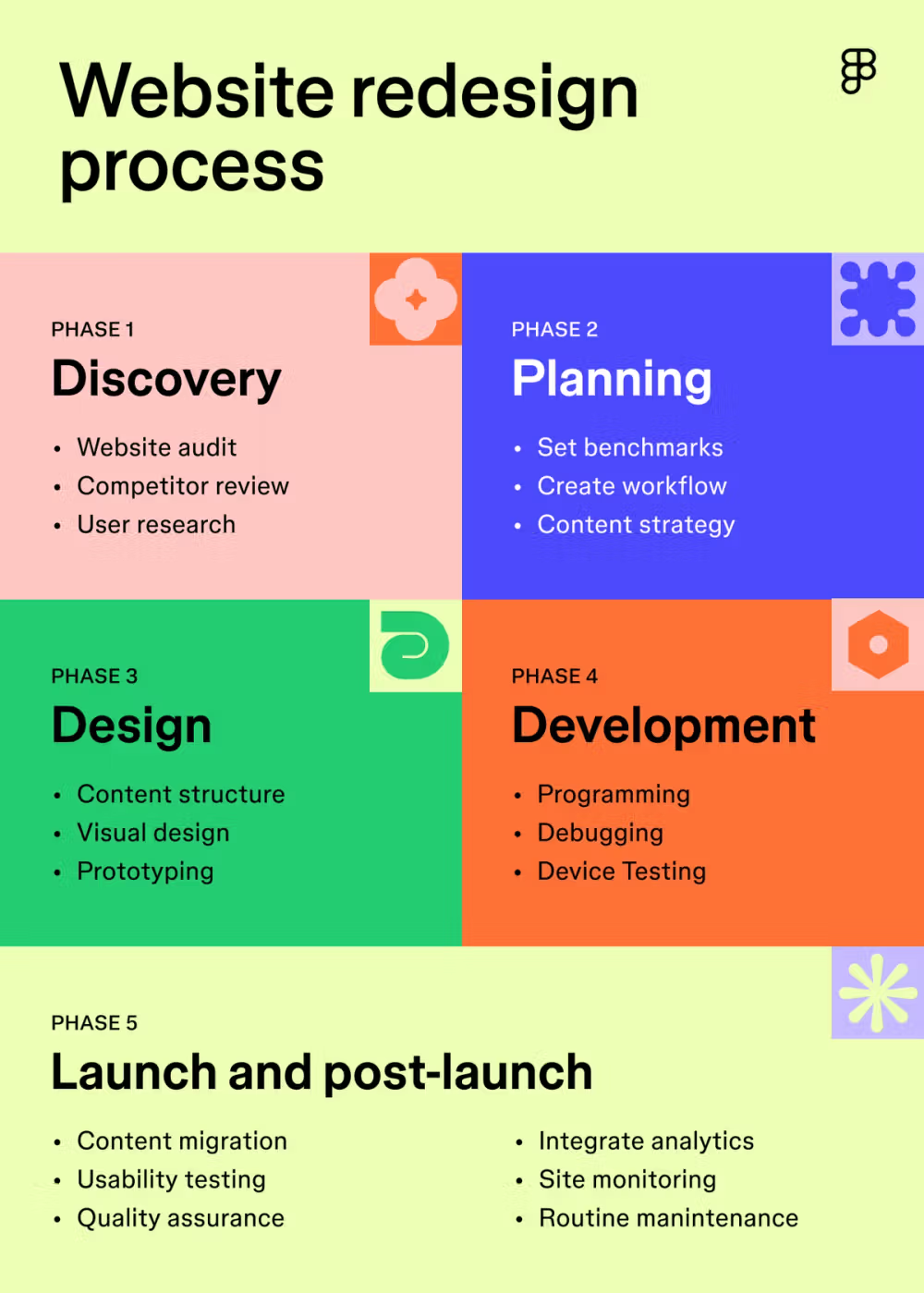
Image Source: Figma
Google specifically recommends creating a URL mapping whenever existing URLs are changing, along with using server-side permanent redirects such as 301 or 308 redirects for moved URLs. This guidance illustrates why a redesign can require considerably more SEO coordination than simply reviewing the finished site once development wraps up.
Where White Label SEO Fits Into the Redesign Process?
A white label SEO partner can support an agency across the full redesign timeline, not just at the end. The work generally breaks down into four stages: before the redesign, during planning and development, before launch, and after launch.
Before the Redesign
Before any development begins, the agency needs a clear picture of what the current site is doing well so nothing valuable gets lost in the rebuild.
- Existing-site SEO audit: This identifies technical and on-page conditions worth preserving or fixing as part of the redesign.
- URL Inventory: Documenting existing URLs helps the team identify which pages matter most before any changes are made.
- Ranking and Traffic Review: This shows which pages already generate organic visibility, so those pages get extra attention during planning.
- Valuable-page Identification: Some pages carry more organic weight than others and should be flagged early for special handling.
- Organic Traffic Review: Reviewing analytics data helps confirm which pages are driving meaningful visits.
- Backlink Review: Pages with strong external links often need dedicated URL or redirect protection to avoid losing that authority.
- Metadata Documentation: Recording important titles and meta descriptions before development prevents them from being overwritten and lost.
- Indexability Documentation: Capturing existing canonical and indexing signals gives the team a baseline to compare against after launch.
Google recommends starting URL mapping with important URLs identified through sitemaps, analytics, server logs, and Search Console. These sources help agencies pinpoint existing organic assets before a redesign has the chance to disrupt them.
During Planning and Development
SEO requirements work best when they're built into the redesign specifications from the start, rather than bolted on after development is finished.
- New Architecture: The proposed site structure should be reviewed for crawlability before it's built, not after.
- URL Mapping: Existing URLs need to be matched to their corresponding new URLs early in the process.
- Content Preservation: Important content should be identified for retention or thoughtful consolidation rather than accidental removal.
- Metadata: Recommendations for important title tags and meta descriptions should be provided to developers ahead of launch.
- Internal Linking: The new structure needs to preserve useful relationships between related pages.
- Technical Requirements: Crawlability and indexability requirements should be documented clearly for the development team.
- Canonical Recommendations: Canonical signals need clear rules for how they should behave on the new site.
- Indexability: Important pages shouldn't end up accidentally blocked from search engines during the build.
- Staging Checks: The development environment should be reviewed for SEO issues before it goes live.
This stage generally follows a consistent workflow: existing SEO data feeds into redesign requirements, which shape SEO recommendations, which inform development, which is then verified through SEO QA. Many agencies use seo outsourcing at this stage specifically because it lets specialist SEO work happen in parallel with design and development instead of stacking up at the end of the project.
Before Launch
A redesigned site should pass a real SEO QA process before it goes live, not just a design review.
- Redirect Implementation and Review: Every changed URL should be checked to confirm it points to the correct new destination.
- Canonical Checks: Canonical tags need to be confirmed as pointing to the intended version of each page.
- XML Sitemap: The sitemap should accurately reflect the URLs the team wants indexed.
- Robots.txt: This file needs to be checked to confirm important areas aren't accidentally blocked.
- Indexability: Important pages should be verified as crawlable and indexable.
- Staging Checks: Staging restrictions need to be removed and production settings confirmed before launch.
- Technical SEO QA: Core technical elements should be reviewed one more time before the site goes public.
- Internal Links: Important pages need to remain properly connected within the new structure.
- Metadata: Titles and descriptions should get a final review pass.
- Structured Data: Applicable structured data should be checked for accuracy.
- Analytics: Tracking needs to be confirmed as functional before launch.
- Conversion Tracking: Key conversion actions should be tested to make sure they still fire correctly.
Google's own migration guidance recommends thoroughly testing the new site before a move, preparing URL mapping, configuring redirects, submitting the new sitemap, and monitoring Search Console after launch. Google also recommends keeping redirect chains to ideally no more than 3 hops and fewer than 5, even though Googlebot can technically follow up to 10 hops. That gives agencies a concrete, checkable QA item, though it's worth noting that not every redirect chain automatically causes ranking loss.
After Launch
Launch day is not the end of the SEO workflow. In many ways, it's the start of a new monitoring phase.
- Crawl the New Site: This shows how the live site is actually being discovered and rendered.
- Check Redirects: Important old URLs should be verified as resolving correctly.
- Check Indexing: Important pages need to be confirmed as indexed the way the team expected.
- Monitor Rankings: Watching priority search terms helps catch meaningful visibility changes early.
- Review Search Console: This surfaces indexing, crawling, and other technical signals worth acting on.
- Identify Crawl Errors: Unexpected errors on important URLs should be investigated right away.
- Review Traffic: Organic traffic should be compared against the pre-launch baseline.
- Review Conversions: Key conversion actions need to be confirmed as functioning properly.
- Resolve Technical Issues: Any problems discovered after launch should be addressed promptly.
- Check Old URLs: Legacy URLs need confirmation that they've been handled correctly.
- Confirm Accessibility: Important pages should remain reachable through the new site structure.
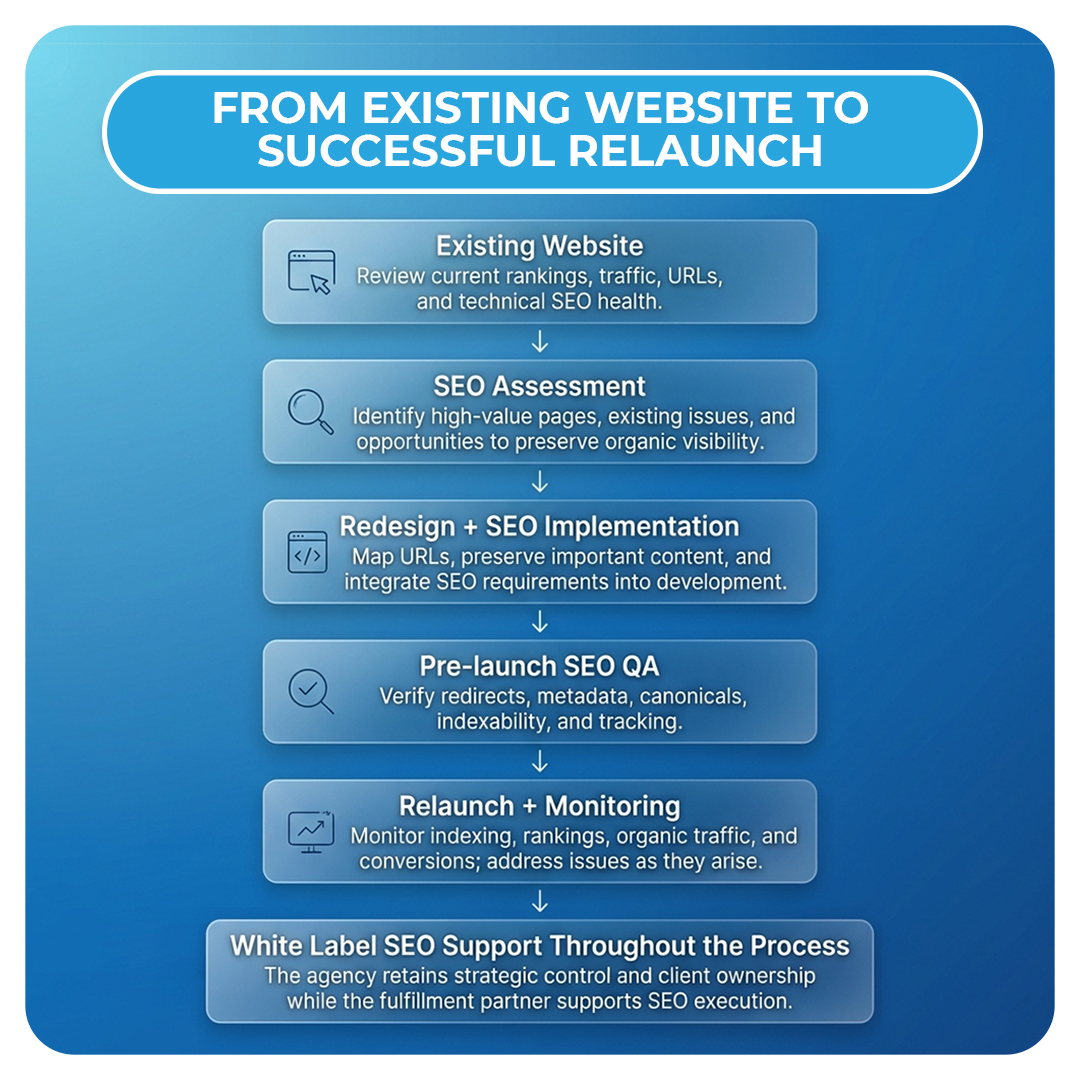
Google recommends monitoring both the old and new sites during this transition period. Its documentation notes that medium-sized sites can take a few weeks or more for new URLs to gradually replace old ones in search results, with larger sites potentially taking longer. The takeaway for agencies is straightforward: launch day is not the end of the SEO workflow.
How Agencies Can Divide Responsibilities With a White Label SEO Partner?
A redesign project runs more smoothly when everyone understands where their responsibilities begin and end. The agency should hold on to strategic and client-facing ownership, while the white label partner supports execution.
Agency Owns:
- Client Communication: The agency remains the primary point of contact for the client throughout the project.
- Strategy: The agency determines the overall SEO and redesign strategy.
- Project Scope: The agency defines exactly what the project includes.
- Design and Development Coordination: The agency coordinates the broader redesign effort across all vendors involved.
- Final Approvals: The agency reviews and approves work before it reaches the client.
- Client Reporting: The agency controls how results and progress get communicated.
- Overall Project Management: The agency keeps the redesign on track toward launch.
White Label SEO Partner Supports:
- SEO Audit: Provides a specialist review of the existing site's technical and content condition.
- Technical Recommendations: Identifies technical SEO requirements for the new build.
- URL Mapping: Helps map existing URLs to their new destinations.
- On-page SEO: Supports optimization work on important pages.
- Metadata: Supports title tag and meta description work.
- Internal Linking: Helps review and implement internal-linking improvements.
- Migration QA: Supports checks around URL and technical changes.
- Technical Checks: Helps identify issues before and after launch.
- Monitoring: Supports post-launch SEO monitoring.
- Reporting Data: Provides SEO data the agency can use in client reporting.
This structure lets the agency retain full strategic control while moving execution-heavy SEO work to a specialist fulfillment team. It's also the core reason agencies look for a white label SEO partner in the first place: the work still gets done to a high standard, but it doesn't require the agency to build out a full in-house SEO department.
How White Label SEO Helps Agencies Manage Redesign Deadlines?
Redesign deadlines tend to create a predictable pattern: as the deadline approaches, SEO workload increases, internal team capacity gets stretched, white label fulfillment absorbs the execution work, and the agency keeps the project moving toward launch.
- Parallel Workflows: SEO work can progress alongside design and development instead of waiting until the project is nearly finished.
- Defined SEO Deliverables: Agencies can set clear SEO responsibilities within the redesign scope from the outset.
- Specialist Support: Additional SEO capacity can take on execution-heavy tasks that would otherwise bottleneck an internal team.
- QA: Dedicated support can review technical SEO requirements more thoroughly than a stretched internal team might manage alone.
- Deadline Management: SEO work can be scheduled around the same launch timeline as development, rather than trailing behind it.
- Avoiding Last-minute SEO Work: Early SEO involvement reduces the risk of discovering critical issues right before launch.
- Reducing Internal Workload: A fulfillment partner can absorb recurring implementation and QA tasks when internal resources are limited.
Google notes that after a migration, the new site may temporarily be crawled more heavily than usual, since crawls of old URLs get redirected to new URLs in addition to normal crawling activity. That's not necessarily a problem, but it's another reason agencies benefit from maintaining technical capacity in the weeks after launch rather than considering the project finished once the site goes live.
What Agencies Should Check Before Launching a Redesigned Site?
A practical pre-launch checklist keeps the team from missing something important in the rush to hit a launch date.
- Important URLs: Confirm they're preserved or properly redirected.
- High-value Content: Confirm important organic content has been retained or intentionally replaced.
- Titles and Meta Descriptions: Review important metadata one more time.
- H1s: Confirm page headings remain relevant and properly structured.
- Canonicals: Verify canonical URLs point where intended.
- Internal Links: Check important links and page relationships.
- Redirects: Test redirects from every changed URL.
- Redirect Chains: Review chains and remove unnecessary hops.
- XML Sitemap: Update and verify the sitemap.
- Robots Directives: Check robots.txt and page-level directives.
- Indexability: Confirm important pages can be indexed.
- Structured Data: Check applicable structured data.
- Forms: Test important forms for functionality.
- Analytics: Confirm analytics tracking is live and accurate.
- Conversion Tracking: Test key conversion actions.
- Search Console: Prepare for monitoring launch and post-launch changes.
Google's Recommended Migration Checks Include:
- Test the new site
- Map old URLs to new URLs
- Implement permanent redirects
- Update sitemaps
- Check canonical and robots directives
- Monitor Search Console and traffic
- Watch for crawl and indexing errors
These checks line up closely with the QA process an agency should already be running before launch. Treating them as a joint checklist, rather than separate tasks handled by different people, reduces the odds that something slips through.
How Agencies Can Use White Label SEO Without Losing Control of the Client Experience?
Outsourcing SEO execution doesn't mean outsourcing the client relationship. A well-run white label seo firm relationship should be invisible to the client, not a second vendor they need to manage.
- Agency Remains Client-Facing: Clients continue communicating directly with the agency, not the fulfillment partner.
- Deliverables Follow Agency Processes: Fulfillment work should fit neatly into the agency's existing workflow and tools.
- Branding Stays Consistent: Client-facing materials should reflect the agency's brand, not the partner's.
- Agency Reviews SEO Work: The agency maintains quality control before anything reaches the client.
- SEO Partner Operates as an Extension of the Team: The partner supports execution without stepping into the agency's role.
- Communication Stays Centralized: The agency remains the single point of contact throughout the project.
- Client Sees One Coordinated Relationship: The client never needs to manage multiple providers to get the project done.
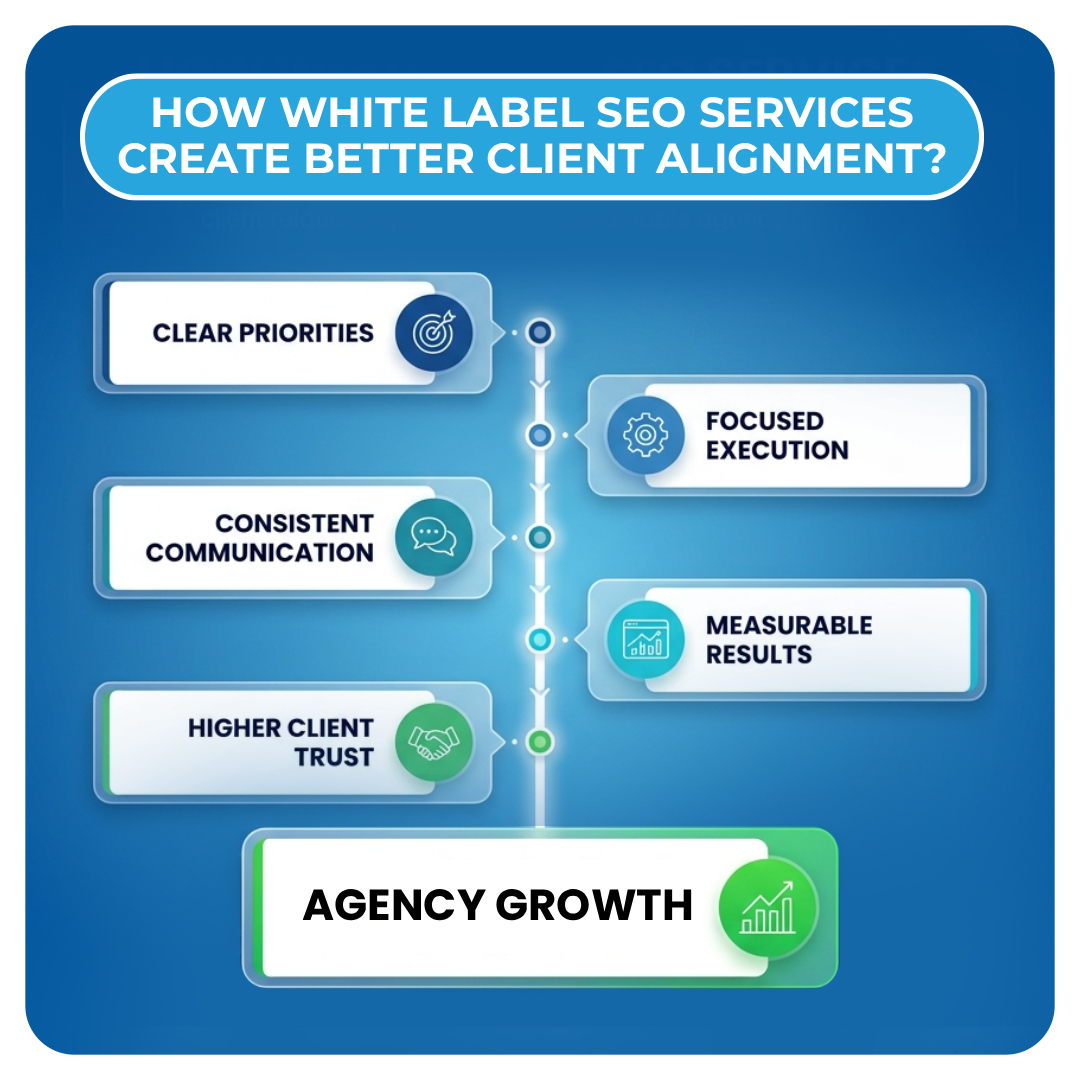
The agency stays responsible for strategy, scope, client expectations, recommendations, approvals, and overall project direction. The fulfillment partner simply adds capacity where it's needed most.
Support Website Redesigns With DashClicks White Label SEO Services
DashClicks supports the SEO workload surrounding a redesign while the agency remains responsible for the client relationship and overall project.
- Pre-redesign SEO reviews: Support for assessing the existing site's SEO condition before development starts.
- Technical SEO execution: Support for technical SEO work tied to the redesign.
- On-page Optimization: Support for optimizing important pages during and after the rebuild.
- URL and Redirect Support: Assistance with SEO work associated with changed URLs.
- SEO QA: Support for pre-launch and post-launch checks.
- Post-launch Monitoring: Help tracking the redesigned site's SEO condition after launch.
- Ongoing SEO Fulfillment: Continued support for SEO work once the redesign is complete.
- Branded Reporting: Support for agency-branded client reporting.
- Client Dashboard: White label client dashboard included as part of the DashClicks offering to help agencies track progress.
The agency doesn't have to hand over the redesign or the client relationship to get this support. It can use white label SEO partner to add specialist execution capacity around the project, while keeping ownership of strategy and the client experience exactly where it already is.
Protecting Organic Performance Through a Redesign
A redesign can affect SEO even when the domain never changes. URL structure, content, navigation, metadata, internal links, and indexing settings all play a role in how search engines understand a site, and any of them can shift during a rebuild.
SEO needs to be part of the conversation before, during, and after the redesign, not treated as cleanup work once the new site is already live. URL mapping clarifies how old and new pages relate to each other. Redirects protect the value built up in existing URLs. Content preservation protects organic assets that took time to earn. Technical QA catches problems while they're still cheap to fix. Post-launch monitoring catches the issues that only show up once real users and real crawlers interact with the live site.
SEO outsourcing gives agencies a way to handle all of this without expanding their internal team for every redesign project that comes through the door. The agency keeps the client relationship, the strategy, the communication, and the final say on every deliverable. The white label partner takes on the execution-heavy work that redesigns tend to generate in large volume.
Not every redesign is a full migration, but every major redesign deserves an honest evaluation of its SEO impact. Agencies that build that evaluation into their redesign process, with the right fulfillment support behind them, put themselves in a much better position to protect organic performance while keeping the project moving toward launch.

Facebook Ads Lead Quality: What Agencies Should Fix Before Scaling
A campaign that produces cheap leads is not the same thing as a campaign ready to scale. Agencies see this mismatch constantly: cost per lead looks great in the reporting dashboard, but the client is frustrated because half the leads never respond, fall outside the service area, or were never serious buyers.
A low CPL does not automatically indicate a healthy campaign. It only tells you that Facebook found a way to generate form submissions cheaply. Whether those submissions turn into real business is a separate question, and too many agencies skip it when recommending a bigger budget.
Before any conversation about scaling happens, an agency needs to determine whether the people entering the funnel fit the client's target customer and show meaningful purchase intent. That is the real diagnostic question, and it matters more than any single platform metric.
This leads to the central argument: fix lead quality first, then scale what is working.
For context, WordStream's 2026 benchmark analyzed nearly 1,800 Facebook ad campaigns, providing current industry-level data on CTR, CPC, conversion rate, and CPL. These benchmarks are useful for understanding where a campaign stands relative to broader industry patterns, but they are not universal targets. A niche B2B campaign and a high-volume local service business will naturally look different against the same benchmark.
The first step toward fixing lead quality starts with a question many agencies never formally answer: What does a "quality lead" actually mean for this specific client?
Define What a Quality Lead Means for the Client
Every client has a different definition of a good lead, even if they've never articulated it clearly. Before touching targeting, creative, or budget, an agency needs to pin this down.
Several factors typically shape what quality means for a given business:
- Location – whether the lead falls within the service area or market the client actually serves
- Service or Product Fit – whether the lead is interested in what the client actually offers, not a related but different service
- Budget – whether the prospect can realistically afford the client's pricing
- Purchase Intent – whether the lead is actively looking to buy or just casually curious
- Business or Customer Type – for B2B clients, whether the lead matches the right company size, industry, or role
- Urgency – whether the prospect has an immediate need or a vague, long-term interest
- Sales-readiness – whether the lead is prepared to have a sales conversation or still needs education
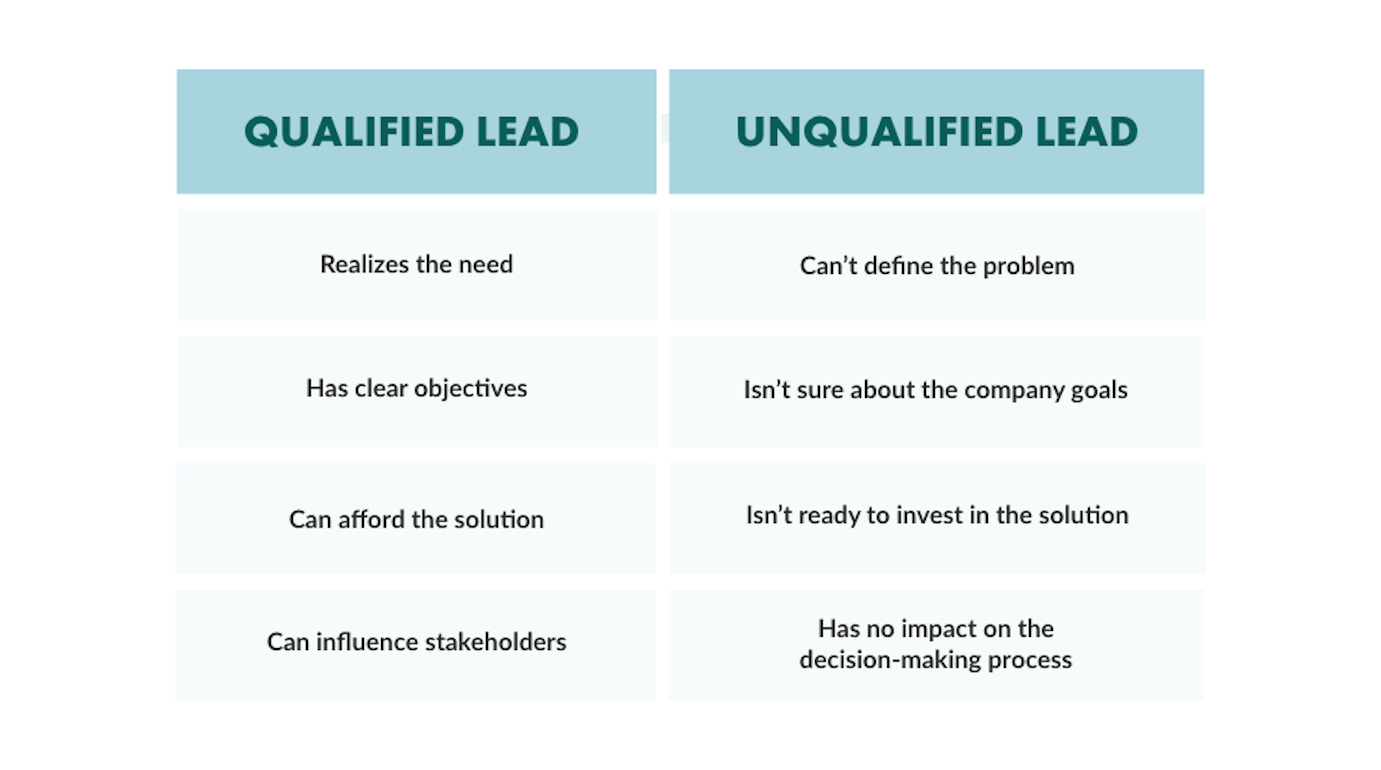
Image Source: SuperOffice
Once these factors are defined, it becomes easier to see that a lead count on its own tells an incomplete story. Leads move through stages, and each stage filters out a portion of the previous one:
Total Leads → Qualified Leads → Sales Opportunities → Customers.
The number of leads entering the CRM is only the beginning of the funnel. A campaign that generates 200 leads a month but only produces 10 qualified prospects has a very different problem than a campaign generating 50 leads with 30 qualified prospects, even though the second campaign has a higher CPL.
WordStream's 2026 data puts the average Facebook leads-campaign conversion rate at 8.54% across industries. That figure is useful for context, but it should not be treated as a universal target. Facebook Ads performance varies significantly by industry, offer, audience, and campaign setup.
A local home services client and a national SaaS company are not playing the same game, even if they're both running lead generation campaigns on the same platform. Wherever possible, agencies should compare current performance against the client's own historical data and business outcomes rather than an industry average.
Check Whether the Ad Is Attracting the Right Audience
Lead quality problems often start well before someone ever submits a form. If the target audience is misaligned with the client's actual customer base, no amount of form optimization will fix the downstream results.
A useful audit here includes:
- Audience characteristics and interests
- Geographic targeting accuracy
- Demographic considerations relevant to the offer
- Audience exclusions that may be missing
- Retargeting audience composition
- Broad versus more defined targeting approaches
- Whether the cheapest-performing segments are actually poor-fit audiences
This is where a common mistake shows up: do not optimize solely toward the cheapest audience. An audience that produces a lower CPL can still generate fewer qualified opportunities than a more expensive one. Cheap leads that never convert into sales opportunities aren't actually cheap. They're just deferred waste.
Agencies should look at the full relationship between cost, lead volume, lead relevance, qualification rate, and downstream sales potential, rather than optimizing toward any single number in isolation. It's also worth resisting the temptation to assume broad targeting or narrow targeting is inherently superior. The right approach depends on the client's objectives, the available audience data, and how Meta's delivery system is currently distributing that specific campaign.
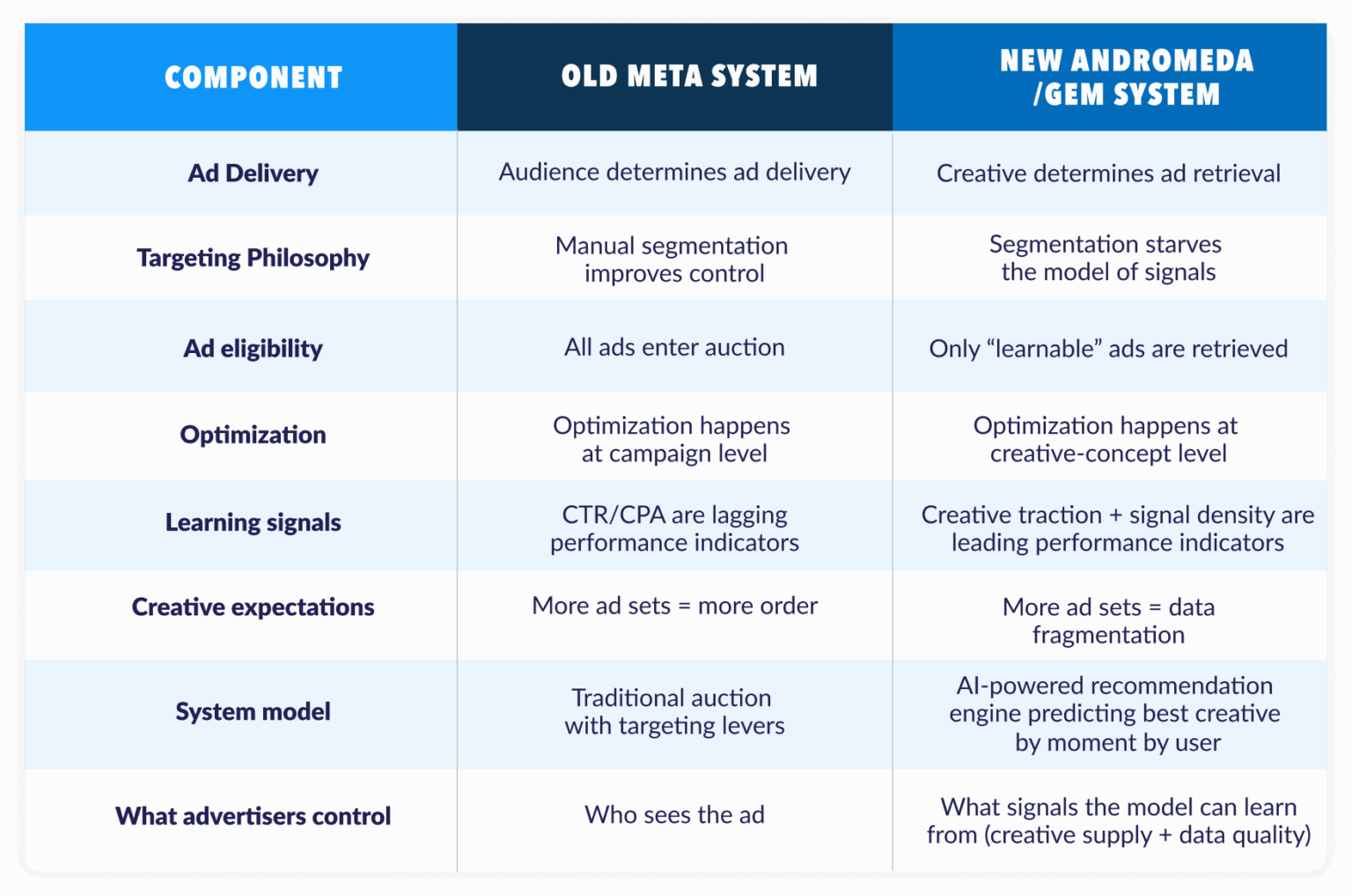
Image Source: Silverback
What worked for one client's audience structure six months ago may not work the same way today.
Use Ad Creative to Pre-Qualify Prospects
Ad creative does more than generate clicks. It shapes who decides to respond in the first place, and that makes it one of the most underused levers for improving lead qualification.
Strong creative for lead-quality purposes typically includes:
- A clear, specific offer rather than a vague value proposition
- Accurate expectations about what happens next
- Specific service or product positioning that filters out mismatched prospects
- Pricing or qualification information when it's appropriate to include
- Clear call-to-action that match the intent of the offer
- Consistency between the ad messaging and what the prospect sees after clicking
The goal isn't to maximize clicks or form submissions at all costs. It's to help prospects understand exactly what they're responding to, so the people who do submit a form are more likely to be a genuine fit. An ad that overpromises or stays intentionally vague might generate more volume, but it also invites more people who don't actually match the offer.
The 2026 WordStream benchmark puts average CTR for Facebook leads campaigns at 2.70%, up from 2.59% in the prior year's dataset. That's a useful engagement benchmark, but it comes with an important distinction: CTR measures response to the ad, not the quality of what comes after. A higher CTR does not automatically mean higher-quality leads. Agencies need to connect engagement metrics like CTR with actual lead quality and downstream outcomes rather than treating 2.70% as a target to chase for its own sake.
Review the Lead Form and Conversion Experience
The conversion experience itself, not just the ad that leads to it, plays a direct role in lead quality. For campaigns using Meta's instant forms, this deserves a close look.
Worth reviewing:
- The number of questions in the form
- Whether those questions actually qualify the prospect
- Any unnecessary friction that doesn't serve a qualification purpose
- Whether the form matches what the ad promised
- What happens immediately after someone submits
- Whether the campaign is attracting people who genuinely understand the offer
There's a balance to strike here. A form with too little information may let large numbers of poor-fit submissions through simply because it's easy to complete. A form with too many unrelated questions may create friction that discourages the exact prospects the client wants to reach.
This is worth stating plainly: more form submissions do not equal better leads. A jump in submissions after simplifying a form can look like a win in the ad account, but if qualification rates drop at the same time, the campaign hasn't actually improved.
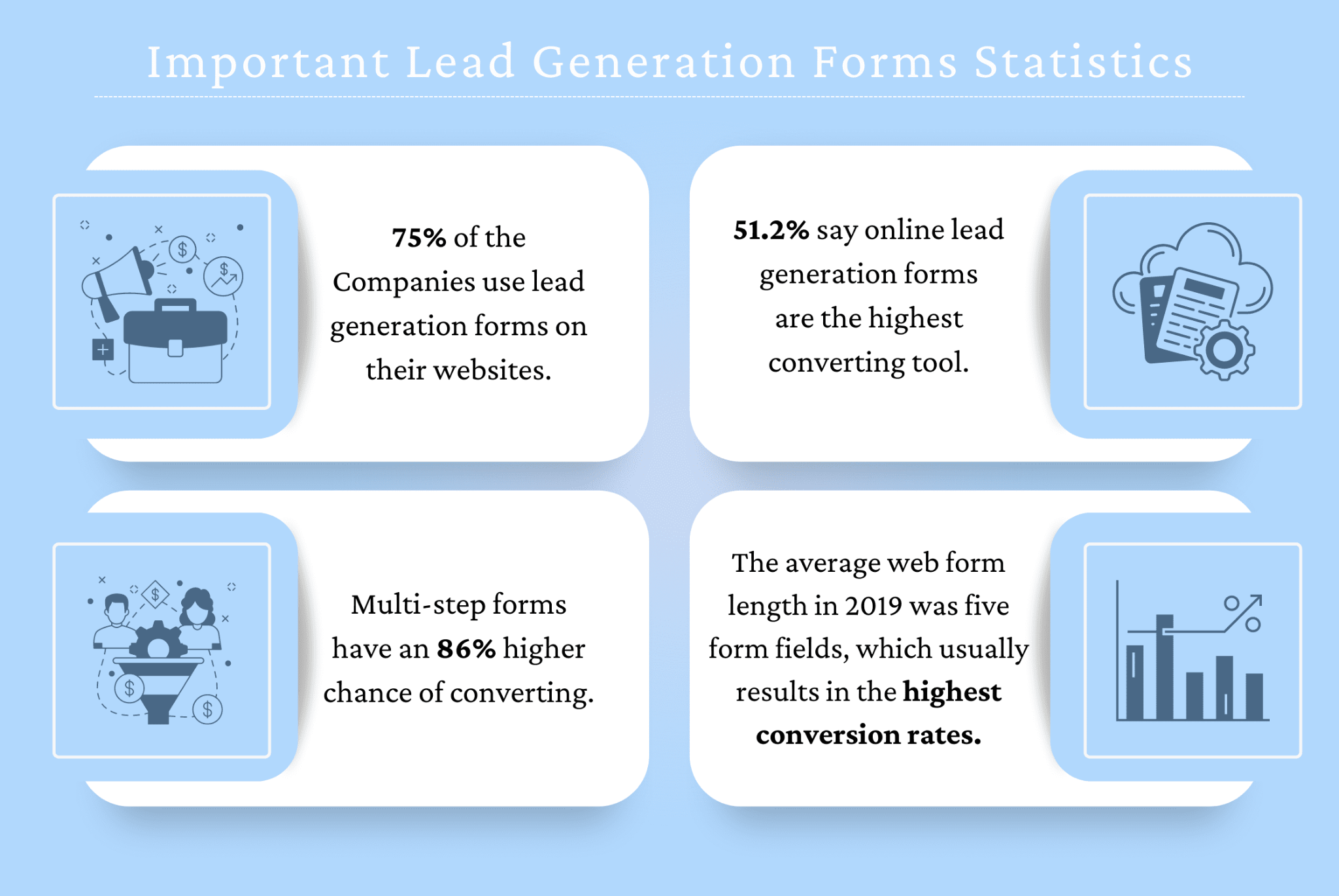
The post-submission experience matters just as much as the form itself. Agencies should understand what happens after someone completes the form, including how quickly the client follows up, because slow or inconsistent follow-up processes can waste leads that were perfectly qualified to begin with.
Further Reading: 10 Form Conversion Optimization Tips to Generate Better Leads
Stop Treating CPL as the Only Success Metric
This is where a lot of campaign reporting falls short. Cost per lead, CTR, CPC, and conversion rate are all useful diagnostic numbers, but none of them tell the full story of whether a campaign is working for the client's business.
Downstream metrics fill in the rest of the picture:
- Contact rate
- Qualification rate
- Appointment rate
- Sales opportunity rate
- Customer acquisition cost
- Revenue or other business outcomes the client cares about
Platform-level metrics are useful for diagnosing what's happening inside the ad account, but they don't automatically reflect business value. A campaign can look efficient on the Facebook Ads dashboard while producing very little actual revenue for the client, and the reverse is also true.
WordStream's 2026 benchmark reports an average CPL of about $27.66 in its 2025 dataset, while the 2026 report shows that lead-campaign costs and conversion performance vary by industry. This figure should be read carefully. It reflects a specific dataset from a specific year, and it shouldn't be presented as a current universal CPL target for every client campaign running today.
The larger point stands regardless of the exact number: a benchmark CPL should provide context, not become the definition of a good lead. A campaign with a higher CPL can potentially be more valuable if the leads it generates are substantially more qualified and more likely to become sales opportunities or customers. That doesn't mean a higher CPL is inherently better. It means CPL alone isn't sufficient to judge whether a campaign is working.
Connect Facebook Ads Data With Actual Lead Outcomes
Real lead-quality diagnosis requires connecting advertising data with what actually happens to those leads after they leave Facebook's ecosystem.
That means looking at CRM data alongside campaign data, including:
- Lead status over time
- Contacted versus unreachable leads
- Qualified versus unqualified leads
- Booked appointments
- Closed customers
- Revenue generated from those customers
This creates a fuller chain to track:
Ad → Lead → Contact → Qualified → Appointment → Customer.
Agencies should aim to optimize toward the stages that actually matter to the client's business, rather than stopping measurement at the form submission. Where the client's setup allows it, sending outcome data back into campaign analysis, and ideally back into Meta's optimization signals, helps connect ad spend with what really moves the needle for the business.
Facebook Ads data becomes far more useful once it's tied to what happened after the lead entered the business's sales process. Without that connection, an agency is optimizing based on partial information.
Diagnose Where Poor-Quality Leads Are Coming From
When lead quality drops, the instinct is often to change everything at once: new audience, new creative, new form, new budget. That approach makes it nearly impossible to know what actually fixed the problem, or whether it will recur.
A more disciplined approach breaks performance down by campaign, ad set, audience, placement, creative, form, and time period. Segmenting the data this way helps identify whether the drop in quality is concentrated in one specific area or spread evenly across the account.
This framework captures the process:
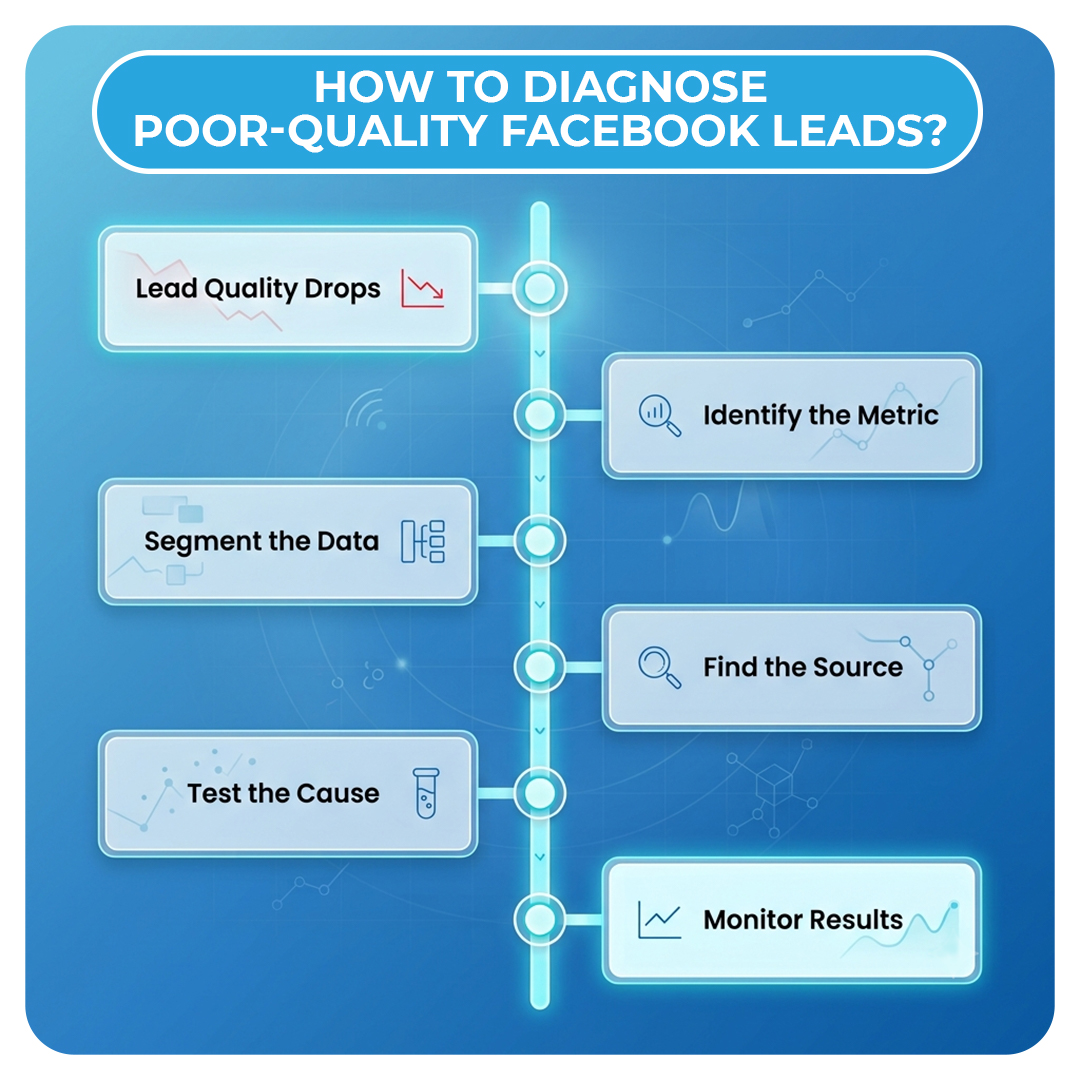
Each stage plays a distinct role:
- Lead Quality Drops. The first step is recognizing that downstream quality has actually changed, rather than assuming the issue is simply lead volume. A drop in leads and a drop in lead quality are different problems that require different fixes.
- Identify the Metric. Determine which specific measure has shifted, whether that's qualification rate, contact rate, appointment rate, or another relevant indicator further down the funnel.
- Segment the Data. Break results down across campaign, audience, placement, creative, form, and timeframe to narrow down where the change is showing up.
- Find the Source. Use that segmentation to identify where the weaker leads are concentrated, whether that's a specific audience segment, a particular placement, or a certain ad variation.
- Test the Cause. Make a targeted change based on what the data points to, rather than adjusting multiple variables simultaneously whenever it's practical to isolate the test.
- Monitor. Track whether lead quality actually improves after the change, and whether that improvement holds over time rather than being a temporary blip.
Fix Lead Quality Before Increasing the Budget
This brings the discussion to the central scaling question every agency eventually faces: when is a campaign actually ready for more budget?
Here's the principle to hold onto: scaling multiplies the existing campaign behavior. If an agency increases the budget while poor-quality leads are still entering the funnel, the likely outcome is simply spending more money to generate more of the same problem, not a better one.
Before scaling, it's worth working through a short sequence:
- Establish a quality benchmark based on the client's own data
- Identify weak segments through the diagnostic process outlined above
- Test targeting and creative changes based on what the data shows
- Monitor downstream lead quality, not just platform metrics
- Confirm that improvements are sustained over more than a single reporting period
- Increase spend gradually while continuing to monitor both volume and quality
None of this should be treated as a rigid universal rule. Campaign conditions, client objectives, market size, available budget, and the quality of available data can all differ from one account to the next. But the underlying logic holds across most situations: scaling should follow evidence that the campaign is attracting the right prospects, not simply evidence that the campaign is capable of spending more money.
Use White Label Facebook Ads to Support Ongoing Optimization
Improving lead quality is not a one-time task. It requires ongoing attention across every client account an agency manages.
Why Agencies Need Fulfillment Capacity
Maintaining the lead-quality workflow requires recurring work, including:
- Campaign monitoring: Tracking performance and identifying issues early.
- Audience refinement: Adjusting targeting based on lead quality and campaign data.
- Creative testing: Testing different ad variations to identify what resonates.
- Budget management: Adjusting spend based on campaign performance.
- Performance analysis: Reviewing campaign and lead-level data.
- Optimization and reporting: Making ongoing improvements and communicating results.
As an agency takes on more clients, maintaining this level of attention across every account can become an execution challenge. The issue isn't always a lack of strategic knowledge. Agencies also need enough fulfillment capacity to implement, monitor, test, document, and refine campaigns consistently.
How White Label Facebook Ads Can Help?
This is where facebook marketing outsource arrangements can be relevant for growing agencies. A white label fulfillment partner can provide additional execution capacity while the agency retains control of client relationships, strategic direction, campaign priorities, and communication.
A white label Facebook advertising agency partnership may support areas such as:
- Campaign setup and maintenance
- Audience targeting
- Creative testing
- Campaign optimization
- Performance monitoring
- Reporting
This allows an agency offering facebook ads services to expand its fulfillment capacity without building and training an entirely new internal team for every client.
White label support does not automatically improve lead quality or guarantee better results. The diagnostic and optimization process still matters. Fulfillment support simply makes it easier to execute that work consistently at scale.
DashClicks provides 100% white label Facebook Ads fulfillment for agencies, supporting the recurring work required to manage client campaigns.
Its Facebook Ads service includes:
- Campaign setup
- Quality assurance
- Campaign approval and launch
- Monthly maintenance
- Ongoing optimization
- Audience split testing
Agencies retain ownership of the client relationship and campaign strategy while using DashClicks as a fulfillment partner.
The agency remains responsible for:
- Client communication
- Campaign strategy
- Setting priorities and goals
- Making strategic decisions
DashClicks provides the execution capacity behind the scenes. This makes the partnership complementary to agency expertise rather than a replacement for it.
The value is straightforward: additional execution capacity, consistent campaign management, and ongoing optimization support.
However, white label Facebook Ads does not guarantee better lead quality, lower CPL, higher conversion rates, or increased revenue. Those outcomes still depend on the diagnostic and optimization process applied to each client's campaign.
Build a Repeatable Lead-Quality Checkpoint Before Scaling
The final piece is turning everything above into a repeatable process rather than a one-time audit.
A useful internal workflow follows this sequence: Define Quality → Launch → Monitor → Evaluate → Diagnose → Optimize → Validate → Scale.
Before recommending a budget increase on any Facebook Ads account, agencies can run through a short checklist:
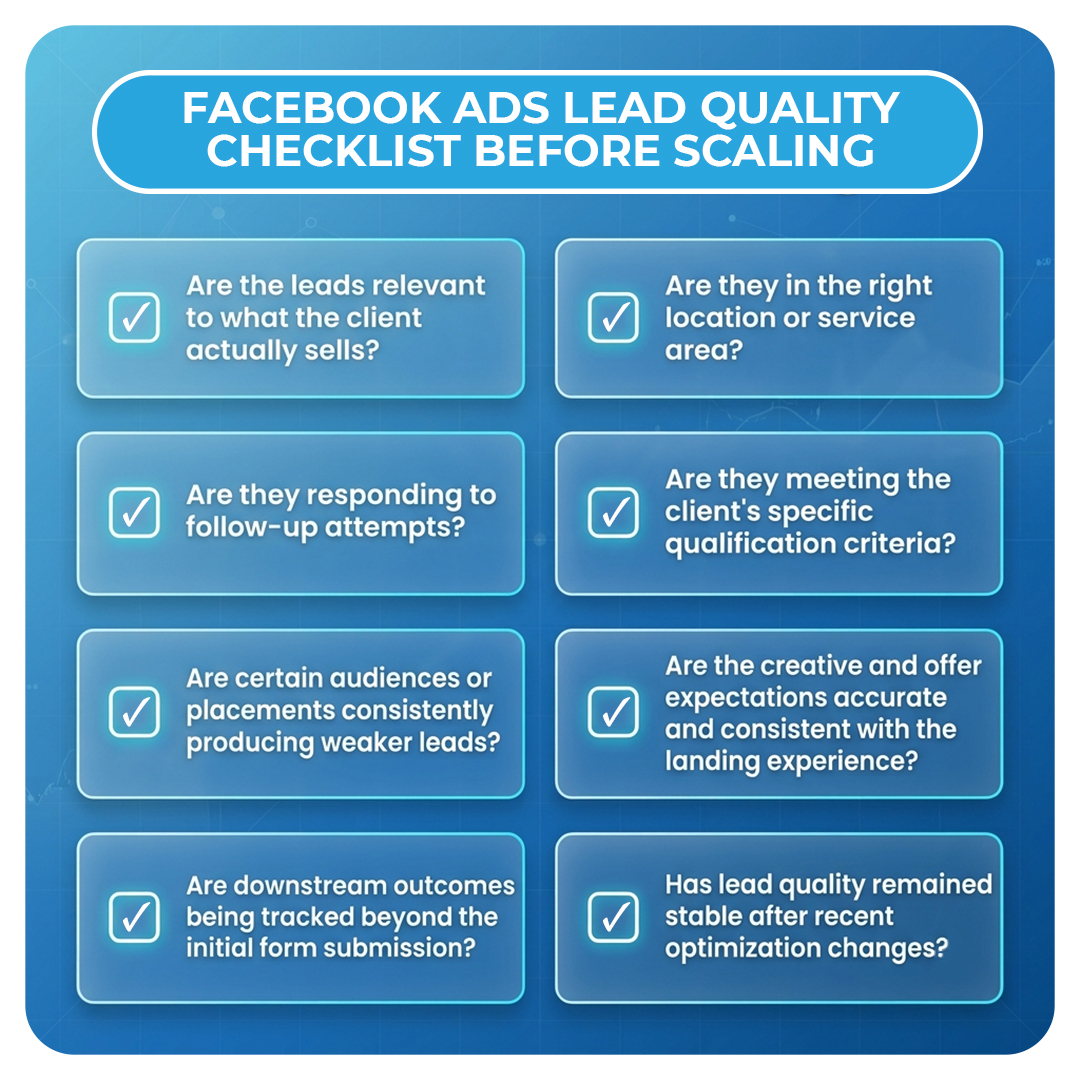
This checkpoint helps prevent agencies from treating a budget increase as the first response to disappointing campaign performance.
Scale What's Actually Working
Scaling should follow reliable lead quality, not replace fixing it. Facebook Ads campaigns should be evaluated against actual business outcomes, not just Ads Manager metrics. Lead volume and CPL are useful, but they don't tell the full story.
Finding where lead quality drops, testing targeted improvements, and monitoring results over time helps agencies scale based on stronger evidence. Increase budgets only when campaigns consistently attract the right prospects and generate meaningful downstream outcomes.
For agencies managing multiple client accounts, white label Facebook Ads fulfillment can provide the capacity needed for ongoing monitoring, testing, implementation, and optimization. It doesn't replace strategic diagnosis, but it can help turn that strategy into consistent execution across client accounts.

White Label SEO for New Websites: What Agencies Should Prioritize First
A new website presents a fundamentally different SEO challenge from an established one. There is often little or no search visibility, a limited content footprint, minimal historical performance data, and few external signals such as backlinks or brand mentions. Most importantly, the agency may not yet know which pages, services, or topics deserve the most attention.
This uncertainty creates a real risk: agencies can overwhelm the first few months with technical fixes, extensive keyword research, content production, link building, and reporting, all launched at once without determining what matters most.
The central principle for this early stage is simple: SEO should first establish the foundation and direction that future work can build upon. Content strategy, link building, and ongoing optimization are more effective when the website has been properly assessed, structured, and prioritized.
BrightEdge's 2019 channel-share research found that organic search accounted for 53.3% of trackable website traffic at the time. This is a historical finding, not a current universal benchmark, as search behavior, algorithms, and channel mixes have changed considerably. However, it illustrates the long-standing importance of organic search and why foundational SEO work matters for a new website.
Before SEO fulfillment begins at scale, the agency should determine what the website already has, what it can realistically support, and where the biggest opportunities and obstacles lie.
Establish What the New Website Actually Has
Before assigning large volumes of SEO work, agencies need to understand the website's current condition. Skipping this step can waste fulfillment hours on pages or issues that aren't actual priorities.
1. Assess the Website Before Assigning SEO Work
Review the site's structure, page count, navigation, URLs, existing content, service or product coverage, and current SEO setup, including metadata, schema, and analytics.
First, determine whether the site is genuinely new or replacing an older website. A redesign or migration may involve existing rankings, redirects, or legacy issues that need to be preserved or resolved. Also identify any work the client has already completed, such as tracking setup, Google Business Profile optimization, or cornerstone content, so the agency can build on existing groundwork rather than starting over.
2. Confirm the Technical Foundation
Focus on the technical elements that affect discovery, crawling, and indexing:
- Crawlability and Indexability: Ensure important pages can be accessed and processed by search engines.
- Robots.txt and XML Sitemap: Confirm they support proper crawling and content discovery.
- Canonicalization: Check for appropriate canonical tags on duplicate or similar URLs.
- HTTPS and Mobile Usability: Verify the site is secure and works effectively on mobile devices.
- Status Codes and Redirects: Identify broken pages, redirect chains, and incorrect redirects.
- Internal Accessibility: Ensure priority pages are reachable through the site's navigation and aren't orphaned.
- Google Search Console: Confirm the property is verified and available for monitoring indexing and search performance.
Google Search Central emphasizes these foundational requirements and the use of Search Console to understand how Google crawls and indexes a site. These checks provide the baseline for subsequent SEO decisions.
3. Separate Critical Issues From Cosmetic Improvements
Not every issue requires immediate attention. Prioritize problems that can prevent important pages from being discovered, crawled, indexed, or understood. Minor formatting issues and non-essential refinements can wait when they compete with critical fixes for the same resources.
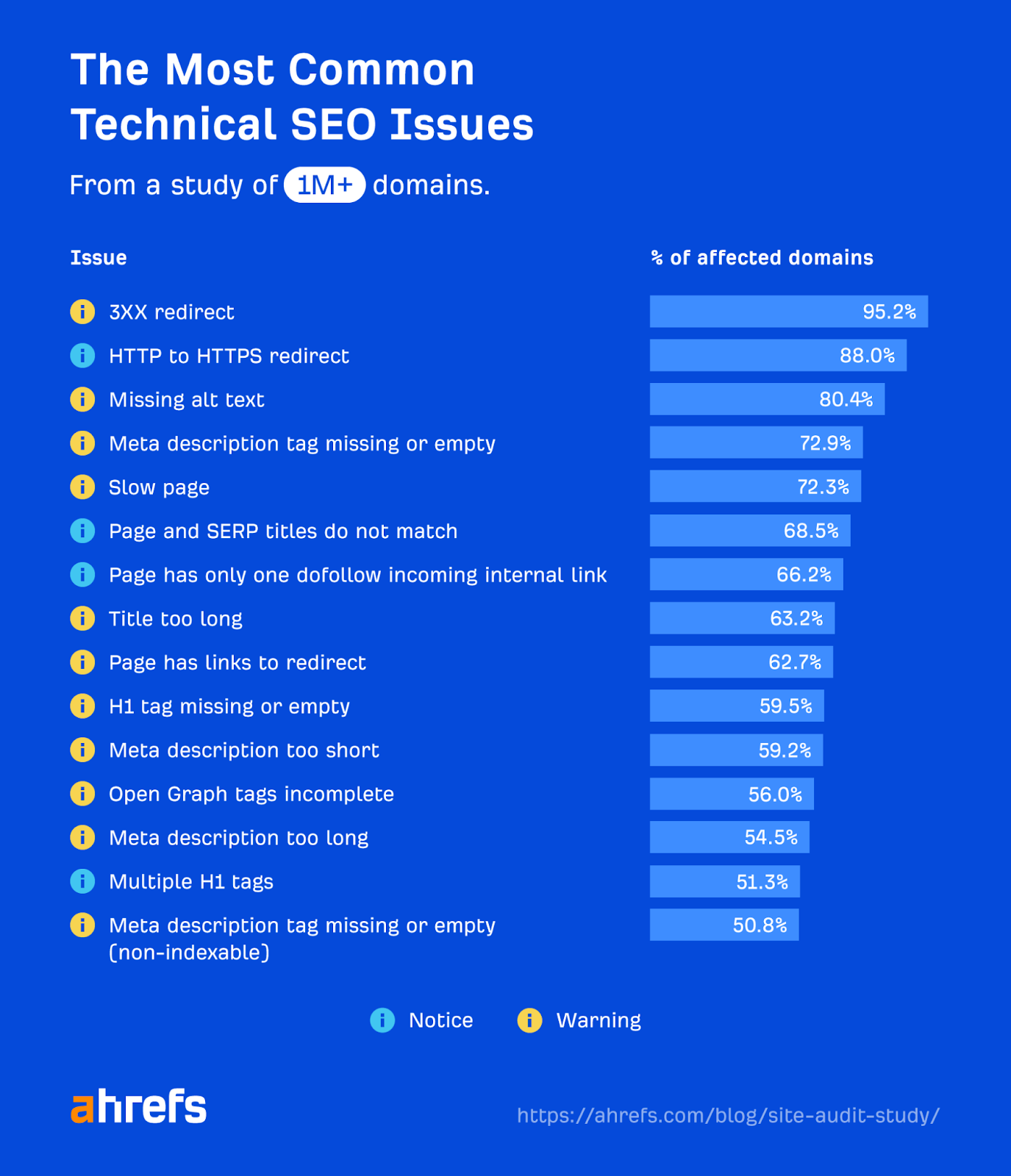
Image Source: Ahrefs
The initial SEO audit should therefore produce a prioritized action plan, not a checklist that treats every issue equally.
Define the Website's Search Priorities Before Expanding Content
Keyword research should guide resource allocation, not simply produce a long list of terms. For a new website, it should help determine which pages, topics, and search opportunities deserve attention first.
1. Start With Business Priorities
Identify the client's most important services, products, locations, and commercial goals before evaluating search volume. SEO targets should support these priorities rather than being chosen solely because they have high search volume. A popular keyword with little connection to the business may have limited value.
2. Map Search Intent to the Site Structure
Determine whether priority searches have commercial, transactional, or informational intent, then match them to the appropriate existing or planned pages. For example, a service-related search should generally lead to a relevant commercial page, while an educational query may be better suited to supporting content.
Create a keyword-to-page map to assign primary search themes, reduce the risk of multiple pages competing for the same intent, and identify topics that need new pages.
3. Prioritize Opportunities, Not Volume Alone
Evaluate potential targets based on relevance, search intent, competition, business value, and realistic ranking potential. A lower-volume keyword may be more valuable for a new site if it aligns closely with the business and offers a more achievable opportunity.
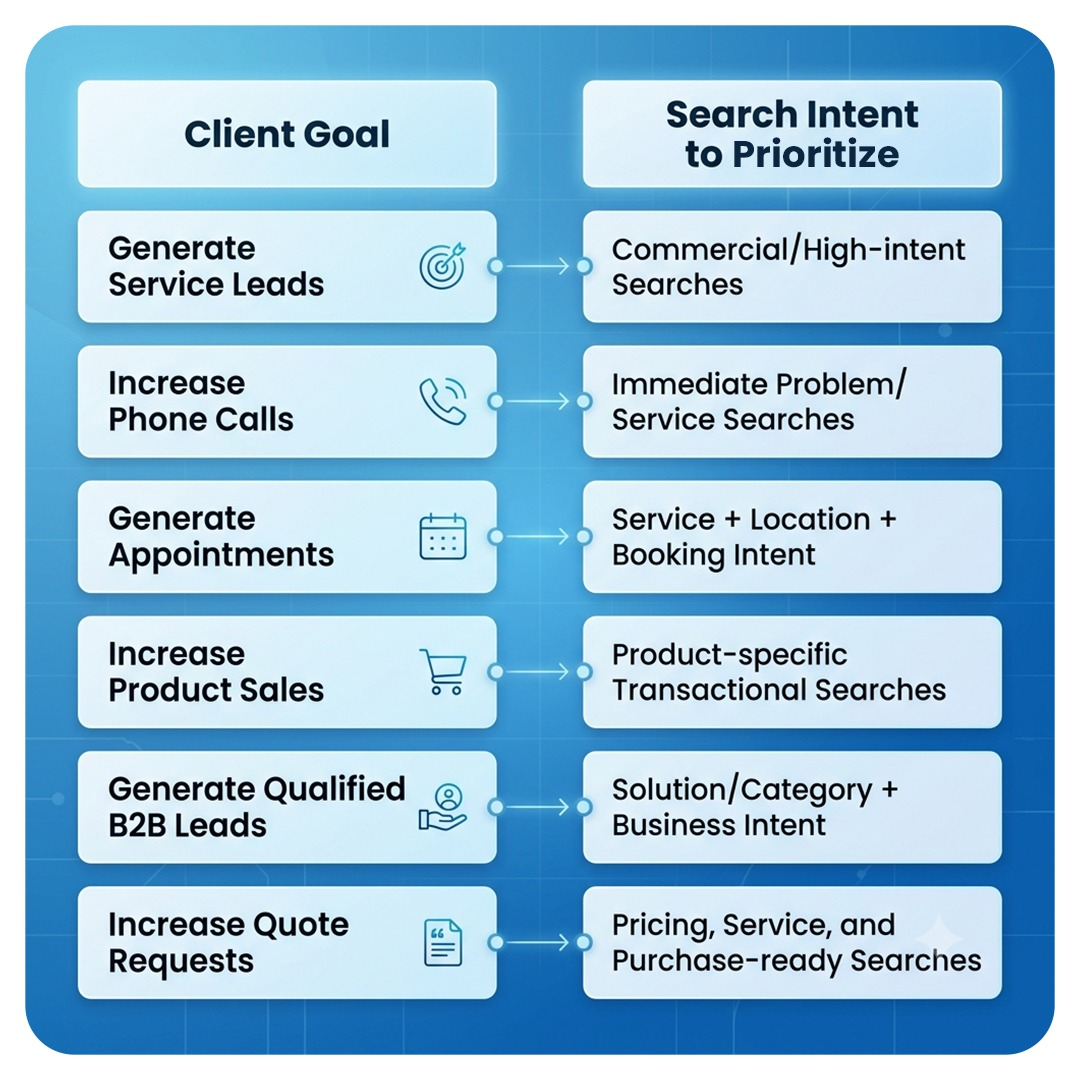
Ultimately, keyword research should answer one question: Which search opportunities deserve fulfillment resources first?
Build and Optimize the Pages That Matter Most
A new website should not automatically receive equal optimization effort across every page. Some pages carry far more commercial weight than others, and the early optimization budget should reflect that.
1. Prioritize Commercial Pages First
Core service pages, product and category pages, important location pages, and high-value landing pages typically deserve attention before lower-priority informational content. These are the pages most directly tied to conversions and revenue, which makes them the logical starting point.
2. Optimize the Page Around Its Actual Search Purpose
Effective on-page optimization considers title and H1 alignment with the target search intent, relevant supporting headings, coverage of what searchers actually need, useful supporting content, clear conversion paths, thoughtful internal links, and appropriate metadata. Optimization should reflect what the page is actually supposed to accomplish for the visitor and the business, not a generic checklist applied uniformly across the site.
3. Avoid Optimizing Every Page Equally
A new site with 30 pages does not necessarily need all 30 pages optimized at the same depth on day one. Agencies should prioritize the pages closest to revenue or strategic business goals, giving them the most thorough treatment first, while other pages receive lighter attention until resources allow for deeper work.
4. Establish Page-Level Baselines
Before optimization work scales up, it's worth recording initial indexing status, search impressions, search clicks, rankings where meaningful, and conversions where sufficient data exists. These baselines give the agency a way to measure change over time. Early ranking movement should not be presented as the sole measure of SEO progress, since indexing, impressions, and engagement often shift before rankings do.
Create Content to Fill Strategic Gaps, Not to Hit a Publishing Quota
A new website does not automatically need a high volume of blog content. Content should exist to serve a strategic purpose, not to satisfy an arbitrary publishing schedule.
1. Identify What the Priority Pages Cannot Answer
Priority commercial pages typically cannot address every question a potential customer might have. Supporting content can fill that gap by covering related questions, comparison topics, educational searches, problem-based searches, and industry-specific informational needs. These topics support the site's commercial priorities by capturing searchers earlier in their decision process and guiding them toward the pages that matter most.
2. Build Supporting Content Around Commercial Priorities
A useful way to think about this relationship: a core service page leads to a supporting topic, which links internally, which drives commercial intent. Supporting content built this way strengthens topical coverage while creating meaningful pathways back to priority commercial pages, rather than existing as an isolated blog post with no connection to the rest of the site.
3. Avoid Premature Content Expansion
Agencies should resist creating dozens of loosely related blog posts simply because the domain is new and needs "more content." Instead, each piece of content should be evaluated for topical usefulness, alignment with search intent, relevance to business priorities, internal linking opportunities, and the site's realistic ability to connect that content naturally to existing pages.
4. Use Realistic Expectations
Ahrefs' survey of 3,680 respondents found that SEO typically takes three to six months to show results, while also noting that there is no universal timeline. This finding should be attributed clearly to Ahrefs' survey research, not treated as a guaranteed outcome or applied uniformly to every new website. Some sites see earlier signals, others take longer, depending on competition, niche, and starting conditions.
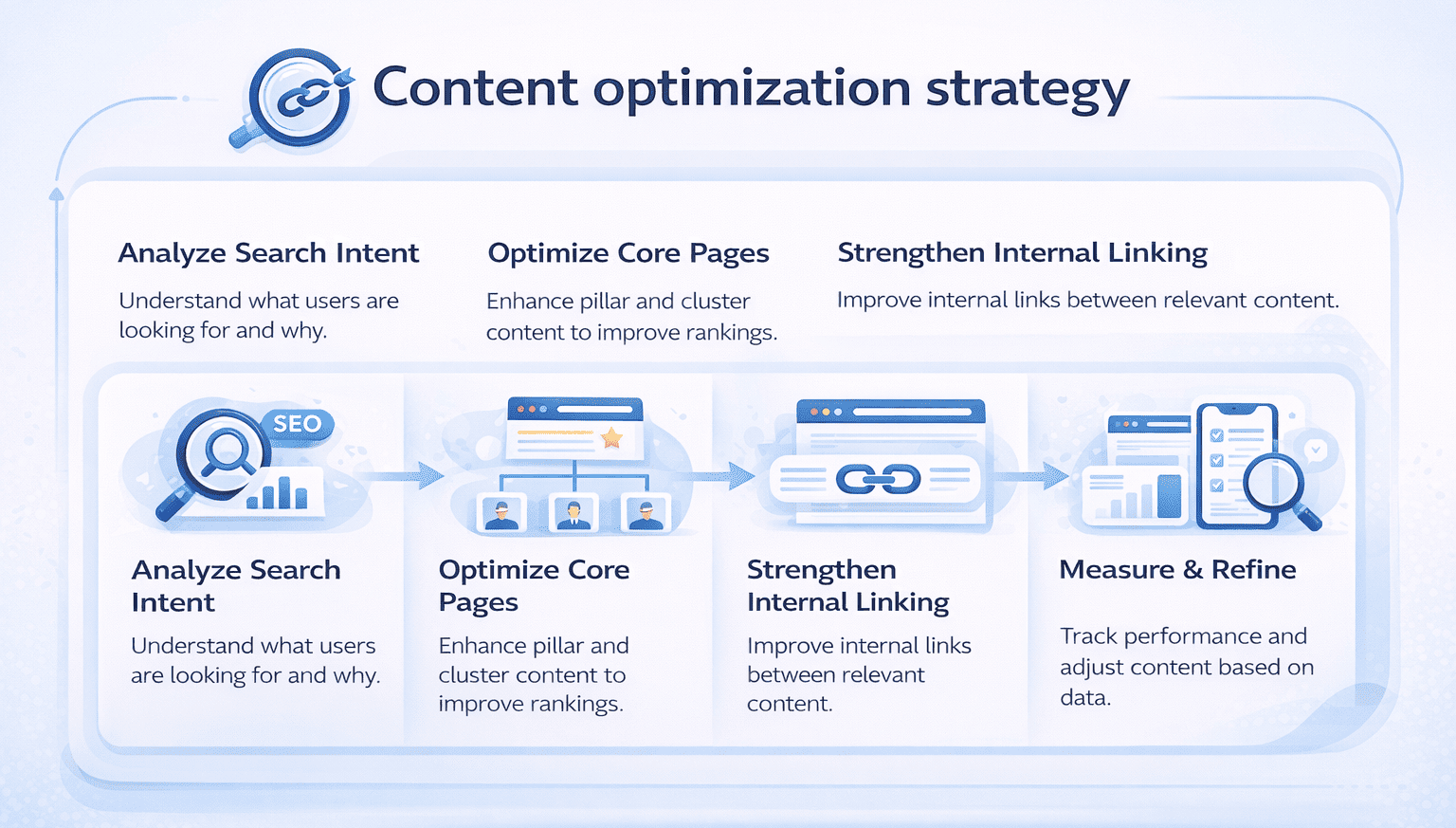
Image Source: Linkbuilding
This research reinforces why agencies should build a sustainable content roadmap rather than promising immediate ranking gains to clients eager for fast results.
Establish Internal Linking Before the Site Gets Large
Internal linking is easier to build correctly from the start than to retrofit after a site has accumulated dozens of pages.
1. Create a Logical Hierarchy
Structure the site so the homepage connects to primary commercial pages, which connect to supporting pages and relevant blog or resource content. This gives search engines and users a clearer path through the site's content as it grows.
2. Connect Related Pages Intentionally
Link new content to relevant commercial and supporting pages using descriptive anchor text rather than generic phrases such as "click here." Ensure important pages aren't orphaned and add internal links as content is published instead of leaving them for a later cleanup project.
Google's guidance indicates that descriptive anchor text helps users and Google understand linked pages. Internal linking isn't a standalone ranking solution, but it supports site structure, discoverability, and navigation.
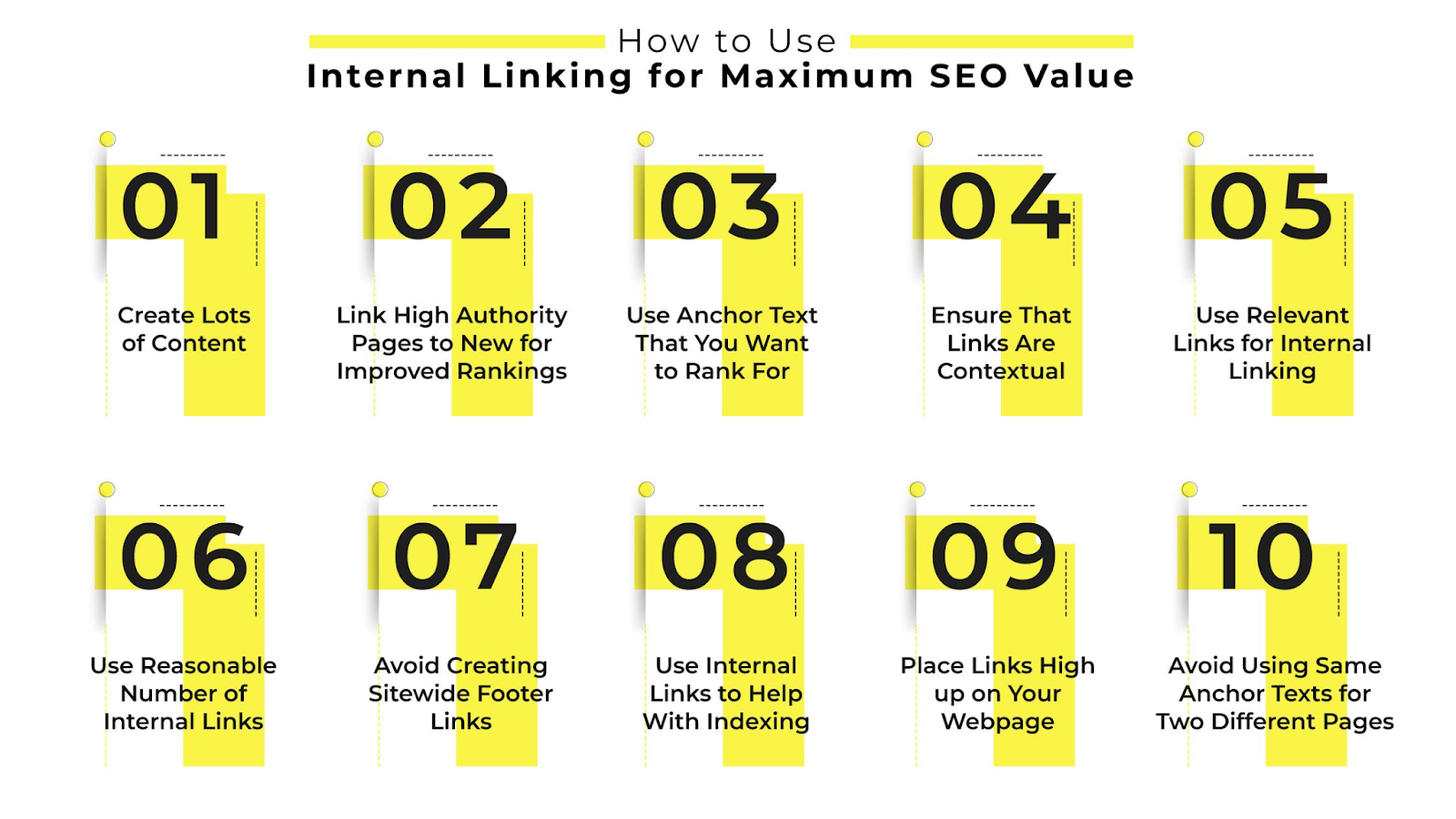
Agency Takeaway: Establishing the linking structure early reduces future rework and helps ensure every new page fits into the site's broader SEO strategy.
Don't Rush Into High-Volume Authority Building
Link building and authority development are valuable, but sequencing matters considerably for a new website.
1. Establish Something Worth Supporting First
Before scaling up link-building activity, agencies should confirm that priority pages actually exist, that content satisfies the intended search need, that the website's architecture is sound, that important technical issues have been addressed, and that the agency knows which pages actually deserve authority in the first place.
2. Make Authority Work Selective
Rather than pursuing links indiscriminately, agencies should focus on relevant opportunities, connect authority-building efforts to strategic pages, and avoid measuring progress by link volume alone. A handful of relevant, well-placed links often outperforms a large batch of low-quality ones.
3. Why Sequencing Matters?
A link pointing to a poorly targeted page does not solve the underlying page problem; it simply sends traffic and authority to something that isn't ready to convert it. Building authority before deciding which pages matter most can spread fulfillment resources too thin across a site that isn't yet structured to take advantage of it.
This isn't an argument against link building. It's an argument for building authority after the site has clear targets for that authority to support. Sequencing depends heavily on the specific website's condition, business model, competitive landscape, and priorities, so this is not a rule that applies identically to every situation.
Turn the First 90 Days Into a Prioritized Fulfillment Roadmap
The following is an example framework, not a rigid universal schedule that applies identically to every website.
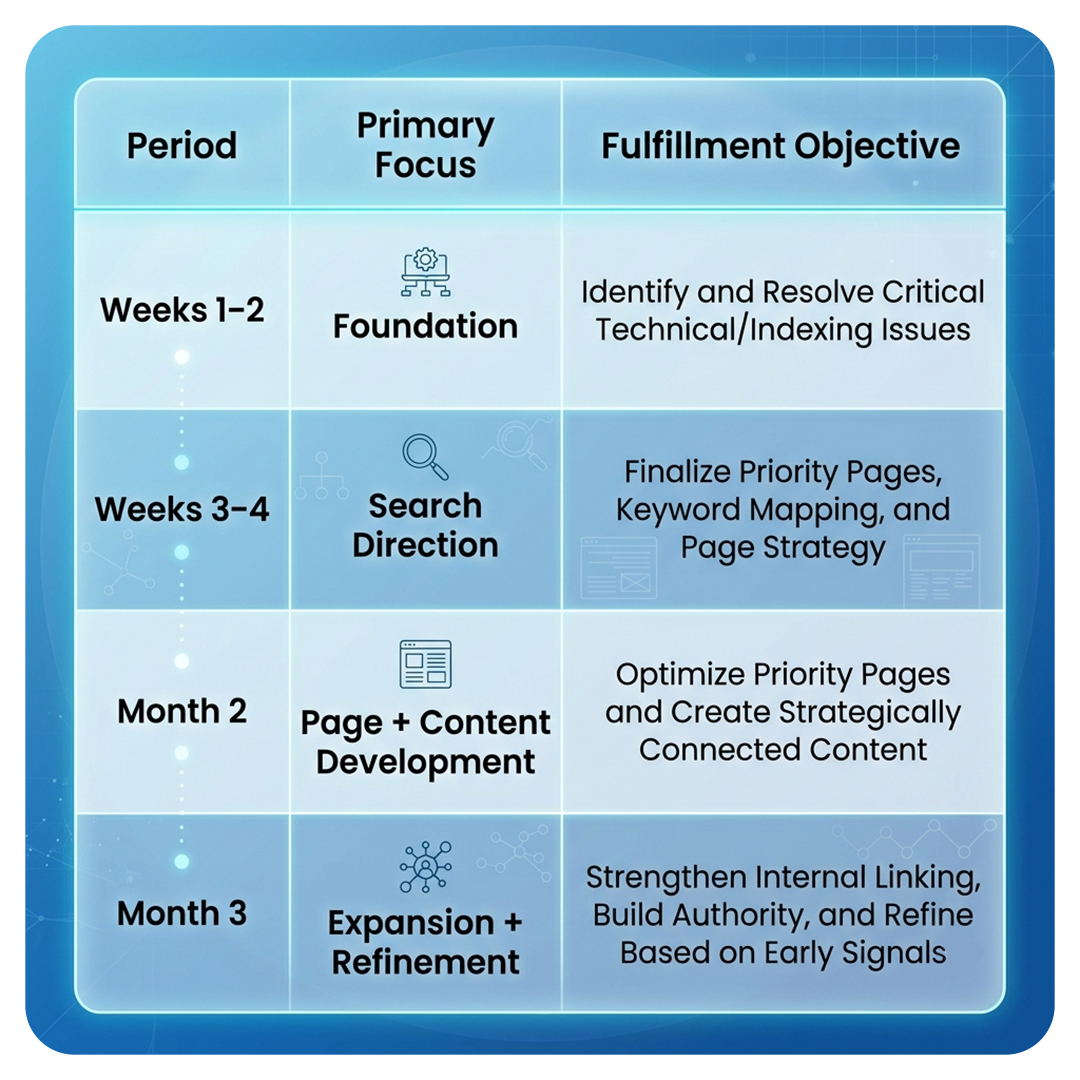
This roadmap should change based on the website's actual condition.
New websites do not all start from the same position. A technically broken website may require significantly more foundational work before it can move forward, while a well-built website may progress faster into content and authority development. Local businesses, ecommerce sites, SaaS companies, and service businesses can all have meaningfully different SEO priorities based on how customers search for and purchase from them.
What Agencies Should Report During This Period?
- Technical Issues Resolved: Show which foundational obstacles were identified and addressed.
- Pages Indexed: Monitor whether important pages are successfully entering Google's index.
- Priority Pages Published or Optimized: Track progress against the agreed-upon page strategy.
- Content Produced: Confirm supporting content is being created according to the roadmap, not on an arbitrary schedule.
- Internal-linking Improvements: Document meaningful structural changes as they happen.
- Search Impressions and Clicks: Use these as early visibility signals, since they often shift before rankings do.
- Ranking Movement Where Meaningful: Consider ranking changes alongside other indicators rather than in isolation.
- Leads and Conversions Where Sufficient Data Exists: Connect SEO activity to business outcomes once the data is mature enough to support the comparison.
This 90-day framework should never be presented as a promise that specific SEO results will occur within 90 days. It is a sequencing guide, not a guarantee.
How White Label SEO Helps Agencies Execute the Roadmap?
The challenge isn't knowing what to do; it's consistently getting it done. New websites can generate a substantial amount of fulfillment work across technical SEO, on-page SEO, content, internal linking, local SEO where applicable, link building, reporting, and quality assurance.
Internal specialists can quickly become a bottleneck when several new clients launch around the same time, especially at agencies without dedicated capacity for every discipline. This is where white label SEO services for agencies can play a practical role.
1. Use Fulfillment Capacity According to Priority
The division of responsibilities matters here. The agency determines strategy and sequence, deciding which pages, topics, and technical issues take priority based on everything discussed above. The fulfillment team then handles assigned execution, working through that prioritized roadmap rather than an undifferentiated task list.
2. Maintain Agency Ownership
Agency remains responsible for:
- Client goals
- Strategy
- Prioritization
- Recommendations
- Client communication
Fulfillment partner supports:
- SEO execution
- Specialist capacity
- Recurring implementation
- QA
- Reporting support
A white label SEO partner extends what the agency can execute; it does not replace the agency's strategic role in the relationship.
3. Avoid Promising Instant SEO Results
White label fulfillment increases execution capacity, but it does not eliminate the time required for SEO to develop naturally. As the Ahrefs survey research noted earlier, results typically take months to materialize, and outcomes should be evaluated according to the website's starting position, competitive landscape, search demand, implementation quality, and available data. A reliable white label SEO company can help an agency execute its roadmap consistently, but it cannot compress the underlying timeline that search engines operate on.

For agencies managing SEO across multiple new-site clients, DashClicks can serve as a fulfillment partner that supports the prioritization framework described throughout this article.
- Support New-Site SEO Without Expanding the Internal Team: DashClicks offers white label SEO services for agencies, including technical SEO support, on-page SEO support, content and other recurring SEO execution, and specialist support as account volume increases. Standardized processes, quality assurance, and branded or client-facing reporting capabilities can help agencies scale fulfillment without building out an entirely new internal department for every discipline.
- Position DashClicks Around the Article's Central Problem: The core idea connecting this article to white label fulfillment is straightforward: agencies decide what needs to happen first, and DashClicks can provide the fulfillment capacity to execute that roadmap. This is the most relevant connection between the SEO prioritization framework outlined above and a white label SEO partner model in general.
- Keep the Agency in Control: The agency retains ownership of the client relationship and strategic direction. DashClicks functions as an extension of the agency's fulfillment team, helping execute prioritized work according to the agency's roadmap.
The Foundation Determines What Comes Next
New websites don't need every SEO task happening simultaneously.
Agencies should first establish the technical foundation, understand what the site already has, and identify the pages and search opportunities most closely tied to business goals. From there, they can optimize priority pages, build supporting content and internal links, and introduce authority-building where it makes strategic sense.
White label SEO fulfillment can provide the capacity to execute this sequence consistently as client volume grows.
The goal isn't to make a new website look busy with SEO activity. It's to make every SEO task contribute to a foundation that can scale.

The Agency Guide to Performance Max Campaign Optimization
Performance Max gives agencies access to Google's advertising inventory across Search, YouTube, Display, Discover, Gmail, and Maps from a single campaign. Instead of managing separate campaigns for each channel, agencies provide assets, goals, and signals while Google's machine learning handles much of the placement and bidding in real time.
Performance Max has become a significant part of Google Ads strategy. In April 2025, Google reported that more than 1 million advertisers were using Performance Max. Google also said that more than 90 quality improvements introduced in 2024 collectively increased conversions and conversion value by more than 10% for advertisers, based on its internal data.
However, automation does not mean a campaign can be launched and left unattended. Agencies still need to monitor conversion data, creative assets, audience signals, search themes, budgets, bidding, landing pages, and performance trends across client accounts.
Effective Performance Max management comes down to providing the right inputs, monitoring meaningful signals, and making controlled adjustments. That becomes more complex when an agency manages multiple accounts with different objectives, budgets, audiences, offers, and conversion goals.
This guide breaks down how agencies can build a systematic, repeatable process for optimizing Performance Max campaigns at scale.
Start With the Right Conversion Goals
Conversion data is the foundation of Performance Max. If campaigns optimize toward the wrong actions or tracking is broken, other optimization efforts will not address the underlying problem.
- Primary and Secondary Conversion Actions: Understand which actions campaigns are optimizing toward. A campaign prioritizing newsletter signups will behave differently from one prioritizing purchases.
- Business Outcomes: Focus on meaningful client outcomes rather than simply maximizing clicks or form fills.
- Conversion Tracking: Confirm tracking works correctly before making optimization decisions.
- Conversion Values: Assign appropriate values when different conversion actions have different business impact.
- Lead Quality: More leads do not necessarily mean better results. Evaluate whether leads are useful to the business.
- Imported Conversions: Verify that CRM or offline conversions accurately represent the client's current goals.
Google's current guidance emphasizes relevant conversion actions and accurate tracking as foundational to Performance Max. Campaigns use conversion events and/or conversion value to determine how to spend the daily budget. Google also recommends balancing conversion actions that are close to the final sale with enough conversion volume for the system to learn effectively.
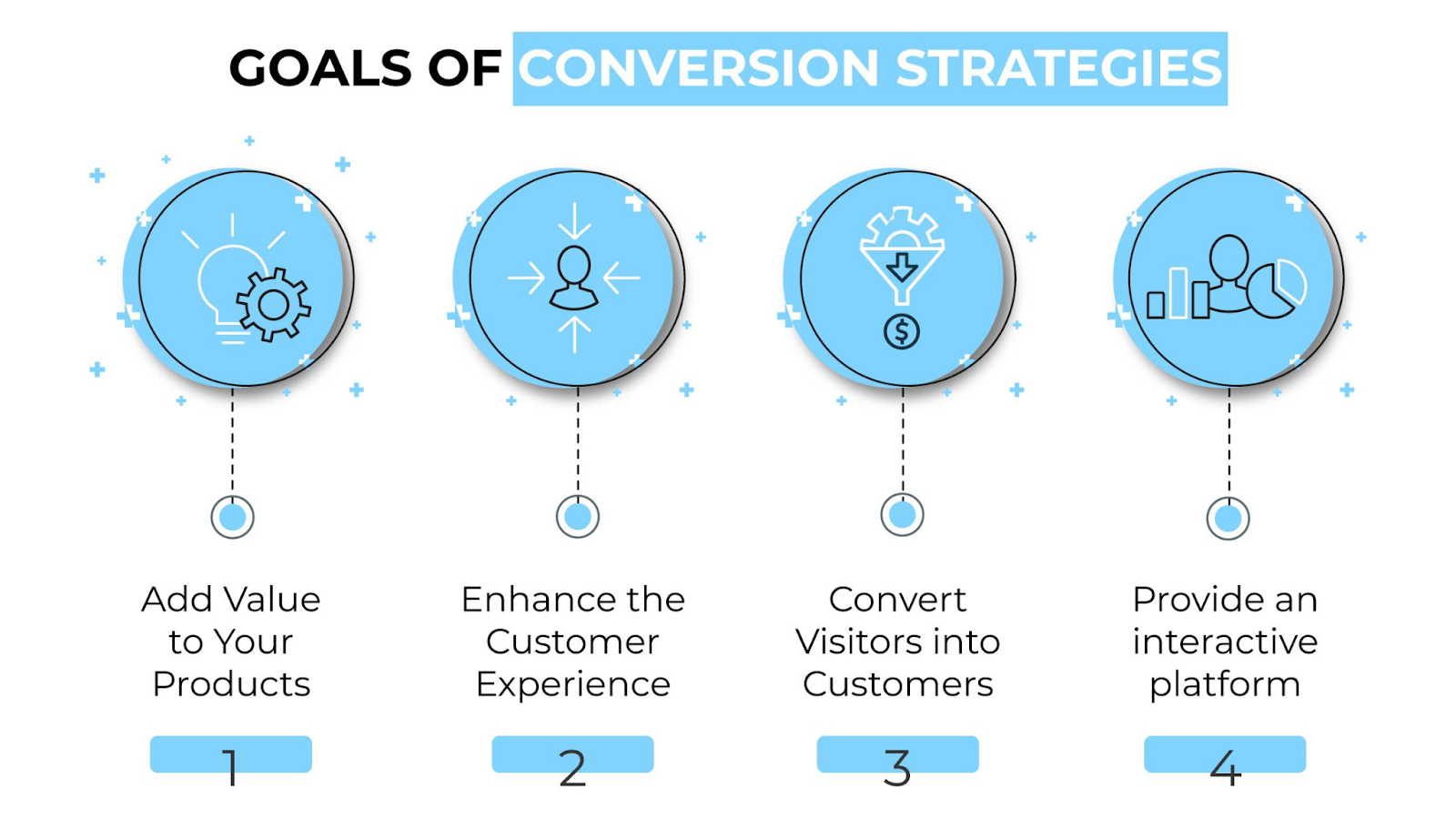
Before changing bids, budgets, or creative, agencies should establish whether Performance Max is learning from the right conversion signals.
Organize Campaigns and Asset Groups Around Clear Goals
Once conversion goals are confirmed, agencies should structure campaigns and asset groups to give automation useful context without creating unnecessary complexity.
- Product or Service Categories: Group campaigns around distinct products, services, or business lines.
- Customer Needs: Separate structures when different customer needs require different messaging.
- Offers or Business Objectives: Create dedicated structures for distinct promotions or business goals.
- Relevant Asset Groups: Keep each asset group focused on a clear product, service, offer, or theme.
- Match Assets to the Theme: Headlines, images, and videos should clearly relate to the asset group's focus.
- Avoid Unnecessary Fragmentation: Do not create excessive divisions that limit conversion volume or add complexity without providing useful context.
Google describes Performance Max as a goal-based campaign type and recommends defining the conversion goals and values that matter to the business. Agencies should apply the same principle rather than relying on a generic structure for every account.
Further Reading: Google Performance Max Campaigns - Everything You Need to Know
Strengthen Performance Max Creative Assets
Creative assets are key inputs agencies can actively improve. Because Performance Max assembles ads across formats and placements, the quality and variety of available assets affect what the system can work with.
- Headlines: Use messaging that reflects the client's offer and relevant search or audience context.
- Descriptions: Reinforce the value proposition and support the headline messaging.
- Images: Review relevance, quality, variety, and suitability across placements.
- Logos: Use recognizable, appropriate logos that maintain brand consistency.
- Videos: Include video assets wherever possible, particularly for YouTube inventory.
- Asset Variety: Provide enough variation for the system to test different combinations.
- Different Creative Formats: Avoid relying only on one format, such as static images.
- Weak or Outdated Assets: Replace assets that no longer fit the client's offer, messaging, or brand.
- Brand Consistency: Keep creative variation aligned with the client's positioning and objectives.
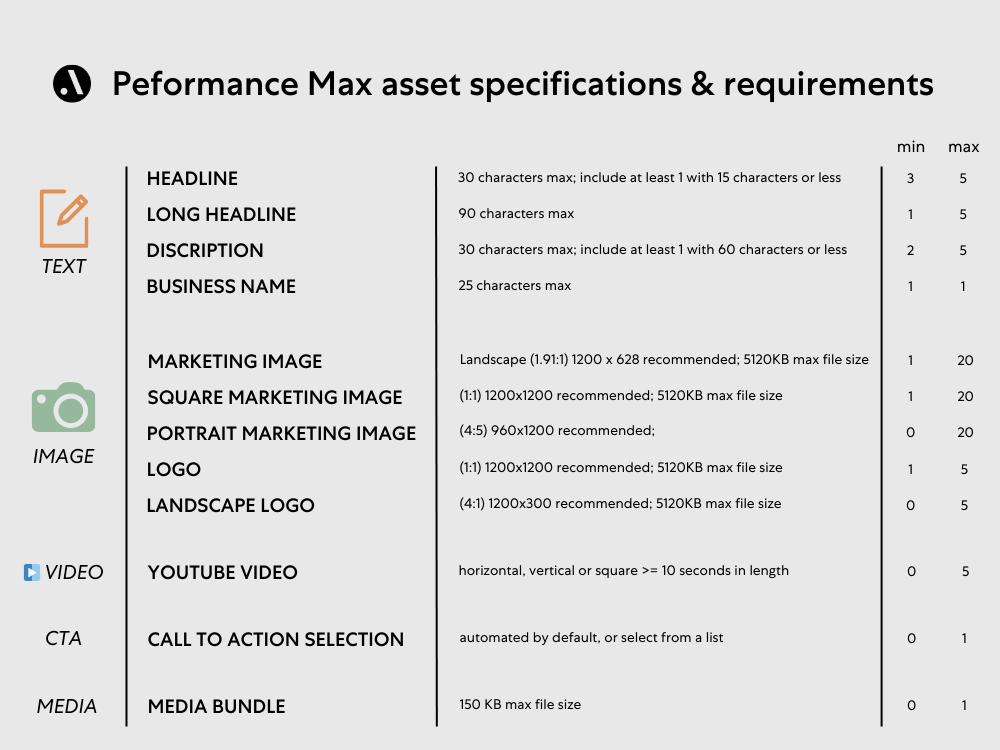
Image Source: Adchieve
Agencies can use asset reporting and Ad Strength as diagnostic inputs while evaluating whether creative changes contribute to meaningful campaign performance. Google's current guidance reports that advertisers improving Ad Strength from Poor to Excellent see a median 6% increase in conversions or conversion value at a similar CPA/ROAS. This is a median figure from Google's data, not a guarantee.
Google also provides conversion metrics at the asset and asset-group levels, giving advertisers more ways to evaluate individual assets.
Use Audience Signals to Guide Campaign Learning
Audience signals provide Google's AI with additional context about users who may be more likely to convert. They inform the system rather than restricting ads to those audiences.
- First-party Customer Data: Use existing customer information to provide context about previous converters.
- Customer Lists: Relevant lists, such as past purchasers or high-value customers, can support campaign learning.
- Website Visitors: Visitor data can provide signals from users who have already shown interest.
- Remarketing Audiences: Keep remarketing lists updated so they continue to reflect relevant user behavior.
- Custom Segments: Use relevant interests or behaviors to add context beyond first-party data.
- Audience Insights: Review insights to understand which audiences are associated with campaign performance.
- Client-specific Knowledge: Translate knowledge of the client's customers, products, services, and buying behavior into useful signals.
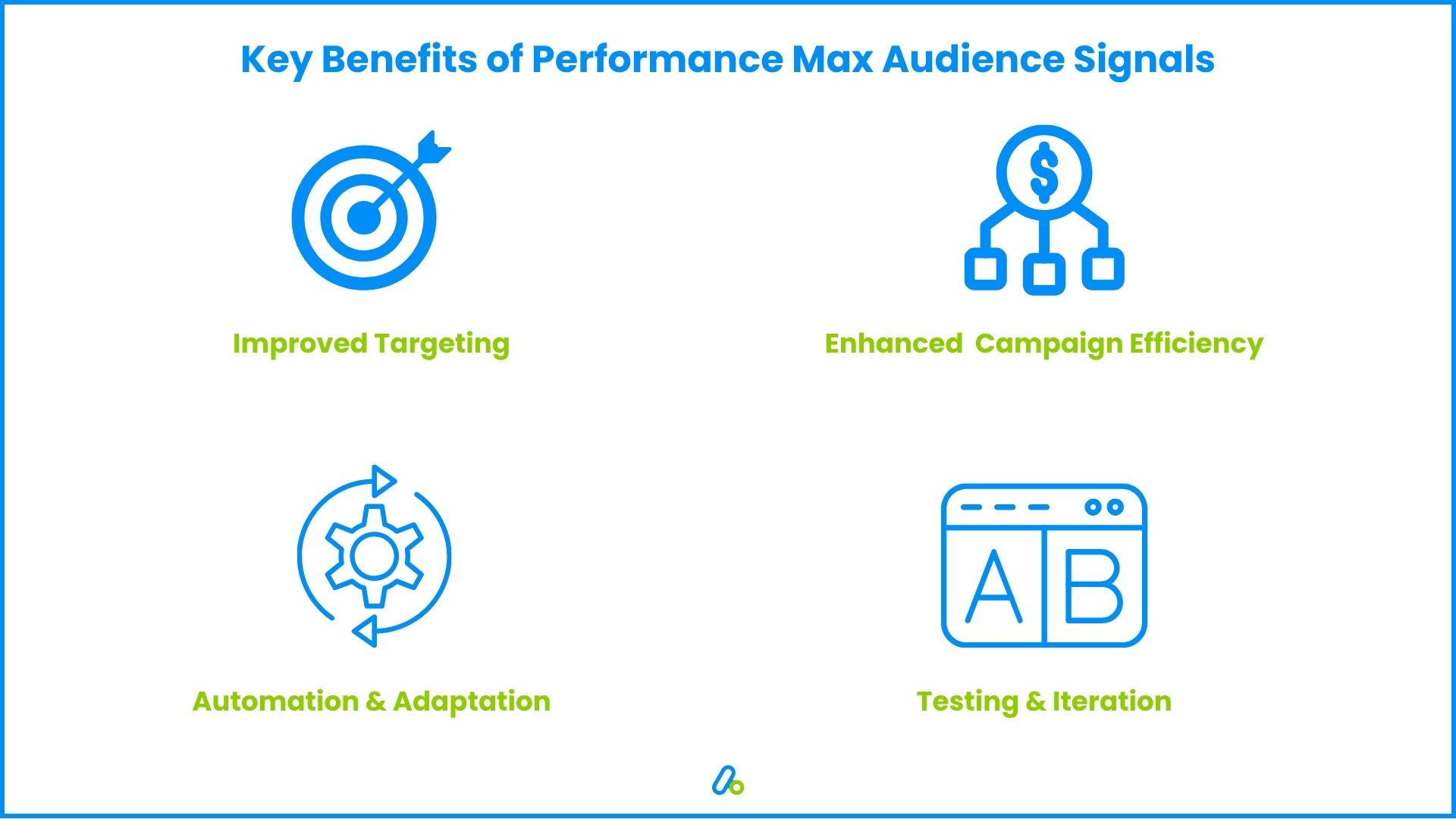
Image Source: Analyzify
Google recommends using updated remarketing lists and strong audience signals to help guide Performance Max's AI. Agencies should clarify that these signals inform the system but do not guarantee ads will only reach those specific audiences.
Refine Search Themes and Search Controls
Performance Max automates much of channel selection, but search-related traffic still requires attention. Agencies should review whether campaign reach remains relevant to the client's business.
- Search Themes: Use themes that reflect the actual products or services being promoted.
- Search Term Insights: Review available insights to understand the queries triggering campaign activity.
- Irrelevant Search Intent: Identify traffic that does not align with the client's offerings or desired audience.
- Negative Keywords: Where available, use negative keywords to limit clearly irrelevant queries.
- Brand Exclusions: Consider brand exclusions when the client does not want Performance Max competing with branded search campaigns.
- Search-related Traffic: Monitor traffic quality and relevance rather than focusing only on volume.
- Product or Service Alignment: Evaluate traffic against what the client actually sells or wants to promote.
The goal is not simply more traffic. Search-related insights should help agencies determine whether campaign reach aligns with the client's business objectives.
Optimize Bidding and Budget Allocation
Bidding and budget decisions are closely connected to conversion volume and campaign goals.
- Budget Constraints: Budget affects available conversion volume, and the data automated bidding can learn from.
- Target CPA: Relevant when the priority is generating conversions at a target cost.
- Target ROAS: Relevant when reliable conversion value data is available, and the client prioritizes conversion value.
- Conversion Volume: Consider whether there is enough activity to support the selected bidding strategy.
- Conversion Value: Account for differences in the business value of individual conversions.
- Budget Pacing: Review spend against campaign objectives and available budget.
- Restrictive Targets: Overly restrictive CPA or ROAS targets can limit delivery and prevent campaigns from spending their full budget.
- Measured Changes: Avoid repeatedly changing bidding settings before there is enough data to evaluate the previous change.
Google reports that advertisers switching from Target CPA to Target ROAS saw, on average, 14% more conversion value at a similar ROAS, according to its cited data. This is an average result, not a guarantee for every account.
Not every performance problem is a bidding problem. Weak conversion tracking, creative, landing pages, or traffic relevance may need to be addressed first.
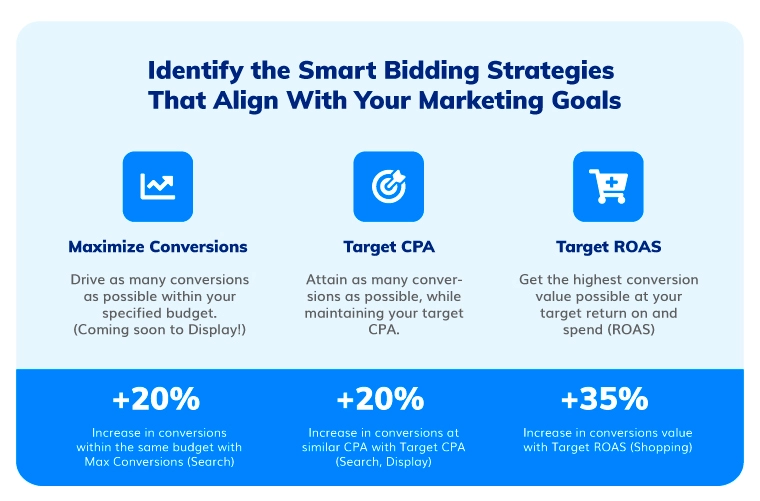
Image Source: White Shark Media
Further Reading: How Agencies Can Adapt to Smart Bidding Trends Using White Label PPC Services
Review Landing Pages and Final URL Expansion
Google Ads optimization extends beyond the ad account. Agencies should also evaluate what happens after the click.
- Landing-page Relevance: Confirm that the page matches the ad, search intent, and promoted product or service.
- Service/Product Alignment: Send visitors to relevant destinations rather than defaulting to the homepage.
- Conversion Experience: Identify friction or disconnects between the ad and landing experience.
- Page Quality: Review factors such as load speed, mobile usability, and call-to-action clarity.
- Final URL Expansion: Understand where Performance Max can direct traffic when final URL expansion is enabled.
- Traffic Destinations: Review where users are actually being sent.
- Stronger and Weaker Landing Pages: Identify destinations associated with stronger or weaker outcomes and adjust settings where appropriate.
Google's current Performance Max reporting guidance includes landing-page and performance insights, helping agencies connect campaign activity with what happens on the client's website.
Monitor Performance Before Making Changes
Optimization should not mean constantly editing campaigns. Agencies should first identify what changed and where the problem is.
- Conversions: Check whether campaigns are generating the intended actions.
- Conversion Value: Review the business value of those conversions.
- Cost per Conversion: Compare efficiency against client goals and relevant historical benchmarks.
- ROAS: Review return relative to spend where value-based measurement applies.
- Conversion Rate: Evaluate what happens after users reach the conversion point.
- Spend: Compare actual spend with budget and campaign objectives.
- Budget Utilization: Identify whether the budget is being used as intended.
- Asset Performance: Review creative reporting and performance trends.
- Search-related Insights: Monitor search themes, search-term insights, and traffic relevance.
- Lead Quality: Where CRM data is available, evaluate whether leads are useful to the business.
Agencies can follow a consistent cycle: identify, diagnose, adjust, allow learning, measure, repeat.
Google says the Performance Max Insights page is refreshed daily and recommends accounting for conversion lag when evaluating performance. Daily updates do not mean agencies should make daily campaign changes. Reactive edits based on incomplete data can create more noise than clarity.
Give Performance Max Time to Learn
Performance Max needs sufficient data and time to respond to changes. Patience is part of effective optimization.
- Learning Periods: Automated bidding and asset delivery need enough data to identify patterns.
- Conversion Cycles: Consider how long it typically takes a click or interaction to become a recorded conversion.
- Significant Campaign Changes: Changes to bidding strategies, asset groups, or conversion goals can affect performance patterns.
- Avoid Unnecessary Edits: Frequent changes make it harder to determine which action affected results.
- Appropriate Comparison Periods: Evaluate performance over a timeframe that reflects the campaign's conversion cycle.
- Change Documentation: Record significant changes so later performance can be evaluated against them.
Google notes that Performance Max can take time to begin generating impressions and emphasizes correct conversion tracking before relying on campaign optimization. Optimization is controlled iteration, not constant intervention.
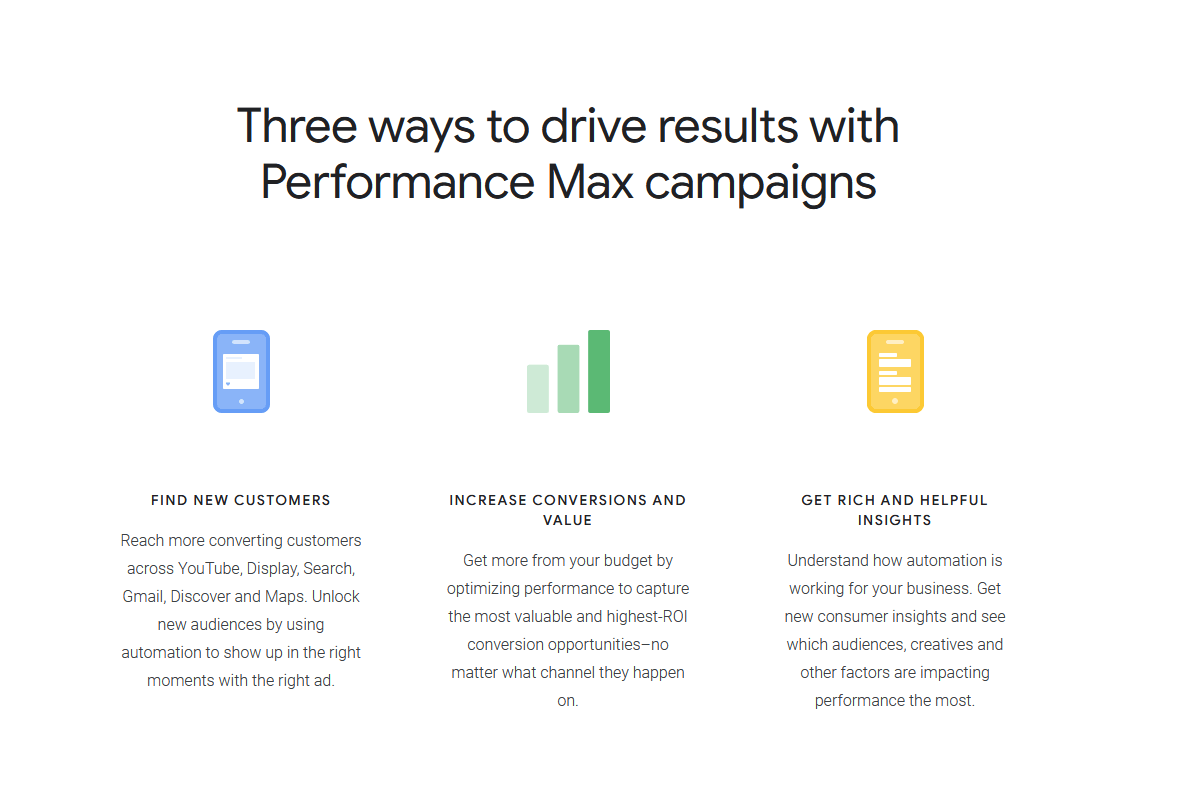
Image Source: Social Media Examiner
Create a Repeatable Performance Max Optimization Process
A documented workflow helps agencies manage multiple Performance Max accounts consistently while keeping decisions specific to each client.
- Check Conversion Tracking: Confirm tracking is accurate.
- Review Campaign Performance: Evaluate conversions, conversion value, cost per conversion, and relevant trends.
- Identify the Biggest Performance Issue: Focus on the issue most likely to affect results.
- Determine the Relevant Optimization Lever: Decide whether the issue relates to conversions, creative, audiences, search relevance, bidding, or landing pages.
- Make a Controlled Adjustment: Change one meaningful variable at a time where practical.
- Allow Sufficient Learning Time: Give the campaign time to respond.
- Review the Impact: Compare results against an appropriate baseline.
- Document the Result and Continue Monitoring: Record the change and outcome before moving to the next issue.
The workflow provides consistency, while account-specific data determines what actually needs attention.
Scale Performance Max Optimization With White Label Google Ads
Knowing how to optimize Performance Max is one challenge. Having enough time and specialized resources to perform that work consistently across every client account is another.
As an agency's client roster grows, the operational demands of managing Performance Max well across every account start to add up.
- Multiple Client Campaigns Requiring Regular Monitoring: Different accounts can require different review schedules, objectives, and optimization priorities, which makes a single standardized routine difficult to apply.
- Different Conversion Goals: One client may care about lead volume while another focuses on conversion value or a specific business action, requiring separate strategies within the same agency.
- Different Budgets and Bidding Strategies: Agencies need to manage account-specific constraints rather than apply one standard setting everywhere.
- Ongoing Creative Requirements: Performance Max requires continued attention to available assets and messaging, which takes ongoing creative resourcing.
- Search and Traffic Analysis: Agencies need to regularly review whether campaign reach remains relevant to each client's specific services and products.
- Campaign Adjustments: Optimization requires controlled changes based on account evidence, not one-size-fits-all edits applied across the board.
- Reporting and Documentation: Agencies need to maintain clear records of performance and changes for every client, which takes time to prepare and communicate.
- Client Deadlines: Campaign management also needs to fit into recurring reporting and delivery schedules that clients expect.
- Limited In-house PPC Capacity: Growing client demand can exceed the agency's available specialist resources, especially for agencies that offer PPC alongside other services.
This is where Google Ads outsourcing becomes a practical option for agencies that need to extend their fulfillment capacity without building an entirely new internal team.
- Specialized PPC Fulfillment: Agencies can use a specialized team to handle ongoing Google Ads execution, including the day-to-day work involved in Performance Max management.
- Consistent Optimization: Established processes can help maintain regular campaign reviews and optimization across every client account, rather than optimization happening only when time allows.
- Agency Retains the Client Relationship: The agency remains the primary client-facing business while fulfillment happens behind the scenes.
- Scalable Delivery: White label Google Ads agency can give agencies additional capacity when their client roster grows, without requiring them to immediately build a larger internal PPC team.
DashClicks operates as an extension of the agency's team in this model, not a replacement for the agency's strategy, client relationship, or decision-making.
Why Agencies Use DashClicks for White Label Google Ads?
DashClicks works as a fulfillment partner that can support agencies with the execution workload behind their Google Ads services, including the ongoing optimization work covered throughout this guide.
- Dedicated PPC specialists: DashClicks provides specialized white label Google Ads management for agencies, giving them access to PPC expertise without hiring additional in-house staff.
- Ongoing Campaign Optimization: Support can include monitoring campaign performance and making optimization adjustments based on each account's specific goals, following the kind of process outlined earlier in this guide.
- Agency-Branded Delivery: The agency maintains the client-facing relationship and can deliver services under its own brand, with fulfillment work happening behind the scenes.
- Scalable Fulfillment: Agencies can use DashClicks to supplement existing PPC capacity as their client roster grows, rather than turning down new business or overextending their current team.
- Reporting and Transparency: Agencies can review campaign performance and communicate results to clients without handing the client relationship to a third-party provider.
- Extension of the Agency Team: DashClicks is positioned as a fulfillment partner that works behind the scenes, supporting the agency's existing strategy rather than replacing it.
Conclusion
Performance Max automation reduces manual campaign management, but it does not eliminate strategic oversight. Agencies still need to provide accurate conversion data and relevant inputs while monitoring creative, audience signals, search controls, budgets, bidding, and landing pages.
A repeatable optimization process helps agencies identify issues, make controlled changes, and allow enough time to evaluate results instead of reacting to daily fluctuations. For agencies whose client base is growing faster than their internal PPC capacity, white label Google Ads can provide additional fulfillment support while the agency retains strategic and client ownership.

How White Label SEO Helps Agencies Turn Search Data Into Actionable Strategies
Agencies today have access to more search data than ever before. Google Search Console, analytics platforms, rank trackers, backlink tools, and SEO audits generate a constant stream of findings about client website performance. Collecting data is the easy part. The harder challenge is identifying what matters, especially when agencies manage multiple client accounts with limited internal capacity.
Search data should answer one practical question: What should we do next? A report full of keyword positions, traffic charts, and technical findings is only useful if it leads to action. The process is straightforward: search data becomes an insight, the insight is weighed against other priorities, the priority becomes a specific SEO action, and the action is measured to determine whether it worked.
Search data → Insight → Priority → SEO action → Measurement
This is where a white label SEO agency can play a meaningful role. Agencies that understand their clients' businesses and search performance still need the hands-on capacity to execute consistently across every account. White label SEO outsourcing provides that execution layer without requiring agencies to build every specialist function internally.
BrightEdge's 2019 channel research found that organic search accounted for an average of 53.3% of trackable website traffic across the industries studied. While this figure is several years old and should not be treated as a current universal benchmark, it illustrates the long-standing importance of organic visibility.
Search data becomes strategically useful when agencies consistently turn findings into prioritized SEO actions.
Why Search Data Alone Isn't Enough?
Having access to SEO data does not automatically produce a useful strategy. Data is raw material. It needs interpretation, context, and follow-through before it becomes something a client benefits from.
1. Large Volumes of Data Can Obscure Priorities
A single client account can generate a long list of findings: ranking changes, technical SEO issues, content opportunities, backlink gaps, traffic fluctuations, and shifts in search visibility. Multiply that across a dozen or more clients, and an agency can end up with dozens of potential issues and no clear sense of which ones deserve attention first. Without a filtering process, teams either try to fix everything at once or default to whatever seems most urgent that week, rather than what is actually most impactful.
2. Data Needs Business and Search Context
The same metric can mean very different things depending on the client. A ranking drop for a seasonal retailer in the off-season is not the same signal as a ranking drop for a service business during its busiest quarter. Interpretation depends on factors like industry, search intent, competitive pressure, seasonality, the website's history, the client's specific business goals, which products or services matter most, and who the target audience is. Search data without this context is just numbers on a screen.
4. Execution Determines Whether an Insight Creates Value
Identifying an SEO opportunity is only the first step. Agencies need to report what happened, understand why, decide what to do next, and complete the work. While many agencies handle the first three stages well, execution can become difficult with limited teams and multiple accounts.
White label SEO fulfillment helps agencies bridge this gap by handling approved SEO work while the agency retains control over strategy and client communication.
Turn Keyword and Ranking Data Into Concrete SEO Opportunities
Ranking reports full of keyword movements are common, but they rarely tell a client anything actionable on their own. Agencies add value by turning that raw movement into specific opportunities.
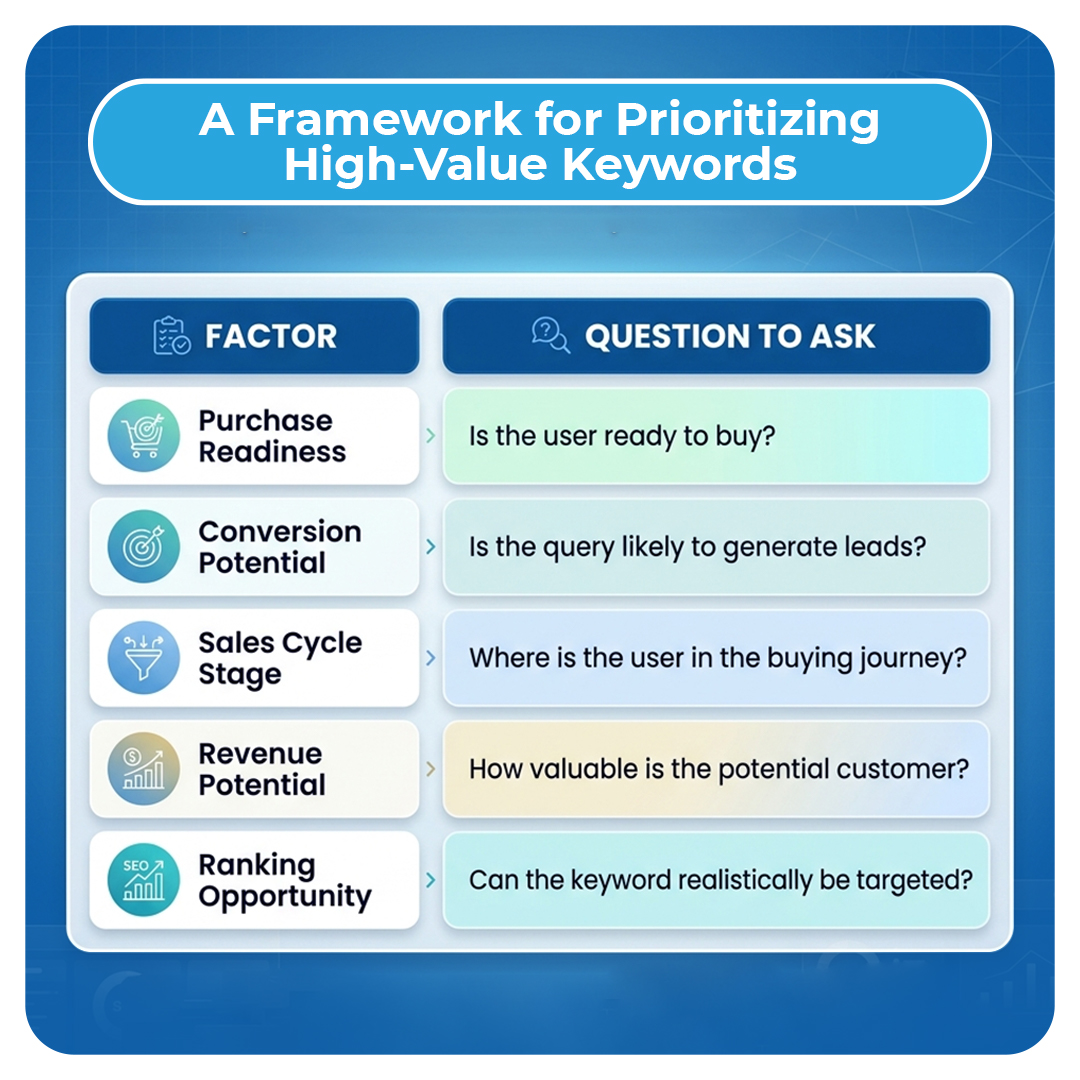
1. Identify Keywords With Existing Search Visibility
Some of the most useful opportunities come from keywords a page already has some visibility for. This includes queries where a page receives impressions but hasn't converted them into strong rankings, terms where there's clear room to move up, and search opportunities tied to a client's priority services or products. Not every keyword with visibility deserves investment. The point is to identify where existing traction could realistically be improved with focused work.
2. Find Relevant Queries That Do Not Match the Original Page Target
Pages often pick up impressions for queries that were never part of the original targeting. When this happens, it's worth checking whether the query matches the page's purpose, whether it reflects a relevant search intent, and whether it should be addressed through content expansion, a new supporting page, or an internal linking adjustment.
3. Investigate Declining Rankings
A ranking decline can point to several different needs: content updates, on-page optimization, stronger internal linking, better alignment with search intent, technical investigation, or additional authority-building work. Not every decline warrants a major response. Agencies should look at the scale of the drop, how long it has lasted, which pages are affected, and how important those pages are to the client's business before deciding on a course of action.
4. Identify Keyword Gaps Carefully
Keyword gap analysis, where a competitor ranks for a term the client doesn't, can surface real opportunities. But a gap is not automatically a priority. It needs to align with what the client actually offers, who they're trying to reach, their business objectives, the relevant search intent, and how much commercial value the term realistically holds.
5. Group Keywords by Search Intent
Rather than treating every keyword as its own isolated task, agencies get more value by grouping related queries according to intent, whether informational, commercial, transactional, or local. This helps consolidate work into fewer, more efficient content and optimization projects instead of a scattered list of one-off fixes.
6. Convert Findings Into Specific SEO Actions
Once findings are organized, they can be translated into concrete tasks: refreshing an existing page, expanding topical coverage, creating a new supporting page, improving internal links, optimizing headings and metadata, building relevant backlinks, reassessing a page's intent, or consolidating overlapping content.
Instead of sending clients a spreadsheet of ranking changes each month, agencies can turn that same data into a prioritized SEO worklist, which is a far more useful deliverable for both the client and the team doing the work.
Use Search Visibility and CTR Data to Find Pages That Need Attention
Rankings only tell part of the story. Search behavior data reveals how people actually respond once they see a page in the results.
1. How Impressions, Clicks, CTR, and Average Position Work Together
Google Search Console's Performance report tracks impressions, clicks, click-through rate, and average position, and allows this data to be broken down by query, page, country, device, search appearance, and date. These metrics work together rather than in isolation, and none of them fully explains the entire customer journey on their own.
2. Identify Common Search Performance Patterns
Certain patterns tend to show up repeatedly and point toward areas worth investigating:
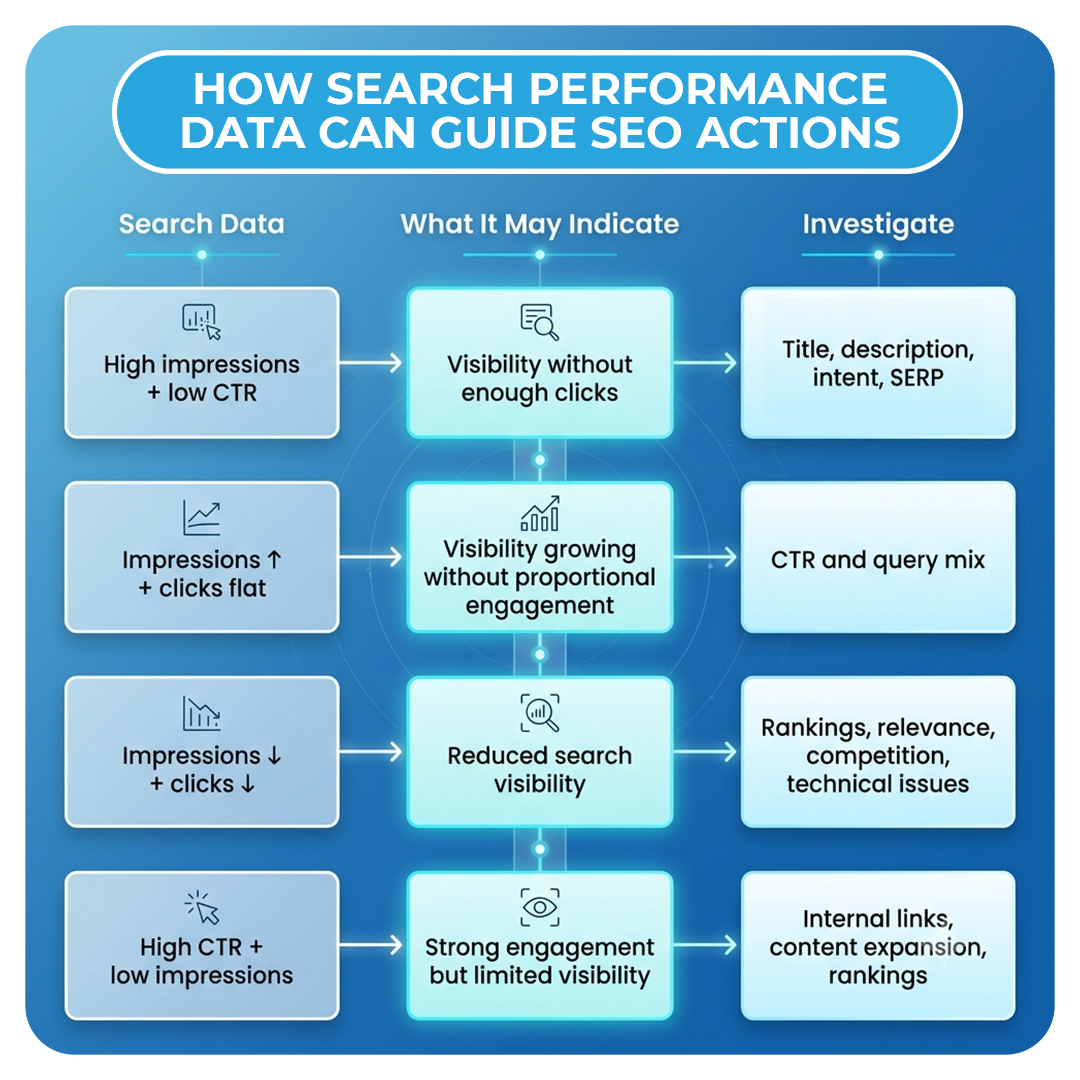
These patterns are starting points for investigation, not automatic diagnoses. The actual cause still needs to be confirmed before action is taken.
3. Interpret CTR in Context
Click-through rate should never be judged in isolation. Average position, search intent, the presence of SERP features, whether the query is branded or non-branded, device type, search appearance, query relevance, and page type all influence what a "good" CTR looks like for a given page. Google itself advises focusing on trends in impressions and clicks over time rather than relying heavily on average position alone when analyzing Search Console data.
4. Turn Search Behavior Findings Into Implementation Tasks
These findings can become real tasks: reviewing metadata, refining page messaging, improving content relevance, strengthening internal links, expanding visibility for pages that are already performing well, or investigating a shift in search appearance or query mix. It's worth being cautious here. No single change guarantees an increase in CTR or traffic, and agencies serve clients better by framing these as informed adjustments rather than certainties.
Turn Technical SEO Data Into a Prioritized Action Plan
Technical audits often generate long lists of issues. The real skill is not finding them but figuring out which ones matter most.
1. Why an Audit With 100 Issues Does Not Mean All 100 Need Immediate Fixes
Not every flagged issue carries the same weight. Agencies should assess findings based on potential search impact, how many pages are affected, severity, how much effort implementation will take, how important the issue is to the client's business, how it relates to current SEO priorities, and overall urgency. A minor issue on a high-revenue page may deserve attention before a larger issue on a page that barely gets traffic.
2. Convert Technical Findings Into Specific Actions
A few examples of how this plays out: important pages with indexing problems require an investigation into the cause, broken internal links need to be repaired to restore navigation pathways, missing or poorly structured headings call for improved content hierarchy, duplicate or weak metadata should be optimized on priority pages, poor internal linking needs strengthening between related pages, and crawlability concerns require a closer look at the affected sections to determine the right fix. Not every audit issue carries the same search impact, and treating them all equally wastes time.
3. Move From Audit to Implementation and QA
A practical workflow looks like this: audit, assigned task, implementation, QA, agency review. The agency decides which recommendations are worth acting on. A white label fulfillment team helps complete that approved work according to the agency's priorities and requirements. The real value in technical SEO isn't just fixing issues. It's deciding which issues get fixed first and why.
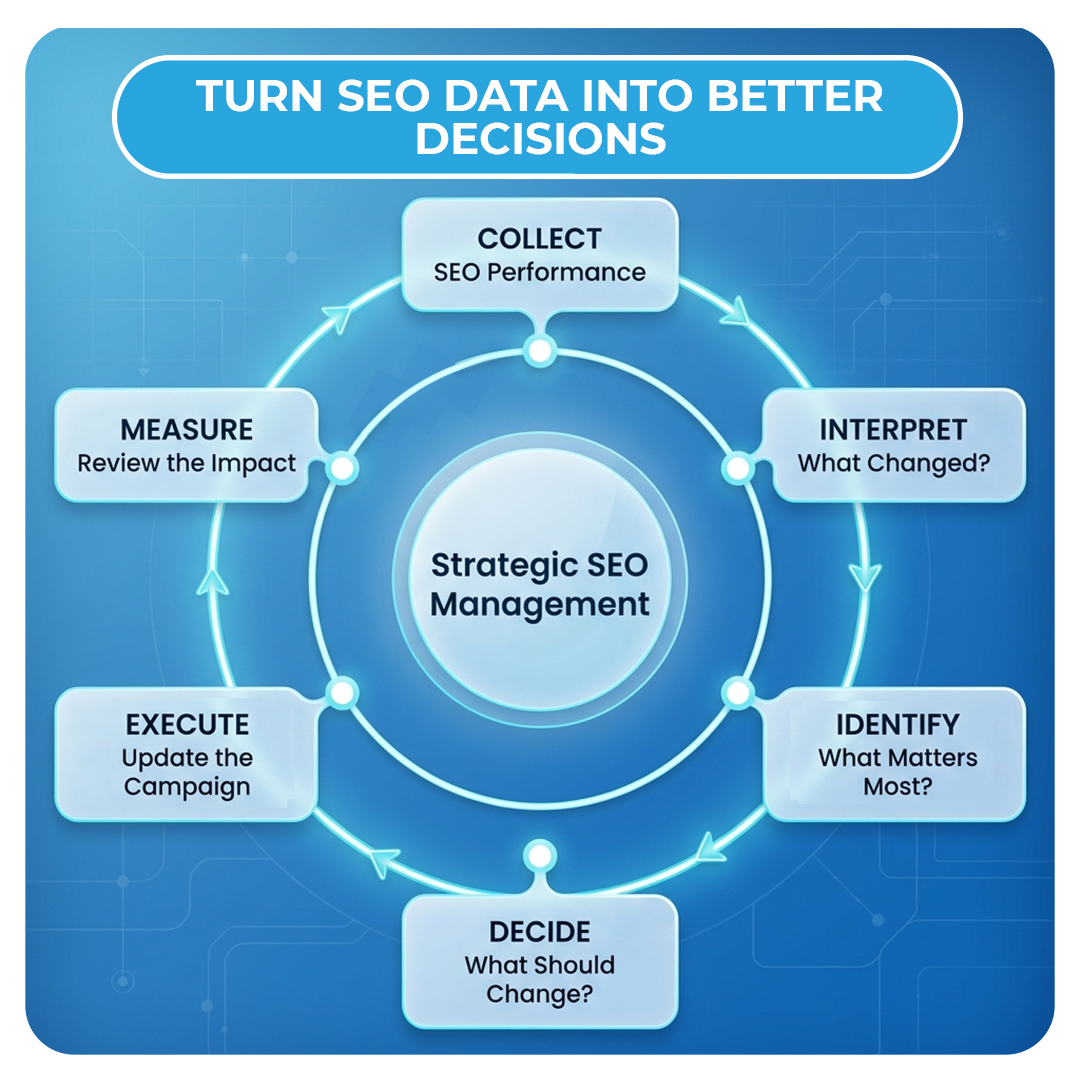
Local SEO Data Can Reveal Location-Specific Opportunities
For local and multi-location clients, agencies can use location-specific rankings, service queries, Google Business Profile performance, and local visibility data to identify priority areas. These findings can lead to actions such as improving location pages, strengthening internal links, updating local content, maintaining citation consistency, or refining Google Business Profile listings. The same prioritization process applies: assess business relevance, search intent, potential impact, and implementation effort before assigning the work.
How White Label SEO Turns Insights Into Execution
White label SEO functions as the execution layer between an agency's strategy and the completed work a client actually sees. The agency owns the interpretation of client goals and strategic priorities. Fulfillment support helps carry out the resulting work consistently across accounts.
Follow a Data-to-Execution Workflow
- Data Collection: The agency gathers relevant information from Google Search Console, analytics platforms, rank trackers, technical SEO audits, backlink tools, competitor research, and local SEO tools.
- Agency Assessment
The agency determines which findings matter most, based on client goals, market conditions, business priorities, search intent, affected pages, and available resources. - Strategy and Prioritization: The agency converts insights into a defined SEO action plan, deciding what should be done, why it matters, and how it fits into the client's broader objectives.
- Fulfillment Assignment: Approved tasks go to the white label SEO team, along with the agency's priorities, instructions, deadlines, and quality standards.
- SEO Execution: Specialists may support work such as on-page optimization, technical SEO, content optimization, keyword research, local SEO, link building, and SEO reporting.
- Quality Assurance: Completed work is reviewed to confirm it matches the original SEO strategy, client requirements, page-level priorities, technical requirements, and the agency's quality standards.
- Agency Review and Client Delivery: The agency reviews the finished work, maintains the client relationship, and delivers updates under its own brand. Fulfillment support does not remove the agency from strategic review or client communication.
- Performance Monitoring: New search data feeds into the next optimization cycle, connecting back to the same loop: data, insight, priority, action, measurement.
DashClicks: White Label SEO Services for Agencies
DashClicks helps agencies fulfill SEO work without building every specialist capability in-house. Agencies retain ownership of client relationships and strategic direction, while the platform supports execution across key SEO services.
Key benefits include:
- Specialist SEO Support: Assistance with technical SEO, on-page SEO, content optimization, local SEO, link building, and reporting, helping agencies manage multiple client accounts.
- Consistent Execution: Established fulfillment processes help agencies turn SEO insights into completed work, reducing the risk of priorities piling up.
- Branded Reporting: Client-facing reporting and infrastructure support agencies in presenting completed work under their own brand.
- Agency-Centered Fulfillment: DashClicks works as an extension of the agency's team, supporting execution while the agency retains control over strategy and client communication.
For agencies exploring white label SEO outsourcing, the goal is to find a fulfillment partner that complements their strategic capabilities, supports consistent execution, and works within their existing client relationships.
Build a Repeatable Data-to-Action SEO Process
Once agencies understand how to interpret search data, the next step is making that process repeatable across client accounts. A simple checklist can help teams consistently move from findings to completed SEO work.
- SEO Data-to-Action Checklist
- Review the latest search data
- Identify meaningful findings
- Add business context
- Prioritize opportunities
- Turn priorities into specific tasks
- Assign the work
- Complete implementation and QA
- Measure the next cycle
This checklist keeps the process focused on what happens after the data is collected. Instead of treating SEO reporting as the end of the process, agencies can use each reporting cycle as the starting point for the next round of decisions and execution.
Turning Data Into a Lasting Advantage
The competitive advantage in SEO was never simply about having access to more data. Most agencies today can pull similar reports from similar tools. The real advantage comes from what happens after the data lands: consistently interpreting findings, prioritizing the right opportunities, executing the resulting work, and measuring whether it made a difference.
White label SEO can help close the gap between strategy and execution, particularly for agencies juggling multiple client accounts with limited internal bandwidth. The agency still owns the strategy, the business objectives, the approvals, and the client relationship. What changes is the ability to reliably turn decisions into completed work, month after month, with the right fulfillment infrastructure behind it. DashClicks is one option agencies can turn to for that execution capacity, supporting the fulfillment side of SEO while agencies focus on strategy and client relationships.
Effective SEO strategy is not just about understanding what the data says. It is about deciding what the data requires the agency to do next, completing that work, and using the next set of findings to guide the following decision.

No results found.
Please try different keywords.
Get Started with
DashClicks Today
Get found online, convert leads faster, generate more revenue, and improve your reputation with our all-in-one platform.
.svg)
Unlimited Sub-Accounts
Unlimited Users
All Apps
All Features
White-Labeled
Active Community
Mobile App
Live Support
100+ Tutorials
Unlimited Sub-Accounts
Unlimited Users
All Apps
All Features
White-Labeled
Active Community
Mobile App
Live Support
100+ Tutorials
Unlimited Sub-Accounts
Unlimited Users
All Apps
All Features
White-Labeled
Active Community
Mobile App
Live Support
100+ Tutorials


