

Managing negative keywords for a single Google Ads account is straightforward enough. Managing them across dozens of client accounts is a different challenge entirely. An exclusion that protects budget for one business can quietly block profitable traffic for another, and the more accounts an agency handles, the easier it becomes to lose track of which rules apply where.
As agencies grow their client rosters, they inherit more search-term data, more campaign objectives, and more opportunities for inconsistent exclusion decisions. A paid training provider and a free-course platform might look similar on the surface, but their negative keyword needs are completely different. Without a deliberate process, agencies end up applying one-size-fits-all logic to accounts that each require individual judgment.
This blog examines why negative keyword management gets harder as account volume increases, what the performance consequences look like when exclusions are mismanaged, and how agencies can build scalable, repeatable workflows that protect budget without restricting valuable search traffic. We'll also look at how white label Google Ads management support can help agencies keep pace with growing execution demands.
Why Negative Keyword Management Becomes Difficult Across Multiple Accounts?
Several operational realities make negative keyword management progressively harder as an agency's client portfolio expands. Understanding these challenges is the first step toward solving them.
1. Different Client Objectives and Search Intent
Two businesses in the same industry can have entirely different service offerings, target audiences, pricing models, and customer intentions. Applying the same negative keyword logic to both accounts risks excluding searches that are valuable to one client and irrelevant to the other.
- A company offering paid training programs may want to exclude searches containing "free courses" to avoid attracting bargain-hunters who won't convert.
- A different business offering free introductory training, however, would want to actively target those exact searches since they represent qualified interest.
- Generic or templated negative keyword lists, applied without understanding each client's actual business model, can quietly suppress the exact traffic an account is trying to attract.
This is why account-specific context has to come before any exclusion decision, not after.
2. Increasing Search-Term Volume
As agencies manage more accounts and campaigns, the volume of search-term data requiring review grows substantially. Search-term reports remain one of the most useful tools for identifying irrelevant queries, but they don't capture everything.
Google does not expose every search term an ad triggers through these reports, which means some irrelevant traffic can go unnoticed even with diligent review habits. When review backlogs build up across multiple accounts, it becomes harder to catch emerging irrelevant traffic patterns before they consume a meaningful budget.
3. Shared Negative Keyword List Complications
Shared negative keyword lists are designed to simplify management, and they do, until they're applied across campaigns with different objectives. A single shared list can serve many campaigns simultaneously, but that convenience comes with a tradeoff: any change made to a shared list affects every campaign using it.
This is where account structure limits become relevant. Google Ads imposes specific thresholds that agencies need to plan around:
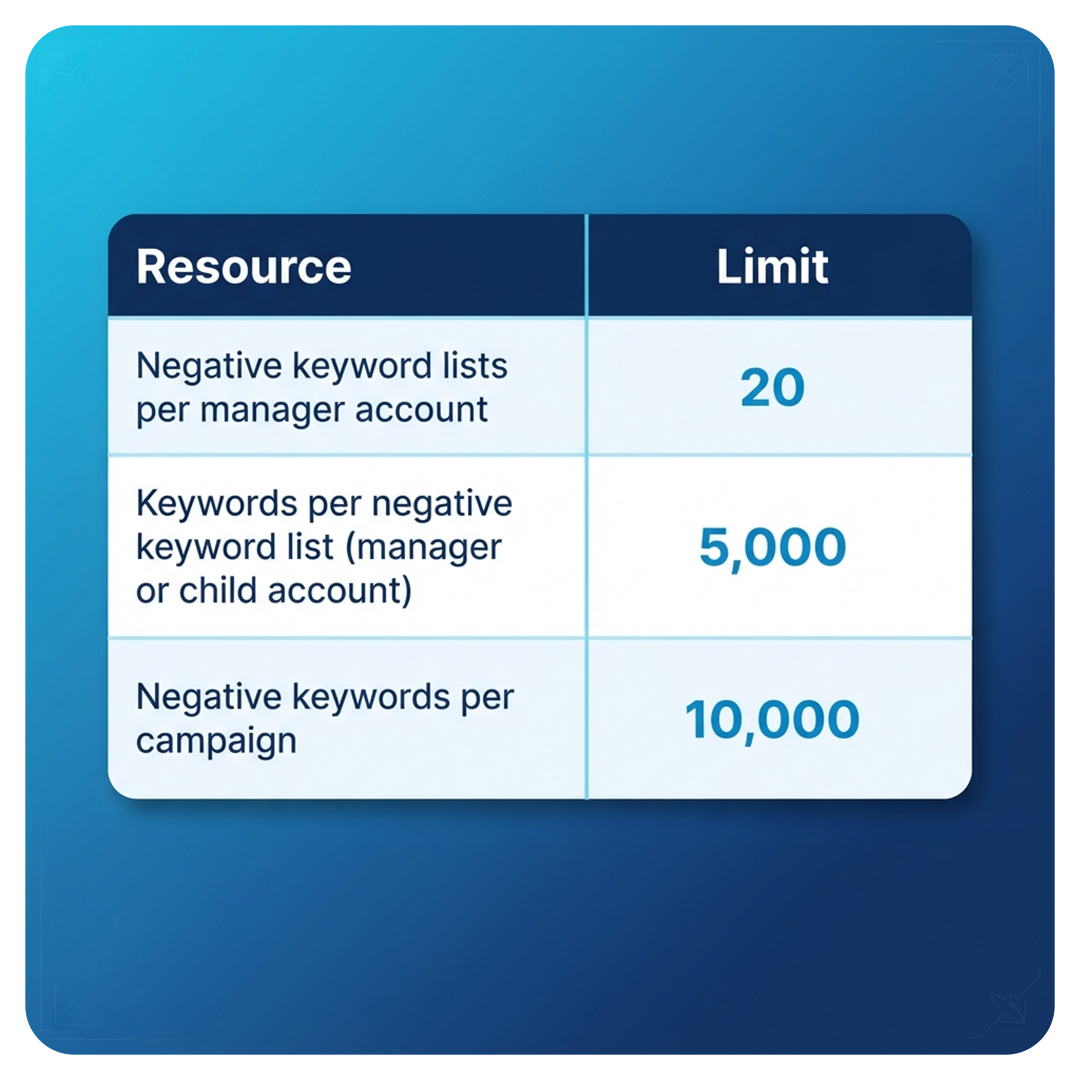
These ceilings mean agencies can't simply keep expanding a single shared list indefinitely as their portfolio grows. Instead, they need organized list structures that distinguish between exclusions that are genuinely universal and those that belong at the client or campaign level, with clear ownership over who can edit each list.
4. Inconsistent Account Management Practices
When multiple account managers work across a portfolio, interpretation of search intent and exclusion criteria naturally varies from person to person. One manager might exclude a term aggressively while another leaves similar terms untouched, simply based on differing judgment calls.
A lack of standardized naming conventions, documentation, and approval procedures compounds this problem. Without clear records, duplicate exclusions creep in, and decisions become inconsistent across similar accounts. Account handoffs make this worse: when a new manager takes over an account, it's often difficult to reconstruct why certain exclusions were originally added, which can lead to outdated terms staying in place long after they've stopped being useful.
5. Risk of Blocking Relevant Traffic
Broad exclusions, applied without enough context, can unintentionally restrict valuable search opportunities. This risk is amplified by how negative keyword match types behave differently from positive keyword match types.
Google Ads Help explains that negative keywords do not automatically cover close variants. Excluding "flowers," for example, does not necessarily exclude "flower." This means singular and plural variations, as well as synonyms, often require separate exclusions to achieve the intended coverage, which adds real maintenance overhead to any account with an evolving negative keyword list.
Consequences of Poor Negative Keyword Management
When exclusion management is inconsistent or reactive, the effects ripple through campaign performance and agency operations alike.
- Unnecessary Advertising Spend: Irrelevant searches consume budget without generating meaningful leads or sales. When exclusions are delayed, recurring irrelevant traffic continues to drain spend week after week, often without anyone noticing until a client asks why conversion rates look off.
- Lost Opportunities From Overly Broad Exclusions: The opposite problem is just as damaging. When an exclusion is applied without sufficient context, valuable searches can get blocked along with the irrelevant ones. Overly restrictive negative keyword lists limit campaign reach and reduce the number of qualified prospects a campaign can actually attract, which directly undercuts the goal the exclusion was meant to serve.
- Campaign Performance Inconsistencies: Different exclusion practices across accounts create uneven optimization quality across an agency's portfolio. One account might have a tightly maintained, well-reasoned negative keyword list while another operates with outdated or haphazard exclusions. This inconsistency makes performance comparisons and troubleshooting considerably more difficult, since teams can't easily tell whether a performance gap stems from strategy, market conditions, or simple neglect.
- Increased Troubleshooting and Rework: When something goes wrong, teams end up spending extra time investigating traffic drops, digging through exclusion histories, and correcting mistakes that could have been prevented with better documentation. Unclear ownership compounds the problem: if nobody recorded who approved or implemented a given change, tracing the root cause takes far longer than it should.
- Reduced Client Confidence: Unexplained fluctuations in traffic, leads, or campaign reach can raise uncomfortable questions about account management, even when the underlying cause is a reasonable optimization decision. Clear client communication about why exclusions were made and what impact they're expected to have goes a long way toward maintaining client trust.
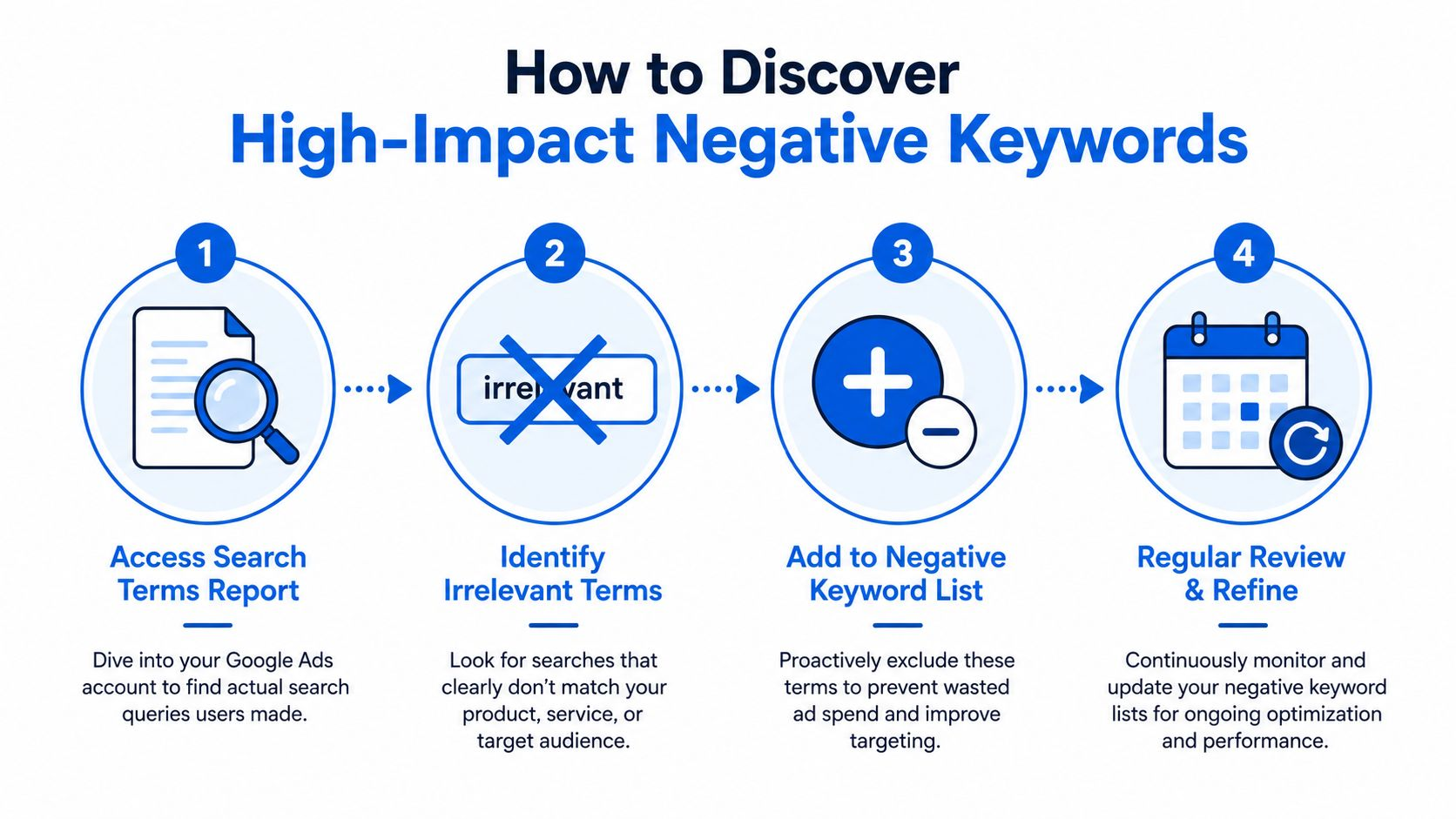
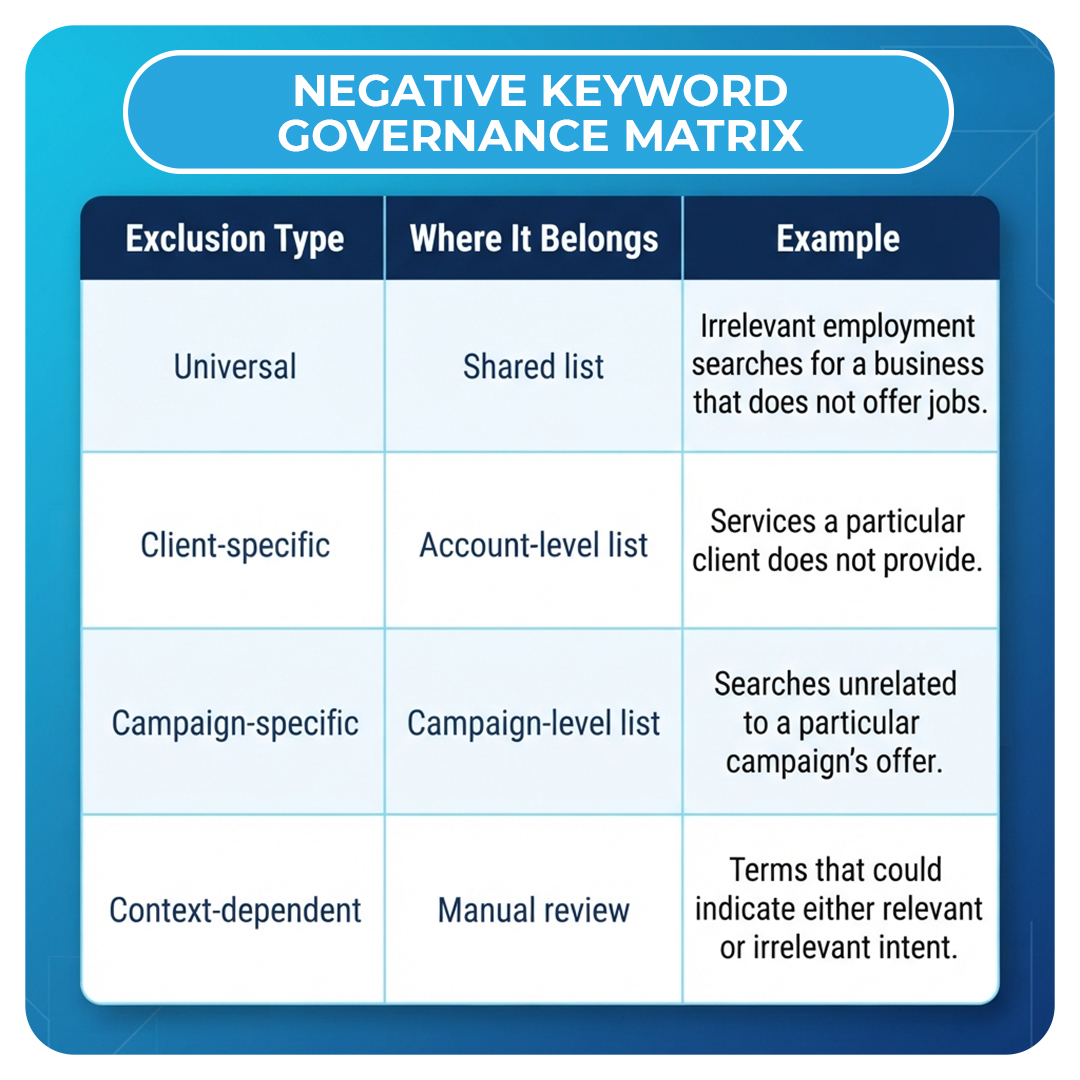
Image Source: Kliqbot
The financial stakes behind these issues are worth putting in context. According to WordStream's 2026 Google Ads benchmarks, which analyzed more than 13,000 campaigns across 23 industries, the average cost-per-click was $5.42, and the average cost-per-lead was $66.69. These figures aren't meant as universal targets since performance varies significantly by industry and account, but they illustrate why irrelevant clicks and inefficient targeting deserve serious attention. Negative keywords alone don't determine these costs, but poor exclusion management is one of the more preventable ways agencies lose ground on efficiency.
How Agencies Can Build a Scalable Negative Keyword Management Process?
With the challenges and consequences established, the real question becomes practical: how do agencies actually build a process that holds up as their account count grows?
1. Establish Account-Specific Exclusion Categories
Start by separating exclusions into distinct categories rather than treating them as one undifferentiated list.
- Universal exclusions: Terms irrelevant to every client regardless of industry, such as job-seeking searches for a business that isn't hiring.
- Industry-specific exclusions: Terms that make sense to exclude for certain verticals but not others.
- Service-specific exclusions: Terms related to services a particular client doesn't offer.
- Campaign-specific exclusions: Terms that only matter within the context of a single campaign's goal.
Build client-level lists around each business's actual offerings and audience intent rather than assumptions based on industry norms. It also helps to maintain a documented list of ambiguous terms that require additional review before anyone decides to exclude them outright.
2. Define Rules for Shared vs. Campaign-Level Lists
Shared lists should be reserved for exclusions that are genuinely relevant across every campaign using them, not used as a catch-all convenience. When search intent differs meaningfully between campaigns, client-specific and campaign-specific exclusions should be kept separate rather than folded into a shared list.
Before applying any change to a shared list, review its potential impact across every campaign that draws from it. A single edit meant to fix one account's problem can inadvertently affect several other accounts at once.
3. Create a Search-Term Review and Prioritization System
Recurring search-term reviews should be scheduled based on account activity and spend level rather than conducted on an ad hoc basis. Prioritize review time around:
- High-spend irrelevant queries that are actively consuming the budget.
- Recurring mismatches that show up across multiple reporting periods.
- Searches with clear intent differences from the campaign's actual offer.
Low-volume terms deserve careful review rather than automatic exclusion, since a single low-volume search can sometimes represent a highly qualified niche prospect. Maintaining a record of reviewed terms and pending decisions keeps the review process from becoming redundant work for whoever picks it up next.
4. Validate Exclusions Before Implementation
Before adding any negative keyword, confirm the actual search intent behind the term. From there:
- Choose the appropriate match type (broad, phrase, or exact) based on how precisely the exclusion needs to apply.
- Check for existing exclusions to avoid duplication, and look for potential conflicts with keywords the account is actively targeting.
- Review singular and plural variations and relevant synonyms, since Google Ads does not automatically extend exclusions to close variants.
- Verify that the proposed exclusion won't unnecessarily restrict valuable traffic the campaign depends on.
5. Document Changes and Monitor Their Impact
Every exclusion added should be recorded with the excluded term, the match type used, the account or campaign it applies to, the reason for the exclusion, and the implementation date. This record becomes invaluable during account handoffs and troubleshooting.
After significant changes, monitor impressions, clicks, conversions, and search-term patterns to confirm the exclusion is having the intended effect. Exclusions should also be revisited whenever a client's offerings, campaign objectives, or audience targeting shifts, since a term that made sense to exclude a year ago may no longer apply.
6. Establish Clear Ownership and Quality Checks
Assign specific responsibility for search-term reviews, exclusion approvals, and implementation so accountability doesn't get lost across a growing team. Broad or account-wide exclusions should receive a second-level review before going live, given their potential to affect a wide range of traffic.
Standardized naming conventions and documentation practices across all client accounts make it far easier for any team member to understand an account's history at a glance. Periodic negative keyword audits also help identify outdated or unnecessary exclusions that have outlived their original purpose.
Scaling Google Ads Management With DashClicks’ White Label Google Ads Services
Even with a well-designed process in place, the actual work of reviewing search terms, updating negative keyword lists, optimizing campaigns, and reporting results across multiple accounts takes real time and dedicated attention. As an agency's client count grows, execution demands tend to grow faster than internal headcount can comfortably absorb.
This is where DashClicks’ White Label Google Ads Services can extend an agency's fulfillment capacity. Rather than hiring an in-house specialist for every new account, agencies can distribute execution work while retaining full strategic control. Relevant areas of support include:
- Campaign Management: Ongoing support for Google Ads campaign execution and optimization helps agencies keep pace with a growing account workload.
- Keyword Management: Support for keyword research, targeting, and exclusion-related optimization within the agreed campaign scope, helping keep negative keyword practices consistent across accounts.
- Campaign Optimization: Ongoing adjustments based on performance data support day-to-day account management without requiring constant internal bandwidth.
- Reporting: Branded reporting helps agencies communicate campaign progress to clients clearly and consistently.
Throughout this arrangement, agencies retain their client relationships, account ownership, strategic direction, budget decisions, and final approvals. White label Google Ads Agency isn't about handing over control; it's about distributing execution responsibilities so internal teams can focus on strategy, client relationships, and account growth while still maintaining consistent oversight.
For agencies exploring whether to outsource Google Ads management for part of their workload, the practical benefit is capacity rather than a shortcut around good process. Structured negative keyword workflows still matter; White Label Google Ads simply gives agencies more hands to execute them consistently across a growing client base.
Build a More Scalable Approach to Negative Keyword Management
Negative keyword management only gets more complex as agencies take on more clients, each with different campaigns and different search intent to account for. What works as a quick manual process for five accounts breaks down fast at fifty.
The path forward comes down to a few consistent practices: building account-specific exclusions instead of generic lists, governing shared lists carefully, running regular search-term reviews, and validating every exclusion before it goes live. Done well, this balance protects budget from wasted spend while preserving the valuable search opportunities that keep campaigns growing.
As portfolios expand, the operational load of maintaining this discipline across every account grows right alongside it. Structured workflows paired with white label Google Ads management support give agencies a realistic way to keep that consistency intact, without stretching internal teams past their limits.