

.svg)

.svg)
.svg)
.svg)
.svg)
.svg)
White label Google Ads management helps agencies improve search campaign performance by providing dedicated specialist capacity, structured optimization workflows, and consistent quality assurance. As agencies scale, these operational advantages make it easier to maintain campaign performance without overloading internal teams.
Managing a growing portfolio of Google Ads accounts becomes increasingly difficult as the number of clients rises. Account managers often balance reporting, client communication, and urgent requests, leaving less time for proactive optimization. As a result, issues such as search-term waste, tracking errors, budget inefficiencies, and missed optimization opportunities can go unnoticed.
The cost of inconsistent management is high. According to WordStream's 2025 benchmark analysis, the average Google Ads search campaign records a $5.26 average CPC, 7.52% conversion rate, and $70.11 average cost per lead, while CPC increased year over year in 87% of industries. With advertising costs continuing to rise, agencies cannot afford inefficient campaign management.
Google Ads management offers a scalable solution by providing dedicated specialists, standardized optimization processes, and ongoing quality assurance without increasing internal headcount. However, outsourcing alone does not improve campaign performance. Better results come from consistent execution, regular monitoring, accurate tracking, and disciplined optimization applied across every account.
This blog explores how a structured Google Ads outsourcing agency helps agencies maintain optimization quality, reduce wasted spend, and improve search campaign performance as their client portfolio grows.
Why Search Campaign Performance Slips as Agencies Scale?
Growth creates operational pressure. For many agencies, that pressure hits hardest in Google Ads management.
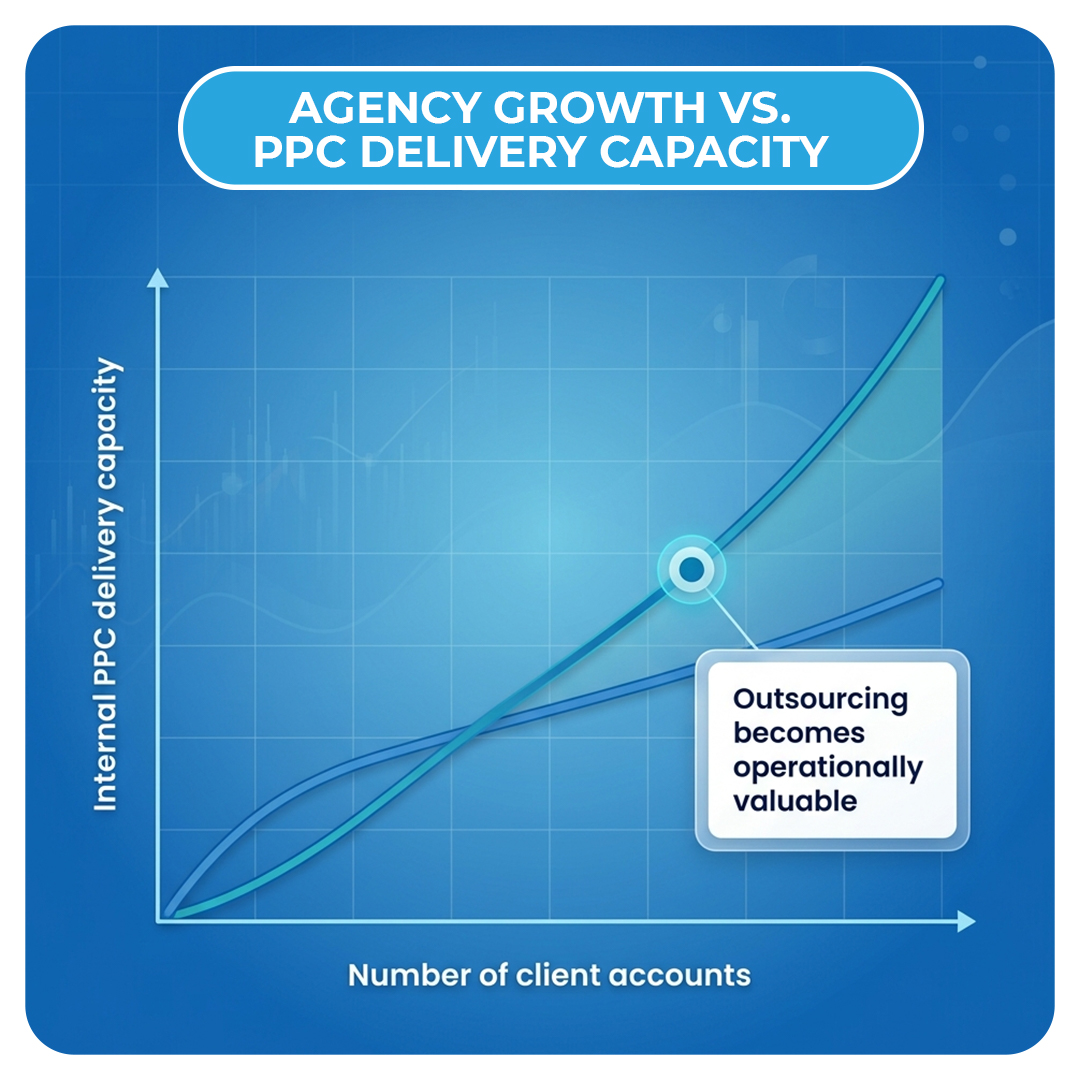
1. Optimization Becomes Reactive Instead of Proactive
When an agency is managing 10 to 20 client accounts, staying on top of each campaign is manageable. At 40 or 60 accounts, something has to give.
Client communication and reporting tend to take priority. Reactive tasks, responding to performance questions, preparing monthly reports, and handling onboarding, consume the hours that should go toward proactive optimization. Bid adjustments get delayed. Negative keyword lists go unreviewed. Ad copy tests sit unanalyzed.
Each individual delay seems minor. Over weeks and months, the accumulated neglect shows up in performance data: rising CPCs, declining conversion rates, wasted spend on poor-quality traffic. By the time the problem is obvious, it has already cost the client real money.
2. Specialist Attention Gets Spread Across Too Many Accounts
Google Ads performance is not generic. A lead generation campaign for a home services company requires a completely different approach than an e-commerce campaign or a B2B SaaS account. Keywords match types, bidding strategies, landing-page alignment, and audience layering all vary by industry and business model.
When account managers are responsible for too many clients across too many verticals, optimization depth suffers. They can manage. They can monitor. What they cannot do is investigate thoroughly, test systematically, and improve consistently. The result is performance that plateaus or slowly deteriorates rather than improving over time.
3. Campaign Signals Get Missed Between Reporting Cycles
A monthly reporting cadence is standard in most agencies. The problem is that campaign conditions do not stay static for 30 days.
Search-term behavior shifts. Competitor bidding changes. Conversion rates fluctuate. Budget caps throttle campaigns during peak demand windows. Tracking tags break. Lead quality changes without any obvious explanation in the data.
Each of these issues has a cost. Some are recoverable quickly if caught early. Others compound silently for weeks before someone notices.
The core issue is not that agencies lack Google Ads knowledge. The issue is inconsistent application of that knowledge across growing account portfolios.
How White Label Google Ads Creates More Consistent Optimization Capacity
When agencies outsource Google Ads, they can change how optimization work gets done and how consistently it happens.
1. Dedicated Specialists Reduce Generalist Bottlenecks
There is a structural difference between an account manager who handles Google Ads alongside client communication, reporting, and strategy work, and a dedicated PPC specialist whose entire role is campaign execution.
Account managers are responsible for the relationship. PPC specialists are responsible for performance. When both functions are separated, each one gets the attention it requires.
White label Google Ads specialists focus on campaign structure, bid management, search-term analysis, ad copy performance, and conversion tracking. Their work goes deeper because their scope is narrower. That depth translates directly into better campaign outcomes.
2. Standardized Optimization Cycles Keep Accounts From Being Neglected
One of the most practical benefits of white label fulfillment is the enforcement of a structured optimization cadence. Campaigns are not reviewed when time allows. They are reviewed according to a defined schedule.
A well-structured cadence typically includes:
Weekly:
- Search-term review to identify irrelevant queries and new keyword opportunities
- Spend pacing review to catch budget misallocation early
Regular (biweekly or as needed by account size):
- Keyword performance analysis
- Negative keyword updates
- Ad performance review and copy testing
Monthly:
- Conversion trend analysis
- Budget reallocation across campaigns
- Campaign restructuring where performance data supports it
- Strategic recommendations to share with the client
The specific frequency varies based on monthly spend, conversion volume, and account complexity. A high-spend e-commerce account needs more frequent attention than a small local services campaign. A professional white label fulfillment team applies the right cadence to each account rather than treating all clients the same.
3. Built-In QA Reduces Execution Errors
Execution errors are more common than most agencies acknowledge. Budgets get set incorrectly after a restructure. Bidding strategies get switched without checking conversion history thresholds. Conversion tracking breaks after a website update and goes undetected for weeks.
Quality assurance processes catch these issues before they become expensive. A structured QA workflow covers budget settings, bid strategies, targeting parameters, conversion tracking status, keyword updates, ad assets, and tracking implementation after any campaign change.
QA is not glamorous work. It is, however, what separates agencies that deliver consistent performance from those that manage by exception.
4. Parallel Fulfillment Increases Agency Capacity
A single senior specialist can realistically manage a finite number of accounts at the optimization depth that produces results. When an agency scales beyond that threshold without adding capacity, quality degrades.
White label fulfillment solves this by providing multiple specialists working simultaneously across an agency's account portfolio. New clients can be onboarded without creating a backlog. Existing accounts do not lose attention when workload spikes. Optimization runs in parallel rather than sequentially.
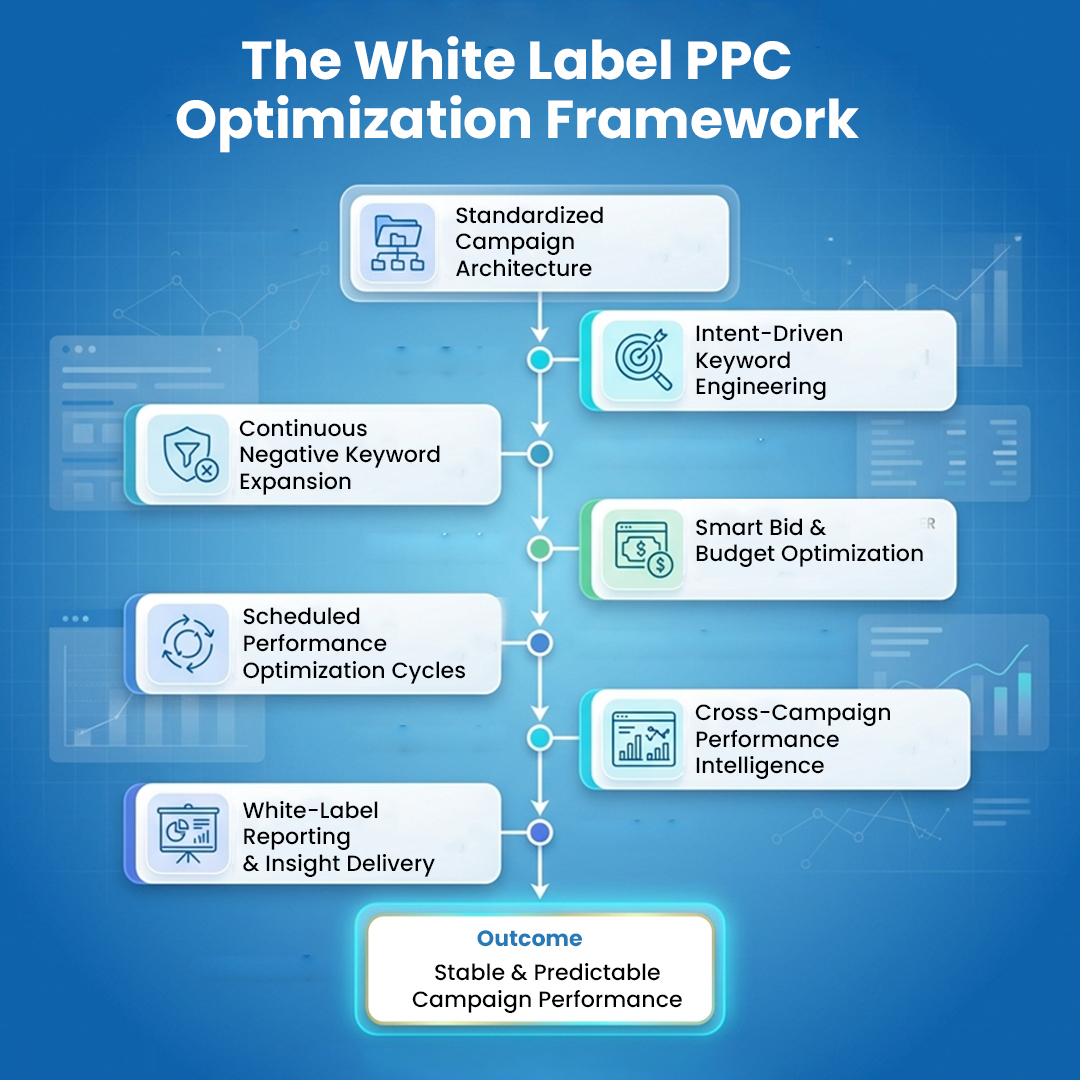
White label fulfillment creates the operational capacity for consistent optimization at any account volume.
How Consistent Search-Term Management Reduces Wasted Spend?
Search-term analysis is one of the highest-impact optimization tasks in any Google Ads account. It is also one of the most commonly neglected as agencies grow.
1. Identify Queries That Consume Spend Without Producing Value
Google's broad match and Smart Bidding systems cast wide nets. That is by design. The tradeoff is that campaigns frequently attract irrelevant searches, low-intent informational queries, and traffic from audiences unlikely to convert.
When these queries are not identified and excluded through negative keywords, the budget gets consumed without producing leads or revenue. CPAs rise. ROAS falls. The campaign appears to be underperforming when the underlying issue is poor targeting hygiene.
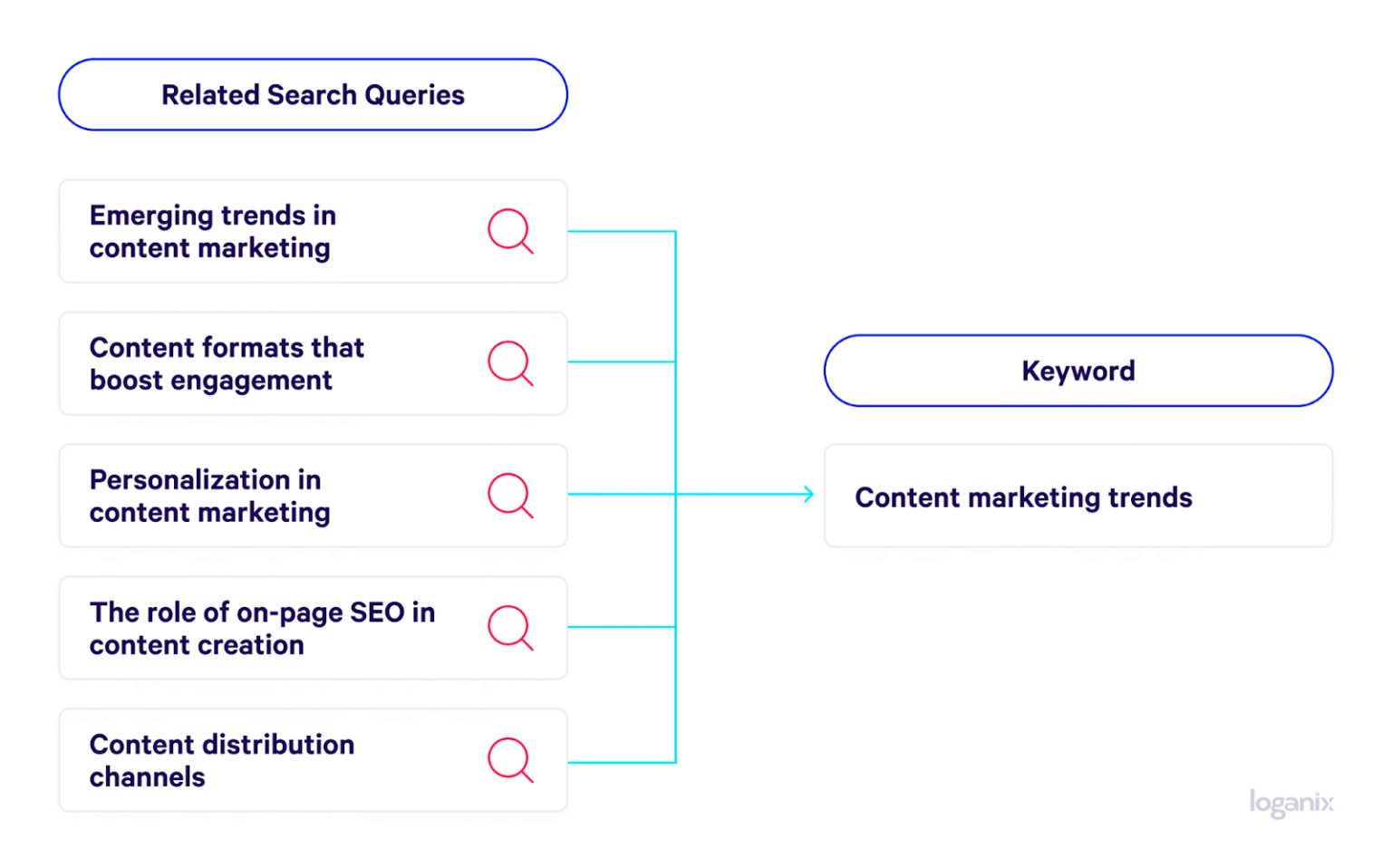
Image Source: Loganix
Regular search-term reviews identify these patterns and eliminate wasted spend through systematic negative keyword management.
2. Search-Term Data Reveals New Keyword Opportunities
Search-term reports do more than surface irrelevant queries. They also reveal what real users are actually searching for, which is often different from what keyword research predicted.
Specific high-intent modifiers, industry terminology used by qualified buyers, location-specific phrases, and competitor comparison queries often appear in search-term data before they appear in keyword research tools. These insights inform keyword expansion, ad copy refinement, and landing-page development.
The search-term report is one of the most underused sources of strategic intelligence in Google Ads.
3. Search-Term Analysis Must Become a Recurring Process
Search behavior changes continuously. New competitors enter the market. Seasonal patterns shift. User intent evolves as a product category matures. A search-term cleanup performed once during onboarding provides a one-time benefit and then becomes outdated.
Consistent weekly reviews build an ongoing optimization loop. Each review improves targeting precision. Over months, the cumulative impact on spend efficiency and lead quality is significant.
4. Becomes Difficult to Maintain Across Dozens of Client Accounts
Manual search-term analysis takes time. For a single account, the weekly task is manageable. Across 30 or 50 accounts, maintaining that discipline requires dedicated capacity.
White label Google Ads specialists maintain structured search-term reviews as a non-negotiable part of their workflow, rather than a task that gets skipped when workloads increase.
How Better Conversion Data Helps Google Ads Automation Work Toward the Right Goal?
Smart Bidding is powerful. It is also only as effective as the conversion data it receives.
1. Smart Bidding Depends on Meaningful Conversion Signals
Google's machine learning adjusts bids based on historical conversion patterns, user signals, and real-time context. When conversion tracking is accurate and the signals fed into the system reflect genuine business value, Smart Bidding performs well.
When tracking is broken, conversion actions are poorly defined, or the system is optimizing toward low-value events, Smart Bidding will do exactly what it was configured to do, just not in the direction the agency intended. Human oversight is still essential to verify that automation is working toward the right objective.
2. More Conversions Is Not Always Better
Maximizing conversion volume is not always the right goal. A campaign optimized for form submissions will generate more form fills. Whether those submissions produce qualified leads, sales conversations, or closed revenue is a separate question.
Agencies serving lead generation clients need to distinguish between:
- Form submissions
- Phone calls
- Qualified leads
- Sales-accepted leads
- Revenue-generating conversions
Optimizing toward top-of-funnel events can inflate volume while reducing actual business value. Aligning conversion goals with client business objectives produces better outcomes even when raw conversion numbers are lower.
3. Choose the Right Primary Conversion Actions
Google allows campaigns to optimize toward primary conversion actions while tracking secondary ones for reference. Choosing the right primary signal matters.
Agencies should audit conversion action settings regularly, ensure that Smart Bidding is not optimizing toward micro-conversions like page visits or scroll depth, and align primary conversion actions with the outcomes clients care about most.
4. Connecting Lead Data to Business Value Improves Bidding
For clients where lead quality varies significantly, value-based bidding strategies produce better results than volume-based strategies. Assigning conversion values to different lead types, importing offline conversion data, and providing Google's algorithm with revenue-level signals allows Smart Bidding to prioritize the traffic most likely to generate real business value.
Better conversion data improves how Google's automation performs at every stage of the funnel.
How Agencies Can Catch Performance Problems Before They Become Expensive?
Performance problems rarely appear suddenly. They develop gradually, through small shifts that compound over time.
1. Monitor CPC, CPA, and Conversion Efficiency Together
Rising CPC is not inherently a problem if conversion rates are improving and CPL remains within target. Declining conversion rate is not always a campaign issue if lead quality is improving and fewer, higher-value leads are being generated.
These metrics need to be evaluated in combination, not in isolation. Monitoring CPC, CPA, conversion rate, lead quality feedback, and conversion value together gives a more accurate picture of account health than any single metric.
2. Detect Declining Conversion Rates Early
A declining conversion rate can have several root causes. The diagnostic process matters as much as identifying that a decline has occurred.
Common causes include:
- Search-query mix shifting toward lower-intent traffic
- Ad creative fatigue reducing click quality
- Landing-page issues affecting post-click experience
- Conversion tracking changes or breaks
- Increased competitive activity driving up CPC without proportional volume gains
- Audience targeting drift in Smart Bidding
Identifying the root cause quickly allows the team to respond with the right fix rather than making indiscriminate changes.
3. Identify Budget Constraints and Misallocation
Budget-limited campaigns miss impression share during peak demand windows. High-spend campaigns in competitive markets may be over-indexed relative to conversion potential. Efficient campaigns may be underfunded while poor performers continue to consume budget.
Regular budget allocation reviews ensure that spend is directed toward the campaigns with the strongest performance signals. This is especially important when overall client budgets are fixed.
4. Tracking Anomalies Require Immediate Investigation
Missing conversions, sudden spikes in recorded events, and attribution changes are not data quirks. They are signals that something in the measurement infrastructure has changed.
A broken conversion tag means Smart Bidding is making decisions without accurate data. A sudden spike in conversions may indicate a tracking duplication error inflating reported performance. These issues require fast investigation and resolution.
5. Escalation Process Prevents Expensive Deterioration
Agencies should define clear thresholds that trigger immediate investigation: CPA increases above a defined percentage, conversion rate drops sustained over multiple days, significant spend anomalies, tracking data gaps, or meaningful shifts in traffic quality.
Consistent monitoring combined with a defined escalation process prevents performance deterioration from becoming client-threatening.
How Agencies Should Measure Whether White Label Fulfillment Is Improving Performance?
Adding white label Google Ads management is an operational investment. Agencies should track whether that investment is delivering measurable improvement.
1. Campaign Performance Metrics to Track
The most direct measure of fulfillment quality is campaign performance across the account portfolio. Key metrics include:
- CTR (click-through rate)
- CPC trends
- Conversion rate
- CPA and CPL
- ROAS for e-commerce accounts
- Impression share
No single metric tells the full story. Reviewing these metrics together, across multiple accounts over time, surfaces patterns that reflect the quality of optimization work being delivered.
2. Fulfillment Quality Metrics to Track
Beyond campaign numbers, agencies should track operational quality indicators:
- Optimization frequency relative to scheduled cadence
- Time between issue detection and resolution
- Tracking error resolution time
- QA completion rates
- Reporting turnaround time
- Consistency of scheduled review completion
These metrics reveal whether the fulfillment process is being executed with discipline or whether the same inconsistencies are recurring under a different provider.
3. Agency-Level Metrics to Track
White label fulfillment should improve agency operations, not just individual campaigns. Track:
- Average accounts managed per specialist
- Total fulfillment hours relative to output
- Gross margin per client
- Client retention rates over 6 and 12 months
- Onboarding capacity per month
- Time saved for internal strategy and client communication
A fulfillment partnership that improves campaign performance while freeing up internal team capacity is delivering compound value to the agency.
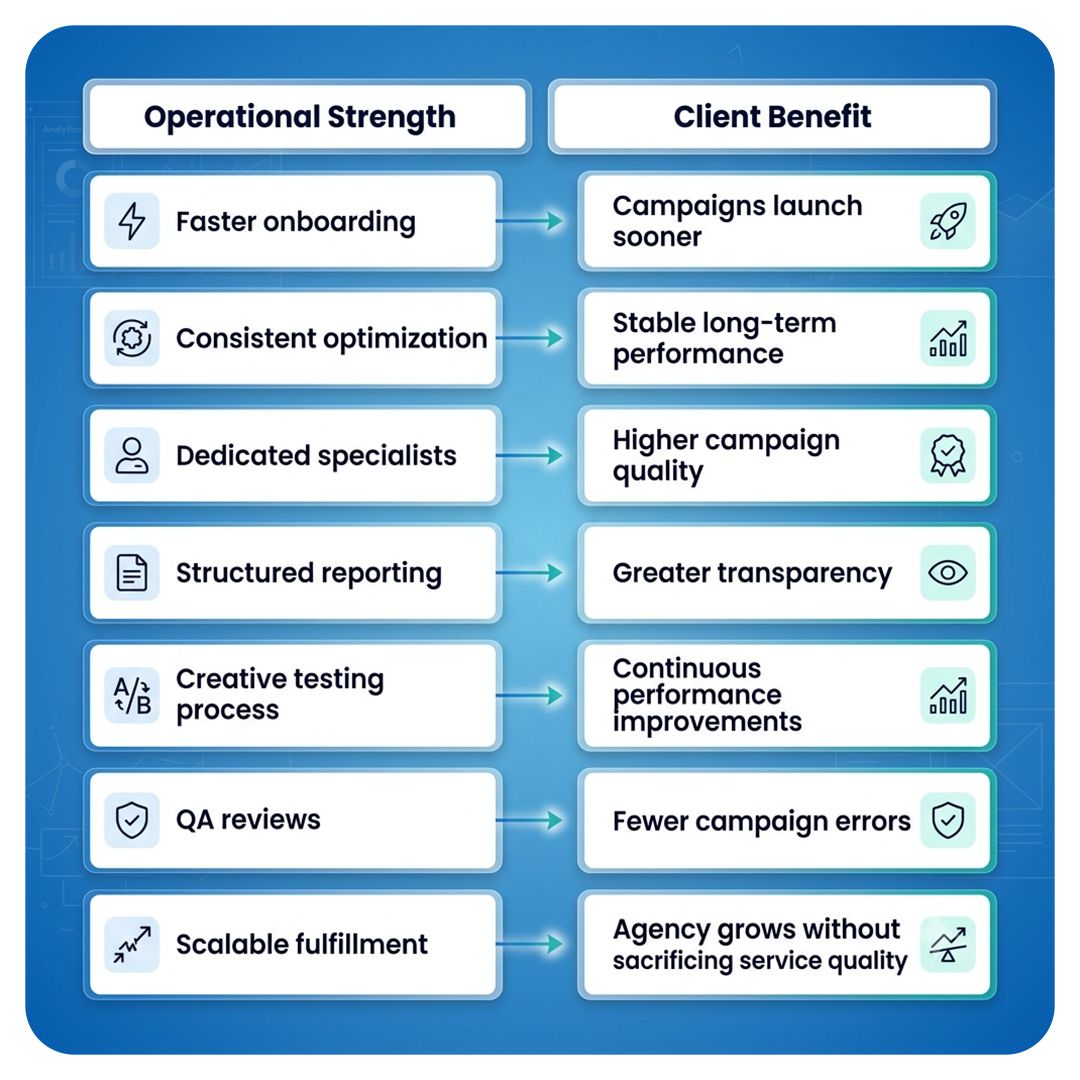
How DashClicks Helps Agencies Improve Search Campaign Performance?
DashClicks provides white label Google Ads management designed specifically for agencies that need reliable, scalable PPC fulfillment.
- Dedicated Google Ads Fulfillment: The fulfillment team assigns dedicated Google Ads specialists to manage campaigns on behalf of agency clients. Specialists focus entirely on campaign execution, bringing the depth of attention that generalist account management cannot consistently provide.
- Structured Optimization and QA: The platform uses standardized optimization workflows and quality assurance processes across all managed accounts. Campaigns are reviewed on consistent schedules, not when time allows. QA checks run after every significant change to catch execution errors before they affect performance.
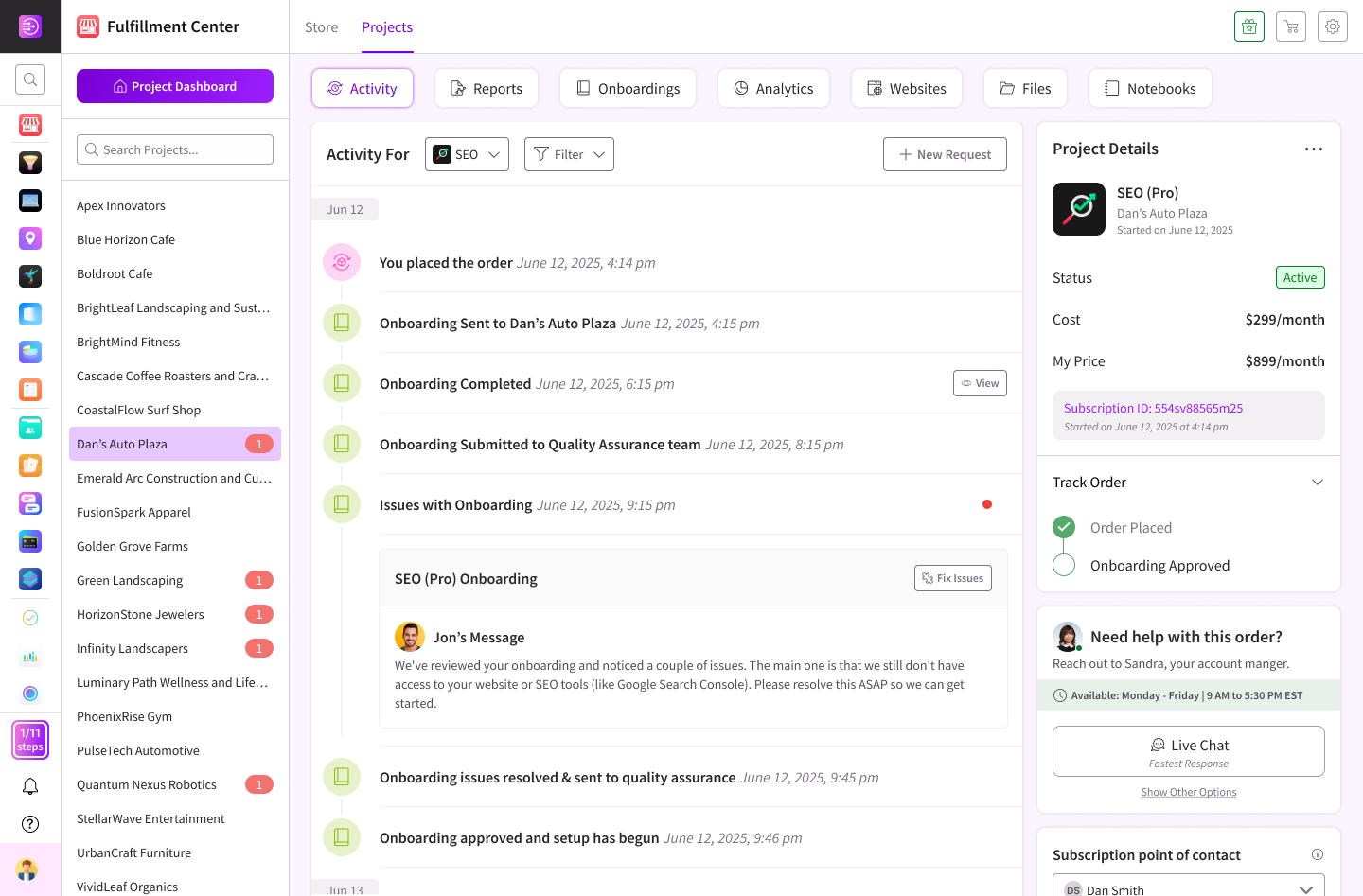
- White Label Reporting: The platform provides white label reporting software that agencies can deliver directly to clients. Reporting is clear, performance-focused, and built to support agency-client communication rather than complicate it.
- Scalable Fulfillment: Agencies can onboard new Google Ads clients without adding internal headcount. DashClicks scales fulfillment capacity to match agency growth, allowing teams to focus on client strategy and business development.
Better Search Performance Requires Consistent Execution
Search campaign performance does not improve by accident. It improves through continuous optimization, disciplined monitoring, accurate conversion tracking, and systematic search-term management, applied consistently across every account in a portfolio.
As agencies grow, maintaining that consistency becomes operationally difficult. Specialist attention gets diluted. Optimization shifts from proactive to reactive. Small performance issues accumulate into larger ones.
White label Google Ads management addresses this directly by providing the specialist capacity and structured workflows that consistent execution requires. Agencies that implement reliable fulfillment processes deliver stronger campaign performance, retain clients longer, and scale without sacrificing optimization quality.


.svg)


.svg)
.svg)
.svg)
.svg)
.svg)