

.svg)

.svg)
.svg)
.svg)
.svg)
.svg)
A client emails on a Tuesday morning: cost per lead jumped 40% last week, and they want to know if Facebook changed its algorithm again. It's a reasonable question. It's also usually the wrong first question.
Blaming the algorithm feels like an answer, but it's rarely a diagnosis. Before an agency can explain a performance shift, or fix it, the team needs to separate what actually changed. That means looking at campaign-controlled factors first: budgets, bids, creative, audiences, and tracking. Then market conditions: seasonality, competition, and shifts in the client's offer. Only after ruling those out does it make sense to consider platform-level auction dynamics.
The goal isn't to find someone or something to blame. It's to determine what changed, where the change occurred in the funnel, and what evidence supports the most likely cause. Facebook Ads performance also varies enormously based on objective, industry, audience, and offer, so there's no single number that defines "normal." WordStream's 2025 benchmark study, which analyzed more than 1,000 Facebook lead campaigns, found an overall 2.59% CTR, 7.72% conversion rate, and $27.66 CPL. Those figures are useful context, not a universal target. A campaign performing below that average isn't necessarily broken, and one performing above it isn't necessarily safe from future decline. Performance should be judged against the campaign's own history and objective, not against an industry-wide figure.
Start With the Exact Performance Change
"Facebook Ads are performing badly" isn't a diagnosis agencies can act on. It's a symptom description that could mean a dozen different things depending on which metric actually moved. Before adjusting anything, the team needs to pin down precisely what changed and by how much.
1. Establish What Actually Changed
A single bad day rarely tells the full story. Ad platforms fluctuate daily due to auction timing, day-of-week behavior, and normal statistical noise. A more reliable read comes from comparing the current period (say, the last seven or fourteen days) against a comparable prior period of similar length.
Within that comparison, agencies should separate movement across each of these metrics rather than looking at cost per lead in isolation:
- Spend
- Impressions
- CPM
- CTR
- CPC
- Landing-page views
- Conversion rate
- CPL/CPA
- Lead volume
Each of these metrics represents a different stage of the funnel. A drop in impressions points to a delivery issue. A drop in CTR points to an engagement issue. A drop in conversion rate points to something happening after the click. Treating all of these as interchangeable symptoms of "the algorithm" makes it far harder to identify what's actually wrong.
2. Connect the Symptom to the Likely Problem Area
Once the moved metrics are identified, they can point toward where to look next. These aren't fixed rules, but they're reasonable starting points for investigation:
- CPM Increases While CTR Remains Stable: This suggests the auction itself has gotten more competitive, so it's worth checking bid strategy and audience overlap before touching the creative.
- CTR Falls While CPM is Stable: This points toward the ad itself, meaning creative relevance or ad fatigue is worth reviewing first.
- CTR Remains Steady, but Conversions Fall: The click is working, so the landing page, offer, tracking, or conversion process deserves attention.
- CPL Rises Because CPC and Conversion Rate Both Deteriorate: This is a compound problem that requires troubleshooting both the ad interaction and the post-click experience.
None of these patterns guarantee a specific root cause. They simply narrow the search so the team isn't guessing blindly.
WordStream's 2025 dataset found that CPL for Facebook lead campaigns increased 20.94% year over year to $27.66, while CTR remained almost flat at 2.59%. That combination matters. If CTR barely moved but CPL rose sharply, the explanation likely lies downstream of the click, in conversion rate, competition for the same audience, or cost per click, rather than in ad engagement itself. The lesson is that a rising CPL alone doesn't identify a cause. Agencies need to look at the metrics beneath it before drawing conclusions.
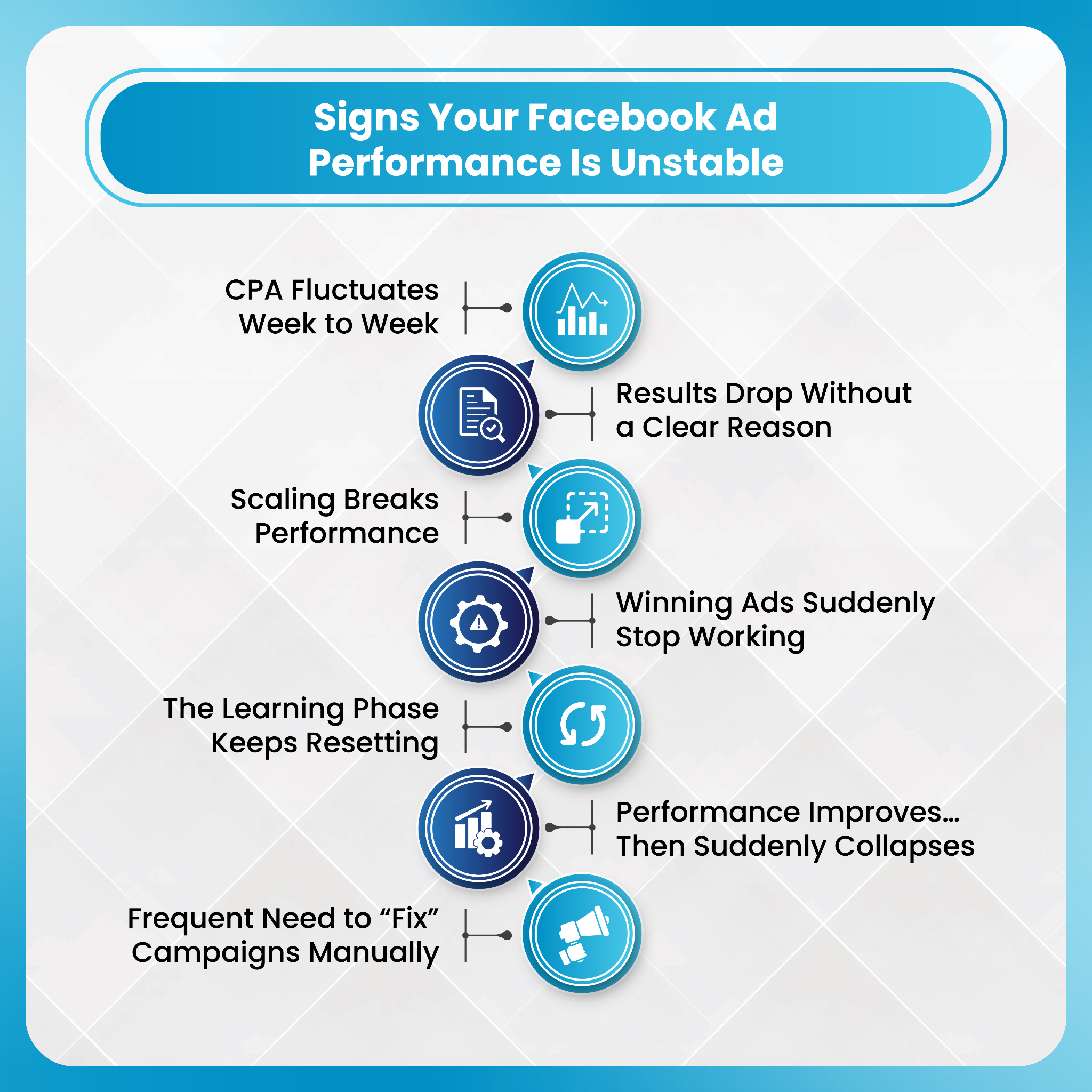
Check Campaign Delivery and Recent Changes
Before considering anything happening outside the ad account, agencies should rule out what happened inside it. Many "sudden" performance changes trace back to a change someone made, sometimes days earlier, that hasn't fully played out yet.
1. Audit Recent Account Changes
Walk through the account's recent history and note anything that shifted around the time performance changed:
- Budget increases or decreases
- Optimization event changes
- Bid strategy changes
- Audience edits
- New placements
- Creative replacements
- Pausing or duplicating ad sets
- Significant campaign restructuring
- Changes to geographic targeting
Any one of these can shift delivery, cost, or conversion behavior. A budget increase can push a campaign into a more competitive slice of the auction. Swapping an optimization event can change who the campaign shows ads to entirely. Context from this audit often explains a performance shift more directly than any external factor would.
2. Check Whether Delivery Itself Is the Issue
Beyond isolated changes, it helps to look at how the campaign is actually spending and reaching people right now. A few questions worth asking:
- Is the campaign spending as expected, or has spending slowed unexpectedly?
- Has the impression volume changed relative to the prior period?
- Has reach changed while spend stayed similar, suggesting the target audience pool has shifted?
- Has frequency increased sharply, meaning the same people are seeing the ad more often?
- Is one ad or ad set absorbing most of the delivery while others go quiet?
These delivery patterns help distinguish a setup or budget-allocation problem, something within the agency's control, from a broader performance issue that requires deeper investigation.
3. Look At Learning and Instability
Meta's delivery systems need time to gather signals after a significant edit. Making several major changes at once, such as adjusting the budget, swapping the optimization event, and refreshing all the creative on the same day, makes it nearly impossible to determine which change actually affected performance. Where possible, agencies should stagger meaningful changes and give the campaign time to stabilize before drawing conclusions from the results.
Meta has explained that ad delivery is dynamic and shaped by auction conditions and the advertiser's own targeting settings. That's a reasonable basis for taking campaign setup seriously as a diagnostic starting point. It isn't proof of what caused a specific account's decline, and agencies shouldn't treat it that way. It's a reminder that delivery, setup, and targeting are worth inspecting before describing a performance dip as unexplainable algorithm behavior.
Verify Tracking Before Diagnosing Performance
Sometimes the campaign hasn't actually gotten worse. The measurement of it has broken. If conversion tracking is unreliable, agencies risk optimizing toward a problem that doesn't exist, or missing a real one hiding behind bad data.
1. Check Whether Conversions Are Being Recorded Correctly
Before assuming a genuine performance decline, confirm the basics:
- Is the relevant conversion event still firing correctly?
- Do Ads Manager conversions roughly match the client's website or CRM data?
- Has reported conversion volume shifted suddenly in a way that doesn't match other signals?
- Are there duplicate, missing, or incorrectly configured events?
- Has lead handoff into the client's CRM broken somewhere along the way?
A tracking discrepancy can look identical to a campaign performance problem on the surface, even when the underlying campaign hasn't changed nearly as much as the numbers suggest.
2. Look Beyond the Platform Dashboard
Where the data is available, it helps to trace leads through the full pipeline rather than stopping at the ad platform's own reporting:
Meta-Reported Leads → CRM Leads → Qualified Leads → Appointments/Sales
Comparing these stages can reveal whether the agency is dealing with a genuine performance decline, a tracking discrepancy between platforms, a lead-routing issue inside the client's systems, or a lead-quality problem that has nothing to do with the ad itself. Not every client will have visibility into every stage, but even partial data along this chain is more informative than Ads Manager numbers alone.
Key Agency Insight: A campaign cannot be diagnosed reliably when the measurement layer is questionable. Fixing tracking issues, or at least confirming they don't exist, should happen before any major optimization decision. Otherwise, the team risks making changes based on numbers that were never accurate in the first place.
Troubleshoot the Ad-to-Conversion Funnel
The ad account doesn't exist in isolation. A person sees an ad, clicks it, lands on a page, and (ideally) converts. Agencies need to follow that entire path rather than treating the ad account as the only place where something could have gone wrong.
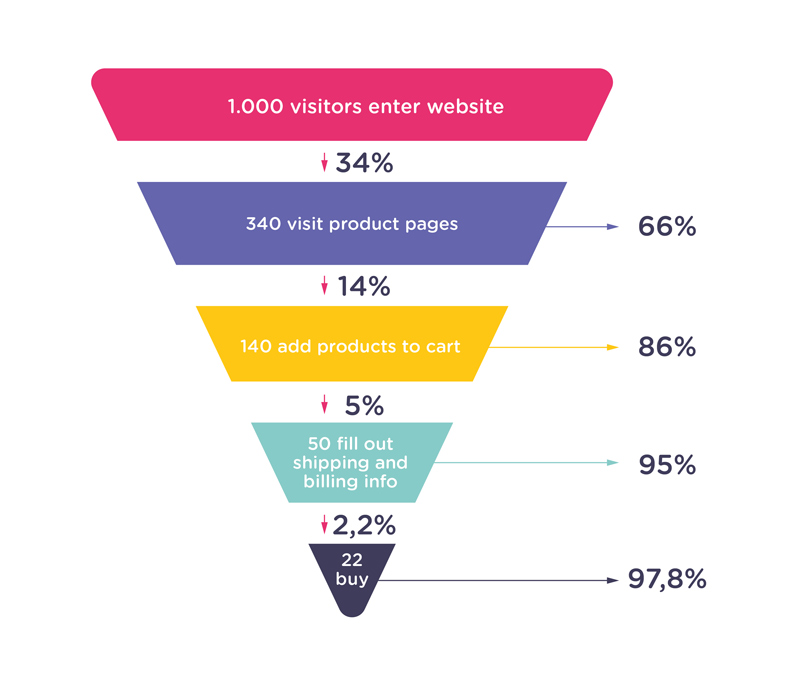
Image Source: Codedesign
- Ad Level: At the top of the funnel, review creative fatigue, the strength of the hook and messaging, CTR trends, frequency, engagement, and performance broken out by placement. It's also worth asking whether the creative still matches the offer the client is currently running. Compare all of this against an appropriate prior period rather than judging it in isolation.
- Click Level: A click isn't the same as a meaningful visit. Check whether clicks are actually turning into landing-page visits, whether CPC has risen because CTR declined, and whether certain placements are producing clicks that don't lead to any downstream activity. Some placements generate cheap clicks that never translate into real interest, which can quietly drag down overall funnel performance.
- Landing-page Level: An ad can do its job perfectly and still run into trouble here. Inspect message match between the ad and the page, the mobile experience, page load speed, CTA clarity, form friction, offer relevance, and any technical issues that might be blocking conversions. It's entirely possible for a campaign to generate appropriate, well-targeted traffic while the landing page itself creates the bottleneck.
- Conversion Level: Rather than relying only on an aggregate CPL figure, compare conversion rates across campaigns, audiences, creatives, and time periods. A blended number can hide the fact that one segment is converting well while another has quietly stopped working.
- Lead-quality Level: A cheap lead isn't automatically a good one. Where data is available, track the path from lead to qualified lead to appointment to customer. This helps determine whether a lower CPL genuinely represents better performance for the client, or whether the campaign is simply generating more leads that never turn into business.
WordStream's 2025 study found an overall 7.72% conversion rate for Facebook lead campaigns, but that figure varied widely by industry, from 3.77% for furniture to 18.25% for restaurants and food. That range illustrates why campaign performance should be evaluated in the context of the specific industry and offer, not against one universal conversion benchmark that may not apply at all.
Check Audience, Auction, and Market Conditions
Once internal campaign factors and tracking have been reviewed, it's time to look outward. External conditions can shift performance even when nothing inside the ad account has changed.
- Audience Conditions: Consider whether the audience has become too narrow over time, whether frequency is climbing, whether prospecting and remarketing audiences are behaving differently than before, and whether overlapping audiences are creating unnecessary internal competition within the account. It's also worth checking whether the available audience itself has simply changed. None of this automatically causes poor performance, but each is worth investigating.
- Auction Conditions: Look at CPM trends, performance differences across placements, performance differences across audience segments, and whether rising costs are isolated to one part of the account or spread across all of it. Auction-related cost increases happen for many reasons and don't necessarily mean the platform has stopped working the way it used to.
- Market Conditions: Factors entirely outside the ad account can still affect results: seasonal demand shifts, competitor promotions, broader industry demand changes, changes to the client's own offer or pricing, and local events or market conditions. Facebook Ads performance can move even when campaign settings stay exactly the same, simply because the market around the campaign has changed.
A higher CPM does not automatically mean the algorithm stopped working. It can indicate a more competitive auction, a shift in who the campaign is actually reaching, seasonal demand, or several other factors. There isn't one universal cause behind a CPM increase, which is exactly why the earlier steps in this process matter before external factors get the blame.
Turn Symptoms Into a Repeatable Troubleshooting Process
Reacting to every performance dip with a fresh round of ad edits isn't a strategy. Agencies managing multiple accounts need a repeatable method they can apply consistently, regardless of which client or campaign triggered the alarm.
The process flows in a logical sequence:
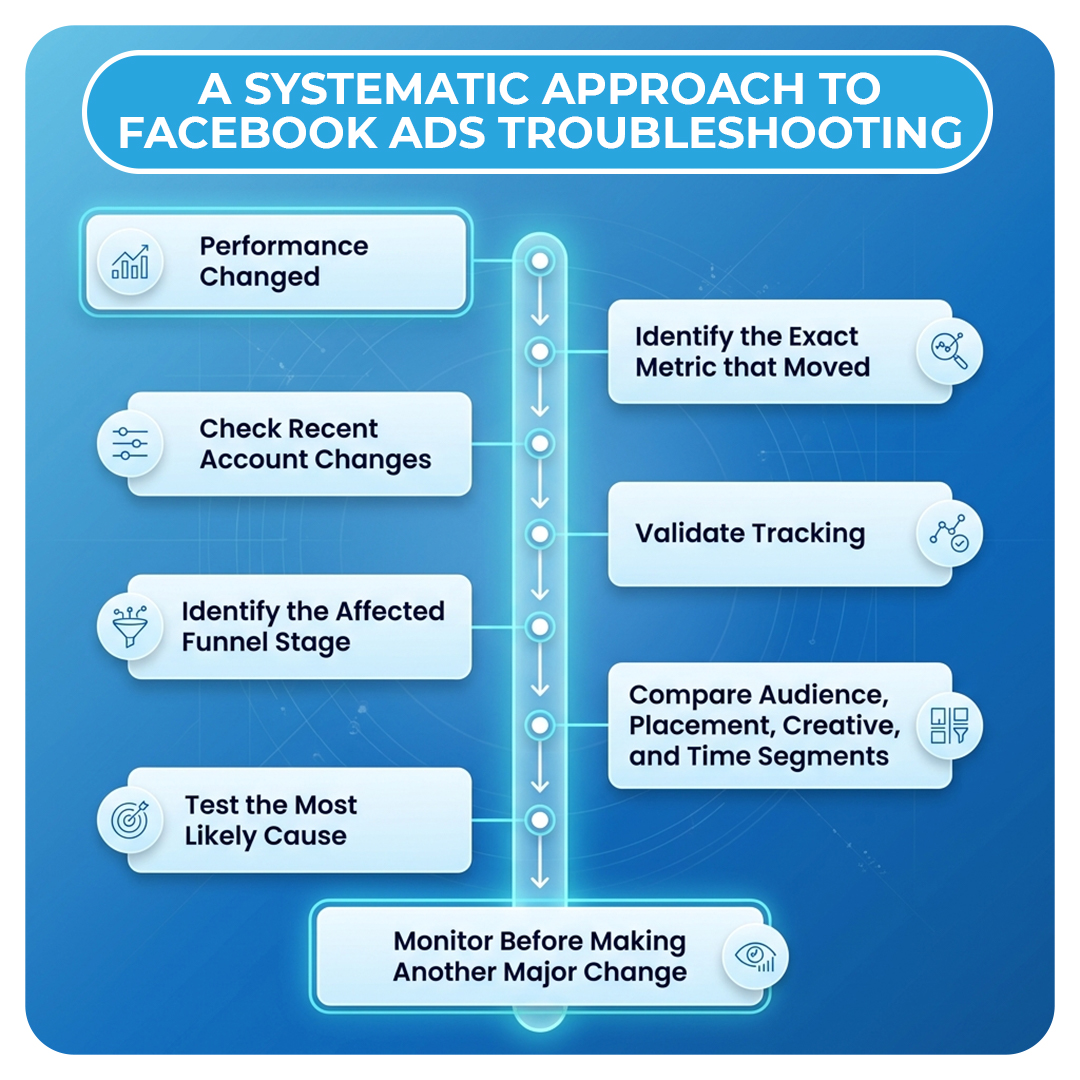
Each stage builds on the last. Identifying the metric narrows the search. Checking account changes and tracking rules out the most common false alarms. Identifying the funnel stage and comparing segments points toward a likely cause. Testing that cause, one change at a time, and monitoring the result confirms or rejects the hypothesis. This sequence is designed to isolate likely causes and reduce reactive optimization, not to guarantee a fix.
1. Include a Symptom-To-Investigation Table
The table below maps common symptoms to reasonable starting points for investigation. These are directions to look at, not definitive diagnoses.
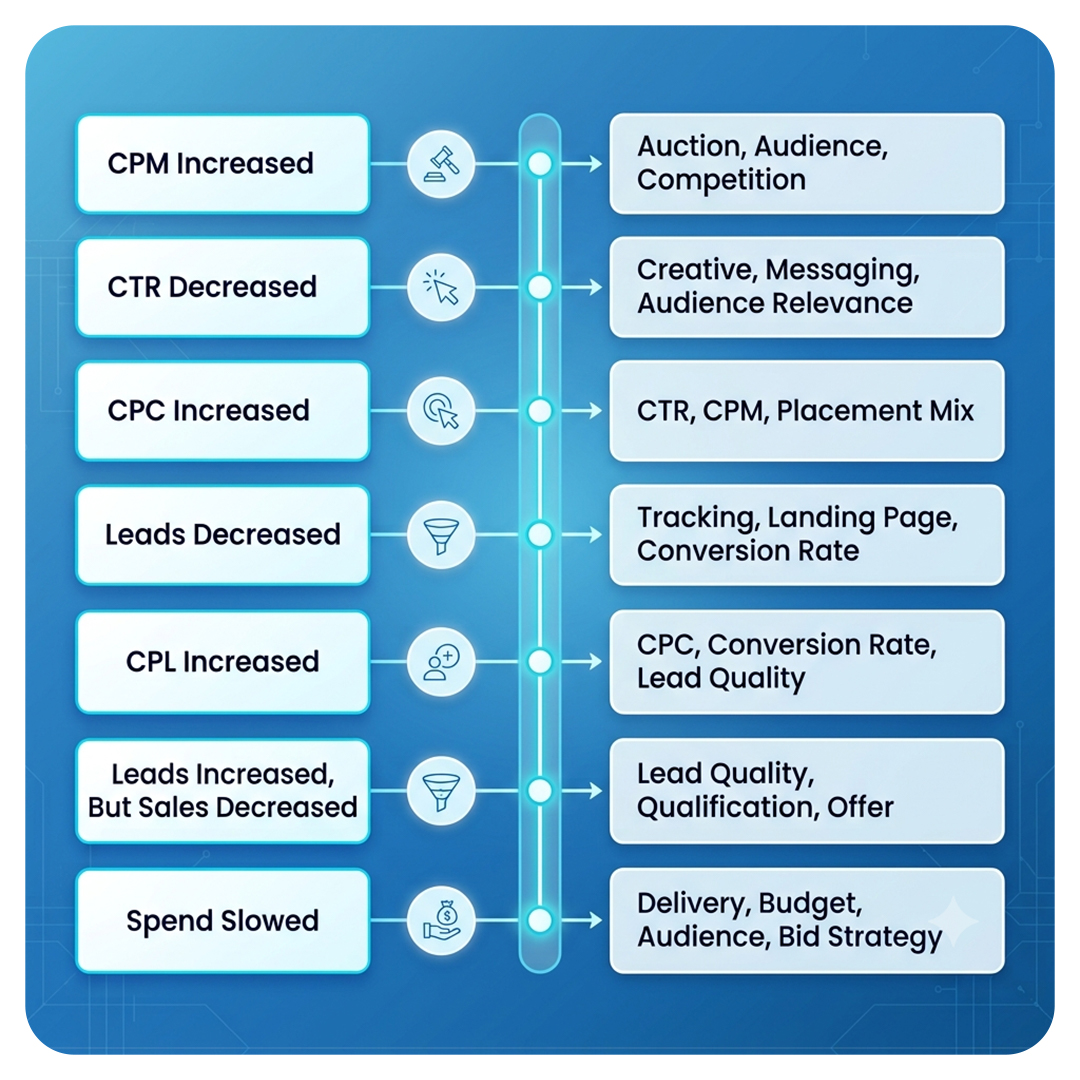
2. Add An Agency Documentation Angle
Every troubleshooting cycle should leave a record behind: the observed symptom, what was checked, the working hypothesis, the meaningful change that was made, and the specific metric that will confirm or reject that hypothesis. Making one meaningful change at a time, rather than several at once, keeps the diagnosis clean. This turns troubleshooting from reactive campaign editing into controlled diagnosis, and it builds an internal record the agency can reference the next time something similar happens.
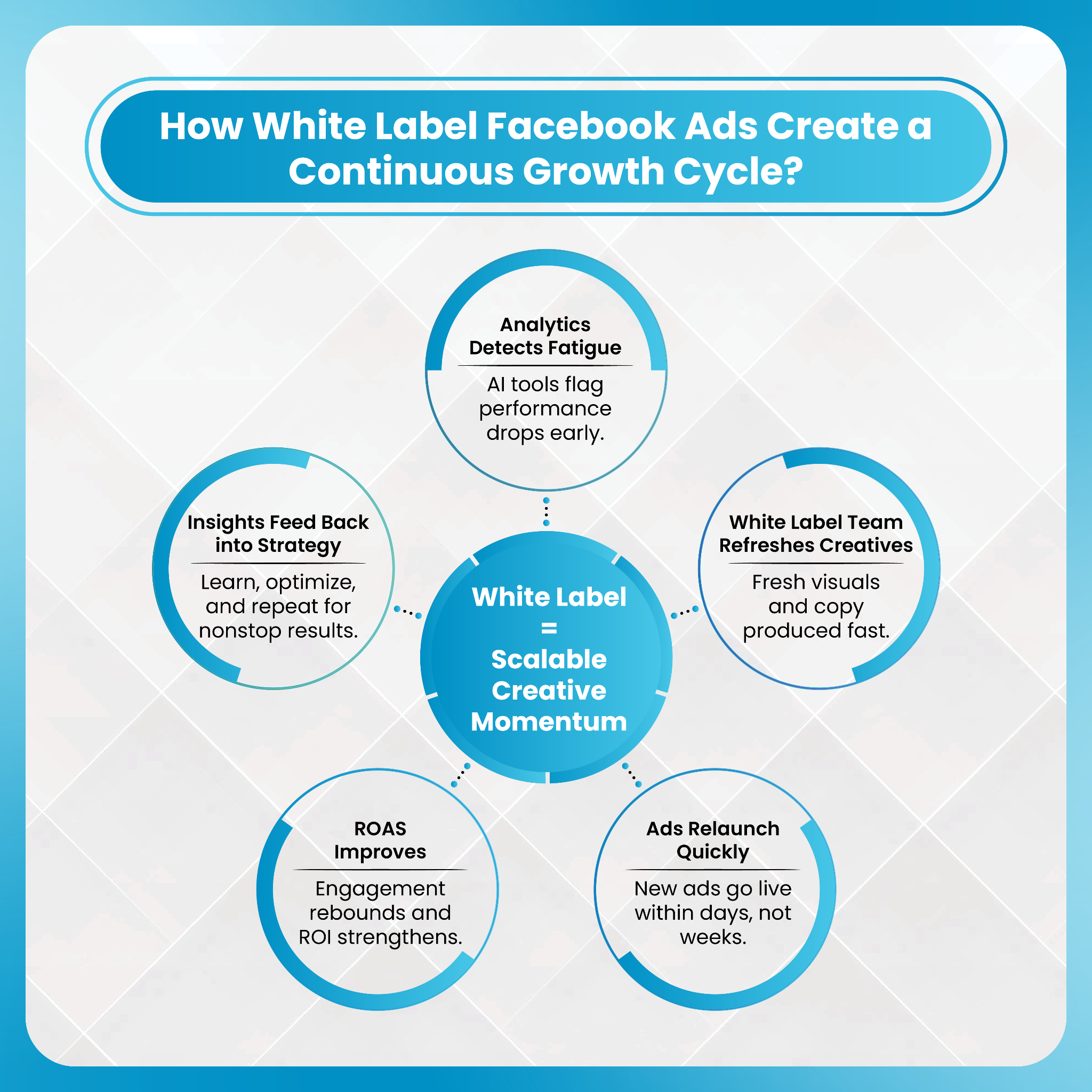
How White Label Facebook Ads Help Agencies Maintain Consistent Troubleshooting?
None of this troubleshooting process happens automatically. It takes recurring analyst time, and that time becomes scarce fast when several client accounts need attention at once. This is where white label Facebook Ads fulfillment fits in, as a source of capacity and execution support, not a replacement for agency strategy.
1. Add Specialist Capacity for Campaign Monitoring
Troubleshooting isn't a one-time task. It requires ongoing analysis as campaigns run, change, and drift. Additional fulfillment capacity can help agencies keep up with performance changes across multiple client accounts without stretching a small internal team too thin. That said, outsourcing capacity doesn't automatically improve campaign results on its own; it simply frees up time for the process described above to actually happen consistently.
2. Handle More Campaign Volume Without Overloading the Internal Team
One unexpected performance issue is manageable for most internal teams. Several clients needing diagnosis in the same week is a different problem entirely, and it's a common one for growing agencies. White label fulfillment can absorb part of the ongoing execution and monitoring workload, giving the internal team room to focus on the accounts that need the most strategic attention.
3. Apply a Consistent Troubleshooting Workflow
A fulfillment partner working from a standardized process can review delivery, creative, audience, conversion tracking, landing-page performance, and lead quality using the same repeatable steps across every account. That consistency matters as an agency scales, since it reduces the risk of one team member troubleshooting differently than another.
4. Keep Strategy and Client Communication With the Agency
Outsourcing execution doesn't mean handing over ownership. The agency should remain responsible for client goals, strategy, prioritization, recommendations, and client communication. The fulfillment partner provides execution and specialist support behind the scenes. White label support should extend agency capacity, not replace agency ownership of strategy.
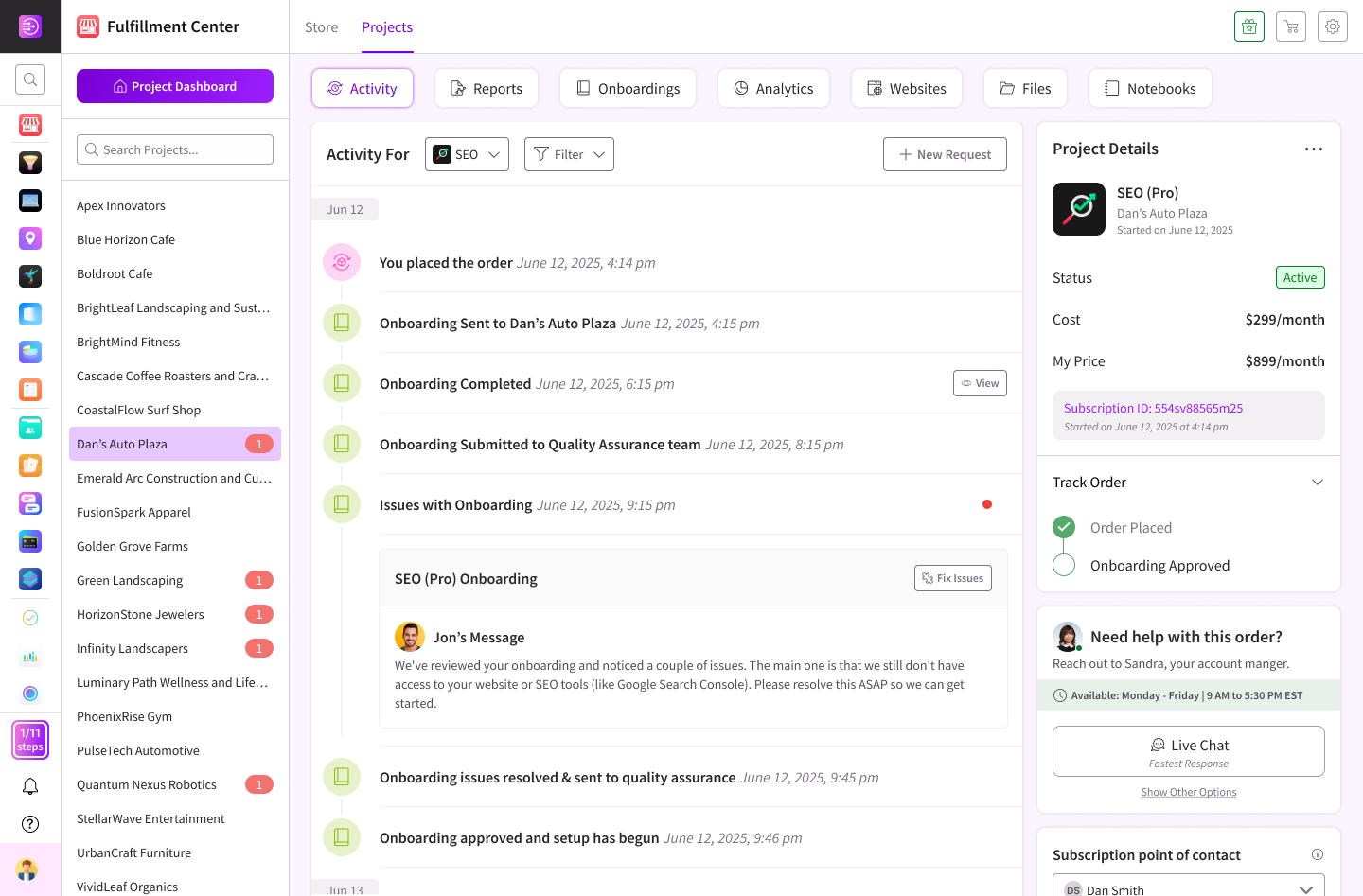
For agencies that need additional Facebook Ads fulfillment capacity, DashClicks is one option worth considering. The focus here isn't a long list of features, but the operational problem it addresses: supporting campaign execution and ongoing management as account volume grows.
DashClicks can give agencies additional white label Facebook Ads fulfillment capacity when campaign volume makes consistent monitoring and optimization difficult to manage entirely in-house. That support is meant to extend internal capacity while agencies retain ownership of client relationships, strategic direction, and business priorities.
It doesn't come with guarantees of lower CPL, higher ROAS, more leads, or more revenue. What it offers is more hands available to run the troubleshooting process consistently, across more accounts, without the internal team burning out.
Diagnose Before You Blame the Algorithm
"The algorithm changed" is rarely a complete answer, and it's rarely a useful starting point for fixing anything. Real troubleshooting starts with the measurable symptom: which metric moved, and by how much. From there, agencies should check recent account changes and delivery patterns, validate that tracking is actually reliable, and follow the complete path from ad to click to landing page to conversion to lead quality. Only after ruling out campaign-controlled factors and tracking issues does it make sense to look at audience, auction, and market conditions.
Testing the most likely cause, one change at a time, and applying that same process consistently across every client account turns troubleshooting into something repeatable rather than reactive. As campaign volume grows, additional fulfillment capacity, including white label support, can help agencies maintain that discipline instead of cutting corners under time pressure.
The strongest Facebook Ads troubleshooting doesn't start by asking what the algorithm did. It starts by asking what changed, where it changed, and what evidence actually explains why.


.svg)


.svg)
.svg)
.svg)
.svg)
.svg)