

.svg)

.svg)
.svg)
.svg)
.svg)
.svg)
A client calls their account manager on a Tuesday morning. Their homepage no longer appears for a branded search term, organic traffic has been falling for weeks, and a page that once brought in steady leads has quietly disappeared from search results. The agency hasn't flagged any of it yet.
This can happen across digital marketing agencies. The issue isn't always a lack of care. SEO problems can develop between reporting cycles, while identifying them often requires more consistent monitoring than a monthly check-in provides.
When a client discovers an SEO problem before the agency does, the impact goes beyond the technical issue. The agency is forced into a reactive position, while the account manager has to investigate under pressure and respond to a client who may already be questioning the quality of their SEO management. Even when the fix is straightforward, the loss of confidence can be harder to address.
This is one reason agencies use white label SEO for more than recurring deliverables. Specialist fulfillment can add the capacity needed to monitor accounts, perform regular QA, and investigate unusual changes before they become client concerns. Organic search also remains an important source of website traffic. BrightEdge research found that organic search accounted for 53.3% of trackable website traffic, although the share varies by website.
The central idea is simple: white label SEO can do more than help agencies complete recurring tasks. With structured monitoring, QA, and specialist diagnosis, it can help agencies detect, investigate, prioritise, and address SEO issues before clients have to bring them up.
Why SEO Issues Can Go Unnoticed by Agencies?
Even well-run agencies with skilled strategists can miss developing SEO problems. This isn't a matter of carelessness.
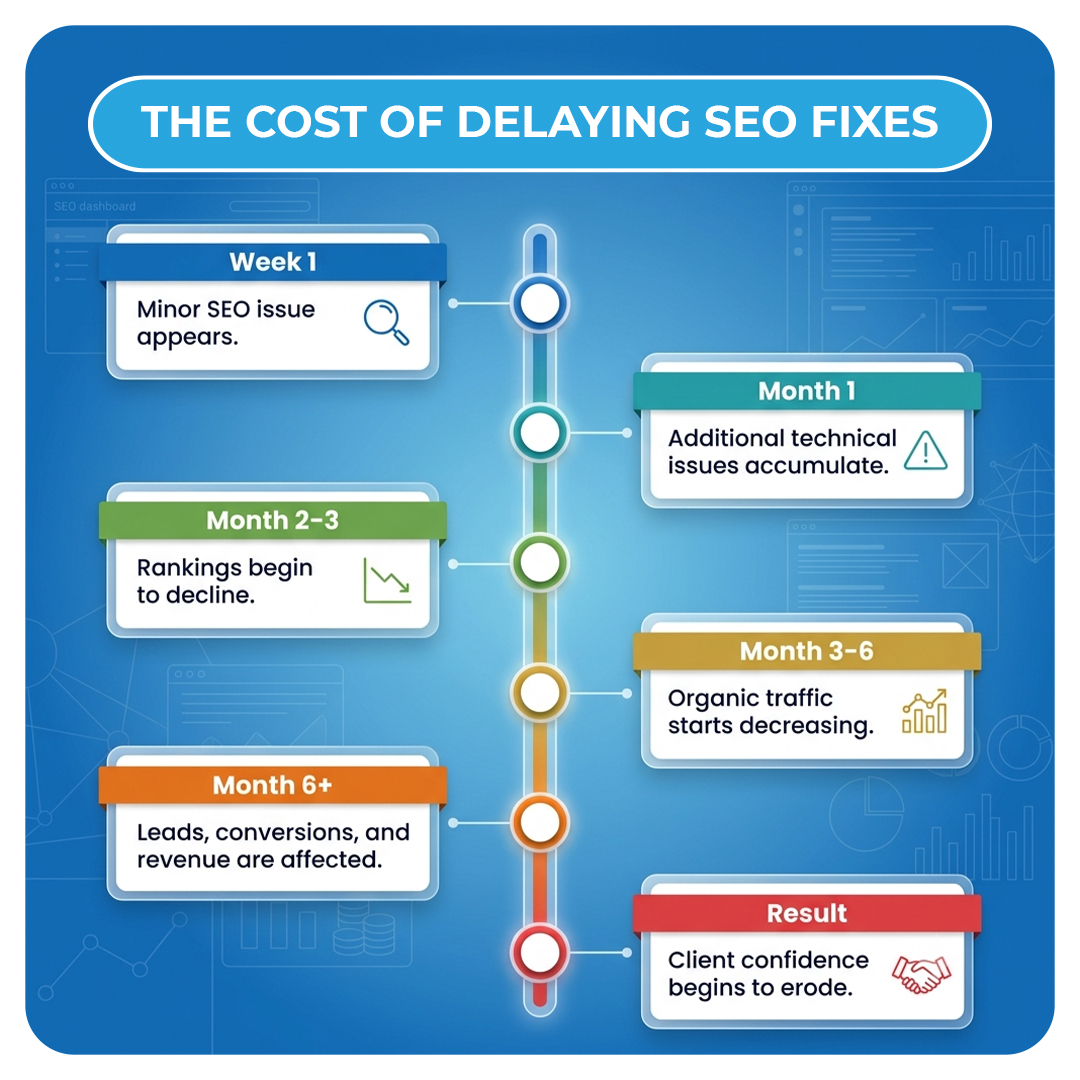
It comes down to how SEO works, how agency teams are structured, and how reporting cycles function.
1. SEO Changes Continuously
Websites are never static. New pages get published, old ones get deleted, and redesigns happen more often than agencies might like. CMS updates, plugin changes, content edits, URL restructuring, redirect adjustments, and internal linking updates all happen regularly, sometimes without SEO even being part of the conversation.
These changes might seem unrelated to search performance on the surface, but they can quietly affect:
- Crawling behavior
- Indexing status
- Internal link structure
- Metadata accuracy
- Page discovery
- Overall organic visibility
A developer swapping out a plugin for site speed improvements might inadvertently break canonical tags. A content team updating a blog post might remove an internal link that was driving crawl equity to a key page. None of these actions are malicious or even careless. They're just part of how websites evolve, and each one carries some SEO risk.
2. Agency Teams Are Managing Multiple Accounts
Strategists and account managers rarely work on a single client. Most oversee a portfolio of accounts, each with its own priorities, deadlines, and reporting schedules. This isn't a knock on agency expertise. It's simply a matter of capacity and scale.
Detailed SEO investigation takes time. Reviewing crawl data, checking Search Console trends, and auditing on-page elements across dozens of pages requires focused attention that's hard to give when juggling multiple clients. As the number of accounts grows, so does the difficulty of maintaining continuous, hands-on monitoring for every single one.
3. Reporting Cycles Don't Capture Every Development
Monthly reports are useful for showing performance trends, but they don't always reveal exactly when a problem started. A technical issue might occur weeks before it shows up clearly in a client report. By the time the data reflects the decline, the issue may have already affected rankings, traffic, or conversions.
Waiting for the next reporting cycle to investigate delays the response. Continuous monitoring fills that gap, offering visibility into what's happening between formal reports rather than relying solely on a monthly snapshot.
4. SEO Problems Aren't Always Visible to Clients or Account Managers
A page can look completely normal to a site visitor while suffering from crawling or indexing issues behind the scenes. A ranking decline might stem from a technical error, a content gap, a competitor's improved content, or a shift in search intent for a given query. None of these causes are immediately obvious just from looking at the live page.
A page can remain published and functional while quietly becoming harder for search engines to discover or understand. The challenge is not simply knowing what SEO problems look like. Agencies also need enough specialist capacity to check for them consistently and act on meaningful changes.
SEO Issues Agencies Need to Catch Early
Not every SEO issue demands immediate action. Minor fluctuations happen constantly and often resolve themselves. But certain categories of problems deserve regular monitoring because they can affect important pages, client trust, and overall organic visibility.
1. Technical and Indexing Problems
Technical issues are often invisible to anyone who isn't actively looking for them. Common problems include broken links and pages, redirect errors, redirect chains, incorrect canonical tags, unintentional noindex tags, crawlability barriers, and XML sitemap errors. Any of these can cause important pages to become harder to discover or get excluded from indexing altogether.
These issues are more common than most agencies might assume. Ahrefs found that 95.2% of more than 1 million domains studied had 3XX redirect issues, and 66.2% of sites had pages with only one followable internal link. This doesn't mean every redirect issue is harmful or that every site is in crisis. It simply shows how frequently technical SEO issues appear, even on sites that seem to be performing well.
Recurring technical checks, rather than occasional audits, are what catch these problems before they compound.
2. Ranking and Organic Visibility Declines
Not every ranking fluctuation is cause for concern. Search results shift constantly, and small movements are part of normal search volatility. The key is distinguishing between expected noise and a decline that actually warrants investigation.
Normal fluctuation looks like:
- Small or temporary ranking shifts
- Short-lived changes tied to algorithm testing or seasonal search behavior
Meaningful decline looks like:
- Persistent loss of visibility over multiple weeks
- Declining clicks or impressions across important pages
- Multiple high-value pages affected simultaneously
- Sudden, sharp changes rather than gradual movement
Google Search Console data, including queries, clicks, impressions, and average position, gives agencies the raw material needed to spot these trends. Monitoring this data over time, rather than checking it sporadically, helps determine whether a change is worth digging into or simply part of normal search behavior.
3. On-Page Optimization Problems
On-page issues can exist quietly for months without anyone noticing, especially on larger sites with hundreds of pages. Common culprits include missing title tags, duplicate titles across multiple pages, weak or missing meta descriptions, poor heading structure, mismatched search intent, newly published pages that were never properly optimized, missed internal linking opportunities, and content edits that unintentionally weaken keyword targeting.
Ahrefs found that 68.5% of sites studied had page titles that didn't match their SERP titles, a clear example of how on-page issues can slip through even when a site otherwise appears well-maintained. Ongoing on-page QA, built into a regular fulfillment process, helps catch these discrepancies before they affect click-through rates or rankings.
4. Content Performance and Optimization Problems
Content performance issues are distinct from technical on-page problems, though the two are often confused. This category covers new content that fails to gain meaningful visibility, previously successful pages that start losing traction, outdated information that no longer matches current search intent, keyword cannibalization between similar pages, competitor content that's pulling ahead, and weak internal linking between related articles.
Some pages may need updating, others expanding, and some might benefit from consolidation into a single stronger resource. Recurring content performance reviews, handled as part of ongoing fulfillment work, help agencies spot which pages need attention before their performance drops too far to recover easily.
5. Local SEO Problems
Local visibility issues can be especially easy to miss because a business can continue operating completely normally while its search presence quietly deteriorates. Watch for incorrect business information, citation inconsistencies across directories, Google Business Profile issues, local landing page problems, and name, address, and phone (NAP) inconsistencies.
A local business might not notice a drop in local search visibility until foot traffic or call volume declines, by which point the underlying issue has likely been present for weeks.
6. Backlink and Off-Page Changes
Off-page monitoring doesn't need to turn into a full link-building initiative, but it should include regular checks for valuable backlinks disappearing, shifts in referring domains, low-quality or suspicious backlink patterns appearing unexpectedly, competitors gaining relevant links, and general changes in the site's off-page profile. The goal here is awareness and early investigation, not an ongoing link acquisition campaign.
How White Label SEO Helps Agencies Detect Problems Earlier
Saying that white label SEO "saves time" understates what specialist fulfillment actually provides. The real value comes from added capacity for recurring monitoring, investigation, quality assurance, and issue escalation, work that's difficult to sustain consistently with limited in-house bandwidth.
1. Recurring Technical SEO Checks
Rather than relying solely on occasional audits, recurring technical checks can cover crawlability, indexing status, redirects, internal linking, metadata, broken pages, and sitemap accuracy on an ongoing basis. This continuous approach catches issues shortly after they appear rather than months later during the next scheduled audit.
2. Continuous Performance Monitoring
Ongoing monitoring of rankings, organic traffic, impressions, clicks, and visibility trends for important landing pages gives agencies a clearer picture of what's actually happening. Not every fluctuation requires action. The goal of continuous monitoring is to flag unusual or meaningful changes and evaluate them in context, rather than reacting to every small dip in the data.
3. Specialist Diagnosis Instead of Surface-Level Alerts
There's a meaningful difference between an alert and a diagnosis. An alert simply says something changed. A diagnosis explains what changed, why it matters, what likely caused it, and what should happen next.
Possible causes behind a given change might include a technical implementation issue, a content update, competitor movement, a shift in search intent, temporary fluctuation, or even a tracking and measurement error. Monitoring alone isn't enough. The change needs to be interpreted by someone who understands SEO well enough to separate noise from a genuine problem.
4. SEO QA After Website and Content Changes
Every meaningful website change carries some SEO risk. QA checks after publishing new pages, updating existing content, changing URLs, implementing redirects, redesigning a website, migrating a site, or substantially revising content can catch implementation problems before they turn into larger performance issues. This kind of proactive checking is far less costly than discovering a mistake weeks later through a traffic report.
5. Structured Issue Prioritization
Not every SEO issue deserves the same level of urgency. A useful prioritization framework considers:
- Potential impact on traffic or rankings
- Which pages are affected
- How important those pages are to the business
- How urgent the issue is
- What action is recommended
This kind of structure prevents both agencies and clients from feeling overwhelmed by a long list of low-priority technical findings that don't meaningfully affect performance.
6. Faster Escalation to the Agency
A clear escalation workflow keeps everyone aligned on responsibility:
Detect → Investigate → Prioritize → Recommend → Agency Review → Client Communication → Resolve → Verify
The fulfillment team handles detection and investigation. The agency reviews the recommendation, owns client communication, and decides how the issue fits into the broader SEO strategy. The fulfillment team then supports execution and verifies that the fix worked as intended.
Turning Early SEO Detection Into a Better Client Experience
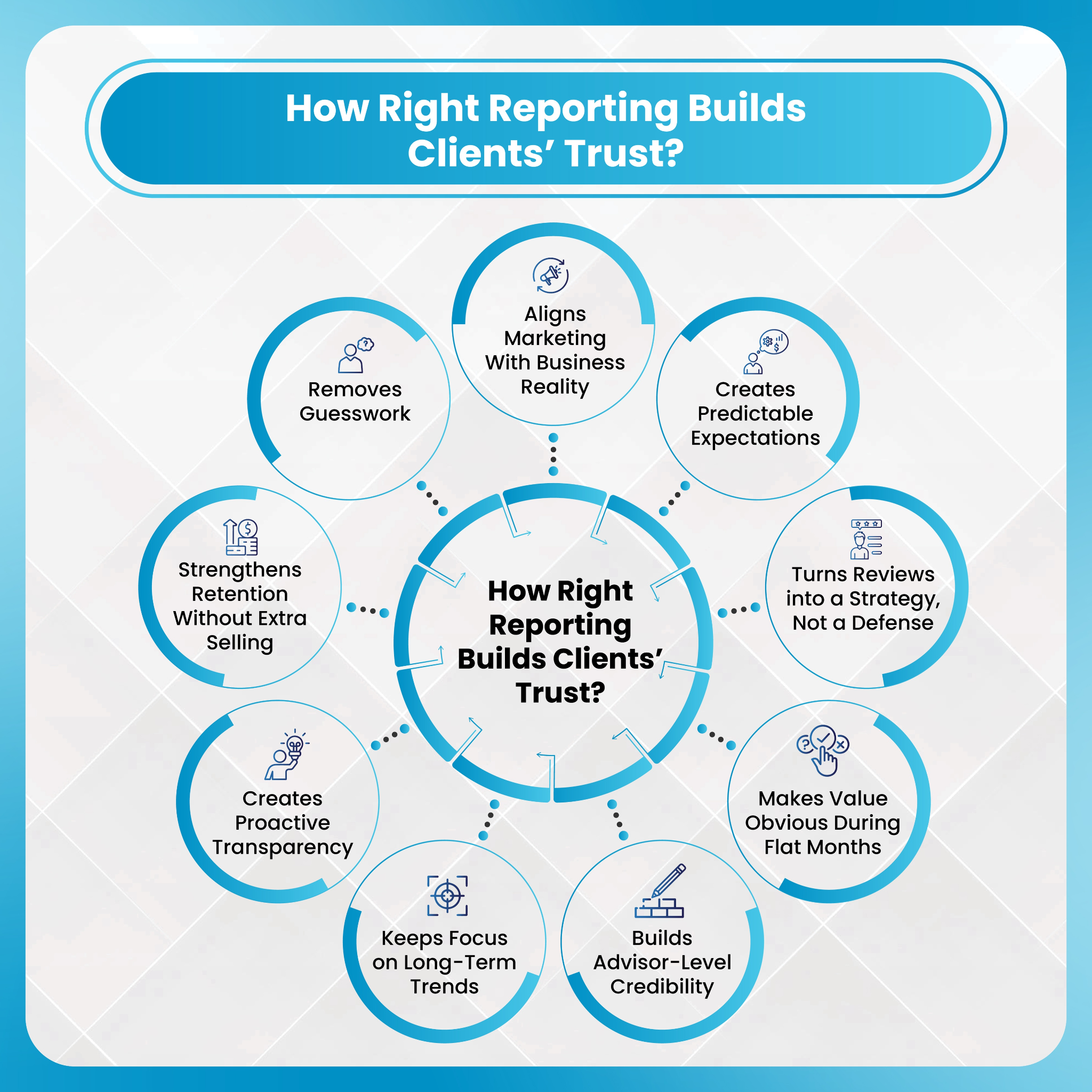
Proactive SEO management isn't about promising clients they'll never encounter a problem. It's about improving how quickly and confidently an agency can identify and respond when something does come up.
1. Agencies Can Be Proactive Instead of Reactive
The difference between the two models is significant:
Reactive Model: Client reports a problem → Agency investigates → Agency identifies the cause → Agency decides what to do
Proactive Model: Agency identifies a change → Investigates impact → Prioritizes the issue → Prepares a response → Agency communicates with the client
The proactive version puts the agency in control of the narrative rather than playing catch-up.
2. Faster Response to Emerging Problems
Specialist support can reduce the burden of initial investigation. That includes finding where a problem started, identifying which pages are affected, determining likely causes, and preparing an action plan. This doesn't guarantee every issue gets resolved instantly, but it does mean the groundwork happens faster.
3. Fewer Unexpected Client Conversations
Proactive monitoring helps agencies identify obvious or meaningful problems before clients bring them up first. The goal isn't to eliminate every client's concern. It's to give the agency better visibility, more context, a clearer response, and a stronger understanding of what actually needs attention.-
4. Stronger Perception of SEO Expertise
When an agency flags an issue before a client notices it, it signals active account management rather than a reporting relationship built solely on after-the-fact updates. This builds client confidence in the agency's expertise, though it's worth noting this doesn't guarantee specific outcomes like client retention, referrals, or renewals.
5. Better Use of Agency Resources
Dividing responsibilities clearly allows each side to focus on what they do best:
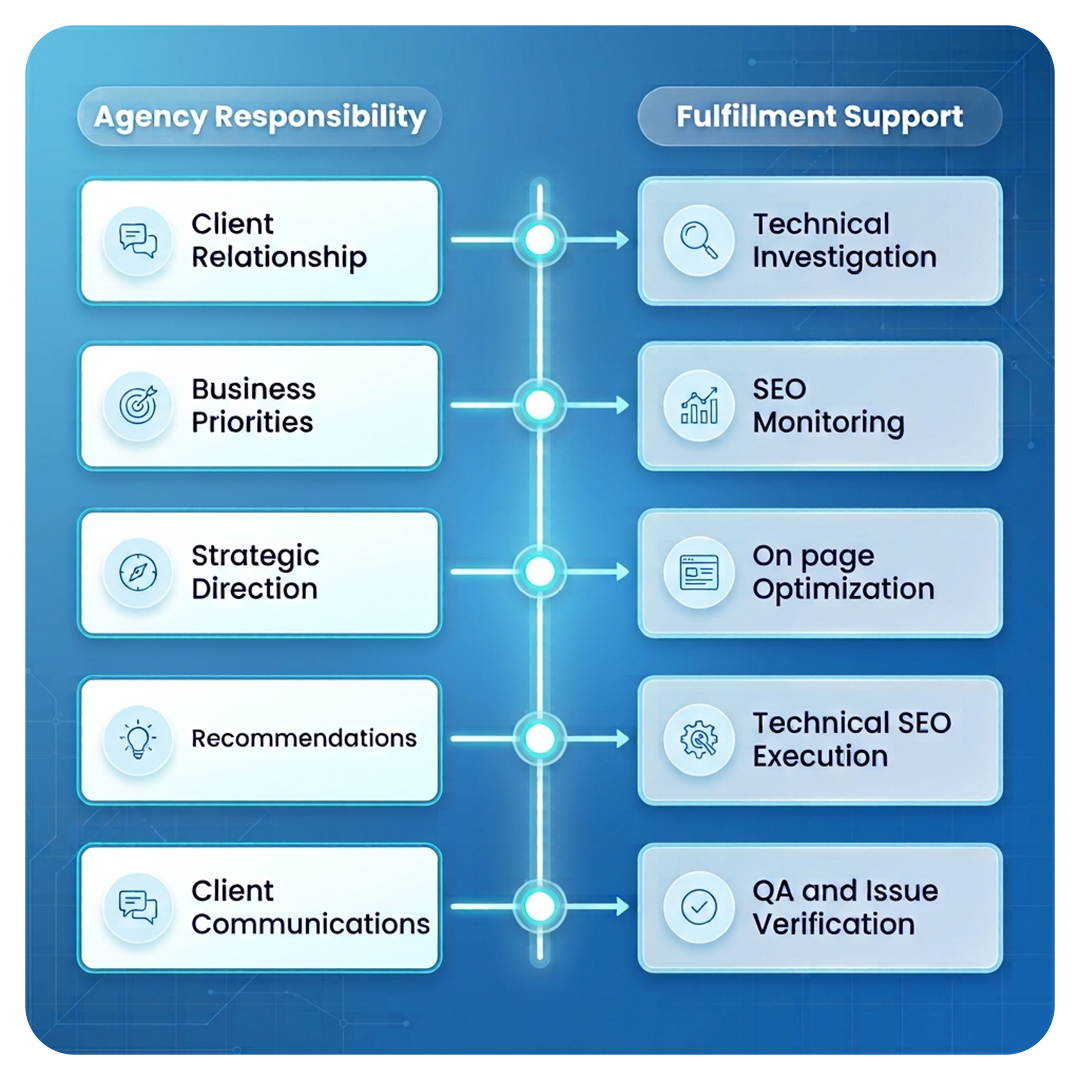
This structure lets agency specialists and account managers concentrate on strategy and client relationships while fulfillment handles the repeatable execution and investigation work behind the scenes.
How DashClicks Supports Proactive SEO Fulfillment
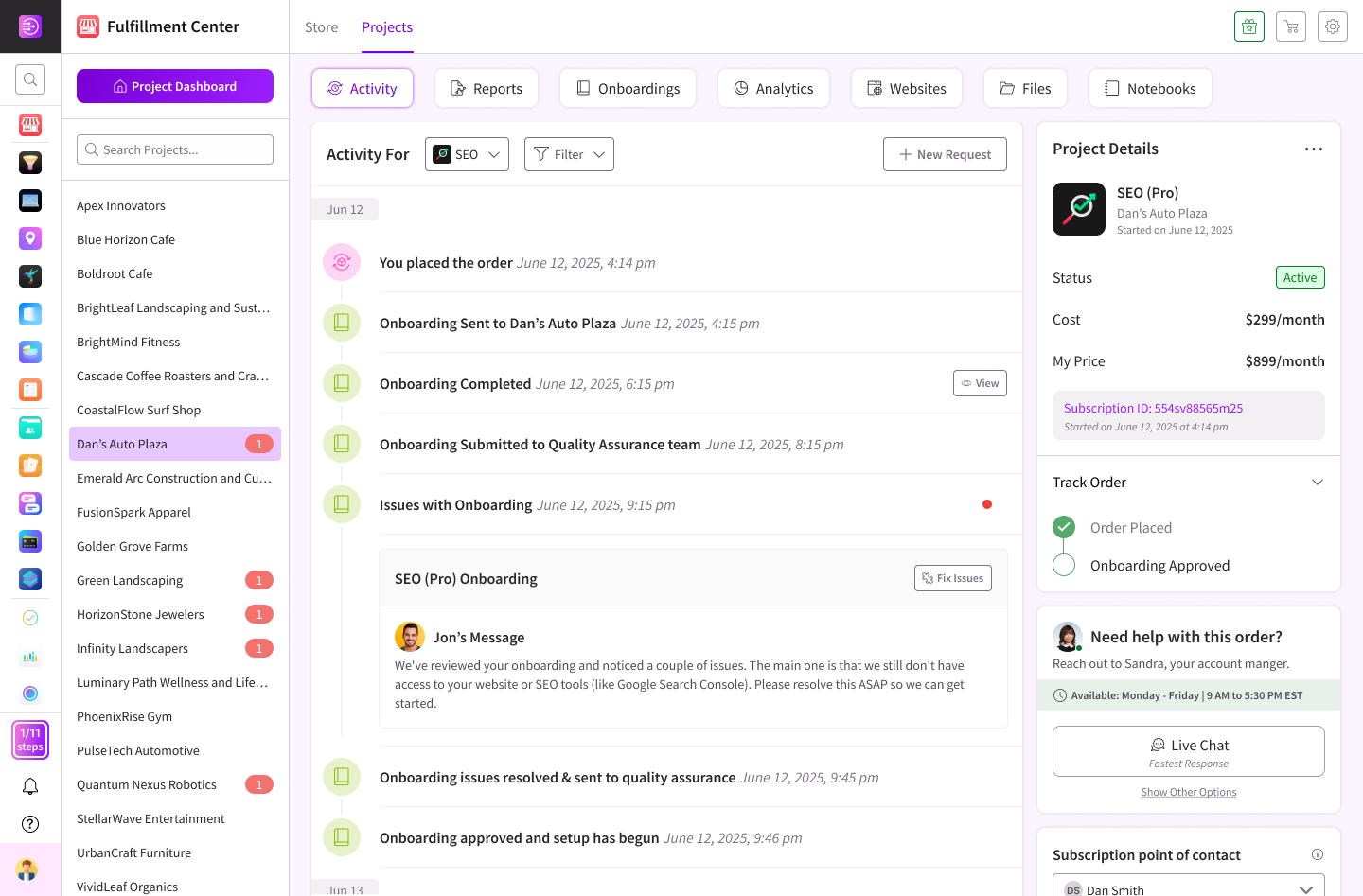
DashClicks works as an extension of an agency's SEO team rather than a disconnected vendor. As a white label SEO management partner, the platform supports agencies across technical SEO, on-page optimization, content optimization, local SEO, link-building support, SEO reporting, QA processes, and broader specialist fulfillment.
Each of these capabilities connects to a consistent process: monitor, identify, assign, optimize, QA, and report. This structure is designed to support the kind of early detection and structured fulfillment covered throughout this article.
Agencies working with DashClicks retain full ownership of the client relationship, strategic direction, business priorities, and client communication. The fulfillment team works behind the scenes to support execution and monitoring, which is what makes DashClicks a practical option for agencies searching for the best white label SEO company to extend their internal capacity without giving up control of client accounts.
Conclusion
SEO issues rarely develop with obvious warning signs. Website changes, technical problems, content shifts, and ranking declines can all happen between reporting cycles, often without anyone noticing until the impact becomes visible in traffic numbers. Agencies managing multiple accounts don't always have the bandwidth to investigate every account continuously, not because of a lack of skill, but because of the sheer volume of work involved in doing it well.
A reliable white label SEO service can provide the additional specialist capacity and structured fulfillment processes needed to catch these problems earlier. Early detection allows agencies to investigate, prioritize, communicate, resolve, and verify issues in a way that feels proactive rather than reactive. Throughout this process, the agency remains responsible for strategy and the client relationship, while fulfillment support handles the monitoring and execution work happening behind the scenes.
The goal isn't simply to fix SEO issues faster. It's to identify them early enough that clients don't have to be the ones bringing them to the agency's attention.


.svg)


.svg)
.svg)
.svg)
.svg)
.svg)