

.svg)

.svg)
.svg)
.svg)
.svg)
.svg)
High cost-per-result is the most common frustration digital marketing agencies face when managing paid media campaigns for clients. When cost per acquisition spikes, many account managers immediately point the finger at external factors. They blame rising competition. They complain about seasonal shifts. They point to high CPMs across the entire platform.
While it is true that advertising costs generally increase over time, blaming external marketplace factors is often a misdiagnosis of the real issue. The reality is much closer to home. High costs are usually the direct result of hidden inefficiencies inside the ad account itself.
The advertising algorithm is designed to reward signal clarity. The system does not just reward the highest bidder. It rewards accounts that provide clear data, structured testing environments, and consolidated audience targets. When an account is messy, the algorithm struggles to deliver the right ads to the right people. This confusion forces the system to spend more money to figure out what works.
Before you can permanently fix high cost-per-result issues, your agency must learn to identify these hidden inefficiencies inside your campaigns. Fixing these backend problems requires technical expertise and a highly systematic approach to media buying.
Many agencies do not have the internal bandwidth to rebuild their entire execution framework. This is exactly where professional Facebook ads services step in. By leveraging expert backend systems, you can completely overhaul campaign performance without hiring a massive internal team.
The Real Problem: Hidden Inefficiencies Driving Up Costs
If your client campaigns are suffering from unpredictable or rising costs, the problem usually stems from how the account is built. The algorithm needs a clean environment to operate efficiently. When campaigns are structured poorly, you end up paying a premium for substandard traffic.
Here are the five most common inefficiencies driving up your costs.
1. Audience Overlap: Competing Against Yourself
Audience overlap occurs when you target the exact same people across multiple different ad sets at the same time. This is a massive problem for agencies that rely on heavy audience segmentation. An account manager might create one ad set targeting a specific interest, another ad set targeting a Lookalike audience, and a third ad set targeting broad website visitors.
Because people often fall into multiple categories simultaneously, these ad sets end up bidding against each other in the auction. When you force your own campaigns to compete for the same eyeballs, you artificially inflate the auction pressure. This directly leads to higher CPMs. The algorithm will generally prevent you from showing multiple ads to the same person at the same time, which means some of your ad sets will simply stop delivering. Your agency ends up paying more money for less efficient delivery.
2. Learning Phase Resets
The learning phase is a critical period where the algorithm explores different delivery options to find the most cost-effective target audience for your ads. To exit the learning phase and achieve stable delivery, an ad set typically needs to generate about 50 conversions within a seven-day window.
Many media buyers get impatient. They check the account every day and make constant tweaks to the budget, the targeting, or the creatives. Every significant edit resets the learning phase. When the learning phase resets, the algorithm has to start its exploration process all over again. This constant state of resetting prevents the account from ever finding historical stability. The immediate impact is wild cost spikes and highly unstable performance day over day.
3. Misaligned Conversion Signals
A campaign is only as smart as the data you feed it. If you optimize for the wrong conversion event, the algorithm will bring you the wrong type of user. For example, optimizing for link clicks or landing page views will certainly get you cheap traffic. However, that traffic will almost never convert into actual paying customers or qualified leads.
Even when agencies select the correct optimization event, they often suffer from weak tracking setups. If the conversion API is not properly configured, or if the pixel is firing duplicate events, the algorithm receives corrupted data. According to Meta's official documentation, advertisers who set up Conversions API alongside Meta Pixel saw a median of 20-30% additional conversions reported for PageView events compared to those using only the Pixel. When your signals are misaligned, you end up paying for cheap but entirely useless results.
4. Creative Fatigue
Even the absolute best ad creative will eventually stop working. Creative fatigue happens when your target audience has seen the same image or video too many times. When frequency creeps up, users stop paying attention. They scroll right past the ad.
This drop in Facebook engagement has a severe impact on your metrics. When your click-through rate drops, the platform assumes your ad is no longer relevant to the user. To compensate for this perceived lack of quality, the algorithm charges you more for impressions. High frequency leads directly to low click-through rates, which ultimately results in a much higher cost per acquisition.
5. Fragmented Account Structure
In the early days of paid media, it was common practice to build highly complex accounts with dozens of hyper-specific campaigns and hundreds of micro-targeted ad sets. Today, a fragmented account structure is incredibly detrimental to performance.
When you spread a limited daily budget across too many different campaigns, you dilute the data. None of the individual ad sets gets enough budget to generate the necessary 50 conversions per week. The system is starved of data signals. This fragmentation leads to incredibly slow optimization and steadily increasing costs. The algorithm simply cannot learn effectively when its budget is fractured into tiny pieces.
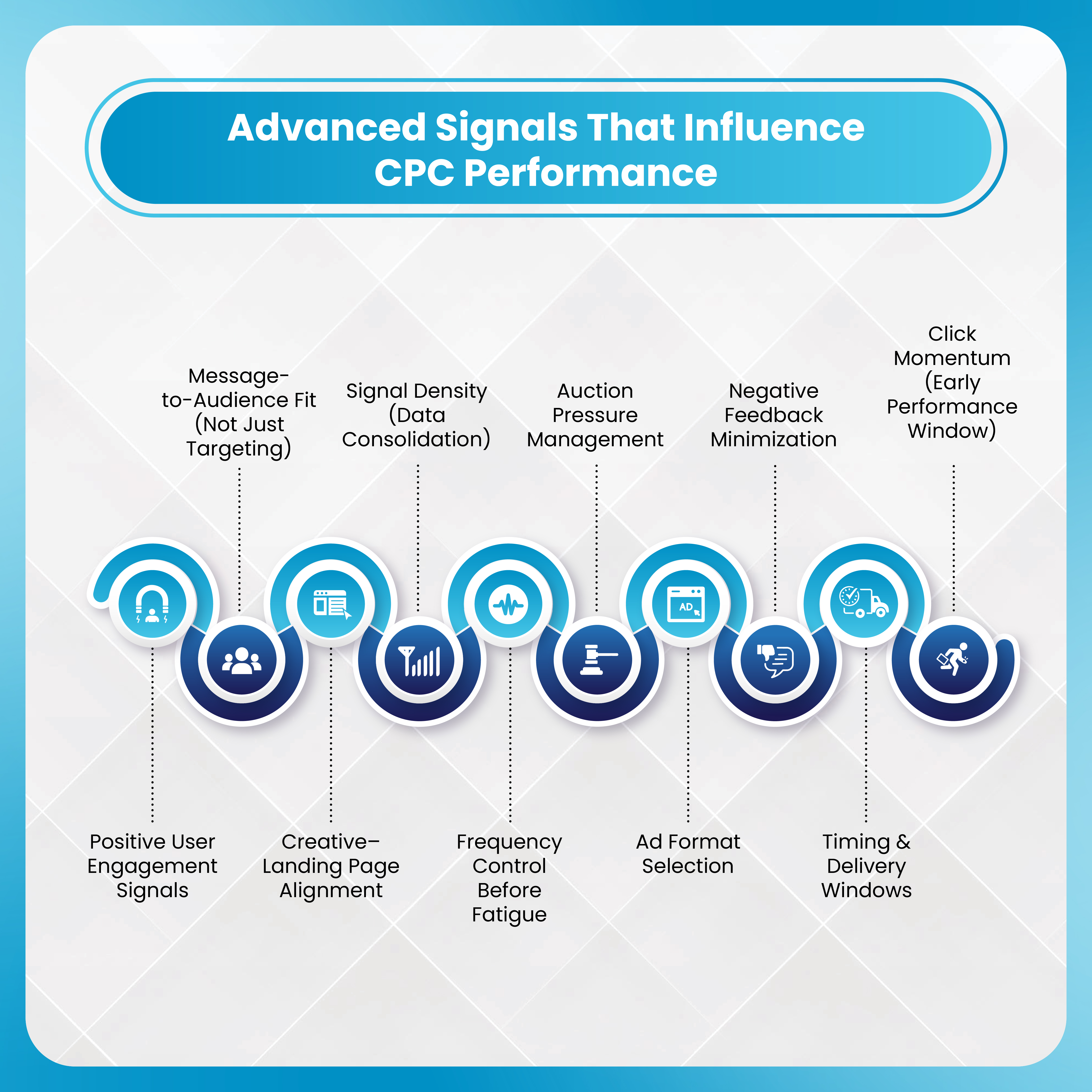
These inefficiencies do not just happen overnight. They compound slowly over time, making it very difficult for a busy account manager to notice the root cause. Fixing these structural flaws requires deep diagnostic skills and structured execution systems.
How White Label Facebook Ads Fix These Inefficiencies?
Fixing a broken ad account takes more than just turning off a few underperforming ads. It requires a complete strategic overhaul of the account architecture. Most growing agencies struggle to execute this level of technical optimization because their teams are stretched thin managing client communication and reporting.
Partnering with a specialized white label Facebook advertising provider gives your agency instant access to the structured systems required to turn performance around.
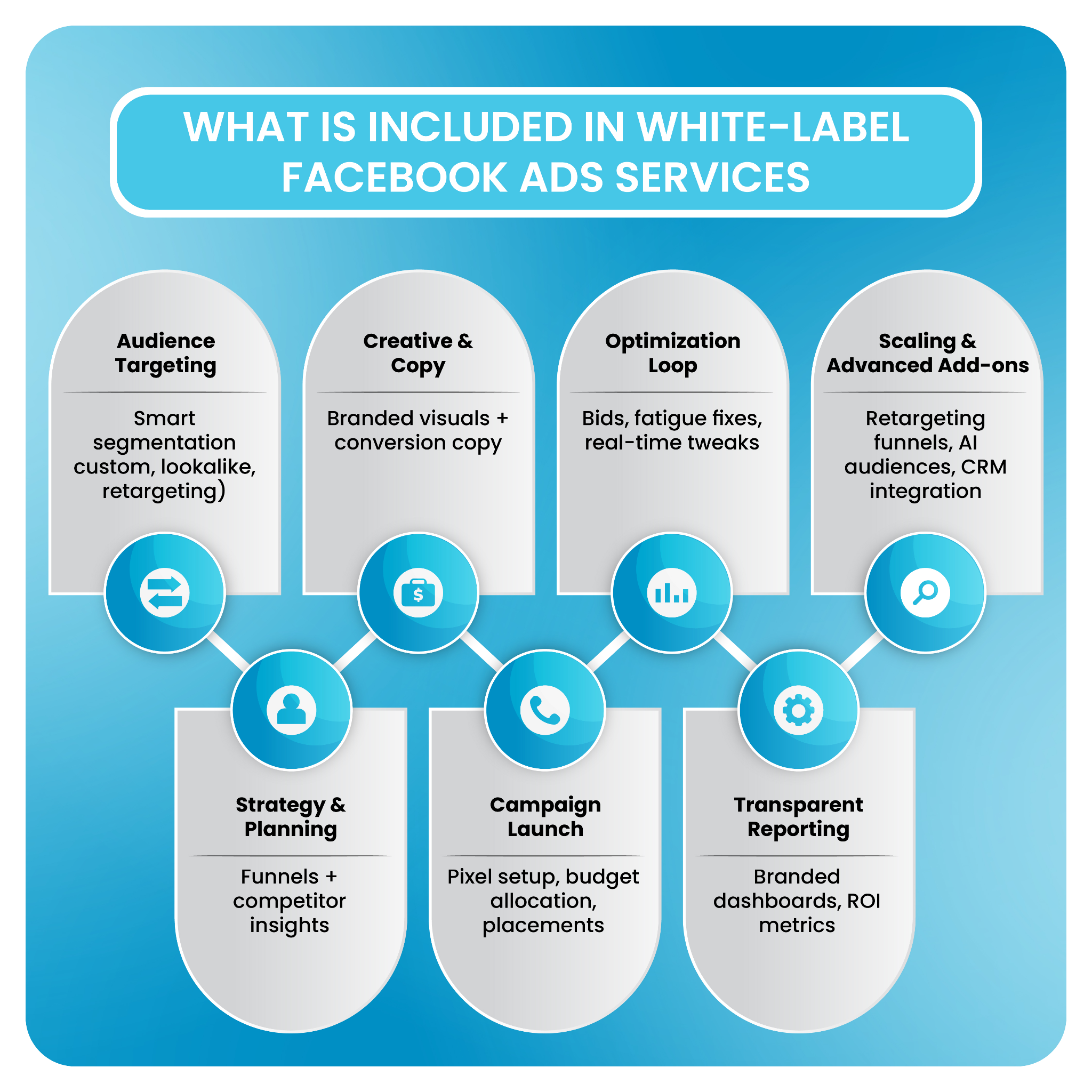
Here is exactly how a structured backend approach solves these hidden inefficiencies.
1. Backend Diagnostics
The first step a premium white label partner takes is conducting a deep technical audit of the ad account. This goes far beyond looking at surface metrics like click-through rate or cost per click. The audit focuses heavily on identifying data signal loss and tracking errors.
Experts will review the pixel setup, the conversion API integration, and the overall event match quality. They look for duplicate firing events and missing parameters. By fixing the foundational data tracking first, the execution team ensures that the algorithm receives 100 percent accurate information moving forward. Clean data is the absolute prerequisite for lowering cost-per-result.
2. Audience Consolidation
To solve the problem of competing against yourself, a structured execution system relies on audience consolidation. Instead of running ten different ad sets with small overlapping audiences, the white label provider will merge these segments into two or three larger, distinct groups.
Consolidation gives the algorithm a much larger pool of users to explore. It removes internal auction competition and significantly reduces auction pressure. The immediate result of this strategy is a lower CPM and vastly improved ad delivery. By letting the algorithm do the heavy lifting within a broad audience, the system can find cheaper conversions that manual micro-targeting would completely miss.
3. Learning Phase Stabilization
An expert media buying team understands the importance of algorithm stability. Instead of making random daily edits based on emotional reactions to minor fluctuations, they implement controlled scaling protocols.
Changes to the account are planned and batched together. Budgets are scaled vertically in safe increments to avoid triggering the learning phase unnecessarily. By allowing ad sets to run uninterrupted, they can easily achieve the required conversion volume to exit the learning phase. The outcome is a much faster optimization period and a highly stable cost per acquisition that your clients can rely on week after week.
4. Conversion Signal Optimization
A core part of professional Facebook ads services involves aligning the platform optimization events with the client's actual revenue goals. The team will ensure that the campaign is bidding on the highest-intent action possible.
If a client wants qualified phone calls, the system is optimized specifically for booked appointments rather than just generic form fills. The white label partner will also implement advanced tracking solutions to feed offline conversion data back into the platform. This creates a closed-loop system where the algorithm gets smarter every single day by optimizing strictly for revenue-generating actions.
5. Creative Iteration Frameworks
To combat creative fatigue, you cannot just throw random images at the wall and hope something sticks. A white label fulfillment team implements structured creative testing frameworks. They isolate specific variables to test mathematically.
First, they will test multiple different hooks. Once a winning hook is identified, they will test different visual formats. Finally, they will test different variations of the core offer. This systematic approach ensures there is always a fresh pipeline of high-performing creative ready to deploy before the current ads fatigue. The outcome is a sustained, healthy click-through rate and a consistently lower cost per acquisition. According to recent industry analysis, Meta's platforms (Facebook and Instagram) capture 70% of total social media advertising revenue globally, making creative differentiation absolutely vital for standing out in the feed.
6. Account Structure Simplification
The final piece of the optimization puzzle is radically simplifying the account structure. A professional execution team will collapse fragmented campaigns down to the absolute essentials. They typically utilize a streamlined structure separating prospecting campaigns from retargeting campaigns.
By consolidating the budget into fewer active ad sets, each ad set receives a much higher concentration of daily spend. This strong flow of budget translates into stronger data signals and faster learning. Simplification removes the friction that slows the algorithm down, resulting in better overall performance and much cheaper results.
Implementing all of these advanced systems simultaneously is incredibly difficult for an agency to do entirely in-house. It requires dedicated media buyers, technical tracking specialists, and constant creative iteration. Most agencies simply do not have the resources to build this infrastructure from scratch.
The Agency Advantage: White Label Without Operational Burden
Building an internal execution team capable of managing complex ad architecture is expensive. You have to hire senior media buyers, train them on your specific standard operating procedures, and manage their daily workflow. When employee turnover happens, the agency is left scrambling to fulfill client expectations.
Partnering with the best white label Facebook ads provider removes this massive operational burden. You gain instant access to advanced optimization systems without adding any internal overhead. The external partner handles all the complex backend execution, technical troubleshooting, and daily optimization.
Because the service operates completely under your brand, your clients never know they are being serviced by an external team. This arrangement allows agency owners to step away from the stress of the ads manager. Instead of worrying about why a specific ad set is underperforming, your internal team can focus entirely on high-level strategy, client management, and scaling the agency's sales pipeline. You get to deliver enterprise-level results while maintaining incredibly lean operations.
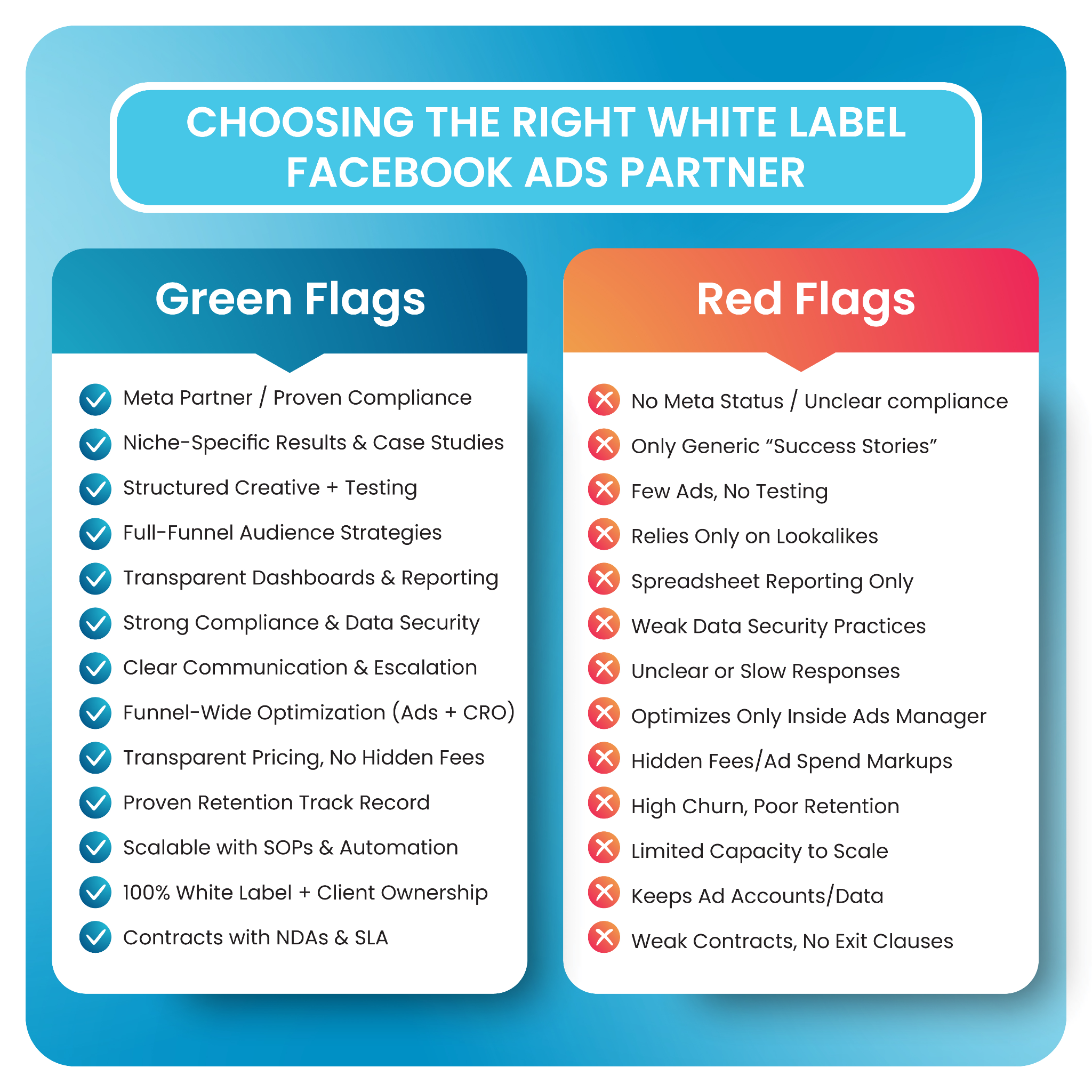
How DashClicks’ White Label Facebook Ads Help Solve Cost Issues?
When you need a reliable execution partner to fix performance bottlenecks, the platform provides a comprehensive infrastructure designed specifically for agency growth. DashClicks operates as a true extension of your agency team by combining expert media buying with powerful software systems, making it one of the best white label Facebook ads solutions available.
- Execution Support: The provider handles the entire lifecycle of the campaign. The execution team takes care of the complex initial setup, audience consolidation, and technical tracking implementation. They conduct continuous performance monitoring to ensure the campaigns remain stable and avoid unnecessary learning phase resets.
- Reporting & Transparency: Client communication is much easier when you have clear data. The platform provides fully white-labeled reporting dashboards. Your agency and your clients get real-time insights into campaign performance, cost-per-result trends, and overall return on ad spend. You never have to spend hours manually building spreadsheets again.
- Scalability: As your agency signs new clients, you can launch new campaigns instantly. The execution systems are built to manage multiple complex accounts easily. This allows your agency to take on larger clients with bigger budgets without worrying about capacity limits.
- Speed: In the agency world, speed of execution is critical. By utilizing a dedicated white label partner, you benefit from much faster implementation cycles. Structural audits, creative testing, and technical fixes happen rapidly, meaning your clients see performance improvements sooner.
- Strategic Support: Beyond just pushing buttons in the ad account, DashClicks provides data-driven insights to help guide your overarching account strategy. This strategic depth helps your account managers communicate more effectively with clients, explaining exactly why costs are improving and what the next phase of growth looks like.
Fixing the System to Scale the Agency
Cost issues in paid media are almost always system problems, not platform problems. When client campaigns suffer from high costs, it is a direct reflection of audience overlap, fragmented account structures, and misaligned conversion signals. Blaming external factors will not fix the root cause of the inefficiency.
To deliver consistent results, agencies must adopt highly structured systems for backend diagnostics, controlled scaling, and creative iteration. However, building and managing these systems internally requires immense resources that distract from client acquisition.
This is the exact problem white label Facebook advertising solves. By outsourcing the complex technical execution to a dedicated partner, your agency can instantly upgrade its service delivery. You secure better results for your clients, reduce wasted ad spend, and stabilize performance metrics across the board. Agencies that fix their underlying execution systems are the ones that scale effortlessly and retain clients for years.


.svg)


.svg)
.svg)
.svg)
.svg)
.svg)