

.svg)

.svg)
.svg)
.svg)
.svg)
.svg)
Facebook advertising continues to dominate digital growth strategies for businesses of all sizes. With more than 3 billion monthly active users across apps owned by Meta Platforms, Inc., Facebook remains one of the most scalable and data-rich advertising ecosystems available today.
For small marketing agencies, this presents a major opportunity. Clients expect Facebook advertising to be part of a complete growth strategy. The demand is there. The budgets are there. The results can be significant.
Yet many small agencies hesitate to fully commit to Facebook Ads management. Not because they doubt its effectiveness, but because scaling delivery without creating operational strain is difficult. Hiring skilled media buyers is expensive. Training new team members takes time. Managing multiple ad accounts requires systems and oversight.
This is where white label Facebook ads change the equation. Instead of building an internal team from scratch, agencies can partner with a white label provider to deliver expert-level campaigns under their own brand.
The result is simple but powerful: Small agencies can scale revenue, improve performance, and expand services without increasing internal overhead.
Before diving into the benefits, let’s first look at the real challenges small agencies face when trying to scale Facebook advertising internally.
The Real Pain Points Small Agencies Face
Scaling sounds exciting in theory. In reality, most small agencies run into the same operational friction points when they try to grow their services with Facebook advertising tips. What starts as a promising revenue opportunity often turns into a strain on resources, time, and cash flow.
Let’s break down the core challenges in more detail.
Pain Point 1: Hiring Is Expensive and Risky
At first glance, hiring an in-house media buyer seems like the logical next step. But for small agencies, it is rarely that simple.
Experienced paid media specialists command competitive salaries. In the United States, mid-level professionals often earn between $60,000 and $90,000 per year, depending on skill level and location. Senior buyers can command even more. Once you factor in benefits, payroll taxes, bonuses, and software subscriptions, the true annual cost climbs quickly.
Then there are hidden costs:
- Recruitment fees or job board expenses
- Time spent reviewing resumes and conducting interviews
- Onboarding and training resources
- Management time for supervision and performance reviews
Even after all that investment, performance is not guaranteed.
Hiring comes with real risk:
- One poor hire can negatively impact multiple client accounts
- Mistakes in targeting or budget allocation can damage client trust
- Training junior staff slows early campaign momentum
- Payroll remains fixed even when client revenue fluctuates
- Leadership time gets pulled into supervision instead of strategy and sales
For small agencies, cash flow matters. A single full-time salary can significantly shift the financial structure of the business. If client churn increases or new deals slow down, payroll obligations remain unchanged.
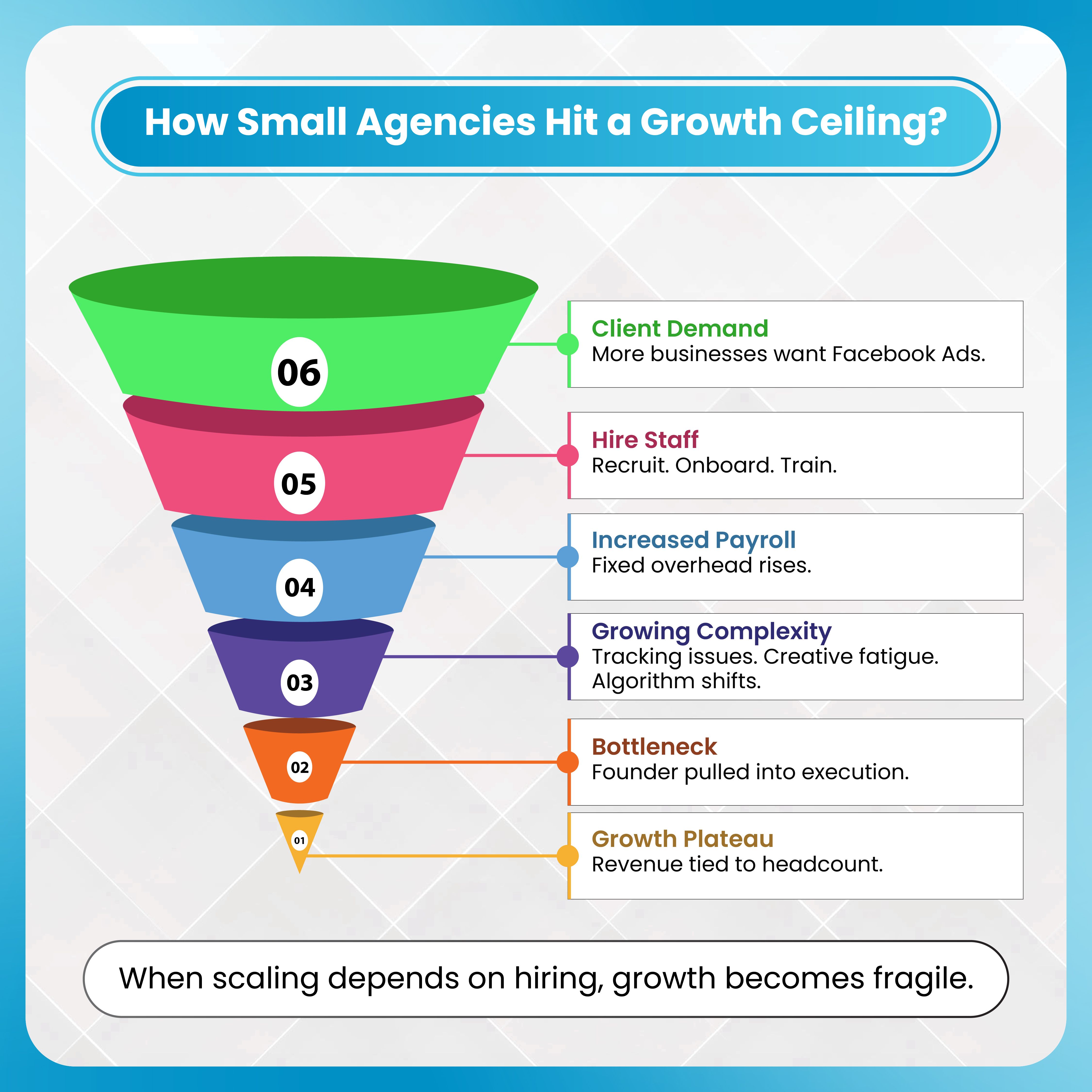
This often creates a dangerous imbalance. Agencies become operationally heavy before they become revenue stable. They add fixed costs in anticipation of growth rather than as a result of proven, consistent demand.
That imbalance reduces flexibility. It limits the ability to experiment, invest in marketing, or pivot services when needed. And even if hiring is not the immediate barrier, internal execution introduces another layer of complexity.
Pain Point 2: Facebook Ads Are Increasingly Complex
Running Facebook ads today is very different from how it worked just five years ago.
The platform has evolved rapidly. What once felt relatively straightforward now requires technical knowledge, structured testing, and continuous adaptation.
Several major shifts have reshaped the landscape:
- Increased automation in campaign structures
- Changes to attribution modeling
- Privacy updates, such as Apple’s App Tracking Transparency framework
- Reduced audience data visibility
- Greater emphasis on creative testing and dynamic ad formats
Privacy changes alone have forced advertisers to rethink how they track and optimize campaigns. Signal loss has made accurate measurement more challenging. Attribution windows have shifted. Audience targeting has become broader and more algorithm-driven.
At the same time, competition has intensified. Global digital ad spending surpassed $600 billion in 2023, and social media continues to capture a large share of that investment. More advertisers competing for the same impressions means higher costs and tighter margins.
Conversion tracking now requires:
- Proper event configuration
- Pixel setup and verification
- Domain authentication
- In many cases, server-side tracking integrations
Creative strategy has also become central to performance. Structured testing frameworks are necessary to identify winning variations. Without consistent experimentation, campaigns can stall quickly.
For small agencies managing multiple clients, staying current with every update is demanding. Algorithm changes do not come with detailed instruction manuals. Best practices evolve continuously.
Without a deep understanding of these moving parts, campaigns can underperform. When results dip, clients notice. When performance fluctuates, trust erodes. Complexity does not just affect campaign outcomes. It also increases internal pressure. Teams spend more time troubleshooting and less time building growth strategies.
And as complexity increases, so does workload.
Pain Point 3: Capacity Bottlenecks Limit Growth
Every new ad account adds layers of responsibility.
- More campaigns to build.
- More budgets to manage.
- More audiences to test.
- More creative assets to review.
- More reports to prepare.
- More client questions to answer.
What initially feels manageable with two or three accounts becomes overwhelming with ten.
Facebook advertising is not a “set it and forget it” channel. Performance shifts daily. Cost per click can spike. Conversion rates can drop. Audiences fatigue. Creative wears out. This demands constant monitoring and optimization.
As the workload grows, founders and senior team members often step in to maintain quality. They review campaigns, adjust budgets, analyze metrics, and join client calls to explain results. Over time, this creates a bottleneck.
Instead of focusing on:
- Business development
- Strategic partnerships
- Process improvements
- Marketing their own agency
Leadership becomes deeply involved in day-to-day campaign execution.
Many small agencies plateau not because demand disappears, but because delivery capacity becomes the ceiling. They stop selling aggressively because they fear overextending the team. Growth slows to protect operational stability. This is where white labeling shifts from being simple outsourcing to becoming a strategic growth decision.
Rather than tying revenue potential to internal headcount, agencies can separate sales growth from execution capacity. That shift alone can redefine what scaling actually looks like.
The Benefits of White Label Facebook Ads for Small Agencies
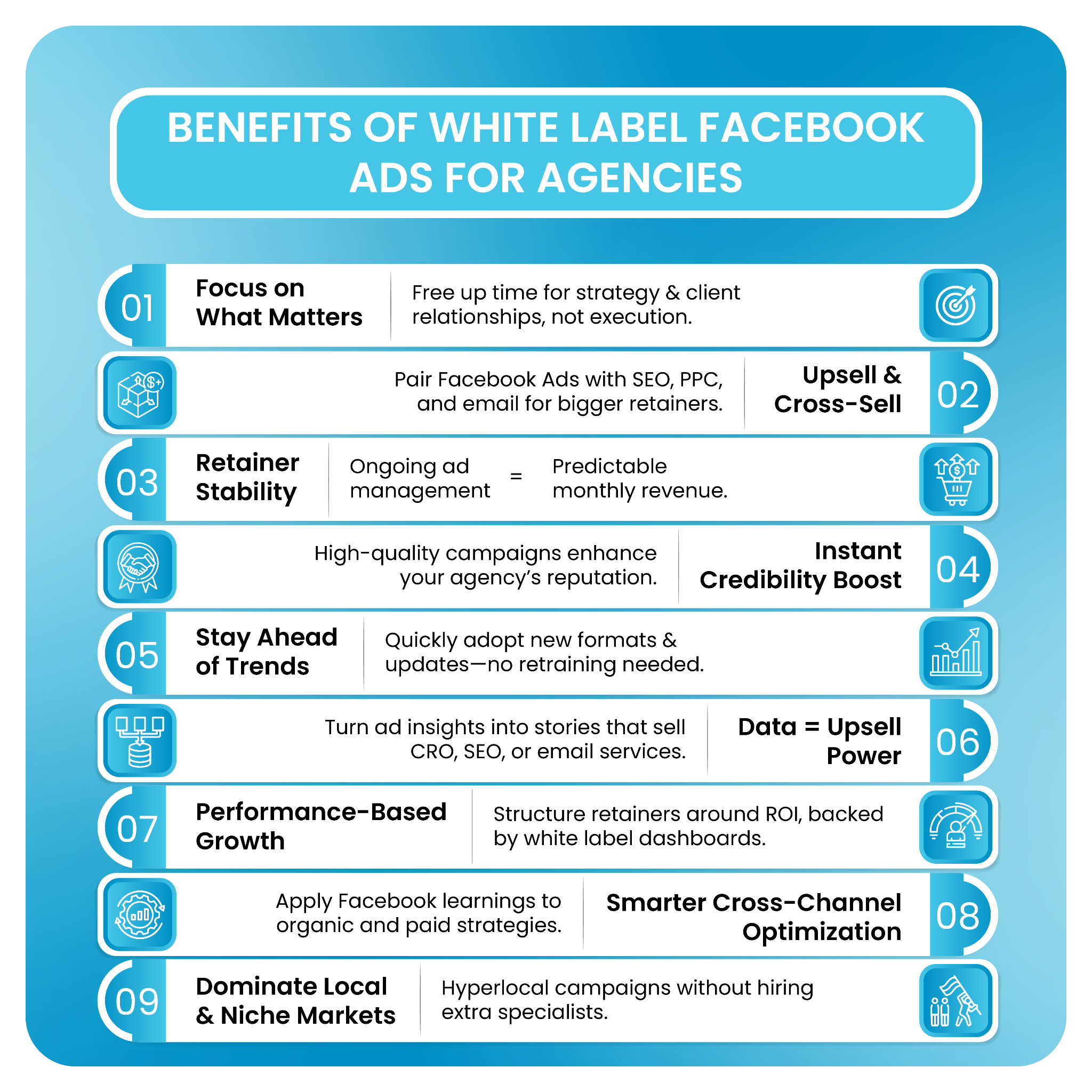
Benefit 1: Instant Service Expansion Without Hiring
White label Facebook ads allow agencies to launch paid social services immediately. There is no need for recruitment cycles, onboarding delays, or months of training. There is no expansion of payroll, HR complexity, or internal management strain.
An agency can move from saying, “We do not offer paid ads,” to confidently presenting advanced Facebook campaign management in a matter of weeks.
This shortens time-to-market dramatically. Instead of building infrastructure first and chasing clients later, agencies can sell immediately and fulfill through a trusted partner. Adding a service only makes sense if it remains profitable. That leads to the next benefit.
Benefit 2: Higher Profit Margins Through Reduced Operational Costs
When hiring internally, agencies absorb several fixed costs:
- Salary and benefits
- Software subscriptions
- Creative production resources
- Management oversight time
With a white label model, agencies pay a predictable wholesale rate and apply their own markup. This creates a cleaner margin structure.
Consider a simplified comparison:
In-house model:
- $75,000 annual salary
- $5,000 to $10,000 in tools
- Additional oversight costs
- Revenue pressure to cover overhead
White label model:
- Fixed monthly wholesale rate
- Clear markup
- No long-term payroll commitment
The financial flexibility alone makes white labeling attractive. Agencies can maintain healthy margins while delivering expert-level services by outsourcing Facebook Ads management. Cost efficiency is powerful. But scalability is where real transformation happens.
Benefit 3: Scalable Growth Without Operational Bottlenecks
With white label support, agencies can manage 5, 10, or even 30 ad accounts without internal stress. Campaign execution runs parallel to sales growth. Revenue increases are not directly tied to hiring timelines.
This removes the capacity ceiling that limits many small firms. Growth becomes a function of sales performance, not operational bandwidth. In practical terms, that means:
- Faster onboarding of new clients
- Less fear of overcommitting
- Greater confidence in expansion efforts
Volume matters, but performance quality determines retention.
Benefit 4: Access to Specialized Facebook Advertising Expertise
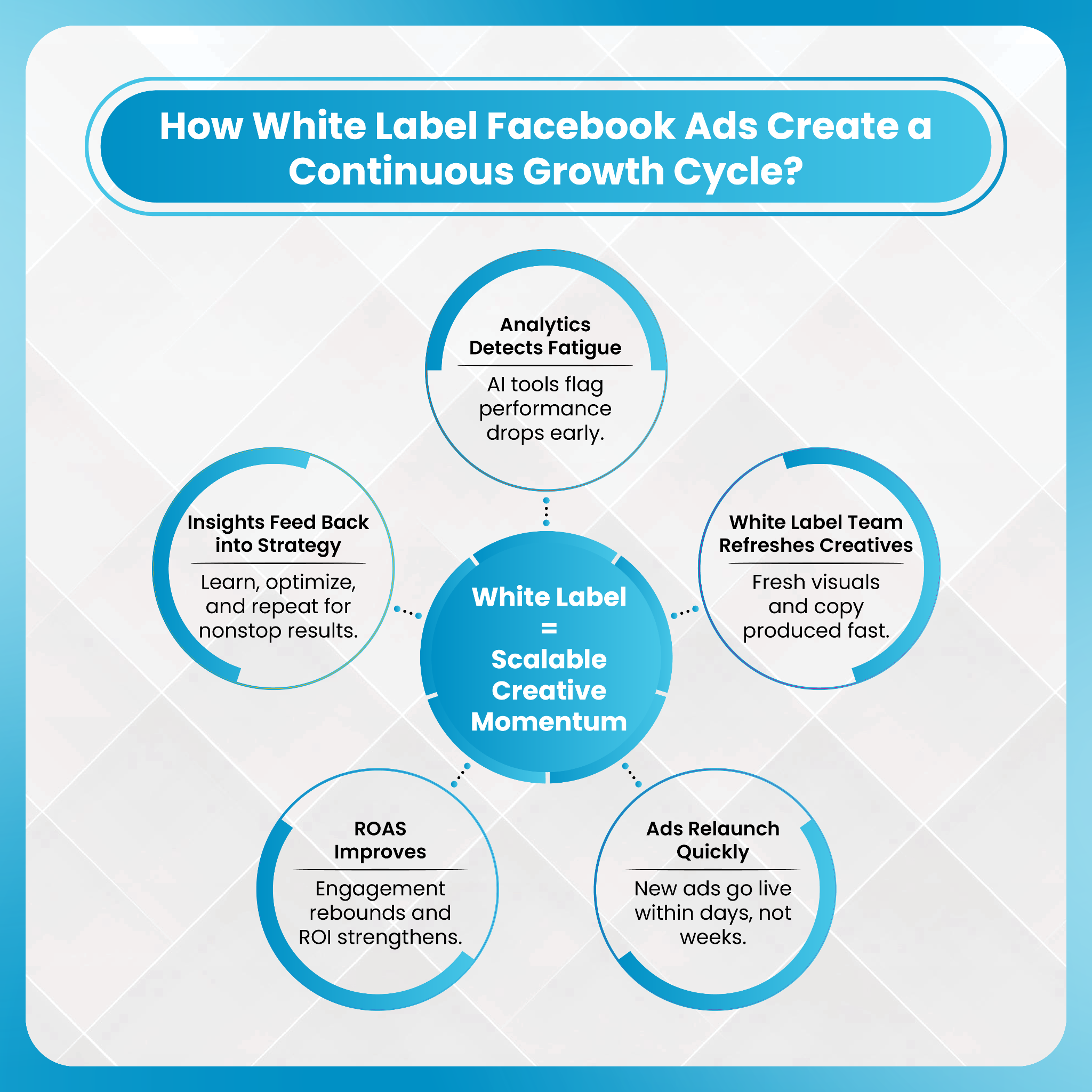
Facebook’s advertising ecosystem evolves constantly. Algorithm shifts, automation tools, and privacy updates reshape best practices every year.
White label providers typically work across multiple industries and dozens of accounts. That exposure builds specialized expertise that small agencies rarely develop internally. This includes:
- Advanced audience targeting strategies
- Pixel configuration and conversion tracking
- Structured creative testing frameworks
- Ongoing optimization based on performance data
Access to this level of knowledge reduces risk. It also improves results. When campaigns perform consistently, client trust strengthens.
Benefit 5: Improved Client Retention and Lifetime Value
Retention is the backbone of agency profitability. Research consistently shows that retaining clients is more cost-effective than acquiring new ones. Strong performance increases trust, and trust leads to longer contracts.
White label Facebook advertising contributes to retention in several ways:
- Faster campaign launches
- Consistent optimization
- Branded reporting dashboards
- Clear performance metrics
When clients see structured reports under your agency’s branding, authority increases.
Retention also impacts agency valuation. Recurring revenue with strong retention metrics makes agencies more attractive for acquisition or investment. Beyond retention, white labeling elevates brand perception.
Benefit 6: Deliver Enterprise-Level Services Under Your Own Brand
Clients want comprehensive solutions. They prefer working with a single partner rather than managing multiple vendors.
White label Facebook ads allow small agencies to present themselves as full-service performance partners. Key advantages include:
- Fully branded dashboards
- Professional reporting
- Scalable campaign management
- Structured performance frameworks
This shifts positioning from “small marketing firm” to “growth partner.” When perceived authority increases, pricing power often follows.
Benefit 7: Stronger Pricing Power and Upsell Opportunities
Facebook advertising rarely operates in isolation. It integrates naturally with:
- SEO services
- Website design
- Email marketing
- Conversion rate optimization
By offering paid social, agencies can increase average client retention. They can bundle services into multi-channel growth packages.
White labeling becomes the foundation for broader expansion. Today, it may start with Facebook ads management. Tomorrow, it can expand into multi-platform paid campaigns. That diversification strengthens revenue stability.
Benefit 8: Predictable, Recurring Revenue Model
Facebook Ads are typically managed on a monthly retainer.
This supports:
- Recurring billing cycles
- Tiered management packages
- Performance-driven pricing structures
Predictable income improves cash flow planning. It reduces uncertainty and allows agencies to invest confidently in growth. In an industry where volatility is common, recurring revenue brings stability.
DashClicks’ White Label Facebook Advertising — Your Agency’s Growth Partner
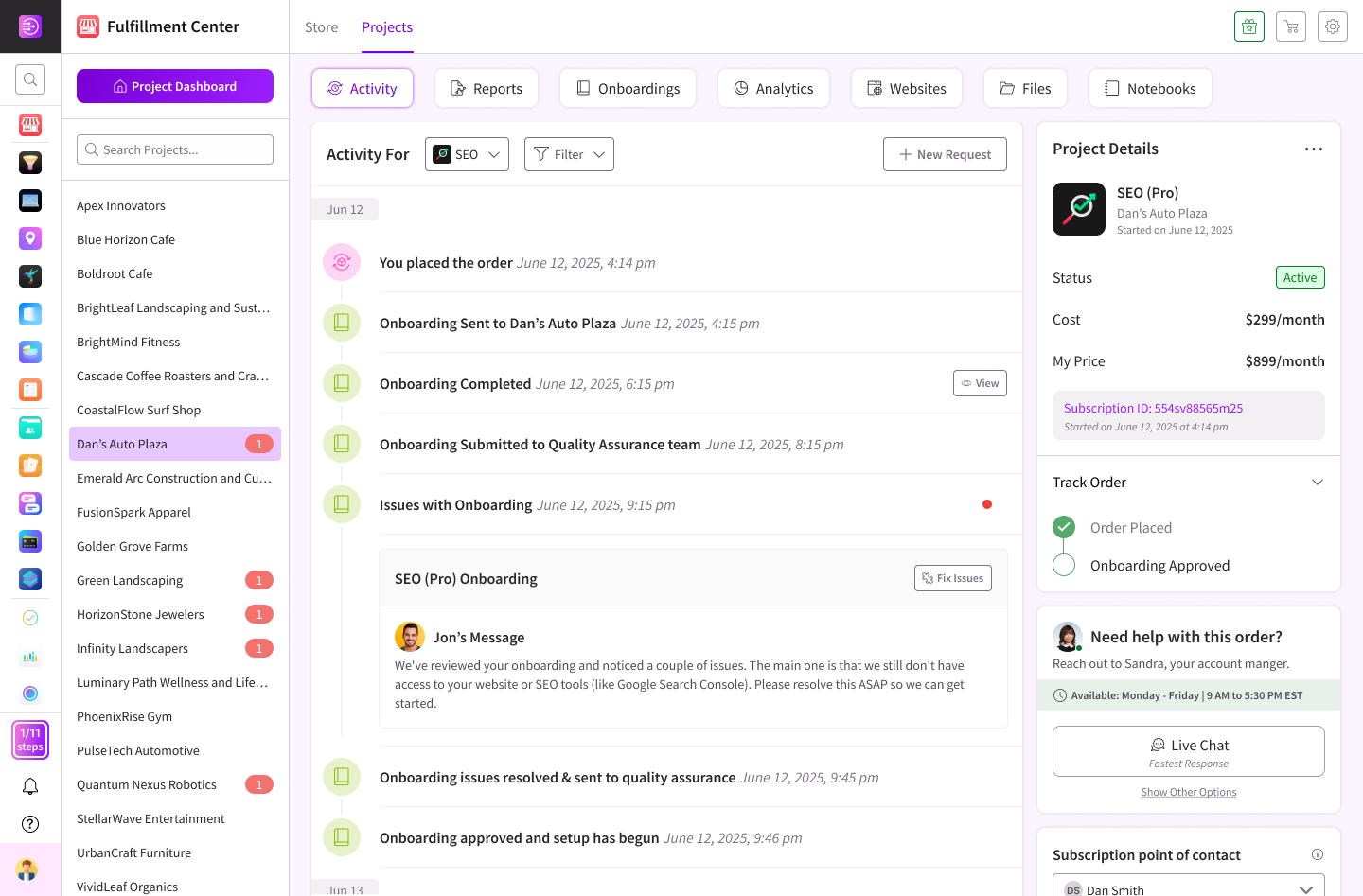
DashClicks provides end-to-end white label Facebook advertising services that operate fully under your agency’s brand. Their solution includes:
- Campaign strategy and setup by experienced media buyers
- Ongoing optimization and performance monitoring
- Structured creative testing frameworks
- Conversion tracking and retargeting systems
- Branded reporting dashboards for client transparency
- Flexible pricing models designed for agency scalability
For small agencies, this means instant capability without hiring internally.
DashClicks enables agencies to confidently offer professional Facebook Ads management while focusing on sales, strategy, and client relationships. Instead of worrying about algorithm updates or campaign troubleshooting, agency owners can prioritize growth.
By combining expert execution with fully branded delivery, DashClicks supports agencies in capturing the benefits of white label Facebook ads while maintaining control over client relationships and brand identity.
Conclusion
Facebook advertising remains one of the most powerful growth channels in digital marketing. With billions of active users and increasing global ad spend, the opportunity is clear.
For small agencies, however, scaling Facebook Ads internally often creates financial pressure, operational strain, and growth bottlenecks. Hiring is costly. Execution is complex. Capacity is limited.
White label Facebook ads offer a practical solution.
They allow agencies to:
- Expand services instantly
- Maintain stronger profit margins
- Scale without internal ceilings
- Access specialized expertise
- Improve retention
- Elevate brand authority
- Increase pricing power
- Build predictable recurring revenue
The right partnership transforms white labeling from a simple outsourcing tactic into a strategic growth engine.
If you are ready to expand your service offerings, improve performance, and scale confidently without increasing internal overhead, explore how DashClicks can support your agency’s next phase of growth.


.svg)


.svg)
.svg)
.svg)
.svg)
.svg)