

.svg)

.svg)
.svg)
.svg)
.svg)
.svg)
Running Facebook ads in 2025 looks very different from just a few years ago. Costs are higher, competition is tougher, and the platform itself keeps changing. Agencies feel this pressure every day. Clients expect steady leads, predictable costs, and clear reporting. At the same time, hiring and retaining skilled Meta ad specialists has become expensive and risky. One wrong hire or sudden resignation can slow performance across multiple accounts.
Recent industry data shows why this challenge keeps growing. WordStream’s latest benchmark summaries point out that average cost per click and cost per acquisition continue to fluctuate across industries. E-commerce and lead generation brands now face CPCs that are often 10 to 20 percent higher than pre-2023 levels. TripleWhale and Lebesgue reports also highlight ongoing CPM volatility, with some US markets regularly crossing the $20 mark during peak seasons. These changes mean that basic campaign setups are no longer enough.
This is where outsourcing becomes a practical option rather than a shortcut. White label Facebook ad partners give agencies access to specialists, tools, and proven workflows without expanding internal teams. The goal is not just to save time but to match or exceed performance benchmarks while staying profitable.
This blog explains why agencies struggle to hit current benchmarks on their own, what white label Facebook ads management actually delivers, and how to measure success using real KPIs. It also takes a closer look at how DashClicks supports agencies that want consistent Facebook ad results without hiring in-house staff.
Why Do Agencies Struggle to Hit Facebook Ads Benchmarks?
As Facebook advertising becomes more complex, many agencies find it harder to keep performance aligned with current benchmarks. The challenge is rarely a lack of strategy. More often, it comes down to execution limits, time constraints, and the growing demands of the platform itself.
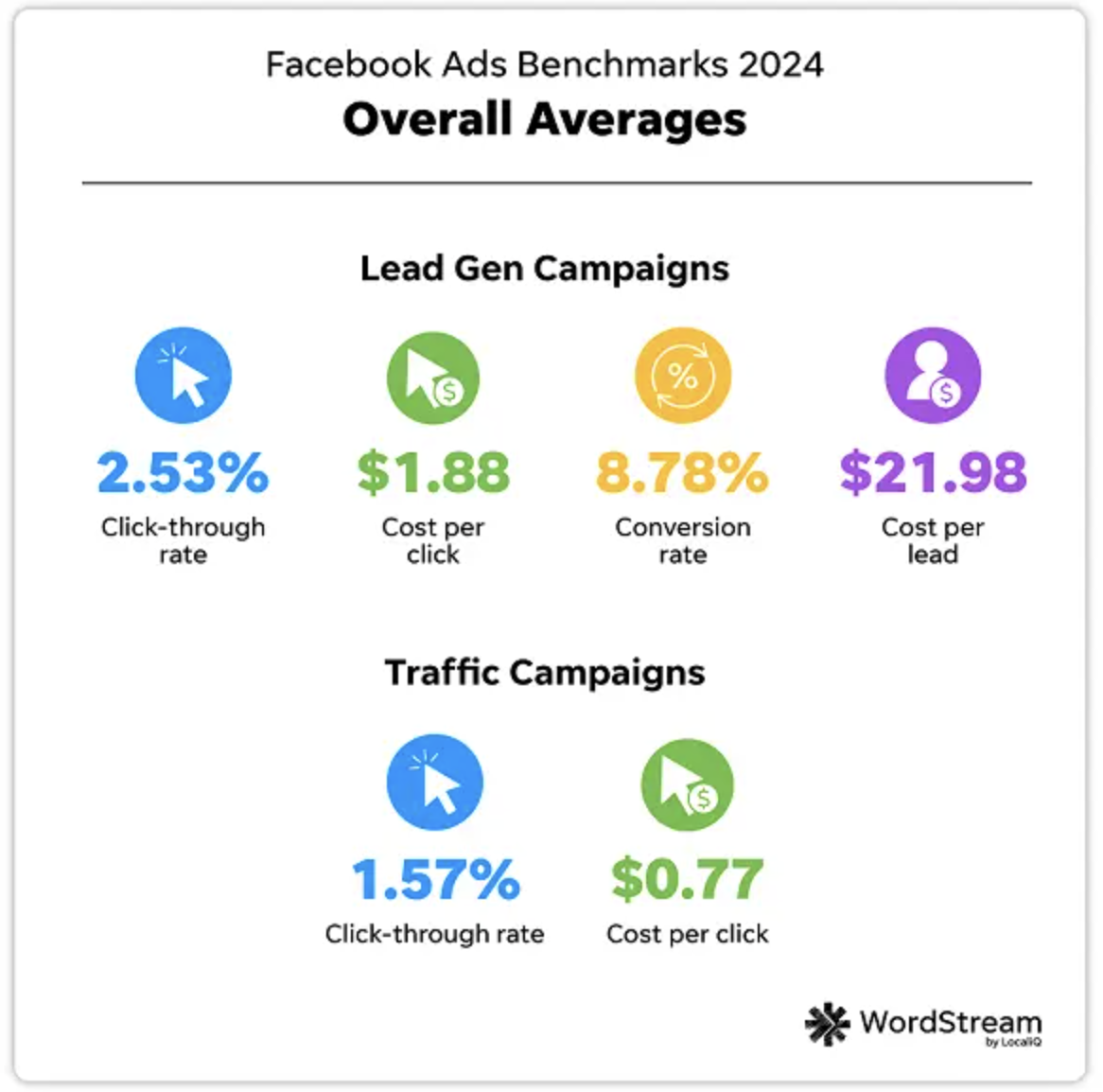
Image Source: WordStream
Three issues stand out as the most common roadblocks in 2025.
1. Rising Auction Costs and CPM Volatility
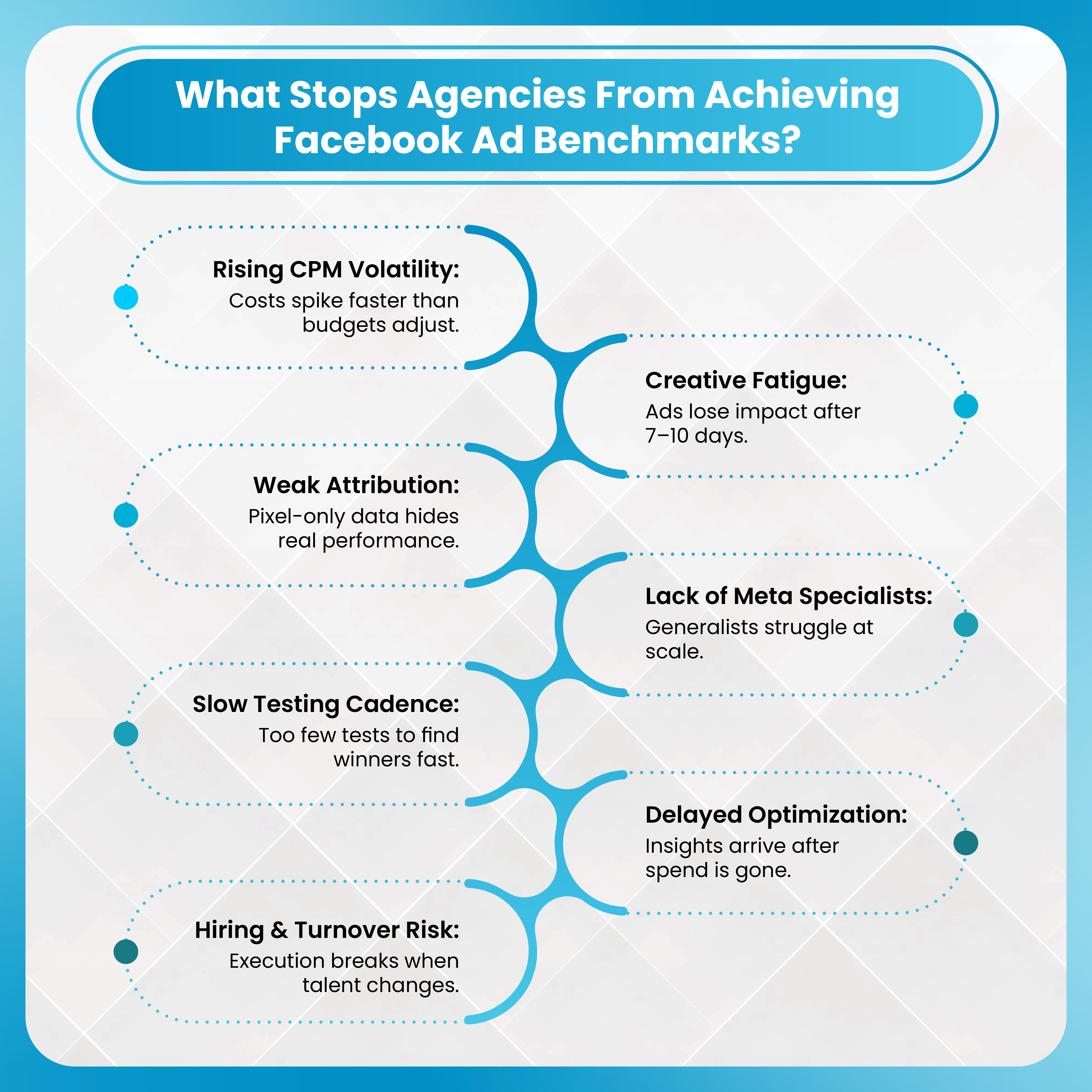
Meta’s ad auction grows more competitive every year. As more brands shift budget into paid social, bids increase and CPMs change rapidly, sometimes within the same day. Industry data from Lebesgue shows that average CPMs in the US have crossed the $20 mark across many verticals, with sharp differences by region, audience type, and seasonality. For agencies managing multiple accounts, keeping up with these swings is difficult without advanced budget controls and daily monitoring.
When CPMs spike and budgets are not adjusted fast enough, campaigns become inefficient. Prospecting campaigns often absorb too much spend, while retargeting is underfunded. Over time, this imbalance leads to rising acquisition costs and inconsistent results.
How this hurts benchmarks:
- Higher CPMs directly push up CPC and CPA when optimization lags.
- Budget waste increases during peak competition periods.
Signals to watch:
- CPM trendlines are increasing week over week.
- Uneven spend distribution between prospecting and retargeting campaigns.
2. Creative Fatigue and the Scale of Testing Required
Creative is now the single biggest performance lever on Facebook. Meta has repeatedly emphasized that ad quality and engagement heavily influence delivery and costs. In practical terms, this means agencies must launch and test new creatives constantly to maintain strong click-through rates. In 2025, testing a few ads per month is no longer enough.
Most small and mid-sized teams struggle to produce fresh visuals, copy, and formats at the pace required. As a result, ads stay live too long, audiences lose interest, and performance slowly declines. CTR drops, CPC rises, and the algorithm shifts delivery toward higher-cost impressions.
How this hurts benchmarks:
- Aging creatives lose relevance and engagement.
- Declining CTR increases CPC and weakens overall efficiency.
Signals to watch:
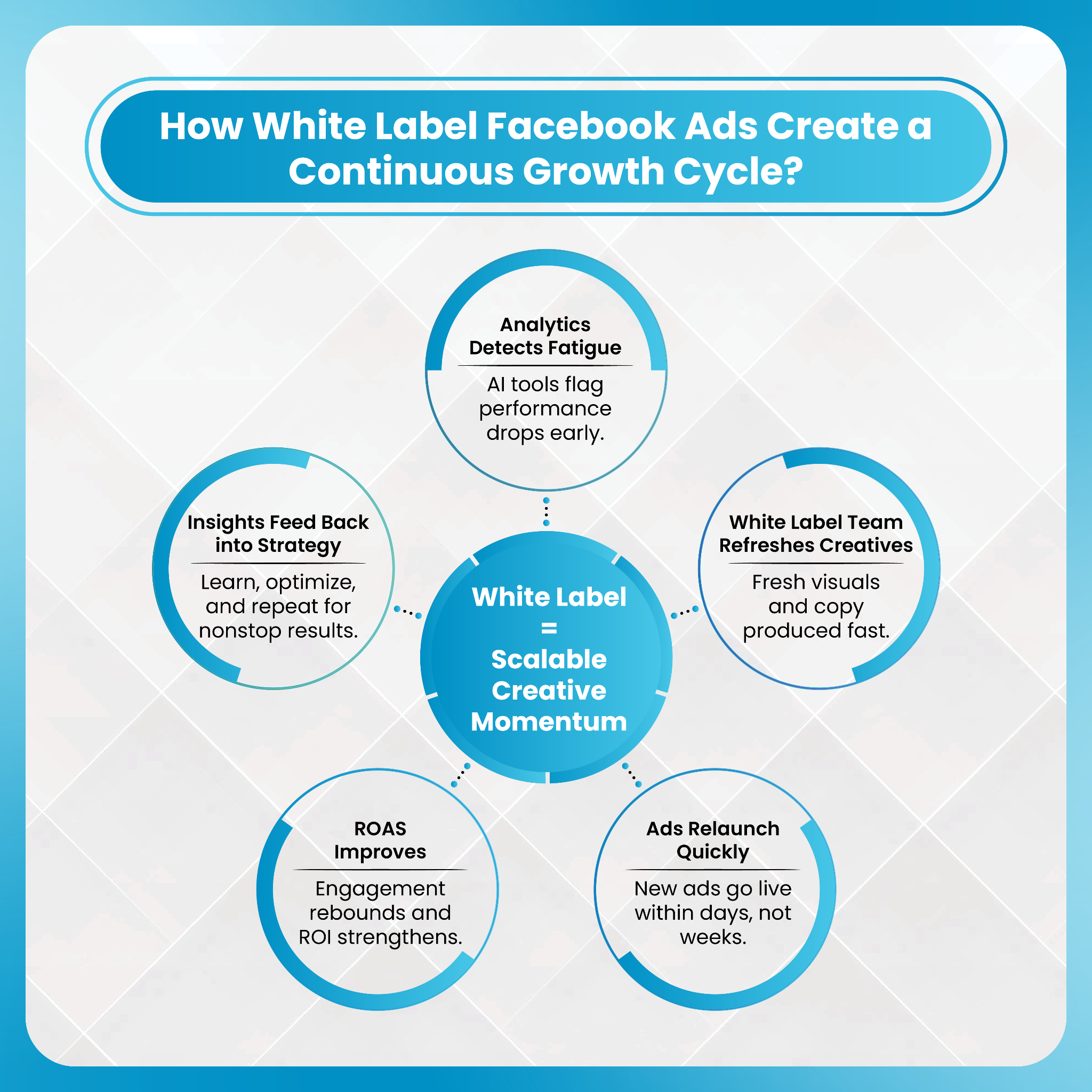
- Gradual CTR declines as creatives age.
- Noticeable performance drops after 7 to 10 days without a creative refresh.
3. Measurement Fragmentation After iOS and Attribution Changes
Even years after major iOS privacy updates, measurement remains one of the biggest challenges in Facebook advertising. Relying on pixel data alone no longer gives a complete picture of performance. Without server-side tracking and proper event mapping, reported conversions often underrepresent actual sales or leads.
Varos benchmark data highlights consistent gaps between platform-reported conversions and backend CRM or e-commerce data. When agencies optimize based on incomplete numbers, they pause winning campaigns, scale the wrong ads, and misjudge true CPA. Over time, this leads to wasted spend and missed growth opportunities.
How this hurts benchmarks:
- Inaccurate CPA reporting causes poor optimization decisions.
- High-performing campaigns may be underfunded or shut down too early.
Signals to watch:
- Conversion mismatches between Meta reports and CRM or sales data.
- Low percentage of conversions tracked through server-side events.
Together, these challenges make it increasingly difficult for agencies to hit Facebook ads benchmarks on their own. Without specialized tools, consistent testing, and accurate measurement, even well-planned campaigns struggle to deliver stable, cost-efficient results at scale.
4. Lack of Specialist Performance Operations
Running Facebook ads at scale takes far more than setting up campaigns and monitoring basic metrics. In 2025, strong performance depends on advanced bidding strategies, conversion value optimization, and precise audience engineering. These tactics require hands-on expertise and constant refinement. Agencies that rely on generalists often lack the depth needed to apply these methods consistently across multiple accounts.
When spending increases, small inefficiencies quickly become expensive. Without specialists managing scaling rules and bid strategies, performance becomes unpredictable. Campaigns that look profitable at lower budgets start to struggle as spend grows.
How this hurts benchmarks:
- ROAS becomes unstable as budgets scale.
- CPA rises faster than overall ad spend.
Signals to watch:
- CPA increasing disproportionately compared to budget growth.
- Flat or declining ROAS despite higher spend.
5. Insufficient Testing Cadence and Statistical Confidence
Consistent improvement in Facebook ads comes from ongoing testing. Audiences, creatives, and placements all need to be tested in parallel to find what truly drives performance. Small teams often lack the time and resources to run enough experiments to reach statistical confidence. As a result, decisions are based on limited data rather than clear trends.
Varos data shows that advertisers running fewer than five tests per month experience slower performance gains. Without a steady testing cadence, agencies struggle to make meaningful improvements that keep up with rising costs.
How this hurts benchmarks:
- Performance gains happen too slowly to counter increasing CPMs.
- Winning strategies take longer to identify and scale.
Signals to watch:
- Low number of tests launched each month.
- A long time is required to reach confident results.
6. Inefficient Tech Stack and Delayed Reporting
Outdated tools and manual reporting processes slow down optimization. When teams review performance data days after campaigns run, they miss critical windows to adjust bids, budgets, or creatives. TripleWhale research shows that delayed insights often lead to overspending during high-CPM periods, especially in competitive markets.
Without real-time dashboards and automated alerts, agencies react too late. This delay increases costs and reduces overall efficiency.
How this hurts benchmarks:
- Late optimizations push CPC and CPA higher.
- Budget waste increases during volatile auction periods.
Signals to watch:
- Long delays between data collection and decision-making.
- High reliance on manual optimizations and reports.
7. Difficulty Hiring and Retaining Meta Ad Talent
Experienced Facebook ad specialists are in high demand. Salaries have increased, competition for talent is strong, and turnover remains a challenge. When key team members leave, campaign performance often suffers. New hires need time to understand accounts, leading to inconsistent execution and missed opportunities.
Frequent staff changes also affect client confidence. When results fluctuate and account managers change often, clients question long-term stability.
How this hurts benchmarks:
- Performance varies widely across accounts.
- Client trust weakens due to inconsistent results.
Signals to watch:
- High turnover among ad operations staff.
- Short average tenure of Facebook ad managers.
These challenges are not signs of poor strategy. They are execution issues that naturally emerge as agencies grow. Addressing them requires a structured, repeatable approach to Facebook ad management that goes beyond what most in-house teams can sustain on their own.
How White Label Facebook Ad Management Helps Agencies Meet or Exceed Benchmarks?
1. Engagement Models and Partner Promise
White label Facebook ads partners offer flexible ways to work. Agencies can choose fully managed accounts, co-managed setups, or audit-based support. Most partners provide rebrandable reports, dedicated performance leads, and service level agreements for optimization cadence.
KPIs to track:
- Optimization frequency.
- Client reporting consistency.
2. Rapid Creative Testing and Production at Scale
Creative testing becomes easier with a partner that has ready templates and production workflows. Short-form videos, static images, and carousel ads are tested in batches. WordStream benchmarks show that maintaining CTR above industry averages helps offset rising CPCs.
KPIs to track:
- CTR by creative group.
- CPC changes after new launches.
Example: Rotating six new creatives per week can help stabilize engagement and reduce wasted spend.
3. Advanced Bidding, Budget Allocation, and Campaign Structure
White label Facebook advertising team handles complex setups like blended bidding and budget shifting between funnel stages. They monitor performance daily and adjust spend to protect CPA targets.
KPIs to track:
- CPA versus spend curve.
- ROAS stability at higher budgets.
Micro Play: Reallocating 20 percent of spend to high-intent retargeting during CPM spikes can keep costs within benchmark ranges.
4. Reliable Measurement and Reconciliation
Accurate tracking is essential. Partners implement Conversion API, server-side events, and reconciliation dashboards. Various insights show that advertisers with stronger measurement setups report more reliable conversion rates.
KPIs to track:
- Percentage of server-side events.
- Alignment between reported and actual sales.
5. Scaled Operations and Automation
Automation rules help manage scale. Low performers are paused quickly, while winners are expanded. Testing calendars ensures steady improvements.
KPIs to track:
- Tests per month.
- Percentage of winning tests scaled.
Example: Running ten parallel A/B tests can accelerate learning and improve conversion rates over time.
6. Cost Control and CPM Efficiency
Partners apply geo-based bidding, placement prioritization, and day-parting strategies. Lebesgue data shows that CPMs vary widely by country, making geo optimization essential.
KPIs to track:
- CPM by region.
- Spend efficiency ratios.
7. Creative to Conversion Funnel Optimization
Ads do not work alone. The best white label Facebook ads team also focuses on landing page alignment and offer testing. Improving post-click experience raises conversion rates and lowers CPA.
KPIs to track:
- Conversion rate lift.
- Bounce rate changes.
8. Reporting, Dashboards, and Cadence
Clear reporting builds trust. White label dashboard like DashClicks compares performance against benchmarks from sources like WordStream, TripleWhale, and Varos.
KPIs included:
- CPC, CPM, CTR, CVR, CPA, ROAS
- Tests per month and tracking coverage.
9. Pricing and ROI Impact for Agencies
Most white label services charge based on ad spend or flat monthly fees. When CPA improves even slightly, agency margins increase. Using conservative benchmark improvements from WordStream averages, many agencies see positive ROI within the first few months.
Not all white label Facebook advertising solutions are built for benchmark-level performance. This is where DashClicks stands out.
How DashClicks’ White Label Facebook Ads Services Support Agencies?
DashClicks offers scalable white label Facebook ads management designed specifically for growing agencies. Their approach focuses on consistent optimization, creative testing, and budget control aligned with benchmarks. Agencies gain access to experienced teams that manage campaigns, test creatives, and adjust bids without exposing the backend process to clients.
DashClicks also supports accurate measurement through server-side tracking and clear reporting. Rebrandable dashboards make it easy for agencies to share results and explain performance trends. By handling the operational side of Facebook ads, DashClicks allows agencies to deliver strong results without expanding in-house teams or increasing overhead. This makes their Facebook ad services a practical choice for agencies aiming to deliver the best Facebook advertising campaigns.
Conclusion
Facebook advertising demands speed, specialization, and constant testing. Rising costs and platform changes make it hard for agencies to rely only on in-house teams. Outsourcing Facebook ad management through a white-label partner helps agencies meet current benchmarks while staying flexible and profitable.
By leveraging expert operations, advanced measurement, and scalable creative production, agencies can maintain strong performance without the burden of hiring and retention. DashClicks provides the structure and support needed to deliver consistent results and keep clients confident in their ad spend.


.svg)


.svg)
.svg)
.svg)
.svg)
.svg)