

.svg)

.svg)
.svg)
.svg)
.svg)
.svg)
A client's Google Ads campaign is generating leads, but the CPA looks high. The agency responds by reducing the budget, pausing weaker keywords, and shifting spend toward campaigns with a lower reported CPA.
Three weeks later, the agency discovers that phone call conversions were never fully connected. Half the qualified leads were missing from the data. The campaign wasn't necessarily underperforming. The measurement was incomplete.
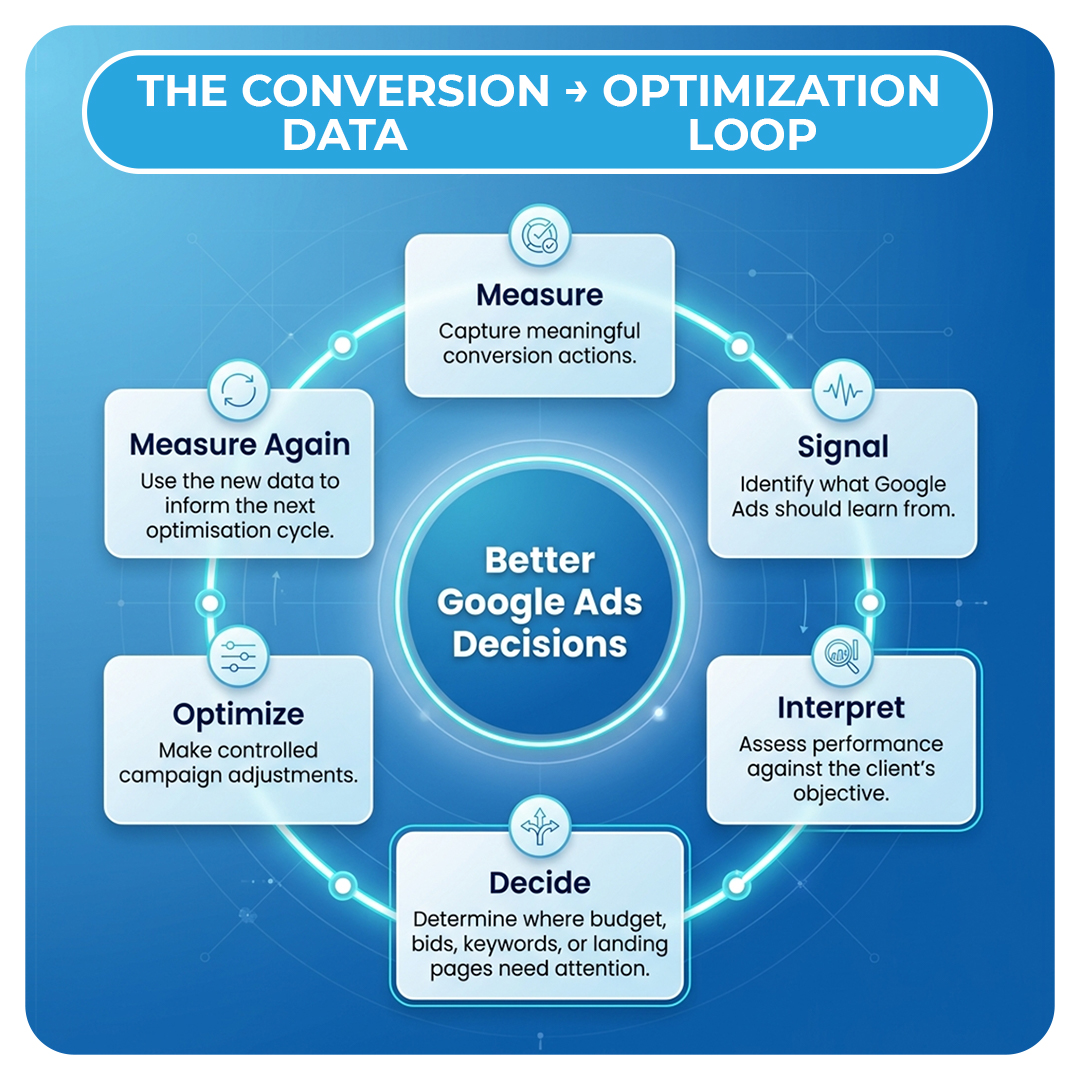
This is why conversion data matters so much in Google Ads management. The typical decision chain is:
Conversion Data → Performance Interpretation → Optimization Decision → Budget Allocation
If the first link is unreliable, every decision that follows can be distorted, even when the optimization itself is technically sound.
For agencies managing multiple accounts, the challenge grows. Different clients use different websites, CRMs, sales cycles, and definitions of a conversion. Ecommerce accounts may focus on purchases, while lead-generation campaigns may depend on qualified leads that take weeks to close. This makes reliable white label Google Ads management and consistent execution harder to maintain across accounts.
Google Ads uses actions included in the conversions column for bidding when relevant primary conversion actions are tied to campaign goals. That makes conversion accuracy part of optimization, not just reporting.
For context, WordStream's 2025 benchmark analysed more than 16,000 search advertising campaigns from April 2024 to March 2025 and found an average conversion rate of 7.52%. The variation across industries reinforces why agencies should treat benchmarks as context rather than automatic targets.
Why Conversion Data Is the Foundation of Google Ads Optimization?
Conversion data does more than populate a client report. It shapes what the algorithm learns and what the agency decides to do next.
It Determines What Google Ads Learns From
Google Ads bidding relies on conversion signals to determine where and how aggressively to spend a client's budget. Primary conversion actions are the ones included in the standard conversions column, and these are the actions typically used for bidding optimization. Secondary conversion actions are generally treated as observational signals rather than bidding inputs.
This distinction matters because an incorrectly classified conversion action can quietly influence the signals the algorithm optimizes toward. Not every account uses an identical bidding configuration, but the underlying principle holds across accounts: what gets marked as primary shapes what the system tries to generate more of.
It Shapes Agency Decisions
Agencies use conversion information to decide which campaigns deserve more budget, which keywords need attention, where bids should shift, which search terms should be excluded, which landing pages need work, and whether a campaign is meeting the client's actual objective.
Conversion tracking is not simply a reporting layer. It is part of the decision-making infrastructure behind the account. Every optimization choice an account manager makes is, in some way, a response to what the conversion data appears to say.
How Poor Conversion Data Leads to Bad Google Ads Decisions?
Different data-quality problems create different kinds of optimization mistakes. Understanding the specific failure pattern helps agencies catch it before it drives a budget decision.
1. Missing Conversions Can Make Good Campaigns Look Weak
Consider a campaign generating qualified leads, but call tracking isn't capturing them correctly. Reported conversions come in lower than actual business results. The agency sees a high CPA and responds by reducing budget or pausing the campaign.
The agency is responding to an apparent performance problem that actually exists in the measurement layer, not the campaign itself. The campaign may be doing exactly what it should. The data simply isn't showing it.
2. Duplicate Conversions Can Make Weak Campaigns Look Strong
The opposite failure is just as damaging. Multiple tags or events can record the same customer action, inflating reported conversion volume. CPA appears lower than it really is, and the agency may increase budget based on performance that looks stronger than it actually is.
Google provides guidance around conversion counting and transaction IDs, particularly to help avoid duplicate sales conversions. Getting this right isn't a matter of running a full tracking audit on every account, but it is worth confirming before treating a low CPA as a genuine win.
3. Low-Value Actions Can Distort Optimization
Page views, button clicks, brochure downloads, time-on-site events, and form starts can all be useful signals. None of them are automatically equivalent to a qualified lead or a purchase.
These actions shouldn't become the primary optimization target simply because they're easy to measure. There's a meaningful difference between activity and business outcomes, and optimization decisions should be built around the latter.
4. Incorrect Conversion Values Can Misallocate Budget
Imagine Campaign A generates fewer but higher-value customers, while Campaign B generates a larger volume of low-value conversions. Without meaningful conversion values assigned to each, Campaign B may appear to be the stronger performer. The agency may end up favoring volume over actual business value, which becomes especially problematic when evaluating value-based bidding strategies. Assigning accurate values doesn't automatically improve performance, but it does give the agency a more honest basis for comparison.
5. Delayed Offline Data Can Create Premature Decisions
Lead generation campaigns often produce leads well before any sale happens. A lead might take days or weeks to become qualified, and it may eventually turn into an appointment, a sale, or a long-term customer.
If an agency only optimizes around the initial lead, it risks favoring lead volume over lead quality. Google Ads supports qualified leads and converted leads goals that can help connect that initial lead generation activity with the sales outcomes that happen later, giving agencies a fuller picture before they act.
6 Conversion Data Problems Agencies Should Check Before Optimizing
Before making a bid, budget, or keyword decision, it's worth running through a short checklist to confirm the data behind that decision holds up.
Are the Right Actions Marked as Primary?
Primary conversions influence standard Conversions reporting and bidding, while secondary conversions are generally observation signals. Confirm that the actions being optimized toward actually represent the client's real objective, not just the easiest thing to track.
Are Conversions Being Counted Correctly?
Watch for a single customer action being recorded multiple times, duplicate form submissions, duplicate purchases, repeated page-load conversions, or incorrect counting settings. Inflated conversion numbers can make performance look considerably better than it is.
Are Important Conversion Paths Missing?
Check whether phone calls, lead forms, purchases, appointment bookings, offline sales, and CRM-qualified leads are all being captured. Missing conversion paths create an incomplete picture of how an account is actually performing.
Do Conversion Values Reflect Business Value?
Not every conversion carries the same weight. A low-value inquiry shouldn't be treated the same as a closed sale. Where possible, conversion values should reflect meaningful differences in what each action is actually worth to the client's business.
Does Platform Data Make Sense Against Business Data?
Compare Google Ads data against CRM records, sales data, call records, ecommerce transactions, and lead qualification data. Not every number needs to match perfectly, but major discrepancies should be understood and explained before big optimization decisions get made.
Did a Recent Website or Tracking Change Break Measurement?
Form updates, thank-you page changes, Google Tag Manager edits, website redesigns, CRM integrations, analytics reconfigurations, and conversion tag updates can all quietly break measurement without anyone noticing right away.
Before changing bids or budgets, confirm that the signal driving the decision can actually be trusted.
From Conversion Data to Google Ads Decisions
Data-quality problems don't stay abstract. They translate directly into specific campaign decisions, often in ways that aren't obvious until after the fact.
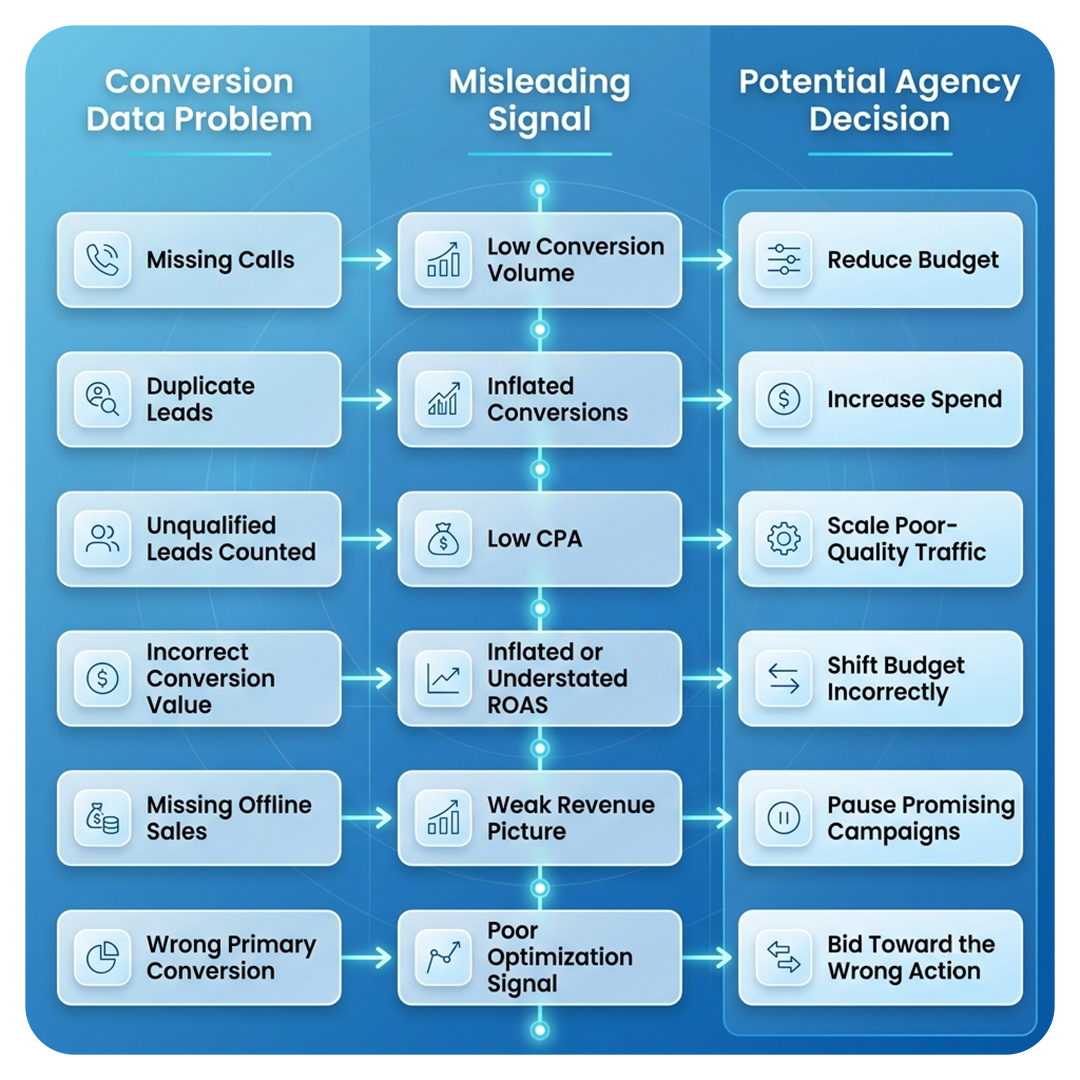
The problem isn't simply the number that shows up in the conversions column. The problem is what the agency concludes from that number. A misleading signal can influence budgets, bids, keywords, campaign priorities, and the recommendations an agency ultimately gives its client.
The objective isn't to maximize the number in the conversions column. It's to make sure that number represents the client outcome the campaign is actually supposed to produce.
Improve Conversion Measurement Before Increasing Ad Spend
Better optimization starts with better measurement, not a bigger budget.
- Define the Business Outcome First: Start by asking what the client actually considers a successful conversion. Is it a form submission, a qualified lead, a booked appointment, a purchase, a closed sale, or a repeat customer? The conversion definition should reflect the campaign's real business objective, not just whatever is easiest to track in Google Ads.
- Separate Primary and Secondary Signals: Keep the actions that genuinely matter for optimization marked as primary, and keep useful but non-critical interactions available for observation where appropriate. Not every measurable interaction deserves equal weight, and the same setup won't work identically across every account.
- Connect Online Leads With Offline Outcomes: This matters especially for B2B, professional services, home services, healthcare, financial services, and any business with a sales team or a longer sales cycle. The progression typically looks like this: lead, then qualified lead, then appointment, then sale. Google's qualified leads and converted leads goals can help connect that initial lead generation activity with the outcomes that happen further down the funnel.
- Strengthen Measurement Where Appropriate: Enhanced cxonversions is worth understanding here. Google states that enhanced conversions can improve conversion measurement by supplementing existing conversion tags with hashed first-party customer data, which can also support bidding optimization. This is particularly relevant when standard conversion measurement doesn't capture the full picture.
According to Google, advertisers using first-party data alongside GCLIDs for offline measurement saw a median 10% increase in conversions compared with standard offline conversion imports. That figure is a reported median result from Google, not a guaranteed outcome, and individual results will vary by account and industry.
Why Reliable Conversion Data Becomes Harder Across Multiple Client Accounts?
The technical measurement problem is only half the story. The other half is an operational one that shows up specifically at the agency level.
Every client can bring a different conversion goal, a different website, a different CRM system, a different sales cycle, a different lead qualification process, a different tracking implementation, and different reporting requirements.
One Agency, Multiple Measurement Frameworks
Client A might measure success in purchases. Client B in qualified phone calls. Client C in booked appointments. Client D in qualified leads that eventually convert to sales.
These accounts can't simply use identical conversion frameworks. The agency needs to understand what each client actually considers valuable, even while relying on standardized processes to support execution across the roster.
Measurement Problems Create Execution Work
Poor or unreliable data doesn't just sit quietly in a dashboard. It creates additional investigation, tracking QA, campaign reviews, repeated client questions, reporting adjustments, and more general uncertainty around every optimization decision.
The challenge isn't only knowing Google Ads. Agencies need enough specialist execution capacity to monitor, diagnose, and act on account data consistently across every client they manage.
How White Label Google Ads Helps Agencies Act on Better Data
This is where a white label Google Ads agency partnership can add real value, though it's worth being precise about what that support actually does and doesn't solve.
White label Google Ads fulfillment does not replace the agency's responsibility for defining client goals or ensuring the measurement framework reflects those goals. It gives the agency additional specialist execution capacity to manage and optimize campaigns once those foundations are already in place. A fulfillment partner can't fix broken tracking on its own, but it can help an agency act more consistently once the data is trustworthy.
- Support Ongoing Campaign Execution: White label Google Ads management support can include campaign management, search-term analysis, negative keyword management, bid optimization, budget pacing, ad management, and ongoing performance monitoring, all tied back to reliable conversion signals rather than raw activity metrics.
- Add Specialist QA: A fulfillment team can add another layer of review across campaign settings, conversion configuration, account changes, optimization work, and reporting accuracy. That QA process won't catch every tracking issue on its own, but it becomes a meaningful part of a broader execution and review process.
- Keep Strategy With the Agency: The agency owns client objectives, conversion definitions, overall strategy, budget decisions, client communication, and final approvals. The fulfillment partner supports campaign execution, monitoring, optimization, recurring Google Ads tasks, QA, and reporting support. This division lets the agency retain strategic ownership while using additional specialist capacity where it's most useful.
- Scale Execution Without Treating Every Account the Same: The right approach is to standardize the execution process, not the client's conversion goals. Agencies can build repeatable workflows for campaign management and QA, but individual conversion goals still need to reflect each client's actual business. A B2B lead-generation account shouldn't be managed using the same conversion logic as an ecommerce account simply because both happen to run through Google Ads.
This is what separates a genuine Google Ads outsourcing partnership from a one-size-fits-all fulfillment arrangement.
A Better Process for Making Google Ads Decisions
A simple, repeatable framework helps keep optimization decisions grounded in reliable data:
- Define the real business outcome
- Identify the conversion actions that represent it
- Verify tracking and attribution
- Separate primary and secondary signals
- Compare platform data with business outcomes
- Optimize campaigns based on reliable signals
- Monitor the data continuously
Better Google Ads optimization doesn't begin with changing a bid or increasing a budget. It begins with knowing whether the data behind that decision can be trusted. Following this process consistently helps agencies avoid major optimization changes based on incomplete or misleading signals.
Better Signals Lead to Better Decisions
Poor conversion data can lead agencies to make incorrect decisions about budgets, bids, keywords, campaigns, and overall performance assessments. Conversion tracking should be treated as part of campaign strategy, not just a reporting function tacked on at the end of the month.
Agencies need a real process for validating conversion quality before acting on performance data, and that process has to account for the fact that different clients require different measurement frameworks. As an agency grows, maintaining reliable measurement and execution across every account becomes more demanding, not less.
White label Google Ads management can provide the specialist execution capacity agencies need to keep pace, but the agency should always retain ownership of strategy and the client relationship itself.
The goal isn't to generate more conversion data. It's to generate better signals, then make better decisions from them.



.svg)


.svg)
.svg)
.svg)
.svg)
.svg)