

.svg)

.svg)
.svg)
.svg)
.svg)
.svg)
Google Ads looks deceptively simple from the outside. You pick some keywords, write a few headlines, set a budget, and wait for the clicks to roll in. The platform is designed to be accessible, and Google actively encourages business owners to set up their own campaigns with guided prompts and automated suggestions at every turn.
But accessible is not the same as effective. And the gap between a campaign that is running and a campaign that is actually generating a return is where most DIY advertisers quietly lose significant money without ever realising it.
This is not a criticism of business owners who try to manage their own Google Ads. It is an honest look at why the platform rewards expertise in ways that are not obvious from the surface, and why the cost of doing it yourself is almost always higher than it appears on a monthly statement.
The Real Cost of Learning on Someone Else's Budget
Every Google Ads account has a learning curve. The platform is complex, the auction mechanics are nuanced, and the difference between a well-structured campaign and a poorly structured one is not always visible in the interface.
For business owners managing their own campaigns, that learning curve is paid for in ad spend. Every misaligned keyword match type, every missing negative keyword, every poorly written ad group structure is a tuition fee charged directly to your credit card. And unlike formal education, there is no clear signal telling you when you are making an expensive mistake.
The most damaging errors in DIY Google Ads are often invisible in the short term. A campaign can be generating clicks and even some leads while simultaneously burning a large portion of its budget on search queries that have nothing to do with what you sell. Without the skills to audit search term reports thoroughly and systematically, those wasted clicks compound week after week.
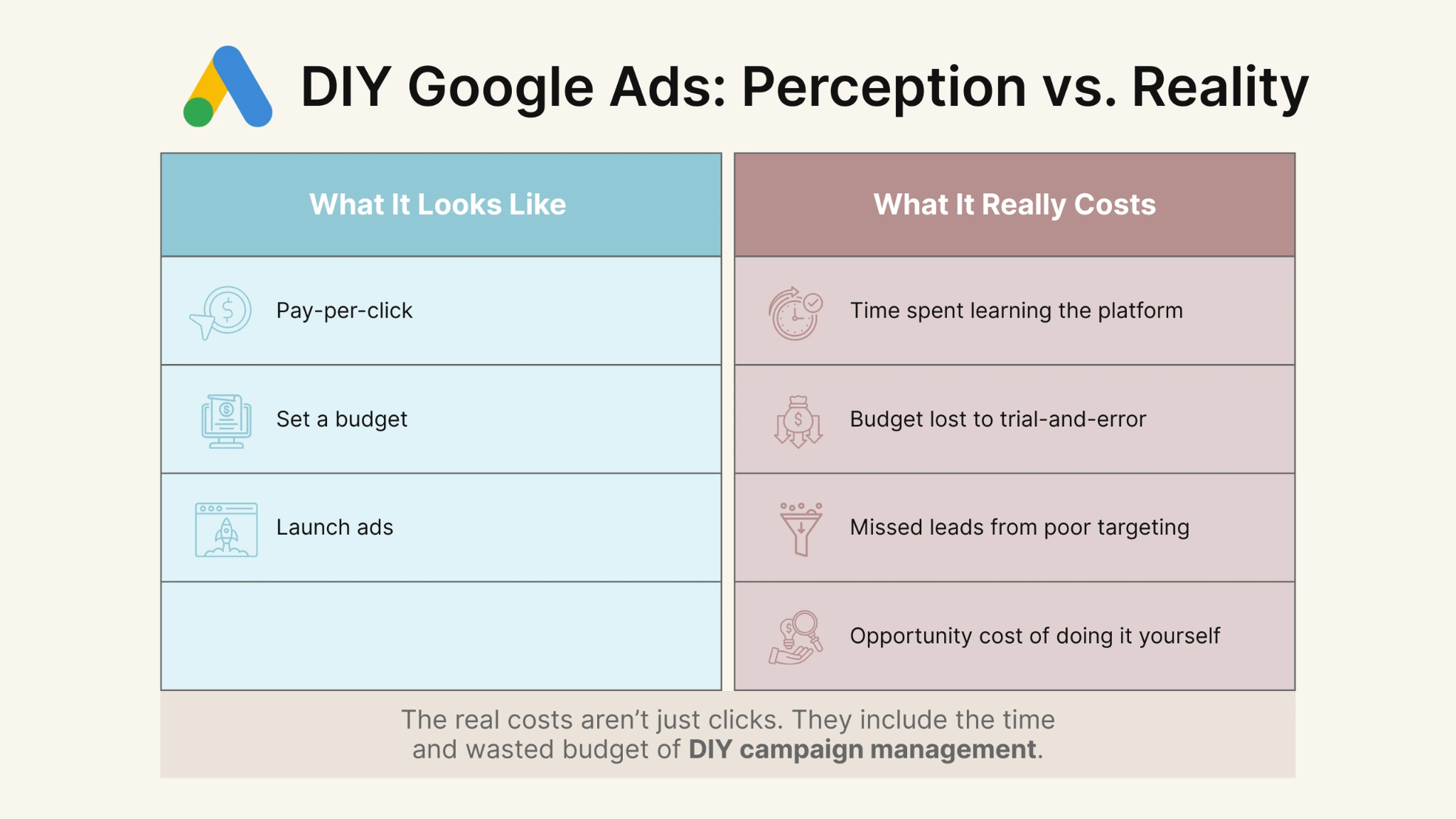
Image Source: CACPro
An experienced Google Ads manager looks at an account that has been self-managed for six months and almost always finds the same pattern: a handful of well-performing terms buried under a much larger volume of irrelevant traffic that has been silently draining the budget throughout.
The time dimension compounds this further. Business owners who manage their own campaigns rarely have the hours required to monitor performance daily, review search term reports weekly, test new ad copy consistently, and stay current with Google's frequent platform updates. The account gets checked occasionally rather than managed actively, and the gap between what it is delivering and what it could deliver widens quietly in the background.
Agencies facing this same challenge often turn to scalable support solutions rather than trying to manage every account internally. Platforms like DashClicks operate as a Google Ads outsourcing agency, allowing agencies to deliver expert-level campaign optimization without needing a full in-house PPC team. This approach ensures accounts are structured and monitored by specialists while agencies maintain control of client relationships and reporting.
Google's Incentives Are Not Aligned With Yours
This is one of the most important things to understand about managing your own Google Ads, and one that the platform understandably does not draw attention to.
Google's business model is built on advertising revenue. The more advertisers spend, the more Google earns. This creates a structural misalignment between what Google's default settings and automated recommendations are optimised for and what is actually in your best interest as an advertiser.
Smart Campaigns, broad match keywords, automated bidding strategies set to maximise clicks rather than conversions, and default campaign settings that expand your targeting far beyond your intended audience are all features that tend to increase spend. They are marketed as convenience, and they genuinely are convenient. But convenience and efficiency are not the same thing.
When Google suggests expanding your keyword list, enabling additional audience targeting, or increasing your budget to capture more opportunity, those suggestions are made by an algorithm that benefits from you spending more. A human expert working on your behalf has a different incentive structure. Their job is to get you the best possible return on what you are already spending, not to increase the amount you spend.
The Recommendations tab in Google Ads is a particularly instructive example. Many of the suggestions it surfaces are genuinely useful. But a significant portion exist primarily to increase spend, broaden targeting, or hand more control to Google's automation in ways that do not always serve the advertiser's best interests. Knowing which recommendations to accept and which to ignore is a skill that takes time and experience to develop.
Understanding this dynamic does not mean Google Ads is a bad investment. It means that navigating it effectively requires someone whose interests are aligned with your outcomes rather than your ad spend volume.
Match Types, Negative Keywords, and the Invisible Budget Drain
Keyword match types are one of the most technically important and least understood aspects of Google Ads management. They determine the range of search queries your ads are eligible to appear for, and getting them wrong is one of the most common and expensive mistakes in DIY campaign management.
Broad match keywords, which are the default in most campaign setups, allow your ads to appear for searches that Google considers related to your keyword. In practice, this can mean your ad for a plumbing business appears for searches about DIY pipe repair tutorials, plumbing certifications, or plumbing careers. These clicks cost money and generate no business value whatsoever.
Phrase match and exact match keywords give advertisers significantly more control over which searches trigger their ads. But they require a deeper understanding of search intent, keyword research methodology, and campaign architecture to implement effectively. Most DIY advertisers default to broad match because the interface presents it as the simplest option, not because it is the most effective one.
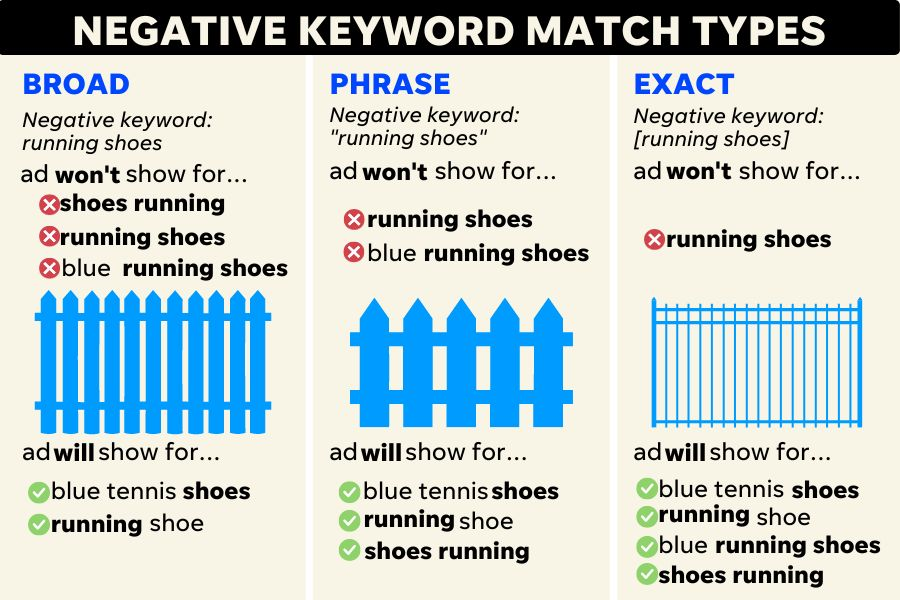
Image Source: LocaliQ
Negative keywords are the mechanism for filtering out irrelevant searches. A properly managed Google Ads account includes an extensive negative keyword list built and refined over time based on actual search term data. Building that list is a skilled, ongoing process that most DIY advertisers never implement properly because they do not know to look for the problem.
The impact is direct and measurable. Campaigns with strong negative keyword management consistently show higher click-through rates, better quality scores, lower average cost-per-click, and higher conversion rates than campaigns running on broad match terms without adequate filtering. Every one of those improvements translates directly into better return on your ad spend.
Quality Score: The Hidden Multiplier That Changes Everything
Google Ads operates as an auction, but it is not purely a highest-bidder-wins system. Quality Score is a metric Google assigns to your keywords based on the relevance of your ads, the expected click-through rate, and the quality of your landing page experience.
Quality Score acts as a multiplier in the auction. A high Quality Score means you can win more auctions at lower bids, reducing your cost-per-click and increasing your ad's average position. A low Quality Score means you pay more for every click and still lose auctions to competitors with better scores even if you are bidding higher in absolute terms.
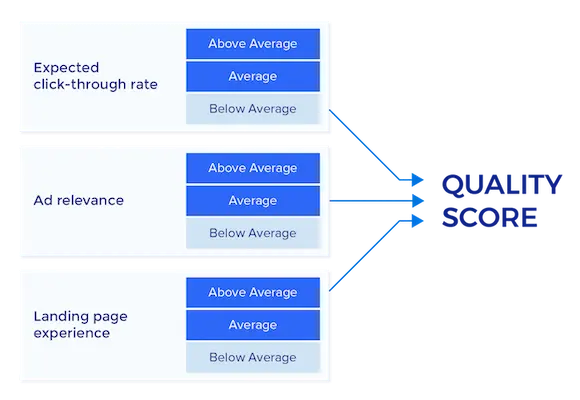
Image Source: Instapage
Most DIY campaigns operate with suboptimal Quality Scores because improving them requires a combination of skills that are rarely found in a business owner who is also running their actual business. Writing high-relevance ad copy, structuring tightly themed ad groups, aligning landing page content with keyword intent, and continuously testing and improving all three components simultaneously is the work of a specialist.
The financial impact compounds over time. A campaign improving its average Quality Score from four to seven across its keyword set can achieve the same results for significantly less spend, or substantially better results for the same spend. That is not a marginal efficiency gain. It is a structural improvement that pays dividends every single day the campaign runs.
Conversion Tracking: You Cannot Optimise What You Do Not Measure
One of the most fundamental requirements for running Google Ads effectively is knowing which clicks are actually turning into customers. Conversion tracking, properly implemented, connects your ad spend to your business outcomes and gives Google's algorithm the data it needs to optimise your campaigns toward the results you actually want.
Many DIY advertisers either have no conversion tracking set up, or have it set up incorrectly. Without accurate conversion data, every optimisation decision in the account is essentially guesswork. You cannot identify which keywords are driving real customers versus which ones are just driving expensive dead-end clicks. You cannot evaluate whether your bidding strategy is working. You cannot make the data-driven decisions that separate effective campaigns from wasteful ones.
Setting up conversion tracking correctly requires technical implementation across your website, your Google Analytics account, and Google Ads. For businesses with forms, phone calls, e-commerce transactions, and multiple conversion points, getting this right is a meaningful technical undertaking. Getting it wrong means making decisions based on data that is incomplete, misleading, or both.

Image Source: AdEspresso
A common DIY mistake is tracking the wrong events as conversions. Page views, button clicks, and time-on-site metrics are not conversions. Actual business outcomes, completed contact forms, confirmed purchases, phone calls of meaningful duration, are what matter. When the wrong signals are fed into Google's bidding algorithms, the system optimises toward the wrong behaviour, spending more budget on activity that looks good in the dashboard but does not translate into revenue.
For agencies managing multiple client campaigns, implementing and maintaining accurate conversion tracking across websites, forms, phone calls, and e-commerce platforms can quickly become resource-intensive. Many agencies address this challenge by partnering with providers like DashClicks, whose white label Google Ads management services include campaign setup, conversion tracking implementation, and ongoing optimization delivered behind the agency’s brand.
Further Reading: 15 Ways to Improve Conversion Rates in Google Ads
When to Stop DIYing and Bring in a Specialist?
Recognising the point at which self-management is costing more than it is saving is one of the most valuable decisions a business owner can make about their Google Ads account.
For most businesses, that point arrives earlier than expected. The time cost of managing campaigns, learning the platform, and trying to troubleshoot underperformance is significant. The opportunity cost of that time, spent away from running and growing the actual business, has a real value that rarely gets factored into the DIY calculation.
The monetary cost of suboptimal performance, compounding week after week in an account that is running but not really working, adds up quickly as well. Paying a management fee to a specialist while operating a well-built, efficiently managed campaign almost always produces better financial outcomes than paying no management fee while running a mediocre campaign.
Partnering with a Google Ads Agency First Page gives businesses the combination of technical expertise, strategic campaign management, and accountable performance improvement that DIY campaigns cannot replicate, regardless of how much time and effort the business owner invests. Experienced campaign managers bring the skills to build properly structured accounts, identify and fix performance issues systematically, and drive continuous improvement over time.
They also bring cross-account experience that is impossible to replicate from a single account. A specialist who manages dozens of accounts across multiple industries has seen performance patterns, tested solutions, and accumulated data that informs better decisions than any individual account's history could provide.
The Compounding Cost of Suboptimal Campaign Structure
Google Ads campaign structure is the architecture that determines how well the platform can understand, serve, and optimise your advertising. A well-structured account with tightly themed ad groups, highly relevant ad copy, aligned landing pages, and properly configured bidding strategies gives Google everything it needs to perform well on your behalf.
A poorly structured account, which is what most DIY campaigns produce not through fault but through lack of specialist knowledge, fights the algorithm at every turn. Ad groups that are too broad mean Google cannot determine which ad is most relevant for which query. Mismatched landing pages mean users who click through do not find what they expected. Bidding strategies applied without adequate conversion data produce erratic results that deteriorate over time.
The cost of poor structure is not always visible in a single month's performance. It manifests over time as a campaign that consistently underperforms its potential, that requires constant reactive adjustment rather than systematic improvement, and that never achieves the efficiency that a well-built account with the same budget could deliver.
Account structure also affects how well Google's machine learning systems can work in your favour. Smart bidding algorithms, responsive search ads, and Performance Max campaigns all perform better when they are built on a foundation of clean structure, accurate conversion data, and well-defined audience signals. Without that foundation, automation amplifies inefficiency rather than improving performance.
Landing Pages: The Part of the Equation Most Advertisers Ignore
Google Ads management does not end when someone clicks your ad. What happens after the click determines whether that ad spend actually generates a return.
Landing page quality is one of the three pillars of Quality Score, which means it directly affects your cost-per-click and ad position. But its commercial significance goes well beyond that. A landing page that fails to convert interested visitors into leads or customers wastes every dollar spent getting those visitors there in the first place.
Most DIY advertisers send all their paid traffic to their homepage or a generic services page. This is one of the most consistent and damaging mistakes in the entire DIY Google Ads playbook. A visitor who clicked an ad for a specific product or service lands on a page that talks about everything the business does, cannot find what they were looking for immediately, and leaves without converting.
Purpose-built landing pages that mirror the specific intent of the search query, deliver the exact information the visitor was looking for, and present a clear and compelling call to action consistently convert at dramatically higher rates than generic pages. The improvement in conversion rate means every click generates more revenue, which changes the entire economics of the campaign.

Image Source: KlientBoost
Building and testing landing pages is a skill in its own right, one that combines copywriting, user experience design, and conversion rate optimisation. It is part of what a specialist brings to paid search management that a business owner managing their own account rarely has the time or expertise to implement properly.
Further Reading: Smart Strategies to Slash Your CPC With Landing Page Optimization
What a Well-Managed Google Ads Account Actually Looks Like?
Understanding what good looks like makes it easier to evaluate the gap between where your current campaigns are and where they could be.
A well-managed account has complete and accurate conversion tracking across every meaningful customer action. It has a tightly structured campaign and ad group architecture that aligns search intent with ad messaging and landing page content. It has an extensive and regularly updated negative keyword list that filters irrelevant traffic systematically. It has ad copy that is continuously being tested and improved based on actual performance data.
It has a bidding strategy that is appropriate for the account's conversion volume and stage of development. It has regular search term audits that identify new negative keyword opportunities and surface new high-value keyword targets. It has landing pages that are evaluated and improved based on conversion rate data rather than assumptions.
It has audience layering that uses remarketing lists, customer match, and similar audiences to adjust bids for users who are more likely to convert based on prior behaviour. It has ad scheduling informed by conversion data showing when the target audience is most likely to be in buying mode. And it has a reporting framework that connects campaign metrics to actual business outcomes in a way that drives decisions rather than simply describing activity.
Most DIY accounts have none of these in place comprehensively. Not because the business owners are not capable, but because building and maintaining all of them simultaneously is a full-time specialist skill set, not a part-time management task.
Delivering this level of account management consistently across multiple clients can be difficult for agencies without a dedicated PPC team. Many agencies address this gap by partnering with a white label Google Ads agency like DashClicks, which provides behind-the-scenes campaign management from experienced specialists. This allows agencies to offer advanced Google Ads services, including campaign structuring, keyword optimization, and ongoing performance monitoring, without expanding their internal team.
The Honest Calculation
The honest financial calculation of DIY Google Ads management is rarely as favourable as it appears when approached with full transparency.
On one side of the ledger, you save the management fee you would pay a specialist. On the other side, you account for the time cost of managing the account yourself, the opportunity cost of that time away from your core business activities, the monetary cost of the performance gap between a DIY campaign and a professionally managed one, and the compounding effect of that gap operating unaddressed month after month.
For most businesses spending meaningful amounts on Google Ads, the performance gap alone exceeds the management fee. A well-managed campaign that improves cost-per-conversion by thirty percent on the same budget is effectively returning the management fee and then some, before even accounting for the time savings and the business owner's reclaimed focus.
The businesses that recognise this earliest and act on it most decisively are the ones that extract the most value from their advertising investment. Google Ads is one of the most powerful and scalable customer acquisition tools available to businesses of any size. In competitive markets, it can be the difference between a business that grows predictably and one that struggles to generate consistent pipeline.
But like any powerful tool, it produces the best results in the hands of people who know how to use it. The platform is not neutral. It rewards expertise with lower costs, better visibility, and higher conversion rates. It penalises inexperience with wasted spend, poor placements, and campaigns that look active on paper while quietly underperforming their potential every single day.
Knowing that, the question is no longer whether DIY Google Ads management costs your business money. The question is how much longer you want it to.


.svg)


.svg)
.svg)
.svg)
.svg)
.svg)