

.svg)

.svg)
.svg)
.svg)
.svg)
.svg)
Search engine optimization was once a straightforward practice of creating good content and building authoritative links. Agencies could reliably rank client websites by focusing on keyword density and on-page metadata. That reality has shifted dramatically. While content and links remain foundational, technical page experience has become a critical barrier to entry for top search rankings. Agencies know exactly what needs to be fixed to improve website performance, yet they consistently fail to implement those changes.
The problem is no longer a lack of knowledge or diagnostic capability. Agency teams are highly proficient at running SEO audit, generating reports, and handing over lists of technical errors to their clients. The actual breakdown happens right after the audit is delivered. Recommendations sit in project management queues for months, waiting for development teams to prioritize them. This creates a massive execution gap that prevents client websites from achieving meaningful growth.
This execution gap is the real bottleneck in modern SEO delivery. Agencies are built to strategize and consult, not necessarily to execute deep technical website optimizations at scale. When a client site suffers from slow load times or poor interactivity, the agency often lacks the internal infrastructure to deploy the necessary code-level fixes.
Understanding how we arrived at this point requires looking at the fundamental shift in how search engines evaluate websites. The evolution of page experience has forced a realignment of what it takes to rank, moving the finish line far beyond the traditional capabilities of a standard marketing agency.
Page Experience Has Evolved Beyond Traditional SEO Control
The criteria for ranking a website have expanded significantly over the last few years to prioritize user experience and technical performance. This transition forces agencies to look beyond basic on-page elements and understand how a website actually renders in the browser.
Traditional SEO workflows were built around content management systems where marketers could easily change text, update meta tags, and add internal links. Those workflows completely fail when the optimization requires altering server configurations, minifying JavaScript, or restructuring the Document Object Model. Google explicitly made Core Web Vitals a ranking factor to evaluate how users experience the speed, responsiveness, and visual stability of a page.
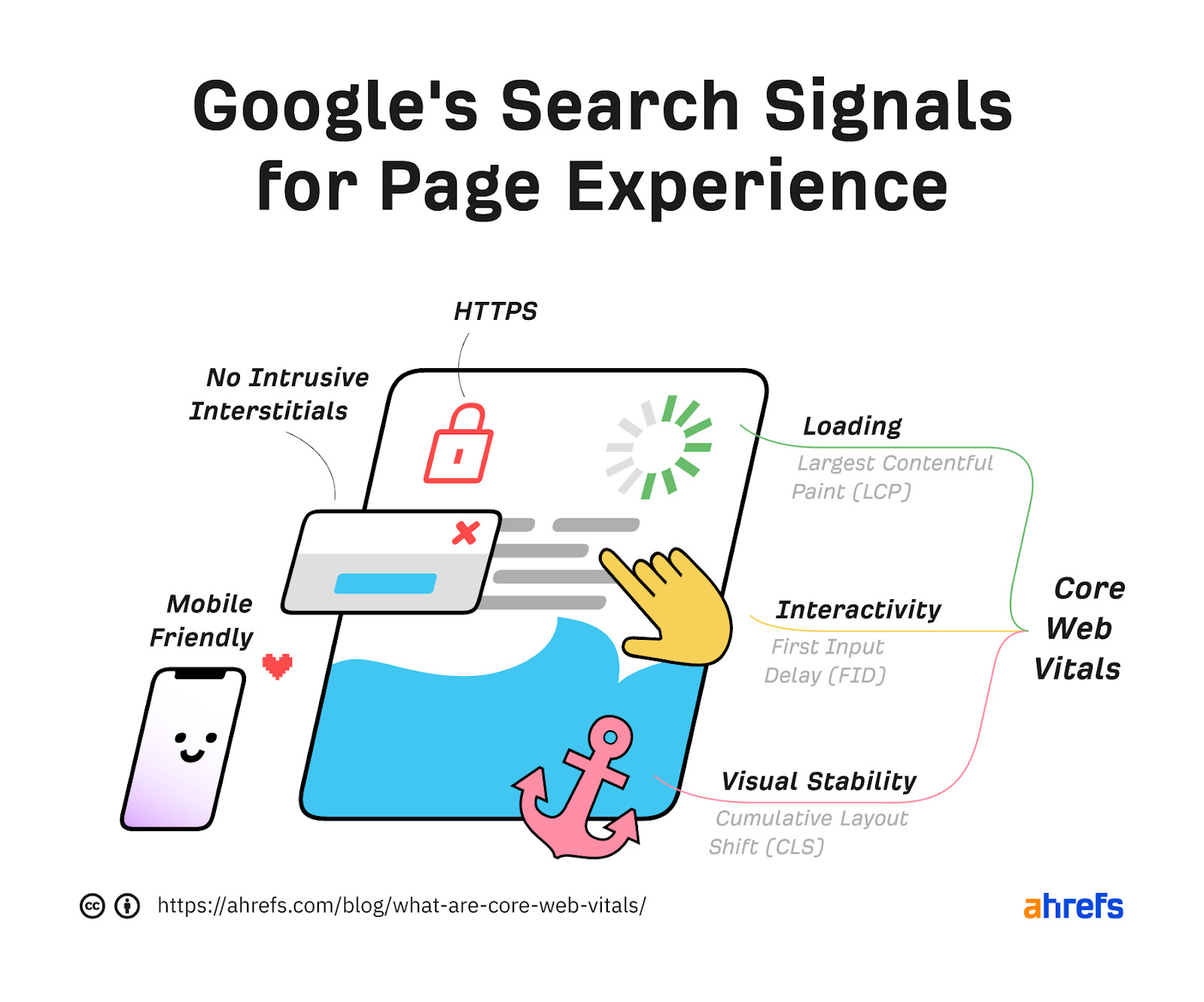
Image Source: Ahrefs
This means that technical execution is no longer optional. It is a mandatory component of organic search visibility. The overlap between SEO, web development, and user experience design has become so tightly knit that treating them as separate disciplines leads to poor campaign performance.
When execution fails, the business impact is immediate and severe. Users have very little patience for poor technical performance. Data shows that 53% of mobile users will abandon a site entirely if the load time exceeds three seconds. Furthermore, even a 100-millisecond delay in website load time can directly hurt conversion rates. Agencies cannot afford to ignore these metrics, yet their traditional operating models are not equipped to handle them. This inability to deliver is a structural issue within the agency model, not just a technical oversight.
The Structural Gaps Inside Agencies That Block Page Experience Improvements
Most marketing agencies operate with workflows designed for creative output and campaign management, which naturally creates friction when technical interventions are required. These structural gaps prevent meaningful improvements to client websites.
1. SEO - Development Disconnect
The relationship between the SEO department and the web development team is often the largest point of friction. SEO specialists identify performance issues and submit tickets to developers, but those tickets rarely get prioritized. Developers are usually focused on building new features, launching new websites, or fixing critical security bugs. Page speed optimizations are viewed as low-priority maintenance tasks, causing essential technical fixes to be delayed by weeks or even months.
2. “Recommendation-Only” SEO Model
Many agencies operate on a consultative model where their primary deliverable is an audit. They use advanced crawling tools to identify every layout shift or slow-loading resource, compile this data into a presentation, and hand it to the client. The gap between auditing a site and actually fixing the code is vast. Clients rarely have the internal technical resources to implement these complex recommendations, leaving the audit to collect dust while the website's performance remains stagnant.
3. Resource Dilution Across Accounts
Agency teams are frequently stretched thin across dozens of client accounts. A single technical SEO specialist might be responsible for monitoring the health of forty different websites. This level of resource dilution means the specialist can only perform shallow execution. They have enough time to check for broken links and missing alt text, but they do not have the bandwidth to rebuild the CSS delivery path for a bloated e-commerce site.
4. Inconsistent Ownership of Performance Metrics
When a website suffers from a poor Largest Contentful Paint or a failing Interaction to Next Paint score, it is rarely clear who is actually responsible for fixing it. The SEO team blames the development team for writing heavy code. The development team blames the design team for using oversized image assets. The design team blames the SEO team for adding too many third-party tracking scripts. This inconsistent ownership means that page experience metrics are observed but never actively managed or improved.
5. Tool Dependency Without Execution Layers
Agencies spend thousands of dollars every month on enterprise-level software that crawls websites and flags performance errors. These tools are fantastic for diagnosing problems, but they do not write code. An agency can have the most expensive diagnostic software in the world, but if they lack the personnel to execute the fixes, the tools only serve to highlight their operational failures. The core issue is a complete lack of execution ownership at the agency level.
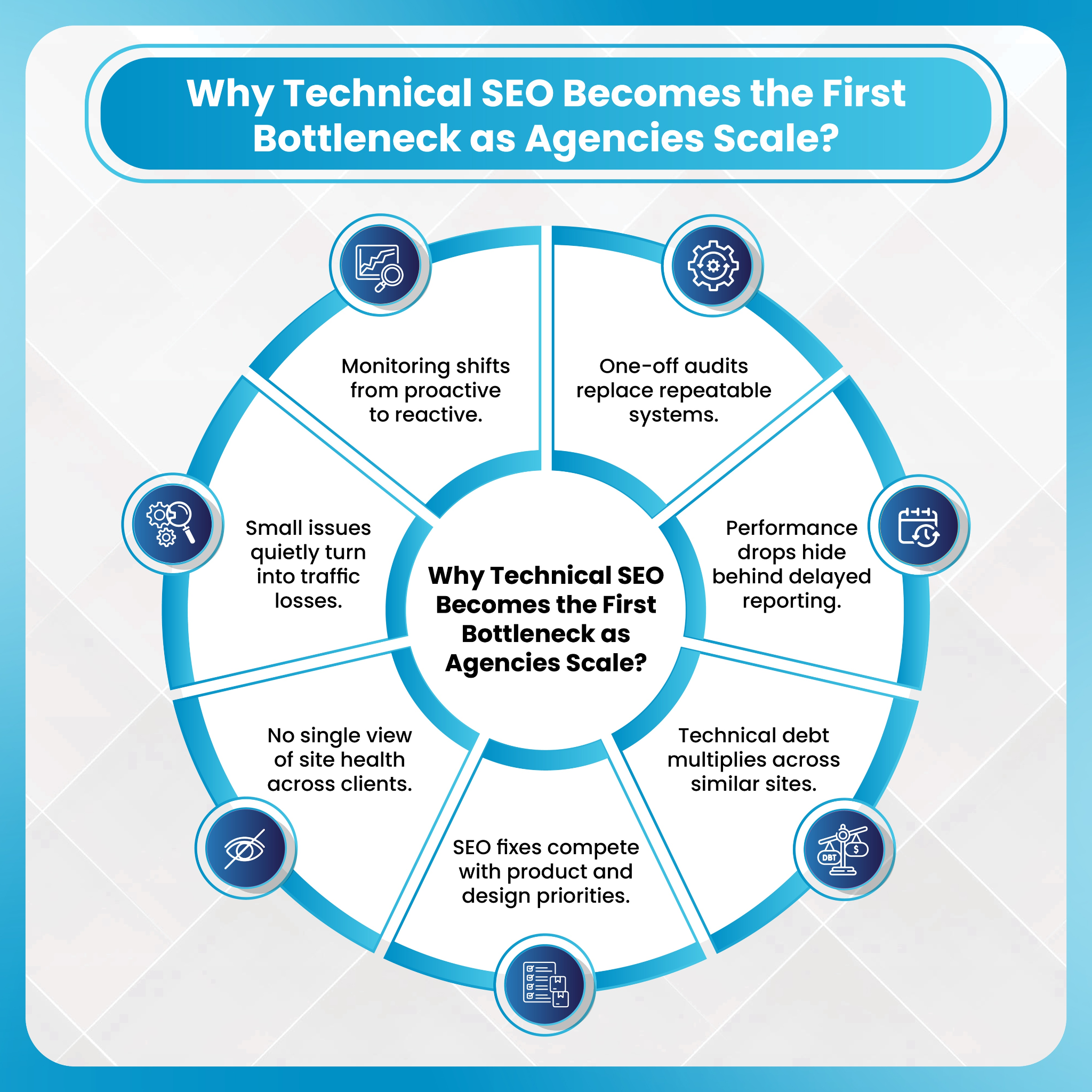
How Page Experience Issues Compound (And Why Agencies Fall Behind)
Website performance does not remain static. Without active and continuous technical intervention, page experience issues stack on top of each other until the website becomes entirely uncompetitive in search results.
1. The “Stacking Effect” of Performance Issues
A single unoptimized image or a single render-blocking script might not destroy a website's rankings on its own. However, these small issues stack together rapidly. A client uploads a massive hero video, the marketing team adds three new tracking pixels, and a plugin updates to include a new JavaScript library. Suddenly, a site that was performing adequately becomes painfully slow, and the compounding weight of these elements drags down every Core Web Vital metric simultaneously.
2. Delayed Fixes = Lost Data Momentum
Because agencies struggle to get technical tickets prioritized, the delay in execution hides the actual impact of the SEO strategy. If it takes six months to implement a caching solution and optimize the critical rendering path, the agency loses six months of potential organic growth. By the time the fixes are finally pushed live, the competitive landscape has already shifted, and the client is left wondering why their traffic has not increased.
3. Template & CMS Limitations
Many agencies build client websites using heavy page builders and bloated WordPress themes to save on development costs. These templates are notoriously bad for page experience. They load massive amounts of unused CSS and JavaScript on every single page. When the SEO team tries to optimize the site, they find themselves fighting against the fundamental architecture of the CMS, constrained by visual builders that prioritize ease of use over technical performance.
4. Continuous Degradation Performance
Websites naturally degrade over time. Marketing departments constantly add new tools, chat widgets, pop-ups, and analytics scripts. Each addition adds weight to the browser's processing load. Without a dedicated system to monitor and prune these additions, a website that passed all performance checks at launch will inevitably fail them a year later. Page experience is a living system that requires constant calibration, not a one-time launch task.
How White Label SEO Introduces an Execution Layer Agencies Lack?
To bridge the gap between knowing what to do and actually doing it, agencies need a dedicated technical partner. White label SEO management provides the exact execution layer that creative and marketing-focused agencies are missing.
1. From Recommendations to Implementation Pipelines
The most significant shift when partnering with a white label provider is moving from a recommendation model to an implementation model. Instead of handing the client a list of problems they do not understand, the agency can simply deploy fixes. The white label team accesses the backend of the website, refactors the code, optimizes the server delivery, and resolves the issues directly. This eliminates the client-side development bottleneck entirely.
2. Dedicated Technical Workflows for Performance
The best white label SEO services operate with highly specialized, repeatable systems. They have dedicated technical teams whose only job is to improve website performance. Because they are not distracted by building new features or running ad campaigns, they can process complex optimization tickets efficiently. This allows them to execute deep technical fixes in days rather than the months it typically takes an in-house agency developer.
3. Parallel Optimization Across Clients
A major challenge for agencies is scaling their operations. If an agency lands five new enterprise clients in one month, their internal technical resources will immediately bottleneck. A white label SEO agency solves this scalability problem by offering parallel optimization. They have the infrastructure to deploy technical audits, image compressions, and code minification across dozens of client accounts simultaneously, ensuring no client is left waiting in a queue.
4. Continuous Monitoring + Iteration
Because page experience degrades over time, it requires ongoing attention. White label partners implement continuous monitoring cycles. They track how new content additions or plugin updates impact the site's performance and deploy corrective measures proactively. This operational discipline ensures that the website remains fast and stable long after the initial round of optimizations is complete.

What Page Experience Optimization Looks Like in Practice?
Understanding the value of an execution layer requires looking at the actual work being performed. Technical SEO involves big, structural changes to how a web server communicates with a user's browser.
1. Fixing Largest Contentful Paint (LCP)
LCP measures how long it takes for the largest element on the screen to render. Fixing this requires optimizing the server response times, usually by implementing advanced caching policies or routing traffic through a Content Delivery Network. It also requires precise image handling, such as converting legacy image formats into Next-Gen formats like WebP, and forcing the browser to preload the specific hero image so it renders immediately upon request.
2. Reducing Cumulative Layout Shift (CLS)
CLS measures visual stability. A high CLS score happens when elements jump around the screen as the page loads, which is incredibly frustrating for users. White label SEO teams fix this by defining explicit width and height attributes for all media elements, ensuring the browser reserves the correct amount of space before the image even loads. They also optimize web font delivery to prevent text from shifting as custom fonts replace system fonts.
3. Improving Interaction to Next Paint (INP)
INP measures the website's responsiveness to user input, such as clicking a button or opening a menu. Poor INP is almost always caused by heavy JavaScript execution blocking the main thread. Optimizing this involves breaking up long tasks in the JavaScript code, deferring non-critical scripts until after the page has fully loaded, and removing unused code entirely to free up the browser's processing power.
4. Mobile-First Performance Tuning
Because Google uses mobile-first indexing, performance optimizations must be prioritized for mobile devices on slower cellular networks. This involves device-based optimization strategies, such as serving scaled-down image sizes exclusively to mobile users and restructuring the CSS so that the mobile layout renders before the desktop layout rules are even processed.
Consider a practical timeline. An in-house agency might take three weeks to audit these metrics and another three months to convince the client's webmaster to implement the changes. A dedicated white label SEO team can identify the render-blocking scripts on Monday, refactor the CSS delivery on Tuesday, implement dynamic image scaling by Wednesday, and show the client a passing Core Web Vitals score by Friday.
The Business Impact – From Technical Fixes to Measurable Growth
Technical optimizations are not just vanity metrics for developers. They have a direct, measurable impact on a client's bottom line and the agency's overall profitability.
1. Faster Sites → Higher Conversion Efficiency
Every fraction of a second matters in digital commerce. By aggressively reducing load times and eliminating layout shifts, agencies remove friction from the user journey. When users can navigate a product catalog instantly without the page freezing due to heavy JavaScript, they are significantly more likely to complete a purchase or fill out a lead generation form.
2. Improved Core Web Vitals → Stronger Ranking Stability
Google rewards websites that provide exceptional user experiences. When a white label team stabilizes a client's Core Web Vitals, the website benefits from a highly stable foundation in the search engine results pages. As competitors ignore their technical debt and slowly drop in rankings, the optimized client site naturally rises to capture that lost organic market share.
3. Performance as a Differentiator in Client Retention
Clients cancel agency contracts when they stop seeing tangible outcomes. If a client is paying for SEO but their website feels sluggish and unresponsive, they will lose trust in the agency's capabilities. Delivering a lightning-fast website provides an immediate, visceral proof of value. When the client navigates their own site and feels the performance upgrade, client retention improves drastically.
4. Ability to Scale Without Increasing Headcount
Building an in-house team capable of executing these deep technical fixes is incredibly expensive. It requires hiring senior developers, technical SEO managers, and quality assurance testers. Leveraging white label SEO services allows an agency to add this exact capability to their service offering without taking on a single dollar of additional payroll overhead. Performance becomes a massive revenue lever that can be scaled up or down based on client demand.
How DashClicks' White Label SEO Services Support Page Experience Optimization
Agencies looking to close their execution gap need a partner that understands the intersection of digital marketing and deep technical performance. DashClicks’ white label SEO services provide an infrastructure specifically designed to solve these operational bottlenecks.
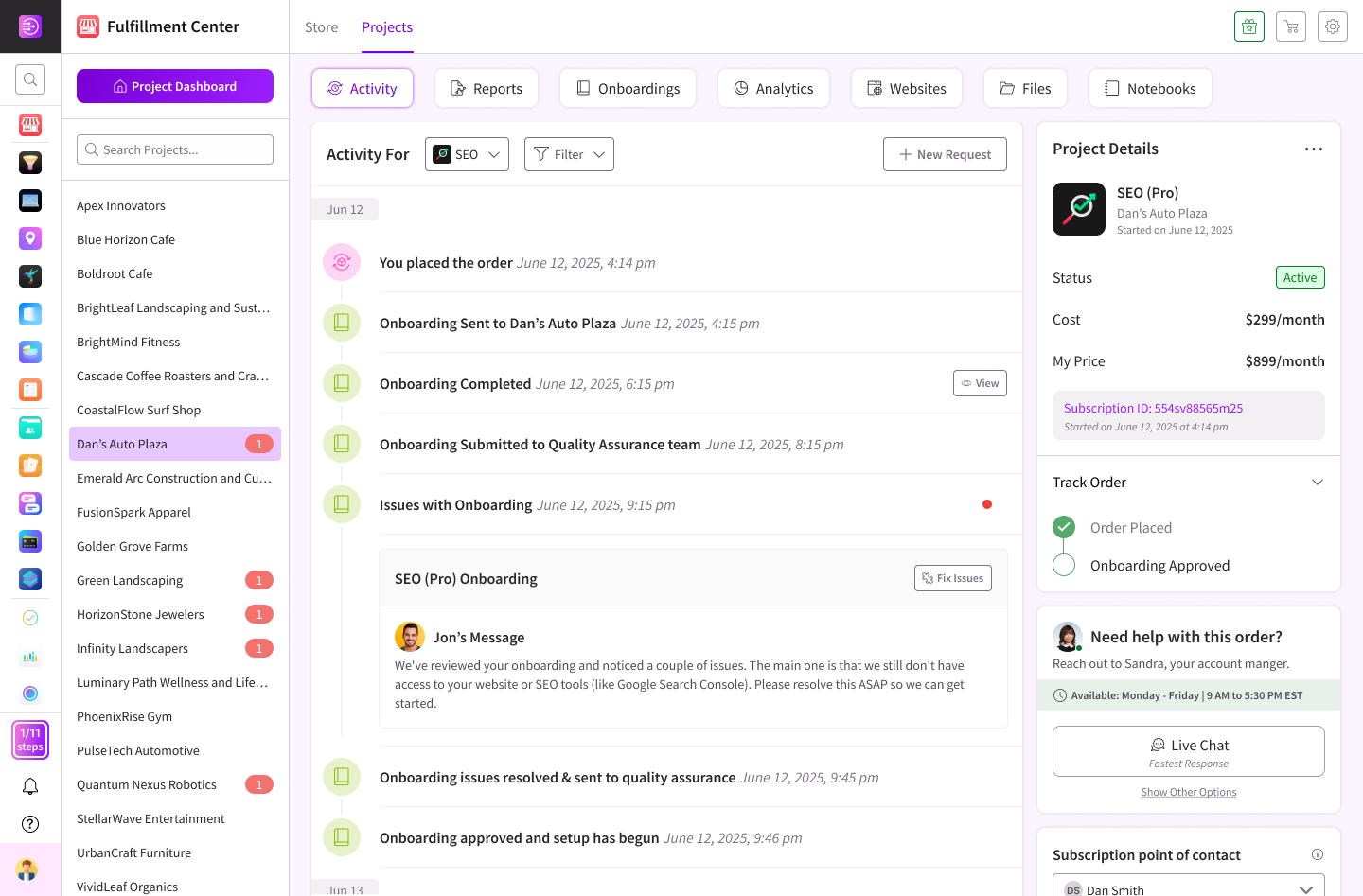
The system is built around dedicated technical execution workflows. Instead of merely auditing a client's website, the platform's fulfillment teams handle the actual implementation of page speed optimization systems. This includes the heavy lifting of code minification, server-level caching setups, and image compression protocols required to pass Google's strict performance assessments.
Furthermore, DashClicks focuses on continuous monitoring to ensure that websites do not suffer from performance degradation over time. Because the reporting is entirely white labeled, the agency gets to take full credit for the improvements in site speed, user experience, and keyword rankings. This scalable delivery model allows agencies of any size to offer enterprise-grade technical SEO without needing to hire an internal development team.
Closing the Execution Gap is the Real Competitive Advantage
Agencies do not fail at technical SEO because they lack intelligence or access to diagnostic tools. They fail because they have a massive execution gap that prevents them from turning audit recommendations into deployed code. Page experience optimization is not a one-time project. It requires continuous effort, specialized workflows, and deep technical ownership.
By leveraging white label SEO management, agencies can bypass their internal bottlenecks and immediately deploy the technical layer required to win in modern search. Fixing the execution gap is no longer just a way to improve a few metrics. It is the ultimate competitive advantage in an industry where most agencies are still just handing over PDF reports and waiting for someone else to do the work.



.svg)


.svg)
.svg)
.svg)
.svg)
.svg)