

.svg)

.svg)
.svg)
.svg)
.svg)
.svg)
The SEO strategy an agency builds during onboarding reflects the client's business at a specific point in time. Six months later, that business may look quite different.
A client launches a new service and wants it to drive the majority of new leads. Another expands into a second city and needs local search visibility there. A third shifts its focus from building brand awareness to generating qualified conversions. A fourth pauses a service that previously accounted for a significant portion of targeted keywords.
These changes are a normal part of running a business. The challenge for agencies is not recognizing that the strategy needs to change. The challenge is executing those changes across multiple accounts without destabilizing ongoing SEO work.
According to an Ahrefs survey of 3,680 respondents, SEO typically takes 3 to 6 months to show meaningful results. That timeline makes strategic pivots more complicated. Abandoning a campaign before existing work has had time to produce results can erase progress that took months to build. Agencies need fulfillment that can adapt to shifting client priorities while protecting the foundational work that supports long-term organic growth.
Why Changing Business Priorities Require SEO Strategy Changes
SEO should support the client's current business objectives, not continue following a keyword list established during client onboarding. When a client's priorities shift, the SEO strategy needs to follow.
1. New Services Become Revenue Priorities
Not every SEO task supporting a new service needs to happen at once. Agencies can prioritize activities based on their importance and complexity, addressing quick opportunities first while scheduling more involved work as part of the longer-term SEO strategy.
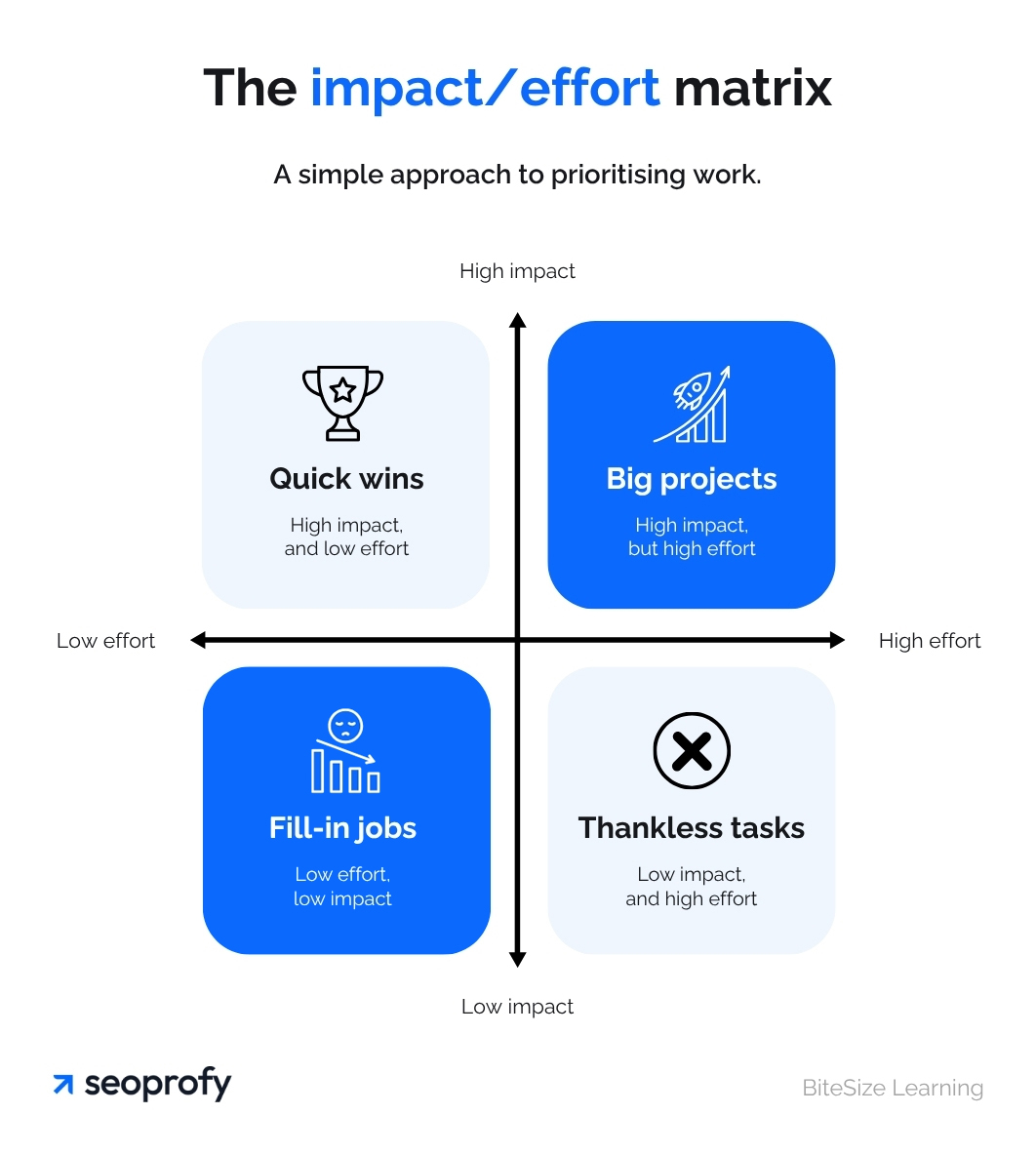
Image Source: SeoProfy
When a client adds a major new service, the SEO work supporting it typically needs to be built from the ground up. This includes:
- New Service Pages: A new service often requires its own optimized landing page with a clear focus on the relevant search intent, rather than a brief mention on an existing page.
- Keyword Research: The keyword targeting should reflect how potential customers actually search for the new service, including commercial and informational queries.
- Supporting Content: Informational content can build topical relevance around the new service and support the commercial landing page within the site's content structure.
- Internal Linking: Internal links from relevant existing pages can direct both users and search engines toward the newly prioritized service page.
- Authority Building: Relevant authority-building efforts may need to shift toward supporting the new priority rather than continuing to reinforce older, lower-priority pages.
2. Clients Expand Into New Markets
Geographic expansion requires more than adding a city name to existing pages. Agencies typically need to address:
- Location-specific landing pages that reflect local search intent.
- Local keyword targeting focused on the new market.
- Google Business Profile priorities aligned with the new location.
- Local citations to establish consistent business information in the new area.
- Location-specific content that serves both users and search engines in that market.
Simply duplicating existing pages with a different city name creates thin content and can work against the agency's SEO efforts rather than supporting them.
3. Business Goals Shift From Traffic to Leads
An increase in organic traffic is not always what a client needs most. When the goal shifts toward lead generation, agencies may need to:
- Reassess the balance between informational and commercial keyword targeting.
- Improve high-intent landing pages to better align with conversion goals.
- Align the SEO strategy with the client's existing conversion paths.
- Evaluate organic conversions alongside traffic data rather than treating traffic as the primary success metric.
4. Seasonal Changes Alter Priorities
External factors can shift SEO priorities even when the client's broader business strategy has not changed. Key scenarios include:
- Seasonal demand: A service with high seasonal demand may temporarily become the highest-priority target, requiring a temporary shift in content and optimization resources.
- Competitor activity: A new or stronger competitor may require strategy adjustments to protect existing rankings or capture new opportunities.
- Market changes: Shifts in customer demand can influence which keywords and topics deserve the most attention at a given time.
- New search opportunities: Emerging search demand around a relevant topic may justify reallocating existing resources toward capturing that opportunity.
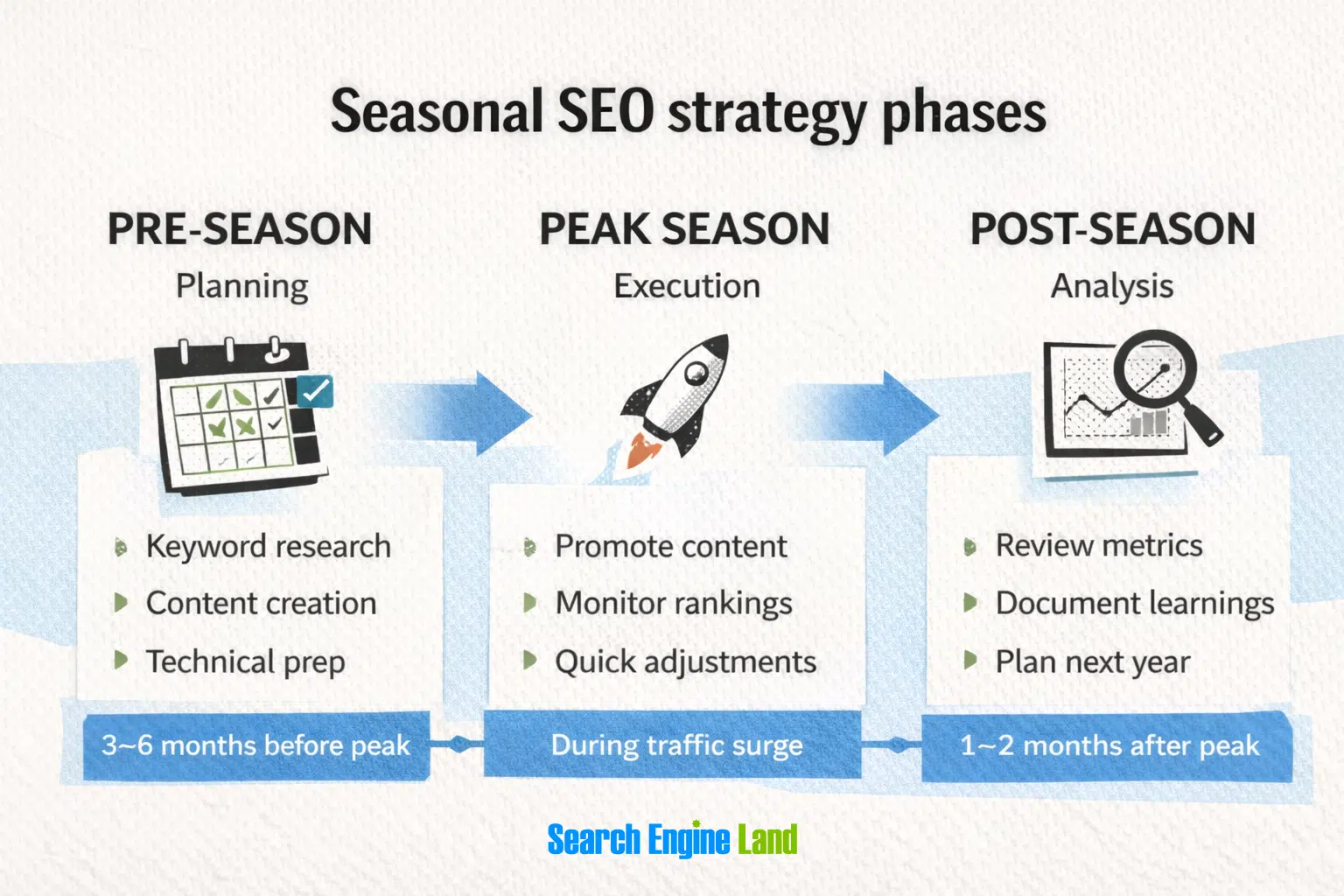
Image Source: Search Engine Land
SEO should remain strategically connected to what the client needs to achieve now, while still protecting work that supports long-term organic growth. Google recommends reviewing and updating content as business needs evolve, and notes that SEO changes can take weeks or months to produce visible results.
The SEO Areas Agencies May Need to Reprioritize
A change in business priorities does not necessarily mean starting the entire SEO campaign again. In most cases, agencies can build on existing work while redirecting effort toward the new priority.
1. Keyword Targeting
- Remove or deprioritize low-value targets: Keywords that no longer support the client's current goals should be moved down the priority list rather than continuing to consume content and optimization resources.
- Add new priorities: New services, locations, or commercial opportunities require fresh keyword research to identify the right targets.
- Identify gaps: Agencies can find missing keyword opportunities around the client's new priority by reviewing what the site does not currently rank for.
2. Existing Content
Existing content should be evaluated in light of the new priority before any new content is created. This means:
- Refreshing pages that partially support the new priority but are not yet fully optimized.
- Expanding content around newly important topics where the existing coverage is thin.
- Consolidating outdated or overlapping content that may dilute topical relevance.
- Redirecting pages where appropriate when content is no longer relevant.
Existing SEO equity built into older pages should not automatically be discarded simply because priorities have changed.
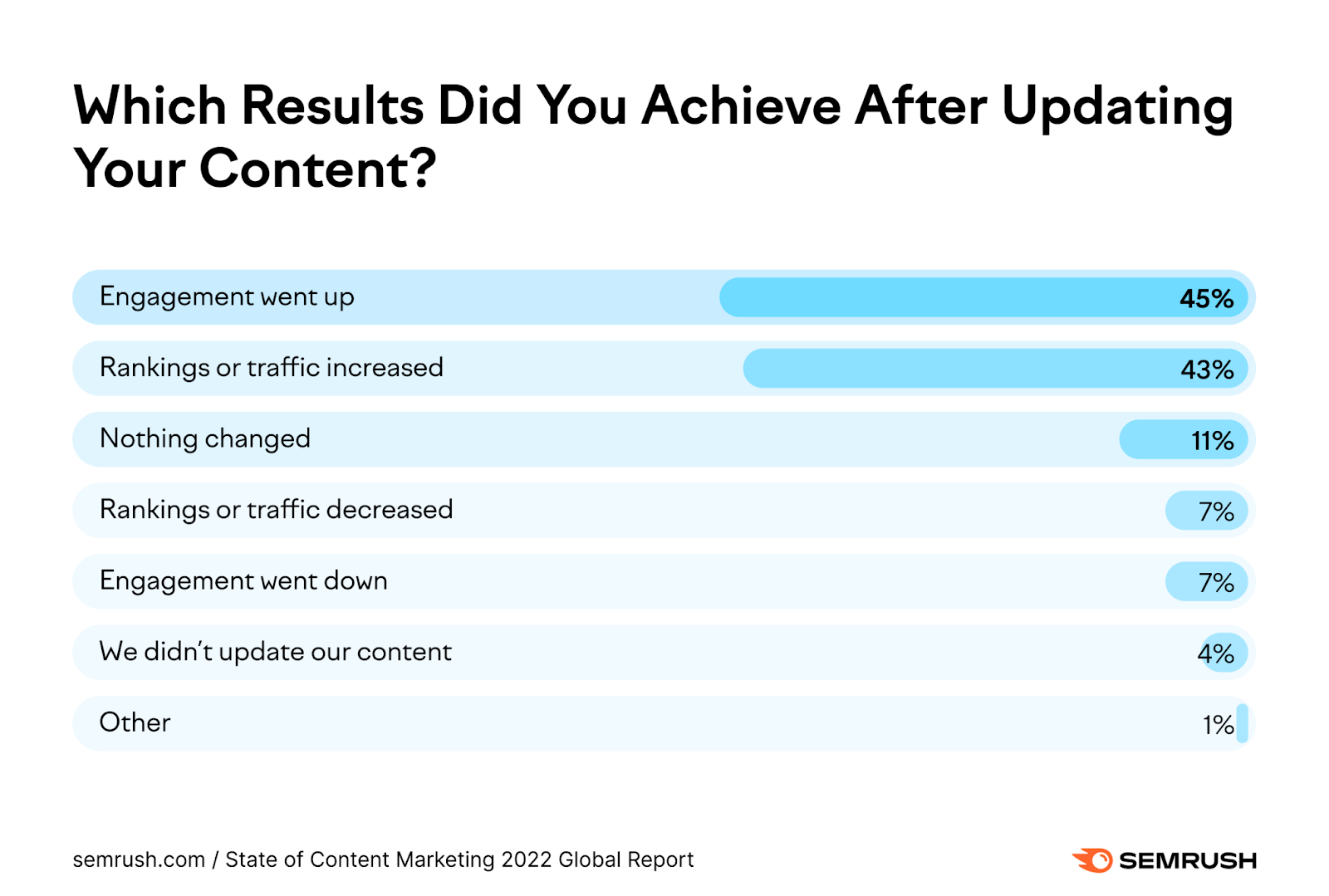
Image Source: Semrush
3. New Service and Location Pages
Some priority changes genuinely require a new landing page. When this is the case, the page should be built with a clear focus on the relevant search intent and conversion goal.
Agencies should avoid creating thin or duplicative pages purely to target additional keywords. Pages created without sufficient depth or differentiation are unlikely to perform well and can negatively affect the overall site quality.
4. Internal Linking
Internal link structures often reflect older priorities. Agencies may need to:
- Redirect internal authority toward newly important commercial pages by adding contextual links from relevant existing content.
- Reassess anchor text and contextual links across high-traffic pages.
- Review navigation links where the new priority warrants more prominent placement.
5. Technical SEO and Schema
Technical SEO should support the newly prioritized pages, not operate as a disconnected checklist. This may include:
- Identifying and resolving technical barriers that could prevent new pages from being crawled or indexed.
- Reviewing crawlability and indexation for any newly created pages.
- Addressing page experience factors that could affect performance in search results.
- Implementing relevant structured data to support the new priority in search.
6. Local SEO and GBP
When a client changes its services or expands into a new location, local SEO elements typically need updating. This includes reviewing and adjusting:
- Local optimization priorities across the site.
- Google Business Profile categories and services.
- Local content that reflects the updated service offering or new market.
- Local citations to ensure consistency across directories and data sources.
Google's guidance around helpful, up-to-date content and logical site organization applies directly here. Keeping local pages accurate and aligned with current business information is a basic but often overlooked SEO requirement.
How Agencies Can Reprioritize SEO Without Disrupting the Entire Campaign?
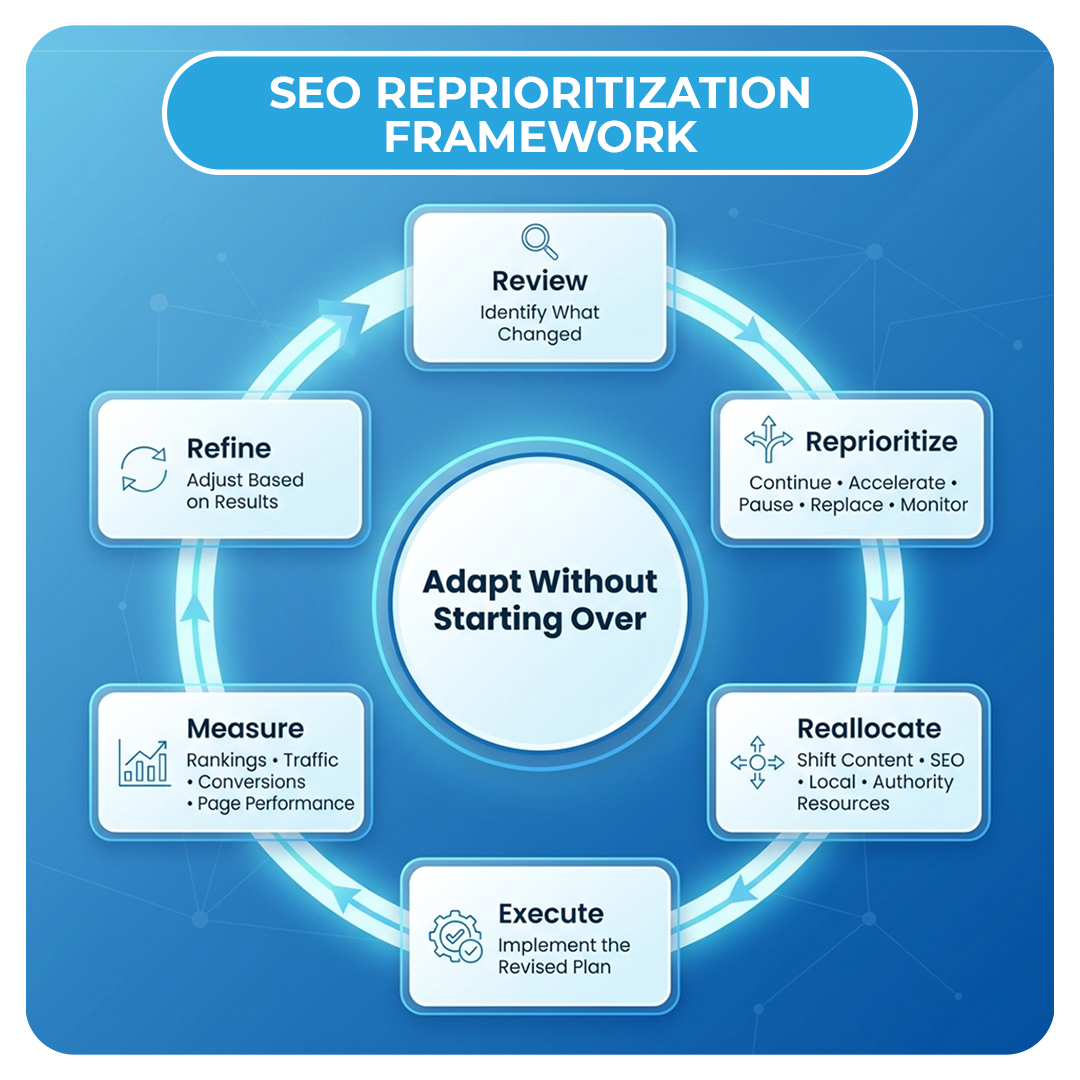
The following framework gives agencies a repeatable way to adapt SEO priorities without abandoning valuable ongoing work.
1. Review
Start by understanding what has changed and what is currently in progress:
- Business Changes: What specifically changed in the client's business, and when?
- Current SEO Work: Which pages and keywords are being targeted under the current plan?
- Existing Performance: What is already producing results and should be protected?
- Active Work: What has already been started that should not be unnecessarily abandoned mid-execution?
2. Reprioritize
Once the review is complete, classify existing and planned work into five categories:
- Continue: Work that still directly supports the client's goals and should remain unchanged.
- Accelerate: Work that should receive additional attention because it aligns closely with the new priority.
- Pause: Work that is temporarily less important but may be resumed later.
- Replace: Work that no longer supports the current business objective and should be substituted with something more relevant.
- Monitor: Work that should continue to be evaluated before any further changes are made.
3. Reallocate
With priorities clarified, fulfillment resources can be shifted accordingly. Agencies can:
- Move content production toward newly important topics.
- Redirect optimization resources toward the highest-priority pages.
- Adjust authority-building efforts to support new commercial targets.
- Shift local SEO attention toward the new market or updated service.
- Reassign specialist capacity to match the revised plan.
4. Execute
The revised plan should be clearly communicated to every specialist involved in delivery. Foundational SEO work, including technical health and site structure, should continue unless there is a specific reason to stop it.
5. Measure
Performance data should be reviewed against the new priority. Key metrics include:
- Impressions and clicks in Google Search Console.
- Ranking positions for newly targeted keywords.
- Organic conversions attributed to the priority pages.
- Landing page performance for newly created or refreshed pages.
Google Search Console provides clicks, impressions, CTR, average position, query data, and page-level performance data, making it a practical starting point for evaluating the impact of any strategy change.
6. Refine
The new strategy should not be treated as permanent after one adjustment. Review the data and determine whether the agency should continue, modify, expand, reduce, or replace the current approach based on what the results are showing.
Managing Multiple Clients With Different and Changing Priorities
Changing priorities become significantly harder to manage when an agency is responsible for dozens of client accounts simultaneously.
Consider four clients running at the same time:
Client A needs local SEO expansion, new location pages, and location-focused content.
Client B needs technical SEO fixes and content consolidation.
Client C needs commercial keyword targeting and conversion-focused landing pages.
Client D needs Google Business Profile optimization and new service targeting.
Each requires a different mix of SEO activities, and each priority may shift independently.
The operational problems this creates include:
- Limited specialist capacity spread across competing requirements.
- Conflicting task queues when multiple clients request changes at the same time.
- Last-minute priority changes that disrupt planned delivery schedules.
- Account manager coordination across multiple specialists and accounts.
- Inconsistent execution when there is no standardized process for handling mid-campaign changes.
What the Agency Needs?
To manage this effectively, agencies need the following in place:
- Documented Workflows: Every team member should understand how a revised priority is identified, communicated, and actioned.
- Campaign-Specific Priorities: Each client account should have clearly defined current objectives, not a generic SEO plan applied uniformly.
- Defined Ownership: Specialists should know exactly who owns each task and who approves changes before they go live.
- QA processes: Changes should be reviewed for accuracy and alignment with strategy before they become client-facing deliverables.
- Flexible Fulfillment Capacity: Agencies need room to absorb changes without disrupting every other active account.
Standardization should create consistency in execution, not force every client into the same SEO strategy. The process should be consistent; the strategy should be specific to each client.
How White Label SEO Supports Flexible Campaign Execution?
This is where white label SEO outsourcing becomes a practical solution rather than simply a cost-reduction exercise.
1. Add Fulfillment Capacity Without Rebuilding the Team
When a client's priorities shift, and new SEO work needs to begin quickly, agencies do not always have the internal capacity to absorb it without affecting other accounts. A white label SEO agency can provide the additional fulfillment capacity needed without requiring the agency to hire, train, and onboard new specialists for every requirement.
2. Access Specialized SEO Expertise
Different client priorities require different SEO skills. SEO outsourcing can provide support across:
- Technical SEO: Audits, implementation priorities, and technical improvements to support newly prioritized pages.
- Content Optimization: Adapting existing content and producing new content aligned with the revised strategy.
- Local SEO: Supporting location-based visibility requirements when clients expand into new markets.
- Google Business Profile: Managing local optimization activities aligned with updated services or locations.
- Schema: Implementing structured data relevant to the client's current business priorities.
- On-page SEO: Adapting pages as commercial priorities change.
3. Adjust Execution Without Changing the Client-Facing Relationship
One of the core advantages of working with a white label SEO firm is that the agency retains full ownership of the client relationship. Fulfillment can be adjusted behind the scenes without changing anything the client experiences. Client communication remains under the agency's control, and reporting can continue under the agency's branding.
4. Maintain Consistency While Allowing Customization
The workflow can be standardized while the strategy remains client-specific. This matters for agencies managing clients with very different goals. The process for handling a priority change should be the same across accounts. The actual SEO activities within that process should reflect each client's individual objectives.
What Agencies Should Communicate When SEO Priorities Change?
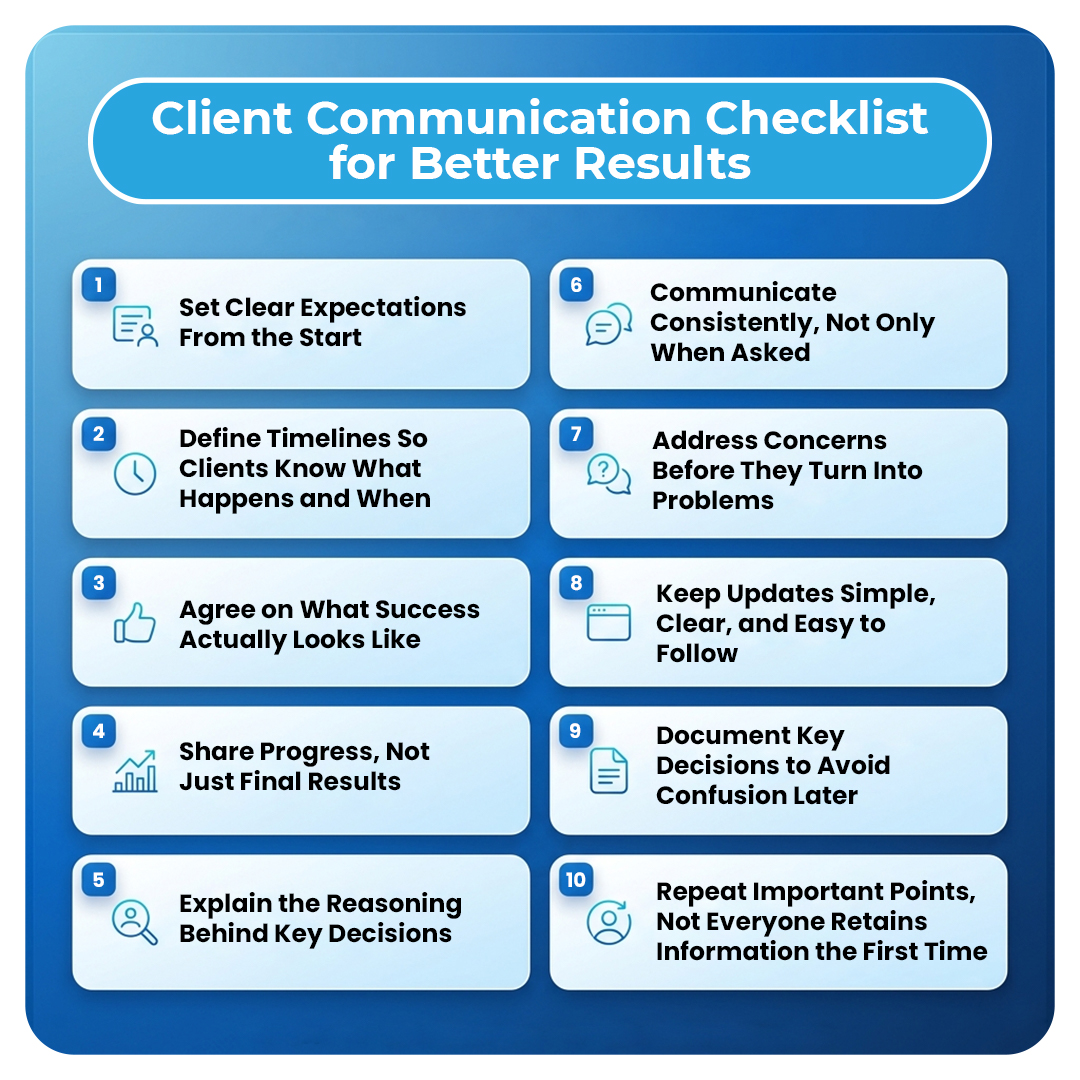
Clients are more likely to accept and support strategy changes when agencies explain the reason and expected outcome clearly. A structured client communication approach helps prevent confusion and builds confidence in the agency's judgment.
What Changed: Name the specific business change. For example: the client is now prioritizing a newly launched service and wants it to generate leads within the next quarter.
Why Did It Change: Connect the shift to a business rationale such as a new revenue opportunity, market expansion, seasonal demand, a change in competitive conditions, or a broader shift in business strategy.
What SEO Work Is Being Reprioritized: Be specific about which activities are continuing, which are pausing, which are accelerating, and which are being replaced.
What Happens to Previous SEO Work: Reassure the client that valuable foundational work is not simply being discarded. Explain how it will be maintained or built upon.
What Will Be Measured: Clearly define which KPIs will be used to evaluate the new priority. This makes the change feel intentional rather than reactive and gives the client a clear frame of reference for evaluating progress.
Further Reading: How Agencies Use White Label SEO to Improve Client Communication
When Changing Priorities Should Trigger a Broader SEO Review?
Not every client request requires a complete strategy overhaul. However, certain changes typically warrant a more thorough review before execution begins.
Trigger 1: The Client Adds a Major Service
Review site architecture, keyword targeting, content coverage, internal linking, schema, and conversion paths across the site to understand how the new service fits within the existing structure.
Trigger 2: The Client Enters a New Location
Review location targeting, Google Business Profile setup, local landing pages, citations, and local content to ensure the new market is properly supported.
Trigger 3: The Client Changes Its Target Audience
Review search intent, messaging, content alignment, and keyword strategy to ensure the site is speaking to the new target audience effectively.
Trigger 4: Existing SEO Results Stall
Review for content decay, competitor movement, changes in search intent, technical issues, and new search opportunities that may not have existed when the original strategy was built.
Trigger 5: Business Objectives Shift From Visibility to Revenue
Review commercial keyword coverage, landing page quality, organic conversion tracking, and conversion path alignment to ensure the SEO strategy is actually supporting revenue goals.
How DashClicks Helps Agencies Adapt SEO Fulfillment as Client Priorities Change
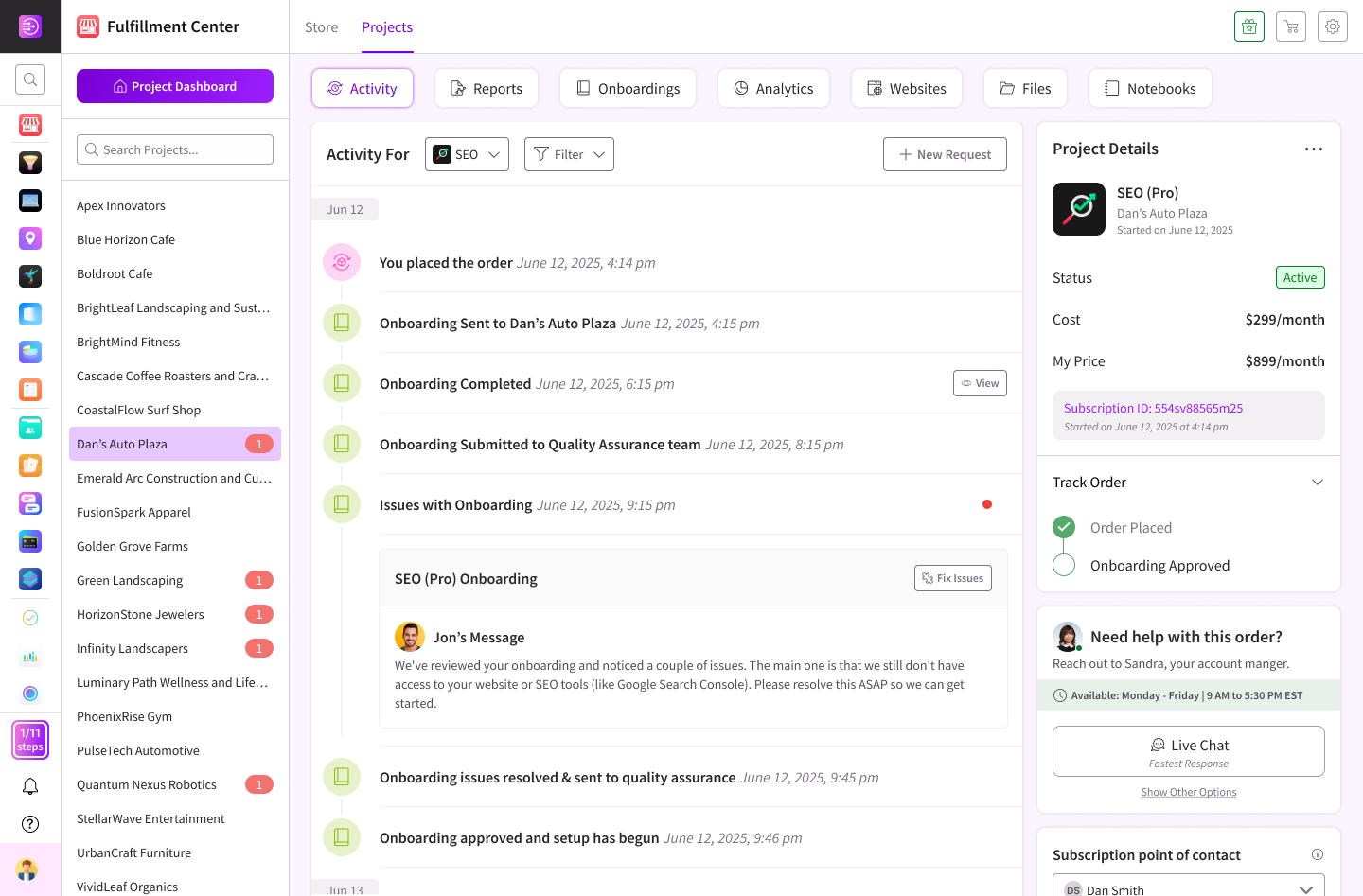
DashClicks provides white label SEO solutions designed to support agencies when client goals, services, markets, or priorities change. Agencies can adjust fulfillment requirements without needing to rebuild their internal team every time a client changes direction.
1. Client-Specific Campaign Execution
Fulfillment is adapted to each client's individual objectives rather than applying a uniform set of SEO activities across every account. This supports the kind of client-specific execution that changing priorities require.
2. Dedicated Support and QA
Dedicated support and quality assurance processes help maintain consistent delivery even when priorities shift mid-campaign. Changes are reviewed before becoming part of the client-facing deliverable.
3. Multiple SEO Capabilities
The platform supports agencies across a range of SEO requirements, including:
- Keyword research aligned with current client priorities.
- On-page SEO adapted as commercial focus changes.
- Technical SEO to support newly prioritized pages.
- Content production and optimization.
- Local SEO for expanding or shifting service areas.
4. Branded Reporting
White label reporting allows agencies to communicate campaign progress and strategic changes while keeping the client-facing relationship entirely under the agency's brand.
5. Agency Retains Strategy and Client Relationships
The division of responsibility is clear. The agency owns the client relationship, strategy, business priorities, and all client communication. The platform supports SEO fulfillment, specialist execution, QA, and reporting infrastructure. The agency remains the strategic owner. DashClicks handles the delivery.
The Agencies That Adapt Are the Ones That Retain Clients
Clients' businesses evolve, and SEO strategies therefore cannot remain completely static. Agencies that recognize this and build the operational capacity to respond accordingly are far better positioned to retain clients and deliver consistent results over time.
Adapting strategy without disrupting delivery requires the right combination of internal process and external fulfillment support. White label SEO outsourcing gives agencies the specialist capacity and flexibility to execute changes without sacrificing the foundational work that long-term SEO depends on.
The most adaptable SEO agency is not the one with a fixed process for every client. It is the one with a reliable process that can accommodate a different strategy when the client's business demands it.


.svg)


.svg)
.svg)
.svg)
.svg)
.svg)