

.svg)

.svg)
.svg)
.svg)
.svg)
.svg)
Agencies rarely get to work in ideal conditions. Monthly SEO deliverables are planned, specialists are assigned to specific accounts, tasks are scheduled, and deadlines are set. Then a client calls.
Maybe they just launched a new service page that needs optimising. Maybe they noticed a sharp traffic drop over the weekend and want answers. Maybe they have 20 new location pages that need to go live next week, or they have discovered an indexing issue that has gone unnoticed for months.
One unexpected request is manageable. Three or four arriving at the same time, across different accounts, during a week when the internal team is already at capacity, is a different problem entirely. At that point, the question is not whether the agency can complete the work. It is whether completing the work will require moving existing tasks, delaying other client deliverables, or asking specialists to absorb hours they do not have.
White label SEO fulfillment provides a practical answer to this problem. Instead of pulling internal specialists away from committed work, agencies can route additional execution through a fulfillment partner while keeping existing roadmaps intact.
Scalable agencies do not avoid unexpected work. They build enough fulfillment flexibility to absorb it without compromising existing commitments.
Why Unexpected Client Work Disrupts SEO Delivery?
Unexpected requests create disproportionate operational pressure because they arrive outside of any planned schedule. The issue is not the request itself but the fact that internal capacity has already been allocated elsewhere.
Several operational factors can turn one additional request into a much larger scheduling problem.
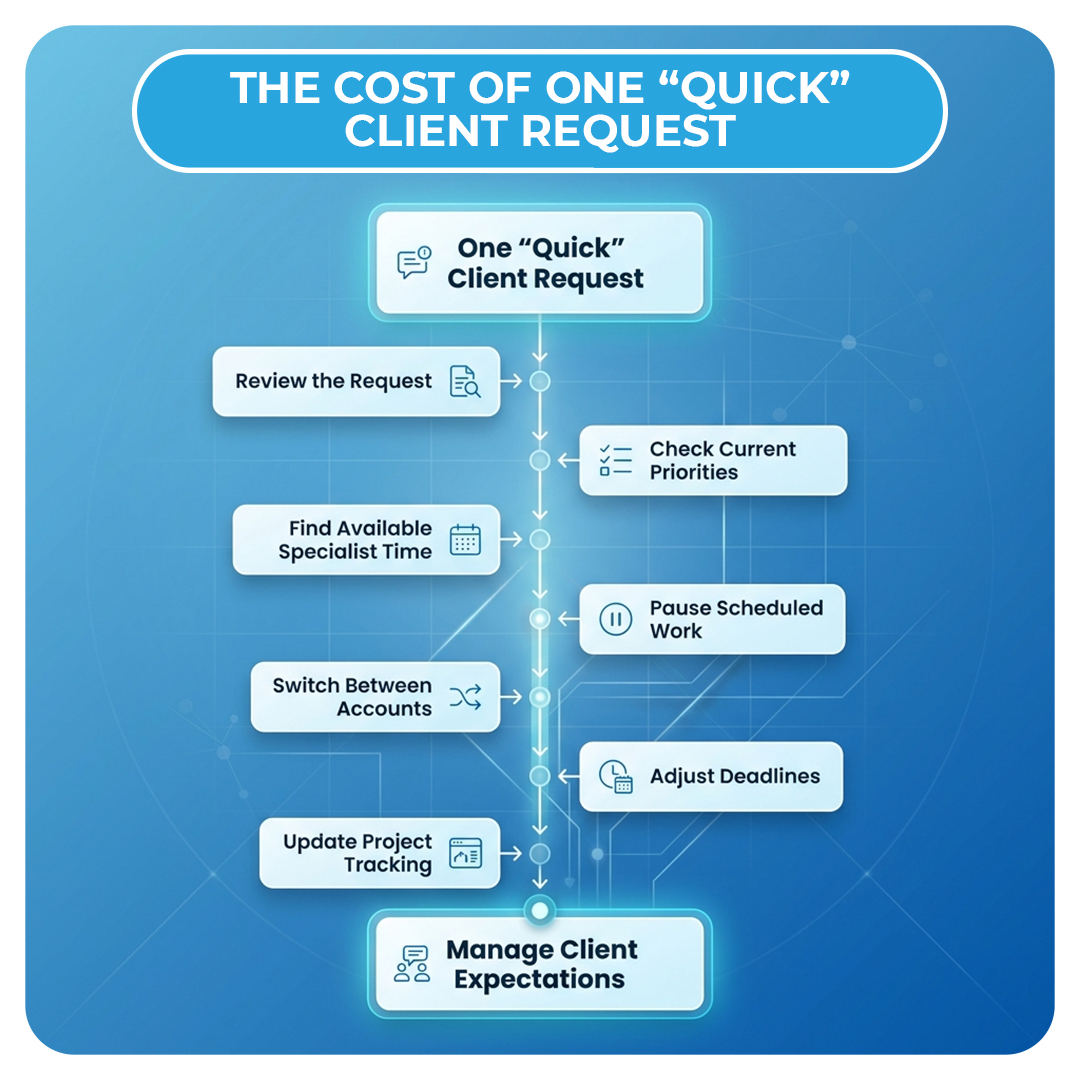
Recurring SEO work requires careful planning to understand why this creates pressure in the first place. Monthly deliverables typically cover a defined set of activities.
1. Monthly SEO Work Is Already Planned
Most agency SEO engagements involve recurring deliverables that are scoped and scheduled in advance. These might include technical optimisation, content production, on-page improvements, link building, local SEO work, and monthly reporting.
Each of these tasks consumes a defined amount of specialist time. When that time is already accounted for across multiple clients, there is little room to absorb additional execution without something else being delayed.
When the team is stretched across many accounts, even a small addition becomes complicated.
2. Specialists Often Manage Multiple Accounts
SEO specialists in agency environments are rarely assigned to a single client. Most manage several accounts simultaneously, which means their monthly capacity is already distributed across competing priorities.
Databox research of 241 eligible agency respondents found that more than half managed 10 to 30 clients, while 17.8% managed 31 to 50 clients. While every agency operates differently, this illustrates the scale of workload that many teams are already managing. Adding one more task to a specialist who is balancing 15 accounts is not always straightforward.
Beyond workload volume, the act of switching between unrelated tasks introduces its own inefficiencies.
3. Unexpected Requests Create Context Switching
When a specialist needs to stop planned work and investigate an unrelated client issue, they must mentally shift context entirely. They may need to review a different website, analyse an unfamiliar account, communicate initial findings, and then return to the original task later.
This kind of context switching reduces workflow efficiency. The time lost is not always obvious, but across a team, it can add up quickly.
Compounding this is the fact that delays in SEO work rarely stay contained.
4. Delays Can Affect Other Deliverables
SEO has natural dependencies. A keyword research delay can push back a content brief, which delays content creation, which delays on-page optimisation, which delays publishing and internal linking updates, all of which affect what can be reported at the end of the month.
Disrupting one task mid-cycle can shift multiple downstream deliverables.
When deliverables slip, the impact moves beyond the SEO team.
5. Account Managers May Need to Renegotiate Timelines
Unexpected work does not only affect specialists. Account managers may need to reprioritise deliverables, explain delays to clients, adjust timelines, and manage expectations across several accounts simultaneously.
The challenge is not simply completing an extra task. It is completing it without creating a domino effect across the agency's existing client workload.
Determine What Work Actually Needs to Be Absorbed
Not every unexpected client request requires an immediate response. Before routing work through additional fulfillment capacity or reallocating internal resources, agencies should assess whether the request is genuinely urgent, important but schedulable, or something that can wait.
This triage step is often skipped under time pressure, but it is one of the most useful things an agency can do to protect its delivery model.
Some SEO issues do require immediate attention, and understanding which ones they are helps avoid unnecessary disruption.
1. Urgent SEO Work
Certain issues have the potential to cause meaningful harm if left unaddressed. These typically include major indexing problems, critical technical errors, site migration issues, significant organic traffic drops, broken redirects, and anything affecting crawlability or site accessibility.
Google Search Central guidance acknowledges that significant site changes, including migrations, can cause temporary ranking fluctuations while Google recrawls and reindexes affected pages. This reinforces why certain technical issues warrant prompt investigation rather than being added to the next available planning cycle.
Other requests are genuinely important but carry less time pressure.
2. Important but Schedulable Work
Not every request classified as "urgent" by a client is operationally urgent from an SEO standpoint. New service page optimisation, content refreshes, additional keyword research, new location optimisation, and internal linking improvements are all valuable tasks. They can usually be given a defined place in the existing roadmap without requiring an immediate interruption.
Scheduling these properly is better than rushing them.
Some requests carry even less urgency.
3. Non-Urgent Requests
Minor on-page recommendations, future content ideas, cosmetic page changes, and low-impact improvements can often wait until the next planned cycle. Telling a client "we will include this in next month's roadmap" is not the same as saying no. It is managing scope and protecting the quality of delivery across all accounts.
White Label SEO Is Not a Reason to Say Yes to Everything?
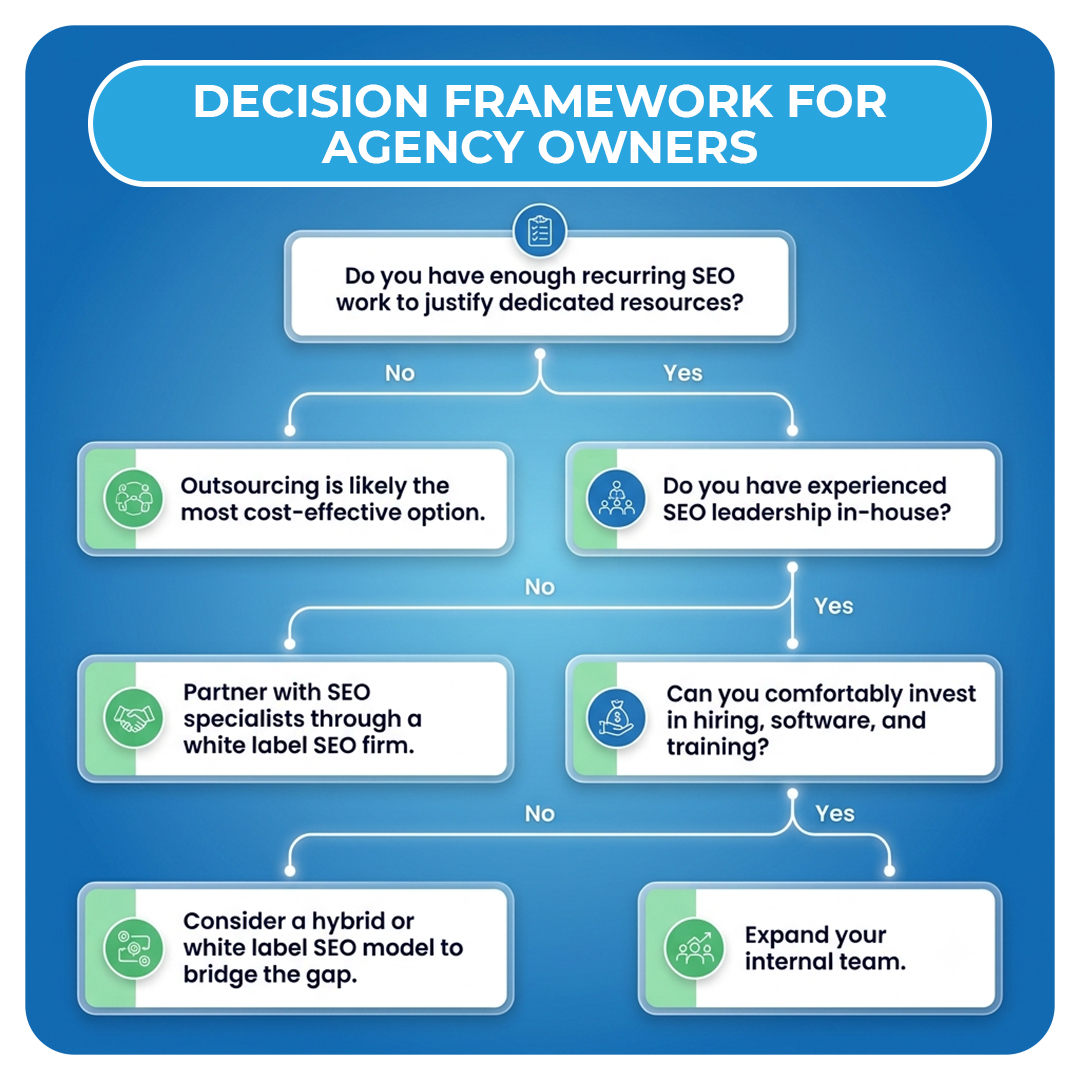
Access to white label SEO outsourcing does not mean every incoming request should be automatically accepted and routed to fulfillment. The goal is to use additional capacity selectively: for work that is important enough to require action but cannot be absorbed internally without disrupting committed deliverables.
How White Label SEO Gives Agencies Extra Fulfillment Capacity?
This is where white label SEO changes the agency's operating model. Rather than treating internal capacity as a fixed ceiling, agencies that work with a white label SEO firm gain an additional execution layer they can draw on when demand exceeds what the internal team can absorb.
The difference between these two models is straightforward.
Without additional fulfillment capacity, the process typically looks like this: an unexpected request arrives, the internal team reprioritises, existing work gets delayed, and monthly deliverables become compressed. Specialists are pulled between tasks, account managers manage fallout, and client satisfaction can suffer.
The white label model changes this dynamic.
With White Label SEO Fulfillment
When white label SEO outsourcing is available, the process shifts. An unexpected request arrives, the agency assesses its priority, the additional work is routed to the fulfillment partner, and the existing roadmap remains protected. The internal team continues executing committed deliverables without interruption.
This additional layer applies across several types of SEO work.
Technical SEO is one area where fulfillment support adds clear value.
Technical SEO and Implementation
When internal specialists are already committed to planned work, technical SEO tasks including audits, implementation, structured data, redirect management, and crawlability fixes can be handled through fulfillment. This is particularly useful when a client's technical issue requires immediate investigation but no internal bandwidth is available.
Content and on-page work is another area where fulfillment capacity helps.
Content and On-Page Optimisation
Additional fulfillment support can cover content creation, content optimisation, metadata updates, on-page improvements, and internal linking. These are often the tasks most vulnerable to delay when specialists are pulled toward urgent technical issues.
Local SEO represents a distinct category of fulfillment need.
Local SEO
For agencies managing clients with multiple locations, unexpected local SEO requests can arrive frequently. Fulfillment support can assist with Google Business Profile work, citation management, and location page optimisation, particularly when a client launches new locations or requires updates across existing ones.
Research and audit work is also something that can be handled through white label SEO services.
SEO Research and Audits
Keyword research, competitor analysis, SEO audits, and opportunity analysis all require specialist time. When internal capacity is already committed, routing this work through a fulfillment partner ensures it gets completed without displacing planned deliverables.
DashClicks is one example of a white label SEO agency fulfillment model designed to address this kind of capacity challenge.
DashClicks as a Fulfillment Example
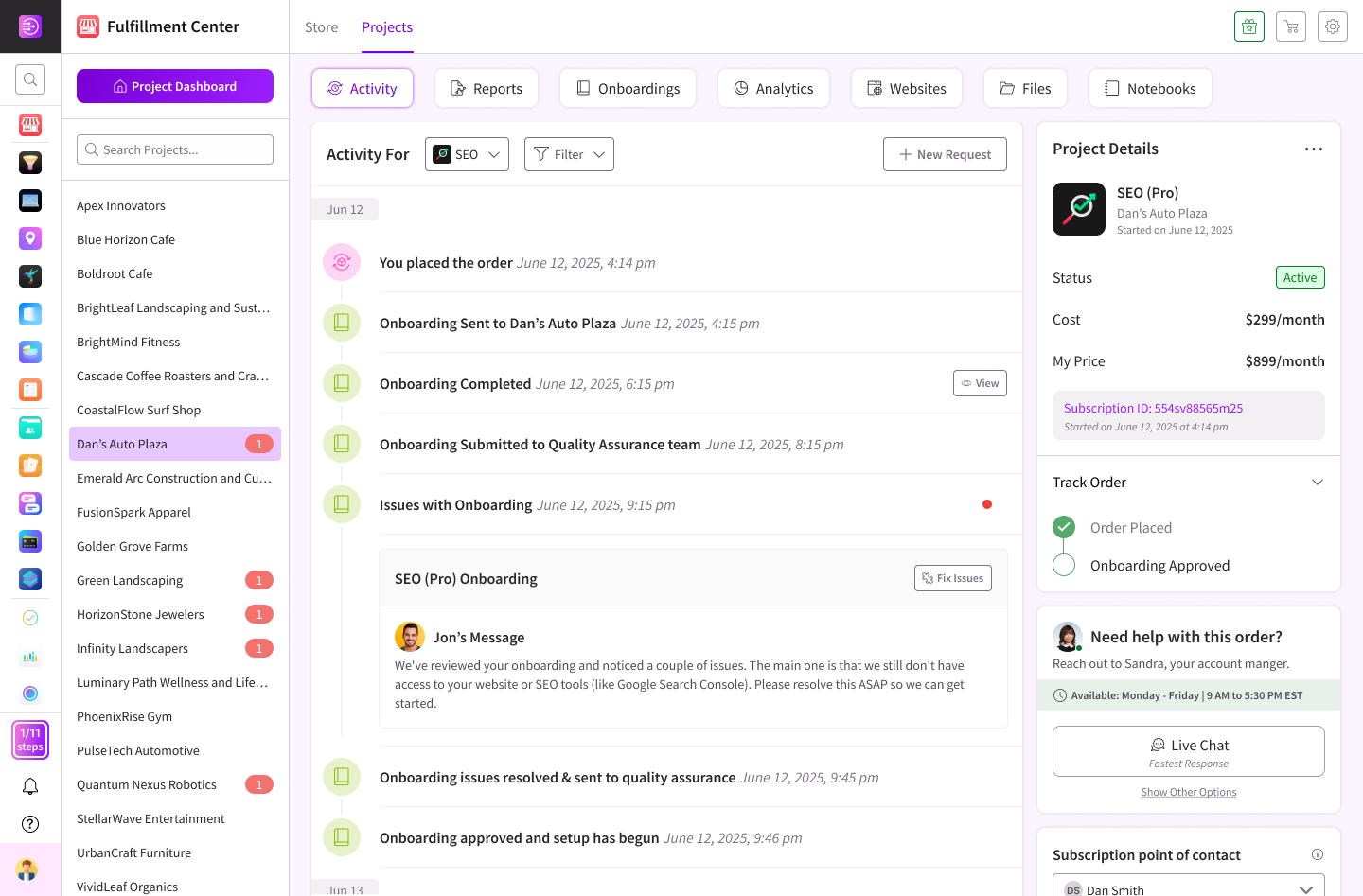
DashClicks provides white label SEO services through dedicated fulfillment specialists working to documented SOPs. Agencies can use DashClicks to handle SEO execution under their own brand, access white label reporting, and give clients visibility through a client dashboard.
The practical value here is not the feature list. It is that agencies can scale their SEO delivery capabilities without immediately adding full-time employees. When a month brings more work than usual, the fulfillment layer absorbs the overflow. When workload normalises, the agency is not carrying additional headcount it no longer needs.
White label SEO gives agencies another layer of fulfillment capacity when the internal team is already committed.
How Agencies Can Use White Label SEO Without Losing Control
One concern agencies often raise about outsourcing execution is whether it creates distance between the agency and the client. Done correctly, it does not. A well-structured white label SEO model separates execution from ownership. The agency remains fully in control of the client relationship.
Understanding where those boundaries sit is important for any agency considering this model.
The Agency Owns the Client Relationship
The agency should remain responsible for client communication, strategy, prioritisation, scope decisions, approvals, quality control, and all client-facing recommendations. These are the functions that define the agency's relationship with its clients. They should not be delegated to a fulfillment partner.
The fulfillment partner's role is fundamentally different.
The Fulfillment Partner Handles Execution
A fulfillment partner executes agreed SEO tasks, handles specialist implementation, produces documentation, supports reporting, and delivers recurring fulfillment work. Critically, this execution happens against the agency's direction. The partner is not redefining client strategy or communicating independently with clients.
A clear workflow keeps both sides aligned.
Use a Clear Workflow
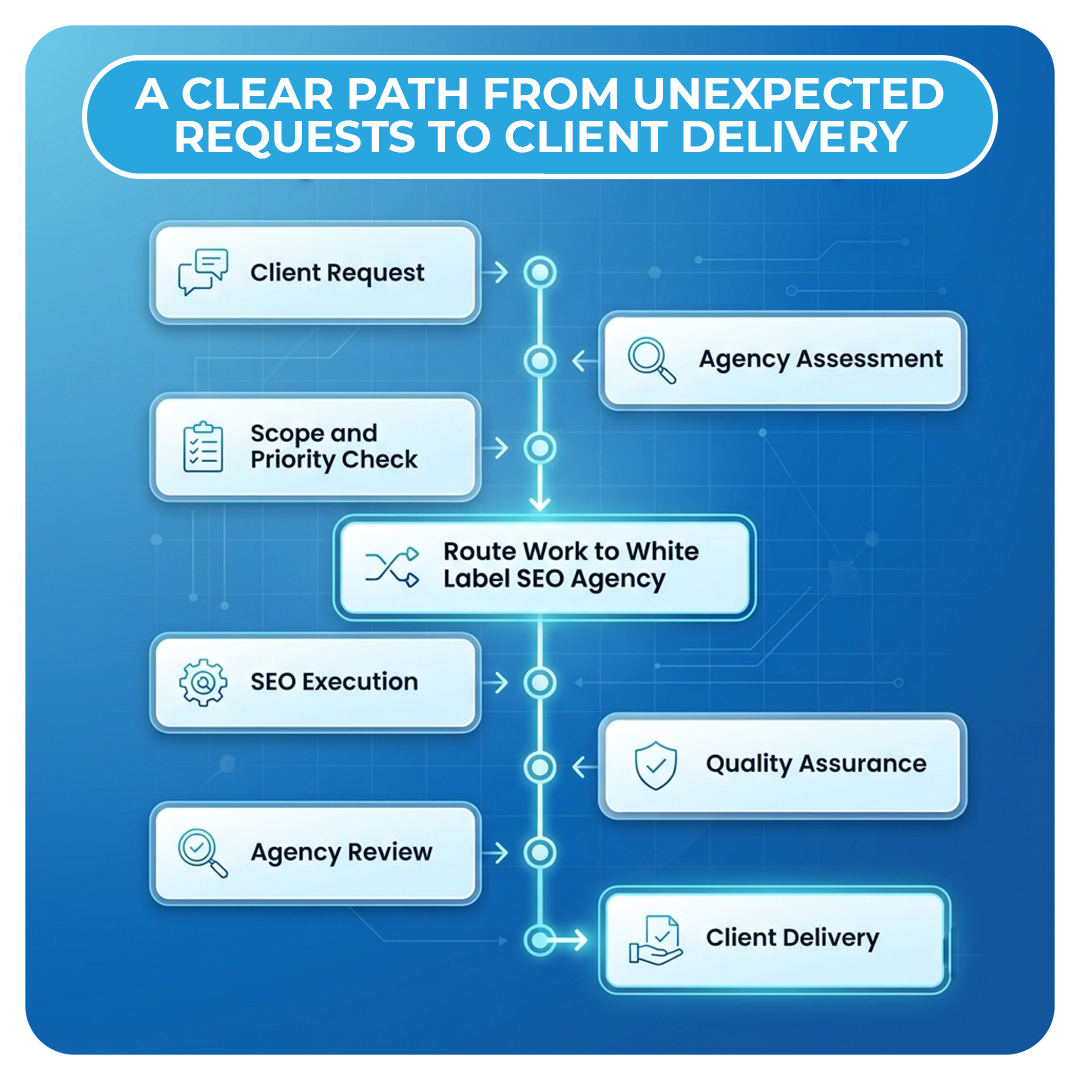
A structured process protects both the agency and the client outcome. The workflow should move through these stages: client request received, agency assessment, scope and priority check, fulfillment assignment, SEO execution, quality assurance, agency review, and client delivery.
Each stage has a defined owner. The agency manages everything the client sees. The fulfillment partner manages everything behind the scenes.
Data supports why client communication should stay with the agency throughout this process. Databox research found that 73.03% of agencies determine KPIs collaboratively with clients. This reinforces why goal-setting, priority decisions, and client expectations should remain the agency's responsibility, even when execution is handled externally.
DashClicks supports this model through SOP-driven fulfillment, white label reporting, and a client dashboard that gives agencies visibility over delivery without exposing the fulfillment relationship to the client.
How White Label SEO Helps Agencies Handle Workload Spikes
Demand rarely arrives at a predictable pace. A single week can bring multiple unexpected requests from different clients, and when that happens, the pressure on internal teams compounds quickly.
Consider this example. An agency receives four unexpected requirements in the same week: Client A needs a technical SEO fix, Client B has just launched a new service, Client C requests 20 new location pages, and Client D needs additional content produced. The internal team might reasonably absorb one or two of these. Absorbing all four while keeping existing monthly deliverables on schedule is a different challenge entirely.
White label SEO fulfillment helps agencies manage these periods in several ways.
Temporary spikes in demand are one of the clearest use cases for additional fulfillment capacity.
Absorbs Temporary Workload Increases
When multiple unexpected requests arrive simultaneously, white label SEO services can provide the additional execution capacity needed to handle the overflow without permanently expanding the internal team.
Certain periods predictably generate higher demand.
Supports Busy Months
Seasonal campaigns, new client onboarding, large project launches, website redesigns, and employee absences can all create short-term capacity gaps. Having a fulfillment resource available during these periods means the agency is not choosing between new work and existing commitments.
Protecting the existing roadmap is often as important as completing new work.
Protects Existing Monthly Deliverables
When additional work is routed through fulfillment, internal specialists can continue executing committed deliverables without interruption. This reduces the risk of delays cascading across client accounts.
Not every unexpected request requires the same skill set.
Provides Specialist Capacity
Some requests require specific expertise that may not be available internally at the right moment. White label SEO fulfillment can provide access to specialists in technical SEO, local SEO, content, or research without requiring the agency to hire for a short-term need.
One note of caution: workload management should always be anchored to realistic timelines. White label SEO agency fulfillment provides additional capacity, but it does not mean every unexpected request can be completed immediately. Agencies should communicate honest timelines to clients regardless of where the work is being executed.
The Databox research showing that many agencies manage portfolios of 10 to 50 clients illustrates why flexible fulfillment becomes increasingly useful as client volume grows. Managing that volume sustainably requires more than good intentions.
DashClicks can function as a fulfillment resource during these peaks, providing agencies with scalable SEO services when internal demand temporarily exceeds what the team can absorb.
Turn Unexpected Requests Into a Scalable SEO Delivery System
The strongest agencies do not simply react to unexpected work. Over time, they identify patterns in the unexpected requests they receive and build processes around them. What starts as a disruption can eventually become a standard service.
The foundation of this approach is an organised triage process.
Establish an Unexpected-Work Triage Process
Agencies should classify incoming requests based on urgency, business impact, technical risk, required effort, and existing commitments before acting. This prevents reactive decisions and ensures that fulfillment capacity is used where it actually matters.
Keeping internal capacity at sustainable levels is equally important.
Maintain a Fulfillment Capacity Buffer
Agencies that plan internal capacity at 100% utilisation have no room to absorb anything unexpected. A modest buffer, even 10 to 15% of available specialist time, creates space to handle legitimate requests without immediately disrupting planned deliverables.
Repeated unexpected requests often signal an opportunity.
Create SOPs for Recurring Requests
When the same type of request keeps appearing across multiple clients, the agency should consider converting it into a defined process with documented steps. This reduces the time spent figuring out how to handle it each time it arrives.
Tracking patterns over time reveals where those opportunities are.
Track Which Requests Keep Appearing
If the same type of request appears repeatedly across different accounts, it may indicate an unmet client need that the agency could formalise into a service offering.
Turning that insight into a defined service creates predictable, scalable delivery.
Create Add-On Services
For example, if clients regularly ask for new pages to be optimised as they launch, the agency could create a defined New-Page SEO Optimisation Service with a standard process, fixed scope, and a clear fulfillment path. The result is a predictable delivery model: standard service, defined process, white label fulfillment, reliable output.
DashClicks can serve as the fulfillment infrastructure behind this kind of service expansion, allowing agencies to grow their SEO delivery capabilities without building every specialist function internally.
The real value of white label SEO is not just handling emergencies. It is giving agencies a scalable fulfillment system that can flex with client demand.
Build Flexibility Into Your SEO Fulfillment Model
Unexpected SEO requests are a normal part of agency life. The question is not whether they will arrive but whether the agency has the operational flexibility to handle them without disrupting everything else.
Growing agencies cannot continually interrupt planned work every time a client makes an unscheduled request. Not every request requires immediate action, and triage should always come before fulfillment. Agencies that assess urgency, scope, effort, and capacity before committing will make better decisions about when to use additional resources.
White label SEO outsourcing provides that additional execution layer when the internal team is already committed. Used well, it can help agencies protect monthly deliverables, reduce workload pressure on internal specialists, handle temporary spikes in demand, support more client needs without sacrificing quality, and expand service capacity without immediately growing headcount.
The agencies best equipped for growth are not those that never encounter unexpected client work. They are the ones with the fulfillment infrastructure to absorb it without letting one new request disrupt everything else.


.svg)


.svg)
.svg)
.svg)
.svg)
.svg)