

.svg)

.svg)
.svg)
.svg)
.svg)
.svg)
When websites grow, technical SEO becomes less forgiving. A single crawl issue, broken redirect, or Core Web Vitals drop can quietly undo months of content and link-building work. For agencies managing multiple client websites, the challenge multiplies. One missed alert or a delayed fix across a large portfolio can lead to traffic losses, ranking volatility, and unhappy clients.
Technical SEO at scale means maintaining crawlability, indexability, clean site architecture, strong Core Web Vitals, efficient server delivery, accurate structured data, and smart internal linking across dozens or even hundreds of sites. It is not a one-time task. It is an ongoing operational discipline that requires systems, people, and repeatable processes.
This is where a white label SEO partner becomes valuable. Instead of building and maintaining large in-house technical teams, agencies can rely on white label SEO services to deliver consistent site health improvements behind the scenes. The agency keeps control of client relationships, while technical execution runs smoothly in the background.
Outsourcing is no longer the exception. According to Floowi, 61% of agencies outsource at least one core SEO service, and many plan to increase outsourcing as they scale. At the same time, organic search remains one of the most important traffic drivers. BrightEdge reports that organic search accounts for over half of all website traffic across many industries, reinforcing how critical SEO performance is to long-term growth.
In this article, we will break down the real technical SEO challenges agencies face at scale, explain how a white label SEO agency solves these issues, and show how DashClicks supports agencies with scalable, reliable technical SEO solutions that protect site health as client portfolios grow.
Common Scaling Pain Points Agencies Face
Managing technical SEO for one website is usually straightforward. You crawl the site, fix what is broken, and move on. When that same process needs to be repeated across dozens of clients, the cracks start to show. Scaling technical SEO is not just about running more audits. It is about maintaining consistency, speed, and clarity as complexity grows.

Below are the most common pain points agencies face, why they matter, and how they impact performance and client relationships.
1. Inconsistent Site Health Monitoring Across Clients
One of the earliest problems agencies encounter at scale is inconsistent monitoring. As client counts grow, monitoring often becomes uneven. High-priority accounts may receive frequent crawls and proactive checks, while smaller or newer clients are reviewed less often.
This inconsistency creates blind spots. Technical issues do not announce themselves politely. A single deployment can introduce broken internal links, duplicate URLs, accidental noindex tags, or JavaScript rendering problems. If a site is not being monitored regularly, those issues can sit unnoticed for weeks.
By the time a problem surfaces, the damage is already done. Rankings slip, organic traffic declines, and clients start asking uncomfortable questions. From their perspective, the drop feels sudden. From the agency’s perspective, it was avoidable.
The impact shows up clearly in reporting. Key metrics affected include:
- Overall site health scores.
- Number and severity of crawl errors.
- Frequency of technical checks per site.
- Variation in health scores across the client portfolio.
Many SEO platforms use a site health score as a standardized benchmark. This makes comparisons easy, but it also exposes inconsistencies. When one client sits at a 92 percent health score and another at 58 percent, agencies are forced to explain not only the gap, but why it was allowed to exist for so long. Over time, this erodes confidence and increases churn risk.
2. Manual, Ad Hoc Audits That Do Not Scale
Manual audits are thorough, but they are also time-intensive. For a single site or a small client list, this approach works. At scale, it becomes a bottleneck.
Agencies often rely on senior SEO specialists to conduct audits one by one. Each audit requires crawling the site, analyzing templates, reviewing indexation, and documenting issues. When client volume increases, audits pile up faster than teams can complete them.
The result is a growing backlog. Fixes are delayed, and issues that could have been resolved quickly remain open. This is especially problematic when agencies manage multiple sites built on the same CMS or theme. The same technical problems appear repeatedly, yet each audit treats them as new discoveries.
This slows down remediation and limits growth. Technical SEO opportunities often depend on timing. Delayed fixes can mean missed ranking improvements, slower recoveries after site changes, and prolonged performance dips.
The metrics most affected include:
- Audit turnaround time.
- Number of open technical issues per client.
- Time from issue discovery to resolution.
- Percentage of recurring issues across similar sites.
As these numbers worsen, operational stress increases. Teams feel stretched, quality becomes inconsistent, and agencies struggle to maintain service standards across their entire client base.
3. Fragmented Tooling and Disconnected Data
Another major challenge at scale is tool sprawl. Many agencies accumulate tools over time: one crawler for audits, another for monitoring, separate platforms for page speed, log analysis, and rank tracking. Add spreadsheets and internal dashboards, and data quickly becomes fragmented.
While each tool may be useful on its own, the lack of integration creates inefficiencies. Teams spend hours exporting, importing, and reconciling data instead of acting on it. Important insights get buried across tabs and platforms.
This fragmentation directly affects responsiveness. When an issue arises, it takes longer to detect and even longer to understand its impact. Mean time to detect issues increases, as does mean time to resolve them. At scale, the overhead of managing data can rival or exceed the effort required to fix the issues themselves.
The problem becomes especially visible during reporting or crisis moments. When a client experiences a sudden traffic drop, agencies must quickly piece together data from multiple sources. Delays and incomplete answers weaken trust, even if the technical team is working hard behind the scenes.
Over time, disconnected data makes technical SEO feel reactive rather than proactive. Instead of preventing problems, agencies find themselves constantly responding to them, which is unsustainable as client numbers grow.
Scaling technical SEO is not just about doing more work. It is about building systems that ensure consistency, speed, and visibility across every client. Without those systems in place, even skilled teams struggle to keep site health under control as portfolios expand.
4. Core Web Vitals Regressions After Launches
Core Web Vitals are no longer a nice-to-have. Google has clearly positioned them as part of its broader page experience signals, which means performance issues can translate into real visibility losses. The challenge for agencies is that regressions often appear after moments that are meant to improve a site.
Redesigns, plugin updates, new tracking scripts, and feature launches are common triggers. Even small front-end changes can affect how a page loads or responds to user input. A new hero image can delay Largest Contentful Paint. A chat widget can interfere with Interaction to Next Paint. Minor layout tweaks can introduce unexpected Cumulative Layout Shift.
What makes this difficult at scale is speed. These regressions do not always cause immediate, dramatic drops. Instead, impressions slowly decline, engagement metrics worsen, and rankings soften over time. By the time the issue is flagged manually, weeks of performance data may already be lost.
Agencies managing multiple sites need continuous, automated monitoring tied directly to deployments and releases. Without it, performance problems are often discovered too late, during monthly reporting or after a client raises concerns.
Key indicators to monitor include:
- Changes in LCP, INP, and CLS before and after launches.
- URLs that fall out of Core Web Vitals “good” thresholds.
- Correlations between performance dips and release timelines.
At scale, the goal is not just measurement but early warning. Catching a regression within hours or days can mean the difference between a quick fix and a prolonged ranking decline.
5. Technical Debt Across Legacy Platforms and Migrations
Many client sites are not built from scratch. They are the result of years of changes, patches, and partial updates. Over time, technical debt accumulates quietly. Duplicate content spreads across parameterized URLs. Redirect chains grow longer. Canonical tags fall out of sync. Templates become bloated and inefficient.
On stable sites, this debt slowly drags down crawl efficiency and index quality. During migrations or platform upgrades, it becomes dangerous.
Migrations amplify every existing weakness. A single missed redirect can break link equity. Incorrect noindex rules can remove entire sections from search results. URL structure changes can confuse crawlers and users alike. Even well-planned migrations can go sideways when legacy issues are not fully mapped beforehand.
Organic traffic losses after migrations are rarely caused by one mistake. They are usually the result of many small technical failures compounding at once. Recovery then takes time, effort, and client patience.
Metrics that matter most in these scenarios include:
- Indexed page counts before and after migration.
- Redirect error rates and redirect chain depth.
- Crawl stats and server response patterns.
- Post-migration traffic recovery timelines.
At scale, agencies struggle to apply the same level of rigor to every migration. Without standardized checklists, automated validation, and post-launch monitoring, technical debt continues to resurface, undermining trust and long-term performance.
6. Limited Engineering Bandwidth
Even when issues are clearly identified, fixing them is not always straightforward. Most agencies do not have dedicated engineering resources assigned solely to SEO. Technical recommendations must compete with other priorities such as design updates, feature development, or client-requested changes.
As a result, SEO fixes are often delayed. Simple changes sit in backlogs. Structural improvements are postponed indefinitely. Over time, this creates a gap between what was promised and what is delivered.
This limitation forces difficult trade-offs. Agencies may focus on quick wins that are easier to implement, while larger foundational issues remain unresolved. While this can protect short-term results, it weakens long-term site health and limits growth potential.
The impact shows up in client conversations. Expectations were set around performance improvements, but timelines slipped due to dependencies outside the SEO team’s control. Retention becomes harder when progress feels slow or uneven.
At scale, limited engineering bandwidth is not just a resourcing issue. It is a coordination problem. Agencies that lack clear prioritization frameworks and repeatable implementation processes find themselves constantly negotiating for fixes instead of executing them efficiently.
Together, these challenges make scaling technical SEO far more complex than simply adding more clients. Without consistent monitoring, structured remediation, and reliable implementation support, even strong strategies struggle to deliver predictable results across a large portfolio.
7. Lack of Repeatable, White Label Processes
One of the biggest barriers to scaling technical SEO is the absence of repeatable, white label processes. When every client is handled differently, growth becomes messy. Onboarding slows down, internal teams spend more time figuring out what to do next, and quality varies from account to account.
Without standard workflows, each new website feels like a clean slate. Audits are structured differently, tools are configured inconsistently, and reporting formats change based on who is managing the account. This increases the chance of missed steps during onboarding, especially for complex sites or time-sensitive launches.
The lack of repeatability also limits commercial growth. Technical SEO becomes harder to package as a clear service when delivery depends on individual effort rather than a defined system. Upselling becomes uncomfortable because timelines and outcomes feel unpredictable. Sales teams struggle to explain what clients will actually receive, and delivery teams feel the pressure once expectations are set.
From a quality standpoint, inconsistency is the real risk. Some clients benefit from thorough monitoring and fast remediation, while others receive only periodic attention. Over time, this creates uneven results across the portfolio and makes it difficult to maintain a consistent brand promise.
Common symptoms of non-standardized processes include:
- Longer onboarding timelines for new clients.
- Inconsistent audit depth and reporting formats.
- Missed technical checks during site launches or updates.
- Difficulty training new team members quickly.
At scale, agencies need systems that work regardless of who is assigned to the account. Repeatable, white label SEO processes allow teams to move faster without sacrificing accuracy. They also make technical SEO easier to sell, easier to deliver, and easier to maintain as client volumes grow.
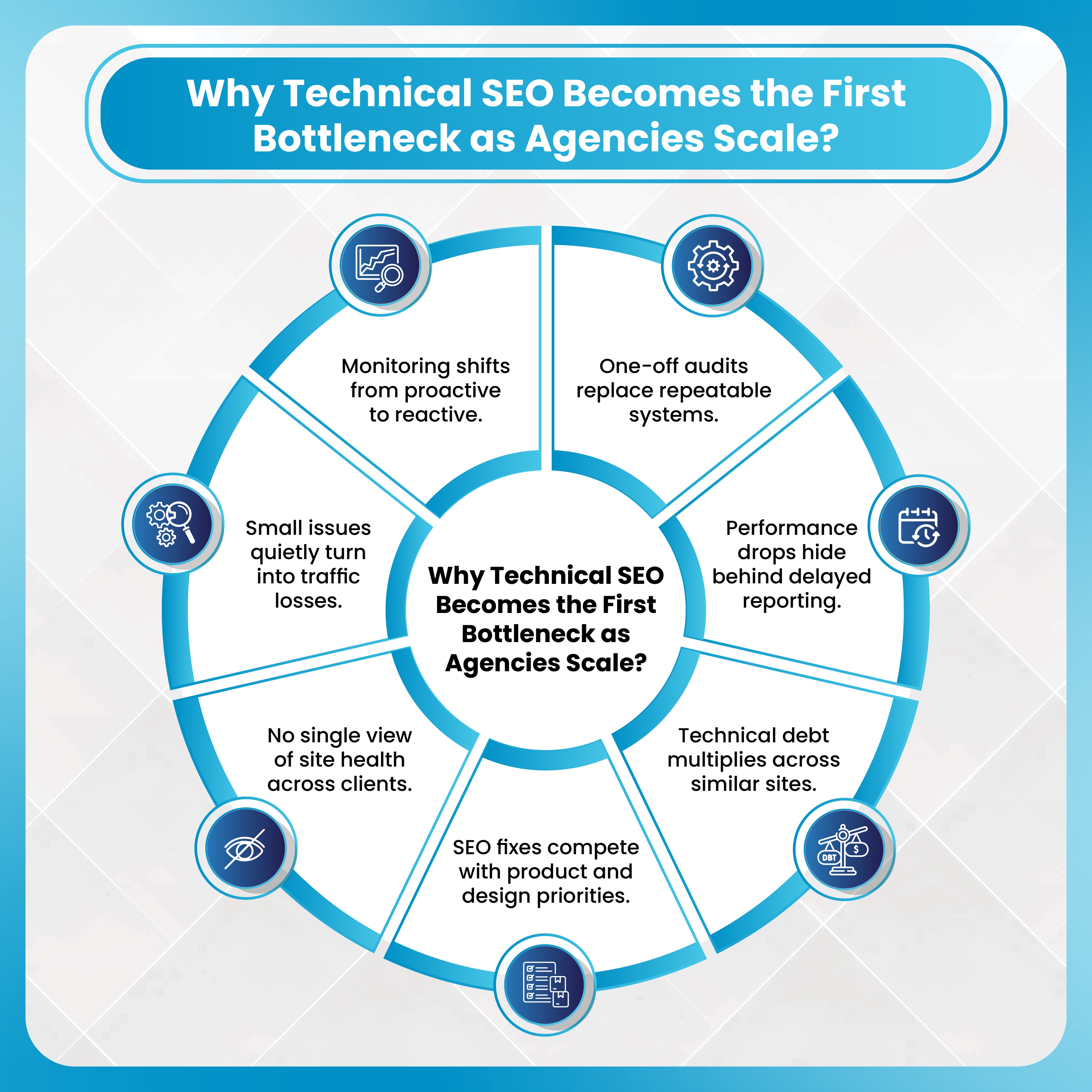
Without this foundation, scaling technical SEO relies too heavily on individual expertise. That approach can work for a while, but it becomes fragile as the agency grows and client expectations rise.
How White Label SEO Partners Solve Scale Problems?
A white label SEO partner provides the structure, tools, and execution needed to handle technical SEO as an operational system rather than a series of one-off tasks.
1. Operational Models and Engagement Types
White label SEO services typically offer flexible engagement models to match agency needs. These include ongoing retainers for technical support, one-time audits with remediation, migration projects, and monthly site care packages.
The white label promise includes rebrandable reporting, dedicated technical leads, and predefined service level agreements for response times. For example, a monthly site health care package may include automated scans, issue triage within 48 hours, and a prioritized fix roadmap.
This allows agencies to deliver consistent technical outcomes without building large internal teams.
2. Scalable Monitoring and Alerting Foundations
A strong white label SEO agency centralizes monitoring across all client sites. Instead of logging into multiple tools, agencies get a single view of site health.
Automated crawls run daily or weekly, Core Web Vitals are monitored using real user metrics, and uptime or speed alerts trigger immediate action. Issues are converted into tickets and prioritized automatically.
Key performance indicators include site health percentage, time to detect issues, and time to resolve them. Semrush site health scores provide a standardized way to measure progress.
3. Repeatable Audit and Remediation Playbooks
White label SEO services rely on standardized audit frameworks. These cover crawling, indexing issues, Core Web Vitals, structured data, redirects, canonicals, hreflang, and server configurations.
Playbooks are built for common platforms like WordPress, Shopify, Magento, and modern JavaScript frameworks. Issues are prioritized into clear categories, making execution faster and more predictable.
Deliverables often include remediation tickets, code-ready recommendations, and quality assurance checklists. For example, faceted navigation issues are handled through proven canonical and parameter strategies.
4. Performance Engineering at Scale
Improving performance across many sites requires templated solutions. White label SEO partner implements image optimization pipelines, critical CSS strategies, caching rules, and CDN configurations at scale.
Performance fixes are often integrated into deployment workflows, ensuring improvements persist after updates. Google Core Web Vitals metrics provide a clear way to measure success. Reducing Largest Contentful Paint or layout shifts improves both user experience and conversion potential.
5. Indexation and Crawl Budget Management
Large sites often waste crawl budget on low-value URLs. White label SEO agencies manage indexation through dynamic sitemaps, robots directives, canonical strategies, and internal linking improvements.
Monthly crawl efficiency reports highlight which pages deserve priority. Success is measured through indexed page quality, crawl frequency, and impressions per indexed URL. These improvements help search engines focus on pages that drive real business value.
6. Structured Data at Scale
Deploying structured data manually across thousands of pages is not practical. White label SEO services use templated JSON-LD implementations with automated validation.
Correct schema improves eligibility for rich results, which can increase visibility and click-through rates. This ties back to the importance of organic traffic highlighted by BrightEdge data. Ecommerce sites benefit from automated product schema applied consistently across catalogs.
7. Migrations, Launches, and Quality Assurance
Migrations are high-risk moments for SEO. White label partners manage pre-launch audits, redirect mapping, and crawl comparisons. Launch-day runbooks ensure fast response if issues appear. Post-launch monitoring tracks indexing and impressions during the critical first 30 days.
Metrics such as indexed page retention and traffic recovery speed help agencies prove success.
8. Reporting, SLAs, and White-Label Dashboards
Agencies need clear, client-ready reporting. White label SEO agency provides branded dashboards, scheduled reports, and weekly technical summaries.
Key metrics include site health scores, Core Web Vitals trends, errors fixed, pages indexed, and organic impression changes. Semrush site health remains a standard KPI for tracking technical progress.
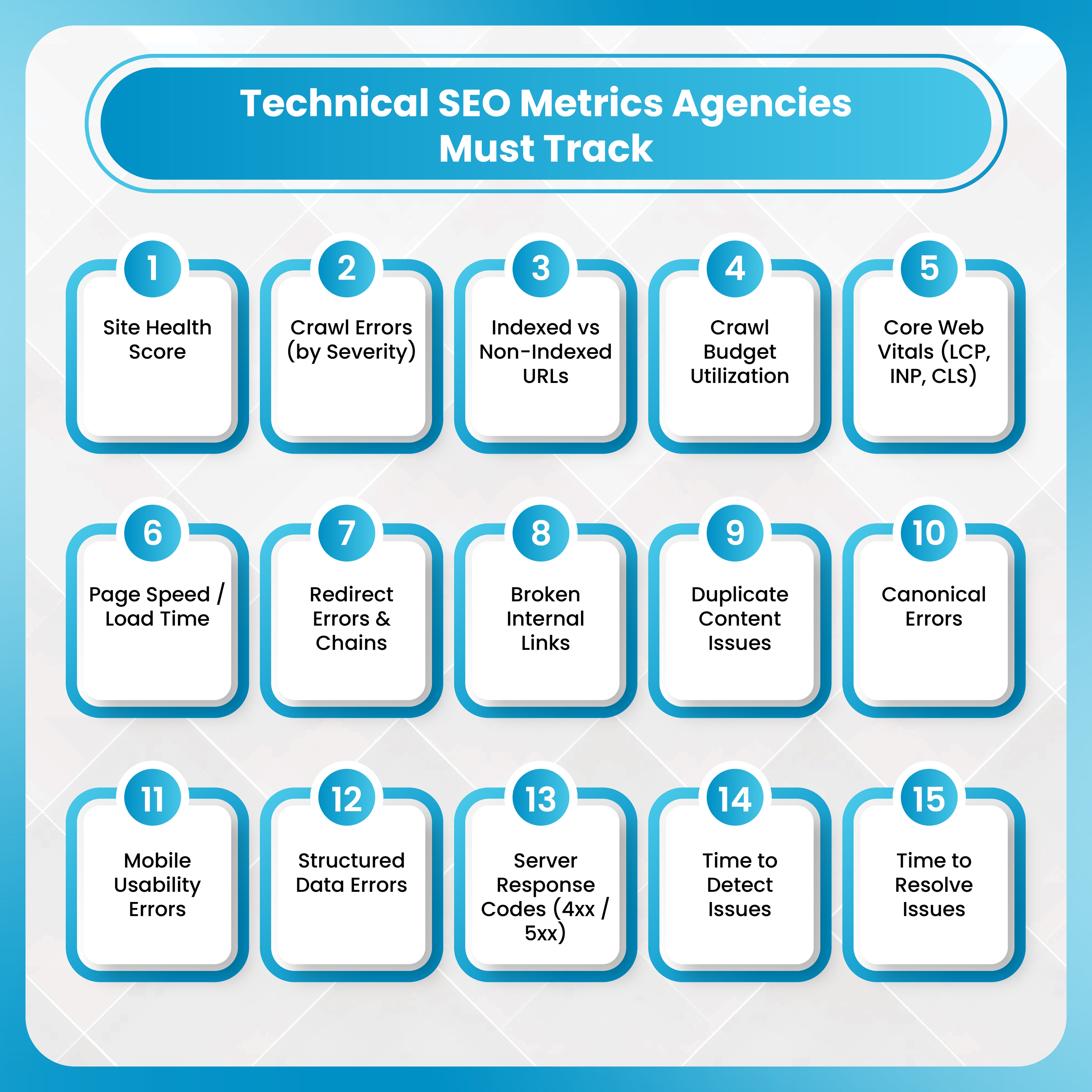
At scale, technical SEO becomes an operational challenge. White label SEO services give agencies the systems and execution needed to maintain site health while focusing on growth.
How DashClicks’ White Label SEO Services Support Technical SEO at Scale?
DashClicks is built to help agencies manage technical SEO efficiently across growing client portfolios. Its white label SEO services focus on scalability, consistency, and transparency.
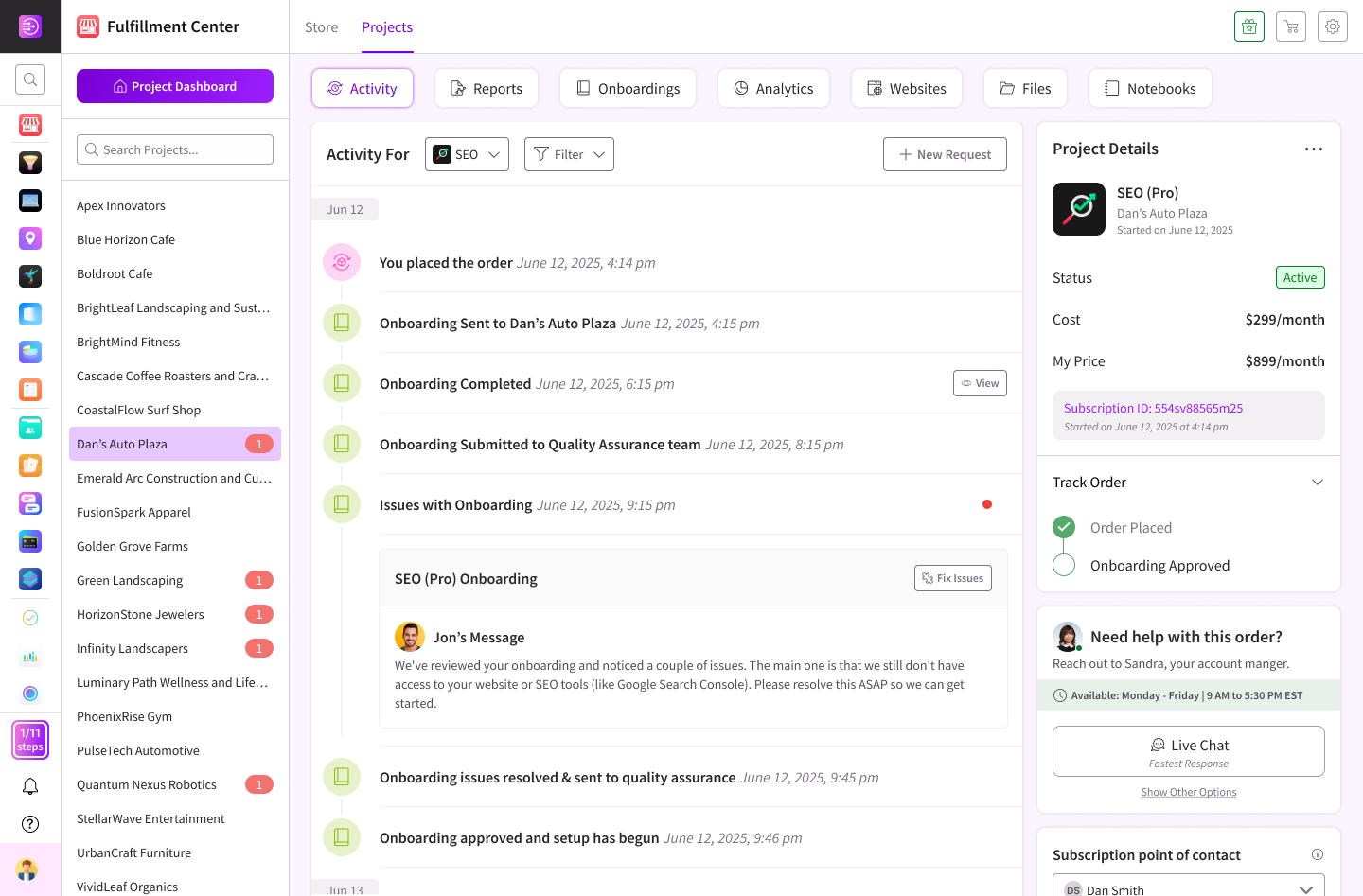
Their services include structured site health monitoring, technical audits, and ongoing fixes designed to protect performance as client numbers increase. Agencies gain access to standardized workflows that reduce manual effort and speed up issue resolution.
One of the key strengths of their platform is its white-labeled reporting. Technical progress is easy to communicate through branded dashboards and clear summaries, helping agencies demonstrate value without overwhelming clients with complexity.
By partnering with DashClicks, agencies can deliver reliable technical SEO outcomes without expanding in-house teams. This allows account managers and strategists to focus on planning and growth, while technical execution runs smoothly in the background.
Conclusion
Technical SEO at scale is not just about rankings. It is about systems, processes, and reliable execution across many websites. As client portfolios grow, manual approaches break down, and risks increase.
White label SEO partners provide agencies with the tools, expertise, and structure needed to protect site health consistently. From monitoring and performance optimization to migrations and reporting, these partnerships turn technical SEO into a repeatable operation.
Agencies looking to scale should review their current site health processes and identify gaps in monitoring, remediation, and reporting. Piloting a white label SEO agency with clear SLAs and measurable outcomes is often the fastest way to improve reliability without adding internal complexity.


.svg)


.svg)
.svg)
.svg)
.svg)
.svg)