

.svg)

.svg)
.svg)
.svg)
.svg)
.svg)
Search is changing fast. With the rise of Google’s Search Generative Experience (SGE), also known as AI Overviews, agencies and their white label SEO partners must rethink how they approach optimization. SGE adds generative summaries directly into the search results, often appearing above or beside traditional links. Because these summaries deliver quick answers, they can significantly shift how people click, scroll, and interact with search pages.
Studies released after Google expanded AI Overviews show that click-through rates for top organic results have dropped sharply, with the first result losing nearly a third of its previous clicks. Other research shows that zero-click searches have increased as users find everything they need in the AI-generated summary. All of this changes how traffic flows across the search ecosystem.
For agencies, especially smaller ones leaning on white label SEO services, these shifts raise the stakes. Clients expect guidance on SGE, not just traditional SEO. That means partnering with a white label SEO agency capable of meeting today’s search realities. If a partner can’t prove they understand SGE, the risks are simple: fewer clicks for clients, thinner margins for your agency, and shrinking trust over time.
What SGE Complicates for Small Agencies and Their Clients?
SGE doesn’t replace organic search, but it changes how people interact with it. As AI-driven summaries become a regular part of the results page, agencies are dealing with a new set of challenges that affect visibility, reporting, and content strategy.
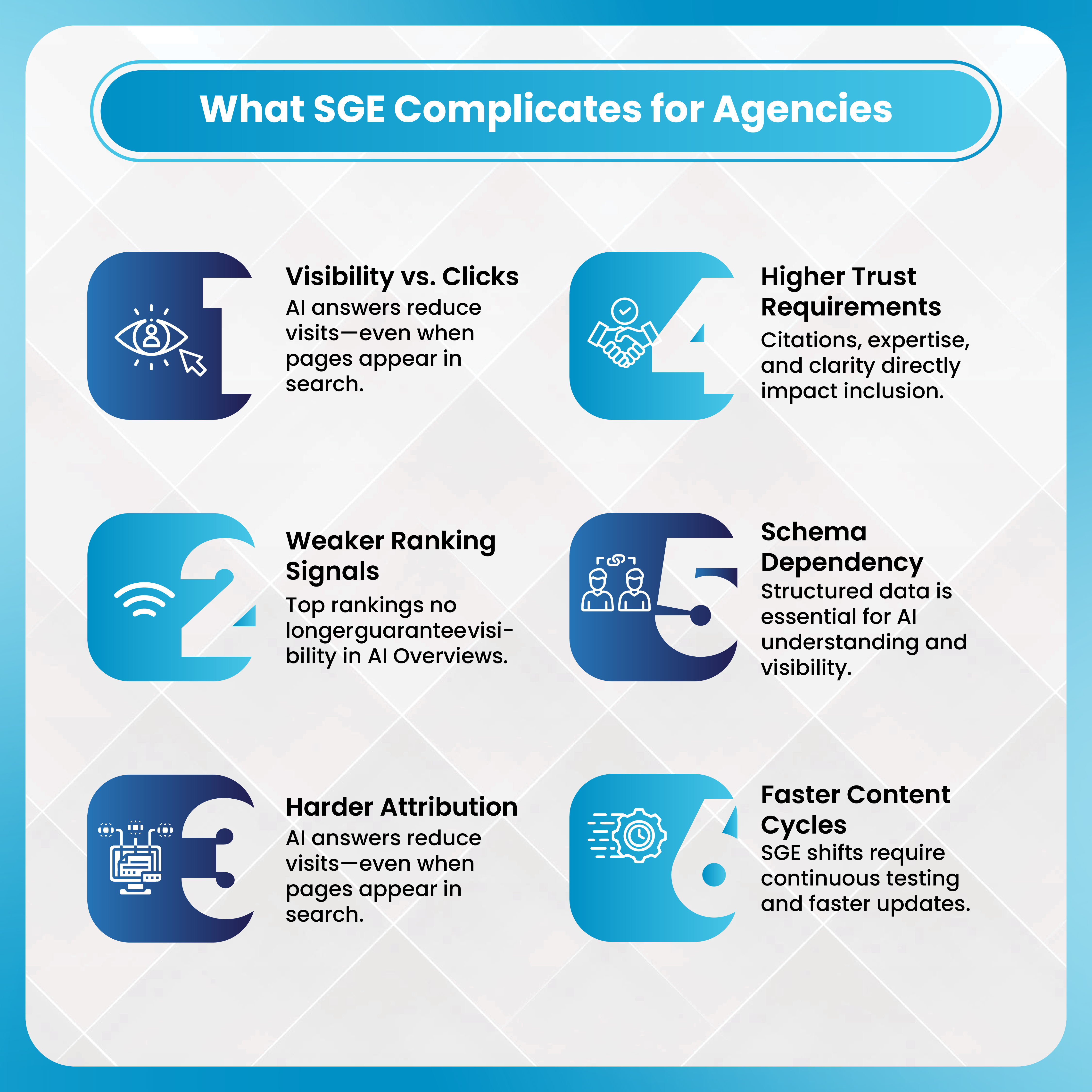
1. Visibility Versus Clicks
AI Overviews often answer a user’s question before they ever visit a website. A quick explanation, a comparison, or a step-by-step answer can all show up in the summary itself. This makes informational queries harder to monetize because users don’t feel the need to click through. Agencies that rely on top-of-funnel traffic see this most clearly, since these queries are the ones most likely to trigger summaries.
2. Traditional Ranking Signals Are Less Reliable
Old habits like publishing long, heavily optimized posts don’t carry as much weight anymore. SGE favors content that stays focused, reads cleanly, and makes its expertise obvious within seconds. A page might hold a good organic position but still get passed over for the AI summary if the structure, clarity, or authority cues aren’t strong enough.
3. Measurement and Attribution Become Harder
When users get what they need without clicking, analytics tools miss part of the story. A page may influence a decision even if the visitor never lands on it. Agencies now need to look at wider signals such as presence in AI summaries, impressions, branded query growth, assisted conversions, and return-to-search behavior. This shifts reporting away from simple traffic numbers and towards visibility and influence.
4. Content Provenance and Trust Matter More
SGE leans heavily on content that shows its sources and expertise. Pages with bylines, citations, original insights, and clear expertise signals stand out. Content that looks vague, generic, or poorly attributed can be skipped or summarized inaccurately, which hurts both visibility and brand trust.
5. Structured Data Becomes Essential
Semantic signals are now a major factor in what SGE chooses to summarize. Schema markup, clearly defined entities, and connections to known data sources make it easier for the AI to understand and surface a page. Without structured data, content is less likely to be pulled into summaries, regardless of how well it ranks.
6. Faster Iteration is Mandatory
The old content workflow of planning, writing, editing, and publishing over several weeks no longer keeps up with SGE. AI summaries change quickly as Google refines how it interprets intent and quality. Agencies need to experiment with formats, refresh pages more often, and adjust answer blocks, FAQs, and summaries as patterns shift. The agencies that move slowly lose ground because competitors can adapt their content in days instead of months.
If your white label SEO partner can’t work at this pace or explain how they’re staying ahead of SGE, you’re exposed to drops in visibility, fewer leads, and slipping client trust. This isn’t an area where “set it and forget it” works anymore.
What Agencies Should Ask White Label SEO Partners?
The best way to protect your clients is to vet your SEO partner with clear and practical questions. Below is a list your agency can use to check whether a provider is truly prepared for SGE. Each question explains why it matters and what you should expect from a strong partner.
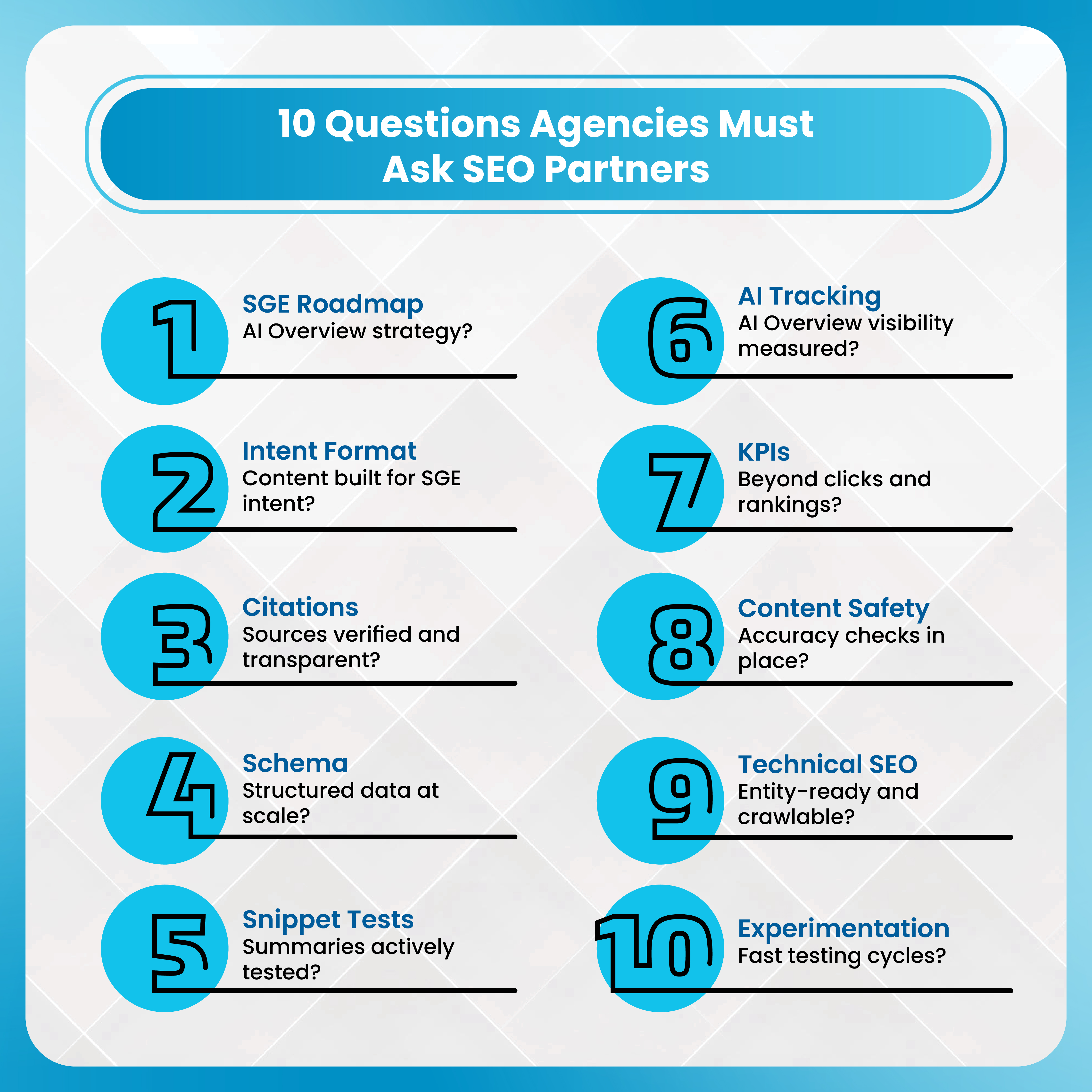
1. SGE Understanding and Roadmap
Start by asking how the partner defines SGE or AI Overviews and what their roadmap looks like for the next few quarters. Anyone who can’t break it down in simple terms won’t be able to build a strategy that holds up. You want a team that follows Google’s updates, tests early, and turns those insights into real processes.
A reliable partner maintains a written SGE playbook, explains how they structure content to improve the chance of being pulled into AI summaries, and shares quarterly testing results. They should be able to show what’s working now, not rely on vague predictions.
Request: A one-page SGE playbook and a few recent experiment summaries.
2. Content Format and Intent Mapping
SGE doesn’t look the same for every query. Some keywords show an overview, while others lean toward instructions or comparisons. A good partner maps these patterns to the content they produce so the structure matches the intent of the search.
A solid answer includes clear intent clusters, short lead summaries, precise answer blocks, and briefs designed to support SGE-friendly formats. If they can show how they plan content around these triggers before writing, that’s a strong sign.
Request: A content brief with a working headline, a 40–80 word summary, and citations.
3. Evidence and Citation Strategy
SGE relies heavily on strong sourcing. You should ask how the partner verifies information and keeps data accurate. Weak or unverified sources lower your visibility in AI Overviews and put your credibility at risk.
The best partners use reputable data, add inline citations, verify claims before publishing, and provide full reference lists. This helps the content earn trust signals that influence both ranking and visibility.
Request: A short article sample with inline citations and a complete source list.
4. Structured Data and Schema Optimization
Structured data gives Google context and improves your chances of being featured in SGE. Your partner should understand the most important schema types and how to apply them across different content types. This includes FAQ, how-to, article, product, and local business schema, along with custom options for niche sites.
Look for partners who use automated schema tools to keep large sites consistent. They should also be able to show where the schema made a measurable difference.
Request: Before-and-after examples showing schema updates and their impact.
5. Prompt and Snippet Testing
AI summaries are sensitive to how information is phrased. Even small changes in the opening paragraph or answer sections can influence visibility. Your partner should run prompt tests, experiment with snippet formats, and track their results.
A strong partner documents variations, compares outcomes, and shares data that shows how adjustments affected impressions or click-through rate. You want proof that they test intentionally, not guess.
Request: Two recent snippet or prompt test logs with clear outcomes.
6. SERP Feature and AI Overview Tracking
SGE visibility is a separate performance layer, and your partner needs to track it directly. If they don’t monitor AI Overviews alongside traditional rankings, you’ll miss insights that shape strategy.
Look for reporting that includes AI Overview impressions, SERP features, organic rankings, and engagement in one place. They should show visibility trends and how SGE affects client demand.
Request: A dashboard or reporting snapshot with SGE-specific tracking.
7. Attribution and KPI Reframing
SGE reduces clicks in many categories, so old performance metrics no longer tell the whole story. Ask how they rework KPIs to capture value beyond traffic alone. You need a partner who understands impression-based reporting, assisted conversions, and multi-touch attribution.
If they still measure success by clicks only, they’re not prepared for today’s search landscape. Updated metrics prove they understand the shift in user behavior.
Request: A KPI proposal that reflects current SGE realities.
8. Content Provenance and Safety
Accuracy matters more than ever with AI systems pulling data from countless sources. Ask how your partner prevents misinformation and what their review flow looks like. The goal is to reduce risk and keep your brand safe.
A strong partner uses human review, verifies claims, checks sources, and fixes errors quickly. They should be able to explain how they ensure content is safe, reliable, and trustworthy across all channels.
Request: Their content quality assurance checklist.
9. Technical SEO Readiness for SGE
SGE still relies on strong technical SEO. If Google can’t crawl or interpret your content, you won’t appear in AI Overviews. Your partner should handle site speed, internal linking, entity optimization, clean structure, and author details that add clarity.
A capable partner can share a technical audit that highlights SGE-specific opportunities like entity gaps, crawl issues, and content hierarchy problems.
Request: A technical audit sample with notes on SGE-related factors.
10. Experimentation Cadence and Fast Failure
SGE evolves fast, so your partner has to move quickly too. Ask about their testing schedule, how they track results, and how they decide when to adjust. Look for teams that run monthly experiments and document their findings in a clear, repeatable format.
A strong partner tests often, learns fast, and adapts without delay. This rhythm helps them stay ahead of the shifts in AI-generated search.
Request: A recent experiment log with takeaways.
Tactical Checklist — Proof to Request from Your Partner
Before choosing a white label SEO agency, ask for:
- SGE Playbook Sample: Shows their strategic approach to AI Overviews, testing schedules, and optimization roadmap.
- SGE-Optimized Content Brief: Demonstrates how they structure articles to match user intent for overviews, step-by-step guides, or comparisons.
- Schema Implementation Matrix: Details which structured data types they deploy for FAQs, how-tos, articles, and local business pages, including automated insertion processes.
- Recent Snippet or Prompt Test Results: Provides proof of experimentation with lead summaries, answer blocks, and phrasing variations to optimize for SGE citations.
- SERP Monitoring Dashboard Screenshot: Confirms they track AI Overview visibility, impressions, and assisted conversions in a measurable, client-reportable way.
- Provenance and Accuracy Guidelines: Outlines their process for sourcing content, verifying data, and reducing misinformation risks.
- Live Sample Content with Citations: Demonstrates that their content is not only well-written but citable, transparent, and backed by reliable sources.
- Technical SEO Audit Including SGE Items: Highlights crawlability, site speed, internal linking, entity markup, and pillar structures optimized for AI-driven summaries.
- Snippet and Prompt Test Logs: Offers documented outcomes of A/B testing, CTR improvements, or impression gains, proving their iterative approach.
- KPI Proposal Built for SGE: Shows how they track value beyond clicks, including impression-based metrics, scroll signals, multi-touch attribution, and downstream conversions.
- Source-Attribution Standards: Confirms that all content has transparent references, inline citations, and a verifiable source list to maintain credibility.
- Updated NDA or SLA Covering SGE-Based Execution: Ensures confidentiality and sets clear expectations around work that includes AI-optimized content and testing protocols.
Quick Wins Agencies Can Apply Immediately
Even before you fully update your workflow, here are simple steps you can implement right now -
- Lead Summary Paragraph: Start pillar pages with an 80-word summary containing two or three citations. This makes your content easier for AI to reference.
- Mini FAQ Blocks: Add short, clear Q&A sections and apply FAQ schema to help AI extract information.
- Provenance Block: Place a “Sources” section at the top or bottom of your content. It boosts trust and clarity for both users and AI.
- SGE Experimental Pages: Publish five short test pages each month, experiment with summary styles, and track impressions and assisted conversions.
How DashClicks Helps Agencies Prepare for Google SGE?
DashClicks supports agencies with a full suite of white label SEO services built for today’s search environment. Their process emphasizes SGE-friendly content structures, clear intent mapping, and comprehensive technical optimization. Agencies using DashClicks can scale content plans without expanding their internal team, while still offering high-quality deliverables optimized for AI summaries.
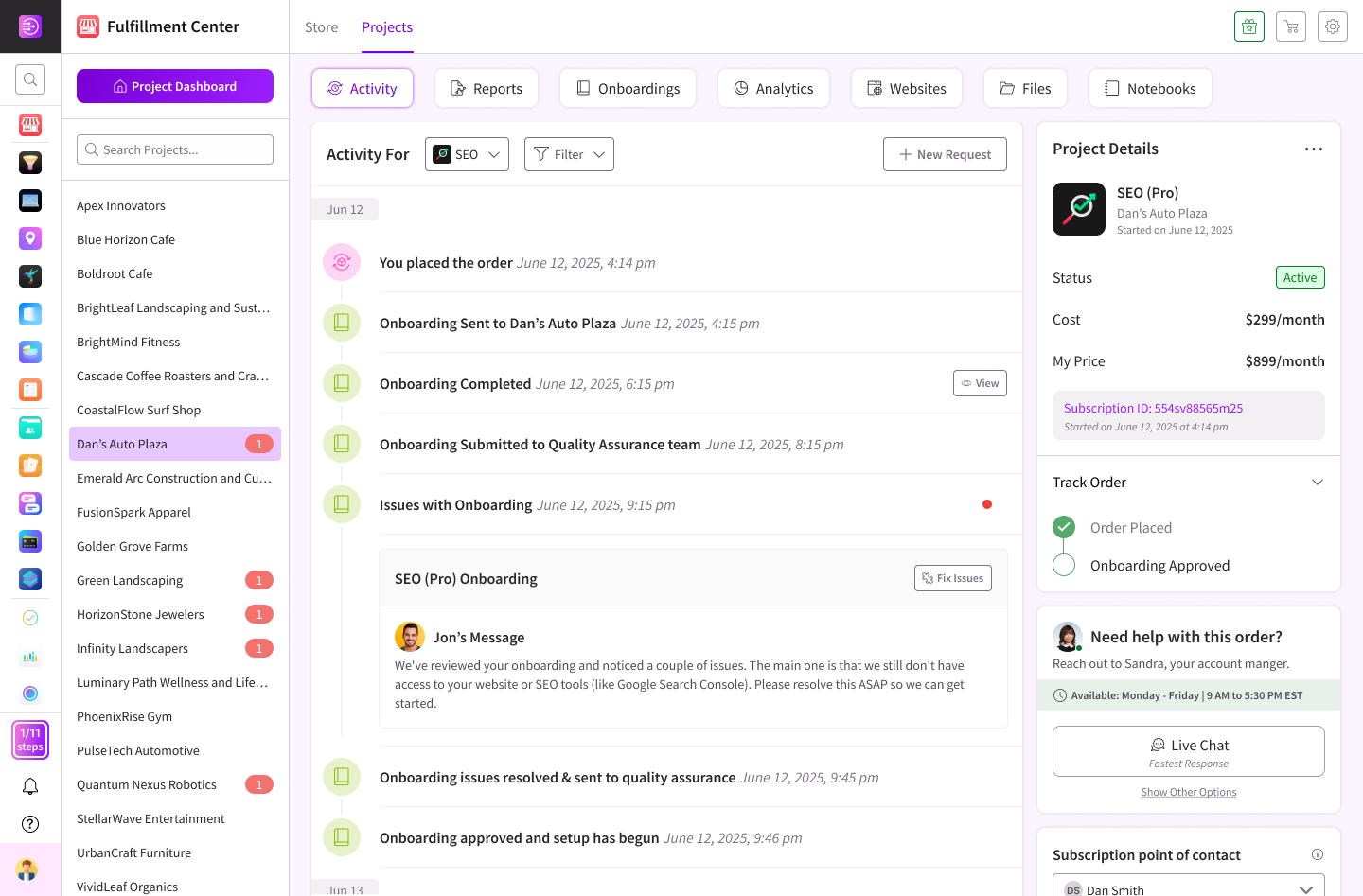
DashClicks also provides extensive schema support, fast implementation cycles, and flexible reporting dashboards. This helps agencies adapt quickly as SGE evolves. With enterprise-level fulfillment and white-label reporting, agencies retain full control while offering clients modern, SGE-aligned SEO solutions.
Conclusion
Google SGE is reshaping how people search and how agencies must think about SEO. Early adopters who build systems for structured data, intent-driven content, and continuous experimentation will stay ahead as generative search expands. With the right white label SEO partner, agencies can move faster, scale smarter, and protect long-term client performance. Preparing now means stronger results, fewer surprises, and better retention.


.svg)


.svg)
.svg)
.svg)
.svg)
.svg)