

.svg)

.svg)
.svg)
.svg)
.svg)
.svg)
Most marketing agencies understand the fundamental principles of a strong paid search strategy. They know how to identify target audiences, write compelling ad copy, and select appropriate keywords. However, the real issue often stems from execution consistency. Building a brilliant strategy is only a small fraction of the battle. The daily implementation of that strategy dictates whether an account succeeds or fails.
When you audit underperforming accounts, campaigns often look active on the surface. Budgets are being spent, and ads are generating clicks. However, a deeper look reveals a lack of structure, stability, and long-term direction. PPC involves daily micro-decisions that compound over time. A minor bid adjustment or a delayed negative keywords addition might seem insignificant in isolation. Over several weeks, these small actions or inactions dictate the overall profitability of the campaign.
The importance of these daily execution details becomes clear when looking at the numbers. According to Google, improving ad relevance and Quality Score can reduce your cost per click by up to 50%. Capturing that cost reduction requires constant vigilance and structured optimization. Similarly, data from WordStream shows that the average Google Ads conversion rate is roughly 7.04%. Reaching or exceeding that benchmark demands meticulous execution.
PPC success is not about occasional optimizations. It is about repeatable execution systems. Small bursts of effort cannot replace a steady, organized approach to account management. Even highly experienced agencies struggle with this reality because maintaining consistent execution requires systems, not just raw effort.
Everyday PPC Execution Gaps That Quietly Hurt Performance
The barriers preventing accounts from reaching their full potential are rarely obvious strategy flaws. Instead, they are small execution gaps that compound over time. These subtle inefficiencies slowly drain budgets and artificially inflate acquisition costs.
1. Inconsistent Optimization Cycles
In many busy agencies, Google Ads optimization happens sporadically. Account managers log in to make adjustments only when a client asks a question or when performance takes a noticeable dip. These changes are reactive instead of proactive. The account manager is putting out fires rather than steering the campaign toward better results.
The deeper issue is the lack of a defined cadence for core management tasks. There is no set schedule for bid adjustments, search term reviews, or creative refreshes. When these tasks occur randomly, the campaign never enters a steady rhythm.
This sporadic approach leads to significant performance fluctuation. Furthermore, making massive changes all at once causes learning resets within the advertising platform algorithms. These resets delay optimization and lead to missed opportunities for continuous, incremental growth.
2. Inefficient Budget Allocation Across Campaigns
Another common gap involves how funds are distributed across different initiatives. Budgets frequently get spread thin across too many campaigns. In these scenarios, high performers are routinely underfunded while low performers are overfunded. The budget runs out on the best campaigns early in the day, leaving the poorly performing campaigns to consume the remaining funds.
The deeper issue driving this problem is the absence of a data-driven prioritization model. Without a system to shift funds based on real-time data, account managers leave money on the table. Google Ads best practices emphasize allocating spend based on conversion efficiency to maximize returns.
Failing to shift budgets effectively results in a lower impression share on winning segments. It also drives up the overall cost per acquisition and leads to significant wasted spend over the lifespan of the account.
3. Unstable Campaign Structures
Many agencies fall into the trap of over-segmentation. They build messy account architectures filled with too many low-data ad groups. They attempt to isolate every possible keyword variation into its own unique container.
This deeper issue reveals a structure built for human control rather than algorithm efficiency. Modern advertising platforms rely on machine learning to optimize bids and placements. Algorithms need significant data volume to learn what works and what does not.
When structures are overly segmented, they suffer from weak signal density. The algorithm cannot gather enough data within any single ad group to make smart decisions. This results in slower optimization and poor quality scores across the board.
4. Lack of Data Clarity and Signal Quality
Data clarity is the foundation of modern paid search. Unfortunately, poor conversion tracking is a widespread issue. Agencies often track the wrong actions or suffer from misaligned tracking goals that do not reflect actual business value.
Google explicitly highlights that improved conversion tracking improves bidding performance. Without accurate data, the automated systems within the ad platforms operate blindly.
When signal quality is poor, smart bidding algorithms make the wrong decisions. The campaigns end up optimizing for the wrong outcomes, such as generating low-quality top-of-funnel clicks instead of driving actual sales or qualified leads.
5. Reactive Decision-Making Instead of Systems
Many account managers rely heavily on their gut decisions. They look at a few days of data and make sweeping changes based on short-term thinking. There are no structured frameworks dictating when and how to pause a keyword or scale a winning ad.
The underlying problem here is that execution is entirely person-dependent. It relies on the specific mood, experience level, and available time of individual employees. It is not system-driven. When execution depends on individuals rather than systems, consistency becomes impossible to maintain.
6. Execution Breaks at Scale
An agency might have brilliant account managers who can handle five or ten clients perfectly. However, this manual approach works for a few clients but breaks at scale. As the agency brings on more accounts, each client receives less individual attention.
The impact of scaling a broken system is immediate. Optimization cycles slow down drastically. Increased human errors slip through the cracks, from misspelled ad copy to incorrect budget settings. Ultimately, this leads to inconsistent results and unhappy clients.
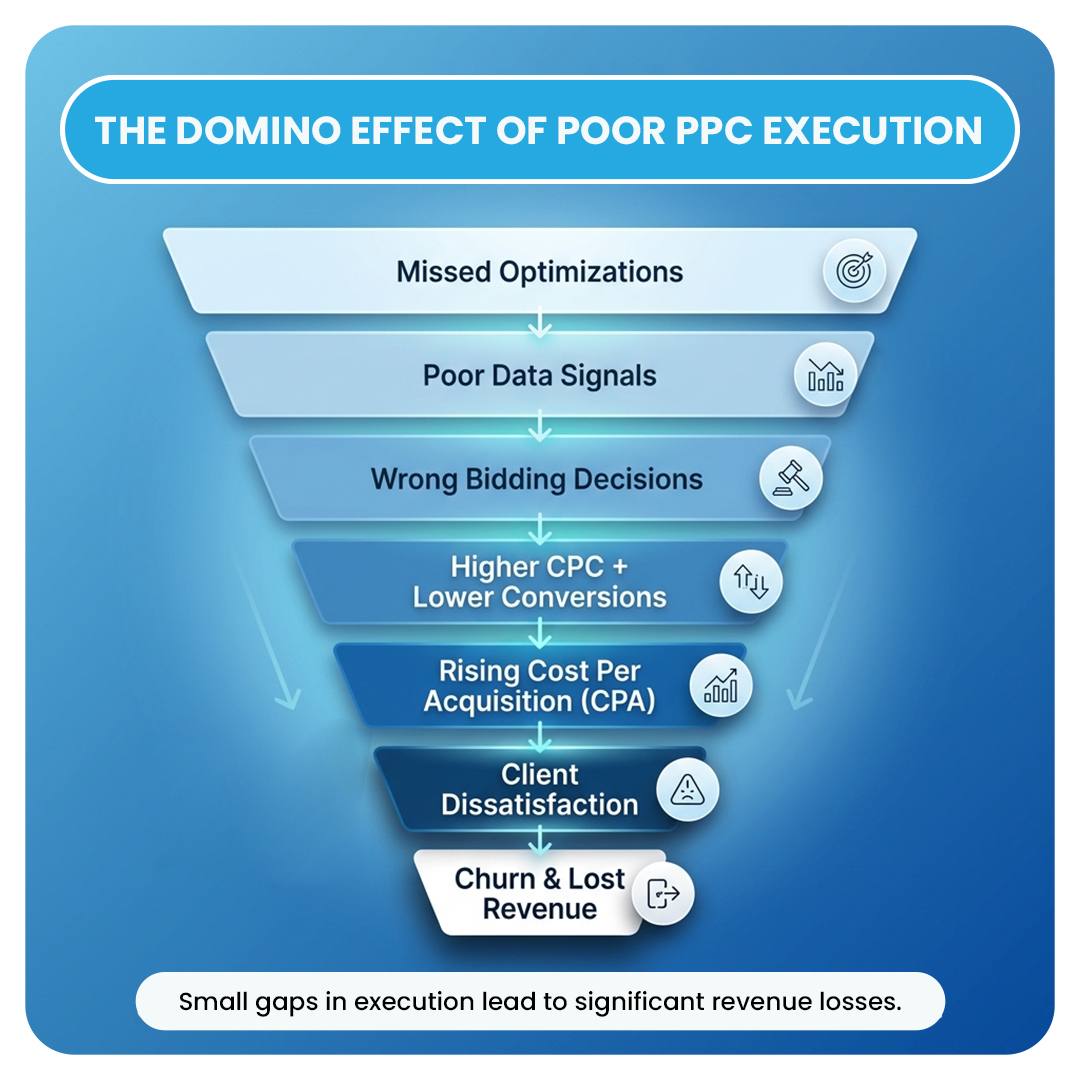
All these problems come from one root cause. PPC execution is handled as isolated tasks instead of structured systems. Solving these issues requires a fundamental shift in how campaigns are managed.
How White Label PPC Services Bring Structure to Execution?
White label PPC services solve these widespread agency problems by introducing a structured execution layer. Instead of relying on overworked individuals to remember every task, these specialized providers implement rigid, proven systems.
1. Standardized Optimization Frameworks
The most immediate benefit of a structured approach is the introduction of standardized frameworks. White label providers operate using strict daily, weekly, and monthly workflows. They have defined standard operating procedures for every possible campaign adjustment.
As a result, consistency completely replaces randomness. Every account receives the exact same level of technical care, regardless of which specific analyst is looking at the screen. Routine tasks happen on a predictable schedule, keeping the campaigns healthy and active.
2. Data-Driven Budget Allocation Models
Structured execution also transforms how budgets are handled. White label PPC services implement strict rules for budget shifts based on real-time performance metrics. They monitor cost per acquisition, total conversions, and impression share daily.
This approach ensures that spending becomes a strategic lever rather than a static setting. Funds are fluidly directed toward the ad groups and campaigns generating the best returns, mathematically improving the overall efficiency of the client's budget.
3. Simplified and Scalable Campaign Structures
Expert white label partners understand how modern algorithms function. They focus on campaign consolidation rather than over-segmentation. By grouping related keywords and audiences, they build structures focused entirely on signal strength.
This consolidation leads to much faster learning phases. Better algorithm performance naturally follows, as the automated bidding strategies finally have the data volume they need to succeed. Furthermore, these streamlined structures frequently result in improved quality score across the account.
4. Accurate Tracking and Signal Optimization
Before spending a single dollar, a structured execution team ensures a clean tracking setup. They audit the existing tags and align all conversion actions strictly with the client's actual business goals.
The result of this foundational work is that smart bidding works properly. The algorithms receive clean, highly accurate data about which clicks turn into revenue. This allows the automated systems to bid aggressively on the right users and ignore the irrelevant traffic.
5. Proactive Optimization Systems
White label teams do not wait for a client to complain before checking an account. They utilize scheduled optimization cycles that occur regardless of current performance trends. They also deploy controlled testing for ad copy and landing pages.
The key insight here is that performance improves through planned iteration. By constantly running controlled experiments and proactively weeding out wasted spend, the baseline performance of the account slowly but surely rises over time.
6. Scalable Execution Without Performance Drop
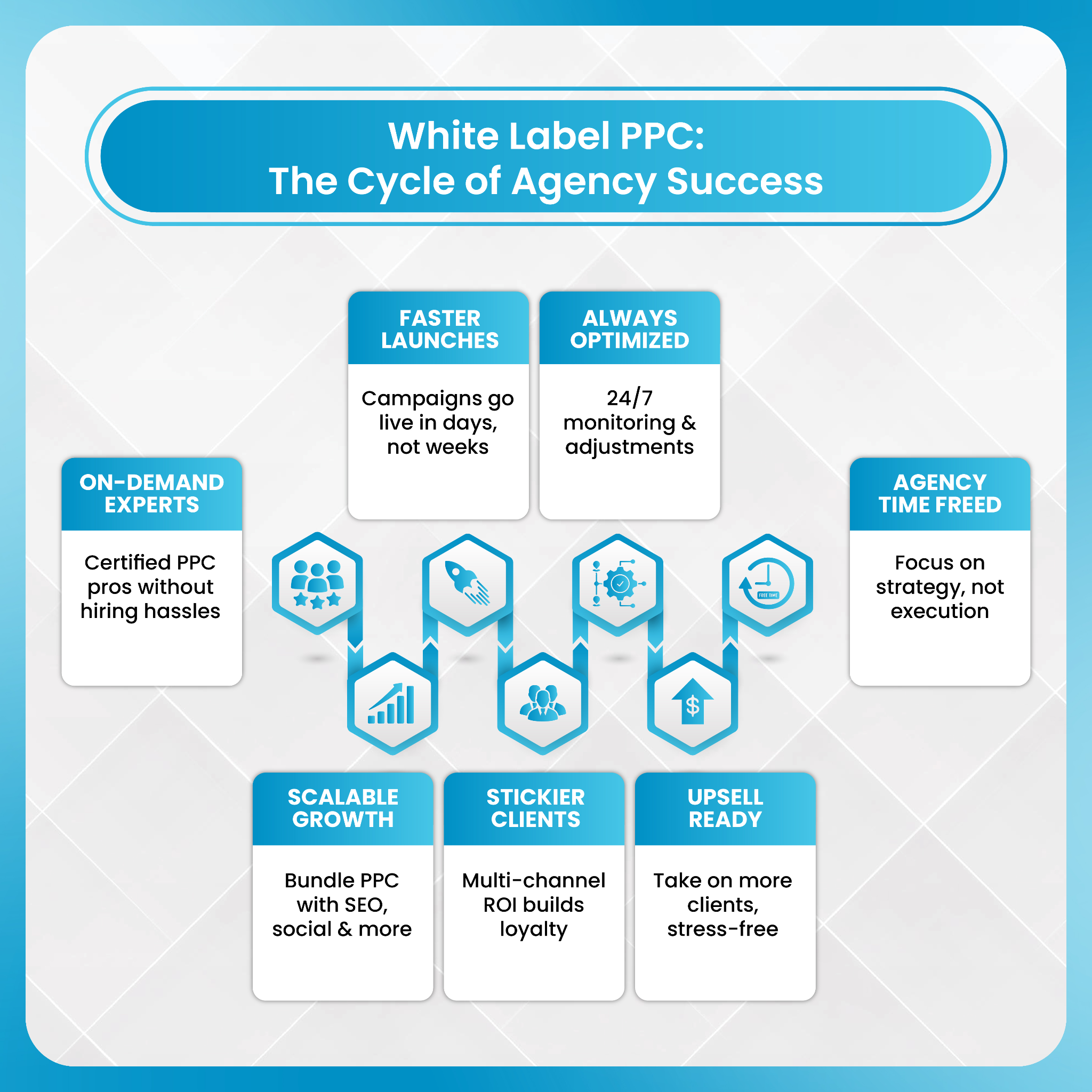
Finally, structured execution solves the scaling problem. White label providers utilize dedicated teams of specialists and parallel campaign handling processes. Because the systems are documented and standardized, new accounts can be onboarded rapidly.
The ultimate result is that agencies can scale without losing quality. An agency can add fifty new clients in a month, and the white label PPC partner will apply the exact same rigorous optimization frameworks to client number fifty as they did to client number one.
When execution becomes structured, PPC performance becomes predictable and controlled. Agencies can stop worrying about daily operational tasks and focus entirely on growth.
What Changes When Execution Becomes System-Driven?
Implementing a system-driven approach to campaign management completely alters the trajectory of an agency. The benefits extend far beyond simple time savings, directly impacting the quality of the service provided to the end client.
1. More Predictable Campaign Performance
One of the most noticeable changes is a drastic reduction in performance volatility. Because optimization happens on a regular schedule, performance spikes and crashes are smoothed out. Agencies enjoy stable cost per acquisition metrics and consistent cost per click trends, making forecasting much easier.
2. Improved Budget Efficiency
System-driven execution eliminates the slow leaks that drain client budgets. By routinely parsing search term reports and pausing inefficient segments, the overall return on investment naturally climbs. Reduced waste means more of the client's money is spent acquiring actual customers.
3. Faster Optimization Cycles
When you rely on systems, you identify and resolve issues much faster. If a landing page breaks or a specific keyword stops converting, the standardized review process catches it immediately. Likewise, this speed allows agencies to experience faster opportunity capture when a new search trend emerges.
4. Stronger Client Confidence
Clients panic when their agency cannot explain why performance changed. Structured frameworks help improve efficiency and client confidence. Account managers can point to clear decision logic and specific optimization schedules. This transparency leads to easier reporting and much stronger trust between the agency and the client.
5. Scalable Growth Without Operational Stress
Perhaps the most important change for the agency owner is the ability to handle more clients without quality loss. System-driven execution via a specialized partner removes the operational bottlenecks holding the agency back. This also results in significantly reduced hiring pressure, as the agency no longer needs to scramble to find and train new media buyers for every handful of new clients.
To achieve this level of operational maturity, agencies need systems, specialized expertise, and relentless, consistent execution.

How DashClicks’ White Label PPC Services Support Structured Execution?
Adopting these necessary frameworks is simple when partnering with an established provider. For example, the white label PPC services provided by DashClicks are built specifically to introduce this missing execution layer to growing agencies. Their platform integrates standardized workflows that ensure every client account receives meticulous, ongoing optimization.
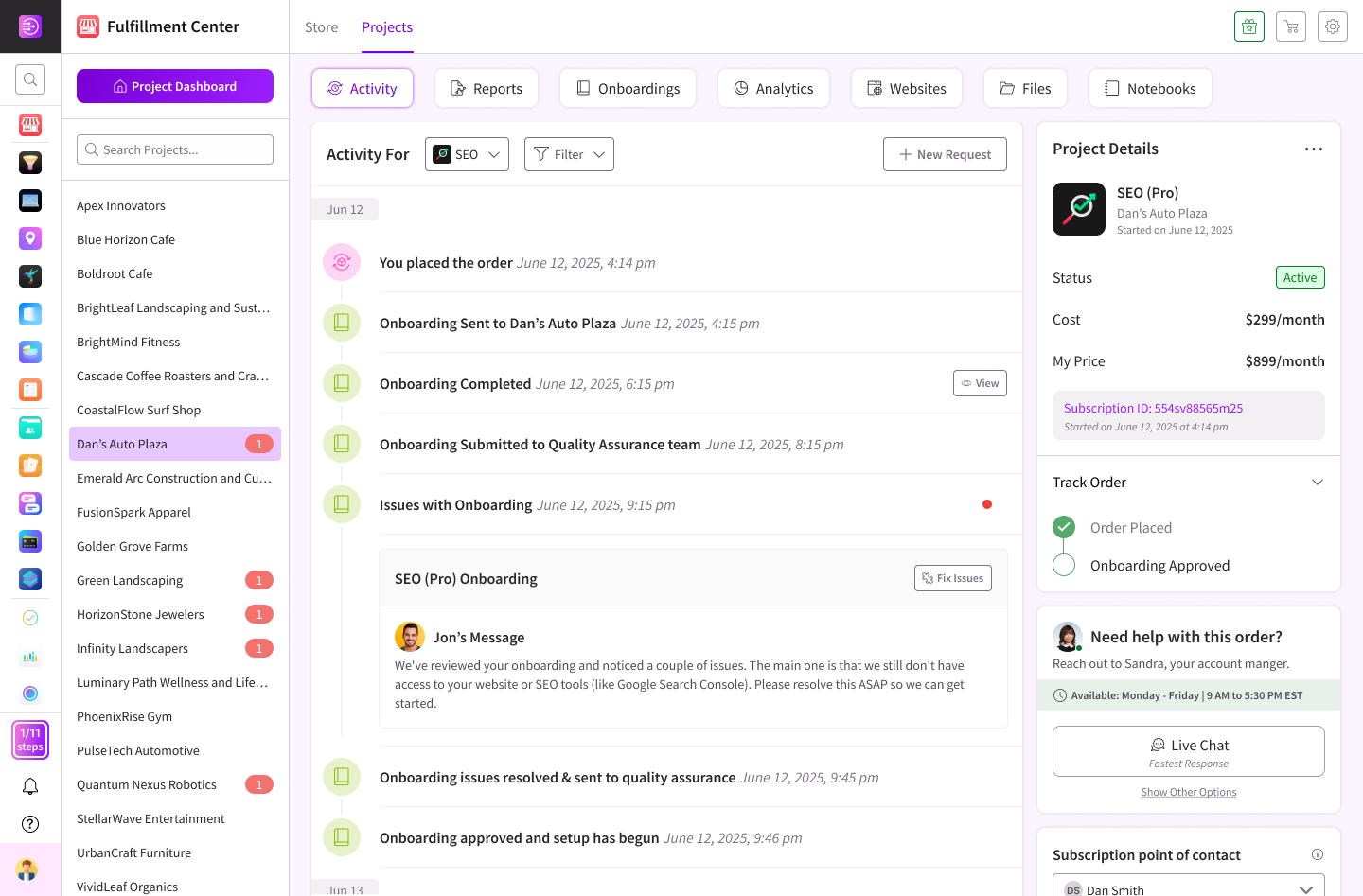
Agencies utilizing DashClicks benefit from data-driven budget strategies and clean tracking setups without having to manage the technical details themselves. Furthermore, they provide fully white labeled dashboards and clear reporting, allowing your agency to maintain complete brand control. This scalable campaign management infrastructure allows agencies to handle rapid growth while executing complex advertising strategies flawlessly, all without increasing their internal workload.
Conclusion: PPC Success Comes from Systems, Not Effort
PPC issues are almost never effort problems. Account managers usually work incredibly hard to deliver results for their clients. The reality is that poor performance usually points to structure problems. When internal teams lack the frameworks to prioritize tasks, inconsistent execution limits agency growth and frustrates clients.
Partnering with a specialized provider transforms campaign management from a chaotic daily scramble into repeatable systems. White label PPC services introduce data-driven processes that remove the guesswork from account optimization. By standardizing the optimization cycles, tracking audits, and budget allocations, agencies can finally deliver predictable outcomes for their clients.
Fixing execution is the single most important step in building scalable agency growth. When you stop worrying about the daily micro-decisions of paid search, you free up the resources needed to expand your business and focus on high-level strategy.


.svg)


.svg)
.svg)
.svg)
.svg)
.svg)