

.svg)

.svg)
.svg)
.svg)
.svg)
.svg)
Facebook Ads has become one of the most widely offered services in digital marketing, making it increasingly difficult for agencies to stand out. According to Meta's Q1 2025 Earnings Report, Meta's Family of Apps reaches more than 3.4 billion people daily, while Statista reports that Facebook has over 3 billion monthly active users. With nearly every agency advertising similar Facebook Ads services, prospects are often faced with identical promises of more leads, higher ROAS, and lower CPA.
Competing on price is rarely a sustainable strategy. Lower fees attract lower-value clients, reduce profitability, and fail to communicate why one agency is a better choice than another. Today's most successful agencies differentiate themselves through consistent execution, proactive communication, reliable reporting, and an exceptional client experience rather than simply offering Facebook Ads.
This is where white label Facebook advertising provides a competitive advantage. By leveraging structured fulfillment and standardized processes, agencies can deliver high-quality campaigns, consistent optimization, and dependable client communication without expanding their internal teams.
In this blog, you'll learn why Facebook Ads services have become increasingly commoditized, what truly differentiates high-performing agencies, how operational excellence creates a lasting competitive advantage, and how white label Facebook advertising helps agencies scale while competing on value instead of price.
Why Has Standing Out Become More Difficult for Facebook Ads Agencies?
The demand for Facebook Ads services has never been higher. But high demand has also attracted more competition, and the gap between agencies on a technical level has narrowed significantly.
Most agencies operating today offer some version of Facebook Ads management. When prospects begin comparing options, they tend to hear the same set of promises regardless of which agency they speak to:
- More leads at a lower cost per acquisition. Every agency leads with this promise, making it difficult for any single agency to own it.
- Better ROAS through improved targeting and creativity. This is a standard selling point now, not a differentiator.
- Lower CPC and CPM through campaign optimization. Again, widely claimed and difficult to verify upfront.
- Higher-quality ad creatives that convert. Most agencies say this, but few show a structured process for achieving it.
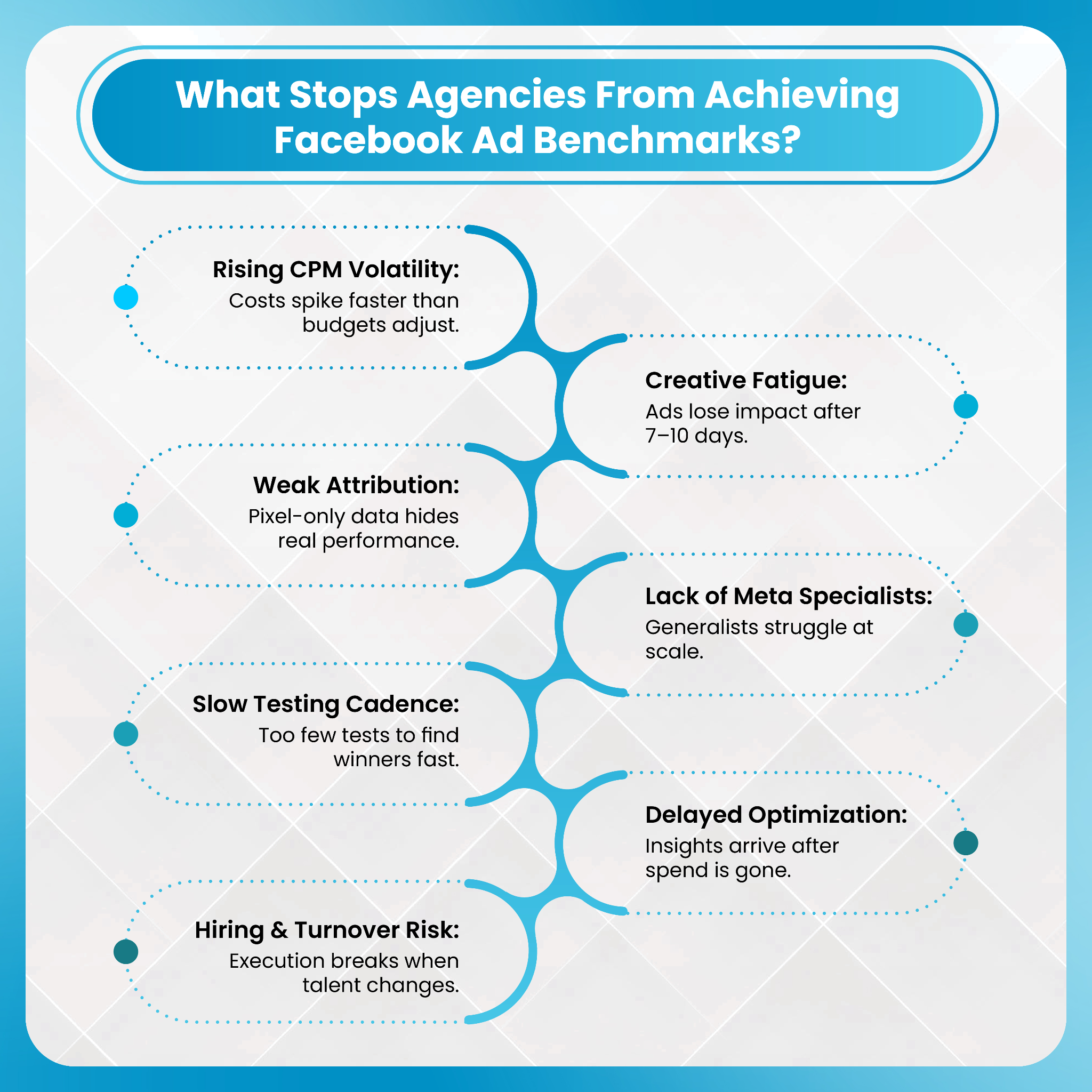
This similarity in messaging creates real buyer indecision. When everything sounds the same, prospects default to price as the deciding factor. That is a race no agency wants to run.
The barrier to entry has also dropped. AI-powered tools inside Meta Ads Manager now assist with audience suggestions, budget optimization, and creative generation. These tools have made it easier for newer or smaller agencies to produce functional campaigns without deep platform expertise.
What clients are increasingly evaluating is not just whether an agency can run ads, but whether the agency has the operational maturity to manage campaigns reliably over time. Platform knowledge is table stakes. How your agency delivers, communicates, and scales is where the real evaluation happens.
When every agency promises similar campaign results, clients begin evaluating something much harder to copy: confidence.
Clients No Longer Buy Facebook Ads, They Buy Confidence
Most clients hiring a Facebook Ads agency do not have a deep background in paid social advertising. They cannot open Meta Ads Manager to accurately assess whether their campaigns are well structured, whether audience targeting is dialed in, or whether budget optimization is handled correctly.
They can evaluate how your agency makes them feel.
According to Salesforce's State of the Connected Customer, 88% of customers say the experience a company provides is as important as its products or services. This applies directly to agency-client relationships. Clients are not just buying campaign management. They are buying the experience of being managed well.
Here is what clients actually use to judge agency quality:
- Responsiveness. How quickly does the agency reply to questions or concerns? Slow responses signal disorganization, regardless of campaign performance.
- Communication. Does the agency explain what is happening, why it matters, and what comes next? Or does it send raw data and leave clients to interpret it?
- Transparency. Are clients kept informed about performance changes, budget pacing, and creative decisions? Or do they feel like things are happening without their knowledge?
- Consistency. Does the agency deliver on time, every time? Or do deadlines slip and reports arrive late?
- Professionalism. Does the agency feel structured and reliable, or does it feel reactive and disorganized?
Agencies that build predictable execution into their operations create a better client experience by default. Clients renew because they trust the process, not because they fully understand every media buying decision. Reliability becomes part of the value proposition, and that is something price alone cannot compete with.
Confidence is built through daily execution, which means operational systems matter just as much as campaign strategy.
The Five Areas Where High-Performing Agencies Differentiate Their Facebook Ads Service
Agencies that consistently outperform their competition tend to share similar operational habits. These habits show up across five specific areas of Facebook Ads service delivery.
1. Faster Campaign Launches
Every day a campaign sits unlaunched is a day a client is questioning their decision to hire your agency. High-performing agencies minimize that window through structured onboarding processes that include:
- Standardized client onboarding checklist that gathers the right information upfront.
- Pixel validation to confirm that conversion tracking is firing correctly before launch.
- Event testing to verify that key actions such as purchases, form fills, and page views are tracked accurately.
- Creative approvals that move through a defined process rather than waiting in someone's inbox.
- Audience preparation so targeting parameters are ready before the account goes live.
Faster launches do not just improve efficiency internally. They immediately strengthen client confidence. A client who sees their campaigns live within a week of signing feels like they made the right choice.
2. Better Creative Testing Systems
Creative is consistently one of the most important variables in Facebook and Instagram ad performance. Meta recommends refreshing ad creatives regularly to reduce ad fatigue and maintain engagement rates. High-performing agencies build repeatable testing frameworks to manage this systematically.
A structured creative testing process includes:
- Testing hooks to determine which opening lines stop the scroll.
- Testing offers to identify which value propositions resonate most with the target audience.
- Testing headlines, formats, and calls to action across ad sets.
- Scheduled creative refresh cycles to prevent audience fatigue before it damages performance.
Without a defined process, creative testing becomes inconsistent. Some clients get it; others do not. A structured system ensures every account benefits from ongoing improvement.
3. Stronger Performance Communication
There is a meaningful difference between reporting and communication. Reporting means sharing data. Communication means turning that data into insights a client can understand and act on.
High-performing agencies build communication habits that include:
- Monthly performance summaries written in plain language, not pulled metrics.
- Recommendations that explain what should change and why.
- Forecasting that sets realistic expectations for upcoming periods.
- Next-step planning so clients understand what the agency is working on, not just what happened last month.
When clients understand campaign performance, they feel more confident in the agency managing it. That confidence directly supports retention.
4. Consistent Optimization Discipline
Campaign optimization is not a one-time task. It is a recurring discipline that drives sustained performance improvements over time. Agencies with strong optimization habits follow structured weekly processes that include:
- Budget pacing reviews to ensure spend is distributed correctly across campaigns.
- Frequency monitoring to identify audiences that are seeing ads too often.
- Audience expansion planning to introduce new targeting when performance plateaus.
- Placement analysis to assess where conversions are coming from and where the budget should shift.
- Attribution review and conversion validation to ensure tracked results are accurate.
Recurring optimization consistently outperforms occasional adjustments because problems get caught earlier and improvements compound over time.
5. Reliable Client Experience
Operational reliability is a form of agency branding. Every time a deadline is met, a report arrives on schedule, or a question is answered quickly, the agency reinforces a reputation for being dependable. Specific habits that build this reputation include:
- Meeting campaign launch and reporting deadlines without exception.
- Delivering consistent reporting on a predictable schedule.
- Responding to client questions faster than clients expect.
- Maintaining organized account documentation and workflows.
- Providing proactive recommendations rather than waiting for clients to ask.
Reliability creates familiarity, and familiarity creates trust. Clients who trust their agency rarely look for alternatives.
Maintaining this level of consistency becomes more difficult as client portfolios expand.
Why Most Agencies Struggle to Differentiate as They Grow?
Operational discipline is manageable when an agency has a small client base. As portfolios grow, the same habits that made differentiation possible become harder to sustain.
Common bottlenecks that emerge with growth include:
- Increased Client Volume: More accounts mean more variables to manage, more reporting to produce, and more communication to maintain simultaneously.
- Limited Specialist Capacity: As account managers take on more clients, the depth of attention each account receives starts to decline.
- Context Switching: Managing multiple accounts across different industries and campaign objectives fragments focus and increases the likelihood of errors.
- Inconsistent Quality Assurance: Without structured QA processes, campaign reviews become reactive rather than systematic.
- Reporting Delays: Reports get pushed back when teams are stretched, which is exactly the moment clients start questioning the relationship.
- Creative Bottlenecks: Creative requests pile up, refresh schedules get delayed, and performance suffers while clients wait.
- Campaign Review Delays: Optimization tasks get deprioritized during busy periods, leading to performance gaps that are difficult to explain.
The growth trap looks like this:
More Clients → More Operational Complexity → Less Strategic Time → Inconsistent Delivery → Weaker Client Experience → Reduced Differentiation
Agencies that built their reputation on reliable execution find that the same growth they worked toward is now threatening the quality that got them there.
Operational consistency influences client perception just as much as campaign performance.
Why Better Facebook Ads Results Alone Aren't Enough?
Imagine two agencies with identical ROAS across their client portfolios. One retains 80% of its clients year over year. The other churns through clients every six months. The difference rarely comes down to campaign performance. It comes down to operational brand perception.
Clients do not experience an agency through spreadsheets and ad accounts. They experience it through every interaction, including:
- How smooth the onboarding process felt.
- How clearly the agency communicated during the first 30 days.
- How professional the first report looked.
- How quickly questions were answered.
- How well the agency explained performance changes.
- How organized the workflow appeared from the client's perspective.
- How proactively the agency educated them on what was happening and why.
Agencies with strong operational brand perception build confidence at every touchpoint. Even during periods when campaign performance is being optimized, clients stay because they trust the process and the people managing it.
Agencies with similar ROAS but weaker operational habits tend to experience higher churn because the client experience does not reinforce trust. Performance alone is not enough to hold relationships together when communication, reporting, and reliability are inconsistent.
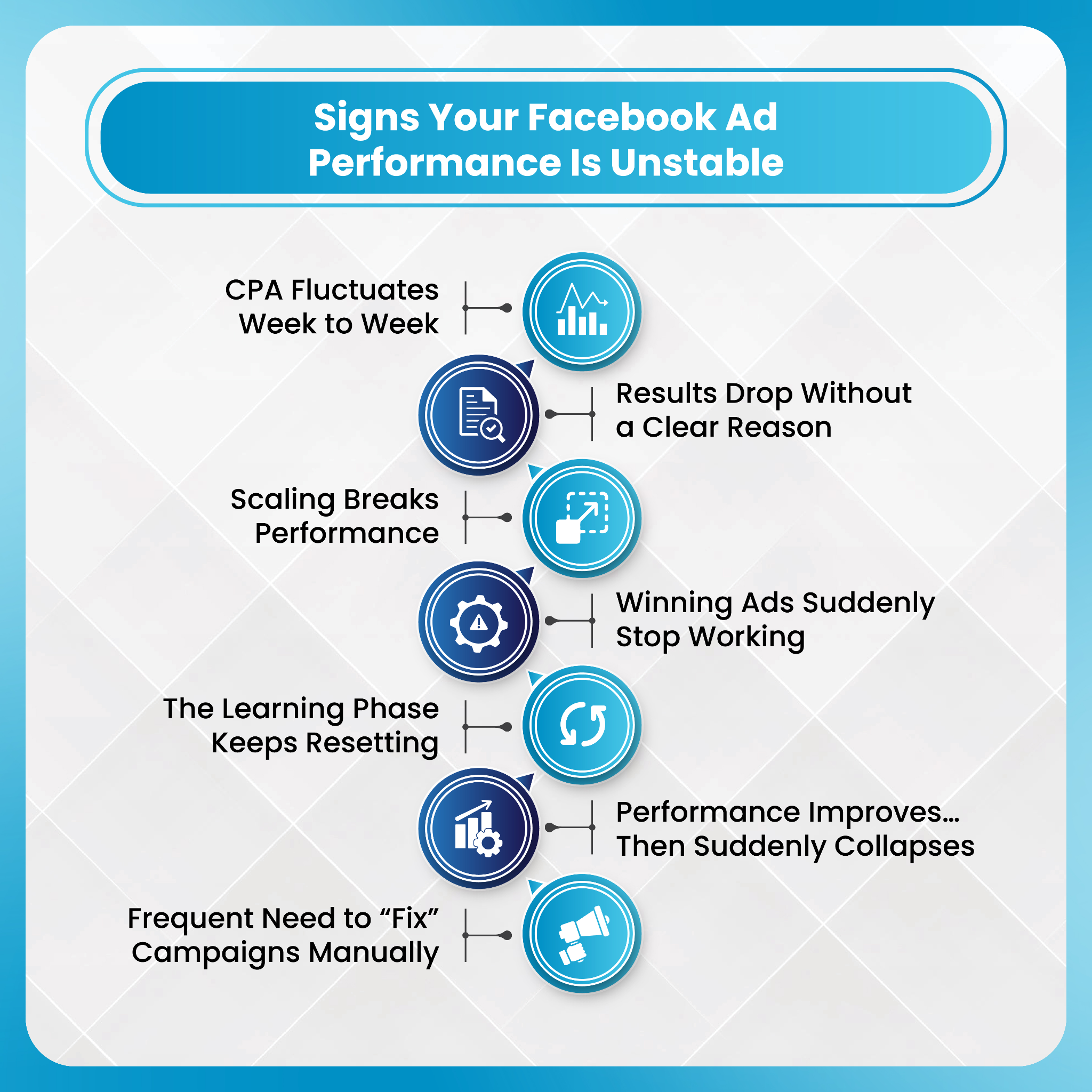
Operational excellence becomes much easier to maintain when fulfillment follows structured systems.
How White Label Facebook Ads Strengthen Every Competitive Advantage?
White label Facebook advertising is more than a way to increase capacity. With structured workflows and experienced specialists, it strengthens the operational areas clients value most.
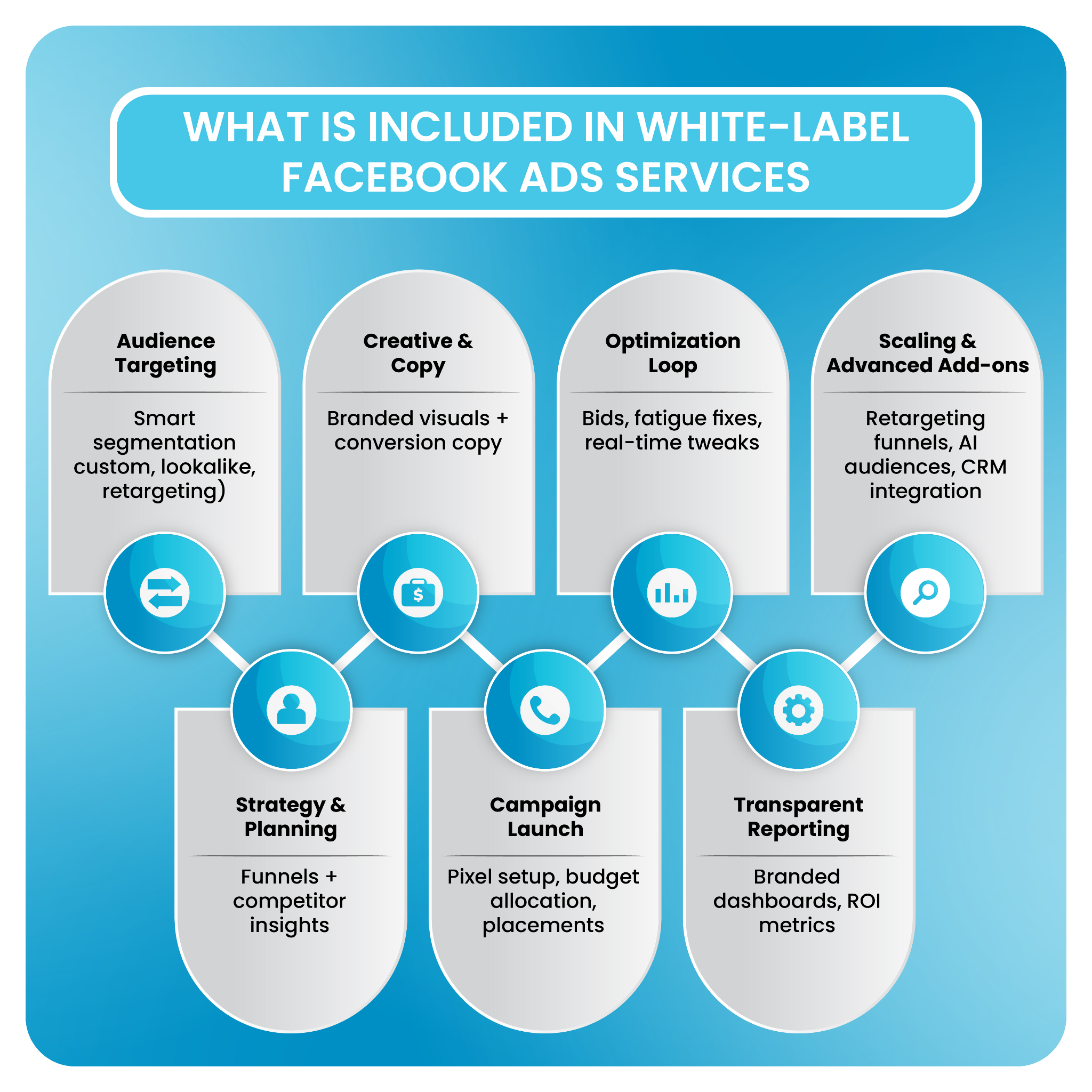
- Specialized Facebook Ads Experts: A white label Facebook advertising agency gives agencies access to dedicated media buyers who focus exclusively on Meta Ads. Their expertise spans audience targeting, creative testing, bidding strategies, budget optimization, and performance analysis, leading to more consistent campaign execution.
- Standardized Campaign Operations: White label partners follow documented SOPs for campaign setup, launch checklists, optimization schedules, quality assurance, and reporting. These standardized workflows reduce errors, improve consistency, and ensure every client receives the same high-quality experience.
- Consistent Creative Execution: Creative testing often becomes inconsistent as agencies grow. White label reporting helps streamline creative requests, organize asset management, schedule testing, and plan refresh cycles, helping campaigns stay optimized without last-minute adjustments.
- White Label Reporting: Professional, branded reporting reinforces agency credibility. White label reporting provides customized dashboards, performance summaries, and actionable insights under the agency's brand, giving clients clear visibility into campaign progress.
- Flexible Fulfillment Capacity: White label fulfillment allows agencies to onboard more clients and handle seasonal demand without hiring additional staff. As workloads increase, fulfillment scales alongside the agency while maintaining consistent service quality.
Together, these operational improvements strengthen both client retention and new business acquisition.
Competitive Advantages Agencies Can Market When Using White Label Facebook Ads
Structured fulfillment creates tangible advantages agencies can showcase during sales conversations.
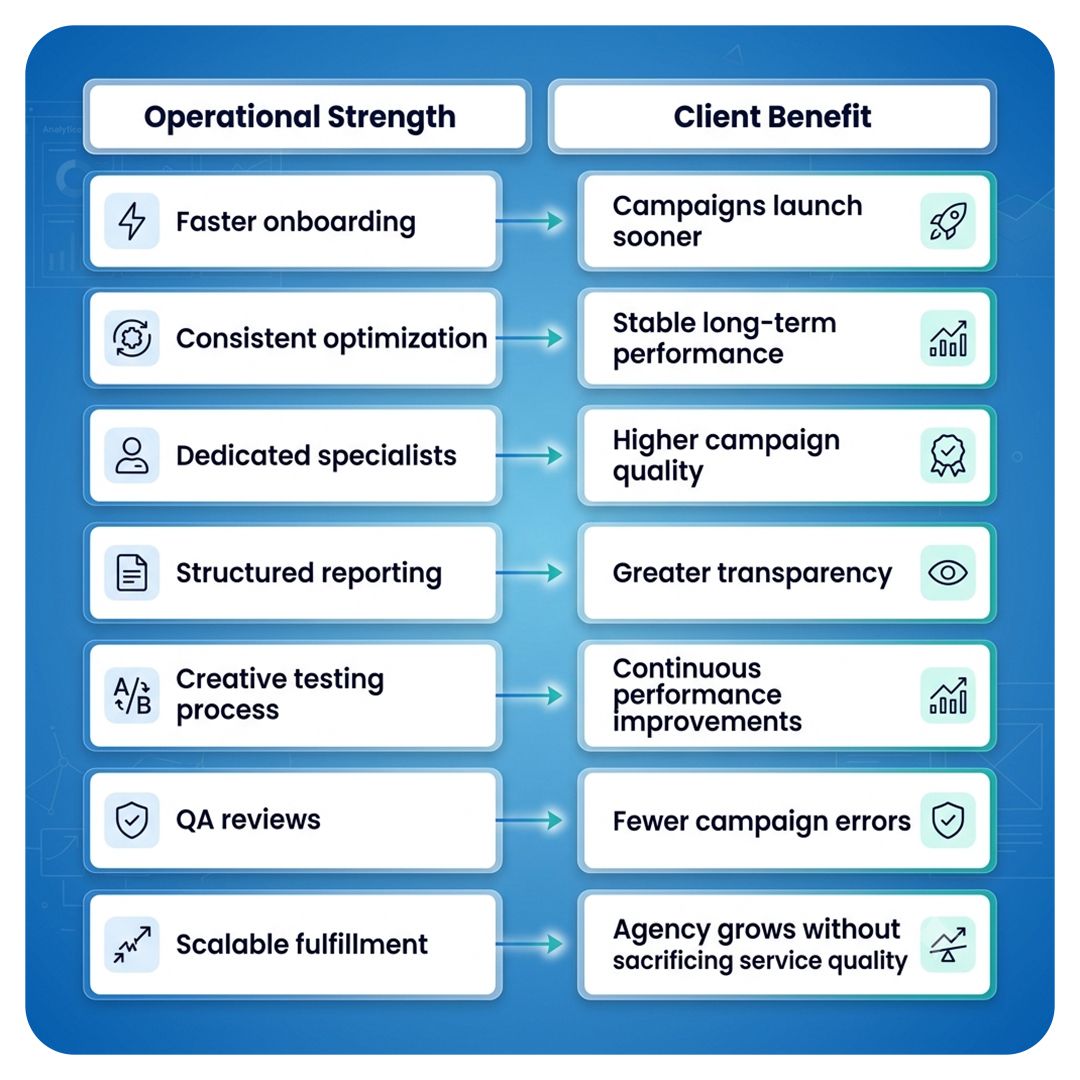
Rather than relying on generic promises, agencies can demonstrate operational maturity through faster launches, structured optimization, and professional reporting. These are differentiators that are difficult for competitors to replicate.
Agencies competing mainly on price often lack these operational advantages.
Signs Your Agency Is Competing More on Price Than Value
If several of these apply, your agency may be relying on pricing instead of operational strength.
- Prospects ask about pricing before strategy.
- Sales conversations frequently involve discounts.
- Facebook Ads packages look similar to competitors'.
- Reports rely mostly on exported Meta Ads metrics.
- Campaign launches regularly miss deadlines.
- Creative testing is inconsistent.
- Client referrals have slowed.
- Account managers spend more time explaining delays than discussing growth.
These signs often point to operational gaps rather than sales problems. Improving internal processes helps shift conversations from price to value by creating a better overall client experience.
How DashClicks Helps Agencies Build a Stronger Competitive Position?
DashClicks provides scalable white label Facebook Ads fulfillment that helps agencies deliver consistent results without expanding internal teams.
- White Label Facebook Ads Fulfillment: The fulfillment team manages campaign setup, ongoing optimization, and day-to-day management under your agency's brand. Every task is handled by experienced specialists, giving your clients the quality of a dedicated media buying team without the overhead of building one.
- Dedicated Media Buyers: Each account is managed by a specialist focused on Meta Ads performance. These media buyers bring platform expertise across campaign objectives, audience targeting, bid strategies, and creative performance, ensuring optimization decisions are grounded in real paid social advertising experience.
- Standardized Campaign Workflows: Fulfillment follows documented SOPs that govern every stage of campaign management, from pre-launch setup through recurring optimization and quality assurance. Structured workflows reduce errors, improve delivery speed, and ensure consistent outcomes across your entire client portfolio.
- Creative Collaboration: The fulfillment team supports asset management and creative testing to help agencies maintain fresh, high-performing ad creatives. Structured testing schedules and organized asset libraries make it easier to keep campaigns running at their best without falling behind on refresh cycles.
- White Label Reporting: Clients receive branded reports and performance summaries through white label reporting software that reflect your agency, not your fulfillment partner. Reports are built to communicate campaign results clearly, with actionable insights that help clients understand what is happening and what comes next.
- Scalable Fulfillment Infrastructure: Whether onboarding new clients or managing seasonal demand, fulfillment scales with your agency while maintaining delivery quality.
Your agency continues to own client relationships, strategy, and growth, while DashClicks manages execution behind the scenes.
The Agencies That Win Long-Term Compete on Execution, Not Price
Every agency can promise better Facebook Ads results, but few consistently deliver a superior client experience. Sustainable differentiation comes from reliable execution, structured communication, and operational consistency.
White label Facebook advertising helps agencies scale these strengths without building large in-house teams. By improving fulfillment, reporting, and campaign management, agencies can compete on value instead of price, strengthen client relationships, and build a more scalable business.


.svg)


.svg)
.svg)
.svg)
.svg)
.svg)