

.svg)

.svg)
.svg)
.svg)
.svg)
.svg)
B2B marketing agencies constantly face a growing gap between lead volume and lead quality. Many teams generate hundreds of clicks and form submissions, only to find that the sales team rejects the majority of these contacts. Because of this common frustration, Facebook is frequently seen as a low-quality lead channel in the B2B space. Agency owners often assume the platform is only good for consumer products, believing business decision-makers are impossible to reach effectively.
However, statistics paint a different picture of the broader marketing environment. According to HubSpot, 79% of marketing leads never convert into sales. This massive drop-off indicates a widespread qualification problem across all channels, not just a platform-specific issue. The reality is that the issue is not Facebook itself, but rather the quality of the execution. When campaigns prioritize cheap clicks over qualified prospects, the resulting lead pool will inevitably lack buying intent. To fix this, agencies must shift their focus from tracking Cost Per Lead (CPL) to measuring Cost Per Qualified Lead (CPQL).
If Facebook is not inherently flawed for B2B marketing, the issue clearly lies in execution strategy. This is where white label Facebook Ads expertise changes the game for growing agencies.
Why White Label Facebook Ads Are a Strategic Advantage (Not Just a Convenience)?
Many agency owners mistakenly view outsourced services strictly through the lens of cost savings. They assume handing off campaign management is simply a way to avoid paying a full-time salary. However, highly successful agencies position white label Facebook advertising as a core performance infrastructure. Partnering with a specialized provider gives your agency immediate access to deep platform expertise that would take years to build internally.
Instead of relying on a single in-house media buyer who has to juggle multiple platforms, you tap into a dedicated team that spends every working hour mastering Meta algorithms. This level of specialization allows agencies to scale client accounts significantly faster without running into internal bandwidth constraints. Internal teams often hit a ceiling where they can no longer test new creative assets or refine audience targeting because they are bogged down by daily maintenance tasks.
Furthermore, having access to an established execution team introduces rigorous testing frameworks. Industry benchmarks consistently show that agencies using structured testing frameworks reduce their optimization cycles by 30 to 50 percent. This massive reduction means campaigns find profitable audiences much faster. Outsourcing provides both the execution speed and the testing velocity required to stay ahead of algorithm updates. When a dedicated partner handles the daily tactical adjustments, your internal team can spend more time consulting with clients and refining high-level strategies.
With the right execution partner managing the granular details, the focus naturally shifts from simply getting leads to engineering better leads.
Redefining Lead Quality in B2B Facebook Campaigns
To improve the results generated for B2B clients, agencies must clearly define what constitutes a high-quality lead. Generating a large list of names and email addresses is meaningless if those individuals cannot make purchasing decisions. A truly qualified B2B lead possesses three distinct characteristics. First, the individual must be a decision-maker within their organization. Second, they must have the budget authority to approve a purchase. Third, they must demonstrate genuine buying intent rather than passive curiosity.
Unfortunately, many agencies still measure success using surface-level metrics. High click-through rates and high conversion rates on instant forms do not equal high lead quality. In fact, a campaign with an exceptionally high click-through rate might actually be attracting the wrong audience by using overly generic or clickbait messaging. Pipeline contribution is the real metric that agencies must track. You need to know exactly how much revenue your campaigns are actively driving for your clients.
This brings us back to the stark reality of lead generation. As noted earlier, 79% of marketing leads never convert into sales. This happens because campaigns are optimized for volume instead of sales pipeline impact. Redefining lead quality means looking past the initial conversion event and tracking the prospect all the way through the sales process. Agencies must align their campaign goals with the client's actual revenue targets.
To improve lead quality and ensure only the right prospects enter the pipeline, agencies must start with audience precision.
1. Precision Audience Segmentation: Filtering Before the Click
The first step in generating high-quality B2B leads is ensuring your ads are only shown to the most relevant professionals. Advanced B2B targeting requires a sophisticated approach to audience segmentation. Standard demographic targeting is no longer sufficient. Agencies must differentiate between simple job roles and actual seniority. Targeting anyone with "marketing" in their title will waste the budget on entry-level employees. Instead, campaigns must isolate titles like "Chief Marketing Officer" or "VP of Marketing" while layering on specific industry segmentation to ensure the company type aligns with the client's ideal customer profile.
A robust segmentation strategy also relies heavily on first-party data. Agencies use client data to build highly accurate CRM lookalike audiences. By uploading a list of the client's best historical customers, Meta's algorithm can find users with similar professional behaviors. Retargeting depth also plays a massive role in this process. Instead of treating all website visitors equally, advanced campaigns segment users based on their specific behavior on the site, such as time spent on pricing pages.
Equally important to who you target is who you exclude. Proper audience exclusions prevent wasted spend. Campaigns must actively exclude students, active job seekers, and users who have demonstrated low-intent behaviors. For example, if a client sells enterprise software, the campaign should exclude users interested in small business startup guides. This specific layering of inclusions and exclusions forms a tight net around the ideal prospect.
Even the best targeting fails without aligned messaging that speaks directly to that carefully selected audience.

2. Tailored Messaging That Attracts Decision-Makers
Reaching the right B2B audience is only half the battle. Once the ad appears in the feed of a key decision-maker, the creative and copy must compel them to take action. Tailored messaging requires a deep understanding of the prospect's daily challenges. Instead of highlighting generic product features, agencies must use pain-point driven messaging. The ad copy should articulate a specific business problem the prospect faces and immediately present a credible solution. This communication must also be heavily revenue-focused, as B2B buyers ultimately care about profitability, efficiency, and growth.
A powerful tactic for improving lead quality is using disqualification messaging. This means intentionally writing ad copy that discourages the wrong people from clicking. For example, stating "For Enterprise Companies with $10M+ Revenue" directly in the ad image will deter small business owners from clicking. While this approach decreases the overall click-through rate, it drastically improves the quality of the traffic. According to an industry report, highly specific messaging reduces irrelevant leads by 20 to 40 percent. This reduction in wasted clicks saves the client money and saves the sales team time.
Furthermore, agencies should deploy authority-led creatives. This involves using case studies, industry reports, and founder-led videos to build immediate trust. Decision-makers are much more likely to engage with content that offers genuine strategic value rather than a standard promotional graphic. Creating these specific, authoritative messages ensures the prospect is already educated before they ever fill out a form.
Once the right audience clicks through the ad, the funnel must filter those prospects even further.
3. Funnel Engineering: Designing for Qualification
The destination following the click is just as critical as the ad itself. Funnel engineering is the process of designing user experience that systematically qualifies prospects. Many agencies rely heavily on native Facebook instant forms because they generate leads quickly and cheaply. However, instant forms often result in low-intent submissions because they auto-fill user data. To combat this, agencies must utilize multi-step funnels that force the user to slow down and consider their submission. A structured lead qualification process acts as a necessary barrier to entry.
Two highly effective structures for B2B campaigns are webinar funnels and booking funnels. Webinar funnels require the prospect to register and commit time to consume educational content. This high level of commitment naturally weeds out passive browsers. Booking funnels prompt the user to schedule a discovery call directly on a calendar. These specific funnel types require the prospect to actively engage with the brand, signaling a much higher level of buying intent.
Agencies must also carefully introduce specific friction points within these funnels. Adding custom form fields that ask about company size or current software solutions requires the user to manually type an answer. Implementing conditional logic can also route unqualified users to a helpful resource page while sending qualified users directly to a sales calendar. The insight here is simple but powerful: increasing form friction can reduce lead volume by 25%, but it can also improve SQL rates significantly. More friction means fewer leads, but those leads are usually better equipped for a sales conversation.
This highly specific funnel data then becomes the foundation for ongoing campaign optimization.
4. Data-Driven Optimization: From CPL to CPQL
To sustain high lead quality over time, agencies must completely rethink how they evaluate campaign performance. As mentioned previously, moving beyond Cost Per Lead (CPL) is an absolute necessity. CPL only tells you how much it costs to acquire an email address. It offers zero insight into whether that email address belongs to a viable buyer. Agencies must shift their focus toward tracking deeper funnel metrics. Cost Per Qualified Lead (CPQL) and Cost Per Acquisition (CPA) provide a much more accurate picture of campaign profitability.
Achieving this level of measurement requires strict CRM integration. The advertising platform must communicate directly with the client's sales software. When a lead advances from a marketing qualified lead to a sales qualified lead, that data must be fed back into Facebook. Tracking these offline conversions allows the algorithm to understand exactly which specific users are driving actual business value. Meta Ads guidance and case studies show that campaigns optimized for deeper funnel events improve conversion quality by up to 2x.
By feeding the algorithm high-quality data, the system learns to prioritize intent over volume. If the campaign only optimizes for the initial click, the algorithm will find users who click on everything. If the campaign optimizes for users who book qualified sales calls, the algorithm will actively seek out serious buyers. This feedback loop is the ultimate key to dominating B2B lead generation.

Image Source: Only B2B
This intense level of optimization requires consistent, daily execution to maintain results.
How White Label Execution Enables Scalable Quality?
Building a robust strategy is entirely different from executing that strategy day after day. Partnering with a white label Facebook advertising provider gives agencies the operational power needed to maintain high standards as client accounts multiply.
1. Execution Bandwidth Constraint
Most marketing agencies understand the exact strategies needed to generate high-quality B2B leads. They know how to build complex audiences and design multi-step funnels. However, they frequently lack the execution capacity to implement these strategies across every single client account simultaneously. When an internal team becomes stretched too thin, corners inevitably get cut. Audience lists do not get updated, and creative assets become stale.
These operational bottlenecks directly reduce the quality of the leads being generated. By outsourcing the heavy lifting, agencies completely remove this bandwidth constraint and ensure every client receives premium execution.
This expansion of capability directly fuels the ability to manage accounts proactively.
2. Always-On Optimization
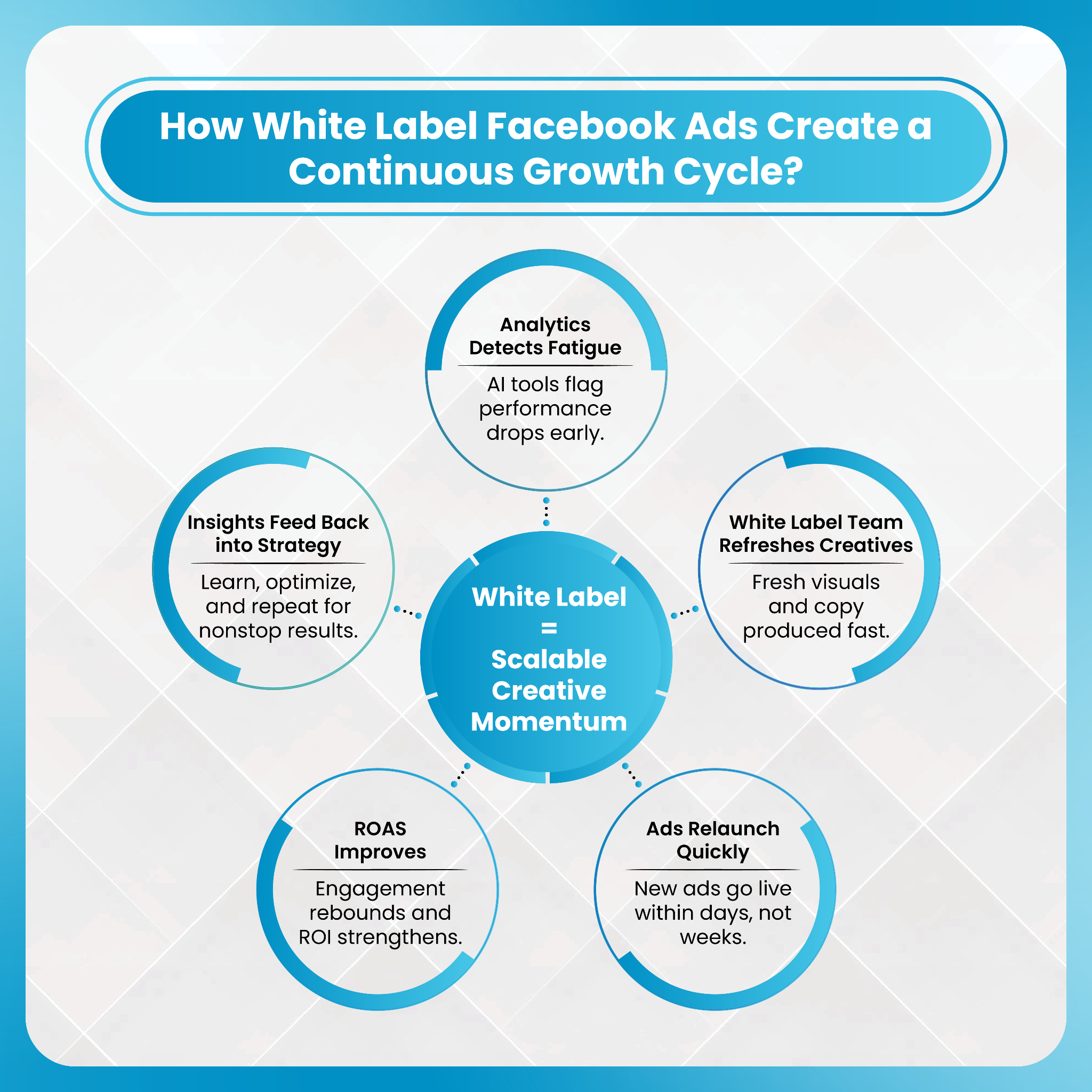
B2B Facebook campaigns are not a set-it-and-forget-it endeavor. They require intense, always-on optimization to combat ad fatigue and audience saturation. A dedicated white label team handles the daily optimization requirements that internal teams often miss. This includes actively monitoring frequency metrics, adjusting bid caps, and rotating copy variations.
Creative refresh cycles are strictly adhered to, ensuring that decision-makers are always presented with fresh, engaging messaging. For example, a white label team will proactively spot a declining click-through rate in a specific target segment and kill those poor-performing segments early before they drain the client's budget.
This relentless daily attention is what makes scaling possible.
3. Scaling Without Losing Quality
One of the most difficult challenges an agency faces is increasing a client's ad spend without causing lead quality to plummet. Scaling challenges occur because algorithms often struggle to find new qualified buyers when forced to spend more money quickly. A specialized white label partner understands how to manage controlled audience expansion. Instead of doubling the budget overnight, they incrementally test secondary lookalike audiences and adjacent industry interests.
The core insight is that scaling requires intense precision, not just a massive influx of budget. An experienced partner knows how to stretch the boundaries of an audience while maintaining strict qualification parameters.
This precision scaling is further enhanced by robust data integrations.
4. CRM-Driven Optimization
To maintain quality at high spending levels, the execution team must rely heavily on backend data. A white label partner has the technical expertise to set up and manage MQL to SQL tracking seamlessly. They ensure that the client's CRM is perfectly synced with the advertising platform. This allows the team to perform offline conversion tracking effortlessly.
By analyzing which specific ads generated closed revenue, the team can reallocate budget toward the most profitable campaigns. In fact, campaigns using offline conversion data can improve conversion quality efficiency by 30%.
Managing this data effectively requires highly organized workflows.
5. Standardized Systems Across Accounts
When an agency tries to manage dozens of Facebook ad accounts using disorganized methods, chaos ensues. A premium white label Facebook ads provider brings standardized systems across all client accounts. They utilize repeatable frameworks for naming conventions, audience testing, and Facebook pixel implementation.
This level of standardization ensures that nothing falls through the cracks during the onboarding process. It also facilitates a much faster ramp-up time for new clients. Because the foundational infrastructure is already built, campaigns can launch quickly and start gathering valuable data without unnecessary delays.
These standard systems do not prevent creativity.
6. Balancing Scale with Customization
There is a common misconception that white label services are entirely rigid and inflexible. In reality, the best white label Facebook advertising providers excel at balancing scale with customization. They rely on standard systems for operational efficiency but apply tailored execution to the actual marketing strategy.
The backend processes, like tracking setup and budget pacing, remain consistent, but the ad copy, audience targeting, and funnel design are uniquely customized for every single B2B client. This balance ensures the client gets a bespoke marketing strategy delivered through a flawless operational vehicle.
This combination ultimately transforms the agency business model.
7. Agency Leverage
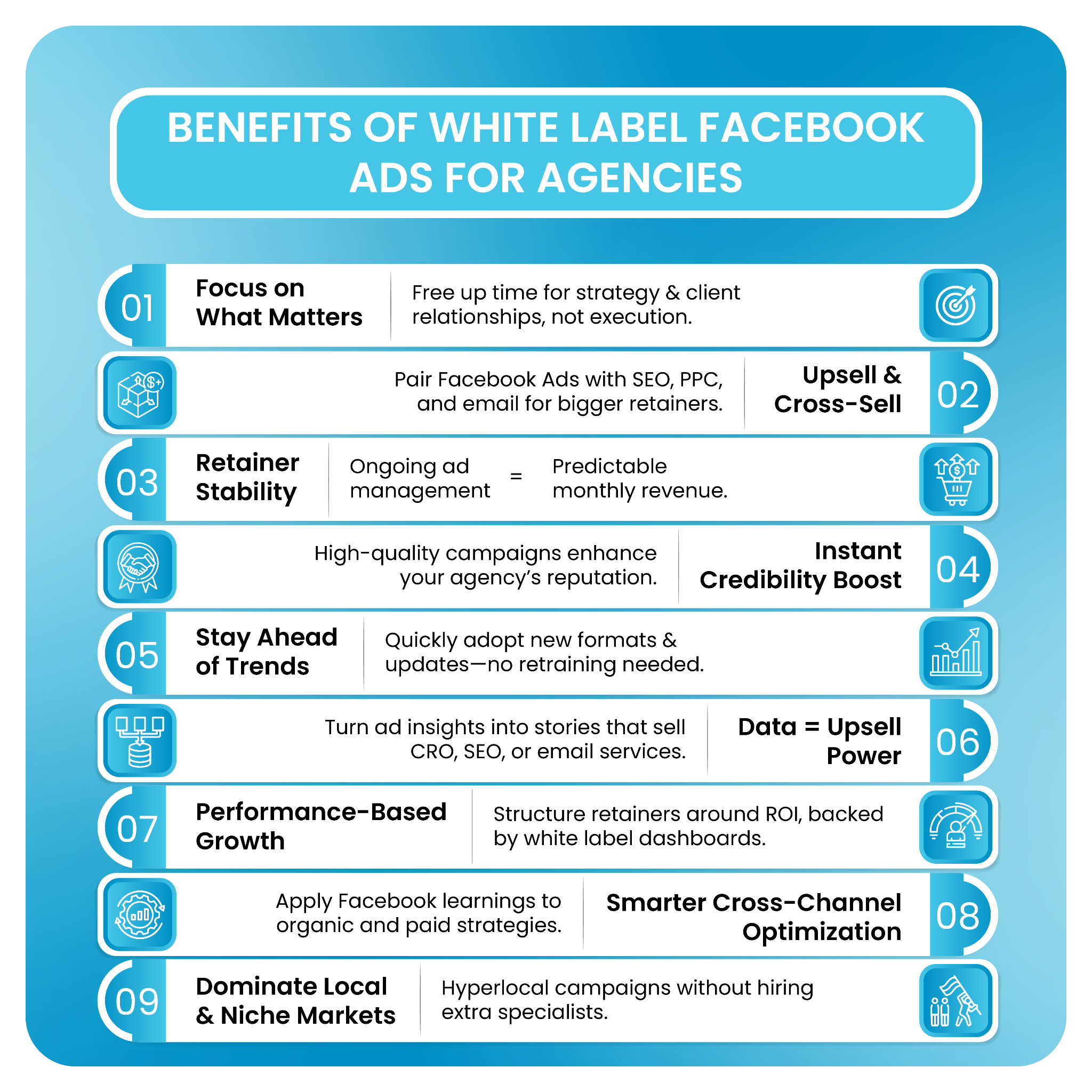
By handing off the complexities of campaign execution, agency owners gain incredible leverage. The internal team's focus shifts entirely to growth, client retention, and high-level consulting. Account managers can spend their time analyzing the CRM data with the client instead of troubleshooting pixel errors inside Business Manager.
This significantly reduced operational burden allows the agency to take on more clients without needing to hire an army of media buyers. The white label partner acts as a silent engine, driving consistent results while the agency takes the credit and builds the relationship.
Having this dependable execution engine is vital for long-term agency success.
How DashClicks’ White Label Facebook Ads Support Lead Quality at Scale?
When evaluating partners to handle this critical execution, agencies need a platform built specifically for scale. DashClicks provides comprehensive Facebook Ads management services designed to act as an extension of your own agency. Their system is structured to handle the heavy lifting of campaign execution, allowing you to focus on client strategy and retention.
The fulfillment team manages everything from initial campaign setup to ongoing optimization. Because they specialize in white label Facebook advertising, their media buyers possess deep audience targeting expertise. They know how to navigate complex B2B segments, implement exclusion lists, and set up the necessary tracking pixels to ensure data flows correctly. You are not just getting a software tool. You are gaining access to scalable fulfillment teams that follow strict, repeatable frameworks for success.
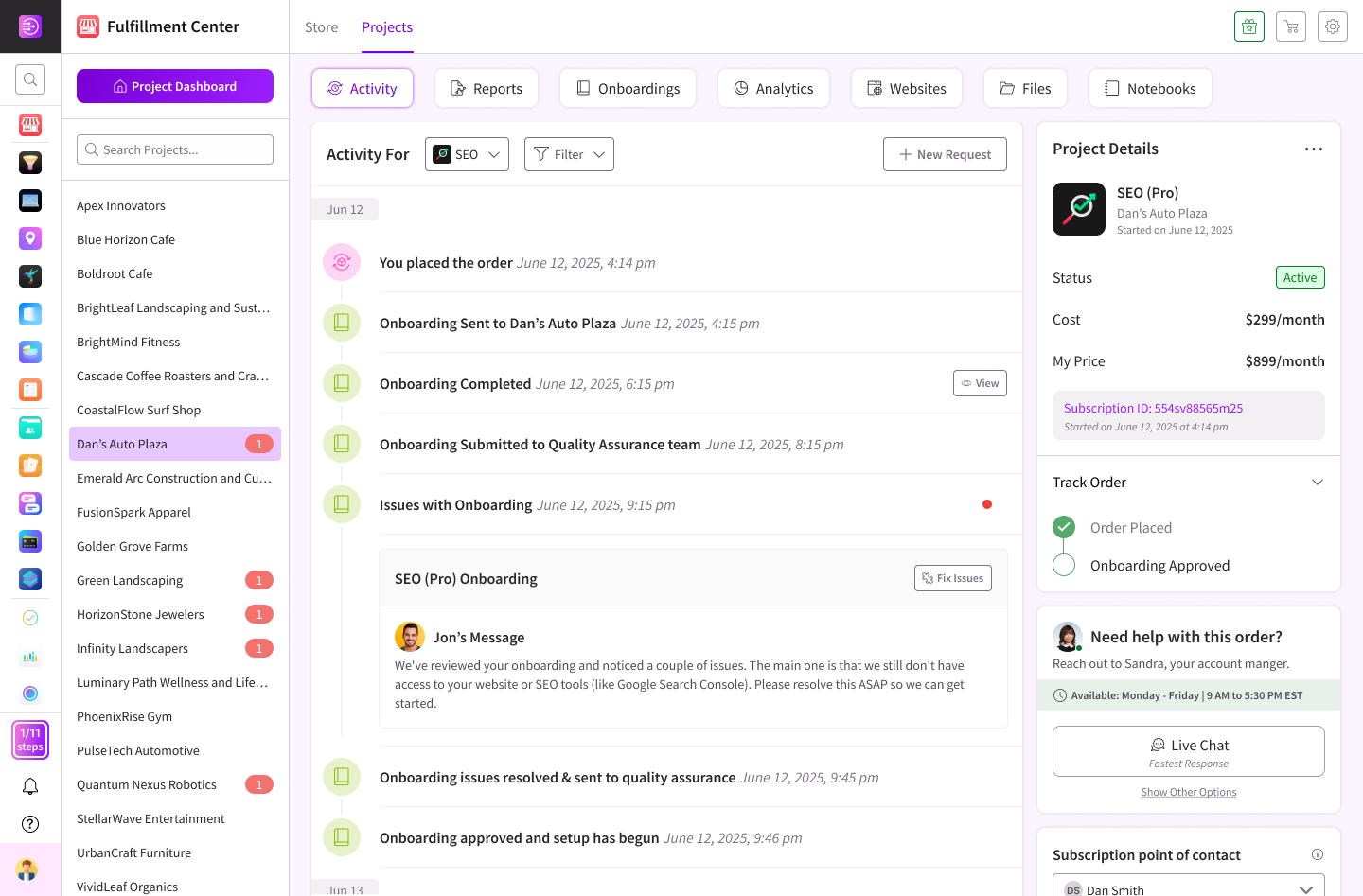
Additionally, DashClicks provides transparent reporting dashboards that you can easily share with your clients. This ensures that you always have clear visibility into key metrics like conversion rates and cost per qualified lead. By acting as your dedicated execution engine, DashClicks enables consistent lead quality without the operational headaches of managing campaigns in-house.
Key Takeaways for Agencies
To thrive in the competitive B2B landscape, agencies must adopt a new mindset regarding social media advertising. Building a profitable campaign requires a calculated approach to every step of the user journey.
Keep these critical principles in mind:
- Lead quality is engineered. It does not happen by accident. You must actively filter prospects using specific targeting, friction-based funnels, and disqualification messaging.
- Facebook works exceptionally well for B2B when executed correctly. The platform has the data to find decision-makers, provided you give the algorithm the right signals.
- White label Facebook Ads partnership equals capability expansion. Outsourcing is a strategic move to access specialized talent and eliminate internal bandwidth bottlenecks.
- Strategy combined with flawless execution becomes a massive competitive advantage. Having great ideas is useless if your team lacks the capacity to optimize campaigns daily.
Final Thoughts on Engineering Scalable Quality
Relying on volume alone is not enough to sustain a B2B marketing agency. Generating a high number of cheap leads might look impressive on a spreadsheet, but it will ultimately lead to frustrated clients and high churn rates. Lead quality is the single factor that determines client retention. If you can consistently deliver prospects who are ready to buy, your clients will never leave you.
The future of B2B social media advertising is entirely driven by intent targeting, highly specific qualification funnels, and data-driven optimization that connects marketing spend to actual closed revenue. As algorithms become more automated, the agencies that win will be the ones who provide the best quality data back to the platform.
Achieving this requires intense focus and relentless daily execution. White label Facebook ads provide the necessary infrastructure for scalable quality, allowing your agency to grow without compromising on performance.


.svg)


.svg)
.svg)
.svg)
.svg)
.svg)