

.svg)
.jpg)
.svg)
.svg)
.svg)
.svg)
.svg)
Switching white label SEO providers mid-campaign is manageable when agencies follow a structured transition plan. The real risk is not the switch itself. It is switching without documenting existing work, auditing active campaigns, and maintaining client-facing continuity throughout the handoff.
Staying with an underperforming SEO provider often feels safer than switching. Your accounts are mid-campaign. Keyword strategies are in motion. Content is in production. Technical fixes are half-finished. Pulling the plug feels like setting fire to months of work.
This concern is legitimate. According to BrightEdge research, organic search generates 53% of trackable website traffic. For many of your clients, SEO is not a secondary channel. It is a primary growth driver. Interrupting ongoing fulfillment carries real consequences, which is exactly why agencies often tolerate poor providers longer than they should.
But the goal of switching is not simply to find a better white label SEO agency. The goal is to transfer SEO fulfillment without creating a visible interruption in client service. Those are two very different objectives, and conflating them leads to poorly planned transitions that create the exact disruptions agencies are trying to avoid.
This blog walks through when to make the move, what risks come with switching too quickly, and how to transfer accounts cleanly so clients never notice the change.
Why Agencies Delay Switching White Label SEO Providers?
Most agency owners know when a provider is underperforming. The decision to act on it is another matter entirely.
- Fear of Ranking Volatility: Agencies worry that changing providers mid-campaign will destabilize rankings that took months to build. This concern has some merit. Poorly managed transitions can create gaps in execution. But staying with a provider that consistently underdelivers creates its own ranking risks over time.
- Client Disclosure Concerns: Many agencies prefer to keep fulfillment arrangements behind the scenes. Switching providers raises the question of whether clients need to be informed, and if so, how.
- Migration Workload: The idea of transferring keyword maps, content calendars, technical audit histories, backlink records, and reporting templates across multiple accounts is genuinely daunting. Agencies often underestimate how much of this work can be systematized.
- Contract Timing: Some agencies wait until a contract expires before addressing a provider problem they identified months earlier. A poorly performing provider does not improve simply because there are two months left on the agreement.
- Sunk-Cost Thinking: Six months of work with a mediocre provider can make switching feel wasteful. The work has already been done. The real question is whether continuing to invest in the same relationship will produce better results.
- Lack of Transition Documentation: When documentation is poor or scattered, switching becomes significantly harder. Agencies may not have clean records of what was done, what is pending, or what was promised.
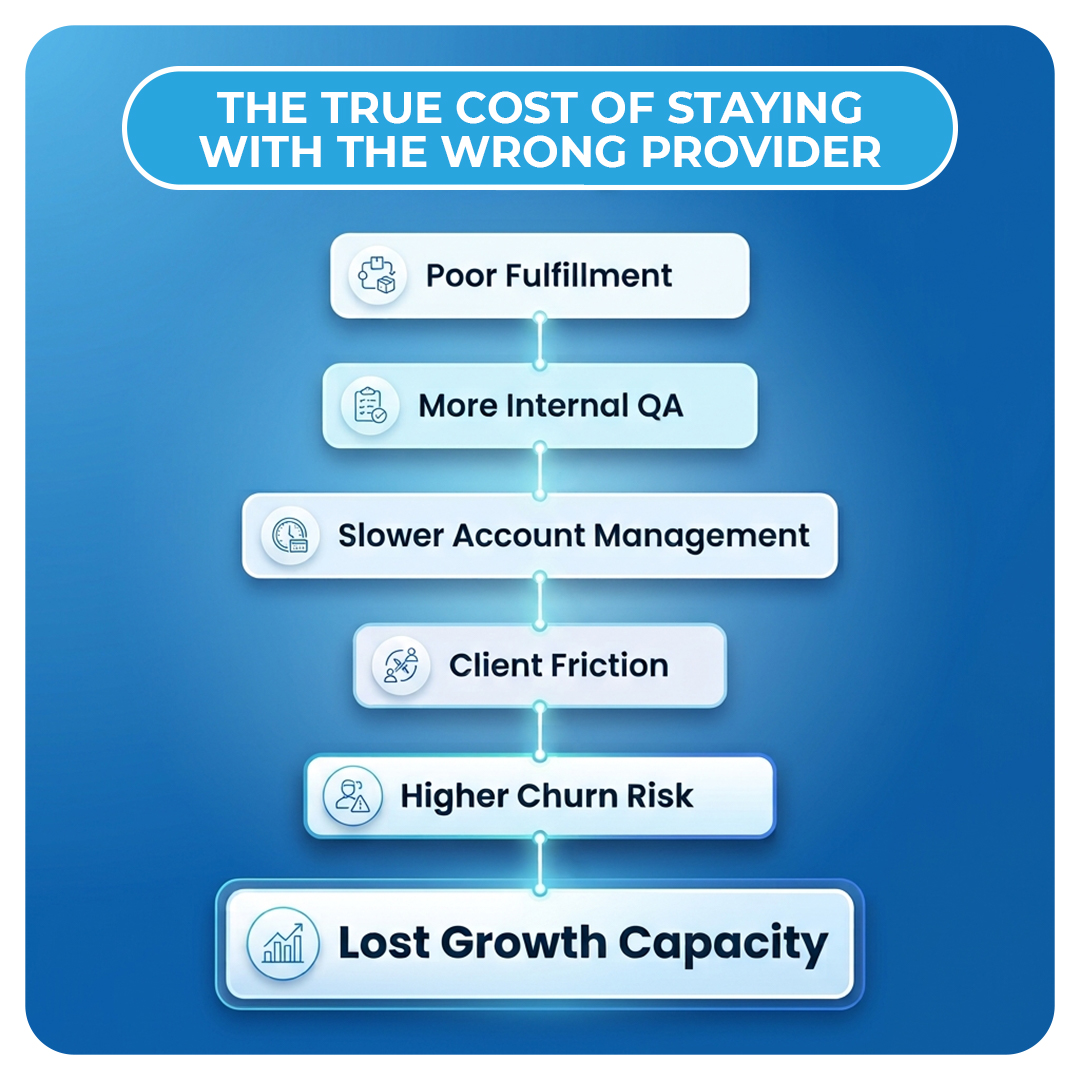
The key takeaway: staying with an unreliable provider is not automatically the lower-risk option. It simply delays the same problems while adding more to untangle later.
Signs Your Current SEO Provider Has Become a Liability
Use this section as a diagnostic. Not every issue warrants an immediate switch, but repeated patterns across multiple signs indicate a structural problem worth acting on.
1. Deliverables Arrive Late Repeatedly
Content misses deadlines. Audits are delayed. Optimization tasks sit incomplete for weeks. Reports arrive after client calls rather than before them.
One missed deadline can be an isolated mistake. When it becomes a pattern across accounts, it signals an operational problem that will not self-correct.
2. Recommendations Are Not Tied to Measurable Priorities
Generic monthly recommendations that are not connected to ranking movement, organic traffic, conversions, or search intent add volume without adding value. Strategy should be tied to specific business outcomes and site-level priorities, not a templated checklist recycled across accounts.
3. Your Agency Has to QA Everything
Outsourcing fulfillment is supposed to reduce your internal workload. If your team spends more time correcting deliverables than managing client relationships, the efficiency you expected from the white label SEO firm never materialized.
This is one of the clearest signs that a provider has become a liability rather than a resource.
4. Reporting Shows Activity Instead of Business Impact
A report that lists completed tasks without showing ranking movement, traffic changes, lead volume, or conversions gives clients no useful information. Reporting should explain what happened, why it matters, and what comes next.
5. Strategy Does Not Evolve With Search Changes
SERP behavior shifts. Competition intensifies. Site performance fluctuates. Content that worked six months ago may now be underperforming. A provider that repeats the same approach regardless of changing conditions is not managing strategy. It is maintaining a schedule.
6. Scaling Creates Quality Problems
Adding several new accounts at once should be manageable for an established white label SEO partner. If quality drops noticeably when volume increases, the provider lacks the infrastructure to support your agency's growth.
7. Communication Becomes Reactive
Strong providers surface issues before you ask about them. Providers operating reactively wait for the agency to raise a concern before addressing it. Over time, reactive communication means your team is absorbing risk the provider should be managing.
The distinction worth making: an isolated fulfillment mistake is different from a systemic provider problem. The signs above become meaningful when they recur across multiple accounts and over multiple months.
When Poor Fulfillment Starts Affecting Client Retention?
Fulfillment problems that stay internal are a nuisance. Fulfillment problems that reach clients are a business risk.
Late reports, incomplete SEO tasks, weak recommendations, unexplained ranking declines, and delayed responses all create client-facing problems. Clients do not see who is handling fulfillment behind the scenes. They see the agency.
There are two categories of risk to consider.
1. Performance Risk
Rankings, organic traffic, conversions, and overall campaign progress may suffer when fulfillment quality drops. This is the most visible form of damage, but it is not always the first.
2. Relationship Risk
Clients may lose confidence in the agency before performance metrics reflect a problem. Inconsistent communication, missed commitments, and late deliverables erode trust faster than a temporary ranking dip.
According to Salesforce research, 88% of customers surveyed said the experience a company provides is as important as its products or services. This applies well beyond SEO. Clients judge agencies on communication and reliability, not just results.
A useful internal metric: track the number of client escalations caused by fulfillment issues each month. An increase in that number is an early warning sign worth taking seriously, even if rankings have not yet moved.

What Agencies Risk by Switching Too Quickly?
This article is not an argument for immediately terminating your current provider. Unplanned transitions carry their own risks.
Switching without a structured plan can result in:
- Losing historical keyword context that informed current strategy
- Abandoning content already in production
- Creating conflicting on-page recommendations from two providers
- Interrupting technical SEO remediation mid-process
- Losing visibility into active backlink campaigns
- Resetting reporting benchmarks and disrupting historical comparisons
- Creating strategy gaps when two providers make overlapping changes
The principle here is straightforward: switching providers is not the risky part. Switching without an account-by-account transition plan is.
A reckless exit from a poor provider can create more disruption than the original fulfillment problems did.
How to Audit Your Existing Provider Before Making the Move?
Before notifying anyone, review every active account. This pre-switch audit gives you a clear picture of what you are working with.
For each account, document:
- Current keyword targets and ranking positions
- Pages actively being optimized
- Unresolved technical SEO issues
- Published content and URLs
- Content in production or outlined but not yet published
- Internal linking recommendations already implemented or pending
- Backlinks acquired and active outreach campaigns
- Local SEO or Google Business Profile work where applicable
- Historical SEO reports and current benchmarks
- Open tasks and promised deliverables
- Client-specific goals and any known restrictions
Once documented, sort every item into one of three categories.
Keep: Work that is performing well and should continue without interruption.
Complete: Work already underway that should be finished before the transition where practical, rather than handed off mid-execution.
Replace: Tactics, templates, or processes that have repeatedly caused problems and should not carry forward to the new provider.
This creates a handoff inventory. It prevents your new white label SEO partner from having to reconstruct entire accounts from scratch and significantly reduces the risk of strategic gaps during the transition.
Build a Provider Transition Checklist Before Giving Notice
Documentation should happen before you terminate the existing relationship. Once notice is given, access to data and cooperation from the current provider becomes less reliable.
Collect and organize the following before making any changes:
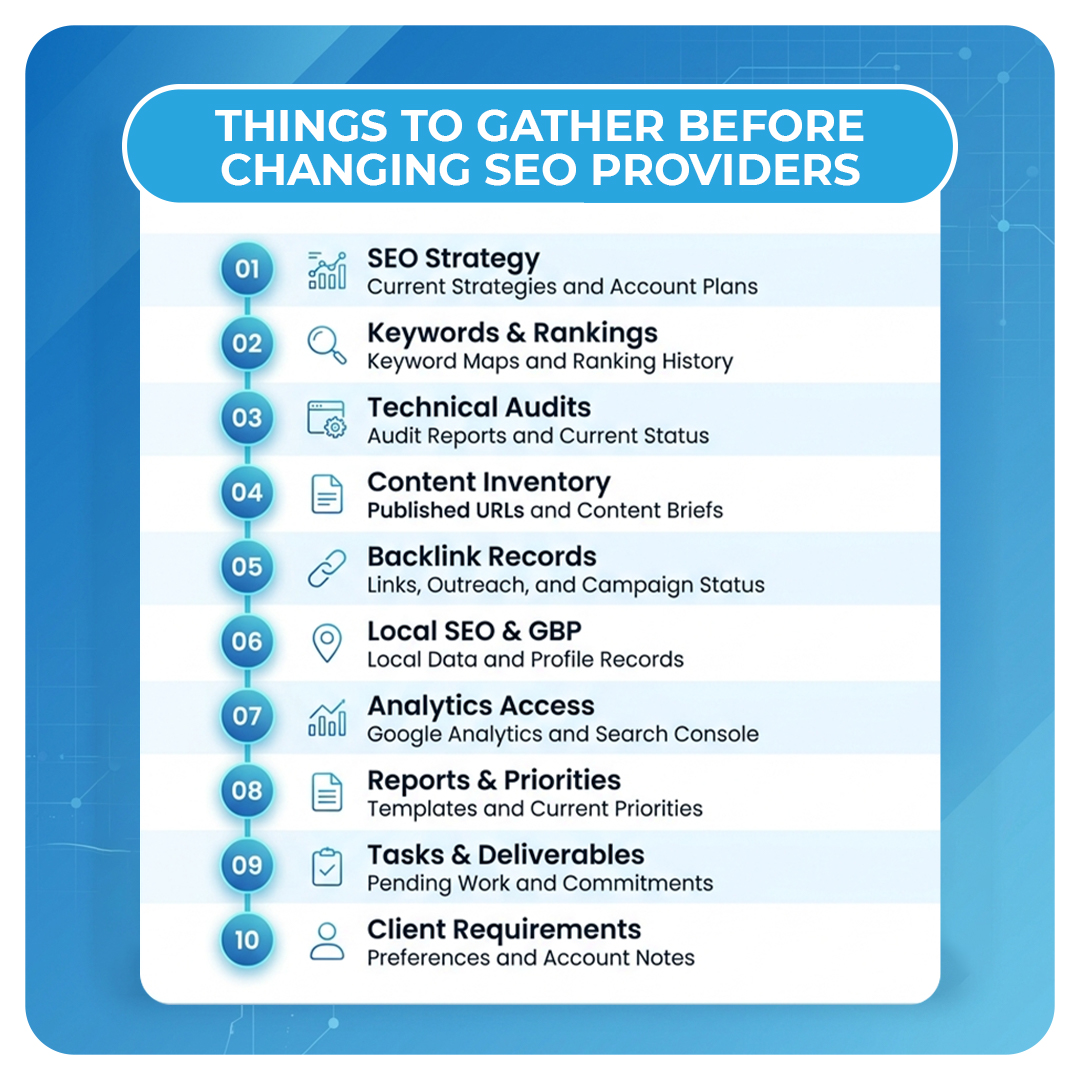
Use a structured transition matrix to track asset status across accounts. Documentation done before termination protects the agency regardless of how cooperative the outgoing provider turns out to be.
How to Transfer SEO Work Without Losing Momentum?
This is where planning makes the largest difference. A structured handoff keeps client campaigns moving during the provider change.
Step 1: Freeze Unnecessary Changes
Avoid introducing major new strategies during the handoff period. Unless there is an urgent technical issue requiring immediate action, stability during the transition is more valuable than optimization.
Step 2: Establish a Baseline
Capture current rankings, organic traffic, conversions, indexed pages, technical health scores, and active campaign status. This gives the incoming provider a clear starting point and protects the agency if performance questions arise later.
Step 3: Prioritize Active Work
Identify what has already been implemented, what is currently being executed, and what was merely recommended but not yet started. Active work takes priority in the handoff. Recommendations can wait.
Step 4: Transfer Account Knowledge
Give the new provider the full picture: strategy rationale, historical data, client goals, known technical issues, and current monthly priorities. A provider working without this context will spend the first several weeks reconstructing information that already exists.
Step 5: Revalidate the Strategy
The new provider should verify existing recommendations rather than blindly inheriting them. Some prior recommendations may be outdated, incorrect, or no longer relevant to the client's current goals.
Step 6: Create a 30-Day Continuity Plan
Weeks one and two should focus on completing or continuing existing deliverables. Weeks three and four can introduce any necessary adjustments. Major new initiatives should wait until the transition period is complete.
Step 7: Establish Early QA
Review the first round of deliverables from the new provider before they reach clients. Early quality checks reduce the risk of problems surfacing during the most sensitive period of the relationship.
Google's guidance consistently emphasizes helping search engines understand content and helping users discover websites. Those principles do not change during a provider transition. Preserve strong SEO fundamentals throughout the handoff rather than treating the new provider's arrival as a reason to rebuild from the ground up.
How to Keep Clients Unaffected During the Transition?
Client communication during a provider switch depends on whether the client needs to know at all.
If the Client Does Not Need to Know
In many cases, the provider change can remain internal. To maintain continuity from the client's perspective:
- Keep the same reporting cadence
- Maintain the same primary contacts
- Carry over the same core KPIs
- Use the same client-facing terminology and report structure
- Preserve the same overall communication rhythm
If the Client Needs to Know
Frame the change around improvement rather than correction. Focus on better fulfillment capacity, expanded expertise, or stronger operational support. Do not criticize the previous provider, and do not make forward-looking SEO promises that depend on factors outside your control.
In either case, use this checklist to confirm continuity from the client's side:
- Same reporting schedule maintained
- Same core KPIs tracked without interruption
- No unexplained gaps in deliverables
- No sudden reversal of existing strategy
- No duplicate SEO work created during the handoff
- No unexplained delays in communication
The client should experience continuity, not the mechanics of the fulfillment transition.
What to Evaluate in Your New White Label SEO Provider?
Avoid evaluating candidates on price and general experience alone. The questions that reveal operational quality are more specific.
- Fulfillment Consistency: Can the provider maintain deadlines reliably across multiple client accounts simultaneously, not just during the onboarding phase?
- SOP Maturity: Are processes documented from onboarding through monthly reporting? Mature SOPs indicate a provider that can deliver consistently regardless of which individual handles the account.
- Account Scalability: Ask directly: what happens when the agency adds 10, 20, or 50 clients over the next year? The answer reveals whether the provider has the infrastructure to support growth or whether quality will degrade under volume.
- Specialist Depth: Find out whether technical SEO, content, link building, and local SEO are handled by specialists or by a single generalist responsible for everything. Specialist depth matters as account complexity increases.
- Reporting Infrastructure: Can reports be fully white-labeled and customized to match the agency's existing client-facing format?
- Communication Structure: Confirm who handles questions, escalations, account updates, and performance concerns. Ambiguity here tends to surface at the worst possible moment.
- Quality Assurance: Are deliverables reviewed internally before reaching the agency? A provider with no internal QA process is effectively outsourcing quality control to you.
- Strategic Flexibility: Can the provider support local SEO, technical SEO, on-page optimization, content production, and link building across different industries? Flexibility matters as the agency's client base evolves.
- Transparency: Can the agency see completed work, pending tasks, current priorities, and active recommendations at any time, without having to request a status update?
The most useful evaluation question is this one: "Could this provider absorb our entire SEO fulfillment operation without forcing our account managers to become project managers?" If the answer is unclear, the provider is not ready to support a growing white label SEO agency.

How DashClicks Supports a Controlled SEO Fulfillment Transition?
DashClicks is a white label fulfillment platform built for agencies managing SEO delivery across multiple client accounts.
- Structured SEO Fulfillment: Uses documented processes to standardize SEO execution, reducing the variability that often causes quality problems when provider relationships are not clearly defined.
- Dedicated Fulfillment Specialists: Rather than assigning one generalist to every SEO function, agencies get access to specialists across technical SEO, on-page optimization, content, and other core disciplines.
- SOP-Driven Delivery: Standardized workflows support consistency across technical work, on-page tasks, content production, and recurring monthly activities.
- Ranker: Includes centralized rank tracking that allows agencies to maintain continuous visibility into keyword performance during and after the fulfillment transition.
- White Label Reporting: Agencies can deliver branded client reports without exposing the fulfillment relationship or requiring clients to interact with the platform directly.
- Client Dashboard: A centralized client dashboard gives agencies visibility into reporting and performance data, supporting organized account management across the full client portfolio.
DashClicks is not a migration shortcut. Its value is in the structured fulfillment infrastructure it provides: defined processes, specialist access, and reporting tools that help agencies standardize delivery and scale without sacrificing consistency.
The Right Time to Switch Is Before Fulfillment Becomes a Client Problem
Use this framework to decide where your agency stands.
Stay and Work Toward Improvement When:
- Problems are isolated to specific accounts or individuals
- Communication with the provider remains open and constructive
- Deliverable quality is recoverable with reasonable feedback
- The provider responds constructively to concerns
Start Evaluating Alternatives When:
- Fulfillment problems are recurring across multiple accounts
- Internal QA workload is increasing to compensate for poor output
- Scaling creates visible quality degradation
- Reporting has become unreliable or consistently late
Prepare a Transition When:
- Fulfillment failures are reaching clients
- Missed deadlines are affecting client relationships
- The provider cannot demonstrate capacity to support agency growth
- The agency no longer has confidence in the delivery process
The safest provider switch is not the fastest one. It is the one planned early enough that clients never experience the disruption.


.svg)


.svg)
.svg)
.svg)
.svg)
.svg)