

.svg)

.svg)
.svg)
.svg)
.svg)
.svg)
Agencies should outsource SEO when internal capacity, expertise, or profitability cannot support sustainable delivery, not simply because outsourcing is convenient. The right decision depends on your operational maturity, growth stage, and which parts of SEO actually differentiate your business. This guide walks through a practical framework to help you decide.
Outsourcing SEO gets positioned as the obvious move for growing agencies. You take on more clients, the workload climbs, and someone suggests bringing in a white label SEO agency to handle fulfillment. Problem solved, right?
Not always.
Outsourcing SEO is a significant operational decision, and agencies that treat it as a default shortcut often end up scaling problems rather than solving them. Poor delivery quality, strained client relationships, and eroded margins are common outcomes when outsourcing happens for the wrong reasons, or at the wrong time.
The agencies that get it right approach outsourcing as a strategic tool. They evaluate it through clear operational factors: capacity, profitability, internal expertise, operational risk, client SEO expectations, and long-term growth goals. They ask hard questions before they sign contracts.
This guide is designed to help you do exactly that. Whether you're a founder juggling fulfillment, an operations manager evaluating delivery models, or a marketing director building a scalable SEO offering, the goal here is to give you a decision-making framework grounded in business logic, not assumptions.
Let's start by reframing the question entirely.
Stop Asking "Should We Outsource?" Start Asking "What Problem Are We Solving?"
Most outsourcing decisions fail because agencies start with the solution. Someone mentions white label SEO outsourcing, it sounds appealing, and the conversation moves to vendor selection before anyone has clearly defined the underlying problem.
Here's why that matters: different operational problems require different solutions.
Outsourcing to reduce workload looks very different from outsourcing to improve quality. Outsourcing because hiring is slow looks different from outsourcing to expand into new service lines. Outsourcing to protect margins requires an entirely different cost analysis than outsourcing because your founders are spending too much time managing SEO fulfillment.
If you misidentify the problem, the solution won't hold. A firm can absorb execution volume, but it cannot fix broken internal workflows. It can add specialized capabilities, but it won't repair a client communication problem.
Use this decision matrix to pressure-test your thinking before moving forward.
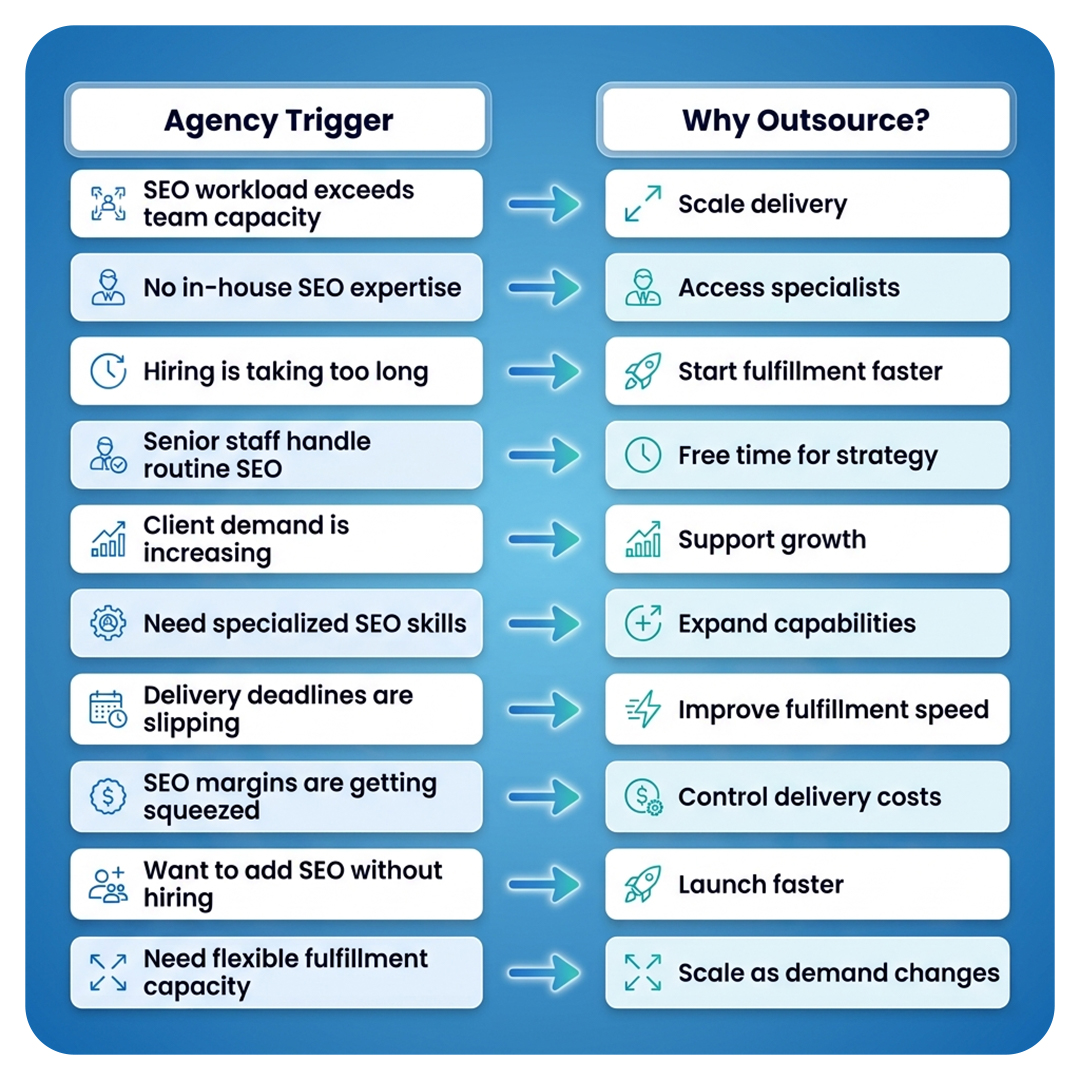
The pattern here is important. Outsourcing works best when the problem is structural (capability gaps, sustained demand, specialized needs) rather than operational (undefined processes, weak project management, inconsistent delivery standards).
McKinsey & Company research supports this. Organizations with standardized, scalable operating models are better positioned to sustain growth than those relying on ad hoc processes. Outsourcing onto an unstable foundation tends to amplify instability, not eliminate it.
Once you understand what problem you're actually solving, you can evaluate outsourcing objectively.
The Seven Questions Every Agency Owner Should Answer Before Outsourcing SEO
1. Is Your Constraint Capacity or Capability?
This distinction matters more than most agency owners realize, and confusing the two leads to the wrong decision every time.
Capacity is a volume problem. You have enough expertise in-house, but there aren't enough hours to handle current demand. Capability is a skills problem. Your team doesn't have the depth to deliver certain types of SEO work at the quality your clients expect.
These problems look similar on the surface. Deadlines get missed, clients get frustrated, and founders start feeling like fulfillment is consuming everything. But they require different solutions.
A capacity constraint can be addressed through outsourcing, better resource allocation, or hiring. A capability gap almost always requires external expertise, whether through outsourcing or targeted recruitment. Identifying which constraint you're facing determines what type of solution will actually work.
2. Does Hiring Actually Cost Less?
The instinct to hire before outsourcing is understandable. It feels like more control. But the true cost of an in-house hire often surprises agency owners who haven't modeled it out carefully.
Direct salary is only the starting point. Add payroll taxes, benefits, software licenses, recruiting fees, onboarding costs, management overhead, quality assurance time, and the cost of turnover. According to the Society for Human Resource Management (SHRM), the average cost per hire in the United States exceeds $4,700, and that figure doesn't include lost productivity during ramp-up periods, which can run three to six months for specialized SEO roles.
When agencies calculate their true delivery cost per client, outsourcing to a white label SEO firm often becomes significantly more cost-competitive than it initially appears. The comparison isn't salary versus agency retainer. It's total loaded cost versus total outsourced cost, including the management time you get back.
3. Which Parts of SEO Actually Differentiate Your Agency?
Not everything your agency does is a competitive advantage. Some of it is simply execution, necessary, time-consuming, and replicable, but not the reason clients choose you over someone else.
Competitive advantage typically lives in:
- SEO strategy and consulting
- Client communication and relationship management
- Planning and goal alignment
- Business consulting and growth recommendations
Execution work, while essential, is generally less differentiated:
- Technical SEO audits
- Keyword mapping and research
- On-page optimization
- Content optimization
- Link building
- Monthly reporting
The problem is that many agencies protect their execution capacity fiercely while letting strategic work slide. Founders and senior team members spend hours on deliverable production instead of high-value client strategy, which ultimately hurts retention.
Outsourcing execution frees your best people to do the work that actually wins and keeps clients.
4. Can You Document What You're Outsourcing?
If you can't clearly define a deliverable, you can't effectively outsource it. Before engaging a white label SEO agency, you need documented service packages, clear scope definitions, and measurable quality standards.
This is a readiness question, not a capability question. Agencies that skip this step end up with frustrating vendor relationships, inconsistent output, and client escalations that trace back to undefined expectations on both sides.
5. Do You Have a Point of Contact for Oversight?
Outsourcing is not the same as delegation without accountability. Someone internally needs to own vendor performance, review deliverables, and manage the relationship.
That person doesn't need to be a technical SEO expert. But they need to understand your clients' goals well enough to evaluate whether work is on track. Without this, quality tends to drift over time.
6. Are Your Client Relationships Strong Enough to Absorb a Transition?
Switching from internal to outsourced fulfillment can create temporary disruption. If your client relationships are already strained, the timing matters.
Strong agency-client relationship creates enough trust to navigate a delivery transition. Weak ones amplify every hiccup. Evaluate your current client health before you make changes to your delivery model.
7. What Does Success Look Like in Six Months?
Define it before you outsource, not after. Measurable outcomes might include faster onboarding, more consistent reporting, fewer founder hours spent on fulfillment, or improved client retention rates.
Without defined success metrics, it's difficult to evaluate whether outsourcing is working or simply adding cost.
Build a Keep vs. Delegate SEO Decision Framework
Once you've worked through the seven questions above, a keep-versus-delegate framework helps you allocate work intelligently across internal and external resources.
This hybrid fulfillment model is increasingly common among high-performing agencies. According to Harvard Business Review, companies that selectively outsource operational tasks while retaining core strategic functions tend to outperform those that either fully insource or fully outsource. The keyword is "selectively," which is why the decision framework matters so much.
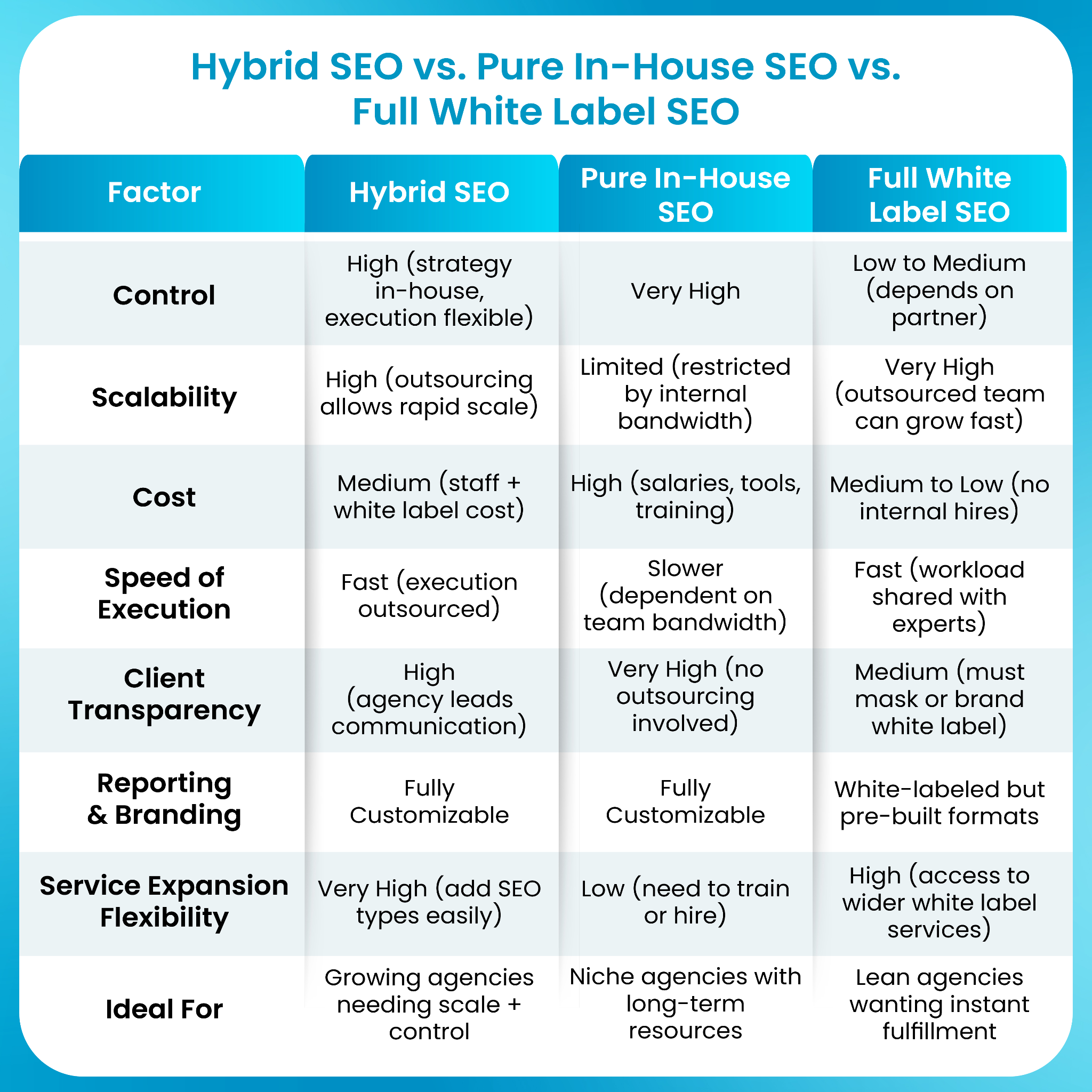
The goal is not to outsource as much as possible. It's to outsource the right work so your internal team can focus on what actually drives client value and business growth.
What Is the Cost of Waiting Too Long?
A lot of outsourcing discussions focus on whether to outsource at all. Fewer focus on what happens when agencies wait too long to make the move.
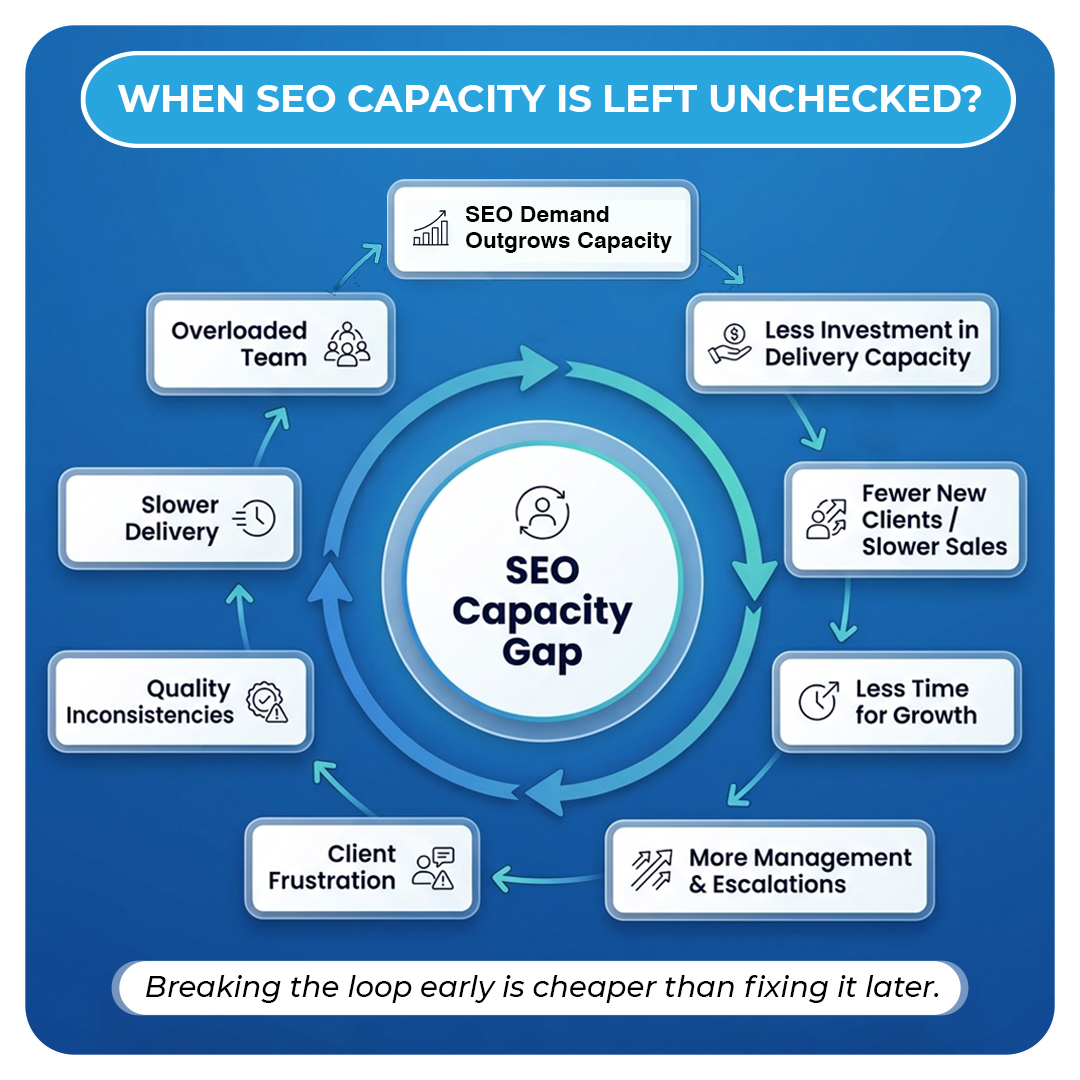
The costs of delayed outsourcing are real and compound quickly. When your SEO specialists are overloaded, quality begins to slip before anyone officially acknowledges a problem. Onboarding slows down. New clients take longer to launch. Existing clients notice inconsistencies in their reporting.
Meanwhile, founders who should be focused on growth become bottlenecks, approving deliverables, fielding escalations, and managing workloads that have outgrown the team. Client churn accelerates, often tied to delivery issues that could have been addressed earlier. Sales slows down because the agency loses confidence in its ability to take on new SEO business.
According to Bain and Company, acquiring a new customer costs five to seven times more than retaining an existing one. When operational overload drives client churn, the financial impact extends far beyond the cost of the clients lost. It erodes the margin available to invest in growth.
Opportunity cost is real even when it's invisible in your P&L. Every month your team operates above sustainable capacity is a month your agency isn't building toward the next stage of growth.
Four Agency Scenarios and the Right SEO Delivery Model for Each
Practical frameworks only go so far without real-world context. Here are four agency scenarios and the delivery model that makes the most sense for each.
Agency A: 10 SEO clients, experienced specialist, stable workload.
This agency has capacity and capability. Outsourcing now would add cost and complexity without clear benefit. The right move is to keep fulfillment internal and focus on building repeatable processes while demand is manageable. Outsourcing becomes relevant when workload grows beyond what the current specialist can absorb.
Agency B: 25 clients, overloaded SEO manager, growing rapidly.
This is a classic hybrid candidate. The internal specialist retains ownership of strategy, client communication, and quality oversight, while execution work (technical audits, link building, reporting) shifts to a white label SEO firm. This protects the client relationship while creating the capacity needed to keep scaling.
Agency C: No SEO specialists, wants to sell SEO services.
White label SEO outsourcing is the right starting point here. Building an internal SEO department from scratch requires significant investment and time. A white label SEO agency provides the expertise and infrastructure to launch SEO services quickly, while the agency focuses on sales and client management.
Agency D: Enterprise agency with an internal SEO department, occasional overflow.
Selective outsourcing fills overflow capacity without requiring permanent headcount changes. This model works well for agencies with variable client demand or project-based SEO work that doesn't justify full-time additions.
According to the U.S. Small Business Administration, small business owners who regularly evaluate their operational models, rather than defaulting to past habits, are better positioned to adapt and scale. The right delivery model for your agency today may not be the right model twelve months from now.
Red Flags That Suggest Your Agency Isn't Ready to Outsource Yet
Outsourcing amplifies what already exists in your operations. If the foundation is strong, outsourcing adds capacity and capability. If it's weak, outsourcing scales the weakness.
Before engaging a white label SEO agency, check your agency against this list:
- No documented client onboarding process
- Unclear or inconsistent SEO deliverables
- Weak internal communication between sales and fulfillment
- Inconsistent reporting formats across clients
- SEO processes that change month to month
- Undefined service packages with vague scope
- No internal point of contact to manage vendor performance
- Client expectations set without alignment to delivery capacity
If more than two or three of these apply to your agency, the highest-leverage work right now is operational improvement, not outsourcing. Define your services, document your processes, and establish your quality standards first. Once those systems exist, bringing in outside support becomes significantly easier and more effective.
What Success Should Look Like Six Months After Outsourcing?
When outsourcing is working, the results show up in operations before they show up in rankings.
Healthy outsourcing outcomes include:
- Your senior team spends more time on strategy and client consulting
- Onboarding timelines shrink because fulfillment moves faster
- Clients receive consistent, well-formatted reports on time
- Fewer bottlenecks in delivery
- Your agency can confidently sell SEO to new clients without capacity concerns
- Client retention improves because delivery quality is stable
- Profitability increases as delivery costs come down or revenue scales up
According to the Project Management Institute, organizations with mature project management practices waste 28 times less money than those with low project maturity. Outsourcing to a structured white label SEO firm brings process maturity to agencies that haven't built it internally yet.
The six-month benchmark is useful because it gives enough time to see operational trends without waiting so long that problems become entrenched. If your team is still managing constant fires six months after outsourcing, the issue is likely in how the outsourcing relationship was structured, not in the concept itself.
How DashClicks Helps Agencies Outsource SEO With Confidence
For agencies that have worked through the framework above and determined that outsourcing is the right move, DashClicks is built specifically to support agency growth through white label SEO fulfillment.
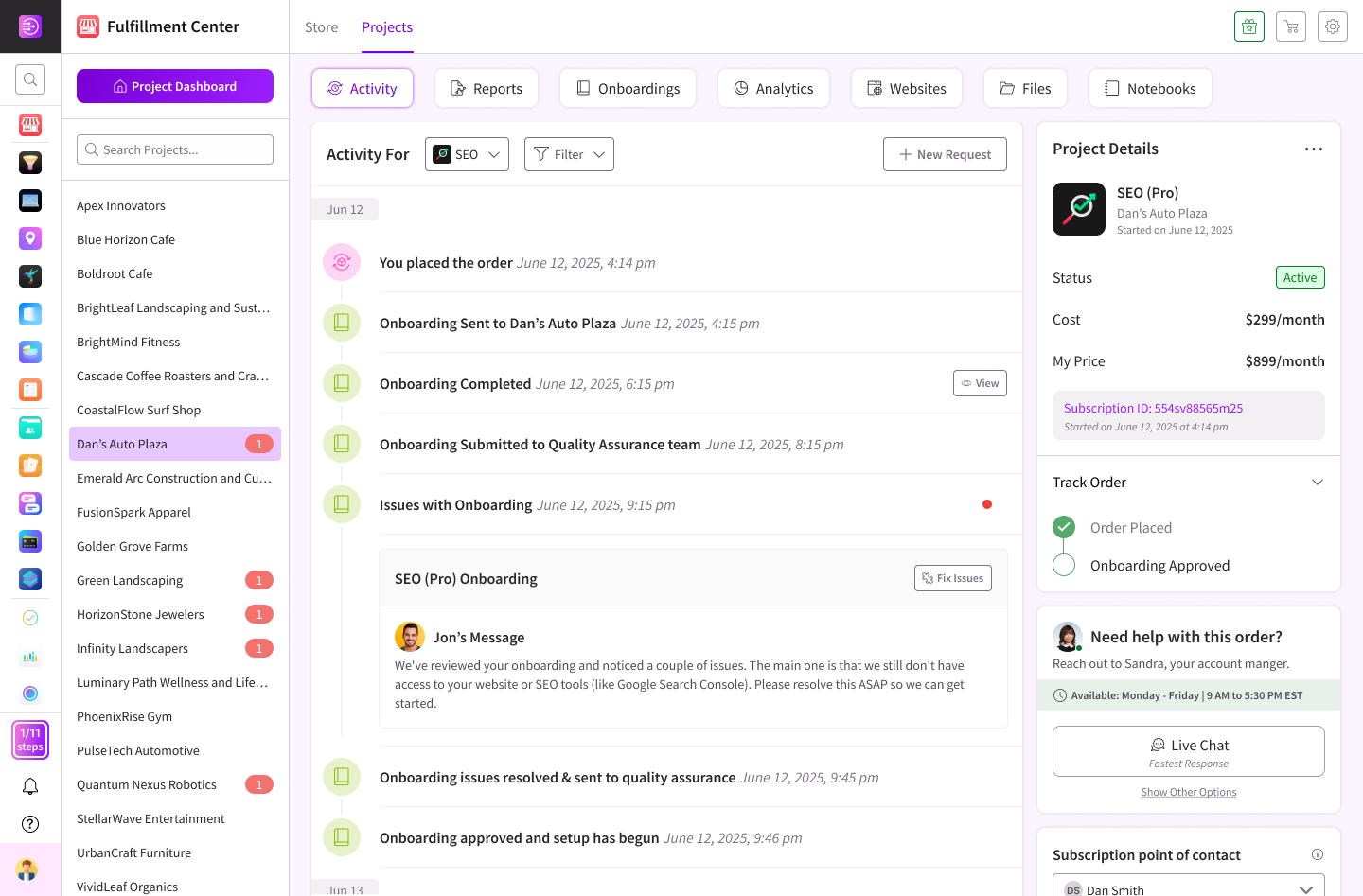
- Supporting Different Agency Growth Stages: DashClicks is designed to serve agencies at different points in their development, from agencies launching SEO services for the first time to established operations managing large client rosters. The platform scales with demand rather than requiring agencies to restructure their operations around a vendor's limitations.
- Reducing Operational Risk: One of the most common concerns agencies have about outsourcing is losing visibility into delivery quality. The platform addresses this through structured fulfillment workflows and transparent reporting, so agencies retain oversight without having to manage every execution detail.
- Helping Agencies Focus on Their Competitive Advantage: By handling execution, DashClicks frees agency teams to concentrate on the work that actually differentiates them: strategy, client relationships, business consulting, and growth planning. This shift is where the long-term value of outsourcing shows up most clearly.
- Flexible Fulfillment That Grows With the Agency: The platform supports both full white label SEO outsourcing and hybrid models, where agencies manage some SEO work internally and outsource specific components. This flexibility means agencies aren't locked into a single delivery model as their needs evolve.
- White Label Reporting: The platform provides white label reporting that agencies can present directly to clients under their own brand. This maintains the client relationship on the agency's terms while outsourcing the production work behind the scenes.
The agency retains strategy, client relationships, and business ownership. DashClicks handles scalable fulfillment. That's the operational partnership model that makes outsourcing work long-term.
Make the Decision That Fits Your Agency, Not Someone Else's
Outsourcing SEO is not automatically the right answer. Neither is hiring. The right decision depends on a clear-eyed look at your capacity, capability, profitability, operational maturity, and long-term growth goals.
Many agencies benefit most from a hybrid fulfillment model, retaining strategic and relationship-driven work internally while outsourcing execution to a white label SEO firm or white label SEO agency with proven delivery infrastructure. This model protects what makes the agency valuable to clients while creating the operational space to grow.
Successful outsourcing strengthens client outcomes. It improves delivery consistency, reduces bottlenecks, and frees your best people to focus on the work that wins and keeps business. But it only works when the decision is grounded in operational logic, not convenience.
The agencies that thrive in the next five years will not be the ones that outsource the most or hire the most. They'll be the ones that make deliberate, well-reasoned decisions about how to build and scale delivery. That discipline, applied consistently, is what separates growing agencies from great ones.


.svg)


.svg)
.svg)
.svg)
.svg)
.svg)