

.svg)

.svg)
.svg)
.svg)
.svg)
.svg)
Most startups don't fail because founders ignore their numbers. They fail because they watch the wrong ones. According to government data, a significant share of small businesses close within their first few years, and poor financial tracking is a consistent factor. Knowing which numbers actually matter is where sustainable growth begins.
The metrics that deserve regular attention fall into a few clear categories: growth signals like revenue, MRR (monthly recurring revenue), and ARR (annual recurring revenue); efficiency markers like CAC (customer acquisition cost), LTV (lifetime value), and gross margin; and survival indicators like burn rate, runway, and churn rate. Retention sits across all three, making it one of the most telling signals a founder can track.
The difference between KPIs and metrics matters here too, since not every number earns weekly attention. Vanity metrics like total signups or page views can look impressive without revealing anything about unit economics or business health. The metrics worth tracking function as operating signals. They tell founders what's working, what's breaking, and what needs a decision now.
The Metrics Founders Should Watch First
Before grouping or prioritizing, it helps to have a clear shortlist in view. The core metrics most founders need to monitor span three areas: growth, efficiency, and survival. That includes revenue, MRR, ARR, CAC, LTV, churn rate, retention, burn rate, runway, and gross margin. The right mix depends on the business model, but these cover the fundamentals across nearly every startup type.
What separates useful metrics from noise is whether they connect to action. Vanity metrics like raw traffic or total downloads can look encouraging without telling founders anything about activation, retention, or revenue. Operating signals, on the other hand, reveal what's actually happening inside the business and point toward decisions that need to be made. That distinction is worth keeping in mind as the sections below break these numbers down further.
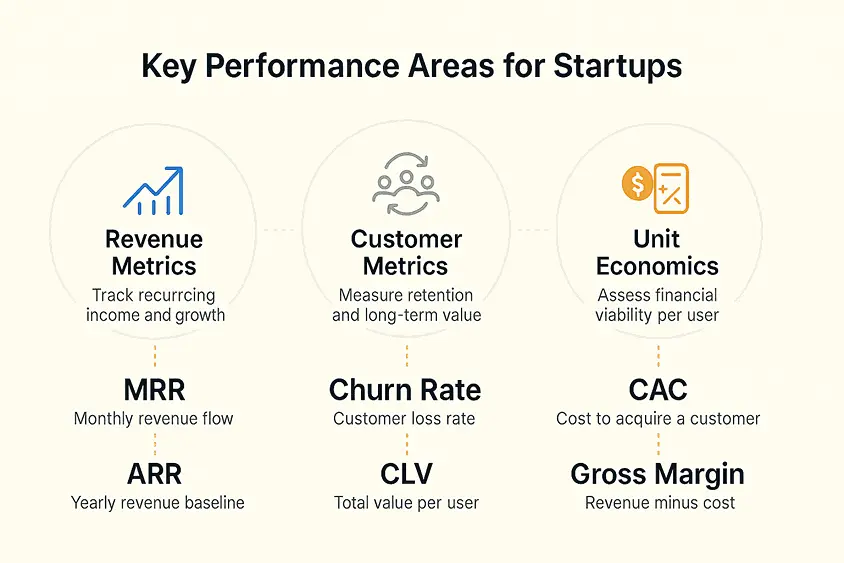
Image Source: Qubit
How to Group Metrics by What They Reveal?
Not every metric answers the same question. Some tell founders whether the business can stay alive long enough to find its footing. Others reveal whether users actually want the product. Still others show whether growth can scale without burning through cash faster than it comes in. Grouping them by what they reveal makes the whole picture easier to act on.
1. Financial Health and Survival
These metrics answer one fundamental question: can the company keep operating? Burn rate measures how quickly cash is leaving the business each month, while runway shows how many months remain before that cash runs out. Revenue and gross margin round out this group. Revenue confirms that money is coming in, and gross margin shows how much of it the business actually keeps after direct costs.
Interpreting these numbers in isolation can be misleading. Resources like Zeni offer benchmarking context that helps founders assess whether a metric trend is ordinary or genuinely concerning, which is especially useful when there's no internal baseline to compare against yet.
2. Customer and Product Traction
Retention and churn rate are the clearest signals of whether a product is delivering real value. High retention points to product-market fit, while rising churn is an early warning that something isn't working. Activation, meaning whether new users reach a meaningful milestone early on, often predicts retention before enough time has passed to measure it directly. These retention and satisfaction signals matter especially in SaaS, where compounding subscriber loss adds up quickly.
3. Growth Efficiency
CAC, LTV, and the LTV:CAC ratio sit at the center of unit economics. CAC measures what it costs to acquire a customer, and LTV measures what that customer is worth over time. The ratio between them tells founders whether their growth model is sustainable. When this ratio is healthy, scaling becomes a more confident decision. When it isn't, more growth often means more loss.
Which Metrics Matter Most at Each Stage?
Metric priorities don't stay fixed as a startup matures. What matters at pre-seed looks quite different from what investors scrutinize at Series A, and understanding that shift helps founders focus on the right signals at the right time rather than tracking everything at once.
1. Pre-Seed and Seed Priorities
At pre-seed and seed stage, investors aren't expecting polished dashboards or perfectly optimized unit economics. What they're looking for is evidence that real demand exists and that the business can survive long enough to validate it.
The tightest focus at this stage should be on retention, activation, and burn rate. Client retention shows whether early users are finding genuine value in the product, while burn rate and runway determine how much time founders have to keep iterating. Early revenue matters too, even if it's modest, because it signals that someone is willing to pay.
For B2B and SaaS startups in particular, cohort retention data carries extra weight at seed stage. It's one of the earliest indicators of product-market fit, long before MRR or ARR figures reach meaningful scale.
2. Series A and Beyond
By Series A, the conversation shifts from survival signals to scalable economics. Investors at this stage want to see that growth is predictable, that the unit economics hold under pressure, and that the business isn't acquiring customers at a loss.
MRR and ARR quality become central, not just their size. Churn rate, gross margin, CAC, and LTV all come under closer scrutiny because they reveal whether the growth model can sustain itself. A strong LTV:CAC ratio is one of the clearest signals that the business has found an efficient path to growth.
Retention continues to matter at every stage, but by Series A it functions as a product-market fit signal rather than just a usage stat, and investors read it that way.
How Metrics Shape Investor Updates?
Investors don't evaluate startups in a single good month. What they look for is trend lines, the relationship between growth and efficiency, and evidence that founders understand their own operating picture. Consistency in how metrics are tracked and presented carries real weight in that conversation.
The metrics most relevant to investor updates include revenue, MRR, burn rate, runway, CAC, churn rate, retention, and gross margin. These aren't chosen arbitrarily. Firms like Y Combinator and a16z consistently emphasize unit economics and capital efficiency when evaluating startups, and these metrics speak directly to both.
Presenting metrics well means showing direction, not just snapshots. A single strong CAC figure tells investors less than three quarters of improving CAC alongside stable gross margin. The goal is to demonstrate operational control, showing that growth isn't happening by accident and that the team understands what's driving it.
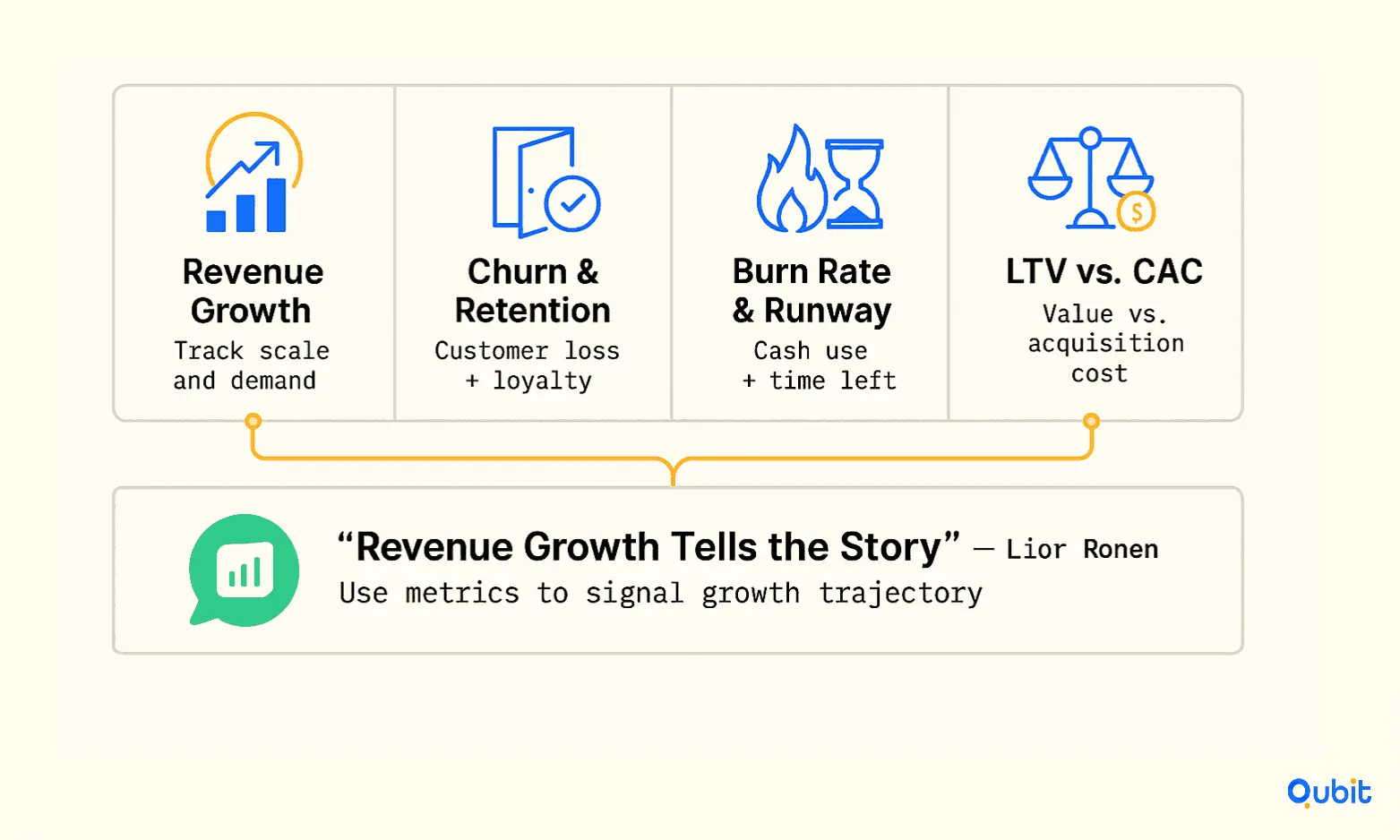
Image Source: Qubit
Founders should also avoid common presentation traps. Cumulative graphs without period-over-period context can make a slowing business look like it's still accelerating. Vanity metrics in pitch materials, like total registered users without any retention data, tend to raise more skepticism than confidence. Investors reading those materials have seen the patterns before, and selective framing often signals the opposite of what founders intend.
Using Metrics to Make Better Strategic Decisions
Metrics become valuable when they influence action. The numbers founders track should help answer practical questions about growth, spending, hiring, and long-term sustainability.
- Hiring and Team Growth: Revenue, runway, and burn rate can help determine whether the business is in a position to expand its team.
- Marketing Investment: CAC, conversion rates, and retention data can reveal whether increasing startup marketing spend is likely to generate profitable growth.
- Product Development Priorities: Retention, churn, and activation metrics often highlight areas of the customer experience that need improvement.
- Fundraising Readiness: Investors typically look for consistent growth, efficient customer acquisition, and strong retention trends rather than isolated performance spikes.
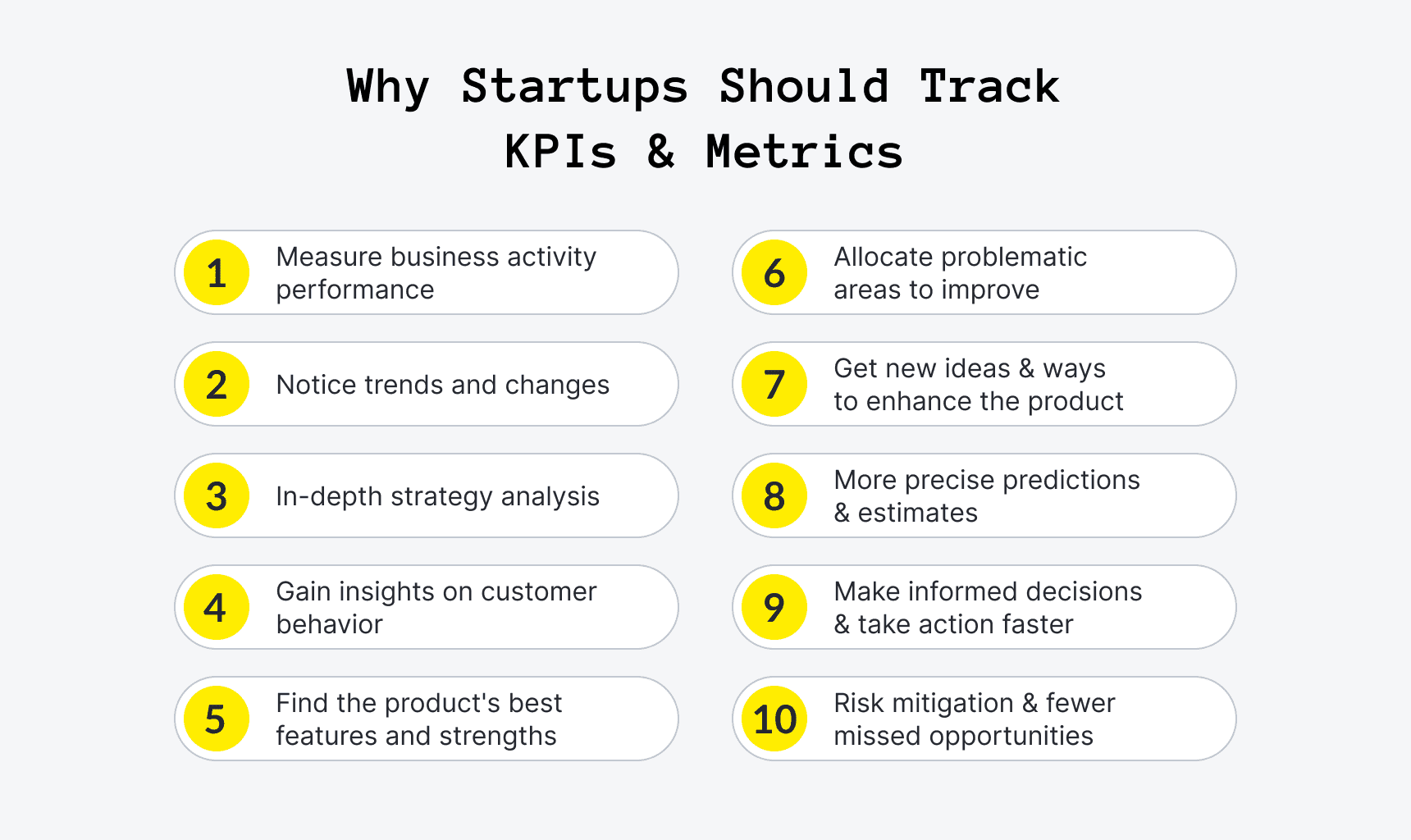
Image Source: Upsilon
When metrics are tied to strategic decisions, they become more than reporting tools—they become a framework for guiding growth.
Common Startup Metric Mistakes to Avoid
Founders don't always struggle because they lack data. In many cases, the challenge is interpreting that data correctly. Even the most important metrics can lead to poor decisions when they're viewed without context or tracked inconsistently.
- Mistake #1: Prioritizing Vanity Metrics: Brief explanation of why traffic, downloads, or social followers don't necessarily translate into business growth.
- Mistake #2: Ignoring Retention: Explain why acquiring customers is only half the equation and why churn often reveals deeper issues.
- Mistake #3: Tracking Too Many KPIs: Discuss how crowded dashboards can make it harder to identify what actually needs attention.
- Mistake #4: Focusing on Individual Data Points: Explain the importance of trends over single-month performance.
Avoiding these mistakes helps founders maintain a clearer view of business performance and make more informed decisions as the company grows.
Centralizing Metrics as Your Startup Grows
Tracking startup metrics becomes more challenging as revenue, customer, and marketing data spread across multiple platforms. A centralized reporting system can make it easier to maintain visibility and identify trends before they become larger issues.
Unified Performance Tracking
Bringing key business data into one dashboard can help founders:
- Monitor growth metrics more efficiently
- Spot changes in performance sooner
- Reduce time spent compiling reports
- Keep teams aligned around shared KPIs
Tools That Support Better Visibility
Platforms like DashClicks offer several tools that can help simplify metric tracking:
- Dashboard & Insights Tools for monitoring performance data in a single view
- Analytics Software for measuring marketing and campaign performance
- CRM Software for tracking customer interactions and sales activity
- InstaReports for automating reporting and sharing business insights
Focus on Actionable Data
The goal isn't to create a dashboard packed with every available KPI. Instead, founders should prioritize a reporting system that keeps their most important metrics visible, accessible, and easy to act on as the business scales.
Track Fewer Metrics, but Track Them Well
The best startup metrics aren't the most impressive ones on a slide deck. They're the ones that actually change a decision. Founders who track retention, burn rate, runway, CAC, and revenue consistently tend to have a clearer operating picture than those juggling a dozen numbers that rarely lead anywhere actionable.
A cluttered dashboard creates the illusion of oversight without the substance of it. The goal is a focused set of metrics tied to the current stage and business model, reviewed on a rhythm that matches how fast things are actually moving.
Growth, retention, efficiency, and cash management each tell a different part of the story. Together, they give founders the clarity to make better calls, sooner.




.svg)


.svg)
.svg)
.svg)
.svg)
.svg)