

.svg)

.svg)
.svg)
.svg)
.svg)
.svg)
A poorly constructed search strategy can quietly undermine months of research work, often without researchers realizing where things went wrong. For those conducting a systematic review, the quality of the search is not just a technical detail; it is the foundation that determines whether the final evidence base is complete, credible, and defensible.
These seven signs offer a practical self-check for any literature search workflow.
7 Signs Your Search Strategy Needs Help
- The research question is vague or shifting, making it impossible to map terms consistently across sources.
- The PICO framework has not been applied, leaving population, intervention, comparator, and outcome elements undefined.
- Boolean operators are used inconsistently or incorrectly, producing either unmanageable result sets or suspiciously few records.
- Coverage is limited to one or two bibliographic databases, missing the breadth that a systematic review requires.
- Grey literature sources such as conference proceedings, theses, and government reports have been excluded entirely.
- There is no documented balance between sensitivity and precision, so the strategy cannot be justified or reproduced.
- The search strategy has never been peer reviewed by an information specialist or librarian, leaving structural errors undetected.
Where Search Strategies Start to Break Down?
Recognizing the signs above is a useful starting point, but understanding why these problems develop is what helps teams address them at the root. The earliest failures tend to cluster around two related issues: an unclear research question and a weak translation of that question into database language.
When the Research Question Is Still Too Fuzzy?
Most search strategy failures begin long before anyone opens PubMed or types the first keyword. They start at the planning stage, when the research question itself is not yet clear enough to guide a structured search.
A vague or shifting research question creates immediate downstream problems. Without a defined population, intervention, comparator, and outcome, the PICO framework cannot be applied properly, and there is no reliable basis for deciding what to include or exclude. Inclusion logic becomes inconsistent, and the search terms selected one day may contradict those chosen the next.
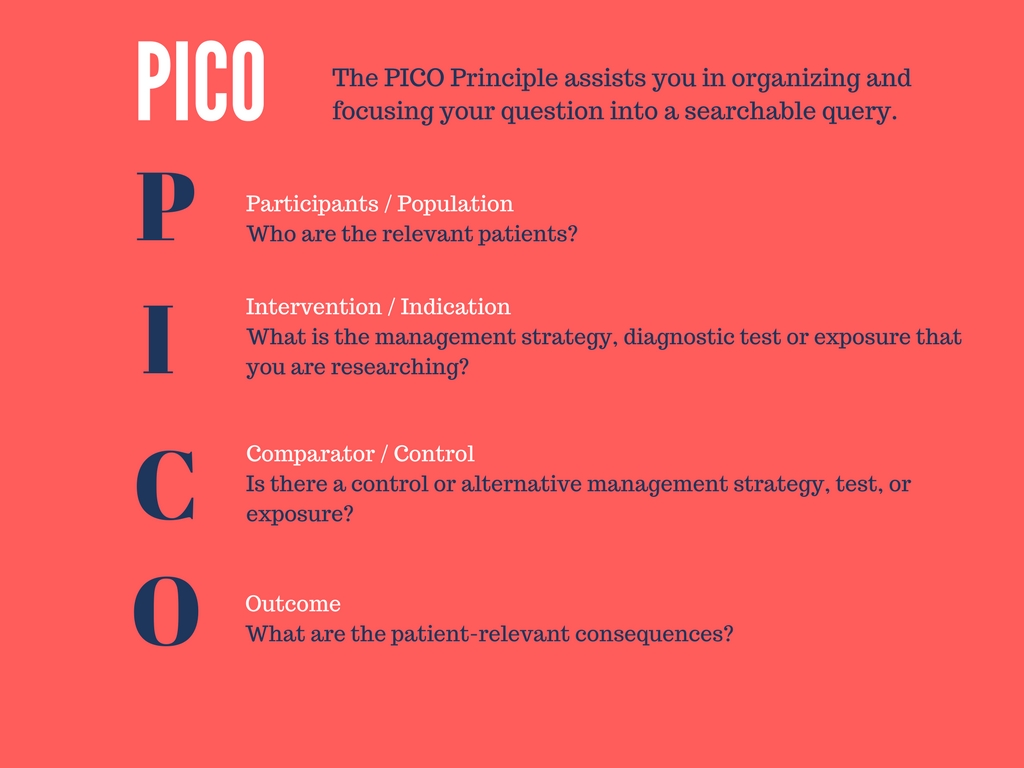
Image Source: Logan University
When concept blocks are built on an unstable question, every subsequent decision inherits that instability. Early guidance from an information specialist at this stage often prevents significant revisions later, once the search is already underway.
When Keywords and Controlled Terms Miss the Topic?
Even when the research question is reasonably clear, the translation into database language is where many strategies quietly lose ground. Researchers often rely on natural language keywords alone, missing the controlled vocabulary that databases like MEDLINE use to index records systematically.
MeSH terms exist precisely to bridge the gap between how researchers describe a topic and how that topic is classified within a database. Without them, relevant records are indexed under terms the search never retrieves.
Boolean operators compound the problem when concept blocks are poorly constructed. A misplaced AND or OR between related terms can eliminate entire clusters of relevant literature, much like how setting realistic SEO expectations early in a project prevents costly corrections later. For complex topics, hiring an SEO agency or a specialist in search architecture is often the clearest path to a structurally sound strategy.
Coverage Gaps That Experts Spot Quickly
Even when the research question is well-defined and the terminology is mapped carefully, a strategy can still fall short if the sources themselves are insufficient. Coverage gaps are among the most consequential weaknesses in a literature search, and they are also among the easiest to overlook without specialist input.
Too Few Sources for the Question You Are Asking
Relying on one or two bibliographic databases is one of the most common structural weaknesses in a literature search, and one of the hardest to detect without specialist input. Each database indexes different journals, applies different coverage criteria, and prioritizes different subject areas.
MEDLINE, EMBASE, and the Cochrane Library are frequently used together precisely because each captures records the others miss. EMBASE, for instance, has stronger coverage of European journals and conference abstracts, while MEDLINE skews toward North American biomedical literature. Running a search through only one of these sources means a portion of the relevant evidence base is never seen, which distorts the findings before analysis even begins.
For a systematic review to meet methodological standards, the source selection itself must be justifiable and documented. An expert will assess which databases are appropriate for the specific topic rather than defaulting to the familiar ones.
Missing Grey Literature and Trial Records
Even a well-constructed multi-database search can leave significant gaps if grey literature is excluded. Conference proceedings, government reports, regulatory documents, and unpublished studies contain evidence that peer-reviewed journals do not always capture.
Trial registries add another layer. ClinicalTrials.gov and similar registries record studies regardless of whether results were ever published, making them essential for identifying potential publication bias. When these sources are absent, the review may systematically favor positive findings.
Experts flag this gap quickly because it carries direct implications for bias risk and the overall credibility of the evidence synthesis.
Image Source: Bloomberg
Your Results Are Broad, Thin, or Off Target
When a search strategy is structurally imbalanced, the evidence shows up in the results themselves. The two failure modes are sensitivity and precision, and both are recognizable once you know what to look for.
A sensitivity-heavy strategy retrieves thousands of records, most of them weakly related to the research question. Reviewers spend hours screening noise, and the signal-to-noise ratio makes the process unsustainable. A precision-heavy strategy does the opposite, returning a narrow set of results that misses obviously relevant studies indexed under slightly different terms.
In PubMed, this balance is shaped by specific technical decisions. Field tags determine where the database looks for a term, whether in the title, abstract, or MeSH heading. Adjacency operators control how close two terms must appear to count as a match, and Boolean operators govern how concept blocks combine. Adjust any one of these, and the result set shifts, sometimes dramatically.
The problem is that iterative tweaking has a ceiling. Researchers can refine a strategy through multiple rounds without resolving a deeper structural flaw, such as a concept block that conflates two distinct ideas or a term hierarchy that is mapped incorrectly. At that point, the adjustments produce diminishing returns, much like running a thorough SEO audit when the underlying site architecture is what needs attention.
For a systematic review, persistent instability in the result set is a reliable indicator that expert review of the full strategy is warranted.
No One Has Checked the Strategy Properly
Even a well-constructed search strategy can carry undetected errors that only become visible when someone with the right training reviews it. This is where quality assurance becomes a decisive factor, not an optional refinement.
The peer review guidelines developed for systematic searches offer a structured way to evaluate whether a strategy meets methodological standards before it is finalized. PRESS guidelines, in particular, provide a reproducible framework for checking syntax, logic, term selection, and conceptual coverage in a systematic way.
Information specialists and librarians are especially well-positioned to apply this kind of review. Where a researcher may read past a misplaced Boolean operator or an incomplete concept block, a trained information specialist recognizes the pattern immediately.
What peer review catches is not always obvious to the person who built the strategy. A search that appears coherent from the inside often contains coverage gaps, redundant terms, or structural inconsistencies that only surface under a methodical external check. Skipping this step leaves those errors embedded in the final search, where they silently affect results.
Image Source: WP-CRM
What to Do When These Signs Show Up?
When multiple warning signs appear together, as outlined throughout this article, they rarely point to a minor adjustment. They typically reflect a structural issue with the search strategy itself, one that individual tweaks are unlikely to resolve.
At that point, bringing in expert guidance early is the more efficient path. An information specialist can assess the full strategy against systematic review standards, identify coverage gaps, and flag logic errors that internal review tends to miss. That input also strengthens the defensibility of the final search, which matters during peer review and publication.
For any team planning a new review or revisiting an existing one, the clearest next step is a careful evaluation of the search structure before the work goes any further.
The Value of Specialist Expertise
Search strategies become increasingly difficult to manage as research questions grow more complex. What begins as a straightforward literature search can quickly expand across multiple databases, controlled vocabularies, grey literature sources, and screening requirements. At that stage, even small weaknesses in search construction can affect the completeness and reliability of the final evidence base.
Specialists bring a level of methodological expertise that helps address these challenges. Information specialists and librarians are trained to evaluate search logic, identify coverage gaps, refine concept blocks, and ensure that strategies remain both comprehensive and reproducible. Their involvement can improve the overall quality of the search while reducing the risk of overlooked evidence.
The importance of expert guidance is recognized across many fields where search quality directly influences outcomes. Whether the goal is evidence synthesis, information retrieval, or digital search performance, organizations often rely on specialists to review complex processes, identify weaknesses, and strengthen overall methodology. This emphasis on structured search practices is reflected in how companies such as DashClicks approach search-focused work, where strategic planning and expert oversight play an important role in achieving reliable results.
As search requirements become more sophisticated, expert review is often the most effective way to ensure that a strategy remains comprehensive, defensible, and aligned with its intended objectives.
Conclusion
A search strategy is more than a collection of keywords and database queries. It is the framework that determines whether a review captures the full scope of relevant evidence or overlooks important studies that could influence the findings.
The warning signs discussed throughout this article, including unclear research questions, incomplete terminology, limited source coverage, imbalanced results, and a lack of peer review, often indicate deeper structural issues within the search process. While some problems can be addressed through refinement, others require a more systematic evaluation of the strategy itself.
For researchers conducting systematic reviews, recognizing these issues early is often the difference between a search that is merely functional and one that is comprehensive, reproducible, and defensible. When uncertainty remains, expert guidance can help identify weaknesses, strengthen methodology, and provide greater confidence in the final evidence base.
Ultimately, the strength of a systematic review depends on the strength of the search that supports it. Investing time in building and validating that foundation is one of the most important steps in producing reliable research.




.svg)


.svg)
.svg)
.svg)
.svg)
.svg)