

.svg)

.svg)
.svg)
.svg)
.svg)
.svg)
Choosing a white label Facebook ad agency is not just a vendor decision. It is a delivery infrastructure decision.
The partner you select will be responsible for campaign performance across multiple client accounts, in your agency's name. That means optimization quality, tracking accuracy, creative testing, and communication standards all become your agency's responsibility, even when a third party handles execution.
Many agencies evaluate white label Facebook ads reseller options based on price, turnaround time, or the number of services offered. Those factors matter, but they do not tell you whether a provider can consistently deliver results as your client base grows.
The right questions reveal how a provider actually operates. They expose whether the team follows structured processes or reacts to problems after the fact. They also clarify whether you are hiring a fulfillment vendor or a strategic partner. The difference between those two shapes your agency's reputation, client retention, and internal workload over time.
This article walks through 12 operational questions every agency should ask before committing to a long-term white label Facebook ads partner. Each question targets a specific area:
- Campaign optimization and troubleshooting
- Creative strategy and testing
- Tracking and conversion data
- Communication and account management
- Quality control across accounts
- Scalability and onboarding
- Reporting and strategic support
- Platform adaptability and ownership
Poor partner selection does not just produce bad campaign results. It creates more internal work for your team, reduces your ability to scale, and puts agency-client relationship at risk. The questions below help you avoid that outcome.
The Problem: Why the Wrong White Label Partner Creates More Work for Agencies
1. Inconsistent Optimization
Optimization is not the same as campaign monitoring. A provider who monitors campaigns without a defined optimization framework tends to react to problems rather than prevent them.
Reactive optimization means your agency often discovers issues only after clients raise concerns. Missed budget pacing, ad fatigue, and audience overlap are all preventable problems that require a proactive process to catch early.
2. Poor Campaign Structure
Fragmented target audience and poorly organized ad sets make campaigns harder to manage and harder to scale. Budget dilution across too many small audiences reduces learning efficiency and makes it difficult for Meta's algorithm to optimize.
Meta's own guidance supports simplified account structures. In one internal test, consolidating campaign architecture produced a 41% increase in conversions. Providers who build bloated structures may be working against that principle.
3. Weak Data and Tracking
Facebook Ads optimization depends on signal quality. Without proper Pixel configuration, Conversions API implementation, and CRM integration, the algorithm is working with incomplete data.
Poor event quality scores reduce delivery efficiency and lead to optimization decisions built on inaccurate attribution. This is especially damaging when scaling ad spend across multiple clients.
4. Communication Gaps
Agencies need regular visibility into what is happening inside their client accounts. A provider who does not proactively communicate changes, test results, or performance issues puts your account managers in a difficult position.
Delayed communication creates delayed issue discovery. By the time your team identifies a problem, the client may already be asking questions your team cannot answer.
5. Scaling Becomes a Fulfillment Problem
A provider may handle five or ten accounts efficiently but struggle when volume increases significantly. Inconsistent turnaround times, declining output quality, and limited specialist capacity all surface under growth pressure.
If a provider cannot scale alongside your agency, your growth creates operational problems rather than momentum. The questions below help you assess that risk before it becomes a reality.
Question #1: How Do You Actually Optimize Campaigns?
This question reveals whether a provider has a structured approach or an informal one.
Questions Agencies Should Ask
- What triggers an optimization review: scheduled cadence, performance thresholds, or both?
- How do you document optimization decisions across accounts?
- What does a typical week of campaign management look like for an account at our average spend level?
- How do you prioritize which accounts to optimize first when managing multiple clients?
What Strong Answers Reveal
Strong providers describe a defined optimization cadence tied to both time intervals and performance signals. They can explain what triggers a bid adjustment, audience refresh, or creative rotation, and why.
Documentation matters here. Providers who log optimization changes enable accountability, support continuity when team members change, and make it easier to communicate reasoning back to your account managers.
Vague answers like "we check campaigns regularly" suggest informal processes. Formal processes reduce variance in quality across accounts.
Question #2: What Happens When a Campaign Underperforms?
Every Facebook Ads campaign eventually underperforms. The question is whether your partner has a structured process for diagnosing and resolving those situations.
Questions to Ask
- Walk me through your troubleshooting process when a campaign misses its KPIs for two consecutive weeks.
- How do you determine whether underperformance is caused by creative fatigue, audience saturation, tracking issues, or structural problems?
- When do you escalate an issue, and who makes that call?
Red Flags
- No structured troubleshooting workflow
- Inability to explain how root causes are identified
- No clear escalation path for persistent problems
Strong Diagnostic Process
A capable provider isolates variables before making changes. They review creative performance, audience overlap, landing page data, and event quality before drawing conclusions.
Escalation should be built into the process, not improvised. Knowing who reviews difficult accounts and when problems are resolved faster and communicated to your team before a client notices.
Question #3: How Do You Approach Creative Testing?
Creative is one of the highest-leverage variables in Facebook Ads performance. Providers who test systematically outperform those who rotate creatives based on intuition.
Ask how frequently new creative concepts are tested, how hypotheses are formed before testing, and how ad fatigue is monitored at the account level.
Strong providers test one primary variable at a time and define success metrics before launching. They track fatigue signals proactively and build iteration schedules rather than waiting for performance to drop before refreshing.
Meta's own creative diversification guidance supports running multiple creative formats across placements to maximize reach efficiency. Ask whether your potential partner builds this principle into their testing workflow.
Question #4: Who Owns Tracking and Conversion Data?
Tracking ownership is one of the most technically consequential questions on this list.
Ask specifically about:
- Pixel implementation and event verification
- Conversions API setup and CRM signal integration
- Event quality monitoring and how discrepancies are caught
- What tracking validation looks like before a campaign launches
Providers who validate conversion events, monitor data quality scores, and integrate offline signals tend to produce more reliable optimization outcomes. Providers who treat tracking as a setup task rather than an ongoing responsibility leave gaps that compound over time.
Reliable data is not a nice-to-have. It is the foundation that Meta's algorithm uses to allocate budget, find audiences, and optimize toward the right outcomes.
Question #5: How Will Your Team Work With Our Account Managers?
Your account managers serve the client relationship. The white label team supports them from behind the scenes. If that working relationship is unclear or poorly structured, your internal team absorbs the management burden.
Questions to Ask
- What is your average response time for account manager inquiries?
- How do you communicate proactive recommendations, not just updates?
- What does your team prepare when an account manager needs to present results to a client?
- How do you handle urgent issues outside of normal business hours?
A good white label Facebook Ads agency reduces the number of questions your account managers need to ask by providing clear, consistent communication. Providers who require frequent follow-up to get basic answers create more internal overhead than they relieve.
Question #6: How Do You Maintain Quality Across Multiple Accounts?
Quality consistency across many accounts requires documented processes. Ask how the provider maintains execution standards when managing campaigns across a range of industries, budgets, and objectives.
Look for:
- Standard operating procedures for campaign setup and ongoing management
- Quality assurance reviews before launches and after significant changes
- Processes for onboarding new accounts without sacrificing quality on existing ones
- A review layer that catches errors before they reach your clients
Providers who rely on individual team members rather than documented systems introduce variability that grows more problematic as your account volume increases.
Question #7: What Happens When We Add 10, 20, or 50 New Accounts?
According to Databox research, agencies commonly manage between 10 and 30 clients simultaneously. Onboarding and scaling become operational challenges without structured fulfillment processes, and many agencies cite this as a significant growth constraint.
Ask your potential partner directly:
- How many accounts does your team currently manage?
- What does your onboarding workflow look like for a surge of five or ten new accounts?
- How do you allocate specialists when volume increases quickly?
- What is your standard turnaround time for campaign setup, and does it change under growth pressure?
Providers who can describe their capacity structure and onboarding workflow clearly are more likely to scale alongside your agency without a quality decline. Vague answers about scalability are a signal to dig deeper.
Question #8: What Does Your Reporting Actually Give Us?
Reporting is often positioned as a deliverable when it should function as a communication tool. The format matters less than the substance.
Databox research shows that 45% of agencies report on a monthly basis, while 18% report weekly or biweekly. Your reporting cadence should match client expectations, but the quality of insights should remain consistent regardless of frequency.
Ask specifically:
- Are reports white-labeled and customizable to our branding?
- Do reports include optimization context or just performance metrics?
- Can we see what actions were taken and why, not just what the numbers show?
- Are strategic recommendations included alongside performance data?
A white label reporting software that explains decisions gives your account managers something to work with. Reporting that only displays metrics puts the interpretation burden on your team.
Question #9: Who Is Actually Managing Our Clients' Campaigns?
This question is about accountability and expertise, not just headcount.
Ask whether dedicated specialists are assigned to your accounts or whether work is distributed across a generalist pool. Ask about the experience level of the people running day-to-day management versus those providing strategic oversight.
The distinction matters because:
- Dedicated specialists build account-specific knowledge over time
- Generalist pools create continuity risks when staff changes occur
- Senior strategy oversight catches issues that junior execution misses
You should know exactly who is responsible for your accounts and what level of expertise they bring to campaign decisions.
Question #10: How Do You Adapt to Meta Ads Changes?
Meta's platform evolves continuously. Providers who adapt quickly outperform those who rely on outdated structures and manual processes.
Ask how the provider incorporates Meta's AI-driven tools, including Advantage+ Shopping Campaigns and automated audience targeting. Ask how they balance automation with human oversight to avoid loss of control over account strategy.
Meta's AI recommendation models have contributed roughly 5% more Instagram conversions and 3% more Facebook conversions based on internal data. These figures underscore why providers need to stay current with Meta's evolving guidance, not just its current features.
Also ask about their process for testing new platform features and how they decide when automation is appropriate versus when manual control is better suited to a client's goals.
Question #11: What Strategic Support Do You Provide Beyond Campaign Execution?
Execution gets campaigns live. Strategy determines whether those campaigns grow client businesses over time.
Ask whether your potential partner offers:
- Growth recommendations based on account performance trends
- Budget allocation advice across campaign types and objectives
- Funnel-level insights that connect ad performance to business outcomes
- Periodic account reviews that go beyond monthly reporting
The difference between an execution partner and a strategic partner is whether they help your agency understand what to do next, not just what happened last month. Agencies that want to position themselves as consultative partners to their clients need the same quality of thinking from their white label providers.
Question #12: What Happens If We Need to End the Partnership?
Every business relationship should have a clear exit process. Avoiding this question does not protect the partnership. It creates risk if the relationship eventually changes.
Ask specifically:
- Who owns the ad accounts, Pixel data, and creative assets?
- How is campaign documentation handed over at the end of the engagement?
- What is the transition timeline, and what support is provided during handoff?
- Are there contractual restrictions that affect your agency's ability to transition?
Vendor lock-in through data ownership or restrictive contract terms is a legitimate operational risk. Providers who have clear, client-first exit processes are more confident in the value they deliver.
How to Evaluate the Answers: Strong Signals vs. Red Flags
Use this table to evaluate what a provider's responses actually indicate:
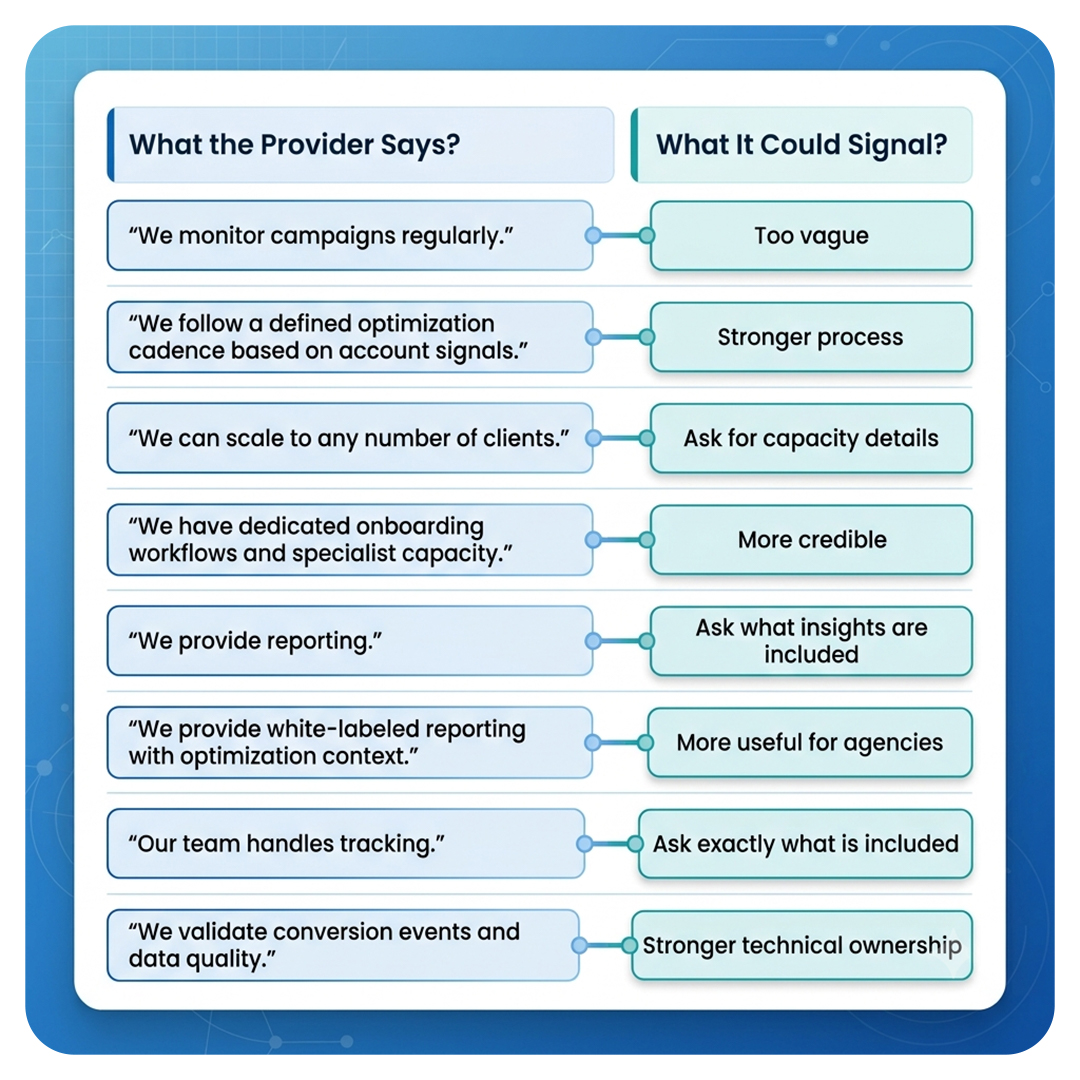
No single answer confirms a partner is the right fit. Pattern recognition across multiple questions gives you a more accurate picture of how the provider actually operates.
The Final Test: Can This Partner Make Your Agency Easier to Run?
Before committing to any white label Facebook ads reseller, consider whether the provider helps your agency:
- Reduce internal management workload across client accounts
- Maintain consistent campaign optimization without constant oversight
- Troubleshoot performance issues quickly and with clear communication
- Run structured creative testing that improves results over time
- Keep tracking and conversion data reliable across all accounts
- Communicate proactively rather than reactively
- Onboard and scale new accounts without quality decline
- Support account managers with reporting and client-ready insights
- Adapt to Meta platform changes without manual intervention
- Contribute strategic thinking beyond campaign execution
Facebook ads services at scale require more than task completion. The right partner strengthens your agency's delivery systems, improves your ability to retain clients, and gives your team the infrastructure to grow without increasing internal complexity.
Choosing a white label Facebook ad agency based on operational capability, not just price or availability, is one of the most consequential decisions a growing agency will make.


.svg)


.svg)
.svg)
.svg)
.svg)
.svg)