

.svg)
.svg)
.svg)
.svg)
.svg)
.svg)
Google's search results look nothing like they did a decade ago. The era of ten blue links has given way to a dynamic, feature-rich landscape where featured snippets, People Also Ask boxes, local packs, video carousels, image results, knowledge panels, and AI-generated overviews now dominate the top of the page. For many queries, these features occupy the majority of visible screen real estate before a traditional organic result ever appears.
This shift has created a fundamental problem for agencies still measuring success through rankings alone. A client can sit at position three and receive a fraction of the clicks that a featured snippet at position zero commands. Rankings tell you where your content lands. SERP features determine whether anyone actually sees it.
The agencies gaining ground right now are not necessarily the ones with the highest rankings. They are the ones systematically optimizing for and tracking the features that control how search results are experienced. Many agencies still deliver monthly ranking reports while competitors are quietly capturing visibility through featured snippets, local packs, and People Also Ask placements that their clients never even know exist.
SERP feature optimization is no longer an advanced tactic reserved for enterprise SEO teams. For agencies looking to deliver measurable organic visibility gains, scale their services, and differentiate their offerings, it has become a core competency. Before diving into how to optimize and track these features, it helps to understand exactly what they are and why they matter so much to modern SEO performance.
What Are SERP Features And Why Do They Matter In Modern SEO?
SERP features are any result that appears in Google's search engine results pages beyond a standard organic blue link. They include a wide range of formats, each designed to serve a specific type of search intent.
The most common SERP features agencies should be optimizing for include:
- Featured Snippets: Direct answers pulled from a webpage and displayed above the standard results at position zero.
- People Also Ask (PAA): Expandable question boxes that pull answers from topically relevant content.
- Local Packs: Map-based results surfacing local business listings for location-specific queries.
- Image Results: Visual content integrated directly into search results pages.
- Video Results: YouTube and other video content are displayed inline within the SERP.
- Knowledge Panels: Information boxes drawn from Google's Knowledge Graph, typically for brands, people, and organizations.
- AI-generated Overviews: Summaries generated by Google's AI systems that synthesize answers from multiple sources.
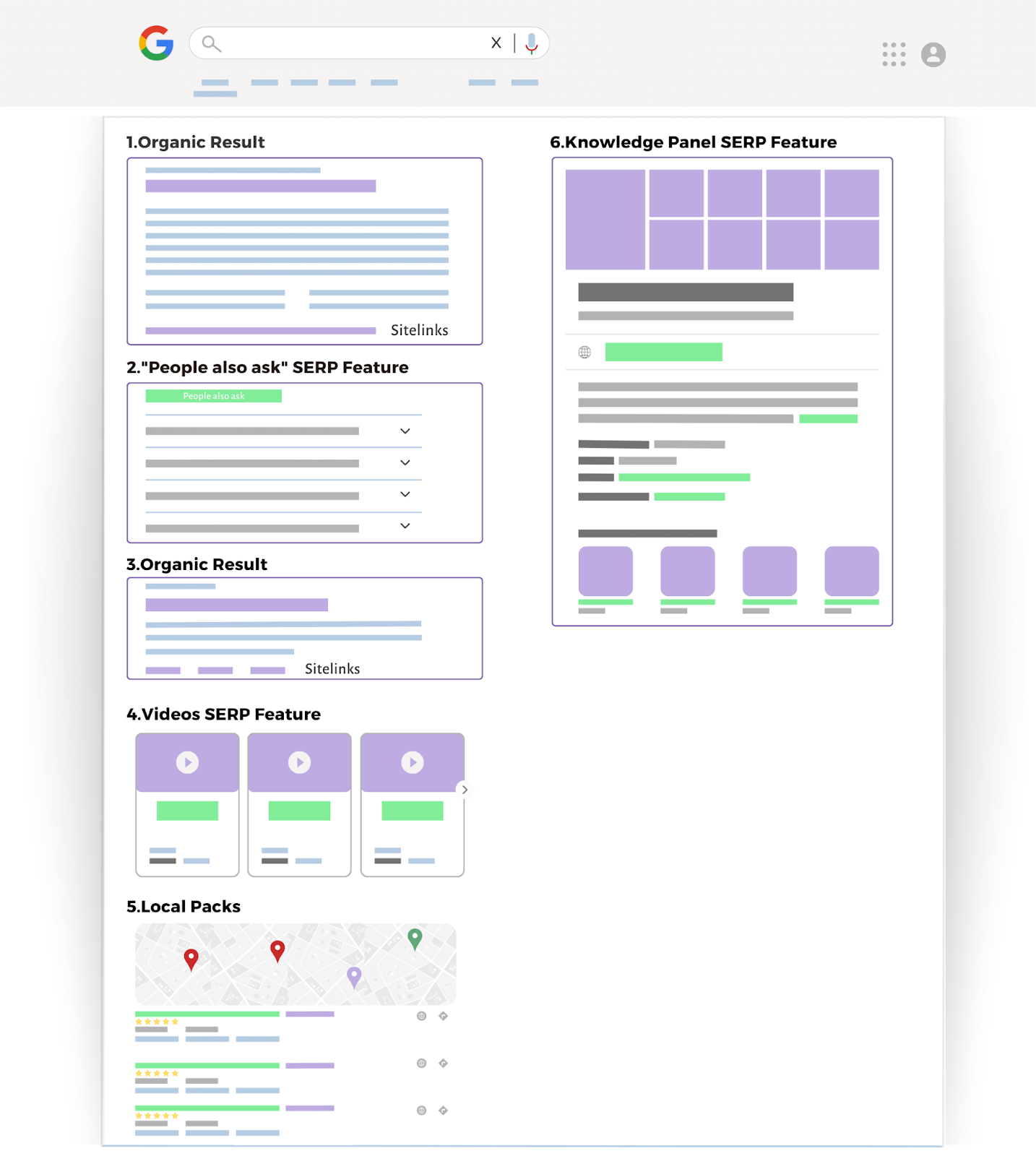
These features are not minor additions to the search experience. They occupy significant portions of the search results page, often pushing standard organic results far below the fold. According to Ahrefs' study of featured snippets, featured snippets can capture approximately 8 to 30% of clicks depending on query type. Meanwhile, research from SparkToro and Similarweb shows that 68% of Google searches in the United States end without a click, meaning users are finding their answers directly within the SERP itself.
For agencies, this reframes the entire definition of visibility. A client ranking at position five for a high-value keyword may be losing the majority of potential traffic to a featured snippet owned by a competitor. Visibility and rankings are no longer the same thing. Understanding that distinction is the starting point for building a modern, results-driven SEO service.
How to Optimize For SERP Features?
Effective SERP feature optimization requires a shift in mindset. Traditional keyword-focused SEO asks, "Where does this page rank?" Intent-focused SERP optimization asks, "Which feature will this query trigger, and how can this content be structured to win it?" Each SERP feature responds to different content structures and optimization signals.
1. Featured Snippet Optimization
Google selects featured snippets based on how clearly and concisely a page answers a specific query. To optimize for featured snippets, content needs to be structured around direct answers.
Key practices include:
- Writing definition-style answers in concise paragraphs of 40 to 60 words.
- Using numbered steps for process-based queries.
- Incorporating tables for comparison-type content.
- Placing the direct answer immediately after the relevant heading, not buried in paragraph text.
- Avoid first-person language and keep answers factual and objective.
Google favors content that mirrors the format it expects to display. If the current featured snippet for a target keyword is a numbered list, structuring content in that same format significantly improves the likelihood of capturing or displacing it.
2. People Also Ask Optimization
People Also Ask expands based on topic depth and semantic relevance. Content that covers a subject comprehensively, addressing the primary question and the related questions users commonly ask, is more likely to appear in PAA placements.
Agencies can optimize for PAA visibility by:
- Building FAQ clusters that group semantically related questions within a single piece of content.
- Structuring supporting sections around H2 and H3 question formats that mirror natural search language.
- Providing concise, self-contained answers beneath each question heading.
- Linking between related content pieces to signal topical authority across the site.
The deeper the topic coverage, the greater the PAA footprint a page can capture. This is especially valuable for clients targeting informational queries with multiple related subtopics.
3. Local Pack Optimization
For agencies serving local businesses, Google local pack visibility can be more commercially valuable than any organic ranking. Local packs appear for location-based queries and are driven by a combination of Google Business Profile signals and on-site relevance.
Optimization priorities include:
- Maintaining consistent NAP (Name, Address, Phone) information across all directories and citation sources.
- Keeping the Google Business Profile fully optimized with accurate categories, business hours, photos, and regular posts.
- Actively generating and responding to Google reviews.
- Creating location-specific landing pages that reinforce geographic relevance.
For clients with multiple locations, this process needs to be systematized across every listing to maintain consistency.
4. Image And Video SERP Optimization
Visual SERP features offer agencies an additional layer of organic visibility that many overlook. Image results and video carousels appear across a broad range of query types, from how-to content to product comparisons.
For image optimization, the focus should be on descriptive alt text, appropriately compressed file sizes, and contextually relevant surrounding content. For video results, YouTube optimization plays a significant role. Descriptive titles, accurate transcriptions, and structured video schema all help signal relevance to Google's indexing systems.
These placements supplement traditional organic results, creating additional touchpoints in the SERP without requiring a corresponding improvement in standard rankings.
5. Technical And Schema Optimization
Structured data is one of the most direct ways to communicate content relevance to Google's systems. Schema markup signals intent and content type, which helps Google identify content as eligible for specific SERP features.
The most impactful schema types for SERP feature optimization include:
- FAQ Schema: Supports People Also Ask placements.
- How-To Schema: Increases eligibility for step-based featured snippets.
- Organization Schema: Strengthens knowledge panel accuracy and brand visibility.
Internal linking and topical authority also play a supporting role. Pages that exist within a well-linked content ecosystem, rather than in isolation, tend to perform better across multiple SERP features simultaneously.
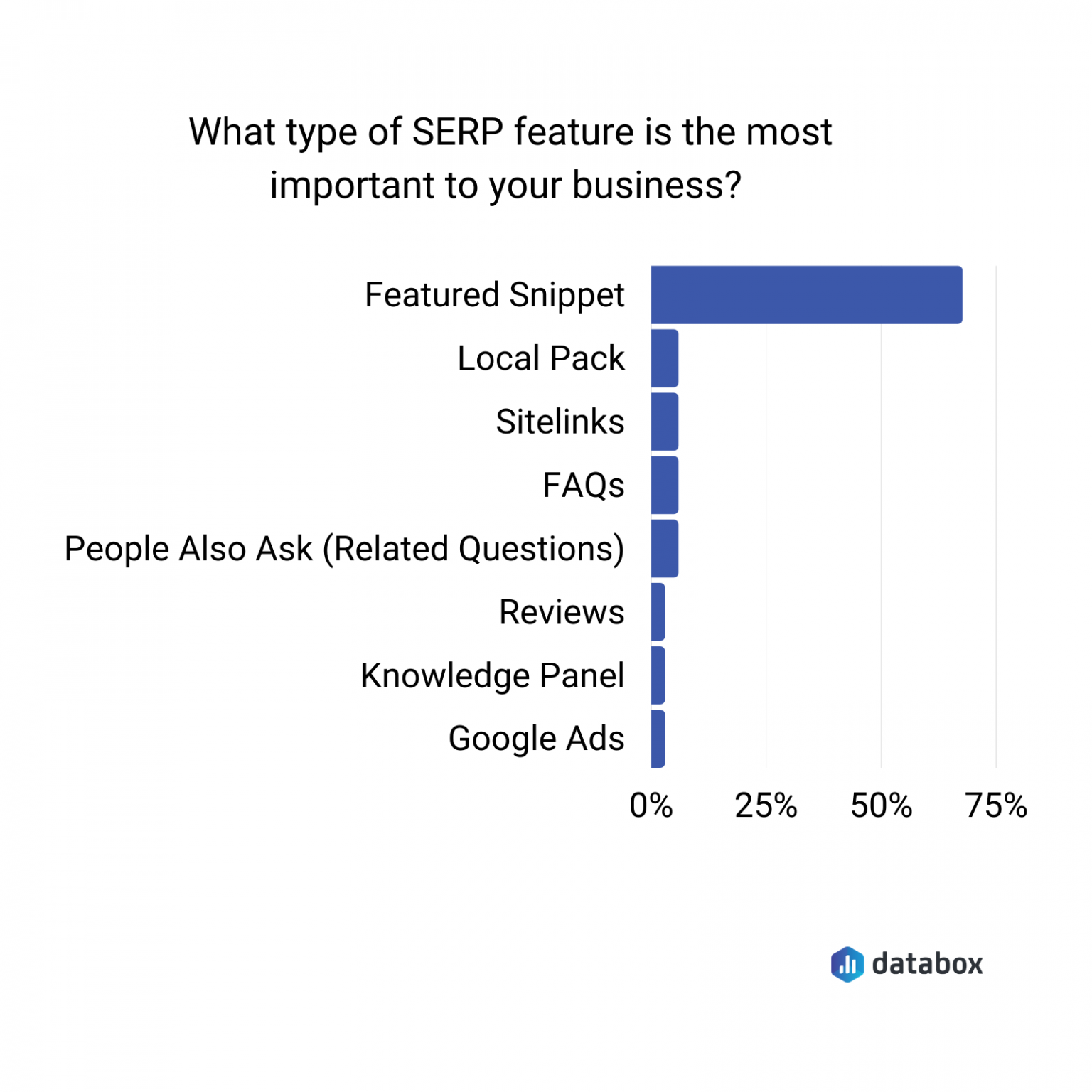
Image Source: Databox
Winning SERP features consistently requires aligning content structure, schema implementation, and search intent at every level of the page.
How White Label SEO Services Help Agencies Scale SERP Feature Optimization?
Knowing how to optimize for SERP features and consistently executing that optimization across a growing client portfolio are two very different challenges. The technical complexity alone, spanning content restructuring, schema implementation, Google Business Profile management, and ongoing keyword-to-feature mapping, quickly becomes difficult to manage at scale.
Most agencies face a common set of constraints: multiple active client accounts, limited in-house specialists with deep SEO expertise, time-intensive schema implementation, and the need for ongoing content optimization that never really stops. SERP feature optimization often fails not because the strategy is wrong, but because execution becomes inconsistent across accounts.
This is where white label SEO services provide a meaningful operational advantage. By partnering with a provider, agencies can access standardized optimization workflows, dedicated specialists, and scalable fulfillment processes without expanding their internal headcount.
Specifically, white label SEO support for SERP feature optimization typically includes:
- Comprehensive keyword research with keyword-to-SERP feature mapping.
- Structured content optimization aligned to featured snippet and PAA requirements.
- Schema markup implementation across FAQ, How-To, and Organization types.
- On-page SEO improvements that address both technical and content-level signals.
- Consistent execution was maintained across all client accounts.
This operational infrastructure also creates a service differentiation opportunity. Agencies that can deliver SERP feature optimization as part of a structured, reportable service offering are positioned to command premium retainers and demonstrate more sophisticated value than competitors still focused on basic ranking improvements.
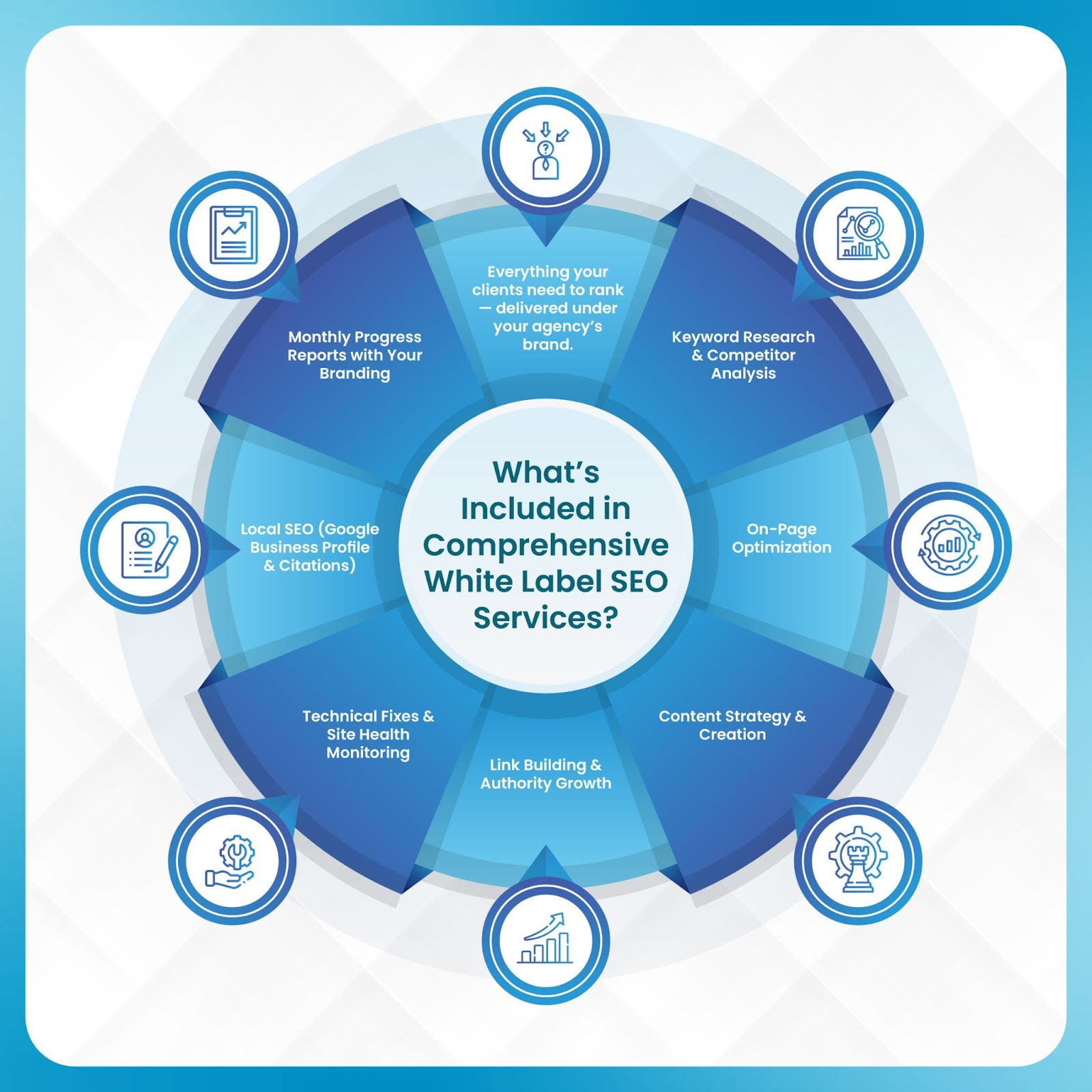
DashClicks' white label SEO services are built to handle the execution complexity that SERP feature optimization demands. The fulfillment process covers keyword research and intent mapping, content optimization aligned to SERP feature formats, technical SEO support, schema implementation, and on-page improvements, all delivered under the agency's own brand.
For agency owners managing multiple clients, DashClicks provides the specialist depth and scalable workflows needed to apply SERP-focused SEO consistently, without the operational burden of building those capabilities internally. Agencies can take on more clients, deliver higher-quality SEO work, and maintain the consistency that makes SERP feature wins repeatable rather than accidental.
Execution at scale requires infrastructure. But execution alone is not enough. Agencies also need to know whether their optimizations are actually producing measurable visibility gains, and that requires a reliable tracking system.
Why Tracking SERP Features Is Critical For SEO Performance?
Traditional ranking reports create a visibility blind spot. When an agency shows a client a ranking improvement from position six to position four, that looks like progress. But if a competitor owns the featured snippet and the top two People Also Ask placements for the same keyword, the ranking improvement means far less than the report suggests.
SERP tracking that goes beyond position data gives agencies a clearer and more accurate picture of organic performance. The metrics that actually reflect visibility in a feature-dominated SERP include:
- Featured snippet ownership by keyword and URL
- PAA appearance frequency and topic coverage
- SERP share of voice across a keyword set
- Click-through rate impact attributed to feature placements
- Keyword-to-feature mapping that shows which content owns which SERP real estate
Tracking these signals reveals content gaps that rankings never surface. It identifies competitive opportunities where a client is close to capturing a feature but has not yet won it. It also provides evidence of real visibility gains that clients need to understand the value of their SEO investment.
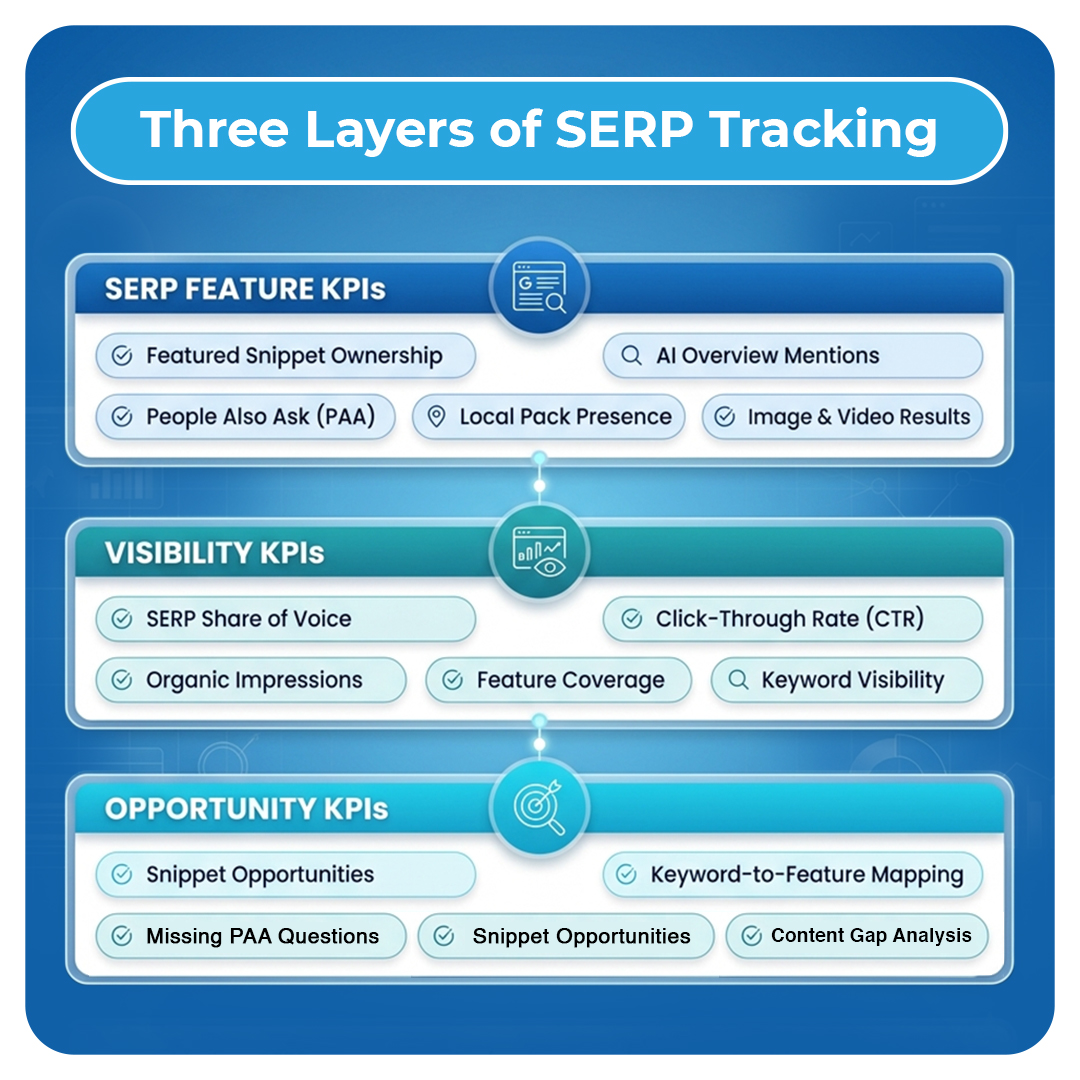
A number one ranking means very little if another result owns the featured snippet and the surrounding PAA visibility. Without tracking SERP features directly, agencies are measuring only part of the organic visibility story, and often not the most important part. As keyword portfolios grow and client accounts multiply, maintaining that level of SERP tracking manually becomes increasingly impractical.
How DashClicks’ Analytics Software Help Track SERP Features?
Effective SERP feature tracking at scale requires centralized systems. Manually monitoring featured snippet ownership, PAA visibility, and local pack performance across dozens of client accounts and thousands of keywords is not sustainable. The agencies that track SERP features most effectively are the ones that have built the right analytics infrastructure to support it.
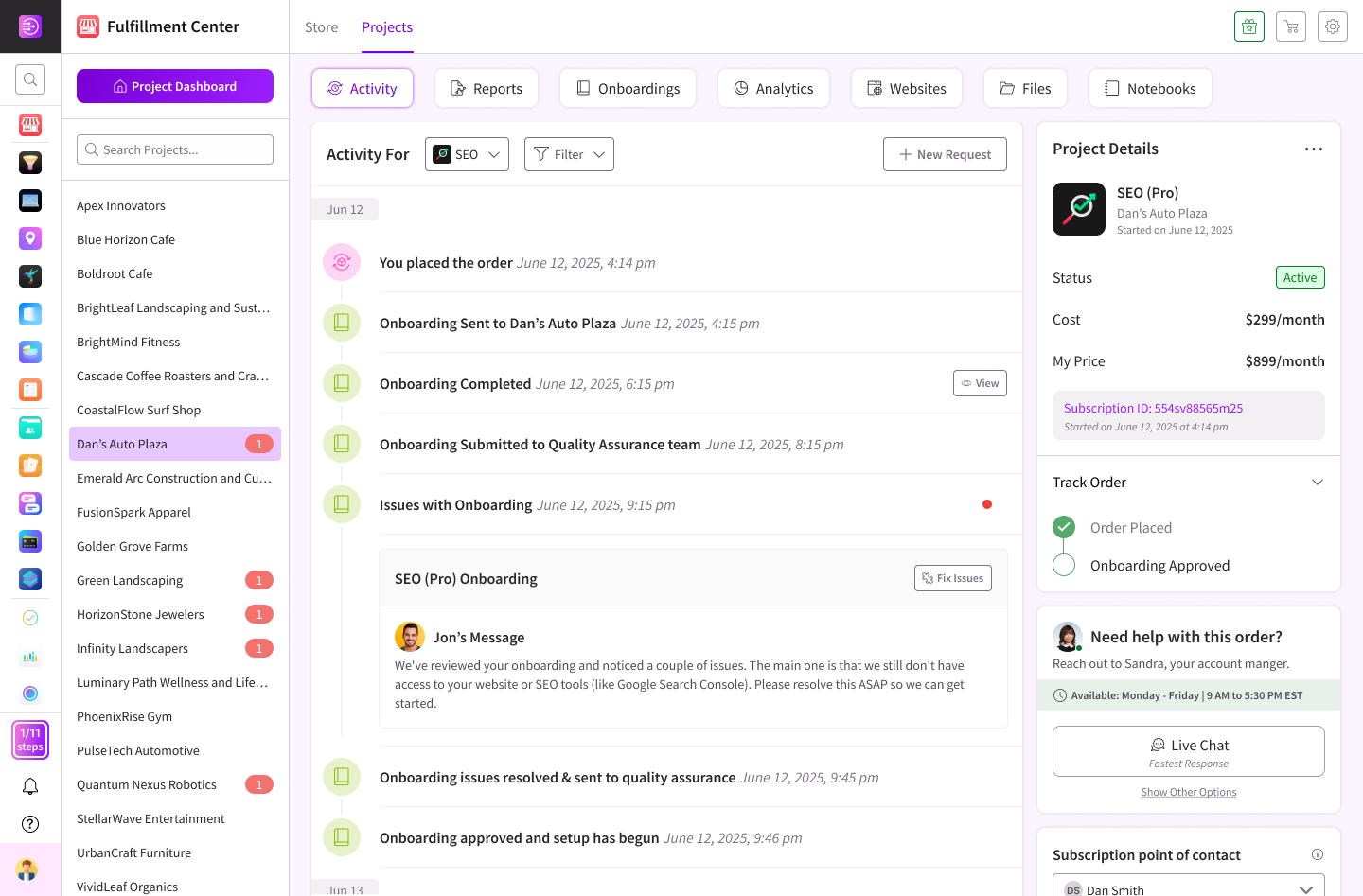
DashClicks’ Analytics Software provides agencies with unified SEO visibility dashboards that consolidate SERP tracking data across all client accounts in a single platform. Rather than managing separate tools or compiling manual reports, agencies can monitor SERP visibility, identify optimization opportunities, and compare performance across clients without the administrative overhead.
Key tracking capabilities include:
- SERP feature ownership monitoring: Track which clients own featured snippets, PAA placements, and local pack positions for their target keywords.
- Cross-client reporting: Compare visibility performance and identify patterns across the entire agency portfolio.
- Automated reporting: Reduce the time spent on manual report generation and deliver consistent, professional reporting to clients on a regular cadence.
- Visibility measurement beyond rankings: Report on the metrics that reflect how clients actually appear in search results, not just where a URL ranks.
The operational benefits extend beyond reporting efficiency. When agencies have reliable, automated data at their fingertips, decisions about content updates, schema adjustments, and optimization priorities become faster and more accurate. Client conversations shift from defending rankings to demonstrating real organic visibility growth. DashClicks closes the loop between optimization work, performance reporting, and the strategic decisions that drive future results.
When optimization systems, white label SEO execution, and analytics infrastructure work together, SERP features stop being a tactical add-on and start functioning as a scalable, trackable growth channel.
Turning SERP Features Into A Scalable Agency Growth Lever
The modern search results page rewards breadth of presence, not just depth of ranking. Agencies that continue to focus exclusively on traditional rankings are measuring an incomplete version of organic performance, one that is increasingly disconnected from how users actually experience search results.
SERP feature optimization gives agencies a structured way to capture more visibility across the full search results page. Featured snippets, People Also Ask placements, local packs, and visual results each represent an opportunity to own additional real estate that rankings alone cannot secure. Tracking those features creates the accountability and reporting quality that translates optimization work into client-visible results. White label SEO services make that optimization scalable across a growing client base without overextending internal resources.
Agencies that build these capabilities gain advantages that compound over time: stronger client retention, more differentiated service offerings, better reporting quality, and the ability to grow without proportionally growing internal workloads.
The agencies dominating modern search are not simply ranking higher. They are owning more of the search results page, and building the systems to prove it.


.svg)


.svg)
.svg)
.svg)
.svg)
.svg)