

.svg)

.svg)
.svg)
.svg)
.svg)
.svg)
The agency business model is quietly splitting in two. On one side, agencies are still selling "Google Ads management" as their core offer. On the other hand, agencies are packaging complete lead generation systems that deliver predictable, measurable outcomes for clients.
The difference is not just semantic. It reflects a fundamental shift in what clients are actually willing to pay for and how agencies can profitably scale without burning out their teams.
Rising ad costs are a big part of the pressure. Average Google Ads CPCs have climbed steadily across most industries, compressing margins and raising the bar on ROI delivery. Clients are no longer satisfied with activity-based reporting. They want leads, booked calls, and closed revenue. At the same time, agencies are increasingly turning to outsourced fulfillment to meet demand without proportional headcount growth. Multiple industry surveys suggest white label PPC adoption among agencies now exceeds 60%.
Agencies that continue selling PPC management as a standalone service face a compounding problem: commoditization. When pricing conversations default to "how much per month to manage our ads," agencies compete on price rather than value. Margins shrink. Churn increases. The hamster wheel spins faster.
Agencies selling lead generation systems, on the other hand, reposition the conversation entirely. They are not just running ads. They are delivering a system built to generate a pipeline, and that is a fundamentally different value proposition.
If agencies are moving toward systems instead of services, the question becomes: what exactly makes a lead generation system scalable and resellable?
Why Do “Lead Generation Systems” Sell Better Than PPC Management?
PPC management has a positioning problem. When you present it as a service, you are essentially asking clients to buy something they do not fully understand and cannot easily measure. That creates friction, skepticism, and churn.
Clients do not buy ads. They buy leads and revenue. The moment an agency reframes its offer around that outcome, the sales conversation changes. Instead of explaining keyword strategies and Quality Scores, the agency is talking about cost per lead, pipeline volume, and return on ad spend.
Google Ads management has also become increasingly commoditized. Countless agencies and freelancers offer it at every price point, which drives down perceived value and makes differentiation difficult. Competing on price is a race no agency should want to run.
Systems create both perceived and actual value because they shift accountability. When an agency owns a lead generation system, it is responsible for outcomes, not just activity. That accountability, packaged correctly, commands higher retainers and stronger client loyalty.
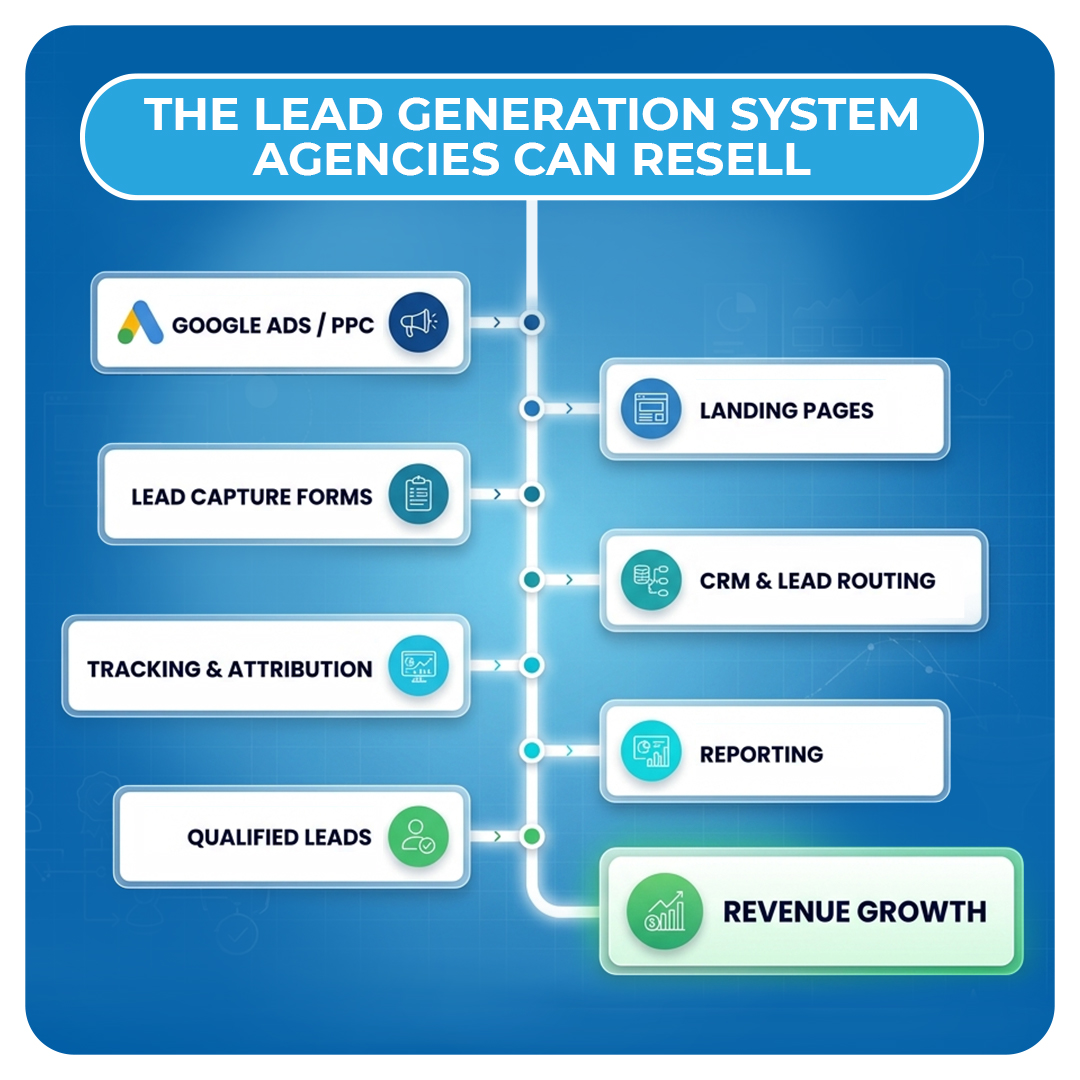
Think of the system in layers. Ads serve as the traffic engine, driving high-intent visitors into the funnel. Landing pages act as the conversion layer, turning traffic into leads. Tracking provides attribution visibility across every touchpoint. Reporting becomes the trust layer, giving clients confidence in what they are paying for.
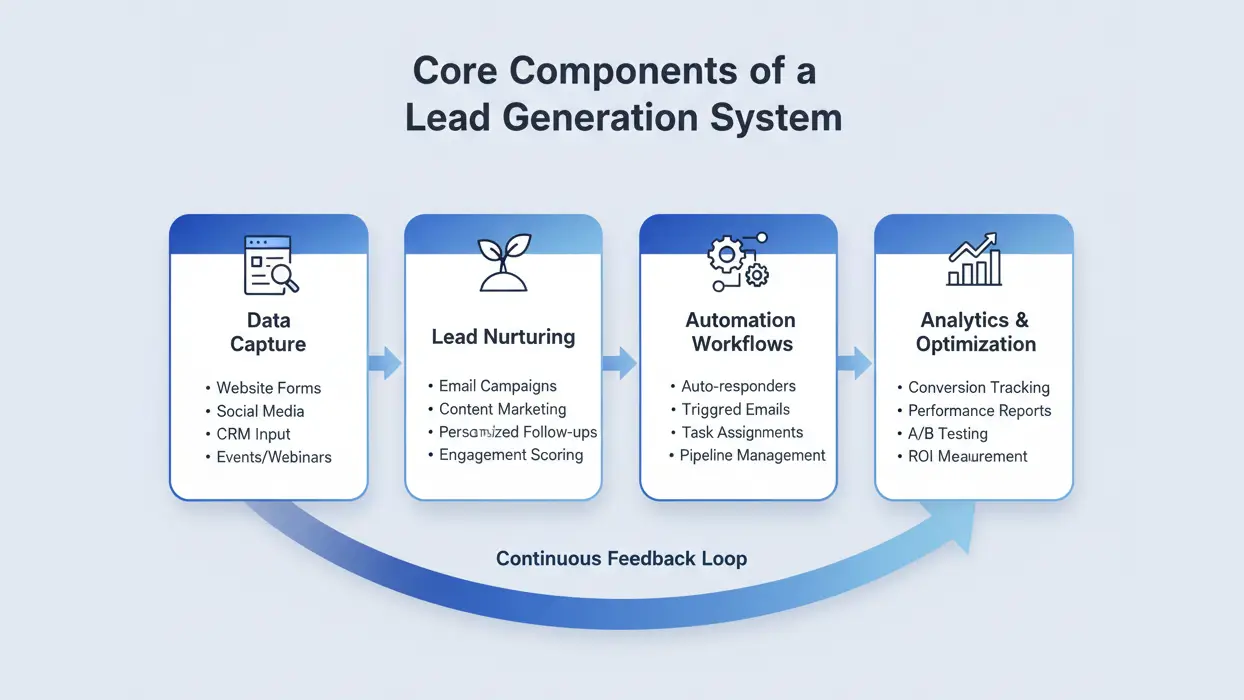
Image Source: Meet Alfred
According to industry benchmarks, average Google Ads conversion rates typically range from 3% to 7%, depending on the vertical. That range illustrates exactly why ad management alone is insufficient. Optimizing across the entire funnel, from click to conversion to lead routing, is where agencies create measurable, defensible results.
Agencies that package outcomes instead of tasks achieve stronger client retention because the client relationship is anchored to business growth rather than ad performance metrics that clients may not fully understand or trust.
Once you understand that clients want systems, the next step is breaking down what a resellable lead generation system actually includes.
Anatomy of a Resellable Lead Generation System
A scalable lead generation system is not a collection of loosely connected tools. It is a structured, repeatable process where every layer reinforces the others. Here is how each component functions within the system.
1. Traffic Engine (Google Ads / PPC)
The traffic layer is where demand capture begins. High-intent keyword targeting ensures that ads reach users who are actively searching for solutions, not passively browsing. Search campaigns anchor the strategy, while Performance Max campaigns extend reach across Google's full inventory, including Search, Display, YouTube, and Discover.
The goal of this layer is not impressions or clicks. It is qualified traffic routed into a conversion environment that is optimized to perform.
2. Conversion Layer (Funnels And Landing Pages)
Traffic without conversion infrastructure is just expensive noise. Dedicated landing pages built for each specific offer outperform generic website pages because they maintain message-to-market fit. Every element, headline, copy, form, and call-to-action is aligned with the intent of the visitor arriving from the ad.
A/B testing ensures the conversion layer improves over time. Continuous optimization compounds results, which means the same ad spend generates more leads month over month as the system matures.
3. Lead Capture Layer (Forms And CRM)
Speed-to-lead is a critical performance variable. Studies consistently show that response time dramatically affects lead qualification rates. Instant lead capture, connected directly to a CRM, ensures no inquiry goes untracked or uncontacted.
Lead routing logic assigns leads to the right sales team, location, or follow-up sequence immediately after submission. Qualification workflows filter low-intent leads before they consume sales resources, improving overall pipeline quality.
4. Tracking And Attribution Layer
Without attribution, agencies cannot prove value, and clients cannot make informed budget decisions. Conversion tracking connects ad spend to lead volume. Call tracking captures phone-based conversions that would otherwise disappear from reporting. Attribution visibility across the funnel enables agencies to identify which campaigns, keywords, and landing page variants are driving the strongest ROI.
This layer transforms the agency from a cost center into a measurable growth partner.
5. Reporting Layer
Reporting is where trust is built or eroded. DashClicks’ White-label dashboard presents performance data in a branded, client-facing format that reinforces the agency's authority. Automated reports reduce the manual effort of compiling data each month and ensure clients receive consistent, accurate information.
Performance transparency creates confidence. When clients can clearly see what their investment is generating, conversations shift from justifying the retainer to discussing how to scale it.
Together, these components function as a unified lead generation system. Each layer depends on the others. Ads without landing pages underperform. Landing pages without tracking leave results invisible. Tracking without reporting leaves clients in the dark.
Building this system manually is complex, which is why most agencies either stay small or outsource fulfillment through white label PPC infrastructure.
Why White Label PPC Is the Backbone of Scalable Lead Generation Systems?
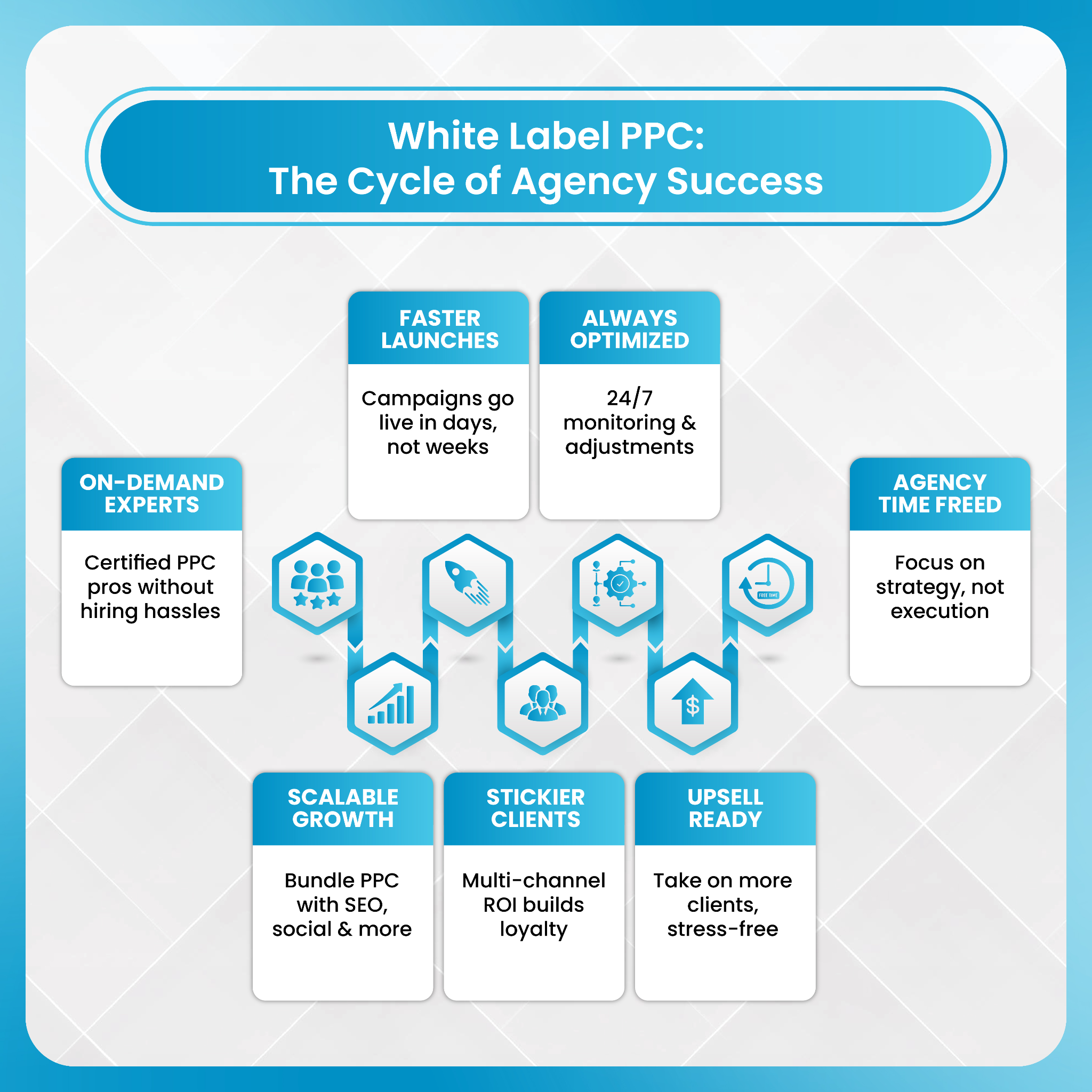
Fulfillment is where most agencies hit their growth ceiling. Hiring, training, and managing in-house PPC specialists is expensive, slow, and creates operational risk. A white label PPC agency partnership solves the fulfillment problem by separating delivery from overhead.
White label PPC allows agencies to resell expert execution without building internal fulfillment teams. Specialists handle campaign setup, optimization, bid management, and ongoing performance management, while the agency maintains the client relationship and brand ownership.
The operational advantages compound quickly:
- No in-house PPC hiring costs or training timelines
- Faster client onboarding through established processes and infrastructure
- Expert-level optimization without the overhead of employing senior PPC talent
- Scalable delivery that grows with client volume rather than headcount
- Reduced operational complexity, freeing agency leadership to focus on growth
Industry data suggest that white label PPC agency partnerships generate gross margins between 30% and 50%, with highly optimized agency models achieving even higher margins depending on pricing structure and fulfillment efficiency.
Fulfillment infrastructure is often the single biggest growth bottleneck for agencies. Without it, every new client adds operational complexity and stretches existing teams. With it, agencies can take on more clients without a proportional increase in resources or risk.
But execution alone is not enough. What truly makes the system scalable is how agencies package, brand, and resell it.
How Agencies Package White Label PPC Into a “Lead Generation System”?
Positioning is where the monetization model takes shape. The offer is no longer "Google Ads Management." The offer is a done-for-you lead generation system, and that distinction changes everything about how clients perceive and purchase it.
A fully packaged lead generation system typically includes:
- White labeled ads management handling campaign setup, optimization, and scaling
- Dedicated landing pages aligned to each offer or audience segment
- CRM integration and lead routing to ensure rapid follow-up
- Branded reporting dashboards providing ongoing performance visibility
- Optimization cycles that systematically improve results over time
Productized services outperform hourly or task-based models for several reasons. Pricing becomes predictable for both the agency and the client. Sales conversations center on outcomes rather than deliverables. Scope creep decreases because the system has defined inputs and outputs. Client retention improves because the agency is accountable for results that clients actually care about.
Effort-based selling creates a ceiling. Every new client adds work, and agencies exchange time for money in a linear, unsustainable way. Outcome-focused positioning breaks that ceiling by anchoring pricing to the value delivered rather than the hours invested.
Packaging is only part of the equation. The real scalability comes from the infrastructure behind delivery and reporting.
How DashClicks Enables This Model?
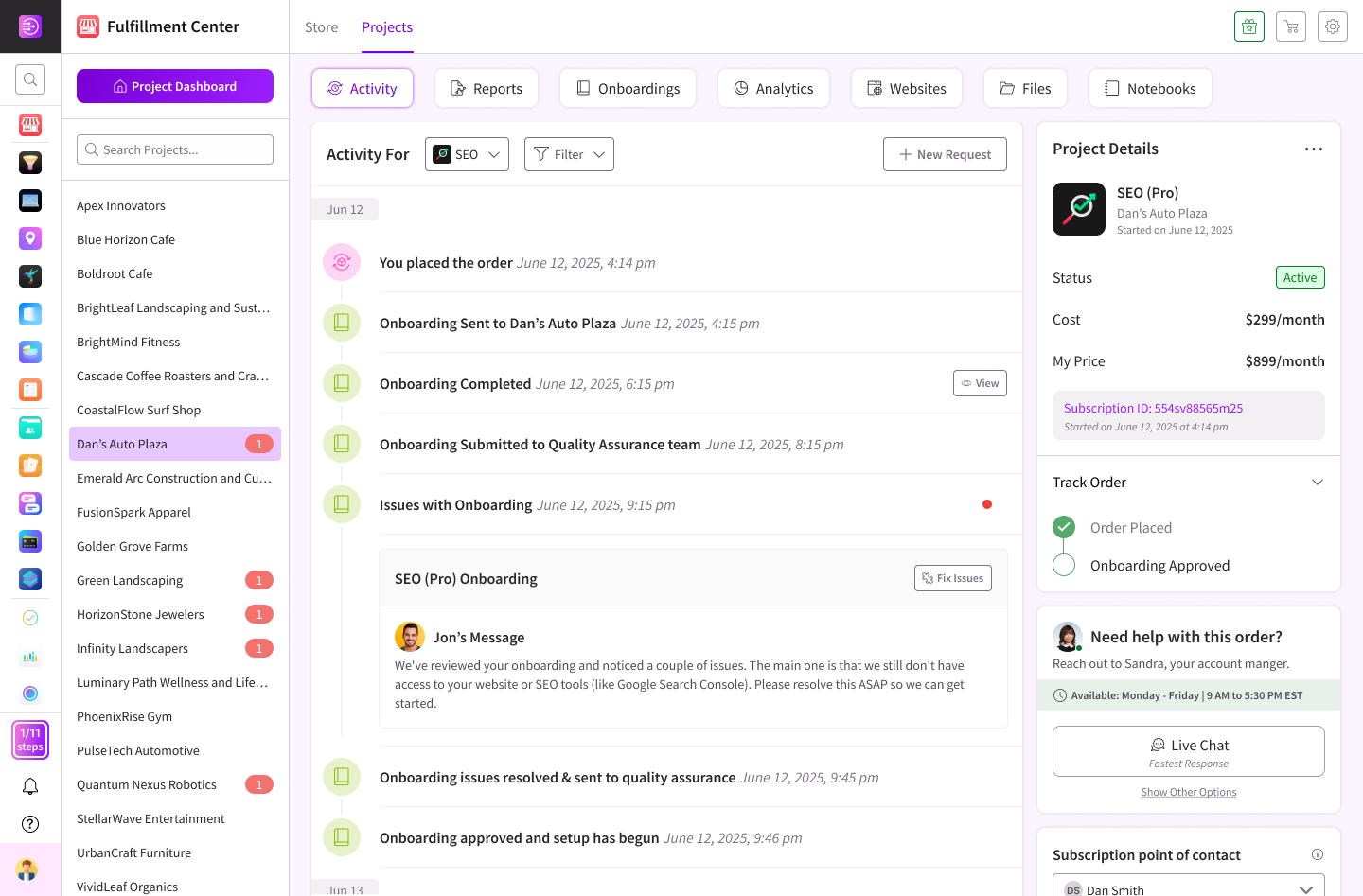
DashClicks functions as the operational layer that agencies use to power scalable lead generation systems under their own brand. Rather than stitching together multiple tools and vendors, agencies access fulfillment, reporting, and lead management through a single platform.
- White Label PPC Fulfillment: DashClicks offers white label PPC services, handling the full campaign lifecycle. Campaign setup, ongoing management, bid optimization, and performance scaling are executed by experienced PPC specialists. Agencies present this work as their own, maintaining brand ownership while the team manages delivery. The result is expert-level execution without the overhead of building an internal team.
- Analytics Dashboard: The platform provides centralized analytics software that gives agencies real-time visibility into campaign performance across all clients. ROI tracking, lead volume, cost-per-acquisition, and other key metrics are available in one place. This reduces the manual effort of compiling reports and gives agencies the data they need to make optimization decisions quickly.
- White Label Client Dashboard: Clients access performance data through a branded white label client dashboard that presents the agency as the authority. Custom branding creates a professional, cohesive client experience. Improved transparency builds confidence, and confident clients stay longer and spend more.
- Inbound Software: DashClicks includes a lead management system that captures, routes, and tracks inbound leads from PPC campaigns. Faster follow-up reduces lead leakage, which is one of the most common and costly failures in lead generation delivery. Structured routing ensures the right leads reach the right people at the right time.
Agencies using structured white label systems like DashClicks can scale more efficiently because they reduce staffing costs, simplify fulfillment, and minimize the need for manual reporting.
The platform helps agencies deliver complete lead generation systems rather than isolated PPC campaigns, enabling a more defensible and profitable agency model.
With infrastructure in place, agencies can now focus on the most important part of growth: pricing and scaling the system profitably.
Pricing, Margins & How Agencies Actually Profit From Reselling PPC Systems
The financial model is straightforward. Agencies pay a fulfillment cost to their white label PPC provider. They charge clients a retainer. The margin is the difference.
What makes this model powerful is that margin expansion does not require more labor. An agency with strong fulfillment infrastructure can increase revenue by adding clients without adding headcount, which means profitability scales with volume rather than effort.
Agency service margins typically range between 25% and 40% net, depending on pricing structure, fulfillment efficiency, and client retention. Agencies that productize their lead generation systems and anchor pricing to outcomes tend to achieve the higher end of that range because they can justify premium retainers.
The critical shift is moving away from pricing based on ad spend percentages or hourly rates. System-based pricing reflects the full value delivered: traffic, conversion, lead capture, attribution, and reporting. Clients pay for a complete solution, and agencies retain healthy margins at each layer.
Once pricing is structured correctly, the final step is ensuring the system can actually scale without increasing operational complexity.
Scaling the System: From 5 Clients to 50+ Without Increasing Headcount
The traditional in-house PPC model scales linearly. More clients require more specialists, more account managers, and more overhead. Revenue grows, but so does cost, and margins stay flat or compress under operational pressure.
White label PPC breaks that relationship. Fulfillment scales through infrastructure rather than headcount, which means agencies can grow revenue without a proportional increase in team size or complexity.
Automation replaces manual processes across the reporting and tracking layers. Instead of compiling performance data by hand each month, automated dashboards deliver client reports consistently. Instead of manually routing leads, CRM integrations handle assignment and follow-up triggers automatically.
The contrast is significant:
- In-House PPC Model: Every new client requires additional specialist capacity, creating a direct link between revenue growth and staffing costs.
- White Label PPC Model: Fulfillment infrastructure supports new client volume without requiring proportional staffing increases, creating operational leverage.
As agencies grow, that operational leverage becomes a competitive advantage. Agencies with white label infrastructure can onboard clients faster, deliver at higher quality, and maintain margins that in-house models cannot match.
This scalability is what makes lead generation systems not just a service offering but a business model transformation.
The Future of Agency Growth Is Productized Lead Generation Systems
The direction of the market is clear. Agencies are shifting from service providers to system providers, and the gap between the two models will widen as client expectations and ad costs continue to rise.
White label PPC is the execution backbone behind this shift. It provides the fulfillment capacity that agencies need to deliver complete lead generation systems without building complex internal operations.
DashClicks provides the infrastructure needed to operationalize the model, connecting PPC fulfillment, analytics, client reporting, and lead management into a single platform that agencies can brand and resell.
The agencies that win in 2026 will not be the ones that simply run ads. They will be the agencies that sell predictable lead generation systems at scale, backed by infrastructure that allows them to grow without operational chaos.
That model is available now. The agencies building it today will be significantly harder to displace tomorrow.


.svg)


.svg)
.svg)
.svg)
.svg)
.svg)