

.svg)

.svg)
.svg)
.svg)
.svg)
.svg)
Many agencies still treat SEO as a traffic channel instead of connecting it to a conversion strategy. That approach is becoming harder to justify as search behavior now influences almost every stage of the buyer journey.
Clients no longer want reports that only show visibility gains. They want to know whether organic search is helping generate better leads, reduce paid media pressure, and support revenue growth.
Agencies also face pressure from multiple sides:
- Paid media costs continue rising
- Clients demand clearer ROI
- SEO campaigns are expected to drive qualified leads
- Internal teams need scalable fulfillment systems
According to BrightEdge, organic search drives 53% of all website traffic. This shows that SEO is no longer a supporting tactic. It is one of the main entry points into the marketing funnel.
Lead quality matters too. HubSpot reports that 60% of marketers say inbound strategies like SEO and blog content generate their highest-quality leads. This means agencies cannot focus only on traffic volume. SEO must connect to intent, conversion, and customer value.
White label SEO helps agencies build funnel-focused SEO systems without overwhelming internal teams. It gives them the execution support needed to cover awareness, consideration, conversion, and retention in a structured way.
To do this well, agencies first need to stop viewing SEO as a single-stage acquisition tactic.
Why Agencies Need a Funnel-Based SEO Strategy?
Traditional SEO reporting is becoming less persuasive for performance-driven clients. Rankings, impressions, and traffic growth still matter, but they do not always prove business impact.
Clients increasingly care about metrics that connect SEO to revenue outcomes, such as:
- Sales-qualified leads
- Cost per acquisition
- Conversion rates
- Pipeline contribution
- Customer acquisition efficiency
This is where funnel-focused SEO becomes important. A page may rank first for an informational keyword and still fail commercially if it does not move users toward the next action.
Organic traffic should guide users toward clear conversion paths, including email capture, demo requests, consultation bookings, comparison pages, and bottom-funnel service pages.
A useful concept here is search intent sequencing. This means mapping how a user’s search behavior changes as they move from problem awareness to purchase intent.
For example, a B2B buyer may first search “how to improve local SEO.” After understanding the problem, they may search for “best local SEO software.” Later, when they are closer to purchase, they may search “SEO agency pricing.”
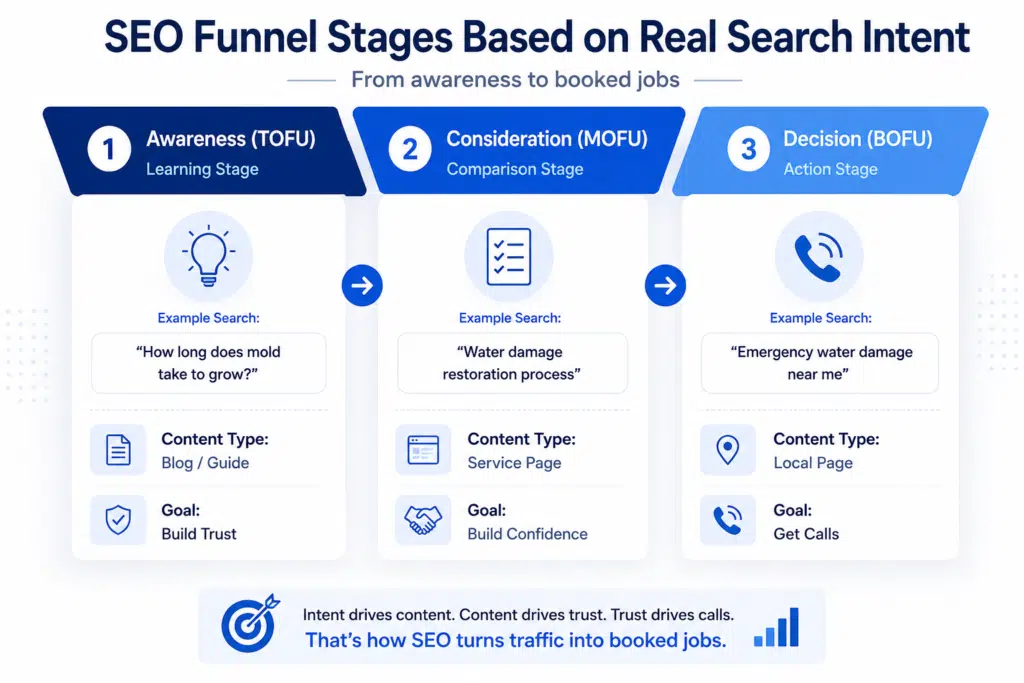
Image Source: Restoration Inbound
Each query reflects a different stage of intent. Agencies that create content across these stages build stronger conversion pathways because they meet buyers before, during, and after evaluation.
The challenge is that this level of SEO requires planning, execution, reporting, and ongoing optimization. That is where white label SEO partners help agencies execute full-funnel strategies at scale.
How White Label SEO Expands Agency Capabilities Across the Funnel?
Full-funnel SEO requires more than publishing blogs or optimizing a few service pages. It involves several connected disciplines that many agency teams cannot manage consistently in-house.
A proper funnel-focused SEO system often requires:
- Technical SEO
- Content production
- Intent mapping
- CRO alignment
- Link building
- Reporting
- Ongoing optimization
White label SEO services help agencies expand capacity without hiring a full internal SEO department. Instead of stretching existing teams across multiple specialized tasks, agencies can rely on structured fulfillment support.
This helps agencies launch SEO campaigns faster, maintain consistency across accounts, access specialized expertise, and reduce delivery bottlenecks.
The agencies scaling fastest are not always the ones hiring the largest internal SEO teams. They are often the ones building repeatable fulfillment systems that allow them to deliver consistently across multiple clients.
Consider a paid media agency facing rising CPCs across client campaigns. Instead of relying only on paid ads, the agency partners with a white label SEO provider to build top-of-funnel blog content, optimize service pages, improve internal linking, and capture non-paid search demand.
This helps the agency improve client acquisition efficiency without building an entire SEO team from scratch.
This matters because buyers spend much of their decision-making journey independently. Gartner research indicates that buyers spend only 17% of the purchasing journey meeting with potential suppliers. Most of the research happens through search, content, reviews, and digital discovery.
That makes full-funnel SEO visibility critical, starting with the top of the funnel.
Top-of-Funnel SEO: Capturing Awareness and Discovery
Top-of-funnel SEO focuses on users who are still discovering their problem. They may not know the solution yet, and they are usually not ready to contact a business immediately.
At this stage, SEO supports brand discovery, problem awareness, educational intent, and early trust building.
Common TOFU content includes:
- Informational blog posts
- Beginner guides
- Industry trend pages
- Glossaries
- Educational resources
Many agencies over-prioritize transactional keywords and ignore early-stage search behavior. This can create higher acquisition costs because the agency only competes for high-intent, high-competition terms.
It can also weaken organic reach, reduce retargeting pools, and limit topical authority.
Top-of-funnel SEO helps agencies build a wider entry point into the buyer journey. Educational content can support retargeting campaigns, email nurturing, brand familiarity, and assisted conversions.
For example, a homeowner may first search “why is my AC leaking water.” They may not be ready to book a repair service yet. But if a helpful article answers their question clearly, that brand becomes more familiar.
Weeks later, when the same homeowner searches “best HVAC repair company near me,” the earlier content interaction can influence trust.
To make TOFU content more useful, agencies can include tactical elements such as downloadable lead magnets, internal links to service pages, FAQ schema, newsletter CTAs, and interactive tools.
The goal is not to force an immediate conversion. The goal is to create enough trust and relevance to move the user into the next stage of evaluation.
Mid-Funnel SEO: Supporting Evaluation and Trust Building
Mid-funnel SEO supports users who understand their problem and are now comparing possible solutions. They may be looking for proof, pricing context, alternatives, or industry-specific guidance.
This stage is where SEO begins to build decision confidence.
Useful MOFU content includes comparison pages, case studies, industry-specific landing pages, ROI-focused articles, and “best” or “alternative” keyword pages.
The biggest issue at this stage is what can be called conversion friction gaps. These are missing pieces of information that stop users from moving forward.
Common friction gaps include:
- Lack of pricing clarity
- Missing social proof
- No case studies
- Unclear timelines
- Weak industry specialization
- Limited ROI context
Agencies may succeed at driving traffic but fail to reduce uncertainty. When users cannot find proof or clarity, they leave and continue evaluating competitors.
A strong mid-funnel SEO strategy connects content instead of treating every page as a standalone asset.
For example, an informational article may link to a related case study. The case study may lead to a service comparison page. That comparison page may include a booking CTA for users ready to speak with the business.
This creates a guided conversion path rather than a disconnected content library.
Tactically, agencies should use intent-based internal linking, comparison keyword targeting, FAQ and review schema, embedded proof assets, and service-specific CTAs.
Mid-funnel SEO is not only about ranking for comparison terms. It is about helping the buyer feel confident enough to move closer to action.
Bottom-of-Funnel SEO: Turning Organic Traffic Into Leads
Bottom-of-funnel SEO targets users who are close to making a decision. These users are searching with higher commercial intent and are often comparing providers, locations, pricing, or service options.
This stage usually includes service pages, location pages, conversion-focused landing pages, commercial-intent keywords, and local SEO optimization.
The key point is simple: ranking does not guarantee conversion.
A service page may attract high-intent traffic, but if the page is slow, unclear, or difficult to use, the user may leave without taking action.
Agencies should optimize bottom-funnel pages for both visibility and conversion. Important elements include:
- Page speed
- CTA placement
- Form simplicity
- Trust indicators
- Mobile UX
- Clear intent alignment
Google research has consistently shown that mobile speed affects user behavior and conversion outcomes. That makes technical SEO and CRO increasingly connected.
A useful framework for BOFU SEO is Visibility, Trust, Action.
SEO creates visibility in search results. Content, testimonials, proof points, and service clarity build trust. UX, CTAs, and forms drive action.
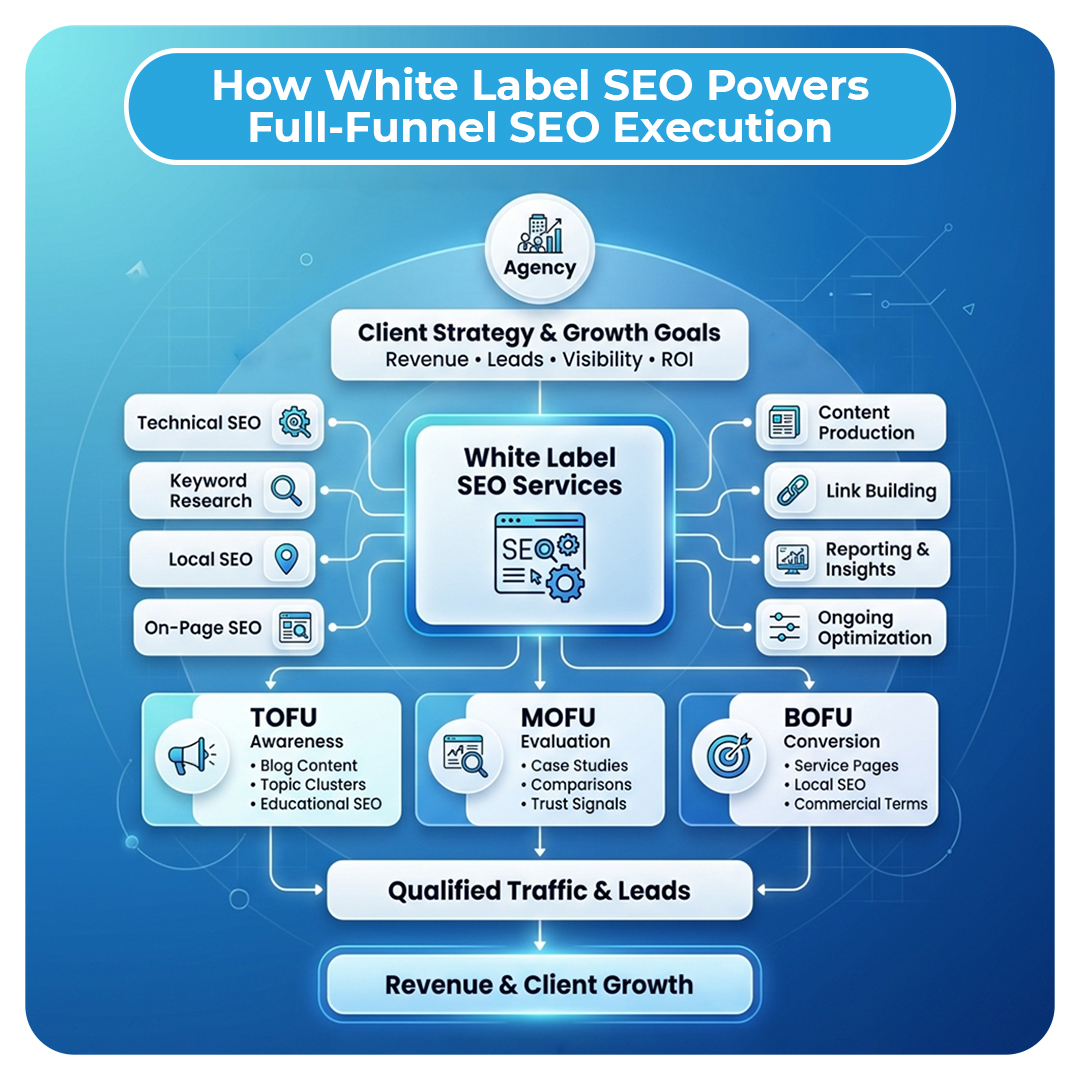
For example, a white label SEO team may help an agency improve local rankings, optimize service pages, strengthen internal linking, and fix technical issues. At the same time, the agency can focus on landing page messaging and lead follow-up.
Together, this creates a stronger path from discovery to inquiry.
Once leads are generated, SEO can also support what happens after conversion.
How SEO Supports Client Retention and Lifetime Value?
The marketing funnel does not end when a user becomes a lead or customer. SEO can continue supporting retention, repeat engagement, brand authority, and upsell opportunities.
Many agencies sell SEO only as a lead-generation service. More advanced agencies position it as a long-term growth asset that supports both acquisition and retention.
Ongoing SEO content can help clients:
- Educate customers after purchase
- Reduce churn through helpful resources
- Build long-term search equity
- Support product or service adoption
- Create upsell and cross-sell opportunities
For a SaaS company, this may include onboarding content, help-center SEO, educational resources, feature comparison pages, and troubleshooting articles.
A user may purchase a software subscription and later search for help with a specific feature. If the company’s help content ranks and answers the question clearly, the customer gets support without needing to contact the team.
That improves the customer experience and reduces frustration.

In this way, SEO becomes more than an acquisition channel. It becomes part of the customer success experience.
This also helps agencies justify recurring SEO retainers. When clients see SEO supporting acquisition, education, retention, and customer value, the service becomes harder to treat as optional.
Why White Label SEO Creates a Scalable Funnel Strategy?
Executing full-funnel SEO consistently across multiple clients requires strong operational systems. It is not enough to have a strategy. Agencies also need the delivery capacity to execute it month after month.
Funnel-focused SEO requires content velocity, technical optimization, cross-stage keyword mapping, reporting infrastructure, and ongoing testing.
Many agencies struggle to scale this internally because SEO roles are specialized. Hiring is expensive, training takes time, and fulfillment can become inconsistent as accounts increase.
This is where SEO operational maturity becomes important.
Agencies that scale successfully usually build systems where strategy is repeatable, fulfillment is standardized, reporting is predictable, and funnel impact is measurable.
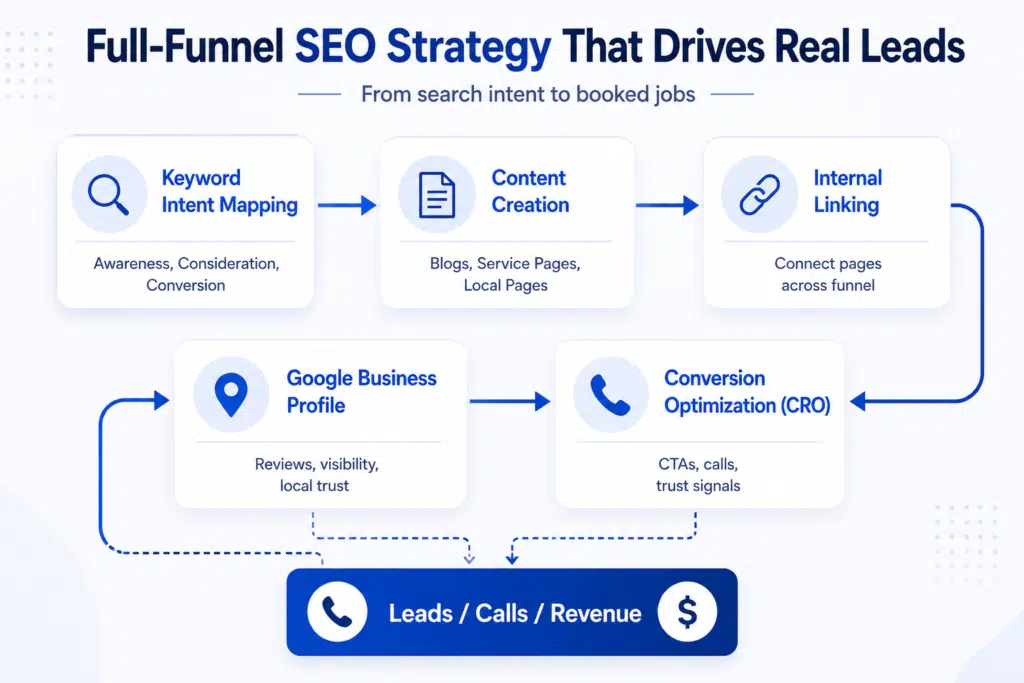
Image Source: Restoration Inbound
White label SEO enables agencies to deliver this level of execution without building every function internally.
When evaluating white label SEO partners, agencies should look beyond basic fulfillment. They should assess whether the partner can support funnel-wide execution.
Key evaluation areas include:
- Reporting quality
- Strategy depth
- Communication workflows
- Technical expertise
- Content quality
- Ability to support TOFU, MOFU, and BOFU SEO
The right partner should help agencies connect search performance to business outcomes, not simply deliver isolated tasks.
As SEO becomes more tied to conversion strategy, agencies need systems that can support the entire funnel without creating delivery strain.
How DashClicks’ White Label SEO Supports Full-Funnel Agency Growth
DashClicks’ white label SEO services help agencies support SEO delivery without building every function internally. As an agency-focused platform and fulfillment provider, DashClicks supports scalable service delivery while allowing agencies to keep the client relationship under their own brand.
- Full-Funnel SEO Support: The platform can support different stages of SEO execution, including visibility, technical improvements, content, local search, and reporting, depending on the selected service package. This helps agencies support awareness-stage visibility, consideration-stage content, and bottom-funnel pages that need stronger search presence.
- Scalable SEO Fulfillment: As client volume grows, maintaining consistent fulfillment becomes harder. The white label model helps agencies expand SEO delivery without hiring for every SEO role internally. This is useful for agencies offering SEO alongside paid media, web design, social media, or other digital services.
- Visibility Across the Funnel: Full-funnel SEO requires agencies to show how organic visibility supports the buyer journey. DashClicks’ platform and reporting capabilities can help organize campaign visibility and communicate SEO activity more clearly to clients.
- Reporting and Agency Efficiency: Agencies need reporting that clients can understand. The company provides agency-focused software and reporting tools that help teams manage client communication and reduce manual backend work across multiple accounts.
- Supporting Agency Growth Without Expanding Internal Teams: For growing agencies, the challenge is often not selling SEO. It is delivering it consistently after the sale. The platform helps agencies increase service capacity without adding unnecessary internal complexity.
As SEO becomes more tied to revenue and acquisition outcomes, agencies need execution systems that support the full funnel instead of treating SEO as an isolated channel.
Conclusion
White label SEO is most valuable when agencies use it to support the full marketing funnel, not just rankings.
Top-of-funnel SEO builds awareness during early research. Mid-funnel SEO helps prospects compare options and build trust. Bottom-of-funnel SEO turns high-intent traffic into leads through stronger service pages, local visibility, and clear conversion paths.
SEO also supports retention after conversion. Helpful content, onboarding resources, and educational pages keep customers engaged while building long-term search equity.
The strongest agencies connect SEO to revenue, conversion, and customer value. White label SEO gives them the operational support to execute that strategy consistently, scale delivery, and support more funnel stages without overwhelming internal teams.


.svg)


.svg)
.svg)
.svg)
.svg)
.svg)