

.svg)
.jpg)
.svg)
.svg)
.svg)
.svg)
.svg)
Most Google Ads campaigns follow a familiar arc. The first few months feel electric. Conversions climb, cost per acquisition drops, and clients send the kind of emails every agency loves to receive. Then something shifts. The gains slow, the metrics flatten, and the same optimizations that once produced results barely move the needle.
This is the Google Ads plateau, and almost every agency runs into it eventually. The frustrating part is that nothing appears broken. Bids are managed, keywords are refined, and budgets are allocated carefully. Yet performance stalls anyway.
A common reaction is to throw more money at the problem. The thinking goes that if a campaign converts well, a bigger budget should produce proportionally more conversions in mature accounts, but that rarely holds. Extra spend often buys lower-quality clicks and diminishing returns instead of fresh growth.
Here is the insight most teams miss: Google Ads plateaus are usually operational and strategic problems, not bidding problems. The bidding is fine. What is missing is the time, perspective, and structured experimentation needed to find the next breakthrough.
That gap widens for agencies juggling multiple client accounts. When your team is stretched across reporting, communication, and daily maintenance, deep breakthrough analysis gets pushed aside. Before any agency can solve a plateau, though, it helps to understand exactly why campaigns hit a ceiling in the first place.
The Google Ads Growth Ceiling Most Agencies Eventually Hit
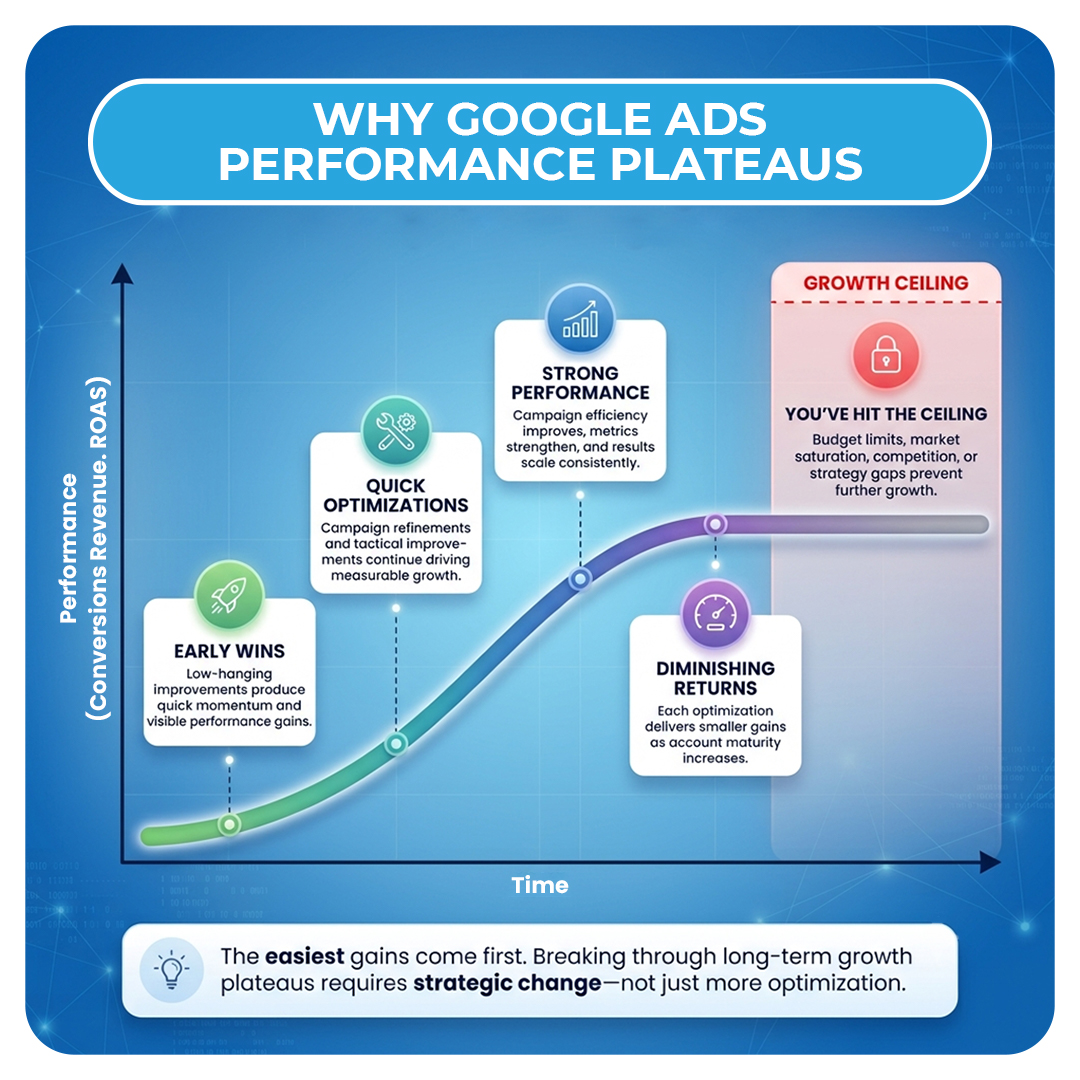
New accounts are full of low-hanging fruit. There are wasted keywords to cut, obvious bid adjustments to make, and ad copy that practically writes itself better. These early wins create momentum and build client trust quickly.
The trouble is that easy wins run out. Once the obvious inefficiencies are gone, every additional gain requires more effort for a smaller payoff. This is the law of diminishing returns playing out in paid search, and it catches even experienced teams off guard.
Mature accounts behave differently from young ones. The structural improvements have been made. The campaigns are clean. So growth that once came from fixing mistakes now has to come from creating entirely new opportunities, which is a much harder task.
Consider a lead generation campaign that cuts cost per lead by 40 percent in its first quarter. By month six, the same account barely improves week over week. Adding budget simply increases spend without adding many incremental leads, because the campaign is already capturing most of the value available to it.
Not all plateaus are created equal, though. Before any agency tries to fix a stalled campaign, it needs to identify which type of growth ceiling it is actually facing.
The 5 Types of Google Ads Plateaus
Plateaus look similar on a performance graph, but their causes vary widely. Treating an audience problem like a bidding problem wastes time and budget. The five plateaus below each demand a different response.
Plateau #1: Search Demand Ceiling
Sometimes a campaign is performing well because it has captured nearly all the available demand. There are only so many people searching for a given product or service each month, and you can only show up for so many of them.
When this happens, traffic growth stalls for a simple reason. The market is finite, and you are already winning most of it.
Signs you have hit a search demand ceiling include:
- High impression share, often above 80 percent
- Stable, strong average positions
- Very little room left for additional clicks
Plateau #2: Audience Saturation
The opposite problem appears when you keep reaching the same people over and over. Remarketing lists and tightly defined audiences eventually run out of fresh prospects to convert.
Repeated exposure leads to fatigue. The audience has seen your ads, made a decision, and stopped responding. Frequency rises while performance falls.
Breaking through this plateau means expanding into new audience segments rather than squeezing the same list harder.
Plateau #3: Creative and Messaging Stagnation
Ad copy wears out. What felt sharp six months ago now blends into the background, especially as competitors sharpen their own messaging. Users scroll past offers they have already seen dozens of times.
This is why swapping a single headline rarely restarts growth. Minor copy edits address the symptom, not the cause. When messaging stagnates, the fix usually requires a genuine creative refresh built around new angles and positioning.
Plateau #4: Conversion Rate Ceiling
Sometimes the ads are doing their job perfectly. Traffic quality is strong, intent is high, and clicks keep coming. The bottleneck sits after the click, on the landing page, or in the funnel.
More clicks do not automatically create more customers. If your landing page converts at 3 percent, doubling traffic doubles cost long before it doubles revenue, because the page itself caps performance.
Picture an e-commerce account driving thousands of qualified visitors to a product page with a clunky checkout. The traffic is excellent. The conversion path is the problem.
Plateau #5: Data and Automation Limitations
Modern Google Ads leans heavily on automated bidding, and automation is only as smart as the data feeding it. Weak conversion tracking, missing offline conversions, and attribution gaps all starve the algorithm of signal.
Google's automation can only optimize using the signals it receives. When those signals are incomplete, the system makes worse decisions, and performance flattens no matter how clean the account looks.
Once an agency knows where a plateau originates, the next challenge is overcoming the operational barriers that prevent deeper optimization.
Why Agencies Struggle to Break Through Plateaus?
Knowing what causes a plateau is one thing. Having the capacity to solve it is another.
Most agencies are not short on skill. They are short on time and focus.
Daily account management consumes resources that could otherwise be spent on deeper growth initiatives. Teams often find themselves focused on:
- Reporting and client communication
- Routine account maintenance
- Performance monitoring
- Budget management
- Campaign troubleshooting
All of these tasks matter. None of them typically unlock breakthrough growth.
Managing multiple client accounts compounds the challenge. Strategic experimentation requires uninterrupted thinking time, yet that time becomes increasingly difficult to find as account loads increase.
As a result, agencies often default to short-term optimizations instead of larger strategic improvements.
The outcome is a common but overlooked reality: many agencies hit operational ceilings before campaigns hit marketing ceilings.
The Difference Between Optimization and Revitalization
Optimization and revitalization get used interchangeably, but they are not the same activity. Confusing them is why so many agencies keep optimizing a campaign that actually needs to be reimagined.
Optimization Includes
- Bid adjustments
- Negative keyword management
- Budget allocation across campaigns
- Ad A/B testing
- Ongoing account maintenance
Revitalization Includes
- Expanding into new audiences
- Repositioning the offer
- Landing page experimentation
- Attribution and tracking improvements
- Campaign restructuring
- Opening new acquisition channels
The distinction matters. Optimization improves the system you already have. Revitalization builds new growth opportunities that did not exist before.
A perfectly optimized campaign can still plateau. That is the part that frustrates teams. They are doing optimization well, but the account needs revitalization instead. The most successful agencies recognize the difference and follow a structured process to spark a second growth cycle.
The Second-Growth Phase Framework
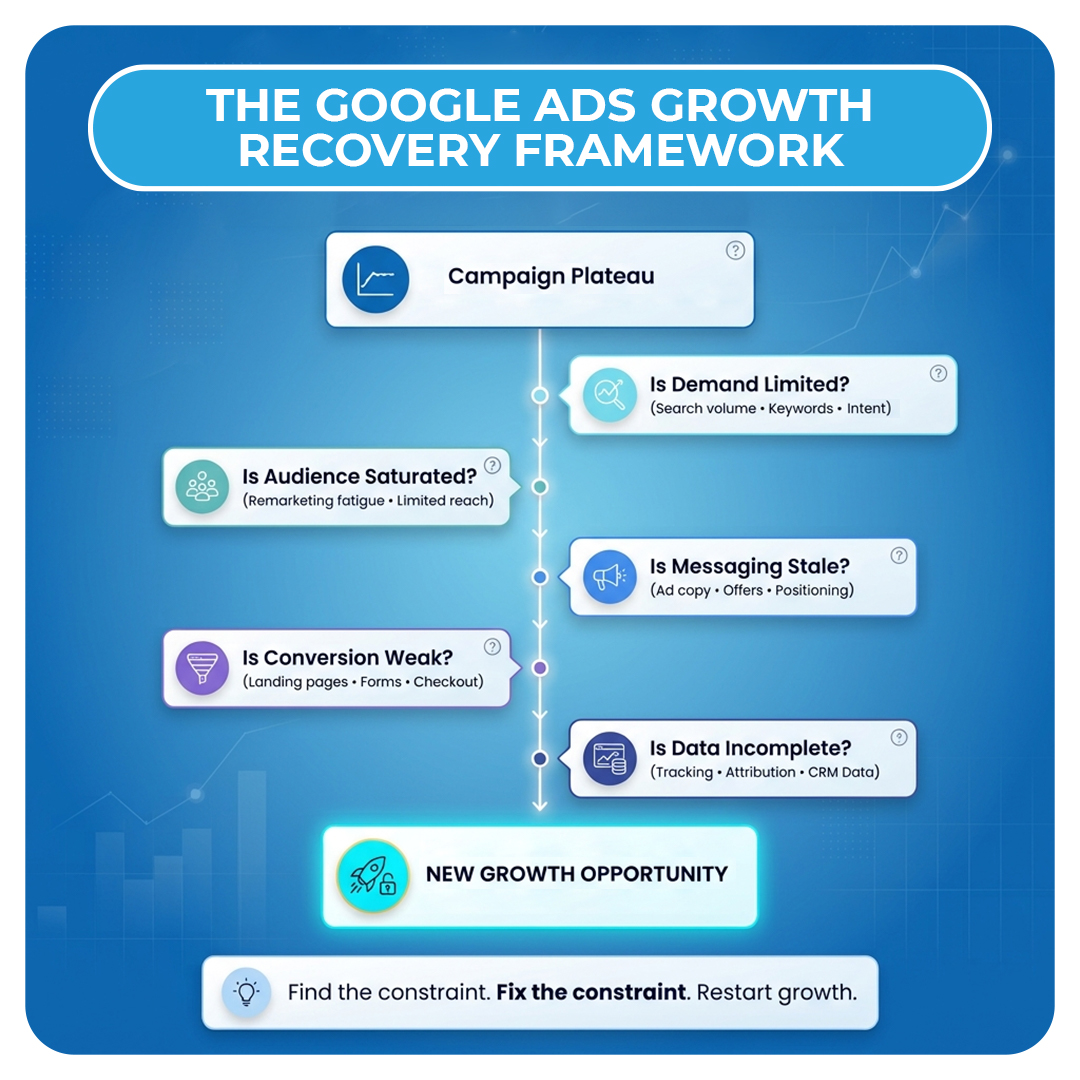
When a campaign plateaus, agencies need a repeatable way to find new growth rather than guessing. The framework below moves through the five common plateau causes in order, so you address the right constraint instead of the most convenient one.
Step 1: Reassess Demand
Start by looking at the market itself. Search behavior changes over time, and new keyword opportunities emerge as customer language evolves. The demand picture you mapped a year ago may be outdated.
Step 2: Expand Audience Opportunities
Next, look beyond your current lists. Analyze your best customers, identify lookalike traits, and expand remarketing into adjacent segments. Fresh audiences reopen growth that a saturated list cannot.
Step 3: Refresh Offers and Messaging
Then revisit what you are actually saying and selling. Test new positioning, sharper value propositions, and different offers. A stronger offer often lifts performance more than any bidding change.
Step 4: Improve Conversion Paths
Now turn to what happens after the click. Audit landing pages, simplify forms, and remove friction throughout the funnel. Small conversion gains compound across every dollar already being spent.
Step 5: Strengthen Data Signals
Finally, feed the algorithm better information. Tighten conversion tracking, enable enhanced conversions, import offline conversions, and connect your CRM. Better signals make automated bidding smarter at every stage.
The point of this framework is not simply more traffic. The goal is to create a new growth cycle from an account that looked tapped out. Running it consistently, however, gets difficult when an agency is managing many client accounts at once.
How White Label Google Ads Services Accelerate Campaign Revivals?
When internal bandwidth runs short, white label Google Ads management offers a way forward. The most useful way to think about it is as operational infrastructure, not outsourced labor. You are adding capacity and expertise to your team, not handing work to strangers.
- Fresh Perspective on Mature Accounts: External specialists see what familiarity hides. A reviewer who has never touched the account spots blind spots, stale assumptions, and overlooked opportunities that internal teams glide past every day.
- Proven Testing Frameworks: A dedicated white label google ads management partner brings structured testing methods refined across hundreds of accounts. That structure accelerates learning, so revival decisions rest on evidence rather than hunches.
- Faster Implementation: Specialized teams move quickly. Instead of waiting weeks for an overloaded internal team to schedule a test, outsourcing Google Ads to a partner can implement changes fast and shorten the path to results.
- Dedicated Expertise: Campaign revival pulls on several disciplines at once. A strong Google Ads outsourcing agency offers specialists across PPC strategy, conversion tracking, landing page design, and attribution, rather than asking one generalist to cover everything.
- Improved Scalability: White label support lets agencies grow without piling on internal complexity. You can take on more clients and revive more campaigns without hiring, training, and managing a larger in-house team.
Fresh expertise often surfaces opportunities that internal teams have simply stopped noticing. Which leads to a point many agencies eventually reach on their own: the answer is not always more budget.
Why Fresh Expertise Often Outperforms More Budget?
The budget feels like the obvious lever, but mature accounts rarely stall because of spending. They stall because of stagnation. Strategy fatigue sets in, familiarity bias takes hold, and account blindness quietly creeps across the team.
When you stare at the same account every week, you stop questioning its foundations. The structure feels permanent. The offer feels fixed. The tracking feels good enough. An outside evaluation challenges all of those assumptions at once.
That outside review regularly uncovers value hiding in plain sight, such as:
- Missed keyword opportunities, the team stopped searching for
- Outdated offers that no longer match the market
- Tracking limitations quietly distort the data
- Audience expansion options nobody had time to test
The lesson repeats across mature accounts. The problem is usually not spending. The problem is stagnation. Agencies that consistently break through ceilings tend to have systems built to support ongoing campaign evolution.
How DashClicks Helps Agencies Break Through Performance Ceilings
Sustainable Google Ads growth depends less on any single tactic and more on having the right support behind your campaigns. DashClicks is built to give agencies that support across the full revival process.
- Comprehensive Account Audits: The process starts by diagnosing the real constraint. Detailed audits surface growth limitations, tracking gaps, and audience restrictions, so you treat the actual cause of a plateau instead of guessing.
- Campaign Revitalization Strategies: From there, the team helps agencies act on what the audit reveals. That means discovering new opportunities, refreshing tired messaging, and improving performance in ways routine maintenance cannot reach.
- Conversion-Focused Optimization: DashClicks keeps the focus on outcomes that matter to clients. The emphasis stays on revenue, lead quality, and business results, not just surface metrics like clicks and impressions.
- White Label Fulfillment That Scales: The white label fulfillment solution is built to grow with you. With dedicated white label Google ads expertise, scalable campaign management, and consistent execution, DashClicks functions as an extension of your performance team rather than a detached vendor.
Every successful campaign reaches a plateau eventually. Sustainable growth comes from knowing how to restart momentum when it does.
Plateaus Are Inevitable, Stagnation Is Not
Every successful Google Ads campaign eventually hits a ceiling. That part is unavoidable. Growth slows because of demand limits, audience saturation, creative fatigue, conversion bottlenecks, or weak data signals, and often a combination of several at once.
More budget rarely solves any of those problems on its own. Spending more on a stagnant account simply makes the stagnation more expensive. The agencies that win are the ones that pause, diagnose the real constraint, and address it directly.
When you identify the true cause of a plateau, you can build a genuine second phase of growth. White label Google Ads management gives agencies the expertise, bandwidth, and structured processes to revive mature campaigns without stretching internal teams to the breaking point.
The agencies that consistently outperform their competitors are not necessarily the ones spending the most. They are the ones best able to spot growth ceilings, remove performance constraints, and open new opportunities for sustainable growth.


.svg)


.svg)
.svg)
.svg)
.svg)
.svg)