

.svg)

.svg)
.svg)
.svg)
.svg)
.svg)
Client Lifetime Value, often shortened to LTV, has become one of the most important growth metrics for agencies in 2025. Winning new clients still matters, but keeping them longer and growing each account is where sustainable profit now lives. Rising ad costs, tighter competition, and longer sales cycles mean that relying only on new client acquisition is no longer efficient.
Recent data shows that acquiring a new customer can cost five to seven times more than retaining an existing one. For agencies, this gap is even wider when you factor in onboarding time, setup costs, and early-stage performance volatility. Improving retention by just 5% can increase profits by 25% to 95%, according to multiple industry studies. These numbers explain why agencies are shifting focus from short-term wins to long-term value.
Facebook Ads continue to play a major role in this shift. With more than 3 billion monthly active users across Meta platforms, Facebook remains one of the most powerful paid channels for scalable growth. Yet many agencies still treat it as a lead-generation tool rather than a long-term revenue engine. This approach often leads to quick wins followed by stalled growth and client churn.
Agencies also face another challenge. As client numbers grow, it becomes harder to balance performance delivery with relationship management. Teams get stuck in daily optimizations, reports, and troubleshooting. Strategic planning and client education often take a back seat.
This is where white label Facebook advertising enters the picture. Not as a shortcut or cost-cutting move, but as a structural solution that helps agencies improve results while protecting client relationships. When done right, white label Facebook ads can directly increase client LTV by improving performance consistency, expanding account value, and freeing agencies to focus on strategy and trust.
Why Agencies Struggle to Improve Client LTV with Facebook Ads?
1. Short-Term Campaign Thinking Hurts Long-Term Client Value
Many agencies still approach Facebook ads with a short-term mindset. Campaign success is often measured by immediate ROAS, cost per lead, or quick wins in the first few weeks. While these numbers are important, they only show a small part of the overall picture. They rarely reflect how much revenue a customer generates over time or how valuable that customer becomes after the first conversion.
When campaigns are built only to deliver fast results, long-term opportunities are often ignored. There is little focus on repeat purchases, retention strategies, or upsell paths. As a result, performance may look strong early on but begins to flatten once the initial audience is exhausted. When growth slows, clients start questioning the value of the partnership.
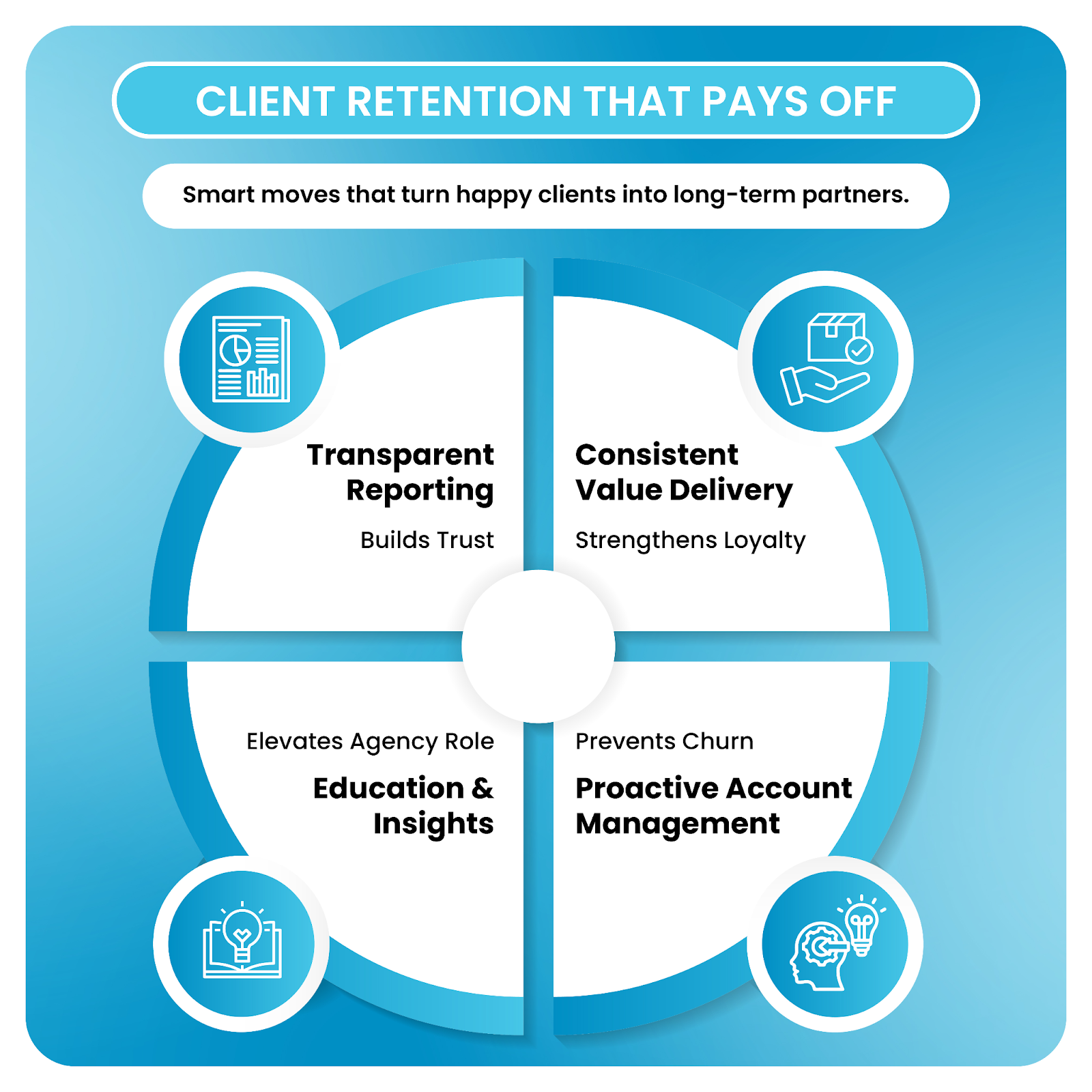
This shift in expectations increases churn risk and directly impacts long-term revenue. A short-term approach affects key LTV drivers such as:
- Client retention rate
- Average account lifespan
- Expansion revenue per client
Without a clear long-term growth plan, even high-performing campaigns can fail to turn into stable, lasting client relationships.
2. Inconsistent Facebook Ad Performance Erodes Client Trust
Facebook ad performance naturally fluctuates. Rising competition, platform changes, and higher CPMs make consistency harder to maintain. In 2024, average Facebook CPMs ranged between $10 and $14 across many industries, putting more pressure on efficiency and optimization. On top of that, frequent algorithm updates can quickly shift what works and what does not.
Creative fatigue is another major factor. When ads run too long without refresh, click-through rates can drop by 20% to 30%. If agencies are slow to respond, these dips become visible in reports. Clients notice rising costs, lower engagement, and reduced returns.
When performance feels unpredictable, trust begins to weaken. Clients ask more questions, request frequent updates, and become cautious about increasing spend. Over time, this uncertainty makes renewals harder and limits opportunities for budget growth.
3. Limited Bandwidth Prevents Strategic Account Growth
Most agency teams are overloaded. Daily optimizations, reporting, troubleshooting tracking issues, and responding to client requests take up a large portion of the workweek. Industry surveys show that media buyers can spend up to 40 percent of their time on routine maintenance instead of strategy.
This leaves very little room for higher-level work, such as:
- Long-term growth planning
- Educating clients on performance trends
- Creating quarterly or annual roadmaps
Account managers often operate in a reactive mode, solving problems instead of guiding growth. Without time for strategy, accounts stay stuck in maintenance mode. This limits how much value agencies can deliver and slows LTV growth over time.
4. Poor Measurement of LTV-Focused Metrics
Another challenge is how performance is measured and reported. Many agencies rely heavily on surface-level KPIs like CPC, CPA, or short-term ROAS. These metrics are easy to track, but they do not show whether campaigns are driving long-term profitability.
Important insights are often missing, including:
- Customer acquisition cost compared to lifetime value
- ROAS influenced by retention and repeat purchases
- Revenue generated after the first conversion
Weak attribution and incomplete funnel tracking make it difficult to connect Facebook ads to long-term outcomes. When clients only see short-term results, the full value of the service is unclear. This lack of visibility reduces confidence and increases the likelihood of churn.
5. Scaling Client Accounts Without Breaking Quality
As agencies grow, maintaining the same level of quality becomes more difficult. With more accounts to manage, creative testing often slows down. Optimization becomes less detailed, and strategies start to look similar across clients.
Instead of tailored growth plans, performance becomes standardized. Over time, this leads to stagnation. Results level off, LTV stops growing, and clients begin exploring other options. Scaling without strong systems and support can quietly damage long-term revenue, even when the agency appears to be growing on the surface.
How White Label Facebook Ads Increase Client LTV?
1. Shifting Facebook Ads from Campaign Delivery to LTV Engineering
White label teams approach Facebook ads with a long-term mindset. Instead of focusing only on launching campaigns and hitting short-term targets, they design strategies around the full customer lifecycle. The goal is not just to acquire users, but to turn those users into repeat buyers and long-term customers.
This approach prioritizes retention, repeat purchases, and sustained revenue growth. Campaigns are structured to guide users from initial awareness through consideration, conversion, and post-purchase engagement. Facebook ads stop being a one-time acquisition tactic and become a continuous growth channel that supports long-term client value.
2. Always-On Optimization Improves Performance Stability
One of the biggest advantages of white label Facebook advertising is consistent, daily optimization. Dedicated specialists monitor performance closely, test new creatives, refresh audiences, and adjust budgets based on real-time data and trends.
This ongoing attention reduces sudden performance drops and limits volatility. More stable results build client confidence and reduce pressure during short-term fluctuations. Over time, this consistency supports stronger LTV-focused metrics, including:
- Blended ROAS measured over longer periods
- Cost per retained customer
- Revenue per acquired customer
When performance feels reliable, clients are more likely to renew contracts and increase budgets.
3. Full-Funnel and Retention-Focused Campaign Structures
White label Facebook advertising allows agencies to run more advanced campaign structures without overwhelming internal teams. Instead of relying on a single campaign type, accounts are supported by a full-funnel strategy that includes:
- Prospecting campaigns to reach new audiences
- Retargeting campaigns to re-engage warm traffic
- Reactivation campaigns for past customers
Using custom audiences and lookalikes built from high-LTV customers helps attract users who are more likely to convert repeatedly. Post-purchase campaigns reinforce loyalty and encourage repeat behavior, which directly increases lifetime value.
4. Advanced Tracking Enables True LTV Measurement
Improving LTV requires accurate data. White label Facebook ads teams often support advanced tracking setups such as Conversion API and server-side tracking. These systems help capture more complete and reliable conversion data.
With better attribution, agencies can clearly see how Facebook ads contribute to long-term revenue, not just first-touch conversions. This visibility makes it easier to measure LTV-to-CAC ratios and overall profitability. When clients understand the full impact of their ad spend, the perceived value of the service increases.
5. Creative Systems Designed for Longevity
Creative fatigue is one of the most common reasons performance declines over time. White label teams address this by using structured creative systems designed for long-term use rather than constant trial and error.
These systems often include:
- Angle-based testing to explore different messaging approaches
- Offer sequencing to guide users through the buying journey
- Creative refresh calendars to prevent burnout
By planning creative updates in advance, campaigns maintain more stable CTRs and lower CPAs. This consistency supports steady account growth and higher lifetime value.
6. More Time for Agencies to Strengthen Client Relationships
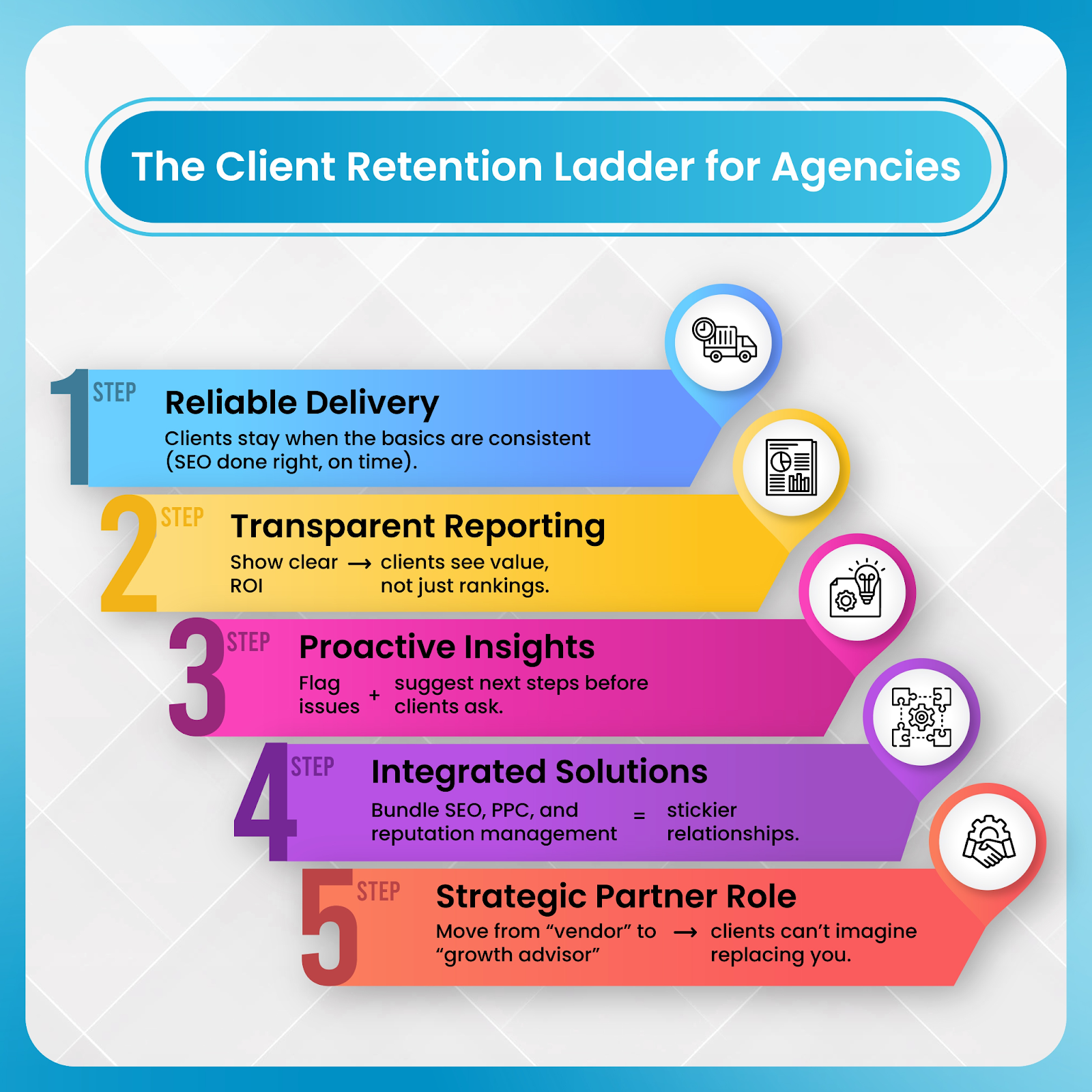
When execution is handled by white label experts, agencies regain valuable time. This time can be redirected toward strategic work such as performance reviews, client education, and future planning.
Stronger relationships lead to clearer communication and better alignment on goals. Studies consistently show that clients who feel supported and informed stay longer and spend more over time. Relationship-building becomes a direct contributor to higher LTV.
7. Predictable Delivery Enables Account Expansion
Consistency creates momentum. When results are predictable, clients feel more confident increasing budgets, testing new funnels, or expanding into additional channels. Predictable delivery turns performance discussions into growth conversations.
White label Facebook ads help agencies transform client accounts into long-term revenue assets rather than short-term projects. This predictability plays a major role in improving LTV across an agency’s entire client base.
How DashClicks’ White Label Facebook Ads Help Agencies Increase Client LTV?
DashClicks offers white label Facebook ad management designed specifically for agencies that want to grow client lifetime value without losing control of their brand or client relationships. The focus goes beyond launching campaigns and chasing short-term metrics. Instead, the service is built around long-term performance, consistency, and scalable growth.
Each agency is supported by dedicated Facebook ad specialists who manage day-to-day optimization, creative testing, and audience strategy. This hands-on approach ensures every account receives consistent attention, even as agencies scale. Ongoing optimization helps reduce performance swings, which builds confidence with end clients and strengthens trust over time. Campaigns are structured to support the full funnel, from customer acquisition to retention and repeat purchases.
DashClicks also places strong emphasis on accurate measurement and visibility. With support for Conversion API integration and improved attribution, agencies gain clearer insight into how Facebook ads contribute to long-term revenue. Instead of relying only on short-term ROAS, agencies can track deeper performance metrics that reflect true lifetime value. This makes it easier to explain results, justify spend, and align campaigns with long-term business goals.
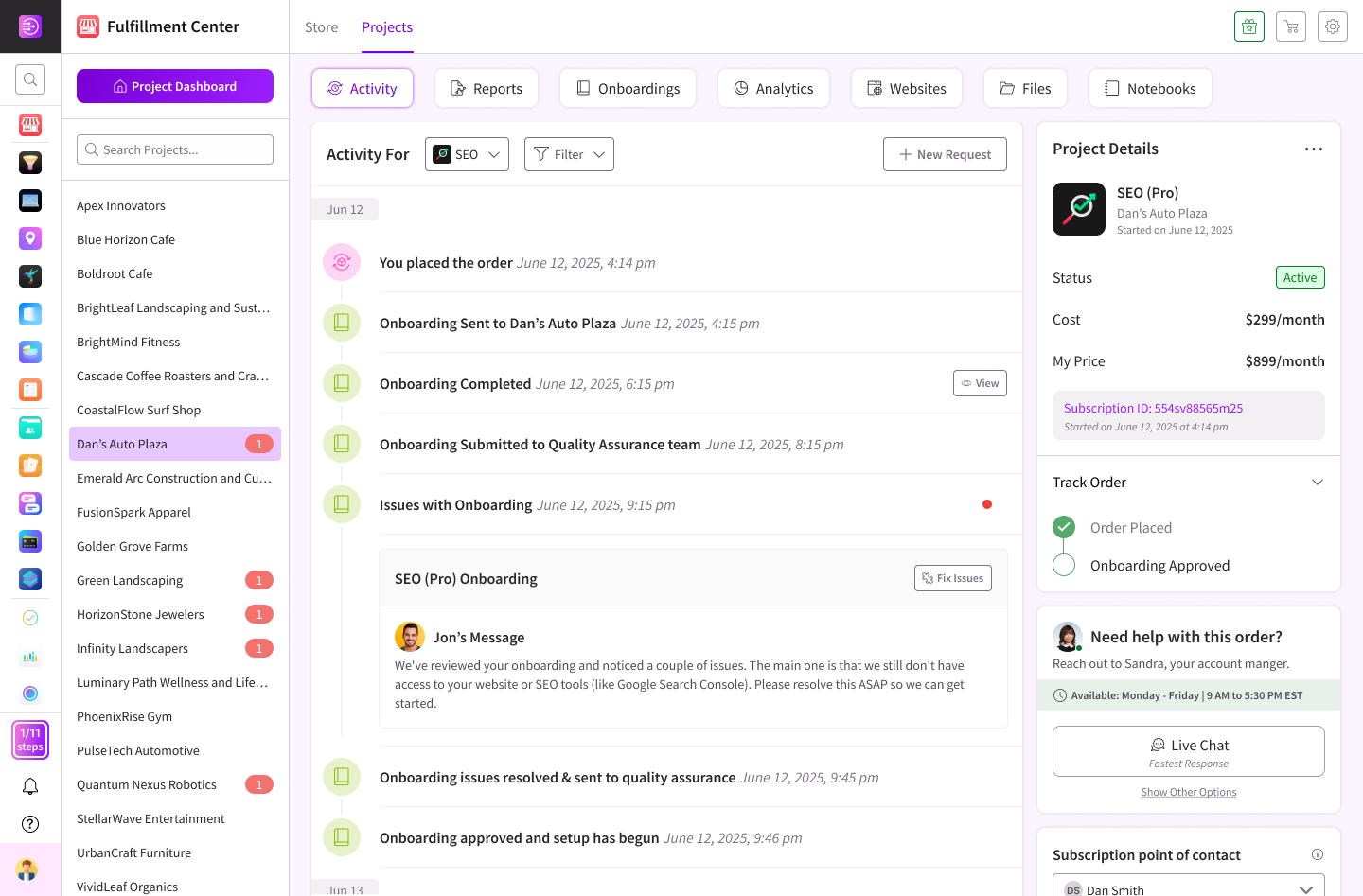
Rebrandable reporting further reinforces agency credibility. Agencies can present clear, professional insights under their own brand, helping clients understand performance without confusion or gaps in data. This transparency strengthens relationships and positions the agency as a strategic partner rather than just a service provider.
By handling execution, optimization, and technical complexity, DashClicks gives agencies the freedom to focus on what matters most. More time can be spent on strategy, growth planning, and relationship building. This balance between performance delivery and partnership is a key reason DashClicks’ Facebook ads services help agencies increase client LTV over the long term.
Closing Thoughts on LTV and the Future of Agency Growth
Agencies that focus on lifetime value consistently build stronger, more profitable businesses than those chasing short-term ROAS. Client LTV reflects more than campaign performance. It represents trust, consistency, and alignment between agency strategy and client goals. This value is built over time through systems that support retention, repeat growth, and measurable long-term results.
White label Facebook ads are not about losing control of accounts or relationships. They are about gaining leverage. With expert execution handled in the background, agencies can maintain performance quality while dedicating more time to strategy, communication, and growth planning.
As competition continues to rise and margins become tighter, success in 2025 will depend on long-term thinking. Agencies that treat Facebook ads as a sustainable growth engine and prioritize client relationships as their most valuable asset will be best positioned to grow, retain clients, and increase lifetime value across their portfolio.


.svg)


.svg)
.svg)
.svg)
.svg)
.svg)